My Regular Pagan holiday post: Mysteries of Santaland

Even as a little kid, I was skeptical. The story is preposterous: a jolly rotund man in a red suit operates a workshop at the North Pole where elves make toys for children. On Christmas Eve, he loads them into a sleigh pulled by flying reindeer and delivers gifts to every child in the world by descending through their chimneys.
Did adults really expect us to believe that! How could that fat guy even get down a chimney? And what if you don’t have a chimney? And visiting every child in the world on one night! Give me a break. And how can wingless reindeer fly anyway? Wouldn’t it make more sense to harness a herd of Pegasuses,* or even a flock of owls? My parents were unable to satisfactorily answer these questions.
But it all starts to make sense when you look at the traditions of Arctic indigenous peoples. Turns out, Santa’s origins might involve a bit more…tripping.

Santa is a modern counterpart of a shaman, who consumed mind-altering fungi by drinking the urine of reindeer.
A Ten Thousand Year High

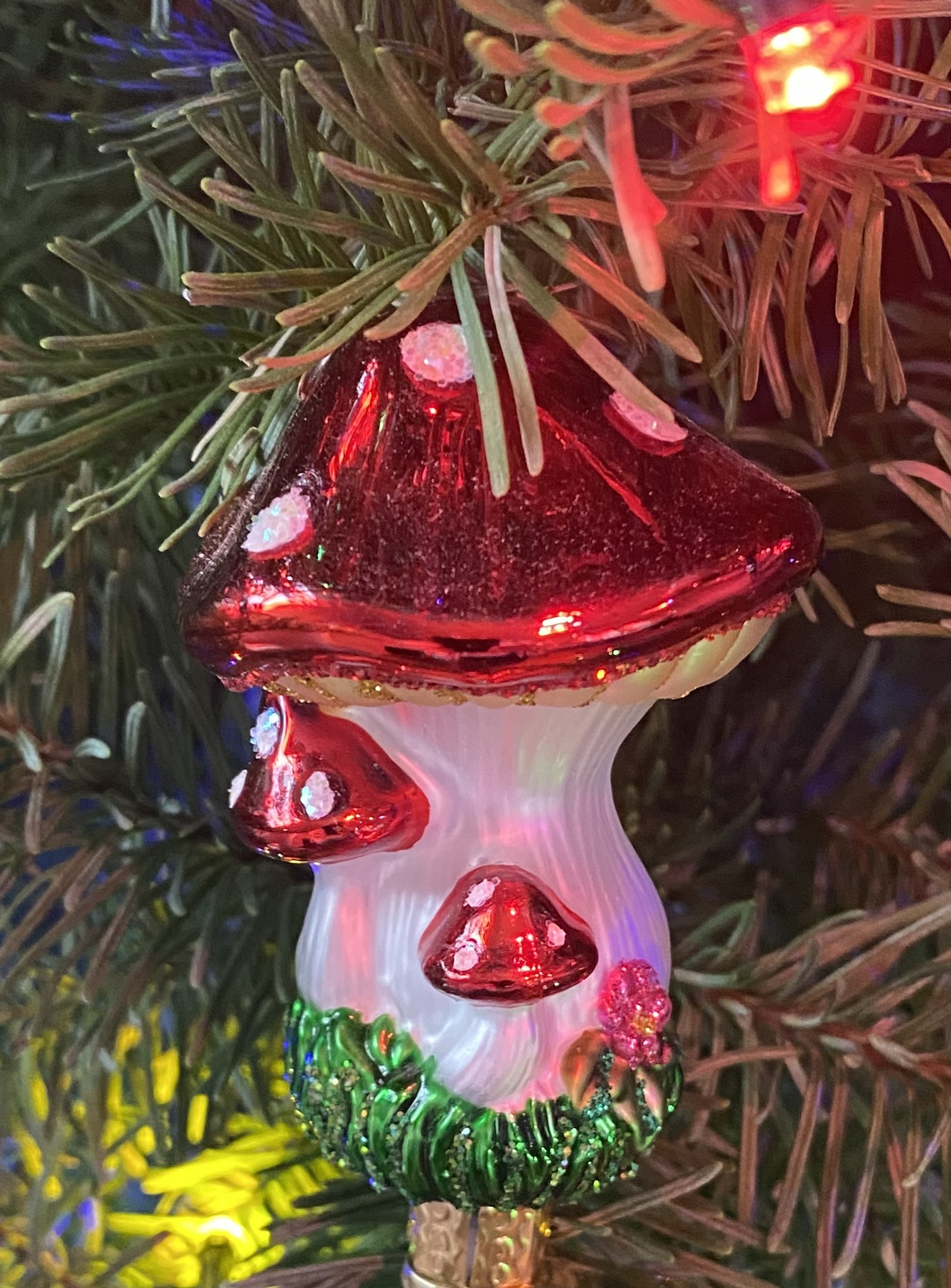
Santa’s story bears striking similarities to the winter solstice practices of Arctic shamans—specifically those of the reindeer herding Koryaks of Siberia and the Sámi of Sápmi (formerly called Lapland) who used hallucinogenic mushrooms in their winter solstice ceremonies. These shamans consumed the mind-altering Amanita muscaria mushroom—the iconic red-and-white fungus often depicted in Christmas decorations—to commune with the spirit world.
Shamanic rituals involving A. muscaria date back over 10,000 years. During Siberian midwinter ceremonies of Annual Renewal, shamans, dressed in red-and-white fur-trimmed coats and tall black boots, gathered the mushrooms from beneath sacred pine trees. These mushrooms are the fruiting bodies of fungi whose mycelial networks interlace with tree roots underground. The association of red mushrooms with green pine trees might explain the colors of Christmas.
Gifts of Vision and Insight
In winter, heavy snow often blocked the doorways of Arctic yurts, forcing shamans to enter through the roof. They slid down the central birch pole, carrying a bag of dried A. muscaria—a probable origin of Santa’s descent through chimneys with a sack of gifts.

Amanita muscaria, found growing under pine trees in Northern California. Photos by author.
After consuming the mushrooms or drinking the urine of reindeer that had eaten them, shamans would enter altered states of consciousness. Amongst the Siberian shamans, the reindeer was an animal spirit to journey with in their vision quests. The gifts shamans brought to their communities included the visions and insights from their psychedelic experiences, as well as portions of the mushrooms themselves.
Flying Reindeer Explained
Reindeer play a crucial role in this story. These animals can eat A. muscaria without suffering its toxic effects, metabolizing the mushroom’s compounds in a way that makes their urine safe—and still hallucinogenic—for humans to consume. Drinking reindeer urine allowed people to experience the mushroom’s psychoactive effects while avoiding its more unpleasant toxins.
The hallucinations induced by A. muscaria often include sensations of flying, contributing to the myth of Santa’s airborne sleigh and reindeer. After ingesting the mushrooms, the shamans were said to experience heightened senses, bursts of energy, the desire to sing, feelings of joy, and increased muscle tone, so any physical effort was easier to perform.
Stockings Hung by the Fire

Indigenous peoples dried their mushrooms on tree branches or by hanging them in socks near fires, practices reminiscent of today’s Christmas stockings. As with many pagan traditions, Christians appropriated these shamanic elements, attributing them to Saint Nicholas, a 4th-century Turkish bishop known for his generosity to children and the needy.
Incidentally, the plural of shaman is shamans, not shamen. There were female shamans among the indigenous peoples, just as there are in many cultures today.

Koryak shaman woman, photo from Jesup North Pacific Expedition 1900. (PD-US)
The Arctic shamans might have been jolly, but probably were not fat. That image was exploited in ad campaigns by Coca cola, starting in 1930 (although folks are mad that the company’s latest AI video ad focuses on trucks instead of Santa).
Mushrooms and Me

My own relationship with mushrooms is one of wonder and deliciousness. Wonder-ful because mushrooms are witchy and mysterious. Scientists estimate that as many as 95% of fungal species on Earth are still unknown! Many mushrooms are associated with particular species of trees, so in learning about ‘shrooms, we learn about the forest and its ecosystem too.
Deliciousness because I’ve foraged, eaten and enjoyed many mushrooms. But A. muscaria is not one of them. The poison is not a deadly one like some of the other Amanitas, but it does make you sick. And while I am curious about hallucinations, I’m not so curious about regurgitations.
Still, A. muscaria fascinates me, not just for its beauty but also for its potential. Recent research explores its psychoactive compounds, muscimol and ibotenic acid, for therapeutic uses. These compounds show promise in treating conditions such as stress, anxiety, insomnia, addiction, and even neurodegenerative diseases like Parkinson’s and Alzheimer’s.
Solstice Spirits
As the winter solstice approaches on December 21, I’m reminded of the deep connections between ancient rituals and modern traditions. So, whether you celebrate with a cup of cocoa or an appreciation for fungi, happy solstice to all—and to all a good long night.
*The proper plural of Pegasus is Pegasi but I like Pegasuses better
P.S. A friend told me she needs sources in order to share this. Here’s a video I liked: https://youtu.be/MrLb2-wETAQ?si=VRQ28QsBitb5ndCF

 tradeswomn musings
Cool history lesson! Yeah, mushrooms certainly have wide uses, don’t they? From innocent food to powerful medicines to wild hallucinogens onto death. Had my share of the hallucinogens, too. When I had my children, after having been rescued from insanity by Jesus, I told my kids that Santa was a game some people played at Christmas, but the Real Gift-Giver is Jesus. It does say somewhere that “they” were deceived by drugs and sorcery. Which I certainly was back in the 60’s. And might not have ever come back. But I did. Thankful thankful forever thankful. Was so lost, and no one could find me. But Jesus. I love you, Cousin Molly, and love the stories you tell. Love to Cousin Don. May your holidays be sweet and your new year be hopeful. See you here in 2025!!! XOXOXOX
LikeLiked by 1 person
Molly! This is my very favorite of all of your seasonal posts. I learned so much and it was written so well with such gre
LikeLiked by 1 person
You are such a talented writer and I can hear your voice and your laughter as I read your post! I’m so glad you have your house back for a few weeks. I’m sure this project feels like it might never end.
LikeLiked by 1 person
Great post, wonderful story. Deep respect for ‘shrooms and grateful for lessons learned in altered states. Also fascinating thought uncommented upon: that women with long, straight hair figure out to braid it and those braids look the same from all corners of Europe on to Eurasia. Must’ve been on helluva traveling hairdresser gal 😉
Seasons greetings, may all be good, may the outer darkness help us ignite our inner light!
LikeLiked by 1 person
Good point Bonnie. I hadn’t thought of that. Might have been the hairdresser that brought the Santa story to Europeans too!
LikeLike
Your page always gives me something new to learn online and develop my research, improving my work as a blogger trying to expand. Thanks a lot
LikeLiked by 1 person
Thank you Albert! I remember when research meant card catalogs and library shelves. Thankful for the internet.
LikeLike
Your page always gives me something new to learn online and develop my research, improving my work as a blogger trying to expand. Thanks a lot
LikeLiked by 1 person