Winter’s Coming and We Like It

My Regular Pagan Holiday Post: Autumn Equinox

You can shake your fist at heaven, you can file your appeal

You can try to rise above it, you can crawl and you can kneel

No matter what life gives you, no matter what you steal

You cannot stop the turning of the wheel

Chorus from Jennifer Berezan’s song Turning of the Wheel

Naked ladies (Amaryllis belladonna), a ubiquitous and favorite fall flower

Sitting out in our yard on a lovely evening at the ides of August, Holly and I luxuriated in the garden’s summer radiance. The day was cooling as the sun retreated. Colorful zinneas and cone flowers bloomed and the fragrance of the rockrose bush enveloped us. Hummingbirds zipped back and forth. Finches and oak titmice populated the feeder. Towhees scratched the ground as mourning doves bobbed and cooed. It was a perfect summer evening.

But as we sat in our twin rockers, we both said, almost in unison, “I’m looking forward to the turning of the seasons.”

Summer, with its long, warm days and bountiful harvests, has been beautiful, but we’re ready for the change. Holly says that humans evolved with the rhythm of change, and that’s why we appreciate the wheel of the year turning.

Now, with the autumn equinox upon us, the new season begins. Pagans call this time Mabon, after the Welsh God who is the son of the Earth Mother Goddess.

Recently, I learned about the lunistice, the moment when the moon seems to pause, similar to the way the sun appears to stop at solstices before shifting direction. It’s a fascinating event, though hard to observe unless you track the moon regularly.

The major lunar standstill is marked by observing the extreme points where the moon rises and sets on the horizon, akin to watching the sun at solstices. Just as the sun’s position reaches its furthest northern and southern points at solstice, the moon does something similar every 18.6 years during a maximum lunistice—an event that occurs near equinoxes and eclipses, and it’s happening now!

This 18.6-year cycle is due to the moon’s orbital tilt and the gravitational pull of the sun, causing the moon’s orbit to swivel and vary its angle relative to Earth.

Excited, I reached out to the folks at Ferguson Observatory at Sugarloaf State Park to learn more. I was intrigued by the idea of “maximum lunistice,” thinking it sounded particularly special. But I learned something surprising: the minimum lunistices are actually more significant, especially in relation to tides. 

The Observatory explained that during maximum lunistices, the moon is furthest from the celestial equator, resulting in less dramatic tides. However, minimum lunistices bring larger tides because the moon is closer to the equator’s gravitational bulge. But since “maximum” sounds more impressive, it tends to get more attention. The next minimum lunistice won’t be until 2034.

At an Old Lesbians retreat in the Mayacamas mountains as a group of us stargazed, I attempted to explain this lunar phenomenon but stumbled over the details. Honestly, I don’t fully grasp it myself. Yet, here’s what’s clear: ancient peoples understood this cycle.

Bronze Age societies, like those who constructed the megalithic monuments in Britain and Ireland, placed great significance on lunar standstills. Modern Neopagan religions find meaning in them too. Ancient cultures beyond the British Isles also recognized these events—sites like Chaco Canyon in New Mexico, Chimney Rock in Colorado, and the Hopewell sites in Ohio all feature alignments to the moon during lunar standstills.

As I write this, the full supermoon is rising with a partial lunar eclipse. The turning of the celestial wheel continues to fascinate us, just as it did our ancestors.

I’d like to call back summertime and have her stay for just another month or so

But she’s got the urge for going so I guess she’ll have to go.

From Joni Mitchell’s song Urge for Going

One of my favorite Joni Mitchell songs, Urge for Going, laments “summertime falling down.” Joni was thinking about snow and cold and pulling the blankets up to her chin. She sang, “All that stays is dying and all that lives is getting out.” But she was singing about winter coming in Canada. In California when I think about winter coming I think rain, which makes plants start to grow in the outdoors. It brings mushrooms, grass, new leaves and flowers. The cold coastal summer fog falls away and dust is dampend. 

David Douglas, the Scottish botanist who traveled in North America in the 1830s (after whom the Douglas fir and other plants were named) remarked on how dead the Sonoma area was in summer. He collected plants in the winter and spring when they were growing and flowering.

These are some of the reasons we here in summer-dry California exclaim with anticipation “Winter’s coming!”

The autumn equinox takes place Sunday September 22. Wishing you all a fabulous fall season.
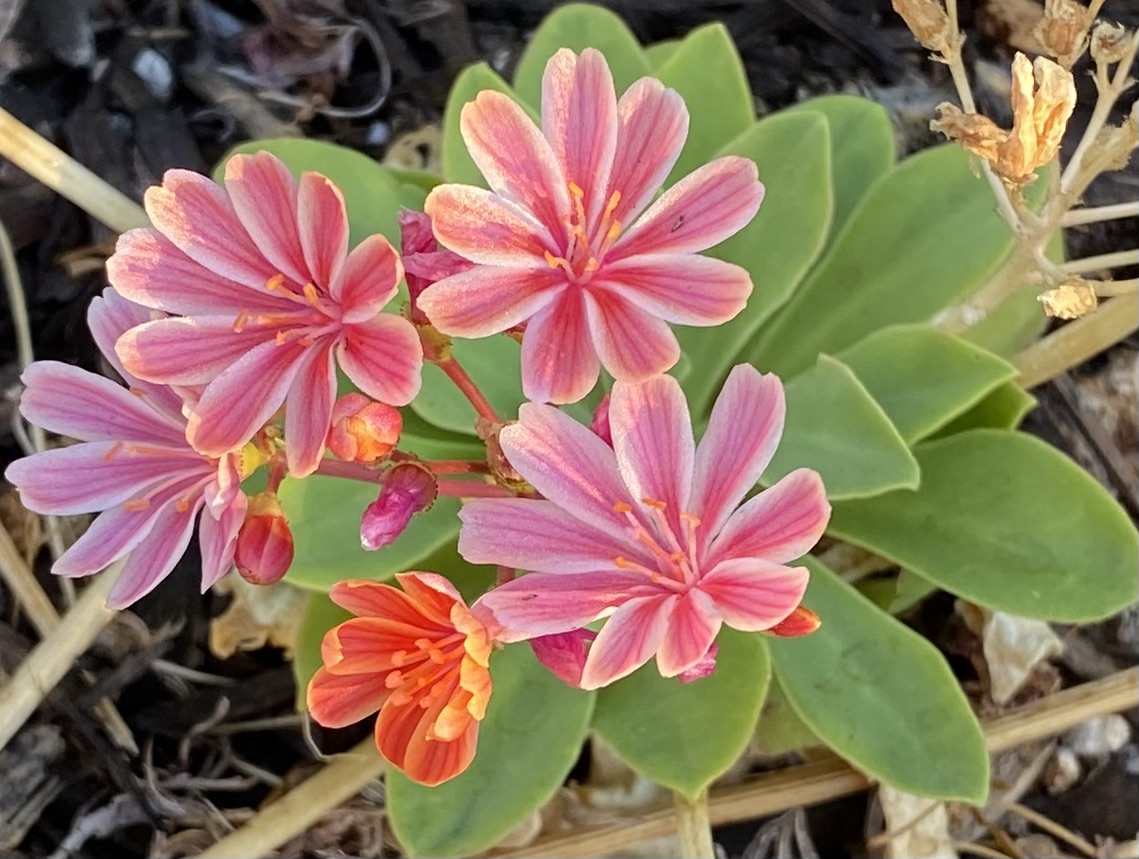
Lewisia, a native in our garden, named for Meriwether Lewis who encountered the species in 1806
Equinox and the Middle Way

My Regular Pagan Holiday post

Dear Friends,

I’m writing this during a gentle rainstorm that has elicited delight among denizens here in Santa Rosa. Our weather station says it has brought a little less than an inch of rain. We are humbled when we think of raging floods elsewhere in the world but of course what we worry about at this time of the year is fire. Word is that the rain has dampened our biggest California fire, the Mosquito Fire, which has burned 75,000 acres in the Sierra foothills and is now 35 percent contained. This rain may not put an end to fire season, but we hope, as the fall equinox approaches, it marks the beginning of the end. This year the autumn equinox takes place on September 22, when the sun crosses the equator making night and day of equal length in all parts of the earth. 

In Japan the equinox symbolizes the middle way between the seasons. This week will mark the start of Higan, a seven-day Buddhist celebration and national holiday in Japan during the fall and spring equinoxes. The origin of the holiday dates from Emperor Shomu in the 8th century. Higan means the “other shore” and refers to the spirits of the dead reaching Nirvana. It is a time to remember the dead by visiting, cleaning, and decorating their graves. The red spider lily signals shūbun, the arrival of fall. 

Buddhist psychology is neither a path of denial nor of affirmation. It shows us the paradox of the universe, within and beyond the opposites. It teaches us to be in the world but not of the world. This realization is called the middle way.

If we seek happiness purely through indulgence, we are not free. If we fight against ourselves and reject the world, we are not free. It is the middle path that brings freedom. This is a universal truth discovered by all those who awaken.

The middle way describes the middle ground between attachment and aversion, between being and non-being, between form and emptiness, between free will and determinism. The more we delve into the middle way the more deeply we come to rest between the play of opposites.

When we discover the middle path, we neither remove ourselves from the world nor get lost in it. We can be with all our experience in its complexity, with our own exact thoughts and feelings and drama. We learn to embrace tension, paradox, change. Instead of seeking resolution, waiting for the chord at the end of a song, we let ourselves open and relax in the middle. In the middle we discover that the world is workable. From the book The Wise Heart by Jack Kornfield

Here in Sonoma County at fall equinox we celebrate the end of those super hot days of summer. There was a day in August when we set a heat record of 115 degrees here. 

We may still get some 90 degree days, but the withering heat is behind us and the cold of winter is yet to come. No more flex alerts! We look forward to enjoying the outdoors in this mild season.

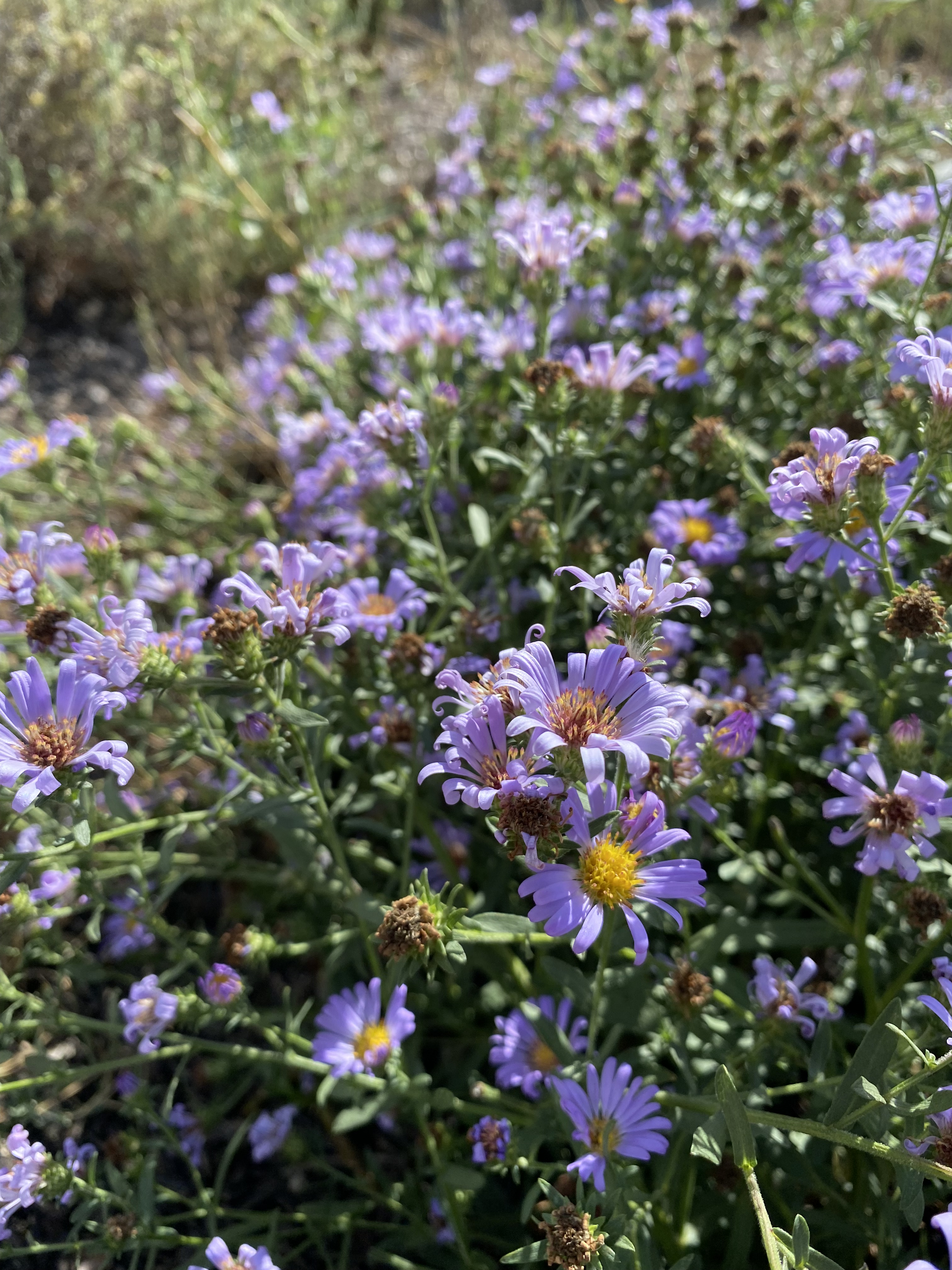
Native aster

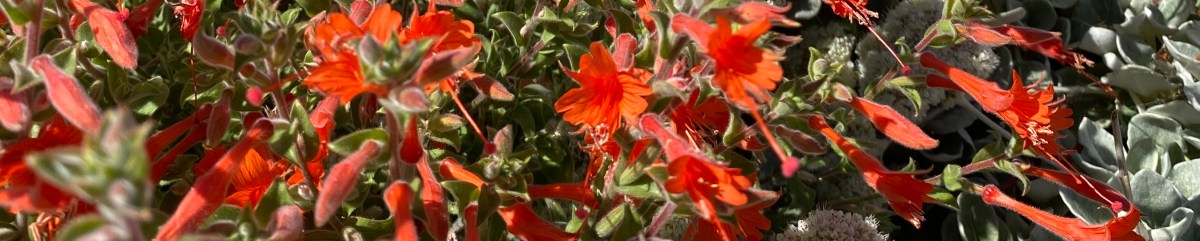
Like all Californians we are conserving water during an ongoing drought. Our vegetable garden is not as robust and productive as in wetter years, but native plants thrive. Favorites include native Epilobium in bright reds and pinks, eriogonum (wild buckwheat), and a purple native aster given to us by a neighbor, still blooming happily without water! Birds of all feathers converge on our garden to eat the seeds of spent wildflower blooms.

Wishing you a tranquil equinox.

Love, Molly (and Holly)

Celebrating the Autumn Equinox

September 23, 2019

One thing I love about living in Santa Rosa is seasons! Our garden still flourishes and flowers bloom, but one day in August, we could suddenly see that the height of summer was over and summertime had begun falling down. And now it’s the autumn equinox. Called Mabon by the Wiccans, the fall equinox marked the second harvest festival to the Celts. Day and night are of equal length and now dark will lengthen till the winter solstice when the light will start to gain again.

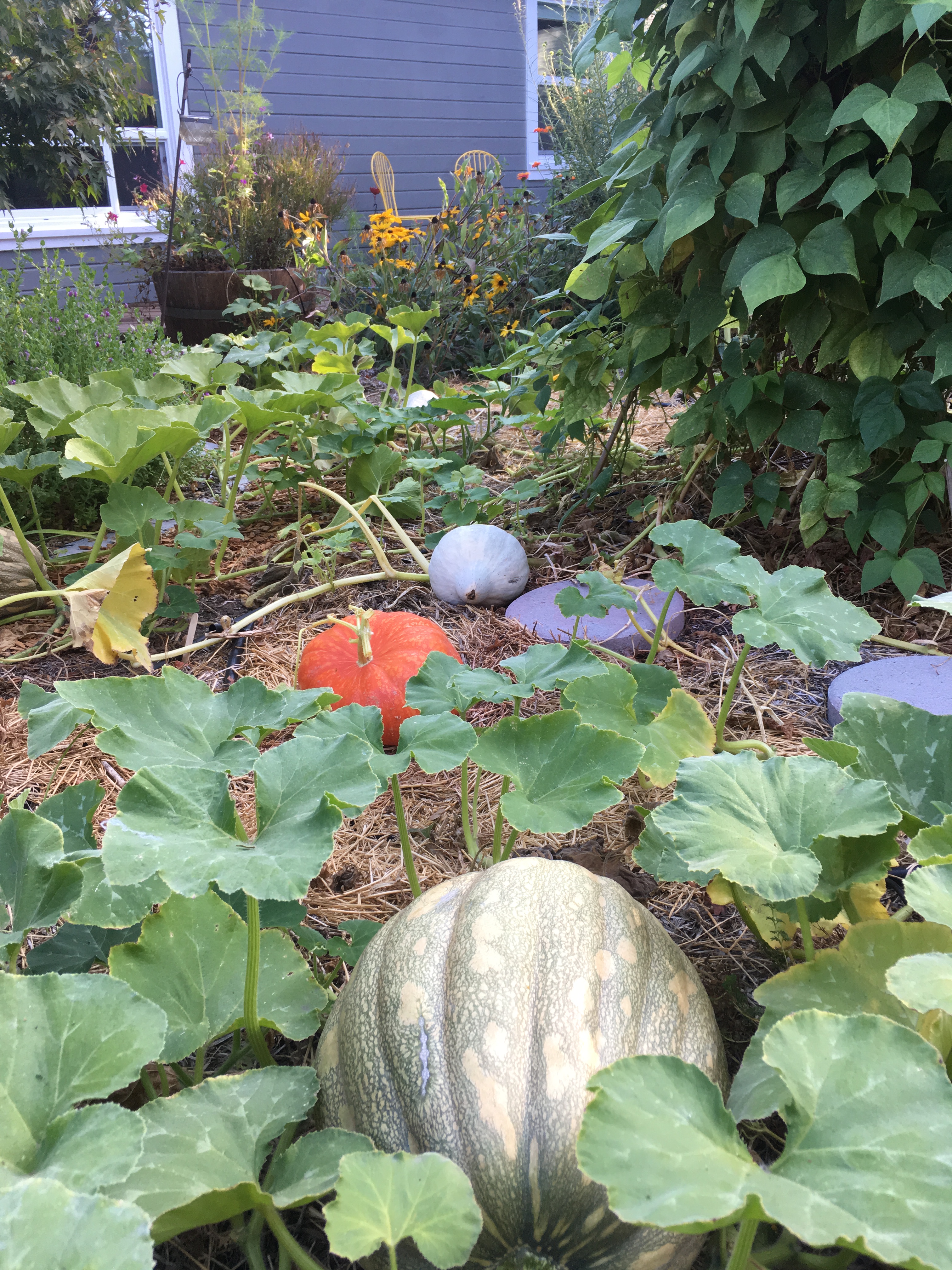
The big squash in the foreground came from last year’s Heirloom Expo

I don’t know exactly what the Celts harvested at the second harvest but here in Sonoma County September is the month of grapes and figs, and of course cannabis. Last year at the Heirloom Expo we drooled over a slew of fig tree species. I had grown figs in San Francisco but the one time a lovely Mission fig finally ripened a raccoon got to it before I could harvest, and broke the whole branch off in the process. That was it for me. That winter I dug out the entire plant. San Francisco’s foggy cool summers just don’t go with figs, although I did see some happy trees there, just not in my backyard. But figs love it here! So this spring we planted one. It’s called a Celestial, a small, rosy sweet fig, and we ate the first one in August. Also our neighbors T and JJ have a mature fig tree and I’ve been making myself sick on them. There’s nothing like a ripe fig perhaps eaten with a slice of local sheep’s milk cheese.

This is not an indictment of San Francisco weather (except when you’re freezing your ass off in the cold wind and fog waiting in line at the gay film festival in June!). I gardened in the same Bernal Heights yard for 38 years. There are some plants that thrive there. Nasturtiums! One year they took over the whole yard. I bought local gardener Pam Peirce’s books, learned about micro climates and the secret season that we didn’t have in my hometown of Yakima, Washington. I became friends with Pam and visited her abundant Excelsior back yard garden. But early on I gave up tomatoes and embraced flowers. Bernal Heights is just up the hill from the Alemany Farmers’ Market where every Saturday I could find seasonal organic produce. Why kill myself fighting shade and fog to grow some tortured veggies?

Zinnias! Love Santa Rosa, hate San Francisco

But tomatoes love the hot summers here. We are still harvesting tomatoes but it wasn’t like last year when we had to give bagsful away to neighbors. One plant suddenly died and gardener friends suggested gophers were eating the roots. Yikes! We had been happily gopher free. But I figured out the problem. I had watered the plant with a hose that had been sitting out in the hundred degree heat. I boiled the roots to death!

I didn’t make it to the climate march September 20. But I did eschew the car and take public transportation to Tradeswomen Inc.’s 40th anniversary celebration in Oakland where I got to commune with 400 tradeswomen. Then on Saturday night I took the Lamplight Tour of Santa Rosa’s historic rural cemetery. It’s a phenomenal production requiring the work of 120 volunteers who wrote, performed and organized eight vignettes about local history. We learned about the influence of the KKK in Sonoma County in the 1920s, the Women’s Christian Temperance Union, Jack London’s story about a local miner and more. Something tells me I’ll get sucked into working with this group of citizens interested in local history.

Naked ladies bloom at the Rural Cemetery

And next week I’ll travel to Minneapolis for the Women Build Nations national tradeswomen conference where history will also be a focus of discussion. A lot of us old timers realize we need to be recording it now before dementia sets in. Along with Brigid O’Farrell I’ll be leading the writers workshop. Methinks a book is in the offing.

Wishing all an auspicious autumn season.