Lammas and Kamala

My regular pagan holiday post: Celebrating the Harvest

August 1, a day that marks the halfway point between the summer solstice and the autumn equinox, is celebrated as the first harvest festival in many parts of the northern hemisphere. The Celts called it Lughnasa or Lammas. Besides Lammas, pagans celebrate two later harvest festivals, Mabon at the fall equinox, and Samhain on November 1.

In Sonoma County we can harvest food year-round, so I guess you could say every pagan holiday is a harvest fest here. By the time August rolls around, we’ve already been celebrating for months. The first bite of every ripe fruit calls for celebration.  

Still blooming in our garden: epilobium, native buckwheat, aster. Hydrangea in shade

Growing up in Yakima, Washington, on the eastern side of the Cascade Mountains, I always knew when the fruit was ripe. Cherries were picked on July 4th, and I would gorge until I was sick. Grandma had an old-fashioned peach tree with fuzzy skin that had to be peeled, and those peaches didn’t ripen until late August. Pears came later, and apples weren’t ready until the end of September.

Here in Sonoma County, our Gravenstein apples ripen at the beginning of August! We celebrate the harvest at the Gravenstein Apple Fair. It’s taken me years to adjust to California’s seasons. There’s no real winter here—just fall and then, magically, spring! Winter is the rainy season, and summer is dry. As Pam Peirce says in her book, Golden Gate Gardening, there’s a secret season here. Many seeds can and should be planted in the fall, but I have to remind myself every year.

Last October, I planted sugar snap and snow peas, and by February I was eating them right off the vine. When I’d eaten them all, I planted sweet peas just to enjoy their beauty and fragrance. Beans came next. Our beans didn’t fare so well this year, thanks to moles. They don’t eat veggies, just meat (like worms, that is—think “moles = meat, voles = veggies”), but they tunnel near the roots and leave air gaps that kill the plants. I even saw the soil moving where I had just planted seeds. Needless to say, those beans never stood a chance.

Sunflower, zinnias doing well in the heat

Sometimes, I think gardening is like throwing dice. You never know what the next season will bring, but that’s what makes it interesting. The garden has a mind of its own.

After a couple of disappointing years where our tomato plants succumbed to wilt, this year is shaping up to be a winner. As soon as the first tomatoes are ripe, we celebrate with BLTs. This year, we enjoyed our first BLTs in the first week of July, slicing the Early Girls (my favorite variety).

There’s always something ripe and ready in our garden. We harvested navel oranges from our tree until June, then our neighbor gifted us a bag of Valencias, keeping us swimming in orange juice until mid-July! By August, the purple Santa Rosa plums are history, but the yellow plums from the tree we planted last year are still ripening. 

I’m a gleaner, and throughout the fall harvest season you’ll find me harvesting my own and neighbors’ pomegranates, figs and persimmons. 

Then there are grapes and wine, the primary crop here in adjoining Sonoma and Napa counties. La Paulée, a traditional Burgundian harvest celebration takes place in the Russian River Valley on August 2-3, when winemakers, chefs and enthusiasts of both will gather to celebrate wine and food. A centuries-old celebration once reserved for French vigneron and their harvest crews, La Paulée is a French variation of the Celtic pagan Lammas holiday, marking the end of the grape harvest.

Like all gardeners we have our favorite plants. We love a dry bean called Eye of the Goat, which I got from the West County Community Seed Exchange in Sebastopol. This all-volunteer group has created a seed garden and a community seed library supporting local gardeners with free, locally grown, open-pollinated, pesticide- and GMO-free seeds. Local seed saving means we can cultivate plants that thrive in our region, with each generation adapting more to the local environment. And as the seed industry consolidates, we can preserve heirloom seeds.

The seed exchange sponsors workdays in their garden and classes, but the most fun event is the annual seed swap in early spring at the Sebastopol grange hall.

Another early spring highlight is the annual scion exchange in February, sponsored by the California Rare Fruit Growers. They share free scion wood from all sorts of fruit trees and vines. Local farmers stand by to help you choose the best varieties for your location. I discovered the scion exchange years ago and got hooked on grafting. 

Global warming is rapidly changing our world here in NorCal. This year June and July were hotter than ever, and August and September are predicted to break more records. On July 22 (and 23), 2024, the hottest day on earth in recorded history, it was 99 degrees here. 

Cone flower (echinacea) petals burned, but native yarrow does well

We and our plants struggle with a warming climate. We’ve already had three heat waves this season and the hottest part of the summer is yet to arrive. Leaves are scorched and beans refuse to flower. Not many plants like 100-degree temperatures; even tomatoes protest.

And fire season started early with smoke blowing down from fires north of us. We may experience poor air quality till the rains start in November. The fire app, Watch Duty (download it if you haven’t already) shows scores of fires in California. The biggest is the Park Fire near Chico at 350,000 acres and growing. Oregon is burning. Practically the whole state of Idaho and much of Montana is under a red flag warning.

Climate change also brings new bugs to our northern climes. There’s a new mosquito in town and she takes no prisoners. She joins about a dozen varieties of mosquitos here. In past years they’ve died off with the advent of winter, but this year, due to a warm, rainy winter, they never left. Holly isn’t much affected by mosquitos, but if I’m in the yard, especially at dawn and dusk, they find me. I’ve had to give up hot tubbing because no matter how quickly I throw a robe on, they attack. They bite in my most vulnerable places! When I’m dressed, they go for my chin and ears. They are stealthy! I don’t hear them, and I rarely see them. I’m terribly allergic to their bites, which result in gigantic welts that itch for weeks. I scratch, and then they weep copious amounts of lymph fluid. So, though I hike every day, mosquitoes have kept me more indoors–not a bad thing when the temperature soars.

There is one more development we’re celebrating this harvest season. As we queers, feminists, pagans, progressives and people of color work to overcome the rise of the christian right, our election fears have lessened with the candidacy of Kamala Harris. Memes abound. I like MALA (Make America Laugh Again).

Now we must work to get her and down ballot Democrats elected! Election day this year is Tuesday November 5. That’s 95 days and counting.

We can Do it!

Here’s to a productive election season, and good Lammas to all.

The top photo is the view of sunset on a hot day over the Coast Range that we see from our street. The high point is called Black Mountain.
Looking for Santa Rosa’s Oldest Rose

We once found it in an ally in the JC neighborhood

Santa Rosa, famed for its roses and annual rose parade, is also known as the home of Luther Burbank, the legendary plant wizard. Why did Burbank choose Sonoma County? Simple—because plants here live their best lives. He famously said, “I firmly believe…that this is the chosen spot of all this earth, as far as nature is concerned.”

Before Holly and I tied the knot and set up camp in Santa Rosa, I lived in San Francisco. Every week I’d take the Golden Gate Transit bus to visit Holly. We had this delightful hobby of cycling through various neighborhoods, ogling the stunning gardens and secretly judging people’s landscaping choices.

On one particularly memorable ride—it must have been April or May in 2010—we spotted a man toiling away in his garden. Naturally, we screeched to a halt, intrigued by his green-thumb magic. As we marveled at his work, the man asked us a curious question, “Have you heard about the oldest rose in Santa Rosa?”

With a sense of mystery, he directed us to an alley between Nason and Spencer in the JC neighborhood. Our mission was clear. We pedaled like detectives on a hot lead until we found the rose. It was a gigantic bush, but, believe it or not, I can’t recall its color. This was pre-cell-phone-camera days, so no pics for proof. Did I smell it? I don’t remember, but I must have, considering I make it a habit to stop and smell the roses around town.

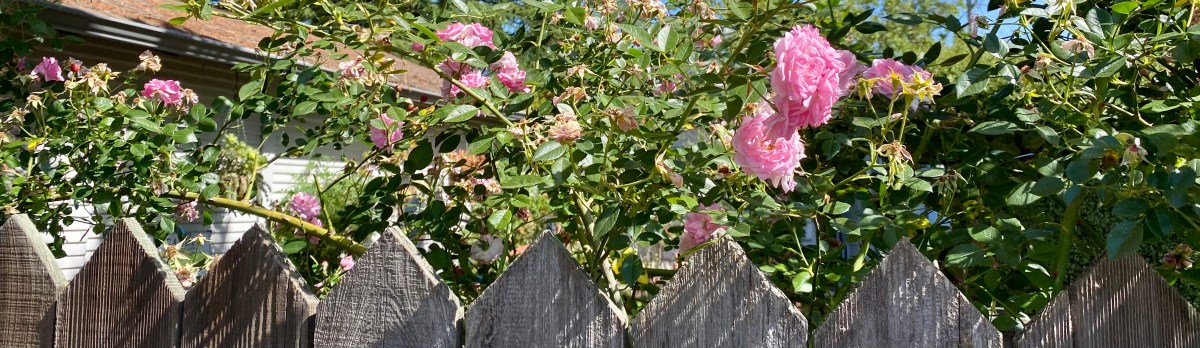
The color? Your guess is as good as mine. I later fantasized it was yellow, like a rose from a century-old house my family moved into back in 1959 in Yakima, Washington. But after diving into rose lore, I’m pretty sure it was pink, which is the go-to hue for ancient roses.

Fast forward to my discovery that roses, despite their ageless beauty, don’t live for a century. The Methuselahs among them might clock in at 35 to 50 years, while the newer hybrids are lucky to hit double digits.

Roses have a traceable origin. They likely sprouted in Central Asia and migrated to northern Europe over centuries. Rose cultivation kicked off in Central Asia around 5000 years ago. Today’s garden-variety roses are the glam descendants of plants from the Oligocene epoch (33 million to 23 million years ago), with fossils found across Europe, Asia, and western North America.

Recently, I went back to search for the oldest rose. I asked a friend who grew up in the JC neighborhood if she had heard of it. She had, but she didn’t remember seeing it—the stuff of urban legend.

The alley between Nason and Spencer stretches from King St. to Mendocino, morphing into Ridgway. I paced up and down that alley more times than I care to admit, but alas, I didn’t find it. Now I know, roses don’t do immortality.

Maybe someone took a cutting and gave it a fresh start. Perhaps the rose’s spirit lives on in the rural cemetery or the JC rose garden, which boasts some elderly blooms.

Rose or no rose, the alley had its charms. I met some interesting folks and stumbled upon quirky artwork on weathered walls. And so, the hunt for the oldest rose may be thorny, but it’s always blooming with stories.

Hope for a New Day

My Regular Pagan Holiday Post

Dear Friends, 

Happy Ostara, the celebration of the vernal equinox, which takes place this year today, March 20. Searching for spring festivals and hoping for inspiration, I found one from Iran.

“In Iran, the festival of NowRuz begins shortly before the vernal equinox. The phrase “NowRuz” actually means “new day,” and this is a time of hope and rebirth.

Boy, am I feeling the need for hope and rebirth right now.

“The Iranian new year begins on the day of the equinox, and typically people celebrate by getting outside for a picnic or other activity with their loved ones. No Ruz is deeply rooted in the beliefs of Zoroastrianism, which was the predominant religion in ancient Persia before Islam came along.”

Getting outside—yes! The vernal equinox must be celebrated outdoors.

Another inspiration comes from my neighbors, many of whom are my age, in their 70s. In Santa Rosa people take their gardens and landscaping seriously. When I walk down the street and see Dan and Karen tending their gardens or Howie down on the ground pulling weeds, or Pam planting natives in her front yard, or Susan wielding digging tools I think yeah I can do that too!

Gardening and planting plants—what a great way to celebrate spring!

I’ve always seen myself as a big strong woman and I’ve spent my adult life telling other women working in the construction trades “We Can Do It!” Admitting that I can’t do something is still hard for me, even though I’ve been practicing it for a decade now. At 72 I discover new limits to my ability constantly.

So, after Holly and I acknowledged to each other that there are some garden chores we just can’t do anymore, we hired a laborer to dig out crab grass, matilija poppy roots and a couple of stumps.

There is also this: I don’t want to do it. I might have felt like I had to in the past, or I was required to show that I could meet some physical challenge. Now I no longer have to make a point.

Or that’s what I thought before Maximo, the laborer, weighed in on my ability. He was digging out the poppy roots with an adz. I said to him, “that’s such hard work.” I knew this because I had dug out the roots a couple years before and found the job taxing.

“Yes,” he said, “you couldn’t do this.”

My hackles went up immediately. What do you mean I can’t do it! I thought to myself. He had said that as he worked without even looking at me. What was it about me that made him think I couldn’t do the work? Gray hair? My gender? To me them’s fightin’ words.

So of course after that I had to do it to prove I still could. I decided to start celebrating spring a little early, on the Ides of March. I know the last day of frost in Santa Rosa is April 15 but I can never wait that long and I figure global warming has moved it up at least a couple of weeks. And I was willing to take a chance. If my seedlings froze I’d just have to start over.

Holly had ordered seedlings from Annie’s Annuals and we set out to plant them in the front yard, which required squatting for long periods.

Look, I’m not decrepit and I’m proud that I can still pee in the woods and get up off my haunches (except for that one time after a back operation when my quads were so weak I needed help from a tree). But peeing is a short operation and planting takes longer. Especially since I get obsessed with pulling out the bermuda grass roots, an unending task (I do know we will never be rid of them).

After working at it for a while and feeling pretty good about my athletic ability, my neck and my hands started sending pain signals. Then suddenly the muscles in my legs objected, seizing up and screaming for me to move, but I was stuck in the position. Oh My Goddess I can’t get up!

I remembered the episode of Grace and Frankie where both Lily Tomlin and Jane Fonda fell and couldn’t get up. They both raced for the phone by swimming across the floor on their backs. And the episode when Jane pulls a MacGyver, lassoing a sculpture to pull herself up off the toilet. If only my elderly exploits could be so funny!

I rolled over to get up the way they teach old people to do and I finished the job on hands and knees.

I did it! Not very gracefully, but I did it.

In the meantime Holly had finished her part of the planting without mishap, but she is a decade younger than I.

Acknowledging that I might not be so good at planting seedlings, I can still throw seeds around the garden and rake them into the dirt while standing up. And that’s what I did last fall for cover crops of mustard, red clover, calendula and fava beans. Now they are flowering and I’m appreciating the fruits of my labor.

Maybe next year I’ll find a new way to celebrate the advent of spring, something I can do while standing upright.

In the meantime I wish you all NowRuz Mobarak–Happy New Year. May this be the start of a new day.

Sending love to you all,

Molly

Celebrating the Autumn Equinox

September 23, 2019

One thing I love about living in Santa Rosa is seasons! Our garden still flourishes and flowers bloom, but one day in August, we could suddenly see that the height of summer was over and summertime had begun falling down. And now it’s the autumn equinox. Called Mabon by the Wiccans, the fall equinox marked the second harvest festival to the Celts. Day and night are of equal length and now dark will lengthen till the winter solstice when the light will start to gain again.

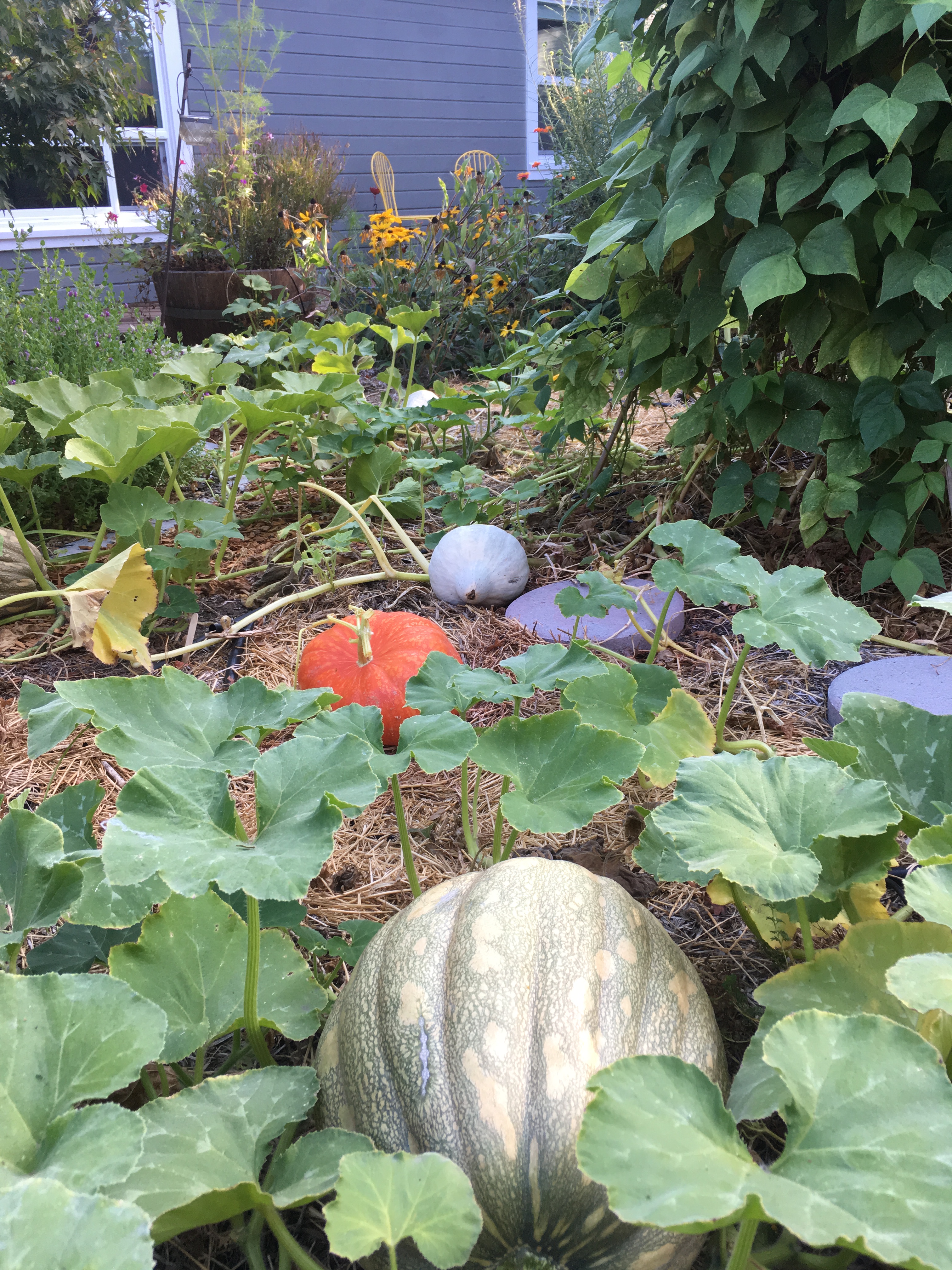
The big squash in the foreground came from last year’s Heirloom Expo

I don’t know exactly what the Celts harvested at the second harvest but here in Sonoma County September is the month of grapes and figs, and of course cannabis. Last year at the Heirloom Expo we drooled over a slew of fig tree species. I had grown figs in San Francisco but the one time a lovely Mission fig finally ripened a raccoon got to it before I could harvest, and broke the whole branch off in the process. That was it for me. That winter I dug out the entire plant. San Francisco’s foggy cool summers just don’t go with figs, although I did see some happy trees there, just not in my backyard. But figs love it here! So this spring we planted one. It’s called a Celestial, a small, rosy sweet fig, and we ate the first one in August. Also our neighbors T and JJ have a mature fig tree and I’ve been making myself sick on them. There’s nothing like a ripe fig perhaps eaten with a slice of local sheep’s milk cheese.

This is not an indictment of San Francisco weather (except when you’re freezing your ass off in the cold wind and fog waiting in line at the gay film festival in June!). I gardened in the same Bernal Heights yard for 38 years. There are some plants that thrive there. Nasturtiums! One year they took over the whole yard. I bought local gardener Pam Peirce’s books, learned about micro climates and the secret season that we didn’t have in my hometown of Yakima, Washington. I became friends with Pam and visited her abundant Excelsior back yard garden. But early on I gave up tomatoes and embraced flowers. Bernal Heights is just up the hill from the Alemany Farmers’ Market where every Saturday I could find seasonal organic produce. Why kill myself fighting shade and fog to grow some tortured veggies?

Zinnias! Love Santa Rosa, hate San Francisco

But tomatoes love the hot summers here. We are still harvesting tomatoes but it wasn’t like last year when we had to give bagsful away to neighbors. One plant suddenly died and gardener friends suggested gophers were eating the roots. Yikes! We had been happily gopher free. But I figured out the problem. I had watered the plant with a hose that had been sitting out in the hundred degree heat. I boiled the roots to death!

I didn’t make it to the climate march September 20. But I did eschew the car and take public transportation to Tradeswomen Inc.’s 40th anniversary celebration in Oakland where I got to commune with 400 tradeswomen. Then on Saturday night I took the Lamplight Tour of Santa Rosa’s historic rural cemetery. It’s a phenomenal production requiring the work of 120 volunteers who wrote, performed and organized eight vignettes about local history. We learned about the influence of the KKK in Sonoma County in the 1920s, the Women’s Christian Temperance Union, Jack London’s story about a local miner and more. Something tells me I’ll get sucked into working with this group of citizens interested in local history.

Naked ladies bloom at the Rural Cemetery

And next week I’ll travel to Minneapolis for the Women Build Nations national tradeswomen conference where history will also be a focus of discussion. A lot of us old timers realize we need to be recording it now before dementia sets in. Along with Brigid O’Farrell I’ll be leading the writers workshop. Methinks a book is in the offing.

Wishing all an auspicious autumn season.