Lammas and Kamala

My regular pagan holiday post: Celebrating the Harvest

August 1, a day that marks the halfway point between the summer solstice and the autumn equinox, is celebrated as the first harvest festival in many parts of the northern hemisphere. The Celts called it Lughnasa or Lammas. Besides Lammas, pagans celebrate two later harvest festivals, Mabon at the fall equinox, and Samhain on November 1.

In Sonoma County we can harvest food year-round, so I guess you could say every pagan holiday is a harvest fest here. By the time August rolls around, we’ve already been celebrating for months. The first bite of every ripe fruit calls for celebration.  

Still blooming in our garden: epilobium, native buckwheat, aster. Hydrangea in shade

Growing up in Yakima, Washington, on the eastern side of the Cascade Mountains, I always knew when the fruit was ripe. Cherries were picked on July 4th, and I would gorge until I was sick. Grandma had an old-fashioned peach tree with fuzzy skin that had to be peeled, and those peaches didn’t ripen until late August. Pears came later, and apples weren’t ready until the end of September.

Here in Sonoma County, our Gravenstein apples ripen at the beginning of August! We celebrate the harvest at the Gravenstein Apple Fair. It’s taken me years to adjust to California’s seasons. There’s no real winter here—just fall and then, magically, spring! Winter is the rainy season, and summer is dry. As Pam Peirce says in her book, Golden Gate Gardening, there’s a secret season here. Many seeds can and should be planted in the fall, but I have to remind myself every year.

Last October, I planted sugar snap and snow peas, and by February I was eating them right off the vine. When I’d eaten them all, I planted sweet peas just to enjoy their beauty and fragrance. Beans came next. Our beans didn’t fare so well this year, thanks to moles. They don’t eat veggies, just meat (like worms, that is—think “moles = meat, voles = veggies”), but they tunnel near the roots and leave air gaps that kill the plants. I even saw the soil moving where I had just planted seeds. Needless to say, those beans never stood a chance.

Sunflower, zinnias doing well in the heat

Sometimes, I think gardening is like throwing dice. You never know what the next season will bring, but that’s what makes it interesting. The garden has a mind of its own.

After a couple of disappointing years where our tomato plants succumbed to wilt, this year is shaping up to be a winner. As soon as the first tomatoes are ripe, we celebrate with BLTs. This year, we enjoyed our first BLTs in the first week of July, slicing the Early Girls (my favorite variety).

There’s always something ripe and ready in our garden. We harvested navel oranges from our tree until June, then our neighbor gifted us a bag of Valencias, keeping us swimming in orange juice until mid-July! By August, the purple Santa Rosa plums are history, but the yellow plums from the tree we planted last year are still ripening. 

I’m a gleaner, and throughout the fall harvest season you’ll find me harvesting my own and neighbors’ pomegranates, figs and persimmons. 

Then there are grapes and wine, the primary crop here in adjoining Sonoma and Napa counties. La Paulée, a traditional Burgundian harvest celebration takes place in the Russian River Valley on August 2-3, when winemakers, chefs and enthusiasts of both will gather to celebrate wine and food. A centuries-old celebration once reserved for French vigneron and their harvest crews, La Paulée is a French variation of the Celtic pagan Lammas holiday, marking the end of the grape harvest.

Like all gardeners we have our favorite plants. We love a dry bean called Eye of the Goat, which I got from the West County Community Seed Exchange in Sebastopol. This all-volunteer group has created a seed garden and a community seed library supporting local gardeners with free, locally grown, open-pollinated, pesticide- and GMO-free seeds. Local seed saving means we can cultivate plants that thrive in our region, with each generation adapting more to the local environment. And as the seed industry consolidates, we can preserve heirloom seeds.

The seed exchange sponsors workdays in their garden and classes, but the most fun event is the annual seed swap in early spring at the Sebastopol grange hall.

Another early spring highlight is the annual scion exchange in February, sponsored by the California Rare Fruit Growers. They share free scion wood from all sorts of fruit trees and vines. Local farmers stand by to help you choose the best varieties for your location. I discovered the scion exchange years ago and got hooked on grafting. 

Global warming is rapidly changing our world here in NorCal. This year June and July were hotter than ever, and August and September are predicted to break more records. On July 22 (and 23), 2024, the hottest day on earth in recorded history, it was 99 degrees here. 

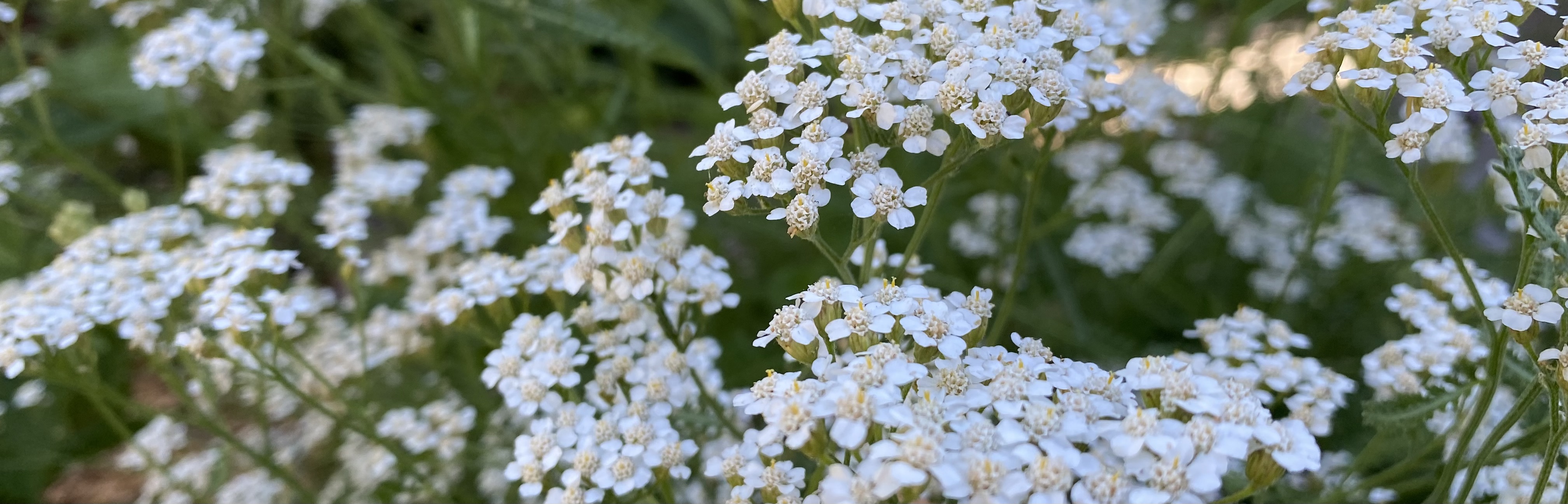
Cone flower (echinacea) petals burned, but native yarrow does well

We and our plants struggle with a warming climate. We’ve already had three heat waves this season and the hottest part of the summer is yet to arrive. Leaves are scorched and beans refuse to flower. Not many plants like 100-degree temperatures; even tomatoes protest.

And fire season started early with smoke blowing down from fires north of us. We may experience poor air quality till the rains start in November. The fire app, Watch Duty (download it if you haven’t already) shows scores of fires in California. The biggest is the Park Fire near Chico at 350,000 acres and growing. Oregon is burning. Practically the whole state of Idaho and much of Montana is under a red flag warning.

Climate change also brings new bugs to our northern climes. There’s a new mosquito in town and she takes no prisoners. She joins about a dozen varieties of mosquitos here. In past years they’ve died off with the advent of winter, but this year, due to a warm, rainy winter, they never left. Holly isn’t much affected by mosquitos, but if I’m in the yard, especially at dawn and dusk, they find me. I’ve had to give up hot tubbing because no matter how quickly I throw a robe on, they attack. They bite in my most vulnerable places! When I’m dressed, they go for my chin and ears. They are stealthy! I don’t hear them, and I rarely see them. I’m terribly allergic to their bites, which result in gigantic welts that itch for weeks. I scratch, and then they weep copious amounts of lymph fluid. So, though I hike every day, mosquitoes have kept me more indoors–not a bad thing when the temperature soars.

There is one more development we’re celebrating this harvest season. As we queers, feminists, pagans, progressives and people of color work to overcome the rise of the christian right, our election fears have lessened with the candidacy of Kamala Harris. Memes abound. I like MALA (Make America Laugh Again).

Now we must work to get her and down ballot Democrats elected! Election day this year is Tuesday November 5. That’s 95 days and counting.

We can Do it!

Here’s to a productive election season, and good Lammas to all.

The top photo is the view of sunset on a hot day over the Coast Range that we see from our street. The high point is called Black Mountain.

Dancing at Lughnasa

My Regular Pagan Holiday Post

I first learned of the August Celtic harvest festival, Lughnasa, from the play Dancing at Lughnasa. Written by the “Irish Chekhov” Brian Friel and first produced in Ireland in 1990, the play examines the cultural war between the catholic church and the old pagan religions it sought to destroy. Did destroy. 

Set in County Donegal in 1936, the tale is told by the boy, Michael, of the summer when the family life carefully constructed by his mother and her four sisters begins to disintegrate. Their only brother, Uncle Jack, returns from 25 years in Africa, where he was sent to practice colonialism as a catholic priest, and has gone native. Supposed to be a “visible saint, exemplar of ideal piety in a sea of persistent savagery,” he responds more to the drumming and fires of the pagan celebrations than to catholic doctrine. When the local priest learns of Jack’s pagan “conversion,” he fires Kate, the oldest sister and the only one of the five sisters with a paying job, from the school where she teaches. Two other sisters made some money knitting gloves until a glove factory opens nearby. Then the family, already dirt poor, suddenly has no income, destroyed by the church, patriarchy and capitalism in concert.

Our pollinator garden

The movie version, made in 1998, starring Meryl Streep as the conventional Kate and the Irish actor Michael Gambon as befuddled Uncle Jack is well worth watching. If you require car crashes or murders or automatic weapons, you will be disappointed. But these actors do a fine job portraying this resourceful proud Irish family in a beautiful rural setting.

A newly acquired wireless radio works on and off and provides a musical background to the family’s drama. We hear popular Western songs of the day, but it’s only when Irish music begins to play that the five sisters’ feet set to tapping and they dance with wild abandon, even priggish Kate, proving there’s still some pagan left in the Irish culture. 

Michael’s father, absent for 18 months, returns on a motorbike but does not intend to stay. He plans to join the International Brigades to fight for democracy in the Spanish Civil War. Uncle Jack asks if the catholic church is for the dictator Franco. Yes, says Gerry Evans, the father. “They would be,” answers Jack. 

Young Gerry says the war will probably be over by Christmas. Old Jack replies, “They say that about all wars.”

Says Kate, “It’s a sad day for Ireland when we send off our boys to fight for godless communism.”

Fr. Jack says he has been called away from the church to “the god of light, god of music.” He hints at his homosexuality when asked by Michael to whom he sings. With a nostalgic expression, he says it is his African houseboy. Jack has been given a feathered baroque helmet by an African priest. Colorful and magisterial, with its tall red and white feathers, it could be a piece of African regalia. But it is a remnant of British imperialism. The hat, reminiscent of a prop from a Gilbert and Sullivan opera, has made its way from the British imperial army to Africa and back again. Ironic because the Irish themselves were slaves to English colonialism.

In the movie, on the night of Lughnasa, fires can be seen burning in the “black hills” of Donegal where bits of the old religions are still practiced. People gather to drink, dance, and jump the fire. From Fr. Jack we learn of the African goddess, Opis (pronounced Opee), the great chthonian goddess of the earth. The Chthonian deities are the manifestations of the Great Goddess, like Gaia or Ge. Jack explains to the family how the Ugandans celebrate the harvest festival. August is the time of the new yam and the sweet cassava. “The Africans cut and anoint the new yam and pass it around. They light fires and paint their faces and they dance and dance and lose all sense of time.” It is easy to see why Jack has renounced repressive catholicism for a freer earth-based religious experience.

Medicinal yarrow

Here in Santa Rosa there is good reason to celebrate the harvest this Lughnasa. Strawberries are at their peak and Holly has planted enough this year to have fruit every morning. The corn is as high as a Columbian mammoth’s eye (they were taller than elephants). We have just harvested the last of the peaches and Gravenstein apples. Eggplant, peppers, tomatoes, beans and cukes are happening. Figs are having a good year. Holly has harvested her herbs and is mixing up the medicine. Flower and pollinator gardens buzz with bees. Even as we strive to conserve water, our garden is happy.

I probably won’t paint my face (ok, maybe my hair) and I certainly won’t light any fires, but you may find me dancing around our garden on Lughnasa on the first day of August.

Fire photo by Meritt Thomas on Unsplash

Celebrating Lughnasa in Quarantine

August 1, 2020

The Gaelic festival Lughnasa, midway between summer solstice and autumn equinox, celebrates the first fruits of the harvest season. 

Here in Santa Rosa, at a more southern latitude, we picked our first fruits at the beginning of July—tomatoes, cucumbers, eggplants, peaches and plums. The neighbor’s Gravenstein apple tree that hangs over into our yard was ready for harvest around August 1 last year, but this year the apples were a couple of weeks early, maybe because we are in a drought, or maybe it’s just global warming. Everything is early this year.

Apple harvest here is usually celebrated at the ides of August at the Sebastopol Apple Festival, but of course all of our local gatherings have been cancelled for covid.

We will miss the Sonoma County fall fairs and expositions. The Heirloom Expo in September is one of our favorites and last year we heard a presentation about native bees by a company based in Woodinville WA that propagates bees and sells them. We bought some—mason bees and leaf cutter bees. They came in the mail with detailed instructions. Native bees don’t live in hives like honey bees. They are solitary and nest in holes, often in undisturbed ground (so don’t dig up your whole garden) and they don’t sting like honey bees.

Introducing the mason bees to our garden went well. They are kept in the refrigerator until you place them in the top drawer of their bee house, mounted on the fence facing east so the morning sun hits it. Mason bees place their eggs in the wooden straws provided and then cement them in with mud to protect them from predators. They emerge with the daffodils in spring. The male bees fly only three weeks and the females seven weeks. We were instructed to leave a patch of wet clay in the garden for their masonry work.

The leaf cutter bees came in June and, before reading directions, we put them in the refrigerator till we could let them out. Only the next day did we read the directions which warned against refrigeration. We killed our bees! But we ran to the refrigerator and dumped them all out on a plate on the deck hoping for revival. Then we watched, transfixed, as they slowly crawled out of their shells, stumbled to the edge of the plate and flew off into the garden. Most of them survived.

For us humans 2020 has been a disastrous year, but for bees in our garden—honey bees as well as native bees—it’s been a great one. 

Sending virtual hugs to all of you as we continue to shelter in place.

Celebrating Lughnasa in NoCa

The noises started in late spring, sort of an irregular popping sound, occasionally loud enough to wake us at night. It sounded like someone was bouncing tennis balls off the fence in back. What were the raccoons up to? It couldn’t be the opossums. One lumbered along the fence every evening as night fell. But she was quiet as she moved to another yard. 

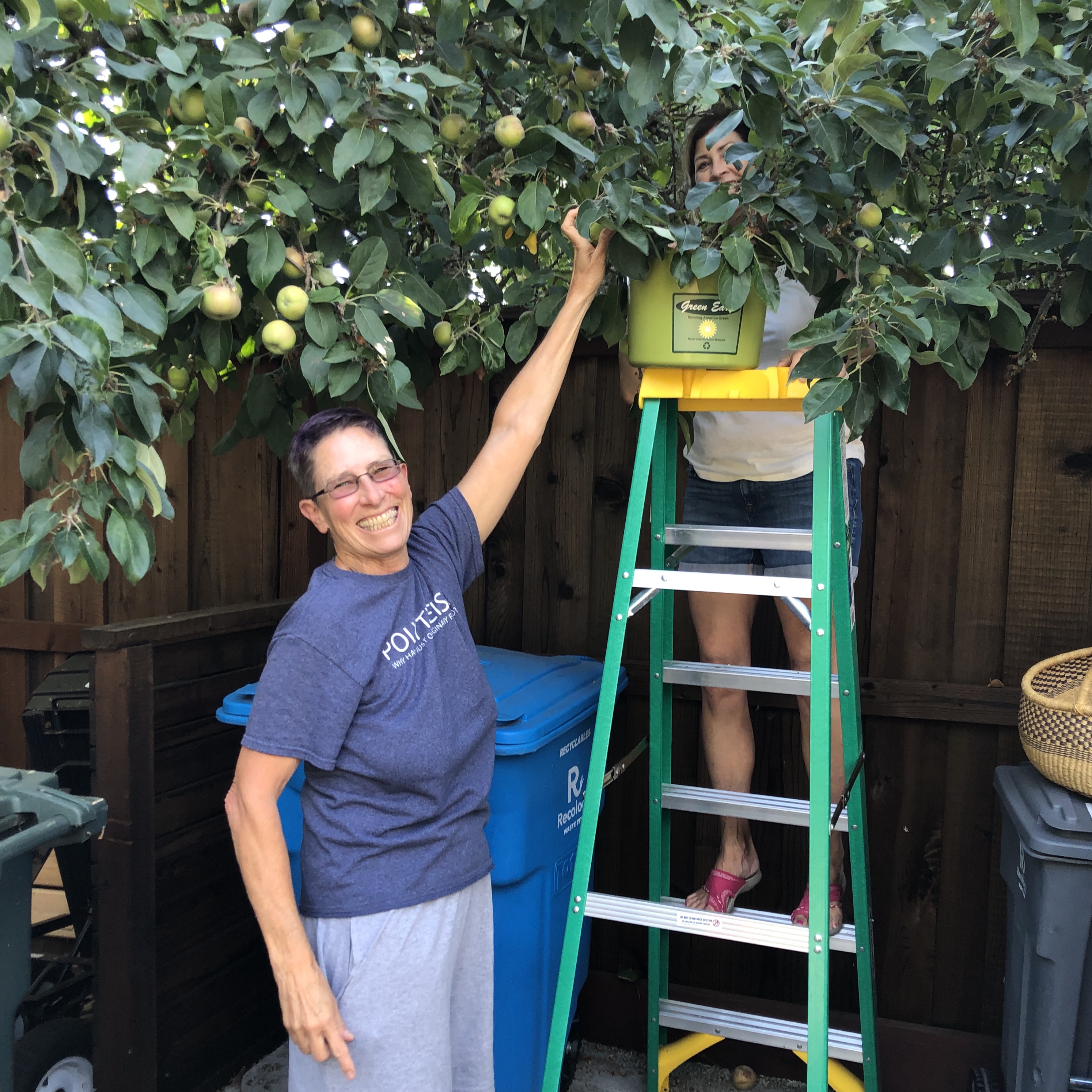
My T-shirt reads: Polytheism. Why have just one imaginary friend

It took a few weeks before we figured out the noise was made by apples falling from our side yard neighbor’s tree. It just got louder as the little green apples grew larger, thudding onto the garden pavers, banging onto the metal shed roof.
When the tree leafed out last spring, Holly was delighted to find it’s a Gravenstein, the apple of her youth. Grandpa warned Holly and her sister not to eat the unripe apples. “They’ll make you sick.” But they just couldn’t wait. They ate them and liked them and never got sick. Grandma would make apple sauce for every dinner during apple season.

I come from apple country too, in Yakima, Washington. But we didn’t grow Gravensteins, which ripen earlier and don’t require the cold nights up north. Our Macintoshes and Red Delicious apples ripened in October and in my day school was let out so kids could help their families with the harvest. To me there is nothing like the taste of a ripe Red Delicious picked right off the tree. I never tasted a Gravenstein until I moved to California.

The iconic apple of Sonoma County was brought to the continent by Russian fur traders. It is said they planted the first tree in 1811 at Fort Ross on the Sonoma coast. Gravensteins ripen in July and August here. The tart fruit doesn’t last long and must be processed or eaten quickly. This year we had a bumper crop. Branches grew far over into our yard so that we had to duck under on our way to the recycling bins. 

By the third week of July the emerging red stripes on the green fruit told us they were ripe. Fortuitously Holly’s cousin Kerri is an apple aficionado. She lives in Roseville and travels to Santa Rosa annually to buy a lug of Gravensteins for pies. Her method is to process them all at once, coring, slicing, sugaring enough for each pie (seven cups of apples) and then freezing in plastic bags for the making of pies and crisps all year long.

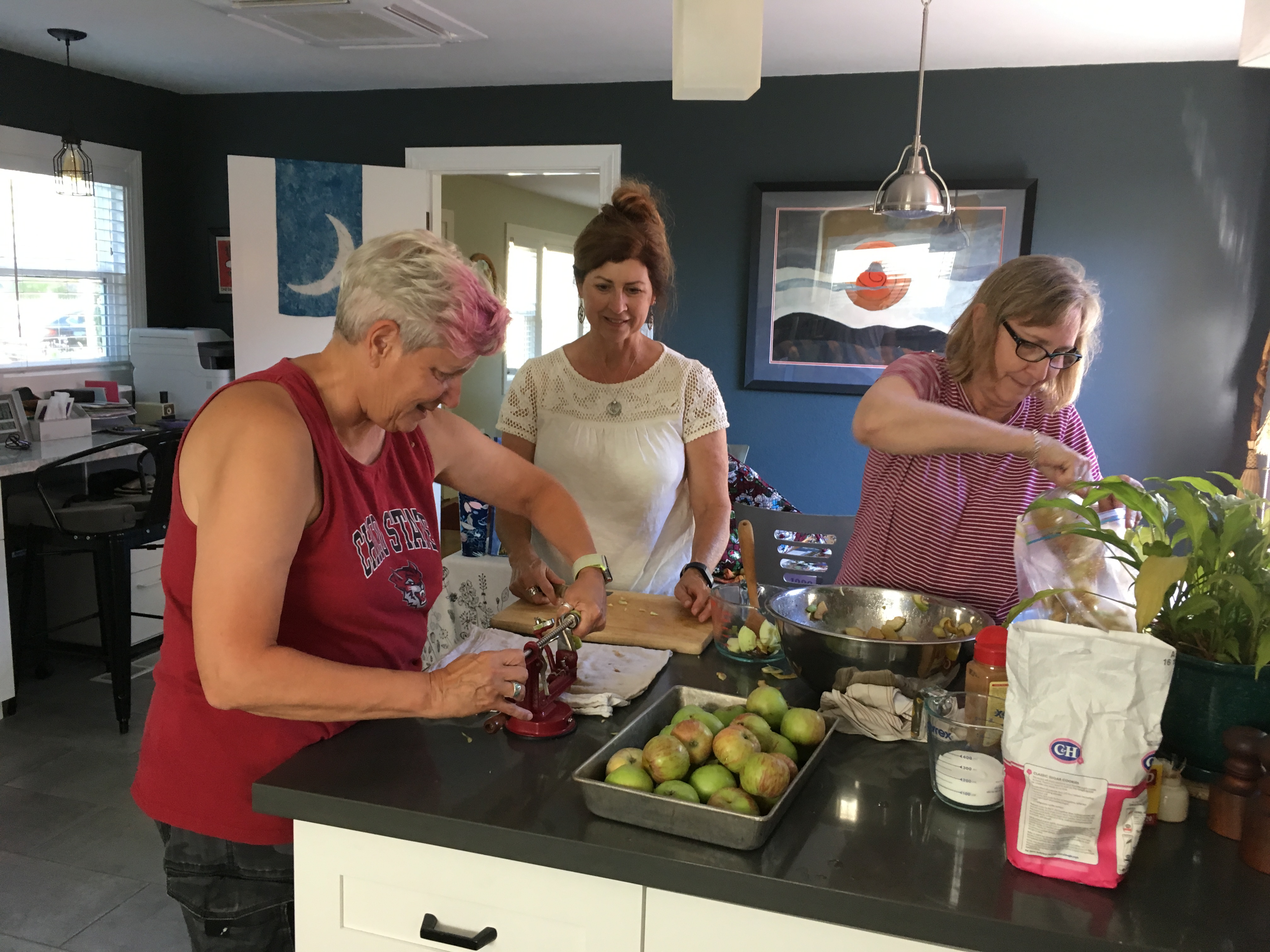
Holly, Kerri and Diana on the disassembly line

Just as the apples ripened we were lucky to be visited by Kerri and her apple coring machine. She came with all the ingredients for making pies—sugar, cinnamon, flour, crisco. Holly’s sister Diana was here too, from San Diego.

Our first chore was to pick the fruit, reliving our childhoods. We gingerly climbed the six-foot ladder, each taking a turn and being especially careful. We were sobered by the recent death of a friend, Chris Jones, who fell from a ladder while hanging a gay pride flag in his yard in San Francisco.

Then we set up an assembly line, coring, slicing and sugaring. What music goes with apples? We chose Lady Gaga. You can dance and core at the same time. Then Kerri made three pies. One we gave to the neighbor, whose apple tree it is. The two others we ate with gusto. And we still have ingredients for many more pies in the freezer. Then Holly and I cut up the remaining small apples and made four quarts of apple sauce. 

And that’s how we celebrated the cross-quarter pagan harvest festival. Called Lughnasa by the Celts and Lammas by the Anglo-Saxons, it’s one pagan festival not appropriated by christians. The first of three Celtic harvest fests, Lughnasa is celebrated on August 1 or 2, about mid-way between summer solstice and autumn equinox. But, as with the other pagan holidays, we extend festivities for as long as we like. We will continue to celebrate the apple harvest at the Gravenstein Apple Fair this year in August 17 and 18 in Sebastopol.

Good harvest to you!