Blossom Peeping in Yakima

My Regular Pagan Holiday post–Ostara

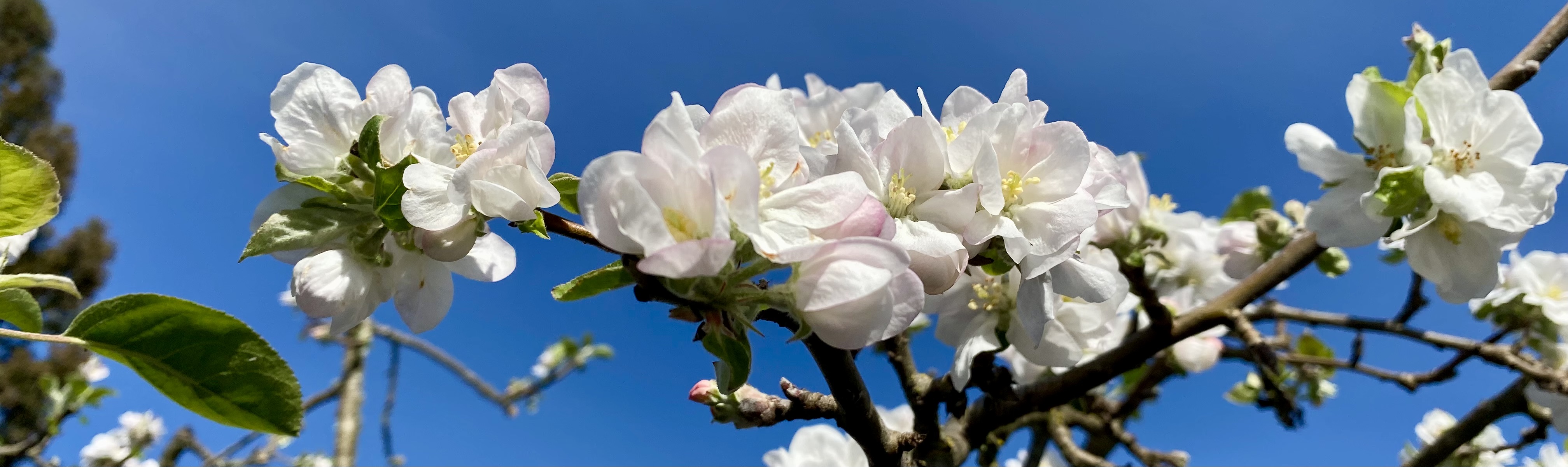
Each spring, near the Vernal Equinox, my family practiced a ritual that felt both ordinary and divine. We piled into the car and drove the back roads, wandering through orchards to admire the blossoming trees. In an agricultural town in the 1950s, perhaps many families did something similar. To us it marked the true arrival of Spring.

Yakima, Washington is on the dry eastern side of the Cascade mountain range, and from certain places in the valley you can glimpse two great peaks rising in white brilliance above the brown, sagebrushy foothills. The Indigenous peoples named the mountain we call Rainier Tahoma, which means “the mother of waters.” The Native name for Mt. Adams is Pahto. Closer in, foothill ridges encircle the valley: Ahtanum Ridge, Rattlesnake Hills, Horse Heaven Hills. 

Our annual blossom pilgrimages would take us south to the Lower Valley where the trees bloomed earlier. To reach it from the town of Yakima, you drive through a narrow gap in the Rattlesnake Hills at Union Gap, where a massive basalt landslide is now slowly creeping south at a foot and a half per week. Drive fast and don’t look up. 

From there, the road winds along the Yakima River past Wapato, Toppenish, and Buena—locally pronounced Byoo-enna. I didn’t realize until adulthood that the word is Spanish. Originally, the place had been called Konewock, a Native word meaning a lush, green marshy place. But when the railroad needed a station name, it became Buena.

The Yakama Indian Reservation borders the Lower Valley towns and stretches west toward Mount Adams. On the reservation stand the remains of Fort Simcoe, where U.S. soldiers were stationed during the Indian wars of the 1850s—a quiet, uneasy reminder of deeper histories layered beneath the orchards.

Yakima was home to vast orchards of apples and pears, along with stone fruits—peaches, cherries, apricots. In the spring the valley was a quilt of flowering trees, fragrant and luminous. But, in my childhood, change was already underway. Like the orchards here in Sonoma County today, many of Yakima’s were already being razed to make room for postwar housing developments and, later, vineyards.

The new ranch-style house we moved into in 1951 stood on land that had been a cherry orchard. The developers left one tall cherry tree in the front yard of each house on the block. I climbed every one of them. Across the street, an apple orchard remained, and bi-planes flew overhead, trailing clouds of DDT and other pesticides. 
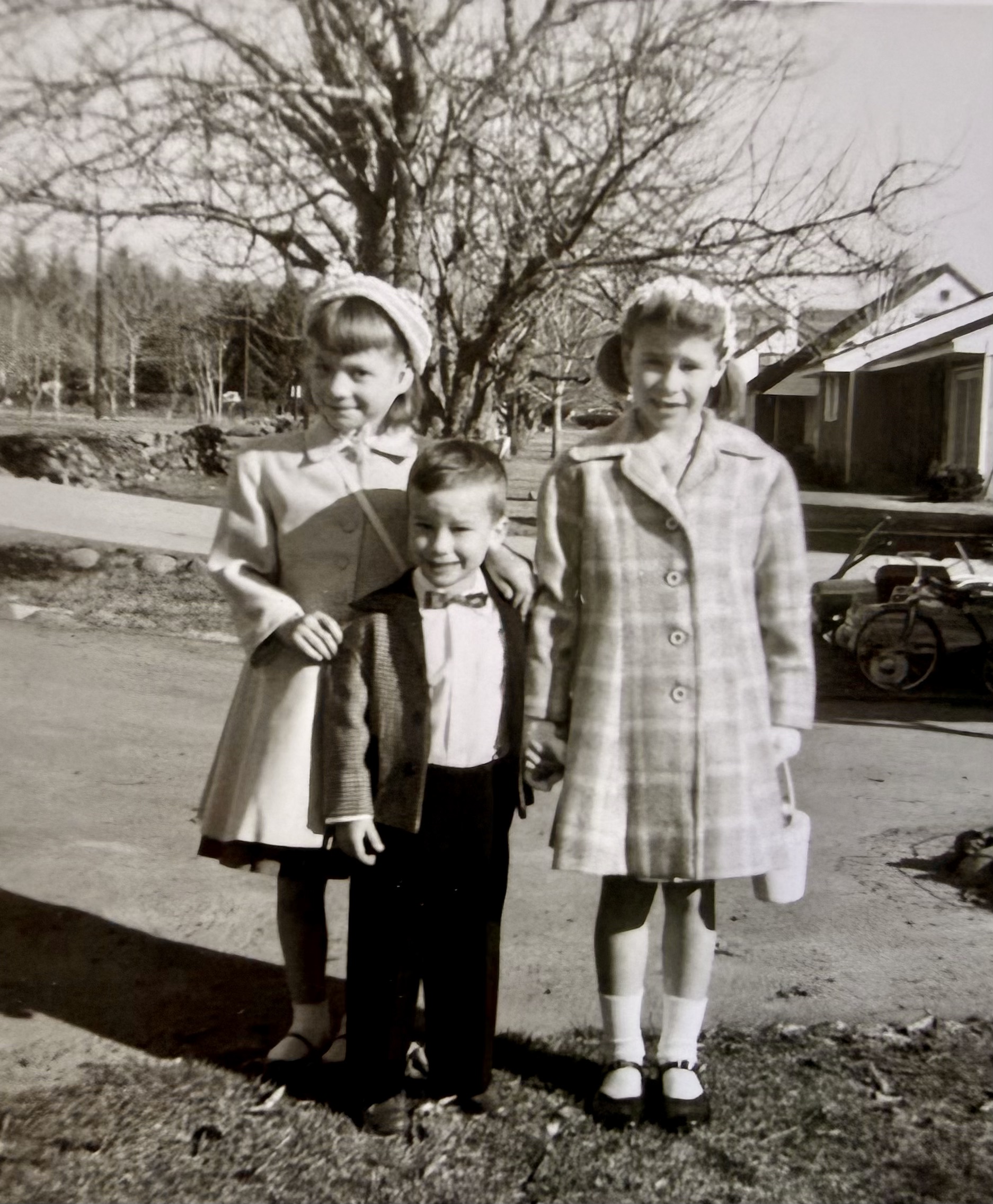
There is the row of cherry trees behind me (R), brother Don and a neighbor. I couldn’t find any blossom pictures and at Easter in 1955 the cherries hadn’t yet bloomed.

When I was a kid, Yakima was a town of about 40,000, with a lively downtown. Women wore hats and gloves to go shopping. Store windows gleamed, sidewalks buzzed, and the town felt cohesive, self-contained. Then, in the 1970s, the first shopping mall arrived, and everything shifted. Downtown slowly hollowed out.
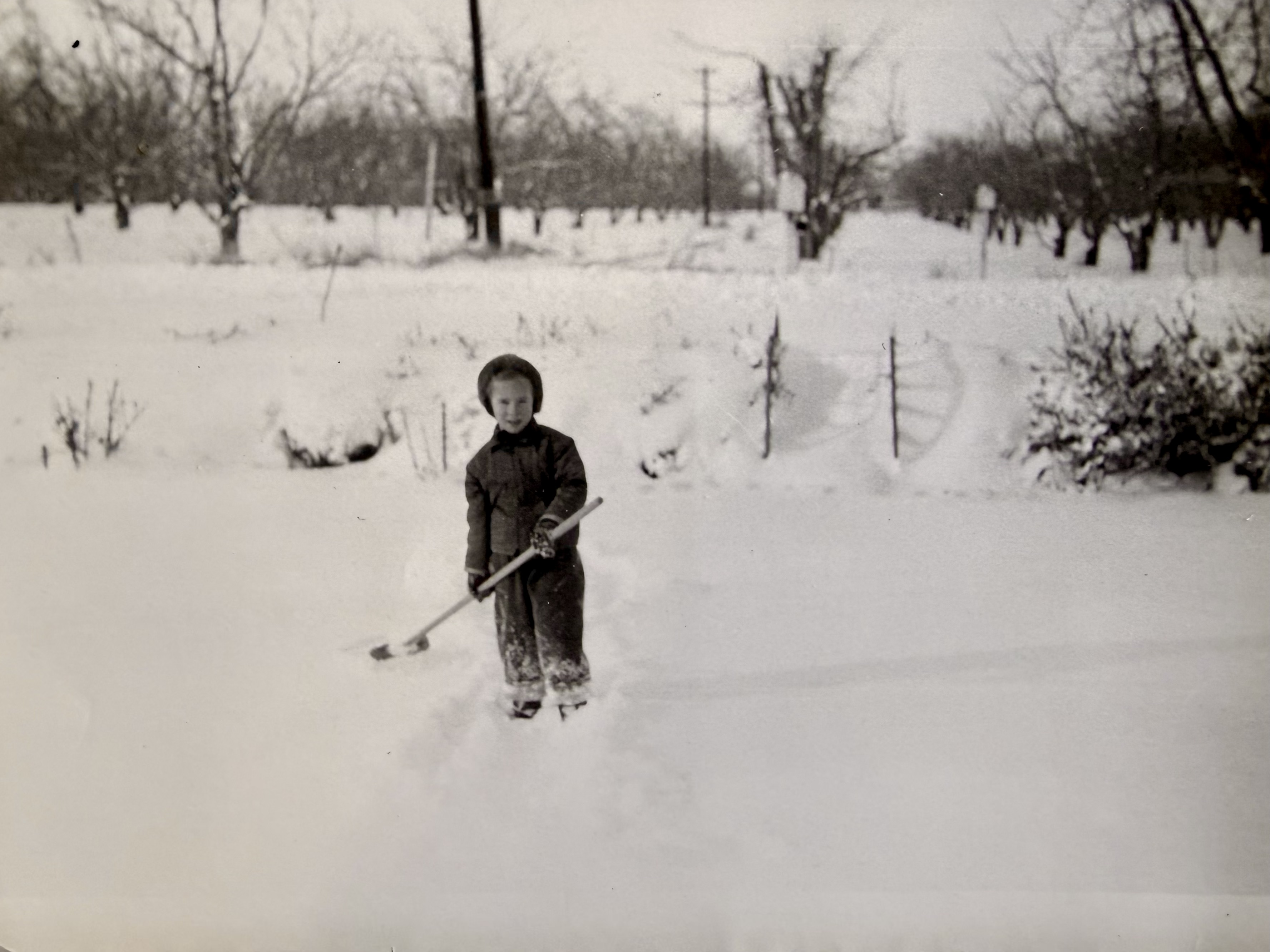
Behind me is the across-the-street apple orchard.

Now the population of Yakima is getting close to 100,000. Farmers still grow hops, and there are still fruit trees—mostly apples—but vineyards have been steadily taking over. There is less blossom-peeping now; grapes, after all, have no blossoms.
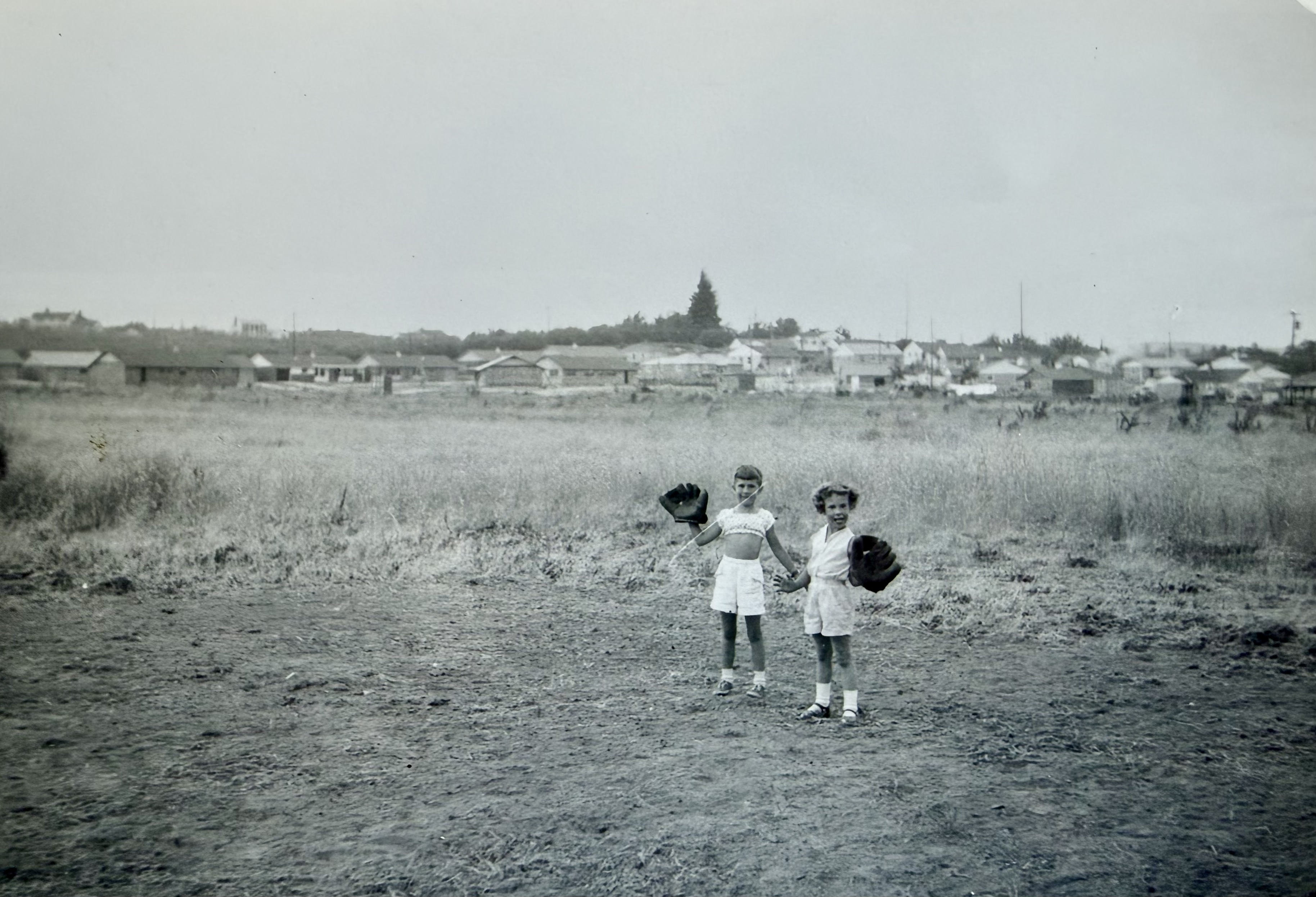
Me (R) and friend. From the back yard we can see development encroaching and a few trees left.

But we still participate in the ritual of spring blossom peeping. Holly and I have planted a little orchard of cherry, plum and peach trees in our back yard. We have a magical orange, and lemon and apple trees hang over our neighbors’ fences. Plus, in our town of Santa Rosa there are magnolias, redbuds, dogwood and ornamental fruit trees, enough to inspire a months’-long Spring ritual right in our neighborhood.

On March 28 we will be marching with our neighbors in the No Kings march and rally here in Santa Rosa, but every little town in Sonoma County will be hosting a No Kings event. We haven’t yet seen a big uptick in ICE arrests here, but the government’s anti-immigrant project is nevertheless creating chaos in the agricultural community. Our sheriff still has not responded to community demands that he not work with ICE and people feel that they are under siege. We are determined to protect and defend our immigrant neighbors.
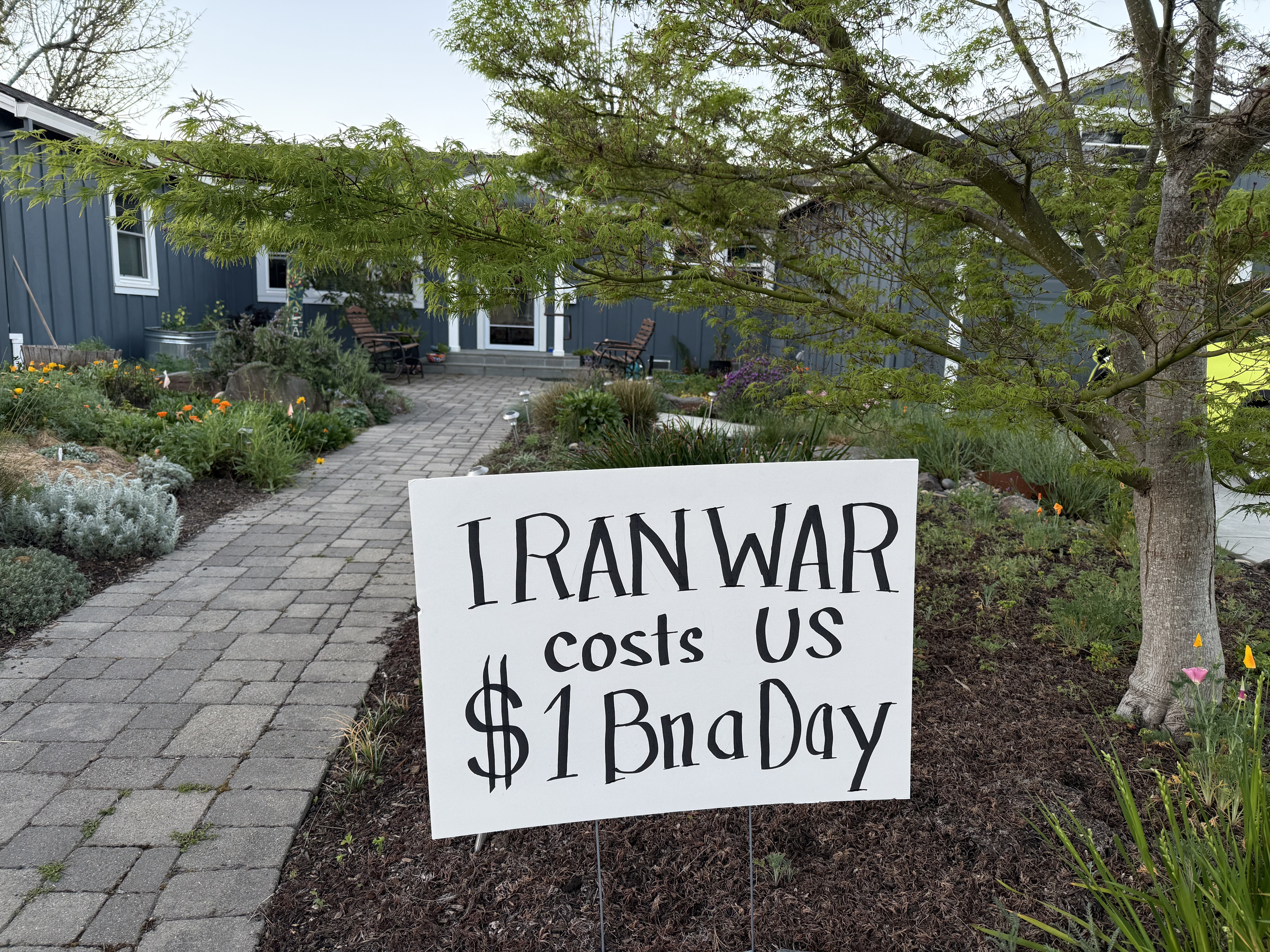
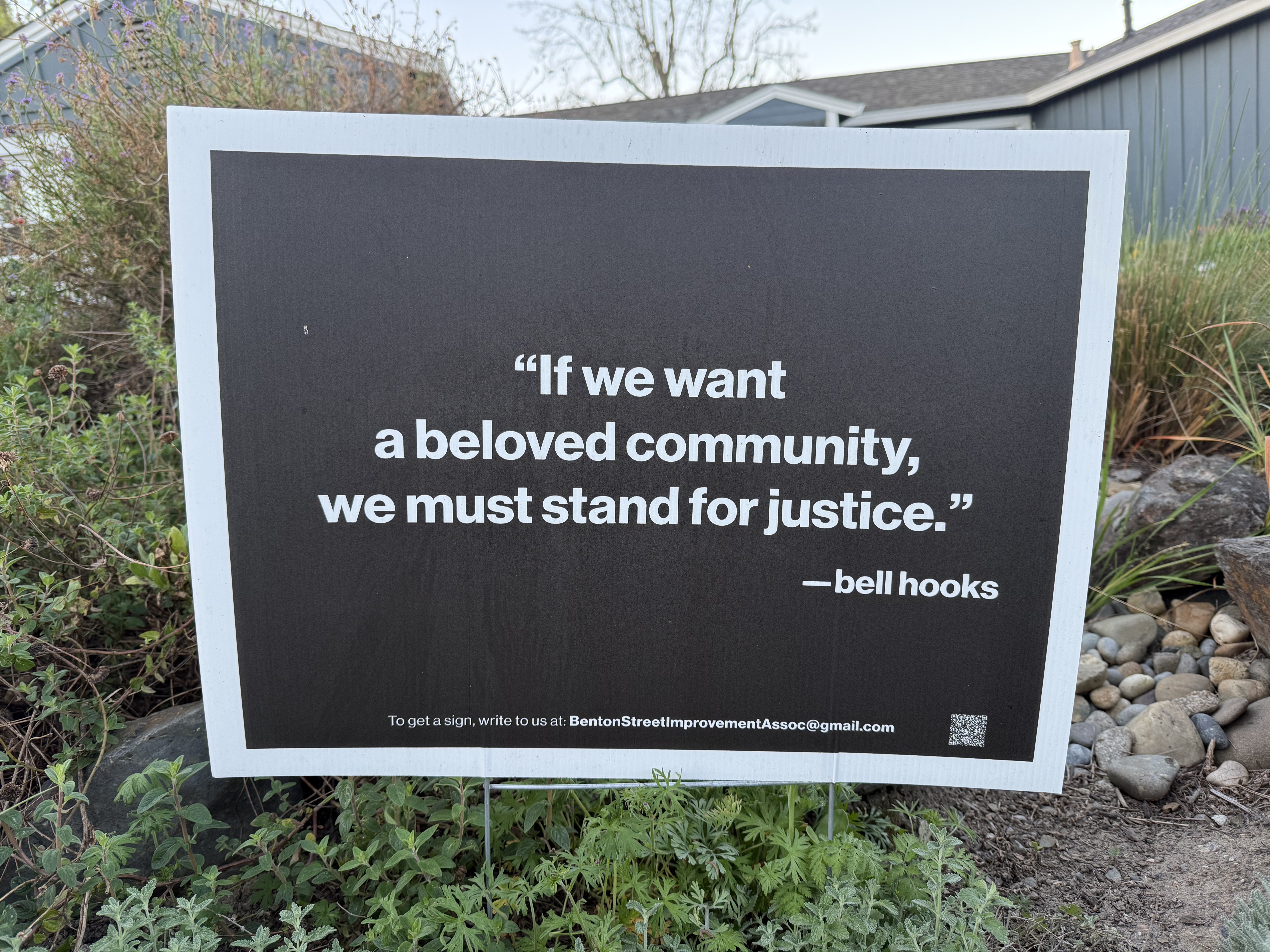
My No Kings sign posted in our front yard
Four women in my neighborhood had these signs made, with quotes from luminaries that promote kindness and justice. Now they are posted in front yards all over town.

Happy Spring blossom peeping and protesting to all!

Hope for a New Day

My Regular Pagan Holiday Post

Dear Friends, 

Happy Ostara, the celebration of the vernal equinox, which takes place this year today, March 20. Searching for spring festivals and hoping for inspiration, I found one from Iran.

“In Iran, the festival of NowRuz begins shortly before the vernal equinox. The phrase “NowRuz” actually means “new day,” and this is a time of hope and rebirth.

Boy, am I feeling the need for hope and rebirth right now.

“The Iranian new year begins on the day of the equinox, and typically people celebrate by getting outside for a picnic or other activity with their loved ones. No Ruz is deeply rooted in the beliefs of Zoroastrianism, which was the predominant religion in ancient Persia before Islam came along.”

Getting outside—yes! The vernal equinox must be celebrated outdoors.

Another inspiration comes from my neighbors, many of whom are my age, in their 70s. In Santa Rosa people take their gardens and landscaping seriously. When I walk down the street and see Dan and Karen tending their gardens or Howie down on the ground pulling weeds, or Pam planting natives in her front yard, or Susan wielding digging tools I think yeah I can do that too!

Gardening and planting plants—what a great way to celebrate spring!

I’ve always seen myself as a big strong woman and I’ve spent my adult life telling other women working in the construction trades “We Can Do It!” Admitting that I can’t do something is still hard for me, even though I’ve been practicing it for a decade now. At 72 I discover new limits to my ability constantly.

So, after Holly and I acknowledged to each other that there are some garden chores we just can’t do anymore, we hired a laborer to dig out crab grass, matilija poppy roots and a couple of stumps.

There is also this: I don’t want to do it. I might have felt like I had to in the past, or I was required to show that I could meet some physical challenge. Now I no longer have to make a point.

Or that’s what I thought before Maximo, the laborer, weighed in on my ability. He was digging out the poppy roots with an adz. I said to him, “that’s such hard work.” I knew this because I had dug out the roots a couple years before and found the job taxing.

“Yes,” he said, “you couldn’t do this.”

My hackles went up immediately. What do you mean I can’t do it! I thought to myself. He had said that as he worked without even looking at me. What was it about me that made him think I couldn’t do the work? Gray hair? My gender? To me them’s fightin’ words.

So of course after that I had to do it to prove I still could. I decided to start celebrating spring a little early, on the Ides of March. I know the last day of frost in Santa Rosa is April 15 but I can never wait that long and I figure global warming has moved it up at least a couple of weeks. And I was willing to take a chance. If my seedlings froze I’d just have to start over.

Holly had ordered seedlings from Annie’s Annuals and we set out to plant them in the front yard, which required squatting for long periods.

Look, I’m not decrepit and I’m proud that I can still pee in the woods and get up off my haunches (except for that one time after a back operation when my quads were so weak I needed help from a tree). But peeing is a short operation and planting takes longer. Especially since I get obsessed with pulling out the bermuda grass roots, an unending task (I do know we will never be rid of them).

After working at it for a while and feeling pretty good about my athletic ability, my neck and my hands started sending pain signals. Then suddenly the muscles in my legs objected, seizing up and screaming for me to move, but I was stuck in the position. Oh My Goddess I can’t get up!

I remembered the episode of Grace and Frankie where both Lily Tomlin and Jane Fonda fell and couldn’t get up. They both raced for the phone by swimming across the floor on their backs. And the episode when Jane pulls a MacGyver, lassoing a sculpture to pull herself up off the toilet. If only my elderly exploits could be so funny!

I rolled over to get up the way they teach old people to do and I finished the job on hands and knees.

I did it! Not very gracefully, but I did it.

In the meantime Holly had finished her part of the planting without mishap, but she is a decade younger than I.

Acknowledging that I might not be so good at planting seedlings, I can still throw seeds around the garden and rake them into the dirt while standing up. And that’s what I did last fall for cover crops of mustard, red clover, calendula and fava beans. Now they are flowering and I’m appreciating the fruits of my labor.

Maybe next year I’ll find a new way to celebrate the advent of spring, something I can do while standing upright.

In the meantime I wish you all NowRuz Mobarak–Happy New Year. May this be the start of a new day.

Sending love to you all,

Molly

The Hilaria: Ostara 2021

Celebrating the Spring Equinox

My Regular pagan holiday post

Looking into ways that humans celebrate the turning of the seasons I discovered the Hilaria (plural of Hilaris). They were spring festivals celebrated by the cult of Cybele, the great mother of the gods, in Asia Minor and Greek and Roman cultures from about the 5th century BCE onward. Cybele’s consort, Attis, was born of her via a virgin birth and resurrected in the spring (sound familiar?). The day of this celebration was the first day after the vernal equinox, or the first day of the year which was longer than the night. I imagine there was a lot of laughing.

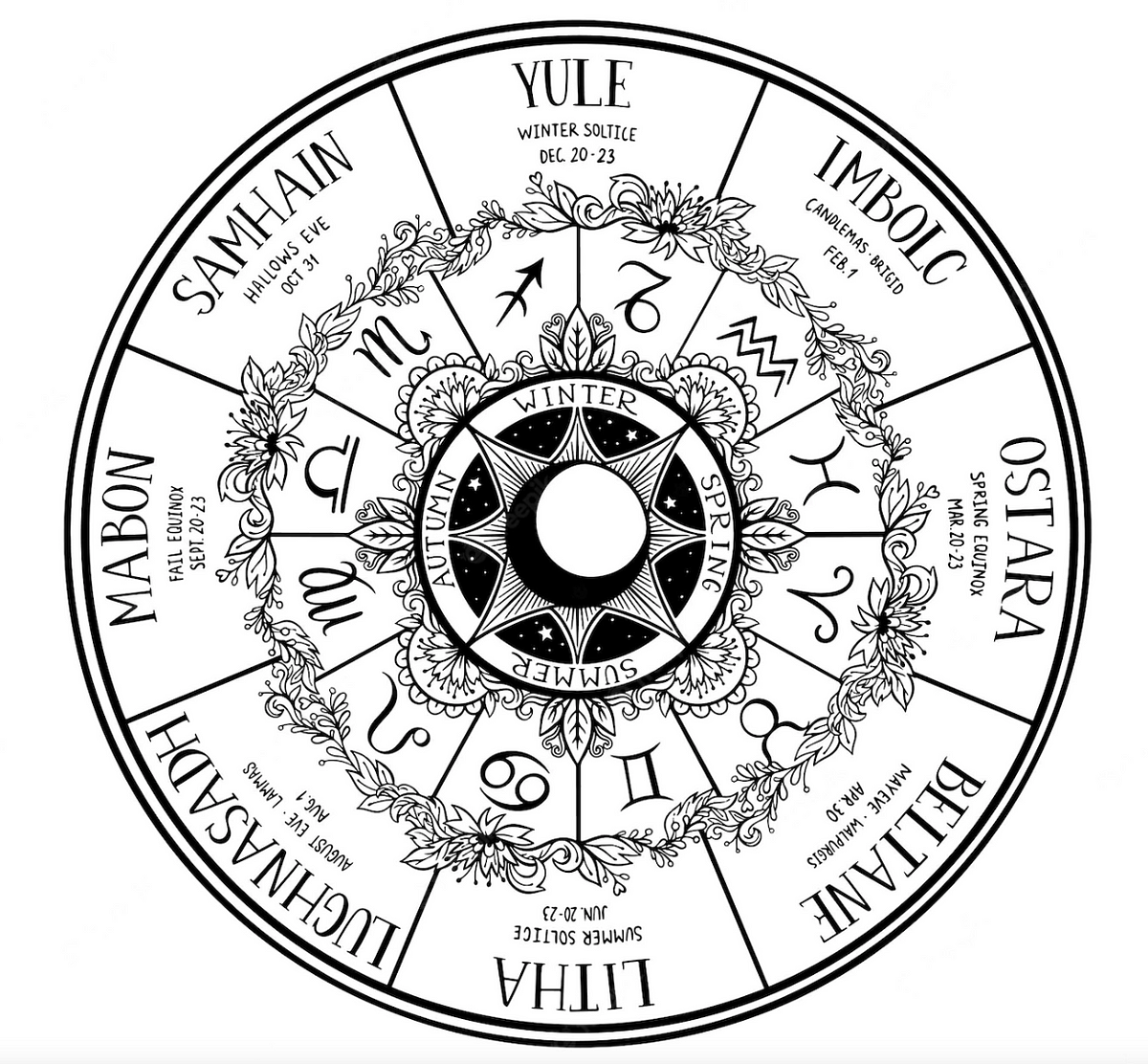
I write these pagan holiday letters eight times a year following the pagan wheel of the year, the annual cycle of seasonal festivals observed by modern pagans. Pagans and wiccans have divided the year into eight parts consisting of the chief solar events (solstices and equinoxes) and the midpoints between them, called cross-quarter holidays. Many of these holidays were stolen by the christian religion while colonizing and absorbing pagan customs. Think Christmas and Easter.

Wiccans have named the spring equinox Ostara with a nod to the ancient Tutonic goddess, but of course equinox celebrations have been practiced by humans for millennia. The Anglo-Saxon goddess is Eastre or Eostre.

I can call myself a pagan even though I don’t worship any goddess or god. Pagan is just a pejorative term used by early christians to refer to polytheists, animists or other non-christians. But modern pagans and wiccans have embraced the term and fashioned a religion of sorts. They borrowed the holidays from various pre-christian traditions. This earth-centered practice beats all to hell the christian teaching that humans have dominion over the earth and its animals (interesting that Genesis leaves out the plants). 

I appreciate the wheel of the year because there is no beginning and no end. Life is a cycle. I find this a compelling way to look at and think about the year. The holidays are just far enough apart for my taste. They correspond with the seasons and the movement of nature. The next holiday is only eight weeks away from the current celebration. Now at Ostara I find it easy to think ahead to the next holiday, Beltane on May 1. What flowers will be blooming then? What will I be planting and harvesting from the garden? When will nesting birds be fledging?

One great thing about these holidays is we can make up our own. My version of paganism takes into account the earth and all its beings, not just humans. My version is anti-capitalist and all-inclusive. My personal Hilaria celebration begins on the Ides of March, maybe a bad day for Caesar but an auspicious date in my life. 

One year ago at this time I had spine surgery at Oakland Kaiser, the last of the elective surgeries just as the pandemic was announced. We had our last restaurant meal on Piedmont Avenue and at the time I thought it might be my last out meal for months, maybe years (I was right). A year later, I’ve recovered from surgery and covid restrictions are being lifted. I’ve just had my first shot of Moderna vaccine.

It was on the Ides of March three years ago that Holly and I hired movers and said goodbye to our San Francisco home, Richlandia, moving to our new home in Santa Rosa, Hylandia.

And here is another reason the Ides of March is auspicious. We are selling the last of the property in San Francisco that I bought in 1980 with my then-collective house of lesbians. I lived there for 38 years. That three-unit building has been the center of my life for four decades. I spent nearly a decade (the 2000s) with my partner at the time, Barb, remodeling the units and turning them into condos with the help of tradeswomen friends, especially carpenters Carla Johnson, who died in 2016, https://mollymartin.blog/2016/06/12/losing-carla-jean/ and Pat Cull. See my blog posts about the building: https://mollymartin.blog/2017/09/16/still-standing/

When we bought Hylandia, we sold the condo we lived in and continued to rent the other two units. I was committed to never evicting anyone from their home, but I did want to get out of the absentee landlord business. Then, last month, both the tenants gave notice allowing us to sell the apartments. 

I was so very attached to Richlandia, into which I put so much blood, sweat and tears. But because letting go has spanned years now, I think I’m ready. And the building, given new life by me and my tradeswomen friends, awaits a community of new occupants.

It is a time of new beginnings and as I write this I think What a cliché. Everyone is writing this. Still it seems momentous, life changing. I know that after this year of trump and covid and the fires and fascists assaulting our capital and Black Lives Matter uprisings and the growing throngs of homeless that things can never “go back to normal.” Nor do I wish for that. Life is a circle with no real endings or beginnings. I’m looking forward to what comes next.