Colonialism: the violent seizure of land, the domination of people, the erasure of cultures. It is the practice of extending and maintaining political and economic control over another people, typically through displacement, suppression, and destruction.
While researching pre-christian seasonal celebrations around the world, I keep running into the same brutal reality: colonialism didn’t just conquer people—it annihilated their histories, their traditions, and their sacred knowledge. Lately, I’ve been searching for evidence of spring rituals in Latin America, only to find that much of what once existed has been deliberately erased.
European colonial invasion of the Americas was not just a conquest—it was an extermination. The very term “pre-Columbian” grates, as if history only begins with Columbus’s arrival, ignoring the fact that indigenous civilizations flourished for millennia before European diseases and massacres decimated their populations.
Nowhere is this erasure more apparent than in the destruction of Mayan knowledge. In the 16th century, Spanish catholic priests set fire to nearly all Mayan codices, incinerating vast repositories of scientific, spiritual, and astronomical understanding in a frenzied effort to impose christianity. Only a handful of these texts survived. What remains is a civilization whose intellectual and architectural brilliance we can only glimpse—its great stone pyramids standing defiantly even as its written history was reduced to ashes.
Can you see the shadow image of the serpent? Photo: Chichen Itza
Yet, despite this attempted obliteration, traces of indigenous traditions persist. In Mexico, celebrations of the spring equinox remain deeply connected to pre-Hispanic heritage, even as they blend with modern religious elements. Across the country, people gather for festivales de primavera, celebrations that embrace the new season and pay homage to a past that refuses to be forgotten.
Chichén Itzá in Yucatán remains the most famous site for these celebrations. Every spring, thousands of people come to witness the astonishing spectacle of light and shadow on the Kukulcán pyramid. Designed with mathematical precision, the structure casts shadows that create the illusion of a serpent slithering down its steps during the equinox. This event is not a coincidence—it is the result of a civilization that understood celestial mechanics better than many modern observers. The pyramid, built in the 12th century CE, stands as a testament to Mayan brilliance, though the city of Chichén Itzá itself dates back to 550–800 CE.
Another important site is Teotihuacan, where thousands—often dressed in white—gather to greet the equinox. With arms raised to the sun, they take part in rituals of purification and energy renewal, honoring the sacred astronomical knowledge that once made this city one of the most important spiritual centers in Mesoamerica.
Mexican equinox celebration. Photo: kunuk hotel
I plan to adopt the tradition of wearing white on the spring equinox. I still have my white jeans and jacket, bought in anticipation of Hillary Clinton’s 2016 presidential victory. White is also the color of the women’s suffrage movement, and it seems we might need to again fight for the right to vote. Trump and his allies would like to take us back to the 18thcentury. I’ll be holding onto my suffrage gear as we witches resurrect our hexes.
The vernal equinox this year falls on March 20. Holly and I will be visiting our exes in San Bernardino County’s high desert. My brother Don and his husband John will join us on their way back from Mexico to Vancouver. We hope the poppies in Antelope Valley will be in bloom, though the lack of recent rains might mean disappointment.
This winter, California has experienced what our weather guru, Dr. Daniel Swain calls hydroclimatic whiplash—extreme shifts between wet and dry weather, an increasingly common global phenomenon. Sonoma County saw zero rainfall in January. Then, in February, while dry Los Angeles burned in the worst wildfire in its recorded history, Northern California was drowning. Though the flooding wasn’t the worst ever, two people died, reminding us to take road warnings seriously: Don’t Drown. Turn Around.
Swain frequently references the Great Flood of 1862, when California, lacking big dams, saw the town of Sacramento submerged. Before colonization, the Central Valley was essentially a giant swamp, and California’s climate has always swung between extremes since it was first monitored in the mid-nineteenth century.
California winter holds some other surprises. February is skunk mating season and, driving around Sonoma County, we see bumper skunk roadkill. They traipse through our garden and they are welcome visitors, eating mice and grubs. Nearsighted but with a keen sense of smell and hearing, they are quite beautiful. Skunks are nocturnal and so we see them only on trips to and from the hot tub at dawn and dusk, which is where Holly encountered one. She didn’t see it until the tail was raised. Too late! The resulting stink resonated in our house for a week. She had to throw away her robe and slippers, which never recovered. Now we stop and look both ways before crossing the deck to the hot tub.
Spring equinox is a time of renewal, balance, and resistance. Let’s celebrate it in ways that honor the past while reclaiming our future.
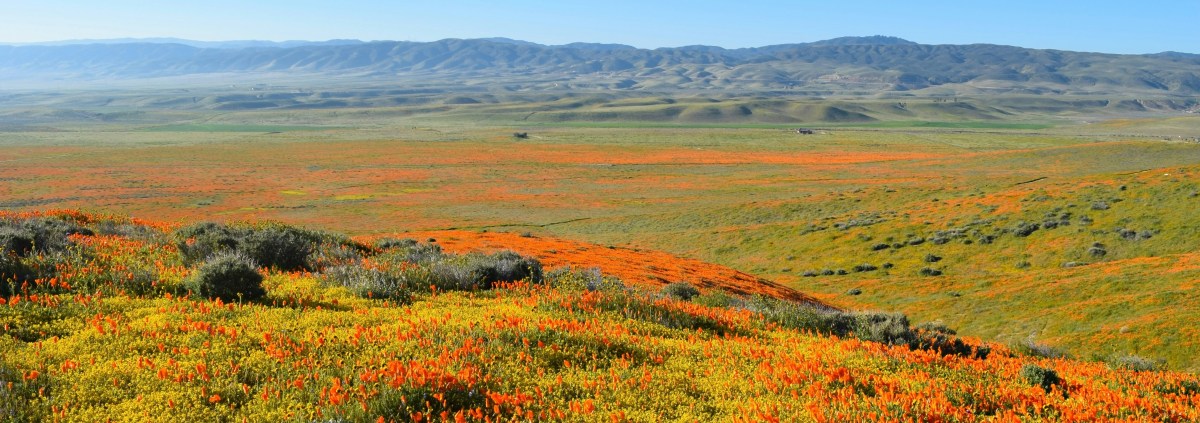
Poppies landscape photo: Pamela Heckel on Unsplash
The Hindu god Krishna, who was blue, worried that his love Radha, who was not blue, might not appreciate his color. His mother suggested that he ask Radha to paint his face any color she wanted. And, according to legend, that’s how the Hindu holiday Holi was born. At the spring equinox people gather to throw colored powders on each other, and lovers paint each other’s faces. The holiday is big in India and it’s also becoming popular in the U.S.
I love the idea of getting together with a big group to throw colors on each other. What fun! But then I started wondering about what is in that powder. And also thinking, as someone with lung issues, what might be the consequence of breathing it in. We all know that breathing dust and smoke is not good for us. There’s farmer’s lung and carpenter’s lung and smoker’s lung. Now there’s probably Holi lung!
So while I’m always looking for new and old ways to celebrate the turning of the seasons, Holi is not a spring equinox tradition I intend to adopt. Instead I’m sending colorful flowers to our household to remind us that the cold wet winter is over. Which right now in Santa Rosa is more of a hope than reality. It’s raining now and it’s not very warm by our standards. Two more atmospheric rivers are threatening in the next week. The whole state of California worries about where all the water from the Sierra snow melt will go.
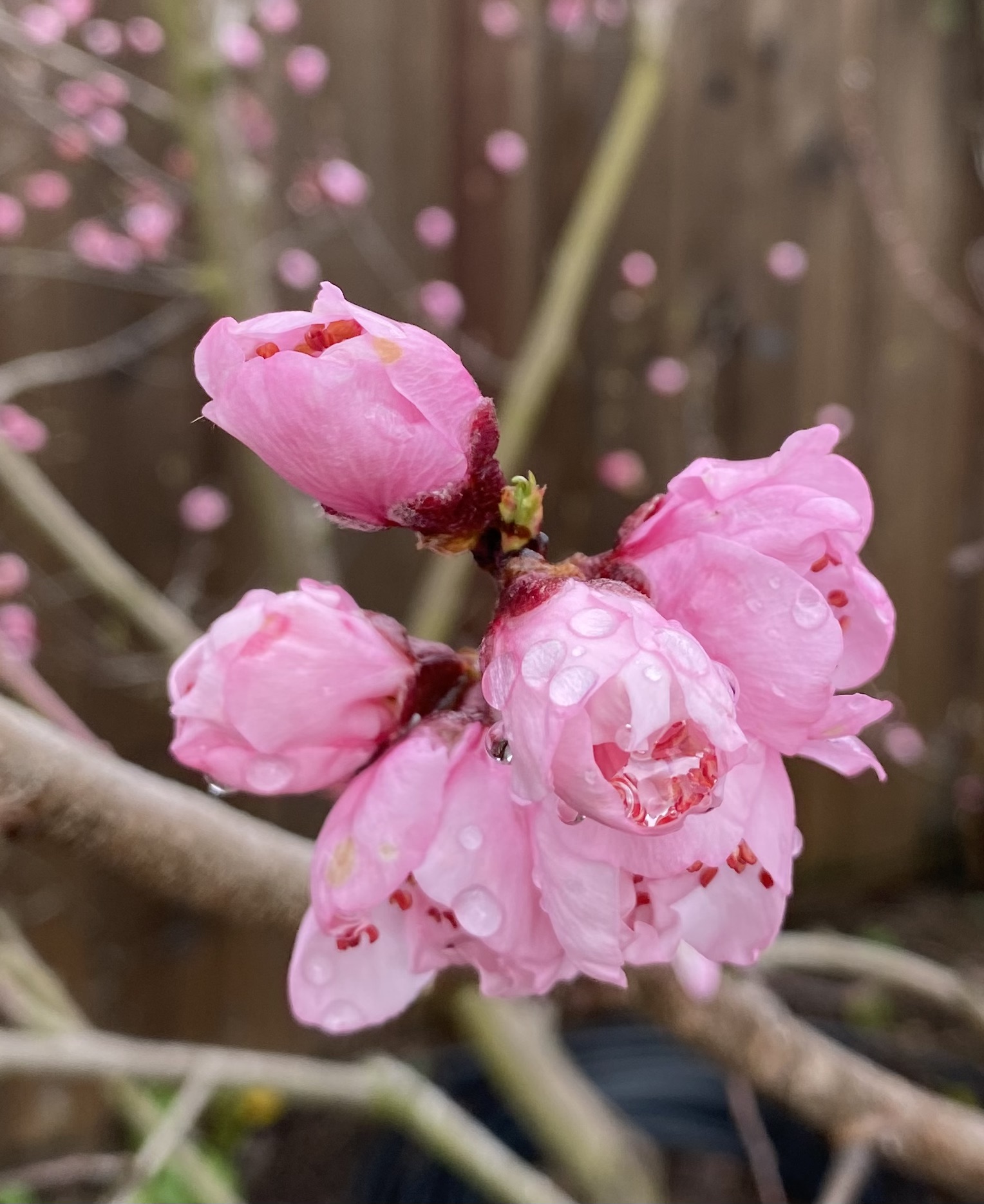
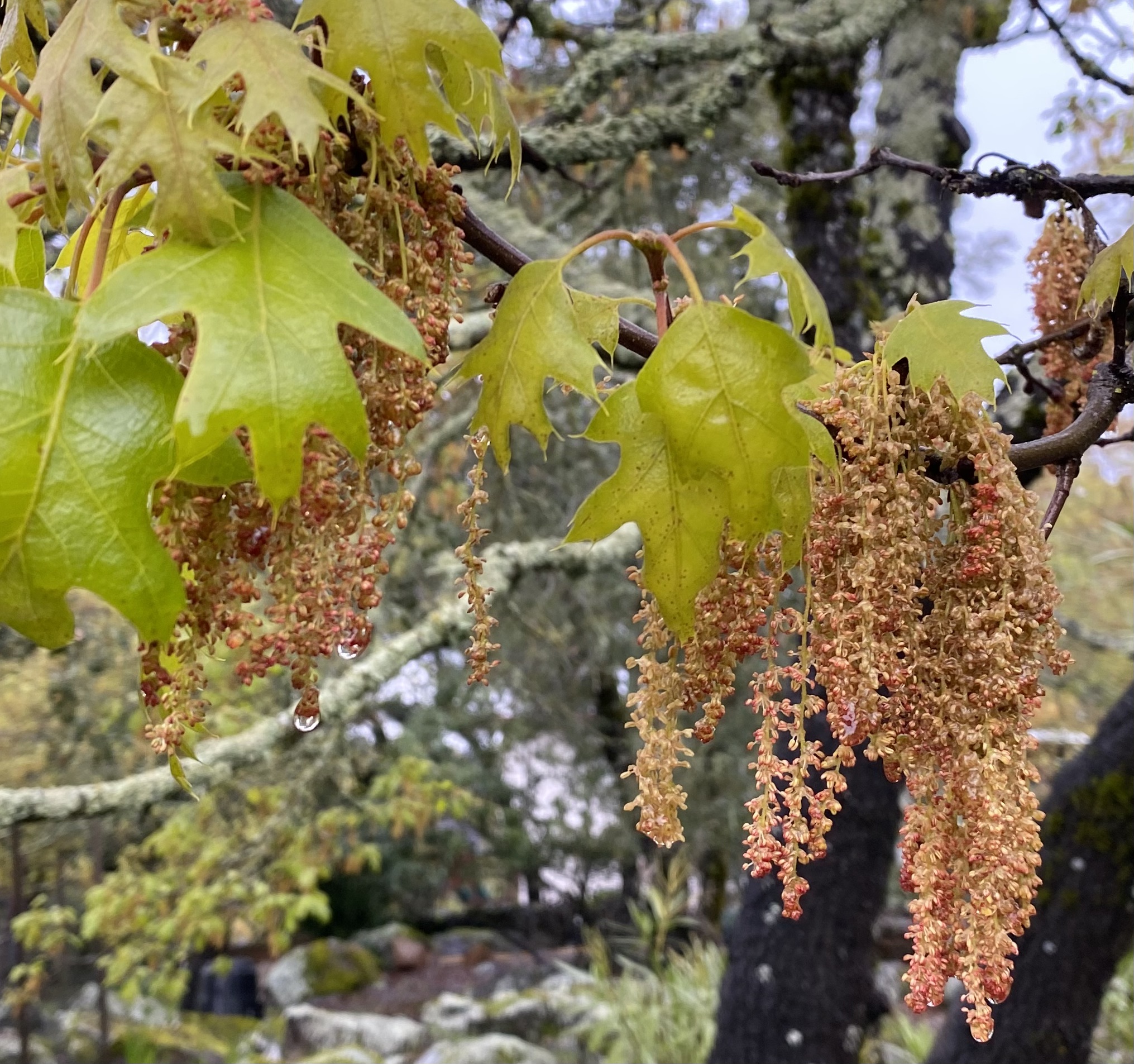
We see some signs of spring. Plum, peach and pear trees are blooming and the magnolias are magnificent. Poppies are starting to bloom. Birds are frisky. Oaks are leafing out. Is it fair to say spring is here but winter is still hanging on?
My boots are muddy and the trails wet but, along with my hiking buddies, I go out every day that it’s not raining. Being outdoors is what has kept me sane through covid. Masks have kept us healthy. One or both of us usually gets sick sometime during the winter with a virus that lands in the chest and hangs on, but Holly and I have avoided air-borne diseases for three years now. Very often these days I’m the only one in a group wearing one, but I feel saved by the mask!
Looking into ways that humans celebrate the turning of the seasons I discovered the Hilaria (plural of Hilaris). They were spring festivals celebrated by the cult of Cybele, the great mother of the gods, in Asia Minor and Greek and Roman cultures from about the 5th century BCE onward. Cybele’s consort, Attis, was born of her via a virgin birth and resurrected in the spring (sound familiar?). The day of this celebration was the first day after the vernal equinox, or the first day of the year which was longer than the night. I imagine there was a lot of laughing.
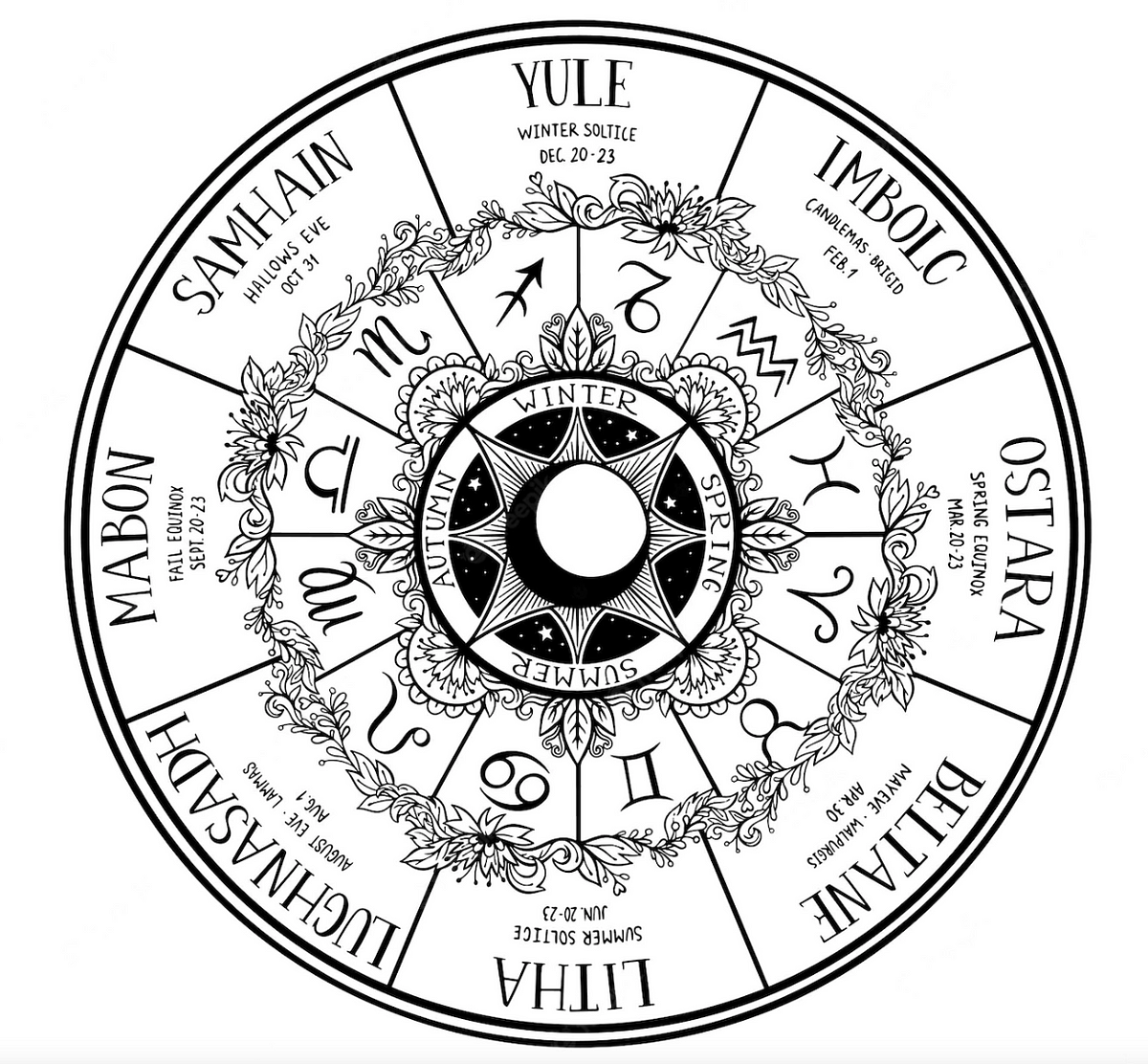
I write these pagan holiday letters eight times a year following the pagan wheel of the year, the annual cycle of seasonal festivals observed by modern pagans. Pagans and wiccans have divided the year into eight parts consisting of the chief solar events (solstices and equinoxes) and the midpoints between them, called cross-quarter holidays. Many of these holidays were stolen by the christian religion while colonizing and absorbing pagan customs. Think Christmas and Easter.
Wiccans have named the spring equinox Ostara with a nod to the ancient Tutonic goddess, but of course equinox celebrations have been practiced by humans for millennia. The Anglo-Saxon goddess is Eastre or Eostre.
I can call myself a pagan even though I don’t worship any goddess or god. Pagan is just a pejorative term used by early christians to refer to polytheists, animists or other non-christians. But modern pagans and wiccans have embraced the term and fashioned a religion of sorts. They borrowed the holidays from various pre-christian traditions. This earth-centered practice beats all to hell the christian teaching that humans have dominion over the earth and its animals (interesting that Genesis leaves out the plants).
I appreciate the wheel of the year because there is no beginning and no end. Life is a cycle. I find this a compelling way to look at and think about the year. The holidays are just far enough apart for my taste. They correspond with the seasons and the movement of nature. The next holiday is only eight weeks away from the current celebration. Now at Ostara I find it easy to think ahead to the next holiday, Beltane on May 1. What flowers will be blooming then? What will I be planting and harvesting from the garden? When will nesting birds be fledging?
One great thing about these holidays is we can make up our own. My version of paganism takes into account the earth and all its beings, not just humans. My version is anti-capitalist and all-inclusive. My personal Hilaria celebration begins on the Ides of March, maybe a bad day for Caesar but an auspicious date in my life.
One year ago at this time I had spine surgery at Oakland Kaiser, the last of the elective surgeries just as the pandemic was announced. We had our last restaurant meal on Piedmont Avenue and at the time I thought it might be my last out meal for months, maybe years (I was right). A year later, I’ve recovered from surgery and covid restrictions are being lifted. I’ve just had my first shot of Moderna vaccine.
It was on the Ides of March three years ago that Holly and I hired movers and said goodbye to our San Francisco home, Richlandia, moving to our new home in Santa Rosa, Hylandia.
And here is another reason the Ides of March is auspicious. We are selling the last of the property in San Francisco that I bought in 1980 with my then-collective house of lesbians. I lived there for 38 years. That three-unit building has been the center of my life for four decades. I spent nearly a decade (the 2000s) with my partner at the time, Barb, remodeling the units and turning them into condos with the help of tradeswomen friends, especially carpenters Carla Johnson, who died in 2016, https://mollymartin.blog/2016/06/12/losing-carla-jean/ and Pat Cull. See my blog posts about the building: https://mollymartin.blog/2017/09/16/still-standing/
When we bought Hylandia, we sold the condo we lived in and continued to rent the other two units. I was committed to never evicting anyone from their home, but I did want to get out of the absentee landlord business. Then, last month, both the tenants gave notice allowing us to sell the apartments.
I was so very attached to Richlandia, into which I put so much blood, sweat and tears. But because letting go has spanned years now, I think I’m ready. And the building, given new life by me and my tradeswomen friends, awaits a community of new occupants.
It is a time of new beginnings and as I write this I think What a cliché. Everyone is writing this. Still it seems momentous, life changing. I know that after this year of trump and covid and the fires and fascists assaulting our capital and Black Lives Matter uprisings and the growing throngs of homeless that things can never “go back to normal.” Nor do I wish for that. Life is a circle with no real endings or beginnings. I’m looking forward to what comes next.
My regular pagan holiday post comes in the form of a (late) diary. Here are the first four entries.
March 30, 2020
In what might be seen as supremely good timing, considering the pandemic lockdown, I have spent the spring equinox (March 19) and the advent of this new season recovering from spine surgery. Now at the end of March I’m still mostly lying in bed flat on my back so I am speaking into my phone to tell you the story. I’m thinking installments.
I was scheduled for the surgery on March 12 at Oakland Kaiser Hospital. The surgeon was the same one who worked on me three years ago when I had surgery on my lower spine, Timothy Huang.
My deteriorated cervical spine
The MRI. My spinal cord was being strangled
Good friends know that I have been complaining about pain in my right arm for years now. According to the actuarial tables I can expect to live to be 82, twelve more years. The prospect of living with worsening pain was depressing and prompted me to seek relief. After years of pain killers (we call ibuprofen vitamin I around our house) I finally got Kaiser to give me an MRI. The expression on the doctor’s face when she saw the picture disturbed me. Even I could see that my spinal cord was being crushed by deteriorating bones in my neck. The doctor said “Don’t fall down. Trauma could result in paralysis.” I began to consider what life might be like as a quadriplegic.
My cervical spine was a mess. Nerves were being pinched, my spinal cord was permanently damaged, vertebrae four through seven are worn down to the bone. I was told it could only get worse not better. So surgery was a no brainer. Oh I looked forward to it.
Including photos from our backyard garden, my savior during this recovery/pandemic period.
April 2, 2020
It’s April now and I’m feeling better three weeks after my surgery. I’m still spending quite a bit of time lying on my back but I’ve been getting up and around a lot more.
Here’s the next chapter of my surgery story.
Holly and I went to a pre-op meeting with the surgeon about a week before the scheduled surgery. We drove to Oakland Kaiser looking forward to hearing what they were planning to do to me.
I was tested and found to have a good strength and reflexes. My worst symptom was the pain in my right arm and hand. We looked at the MRI together and the surgeon said “This won’t get better; it will only get worse.” He said it wasn’t the result of a particular injury, just long term wear and tear. I thought of all those hours spent working over my head looking up at light fixtures as an electrician.
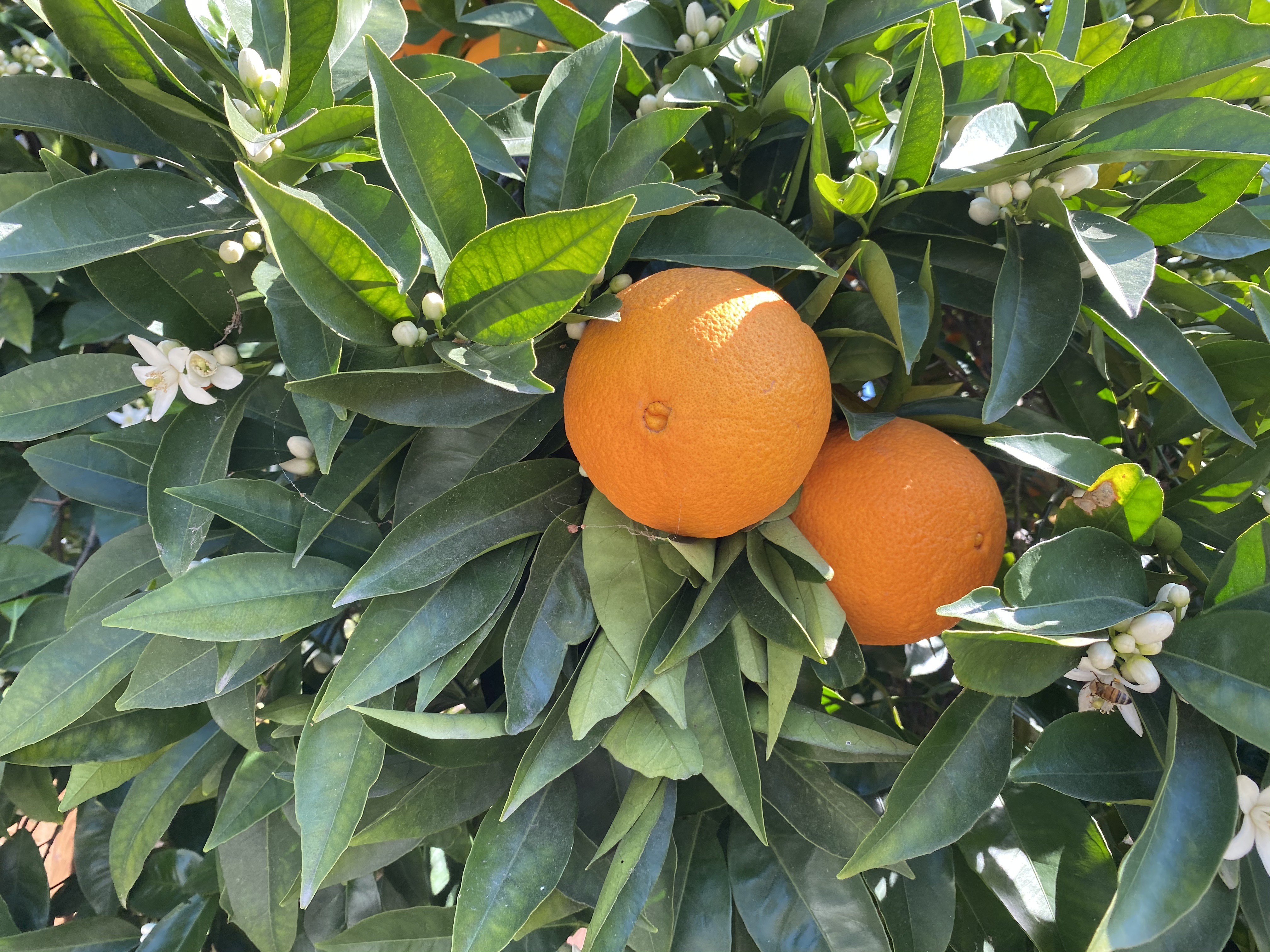
Lying in bed I can smell the orange blossoms right outside my window
We learned that spinal cord tissue is less resilient than nerve tissue. The most pressing problem was not the nerve pain in my arm but the compression of my spinal cord, even though that was not as painful. He recommended first tackling the spinal cord compression. To do that they would open the back of my neck, cut the vertebrae, crack them open and screw small plates in. That gives the spinal cord more room. He said this surgery might not feel like a big improvement. It’s more to hold the decline. The basic surgery is called laminoplasty, essentially decompression.
To repair the nerve damage that creates pain in my arm he said they would have to go in from the front of my neck. Sometimes they do both operations all at once but they would like to do just the back, wait six months and see how much improvement there is before surgery from the front, which is much more risky.
Why hadn’t I felt more pain in my neck I wondered. The surgeon said that because the deterioration had been gradual over time my body just got used to it. Also we know that I have a high tolerance for pain. I guess this is a good thing.
The surgery was a week away and I was glad that we’d been able to get an appointment so soon. I wanted to get it over with.
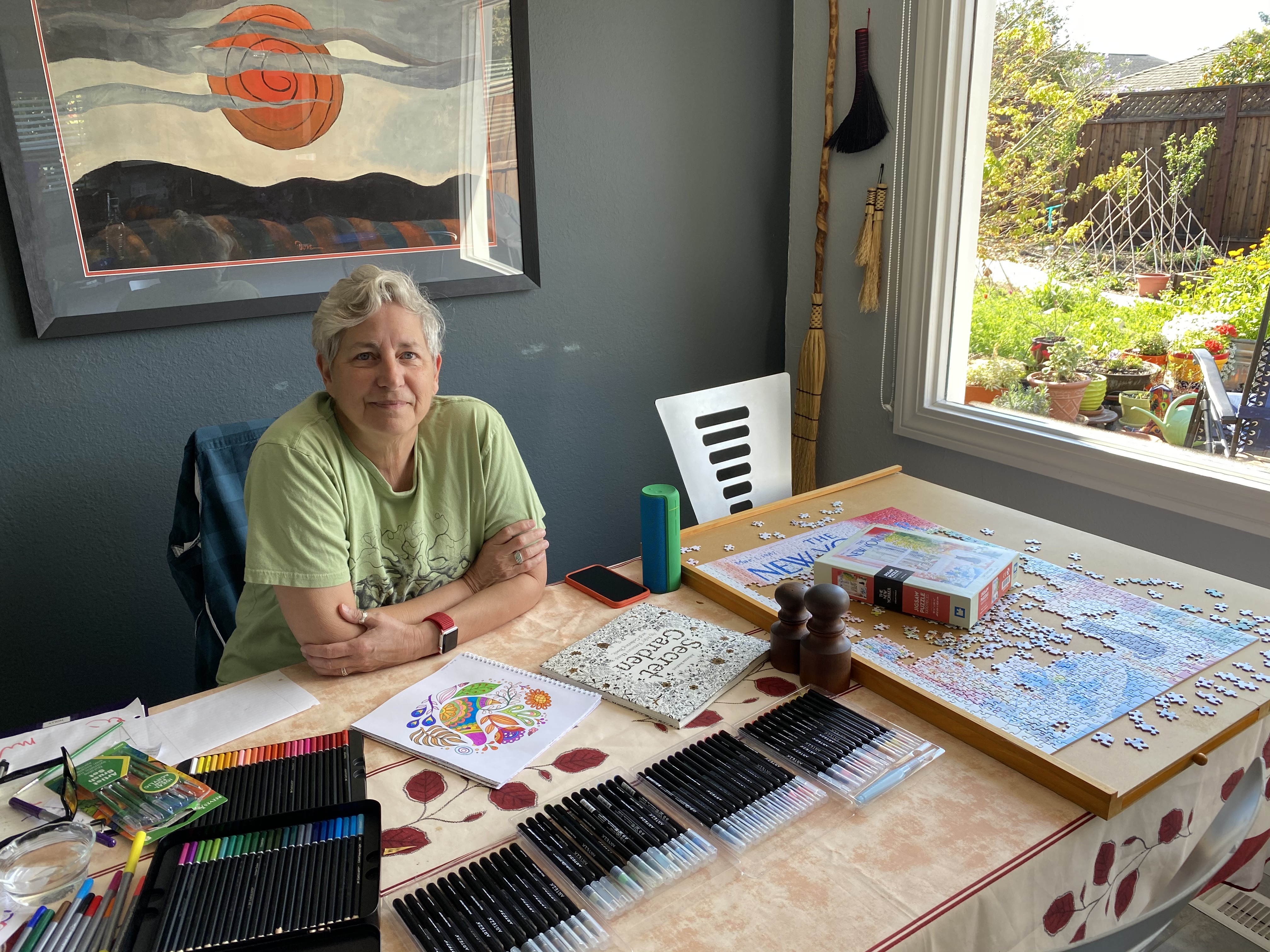
Our pandemic crafts table. Holly colors while I work on the puzzle
April 5, 2020
It’s been nearly four weeks since my spine surgery and I’m feeling ever so much better. I still spend many hours lying on my back listening to podcasts and novels on my phone, but I’ve been sitting up more, taking little walks and sitting in the sun in the garden. I’m not ready yet to be a planter. Holly is doing that. But I actually pulled some weeds yesterday. Like three weeds. Still it felt like one small step for woman.
Not yet up to gardening but I can watch my wife
Wearing my “cone of shame”
Here’s chapter three of my surgery story.
Our Oakland Adventure. March 11, 2020.
We planned to drive to Oakland the day before my surgery. Holly had reserved a motel room near Kaiser hospital where she could stay while I was recovering. I would be staying in the hospital for at least a couple of nights so Holly would have a place to park and a real bed within walking distance.
We thought we would probably have to be at the hospital at 6 AM. Isn’t that always the way it goes? But we found out the day before that we wouldn’t have to arrive till noon the day of surgery so we would have 24 hours in Oakland California. Just like in one of those travel magazines. In this case we would just experience the half mile around the Kaiser hospital. I resolved to be a tourist.
By this time the coronavirus was here in the Bay Area and we all knew it but there wasn’t a lockdown yet and, while some people were wearing masks on the street, most of us were not. We were just anxious. I had already been sheltering in place for the past month because I didn’t want to get any virus that would compromise my surgery.
Holly and Linda practicing social distancing in the front yard.
We ate dinner that night at a newish Mexican place just up from Kaiser on Piedmont Avenue, the upscale walking and shopping street. We tried to social distance by sitting in the outdoor patio area. It would be my last meal in a restaurant for weeks, maybe months (maybe years?).
At the corner of Piedmont and MacArthur waiting for the light to change a young Chinese man asked us a question. We didn’t understand and so had him repeat it.
“Are you lesbians?”
“Yes,” we said, a little surprised at the bold question.
Then he explained by telling a story about his grandmother and something about style or fashion.
“Is your grandmother a lesbian?”
No that wasn’t it. He smiled politely. We decided his grandmother likes lesbian fashion and style. She must be about our age—old. I imagined she must be in China. He knew English but his accent was so thick we couldn’t understand. We smiled as we parted, amused at our flannel shirt fashion plate status.
Kaiser hospital sits at the confluence of Broadway, MacArthur and Piedmont streets, a dividing line between two very different neighborhoods.
I have spent a lot of time on Piedmont Avenue because I often visit my friend Pat who lives near there. But I have never spent time on the MacArthur side. Our motel on MacArthur was only half a mile west of the hospital but a world apart from Piedmont on the east side with its restaurants, shops, movie theater, and sidewalks packed with pedestrians.
Our hospital hotel
Wide, commercial MacArthur had been known as a haven for hookers, and while we didn’t see a single hooker, we soon realized our hotel had been part of that scene. We could see it had undergone a recent renovation with new paint. But check-in was accomplished through a barred window.
Our room had a new paint job and the bed was perfectly comfortable. Yet the barred windows didn’t open. And we could see that the door had suffered a break-in. The card lock was secured on the inside with electrical tape. I tried to imagine what had prompted breaking down the door. Had someone died in there?
In the morning there was no coffee in the lobby. No lobby. We hiked the half-mile to the closest coffee shop, a Starbucks in the hospital, where we watched a diverse population of hospital workers come and go, start their shifts. Oakland Kaiser seemed endlessly interesting and we would get to know some of the staff in the coming days.
April 9, 2020
I can’t believe I’m on chapter 4 and I haven’t even gotten to the surgery yet. But this is it!
Many of the nurses at Kaiser were men. And the guy who was my pre-op nurse told me he had worked as an ironworker before studying to be a nurse. He worked in San Francisco, he said, before OSHA made you tie off when you walked on those big I-beams. Yeah, I thought. Working without safety measures. It’s a dick thing. Anyway I got all excited because he was a construction worker brother. I told him I had worked construction and I told him about the new ironworker union‘s pregnancy leave policy which we tradeswomen are all very proud of. That didn’t interest him and he showed his hand when he said, “Women were given all the easy jobs.” I told the story to another construction worker friend of mine, a sprinkler fitter, and she said, “Hell there are no easy jobs in the ironworkers. They’re all hard. That’s one of the hardest trades there is.” She had worked on some construction jobs with our friend Fran Kraus, one of the first women ironworkers. Fran was assigned to place and weld steel stairs, a job that requires smarts and precise planning. Few of the men were capable and that’s why they gave the job to Fran. Maybe they thought it was easy, but it was not. And I thought of a few women ironworkers I know who worked in San Francisco. None of them would’ve wanted easy work. It was bullshit, but I think typical of the prejudicial thinking of our male coworkers. Sigh.
I’d had my hair shaved into a cool newfangled cut right before I went into surgery but it wasn’t short enough. A woman came in to cut the back of my hair even shorter and she did a pretty good job. She shaved it right across the back from ear to ear and so now I have an even cooler haircut. Then I got the blue net over my head.
My radical new haircut
The surgery room was shining bright, full of stainless steel. Five or six gowned workers, including the surgeon Tim Huang, surrounded me with smiling faces. Whenever they come in to give you medication or do anything nurses and doctors always ask you your name and your birthdate. Well I can remember that but when they wheeled me into surgery they asked me my name, my birthdate and what operation I was getting. I was flummoxed. I have not even tried to memorize the medical description of my surgery. I said “neck” and they said that was good enough. And after that I don’t remember anything more.
Here is what the written operative procedures said: Cervical laminoplasty, 3 or more levels; Cervical posterior instrumentation, 2-5 levels; Cervical far lateral discectomy or foraminotomy, 2 levels; Cervical laminectomy for decompression, 2 levels. Now why wasn’t I able to remember that?






 tradeswomn musings