
After VE-Day they continue working

My Mother and Audie Murphy Ch. 72
At the end of the European war, a reporter interviewed the clubmobilers and filed this story, probably for an army publication like Stars and Stripes. It offers a clear summary of some of their toughest challenges and adds details we might not have known. We learn that the women once entered a town still held by the Germans and had to make a quick retreat, and that there were days when the boys refused to leave their foxholes for donuts because the shelling was too intense. The story describes the “Doggie Rest Camp,” where two men at a time were allowed to leave their positions long enough to grab donuts and wash up. And we learn that the clubmobilers visited army hospitals—with donuts of course.
Donut Gals Have Close Calls in Work
“Donuts for supper!” That’s the cry now, but at one time these same donuts had to be brought many miles over all sorts of situations. Then the cry was, “Donuts in the rations tonight!”
The Third Division Red Cross Clubmobile with its four occupants are as well known as the donuts, coffee, and cigarettes they bring. The “girls” have experienced many close escapes during their tour of duty with the division which dates back to the Italian days.
In the Colmar Pocket outside of Neuf-Brisach they volunteered to go on patrol on the Rhine with an artillery and mortar F.O. (field operations) party. “We all had a case of scratched knees, mud casts, and aching muscles after that,” said Miss Florence Wick, Yakima, Wash.
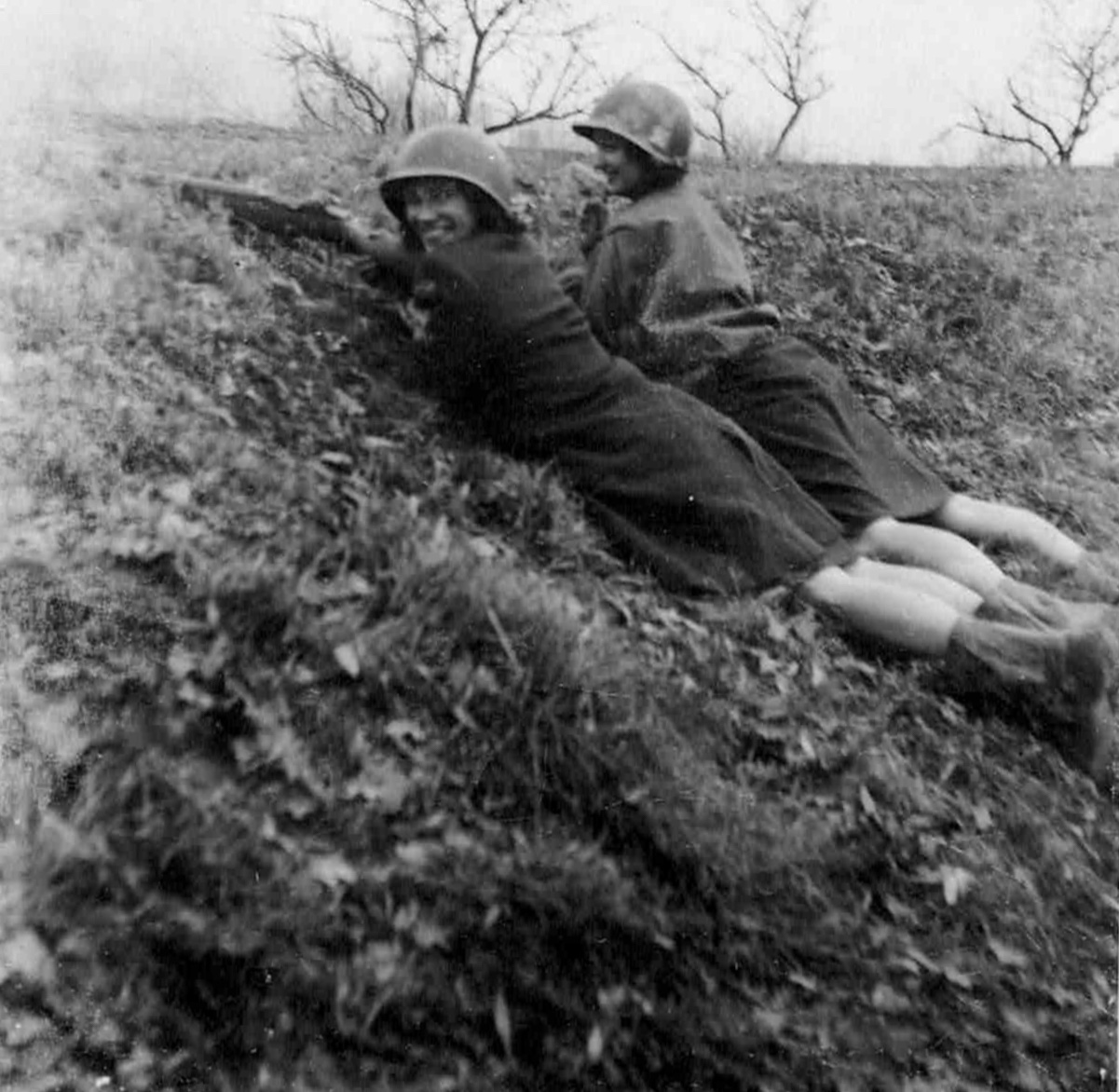
Still another time after they had sweated out the ride to the battalion CP (command post) the men refused to come out of their holes for donuts because of the heavy shelling.
Visit Kraut Town
It was during this trip while darting in and out of the smoke screen, that they went into a town that was ominously quiet. Recognizing the symptoms, they hastily parted company with the place. That afternoon they found out the town had just fallen.
When the Seventh was in Beblenheim, Alsace, the girls visited and fed a novel, so-called, “Doggie Rest Camp.” There two men at a time came in from their positions for a few minutes each to wash up, and put themselves in shape. They also visited the mortar OP (observation post), and threw a smoke screen from the sand-bagged position.
“The boys used to accuse us of always coming when they were moving out,” said Miss Janet Potts, NYC. “They were always on the move anyway!” chimed in Miss Elizabeth Elliot, NYC.
During the lightning dash through Southern France the girls really roughed it. They had no cover at all, and had to crawl under the tarpaulin that they used to cover the donut machine.
Visit Hospitals
After the Meurthe River crossing they went back to the hospital carrying their usual good cheer and inseparable trays of round, brown donuts with them, to see the men whose luck had not held out.
At one time they were confronted with mile after mile of mountains to accommodate the men, but they never missed once. Ask some of the “boys” as they call them—the proof is in the eating and they do mean donuts.
The quartet is not now up to combat strength as Miss “Fritzie” Haugland, Berkeley, Calif. Is hospitalized, but her three running mates are doing a fine job.
It is now possible to set a schedule and keep it without first having to wonder if the men will be there when they arrive. The next line that forms at the well known Clubmobile will get their donuts from the same smiling girls that brought them up under all the conditions imaginable before V-Day. They are just what their patch proclaims—part of the outfit.
Ch. 73: https://mollymartin.blog/2025/11/23/settled-in-salzberg/

 tradeswomn musings
Another very interesting account of life in WWII. Thanks for sharing this history with all. Minerva
>
LikeLiked by 1 person
It is incredible all that they endured in that time and place of war. And they kept on, and on, as long as the soldiers. They were, indeed, soldiers also. May I have their strength and determination if ever called upon. God bless these women and their descendants, too.
LikeLiked by 1 person