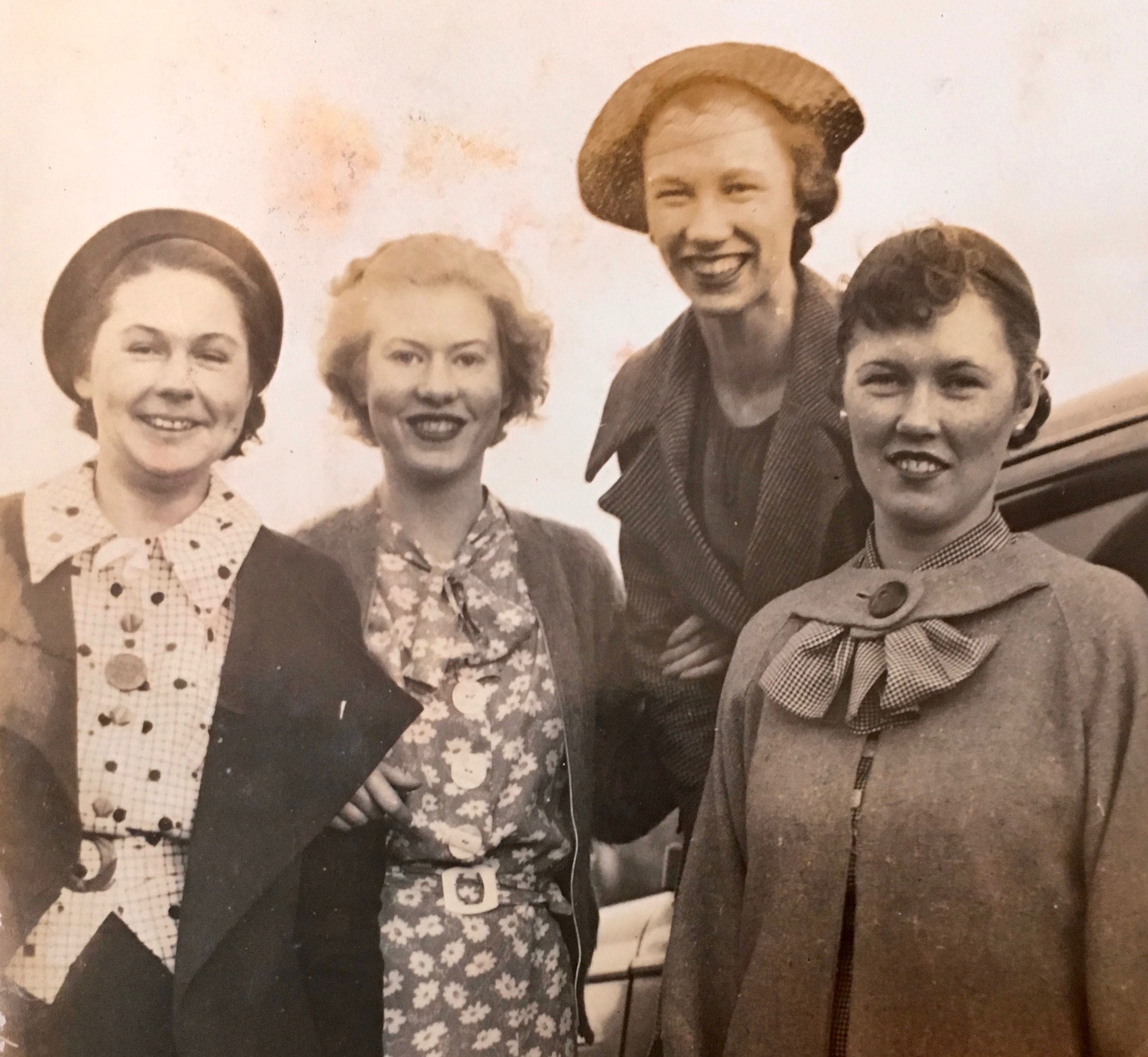
Breakfast at 16th Avenue July 27, 1938

Chapter Two

“Breakfast, girls,” called Gerda. She had already been out to open the chicken coop and the hens’ cluckings came through the open upstairs window. The smell of coffee boiling wafted up from the kitchen below where Gerda cooked breakfast on the wood-burning stove in the kitchen. Gerda always served coffee in the morning, and also as the Swedish custom, in mid-afternoon. This afternoon the coffee would be cooled with ice delivered weekly by the iceman. Betty and Flo made their way down the steep stairs.

The Wick family home on 16th Avenue So.

The family had taken out a mortgage for $3500 to buy the house on 16th Avenue South in 1921. It had been built by Gerda’s brother, Albin Lunstrum, who had brought his carpentry skills from Sweden. Most of the houses on Johnson’s Corner, the Swedish neighborhood, had been built by hand by Albin and his brother-in-law partner, Axel Jacobson. They were boxy two-story clapboard-clad frame houses with generous front porches, a popular style at the time. The family had come to Yakima after having failed at chicken farming near Roseburg, Oregon during WWI. When Ben was offered a teaching job at Yakima High School, Gerda was happy to join two sisters, two brothers and some cousins who had also immigrated from Sweden.

Ruth smiled good morning from her place at the dining room table which she had set for the family. She had fixed her light brown hair in a neat Marcel wave and she wore a floral cotton dress. Her well-scrubbed rosy cheeks shone with radiant good health.

“Don and I have set the date for our wedding,” she blurted. “I wanted to wait till you were all here to tell you. It will be August 30 at the Presbyterian Church. Of course I want my sisters to be bridesmaids.”

“Congratulations!” chorused her sisters, mother and father.

“Will there be time for Momma to make your dress?” asked Betty.

“Oh, I won’t need a dress. I can wear the suit she made me last year. It’s very stylish,” Ruth said.

“Gee, you’re in an awful hurry,” said Flo. “Where do you and Don plan to live?”

Ruth’s wedding announcement

“We’ll find an apartment in Yakima. Of course you know this is all your fault for introducing us.” Ruth was looking forward to having her own home, away from her bossy older sister.

Flo was happy for her sister, but worried about the family’s welfare. She silently calculated the loss of Ruth’s contribution to the mortgage payment. Ruth brought in $60 a month from her job and she could thank their father for that. He had rung doorbells for the Democrat running for county auditor who had won the seat in 1934 in the wake of FDR’s election two years before. Ruth got a patronage job and now she would lose it when she married. Women were expected to give up their jobs when they married and there were even laws prohibiting married women from working. She and Flo had paid the hospital bill for their father’s care after his coronary. If he ended up in the hospital again it would be all on Flo this time. Ruth would be a married woman starting her own family. At least with the vacated bedroom they would be able to house a boarder, thought Flo.

“Good morning Daddy. How are you feeling?” Flo bent to give her father a kiss on the cheek and a hug. At 58, Ben was looking old. His still abundant head of hair had turned from black to gray and his blue eyes seemed sunken.

“I’m feeling quite well today,” he answered. “Did you see that we got a letter from Eva yesterday? She says she’s doing well in her nursing program. I think my brother Erick’s loan to her was a good investment.” He had retrieved the morning Yakima Herald and was dividing the sections to be shared. Both Flo and Ben usually read a book or newspaper as they ate. For breakfast this day Gerda served homemade toast, boiled eggs she had collected from the little hen house and the first of the fresh apricots she had gleaned from the Pacific Fruit Packing Co. The canning season had begun and Gerda was preparing to get started on stone fruit. As hot as it was, this would still be a canning day. Gerda had procured boxes of culled apricots from her seasonal job as a fruit packer and they would spoil if held for processing. Apples, the primary crop of the Yakima Valley, did not ripen until the late fall.

Eva graduated from the nursing program at Swedish Hospital in Seattle

Flo scanned the front page. It seemed little news was good in this Depression year. Five of the Negroes who had been attacked earlier in the month by a mob of 200 whites in Wapato had filed a lawsuit against the local marshal, deputy marshal and the county sheriff for failure to enforce the law and protect them from the mob. (They would later lose in court.) The Anti-Japanese League, the American Legion and the Grange were still harassing Japanese farmers in the Lower Valley where they leased land on the Yakama Indian reservation.

“The American Legion is still trying to run the Japanese out of town,” said Flo. “No matter that they’ve been here longer than most of the Legionnaires.”

Abroad, Jews in Germany were being ordered to report to police to receive identification cards. The war in Spain continued, but, even with thousands of volunteers from around the world joining the Republicans to fight, Franco’s fascists were winning with Hitler’s help.

“Why won’t our government take a side in this war and send armaments?” asked Flo. “Can’t they see this is the ultimate fight for democracy?”

“I don’t think public opinion supports our intervention,” said Ben. “But that doesn’t mean it’s right.”

In Yakima, agriculture was always front-page news. The cherry crop, harvested in the first week of July, had been ruined by the hot weather.

“The farmers complain every year, no matter what the weather,” said Ben flatly. “It’s either too rainy in June or too hot in July.”

Orchardists and farmers nervously geared up for harvest season, hoping they would have enough migrant workers and that labor agitators demanding higher wages would stay out of the Valley. A strike by the Wobblies had been put down five years earlier and the stockade built to hold the strikers still stood downtown, daring any to stand up for better conditions in the fields and orchards. None had.

Farmers advertised for migrant labor and migrants traveled from Mexico and other states hoping to find work. They were housed in several labor camps called shacktowns. Some had tiny cottages built by the farmer. Others were built by the migrants themselves of scraps of wood and found materials. Growers did not want to let the migrants get too comfortable. They were urged to move on after harvest season.
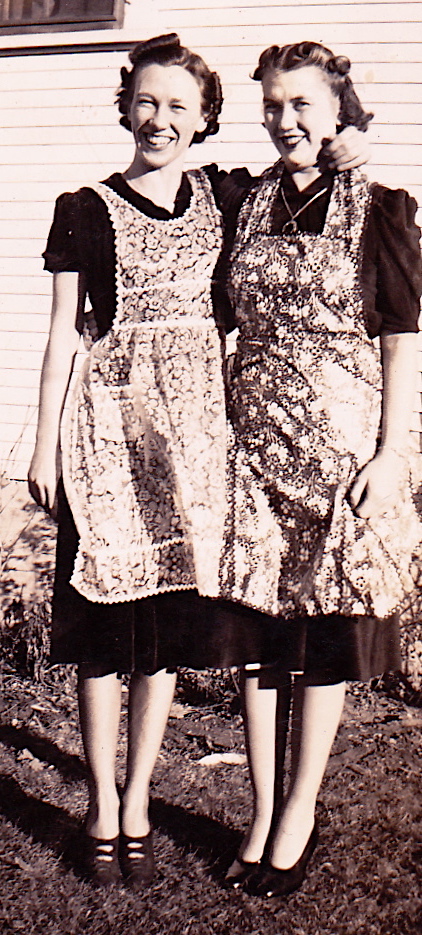
Sisters Flo and Betty

After breakfast Flo would drive the family Model A to work at the State Highway Department in Old Yakima several miles away, dropping off Ruth at the county offices downtown. Betty would take the streetcar to her part-time bookkeeping job at the butcher’s on the west side of town. Ben had a summer break from part-time teaching jobs. Gerda had arranged for her sister Anna to come over to help her can the apricots.

Flo slid into the driver’s seat and put on the horn-rimmed glasses that corrected her nearsightedness so she could see to drive. Girls with glasses were seen as bookish and unattractive, and she only wore them when absolutely necessary, never when her photograph was being taken.

Flo sometimes imagined that the four sisters were like the sisters in Louisa May Alcott’s Little Women, although the comparison didn’t altogether work. They had lost a sister to typhoid fever just as the March sisters had lost Beth to scarlet fever, but Elizabeth had died at seven, not 17, and that was 18 years ago now. The Wick sisters hadn’t written and produced plays like the March sisters had and they weren’t genteel poor like the Marchs, just plain poor. But Flo saw herself in Jo, the tomboy reader, writer and intellect of the four. She pushed against the constraints of gender and rejected the idea of romance and marriage just as Jo had in her youth. As the oldest sister after Elizabeth’s death, Flo saw herself as the family caretaker, not in the traditional female role, but as the wage earner who took over the father’s role after he had been laid off from his teaching job six years before. The school superintendent who laid him off seemed to think that Ben’s four daughters could support the family and Flo took up the challenge.

The Wick Family July 27, 1938

Chapter One

Dear Readers,

As I delved into my mom’s scrapbook from her time as a Red Cross “donut girl” in Europe during WWII, I began to wonder what motivated her to sign up for a job so close to the front lines in the war. What were Americans in small towns thinking about the wars in Europe and how were they affected? I was moved to look into my mother’s childhood and young adulthood in Yakima, Washington, and that research resulted in my last essay, Make America White Again, about the roots of racism in my hometown. I just read a fascinating book of creative nonfiction, We Were the Lucky Ones, by a young author, Georgia Hunter. It started as a blog about her Polish Jewish family and how they escaped the Holocaust during the war. That book inspired me to look deeper into my own family history.

So before I jump into WWII, I want to explore what my mother and her family’s lives were like as Europe was gearing up for war and the US was still stuck in the Great Depression. I chose to tell their story in one day, July 27, 1938, in five short chapters. Chapter One follows.

A Day in the Life of the Wick Family

July 27, 1938 started out hot and it just got hotter. Flo and her younger sister Betty had left the window in their upstairs room open all night but when the alarm woke them the room was still hot.

­Flo had come in late the night before after Betty was asleep. When they were both awake she confronted her sister.

“Where were you yesterday? I came by the butcher’s to see if you wanted a ride home after work. Were you with Cecil?”

Betty’s face reddened. “Well….”

“He’s a married older man, Betty. He will destroy your reputation.”

“There is nothing going on between us. He just likes my company and he gives me things. Look what he gave me.” Betty opened a small box to reveal a gold necklace.

“This is terrible,” rasped Flo. “You must never accept these things from him. Return it to him and hope Mama never sees it.”

“But I don’t want to give it back,” complained Betty. “Look, here’s proof I’m a good girl.” She pulled from a large envelope a certificate signed with three names. It was titled The Senior High Society of Christian Endeavor DIPLOMA and it certified that “Betty Wick has for three years been a member of the above mentioned society of the First Presbyterian Church of Yakima, Washington, and that now she is affectionately graduated and earnestly commended to the Young Peoples Society of Christian Endeavor.” It had the gold corporate seal of the church with a red and a white ribbon pasted on.PresbyCert

“I’m sorry,” said Flo, gently putting a hand on Betty’s shoulder. “You must return the necklace. Tell Cecil your family says these gifts are not proper.”

Flo did not know what to do with her younger sister who, at only 16, seemed so very different from herself. But she loved her dearly and put some effort into protecting her from their mother’s wrath. Their Swedish mother, Gerda, had early on been influenced by her own sister Ellen who had joined the Pentecostal church and who believed that movies, dancing, playing cards and makeup were deadly sins. Flo and Ruth, the oldest sisters, had been most affected by their mother’s religious piety, which forced them as teenagers to lie about attending movies and to wipe off makeup before going home. By the time the youngest sister, Betty, came along, Gerda’s strict rules had relaxed but she still expected rigorous moral standards to be met.

The sisters each had their own bed ever since their two other sisters, Ruth and Eve, had taken live-in housekeeper jobs. Ruth had recently returned to the family home when she got a job as a stenographer. She now slept in one of the downstairs bedrooms. Betty, who was still in high school, had shared a bed with Eve as a child and Flo and Ruth had slept together. As kids, the four sisters had all shared the one big attic room accessed by a narrow unlit stairway from the kitchen. Gerda, a master of many skills, had hung cheery yellow flowered wallpaper, painted the fir floor a dark red and made a braided oval rug from scraps of wool left over from old clothes people had given her. One light bulb hung from the ceiling in the middle of the room. It cast light through the window into the yard at night indicating that Flo was reading instead of sleeping. Their father, Ben, would see it and call up the stairs, “Turn off the light.” Sometimes she did, recalled Ruth.

Neither sister wanted to get up. Betty liked to sleep in whenever possible, but that was rarely allowed in this household where early-to-rise was the rule. Each had her chores, although Flo, now the main breadwinner in the family, was exempt from most household chores. Gerda took care of the cooking and canning, shopping, washing, ironing, sewing and knitting of clothes, gardening and cleaning, with some help from the girls. Ben was still recuperating from a serious heart attack, which had landed him in the hospital a couple of months before.

The sisters took turns using the indoor toilet and sink in the downstairs bathroom where they also dumped their chamber pots. Bath day was Saturday and all family members used the same water from the little tank in the kitchen heated by the wood stove. The youngest went first with poor Dad last. Sponge baths at the sink supplemented bath day during the week.

Flo was feeling sticky and grimy on this Wednesday. To make matters worse, she saw blood in the toilet. Her period had started, which meant she’d be in pain with cramps for the next couple of days. She found the bottle of aspirin in the medicine cabinet above the sink and swallowed two pills, taking the bottle with her. At least she didn’t have to wear rags as she had when her periods had first begun, but Kotex pads were just one more expense to deduct from a tight budget. She found the box of Kotex hidden behind folded towels in the linen cabinet and took several to hide in her bag to take to work, making sure she was not seen. Menstruation was something to be hidden and not talked about, except with her sisters.

Flo was glad for the family’s indoor bathroom and running water. In their last home on the chicken farm in Meadowview, Oregon, they’d had only an outdoor privy with a Sears catalog for toilet paper and a water pump near the back porch. She returned to the bedroom to dress.

Sorority sisters (Flo and Ruth at right)

“How was your gathering last night?” asked Betty.

“It was great fun. We took the potluck out to Mrs. May’s lawn. We’re planning for the summer party next weekend up in Naches.”

Flo had been out the night before with her sorority sisters at their bi-monthly meeting. She had pledged the working girls sorority, Epsilon Sigma Alpha, in 1933 and become the chapter president in 1936, organizing the social outings as well as discussion groups and business meetings. She was now a central person in the sorority and in the Business and Professional Women’s group, representing them at conferences around the state and at national events. She was a busy woman, working 44 hours a week as a stenographer as well as spending many hours doing organizational work and singing in the Presbyterian church choir.

Flo pulled newly bought cotton underwear from their shared dresser. Since she had been working she’d been able to afford her own underwear and some clothing, although Gerda sewed most of her wardrobe. Betty still wore the underwear Gerda had made from bleached flour sacks—crude brassieres, underpants and garter belts.

Flo picked out a white cotton blouse and darker-colored mid-calf cotton skirt to wear to work. It would be hot in the State Highway Department office too. As she rolled on rayon stockings to her knees, she thought about their father, whose health had been poor for the past several years. He had gone back to working as a bookkeeper and part-time teacher after his heart attack because the family needed his income. During her school summer vacation Betty had been helping him with the bookkeeping job at a butcher shop. Flo wished he didn’t have to work at all.ShoeSlogan

Their wardrobes may have been skimpy but the one thing the sisters had plenty of was shoes. Flo loved shoes that showed off her shapely ankles and legs. The year before, she had won a year’s supply of shoes for a slogan she had composed for Fashion Week. Her winning slogan, out of 40,000 entries, read: “I like Paris Fashion shoes because…their smartness and quality make feet fashionably well-shod and comfortable….Their reasonable price keeps them within my budget…yet does not cramp their style.” She had allowed Betty to pick out one pair of the eight she had won and the shoes still graced their shared closet. Flo was always submitting essays, ditties and slogans to contests, and she seemed to win most of them. The year’s supply of shoes was the prize she was most proud of.

As they each combed and shaped their short dark hair into place before their shared mirror, Betty tapped Flo’s arm. “What’s eating you, sis?”

“Oh, I’m just worrying about Dad. I know he says he feels better but he seems so fragile since his heart attack.”

“Well worrying won’t get you anywhere. Let’s put on a happy face for him.”

Chapter Two: https://mollymartin.blog/2017/03/15/breakfast-at-16th-avenue-july-27-1938/