
A Summer Solstice Walk Around Mt. Tamalpais
When I learned about the quarterly circumambulation of Mt. Tamalpais, I pledged to complete it for the summer solstice. A sister hiker, Dolores, agreed to join me.
The practice was begun in 1965 by poets Gary Snyder, Allen Ginsberg and Philip Whalen–a ritualized walking meditation around Mt. Tam. Following the traditional clockwise direction, they selected notable natural features along the way, performing Buddhist and Hindu chants, spells, sutras, and vows at each stop.
There are two walks, the longer one is 17 miles, the shorter 6.2 miles. At 89, Dolores was the oldest hiker, and I at 74 was likely the second oldest. We chose the shorter walk.
We met up at Rock Spring with about 40 long hikers, who had started earlier in the morning at Muir Woods. The temperature was a warm 74 degrees. Fog was coming in from the ocean down below us.
The short walkers join the long walkers for three of the nine stations. Our first stop was the serpentine rocks overlooking the ocean and the Golden Gate, where participants joined in ceremonial readings.


Ascending the serpentine hill; Leader Gifford Hartman reads a Gary Snyder poem to the group
In a poem, Gary Snyder advises us to learn the flowers. On this walk we did our best, focusing especially on native plants.
Few plants can grow in serpentine soil because of its high levels of toxic heavy metals, and low levels of water and nutrients. But a few plants have adapted to serpentine. Some grow right out of the rock.


Native buckwheat (Eriogonum luteolum), native cobweb thistle (Cirsium occidentale) and fog
Next we hiked on to Potrero Meadows for lunch and more readings. One hiker composed limericks just for us. Snyder envisioned the circumambulation as a joyful, creative endeavor, encouraging participants to be imaginative. He emphasized the importance of paying attention to the surroundings and oneself: “The main thing is to pay your regards, to play, to engage, to stop and pay attention. It’s just a way of stopping and looking — at yourself too.”


Walkers gathering at Potrero Meadow. In this area is mostly a Douglas fir, live oak and Bay laurel forest
Hiking through the Bay laurel leaves gave off a wonderful pungent menthol-like fragrance.


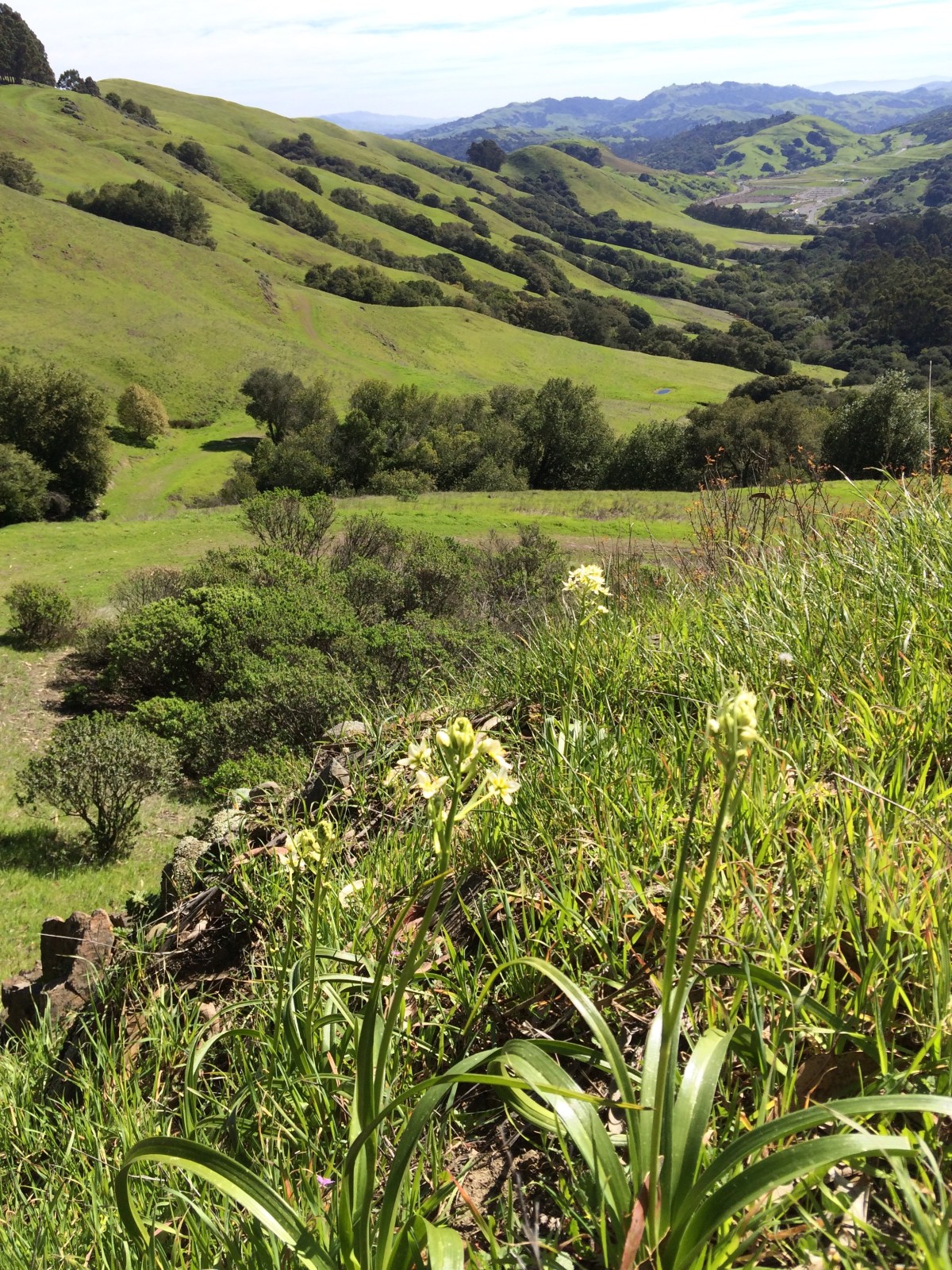
Watching for ticks in the meadow; native Mariposa lilies (Calochortus) and Ithuriel’s spear (Triteleia laxa) peeking out of the tall grass
Our next station was the serpentine cairn. We circumambulated the cairn, each tossing a stone upon it and chanting Women Life Freedom. Zan, Zendigi, Azadi.
The chant was led by an Iranian-American woman. The spark for this chant and an uprising of Iranian women was the death of Mahsa Amini, a young Kurdish woman who died after being detained by Iran’s morality police for “improper hijab.”
For me this was the highlight of our trip. I was delighted to be led in this chant, joining Iranian women who have been risking their lives to protest for women’s rights and equality.


Dolores and the cairn (L); a closer look at the green serpentine rock
After that Dolores and I and three others went our own way, leaving the large group behind. We headed along the International trail toward the West Point Inn where I hoped to score a cold drink and maybe a popsicle.


California hedge nettle (Stachys bullata); Tanoak (Notholithocarpus densiflorus)
We saw lots of tan oak, the tree that has been devastated by sudden oak death (SOD). This species seems to be recovering. Soon the younger hikers walked on ahead of us. No problem we said. We have maps! Dolores and I continued together.


Me on the trail to the east slope; native chamise (Adenostoma fasciculatum) in bloom
We entered a plant community of chaparral, characterized by manzanita and scrub oak. Many of the native wildflowers had bloomed, but we found a few late bloomers.


Dolores with wooly sunflower (Eriophyllum lanatum), sticky monkeyflower (mimulus), lupine (Lupinus chamissonis)
Coming around to the east side of Tam we were treated to spectacular views of the Bay Area.

Looking toward Mt. Diablo (L) we could see smoke from north bay fires blowing into the Napa Valley. The city of Oakland on the far right.
More blooming plants greeted us.


Toyon (Heteromeles arbutifolia), mountain coyote mint (Monardella odoratissima)
I couldn’t stop taking pictures of the view.

The skyscapers of San Francisco appear above the fog right of center.
We’d been so looking forward to a rest stop at the West Point Inn but it was closed for a huge renovation. Some bikers and hikers hung around and we were able to refill water bottles from a spigot.


Built in 1904, it was once a stop on the Mill Valley and Mt. Tamalpais Scenic Railway.
From Old Railroad Grade we headed down the Rock Spring Trail to our starting point at Rock Spring, the final leg of our journey.


California aralia, the only member of the ginseng family native to California; Yerba Santa (Eriodictyon)
We were happy not to have to compete with bikes or horses on this trail.


Sign on the Rock Spring trail, Coast silk tassel (Garrya elliptica)
We knew we were close to the end of our circumTambulation when we came to the Mountain amphitheater, the 4,000-seat open air theater opened in 1913. This is the venue for the annual Mountain Play. Structures for this year’s play, Kinky Boots, were being struck. We were beat!


The Mountain Theater seats, taking a break near the end
Back on the road we got a bit lost. Which way to Rock Spring? We flagged down a passing car. Take that trail right there said the occupants. They were two of the young 17-mile circumabulators, already finished with their long walk!
We might have been slower but we made it!


 tradeswomn musings