Crossed Off

Welcome to the Face Plant Club
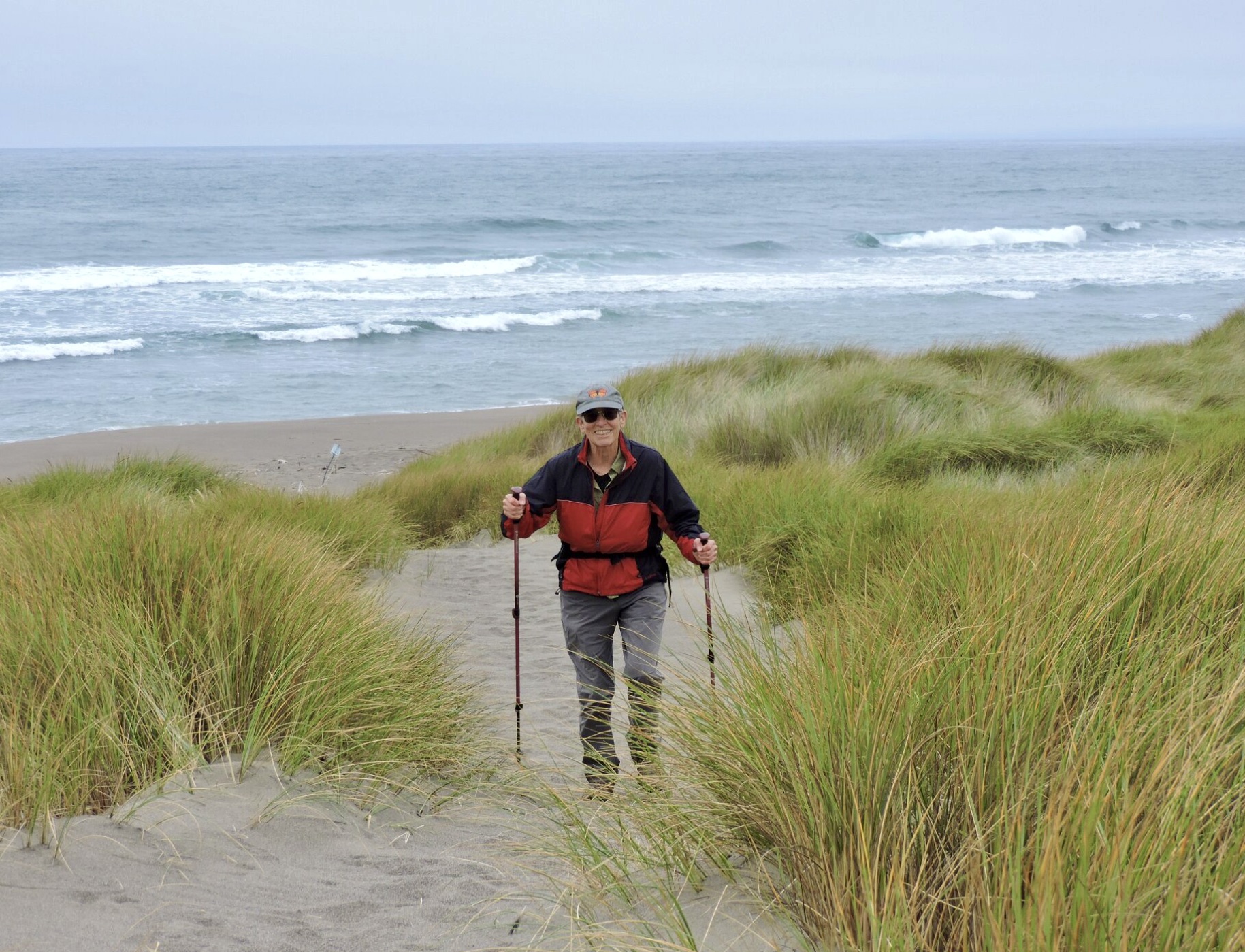
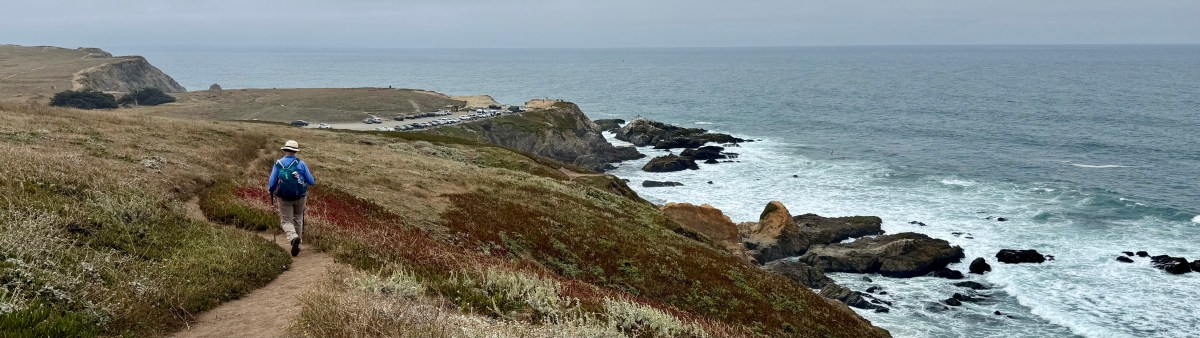
I’m illustrating this essay with pictures of a hike this week across the Bodega Dunes to Bodega Head.  This is a unique ecosystem with cool native plants. Photo of me by Joe Tenn.

It was humiliating.

A friend texted and asked if she could come over to talk about the horse-packing trip we were planning. I assumed she wanted to discuss food, gear, or transportation. She had already added me to the group, and I was thrilled at the thought of getting back into the Sierra backcountry.

Instead, she came to ask me to withdraw.

She explained that she thought I represented a falling hazard. What if I fell and injured myself? What if the group had to call in a helicopter? I would ruin the trip, she said, and she would spend the entire week worrying about me.
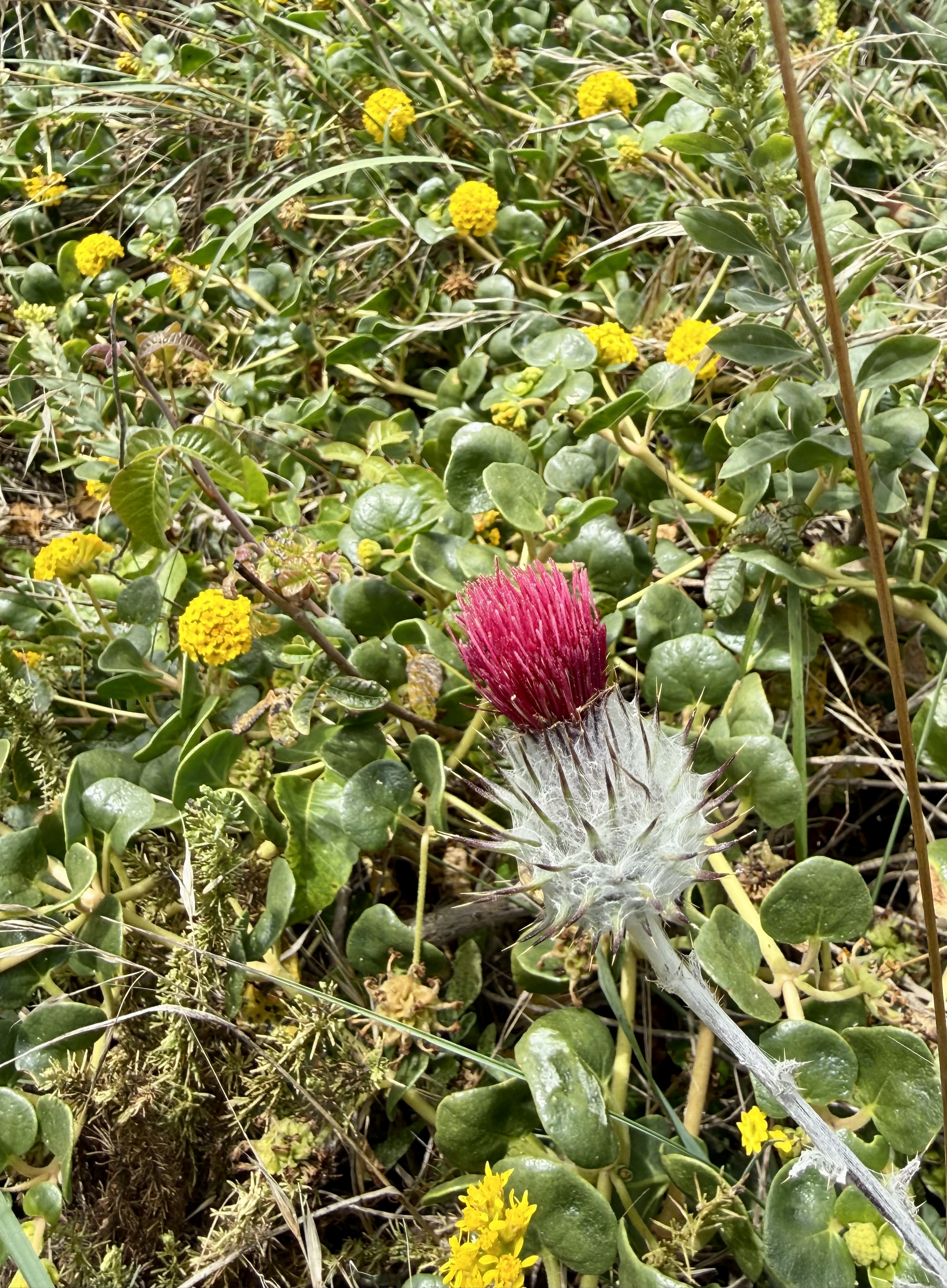
Our native cobweb thistle with yellow sand verbena

I sat there stunned. I couldn’t believe this was how she saw me.

It couldn’t have been easy for her to come to my house and have this conversation. We aren’t close friends, but we’re neighbors who hike with the same club. She wasn’t trying to be cruel. She was trying to prevent what she imagined could become a disaster.

True, I’d taken a bad fall stepping onto my deck a couple of months earlier and injured my ankle. I blame thick-soled flip-flops. Years before, I’d tripped over a root and landed flat on my face during a hike. My companions shrugged it off. “Welcome to the face-plant club,” they said. “It happens to all of us.”

Since then I’ve become a much more careful hiker. I switched to two trekking poles. I stop before taking a picture or removing a jacket instead of trying to multitask. I’ve even taken classes on how to fall safely. Every setback has taught me something.

My friend asked what I was doing to recover from my ankle injury. Had I added balance exercises to my daily routine? Did I do squats? Stand on one foot while brushing my teeth?

As if, after living seventy-seven years, I had somehow never heard this advice.
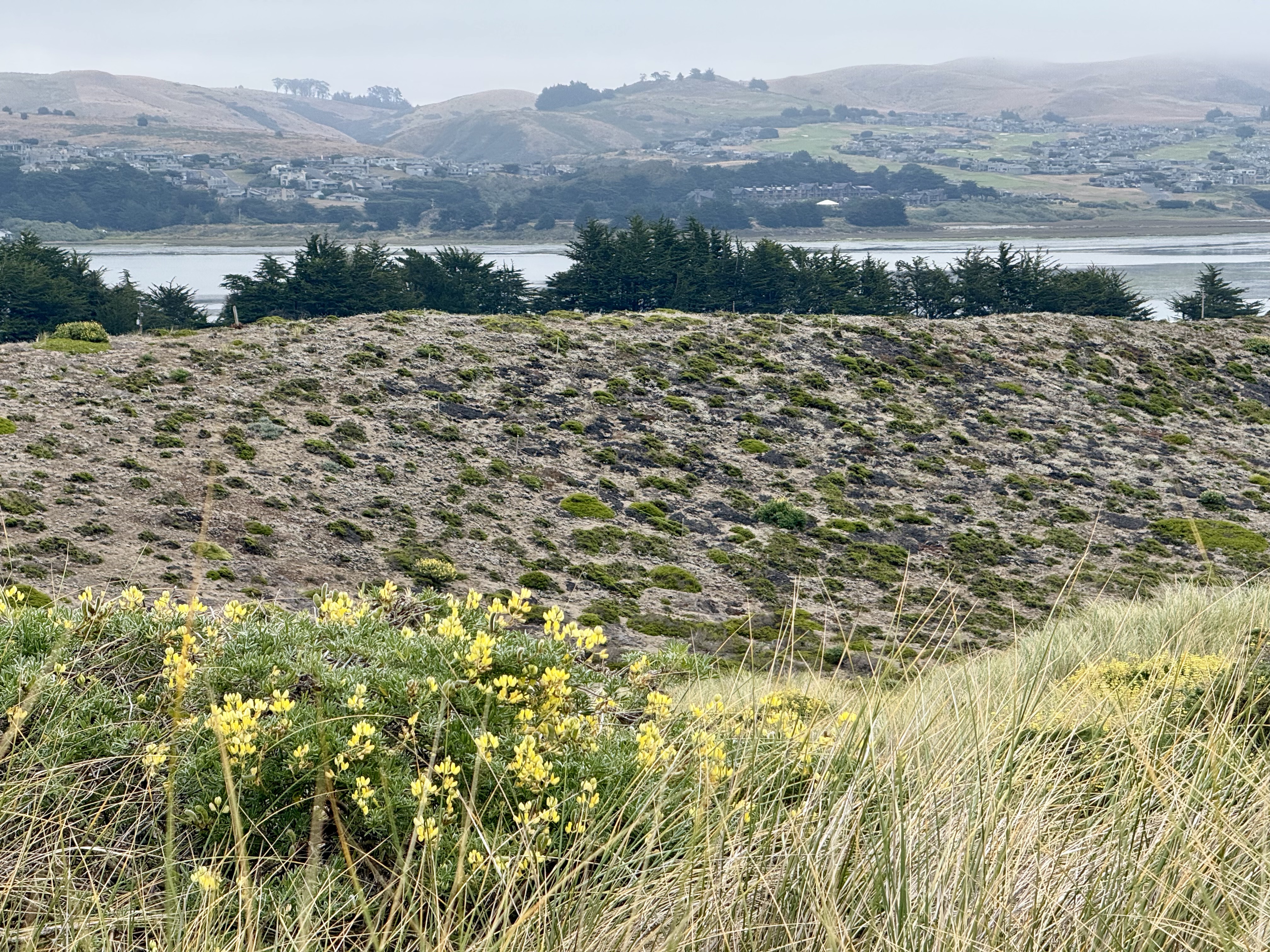
The yellow bush lupine was in bloom. Looking across Bodega Bay at the town of Bodega.

The irony is that I walk really well. I hike several miles almost every day with different hiking groups. Sonoma County is filled with wonderful trails through state and county parks and protected open spaces, and I rarely miss a chance to explore them. The longest hike on this Sierra trip would have been seven miles—a distance I cover routinely.

What I can’t do anymore is backpack. After two back surgeries, I know I can’t carry a heavy pack for days. That’s why this horse-packing trip appealed to me so much. The horses would carry the gear, leaving me free to hike.

I told her I wasn’t ready to resign from the trip. I felt strong and capable.
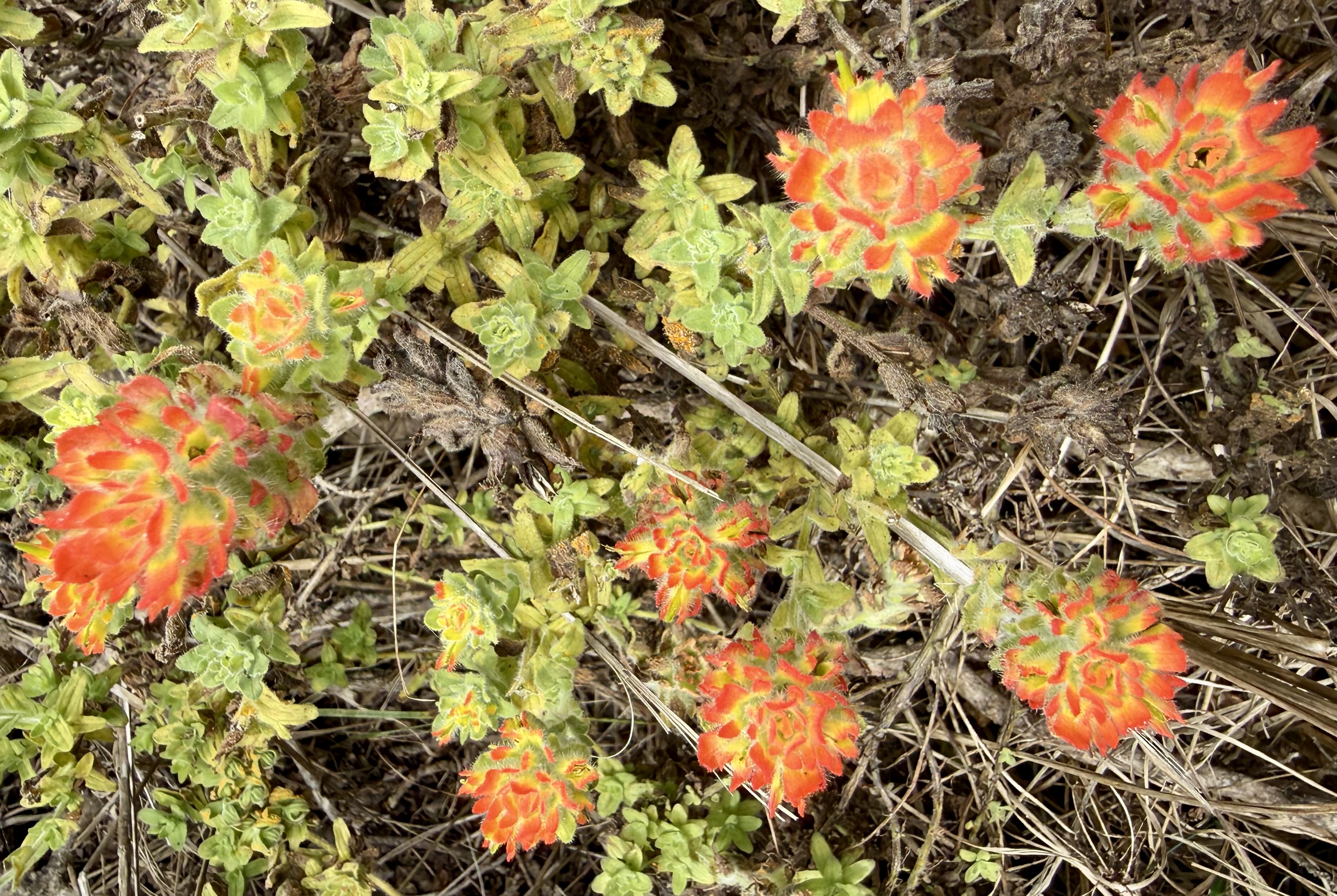
Coast paintbrush

At first I was angry that she’d invited me and then, in effect, uninvited me. But as my anger faded, I began wondering how she had come to see me this way. As I write this, I realize I played a part in creating the image she has of me.

Among my hiking friends—especially the women my age—we talk openly about our health. Who’s taking Fosamax? Who opted for the Reclast infusion? (I did both). We compare bone scans, surgeries, aches, and physical therapy.

I’ve talked about my osteoporosis diagnosis and my back surgeries. At one point I joked, “It seems like my spine is crumbling.”

More recently, though, a bone-density scan upgraded me from severe osteoporosis to osteopenia. Had my doctor exaggerated my diagnosis to persuade me to take medication?

Perhaps I’d spent too much time talking about what was wrong with me and not enough time showing people everything that was still right.
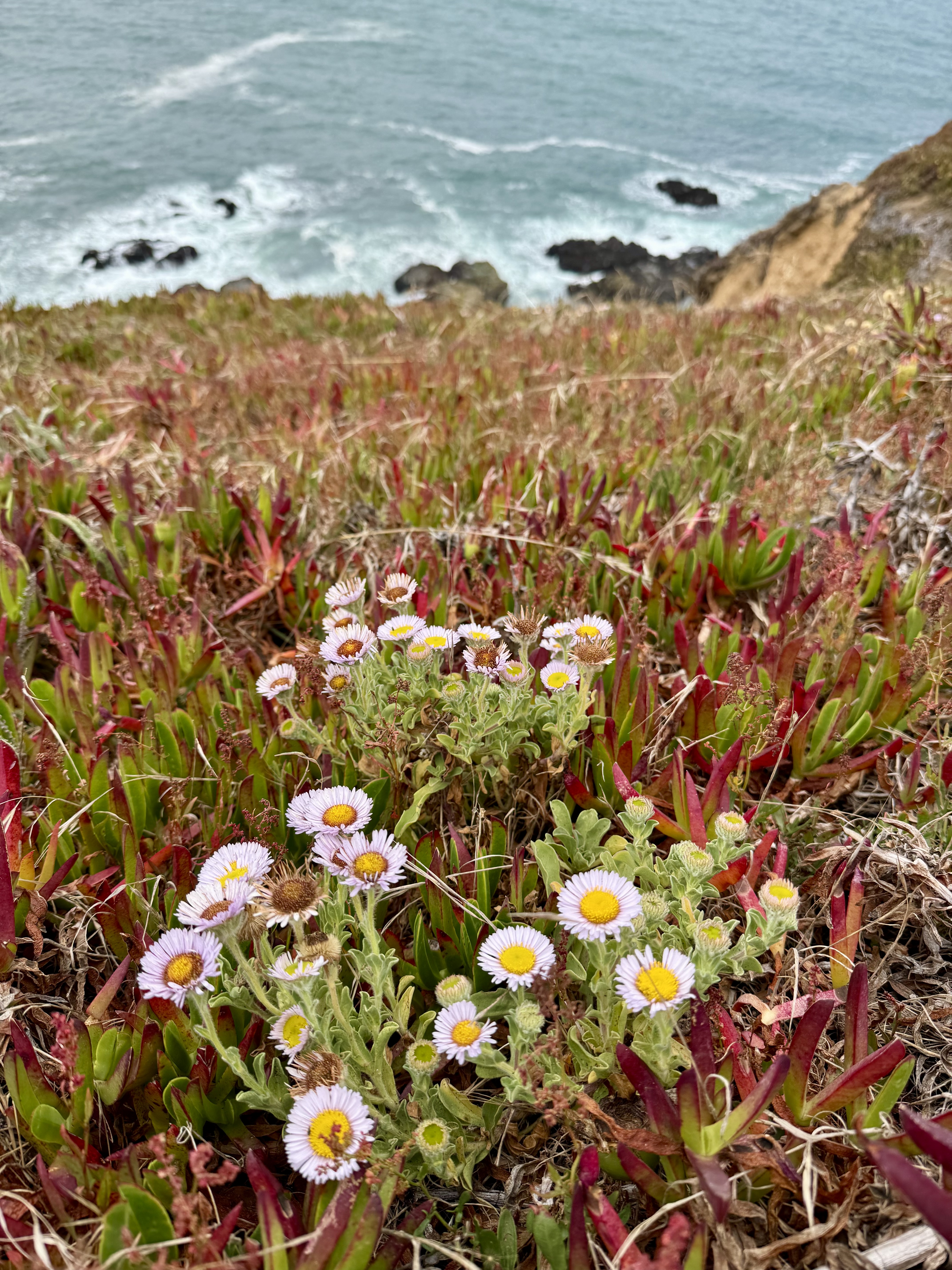
Native beach aster and invasive ice plant. Volunteers are working at removing the ice plant.

The next day I texted my friend and withdrew.

What changed my mind wasn’t that I’d suddenly decided she was right. It was that I realized her anxiety would poison the trip for both of us. Even if I hiked every mile without incident, she’d spend the week worrying, and I’d spend it wondering whether every stumble or awkward step was confirming her fears.

That wouldn’t be much fun for either of us.

I’m deeply disappointed not to be going into the Sierra backcountry. More painful still is the realization that perhaps I’ll never get there again. Growing older means slowly crossing things off the list of what you can still do. Sometimes you choose to cross them off. Sometimes someone else does it for you.

Russian thistle with native bumble bee and yellow lupine

After I’d withdrawn, I wrote to her:

“I think what makes me saddest is that somehow I’ve made you think I’m an unsafe, incompetent hiker who is likely to ruin a trip. I don’t see myself that way, and I don’t think others do either. I only ask that you not promote that image of me to the other hikers. If you need an explanation for why I didn’t come, you can simply mention my ankle injury.”

She replied, “I’m feeling your sadness and feeling sad too. I appreciate your generosity in letting go. I do tend to be a worrier sometimes. Hard to say whether my worry or your optimism was more accurate.”
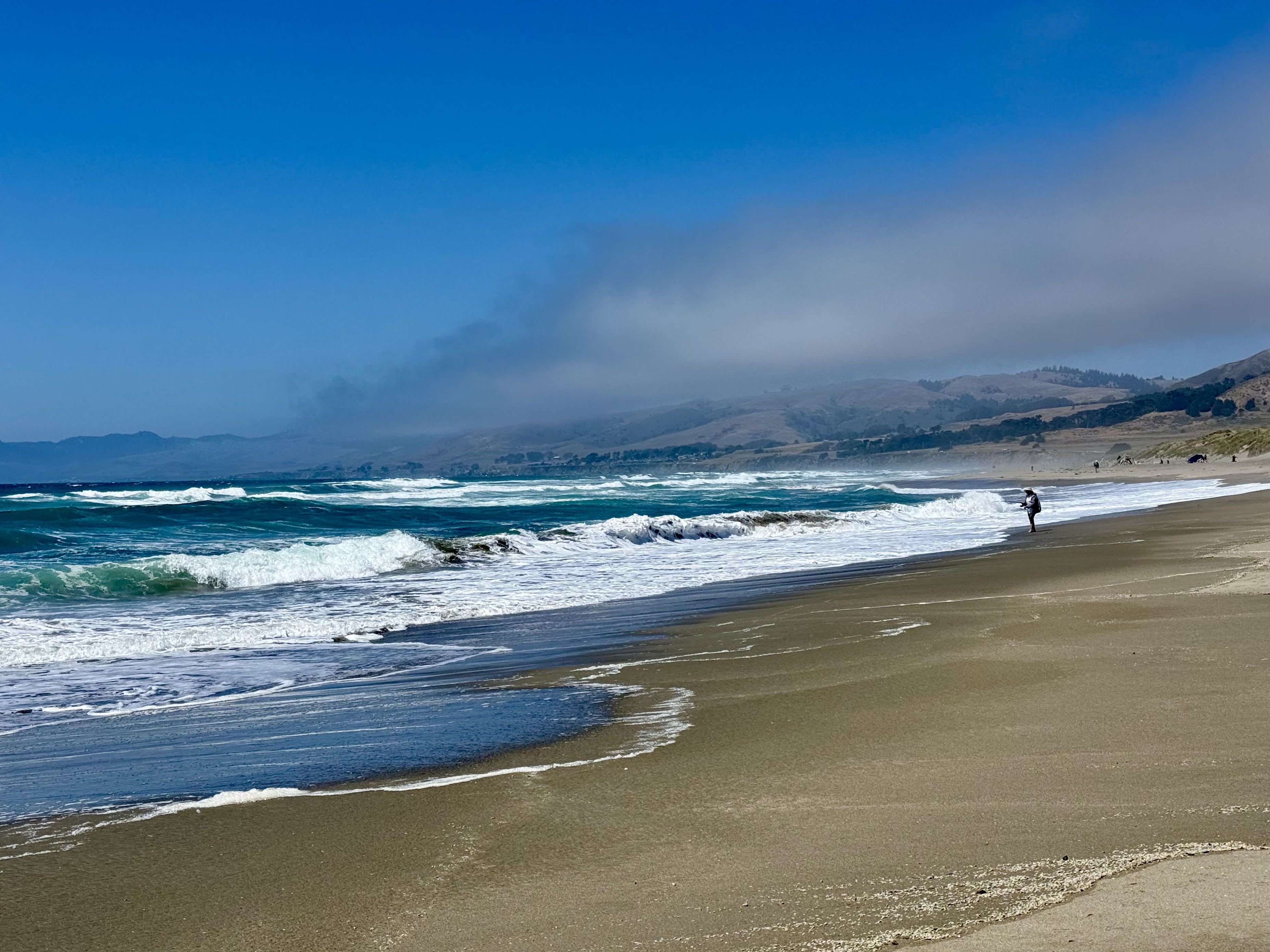
On the way back hiking up Salmon Creek Beach we encountered fishers.

I’ve thought a lot about what happened.

What we tell people about ourselves shapes how they see us. Repeated often enough, stories about our illnesses and injuries can become our identity in someone else’s mind.

There is a difference between acknowledging our limitations and allowing them to define us.

I don’t intend to pretend I’m younger than I am. My back has been operated on twice. My bones aren’t what they once were. I have fallen.

But I’m also someone who hikes almost every day, who loves being outdoors, and who still thinks of herself as capable.

Maybe the lesson isn’t to stop talking about my health.

Maybe it’s to make sure that’s not the only story I tell.
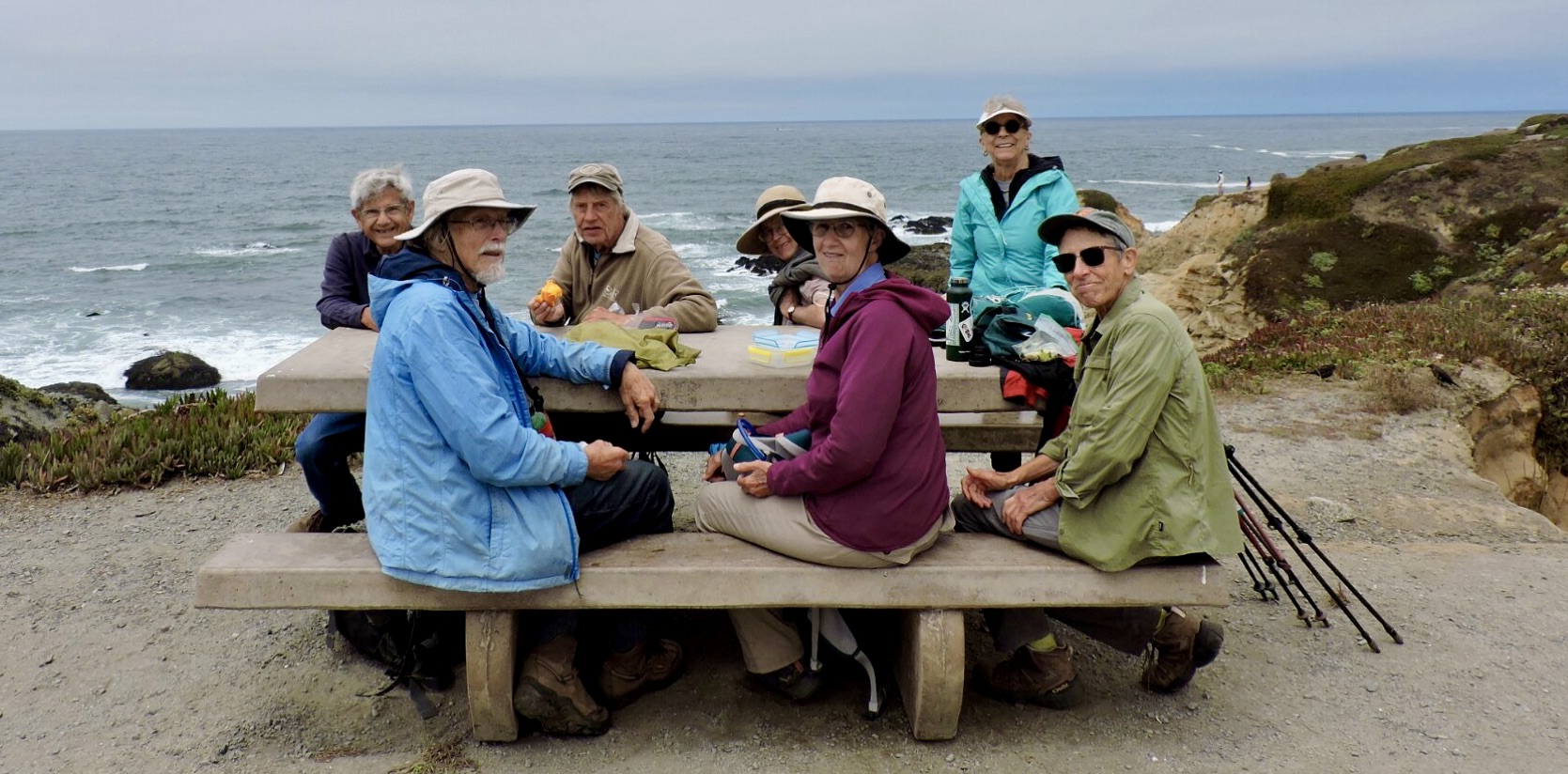
Lunch at Bodega Head with my hiking buddies. 7.3 miles out and back.

CircumTambulation Complete!

A Summer Solstice Walk Around Mt. Tamalpais

When I learned about the quarterly circumambulation of Mt. Tamalpais, I pledged to complete it for the summer solstice. A sister hiker, Dolores, agreed to join me.

The practice was begun in 1965 by poets Gary Snyder, Allen Ginsberg and Philip Whalen–a ritualized walking meditation around Mt. Tam. Following the traditional clockwise direction, they selected notable natural features along the way, performing Buddhist and Hindu chants, spells, sutras, and vows at each stop.

There are two walks, the longer one is 17 miles, the shorter 6.2 miles. At 89, Dolores was the oldest hiker, and I at 74 was likely the second oldest. We chose the shorter walk.

We met up at Rock Spring with about 40 long hikers, who had started earlier in the morning at Muir Woods. The temperature was a warm 74 degrees. Fog was coming in from the ocean down below us.

The short walkers join the long walkers for three of the nine stations. Our first stop was the serpentine rocks overlooking the ocean and the Golden Gate, where participants joined in ceremonial readings.

Ascending the serpentine hill; Leader Gifford Hartman reads a Gary Snyder poem to the group

In a poem, Gary Snyder advises us to learn the flowers. On this walk we did our best, focusing especially on native plants.

Few plants can grow in serpentine soil because of its high levels of toxic heavy metals, and low levels of water and nutrients. But a few plants have adapted to serpentine. Some grow right out of the rock.

Native buckwheat (Eriogonum luteolum), native cobweb thistle (Cirsium occidentale) and fog

Next we hiked on to Potrero Meadows for lunch and more readings. One hiker composed limericks just for us. Snyder envisioned the circumambulation as a joyful, creative endeavor, encouraging participants to be imaginative. He emphasized the importance of paying attention to the surroundings and oneself: “The main thing is to pay your regards, to play, to engage, to stop and pay attention. It’s just a way of stopping and looking — at yourself too.”

Walkers gathering at Potrero Meadow. In this area is mostly a Douglas fir, live oak and Bay laurel forest

Hiking through the Bay laurel leaves gave off a wonderful pungent menthol-like fragrance.

Watching for ticks in the meadow; native Mariposa lilies (Calochortus) and Ithuriel’s spear (Triteleia laxa) peeking out of the tall grass

Our next station was the serpentine cairn. We circumambulated the cairn, each tossing a stone upon it and chanting Women Life Freedom. Zan, Zendigi, Azadi.  

The chant was led by an Iranian-American woman. The spark for this chant and an uprising of Iranian women was the death of Mahsa Amini, a young Kurdish woman who died after being detained by Iran’s morality police for “improper hijab.”

For me this was the highlight of our trip. I was delighted to be led in this chant, joining Iranian women who have been risking their lives to protest for women’s rights and equality.

Dolores and the cairn (L); a closer look at the green serpentine rock

After that Dolores and I and three others went our own way, leaving the large group behind. We headed along the International trail toward the West Point Inn where I hoped to score a cold drink and maybe a popsicle.

California hedge nettle (Stachys bullata); Tanoak (Notholithocarpus densiflorus)

We saw lots of tan oak, the tree that has been devastated by sudden oak death (SOD). This species seems to be recovering. Soon the younger hikers walked on ahead of us. No problem we said. We have maps! Dolores and I continued together.

Me on the trail to the east slope; native chamise (Adenostoma fasciculatum) in bloom

We entered a plant community of chaparral, characterized by manzanita and scrub oak. Many of the native wildflowers had bloomed, but we found a few late bloomers.

Dolores with wooly sunflower (Eriophyllum lanatum), sticky monkeyflower (mimulus), lupine (Lupinus chamissonis)

Coming around to the east side of Tam we were treated to spectacular views of the Bay Area.

Looking toward Mt. Diablo (L) we could see smoke from north bay fires blowing into the Napa Valley. The city of Oakland on the far right.

More blooming plants greeted us.

Toyon (Heteromeles arbutifolia), mountain coyote mint (Monardella odoratissima)

I couldn’t stop taking pictures of the view.

The skyscapers of San Francisco appear above the fog right of center.

We’d been so looking forward to a rest stop at the West Point Inn but it was closed for a huge renovation. Some bikers and hikers hung around and we were able to refill water bottles from a spigot.

Built in 1904, it was once a stop on the Mill Valley and Mt. Tamalpais Scenic Railway.

From Old Railroad Grade we headed down the Rock Spring Trail to our starting point at Rock Spring, the final leg of our journey.

California aralia, the only member of the ginseng family native to California; Yerba Santa (Eriodictyon)

We were happy not to have to compete with bikes or horses on this trail.

Sign on the Rock Spring trail, Coast silk tassel (Garrya elliptica)

We knew we were close to the end of our circumTambulation when we came to the Mountain amphitheater, the 4,000-seat open air theater opened in 1913. This is the venue for the annual Mountain Play. Structures for this year’s play, Kinky Boots, were being struck. We were beat!

The Mountain Theater seats, taking a break near the end

Back on the road we got a bit lost. Which way to Rock Spring? We flagged down a passing car. Take that trail right there said the occupants. They were two of the young 17-mile circumabulators, already finished with their long walk!

We might have been slower but we made it!

Hiking the EBMUD Watershed

My hiking buddy Marg suffers from Multiple Chemical Sensitivity (MCS) and so she tries to find places to hike where chemical herbicides and pesticides are not used. This is not as easy as one might imagine. Land managers spray tons of herbicides in our public parks and don’t always alert the public.

Marg is actively involved in community groups fighting the cutting of trees in the East Bay hills, financed by FEMA, but even with much vocal opposition from the community the project continues. Contractors are now in the process of cutting hundreds of trees and then treating the stumps with herbicides to keep them from sprouting. The herbicides will be applied multiple times and the project will go on for years, but the public continues to protest. http://milliontrees.me/2015/11/27/public-opposition-to-pesticide-use-in-our-public-parks/. Marg was threatened with arrest recently when, on a walk, she came upon a tree-cutting crew and, um, got in their way.

On our hikes I’m always stopping to identify birds and native plants and flowers. It seems like on every hike, Marg and I revert to the same argument: what is native? Does native mean before humans lived here, like 10,000 years ago? Or does it mean before whites settled here? Or does it include plants that have adapted to this environment and thrive here? And why do I care? My answer is that I just appreciate plants that have adapted to this place over centuries, like the California Buckeye, Aesculus californica, endemic to our coastal hills and foothills. The buckeye blooms spectacularly in spring, loses its leaves in the dry summer and looks dead with only its fruit hanging on bare branches by fall. Or the perennial wild cucumber, Marah macrocarpa, which dies back during the dry season and stores water in a huge tuberous root (it’s also called man root). Of course eucalyptus is one of the “invasives” that have adapted well and are now being felled. This argument can go on forever and I won’t repeat it here. Suffice to say that Marg has convinced me that the eucs should not be cut down. I did not need to be convinced that spraying toxic chemicals is bad policy.

In her search for toxic-free places to hike, Marg was assured by a higher up at the East Bay Municipal Utility District (EBMUD) that no chemicals are applied to the watershed lands in their purview. So last week we chose to hike on EBMUD land. For most trails, hikers are required to buy a permit and it’s easy to do on the EBMUD website: https://www.ebmud.com/recreation/buy-trail-permit/#. This watershed has miles and miles of developed, well-maintained trails and we will be sampling more in the future.