
His best friend dies: Murph loses his cool
Ch. 26 My Mother and Audie Murphy
D-Day in Southern France. August 15, 1944
They jump from the landing craft and wade through the swirling surf. From the hills above, German guns begin to crack. Shells burst among them. Medics move instantly, sleeves rolled, already tending to the fallen.
An explosion erupts on the left. When the smoke clears, the remains of a soldier lie scattered—he has stepped on a mine. A medic kneels beside him briefly, then signals to the litter bearers that there is nothing to carry.
Ahead lies a strip of scrub and tangled grass. The men advance toward it with cautious, deliberate steps, as though walking on eggshells. The entire beach is mined, every footstep a gamble.
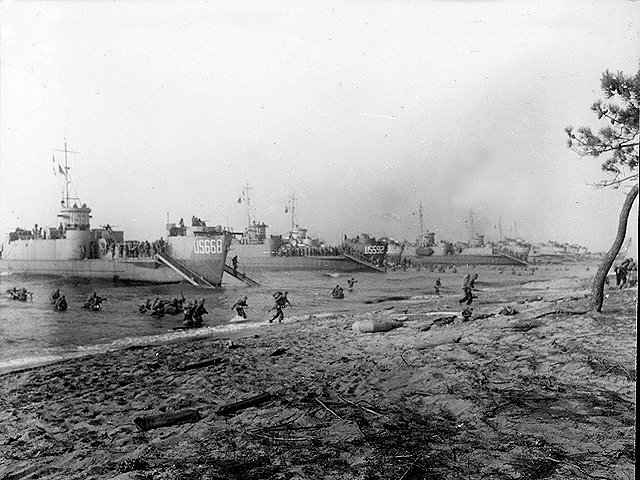
They reach the edge of a green meadow. Beyond it stretch vineyards and scattered farmhouses, each one potentially harboring an unseen gun crew. Murphy drops into a drainage ditch and pushes forward, mud sucking at his boots as he moves.
They kill two Germans and capture six.
The thin shell of resistance at the beachhead collapses quickly, and the company advances inland. Three wooded hills rise to their right. From the center hill, a concrete pillbox juts outward, its cannon angled toward the beach. Intelligence marks this hill as a major strongpoint, and Murphy’s company receives the order to neutralize it.
Under a punishing sun, the men climb in sweat-soaked uniforms. Murphy’s platoon leads, and he brings up the rear. Suddenly automatic fire sweeps down from the hill.
Murphy’s two comrades are killed. He is alone and the Germans have discovered his position.
Then Murphy engages in acts of heroism that earn him one of his many medals. He duels with the enemy until his ammunition is exhausted. Then he seizes a machine gun and rakes the foxholes. Still under fire, he is joined by a comrade, his best buddy in the squad.
The surviving Germans wave a white cloth in surrender. Murphy’s friend rises casually from cover, believing the danger has passed. A hidden machine gun opens at once. He topples backward into the hole, barely whispering Murphy’s name before dying. Murphy freezes in shock, caught between the bodies of his friend and the Germans he has killed.
He checks for a pulse. There is none. He calls for medics, but the hill roars with gunfire. No one can reach him.
Grief and disbelief overwhelm him. He refuses to accept the death. With quiet, deliberate care, he lifts his friend from the hole and lays him beneath a cork tree, as though fresh air alone might restore life. How he avoids being shot while doing this remains inexplicable.

A machine gun shifts toward him. Murphy reacts instantly, diving back into the hole, throwing a grenade, and then rushing forward. The grenade has done its work. Both German gunners are dead. Murphy takes their weapon, checks it, and begins climbing the hill again.
He wrote: “I remember the experience as I do a nightmare. A demon seems to have entered my body. My brain is coldly alert and logical. I do not think of the danger to myself. My whole being is concentrated on killing. Later the men pinned down in the vineyard tell me that I shout pleas and curses at them because they do not come up and join me.”
He reaches the gun crew responsible and kills them before they even know he is there. He keeps firing until their bodies stop moving.
Resistance on the hill collapses. The company advances and reorganizes on the crest. Murphy stands apart, trembling, stunned by the sudden weakness that overtakes him. When the company moves on, he returns alone to his friend’s body.
He gathers his personal effects, looks once more at the photograph of the little girl with pigtails, then places the pack beneath his friend’s head like a pillow. He sits beside him and weeps without restraint.
As time passes, the rage drains away. The enemy becomes again simply the enemy—not monsters, not personal. The war resumes its relentless form: a series of brutal tasks carried out by flesh and will. Murphy accepts this, as he has every day since the war began.
And he rises, wipes his face, and walks back over the hill to rejoin the company.
Quotes are from From Murphy’s autobiography To Hell and Back
Ch. 27: https://mollymartin.blog/2025/05/15/flo-and-her-crew-sail-to-france/

 tradeswomn musings
War is truly hell. What a horrible tragedy. It’s hard to imagine an experience like that. Again, thanks for sharing this story. Minerva
>
LikeLiked by 1 person