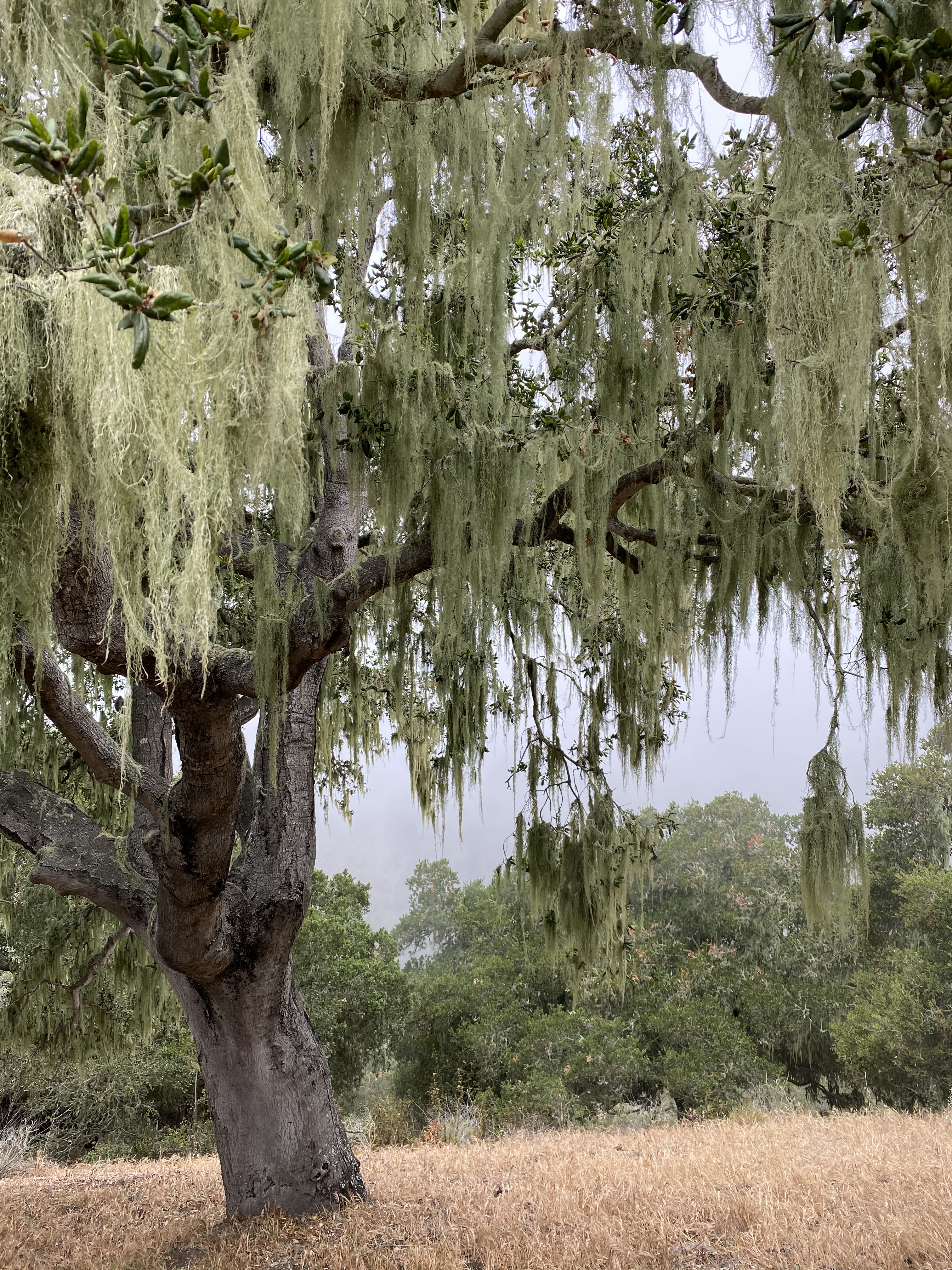
It felt like fate. On our very first date, a hike in the hills above Muir Beach, Holly and I bonded over plants. She pointed out a lichen growing on an oak tree—Usnea. To identify it, she said, you snap a branch and pull it apart until you see the central cord inside.
Usnea on oak. Photo by author
Usnea is known by many names: old man’s beard, beard lichen, or beard moss. A sensitive bioindicator of air quality, it only thrives where the air is clean and unpolluted. For centuries, it has been used in traditional medicine to treat wounds and infections. Today it’s still valued—for easing sore throats, helping wounds heal, reducing fevers and pain, even as a possible cancer-fighting agent.
Holly, now my wife, is a witch and an herbalist. She first learned about Usnea from a teacher of medicinal plants, and today her garden overflows with remedies.
The fall equinox—Mabon—is our time to harvest herbs and brew up remedies. Holly stirs up her bite balm, a salve for every kind of skin irritation, while I turn to cannabis. Since I don’t smoke, I’ve studied the alchemy of decarboxylation: gently heating the herb to unlock its powers before infusing it into oils for cooking.
NettleComfreySelf Heal
Some of the herbs in Holly’s garden. Photos by author
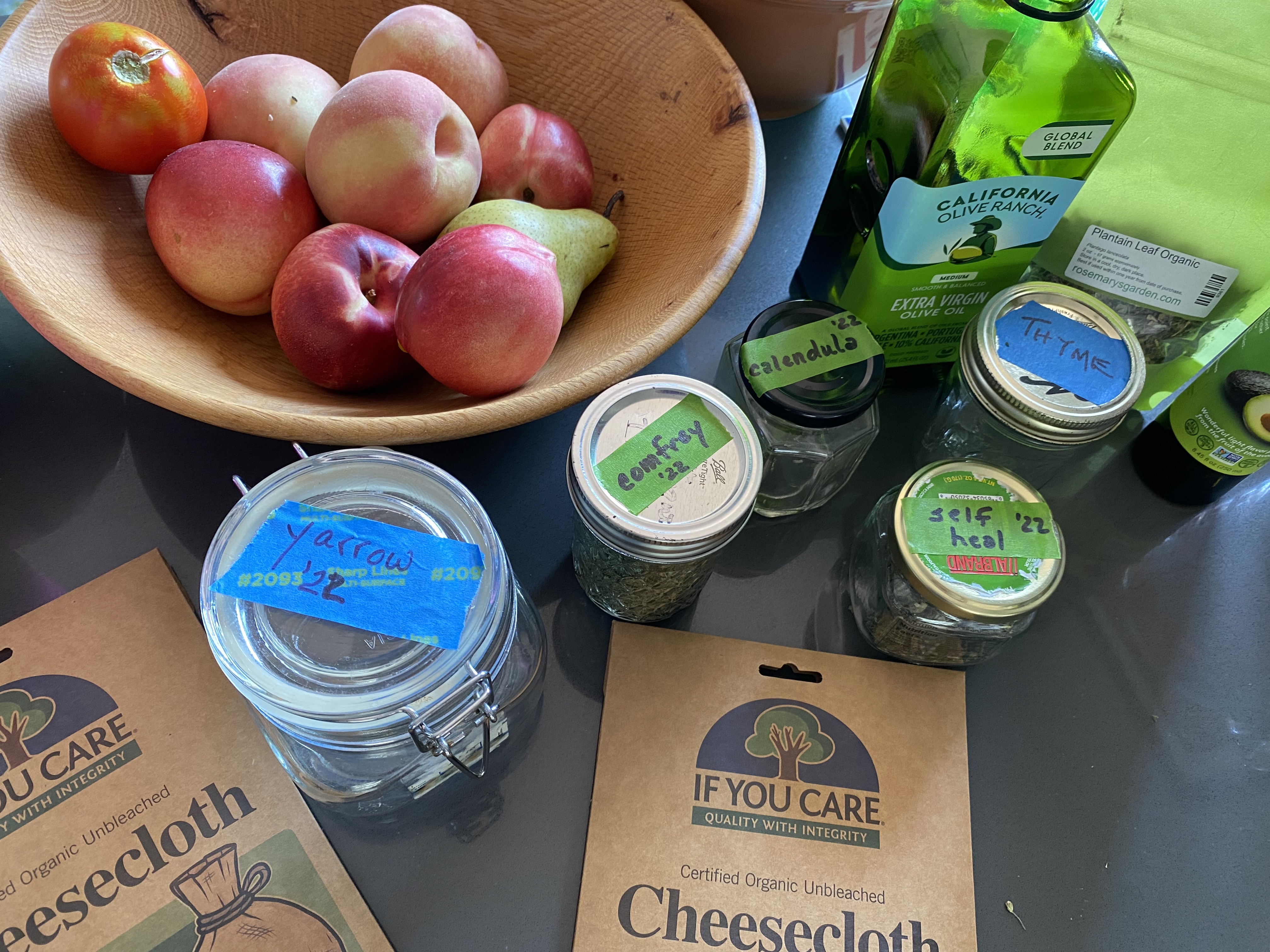
Together we blend teas from garden herbs. Our MoHo Blend we make from nettle, comfrey, and lemon balm. Comfrey mends bones; nettle brims with minerals; lemon balm lifts the spirit. Holly grows native yarrow, too, and last week she showed me how to stop a cut from bleeding: chew a fresh leaf and press it to the wound.
Some of the ingredients for bite balm. Photos by author from 2022
This season, I’m also harvesting and drying figs. Sonoma County is fig country, rich with varieties—Black Mission, Brown Turkey, green Kadota, Adriatic. The fig in our own garden is called Celestial: small, pink-fleshed, and honey-sweet. I can’t resist foraging (with permission) from neighbors’ trees, and the green figs from the tree across the street are my favorite treat.
Earlier in the summer we dried peaches from our little orchard. We peeled and cored the apples that hang over from next door, simmered them into apple sauce and pie fillings for the freezer, and pressed the rest into juice with friends. These harvest gatherings always feel like old-time rituals, neighbors bound by fruit, labor, and laughter.
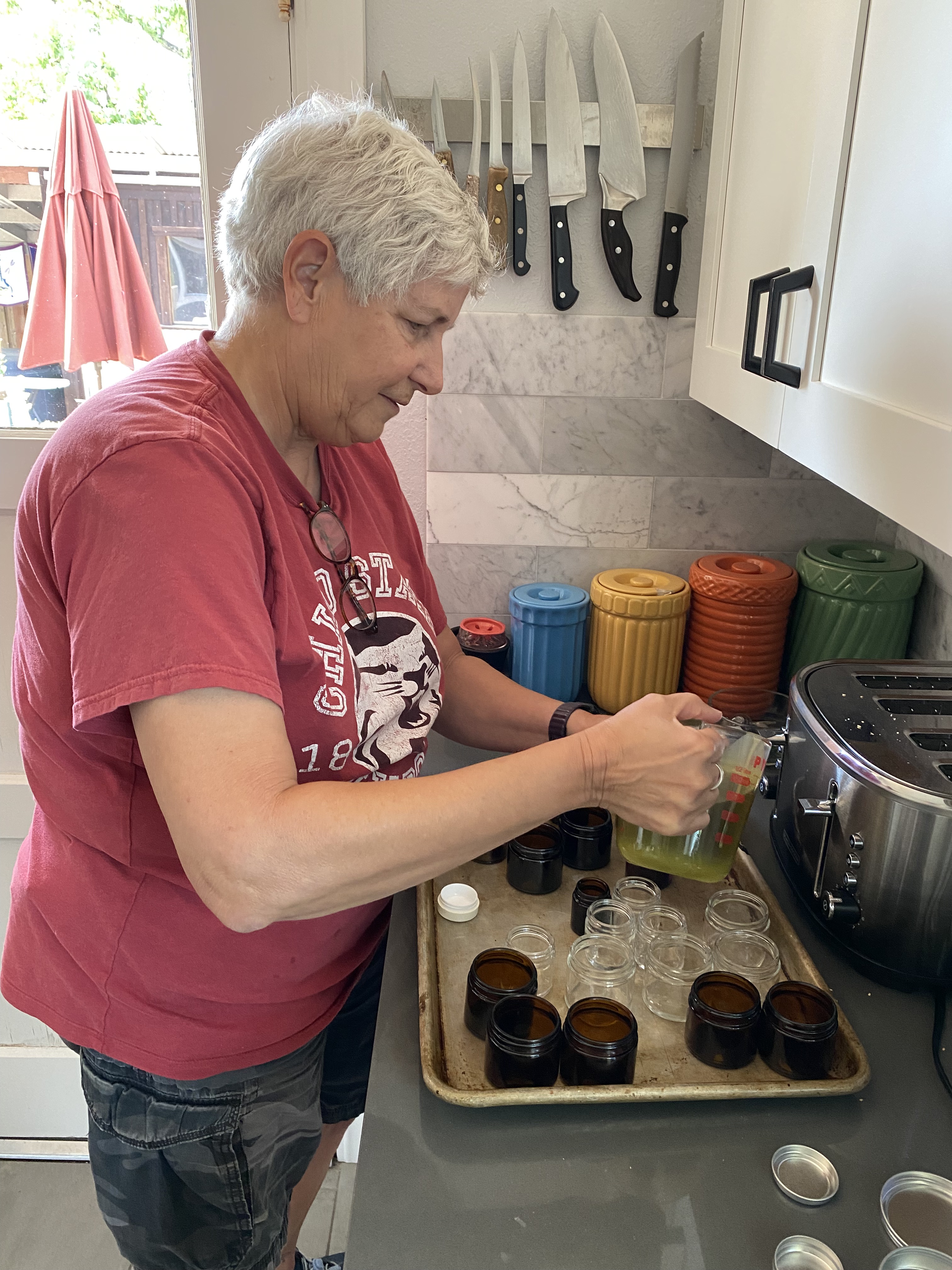
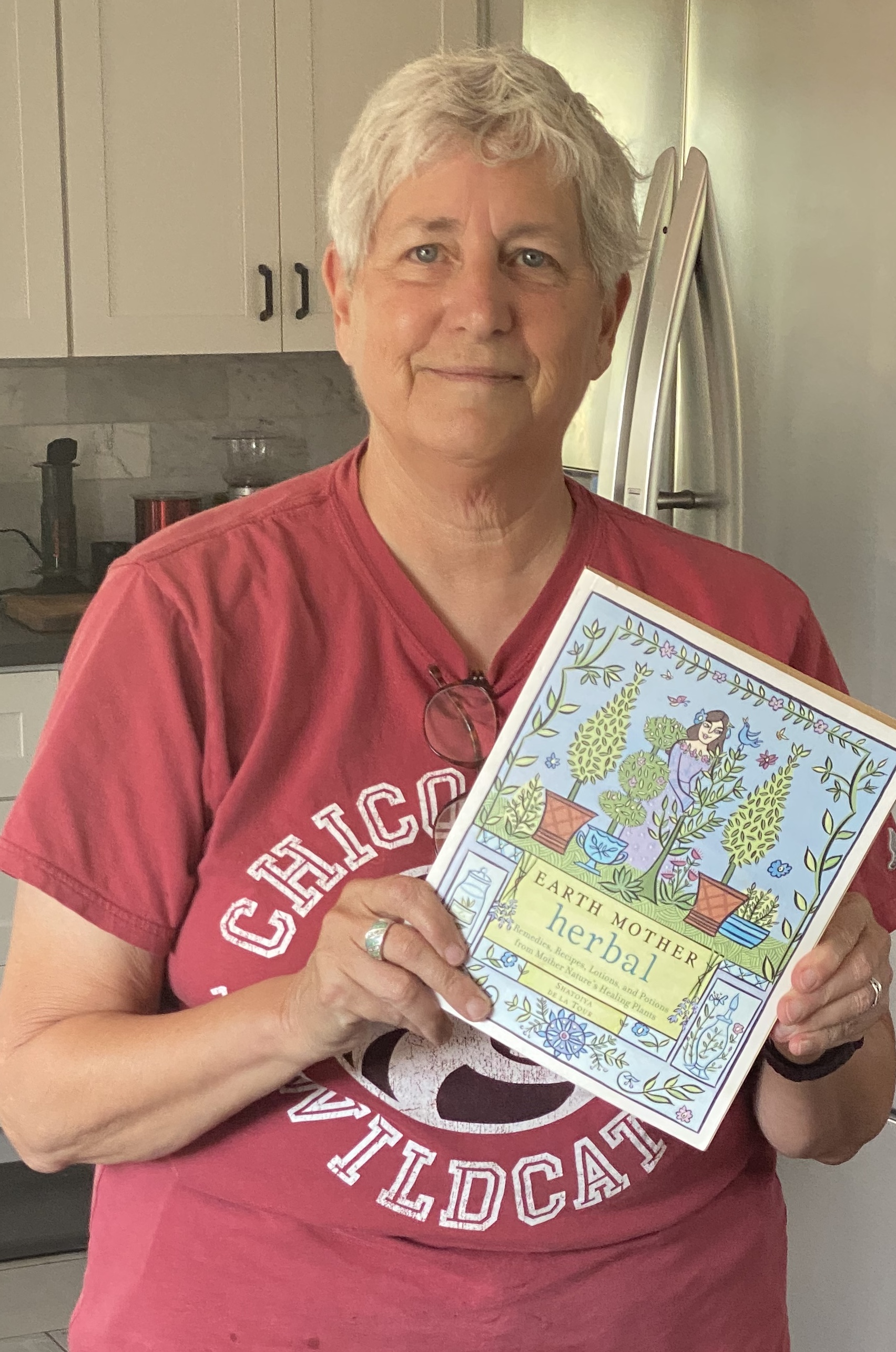
Holly pouring the final productOne of many reference books
Our garden is more than soil and stems. It is a living grimoire—a book of green magic—where medicine, ritual, and daily life are entwined. Harvesting and making are rituals of resistance too: an antidote to the anxiety of a world slipping toward fascism. To touch leaf, fruit, and root is to salve our spirits, to root ourselves again in Mother Earth.
Today, January 23, marks the end of the Persephone Period here in Sonoma County.
Have you heard of the Persephone Period? It’s a concept we’ve only recently discovered, but it’s already proving to be a valuable guide for us gardeners.
Most of us are familiar with the myth of Persephone, the daughter of Zeus and Demeter, the goddess of agriculture. According to Greek mythology, Persephone was abducted by Hades, the god of the underworld. Grief-stricken, Demeter caused the earth to grow barren until a compromise was reached: Persephone would spend four months of the year in the underworld, during which the earth experienced winter, and then return to bring the renewal of spring.
In gardening terms, the Persephone Period begins on the last day of the year with 10 hours of sunlight and ends when daylight hours rise above 10. Across much of the Northern Hemisphere, this period typically spans mid-November to early February. I like to think of it as starting around Samhain, the pagan holiday on November 1, and ending at Imbolc on February 1. Another fitting end point is the lunar new year, which in 2025 falls on January 29.
In Northern California, our Persephone Period is shorter than in regions further north. In Sonoma County, it starts on November 18 and ends today.
The Myth Meets Science
Ornamental flowers blooming nowNarcissus
The Persephone Period isn’t just a poetic reference—it mirrors the biological response of plants to diminishing sunlight. When daylight drops below 10 hours, most plants enter dormancy, conserving energy and resources to survive the colder months. Growth slows or halts entirely, allowing plants to endure harsh conditions and rebound when warmth and light return.
For gardeners, understanding this phenomenon is key to successful planning. During the Persephone Period, it’s best to avoid sowing seeds or transplanting seedlings, as plants struggle to establish themselves while dormant.
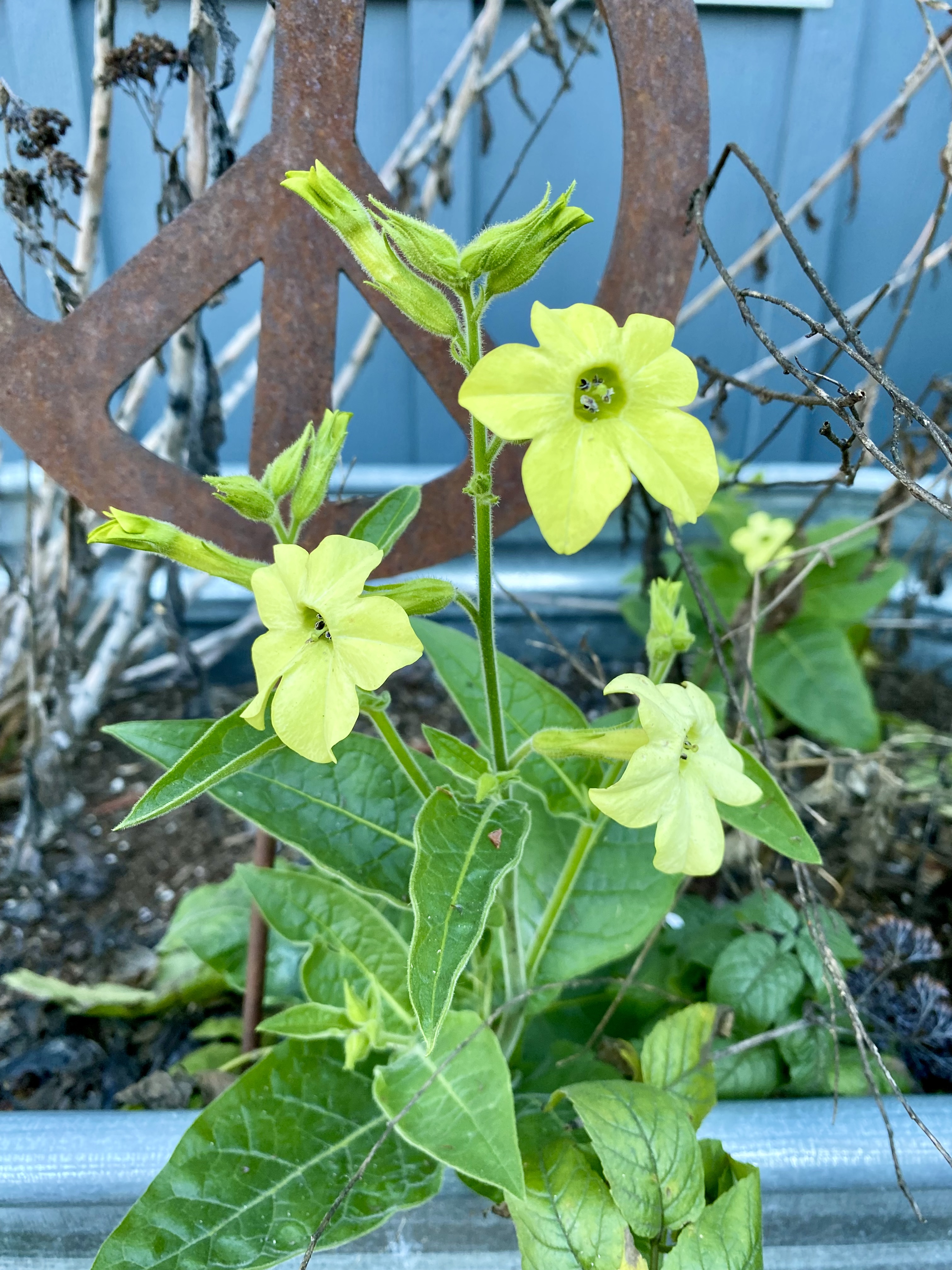
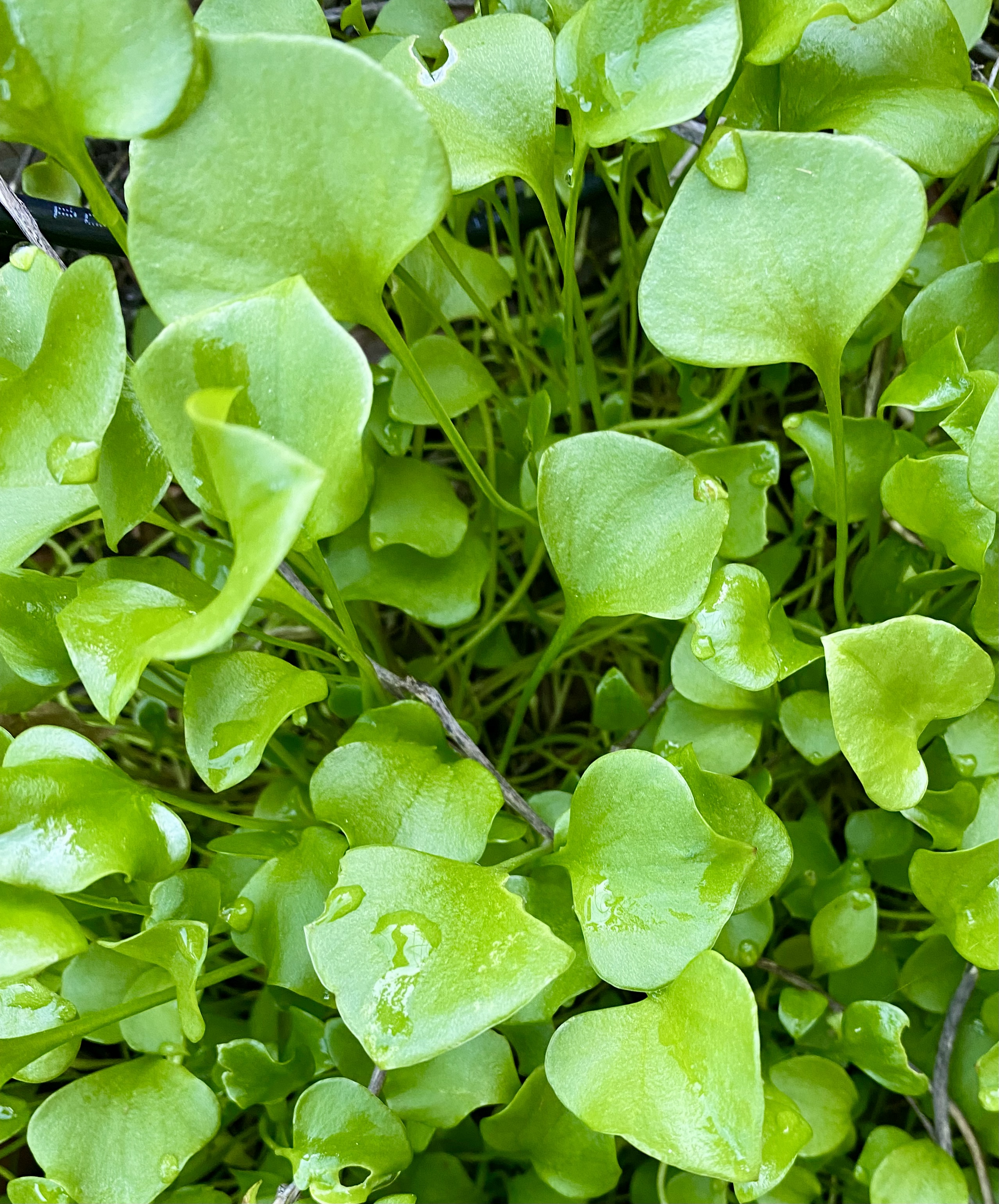
TobaccoMiner’s lettuceNative verbena
Timing Is Everything
Here in the San Francisco Bay Area, we’re lucky to have a “secret season” for winter gardening. The key to success is planting seeds well before the Persephone Period begins, giving plants enough time to develop roots and begin growing before sunlight dwindles.
In the past, I assumed planting when rains come in October—or even early November—was sufficient. Snow peas planted in our garden in October yield a crop by February. But Sonoma County Master Gardeners recommends planting winter seeds as early as August or September. This gives plants more time to grow before the Persephone Period slows them down. The downside? Planting in late summer requires consistent watering, often daily or every other day, during the dry months—a challenge for many gardeners.
Our Winter Garden
I’ll admit, I’m not particularly enthusiastic about winter vegetables like carrots or Brussels sprouts—they’re cheap and plentiful at local farmers’ markets. But I do appreciate winter greens. I love being able to harvest greens in the middle of winter. Just now I’m snacking on miner’s lettuce, coming up around the garden. The kale I planted last year has grown to an impressive three feet tall. Birds, especially finches, eat the leaves and so we’ve left those plants for the birds.
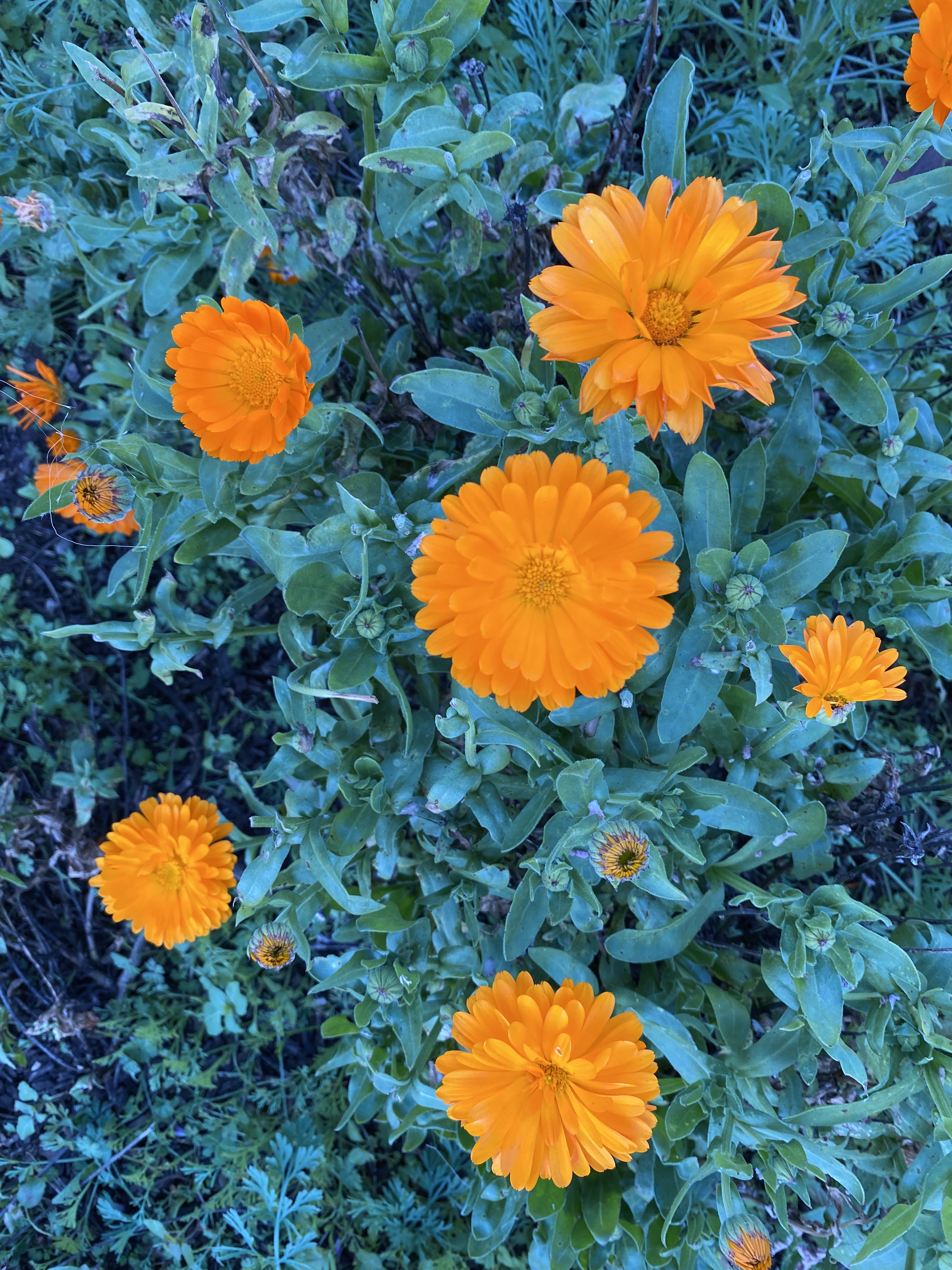
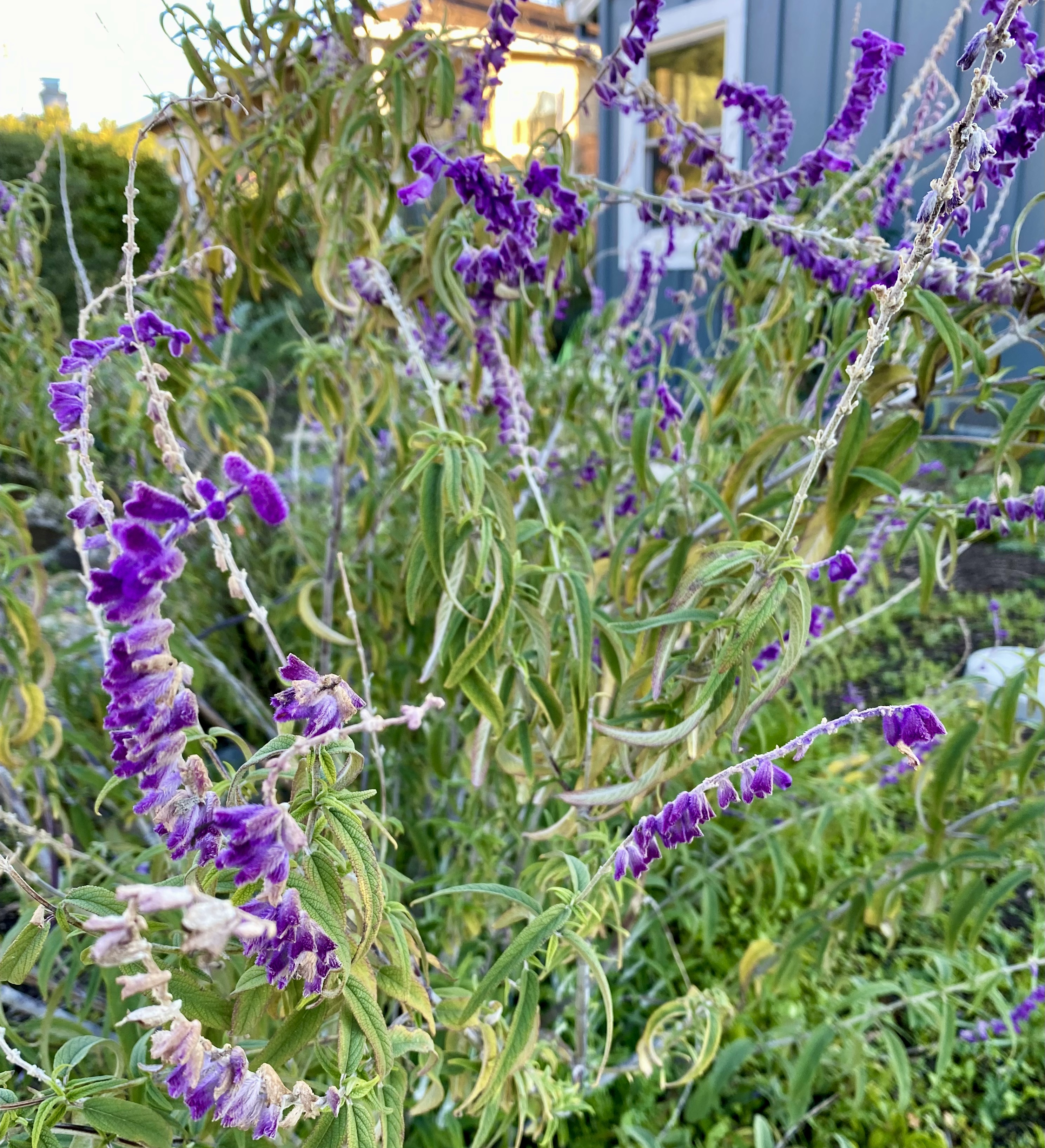
CalendulaWooly blue curls
Seasonal Markers
Other plants, too, thrive here even during the Persephone Period. The start of winter rains wakes them up. Here are a few standouts in our winter garden:
Calendulas: Their cheerful, easy-to-grow blooms brighten the garden.
Woolly blue curls: A native plant gifted by a friend, it’s flourishing in our front yard.
Native verbena: A reliable bloomer nearly all year long.
Ornamental flowers: Planted in the fall, they’re still adding a welcome burst of color.
Narcissus: Lovely, though I find their fragrance too overpowering for indoors—I’ve had to move the gifted bouquet outside.
And last week our daffodils started blooming!
Winter may bring shorter days and quieter rhythms, but it also offers its own moments of beauty. Between the blooms in the garden and the bounty of oranges from our old tree, I’ve learned to appreciate the Persephone Period for what it is: a time of rest, resilience, and subtle life persisting through the season’s challenges.
To all a blooming Imbolc and festive Lunar New Year!
My regular pagan holiday post:Celebrating the Harvest
August 1, a day that marks the halfway point between the summer solstice and the autumn equinox, is celebrated as the first harvest festival in many parts of the northern hemisphere. The Celts called it Lughnasa or Lammas. Besides Lammas, pagans celebrate two later harvest festivals, Mabon at the fall equinox, and Samhain on November 1.
In Sonoma County we can harvest food year-round, so I guess you could say every pagan holiday is a harvest fest here. By the time August rolls around, we’ve already been celebrating for months. The first bite of every ripe fruit calls for celebration.
Still blooming in our garden: epilobium, native buckwheat, aster. Hydrangea in shade
Growing up in Yakima, Washington, on the eastern side of the Cascade Mountains, I always knew when the fruit was ripe. Cherries were picked on July 4th, and I would gorge until I was sick. Grandma had an old-fashioned peach tree with fuzzy skin that had to be peeled, and those peaches didn’t ripen until late August. Pears came later, and apples weren’t ready until the end of September.
Here in Sonoma County, our Gravenstein apples ripen at the beginning of August! We celebrate the harvest at the Gravenstein Apple Fair. It’s taken me years to adjust to California’s seasons. There’s no real winter here—just fall and then, magically, spring! Winter is the rainy season, and summer is dry. As Pam Peirce says in her book, Golden Gate Gardening, there’s a secret season here. Many seeds can and should be planted in the fall, but I have to remind myself every year.
Last October, I planted sugar snap and snow peas, and by February I was eating them right off the vine. When I’d eaten them all, I planted sweet peas just to enjoy their beauty and fragrance. Beans came next. Our beans didn’t fare so well this year, thanks to moles. They don’t eat veggies, just meat (like worms, that is—think “moles = meat, voles = veggies”), but they tunnel near the roots and leave air gaps that kill the plants. I even saw the soil moving where I had just planted seeds. Needless to say, those beans never stood a chance.
Sunflower, zinnias doing well in the heat
Sometimes, I think gardening is like throwing dice. You never know what the next season will bring, but that’s what makes it interesting. The garden has a mind of its own.
After a couple of disappointing years where our tomato plants succumbed to wilt, this year is shaping up to be a winner. As soon as the first tomatoes are ripe, we celebrate with BLTs. This year, we enjoyed our first BLTs in the first week of July, slicing the Early Girls (my favorite variety).
There’s always something ripe and ready in our garden. We harvested navel oranges from our tree until June, then our neighbor gifted us a bag of Valencias, keeping us swimming in orange juice until mid-July! By August, the purple Santa Rosa plums are history, but the yellow plums from the tree we planted last year are still ripening.
I’m a gleaner, and throughout the fall harvest season you’ll find me harvesting my own and neighbors’ pomegranates, figs and persimmons.
Then there are grapes and wine, the primary crop here in adjoining Sonoma and Napa counties. La Paulée, a traditional Burgundian harvest celebration takes place in the Russian River Valley on August 2-3, when winemakers, chefs and enthusiasts of both will gather to celebrate wine and food. A centuries-old celebration once reserved for French vigneron and their harvest crews, La Paulée is a French variation of the Celtic pagan Lammas holiday, marking the end of the grape harvest.
Like all gardeners we have our favorite plants. We love a dry bean called Eye of the Goat, which I got from the West County Community Seed Exchange in Sebastopol. This all-volunteer group has created a seed garden and a community seed library supporting local gardeners with free, locally grown, open-pollinated, pesticide- and GMO-free seeds. Local seed saving means we can cultivate plants that thrive in our region, with each generation adapting more to the local environment. And as the seed industry consolidates, we can preserve heirloom seeds.
The seed exchange sponsors workdays in their garden and classes, but the most fun event is the annual seed swap in early spring at the Sebastopol grange hall.
Another early spring highlight is the annual scion exchange in February, sponsored by the California Rare Fruit Growers. They share free scion wood from all sorts of fruit trees and vines. Local farmers stand by to help you choose the best varieties for your location. I discovered the scion exchange years ago and got hooked on grafting.
Global warming is rapidly changing our world here in NorCal. This year June and July were hotter than ever, and August and September are predicted to break more records. On July 22 (and 23), 2024, the hottest day on earth in recorded history, it was 99 degrees here.
Cone flower (echinacea) petals burned, but native yarrow does well
We and our plants struggle with a warming climate. We’ve already had three heat waves this season and the hottest part of the summer is yet to arrive. Leaves are scorched and beans refuse to flower. Not many plants like 100-degree temperatures; even tomatoes protest.
And fire season started early with smoke blowing down from fires north of us. We may experience poor air quality till the rains start in November. The fire app, Watch Duty (download it if you haven’t already) shows scores of fires in California. The biggest is the Park Fire near Chico at 350,000 acres and growing. Oregon is burning. Practically the whole state of Idaho and much of Montana is under a red flag warning.
Climate change also brings new bugs to our northern climes. There’s a new mosquito in town and she takes no prisoners. She joins about a dozen varieties of mosquitos here. In past years they’ve died off with the advent of winter, but this year, due to a warm, rainy winter, they never left. Holly isn’t much affected by mosquitos, but if I’m in the yard, especially at dawn and dusk, they find me. I’ve had to give up hot tubbing because no matter how quickly I throw a robe on, they attack. They bite in my most vulnerable places! When I’m dressed, they go for my chin and ears. They are stealthy! I don’t hear them, and I rarely see them. I’m terribly allergic to their bites, which result in gigantic welts that itch for weeks. I scratch, and then they weep copious amounts of lymph fluid. So, though I hike every day, mosquitoes have kept me more indoors–not a bad thing when the temperature soars.
There is one more development we’re celebrating this harvest season. As we queers, feminists, pagans, progressives and people of color work to overcome the rise of the christian right, our election fears have lessened with the candidacy of Kamala Harris. Memes abound. I like MALA (Make America Laugh Again).
Now we must work to get her and down ballot Democrats elected! Election day this year is Tuesday November 5. That’s 95 days and counting.
We can Do it!
Here’s to a productive election season, and good Lammas to all.
The top photo is the view of sunset on a hot day over the Coast Range that we see from our street. The high point is called Black Mountain.
We once found it in an ally in the JC neighborhood
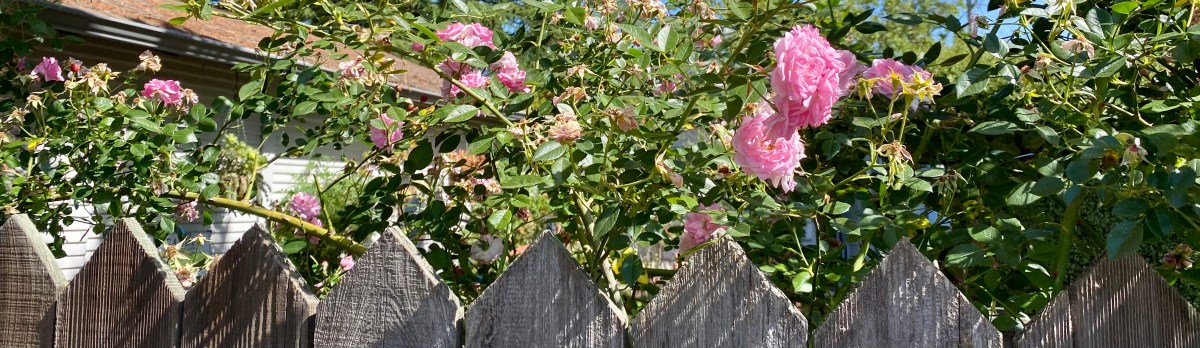
Santa Rosa, famed for its roses and annual rose parade, is also known as the home of Luther Burbank, the legendary plant wizard. Why did Burbank choose Sonoma County? Simple—because plants here live their best lives. He famously said, “I firmly believe…that this is the chosen spot of all this earth, as far as nature is concerned.”
Before Holly and I tied the knot and set up camp in Santa Rosa, I lived in San Francisco. Every week I’d take the Golden Gate Transit bus to visit Holly. We had this delightful hobby of cycling through various neighborhoods, ogling the stunning gardens and secretly judging people’s landscaping choices.
The ally between Nason and Spencer
On one particularly memorable ride—it must have been April or May in 2010—we spotted a man toiling away in his garden. Naturally, we screeched to a halt, intrigued by his green-thumb magic. As we marveled at his work, the man asked us a curious question, “Have you heard about the oldest rose in Santa Rosa?”
With a sense of mystery, he directed us to an alley between Nason and Spencer in the JC neighborhood. Our mission was clear. We pedaled like detectives on a hot lead until we found the rose. It was a gigantic bush, but, believe it or not, I can’t recall its color. This was pre-cell-phone-camera days, so no pics for proof. Did I smell it? I don’t remember, but I must have, considering I make it a habit to stop and smell the roses around town.
The color? Your guess is as good as mine. I later fantasized it was yellow, like a rose from a century-old house my family moved into back in 1959 in Yakima, Washington. But after diving into rose lore, I’m pretty sure it was pink, which is the go-to hue for ancient roses.
Fast forward to my discovery that roses, despite their ageless beauty, don’t live for a century. The Methuselahs among them might clock in at 35 to 50 years, while the newer hybrids are lucky to hit double digits.
I concur
Roses have a traceable origin. They likely sprouted in Central Asia and migrated to northern Europe over centuries. Rose cultivation kicked off in Central Asia around 5000 years ago. Today’s garden-variety roses are the glam descendants of plants from the Oligocene epoch (33 million to 23 million years ago), with fossils found across Europe, Asia, and western North America.
Recently, I went back to search for the oldest rose. I asked a friend who grew up in the JC neighborhood if she had heard of it. She had, but she didn’t remember seeing it—the stuff of urban legend.
The alley between Nason and Spencer stretches from King St. to Mendocino, morphing into Ridgway. I paced up and down that alley more times than I care to admit, but alas, I didn’t find it. Now I know, roses don’t do immortality.
Maybe someone took a cutting and gave it a fresh start. Perhaps the rose’s spirit lives on in the rural cemetery or the JC rose garden, which boasts some elderly blooms.
Rose or no rose, the alley had its charms. I met some interesting folks and stumbled upon quirky artwork on weathered walls. And so, the hunt for the oldest rose may be thorny, but it’s always blooming with stories.
Teresa Romaine got up on the ladder and picked a bucket of oranges then hung out with us on the new deck furniture. We got some sun, we got some rain. Yay!
I just learned about something called burrowing, where appointed officials make their way into the civil service and become career employees. You can’t get rid of them. Apparently there are a bunch in the federal government left over from trump. I wonder how long the citizenry will have to live with them and how much damage they might do.
Then I wonder about our own burrowing animals right here at Hylandia. One day last summer, covid-confined to our back yard, Holly and I saw the ground start to move. It was not an earthquake. Some animal was making its way just under the thinnest layer of garden soil. We watched quietly, fixated, but when we tried to sneak up and unmask it, the creature disappeared.
“Oh my goddess we have gophers!” I yelped.
No burrowing animals ever invaded my San Francisco garden but Holly had years of experience combatting gophers when she lived in Santa Barbara.“They love poppies,” she declared. And so we waited for the many poppies in our yard to be pulled underground just like Bugs Bunny did in cartoons. But only one plant, a sunflower, suffered root damage.
Later in the fall, looking out our picture window, we watched a tall cosmos plant shimmy as if in an earthquake. The dance went on for many minutes. Nothing else in the garden moved. The burrowers were at it again.
Infrastructure was affected. Holly continually leveled out the birdbath fountain and then it would be undermined and again tipped at an angle.
We installed raised beds with gopher wire and bought wire cages to plant in.
Then we started seeing cone-shaped piles of dirt around the garden. We saw no hole in the middle and no tunnels. We were flummoxed. Gophers leave a horseshoe shaped mound of earth near their burrows and the entrance hole is visible.
Maybe we didn’t have gophers. But what could it be? Someone told us that local gardeners have problems with voles. I have seen voles in the mountains emerging from their burrows on backpacking mornings, but I didn’t know they lived here or were found in gardens.
We decided our culprits were voles, also called meadow mice, the cutest of the burrowing animals likely to be found in gardens, but possibly the most damaging. They look like mice with shorter tails and rounder heads, about five inches long. Voles pay no attention to gopher wire. They just climb right up into the raised beds and gnaw at the base of plants, even killing trees.
Plants were not dying and we saw no evidence of gnawed trunks on our fruit trees. Maybe they weren’t voles. Our period of idle speculation continued for a while until we finally googled.
The three main burrowing animal “pests” are voles, moles and gophers. When you look them up online, the whole first page of google is filled with pest control companies explaining how these mammals damage your lawn and how to get rid of them by poison or other means.
I did find one website that was not only about extermination—the Oregon State University Extension Service. It says, “Moles, voles and gophers all improve the soil by aerating it and mixing nutrients, but sometimes their habits get them in trouble with gardeners.”
Wow! They all improve the soil! Our soil here is dense clay that resists the spade in the dry season. Could burrowing animals be good for our garden?
“The important part is for people to assess the level of damage with the level of control,” says Dana Sanchez, wildlife specialist. “Is having a few holes in the lawn enough of a problem that you need to take action?”
Thank you Dana Sanchez! Perhaps we can live with burrowing animals in our garden. We already live with rats, birds, cats, opossums, raccoons, fence lizards and squirrels.
Reading descriptions of these animals and their habits made us decide we have moles, not voles. Moles leave mounds of dirt and voles do not. Moles eat worms, slugs and insects; voles eat plants. They are way more dissimilar than their names suggest. Moles are in the order Eulipotyphla along with shrews. Voles are Rodentia, as are gophers and rats.
We learned that we will probably never see a mole. Unlike gophers and voles, they really do spend their entire lives underground. They make two tunnel systems, one deep in the earth about ten inches down and one closer to the surface. They are solitary and one mole can have a territory of two back yards. Maybe we have only one mole.
Moles are not as damaging as gophers and voles. Moles don’t destroy plants except by sometimes undermining the roots by leaving a void underneath. Would I feel the same way if we had gophers or voles destroying our plants? Probably not. I’d be scheming about how to exterminate them. My brother told me his husband once put gas down into a gopher hole and lit the fumes. It seemed like the whole yard raised up in the explosion, he said. There are videos on YouTube. Apparently people do this all the time. What would you look up? I wondered. He suggested “mole yard explosion.”
I remember during the cold war when mole also meant a spy. We used to worry about Soviet moles in the government, spies who spent lives burrowing in. Now it’s the Russians and the moles are people sitting at computer consoles far out of reach. Reports suggest they have burrowed into every part of our government, although that scandal hasn’t seen much light lately.
And we must add to that white supremacist and nazi moles. How many of these moles are still in the military? Were moles the reason the military failed to aid the capitol police in the recent attempt to overthrow our government? And members of Congress—shall we view those who voted to defend trump as moles who have now been exposed?
Now that we know moles aren’t so damaging to gardens, maybe we can live with them. But I’m not so sanguine about living with moles in the government and the military. If I google “moles in the government” perhaps I’ll find strategies for removing the burrowers.
One thing I love about living in Santa Rosa is seasons! Our garden still flourishes and flowers bloom, but one day in August, we could suddenly see that the height of summer was over and summertime had begun falling down. And now it’s the autumn equinox. Called Mabon by the Wiccans, the fall equinox marked the second harvest festival to the Celts. Day and night are of equal length and now dark will lengthen till the winter solstice when the light will start to gain again.
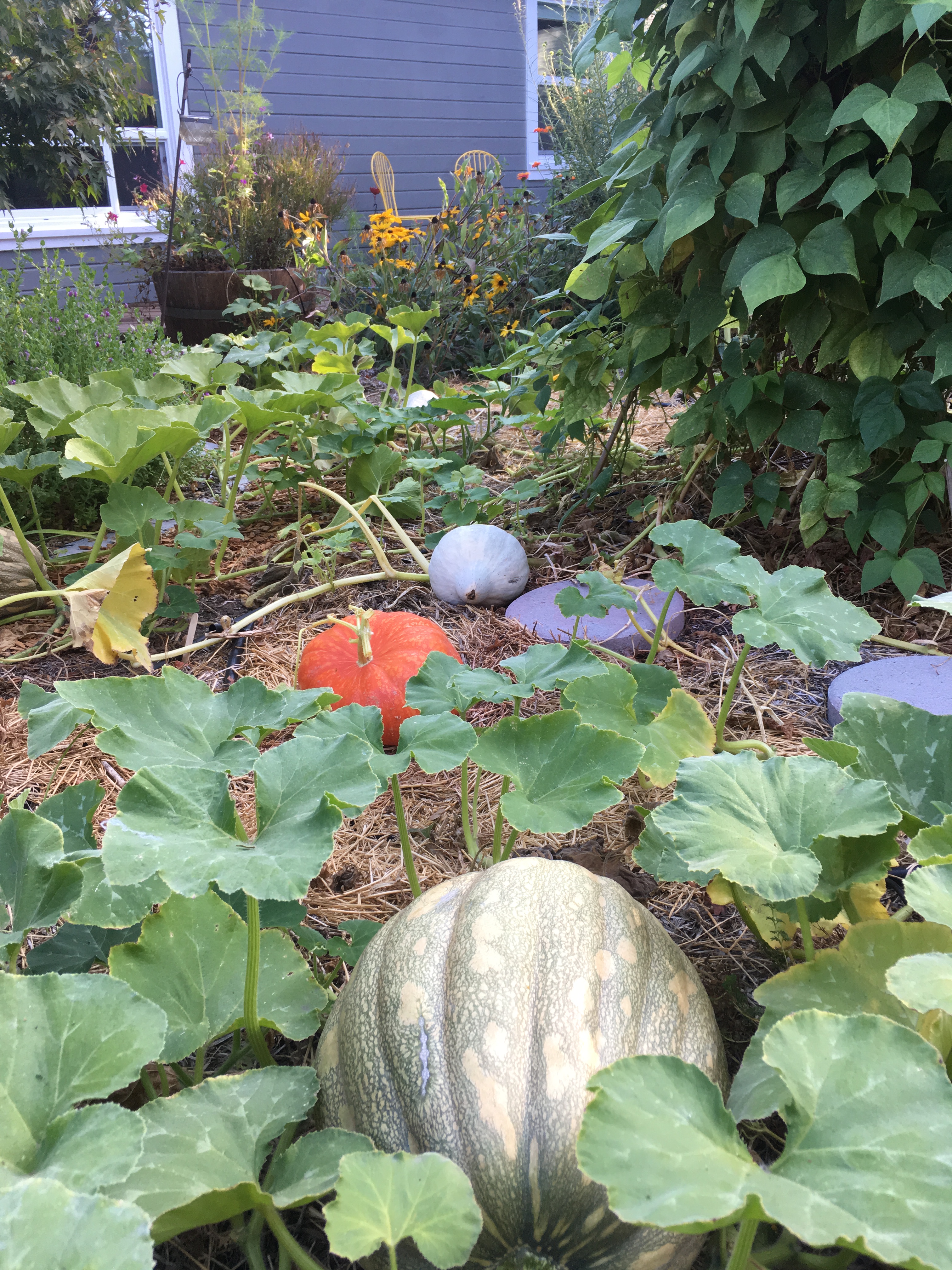
The big squash in the foreground came from last year’s Heirloom Expo
I don’t know exactly what the Celts harvested at the second harvest but here in Sonoma County September is the month of grapes and figs, and of course cannabis. Last year at the Heirloom Expo we drooled over a slew of fig tree species. I had grown figs in San Francisco but the one time a lovely Mission fig finally ripened a raccoon got to it before I could harvest, and broke the whole branch off in the process. That was it for me. That winter I dug out the entire plant. San Francisco’s foggy cool summers just don’t go with figs, although I did see some happy trees there, just not in my backyard. But figs love it here! So this spring we planted one. It’s called a Celestial, a small, rosy sweet fig, and we ate the first one in August. Also our neighbors T and JJ have a mature fig tree and I’ve been making myself sick on them. There’s nothing like a ripe fig perhaps eaten with a slice of local sheep’s milk cheese.
This is not an indictment of San Francisco weather (except when you’re freezing your ass off in the cold wind and fog waiting in line at the gay film festival in June!). I gardened in the same Bernal Heights yard for 38 years. There are some plants that thrive there. Nasturtiums! One year they took over the whole yard. I bought local gardener Pam Peirce’s books, learned about micro climates and the secret season that we didn’t have in my hometown of Yakima, Washington. I became friends with Pam and visited her abundant Excelsior back yard garden. But early on I gave up tomatoes and embraced flowers. Bernal Heights is just up the hill from the Alemany Farmers’ Market where every Saturday I could find seasonal organic produce. Why kill myself fighting shade and fog to grow some tortured veggies?
Zinnias! Love Santa Rosa, hate San Francisco
But tomatoes love the hot summers here. We are still harvesting tomatoes but it wasn’t like last year when we had to give bagsful away to neighbors. One plant suddenly died and gardener friends suggested gophers were eating the roots. Yikes! We had been happily gopher free. But I figured out the problem. I had watered the plant with a hose that had been sitting out in the hundred degree heat. I boiled the roots to death!
I didn’t make it to the climate march September 20. But I did eschew the car and take public transportation to Tradeswomen Inc.’s 40th anniversary celebration in Oakland where I got to commune with 400 tradeswomen. Then on Saturday night I took the Lamplight Tour of Santa Rosa’s historic rural cemetery. It’s a phenomenal production requiring the work of 120 volunteers who wrote, performed and organized eight vignettes about local history. We learned about the influence of the KKK in Sonoma County in the 1920s, the Women’s Christian Temperance Union, Jack London’s story about a local miner and more. Something tells me I’ll get sucked into working with this group of citizens interested in local history.
Naked ladies bloom at the Rural Cemetery
And next week I’ll travel to Minneapolis for the Women Build Nations national tradeswomen conference where history will also be a focus of discussion. A lot of us old timers realize we need to be recording it now before dementia sets in. Along with Brigid O’Farrell I’ll be leading the writers workshop. Methinks a book is in the offing.
The noises started in late spring, sort of an irregular popping sound, occasionally loud enough to wake us at night. It sounded like someone was bouncing tennis balls off the fence in back. What were the raccoons up to? It couldn’t be the opossums. One lumbered along the fence every evening as night fell. But she was quiet as she moved to another yard.
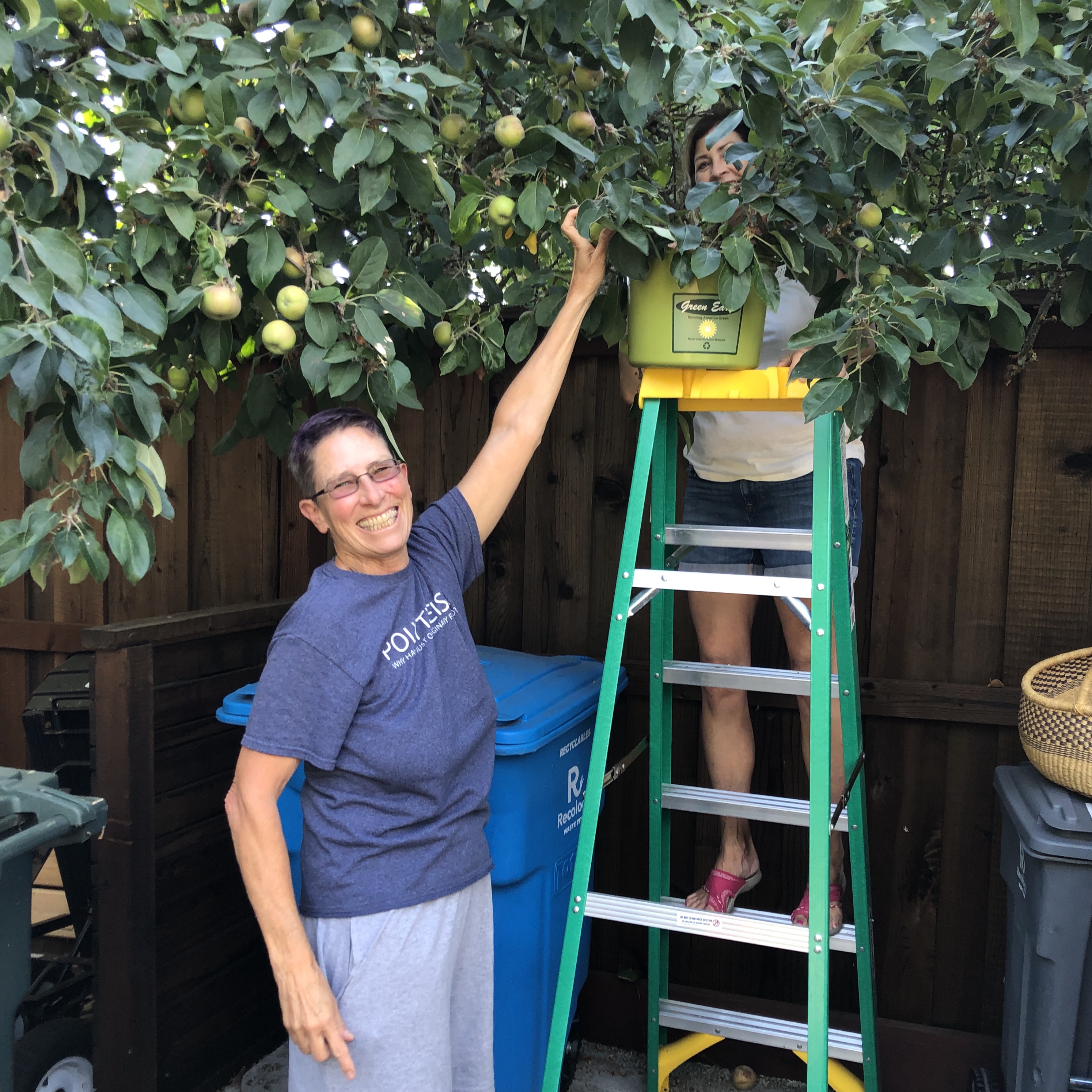
My T-shirt reads: Polytheism. Why have just one imaginary friend
It took a few weeks before we figured out the noise was made by apples falling from our side yard neighbor’s tree. It just got louder as the little green apples grew larger, thudding onto the garden pavers, banging onto the metal shed roof. When the tree leafed out last spring, Holly was delighted to find it’s a Gravenstein, the apple of her youth. Grandpa warned Holly and her sister not to eat the unripe apples. “They’ll make you sick.” But they just couldn’t wait. They ate them and liked them and never got sick. Grandma would make apple sauce for every dinner during apple season.
I come from apple country too, in Yakima, Washington. But we didn’t grow Gravensteins, which ripen earlier and don’t require the cold nights up north. Our Macintoshes and Red Delicious apples ripened in October and in my day school was let out so kids could help their families with the harvest. To me there is nothing like the taste of a ripe Red Delicious picked right off the tree. I never tasted a Gravenstein until I moved to California.
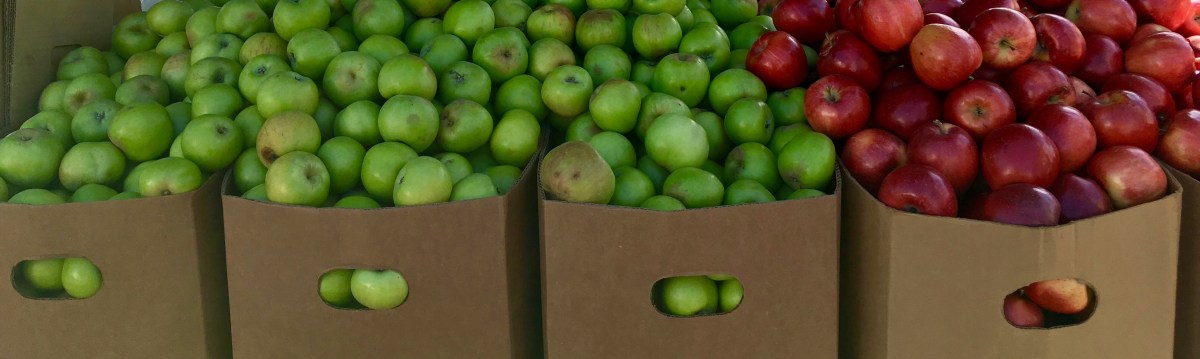
The iconic apple of Sonoma County was brought to the continent by Russian fur traders. It is said they planted the first tree in 1811 at Fort Ross on the Sonoma coast. Gravensteins ripen in July and August here. The tart fruit doesn’t last long and must be processed or eaten quickly. This year we had a bumper crop. Branches grew far over into our yard so that we had to duck under on our way to the recycling bins.
By the third week of July the emerging red stripes on the green fruit told us they were ripe. Fortuitously Holly’s cousin Kerri is an apple aficionado. She lives in Roseville and travels to Santa Rosa annually to buy a lug of Gravensteins for pies. Her method is to process them all at once, coring, slicing, sugaring enough for each pie (seven cups of apples) and then freezing in plastic bags for the making of pies and crisps all year long.
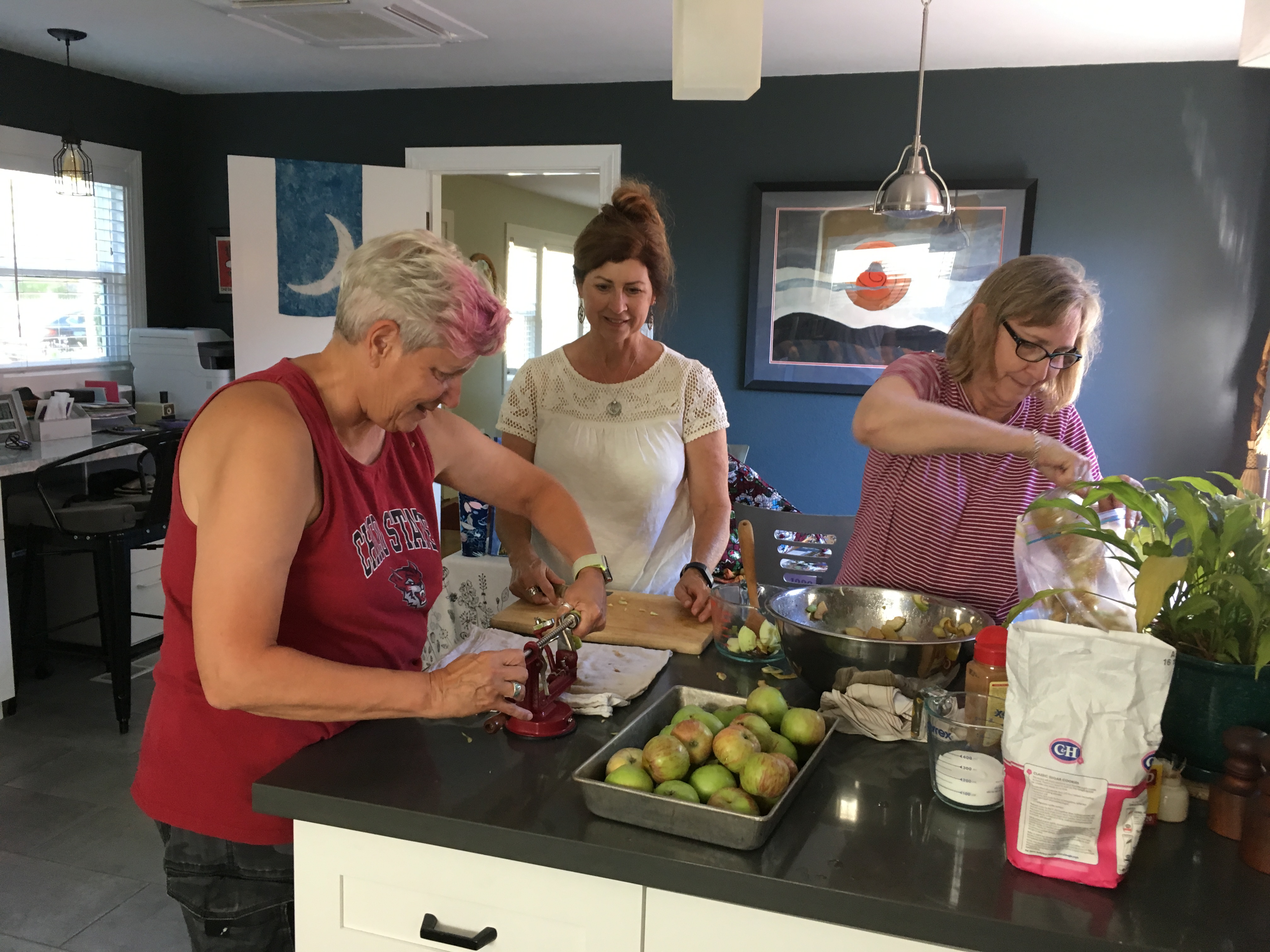
Holly, Kerri and Diana on the disassembly line
Just as the apples ripened we were lucky to be visited by Kerri and her apple coring machine. She came with all the ingredients for making pies—sugar, cinnamon, flour, crisco. Holly’s sister Diana was here too, from San Diego.
Our first chore was to pick the fruit, reliving our childhoods. We gingerly climbed the six-foot ladder, each taking a turn and being especially careful. We were sobered by the recent death of a friend, Chris Jones, who fell from a ladder while hanging a gay pride flag in his yard in San Francisco.
Then we set up an assembly line, coring, slicing and sugaring. What music goes with apples? We chose Lady Gaga. You can dance and core at the same time. Then Kerri made three pies. One we gave to the neighbor, whose apple tree it is. The two others we ate with gusto. And we still have ingredients for many more pies in the freezer. Then Holly and I cut up the remaining small apples and made four quarts of apple sauce.
And that’s how we celebrated the cross-quarter pagan harvest festival. Called Lughnasa by the Celts and Lammas by the Anglo-Saxons, it’s one pagan festival not appropriated by christians. The first of three Celtic harvest fests, Lughnasa is celebrated on August 1 or 2, about mid-way between summer solstice and autumn equinox. But, as with the other pagan holidays, we extend festivities for as long as we like. We will continue to celebrate the apple harvest at the Gravenstein Apple Fair this year in August 17 and 18 in Sebastopol.












 tradeswomn musings