Solstice Stolen by Christians!

It’s been a long time since I celebrated the christian holiday of christmas. And from the looks of me in a whole series of family pictures, I hated the holiday even as a little kid.

Xmas1953
1953

My little brother Don and littler brothers Tim and Terry are always smiling, especially Don who was an adorable child (now old and still adorable). Why was I so glum? I wasn’t a pouty kid in any other pictures. 

Clearly I was never a fan of christmas, but even less so after I left home and developed a critique of capitalism and christianity. I hated the consumer aspect but also the religious stuff. I joined the  Church of Stop Shopping, led by the charismatic Rev. Billy with backup  by the incomparable Stop Shopping Choir protesting at malls on black Friday. I still avoid shopping after September (it gets earlier every year) because I can’t stand the holiday  music played in stores.

Xmas1958
Martin family Xmas card 1958

In college, researching the history of religions, we learned  that christians had stolen their holidays from pagans and those who had gone before. Christmas co-opted pagan solstice celebrations. They even stole the virgin birth thing. Why not recapture our history; there were so many ancient solstice traditions to choose from! 

In the early ‘70s, we dissidents at the Rosa Luxemburg Collective chose to celebrate the Roman winter solstice holiday of Saturnalia. It was essentially a great big party. Traditional roles were reversed. Masters served slaves. Men dressed in women’s clothes and women in men’s. All were set  free of their marriage obligations and could have sex with anyone they wanted. The festivities lasted for a couple of weeks at least (no research here; just remembering). Of course, we had already dispensed with gender roles and monogamy so the holiday was really just a continuation of our chosen lifestyle. We cooked sumptuous feasts and ate a lot. We set up an aluminum tree with rotating colored lights in the Vulgar Americana Room. It stayed up all year.

Americana
The Vulgar Americana Room with tree and the papier mache finger, made for an anti-war demonstration

Lately Holly and I have been adding to and making up our own traditions. They change every year because we tend to forget our brilliant ideas from the year before, but for many years now we have been celebrating what we call the Twelve Days of Solstice. The holiday starts on solstice, which this year is December 21, and ends on New Year’s Day.  

We incorporate pagan rituals and customs—greenery and garlands, feasting and lights. Solstice signifies the return of light in the Northern Hemisphere, important to our animistic ancestors who worshipped nature. My Swedish grandmother set in her window a brightly painted wooden candelabra which looked very much like a menorah. Her decorations were figures of reindeer and elves made of straw. She made tree ornaments of fat candy canes wrapped in red and white tissue paper. And I still have the slender santa and elf figures that she hand knit and brought out every year.

GramsSantas
Grandma Wick’s knit creations

This year we added some days to the holiday since the full  moon appeared on Friday the 13th of December, an especially witchy occurrence. How did we celebrate? We planted winter greens and bulbs in the garden. We made apologies to our mother earth for what our species has wrought. We donated to the porta-potty fund for the homeless here. I archived some papers, an ongoing project. From the hot tub I watched the moon rise twice from behind cloud banks. We toasted our good fortune. And then, with Holly’s reminder that winter is for hibernating, we settled down for a long winter’s nap.

Wishing you a good solstice or as the Swedes say god yul.

Fleeing Fire

Continuing my ongoing seasonal letters on pagan holidays

Dear Friends,

Bonfires were a big part of Celtic harvest festivals, perhaps a historic precedent for our October fires in Sonoma county that now take place annually. As we celebrate Samhain, the third pagan harvest festival, our county is burning up again this year. A new element is Pacific Gas and Electric shut offs, induced by dry weather and high winds that take place in the fall. With little notice and less planning our power company did cut our power and threatens to cut us off again at any time. And it looks like faulty PGE equipment is responsible for our latest fire, still burning, called Kincade. Popular sentiment is angry, fearful (many survivors of the deadly 2017 fires suffer from PTSD), confused. Looks like PGE has more regard for its shareholders than customers. We want publicly owned power, and SF and other cities have offered to buy the bankrupt company but directors say it’s not for sale. PGE is responsible for the deaths and loss of property of thousands of Californians in recent fires and a deadly gas explosion a few years ago. We survivors intend to hold them accountable.

As I write this Gov. Newsom has declared a state emergency with the largest evacuation of Sonoma County residents in history. Much of Northern California is without power so folks in rural areas also have no water, which requires electric pumps. The fire started while we were vacationing in Kauai with Barb and Ana, our exes and besties. Holly and Ana had not been to Hawaii and it was at the top of their bucket lists. We flew out of Lihue and into Oakland Saturday night and stayed with friends in Berkeley thinking we’d drive back to Santa Rosa Sunday. Stayed up pretty much all night keeping track of the news. Holly’s 85-year-old mom was evacuated from her assisted living place in Windsor to Santa Rosa, then again to Scotts Valley near Santa Cruz. We haven’t been able to speak to her yet, but we know she’s in good hands. Holly did talk to a caregiver there who said they were all sleeping on inflatable beds that night. The poor workers at these places are being asked to take the job of first responders and work 24-hour shifts while their own families evacuate and they worry about their own homes burning.

Now we are camped out in my old home in San Francisco with air filters going. It’s still windy but air quality here has improved as the wind took a turn west toward the ocean. So now the Russian River towns and points west in Sonoma County also have been evacuated. I hope the fire can be stopped before Guerneville and the river area which suffered damaging flooding last winter and is just now recovering. Marin County and most of Sonoma County are still without power.

We will be in San Francisco on November 2 but not to celebrate the Day of the Dead procession and festival of altars in the Mission as usual. I’ve got a stand up gig! I’ll be telling a story in front of a live audience at the semi-annual MUNI Diaries Live event. It’s at a place Called the Rickshaw Stop near Civic Center at 6:30. Locals, do come if you can. Laugh at my jokes! Supply friendly support! Although some of my friends have told me they plan to come just to heckle.

Muni Diaries is the brainchild of two women. They are working to create a culture around public transportation and seem to be having a great time doing it. You can hear me read another story on the MUNI Diaries podcast to be published October 28. Just subscribe to the podcast or look us up at munidiaries.com.

Yikes! Now I’m worrying. I’m old and CRS. Must practice!

Sending Samhain love,

Molly

PS: Today, October 29, we have fled again, this time to Sacramento to stay with in-laws. We drove back to Santa Rosa to fetch a few things. The AQI there was 308. Who goes to the Central Valley for good air?! Just living as climate refugees day to day.

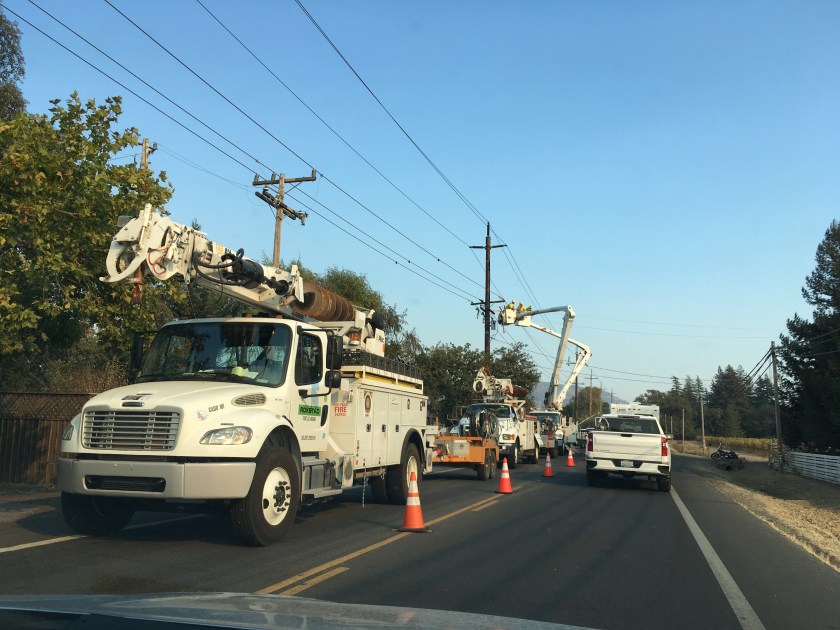
On the way out of town–unharvested grapes in the smoke and PGE crew repairing wind damaged power lines.

Celebrating the Autumn Equinox

September 23, 2019

One thing I love about living in Santa Rosa is seasons! Our garden still flourishes and flowers bloom, but one day in August, we could suddenly see that the height of summer was over and summertime had begun falling down. And now it’s the autumn equinox. Called Mabon by the Wiccans, the fall equinox marked the second harvest festival to the Celts. Day and night are of equal length and now dark will lengthen till the winter solstice when the light will start to gain again.

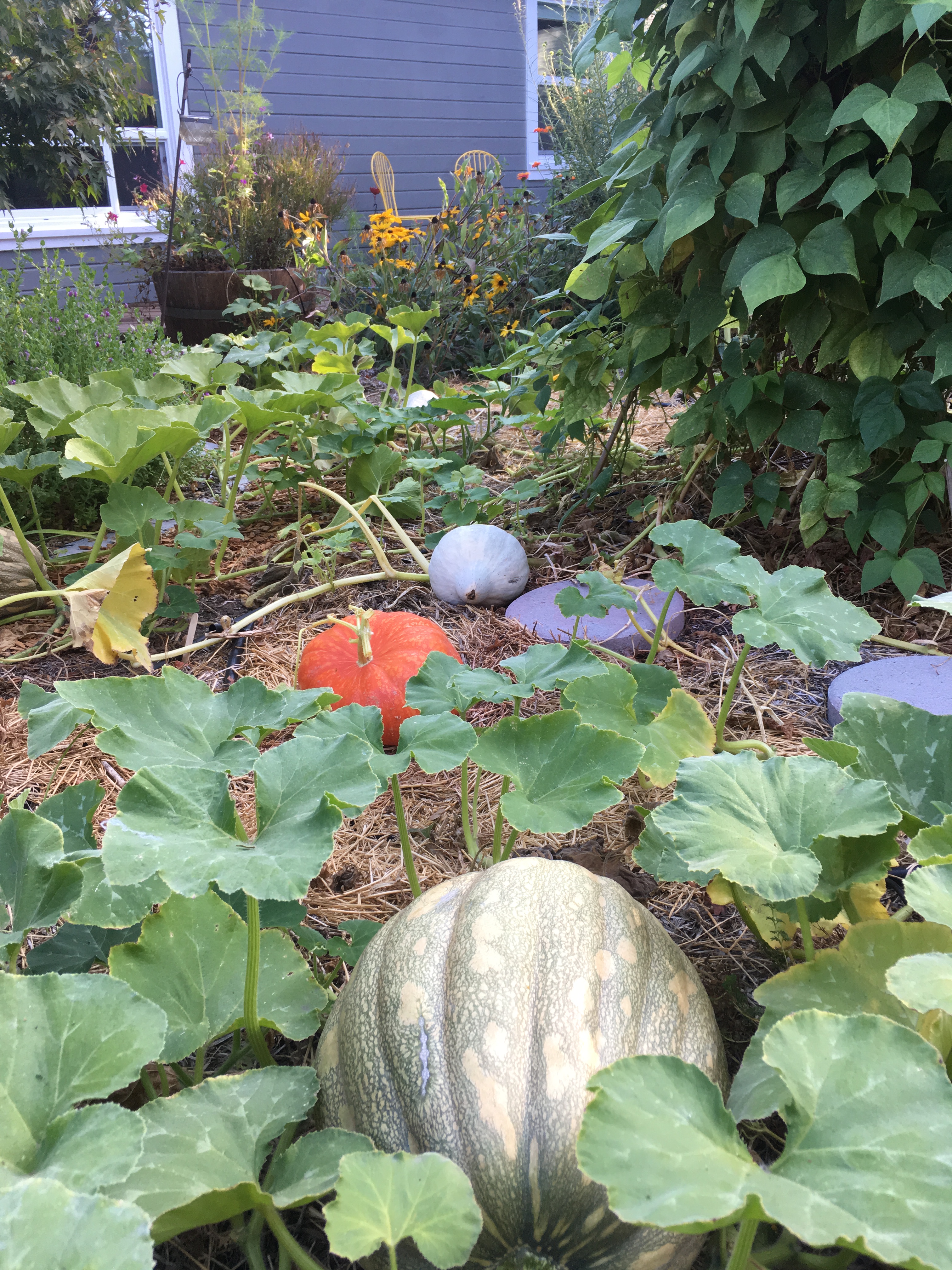
The big squash in the foreground came from last year’s Heirloom Expo

I don’t know exactly what the Celts harvested at the second harvest but here in Sonoma County September is the month of grapes and figs, and of course cannabis. Last year at the Heirloom Expo we drooled over a slew of fig tree species. I had grown figs in San Francisco but the one time a lovely Mission fig finally ripened a raccoon got to it before I could harvest, and broke the whole branch off in the process. That was it for me. That winter I dug out the entire plant. San Francisco’s foggy cool summers just don’t go with figs, although I did see some happy trees there, just not in my backyard. But figs love it here! So this spring we planted one. It’s called a Celestial, a small, rosy sweet fig, and we ate the first one in August. Also our neighbors T and JJ have a mature fig tree and I’ve been making myself sick on them. There’s nothing like a ripe fig perhaps eaten with a slice of local sheep’s milk cheese.

This is not an indictment of San Francisco weather (except when you’re freezing your ass off in the cold wind and fog waiting in line at the gay film festival in June!). I gardened in the same Bernal Heights yard for 38 years. There are some plants that thrive there. Nasturtiums! One year they took over the whole yard. I bought local gardener Pam Peirce’s books, learned about micro climates and the secret season that we didn’t have in my hometown of Yakima, Washington. I became friends with Pam and visited her abundant Excelsior back yard garden. But early on I gave up tomatoes and embraced flowers. Bernal Heights is just up the hill from the Alemany Farmers’ Market where every Saturday I could find seasonal organic produce. Why kill myself fighting shade and fog to grow some tortured veggies?

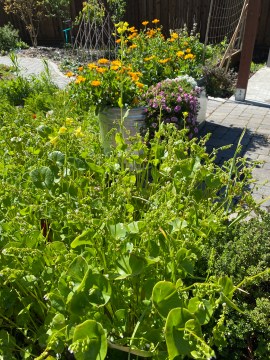
Zinnias! Love Santa Rosa, hate San Francisco

But tomatoes love the hot summers here. We are still harvesting tomatoes but it wasn’t like last year when we had to give bagsful away to neighbors. One plant suddenly died and gardener friends suggested gophers were eating the roots. Yikes! We had been happily gopher free. But I figured out the problem. I had watered the plant with a hose that had been sitting out in the hundred degree heat. I boiled the roots to death!

I didn’t make it to the climate march September 20. But I did eschew the car and take public transportation to Tradeswomen Inc.’s 40th anniversary celebration in Oakland where I got to commune with 400 tradeswomen. Then on Saturday night I took the Lamplight Tour of Santa Rosa’s historic rural cemetery. It’s a phenomenal production requiring the work of 120 volunteers who wrote, performed and organized eight vignettes about local history. We learned about the influence of the KKK in Sonoma County in the 1920s, the Women’s Christian Temperance Union, Jack London’s story about a local miner and more. Something tells me I’ll get sucked into working with this group of citizens interested in local history.

Naked ladies bloom at the Rural Cemetery

And next week I’ll travel to Minneapolis for the Women Build Nations national tradeswomen conference where history will also be a focus of discussion. A lot of us old timers realize we need to be recording it now before dementia sets in. Along with Brigid O’Farrell I’ll be leading the writers workshop. Methinks a book is in the offing.

Wishing all an auspicious autumn season.

Celebrating Lughnasa in NoCa

The noises started in late spring, sort of an irregular popping sound, occasionally loud enough to wake us at night. It sounded like someone was bouncing tennis balls off the fence in back. What were the raccoons up to? It couldn’t be the opossums. One lumbered along the fence every evening as night fell. But she was quiet as she moved to another yard. 

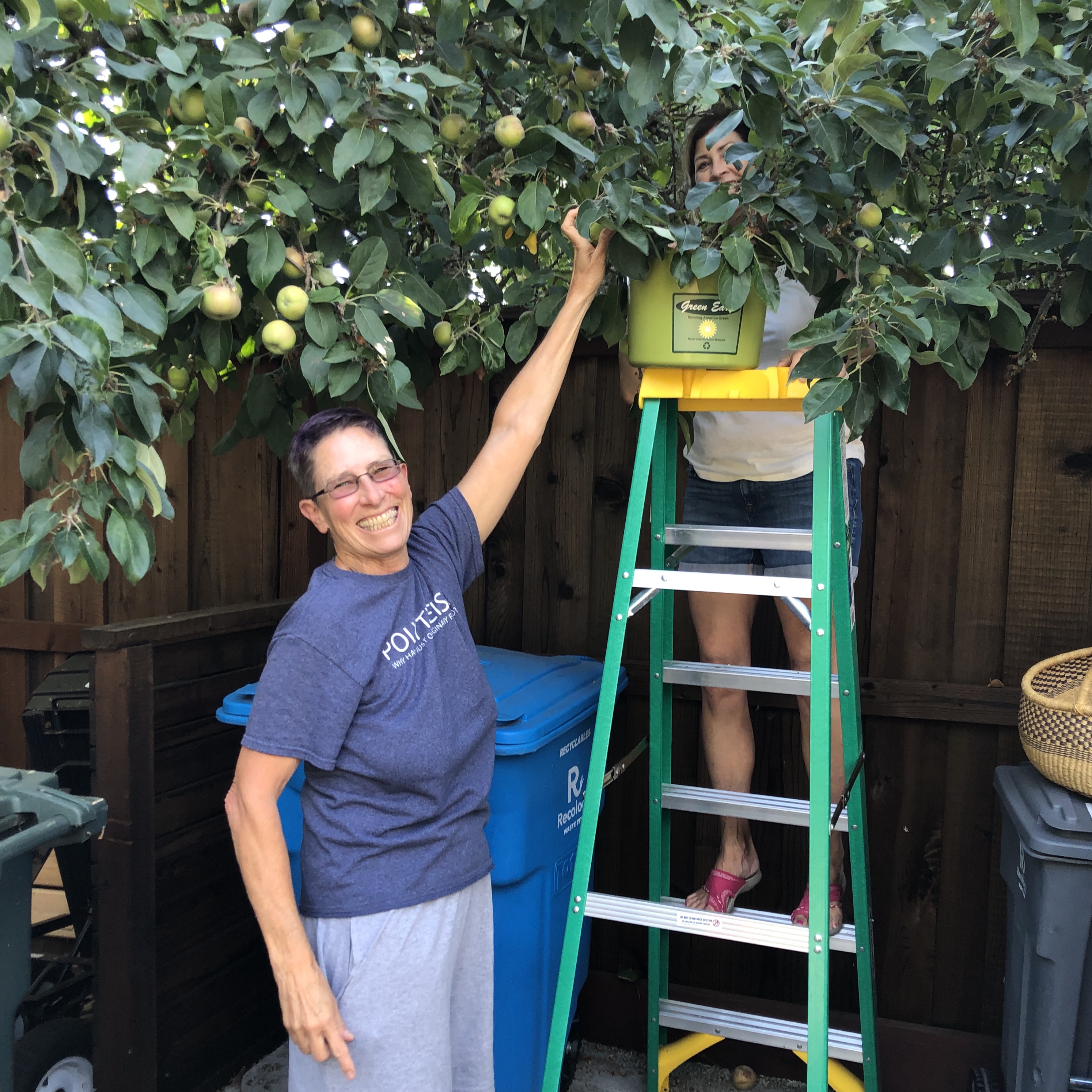
My T-shirt reads: Polytheism. Why have just one imaginary friend

It took a few weeks before we figured out the noise was made by apples falling from our side yard neighbor’s tree. It just got louder as the little green apples grew larger, thudding onto the garden pavers, banging onto the metal shed roof.
When the tree leafed out last spring, Holly was delighted to find it’s a Gravenstein, the apple of her youth. Grandpa warned Holly and her sister not to eat the unripe apples. “They’ll make you sick.” But they just couldn’t wait. They ate them and liked them and never got sick. Grandma would make apple sauce for every dinner during apple season.

I come from apple country too, in Yakima, Washington. But we didn’t grow Gravensteins, which ripen earlier and don’t require the cold nights up north. Our Macintoshes and Red Delicious apples ripened in October and in my day school was let out so kids could help their families with the harvest. To me there is nothing like the taste of a ripe Red Delicious picked right off the tree. I never tasted a Gravenstein until I moved to California.

The iconic apple of Sonoma County was brought to the continent by Russian fur traders. It is said they planted the first tree in 1811 at Fort Ross on the Sonoma coast. Gravensteins ripen in July and August here. The tart fruit doesn’t last long and must be processed or eaten quickly. This year we had a bumper crop. Branches grew far over into our yard so that we had to duck under on our way to the recycling bins. 

By the third week of July the emerging red stripes on the green fruit told us they were ripe. Fortuitously Holly’s cousin Kerri is an apple aficionado. She lives in Roseville and travels to Santa Rosa annually to buy a lug of Gravensteins for pies. Her method is to process them all at once, coring, slicing, sugaring enough for each pie (seven cups of apples) and then freezing in plastic bags for the making of pies and crisps all year long.

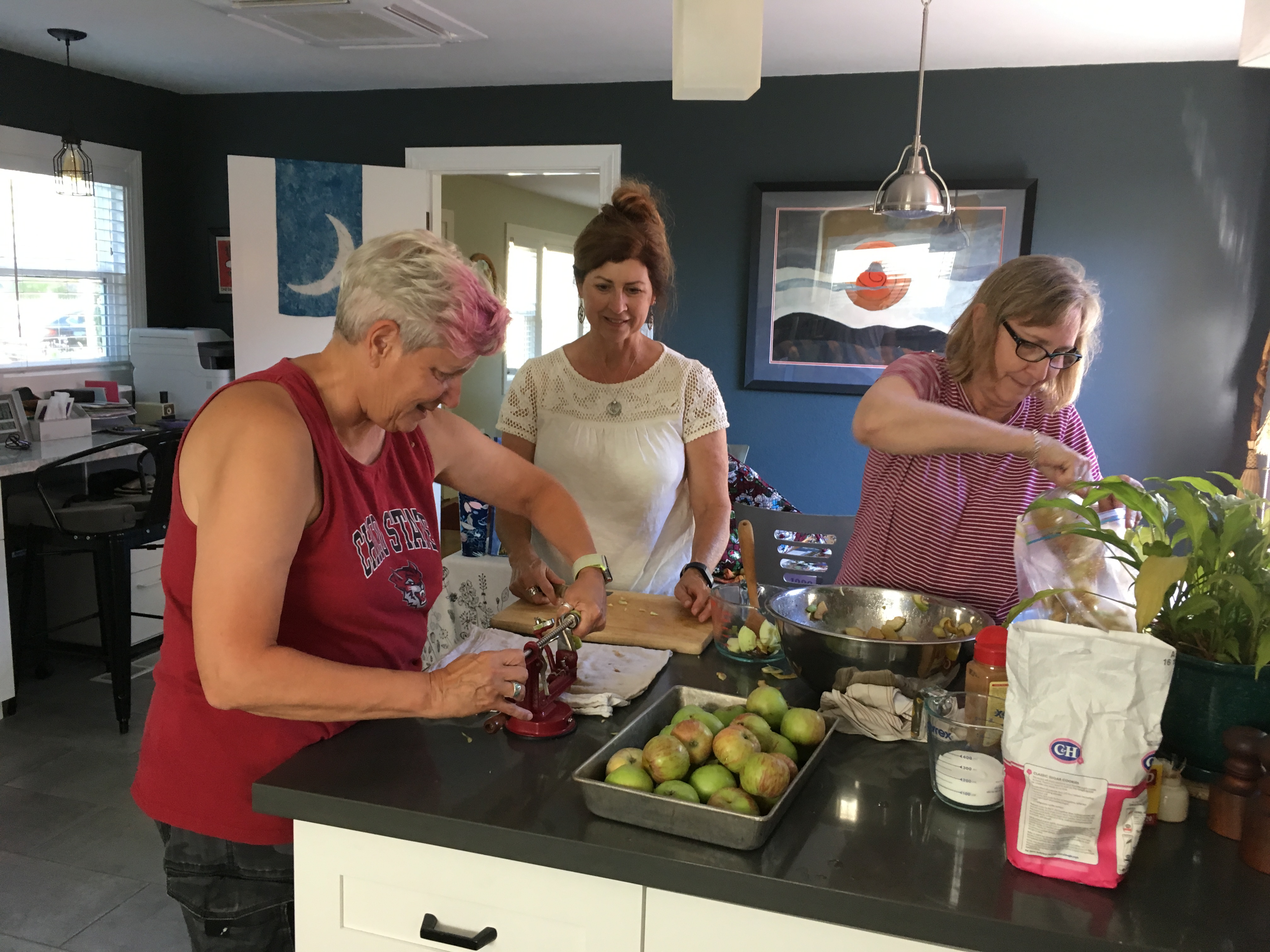
Holly, Kerri and Diana on the disassembly line

Just as the apples ripened we were lucky to be visited by Kerri and her apple coring machine. She came with all the ingredients for making pies—sugar, cinnamon, flour, crisco. Holly’s sister Diana was here too, from San Diego.

Our first chore was to pick the fruit, reliving our childhoods. We gingerly climbed the six-foot ladder, each taking a turn and being especially careful. We were sobered by the recent death of a friend, Chris Jones, who fell from a ladder while hanging a gay pride flag in his yard in San Francisco.

Then we set up an assembly line, coring, slicing and sugaring. What music goes with apples? We chose Lady Gaga. You can dance and core at the same time. Then Kerri made three pies. One we gave to the neighbor, whose apple tree it is. The two others we ate with gusto. And we still have ingredients for many more pies in the freezer. Then Holly and I cut up the remaining small apples and made four quarts of apple sauce. 

And that’s how we celebrated the cross-quarter pagan harvest festival. Called Lughnasa by the Celts and Lammas by the Anglo-Saxons, it’s one pagan festival not appropriated by christians. The first of three Celtic harvest fests, Lughnasa is celebrated on August 1 or 2, about mid-way between summer solstice and autumn equinox. But, as with the other pagan holidays, we extend festivities for as long as we like. We will continue to celebrate the apple harvest at the Gravenstein Apple Fair this year in August 17 and 18 in Sebastopol.

Good harvest to you!