Wharlest Jackson Died for Our Rights

The Black Freedom Movement and Tradeswomen History

I want to take us back in time and imagine a world, a culture, in which job categories were firmly divided between MEN and WOMEN. Women were restricted to pink collar jobs that paid too little to raise a family on or even to live without a man’s support. Even doing the same jobs, women were legally paid less than men. Married women were not allowed to work outside the home. Single women who found jobs as teachers or secretaries were fired as soon as they married. Black people were only allowed to work as laborers or house cleaners.

This was the world we fought to change.

Tradeswomen who have jobs today must thank Black workers who began the fight for jobs and justice. 

The Black Freedom Movement has advocated for workplace equity since the end of the Civil War.

The movement gained power during and after WWII. A. Philip Randolph headed the sleeping car porters union, the leading Black trade union in the US. In 1940 he threatened to march on Washington with ten thousand demonstrators if the government did not act to end job discrimination in federal war contracts. FDR capitulated and signed executive order 8802, the first presidential order to benefit Blacks since reconstruction. It outlawed discrimination by companies and unions engaged in war work on government contracts. This executive order marked the start of affirmative action.

The fight to desegregate the workforce continued.

In the early 1960s in the San Francisco Bay Area, protesters organized successful picket campaigns against businesses that refused to hire Blacks, including the Palace hotel, car dealerships and Mel’s Drive-In. Many of the protesters were white students at UC Berkeley.

In August 1963, the march on Washington brought 200,000 people to the capitol to protest racial discrimination and show support for civil rights legislation. The civil rights act of 1964, signed into law by President Johnson, is the legal structure that women and POC have used to put nondiscrimination into practice.

But change did not come quickly or easily.

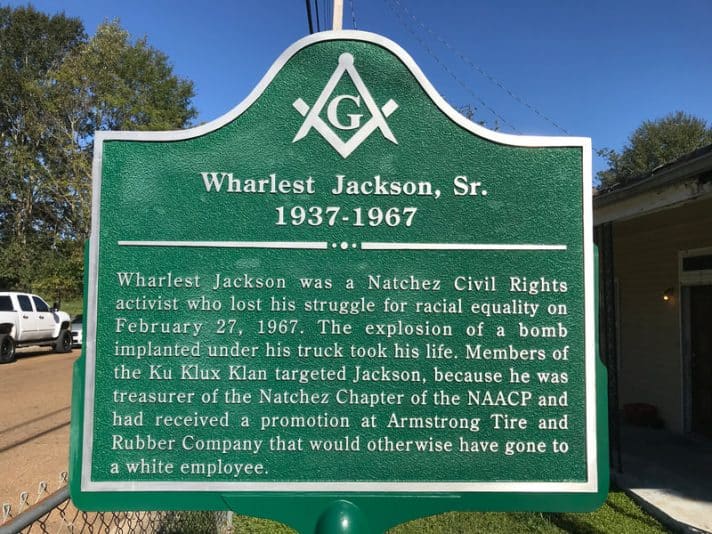
Black workers at a tire plant in Natchez Mississippi were organizing to desegregate jobs. The CIO, Congress of Industrial Organizations, supported them in this fight. In 1967, three years after the civil rights act became law, a Black man, Wharlest Jackson, who had won a promotion to a previously “white” job in the tire plant, was murdered by the KKK. They blew up his truck as he was driving home from work. No one was ever arrested or prosecuted for this crime.

Wharlest Jackson was the father of five. His wife, Exerlina, was among those arrested for peacefully insisting on equal treatment during a boycott of the town of Natchez’s white businesses. She was sent to Parchman penitentiary.

Jackson was just one of many who died for our right to be treated equally at work.

Tradeswomen are part of the feminist, civil rights and union movements. We continue to seek allies because we are few.  

Discrimination has not ended, but, because of decades of organizing, our work lives have improved. We owe much to the Black workers who sought equity in employment for decades before us. 

Photo: the Zinn Education Project
We Survive Another Disaster

Celebrating Ostara, the Vernal Equinox

My regular pagan holiday post

Holly keeps saying the water is rising but I am watching a movie. She says its rising really fast. She’s running around trying to find rubber boots. Oh man, the movie is almost done. But you don’t see how fast it’s rising she says. I look out the window and see that rain is pouring down and the street in front of our house is a lake. Ok where did I put my rubber boots? They have a zebra design (bought at Sebastopol hardware) so they shouldn’t be too hard to find in the mess that is our garage.

Our garage has been a mess for a long time. Goddess, how long has it been since we could actually park our Bolt in the car garage? Years, it’s been years. It’s always something. Lately it’s that Holly’s mom died and Holly had to clean out her stuff from Mom’s room at the assisted living place where she had lived for five years. Amazing how much stuff you can fit into one room. Now it’s in our garage, what’s left over after giving away what we could.

The boots are tucked in a corner of the garage, which is already flooding. Out in the driveway the water comes halfway up to the top of my boots. Holly has already soaked her short boots and has moved on to water shoes.

We think the problem is a blocked drain somewhere in the system. Neighbors are all out on the street and their nearby driveways are flooding too, but ours is the only house whose garage is flooding. Holly and I quickly move cardboard boxes out of the way of the water. Most of our stuff is stored in plastic boxes, but Mom’s stuff is not.

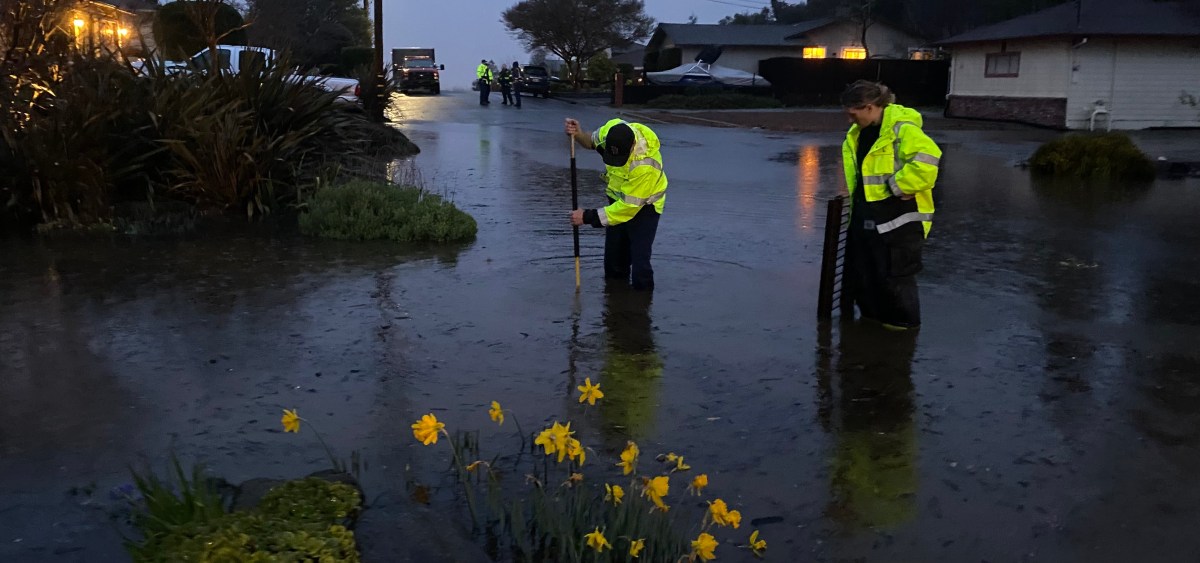
We stand in the open garage and watch as the fire department tries to free the drains. One of the firefighters is a woman! Our neighbor Chuck trots back and forth through the muck trying to explain how the drainage system works in the neighborhood. Chuck was here 20 years ago when this happened. The story goes that his car floated away, or maybe his car was just engulfed in water and the city paid to fix it. I move our car up further as far into the garage as the junk stored there will allow.

Out in the street in front of our house the firefighters are up to their knees in water and they are working to find the plugged drain. The water keeps rising. One young firefighter joins us in the garage to check on and calm us old ladies. We are a lot calmer that he is. He keeps saying how sorry he is. We keep saying it’s not his fault that our street is flooding.

Our sump pump turns itself on, the first time we’ve ever seen this happen. We usually have to help it along, pulling the bulb up by hand to make it work. That means the water under the house in the crawl space is rising too. The pump works hard to pump the water out of the crawl space and onto the flooded driveway. Then the water flows back under the house again. Futile. We worry that the crawl space water will rise up to the floor boards and come up through the wood floor. We imagine ourselves sloshing around the house in a foot of water. I mentally tally the cost of replacing the oak flooring. This could be a real disaster. We run around the house picking things up from the floor—computers, furniture, air filters. Holly folds up the colorful quilt our friend Linda just made for her and puts it up high in a closet.

It gets dark. Then the city arrives with a vacuum truck. The water begins to recede. They are still on the street the next day looking for the blockage. They tell me this magical truck also can blow out the blockage and that’s what they’re trying to do.

One of our neighbors, an engineer, meets with the city people to work on a solution. I say we need a drawing so we understand where the water goes. He says you can find it online but it is incorrect. The system was designed to drain the water in the opposite direction than it is draining! He is pressuring the city to fix the drainage system so flooding does not become a neighborhood ritual.

In the six years we’ve lived here we’ve survived fire (the neighborhood was evacuated in the Tubbs fire in 2017 and we self-evacuated in 2019 and 2020), and an earthquake on the Rogers Creek fault which runs very near our house, if not under it. But we never thought we’d have to worry about flooding. We live on a hill! Come to find out there’s a dip at the top of the hill right where our house sits. 

Now we are calling ourselves the Dips on the Hill.

We fervently hope that flooding does not become a routine disaster on our block and with that in mind we are not inventing any associated rituals. But we did partake in an annual spring ritual especially festive in the gay community–watching the Oscars. Sonoma County’s party takes place at the Rialto theater in Sebastopol. It’s a benefit for Food for Thought, a food bank started in 1988 to serve people with AIDS. Lesbians, like our friend Jude Mariah, were the early organizers. Still going strong, it’s a free service that depends on volunteers to deliver healthy meals to all community members with serious illnesses, more than 4000 people last year.

The vernal equinox this year is March 19, the astronomical beginning of the spring season in the northern hemisphere. Pagans call it Ostara, a word that comes from the Anglo-Saxon goddess name, Eostre. Also the root of the word Easter.

Here in Sonoma County we are celebrating the last of the atmospheric rivers and the beginning of warm weather.

Happy Ostara!

Molly (and Holly)