On Soyal Native Americans marked the shortest day of the year
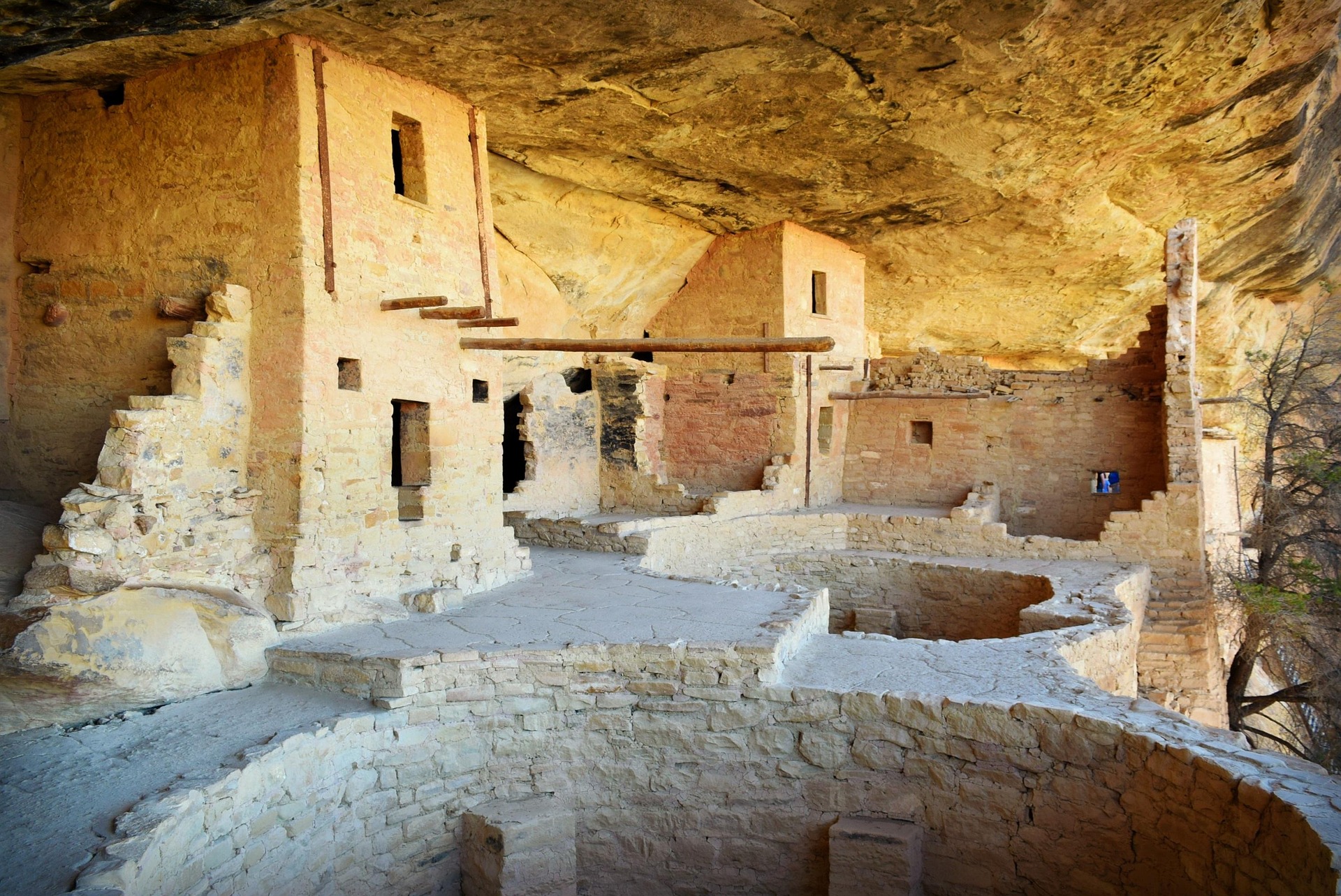
Cliff Palace in Mesa Verde National Park, Colorado. Photo by Judson McCranie. (CC BY-SA 3.0) It is believed that ancestors to the Hopi built and lived in Cliff Palace from about 1200 to 1300 C.E.
My Regular Pagan Holiday Post: Winter Solstice
My queer family chooses to forgo holidays shaped by a christian tradition steeped in homophobia and misogyny—a church that has long covered up sexual abuse against children and parishioners while scapegoating queer people. Recent comments by Pope Francis only underline this contradiction, reaffirming the catholic church’s ban on ordaining gay men and punishing and defrocking priests who question that policy or support what it calls “gay culture.”
So we create our own rituals instead—queer, chosen-family–centered traditions. We look to other cultures for inspiration, especially pagan and pre-christian practices that honor the natural world and community rather than dogma.
We can learn much from Native Americans that might help us through what is shaping up to be a particularly dark period in our history and present.
Soyal: Winter Solstice and Renewal
On the winter solstice, Hopi and Zuni peoples perform a ceremony with the intention of achieving unity and strengthening community. Soyal is held on the shortest day of the year. It marks the symbolic return of the sun, the turning of the seasonal wheel, and the beginning of a new spiritual cycle. Soyal is a time of purification, prayer, and renewal, when the community prepares itself—spiritually and socially—for the year ahead.
In the days before Soyal, families create pahos, prayer sticks made with feathers and plant fibers, which are used to bless homes, animals, fields, and the wider world. Sacred underground chambers, called kivas, are ritually opened to mark the beginning of the kachina season. The kachinas are understood as spiritual messengers who carry prayers for rain, health, balance, and right living. Songs, dances, offerings, and storytelling strengthen community bonds and pass ethical teachings from elders to children.
Soyal also dramatizes the struggle between darkness and light. Through symbolic dances and ritual objects, such as shields representing the sun and effigies symbolizing destructive forces, the community enacts the tension between chaos and order, drought and rain, winter and warmth. The message is not that darkness must be destroyed, but that it must be faced, respected, and brought back into balance.
The solstice itself becomes a sacred pause: a moment when time feels suspended and people are invited to examine their lives. It is a season for letting go of harmful habits, reconciling conflicts, offering forgiveness, and setting intentions rooted in responsibility rather than personal gain. Gifts are exchanged not as possessions, but as blessings and goodwill.
Creating Our Own Rituals
Soyal reminds us that human life is meant to move in natural cycles, not endless acceleration. Rest is not weakness; it is a form of wisdom. Renewal begins with humility, gratitude, and shared responsibility. Personal healing is inseparable from the health of the community and the land.
The enduring spiritual mission expressed through Soyal is the same across Hopi villages: to promote and achieve the unity of everything in the universe.
While that vast unity may be beyond our vision, we, too, seek to strengthen our community and mark the return of light. At winter solstice, we gather ourselves and our loved ones, shaping rituals that keep us connected to one another and to the slow turning of the year. We invite friends to help us trim our solstice tree, contribute to the local food bank, have neighbors over for hot chocolate, read poetry and stories aloud, bake cannabis edibles, host impromptu living room dance parties, cook savory soups, plant flower bulbs. With neighbors, we make signs and join street protests to raise our voices against fascism. We look for the sacred in everyday life.
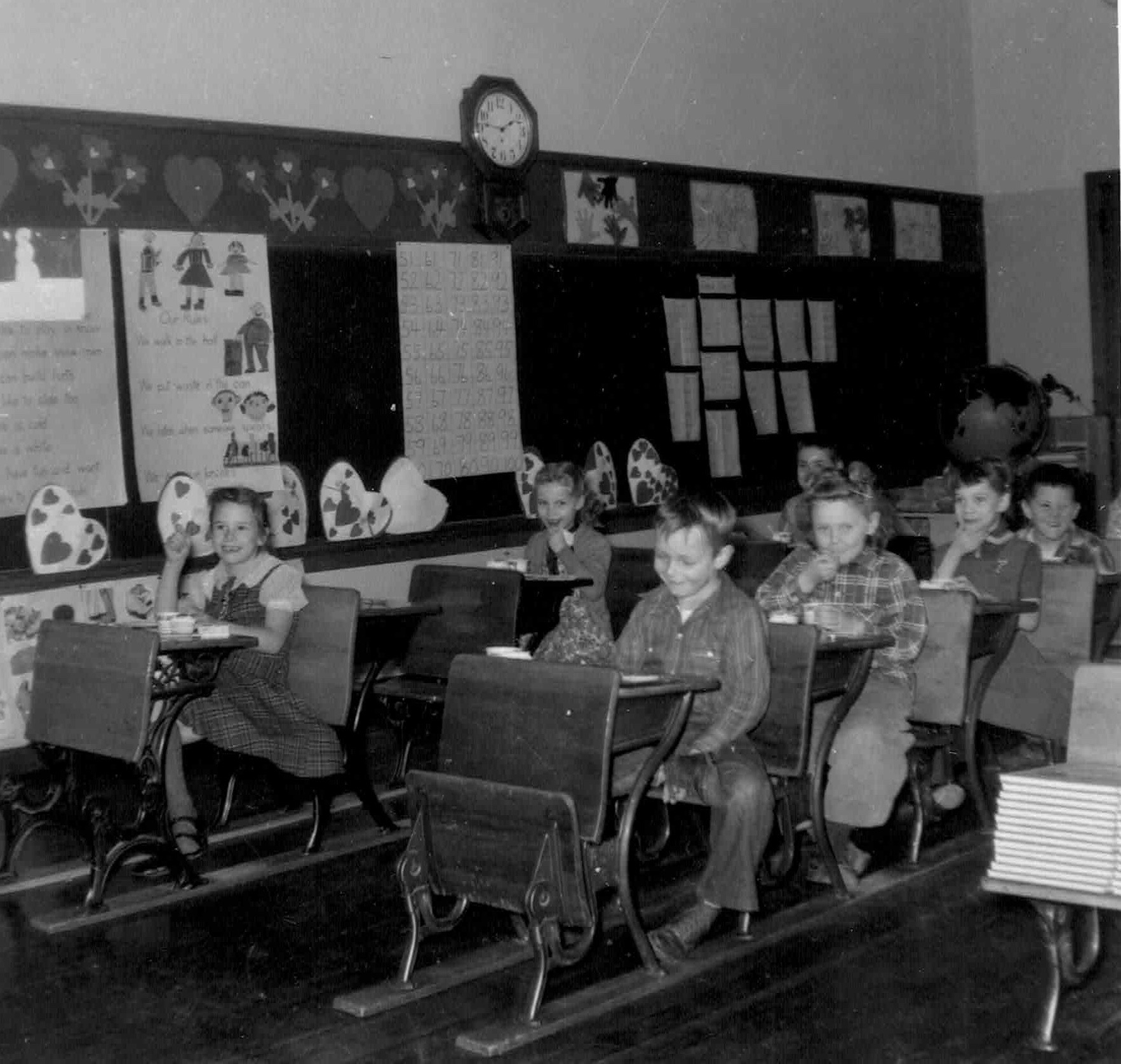
Wide Hollow Elementary School in Yakima, Washington, was already an old building when I began attending in the 1950s. At the time, it served students from first through eighth grades. The little kids were on the first floor, the big kids upstairs. I remember the worn wooden steps leading to the second floor, scalloped by generations of student feet.
Our classrooms held old-fashioned desks—wooden with ornate cast-iron legs—each one with a small hole in the top for an ink bottle. We were taught how to fill our fountain pens by dipping the nib into the ink and lifting a lever to draw it in. (This cannot have happened without spills—the poor teachers!)
Valentines day 1956 at Wide Hollow school. That’s me on the far left.
Every room had a long wall of blackboard, with erasers that students cleaned by smacking them together, creating great clouds of chalk dust. The tall windows were opened using a long pole. Above the blackboards, neat rows of Palmer Method cursive letters reminded us of the proper way to form our handwriting.
The school was heated by a coal furnace. A coal chute led to the basement, where the coal man would periodically unload his delivery.
My first grade class at Wide Hollow
Outside, the playground seemed enormous. A towering maple tree stood right outside the building. We had swings, a slide, and a ride called the “ocean wave”—a notoriously dangerous contraption rumored to have killed children in other schools. As far as I know, ours survived it, though I did rip my good dress riding it on the very first day of first grade.
At recess, we played Ring Around the Rosie, Red Rover, jump rope, tetherball, and a game where we bounced a ball against the wall chanting, “Not last night but the night before, 24 robbers came knocking at my door.”
Much has changed. The old building was torn down years ago and replaced. The curriculum has become more inclusive. I still remember being twelve and furious that our new history books made no mention of the Indigenous peoples of the area. Today, Wide Hollow proudly displays a land acknowledgment on its website:
“We would like to acknowledge that we’re coming to you from the traditional lands of the first people of our valley, the 14 Confederated Tribes and Bands of the Yakama Nation, and we honor with gratitude the land itself and the Yakama Tribe.”
Wide Hollow is now a K–5 school. They host a “multicultural celebration,” but I don’t believe the ancient pagan Spring holiday of May Day is among those still observed. Back in our day, we celebrated May Day by weaving ribbons around a maypole (perhaps the tetherball pole?) and making May baskets, often filled like Easter baskets with flowers.
Dancing around the maypole
While May Day celebrations have largely fallen out of fashion in the U.S., they still take place in some towns. In Europe, the tradition persists more strongly. In modern pagan communities, May Day has been revived and reimagined through the Celtic festival of Beltane.
In Sweden, maypole dancing has shifted to the big Summer Solstice festivals, but until the 19th century, May Day was celebrated with mock battles between Summer and Winter. I love this account by Sir James George Frazer in The Golden Bough (1911):
“On May Day two troops of young men on horseback used to meet as if for mortal combat. One of them was led by a representative of Winter clad in furs, who threw snowballs and ice in order to prolong the cold weather. The other troop was commanded by a representative of Summer, covered with fresh leaves and flowers. In the sham fight which followed, the party of Summer came off victorious, and the ceremony ended with a feast.”
Note: the picture of Wide Hollow school at the top is a postcard labeled North Yakima. That means the picture was taken before 1918 when North Yakima was changed to Yakima. So the school was originally built probably in the teens.
May 1 is also International Workers Day
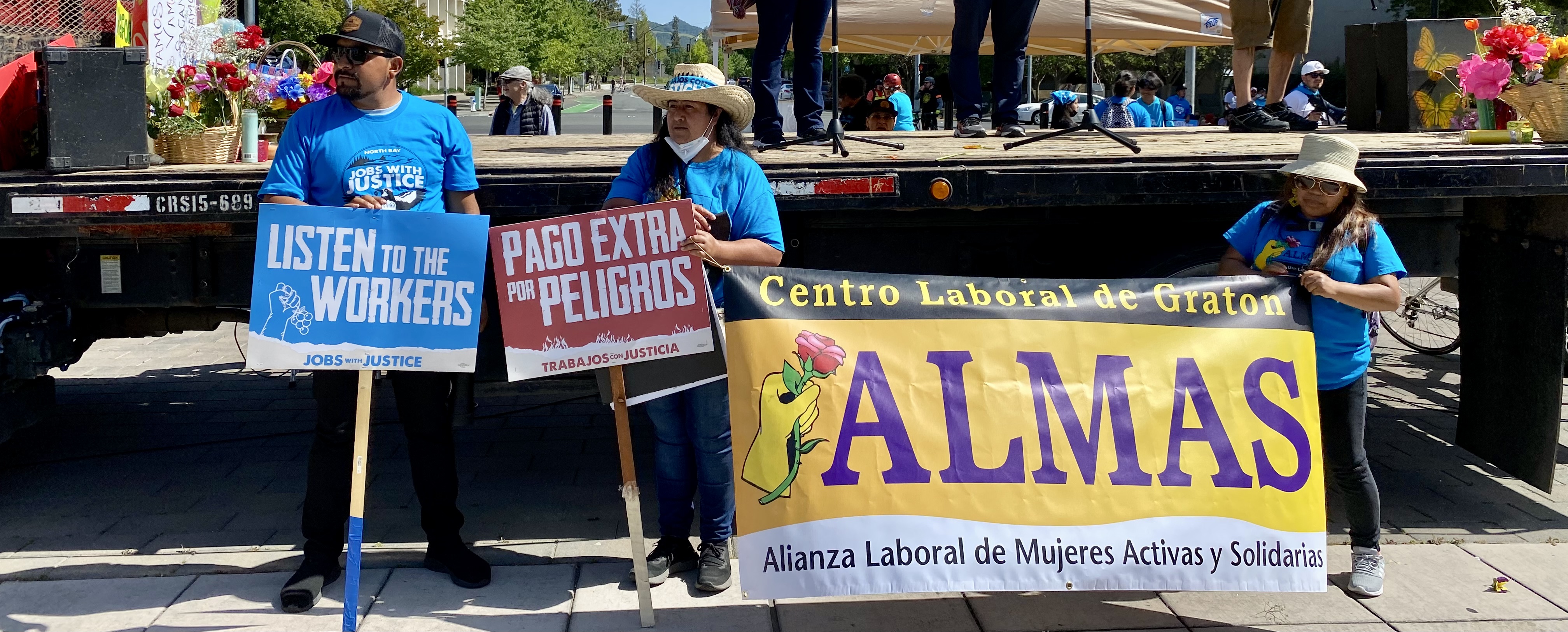
At the Santa Rosa International Workers Day celebration
May 1st is also recognized globally as International Workers’ Day. In 1889, the date was chosen by an international federation of socialist groups and trade unions to commemorate the Haymarket Affair—a violent deadly police riot in Chicago in 1886 targeting workers organizing for the eight-hour workday.
Here in Sonoma County, this year May Day marks the beginning of the Days of Action May 1-5, organized by Community United to Resist Fascism (CURF). The International Workers’ Day march will call for immigrant rights and is co-organized with the May 1st Coalition. The event will begin at 3 p.m. in Santa Rosa at the Sonoma County Sheriff’s Office, proceed to the Board of Supervisors’ office, and then continue to Old Courthouse Square to rally at 5pm. I’ll see you there!
As we construct our ofrendas for Day of the Dead, decorate our yards for Halloween and celebrate the pagan holiday Samhain, I’ve been thinking about two other holidays we celebrate this time of year–Indigenous Peoples’ Day and Thanksgiving. This is a story about how the meaning and celebrations of American holidays can evolve to reflect new understanding of our history.
As we learn more details about our history, in the last few years Americans have been rethinking the stories connected with Thanksgiving and Columbus Day.
My generation of students learned to recite, “In 1492 Columbus sailed the ocean blue.” We learned about the Nina, the Pinta and the Santa Maria and that Christopher Columbus “discovered America.”
In elementary school in the 1950s I participated in those Thanksgiving pageants in which you were either a Pilgrim—boys with black buckled hats and shoes, girls in long, aproned dresses and bonnets—or an Indian with feathered headband and tomahawk. The story we enacted was a peaceful meeting and feast between Indians and pilgrims just off the Mayflower. It was the beginning of a happy long relationship between settlers and Indians.
Sadly, almost all of what we were taught was incorrect and incomplete; the myth conveniently left out the parts about genocide, slavery and land theft.
It turns out that Christopher Columbus was a homicidal tyrant who initiated the two greatest crimes in the history of the Western Hemisphere–the Atlantic slave trade, and the American Indian genocide. It’s not dissing Italians to say we no longer venerate this colonizer. Over the last few decades, Columbus Day has evolved into Italian Heritage Day in many locales.
And we are witnessing a movement to honor Native peoples on Columbus Day. It originated in 1989 in South Dakota during its “Year of Reconciliation,” in an effort to atone for terrible history.
The phrase “merciless Indian savages” is written into the Declaration of Independence. That says all we need to know about how the founders of our country viewed the indigenous people in this land.
For centuries, the American government saw Indians as the enemy, sponsoring their slaughter and “removal.” Through a series of notorious atrocities, including the Trail of Tears, the Sand Creek Massacre and Wounded Knee, (and in California, our own Trail of Tears in 1863, and the Bloody Island Clear Lake massacre in 1850, among others) the United States adopted an official expansionist policy of discriminating against Native Americans in favor of encouraging white settlers in their territories. This policy led to the subjugation, oppression, and death of many Native Americans, whose communities still feel its effects. Only in 1924 were Native Americans allowed to become citizens of the United States, and it took decades more for all states to permit them to vote.
But as we Americans acknowledge this history, our contemporary view of Native Americans is changing.
Congresswoman Norma Torres (D-CA) has introduced legislation to establish Indigenous Peoples’ Day as a federal holiday. Now, at least 13 states and over 130 cities have adopted Indigenous Peoples’ Day or Native American Day. In 2021, President Joe Biden formally recognized Indigenous Peoples Day.
Here in Sonoma County indigenous people are well integrated into our local culture and community events. Tribes are consulted by land keepers and planners. Colleges, libraries and nonprofits sponsor classes about indigenous culture. My wife Holly and I attended the Indigenous Peoples’ Day gathering at Santa Rosa Junior College, which featured native dancing, music, drumming, food, speeches and vendors. The SRJC also has a native museum whose latest exhibit features the stories and art of local basket weavers.
As with Columbus, Americans have been taught a false narrative about Thanksgiving.
Two different early gatherings may have inspired the American Thanksgiving holiday. At the first, in 1621, Wampanoagwere not invited to the pilgrims’ feast, but heard celebratory gunshots and came to the aid of the colonists. They had formed a mutual defense pact. Once there, the Indians stayed and feasted, but the feast did not resolve ongoing prejudices or differences between them. Contrary to the Thanksgiving myth, this was not the start of any long-standing tradition between the settlers and the Wampanoag tribe. The myth doesn’t address the deterioration of this relationship, culminating in one of the most horrific colonial Indian wars on record, King Philip’s War.
Ironically, Thanksgiving as a holiday originates from the Native American philosophy of giving without expecting anything in return. The Wampanoag tribe not only provided food for the first feast, but also the teachings of agriculture and hunting. Corn, beans, wild rice, and turkey are some examples of foods introduced by Native Americans.
The first written mention of a “Thanksgiving” celebration occurs in 1637, after the colonists brutally massacred an entire Pequot village of 700 people, then celebrated their barbaric victory, giving thanks to their god.
During Reconstruction, the Thanksgiving myth allowed New Englanders to create the idea of bloodless colonialism, ignoring the Indian Wars and slavery. Americans could feel good about their colonial past without having to confront its really dark characteristics.
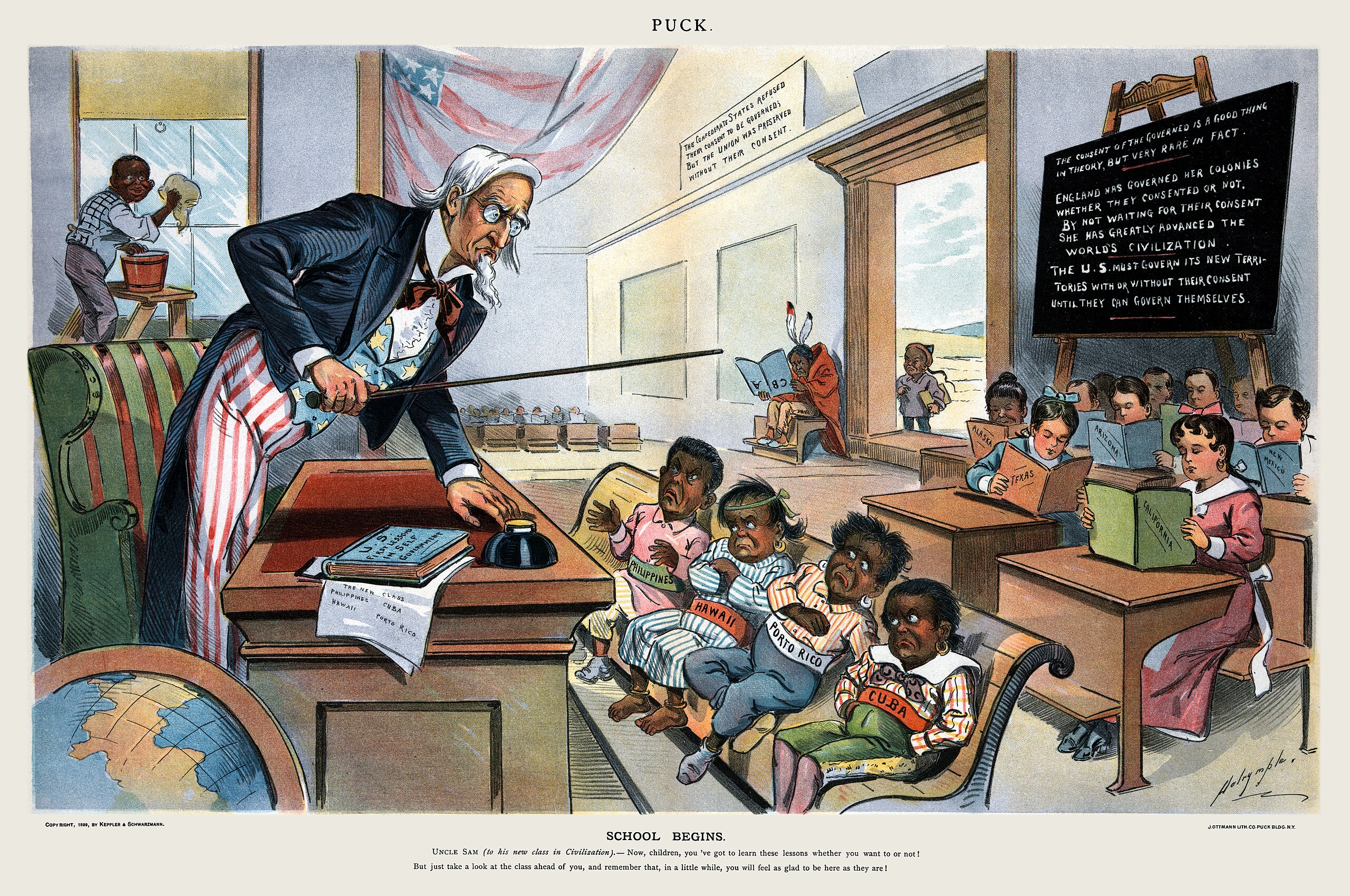
Now children you’ve got to learn these lessons whether you want to or not! Puck Magazine 1899.
For many Native Americans, Thanksgiving is a day of mourning and protest since it commemorates the arrival of settlers in North America and the following centuries of oppression and genocide.
Indian protests in the 1960s and 70s often attacked the Thanksgiving myth. In 1969 after natives took over Alcatraz, allies and Indians of all tribes came together for Unthanksgiving Day, a gathering that’s become a tradition, welcoming all visitors to a dawn ceremony on the island.
In 1970 during a Thanksgiving celebration in Plymouth, activists from the American Indian Movement stormed the Mayflower II ship and occupied it in protest. It was then that the United American Indians of New England recognized the fourth Thursday in November as a National Day of Mourning, to bring awareness to the long lasting impacts that colonization had on the Wampanoag and other Native American tribes. This year the in-person event will also be livestreamed.
Americans are told and we want to believe that we are the saviors of the world. But historical truth is far different.
Does the acceptance of Indigenous Peoples Day in place of Columbus Day and the updating of the Thanksgiving myth mean that we Americans are beginning to acknowledge our country’s history of imperialism and genocide? I hope so.
This time of year, and these two holidays, Thanksgiving and Indigenous Peoples Day, give us the opportunity to reflect on our collective history, to celebrate the beauty, strength, and resilience of the Native tribes of North America, and also to conduct our own rituals.
Long before settlers arrived, indigenous people were celebrating the autumn harvest and the gift of the earth’s abundance. Native American spirituality, both traditionally and today, emphasizes gratitude for creation, care for the environment, and recognition of the human need for communion with nature and others. I hope we can incorporate these ideals into our American harvest celebrations while we as a species still live.
Whether or not we cook a big turkey dinner, many of us practice Thanksgiving rituals. My and Holly’s ritual is to get together with our exes. We introduced them at a Thanksgiving dinner 13 years ago and they fell in love. We were surprised, and also delighted. Barb and Ana have become our exes and besties. We are participating in a lesbian tradition of incorporating our exes into our chosen families.
No matter where you are in North America, you are on indigenous land. In Sonoma County we live on unceded territory of the Pomo, Wappo and Coast Miwok tribes.
Good Samhain, Halloween, Day of the Dead and Thanksgiving to you all.
You could say that she died at the hands of the white man too
The posse didn’t wait to start shooting as they drove their horses down into the wash where the Indians slept in their camp. The reward had been promised whether they were brought in dead or alive. It was easier to kill them all.
On a cold February day in the Nevada hinterlands, a battle raged for three hours, pitting 13 Indians with few guns and little ammunition against 19 well-armed vigilantes. The women defended themselves and their children with spears and arrows. The little children threw rocks at the invaders.
One of the whites was killed as he advanced when a girl held up her skirts and flashed her genitals, smiling and moving forward in a weaving dance. As the white man stared in astonishment, she dropped down and her brother shot him with the one bullet left in his gun.
The youngest baby was in a cradleboard on her mother’s back when her 19-year-old mother was shot and killed. Her head fell back into the snowy mud. The marauders heard the baby crying and retrieved her along with three other children who had run into the sagebrush.
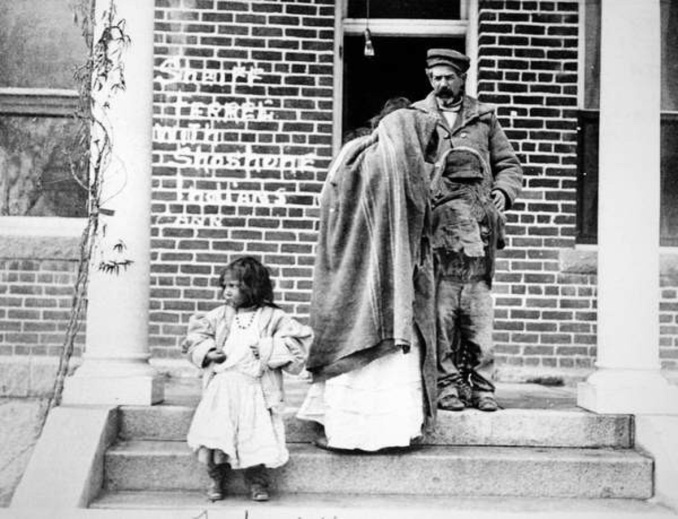
The four children were put in jail after capture. Mary Jo is a baby held by her aunt here.
That baby grew up to be Mary Jo Estep, the last surviving Indian of the last Indian massacre in 1911, a woman I would meet many years later.
She was one of four children who survived the massacre, but the other three died the following year of tuberculosis. Mary Jo was about 18 months old when the posse ambushed the remnants of her tribe. Her grandfather, “Shoshone Mike,” had led the band across 300 miles of western desert in northern Nevada and California after refusing to go to a reservation.
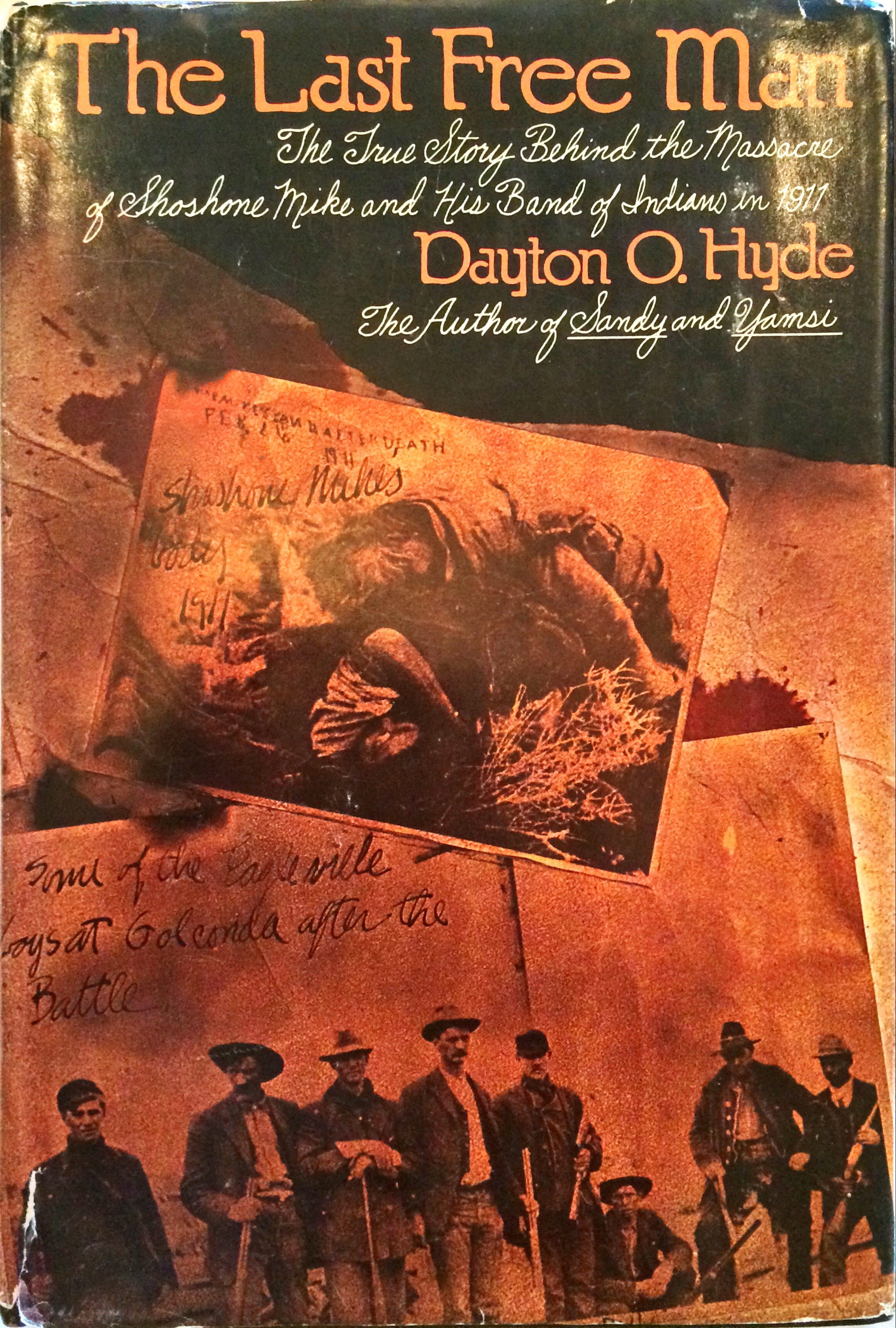
Mary Jo knew little of this and did not remember it. When, in 1973, the Oregon writer Dayton O. Hyde wrote a book about her grandfather and the massacre, he speculated that the children might still be living. He learned of Mary Jo and then agonized about how to approach her and tell her the story of the massacre.
In 1911 Indians had no rights and were not considered human. White men could get away with killing Indians with impunity. It was easy to blame crimes on Indians, and that is what happened to Shoshone Mike. A cattle rustling gang whose leader was the son of a prominent judge blamed their crimes on Mike. A vigilante group formed with eyes on the reward money. Federal marshals also were after Mike and posses began roaming the desert in northern Nevada looking for him.
Mike and his extended family evaded the posses for a year. But the winter of 1911 was the worst in a long time and, starving and tired, they were forced to camp in an unprotected spot where they were discovered.
The surviving children were taken to the jail in the nearest town and eventually moved to an Indian school. The murdered Indians’ bodies were never properly buried.
Until Hyde wrote the book it was still said that Shoshone Mike had committed crimes and the killing of his family was justified. Mike’s crime was that he wanted to live the nomadic life he had grown up with, camping every winter for 30 years on Rock Creek in southern Idaho and then moving to higher country for the summer season. The white man’s fences, sheep and cattle, mining waste, and development made his family’s lifestyle more and more difficult.
Hyde had been obsessed with the story of Shoshone Mike and his research included interviews with people who still remembered the massacre 60 years later. He traveled the route taken by Mike and his family, even collecting remaining bones of the Indians and reburying them.
Writing the book, he set the story straight. Mike and his family were innocent of the crimes whites accused them of. The murderers were never brought to justice; they were hailed as heroes by people in the surrounding towns. Hyde also uncovered evidence that Mike was Bannock, not Shoshone. His wife, Jennie, was Ute.
When she learned the story, Mary Jo’s first reaction was to discount it. “Most of my friends are non-Indians. I was raised in the white world,” she said.
Later she became a local celebrity of sorts in my hometown of Yakima, Washington, giving interviews and speaking to groups who wanted to hear her unique story.
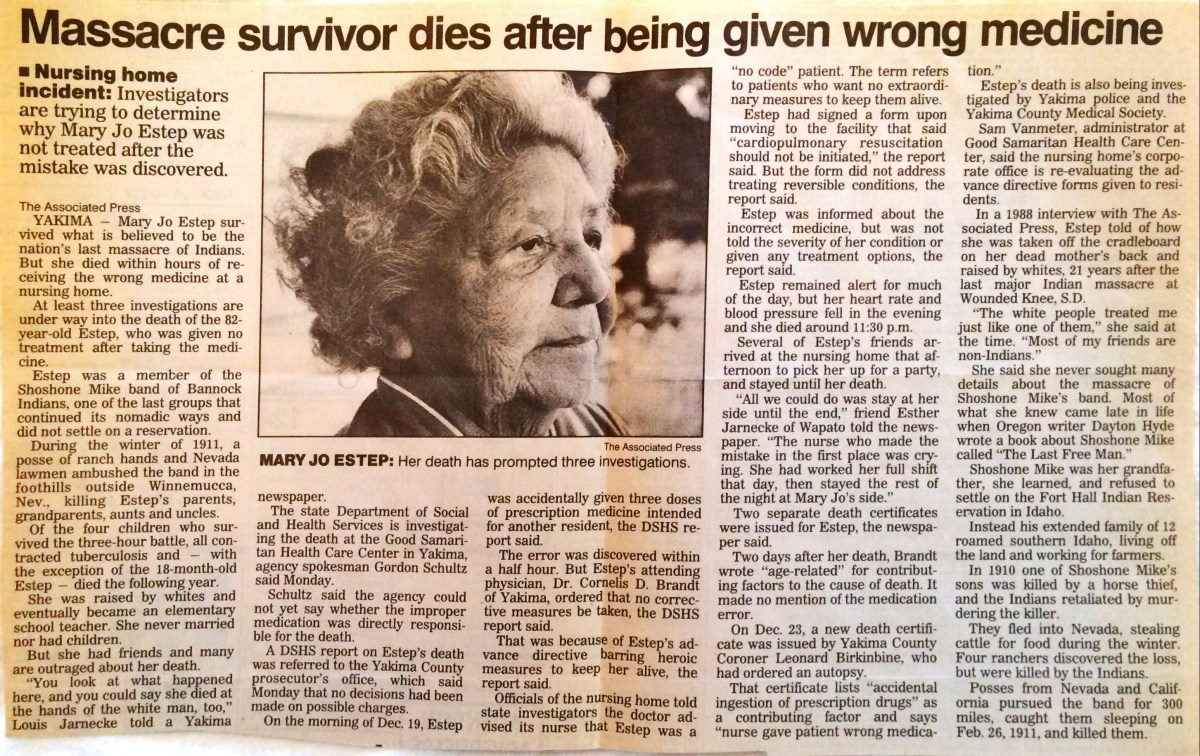
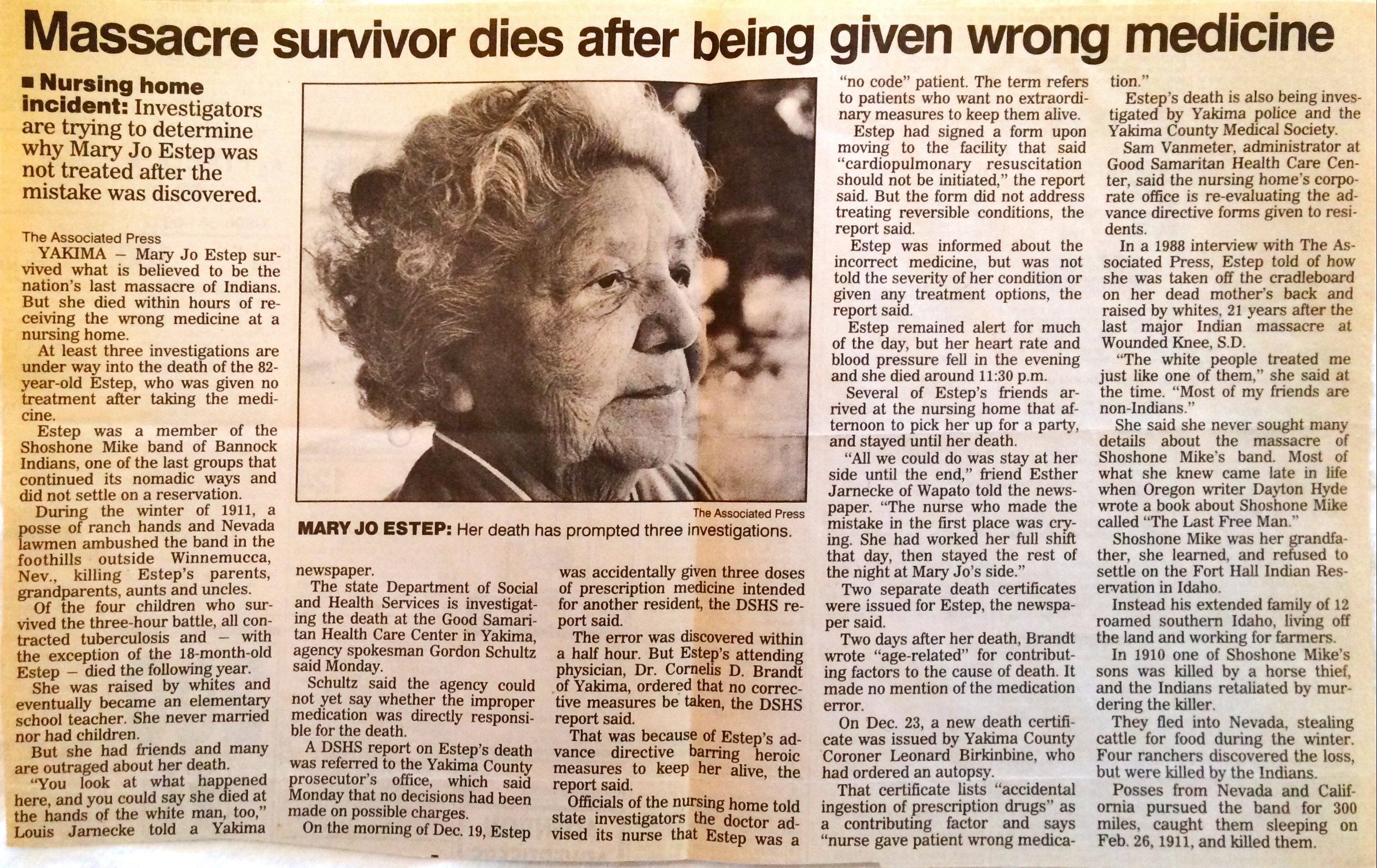
Mary Jo Estep was raised by the family of the Fort Hall Indian reservation superintendent. She graduated from Central Washington College with a degree in music and spent 40 years teaching school before retiring in 1974. At the age of 82 in 1992, Mary Jo died in a nursing home because a nurse had given her the wrong medication and hospital staff determined that her non-resuscitate directive meant that they could not help her. The effects of the overdose could have been easily reversed. She took several hours to die and in that time her friends, who had come to pick her up for a party, surrounded and comforted her, but could not move the doctors to save her life.
“You look at what happened to her, and you could say that she died at the hands of the white man too,” said Louis Jarnecke, one of her friends.
I still have the newspaper article telling of Mary Jo’s death, and the book written about her grandfather, The Last Free Man. What they don’t say is that Mary Jo Estep was a lesbian. She lived with her “long-time companion” Ruth Sweany for more than 50 years on Summitview Avenue in Yakima.
My mother, Florence Martin, with the chapbook
I met Mary Jo and Ruth through my mother who had organized a seniors’ writing group in Yakima. My mom was interested in the history of our part of the world and she encouraged old people to tell and write their stories. She worked for the senior center there and for a time she produced a local TV program in which she interviewed old-timers and recorded their histories. The women told me they were part of a group called “Living Historians,” and laughed saying, “At least we’re still living!”
In 1980, my brother Don and his press, Hard Rain Printing Collective, printed a chapbook that includes the writing of all three: Mary Jo, Ruth, and my mother Florence Martin. Mary Jo’s only piece in the chapbook chronicles an incident from her childhood of an old man who is lost and then found the next day by neighbors. Two of the published entries are by my mother. Ruth Sweany has four; three are poems, but the fourth is a prose piece that describes her life with Mary Jo, particularly when their friend Mabel comes to visit on Fridays. I think the friend must be Mabel George, another writer published in the chapbook.
A photo in the archive Yakima Memory from the Yakima Herald-Republic newspaper shows Mabel George (born January 8, 1899) at the piano, and another entry is titled Mabel George Children’s Songs from 78 records, 1947. So Mabel was a musician and songwriter.
Ruth’s story never mentions Mary Jo, but clearly the “we” in the piece refers to Ruth and Mary Jo as a couple. It’s about the fun they have when their friend Mabel visits. They listen to music (a critique of modern loud disco music follows), they read poetry and plays to each other. They also write and produce plays, calling themselves “The Carload Players.” Ruth writes that they even produced a couple of plays before an audience. This makes me wish their papers had been archived but I can find no evidence that they were saved.
These women rejoiced in each other’s company. Ruth writes: “So our Fridays are always cheerful. Why not? We are doing things we enjoy, in a congenial group. After one of Mabel’s visits the world stops going to the dogs and the sunshine comes out a little brighter.”
Mary Jo died November 19, 1992. Ruth died November 28, nine days later. They were both buried in the Terrace Heights cemetery in Yakima. They chose identical gravestones.
Ruth and Mary Jo carved out their own woman-centered culture in the hostile environment of Eastern Washington before the advent of the modern women’s movement and lesbian pride. Living lightly on the cultural landscape served them well.





 tradeswomn musings