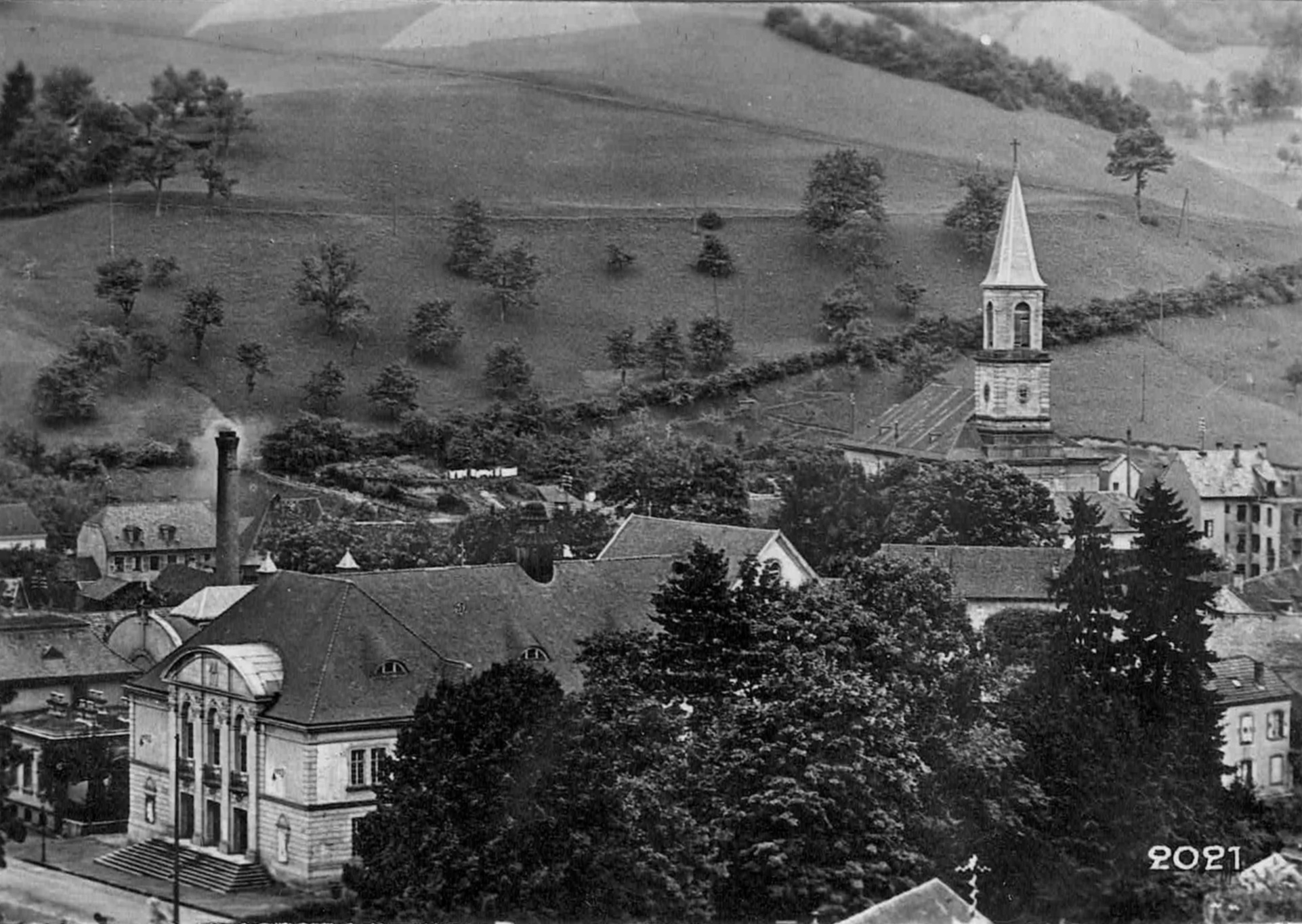
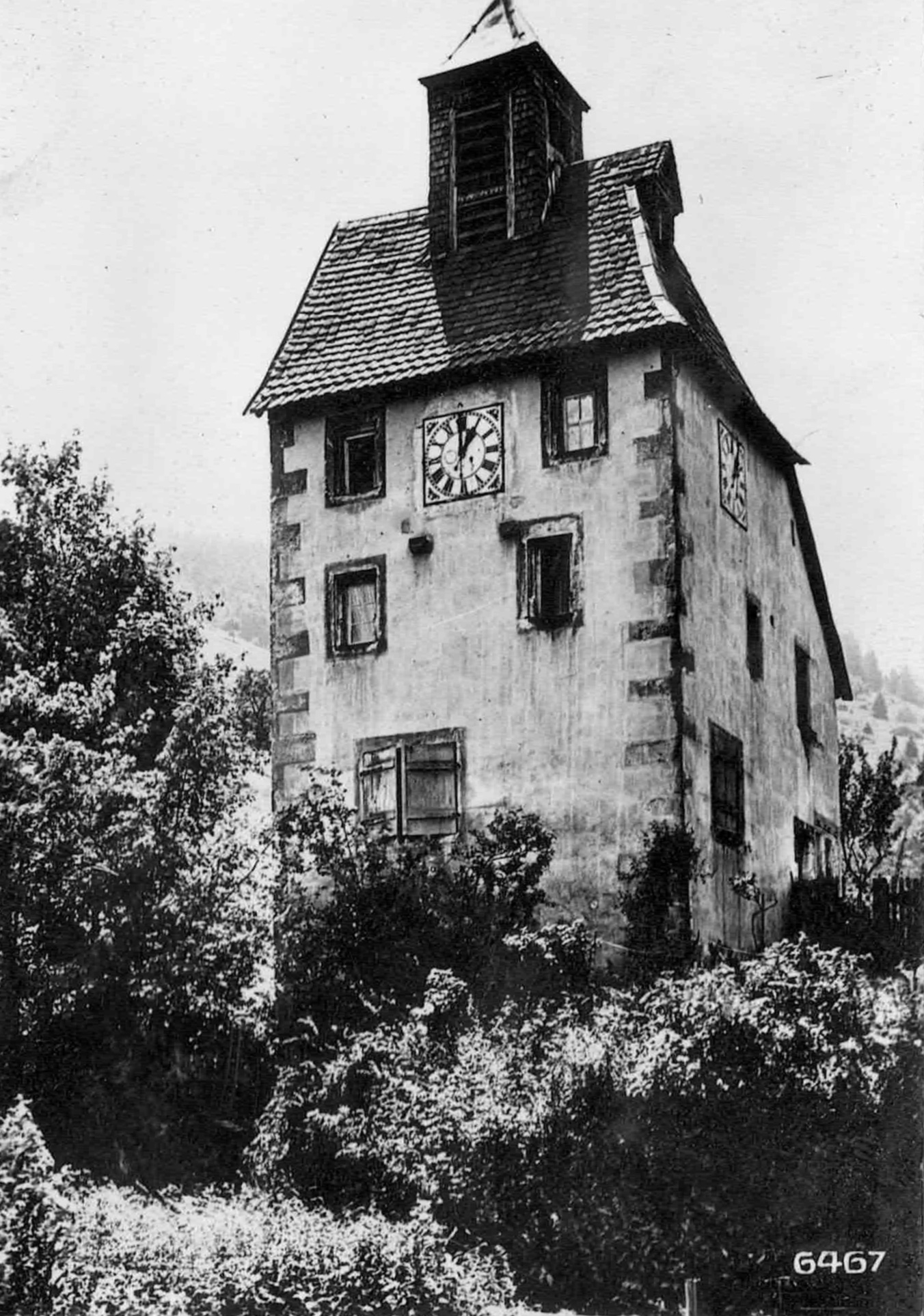
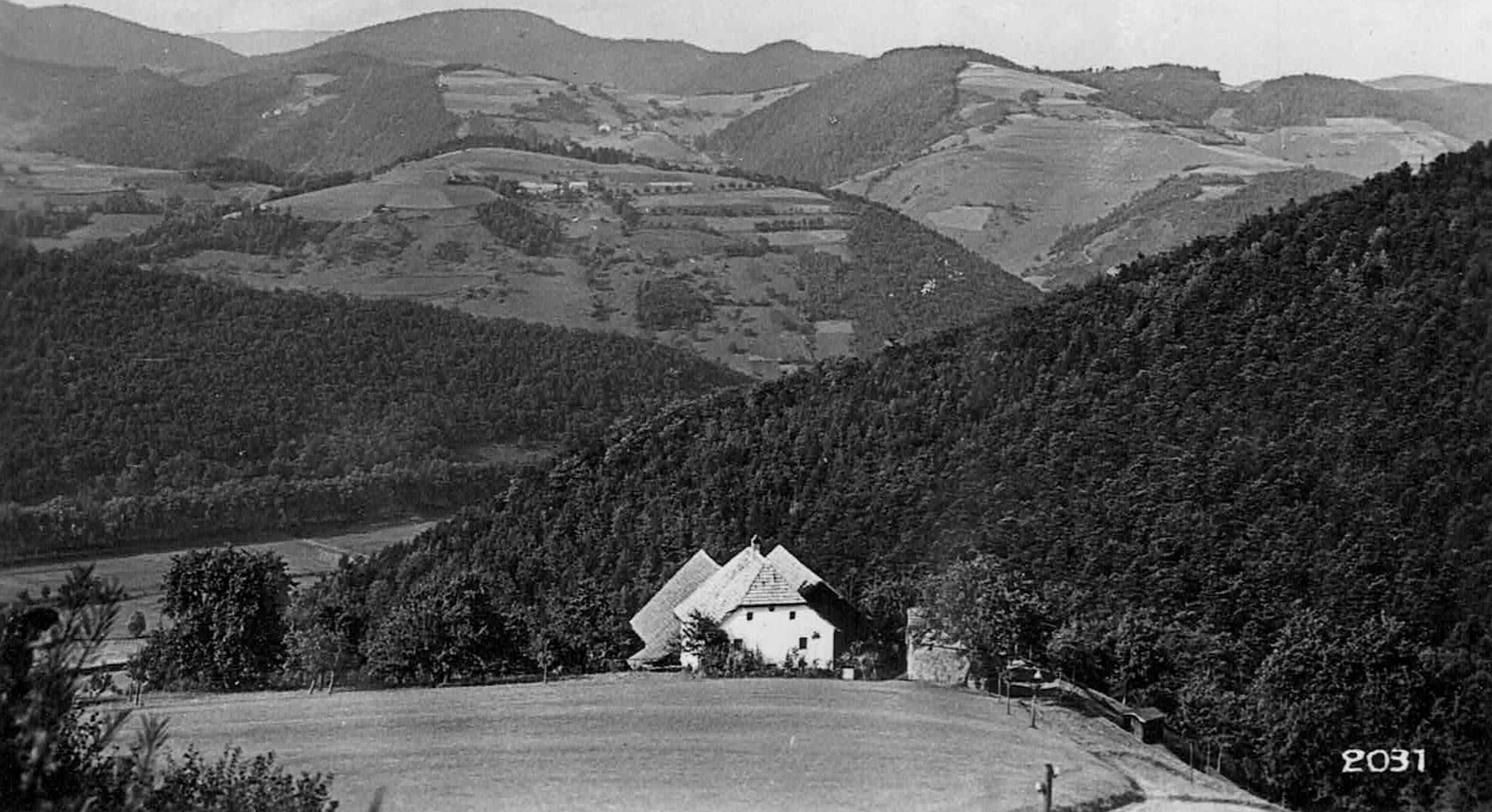
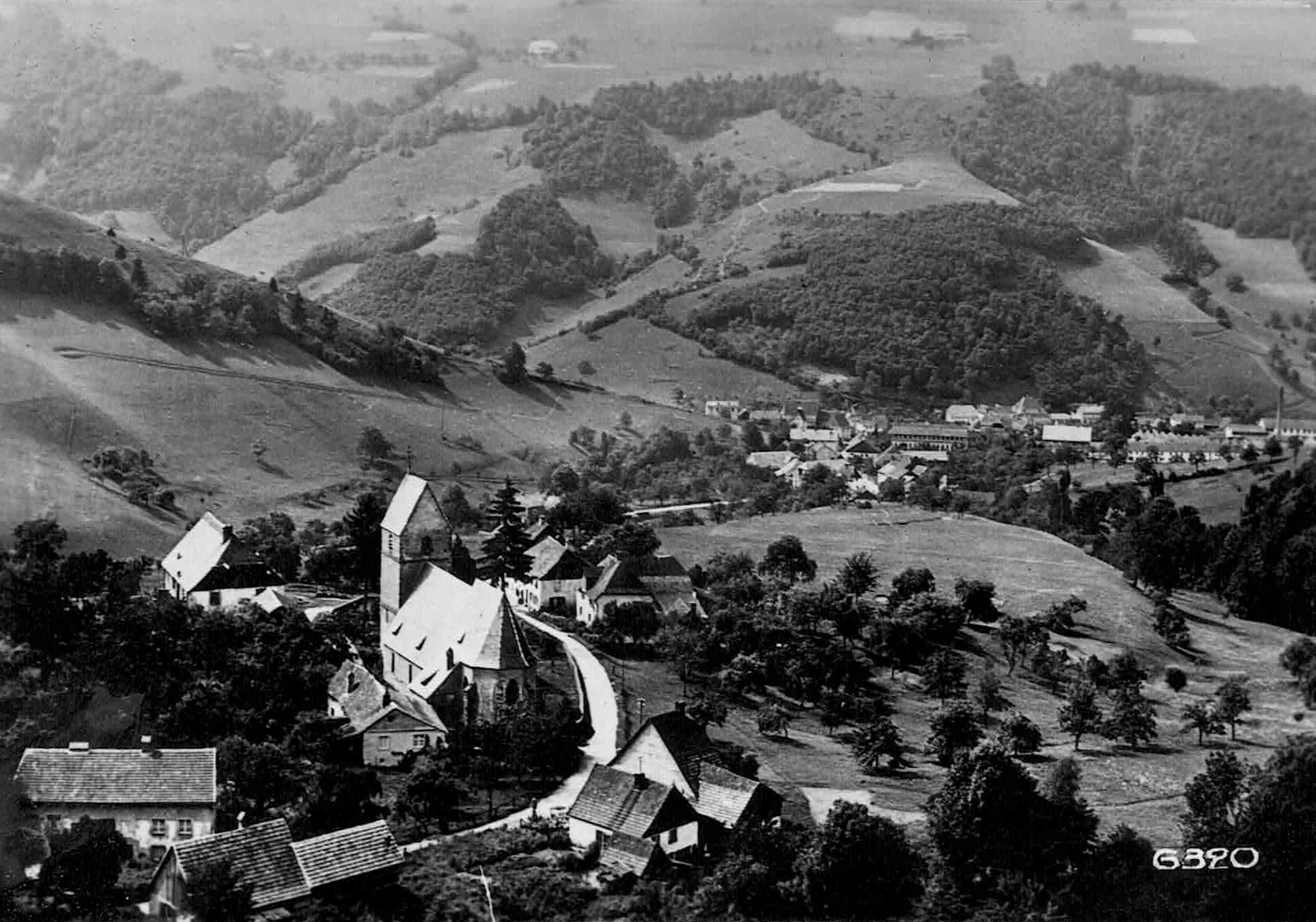
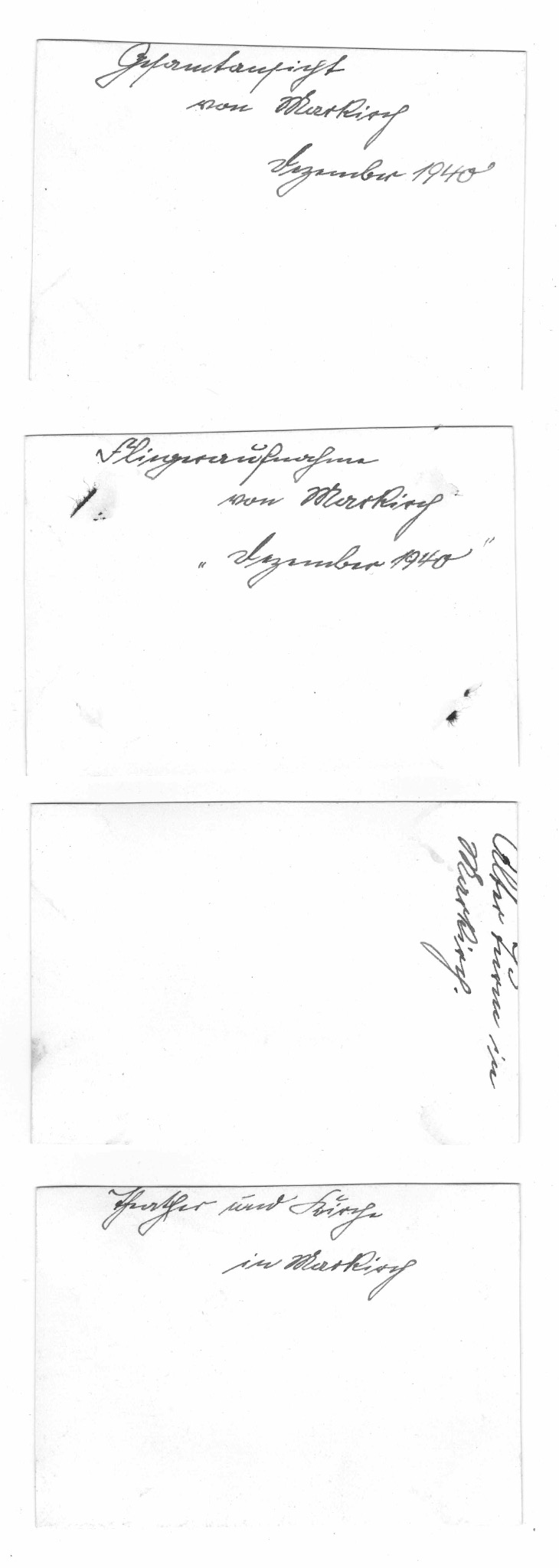
I assumed these landscape photos were pictures of the lovely French Alsace town of Sainte-Marie-Aux-Mines. That is until I turned them over and read, or tried to read, the captions. They describe Markkleeberg, a town in the Saxony region of Germany near Leipzig. It’s now described as a suburb of Leipzig.
According to AI, the captions on the back are in German, written in an old-fashioned cursive handwriting, and the captions read: “General view, War memorial, Old gatehouse, and Richter and Sons in Markkleeberg, December 1940”.
Professionally made photos with numbers in the right lower corner, they could be postcards. I can’t imagine who might have taken them, who wrote the captions, or why Flo put them on a page headlined Sainte-Marie-Aux-Mines. The Third Division had not yet crossed the Rhine into Germany, although Audie Murphy wrote that a number of Allied units had entered Germany by January, 1945.
The other three photos on this page are captioned Marie of Ville France; Lt. Reardon, me, Janet, Lt. Nelson. Fraize, France; and Sgt. Holbrook, St. Die France ad center.
My three younger brothers and I all listened to our mother’s stories about the war and her two years as a Red Cross clubmobile worker in Europe. Of course, we each have different memories of her tales. I don’t remember her telling about the first time she tasted eggplant, but my brother Don does. I asked him to write about what he remembers. Here is his story.
Don Martin Remembers
2022. Recently my sister decided to start using emojis in her text messages. She is in her mid-70s and is not particularly a maven of popular culture, so her understanding of this youth-driven vernacular is limited. How do old people like us decipher the coded meanings of subtle facial expressions or the specific colours of hearts, for example? I try to keep up on these things, but I don’t pretend to understand the nuances. One day, however, she sent me a text with a string of eggplant emojis and I was confused.
“Molly, do you know what an eggplant emoji means?” I asked.
“Doesn’t it just mean eggplant? I like eggplants.”
“Oh, dear. I hope you aren’t sending eggplant emojis out indiscriminately. You really should google these things first.”
“I need to google emojis? So, what does it mean?”
I explained that the eggplant is now commonly used in sexting to represent male genitalia. To which she howled with laughter. But it started a whole conversation between us, (mostly about eggplants). I recounted a memory of the first time our mother prepared this berry of the nightshade family for dinner.
It was the summer of 1959. Molly had just turned ten years old. I was seven. We lived in the all-white suburbs of a moderately-sized farming community in central Washington state. Our neighbourhood was like the little boxes on the hillside described by Malvina Reynolds in her song about ticky tacky post-war American life. The low-slung houses were close together and we were close to the families next door most with children our age. Our backyards were still unfenced so we kids had a block-long grassy playing field. The moms chatted as they hung their laundry out to dry in the desert air and the dads planned fishing trips over bottles of beer.
I remember we had a concrete patio off the back stoop large enough to accommodate a picnic table, a set of lawn chairs, and a charcoal barbeque. The table had a hole in the middle for an umbrella that provided shade on blazing summer afternoons. For this particular dinner Mom decided to cook outside. I remember she had a small prep table with a cutting board, two shallow bowls and the big square electric frying pan she used for nearly everything. I think Dad was grilling hamburgers or chicken, the aromas of which enticed the Yaden kids to come over and see what we were having.
On the patio in Yakima about 1955. Don (L) Molly (R), Tim on Dad’s lap
The Martins had always been a very meat-and-potatoes kind of family. Vegetables in our diet were limited to canned green beans and creamed corn. Sure, we had fresh tomatoes and cucumbers in the summer, but never had we eaten something as exotic as an eggplant. You didn’t see it in regular grocery stores back then. Too ethnic I guess. I’m not sure where Mom found it, maybe at one of the roadside vegetable stands run by Italian farmers in the Valley.
I loved to help mom cook, so when I saw her bringing the rest of the food out to the patio I left the other kids and ran over. The Yaden twins followed.
“What is that?” screamed Susan Yaden pointing at the large purple thing on the cutting board.
“That is an eggplant,” mom said. “We’re going to try something I had for the first time many years ago in France.”
“Ew,” giggled Susan’s sister Janet, and they both ran off.
I, too, was a little scared, but intrigued. I asked what I could do to help. As Mom peeled the eggplant and sliced it into half-inch rounds, she had me beat two eggs in one bowl. The other bowl was filled with cracker crumbs. She showed me how to dip the slices in the eggwash and coat both sides with the crumbs. Then she fried them in batches until they were golden brown.
“This is how a family I stayed with in France taught me to fix eggplant,” Mom explained. “I’d never eaten it before either.” She looked up from the sizzling slices and stared wistfully into the distance. “It was when I was in the Red Cross, sweetie, during the war. The other doughnut gals and I were driving north to catch up with the army and we had almost no food with us. We decided to stop at a farm house and ask for an egg or a little bread. Of course, we would pay them for it because we knew they probably didn’t have much food either.”
I brought her attention back to the present. “Mom, It think it might be time to turn them over. They look pretty brown,” I advised, still listening intently.
“Yes. There. Don’t they look good? Crunchy on the outside and soft in the middle.” She was deep in thought for a minute or two. “The French people were so happy to see us because they knew it meant the war might be over soon. This family made us a wonderful dinner and let us sleep there that night. It’s one of my fondest memories of that horrible time. Okay call your brothers and sister over. I think everything is ready.”
That is how I was introduced to eggplant. The vegetable. I can’t remember if everybody liked it, but Molly and I did. I remember feeling very sophisticated and a little closer to Mom.
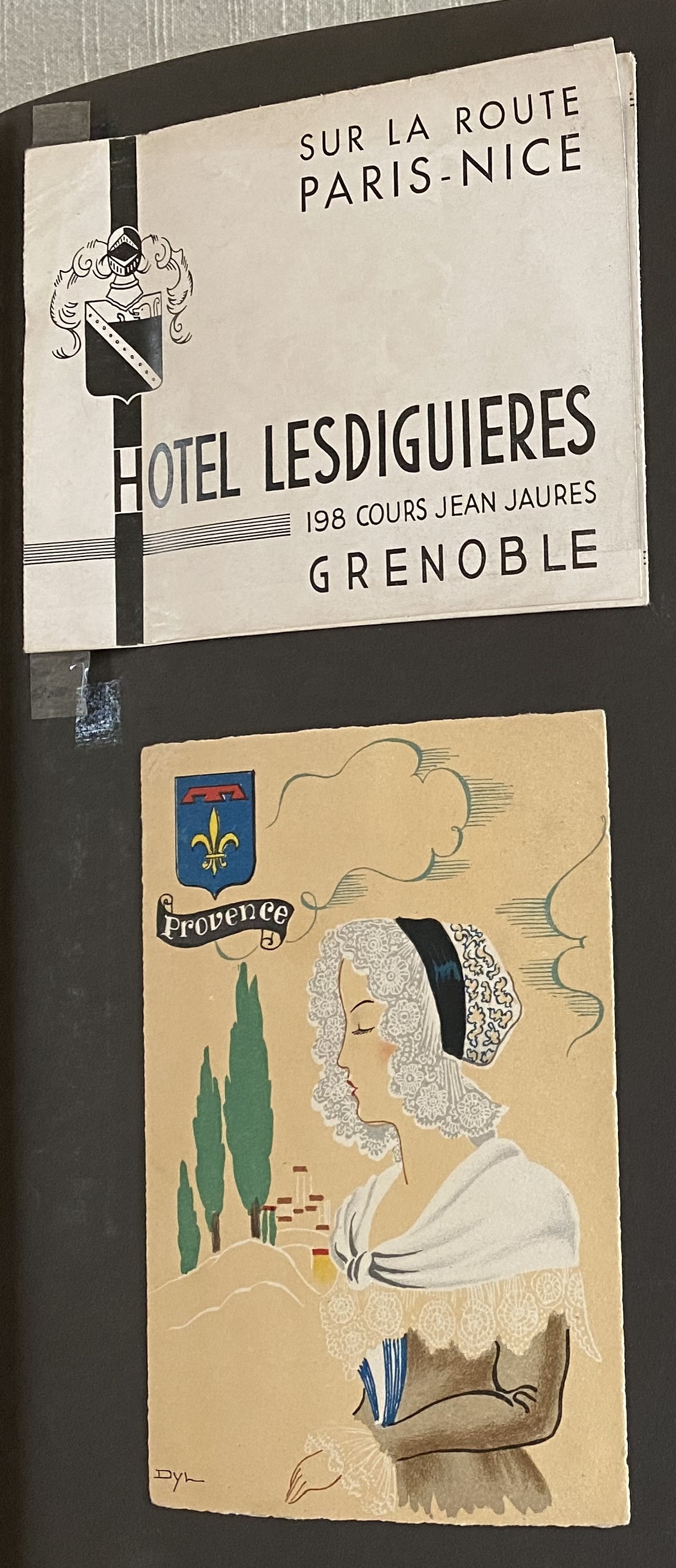
September 8, 1944. After several days in the small town of Aix-en-Provence, the Red Cross crew drove north in an effort to catch up to the Third Division. They stopped in Grenoble where they stayed for a night in what Flo called, “a lovely hotel, taken by 7th Army.” She noted: “Boy from Ballard (A Seattle neighborhood) gave me cinnamon rolls.” She described Grenoble as “lovely and modern—very mountainous.”
From Flo’s albumFrom Flo’s diary
Flo also pasted on this page of her album a newspaper story quoting Sgt. Louis Roberts about Nazi brutality endured by the French. Sgt. Roberts must be a Yakima native. From the Yakima Herald:
Atrocities Are Reported
Sgt. Roberts Avers France Bled White
Sgt. Louis Roberts who has been staying recently with a French family, has thus been able to get a better understanding of condition in France than most of the Americans and has the added advantage of speaking the language.
“It is hard to fathom how Germany bled France of resources,” he says. “From one little sector each month the people had to send 13 ½ tons of shoes, 10,000 head of cattle, tons of butter, milk, wood and other things plus a monthly payment of five million francs. It is incredible how much a small region could ever supply so much. These people have been thrifty and economical enough to endure this war.
“Being deprived of food and clothing did not bother the French so much as the brutal measures the Germans took. Often children had to suffer the loss of limbs so parents would take pity on them and disclose vital information about the F.F.I. (French Forces of the Interior. The French resistance) One town north of here was taken by the F.F.I. The Germans warned the patriots that if one shot were fired after 11 o’clock they would retaliate. The warning was not heeded and the Germans retook the town and set all the houses afire along the main street.
“Numerous incidents are constantly told about how the Germans would shoot our wounded prisoners. Women would cover the bodies of dead aviators or allied soldiers with flowers which would be scattered by the Germans who were on guard. If some persons would linger over the body of one of our soldiers to pray they would be driven away at the point of bayonets.
“These French are very sorry, indeed, that all of us cannot understand the language. Each of them has some grewsome story to tell, not necessarily how they suffered but how the rest, or all of France, has to suffer. I have seen results of such brutality and I feel even more sorry for the French still in German territory. I could write a book on what I have heard and seen.
Yesterday I went to mass—a special mass for the liberation of the town. The church was beautifully decorated with numerous flags and stretched out up over the altar was a huge banner ‘Honor and Glory to the Americans.’ The choir and music were also beautiful. It was like Easter at home.”
Sgt. Roberts and Miss Florence Wick, Yakima Red Cross worker, are in the same town and see each other at times. He adds that “even though people are bombed out of their homes they are most happy to be liberated.”
World War Two, the defining feature of my parents’ generation, affected my generation too. Maybe more than we know.
The Sound of Nazis
I was 15 going on 16, a sophomore in high school. It was 1965 and the Sound of Music was opening at the Capitol Theater in downtown Yakima. My mother offered to drive me and three girlfriends to see it.
Did my mother already know the story of Maria Von Trapp? Probably she knew of the post-war memoir or the 1959 Rogers and Hammerstein stage musical (she subscribed to the New Yorker magazine after all.) But whenever she learned of the story she must have wanted to see it. She had worked as a Red Cross “donut girl” in Europe during the war, passing out donuts to the troops on the front lines in Italy, France and Germany. She had lost her fiancé to a German land mine just days before they were to be married. She had witnessed the liberation of Dachau.
My girlfriends and I didn’t know the story. We were just excited to see the movie.
What a treat! We lived on the west side of town, out amidst the orchards and ranches. Our high school sat in the middle of an apple orchard. So getting anywhere required a car, even though in those days the school bus did pick us up and drop us off daily, but only after an hour spent driving around in the sticks.
The town of Yakima, Washington didn’t yet have a mall and so people still got dressed up when they went downtown to go shopping or see a movie at the Capitol Theater. When it was built in 1920 it had been the biggest and most ornate theater in the Northwest with seats for 2000.
By 1965 girls and women were no longer required to wear dresses, hats and gloves downtown. At school we were required to wear skirts, but on Saturdays we could wear play clothes—pedal pushers (zippers on the back or side only) and penny loafers with ankle socks. My mother still wore housedresses, even to clean the house, but she put on a polyester pantsuit to go to the movies.
We were teenagers, no longer children—young women really. Ponytails had metamorphosed into sleek pageboys and flips, which required sleeping on huge hair curlers. I had just converted to the popular flip, like a pageboy but flipped up at the ends instead of under. Beehive hairdos were in. You achieved a fuller look by ratting the hair, then combing over until it looked smooth.
We looked at the Simplicity pattern catalog to see what the new styles would be; Simplicity was remarkably prescient about fashion. Then we would just sew it. A-line dresses were comfortable and exceedingly easy to sew. Paisley was big. Hip hugger bell bottoms were popular and I made myself a pair with bright flowers in pinks and yellows.
Music didn’t move me like it did some others. I didn’t like my mother’s opera records or any of the odd assortment of 78 rpm records in her collection. As for popular music I just went with the flow, collecting 45 rpm records and playing them on a tiny square record player. The Beatles were big and we danced to “Love Me Do” and “Please Please Me.” My favorite 45 was “Chains” sung by the Cookies, a three-member group of Black women.
my baby’s got me locked up in chains
and they ain’t the kind that you can see, yeah
I didn’t know then that it was written by Carole King and Gerry Goffin.
I was a bit of a skeptic even then, irritably literal and unimaginative. My friend Susie had gone to the Beatles concert in San Francisco the year before and told me she couldn’t stop screaming while the group was singing. I asked her why girls do that. She couldn’t explain it; she said you just felt like it. I tried hard to understand but I really didn’t get it. Why would anyone scream while listening to music?
However, we were singers. We had formed a group called The Nonettes in eighth grade (there were nine of us). We sang Hootenanny songs like “500 Miles” and popular songs like “Winter Wonderland.” We hadn’t yet heard the Rodgers and Hammerstein music from the Sound of Music but we would learn it, since we were buying the Hi-Fi 33 rpm album after the show.
I was drawn into the musical immediately. What teenage girl would not identify with Maria—too exuberant to be a nun, too in love with the natural world to be ladylike. Did my girlfriends and I see ourselves as a problem to be solved?
The captain was like everyone’s father—militaristic, distant, full of orders, strict. But it was hard not to like the nuns even if they did kick Maria out of the convent.
We knew that booing at the movies was rude behavior, but we all booed silently when the baron’s lady friend and the children’s stepmother-to-be appeared. She would make a terrible mother to those children! Maria was so much better.
When the Nazis came on screen I heard what sounded like a low murmur coming from my mother. “Krauts,” she growled under her breath.
Then during the scene where the family is hiding from the ersatz boyfriend, she snarled, “Bastard.”
I felt myself flush. Talking in the movie theater was strictly forbidden and everyone sitting near us could hear my mother. They were turning around to shush her. Had my mother set out to embarrass me in front of my girlfriends?
I turned to frown at her. She sat on the edge of her seat with a death grip on the arm rests, her face twisted in anger. It was only then—20 years after the end of the war—that I began to see the depth of trauma my mother and many of our parents had experienced. Joan’s father, a bomber pilot, lost his mind. Rachel’s parents, having survived a concentration camp, could not talk about the war. My father and others viewed parenting as an extension of basic training.
It would take many more years to understand how my girlfriends and I—the next generation—were also deeply affected by the war that ended before we were born. #
“We are all at fault for allowing it to happen“
My mother wasn’t able to talk about the Nazis’ crimes against humanity until the program QB VII came on TV in 1974. Then she wrote this letter to the editor.
Sherman Alexie’s eulogy for his mother reads, “My mother was a dictionary. She was one of the last fluent speakers of our native language.” When she died the words died with her. He has one cassette tape of his mother and grandmother speaking together and singing a song.
My mother was maybe more like an encyclopedia. She collected the stories of old people on cassette tapes and in the 1970s she produced a public TV program on which she interviewed elders who lived in the Yakima Valley. I think some of those programs must be collected in the Yakima Valley Museum, but perhaps not. The words may have died with her.
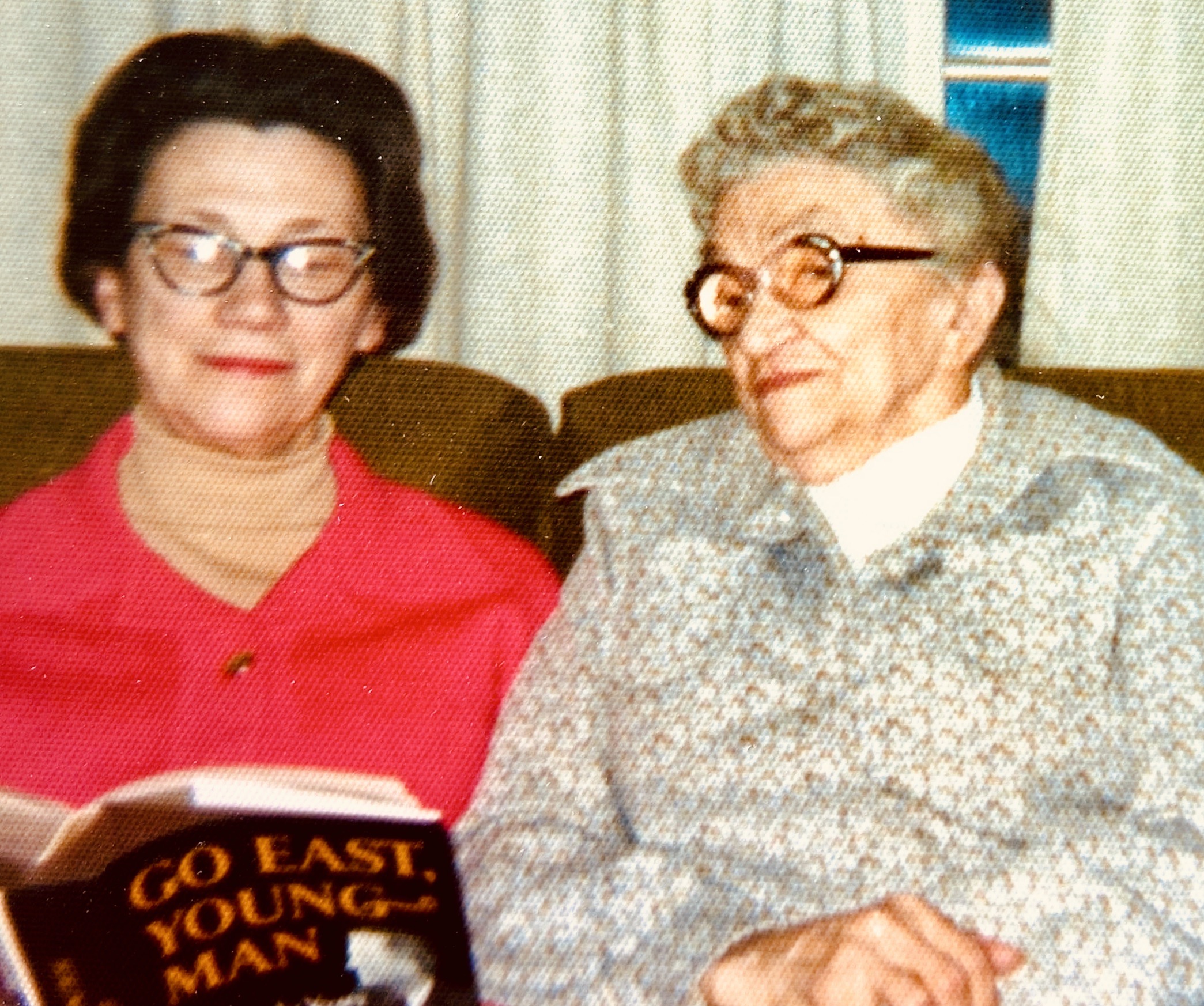
My mom, Flo, and her mother, Gerda, reading Wm O Douglas’s book
After my mother died, I asked myself the question so many of us ask. Why didn’t I record her story? She told me stories of her life as we sat at the butcher-block table in our country kitchen drinking tea late at night. I remember the film the Lipton’s left on the white cup, but I remember little of what she told me. Why didn’t I just turn on the tape recorder? Was it because I didn’t want to imagine a world without her in it?
Now I wish I had a recording of my mother talking, saying anything, but although I have looked through my saved cassette recordings, I haven’t found one. She had an unusually low voice, a result of allergies, asthma and post-nasal drip. When she answered the phone, sometimes the caller thought it was a man talking. But she had been a singer in her youth and I imagine her voice as a young person to have been clear and high.
There was one time when I did record my mother’s voice. It was after my boyfriend, Mark, and I had driven across the country and back in 1976. She had lent us her car for the trip, a VW station wagon, which very nearly didn’t make it over the Rockies. It was a big sacrifice on her part, I realize now. The trip took a month. My relationship with Mark didn’t survive the trip, but I think we felt we had to put on a good face for Mom on our return. I recorded her asking questions of Mark about the trip. In the recording, Mark unleashed pent-up anger at her. His condescending answers tagged her as a bourgeois reformist liberal. I thought he was abusive. Later he wrote her an apology and she replied in a thoughtful six-page letter, he told me.
I tried to listen to the tape later and it just made me mad. I have a vague memory of throwing it away, thinking I couldn’t bear to listen again. But my memory is terrible, which gives me hope. Perhaps I only thought I trashed it. It could be saved somewhere in the cases of cassette tapes in the basement. I’m making my way through them and I’ve already listened to many. It takes time. You have to listen till the end, as something important may have been recorded there. I have listened to hours of nothing—musical performances that could have been opera very far away but translated to audience coughing and fidgeting.
Some of the tapes are ones my mother made, labeled in her perfect cursive. She recorded the Camp David Accords, signed by Egyptian President Anwar Sadat and Israeli Prime Minister Menachem Begin in 1978. She was sure the treaty, facilitated by President Jimmy Carter, signaled the end of Middle East discord. Sadat and Begin were both awarded the Nobel Peace prize. Three years later Sadat was assassinated. The tapes are imbued with my mother’s optimistic desire for world peace. I’ll probably never listen to them, but I haven’t been able to throw them away.
I have not yet found any tape with my mother’s voice, but there are cassettes I have yet to listen to and I think I remember where I stored them. I still have hope.











 tradeswomn musings