Born in Oregon, Buried in France

Remembering Eugene Gustafson

My Mother and Audie Murphy Ch. 44

To return to the start of this series, My Mother and Audie Murphy: https://mollymartin.blog/2024/11/04/my-mother-and-audie-murphy/

Even as soldiers were dying all around them, the death of Flo’s fiancé, Gene, on October 28, 1944, came as a horrific shock. In a letter to her mother, Flo wished she could just go home. But she wasn’t a quitter, and she even stayed in Europe through the post-war occupation, returning to the U.S. in March, 1946, nearly a year after the war’s end.

Back home, making her album, she devoted a page to Gene with the obituary from his hometown newspaper, and the poem by Archibald MacLeish, The Young Dead Soldiers. He was buried in a military cemetery in Epinal, France.
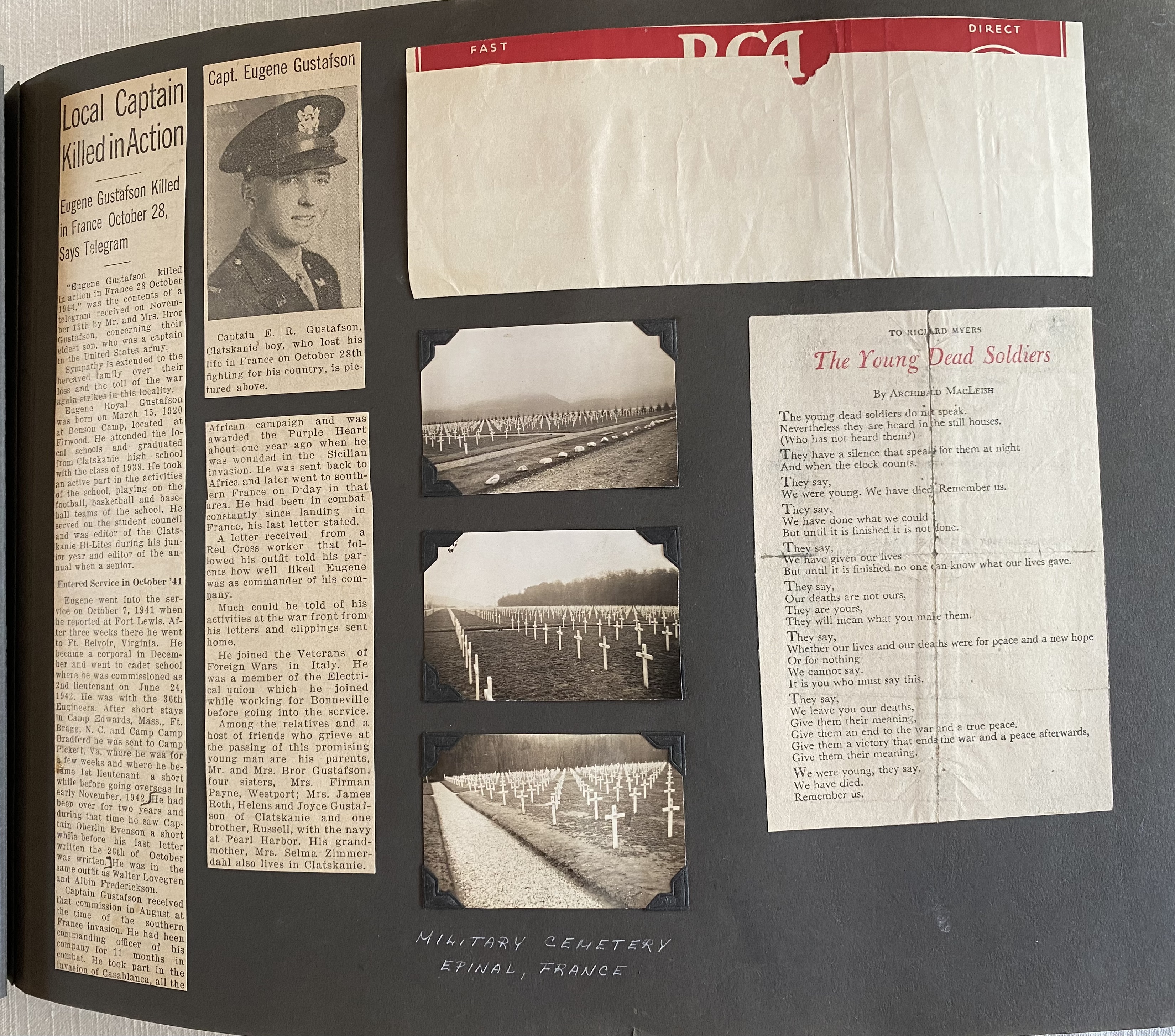
A page in Flo’s album

Reading Gene’s obituary gave me a fuller picture of the man. I learned some things:

He was born in a “camp” in Oregon in 1920—probably a lumber camp. 

He had one brother serving in the Navy and four sisters back home. He was a jock, sure—but also the editor of his high school newspaper in Clatskanie, Oregon. 

Before the Army, Gene had been a union electrician with the Bonneville Power Administration–a working class guy. 

His military training was intense—taking him from Washington to Virginia, then on to Massachusetts, North Carolina, and back to Virginia again. He enlisted in October 1941 and was sent overseas in November 1942. A year of preparation for a war he would not return from.

I learned he was wounded during the Sicilian invasion and awarded a Purple Heart, and that official news of his death didn’t reach his family until two weeks later. 

Learning these things made Gene feel more real to me—not just as a name in someone else’s story, or a loss recorded in a diary, but as a whole person with a life that mattered. I wish I could’ve met him. In some small way, reading his obituary felt like I did.

Gene’s obituary published in his hometown paper

Local Captain Killed in Action

Eugene Gustafson Killed in France October 28, Says Telegram

“Eugene Gustafson killed in action in France 28 October 1944,” was the contents of a telegram received on November 13th by Mr. and Mrs. Broer Gustafson, concerning their eldest son, who was a captain in the United States army.

Sympathy was extended to the bereaved family over their loss and the toll of the war again strikes in this locality.

Eugene Royal Gustafson was born on March 15, 1920 at Benson Camp located at Firwood. He attended the local schools and graduated from Clatskanie high school with the class of 1938. He took an active part in the activities of the school, playing on the football, basketball and baseball teams of the school. He served on the student council and was editor of the Clatskanie Hi-Lites during his junior year and editor of the annual when a senior.

Entered service in October ‘41

Eugene went into the service on October 7th, 1941 when he reported at Fort Lewis (WA). After three weeks there he went to Fort Belvoir VA. He became a corporal in December and went to cadet school where he was commissioned as 2ndlieutenant on June 24th 1942. He was with the 36th Engineers. After short stays in camp Edwards MA, Fort Bragg NC and Camp Bradford, he was sent to Camp Pickett VA where he was for a few weeks and where he became 1st lieutenant a short while before going overseas in early November 1942. He had been over for two years….

Captain Gustafson received that commission in August at the time of the southern France invasion. He had been commanding officer of his company for 11 months in combat. He took part in the invasion of Casablanca, all the African campaign and was awarded the Purple Heart about one year ago when he was wounded in the Sicilian invasion. He was sent back to Africa and later went to southern France on D-Day in that area. He had been in combat constantly since landing in France, his letter stated.

A letter received from a Red Cross worker that followed his outfit told his parents how well liked Eugene was as commander of his company.

Much could be told of his activities at the war front from his letters and clippings sent home.

He joined the Veterans of Foreign Wars in Italy. He was a member of the electrical union which he joined while working for Bonneville before going into the service.

Among the relatives and a host of friends who grieve at the passing of his promising young man are his parents, four sisters, and one brother, Russell with the Navy at Pearl Harbor. His grandmother, Mrs. Selma Zimmerdahl also lives in Clatskanie.

Of course the “Red Cross worker that followed his outfit” referenced in the obit must have been Flo. I wonder how she felt about being described that way.
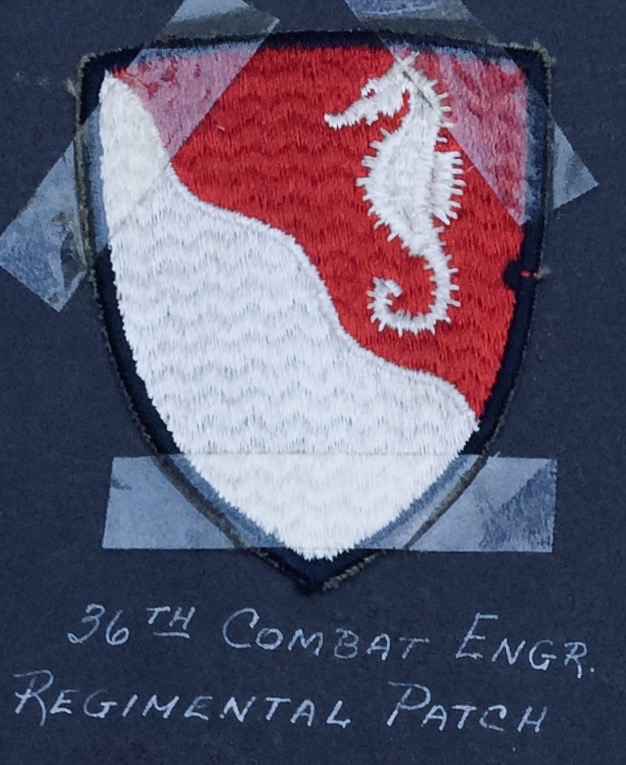
Gene’s regimental patch. The seahorse is a nod to their training in amphibious assault and support operations. The red and white colors of the shield represent the Corps of Engineer regimental colors. 


Ch. 45: https://mollymartin.blog/2025/08/06/a-cold-rainy-november/

CircumTambulation: A Ritual

My Regular Pagan Holiday Post: Summer Solstice

Circumambulation (from Latin “circum” meaning around and “ambulātus” meaning to walk) is the act of moving around a sacred object or idol. This practice is integral to Hindu and Buddhist devotional rituals (known in Sanskrit as pradakśiṇā) and is also present in Christianity, Judaism, and Islam.

Native bush lupine blooming on the west slope, Deep in the redwood forest

Seeking rituals associated with solstices, I discovered one right here in the Bay Area that has been ongoing since the 1960s at the iconic Mt. Tamalpais in Marin County.

My wife, Holly, introduced me to the circumambulation of Mt. Tam, having learned about it from the poet Gary Snyder, who initiated it. Unfamiliar with the term, I had to look it up. Once I did, I found myself repeating it because it’s such a cool word and fun to say.

A new bridge on the Steep Ravine Trail, Looking south at the golden gate and San Francisco

The Genesis of CircumTambulation

The circumTambulation (as it has been called) was started by Snyder, Philip Whalen, and Allen Ginsberg. They were inspired by ceremonial circumambulations that Snyder, and later Ginsberg, learned about during their travels in Japan, India, and Nepal. These men, part of the Beat movement, had studied Buddhism and aimed to introduce Eastern enlightenment to Western audiences.

In 1965, after a decade of studying Zen Buddhism in Japan, Snyder returned to California. He, along with Whalen and Ginsberg, embarked on a ritualized walking meditation around Mt. Tam. Following the traditional clockwise direction, they selected notable natural features along the way, performing Buddhist and Hindu chants, spells, sutras, and vows at each stop.

The hike spans 15 miles and is typically completed in a day. During summer, the long daylight hours are sufficient to finish the trek, while in winter, flashlights may be needed. I was relieved to learn that there is also a 6.2-mile option where participants can join the long walkers halfway.

Trail signs; View of redwoods, Bolinas and the Pacific Ocean

A Dive into Beat Poetry

Learning about this ritual led me to explore the Beat poets further. San Francisco and the Bay Area was ground zero for the Beats and they congregated here. Snyder lived in a shack on Mt. Tam’s southeast slope during the 1950s, where he was visited by other writers of the time.

This prompted me to read Jack Kerouac’s “The Dharma Bums,” which recounts his famous hike with Snyder over the mountain from Mill Valley to Stinson Beach and back. Kerouac also describes an epic three-day party at Snyder’s shack before Snyder’s departure to Japan in 1956. Although the shack was demolished long ago, the house still stands on the property in the Homestead neighborhood near the Pixie Trail. Commenters on AllTrails mention it’s not well maintained, but I still want to hike there.

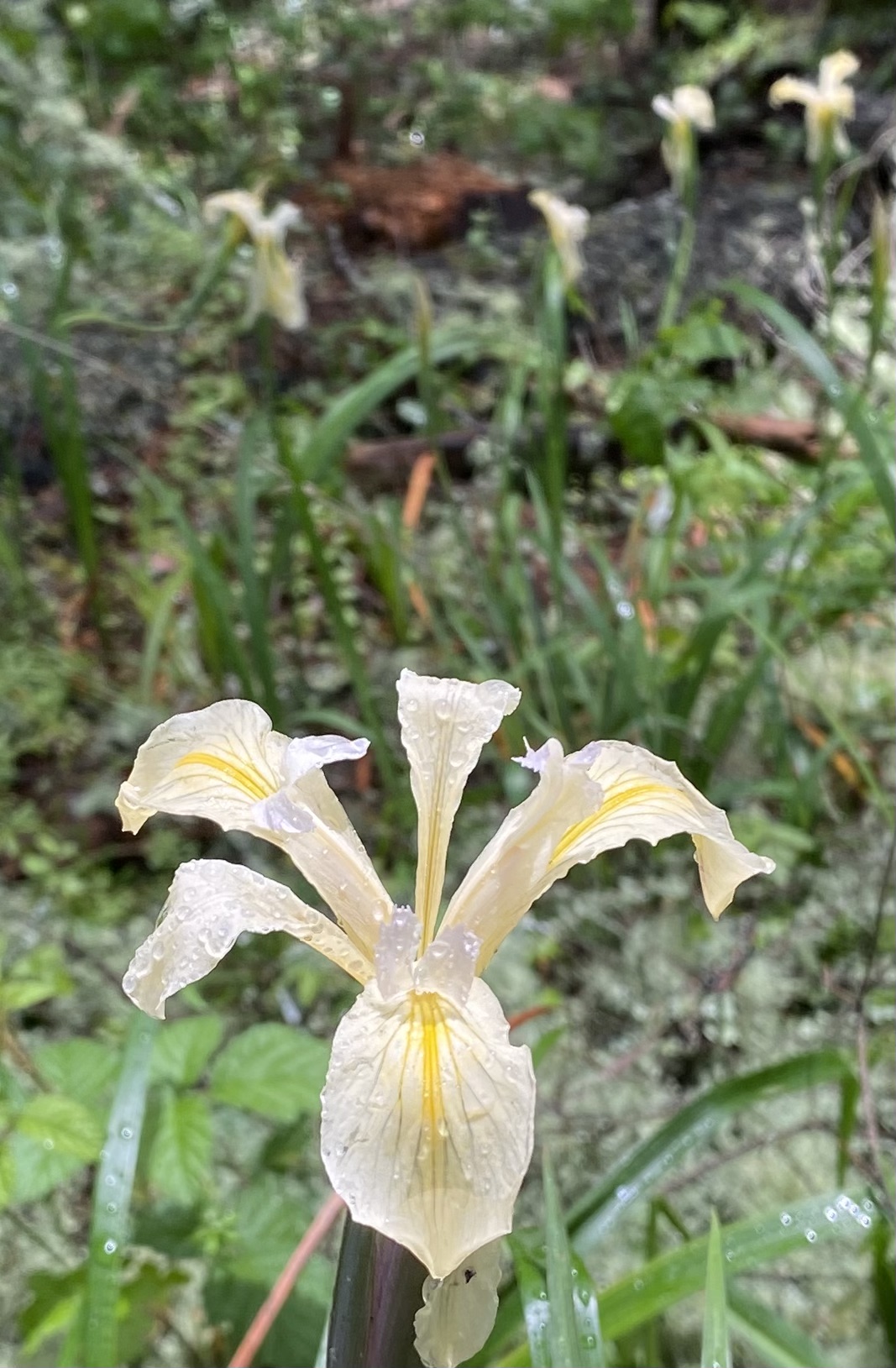
Native Douglas iris, cool paintbrush (a kind I’d never seen before)

Reflections on the Beats

As I trace the path of circumTambulation, I think about Snyder, Ginsberg, and the Beats. They were often egotistical and sexist, but also perhaps geniuses. Kerouac was likely schizophrenic, and Neal Cassady a “charismatic sociopath.” Much has been written and filmed about them, but women in their circle received little recognition until recently.

Through Snyder, I discovered the poet Joanne Kyger, who married him in 1960 in Japan and traveled with Snyder, Ginsberg, and his lover Peter Orlovsky to India, meeting the Dalai Lama. Kyger, a serious poet herself, recorded her travels in diaries published in 1981 as “The Japan and India Journals 1960-1964,” providing a rare female perspective on the male-centered Beat movement. Kyger settled in Bolinas and lived there until her death at 82 in 2017.

Despite being part of the same journey through Japan and India, Kyger is often omitted from accounts that only mention Snyder, Ginsberg, and Orlovsky. Her diaries are a testament to her presence and contributions during this significant period.

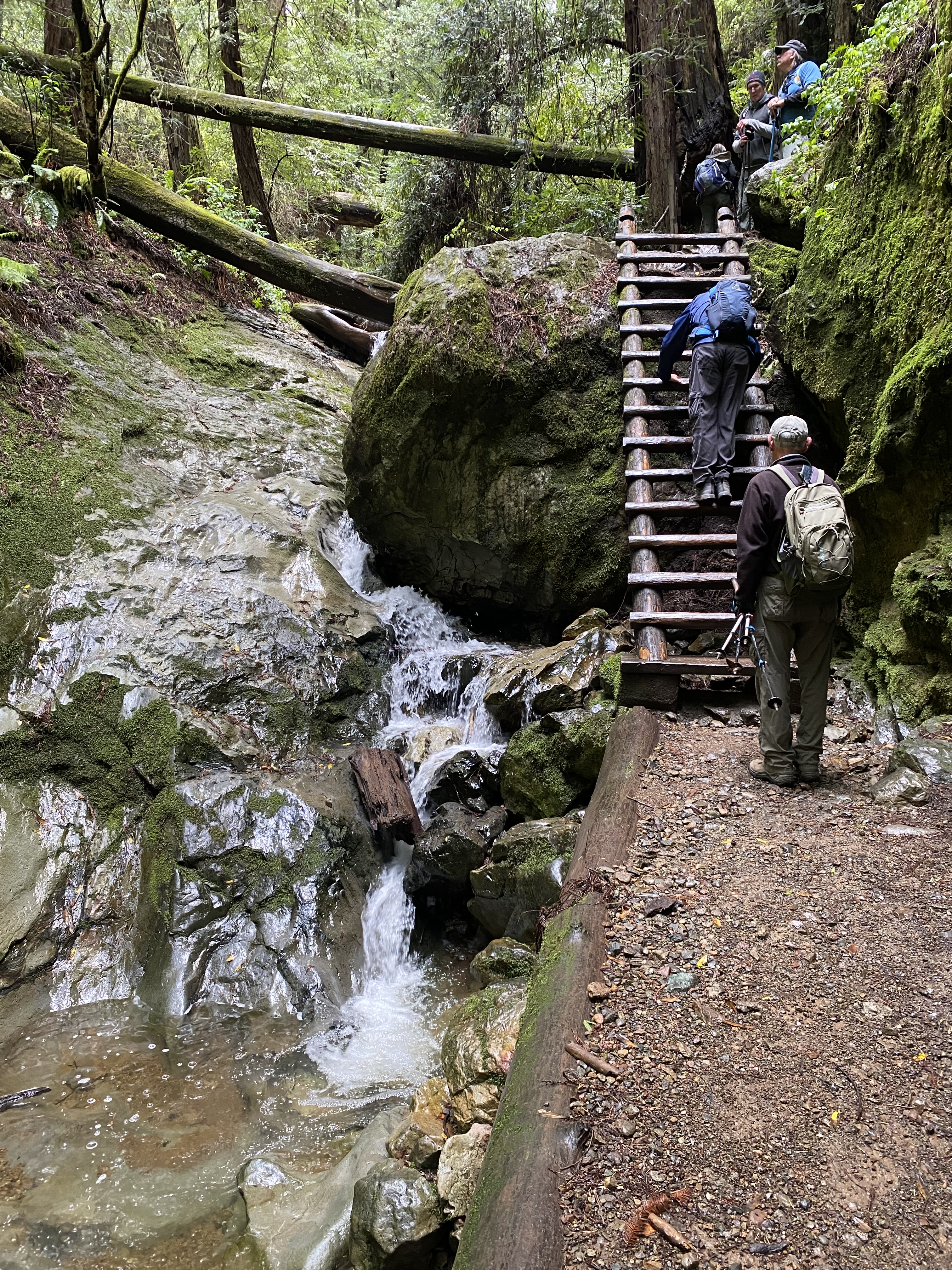
Climbing the ladder on the Steep Ravine trail

Continuing the Tradition

Snyder envisioned the circumambulation as a joyful, creative endeavor. He encouraged participants to be imaginative, stopping at points his trio had designated or choosing their own. He emphasized the importance of paying attention to the surroundings and oneself: “The main thing is to pay your regards, to play, to engage, to stop and pay attention. It’s just a way of stopping and looking — at yourself too.”

Since the fall of 1974, the circumambulation has taken place on each solstice and equinox (or the closest Sunday), starting and finishing at Muir Woods National Monument. The tradition has been led by dedicated guides, first Matthew Davis, then Laura Pettibone, and currently Gifford Hartman, a San Francisco-based educator and labor historian.

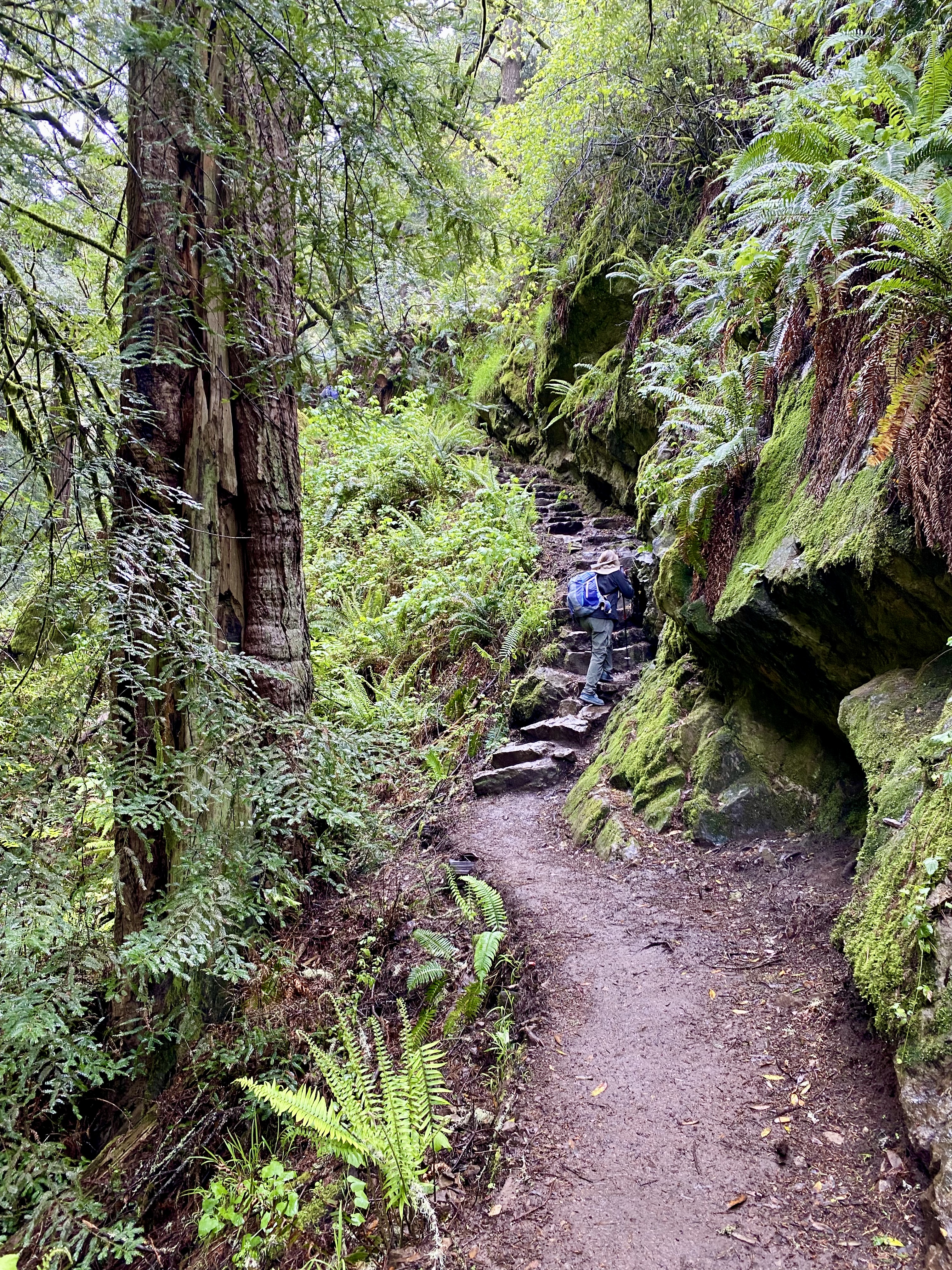
Lots of mosses and lots of steps

Historical and Spiritual Significance

Mount Tamalpais (tamal = west, pais = hill or mountain) is sacred to the native Coast Miwok people, as well as other native groups. Along with other mountains visible from Sonoma County—Sonoma in the Coast Range, Hood and Kanamota (St. Helena) in the Mayacamas Range, and Diablo (tuyshtak in Ohlone)—Mt. Tam retains its spiritual character.

The US military destroyed Mt. Tam’s summit in the 1950s, establishing a base and lookout during the Cold War. Gary Yost’s film “The Invisible Peak (hidden in plain sight)” explores this history https://www.youtube.com/watch?v=y6TA-jbZqQU. I also recommend Will Hearst III’s video about Snyder, “The Practice of the Wild.” https://vimeo.com/418682866

Embracing Tradition

The ending of Gary Snyder’s poem “For the Children” encapsulates the spirit of this tradition:

stay together
learn the flowers
go light

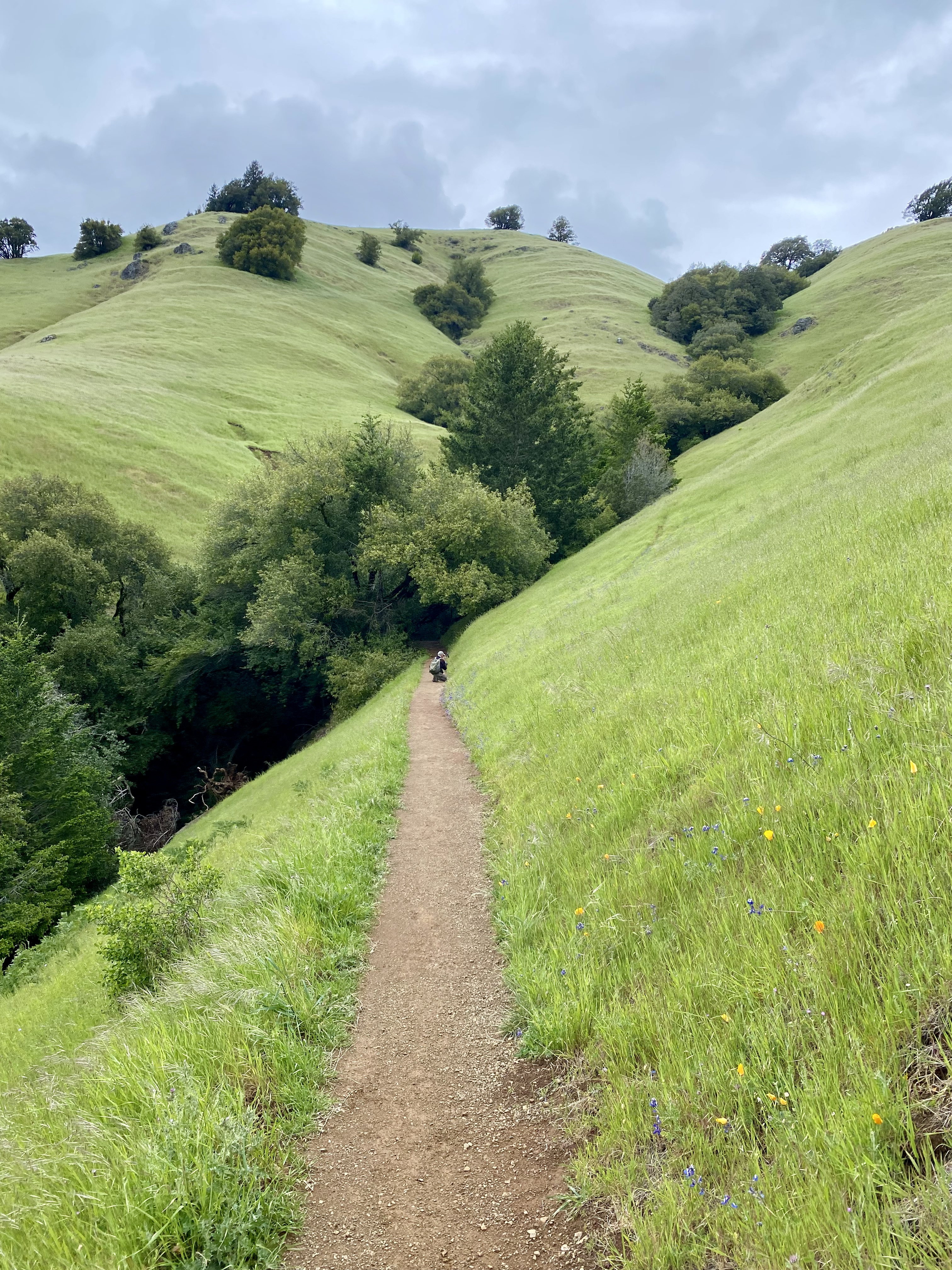
Looking south toward San Francisco, Photographing flowers on the west slope

I try to live by this advice as I hike around our beautiful Bay Area open spaces. I joined a hiking group whose average age is 80. At 74 I’m one of the young ones. One woman at 93 still leads us on seven-mile hikes. We stay together to help each other in case of inevitable disasters (I’ve had a couple of falls this season but didn’t break anything). We learn and delight in the flowers, although with my poor memory I must relearn them every year (I think there’s something very Zen about that). And perhaps our old age inspires us to go light in its many senses. I took these photos on a Mt. Tam hike on the Dipsea, Steep Ravine, Coast View and Matt Davis trails in early May.

I plan to celebrate this summer solstice by joining the circumTambulation on Sunday, June 23. Please join me. For more information, visit: CircumTambulation.

Happy Solstice and Happy Pride!

Adventures in VanCity

Vancouver, BC.

Carpenter/writer Kate Braid

Whenever I visit I always look for tradeswomen in this city of high rises and construction cranes. On this trip I was lucky to meet up with Kate Braid, the tradeswoman poet laureate of Canada (my christening). I’ve known Kate for decades, and we published her poems in Tradeswomen Magazine regularly, but she and I figured we hadn’t seen each other for 30 years. If you’re not familiar with her writing, go to her web page, Katebraid.com. Her book of poems about working construction, Covering Rough Ground, was published in 1991. Her newest book, Rough Ground Revisited, includes some of the original poems and new ones as well.

Kate has a memoir too: Journeywoman: Swinging a Hammer in a Man’s World, published in 2012. She speaks to tradeswomen all around Canada, and she reminded me as we reminisced that the very first national tradeswomen’s conference happened in the nation of Canada in 1980! We discussed the possibility of Canadians hosting the next tradeswomen conference, since it looks like our building trades in the US have dropped the ball. Come on Canadian tradeswomen: Pick it up and run with it!

One does not always plant one’s feet daintily when one is covering rough ground.

–Emily Carr, Journals

 I was delighted to learn that Kate and I share an interest in the Victoria artist and writer Emily Carr. In fact, Kate is a Carr scholar, having published two books of poetry and a biography of Carr. These I can’t wait to read, but when I tried to order them from the San Francisco Public Library they were not in the stacks. So I have my work cut out for me when I return home. It seems we in the US are not very literate where Canadian authors are concerned, a prejudice that must be rectified.

Walking around downtown Vancouver I passed many high-rise construction sites but the only tradeswomen I saw this time were flaggers. I flagged down two of them and they assured me there are lots of tradeswomen working up above. While most of the signs here are gender neutral, I did find one of the old Men Working kind, an advertisement that this contractor discriminates against women. Why would anyone want to advertise that?