
I was inspired looking through old photos












I was inspired looking through old photos
by Molly Martin, Gail Sansbury, Elaine Elison, and the Bernal History Project

Dow Wilson of Painters Local 4, who was famously assassinated in 1966, standing in front of a picture of the writer and socialist Jack London.
Bernal Heights in San Francisco has always been called Red Hill, perhaps because it’s made of red rock—Franciscan formation chert—that once lay under the ocean.
More likely that moniker has to do with the large number of Reds who lived on the hill over the decades: Communists, Socialists, labor activists, and New Leftists.
Ever since it was colonized by Europeans, Bernal Heights, on San Francisco’s south end, has been a working class neighborhood. Slaughterhouses and tanneries proliferated along the creeks on the south and north sides of the hill before the turn of the 20th century. Breweries like the North Star on Army St. operated until the Volstead Prohibition act put them out of business in 1920.

This photo of Mission Street at Kingston was taken in 1906 during one of many carmens’ strikes of that era.
Bernal Hill never was home to much industry, but its two streetcar barns at the foot of the hill were the site of pitched battles during the carmens’ strike of 1907. In San Francisco’s deadliest strike, 26 people were killed and hundreds injured during the nine months the carmen were out. That year saw strikes in several unions, of women as well as men workers, and a general strike was nearly called. The city seemed on the verge of class war, with Market Street being the dividing line. It’s not hard to guess which side Bernal’s residents were on.
In the 2000s, neighbors came together to form the Bernal History Project and to research the history of our hill. We published a book, San Francisco’s Bernal Heights, and gave slideshow presentations around the city. In 2008 as part of the annual SF Labor Fest we gave a presentation called Reds on the Hill at the local bookstore, then Red Hill Books.
We chose to focus on six Bernal residents who had been active in labor struggles from the 1930s through the 1980s: Eugene Paton, Miriam Dinkin Johnson, Phiz Mezey, Dow Wilson, Bill Sorro and Giuliana “Huli” Milanese. These are the stories of working class people deeply committed to changing the world. They are six of many.
Thanks to the SF Labor Archives and Research Center, a rich source of information about union movements and working class life in the Bay Area, and the families of our subjects, especially Patty Paton Cavagnaro and Petrina Caruso Paton for their family albums.
Miriam Dinkin Johnson (1918-2001)

Eugene “Pat” Paton (1913-1951)


Giuliana “Huli” Milanese (1944-)

This story was first published in FoundSF.org, the San Francisco digital history archive.
My Regular Pagan Holiday post
She is a towering figure, casting mountains by flinging stones from her wicker basket. She is the crone goddess, ancient and wise, with flowing white hair and—some legends say—one eye in the center of her forehead. The Cailleach (pronounced kallyak), the Celtic goddess of winter, seizes control of the earth on November 1, at the pagan festival of Samhain (pronounced sow-in), and reigns until the thaw of spring. She governs the weather, especially storms, and with each step, she shapes the land.
The hag’s face is pale blue, cold like a corpse, her long white hair streaked with frost. Cloaked in a gray plaid, she appears worn by time, yet her power is immense. She is both creator and destroyer, molding the hills and valleys with her hammer, a deity tied to cycles of death and rebirth. Some say she has roots as ancient as the Indian goddess Kali.
As the harbinger of winter, the Cailleach has been feared and revered for centuries. On Imbolc, February 1, she is said to gather firewood for the remainder of winter. If the weather is clear and bright, it’s a sign she intends for the cold to stretch on, collecting plenty of wood to sustain her. But if the day is foul, people sigh in relief—the Cailleach sleeps, and winter’s end is near. Today, we mark this custom with Groundhog Day.
“Winter is coming”—a phrase popularized by Game of Thrones—is not just a warning of seasonal change, but a metaphor for scarcity, hardship, and the potential for conflict. The ominous truth is that winter is always coming, unless we are already in the thick of it. Perhaps, politically, we are.
The looming threat of a Trump presidency feels like the onset of a long, harsh winter. It keeps me awake at night. For decades, Republicons have skewed the game, and I’ve lived long enough to witness it firsthand. From voter suppression to outright vote theft, it’s been an ongoing battle. I was blown away by Greg Palast’s latest documentary, Vigilantes Inc.: America’s New Vote Suppression Hitmen, produced by Martin Sheen, George DiCaprio, and Maria Florio (Oscar, Best Documentary). He exposes the political history of racist Georgia Gov. Brian Kemp and his slave owning family. Stream it for free.
For those unfamiliar with Greg Palast, he’s a freelance journalist with a history of working for the BBC and The Guardian. His investigations predict that MAGA extremists may riot on December 11, the constitutional deadline for states to submit their final lists of electors. You can read more on his site: https://www.gregpalast.com/maga-militants-to-riot-on-december-11/
I’m sending this message before Samhain, hoping these warnings help to thwart the political winter ahead. We may already be in the storm’s grip, but awareness can help us weather it.

For those of you in Sonoma County, I hope you’ll join me at a Democracy Fair, sponsored by the Deep Democracy group of the North Bay Organizing Project. Get voter information about local and state propositions and races. Plus games and prizes! It’s happening this Friday October 18 from 4 to 7pm at the SRJC student center. Registering ahead will help us plan. Here’s the RSVP link: tinyurl.com/deepdemfair. (Apologies to those I’ve already sent this to.)
One more thing. I was saddened to learn of the death of my friend, the artist and writer Mary Wings in San Francisco. We were both born in 1949 (it was a very good year for Boomers) and shared a neighborhood in Bernal Heights. Mary was kind of famous; she rated an obit in the New York Times: https://www.nytimes.com/2024/08/08/arts/mary-wings-dead.html?unlocked_article_code=1.SU4.GC0y.GZ_rimClOb6P&smid=url-share
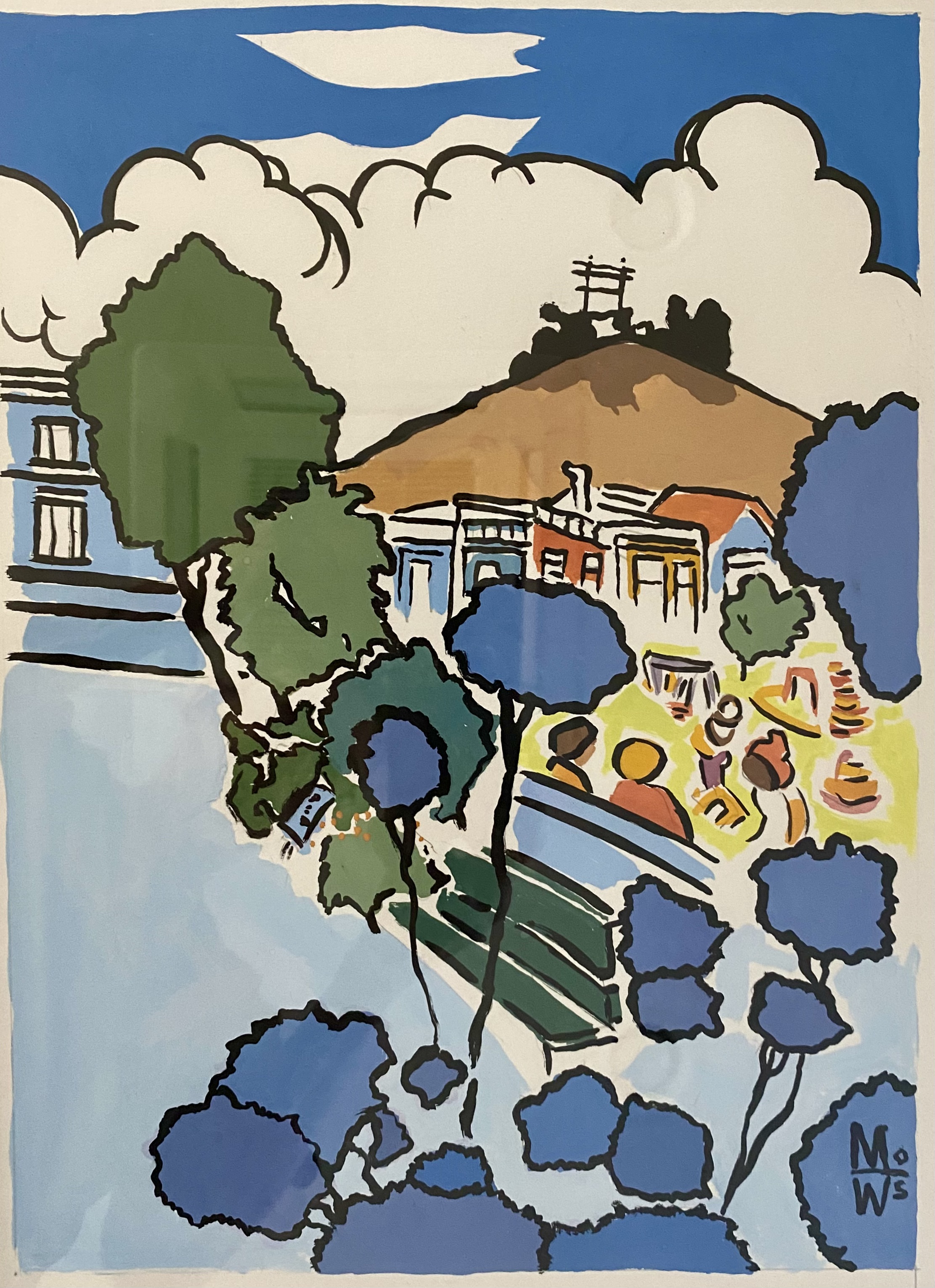
She was always working on art projects and her friends were often the lucky recipients of her creations. One of her gifts to me was this painting of Bernal Hill viewed from Precita Park where she lived. I lived on the opposite side of the hill. The painting had originally been framed in something she’d found at Scrap, but it fell apart over time. Recently, I rediscovered it in the garage and had it reframed. Now it’s hanging on the kitchen wall, and it’s a beautiful way to remember both Mary and our beloved San Francisco neighborhood.
Sending Samhain greetings to all.
Love, Molly (and Holly)
The top photo is by David Mirlea on Unsplash (having trouble with captions)
In which I learn that propaganda works
After I made it clear in a blog post that I support Kamala Harris for president, my neighbor texted me saying we are on opposite sides of the political spectrum and did I want to talk about it? She is part of an organization called Braver Angels whose mission is to bring Americans together to “bridge the partisan divide and strengthen our democratic republic.”
Well, yeah. I’d love to understand why anyone is planning to vote for a criminal misogynist racist incompetent ignorant vindictive idiot. I truly do want to understand.
We met at a local café where I asked her to lay out her thoughts.
We have much in common. We are about the same age (75). She has campaigned for social justice, and protested the Vietnam war. She was a student at SF State during the 1968 student and faculty strike. She voted against Hillary in 2016 because she was pro-war and Trump said he would end wars. Then she voted again for Trump in 2020.
She tells me she is a Quaker
Me: Do you go to quaker meetings? Are there Quakers who consider themselves Christian nationalists?
Yes, she has gone to meetings in many places. There are Quakers who want to walk a more middle line.
Where do you get your news?
Mostly from citizen journalists. People who report from the street. She mentions Tucker Carlson and other right-wing commentators.
She likes Vivek Ramaswamy. She says he went to Springfield Ohio to bring people together.
Why do you think he went there? What is he running for–a cabinet position?
He wanted to find out what is really going on.
He’s supporting Trump. How can he pretend to be nonpartisan?
He says they brought in too many immigrants.
The Haitians are legal immigrants.
No. they have “temporary protected status.” That’s different. They don’t all have jobs. Some of them hang out on the street.
Do you agree with trump’s plan to deport all immigrants?
There needs to be more oversight. We need to stop the rapists and felons. Send them back.
Trump is a convicted rapist. Should we send him back?
Social security. Trump wants to stop taxing it.
Yeah that’s what he says but the republicans have been saying for years they want to abolish it.
What about Kamala’s economic plans? (A republican talking point.)
You are treating trump like a regular candidate instead of a crazy guy who can’t string a sentence together and who promotes violence.
What do I think about RFK?
I liked him when he was an environmental lawyer. Now I think he’s lost his mind.
He only wanted people to have a choice about vaccination.
What about the republicans who would take away women’s vote? Who want to return to slavery?
She hasn’t heard much about them but knows about Mark Robinson in NC.
What about project 2025?
Trump is not involved with that.
You know that JD Vance, his VP candidate, wrote the introduction and the others involved were almost all on Trump’s staff?
She didn’t know that. It’s the Heritage Foundation she says.
We talked respectfully about many other issues. After an hour I have to go. I’m getting a little sick. We agree that we hate war. I shake her hand. She hugs me. She says see we do have something in common.
She tells me I should listen to Vivek. I tell her she should read and listen to different media. I send her a youtube clip from Trae Crowder the Liberal Redneck. Love that guy.
I still feel profoundly disturbed. We did not bridge the partisan divide nor strengthen the republic. For years the rest of us have been asking why any sane person could still support a con man like trump. My theory is that it’s the fault of the right wing media’s lies. And one thing this meeting has done is confirm my theory. Now I understand.
Propaganda works!
Gay Man Will Rollins Running Against Anti-Gay Incumbent
Californians will be sidelined again in the upcoming presidential election. With nearly 40 million residents, the state won’t play a decisive role in choosing the next president until the electoral college system is changed. Instead, the focus remains on swing states, leaving many Californians feeling left out, and me outraged again.
But we are not twiddling our collective thumbs. We’re shifting our attention to key down ballot races. A strong coalition, Mobilize—comprising Indivisible, California Grassroots Alliance, and others—is targeting six red districts in an effort to flip the House blue.
One candidate I’m particularly excited about is Will Rollins, who is openly gay and has a great shot at winning. When the districts were reorganized, he gained the queer-friendly city of Palm Springs in California’s 41st District. Rollins, a former federal prosecutor, is running again after nearly defeating Republican Ken Calvert, an incumbent with a long anti-LGBTQ voting record, in the last election. Polls show Rollins with a six point lead. https://willrollinsforcongress.com
I can’t vote for Will. I’m in a safe blue Congressional district. But, like hundreds of other Californians, I’m writing postcards to voters, getting out the vote, posting yard signs, and wearing my Kamala swag. Let’s paint Congress blue!
VOTE! Don’t Let Republicans Take Away Our Rights!


Dating Negotiations in the 90s
I met her as part of a couple, Anne + Judy. They were both in the first class of women to break into the San Francisco Police Department after several years of pressure from the feminist community to integrate women.
There were two sides to this story. Some feminists thought cops were unredeemable and that women should never be cops. They said women would take on the racist and repressive world view of the police; they would be sullied by the job. I was an electrician and one of those working to get more women into nontraditional jobs. I thought women deserved access to those jobs and I even suspected that women might change the culture in the PD if given the chance.
Kissing lesbians was a thing I did in June–Gay Month
Work life was tough for those first women, and they were on the front lines of the feminist movement to desegregate the workplace. They took the most shit from their male coworkers and bosses, who were almost all white back then in the 1970s. Men of color had been kept out too and the efforts of us activists to enforce affirmative action laws included all minority classes.
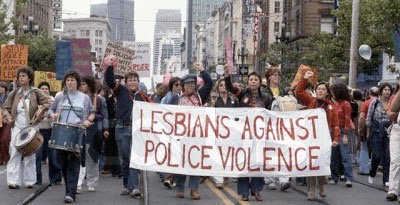
Being in a relationship with another woman navigating the same sexist workplace was probably a main reason Judy and Anne both stayed in the PD and made good careers. My lovers, too, were women in the trades, the only people who really understood what I was going through at work. They provided the support I needed to survive on the construction site.
I knew Judy better than Anne. She was a feminist and out on the job as a lesbian. One time when I ran into her working the gay parade, I threw my arms around her and planted a big kiss on her lips. Yeah, you’re not supposed to do that to cops when they’re working. But kissing lesbians was a thing I always did in June–gay month. I was just so happy to be out in San Francisco, I had to pass around my good cheer.
I got to know Anne better in the early 90s after she and Judy had broken up. We had a mutual friend, a mystery writer, who used us both for expert background. (What kind of electric shock will kill a person? How would a killer behave in this situation?) I think the mystery writer was hoping there would be a spark of attraction when she introduced us. She confided to me that Anne was in a secret ongoing affair with a closeted columnist who wrote for the local paper. The columnist was also in a long-term relationship with a lover who did not know about Anne.
Are you following me here?
Lesbian relationships were tangled in that era as we thrilled to new freedoms and experimented with new models. Anne was the Other Woman and I was admonished not to tell anyone. I had practiced nonmonogamy zealously but eventually came to see that being the other woman, especially if you’re in love, spells heartache. I sympathized mutely. It can’t have been easy for her.
I had never tried to romance a cop
We bonded over the internet. I had a new 512K Mac and I wanted to learn to use email. Anne, who used the internet to research crimes and criminals, set me up on AOL. It was dial up. You had to understand acronyms like POP, HTTP and some other things like hardware and software. They all confused the hell out of me, never a tech wizard. I remember receiving my very first email message from Anne. She didn’t say anything sexy, but it was exciting, world changing!
Was there an attraction? Well, sure. Anne was handsome, with shoulder-length dark hair and a muscular physique. She was handy. She had remodeled the Victorian house she owned in the Dogpatch neighborhood. I was impressed, and horny. But I had never romanced a cop. A veteran of protest marches, anti-war and anti-racism campaigns, I had been on the other side of many police barricades. I did not believe all cops were pigs as many did, but my generation of activists will never forget COINTELPRO, the police killing of Fred Hampton and so many others. Not to mention the attacks by the SFPD on our gay and lesbian bars and gathering places.
I was thinking about how I would undress her when she saw the stack of mail on my desk.
By that time I knew Anne well enough to know that we disagreed politically on just about everything. I figured she was one of those women who find it easier to not rock the boat and who identify with their male coworkers in order to survive on the job. Or maybe she’d been brought up in the 50s during the McCarthy era to hate communists. But, I reasoned, we didn’t have to talk politics. Maybe we could just have sex.
I managed to get Anne over to my house to help with AOL and I made lunch. An opening salvo. I imagined us moving into the bedroom after lunch.
I was thinking about how I would undress her when she saw the stack of mail on my desk. Right on top was a newsletter from the Committees of Correspondence, a democratic socialist group I was a member of.
“Are you a communist?” she asked, looking up.
She seemed surprised, but at that time I thought that most lesbians were leftists at least, if not communists. My friends and I were activists trying to rid the world of imperialism, racism and police violence. It wasn’t that weird.
“Well, yes,” I said. “Communist with a small c.”
“I could never be with a communist,” she sputtered.
“But,” I said, “you wouldn’t have to BE with me. We could just have sex.”
The look of horror on her face conjured the pain of the long-term other-woman relationship that I wasn’t supposed to know about. And probably she really did hate communists. She was a cop first and a lesbian second.
My disappointment didn’t last long. It never would have worked out. I hoped Anne would find the right woman, and I wondered if she would tell that woman about her own secret affair with the columnist. I never found out.
I just learned about something called burrowing, where appointed officials make their way into the civil service and become career employees. You can’t get rid of them. Apparently there are a bunch in the federal government left over from trump. I wonder how long the citizenry will have to live with them and how much damage they might do.
Then I wonder about our own burrowing animals right here at Hylandia. One day last summer, covid-confined to our back yard, Holly and I saw the ground start to move. It was not an earthquake. Some animal was making its way just under the thinnest layer of garden soil. We watched quietly, fixated, but when we tried to sneak up and unmask it, the creature disappeared.
“Oh my goddess we have gophers!” I yelped.
No burrowing animals ever invaded my San Francisco garden but Holly had years of experience combatting gophers when she lived in Santa Barbara.“They love poppies,” she declared. And so we waited for the many poppies in our yard to be pulled underground just like Bugs Bunny did in cartoons. But only one plant, a sunflower, suffered root damage.
Later in the fall, looking out our picture window, we watched a tall cosmos plant shimmy as if in an earthquake. The dance went on for many minutes. Nothing else in the garden moved. The burrowers were at it again.
Infrastructure was affected. Holly continually leveled out the birdbath fountain and then it would be undermined and again tipped at an angle.
We installed raised beds with gopher wire and bought wire cages to plant in.
Then we started seeing cone-shaped piles of dirt around the garden. We saw no hole in the middle and no tunnels. We were flummoxed. Gophers leave a horseshoe shaped mound of earth near their burrows and the entrance hole is visible.
Maybe we didn’t have gophers. But what could it be? Someone told us that local gardeners have problems with voles. I have seen voles in the mountains emerging from their burrows on backpacking mornings, but I didn’t know they lived here or were found in gardens.
We decided our culprits were voles, also called meadow mice, the cutest of the burrowing animals likely to be found in gardens, but possibly the most damaging. They look like mice with shorter tails and rounder heads, about five inches long. Voles pay no attention to gopher wire. They just climb right up into the raised beds and gnaw at the base of plants, even killing trees.
Plants were not dying and we saw no evidence of gnawed trunks on our fruit trees. Maybe they weren’t voles. Our period of idle speculation continued for a while until we finally googled.
The three main burrowing animal “pests” are voles, moles and gophers. When you look them up online, the whole first page of google is filled with pest control companies explaining how these mammals damage your lawn and how to get rid of them by poison or other means.
I did find one website that was not only about extermination—the Oregon State University Extension Service. It says, “Moles, voles and gophers all improve the soil by aerating it and mixing nutrients, but sometimes their habits get them in trouble with gardeners.”
Wow! They all improve the soil! Our soil here is dense clay that resists the spade in the dry season. Could burrowing animals be good for our garden?
“The important part is for people to assess the level of damage with the level of control,” says Dana Sanchez, wildlife specialist. “Is having a few holes in the lawn enough of a problem that you need to take action?”
Thank you Dana Sanchez! Perhaps we can live with burrowing animals in our garden. We already live with rats, birds, cats, opossums, raccoons, fence lizards and squirrels.
Reading descriptions of these animals and their habits made us decide we have moles, not voles. Moles leave mounds of dirt and voles do not. Moles eat worms, slugs and insects; voles eat plants. They are way more dissimilar than their names suggest. Moles are in the order Eulipotyphla along with shrews. Voles are Rodentia, as are gophers and rats.
We learned that we will probably never see a mole. Unlike gophers and voles, they really do spend their entire lives underground. They make two tunnel systems, one deep in the earth about ten inches down and one closer to the surface. They are solitary and one mole can have a territory of two back yards. Maybe we have only one mole.
Moles are not as damaging as gophers and voles. Moles don’t destroy plants except by sometimes undermining the roots by leaving a void underneath. Would I feel the same way if we had gophers or voles destroying our plants? Probably not. I’d be scheming about how to exterminate them. My brother told me his husband once put gas down into a gopher hole and lit the fumes. It seemed like the whole yard raised up in the explosion, he said. There are videos on YouTube. Apparently people do this all the time. What would you look up? I wondered. He suggested “mole yard explosion.”
I remember during the cold war when mole also meant a spy. We used to worry about Soviet moles in the government, spies who spent lives burrowing in. Now it’s the Russians and the moles are people sitting at computer consoles far out of reach. Reports suggest they have burrowed into every part of our government, although that scandal hasn’t seen much light lately.
And we must add to that white supremacist and nazi moles. How many of these moles are still in the military? Were moles the reason the military failed to aid the capitol police in the recent attempt to overthrow our government? And members of Congress—shall we view those who voted to defend trump as moles who have now been exposed?
Now that we know moles aren’t so damaging to gardens, maybe we can live with them. But I’m not so sanguine about living with moles in the government and the military. If I google “moles in the government” perhaps I’ll find strategies for removing the burrowers.
I’m publishing a selection of letters written by my mother, a prolific letter writer who lived in the conservative town of Yakima, Washington all her life. In a 1977 letter she castigates Sen. Henry Jackson and Democrats in Congress for their lack of support for President Carter, and schools them on the history of the Panama Canal.
“Neither you nor the great media with its resources has bothered to challenge the propaganda of Ronald Reagan…”
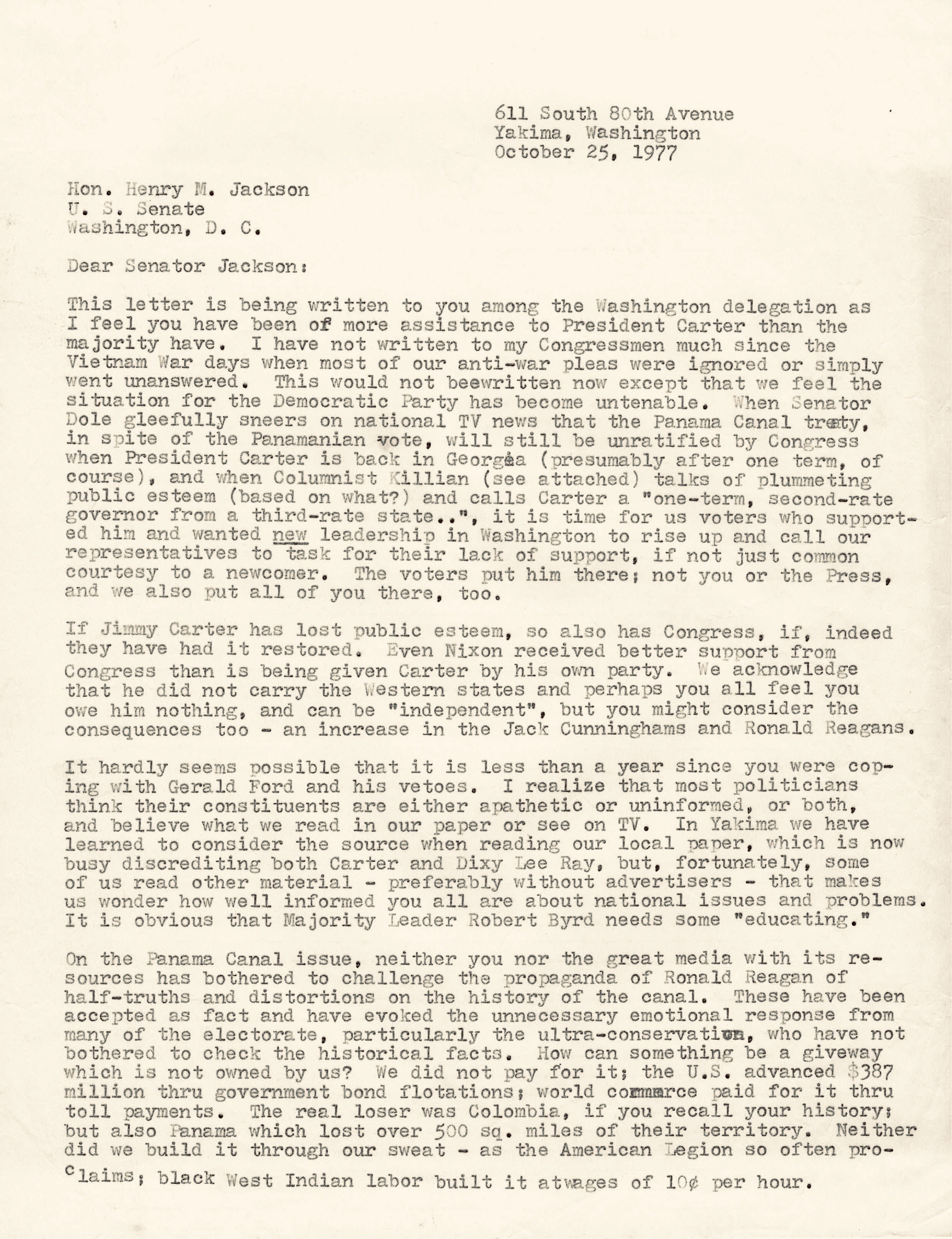
“We strongly support President Carter in scolding the oil companies; it should have been done long ago.”

Back in 1980 gun control was a big issue. Politicians and celebrities were victims as well as less famous citizens. After John Lennon was shot I had to admit to my mother that I had bought a hand gun, the same type that killed John. She was distraught. What could I have been thinking? I was thinking as a radical socialist lesbian feminist I might have to defend myself. I learned how to shoot at local gun clubs. I put the gun in a drawer next to my bed, but began to worry that a visiting child might find it. What if someone accidentally got shot with my gun! I soon put the gun far away out of anyone’s reach. My thinking changed, but the scourge of gun violence did not. Except that Mom is writing here about handguns rather than now-popular semiautomatic weapons.

“We do have wild animals, but they are two-legged.”




 tradeswomn musings