
Catching up with the Third Division
My Mother and Audie Murphy Ch. 31
September 8, 1944. After several days in the small town of Aix-en-Provence, the Red Cross crew drove north in an effort to catch up to the Third Division. They stopped in Grenoble where they stayed for a night in what Flo called, “a lovely hotel, taken by 7th Army.” She noted: “Boy from Ballard (A Seattle neighborhood) gave me cinnamon rolls.” She described Grenoble as “lovely and modern—very mountainous.”
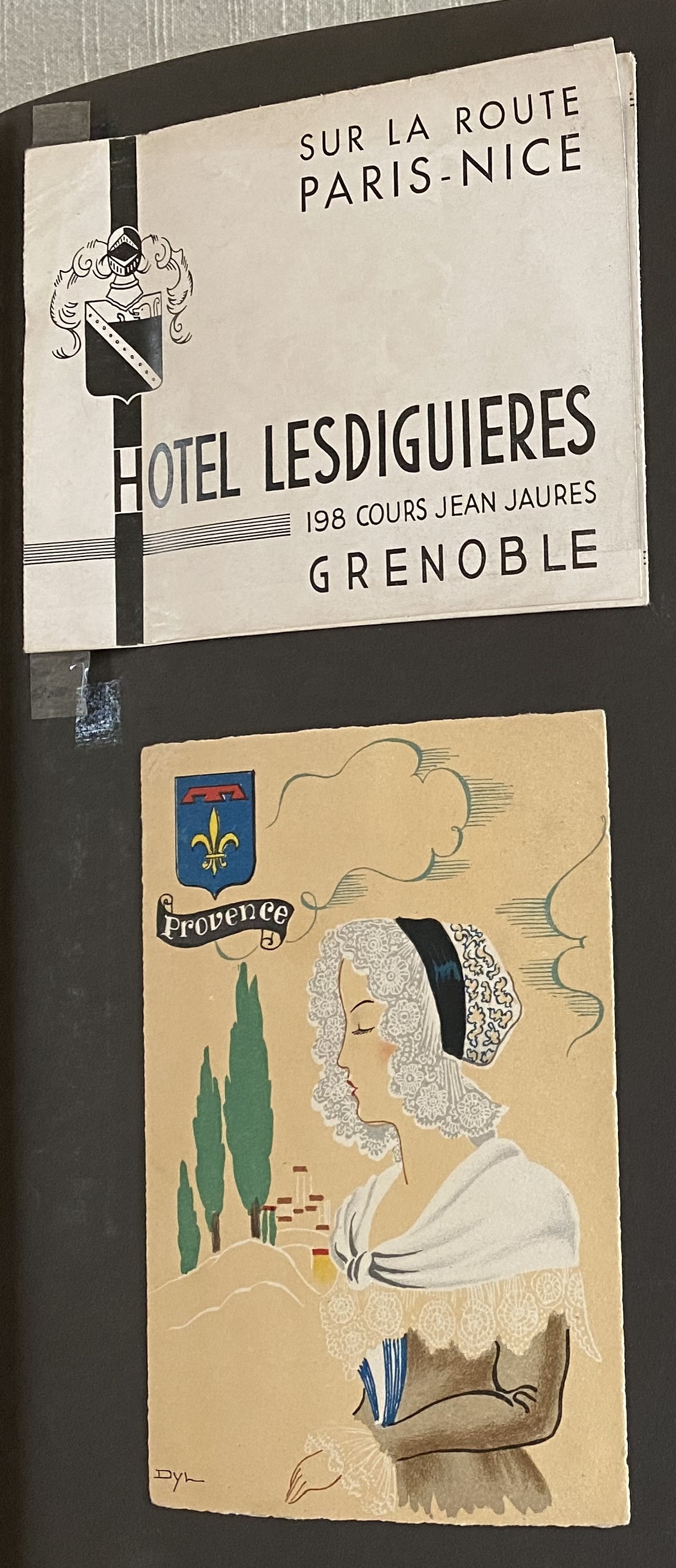

Flo also pasted on this page of her album a newspaper story quoting Sgt. Louis Roberts about Nazi brutality endured by the French. Sgt. Roberts must be a Yakima native. From the Yakima Herald:
Atrocities Are Reported
Sgt. Roberts Avers France Bled White
Sgt. Louis Roberts who has been staying recently with a French family, has thus been able to get a better understanding of condition in France than most of the Americans and has the added advantage of speaking the language.
“It is hard to fathom how Germany bled France of resources,” he says. “From one little sector each month the people had to send 13 ½ tons of shoes, 10,000 head of cattle, tons of butter, milk, wood and other things plus a monthly payment of five million francs. It is incredible how much a small region could ever supply so much. These people have been thrifty and economical enough to endure this war.
“Being deprived of food and clothing did not bother the French so much as the brutal measures the Germans took. Often children had to suffer the loss of limbs so parents would take pity on them and disclose vital information about the F.F.I. (French Forces of the Interior. The French resistance) One town north of here was taken by the F.F.I. The Germans warned the patriots that if one shot were fired after 11 o’clock they would retaliate. The warning was not heeded and the Germans retook the town and set all the houses afire along the main street.
“Numerous incidents are constantly told about how the Germans would shoot our wounded prisoners. Women would cover the bodies of dead aviators or allied soldiers with flowers which would be scattered by the Germans who were on guard. If some persons would linger over the body of one of our soldiers to pray they would be driven away at the point of bayonets.
“These French are very sorry, indeed, that all of us cannot understand the language. Each of them has some grewsome story to tell, not necessarily how they suffered but how the rest, or all of France, has to suffer. I have seen results of such brutality and I feel even more sorry for the French still in German territory. I could write a book on what I have heard and seen.
Yesterday I went to mass—a special mass for the liberation of the town. The church was beautifully decorated with numerous flags and stretched out up over the altar was a huge banner ‘Honor and Glory to the Americans.’ The choir and music were also beautiful. It was like Easter at home.”
Sgt. Roberts and Miss Florence Wick, Yakima Red Cross worker, are in the same town and see each other at times. He adds that “even though people are bombed out of their homes they are most happy to be liberated.”
Ch.32: https://mollymartin.blog/2025/06/09/catching-up-to-the-3rd-division/

 tradeswomn musings