A Demon Enters My Body

His best friend dies: Murph loses his cool

Ch. 26 My Mother and Audie Murphy

D-Day in Southern France. August 15, 1944

They jump from the landing craft and wade through the swirling surf. From the hills above, German guns begin to crack. Shells burst among them. Medics move instantly, sleeves rolled, already tending to the fallen.

An explosion erupts on the left. When the smoke clears, the remains of a soldier lie scattered—he has stepped on a mine. A medic kneels beside him briefly, then signals to the litter bearers that there is nothing to carry.

Ahead lies a strip of scrub and tangled grass. The men advance toward it with cautious, deliberate steps, as though walking on eggshells. The entire beach is mined, every footstep a gamble.
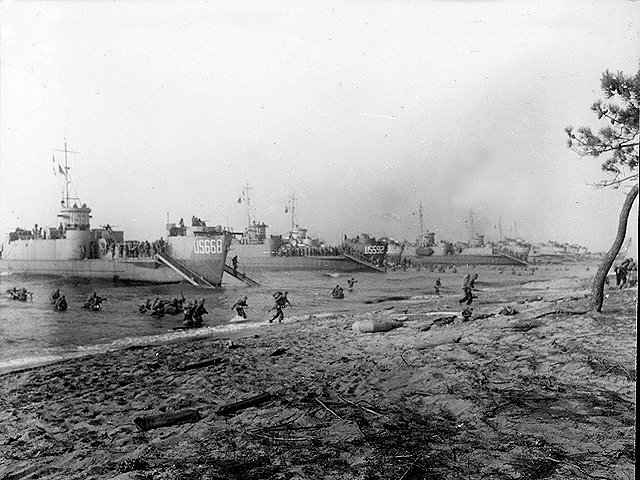
Landing at Red Beach. Photo: Dogface soldiers collection

They reach the edge of a green meadow. Beyond it stretch vineyards and scattered farmhouses, each one potentially harboring an unseen gun crew. Murphy drops into a drainage ditch and pushes forward, mud sucking at his boots as he moves.

They kill two Germans and capture six.

The thin shell of resistance at the beachhead collapses quickly, and the company advances inland. Three wooded hills rise to their right. From the center hill, a concrete pillbox juts outward, its cannon angled toward the beach. Intelligence marks this hill as a major strongpoint, and Murphy’s company receives the order to neutralize it.

Under a punishing sun, the men climb in sweat-soaked uniforms. Murphy’s platoon leads, and he brings up the rear. Suddenly automatic fire sweeps down from the hill.

Murphy’s two comrades are killed. He is alone and the Germans have discovered his position.

Then Murphy engages in acts of heroism that earn him one of his many medals. He duels with the enemy until his ammunition is exhausted. Then he seizes a machine gun and rakes the foxholes. Still under fire, he is joined by a comrade, his best buddy in the squad.

The surviving Germans wave a white cloth in surrender. Murphy’s friend rises casually from cover, believing the danger has passed. A hidden machine gun opens at once. He topples backward into the hole, barely whispering Murphy’s name before dying. Murphy freezes in shock, caught between the bodies of his friend and the Germans he has killed.

He checks for a pulse. There is none. He calls for medics, but the hill roars with gunfire. No one can reach him.

Grief and disbelief overwhelm him. He refuses to accept the death. With quiet, deliberate care, he lifts his friend from the hole and lays him beneath a cork tree, as though fresh air alone might restore life. How he avoids being shot while doing this remains inexplicable.

Map of the invasion. Photo: NARA

A machine gun shifts toward him. Murphy reacts instantly, diving back into the hole, throwing a grenade, and then rushing forward. The grenade has done its work. Both German gunners are dead. Murphy takes their weapon, checks it, and begins climbing the hill again.

He wrote: “I remember the experience as I do a nightmare. A demon seems to have entered my body. My brain is coldly alert and logical. I do not think of the danger to myself. My whole being is concentrated on killing. Later the men pinned down in the vineyard tell me that I shout pleas and curses at them because they do not come up and join me.”

He reaches the gun crew responsible and kills them before they even know he is there. He keeps firing until their bodies stop moving.

Resistance on the hill collapses. The company advances and reorganizes on the crest. Murphy stands apart, trembling, stunned by the sudden weakness that overtakes him. When the company moves on, he returns alone to his friend’s body.

He gathers his personal effects, looks once more at the photograph of the little girl with pigtails, then places the pack beneath his friend’s head like a pillow. He sits beside him and weeps without restraint.

As time passes, the rage drains away. The enemy becomes again simply the enemy—not monsters, not personal. The war resumes its relentless form: a series of brutal tasks carried out by flesh and will. Murphy accepts this, as he has every day since the war began.

And he rises, wipes his face, and walks back over the hill to rejoin the company.

Quotes are from From Murphy’s autobiography To Hell and Back

Ch. 27: https://mollymartin.blog/2025/05/15/flo-and-her-crew-sail-to-france/
Operation Dragoon: The Landing

Audie Murphy recalled landing on French soil

My Mother and Audie Murphy Ch. 24

August 15, 1944. From Murphy’s autobiography To Hell and Back:

Audie Murphy later described the landing in southern France in his autobiography To Hell and Back. He recalled that, technically, the operation was considered perfect. The assault had been calculated to the smallest detail, every movement coordinated so that the effort unfolded with the smooth precision of a machine.

Compared to earlier invasions, resistance here was light. Weeks before, Allied forces had already broken out of Normandy and were cutting through northern France like a flood bursting through a levee. On the eastern front, the Russians were hammering the German armies. Overhead, American bombers were grinding German cities to rubble. Murphy likened Germany’s situation to that of a man hiding in a stolen house, frantically running between front and back doors as justice pounded from both sides—only to realize too late that another force was now rising up through the cellar. His regiment, Murphy observed, was that third force.

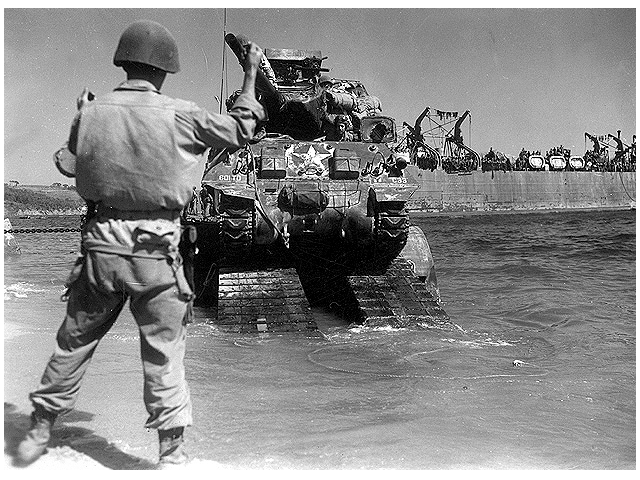
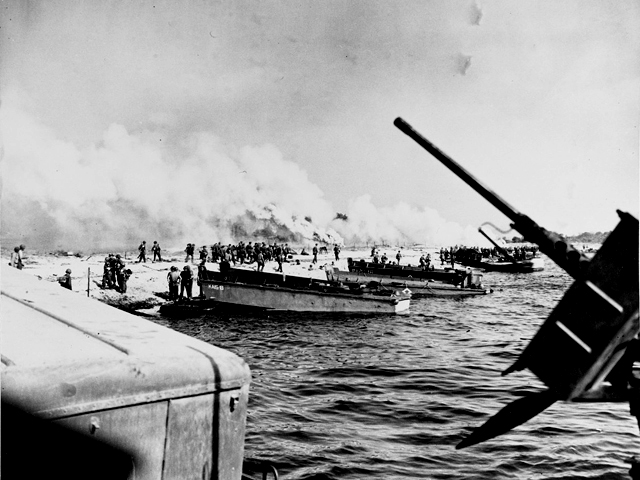
Landing craft on D-Day August 15. More than 90,000 amphibious and 9,000 airborne troops participated in the initial two-day southern France landings. Photo: NARA

Yet the men in the landing craft knew nothing of this sweeping strategic picture. They saw only the edge of the boat, the immediate shoreline, and the moment that lay before them. Their first objective was a narrow, harmless-looking strip of sand called “Yellow Beach.” It was early morning in mid-August; a thin mist hovered above the flat fields beyond the shore, and beyond that, quiet green hills rose inland.

Photo: Dogface soldiers collection

The bay between St. Tropez and Cavalaire was crowded with the familiar pattern of an amphibious assault. Battleships had already given the coastline a thorough pounding and now drifted silently in the background. Rocket craft followed, launching volleys that hissed through the air like schools of strange metallic fish, exploding mines and shredding barbed wire while rattling the nerves of the Germans waiting on shore.

Photo: Dogface soldiers collection

Under this barrage, scores of landing boats churned forward. Murphy stood in one of them, gripped again by that old, stomach-knotting fear that always came before action. Around him, his men crouched like miserable, soaked cats. Some were seasick; others sat glassy-eyed, lost in the kind of inward withdrawal that came just before battle.

And then, in the midst of dread, Murphy felt the absurdity of the moment. Here they were—small, cold, wet men—thrust into a riddle vast as the sky. He laughed, as he often did when confronted with the enormity of life and death.

Photo: Dogface soldiers collection

As the boats drew nearer, Murphy tried to rally his men by urging them to sing. They weren’t interested. But singing had long been a way soldiers kept fear in check, anger in rhythm, and marching in step. The Third Division even had its own song—Dogface Soldier—written in 1942 by two of its own, Sgt. Bert Gold and Lt. Ken Hart, both from Long Beach, New York. The division commander, Lucian Truscott, liked it so much he made it official. Third Division soldiers sang it, marched to it, and danced to it.

Years later, in 1955, when Murphy played himself in the film To Hell and Back, the song made its public debut. It became one of the most well-known songs of the war, celebrating not heroes of legend, but the ordinary infantryman—the “dogface” soldier who carried the rifle, slogged the mud, and shouldered the daily weight of the war.

The lyrics—simple, proud, and rough-edged—captured exactly who they were:

I Wouldn’t Give A Bean
To Be A Fancy Pants Marine
I’d Rather Be A
Dog Face Soldier Like I Am

I Wouldn’t Trade My Old OD’s
For All The Navy’s Dungarees
For I’m The Walking Pride
Of Uncle Sam

On Army Posters That I Read
It Says “Be All That You Can”
So They’re Tearing Me Down
To Build Me Over Again

I’m just a Dogface Soldier, 
With a rifle on my shoulder, 
And I eat a Kraut for breakfast every day. 

So Feed Me Ammunition
Keep Me In the Third Division
Your DogFace Soldier’s A-Okay

Ch. 25: https://mollymartin.blog/2025/05/07/ready-to-leave-poor-italy/

Goodbye to the Boys

Chapter 22: My Mother and Audie Murphy

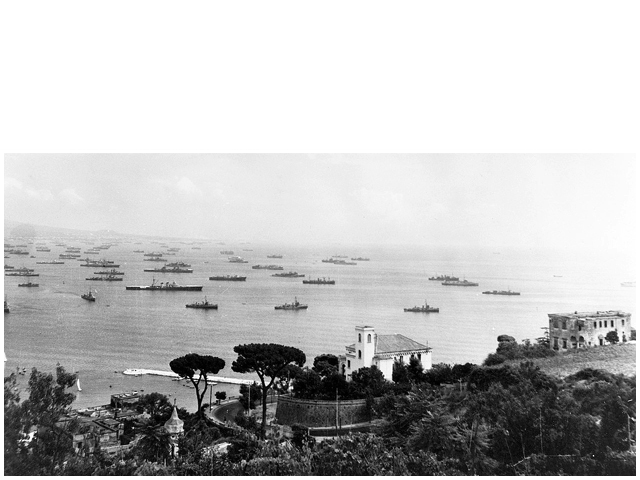
August, 1944. Operation Dragoon—the Allied invasion of Southern France—had been debated for months. Originally, it was supposed to launch alongside the more famous Operation Overlord, the Normandy invasion on June 6, 1944. But the top brass couldn’t agree. Resources were stretched thin, and priorities clashed. Was it wise to open a second front in France? Could they even pull it off?

Part of the Operation Dragoon invasion fleet anchored off Naples. Photo: NARA

Meanwhile, thousands of young men trained on the sunbaked beaches near Naples, waiting for orders that never seemed to come. Tension hung heavy in the air. They practiced amphibious landings again and again, sand grinding into their boots and rifles, minds on the fight ahead—or trying not to think about it at all.

By August, the go-ahead finally came. Operation Dragoon would launch on August 15, with landings near St. Tropez. The plan: storm the beaches, push inland, liberate Marseille, and link up with the northern forces. It would be a massive undertaking, one that might finally break the German grip on Southern France.

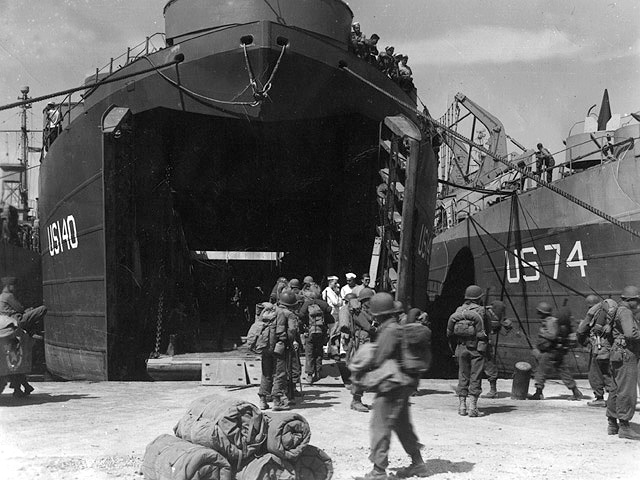
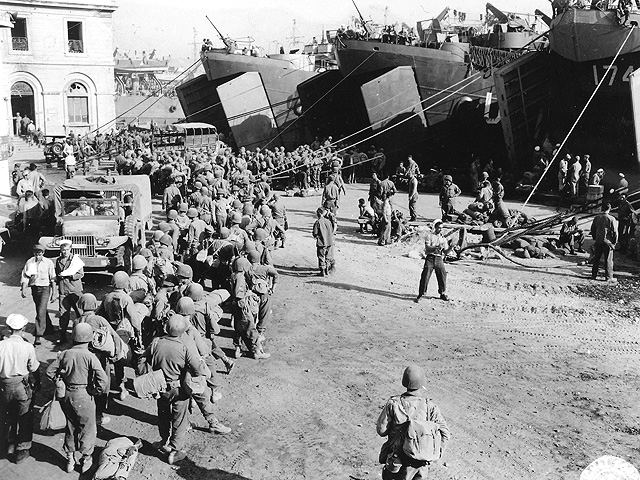
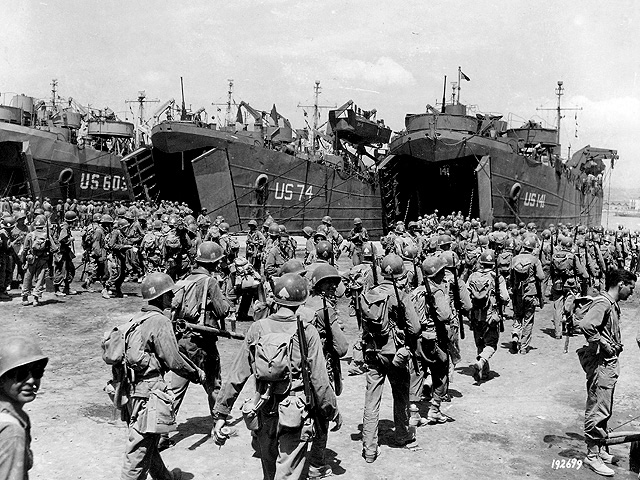
In the ports around Naples, everything sprang into motion. Soldiers, tanks, trucks, jeeps, crates of ammunition and rations—all were loaded onto the towering LSTs (Landing Ship, Tank). The docks were a blur of noise and movement. Beneath the logistical precision, though, was something quieter, more personal: goodbye.

Loading the LSTs

The Red Cross women were there, as they always were—on the edges of history, offering comfort, coffee, and smiles to boys about to disappear into war.

On Monday, August 7, Flo wrote in her diary:  

“Served 3rd Div. leaving from Baia. Said goodbye to Stonie, Rick & Miles & part of 36E. Last date with Gene. Went to beach. Hated to say goodbye. Love him in spite of resolve.” 

The day before, Flo had written in her diary, “Decided I want to marry Gene.” He was now her fiancé, and they were parting ways, perhaps for the last time.

The next day, August 8, she wrote:  

“On beach at Nisida. Mostly Infantry—7th & 30th. Saw Gus, Buzz and all the rest of 1st Bn. Hot & dirty. Worked from 7 a.m. to 7 p.m.”  

What a gigantic operation! Photo: NARA

Twelve-hour shifts, in the heat and dust, trying to give each man a sense that someone saw him, that someone cared. How do you say goodbye to that many young men, most of them barely more than boys? How do you smile through it, knowing many might never come back?

When the last ships pulled out, the docks were quiet. The women packed up their things, broke camp, and moved into Naples near headquarters. Flo wrote:  

“Much baggage. Helped 45th girls at Pozzuoli. Also 36th Div. leaving there. Very hot, busy and tired. LST ensign gave me dozen eggs. Exhausted after days of saying goodbye to thousands of boys en route for invasion.”  

Photo: NARA

Now they waited. The invasion was set for August 15. First, the troops would land. Then they’d have to fight their way inland, clear the Germans, secure the roads. Only then would Flo and the other ARC staff be allowed to follow, to bring comfort once again to the weary, wounded, and grieving.

In the silence of the following days, Flo thought of Gene. And of Stonie, Rick, and Miles. And of the thousands of names she never knew—just faces, voices, laughter fading down the gangplank.

Ch. 23: https://mollymartin.blog/2025/04/27/on-leave-sorrento-and-capri/