Pozzuoli, Italy—In the sweltering summer of 1944, the 3rd Infantry Division assembled near this small resort town, joining the 36th and 45th Divisions in preparation for a high-stakes amphibious invasion of southern France. These battle-hardened troops, fresh from the grueling Anzio campaign and the march to Rome, were now under the Seventh Army’s command, sharpening their combat readiness for the next major offensive.
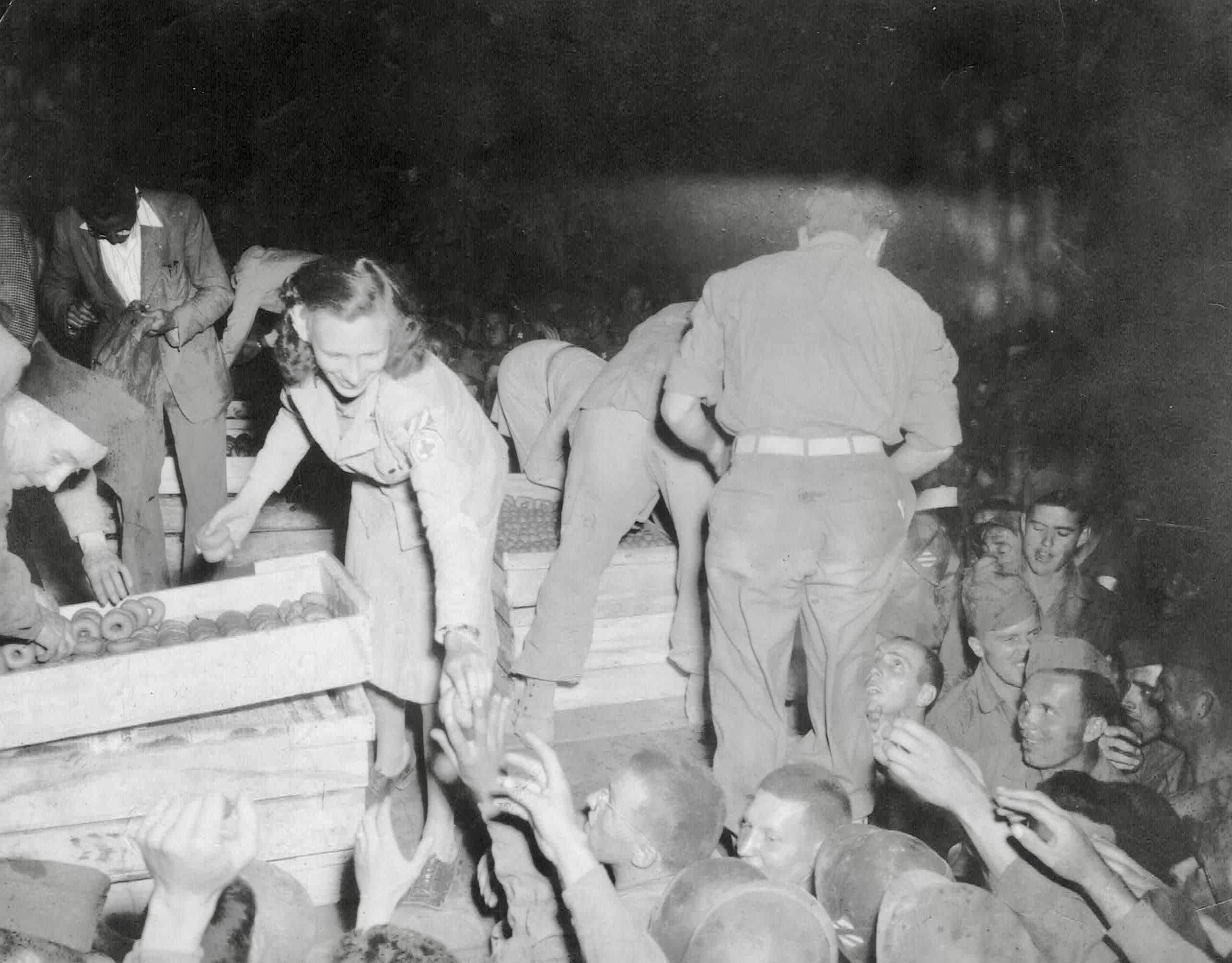
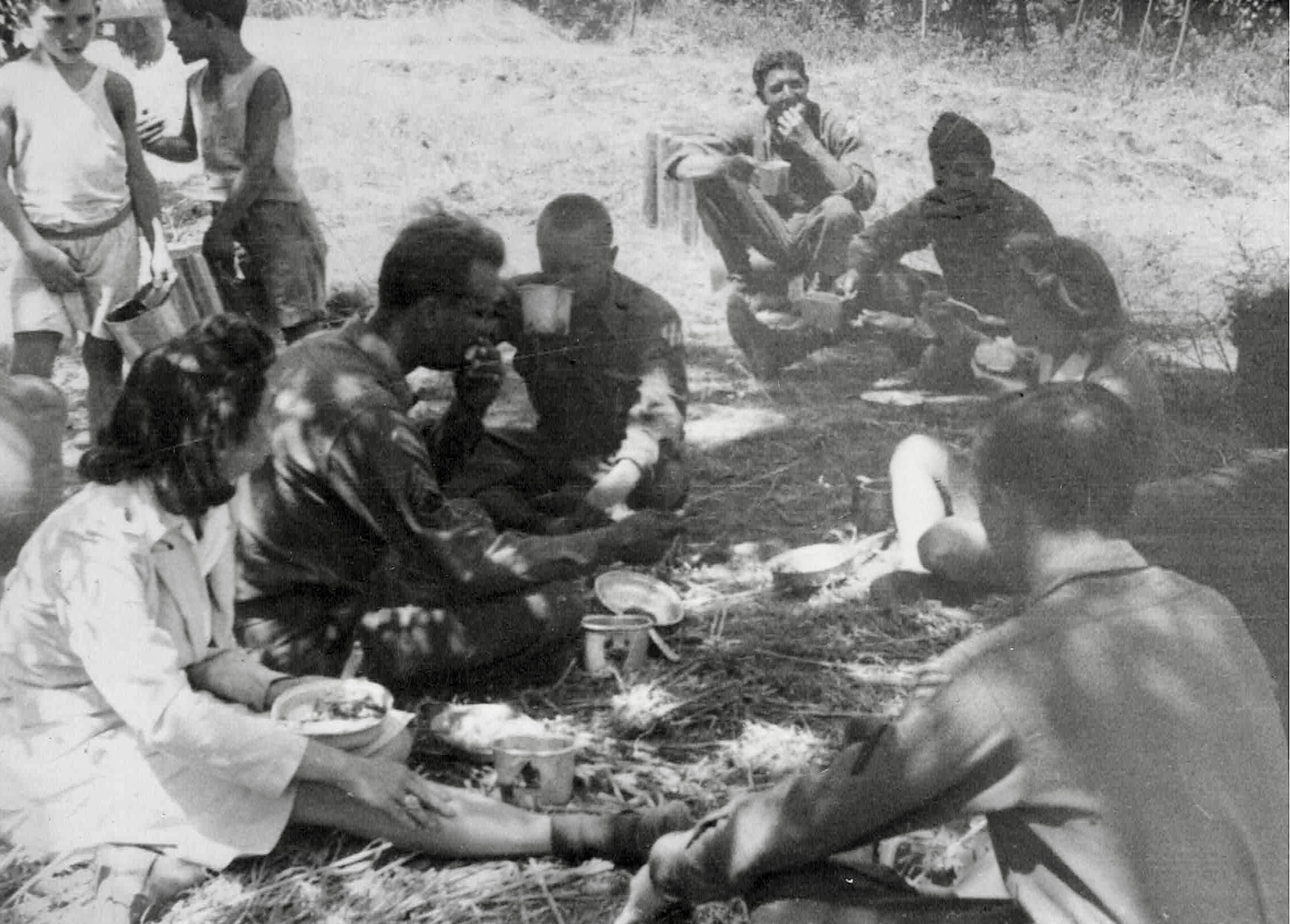
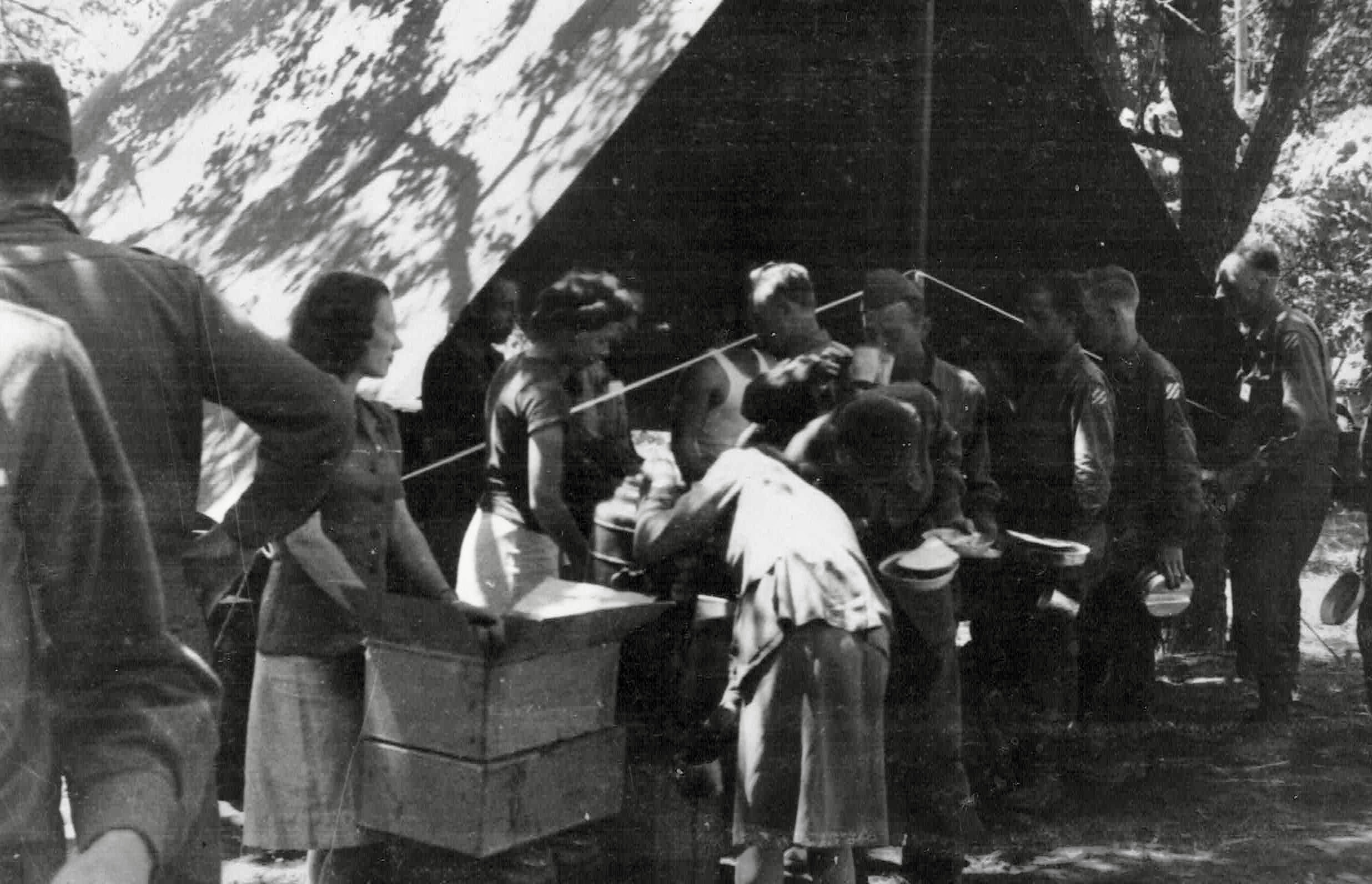
(L-R) Flo, Dottie and Jingles serve the 803rd Ordnance Co.Flo hands out donuts with a smileIsabelle Hughes serves soldiers on the docks returning from a training missionLunch with the “boys”
Among them was an unassuming but vital group—Flo and her clubmobile squad—who arrived in June to serve the men a taste of home: fresh donuts and hot coffee. Stationed in a sprawling tent city, these women had to get creative without a clubmobile truck, the specially outfitted vehicle designed for donut-making on the go. Instead, they improvised, scrounging up transportation and setting up makeshift field canteens in the dusty camps where soldiers could grab a sweet treat before heading back to drills. They were assisted by “donut boys,” soldiers who manned the donut machine in a tent kitchen.
Flo on the leftFlo and the “boys”Isabella, Flo and Dottie serving at bivouacFlo serving at night
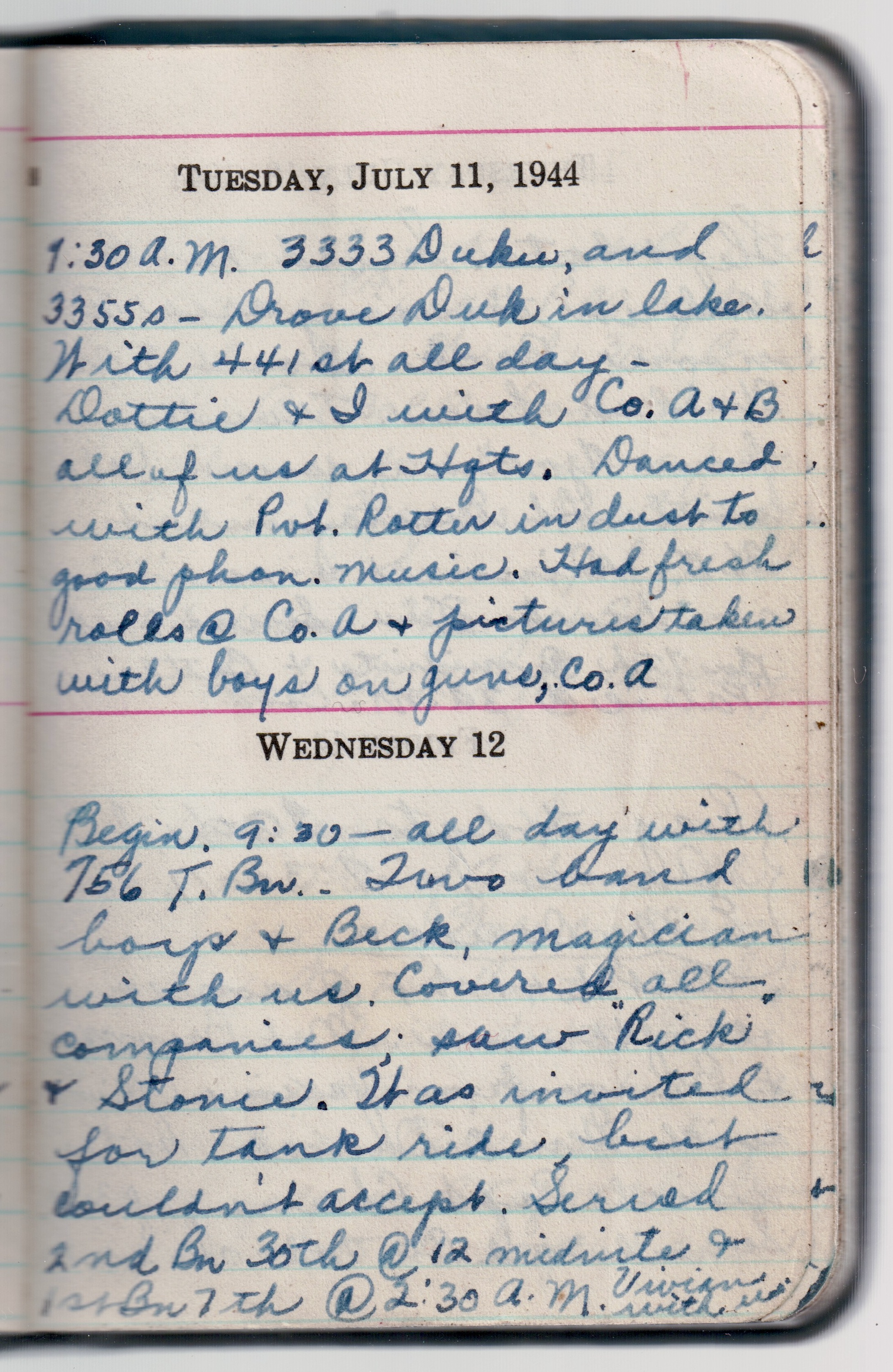
Flo meticulously recorded her daily work in a diary that read like a military log, listing the units she and her team served, often during the darkest hours of the night. Her notes mentioned names that would later be etched in history: the 1st Battalion of the 30th Infantry Regiment, the 441st Co. A+B, the 9th Field Artillery, the 36th Combat Engineers. On one occasion, on July 16, she may have even handed a donut to a young soldier named Audie Murphy—the future war hero and Hollywood star—though she dryly noted the day as “quite dull.” Murphy, in his autobiography, recalled the 1st Bn. 15th completing amphibious training earlier in the year, which likely explains their limited encounters at Pozzuoli.
One entry stood out: service to the 442nd Ack Ack (Anti-Aircraft Battalion), part of the legendary segregated Japanese American 442nd Regimental Combat Team. These soldiers, despite facing discrimination at home, were training for a mission that would cement their reputation as one of the most decorated units in U.S. military history.
Flo’s diary (pinch out to read)
Photographs from this period, many taken by the 3rd Signal Company, capture Flo and her fellow workers hard at work. These combat photographers, who had joined the division at Anzio, developed and printed their images in a darkroom trailer, documenting the war in vivid, unfiltered detail. Their images offer a rare glimpse into the everyday moments behind the front lines. For more see dogfacesoldier.org, a website dedicated to their photos and the 3rd Division.
Her letters home are published in the Yakima paper
My Mother and Audie Murphy ch. 13
Miss S.I. Anthon was a family friend who visited and sent Christmas cards throughout my childhood. She reminded me of the BBC version of Agatha Christie’s sleuth, Miss Marple. She was unmarried, was short with short curly hair, and (during the 1950s and 60s) dressed in a straight no-nonsense mid-calf-length skirt, blouse, vest and suit jacket and those low-heeled sturdy shoes worn then by women of a certain age. She usually wore a hat (women wore hats in those days). We always called her Miss Anthon. She was a reporter for the local newspaper, the Yakima Republic, later the Yakima Herald-Republic.
Soester (sister in Danish) I. Anthon was born in Denmark in 1890 and she lived in Yakima’s Scandinavian neighborhood. She was a neighbor as well as a mentor to my mother, and she shared Scandinavian roots with the Wick family. By 1930 Miss Anthon was the managing editor of the Yakima Republic, the evening newspaper, a rare accomplishment for an immigrant woman whose first language was not English. For many years she wrote a column called “Daily Mirror of Life in Yakima,” and during the war she reported on the activities of local men and women serving overseas.
When Flo wrote home from Europe, her mother, Gerda, would share the letters with Miss Anthon, who would write them up into news stories. While few of Flo’s actual letters to her mother survive, Miss Anthon’s clipped stories are pasted throughout Flo’s WWII album.
A page in Flo’s WWII album
One of Miss Anthon’s earliest reports quotes Flo’s descriptions of her first weeks in Italy.
June, 1944.
Headline: Yakima Girl Now in Italy. Miss Wick Tells About Her Tasks
Miss Florence Wick, who recently landed in Italy as a member of an American Red Cross clubmobile staff, is getting broken into her work “by passing out doughnuts and a smile,” she writes her relatives here.
“Several of us clubmobile girls are billeted at present in an old Italian hotel,” she says. “It has such incongruous items in it as a huge crystal chandelier and ornate gold valances over the doors. As in all Europe, the plumbing leaves much to be desired and warm water is rare enough to cause excitement.
“We have a sweet little Italian girl who acts as maid, does our laundry and tries very hard to learn English. She even goes to school after working all day. They are so poor here. It makes our standard of living seem even higher and makes us all appreciate the U.S. more than ever.
“I saw some of the Italian country-side in a tour and find it very pretty and picturesque. The fruit trees (cherries and apricots) remind me of Yakima.
“The trains are small and have only two or three cars on them. They are more like our street cars.
“Clubmobile will give me an opportunity to see more of Italy than just club work and although we clubmobile gals won’t be as settled and won’t be able to dress up as much, I think we will get a greater experience.”
“I have had some interesting talks with the men—both officers and G.I.’s. Some have had some harrowing experiences. They can always laugh and ‘sling a line,’ regardless, and the ‘purple heart’ boys do the best of any.
“The Red Cross service men’s club here is the nicest I’ve ever seen and the boys really appreciate it. There haven’t been many West Coast boys through here, but when I run into them, I’m as pleased as they are. All the others seem to think Washington state is out of this world.”
Flo was assigned to a clubmobile group of four women, and she was designated captain of the group, which included Isabella Hughes (Jingles) of Baltimore, Elizabeth Elliott (Liz) of New York City, and Dorothy Shands (Dottie) of Greenville, Miss.
L-R Isabella Hughes (Jingles), Elizabeth Elliott (Liz), Dorothy Shands (Dottie), Florence Wick (Flo). Flo wrote “Overlooking a lovely Mediterranean beach. The villas along here were all bombed and ruined.”
Flo and her team were first stationed near Naples in an old Italian hotel from the time her ship docked May 28, 1944. It seemed like the ARC was not quite ready for their arrival. The women just sat around for several days before the ARC could figure out what to do with them. They had started to feel like they’d been hired as concubines when they finally got an assignment. Rather than driving a two-and-a-half-ton truck around Italy like the other Europe-based clubmobilers, they would be bivouacked with the Third Infantry Division of the Army. The tent city was near the town of Pozzuoli, on the sea, just north of Naples, where the soldiers trained for an amphibious landing in France.
Goodbye hotel with crystal chandeliers, maid and laundry service. Hello Army tents with cots and bedrolls.
A Familiar Voice in the Blackout
The company had just arrived in Naples, one of thousands of American and British units flooding into the battered port city. Their first stop was the American Red Cross club, a welcome sight after weeks on the move.
Inside, amid the clatter of cups and typewriters, he scanned the lists of newly arrived Red Cross women. There it was — a familiar name. An old girlfriend from back home. The war had scattered them across oceans, and now fate had brought them to the same city. But there was no time to find her. Orders came down; the company had to move.
That night, the air raid sirens began. The Germans, retreating north, were still pounding the city, shelling the docks and rail lines. The blackout was immediate — every light extinguished. Hundreds of soldiers, nurses, and civilians poured from buildings into the damp mouth of a tunnel carved into the hillside.
It was pitch dark. The air was thick with fear, sweat, and the echo of boots. Then, through the chaos, he heard a voice. Her voice.
He called her name, and she called back. In the darkness, they moved toward each other, guided only by sound. They reached out — a hand, a sleeve, a touch — and for a moment, found each other. They couldn’t see a thing, but they laughed softly in disbelief. Two people from the same small town, meeting again by chance in the middle of a war, in total darkness.
When the shelling stopped, the crowd dispersed into the shattered streets, and they lost each other again.
They wouldn’t see each other until after the war, back home, this time in daylight.
The woman was my mother, Florence Wick. The man was (later) my uncle Morton Werner. He married Flo’s sister, Ruth. They each told this story many times, marveling at the happenstance.







 tradeswomn musings