The Strange History of 386 Richland Avenue
| In the 2000s, I began to deconstruct my Bernal Heights home. In opening up the walls, I started to uncover the house’s history, leading me to an investigation into its owners and architectural evolution from the distant past to its having been bought by my lesbian collective in 1980. The story of 386 Richland Avenue is one of Bernal Heights, San Francisco, and California more broadly, speaking to themes of land ownership and development, the legacies of slavery, and the role each person has in shaping their neighborhood. |

386 Richland Avenue 1980. Photo: Molly Martin
An old house holds the ghosts and remnants of all the people who have occupied it over the years. When you live in an old house I believe you must acknowledge all the people who have lived there and the people who built and worked on the house.
When I got to San Francisco in 1976, I decided there was no place I’d rather live. I had never owned a house before and really had no hope of ever owning a building in San Francisco until my living collective of four lesbians agreed to pool our money.
I got curious about the history of our Bernal Heights building as soon as we bought it in 1980. How old was it? Real estate records said it was built in 1900, but that is the default date for all San Francisco buildings built before the earthquake and fire of 1906 destroyed city building department records. So I knew it was probably built before 1900. It was always a weird looking building: three stories with three flats over a garage. Notice the weird roofline and window placement. What architect would design such a building?
I wanted to know who had lived there before me.
The Land Underneath

Ohlone village
The first human residents of this land of gently rolling grassy hills were the Ramaytush Ohlone. Hundreds of shell mounds have been uncovered all around the San Francisco Bay and there is evidence of a great Ohlone settlement at the mouth of Islais Creek, which once flowed just down the hill south of my house where Alemany Blvd and Interstate 280 now flow with traffic. Before progress changed its course and buried it, Islais Creek formed a deep gorge on the south side of my neighborhood of Bernal Heights. The creek was long ago undergrounded and replaced by freeways but the gorge remains.
I was delighted to learn that islay is an Ohlone word naming a native bush called the islais cherry (Prunus ilicifolia) that grew along the creek and still grows in forgotten corners of San Francisco. The shiny leaves look like a cross between holly and oak. And the fruit is edible. They were eaten by the Ohlone along with plentiful bay creatures, shellfish, fish, birds, deer, and other land animals.
Spain had laid claim to San Francisco and what it called Alta California in 1542. Starting in the 1760s the Spanish established missions from San Diego up to Sonoma along the king’s highway or El Camino Real, now Mission Street and Highway 82. The Spanish and the Indians they enslaved built San Francisco’s Mission Dolores in 1776, and so the road from San Jose and the south had come sometime before that. These are well-traveled pathways that extend quite far back in time.
After Mexico won independence from Spain in 1821, it secularized the Catholic missions. In order to receive a Mexican land grant, a man had to be a Catholic. But the land was not handed out to the church as it had been by Spain.
José Cornelio Bernal was granted a league, about 4,400 acres, by the Mexican government in 1839. José was the son of Juan Francisco Bernal who, with his family, arrived in San Francisco with the Spanish Anza expedition in 1776. José and his family were cattle ranchers, some of the original Californios. Over time they lost the land to squatters, lawyers, and bankers. The family first defaulted in 1859 to William Tecumseh Sherman, a banker before he became a Civil War general, who had loaned the Bernal patriarch money. The Bernals finally relinquished their last 25 acres to foreclosure in 1917. It marked the passing of the very last bit of San Francisco real estate from the families of original Mexican land grantees—the Californios.
The area south of the Mission including Bernal Heights was not platted until after the Civil War. At that time the lack of transportation infrastructure made lots hard to sell.
Large sections of southern San Francisco fell into the hands of the real estate developer François Louis Alfred Pioche. Pioche platted and developed much of southern San Francisco. A French financier, Pioche is described as a suave and cultured European who introduced fine French wine to San Francisco’s elite, an influential player who lived openly with his male lover and business partner, L.L. Robinson. No one is sure why he committed suicide in 1872.

Bernal Hill in 1875. Photo: Carleton Watkins, courtesy of California State Library
Carleton Watkins (1829-1916) was one of the most famous outdoor photographers of the American West. He also made many pictures of the growing city of San Francisco, like this one taken in 1875. From around Silver Avenue, looking north to Bernal Heights, the bare grasslands of southwest Bernal are revealed with the Mission District and the town of San Francisco in the distance. The prominent enclosure nearby is the site of St. Mary’s College. It faced Mission Road (now Street), the principal route at the time. College Hill Reservoir is the flat area near the center of the picture. The fenced circle denotes Holly Park, donated to the city in 1862 by the silver mining baron James Graham Fair. On the extreme right is the top of Bernal Heights. My house would be just to the right of this picture near the east edge of Holly Park.
Building 386 Richland
When we bought 386 Richland, the place was a mess. The most recent owner had “remodeled” by covering the walls and even wood window trim with quarter inch sheetrock. I’m an electrician. Trying to solve an electrical problem, I discovered live bare wiring between the sheetrock and tongue and groove finish wall in the kitchen of the lowest unit. This was very disturbing but I didn’t have time to demo the walls. That would have to wait 20 years until I retired.
One day I drilled a hole in a closet wall to pull some low voltage wiring. I used a four-inch hole saw and was surprised that when the saw got through a layer of sheetrock, it hit wood. When I finished I pulled the four-inch-round block of wood out of the saw. It was inch-thick redwood. I turned it over and found newspaper pasted to the inside, a primitive type of insulation. It was a racing form dated 1893. Well, that was a clue.

The San Francisco Call applied directly to redwood for insulation. Photo: Molly Martin
Someone told me the San Francisco Water Department records had been kept in a safe and survived the 1906 fire. All you had to do was ask at the headquarters. The clerk stepped into a big safe and brought out a single piece of paper, a Xeroxed copy of the permit, which said water was provided August 1, 1893. It was signed in a clear hand by the owner, G. Shadburne.
The document contained several other clues. The Spring Valley Water Company (we didn’t yet have a publicly-owned water department) supplied water to what was then a single-family building of 825 square feet. The property owner paid $10 in gold coin. Listed were two wash trays, one wash basin, one bath, one water closet and 30 square yards of irrigation. E. J. Fisk of the water company had charged for two cows and then apparently been convinced to erase them along with some other notes. Were the cows just visiting? Had a family been living at 386 Richland without running water? It would have been possible; there were several active springs on the hill and many early homes had been built without indoor plumbing. But while Shadburne could have bought the property earlier, all evidence points to 1893 as the year a building was first erected here.

George David Shadburne during the Civil War
From the census record I learned that the house’s owner in 1900 was George David Shadburne, a lawyer originally from Texas who had moved to San Francisco in 1868. He did all right for himself in San Francisco, well enough to be published as a person of note in the city’s blue book in 1894-95. He never lived at Richland Avenue, which he developed and rented out to poorer tenants. He lived instead in a tonier neighborhood on “California Hill,” and his business address was 429 Montgomery in downtown San Francisco, a building which he owned.
Shadburne might have been the original slumlord.
Once I had his name, I went to the San Francisco History Center at the San Francisco Public Library main branch where helpful librarians point you to volumes of historical data. Even though building department records were lost in the earthquake and fire of 1906, the history room contains a wealth of other supporting historical documents. I learned about the Sanborn insurance maps (most every city has them) and found that my neighborhood had been surveyed in 1905 and 1915.

A Sanborn Fire Insurance map showing the Holly Park tract in 1905
386 Richland is part of the Holly Park Tract. Development in Holly Park had only just started in 1905. Except for a small addition that was added to the rear of our building in 1961 (there was a building permit), the footprint is the same as today. It was still a single family dwelling then.

Sanborn map in 1915
By 1915 our neighborhood had been fully developed. Along with five neighbors I published a pictorial book about Bernal Heights history: San Francisco’s Bernal Heights. We learned that Bernal saw its greatest surge of development after the earthquake and fire of 1906. Some people moved earthquake shacks here and some built homes. By this time 386 had been turned into two flats, 386 and 386 1/2. Rather than a D, the map says 2F meaning two flats and adds the ½ to the address.
Deconstructing

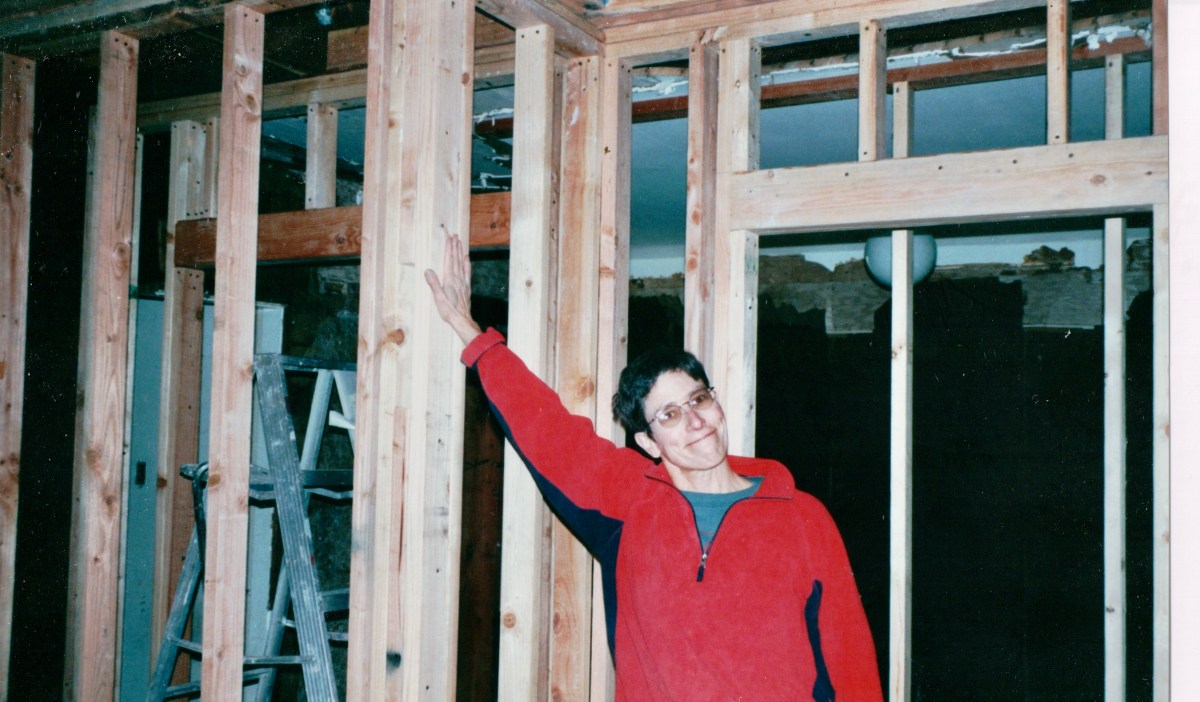
Barb Schultheis building a shoring wall after we discovered that there were no studs in existing walls. Photo: Molly Martin
It wasn’t until the year 2000, 20 years after my original collective had bought the building, that I had the time and inclination—and also a partner who wanted to get her hands dirty—to begin to open walls and really see the structure. My then-partner Barb Schultheis and I started just a little kitchen remodel in my unit on the third floor. We opened one wall in the kitchen, pulling off many layers of finishes including sheetrock, oil cloth, and newspaper. What we found was worse than anything I’d imagined. Underneath it all was one-inch coarse sawn redwood planks, some as wide as 20 inches, and under the redwood was cross bracing and nothing else: no studs in this part of the third story apartment. And there was another story on top! The redwood was structural. We quickly built a shoring wall.
I’d never seen this building method. My carpenter girlfriend in New England called it a plank house, a more common style of building there in the 1800s.
Our demolition progressed to the front room of our unit. Here we found another construction method, more common in today’s buildings–platform construction. The walls had 2×4 studs 16 inches on center and the finish was lath and plaster.
As we deconstructed the building, we kept wondering why it is so oddly shaped, why construction methods differed from floor to floor and room to room, why floors were different heights in adjacent rooms, why floor and ceiling joists sometimes went north and south, sometimes east and west, why when wall coverings were removed we could see sky through cracks in the exterior walls.

Another clue: the staircase had been open and was closed in to create a third unit. Photo: Molly Martin
Then one day when I was standing across the street looking at the building I had an epiphany. Our home was never a plan in some architect’s mind. The different construction methods told us that these were different buildings, constructed at different times and later nailed together. It was a collection of buildings set on top of one another, cut off, pushed together, raised up, and without benefit of removal of siding, spiked together with a few big nails. Suddenly all the mysteries we’d cataloged made sense.
The old house had been turned so that its side, not the front, faced the street. Houses were often moved at the turn of the century. A builder would build a single-story house and later raise it up to add a second story. There were few systems like electrical and plumbing to disconnect as there are today. I believe this building was moved from another location where its rounded entryway faced the street. I propose that the three buildings were given to Shadburne or sold to him cheap.

Illustration of my “many buildings” theory
In this drawing I removed the double stairs to better see the different parts. I had always thought the oldest building, the yellow part, was the first house on the lot, but the square footage didn’t add up. Then I realized that the original 825 square foot house is the pink building turned so its side faces the street.
Here we can see three different buildings built with different construction methods: the yellow building had planks joined with square nails and no studs, insulated with 1893 newspapers. The pink building had modern platform construction, rolled nails (invented around the turn of the 20th century), and lath and plaster finish. The blue building below had old fashioned balloon framing with 4×4 studs 24 inches on center, also finished with redwood planks, but with rolled nails.
Our remodel progressed to the garage where we demolished a shelving unit made of old doors and metal pipes attached to a wall of sheetrock with no studs. Barb and I were standing at the base of a four-story building. We were right under three stories of kitchens with heavy appliances. We looked up to see the floor above bowing toward us. We rushed to build another shoring wall. That’s how we figured out that the bearing wall under all the kitchens had been removed! My search for building permits had uncovered a 1917 project to raise the building and add a garage. I believe the bearing wall was removed then. The building inspector didn’t notice. The building had been slowly falling down for a hundred years! So, with help from carpenter friends Carla Johnson and Pat Cull, we dug up the garage floor, poured a footing, jacked up the building, and built a new bearing wall.

Retired union carpenter Pat Cull oversaw our project and taught us much about carpentry. Photo: Molly Martin
Another shocking discovery resulted in more unplanned structural work: not one but two bearing walls had been removed to make way for the garage in 1917. Engineer Marg Hall helped us to understand the physics of load bearing (one test: have your girlfriend run up to the floor above and jump up and down) and did calculations required for the permit. I drew plans and waited in line at the Dept. of Building Inspection. This second un-wall we rebuilt as an engineered glue lam wood beam on posts.

Postcard found in the ceiling, maybe from 1903. Photos: Molly Martin
When Barb and I opened the ceiling above unit B, the third story, we found a crib full of about a ton of plaster that had been discarded when the buildings were tacked together (no wonder the ceiling was bowing). We had to remove it by hand, scooping it into buckets to take to the dump. This was the most disgusting job of the whole project. This postcard was in there. I asked Ancestry buffs brother Don Martin and cousin Richard Juhl for help researching this. They found John Hargens at this address in a 1907 city directory. He was an immigrant from Germany, born about 1868. His wife Minnie was also German which might account for the florid cursive. They lived at 386 in 1907 with their five children but moved to Santa Marina (a nearby street) in 1908. Did they move because of construction on 386? How did this postcard get into a pile of plaster left in the attic?

Some of the objects found in the walls, dating back as early as the 1800s, gave us clues to the tenants in different eras. Coffee can metal (bottom right) was used to patch holes in the fir floors. Photos: Molly Martin
Demolition was like an archeological dig and while we didn’t find anything valuable, we uncovered lots of clues about the building of the house. When I finally saw the wiring inside the walls, I couldn’t believe the building hadn’t burned down. In my time as an electrician and inspector I’ve seen the insides of a lot of walls in San Francisco but I’d never seen such hazardous wiring. Much of the building was wired with the equivalent of zip cord.
Thanksgiving 2000 was our last dinner party in my old apartment B. By Christmas I had moved up to Barb’s penthouse apartment and moved all my stuff out to the shed we’d built the year before, clearing room for the remodel. We spent the last days of December pulling apart my kitchen. Our four-story, three unit building required near complete rebuilding, a far more difficult task than simply constructing a new building from the ground up. If only I’d known what we were in for, I’d have sold the building. But there’s probably a real estate disclosure law requiring truth telling, so once we started, we had to forge ahead.
Rebuilding
In those first two years of destruction and construction of the lower two units, Barb and I did all the demolition, carpentry, and electrical work ourselves, with the help of many dear women friends. Scores of women helped us on this years-long project. We couldn’t look at the whole big project or we’d get depressed at the overwhelming amount of work ahead of us and think of suicide. Instead, we focused on each small project and celebrated whenever we finished framing a wall (virtually all the walls had to be reframed) or laying a subfloor in one room.

Carla Johnson jackhammers for new footing
In November of 2002 we celebrated having gotten the house closed up for winter and ready for sheetrock. Barb had taken off a couple of weeks in October and we’d worked our butts off replacing siding, installing new windows, patching, caulking, weatherproofing, and painting the back and west side of the building and rear stairs.
We knew the building was funky—the three-story utility “shed” which enclosed bathrooms had been added on at the turn of the 20th century with no foundation, so it had gradually separated from the main building over four inches near the top. Bad carpenters and handyman homeowners had been plugging the gap for 100 years. But we figured 21st century caulk might buy us a few more years. We decided we would tackle rebuilding the back of the house after this remodeling project was complete.

The rear side of 386 Richland before the storm; all of this work had to be torn down. Photo: Molly Martin
Then in mid-November 2002, the winter’s first storm hit. The four-story wood frame building had always moved in the wind. You’d lie in bed in a storm and feel it shimmy and buck on any floor (I’ve lived on all three and lying in bed in the bottom unit I could tell when the couple in the top unit were having sex), but especially on top. I figured it had survived a century and two big earthquakes probably because of its profound flexibility.
That night of the storm it felt like the building was on the verge of falling down. Of course! We’d removed all the many layers of wall coverings and completely gutted the two floors below. Like scotch tape and gum, the interior finishes had been holding us up. Upstairs in the top unit, lamps were swaying and everything was moving. We could see the glass in our living room windows bow in the wind and worried they might shatter. So we closed the blinds and finally went to bed, though I don’t think either of us got much sleep.
The storm caused plenty of damage in San Francisco and the area. Folks in some places were without power for weeks. I guess we were lucky. The only thing we had was water in places it didn’t belong—lots of water. One corner looked like a waterfall, and of course had been leaking for years. Only now with all the walls open could we see it. For Barb and me, this was the lowest point. It seemed as if the project would never end.
The upshot is we spent the next year tearing off the whole back of the building, including deck and stairs, and rebuilding it. All the new windows and doors we’d hung and trimmed (making casing by planing the salvaged redwood) had to be taken out, projects we’d sweated and cried over for hours and redone time after time as we learned the rudiments of carpentry.

Contractor John Burton reframing the roof. Photo: Molly Martin
To demo and rebuild the back of the building we hired a contractor, my old friend John Burton, who I’d worked with to remodel the People’s Cultural Center on Valencia Street in 1978.
We recycled the redwood stairs, reusing them as stairs when we could and building planter boxes with the rest. Barb and I bolted the foundation, put in hold-downs wherever we could to hold the various parts of the building together. Then we sheared all the open walls in the front of the building with plywood. The new rear walls have been sheared on the outside. Afterward in a windy storm I laid on the bed slightly disappointed that the house hardly moved at all.

My Local 6 electrician sisters and I showing off our tools. We were some of the first women to get into our trade. Photo courtesy of Molly Martin
With help from my women electrician sisters from International Brotherhood of Electrical Workers (IBEW) Local 6 and Local 617 I rewired the building and installed a 200 amp four-meter electric service. The job was signed off by city electrical inspector Sylvia Montiel, who had worked with me when we were electricians wiring high rises back in 1981.
The building’s plumbing–water, drains, waste, gas, and venting had to be replaced. I calculated the size of piping and drew plans. We installed on-demand water heaters in all the units, as well as heating systems. The two chimneys were demo’d and the tons of bricks recycled. We replaced all the windows, keeping only the existing old growth redwood sills.
Our remodel (perhaps it should be called a rebuild) took nearly a decade. The San Francisco Building Department granted us a building final and certificate of occupancy in 2009.
Legacies of 386 Richland
I didn’t learn much more about the house’s original owner, G. Shadburne, until the Internet made researching so much easier. He was a Confederate soldier, a captain who had been wounded, had spied for the Confederacy. During the summer of 1864 Shadburne became one of Wade Hampton’s notorious “Iron Scouts,” who hid along the Blackwater River just two miles from Grant’s lines near City Point, Va. Wearing Yankee uniforms, they skillfully eluded capture while they killed and captured Union pickets and couriers and interfered with wagon trains and telegraph lines. Shadburne also helped lead the Beefsteak Raid, stealing 2,500 head of Union cattle, Union supplies, and capturing 304 Yankee prisoners. Shadburne was captured on March 6, 1865, near Fredericksburg. He was sent to Fort Monroe, Va., then to Wallkill, a Union prison barge at City Point. Charged with being a spy, he faced hanging, but escaped on March 10th and returned to the Iron Scouts.
After the Civil War, like other Confederate slaveholders, he considered relocating to Brazil where slavery was still legal, but that didn’t work out. In 1868 Shadburne and his wife arrived in San Francisco where he opened a law practice. He gained a reputation as a bulldog litigator who never gave up until the last appeal failed and who was not above resorting to physical violence or verbal attacks on his opposing counsel.

The back of an 1858 appraisal of Shadburne’s property lists the names of his 20 slaves and their values. Image: Xavier University of Louisiana
Then I found an appraisal of Shadburne’s property from 1858 in Louisiana in the online archives of Xavier University of Louisiana. It lists the land he owned as well as his 20 slaves. What happened to them? When Shadburne moved to San Francisco slavery was illegal. I could find no evidence that he brought any of them with him. Tracing the lives of enslaved people is made difficult because only their first names and ages are recorded, sometimes with a note saying “cook” or “lame.”
Many of California’s settlers were Southerners and slave owners who sought to make California a slave state. Shadburne, who founded the Southern Society and immersed himself in civic projects, certainly contributed to the culture of San Francisco. He presented himself as a Civil War hero. He lived in San Francisco until his death in 1921.
Various owners followed Shadburne. Some actually lived there. But the property remained a rental, at least in part, in the working class neighborhood of Bernal Heights until my collective of four lesbians bought the building in 1980.
Lenders didn’t know what to do with four unmarried women buying a building together. Women had only just won the right to our own credit. We were tenants in common, not very common then, but now a common way for unrelated people to buy property together.

Lesbians Against Police Violence. Photo: Ruth Mahaney
My collective household was part of a movement. The collective living movement developed from a critique of the nuclear family and patriarchy. We sought to build alternatives. We envisioned a world without war, police violence, discrimination, imperialism, capitalism, and private property. We protested. But we also worked to build new institutions and new ways to live. For nearly 40 years of its 130-year history the building was a center of lesbian and women-centered culture and activism.

386 Richland after the remodel. Photo: Molly Martin
The lesbian collective slowly dissolved, but with numerous refinancings, 386 Richland helped the partners finance more woman-owned houses in San Francisco. I moved out of the building in 2018; today is a new chapter in Bernal history. The neighborhood, colonized by Californios, then working class immigrants from Ireland, Italy, and European countries, Communists and leftists, Mexicans and Latin Americans, and lesbians, is now being taken over by techies. The neighborhood of Bernal Heights has never been static since Europeans invaded.
As citizens and historians we don’t want to forget our own part in history. We all play an important part in shaping the culture of our neighborhood and our city.








 tradeswomn musings