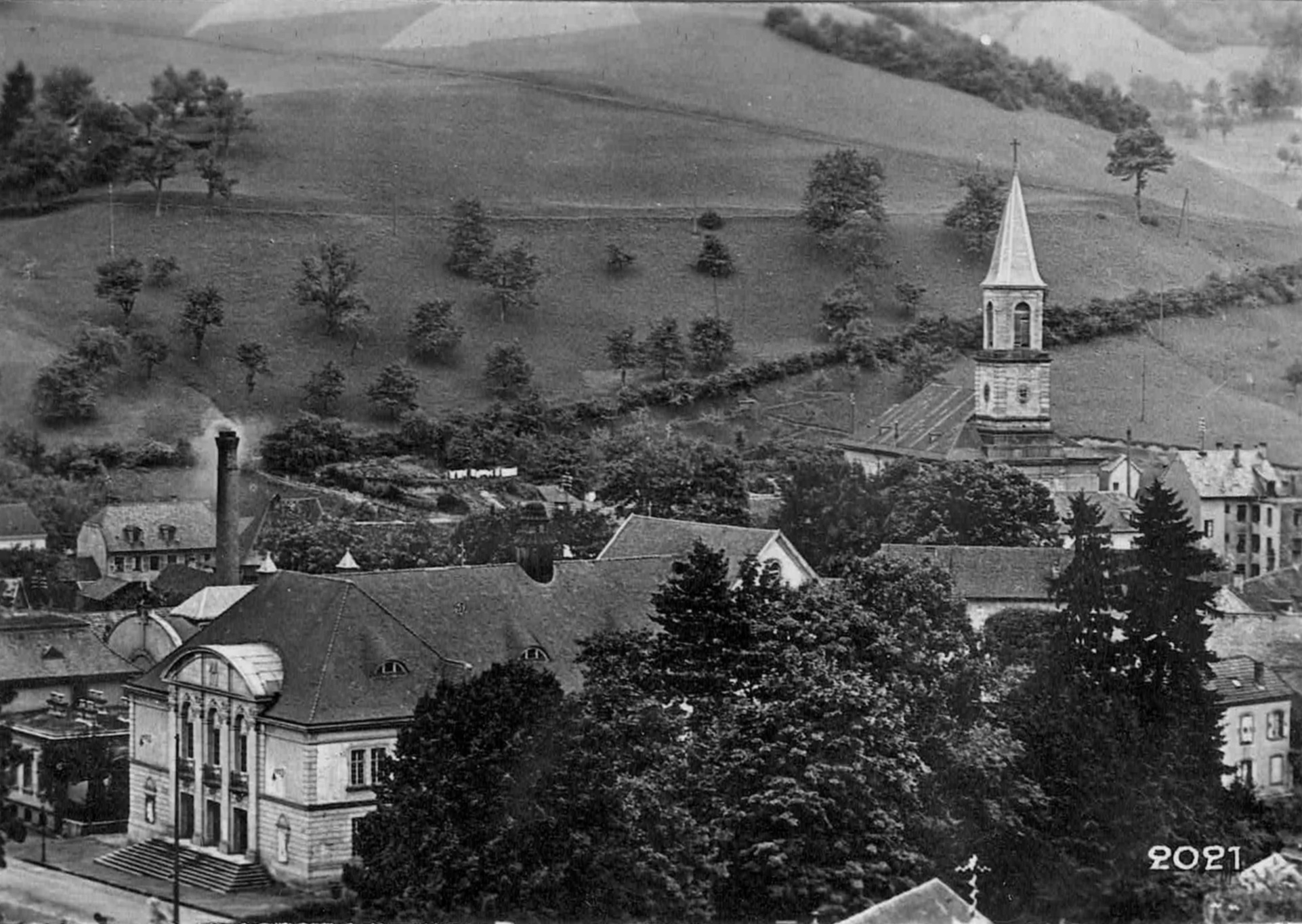
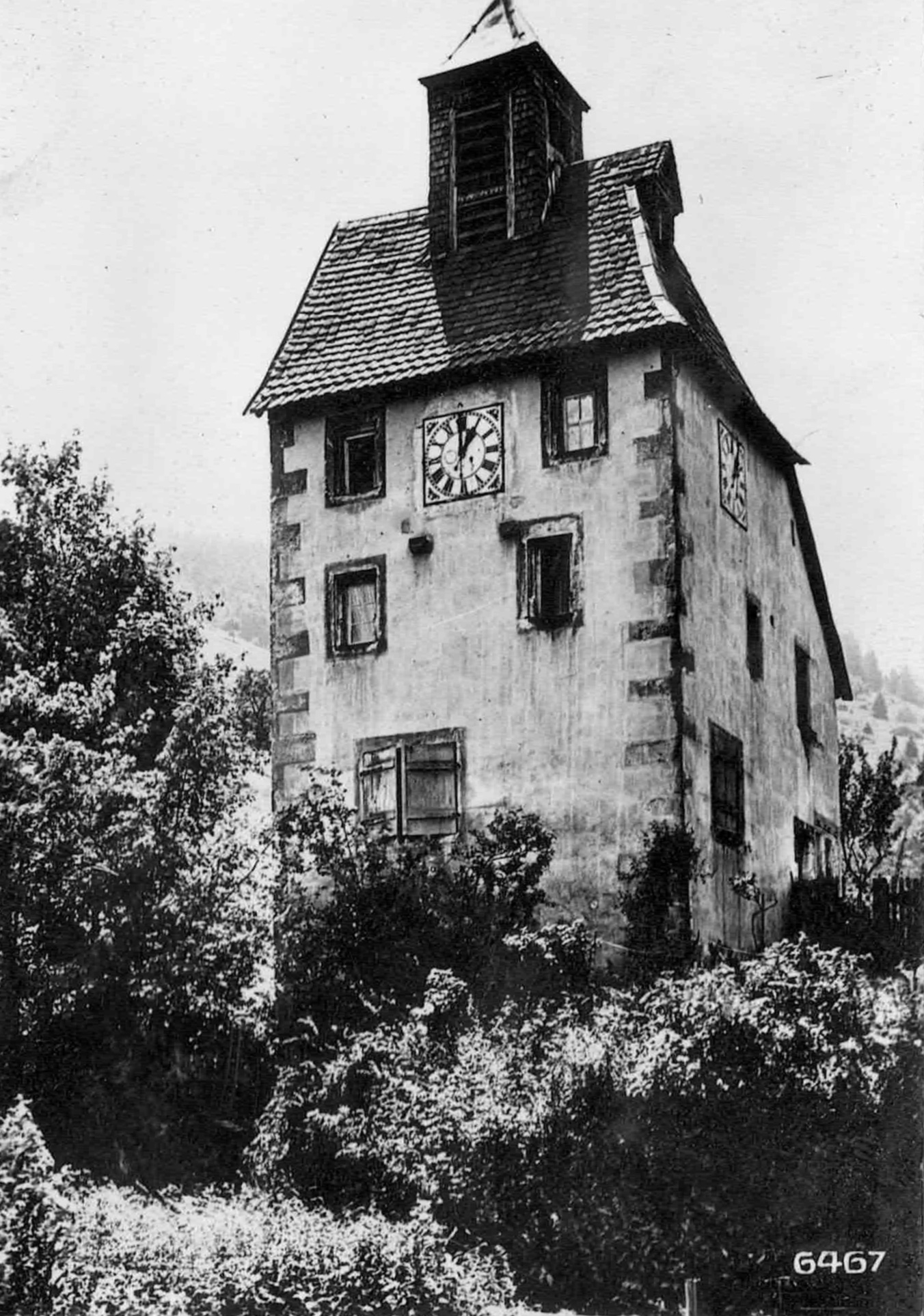
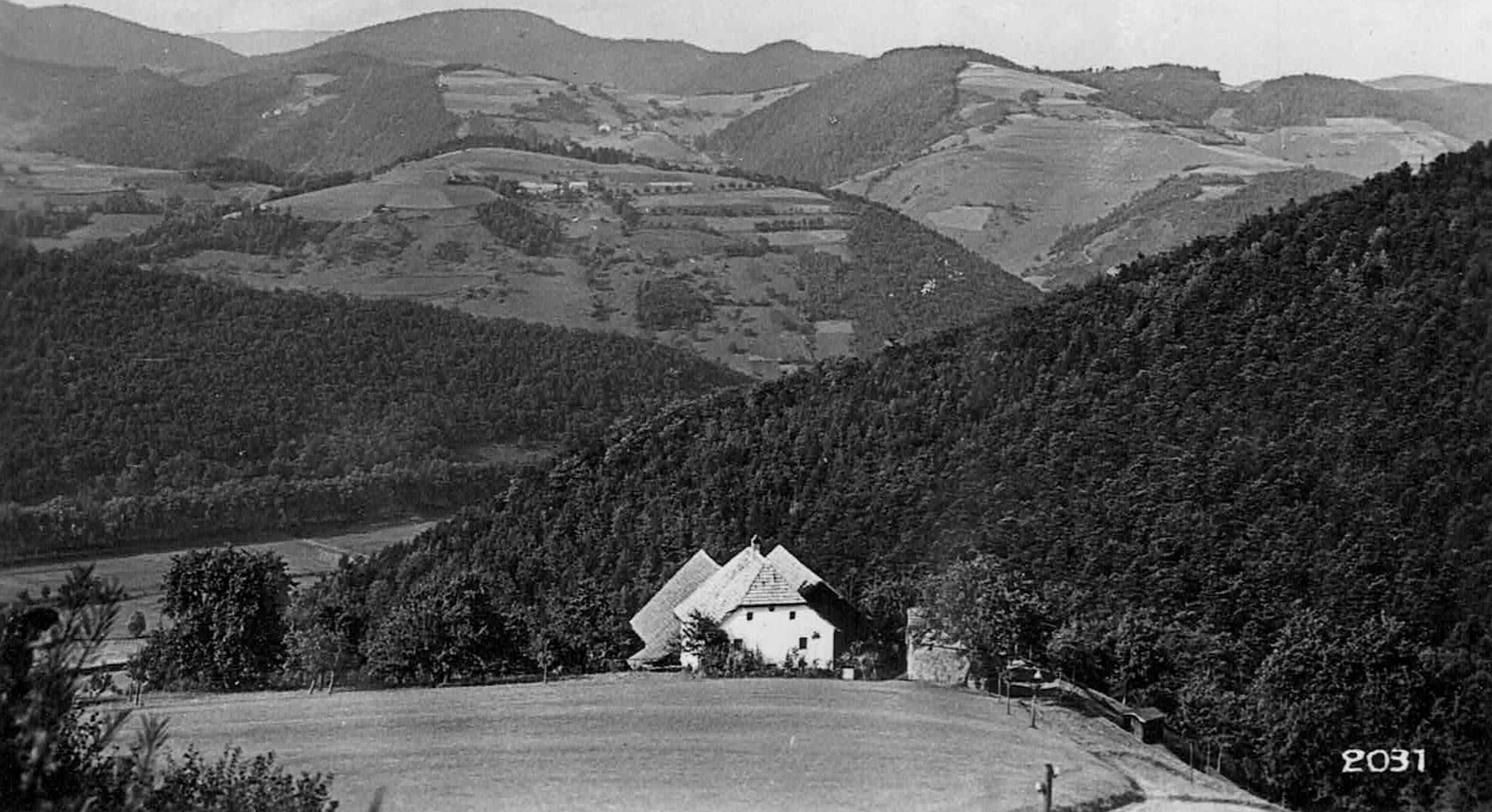
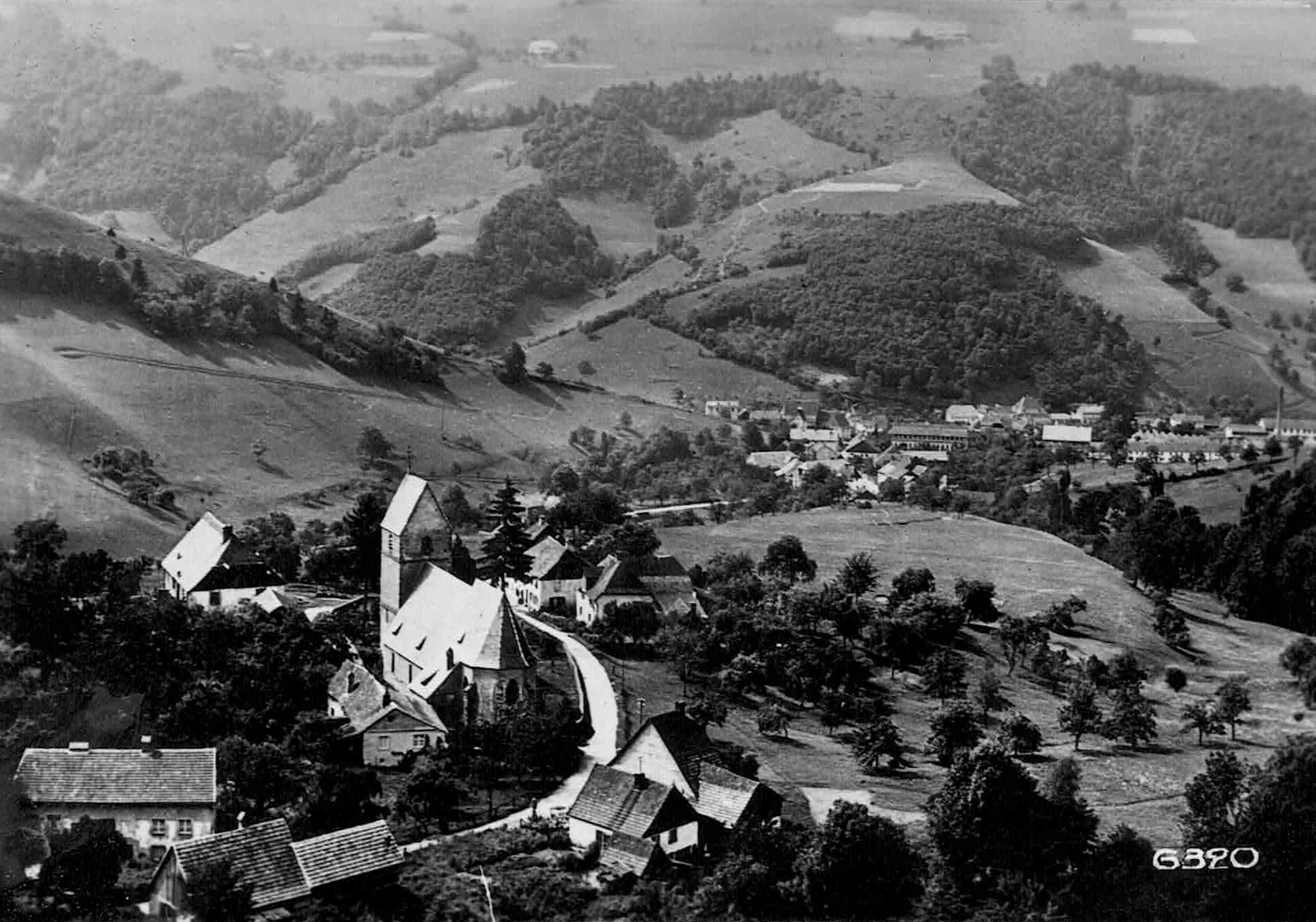
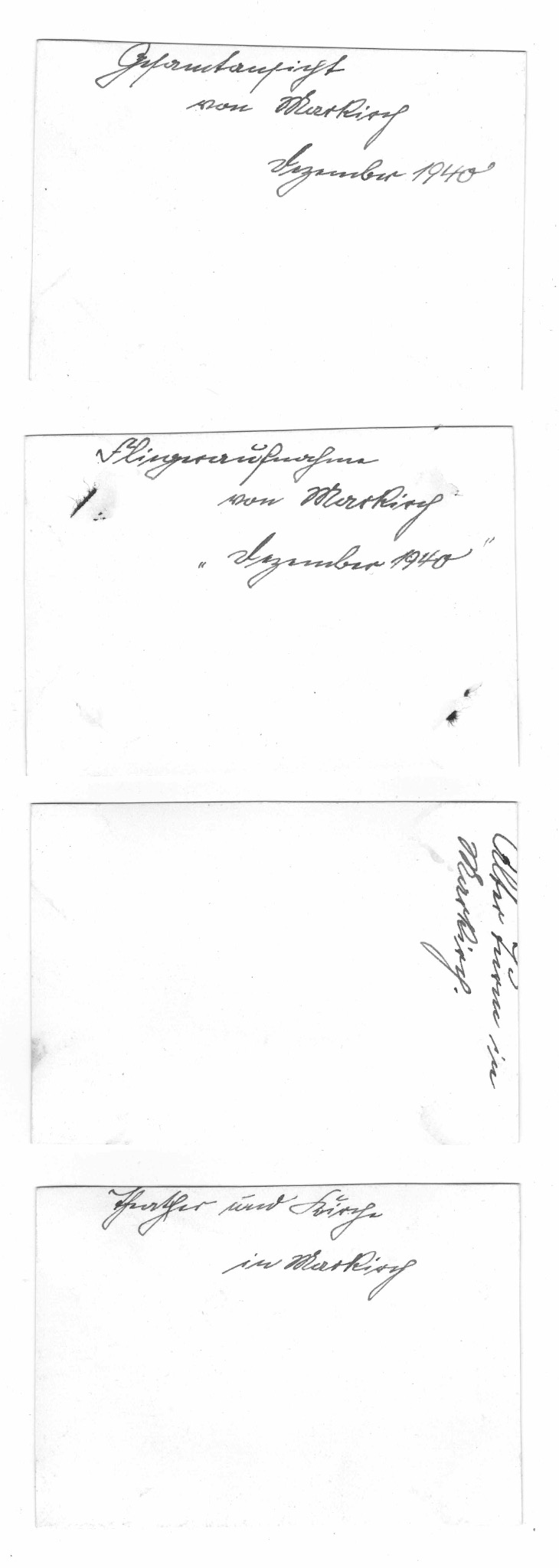
I assumed these landscape photos were pictures of the lovely French Alsace town of Sainte-Marie-Aux-Mines. That is until I turned them over and read, or tried to read, the captions. They describe Markkleeberg, a town in the Saxony region of Germany near Leipzig. It’s now described as a suburb of Leipzig.
According to AI, the captions on the back are in German, written in an old-fashioned cursive handwriting, and the captions read: “General view, War memorial, Old gatehouse, and Richter and Sons in Markkleeberg, December 1940”.
Professionally made photos with numbers in the right lower corner, they could be postcards. I can’t imagine who might have taken them, who wrote the captions, or why Flo put them on a page headlined Sainte-Marie-Aux-Mines. The Third Division had not yet crossed the Rhine into Germany, although Audie Murphy wrote that a number of Allied units had entered Germany by January, 1945.
The other three photos on this page are captioned Marie of Ville France; Lt. Reardon, me, Janet, Lt. Nelson. Fraize, France; and Sgt. Holbrook, St. Die France ad center.
Flo and crew attend officers party at Division Headquarters
My Mother and Audie Murphy Ch. 50
In January, 1945, the Third Division headquarters moved to the town of Sainte-Marie-Aux-Mines, known for its iron mines from the time of Roman occupation. This region of Alsace-Lorraine has been passed back and forth like a football between empires for centuries and is still characterized by a blend of German and French influences. After the 1870-71 Franco Prussian war, Alsace was annexed by Germany and became a part of the unified German Empire as a formal Reichsland, or imperial territory. After World War I the victorious Allies detached it from Germany and the province became part of the Third French Republic. Occupied and annexed by Germany during World War II, it was returned to France by the Allies at the end of the war.
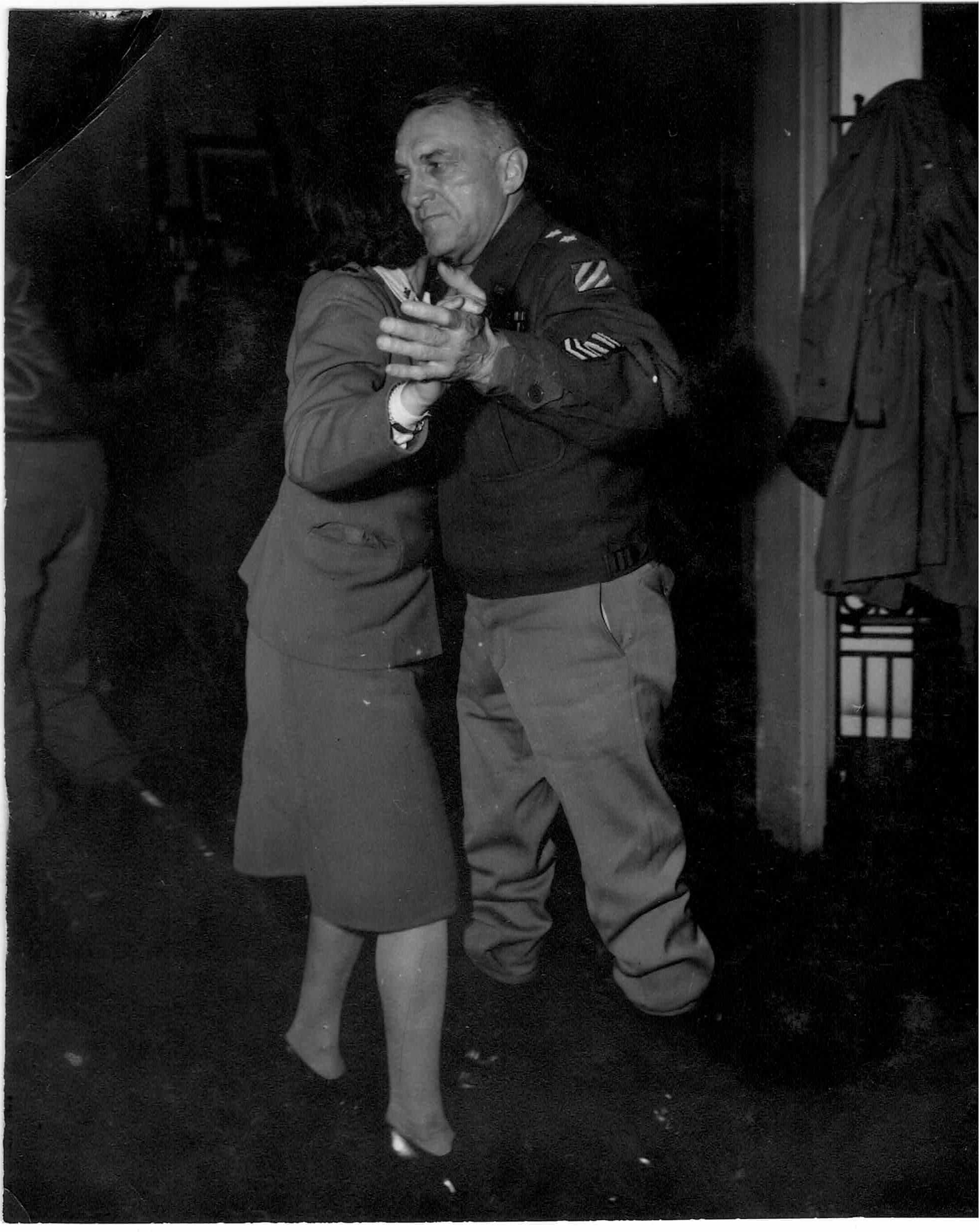
I don’t see Flo in these pictures, so perhaps she was the photographer. She wrote that she was using a captured German camera so she may have had it at this point. There’s Liz sitting next to Gen. Iron Mike O’Daniel, who is also pictured dancing with two different women I don’t recognize. The other clubmobilers must have been there but their backs are turned to us.
After weeks in the hospital with a gangrenous hip wound, Murphy returns to the lines in late January 1945—just in time for the brutal fighting around the Colmar Pocket during the coldest winter in fifty years. Snow lies two feet deep, and the cold cuts through even the thickest layers.
Attack plan. The 3rd Division is with the 7th Army under Gen. Patch
By the time he rejoins his unit, the Third Division has pushed through the Vosges, smashed the German winter line, and reached the Rhine at Strasbourg. Germany lies just beyond the river, close enough to see, but still weeks—and many casualties—away from any attempted crossing.
The entire front is restless. To the north, the Battle of the Bulge is sputtering out. American units are crossing into Germany, seeking firm ground for the spring offensive. Columns of men and supplies move constantly across frozen French and Belgian roads. But the men at the front think only of the task immediately ahead: eliminating the Colmar Pocket, a heavily fortified German position stretching toward the Swiss border.
A supply convoy makes it way over a snowy road toward Colmar. Photo dogface soldier
The pocket is a dangerous bridgehead jutting west of the Rhine, fed by steady reinforcements from across the river. It threatens the Allies’ right flank and could serve as a launch point for a massive German counterattack. The Third Division has already trimmed its northern edge and now stands near Guémar, ready to strike at the center.
The terrain favors the Germans. Icy winds sweep down from the Vosges. Forest patches, open fields, and fortified villages form their defense. Tanks hide in the woods, covering the plains the Americans must cross. Temperatures rarely climb above fourteen degrees. Snow reaches to the knees. Even without enemy fire, the nights are a battle simply to avoid freezing.
Soldiers in snow cloaks on the way to Colmar. Photo: dogface soldier
Two rivers, the Fecht and the Ill, lie between the division and the enemy. At night, the 7th and 30th Regiments slip across the Fecht after breaching German lines. The 7th pushes south to strike Ostheim; the 30th clears a forest and captures a small wooden bridge over the Ill. That fragile track becomes the hinge of the entire operation.
The 30th crosses it and prepares to attack two small villages, Holtzwihr and Riedwihr, separated by a stretch of woodland. At 4:30 in the afternoon, disaster strikes: ten German tanks and tank destroyers smash into the 3rd Battalion near Holtzwihr. The infantry have no protection. The frozen ground is too hard to dig into. The tanks break the battalion into pockets and rake them with machine-gun fire.
Training for warfare in the snow. Photo: dogface soldier collection
An hour later, the 1st Battalion is hit near Riedwihr and torn apart in the same way. Survivors retreat toward the Ill, some swimming through the icy water, emerging with their uniforms stiff with icicles.
Murphy’s regiment, held in reserve, is rushed forward. At 3 a.m., the 3rd Battalion attempts to establish a bridgehead across the Ill. It gains ground until a counterattack with four German tanks drives it back to the river.
A grave registration unit operates 10 miles north of Colmar. Photo: dogface soldier collection
It becomes clear that without tanks of their own, the infantry are battering themselves against a stone wall. Still, the attacks must continue—the Germans cannot be allowed to maneuver freely or shift their strength. If given the chance, they could destroy the Allied forces piecemeal.
Behind the lines, engineers work frantically to build a bridge across the Ill. Murphy and the men of his regiment fight simply to hold the enemy back long enough for that bridge to be completed.
Strasbourg, France was liberated by the French 2nd Armored Division supported by the U.S. 7th Army on November 23, 1944, during the Alsace campaign, ending the city’s occupation by the Nazis.
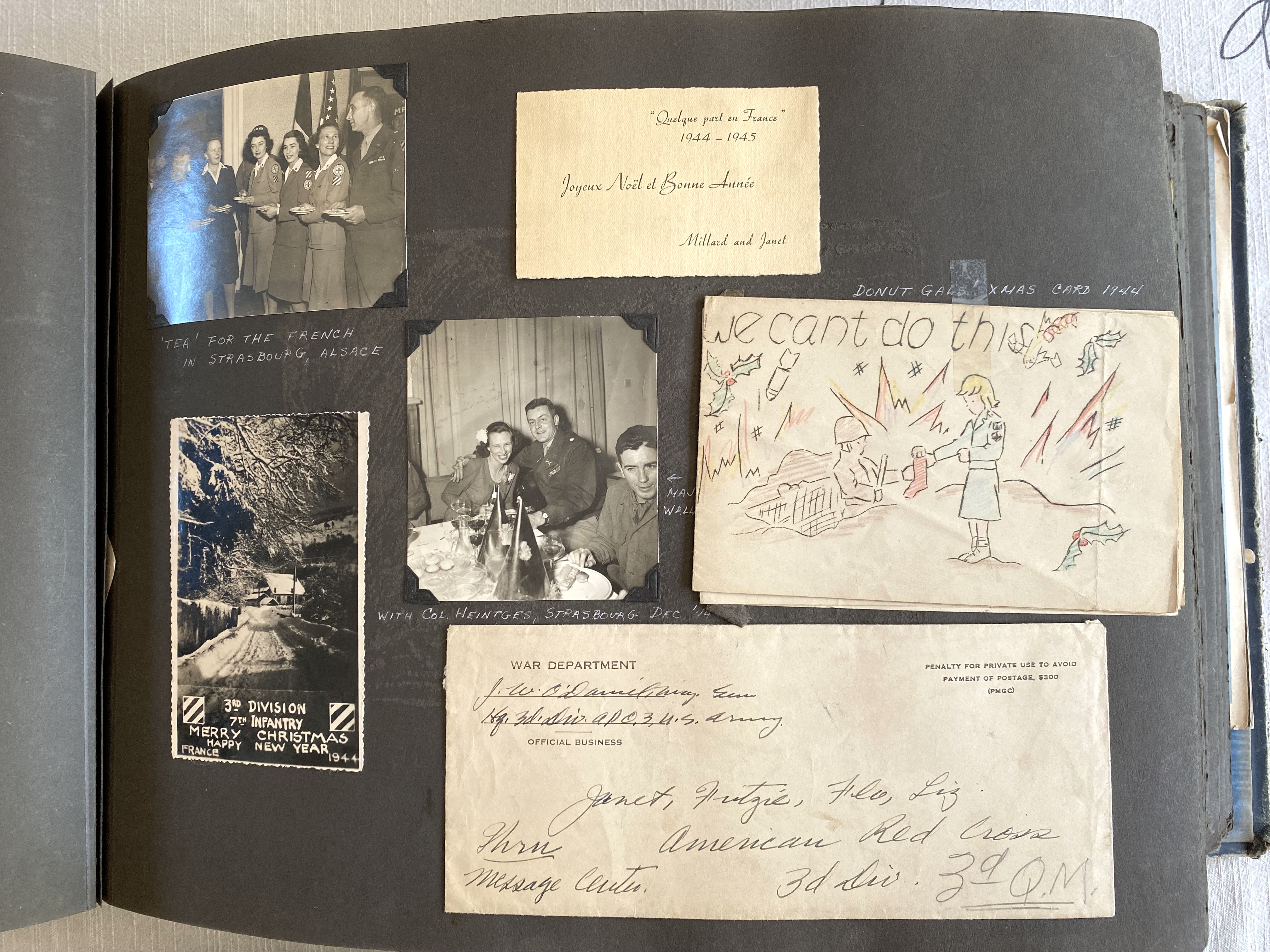
Flo devoted a page in her album to a party and a “tea for the French” in Strasbourg. There was a little time for celebrating before all had to return to the continuing war.
The page from Flo’s album
On the back of a rare picture of the whole clubmobile crew, Flo indentified the ARC clubmobilers and the generals on either side. I could see that she spelled Fritzie’s last name Haugland, so that is likely correct. In the picture are Fritzie, Janet, Liz and Flo with Gen. Schwartz, commander of the 10th French military district and acting commanding Gen. Robert Young.
Gen. Schwartz, Fritzie, Janet, Liz and Flo and Gen. Robert Young at a tea for the French
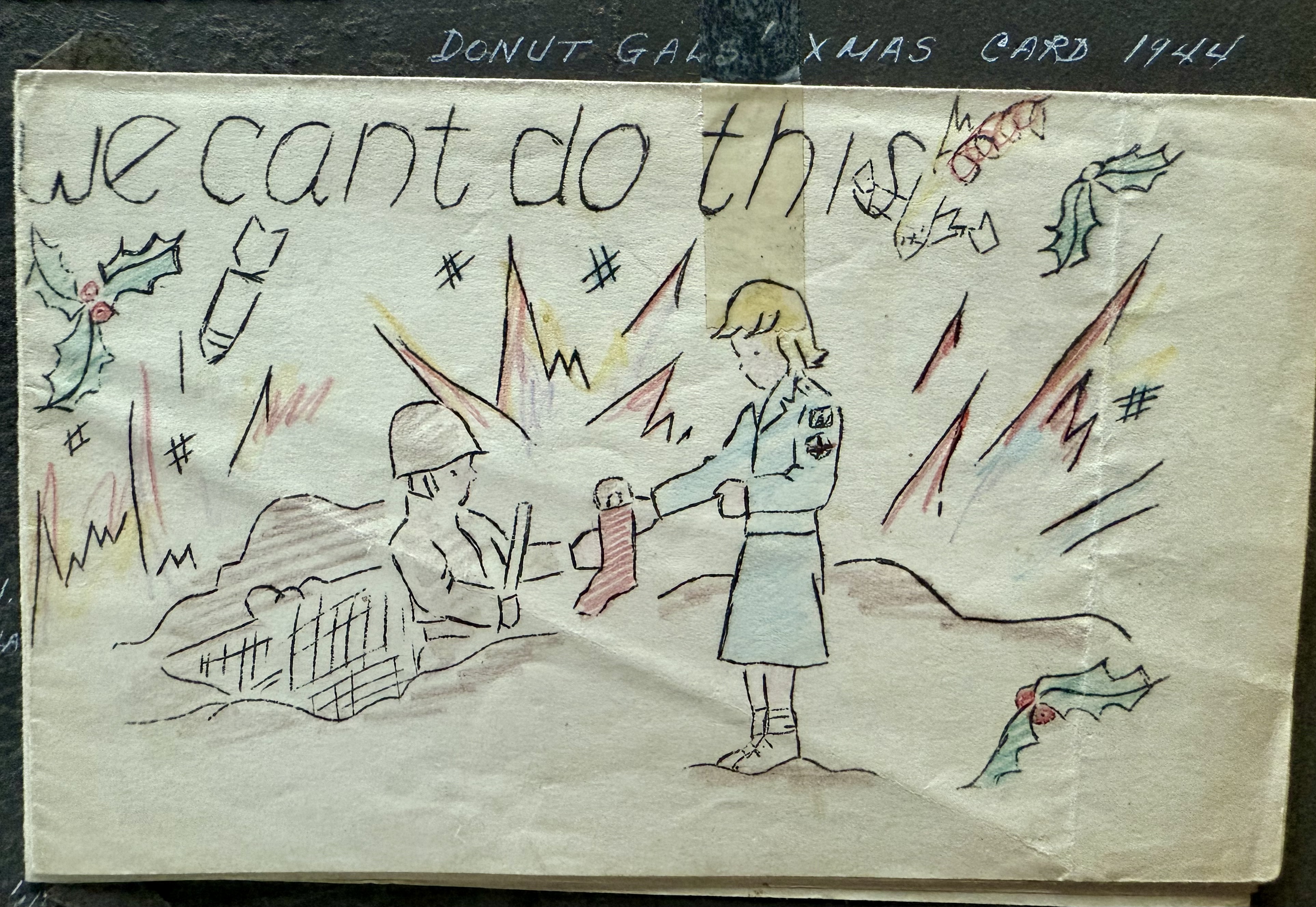
The ARC clubmobilers 1944 Xmas card, made by Liz, is pasted on this page. Cleverly folded, its message reads: We can’t do this (hand out Xmas stockings to boys in foxholes as bombs blast) nor this (offer permanent passes to the USA) but we do wish you a Merry Christmas and Happy New Year. Janet – Fritzie – Flo – Liz ARC.
ARC Xmas card made by Liz
The envelope contains a hand-written thank you letter from Gen. Iron Mike O’Daniel.
There’s also a picture of what looks like a nice party with wine and canapes. Are those pointed hats on the table? This might be a New Years party. Flo captioned it Strasbourg Dec. ’44. Her date for this evening was Lt. Col. John Heintges, who was romancing her just then.
Flo partying with Lt. Col. Heintger. On the right is Major Wallace. But who is in back with a hand is on Heintger’s. Does he have a war boyfriend?
Flo saved two letters from him, written in December 1944, that show he definitely had a thing for her. And it seems like the thing was mutual, at least for a while, as she was writing to him too.
He wrote: “Anyone who writes as beautiful, sentimental and sensible as you is truly a lovely person. I enjoyed your little card very much and I must admit Flossie that more than once since I last saw you have I thought of you.”
In the next letter he addressed a bit of rivalry.
“Hello Flossie! I understand you did me dirt n’est ce-pas? I thought we were going to Paris together. I guess why not after the rough treatment I imposed on you.”
I can’t imagine what this means but it might be the reason Flo decided to move on.
He continued, “The fact that Chris Chaney went at the same time sort of makes me a little envious but then he’s not your type anyway—or am I wrong. No Flo I am not really jealous because in the first place I have no right to be and in the second I know where your duty lies.…. I guess I am not the number one man I thought I was.
His first letter is signed, “Sincerely, John”. The second ends with “Be good my little angel”.
The officers were fighting over her and that must have felt good. He is right that she chose Chris Chaney, although Chaney wasn’t able to get leave to join Flo in Paris. It seems like Flo went to Paris as often as she could.
By April, Lt. Col. Chaney was addressing Flo as darling:
1 April 45
Hello, Flo, darling,
I am sitting here peacefully in a beautiful CP drinking some captured German cognac, and thinking how nice it would be if you were to walk in, to serve donuts, of course. Oh well, can’t have everything I guess.
Really enjoyed your letter from Paris and wherever you were when you finished it. Wish I could have been there with you, and we really would have seen the town. I think your idea of seeing England is swell, together I mean.
I saw my close friend, Col. Heintgas, the other day, after I had taken one of his towns for him for which he thanked me, anyway, and asked him if he was getting any letters from my girl, and he said “Yes, lots,” So he gave me a drink of good whiskey!
Lots of love, CW Chaney
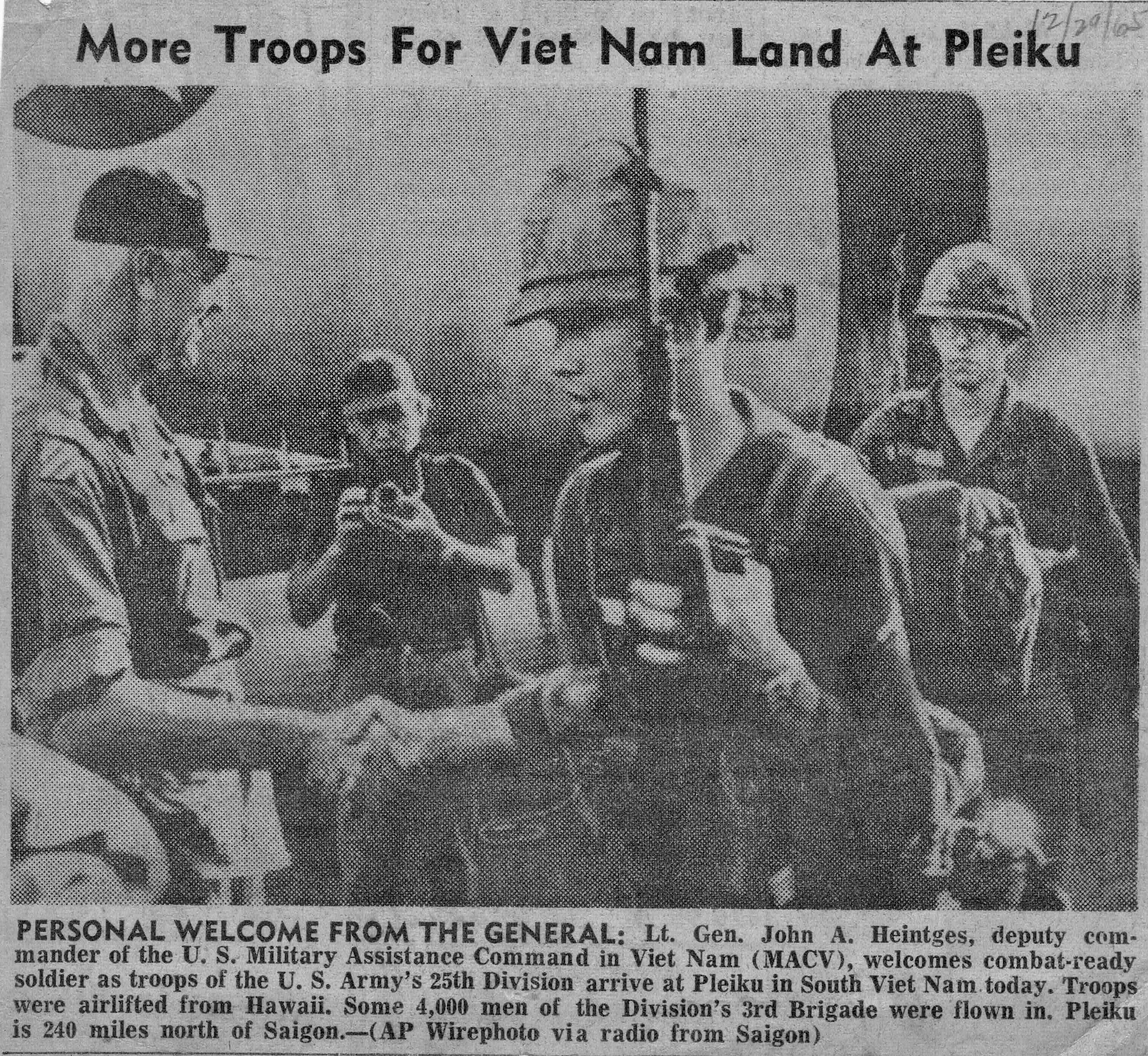
Tucked in the back of Flo’s album along with a lot of post-war ephemera was a newspaper clipping from 1965—a picture of Heintger, now a general, welcoming troops arriving at Pleiku, South Vietnam.
There’s no way to know why she broke up with Heintges (I found different spellings of his name, but this is from his Wikipedia page. Chaney mocked him with the spelling Heintgas), but perhaps the life of an army wife just didn’t appeal to Flo.
“Total damage: one volkswagon and 1500 donuts,” so read unit B’s report of accident. Back of the simple statement, however, was more than meets the eye.
Sent to serve an artillery unit of the infantry division to which they are attached, Florence Wick and Janet Potts took off for the assignment in their captured German jeep or volkswagon.
Liz and Flo with the captured VW jeep. Later it became The Thing
Down the road they went, bounding happily along in the mud. The car ran smoothly while the girls served their coffee and then things began to happen.
“After covering part of the battalion,” Miss Wick reports, “our car caught on fire from a short in the wiring system, and a few minutes after we had gone out the only door in front that worked, the gas tank exploded and threw gasoline across the highway and held up traffic for several minutes.”
Nothing daunted, the girls thumbed a ride back to their donut shop, a little shaky, then started out again with more donuts and covered the balance of their day’s assignment.
After the war, Flo still drove Volkswagens
Flo developed a hatred for Germans; they killed her fiancé and many of her friends. But she wasn’t one of those war survivors who refused to drive German-made cars after the war. She hated krauts, but she loved their cars.
At the start of their service the clubmobilers were told they would be issued a 2 ½ ton truck retrofitted with a kitchen and equipment for making coffee and donuts. But they travelled through Italy and France before they finally got their truck in Germany. Until then the women had to scrounge vehicles in which to carry their donuts to the troops. They used any vehicle they could get their hands on; for a while it was a recommissioned ambulance. Later they used a captured German Volkswagen. It seems this was not the vehicle that blew up. Flo notes that they left the Volks behind when they crossed the Rhine into Germany.
Flo sent the photo to Wagen Wheels, the Volkswagen magazine, in 1973. She wrote to them:
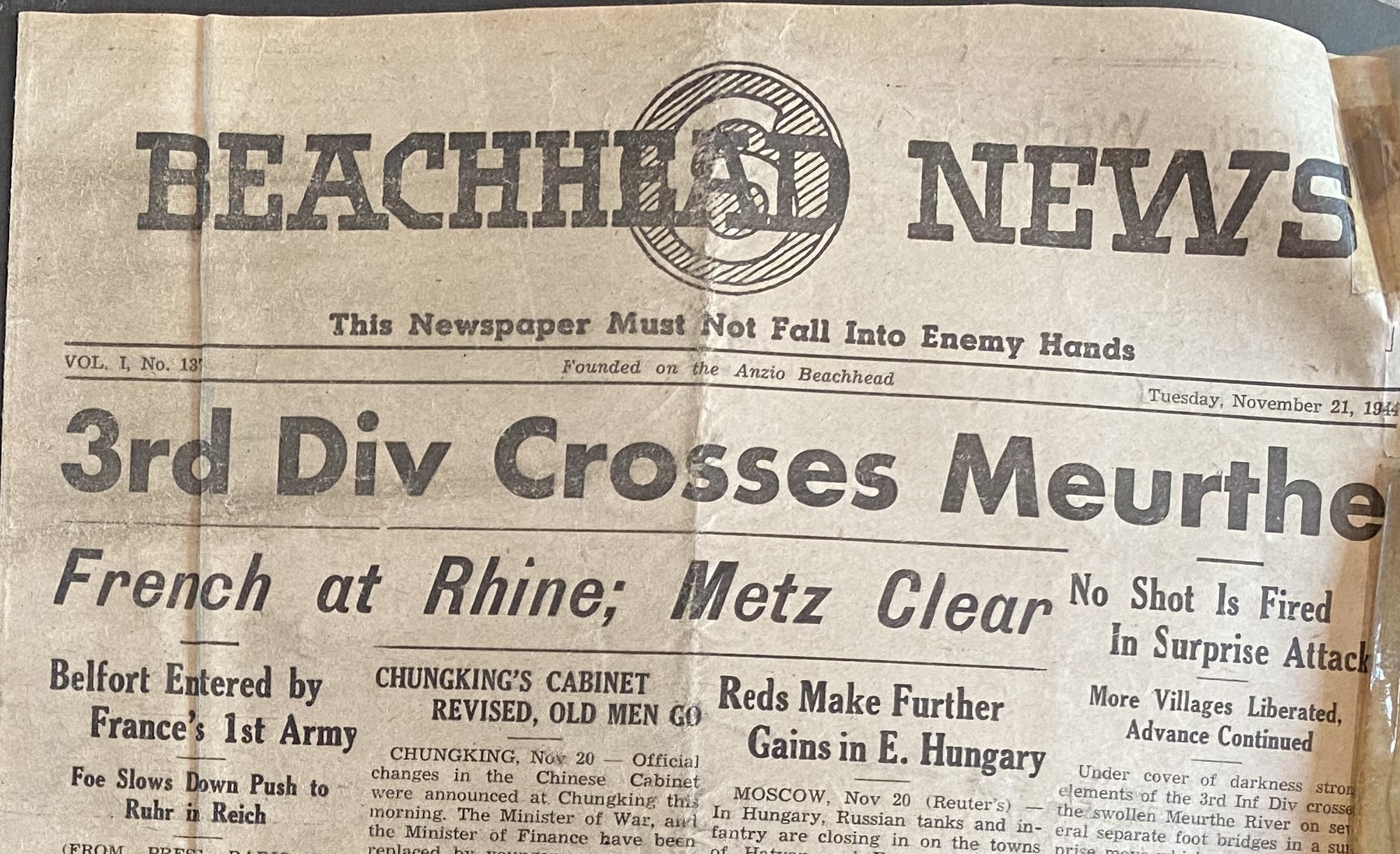
“Leaning on their ‘donut delivery wagon’ are Liz Elliott of Manhattan, New York, and Flo Wick of Yakima, Washington, donut gals with the American Red Cross in World War II. They were attached to the famed Third Infantry Division which left from home base at Fort Lewis, Washington in 1942 for North Africa, thence to Sicily, Anzio, Rome, France and Germany, ending the war in Salzburg, Austria in 1945 and with more Congressional Medals of Honor than any other unit in World War II (a majority posthumous). Most famous Congressional Medal holder, Audie Murphy, later made his movie, “To Hell and Back” in the Yakima area.
“Their vehicle is an original People’s car (Volkswagen) which the German people bought, contributed to the Fatherland for the war with the promise that after the war (and victory, of course), their car would be returned to them.
“Fortunately, the American and British armies were able to spoil their plans and when this particular VW “German jeep” was captured in France in 1944 it was presented to the 3rd Division’s four Red Cross girls who converted it into a donut wagon in which they delivered Red Cross donuts to units of the combat division in all the best mountains and fields of France. Later, after crossing the Rhine into Germany and leaving the Volks behind, they had a more military vehicle in which to deliver donuts—a 2 ½ ton clubmobile truck.
“Flo Wick, Red Cross Clubmobile Captain, from Yakima, Washington is now Mrs. Carroll Martin of that city—mother of a daughter and three sons—daughter and eldest son college students. She is the happy owner of a VW Squareback in which she commutes from her home in Yakima’s West Valley to her office in Selah, some 15 miles, every day. There are two other VWs in the Martin family—one, another Squareback, used by the 19-year-old son, and the other, a red Beetle, operated by the youngest son, a junior in high school. None of these, however, can match the ugly little original for stamina and glamor. After all, not many VWs have “fought” on both sides of World War II!”
In 1944, while in France, the Third Division “liberated” one of the Wermacht’s famous Kubelwagens. A second incarnation was called The Thing.
Flo’s story was published in the 1973 Wagen Wheels magazine.
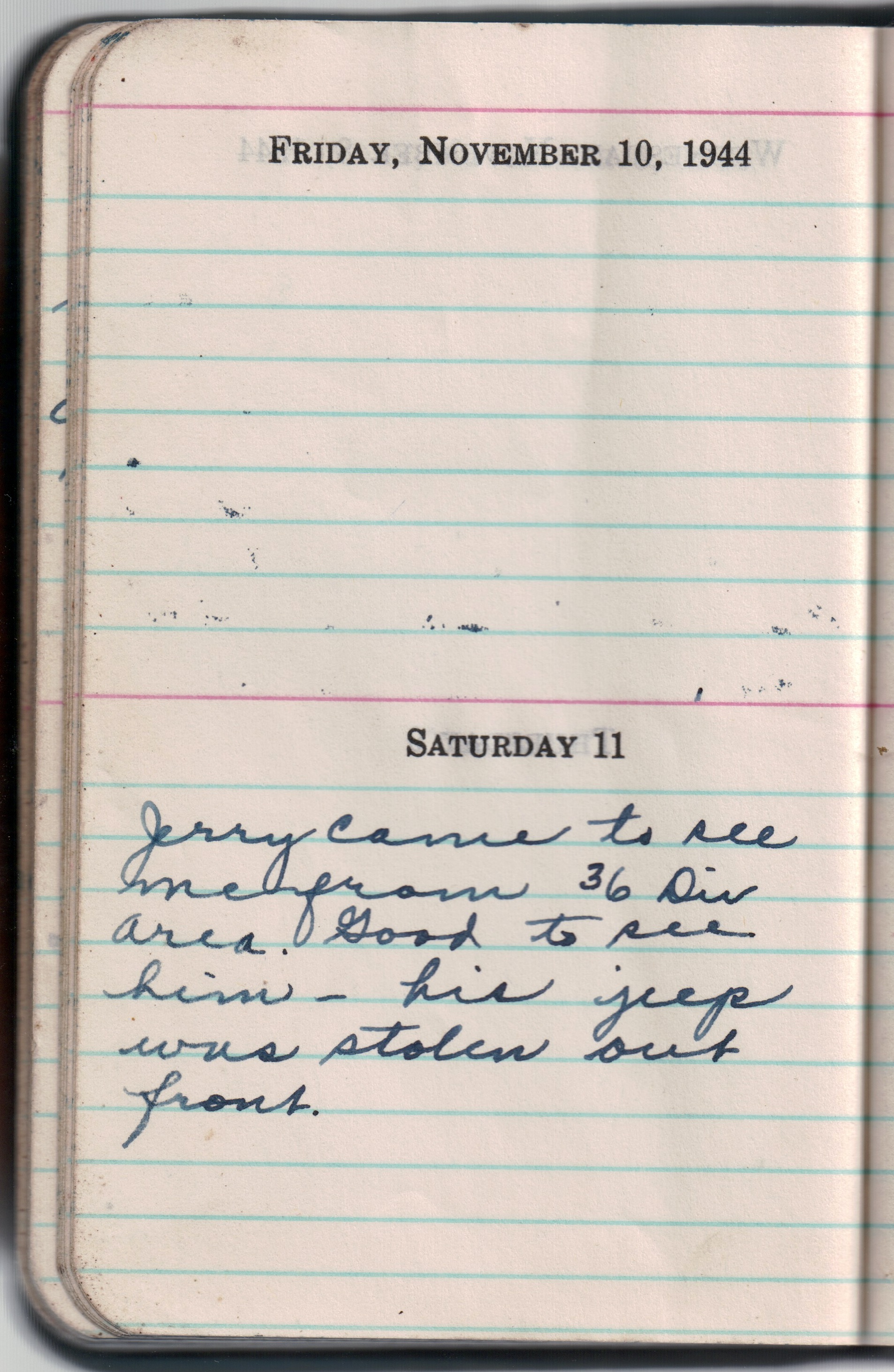
Flo had written her mother after Gene’s death that she planned to go to Paris to visit her sister Eve who worked as an Army nurse in a hospital there. She may have done so but there is no record of it in her diary or album. Her final three diary entries note that she attended a dance in Epinal on Nov. 1. Then she visited with boys from Gene’s company Nov. 11 and 12. If she traveled to Paris in the meantime, it can’t have been a happy trip, but she would have been glad for comfort from Eve and her ARC friend Janet Tyson, who traveled with her.
The last three entries in Flo’s diary
November 1944 in the Vosges mountains was cold and rainy, presaging a bad winter. In a letter to her mother published in her hometown paper, Flo celebrated the dogface soldiers and chastised Americans and the media in the States for thinking the war was near its end.
Florence Wick Writes
Miss Florence Wick, who is with the American Red Cross in France, writes to her mother:
“Things have slowed down considerably now though, and the boys are having a tough fight. The weather is cold here, and winter looks discouraging in that respect. It rains a lot, which makes it miserable, but we get used to it, and to wading in mud. Every once in a while the sun will come out, and that’s wonderful.
We are up quite far and are serving doughnuts every day, and keeping very busy. It is hard to see these boys come out of the lines dirty, cold, tired and old, but we do have a chance to spread a little cheer before they have to go back again. God bless the ‘dog faces’. They are winning this war mile by mile, and dying too. There is none like them. They are so sick of it all, but they are good soldiers, and everyone at home should appreciate what they are doing and pray for them all daily. They have a very hard fight ahead of them, and in winter, that’s tough.
People at home shouldn’t take the papers too literally–the war is definitely not over yet, and they had better carry on as they have been doing and not relax any effort. I wish they could see their own boys for just one day during combat, or eat the C ration these kids eat, and they wouldn’t talk of an early end to the war.”
Liz Elliott’s drawing illustrates a typical challenge for the clubmobile workers
Even as soldiers were dying all around them, the death of Flo’s fiancé, Gene, on October 28, 1944, came as a horrific shock. In a letter to her mother, Flo wished she could just go home. But she wasn’t a quitter, and she even stayed in Europe through the post-war occupation, returning to the U.S. in March, 1946, nearly a year after the war’s end.
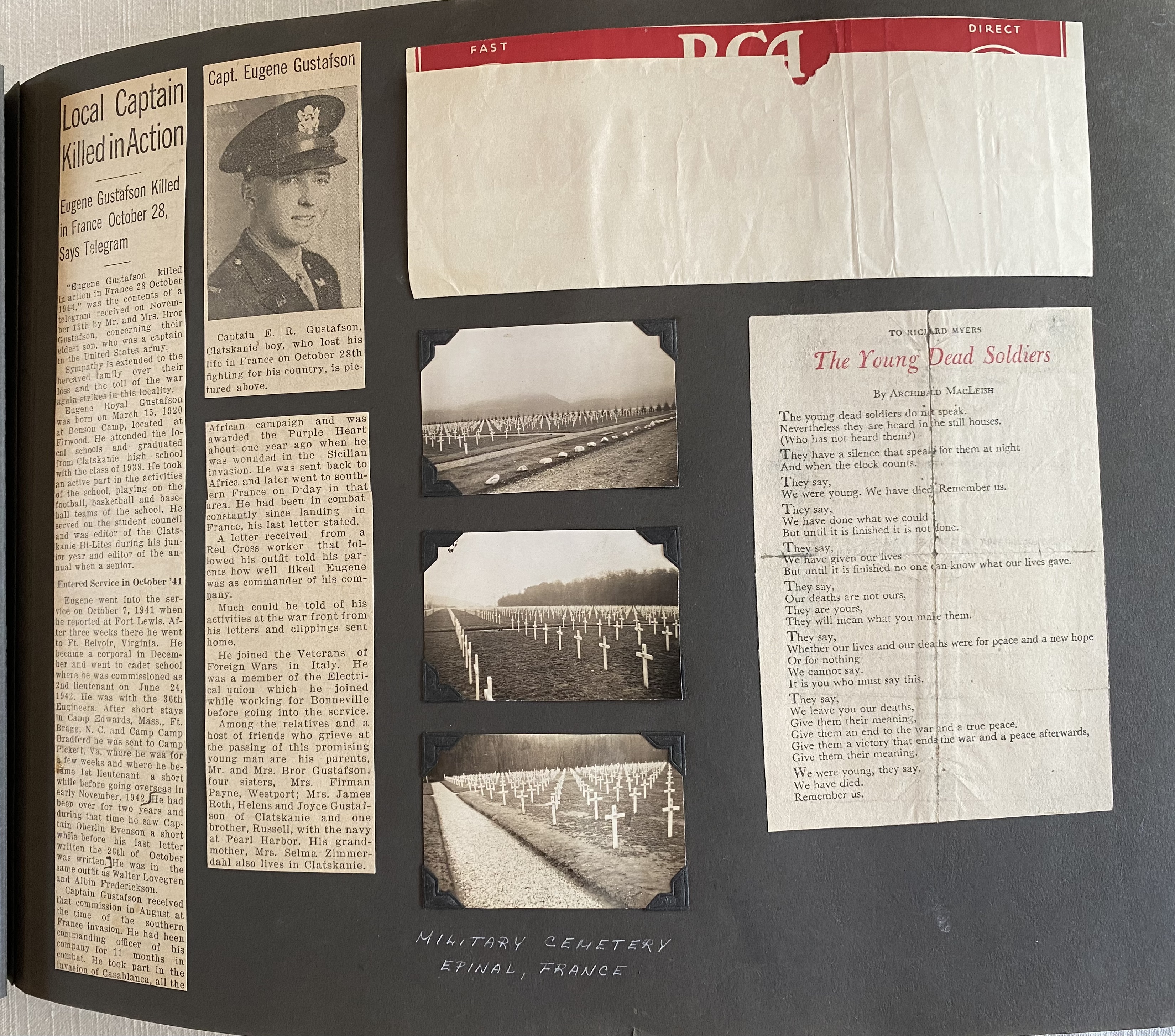
Back home, making her album, she devoted a page to Gene with the obituary from his hometown newspaper, and the poem by Archibald MacLeish, The Young Dead Soldiers. He was buried in a military cemetery in Epinal, France.
A page in Flo’s album
Reading Gene’s obituary gave me a fuller picture of the man. I learned some things:
He was born in a “camp” in Oregon in 1920—probably a lumber camp.
He had one brother serving in the Navy and four sisters back home. He was a jock, sure—but also the editor of his high school newspaper in Clatskanie, Oregon.
Before the Army, Gene had been a union electrician with the Bonneville Power Administration–a working class guy.
His military training was intense—taking him from Washington to Virginia, then on to Massachusetts, North Carolina, and back to Virginia again. He enlisted in October 1941 and was sent overseas in November 1942. A year of preparation for a war he would not return from.
I learned he was wounded during the Sicilian invasion and awarded a Purple Heart, and that official news of his death didn’t reach his family until two weeks later.
Learning these things made Gene feel more real to me—not just as a name in someone else’s story, or a loss recorded in a diary, but as a whole person with a life that mattered. I wish I could’ve met him. In some small way, reading his obituary felt like I did.
Gene’s obituary published in his hometown paper
Local Captain Killed in Action
Eugene Gustafson Killed in France October 28, Says Telegram
“Eugene Gustafson killed in action in France 28 October 1944,” was the contents of a telegram received on November 13th by Mr. and Mrs. Broer Gustafson, concerning their eldest son, who was a captain in the United States army.
Sympathy was extended to the bereaved family over their loss and the toll of the war again strikes in this locality.
Eugene Royal Gustafson was born on March 15, 1920 at Benson Camp located at Firwood. He attended the local schools and graduated from Clatskanie high school with the class of 1938. He took an active part in the activities of the school, playing on the football, basketball and baseball teams of the school. He served on the student council and was editor of the Clatskanie Hi-Lites during his junior year and editor of the annual when a senior.
Entered service in October ‘41
Eugene went into the service on October 7th, 1941 when he reported at Fort Lewis (WA). After three weeks there he went to Fort Belvoir VA. He became a corporal in December and went to cadet school where he was commissioned as 2ndlieutenant on June 24th 1942. He was with the 36th Engineers. After short stays in camp Edwards MA, Fort Bragg NC and Camp Bradford, he was sent to Camp Pickett VA where he was for a few weeks and where he became 1st lieutenant a short while before going overseas in early November 1942. He had been over for two years….
Captain Gustafson received that commission in August at the time of the southern France invasion. He had been commanding officer of his company for 11 months in combat. He took part in the invasion of Casablanca, all the African campaign and was awarded the Purple Heart about one year ago when he was wounded in the Sicilian invasion. He was sent back to Africa and later went to southern France on D-Day in that area. He had been in combat constantly since landing in France, his letter stated.
A letter received from a Red Cross worker that followed his outfit told his parents how well liked Eugene was as commander of his company.
Much could be told of his activities at the war front from his letters and clippings sent home.
He joined the Veterans of Foreign Wars in Italy. He was a member of the electrical union which he joined while working for Bonneville before going into the service.
Among the relatives and a host of friends who grieve at the passing of his promising young man are his parents, four sisters, and one brother, Russell with the Navy at Pearl Harbor. His grandmother, Mrs. Selma Zimmerdahl also lives in Clatskanie.
Of course the “Red Cross worker that followed his outfit” referenced in the obit must have been Flo. I wonder how she felt about being described that way.
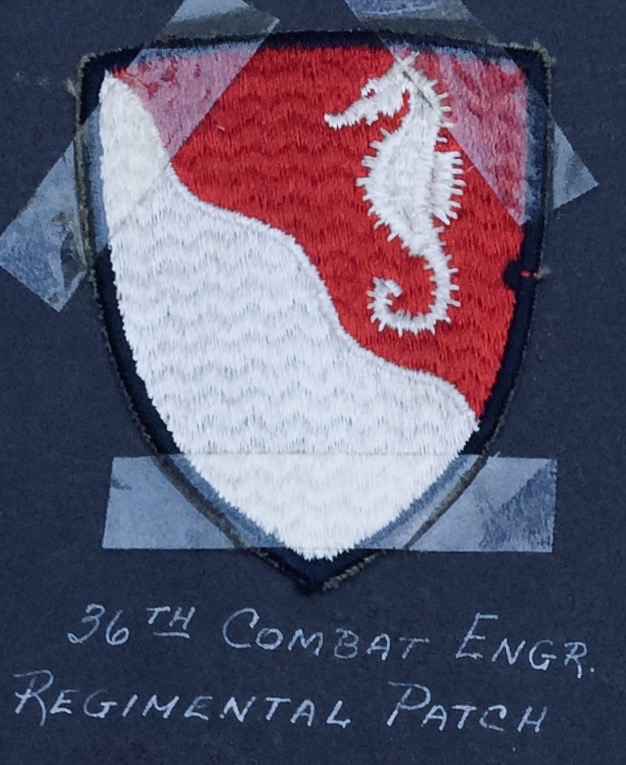
Gene’s regimental patch. The seahorse is a nod to their training in amphibious assault and support operations. The red and white colors of the shield represent the Corps of Engineer regimental colors.



















 tradeswomn musings