Paris—cultural capital of the world—was a dream destination, even in wartime. Everyone in Flo’s Red Cross crew wanted to see it. They’d heard about the food, the fashion, the grandeur. Who wouldn’t want a taste of it, especially after months of mud, cold, and war?
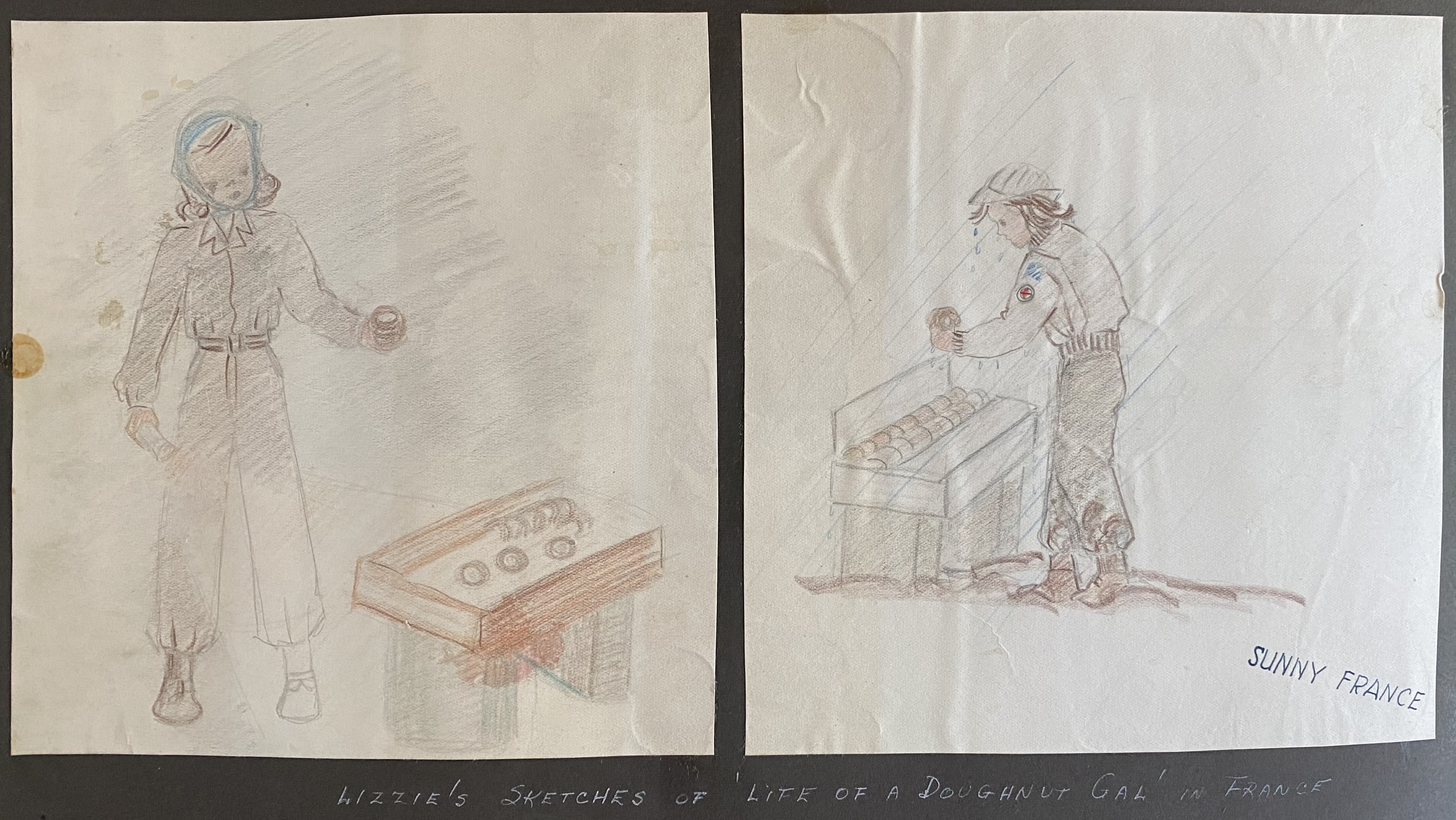
Liz Elliott’s drawing
In October 1944, Flo and her crew made the trip. It’s unclear why they chose to go just then—or why they stayed only two days—but they made the harrowing drive from the Vosges. Though the route avoided the front lines, it was still far from safe.
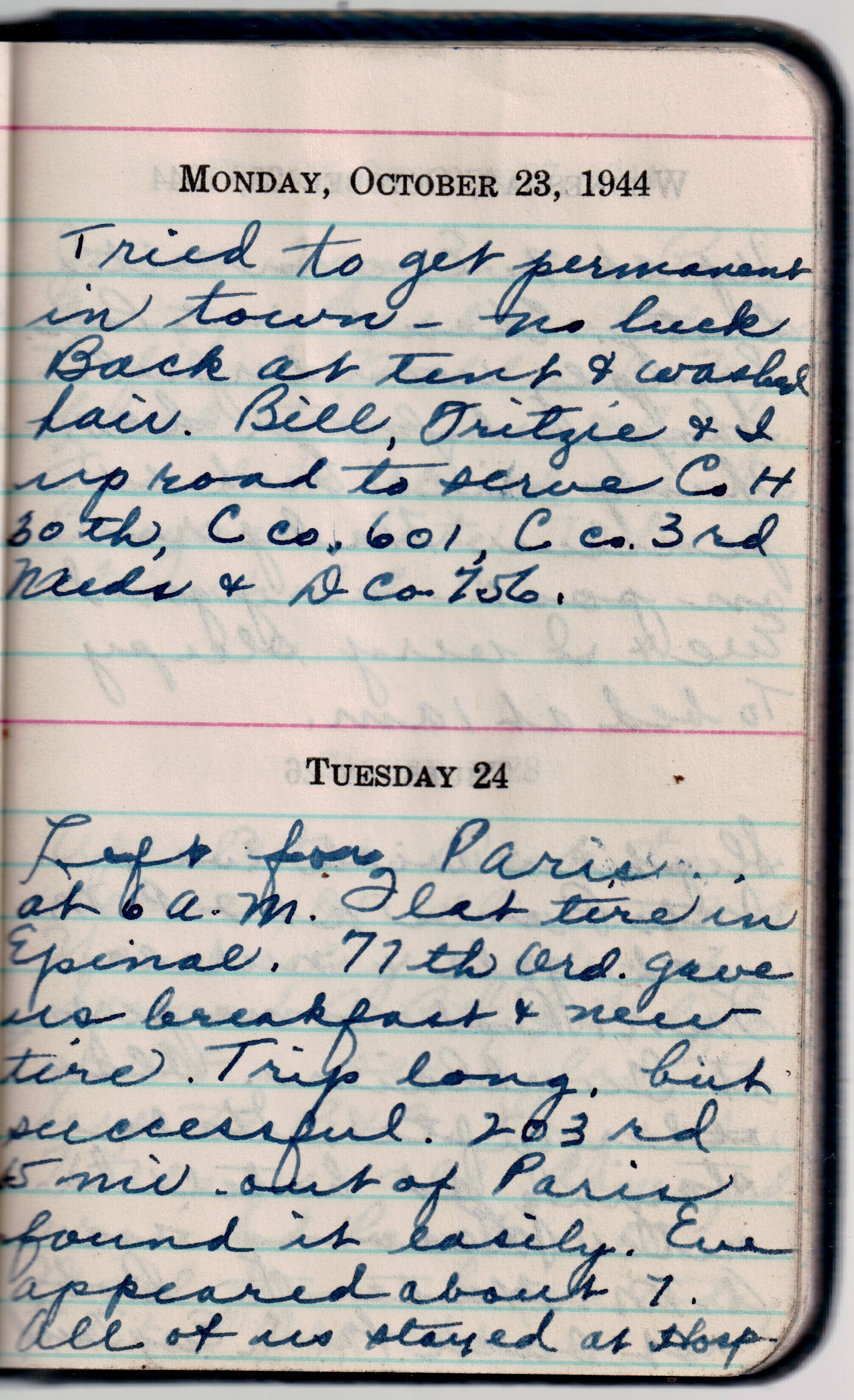
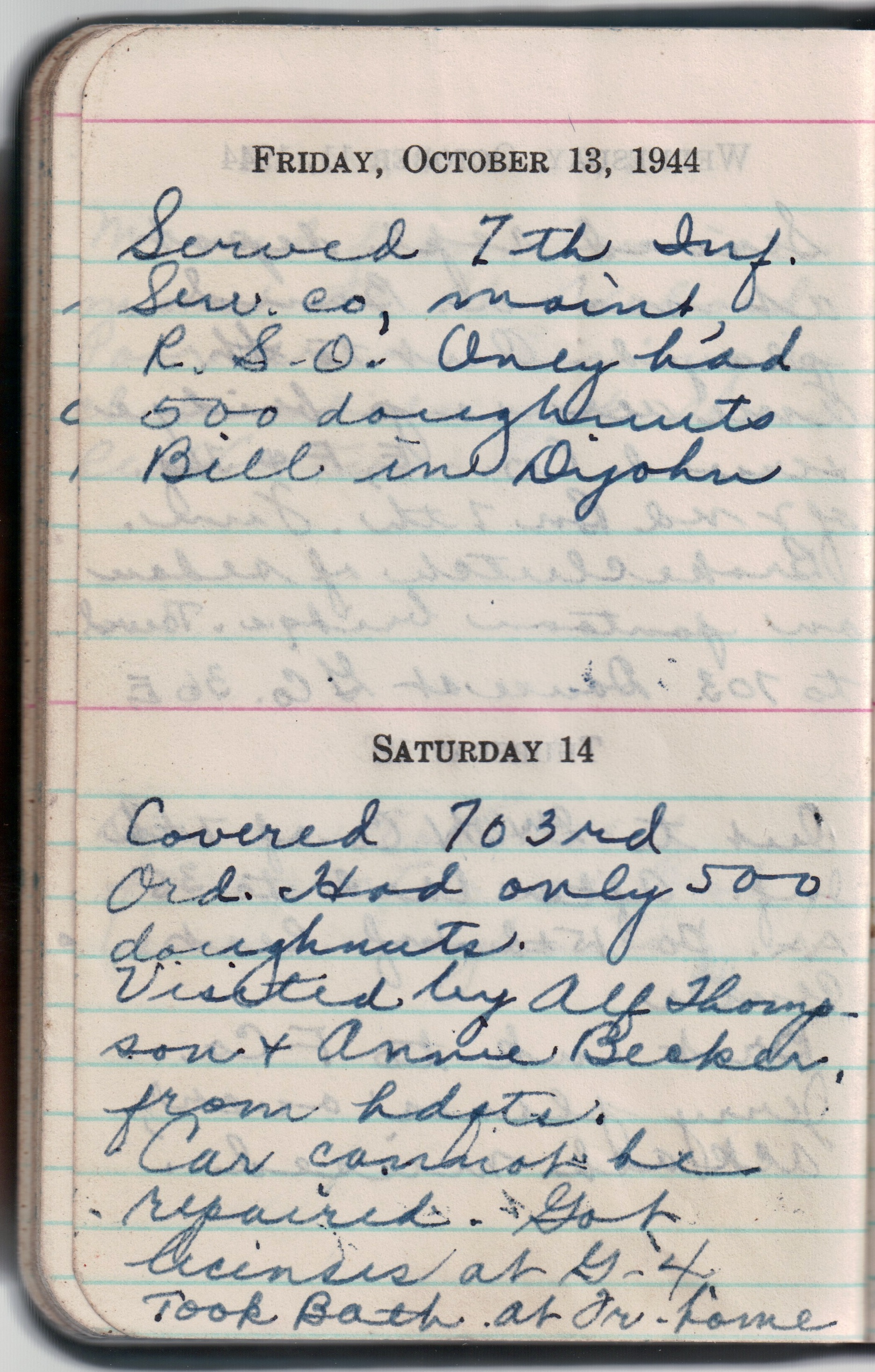
According to Flo’s diary, they left at 6 a.m. and got a flat tire in Épinal. Luckily, the 77th Ordnance gave them a new tire—and breakfast. “Trip long, but successful,” she wrote. Successful how? I can’t help but wonder if this was the trip my cousin later referred to—when Flo supposedly went to Paris for an abortion.
The group’s main stop was the 203rd Army Hospital, about 15 miles outside the city, where Flo’s sister Eve was working as a nurse. Flo noted that they found the hospital easily and spent the night there. Eve, on night duty, didn’t appear until around 7 p.m.
Flo’s diary
The next day, they went into Paris. “Simply wonderful,” Flo wrote. “Shopped for 2 hours. Things nice but expensive.” She also had a perm done “on post—very good.” But I wonder—was that all she had done that day?
After my mother died, I asked her sister Eve about the abortion story. Eve said she didn’t know anything about it. But she recalled that Flo once told her she’d miscarried while lifting heavy equipment. The original story came from their other sister, Ruth—who, according to her daughter, had been sworn to secrecy. It’s possible Flo never told Eve, perhaps fearing she couldn’t keep the secret.
Still, from the diary it seems Flo and Eve spent most of that day together, which makes it hard to imagine that Flo had a medical procedure without Eve noticing. That night, she wrote, “Eve and I very sleepy. To bed at 1 a.m.”
The following afternoon, Flo returned to the city with “gals and nurses.” They shopped again, bought gifts, and enjoyed themselves. “Leaving in am. Hate to,” she wrote.
She also noted, “Bob not back from England.” That was Eve’s husband, also in the military.
Flo did return to Paris later, so perhaps the abortion took place on a different trip. Maybe this one really was just for sightseeing, shopping, and a little time with her sister. Or maybe it was something more—something she chose never to write down.
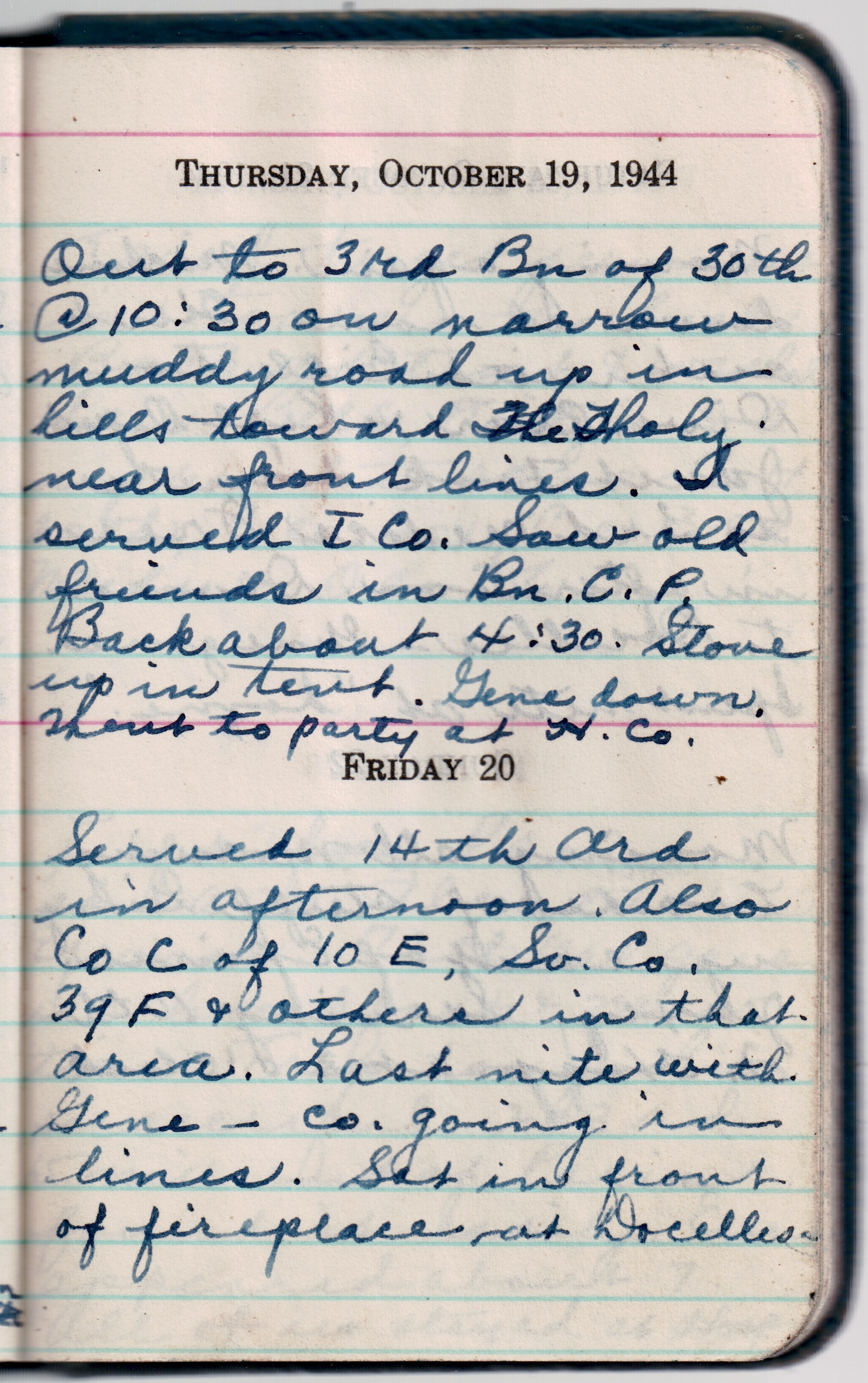
October, 1944.The four-woman crew gets to work, Flo sees Gene before his company goes in the lines, clubmobilers get up near the front lines and they move to a new camp.
Flo’s diary (pinch out to read)
A note here about the challenge of research: In 1973, a fire at the National Personnel Records Center (NPRC) destroyed 16-18 million official military personnel files. Among them were the archived records of the Clubmobile program, making modern-day research into these women’s service difficult.
From Flo’s album
One helpful resource is The Clubmobile—The ARC in the Storm: A Personal History of and by the Clubmobilers in the European Theater of War During WWII, compiled by Marjorie Lee Morgan. The book includes interviews, diary entries, and photographs. But it focuses solely on the European Theater and omits those who served in the North African and Italian Theaters—even though many of those women, like my mother, also served in France, Germany, and Austria. And these women were the first to enter France and Europe. The book even includes a list of clubmobilers, but no names from the North African/Italian Theater appear, except Forence Wick on the inactive list.
With help from my brother Don, I was able to find some information on Janet Potts and even contacted her daughter. But so far, we’ve found nothing definitive about Fritzie Hoglund (or possibly Hoagland). A newspaper clipping pasted into Flo’s album says Fritzie was from Berkeley, California.
Janet Jenson (née Potts)
Born in New Rochelle, New York, Janet graduated from the Brearley School, attended Barnard and Columbia, and joined the Red Cross in 1944. An accomplished equestrian, she rode in a Third Division “rodeo” at the end of the war.
Janet was one of eight sisters—three of whom served in the Red Cross during the war. Janet was the only one who went to Europe, while the two others served in the South Pacific.
She married Lloyd Jenson in 1946 and had two daughters. Her daughter Susan Jenson told me that Janet often spoke of Flo and that her mother also made a wartime album, which she plans to go through.
Janet’s daughter wrote, “I personally think there’s far too much focus on donuts in the way the clubmobilers’ work is remembered. These women were brave and generous souls who took on a difficult and emotionally demanding role, offering comfort to exhausted and traumatized troops. As my mother often said, the French sometimes mistook them for camp followers—a euphemism for prostitutes. They had no idea what these women were really doing. But for many soldiers, these were the last warm smiles they ever saw.
“Janet always had kind things to say about Flo. I can imagine the two of them together in a jeep, laughing. It was an adventure—but also full of heartbreak.”
Janet died in 2011, in Denver at age 96.
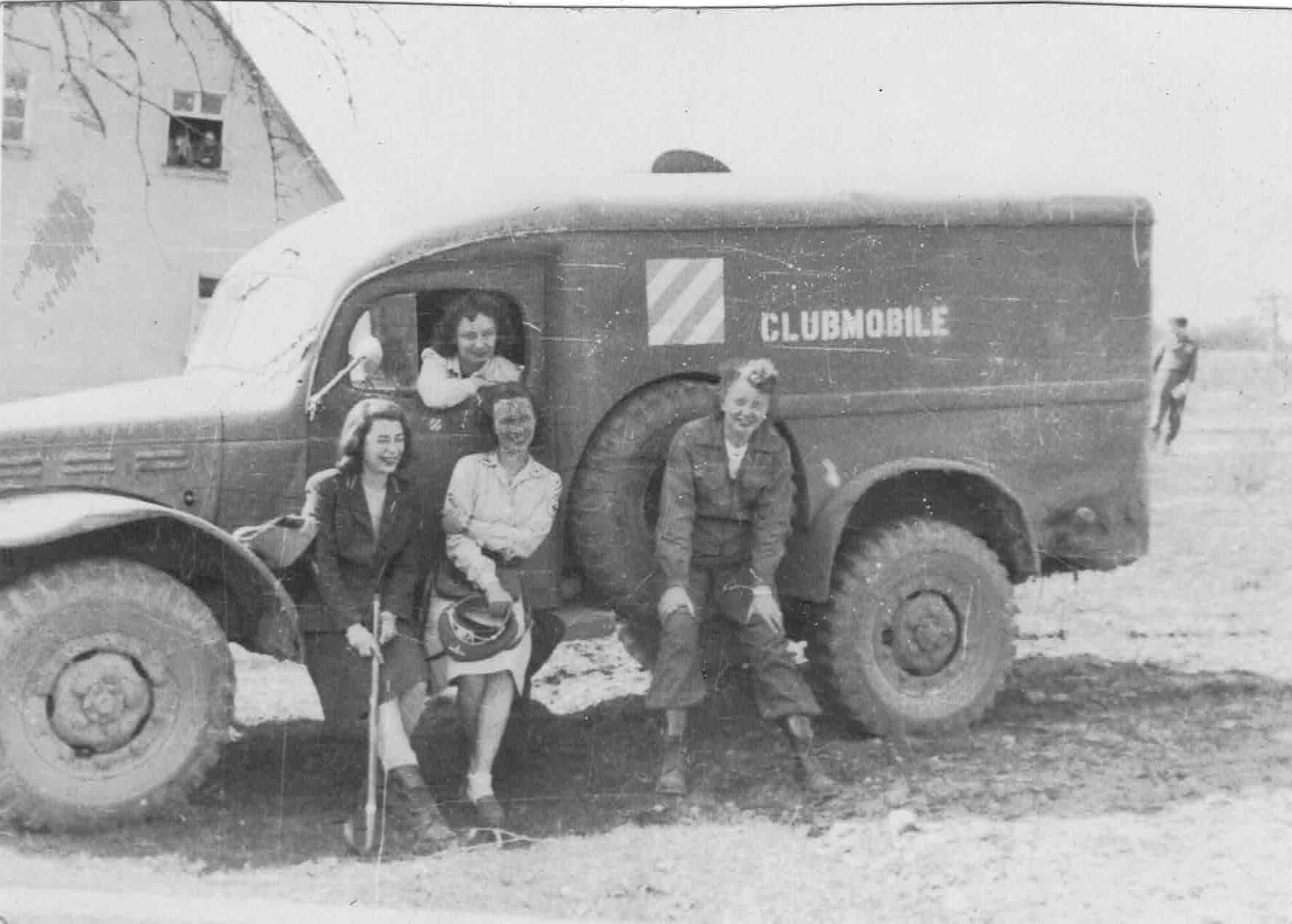
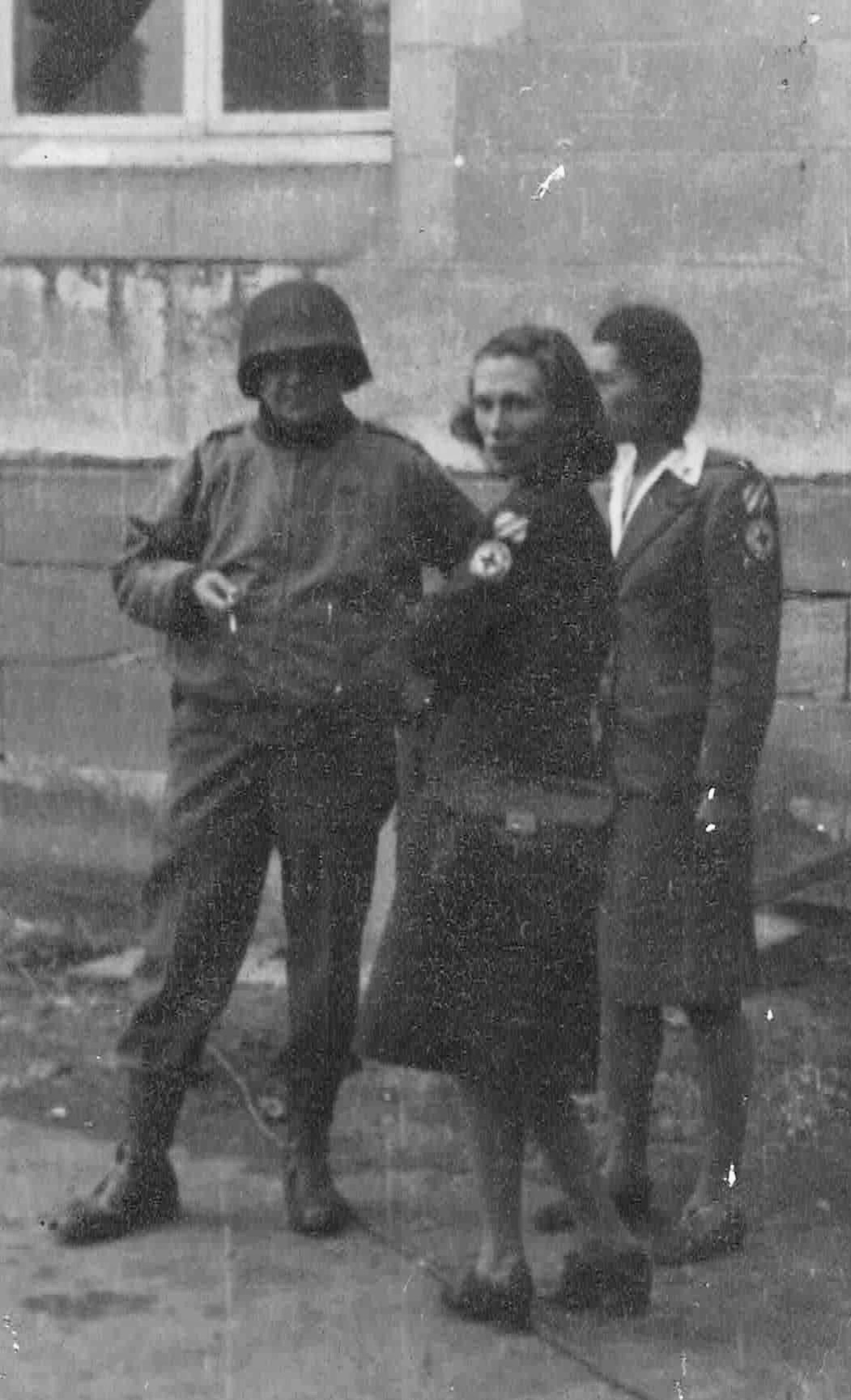
Liz, Flo, Fritzie and Janet (in clubmobile)
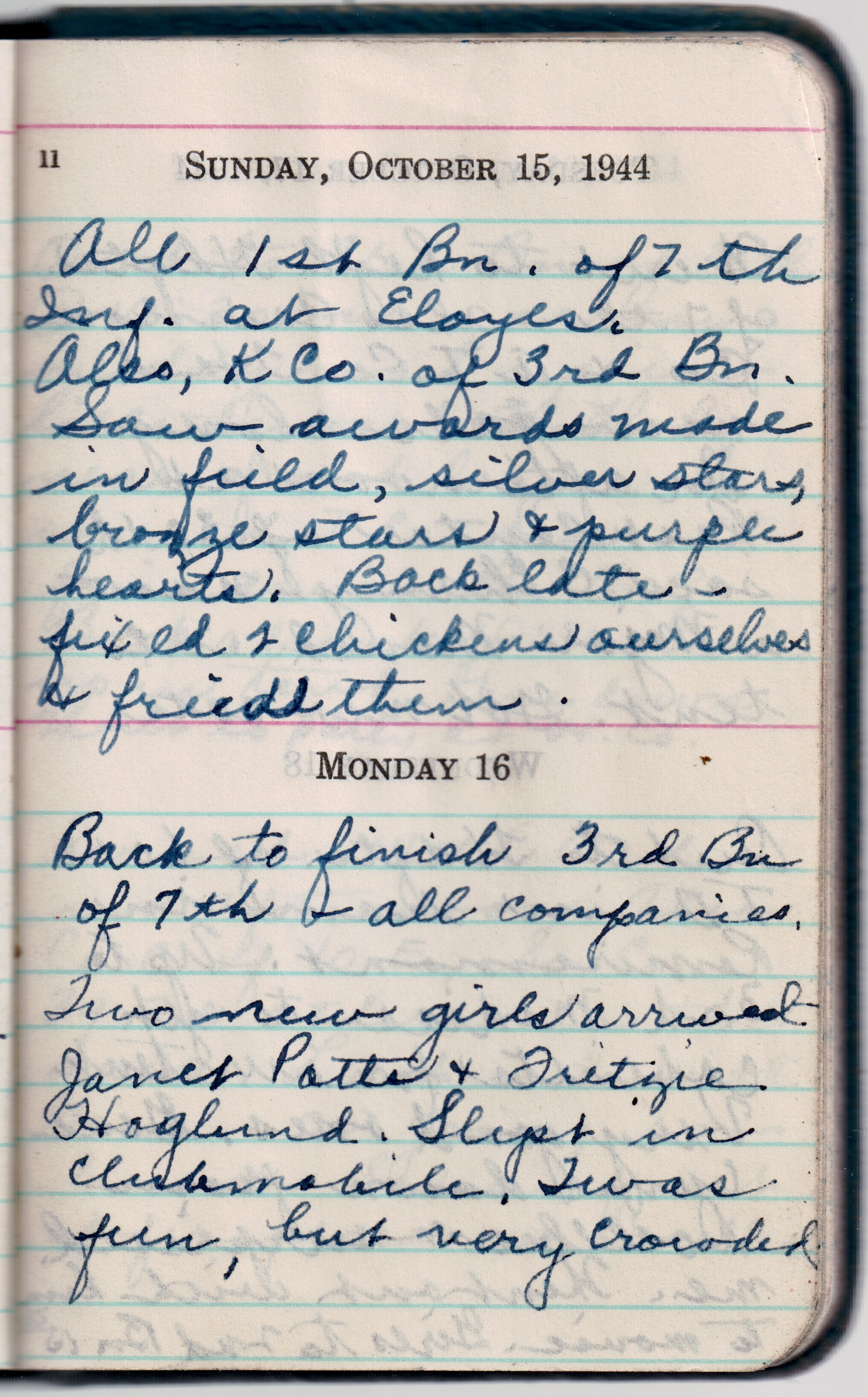
The new four-woman crew slept in the clubmobile. Flo wrote in her diary, “It was fun, but very crowded.” Later, they were issued a tent and new cots.
At one point, Flo’s fiance Gene came down from Docelles and surprised her. “Went out to a movie with him,” she wrote. She saw him again on October 19. Then on October 20: “Last night with Gene—co. going in lines. Sat in front of fireplace at Docelles.” The next day in a free afternoon, she drove back to Docelles maybe with the hope of seeing him one last time. She wrote: “Gene gone. Spent night at ‘home.’”
The following morning, Flo and the crew spent hours loading and moving supplies—the clubmobile was relocating to an area near Épinal.
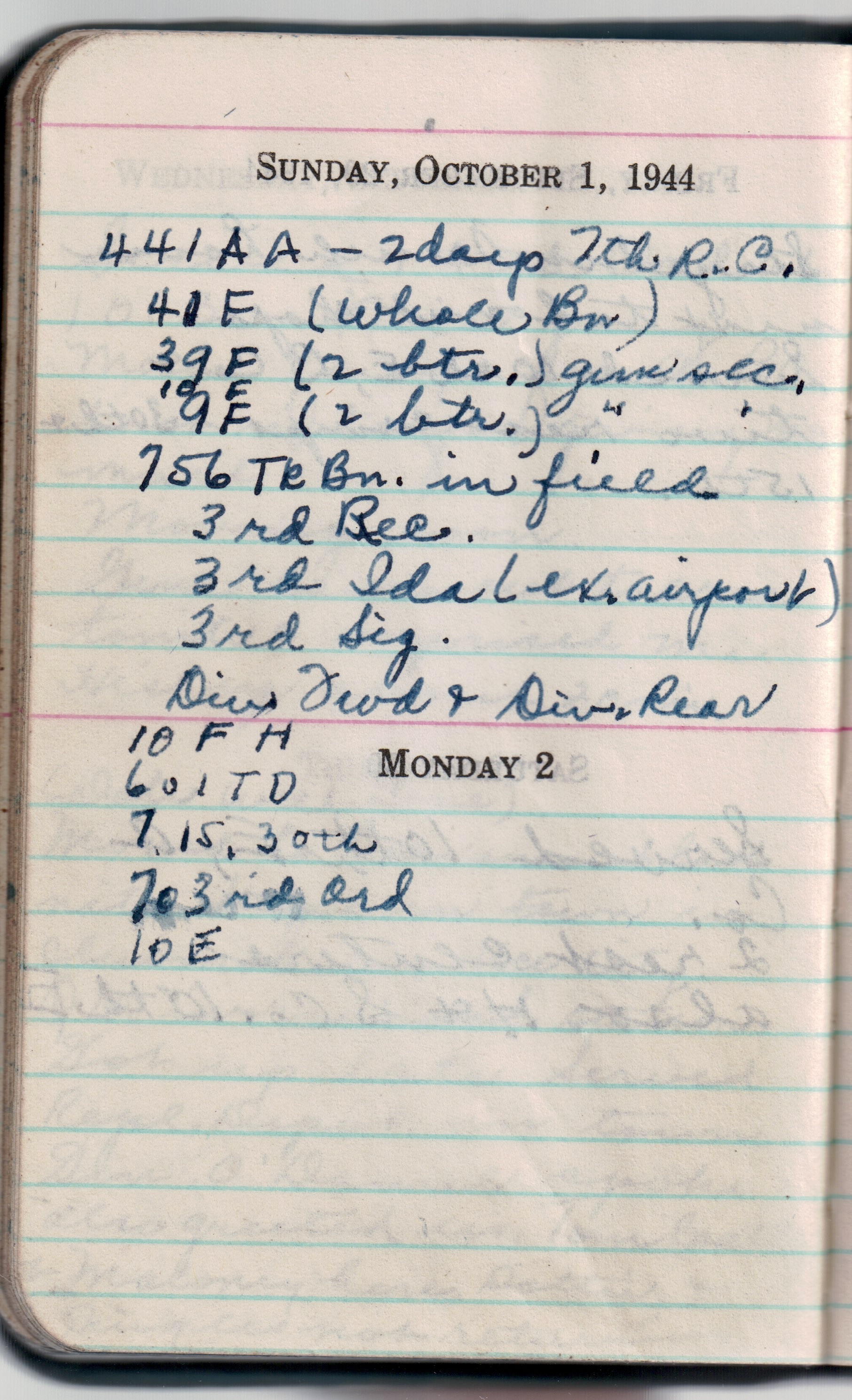
October 1944. Flo’s diary is blank from October 2 to October 7, 1944. There’s no way to know what happened during that time, but there are clues. My cousin told me that at some point during the war Flo went to Paris for an abortion. I wrote about it here: https://mollymartin.blog/2022/04/16/solving-a-wwii-era-mystery/. The city had been liberated in late August and it would have been possible for Flo to travel there and back in five days. Flo stayed in touch with her sister, Eve, who was serving as an Army nurse in a Paris hospital. Eve told me that Flo had also suffered a miscarriage while hauling heavy equipment. Flo never wrote about any of it in her diary, and she never spoke of it later. But whatever happened during that week, it was serious enough to stop her from writing altogether.
Flo’s diary (pinch out to read)
By October 8, Flo and Liz were back in action, serving hundreds of donuts to American troops every day. They had moved from Remiremont to nearby Saint-Nabord, a grim, war-torn area where they now lived in their clubmobile. One day they drove to Luxeuil for photos. Another day they served the replacement depot while a military band played. And then they bounced across a pontoon bridge into Saint-Amé, until their battered old sedan gave out. The clutch snapped halfway over the bridge and couldn’t be repaired.
During this time, they served the 15th Infantry—Audie Murphy’s unit—a couple of times. The men were quiet, polite, exhausted. After some hard battles, the 15th was finally getting a little rest. But Murphy was not among them. He had been wounded in the fight for Cleurie Quarry. At the aid station, he learned that nearly his whole platoon had been wiped out the night before. Because of the rain and mud, the wounded men could not be evacuated for three days. At the hospital Murphy learned gangrene had resulted. He would be out of commission until January.
In breaks from battle, the army handed out medals. The Third Division took home more than any other. This would be Murphy’s third purple heart.
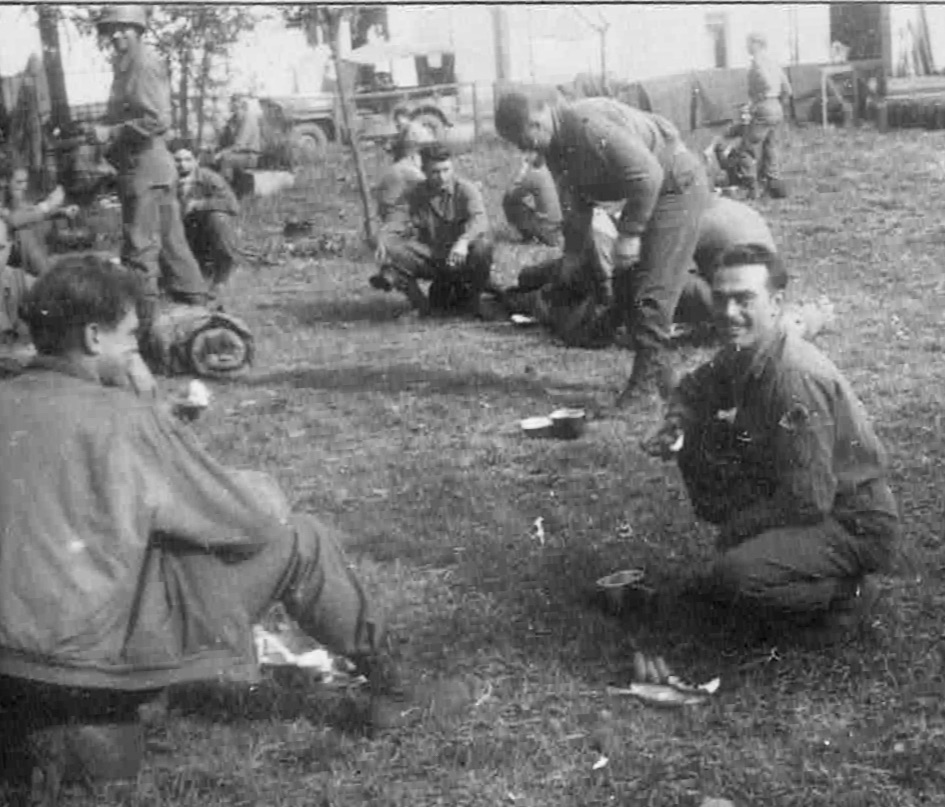
Flo was able to see her fiancé Gene occasionally, as his unit, the 36th combat engineers, was stationed nearby. They met for church, a dance and meals at his camp. They planned to marry by Christmas and he had ordered rings for them.
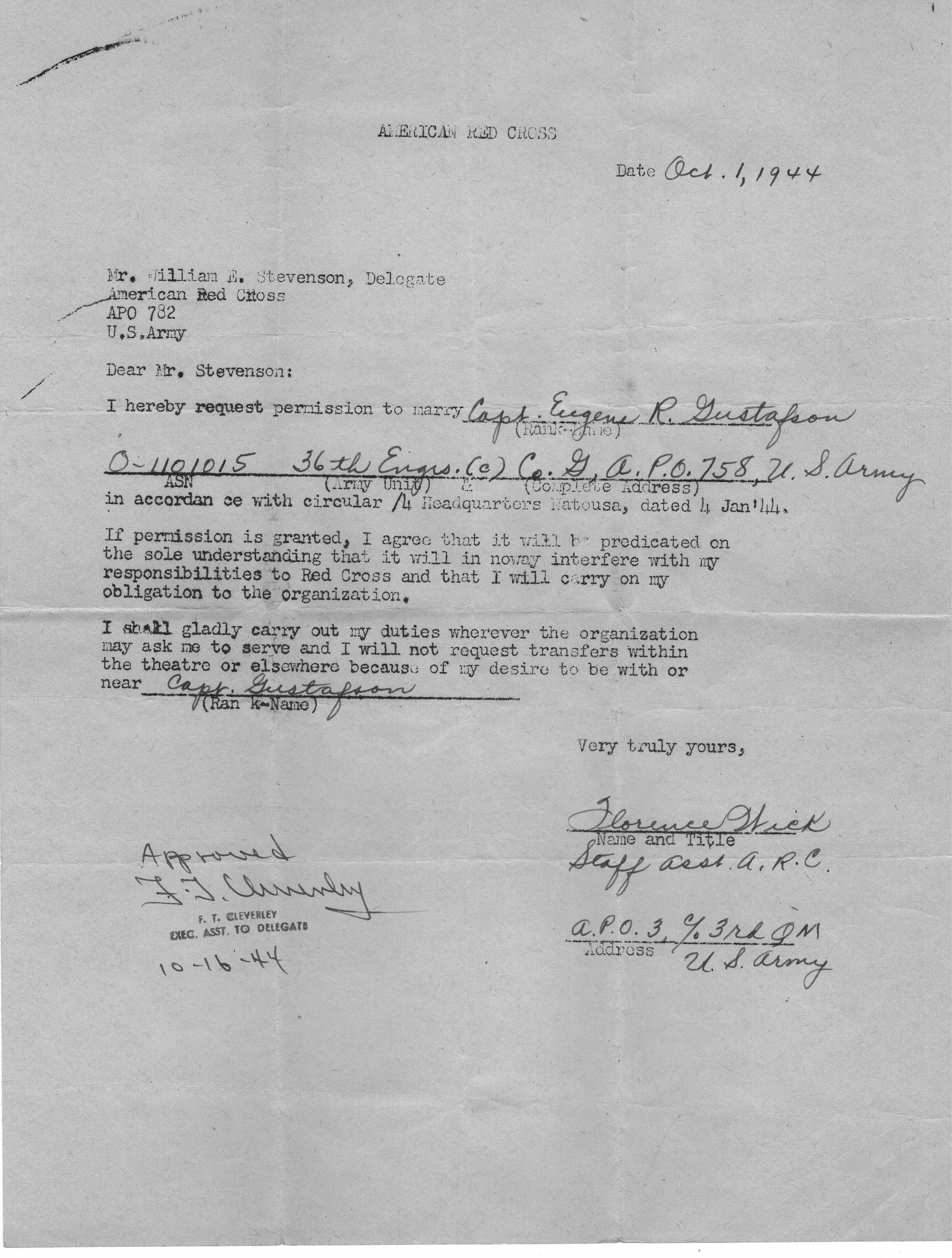
Form letter asking for permission to marry
On October 1, Flo sent a formal request to William Stevenson at Red Cross headquarters for permission to marry Gene. The form letter says,
“If permission is granted, it will be predicated on the sole understanding that it will in no way interfere with my responsibilities to Red Cross and that I will carry on my obligation to the organization. I shall gladly carry out my duties wherever the organization may ask me to serve and I will not request transfers within the theater or elsewhere because of my desire to be with or near Capt. Gustafson.”
In her accompanying letter, Flo had again managed to put her writing skill into practice. Whatever she wrote convinced the ARC. She received permission to marry in a warm letter from Eleanor “Elly” Parker, Director of Staff Welfare, dated October 23.
She wrote, “Thanks very much for your nice letter and I feel much more comfy issuing your marriage approval after having your explanation of exactly what is happening….You sound well surrounded by friends and family in France and I am glad you enjoy being there….I imagine that you are terribly busy and very hard at work under pretty trying cricumstances….
Permission granted and our shoes are boring (sorry)
Apparently Flo also had asked about getting some shoes after her nice shoes were stolen in Italy. But Elly Parker wrote that all they have at the PX are “regular black Red Cross shoes.” Not exactly what Flo, a lifelong shoe queen, had in mind.
On October 12, German planes flew overhead. Everyone looked up at the roar, held their breath as the anti-aircraft fire opened up—and missed.
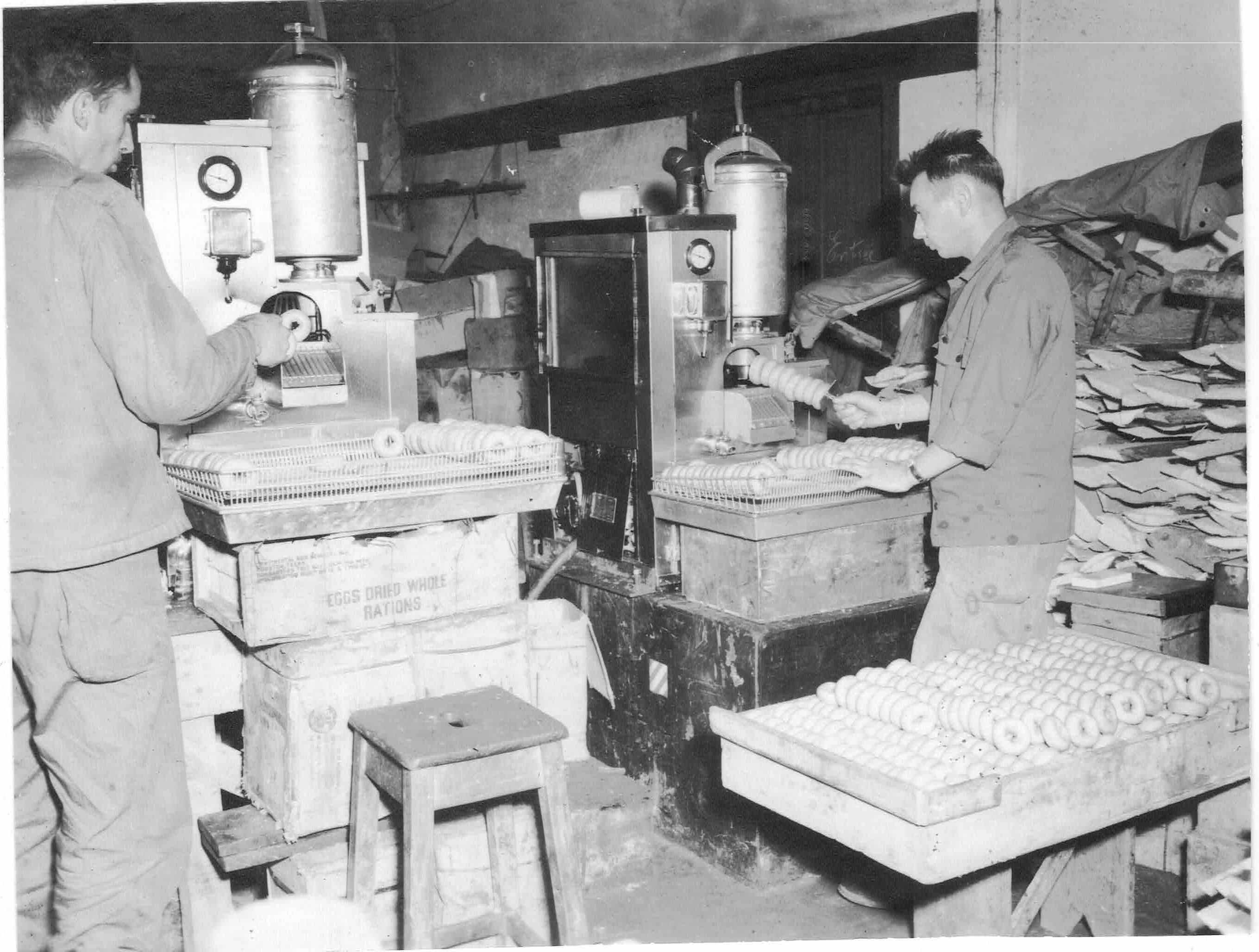
Late September, 1944. Flo and Liz were back on duty, serving donuts to soldiers rotating off the front lines and into rest camps. They were supported by a crew of “donut boys,” who pitched a tent that housed the donut making machines. The men were regular soldiers assigned to special service units. They tended the equipment and made donuts. Some of the temporary attachments to the donut detail were soldiers in need of limited duty and sometimes Medal of Honor recipients waiting for reassignment.
Flo and Liz with the donut making crew Joe Fronek, head donut boywith dog TC
Once the fresh donuts were ready, they were packed into the clubmobile—or whatever vehicle was available—and the women drove them out to towns and camps where they set up a serving line. They made stops in Faucogney, Luxeuil-les-Bains, Remiremont, St. Nabord, and rest camps across the region.
Joe Fronek painting the ARC logoDo ut boys making donuts
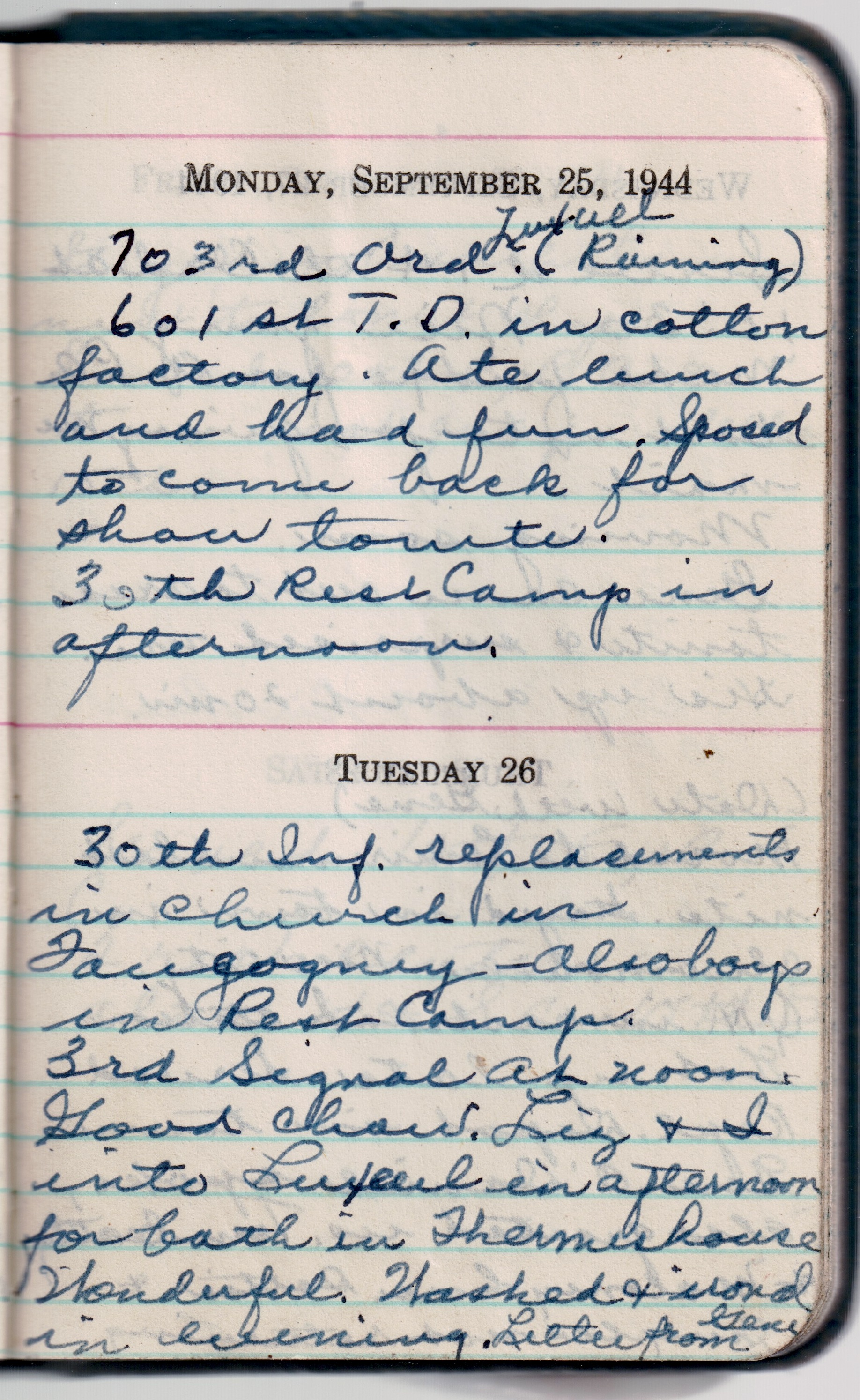
Flo noted in her diary that she and Liz had taken a rare break: “Went into Luxeuil for bath in Thermis house. Wonderful.” In the 1940s, many European towns still operated communal bathhouses, a tradition that faded with the rise of private bathrooms but has seen a modern revival—especially in Germany.
Coffee in bed?Feeding the unit’s pet monkey
One day brought a welcome surprise: a letter from Flo’s fiancé, Gene. Grateful to the APO for delivering it, she made them a batch of fudge. That evening, she wrote, “Gene came out to area tonite and surprised me. He’s up about 20 min.” The next day, she simply noted: “(date with Gene).”
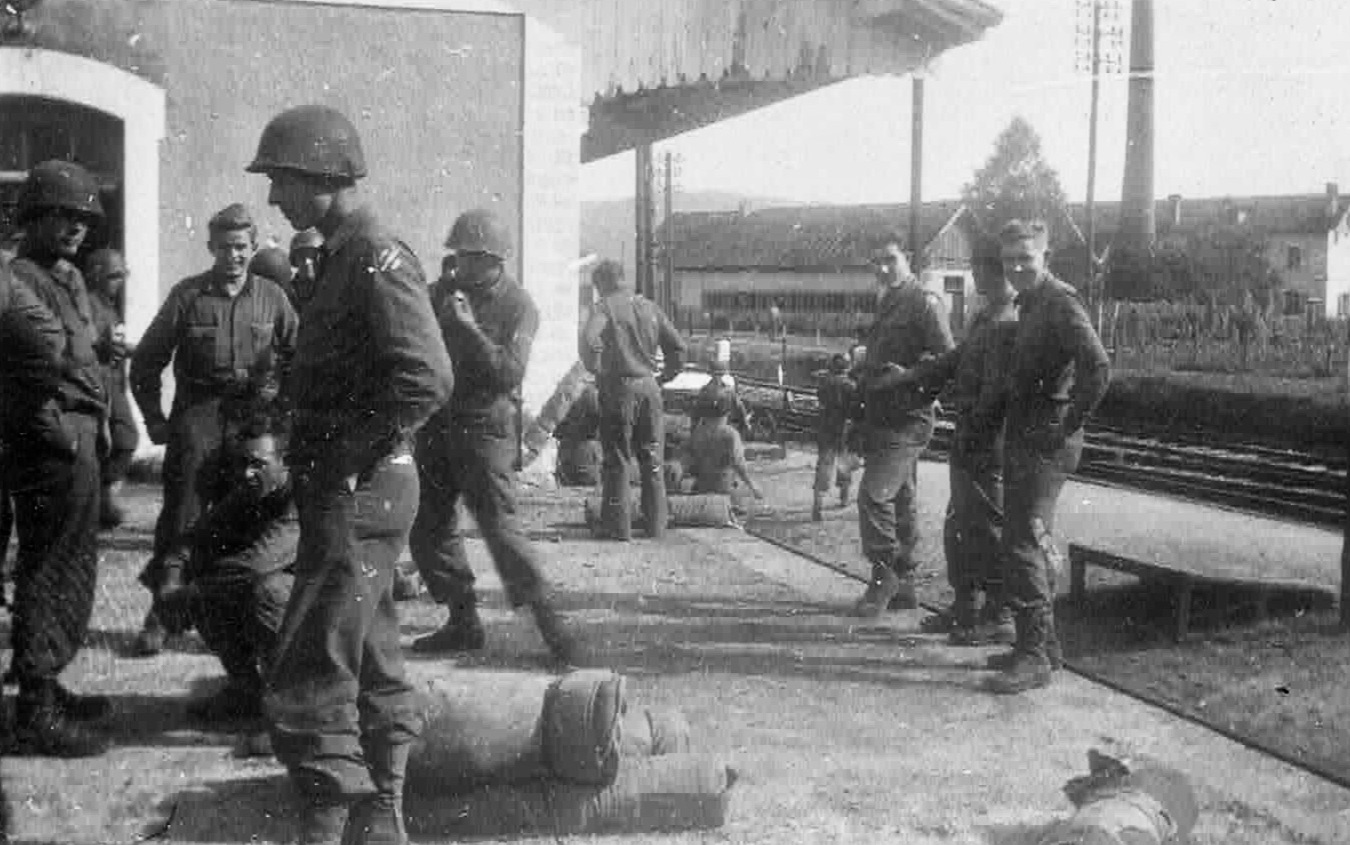
QM at the railroad stationOne of the many rest camps
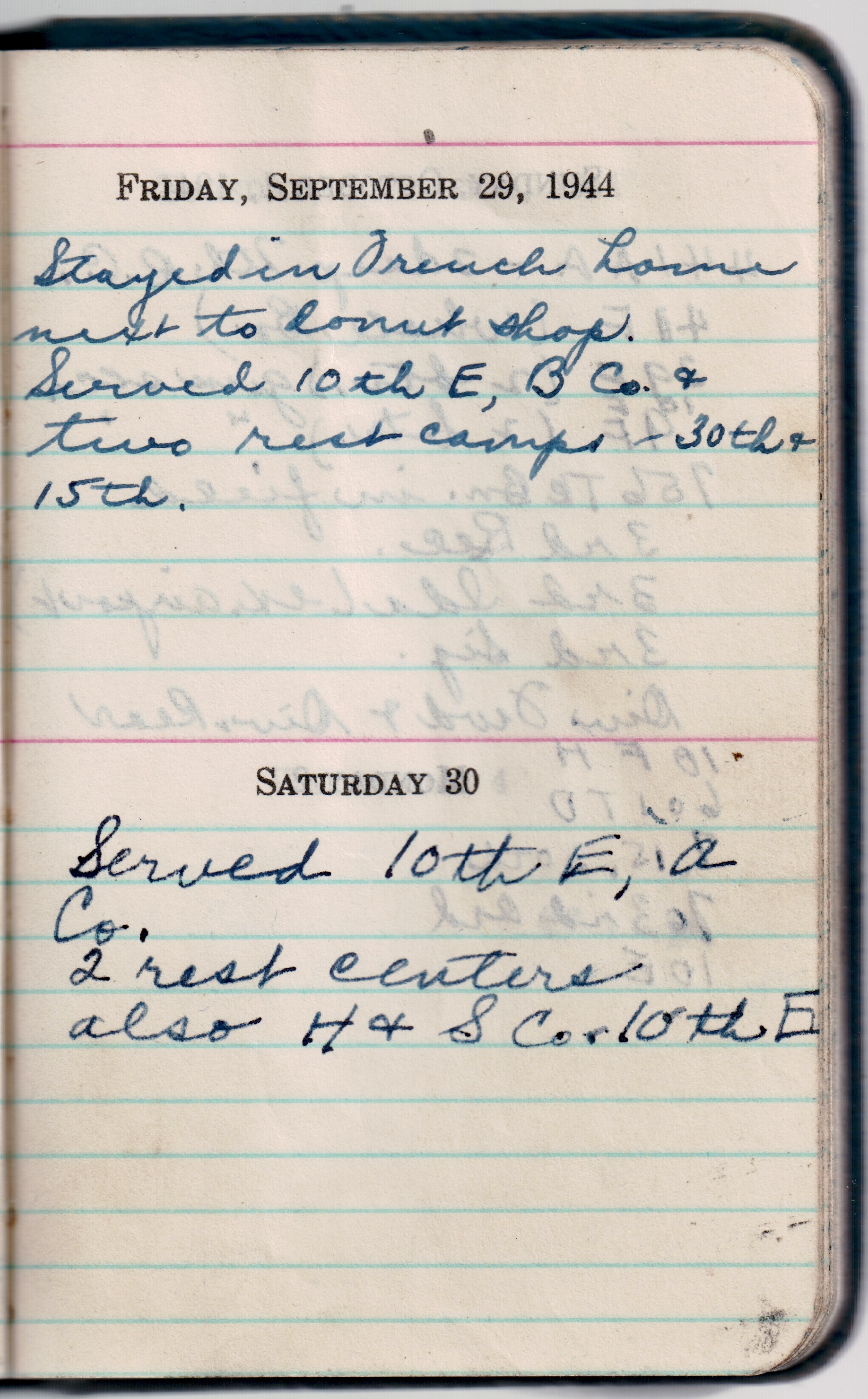
News arrived that the rest of their original crew, Jingles and Dottie, wouldn’t be returning. For now, it was just Flo and Liz. They were mostly sleeping in the clubmobile, though occasionally they stayed with French families. Flo continued to meticulously record the military units they served.
Flo’s diary September 25-October 2, 1944 (pinch out to read)
Flo and Liz with Gen. O’Daniel
At one event, Flo wrote, “Gen. O’Daniel spoke, also greeted us.” General John “Iron Mike” O’Daniel, commander of the Third Infantry Division, led his troops from the beaches of Anzio through France and Germany, and into Austria. Admired by his men, he was rarely far from the front and was known for his hands-on leadership in battle. Unlike some other army commanders, he appreciated the Red Cross clubmobilers.
After living in tents for the summer of 1944 at a training camp for the Third Infantry Division in Italy, the American Red Cross clubmobile workers made it to France. They scrambled to catch up with the fast moving war and their boys in the front lines.
Flo (my mother, Florence Wick) and her coworker Liz Elliott traveled north from southern France trying to get to a place where they could go back to work serving donuts and coffee to the troops.
Flo captioned this “Lizzie’s sketches of ‘Life of a Donut Gal in France’“
They had been a crew of four, but Isabella Hughes and Dottie Shands stayed in Marseille. They expect to join Flo and Liz, but for the time being Flo and Liz are a crew of two living mostly in the clubmobile. Frequent rain has turned roads and fields to muddy sludge.
Liz and Flo and the clubmobile they lived in
They were originally assigned to the Third Division, but after a major evicted them, they moved in with the 6th Corps artillery unit near Vesoul for a time. Then they were allowed back in to the division as three regimental rest camps were opened.
Flo has met up with her fiancé Gene several times and she corresponds with him through the APO mail, although she complains often in her diary of “no mail.” He is with the 36th Engineers, the crew that rebuilds bombed out bridges and roads. But they are also forced into combat when foot soldiers are needed.
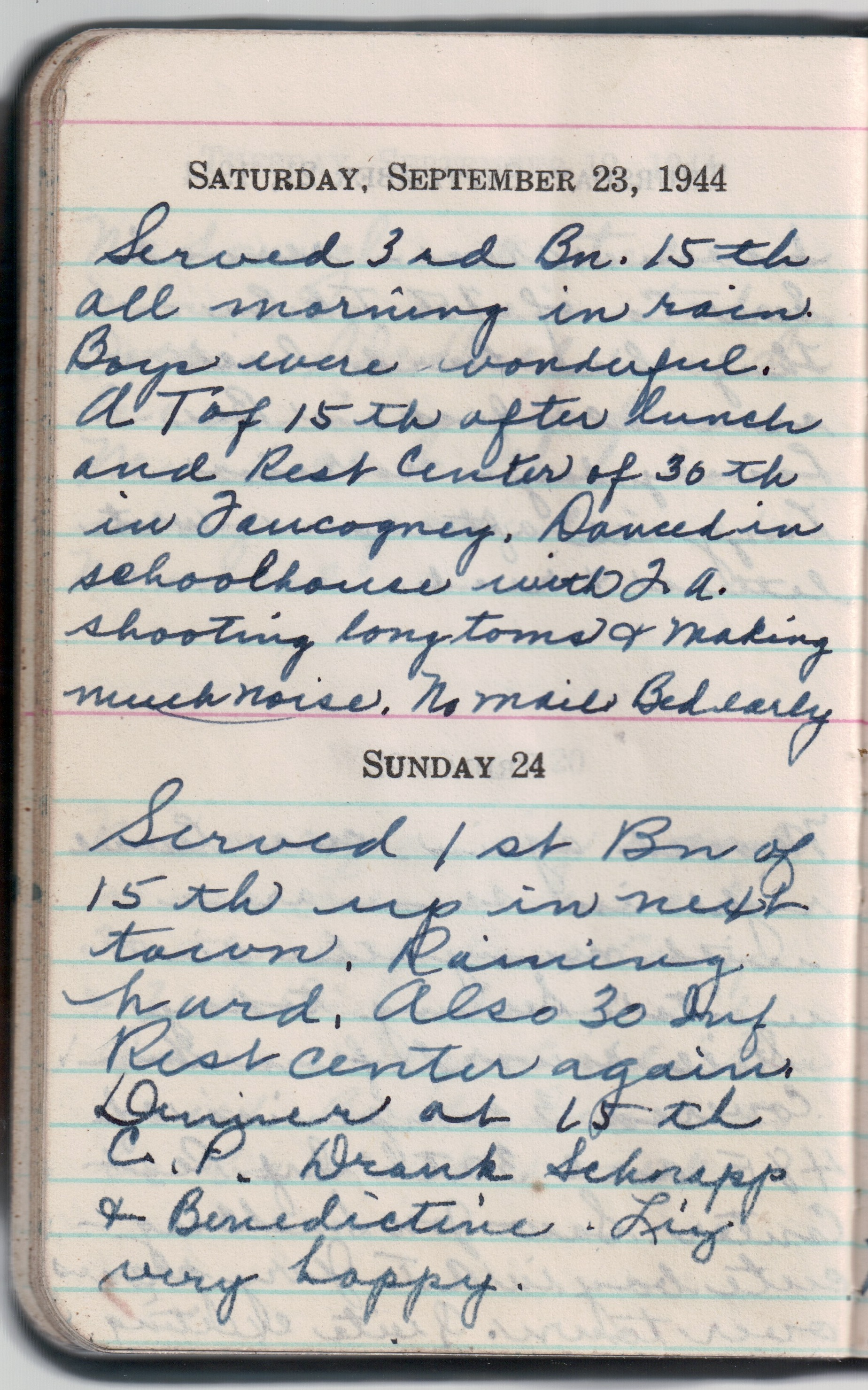
September 19-24 Flo’s diary (pinch out to read)
“Good to be back at work,” wrote Flo in her diary, after the Red Cross women had been allowed back into the Third Division.
“Gene way up on lines. No mail.”
“Served 30th Inf. Rest camp & 3rd Div band. Boys tired. Fun with band.”
Flo working in the field
On Sept. 21 she wrote, “ Served co. of 756 tank Bn. They had hard luck—several lost in Bn.”
Sept. 22: “Served in same area with many other div. Still no word from Gene. Jerry planes over town. Quite exciting.”
Sept. 24: “Served 1st Bn of 15th up in next town. Raining hard…dinner at 15th C.P.”
This is Audie Murphy’s unit and must be where they met. He remembered Flo served him donuts somewhere in France.
My three younger brothers and I all listened to our mother’s stories about the war and her two years as a Red Cross clubmobile worker in Europe. Of course, we each have different memories of her tales. I don’t remember her telling about the first time she tasted eggplant, but my brother Don does. I asked him to write about what he remembers. Here is his story.
Don Martin Remembers
2022. Recently my sister decided to start using emojis in her text messages. She is in her mid-70s and is not particularly a maven of popular culture, so her understanding of this youth-driven vernacular is limited. How do old people like us decipher the coded meanings of subtle facial expressions or the specific colours of hearts, for example? I try to keep up on these things, but I don’t pretend to understand the nuances. One day, however, she sent me a text with a string of eggplant emojis and I was confused.
“Molly, do you know what an eggplant emoji means?” I asked.
“Doesn’t it just mean eggplant? I like eggplants.”
“Oh, dear. I hope you aren’t sending eggplant emojis out indiscriminately. You really should google these things first.”
“I need to google emojis? So, what does it mean?”
I explained that the eggplant is now commonly used in sexting to represent male genitalia. To which she howled with laughter. But it started a whole conversation between us, (mostly about eggplants). I recounted a memory of the first time our mother prepared this berry of the nightshade family for dinner.
It was the summer of 1959. Molly had just turned ten years old. I was seven. We lived in the all-white suburbs of a moderately-sized farming community in central Washington state. Our neighbourhood was like the little boxes on the hillside described by Malvina Reynolds in her song about ticky tacky post-war American life. The low-slung houses were close together and we were close to the families next door most with children our age. Our backyards were still unfenced so we kids had a block-long grassy playing field. The moms chatted as they hung their laundry out to dry in the desert air and the dads planned fishing trips over bottles of beer.
I remember we had a concrete patio off the back stoop large enough to accommodate a picnic table, a set of lawn chairs, and a charcoal barbeque. The table had a hole in the middle for an umbrella that provided shade on blazing summer afternoons. For this particular dinner Mom decided to cook outside. I remember she had a small prep table with a cutting board, two shallow bowls and the big square electric frying pan she used for nearly everything. I think Dad was grilling hamburgers or chicken, the aromas of which enticed the Yaden kids to come over and see what we were having.
On the patio in Yakima about 1955. Don (L) Molly (R), Tim on Dad’s lap
The Martins had always been a very meat-and-potatoes kind of family. Vegetables in our diet were limited to canned green beans and creamed corn. Sure, we had fresh tomatoes and cucumbers in the summer, but never had we eaten something as exotic as an eggplant. You didn’t see it in regular grocery stores back then. Too ethnic I guess. I’m not sure where Mom found it, maybe at one of the roadside vegetable stands run by Italian farmers in the Valley.
I loved to help mom cook, so when I saw her bringing the rest of the food out to the patio I left the other kids and ran over. The Yaden twins followed.
“What is that?” screamed Susan Yaden pointing at the large purple thing on the cutting board.
“That is an eggplant,” mom said. “We’re going to try something I had for the first time many years ago in France.”
“Ew,” giggled Susan’s sister Janet, and they both ran off.
I, too, was a little scared, but intrigued. I asked what I could do to help. As Mom peeled the eggplant and sliced it into half-inch rounds, she had me beat two eggs in one bowl. The other bowl was filled with cracker crumbs. She showed me how to dip the slices in the eggwash and coat both sides with the crumbs. Then she fried them in batches until they were golden brown.
“This is how a family I stayed with in France taught me to fix eggplant,” Mom explained. “I’d never eaten it before either.” She looked up from the sizzling slices and stared wistfully into the distance. “It was when I was in the Red Cross, sweetie, during the war. The other doughnut gals and I were driving north to catch up with the army and we had almost no food with us. We decided to stop at a farm house and ask for an egg or a little bread. Of course, we would pay them for it because we knew they probably didn’t have much food either.”
I brought her attention back to the present. “Mom, It think it might be time to turn them over. They look pretty brown,” I advised, still listening intently.
“Yes. There. Don’t they look good? Crunchy on the outside and soft in the middle.” She was deep in thought for a minute or two. “The French people were so happy to see us because they knew it meant the war might be over soon. This family made us a wonderful dinner and let us sleep there that night. It’s one of my fondest memories of that horrible time. Okay call your brothers and sister over. I think everything is ready.”
That is how I was introduced to eggplant. The vegetable. I can’t remember if everybody liked it, but Molly and I did. I remember feeling very sophisticated and a little closer to Mom.
The war was moving north fast, and the Red Cross personnel had to move fast to catch up. Isabella and Dottie had stayed in Marseilles, so Flo and Liz were on their own. They snagged a car, driving from Aix-en-Provence to Grenoble, and on to the QM area near Quingey, just south of the town of Besançon. Flo wrote, “Should not have come up, but Bill let us stay.”
I think she is saying they are too close to the front lines. Bill is probably Bill Shay, whose photo is pasted in the album titled Bill Shay ARC, maybe their boss. In letters and interviews, the clubmobilers complained that their ARC bosses were of little help. The women were generally tasked with figuring things out on their own.
Bill Shay ARC
Flo also noted, “Moved same evening to area beyond town. Liz and Bill came late, so slept in Major Goodwin’s bedroll.”
That might be the theme of Liz’s drawing.
Liz’s drawings of clubmobile life are pasted throughout Flo’s album
The next day, Sept. 10, Flo wrote, “Shopped in Quingey for pans to cook for boys. Saw 36th Div. gals. Slept under trailer tarp. Very comfortable. Cooked for donut crew.”
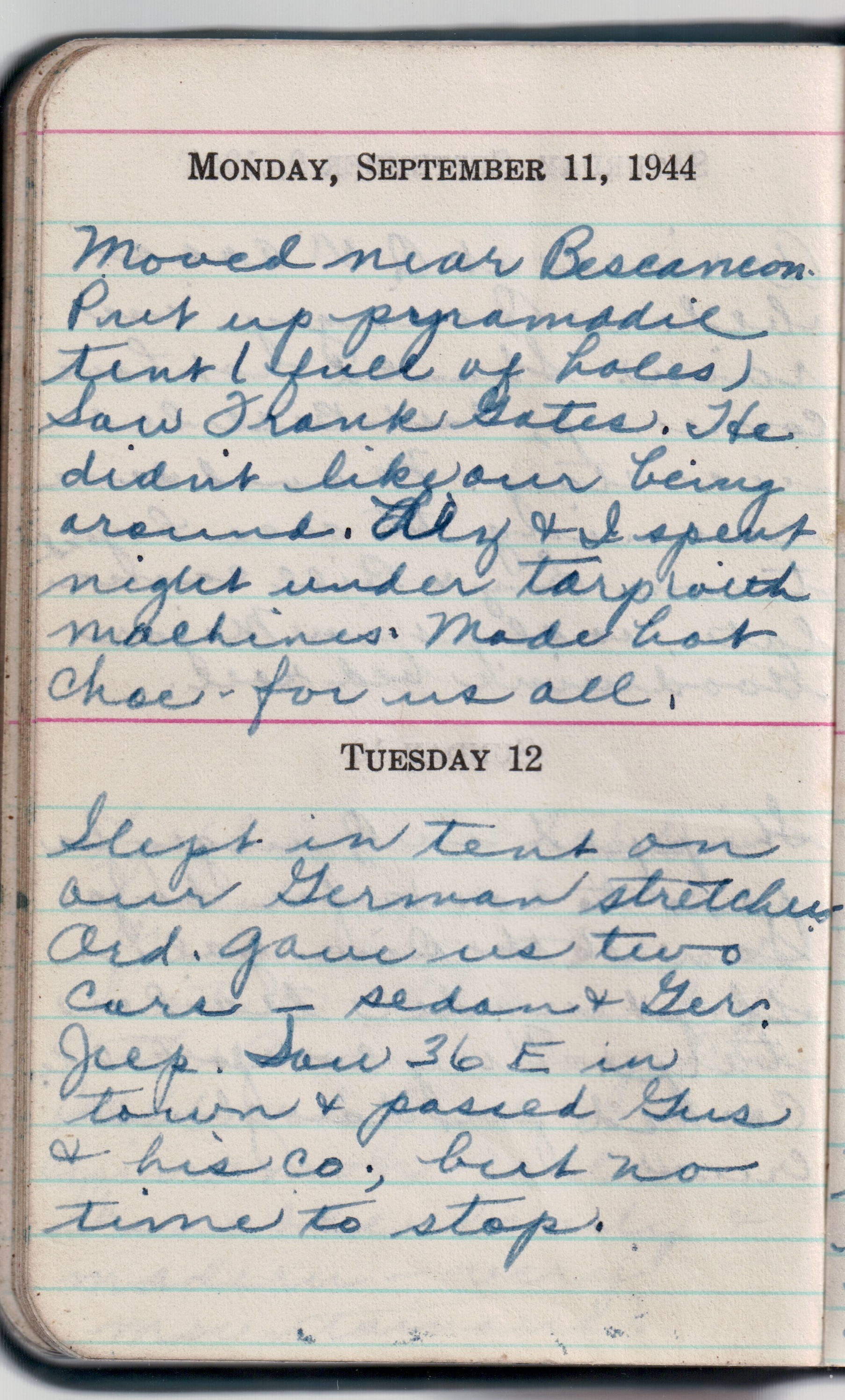
On Monday, Sept. 11 she wrote: “Moved near Besancon. Put up pyramidal tent (full of holes). Saw Frank Gates.”
(Gates is the ARC man who took them to Rome on the amphib jeep June 5. That seems to long ago!)
“(Gates) didn’t like our being around. Liz and I spent night under tarp with (donut making) machines. Made hot choc. For us all.
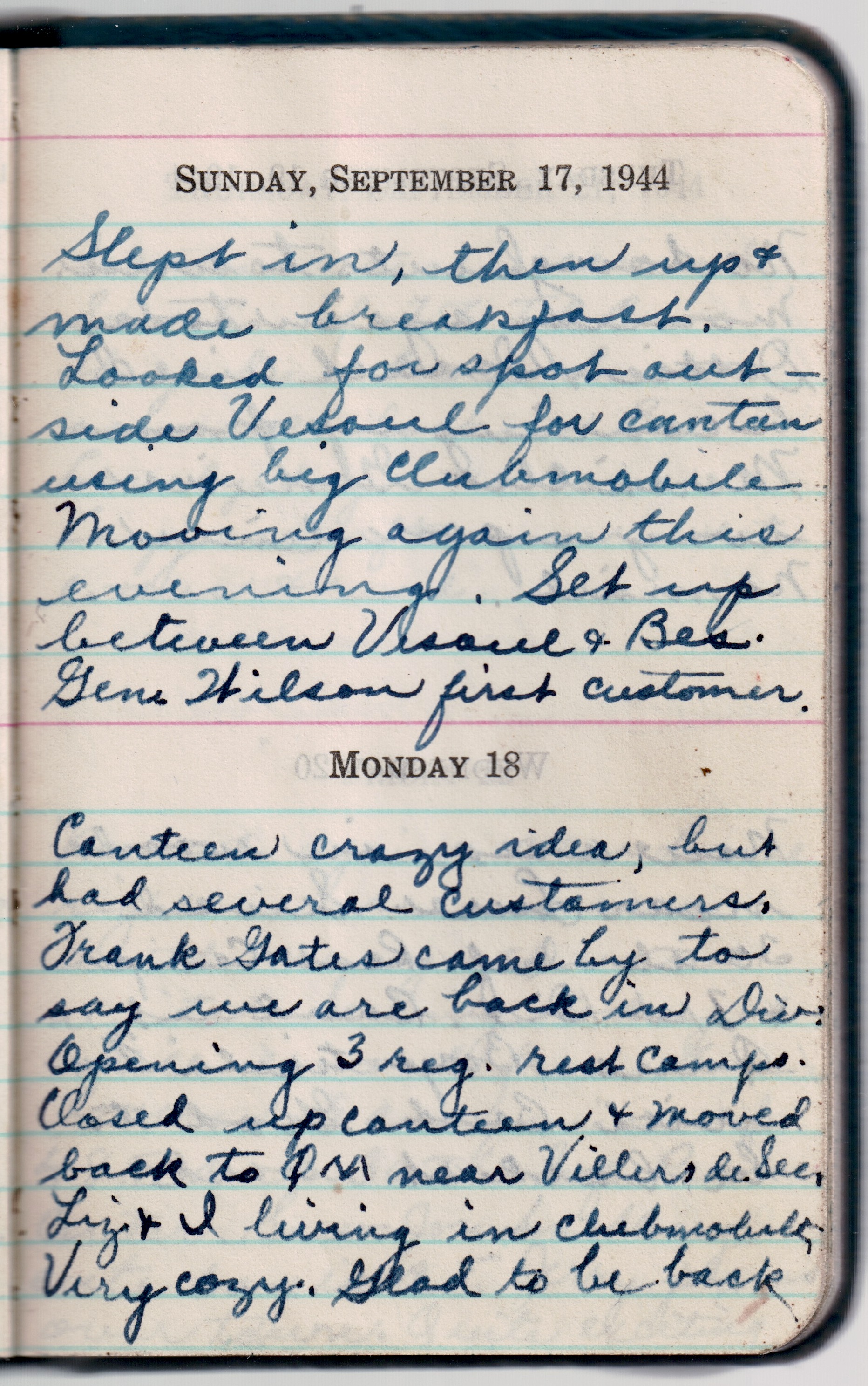
Flo’s diary
Sept. 12, Flo wrote, “Slept in tent on our German stretchers. Ord. gave us two cars—sedan & Ger. Jeep. Saw 36th E in town…” She doesn’t mention that she saw her fiance, Gene, who was with the 36th Engineers.
Sept. 13. Raining. “Spent wet night. Had fried chicken. Very good. Liz is KP & Flo is mess sgt.”
Sept. 14. “Frank Gates says Maj. Basilla wants us to get out, so we moved up to 6th Corps artillery unit.”
It seems like this means that Major Basilla was kicking them out of the Third Division. Some of the commanding officers were opposed to having the clubmobilers near the army. Gen. Mark Clark had been their advocate and protector in the beginning, but he was no longer there.
She wrote: “Spent night in French summer home. Wonderful beds. Both of us blue & orphans.”
Friday, Sept. 15 Flo wrote, “Left for Vesoul w/6th Corps artillery. Moved into small inn in Villers de Sac with Liz. Wonderful beds & kitchen to cook meals in. Fun. Drove down to QM in Ger. Jeep.
Sept. 16. “Cooking for 6th Corps donut gang. Madame Susan good to us. Fried 3 chickens & cut ‘em up myself. 11 for dinner. Danced in inn to phono. Raining hard.”
Liz and Flo plucking French chickens
Flo was very proud of herself for cutting up chicken and cooking meals. She had never been a cook. At home, she had worked at a job and her mother had done all the cooking. From the notes in her diary, it seems like she was getting in to her domestic side.
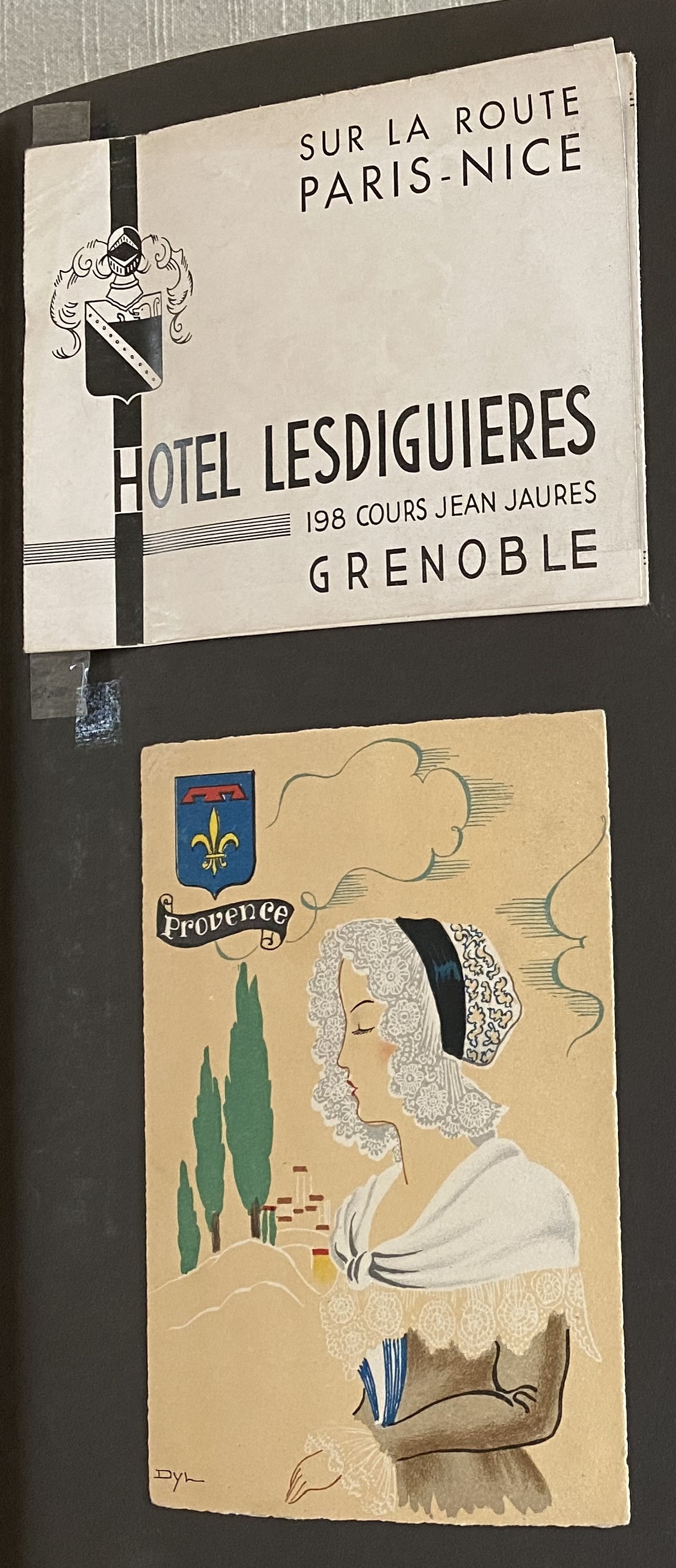
September 8, 1944. After several days in the small town of Aix-en-Provence, the Red Cross crew drove north in an effort to catch up to the Third Division. They stopped in Grenoble where they stayed for a night in what Flo called, “a lovely hotel, taken by 7th Army.” She noted: “Boy from Ballard (A Seattle neighborhood) gave me cinnamon rolls.” She described Grenoble as “lovely and modern—very mountainous.”
From Flo’s albumFrom Flo’s diary
Flo also pasted on this page of her album a newspaper story quoting Sgt. Louis Roberts about Nazi brutality endured by the French. Sgt. Roberts must be a Yakima native. From the Yakima Herald:
Atrocities Are Reported
Sgt. Roberts Avers France Bled White
Sgt. Louis Roberts who has been staying recently with a French family, has thus been able to get a better understanding of condition in France than most of the Americans and has the added advantage of speaking the language.
“It is hard to fathom how Germany bled France of resources,” he says. “From one little sector each month the people had to send 13 ½ tons of shoes, 10,000 head of cattle, tons of butter, milk, wood and other things plus a monthly payment of five million francs. It is incredible how much a small region could ever supply so much. These people have been thrifty and economical enough to endure this war.
“Being deprived of food and clothing did not bother the French so much as the brutal measures the Germans took. Often children had to suffer the loss of limbs so parents would take pity on them and disclose vital information about the F.F.I. (French Forces of the Interior. The French resistance) One town north of here was taken by the F.F.I. The Germans warned the patriots that if one shot were fired after 11 o’clock they would retaliate. The warning was not heeded and the Germans retook the town and set all the houses afire along the main street.
“Numerous incidents are constantly told about how the Germans would shoot our wounded prisoners. Women would cover the bodies of dead aviators or allied soldiers with flowers which would be scattered by the Germans who were on guard. If some persons would linger over the body of one of our soldiers to pray they would be driven away at the point of bayonets.
“These French are very sorry, indeed, that all of us cannot understand the language. Each of them has some grewsome story to tell, not necessarily how they suffered but how the rest, or all of France, has to suffer. I have seen results of such brutality and I feel even more sorry for the French still in German territory. I could write a book on what I have heard and seen.
Yesterday I went to mass—a special mass for the liberation of the town. The church was beautifully decorated with numerous flags and stretched out up over the altar was a huge banner ‘Honor and Glory to the Americans.’ The choir and music were also beautiful. It was like Easter at home.”
Sgt. Roberts and Miss Florence Wick, Yakima Red Cross worker, are in the same town and see each other at times. He adds that “even though people are bombed out of their homes they are most happy to be liberated.”
Late August, 1944. Support staff, including the American Red Cross women, were required to wait till the end of August to follow the troops into Southern France. They sailed from Italy on the USS Joseph T. Dickman, the same ship that had carried many of the men, landing on the same beach near St. Tropez. The ARC women attached to the Third Infantry Division were the first to reach France.
They were billeted for a week in a small town, Aix-en-Provence, where they stayed in what Flo called “a quaint but comfortable hotel.”
Aix-en-Provence. Pictures of the “quaint” hotel where they stayed, on right.
Flo’s letter home was published in the local Yakima newspaper:
Word From Florence Wick
Mrs. Gerda Wick, mother of Florence Wick, who is serving with the ARC in France has received a very interesting letter from her daughter. Florence writes:
“We came to France by boat. There were about 25 of us clubmobile girls, and we are waiting now in a lovely, quiet little southern French town until we can rejoin our various divisions. We landed in the same fashion as our troops had done previously, although, of course, we had the advantage of not being under fire.
“This part of southern France reminds me of Washington. There are fine trees and mountains and lovely valley gardens. The people are very nice, clean and polite. Their own soldiers are fighting as well as the civilians, and the spirit is wonderful.
“The war is moving so fast that we cannot keep up with it ourselves. When we can rejoin our units is unknown, but we miss them badly and want to get up there as soon as possible. Meanwhile, we are staying in a quaint but comfortable hotel, and enjoying white sheets and soft mattresses.
“The French can even make army K rations taste different, and their table service is wonderful. A separate plate for everything, and interesting sauces camouflaging our corned beef, Spam, etc. Their interior fighting forces, such as civilians underground, etc. have done a wonderful job and “fighting French” means just what it says.
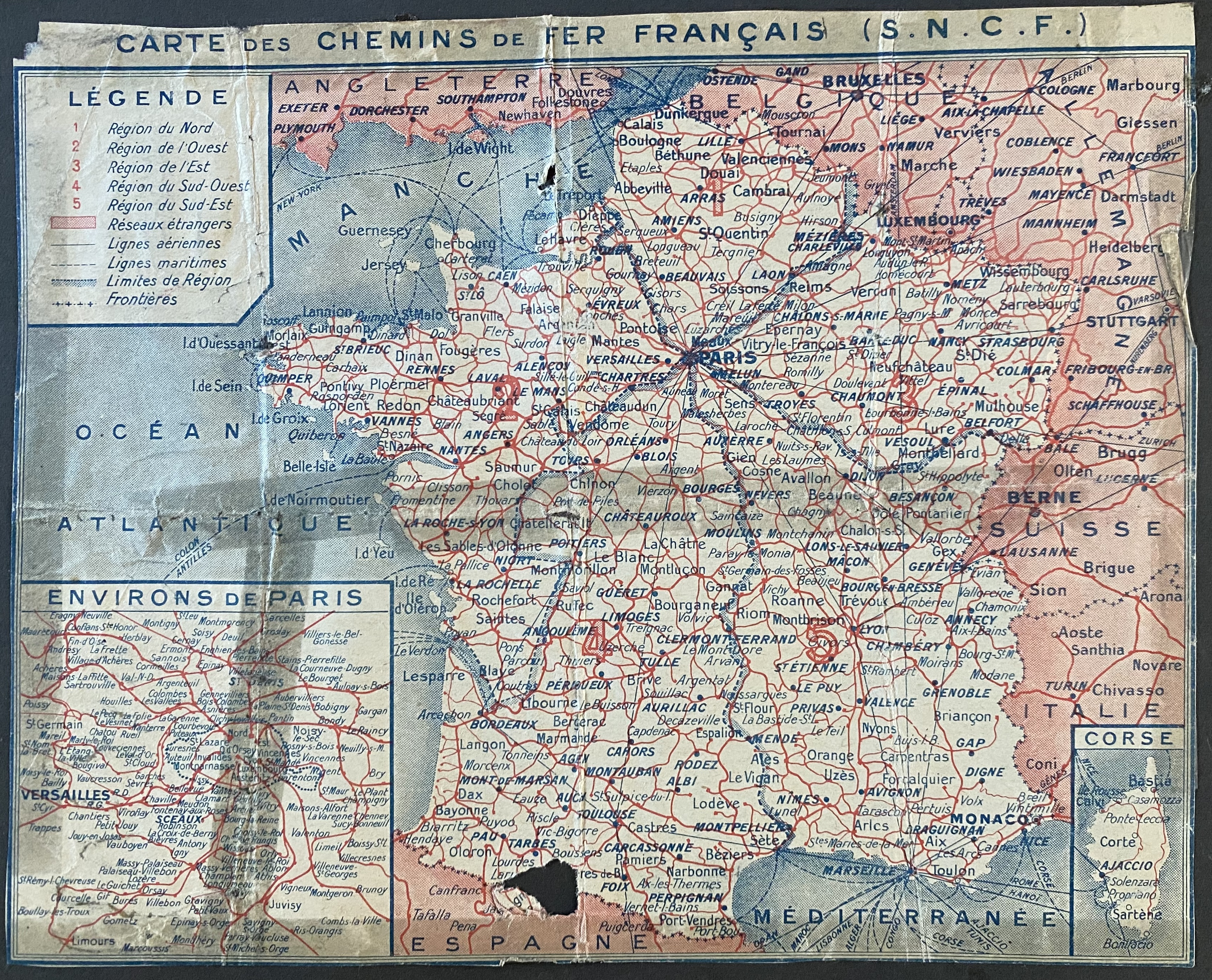
Flo’s road map of France was put to good use by ARC clubmobilers
“The fruit here is very good—all varieties of melons, excellent tomatoes which they can fix a dozen different ways, and grapes.
“The thing that makes these French towns so different from ours is the complete lack of frame buildings. Everything is stone or stucco with tile roofs. That was true in Italy also. France is unbelievably clean and peaceful looking. There are, of course, smashed buildings, burned up and overturned Jerry equipment and shells lying around here and there to remind one of war, but they don’t seem real, somehow.
“The clubmobile girls were the first ARC girls in France and we are quite thrilled by it all particularly as there are hundreds who want to get over here and must stay on in Italy for a time.
Finally, the time had come for the American Red Cross workers to follow the boys to France. Flo wrote in her diary:
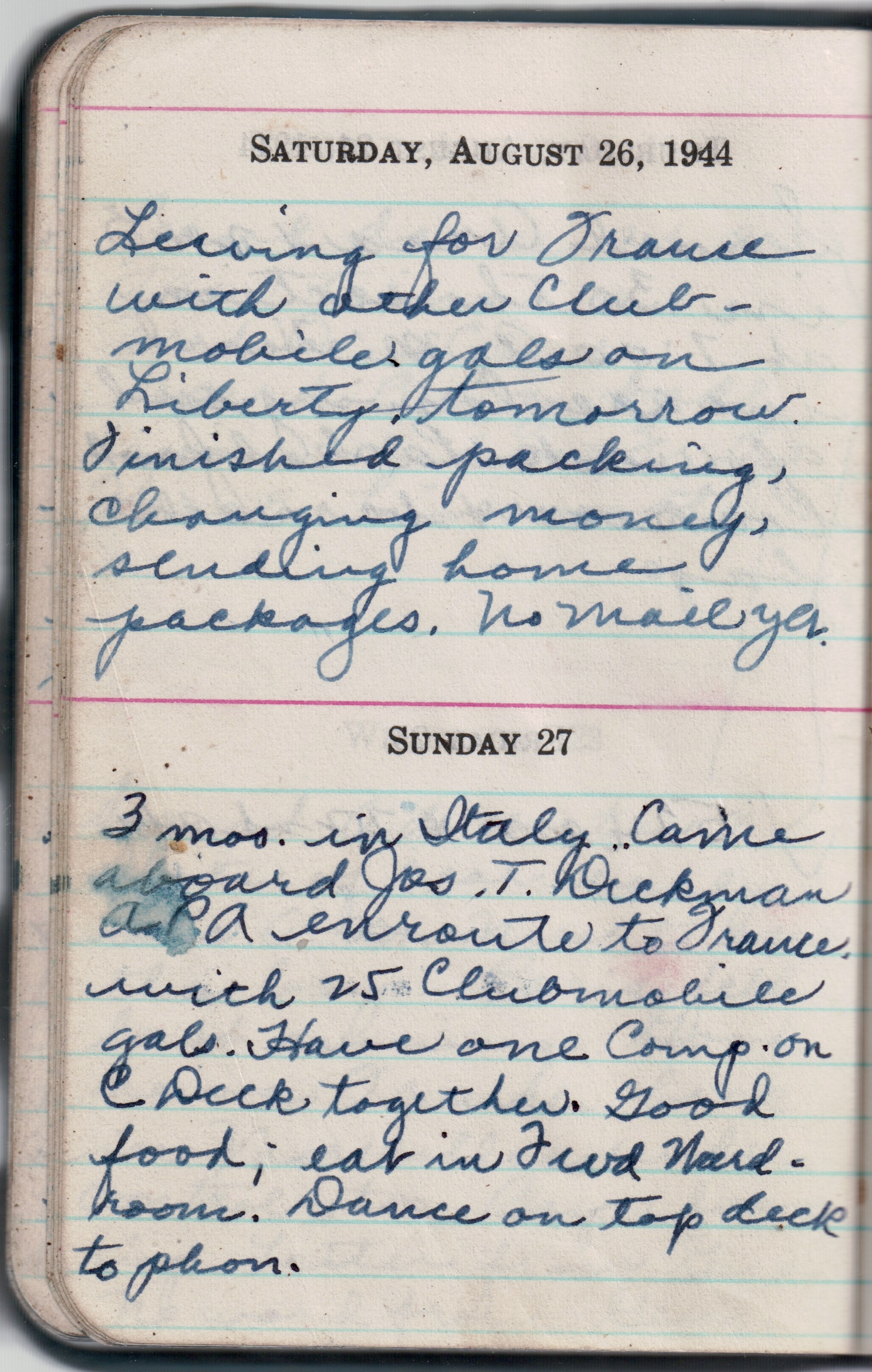
Saturday,August 26, “Leaving for France with other clubmobile gals on Liberty tomorrow. Finished packing, changing money, sending home packages. No mail yet.”
Flo’s diary
Sunday, August 27
“3 mos. In Italy. Came aboard Jos. T. Dickman APA enroute to France with 25 clubmobile gals. Have one comp. on C deck together. Good food. Dance on top deck with phon.”
August 28
“On board ship. Fun with Lt. Scharff. Dancing in moonlight on deck. Very hot in compartment.”
USS Joseph T. Dickman
August 29
“Still on ship—last day. No dance while at sea. Spent time with Lt. Scharff.”
(I don’t know who Lt. Scharff was. Flo did correspond with friends after the war, but there’s no indication she ever saw or corresponded with Lt. Scharff again.)
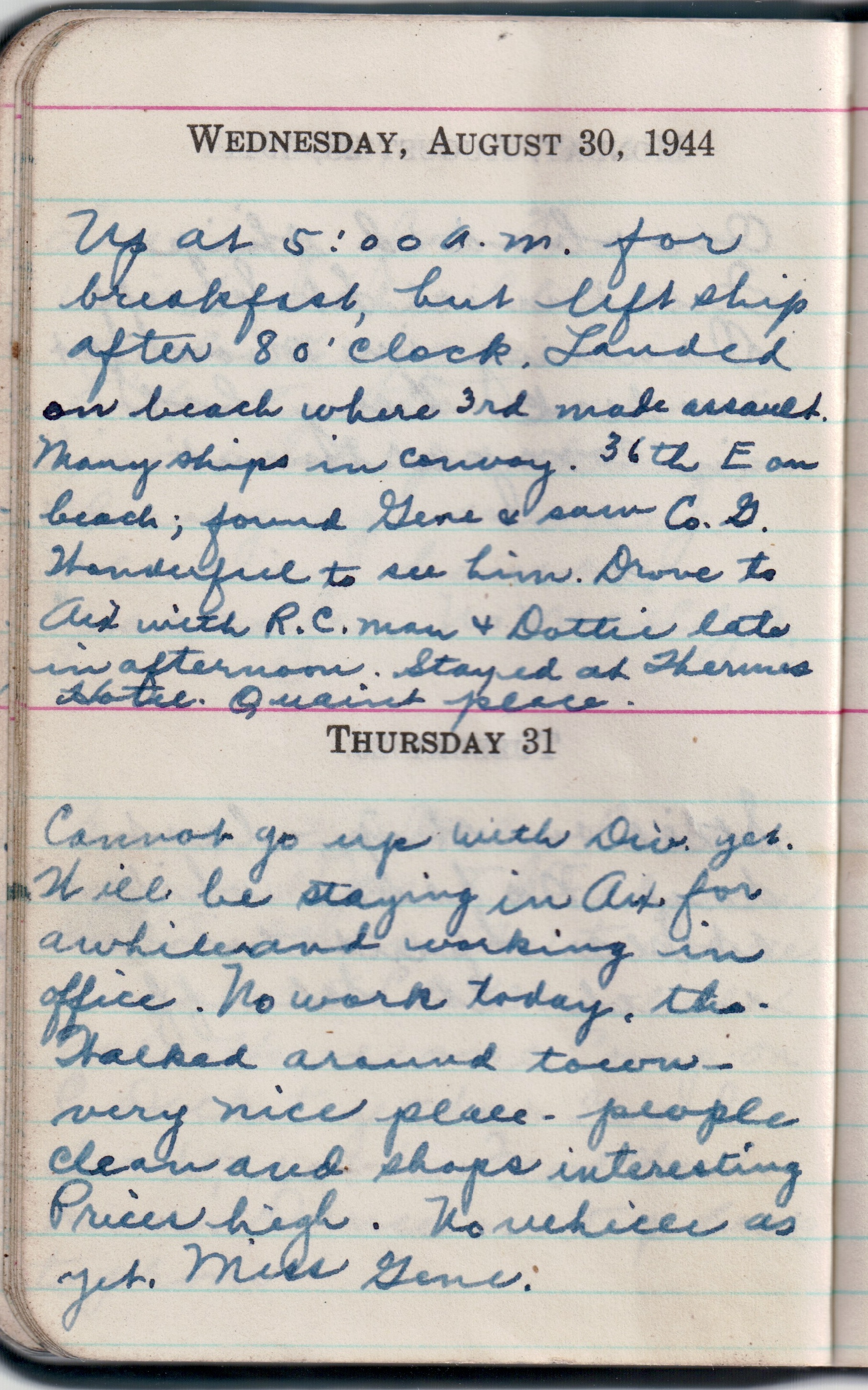
Wednesday August 30
Up at 5:00 a.m. for breakfast, but left ship after 8 o’clock. Landed on beach where 3rd made assault. Many ships in convoy. 36th E on beach; found Gene & saw Co. G. Wonderful to see him. Drove to Aix (Aix-en-Provence) with R.C. man & Dottie late in afternoon. Stayed at Thermes Hotel. Quaint place.
August 31
Cannot go up with Div. yet. Will be staying in Aix for a while and working in office. No work today, tho. Walked around town—very nice place—people clean and shops interesting. Prices high. No vehicles as yet. Miss Gene.
Sunday September 3
Down to Red Beach to see about car. Saw Gene.
September 4
With 36 E
36 E is the 36th Engineers, Flo’s fiancé, Gene’s unit.

























 tradeswomn musings