We once found it in an ally in the JC neighborhood
Santa Rosa, famed for its roses and annual rose parade, is also known as the home of Luther Burbank, the legendary plant wizard. Why did Burbank choose Sonoma County? Simple—because plants here live their best lives. He famously said, “I firmly believe…that this is the chosen spot of all this earth, as far as nature is concerned.”
Before Holly and I tied the knot and set up camp in Santa Rosa, I lived in San Francisco. Every week I’d take the Golden Gate Transit bus to visit Holly. We had this delightful hobby of cycling through various neighborhoods, ogling the stunning gardens and secretly judging people’s landscaping choices.
The ally between Nason and Spencer
On one particularly memorable ride—it must have been April or May in 2010—we spotted a man toiling away in his garden. Naturally, we screeched to a halt, intrigued by his green-thumb magic. As we marveled at his work, the man asked us a curious question, “Have you heard about the oldest rose in Santa Rosa?”
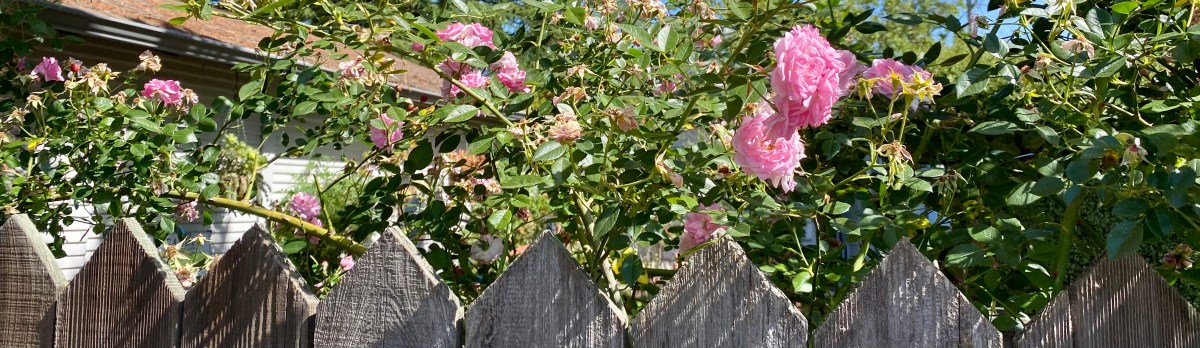
With a sense of mystery, he directed us to an alley between Nason and Spencer in the JC neighborhood. Our mission was clear. We pedaled like detectives on a hot lead until we found the rose. It was a gigantic bush, but, believe it or not, I can’t recall its color. This was pre-cell-phone-camera days, so no pics for proof. Did I smell it? I don’t remember, but I must have, considering I make it a habit to stop and smell the roses around town.
The color? Your guess is as good as mine. I later fantasized it was yellow, like a rose from a century-old house my family moved into back in 1959 in Yakima, Washington. But after diving into rose lore, I’m pretty sure it was pink, which is the go-to hue for ancient roses.
Fast forward to my discovery that roses, despite their ageless beauty, don’t live for a century. The Methuselahs among them might clock in at 35 to 50 years, while the newer hybrids are lucky to hit double digits.
I concur
Roses have a traceable origin. They likely sprouted in Central Asia and migrated to northern Europe over centuries. Rose cultivation kicked off in Central Asia around 5000 years ago. Today’s garden-variety roses are the glam descendants of plants from the Oligocene epoch (33 million to 23 million years ago), with fossils found across Europe, Asia, and western North America.
Recently, I went back to search for the oldest rose. I asked a friend who grew up in the JC neighborhood if she had heard of it. She had, but she didn’t remember seeing it—the stuff of urban legend.
The alley between Nason and Spencer stretches from King St. to Mendocino, morphing into Ridgway. I paced up and down that alley more times than I care to admit, but alas, I didn’t find it. Now I know, roses don’t do immortality.
Maybe someone took a cutting and gave it a fresh start. Perhaps the rose’s spirit lives on in the rural cemetery or the JC rose garden, which boasts some elderly blooms.
Rose or no rose, the alley had its charms. I met some interesting folks and stumbled upon quirky artwork on weathered walls. And so, the hunt for the oldest rose may be thorny, but it’s always blooming with stories.
When I learned about the quarterly circumambulation of Mt. Tamalpais, I pledged to complete it for the summer solstice. A sister hiker, Dolores, agreed to join me.
The practice was begun in 1965 by poets Gary Snyder, Allen Ginsberg and Philip Whalen–a ritualized walking meditation around Mt. Tam. Following the traditional clockwise direction, they selected notable natural features along the way, performing Buddhist and Hindu chants, spells, sutras, and vows at each stop.
There are two walks, the longer one is 17 miles, the shorter 6.2 miles. At 89, Dolores was the oldest hiker, and I at 74 was likely the second oldest. We chose the shorter walk.
We met up at Rock Spring with about 40 long hikers, who had started earlier in the morning at Muir Woods. The temperature was a warm 74 degrees. Fog was coming in from the ocean down below us.
The short walkers join the long walkers for three of the nine stations. Our first stop was the serpentine rocks overlooking the ocean and the Golden Gate, where participants joined in ceremonial readings.
Ascending the serpentine hill; Leader Gifford Hartman reads a Gary Snyder poem to the group
In a poem, Gary Snyder advises us to learn the flowers. On this walk we did our best, focusing especially on native plants.
Few plants can grow in serpentine soil because of its high levels of toxic heavy metals, and low levels of water and nutrients. But a few plants have adapted to serpentine. Some grow right out of the rock.
Native buckwheat (Eriogonum luteolum), native cobweb thistle (Cirsium occidentale) and fog
Next we hiked on to Potrero Meadows for lunch and more readings. One hiker composed limericks just for us. Snyder envisioned the circumambulation as a joyful, creative endeavor, encouraging participants to be imaginative. He emphasized the importance of paying attention to the surroundings and oneself: “The main thing is to pay your regards, to play, to engage, to stop and pay attention. It’s just a way of stopping and looking — at yourself too.”
Walkers gathering at Potrero Meadow. In this area is mostly a Douglas fir, live oak and Bay laurel forest
Hiking through the Bay laurel leaves gave off a wonderful pungent menthol-like fragrance.
Watching for ticks in the meadow; native Mariposa lilies (Calochortus) and Ithuriel’s spear (Triteleia laxa) peeking out of the tall grass
Our next station was the serpentine cairn. We circumambulated the cairn, each tossing a stone upon it and chanting Women Life Freedom. Zan, Zendigi, Azadi.
The chant was led by an Iranian-American woman. The spark for this chant and an uprising of Iranian women was the death of Mahsa Amini, a young Kurdish woman who died after being detained by Iran’s morality police for “improper hijab.”
For me this was the highlight of our trip. I was delighted to be led in this chant, joining Iranian women who have been risking their lives to protest for women’s rights and equality.
Dolores and the cairn (L); a closer look at the green serpentine rock
After that Dolores and I and three others went our own way, leaving the large group behind. We headed along the International trail toward the West Point Inn where I hoped to score a cold drink and maybe a popsicle.
California hedge nettle (Stachys bullata); Tanoak (Notholithocarpus densiflorus)
We saw lots of tan oak, the tree that has been devastated by sudden oak death (SOD). This species seems to be recovering. Soon the younger hikers walked on ahead of us. No problem we said. We have maps! Dolores and I continued together.
Me on the trail to the east slope; native chamise (Adenostoma fasciculatum) in bloom
We entered a plant community of chaparral, characterized by manzanita and scrub oak. Many of the native wildflowers had bloomed, but we found a few late bloomers.
Coming around to the east side of Tam we were treated to spectacular views of the Bay Area.
Looking toward Mt. Diablo (L) we could see smoke from north bay fires blowing into the Napa Valley. The city of Oakland on the far right.
More blooming plants greeted us.
Toyon (Heteromeles arbutifolia), mountain coyote mint (Monardella odoratissima)
I couldn’t stop taking pictures of the view.
The skyscapers of San Francisco appear above the fog right of center.
We’d been so looking forward to a rest stop at the West Point Inn but it was closed for a huge renovation. Some bikers and hikers hung around and we were able to refill water bottles from a spigot.
Built in 1904, it was once a stop on the Mill Valley and Mt. Tamalpais Scenic Railway.
From Old Railroad Grade we headed down the Rock Spring Trail to our starting point at Rock Spring, the final leg of our journey.
California aralia, the only member of the ginseng family native to California; Yerba Santa (Eriodictyon)
We were happy not to have to compete with bikes or horses on this trail.
Sign on the Rock Spring trail, Coast silk tassel (Garrya elliptica)
We knew we were close to the end of our circumTambulation when we came to the Mountain amphitheater, the 4,000-seat open air theater opened in 1913. This is the venue for the annual Mountain Play. Structures for this year’s play, Kinky Boots, were being struck. We were beat!
The Mountain Theater seats, taking a break near the end
Back on the road we got a bit lost. Which way to Rock Spring? We flagged down a passing car. Take that trail right there said the occupants. They were two of the young 17-mile circumabulators, already finished with their long walk!
Circumambulation (from Latin “circum” meaning around and “ambulātus” meaning to walk) is the act of moving around a sacred object or idol. This practice is integral to Hindu and Buddhist devotional rituals (known in Sanskrit as pradakśiṇā) and is also present in Christianity, Judaism, and Islam.
Native bush lupine blooming on the west slope, Deep in the redwood forest
Seeking rituals associated with solstices, I discovered one right here in the Bay Area that has been ongoing since the 1960s at the iconic Mt. Tamalpais in Marin County.
My wife, Holly, introduced me to the circumambulation of Mt. Tam, having learned about it from the poet Gary Snyder, who initiated it. Unfamiliar with the term, I had to look it up. Once I did, I found myself repeating it because it’s such a cool word and fun to say.
A new bridge on the Steep Ravine Trail, Looking south at the golden gate and San Francisco
The Genesis of CircumTambulation
The circumTambulation (as it has been called) was started by Snyder, Philip Whalen, and Allen Ginsberg. They were inspired by ceremonial circumambulations that Snyder, and later Ginsberg, learned about during their travels in Japan, India, and Nepal. These men, part of the Beat movement, had studied Buddhism and aimed to introduce Eastern enlightenment to Western audiences.
In 1965, after a decade of studying Zen Buddhism in Japan, Snyder returned to California. He, along with Whalen and Ginsberg, embarked on a ritualized walking meditation around Mt. Tam. Following the traditional clockwise direction, they selected notable natural features along the way, performing Buddhist and Hindu chants, spells, sutras, and vows at each stop.
The hike spans 15 miles and is typically completed in a day. During summer, the long daylight hours are sufficient to finish the trek, while in winter, flashlights may be needed. I was relieved to learn that there is also a 6.2-mile option where participants can join the long walkers halfway.
Trail signs; View of redwoods, Bolinas and the Pacific Ocean
A Dive into Beat Poetry
Learning about this ritual led me to explore the Beat poets further. San Francisco and the Bay Area was ground zero for the Beats and they congregated here. Snyder lived in a shack on Mt. Tam’s southeast slope during the 1950s, where he was visited by other writers of the time.
This prompted me to read Jack Kerouac’s “The Dharma Bums,” which recounts his famous hike with Snyder over the mountain from Mill Valley to Stinson Beach and back. Kerouac also describes an epic three-day party at Snyder’s shack before Snyder’s departure to Japan in 1956. Although the shack was demolished long ago, the house still stands on the property in the Homestead neighborhood near the Pixie Trail. Commenters on AllTrails mention it’s not well maintained, but I still want to hike there.
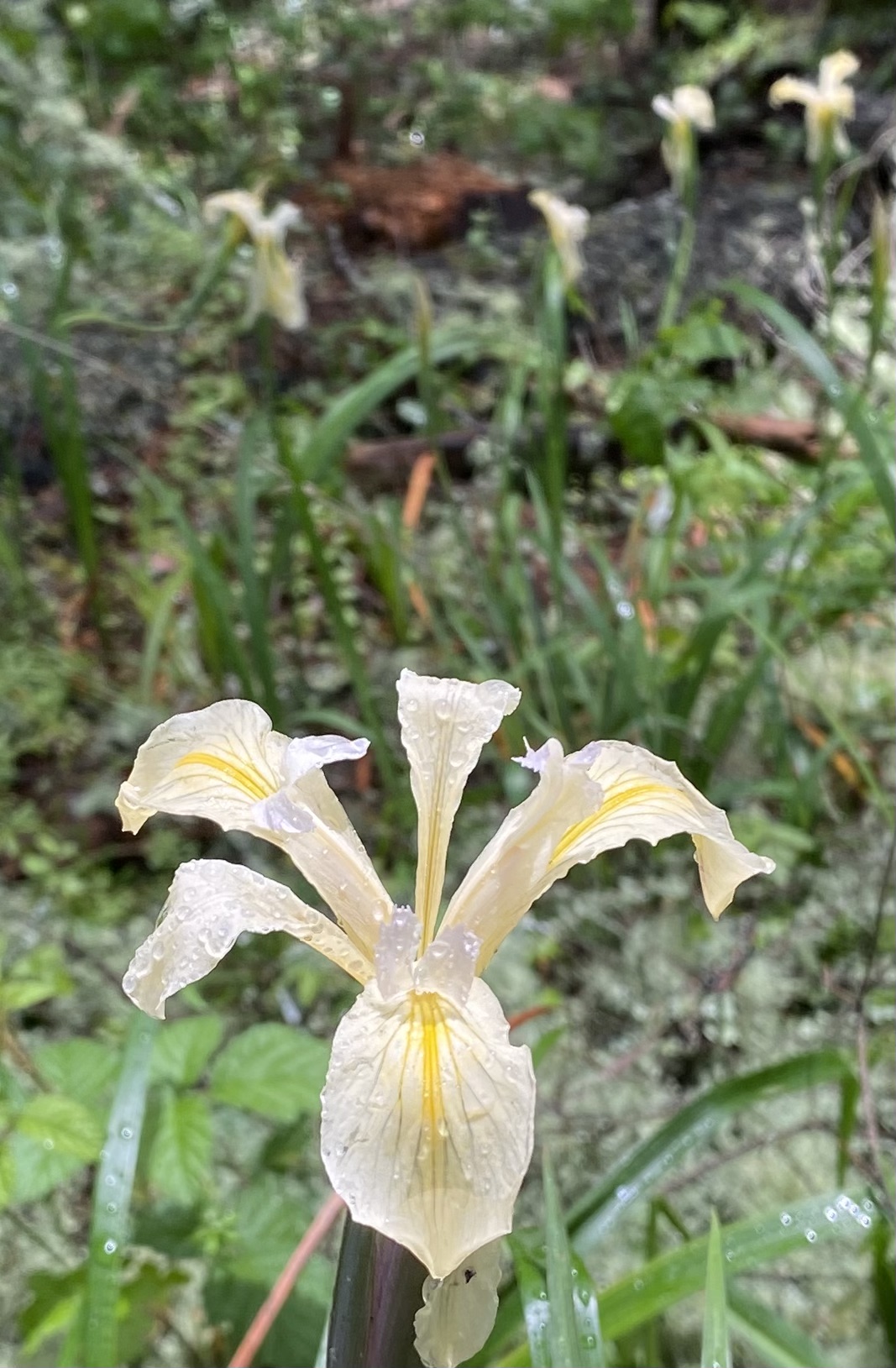
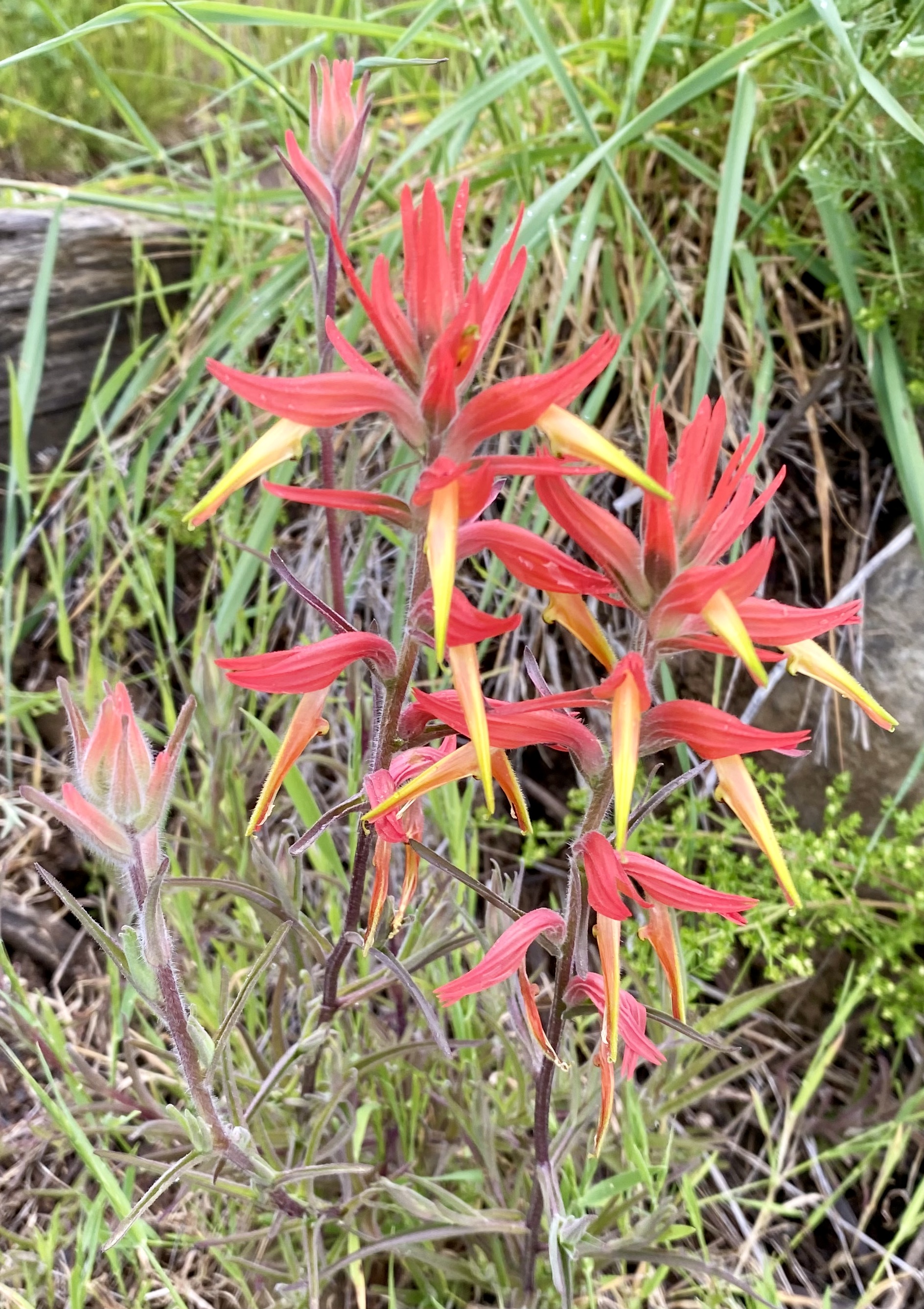
Native Douglas iris, cool paintbrush (a kind I’d never seen before)
Reflections on the Beats
As I trace the path of circumTambulation, I think about Snyder, Ginsberg, and the Beats. They were often egotistical and sexist, but also perhaps geniuses. Kerouac was likely schizophrenic, and Neal Cassady a “charismatic sociopath.” Much has been written and filmed about them, but women in their circle received little recognition until recently.
Through Snyder, I discovered the poet Joanne Kyger, who married him in 1960 in Japan and traveled with Snyder, Ginsberg, and his lover Peter Orlovsky to India, meeting the Dalai Lama. Kyger, a serious poet herself, recorded her travels in diaries published in 1981 as “The Japan and India Journals 1960-1964,” providing a rare female perspective on the male-centered Beat movement. Kyger settled in Bolinas and lived there until her death at 82 in 2017.
Despite being part of the same journey through Japan and India, Kyger is often omitted from accounts that only mention Snyder, Ginsberg, and Orlovsky. Her diaries are a testament to her presence and contributions during this significant period.
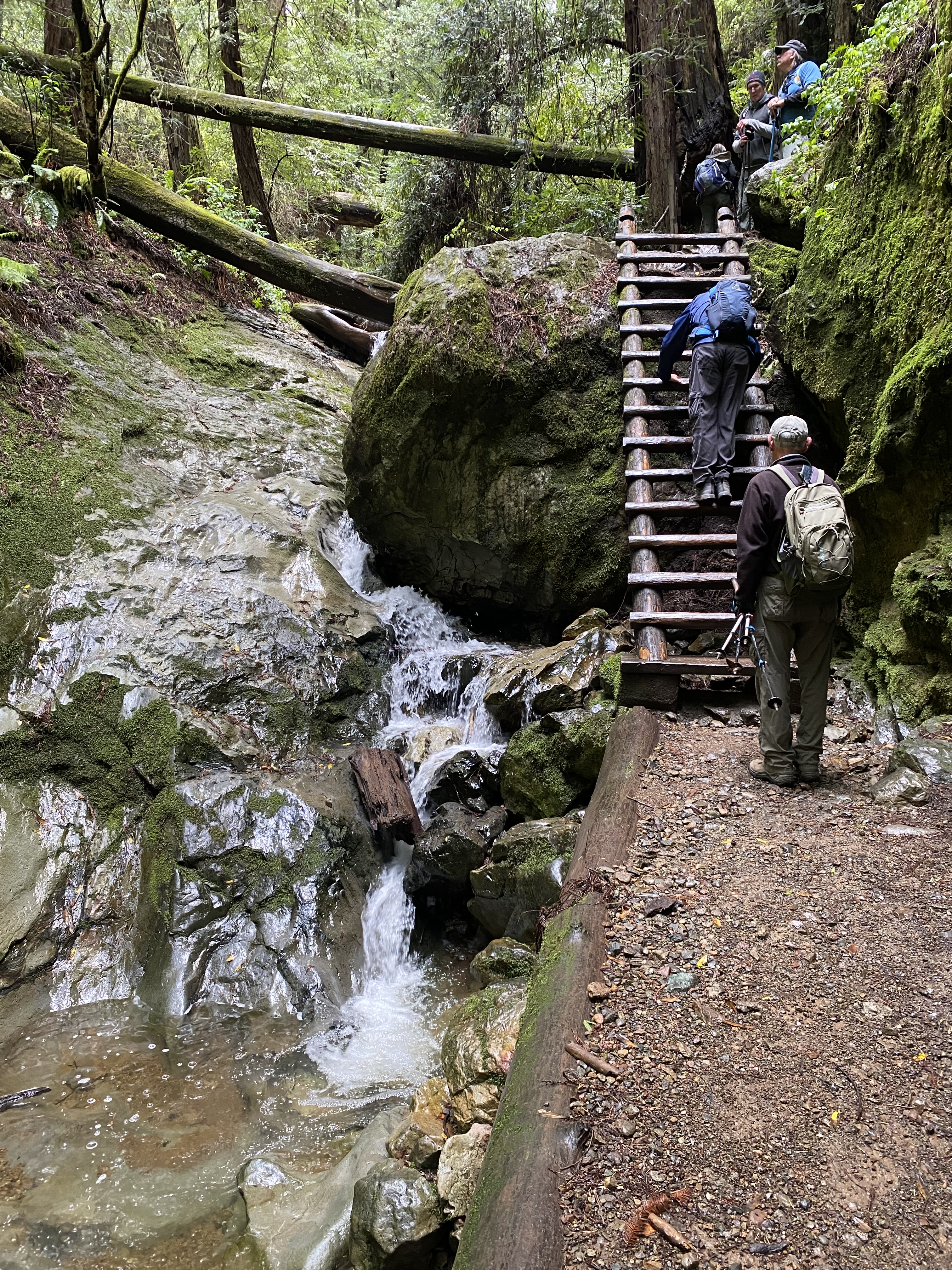
Climbing the ladder on the Steep Ravine trail
Continuing the Tradition
Snyder envisioned the circumambulation as a joyful, creative endeavor. He encouraged participants to be imaginative, stopping at points his trio had designated or choosing their own. He emphasized the importance of paying attention to the surroundings and oneself: “The main thing is to pay your regards, to play, to engage, to stop and pay attention. It’s just a way of stopping and looking — at yourself too.”
Since the fall of 1974, the circumambulation has taken place on each solstice and equinox (or the closest Sunday), starting and finishing at Muir Woods National Monument. The tradition has been led by dedicated guides, first Matthew Davis, then Laura Pettibone, and currently Gifford Hartman, a San Francisco-based educator and labor historian.
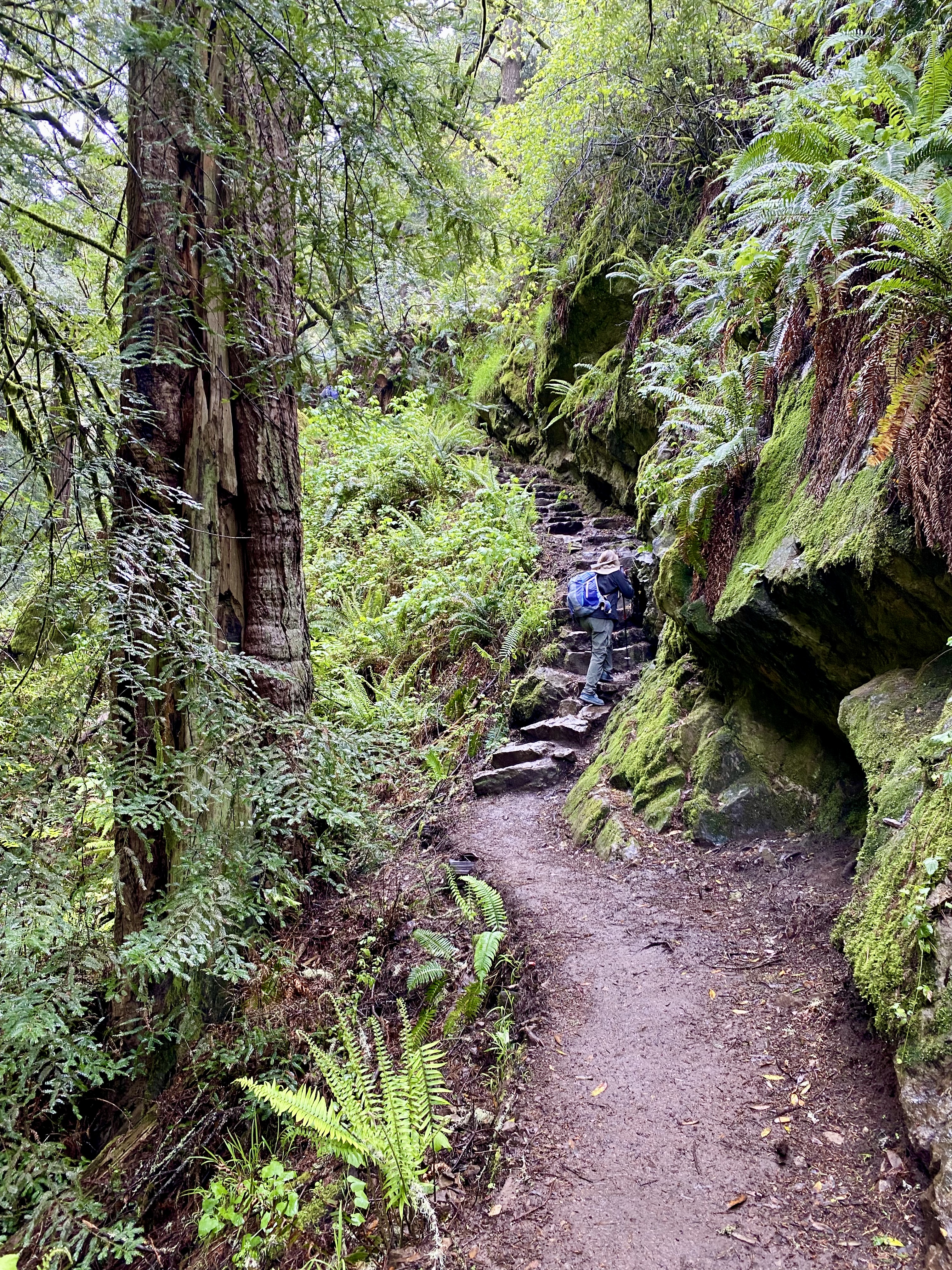
Lots of mosses and lots of steps
Historical and Spiritual Significance
Mount Tamalpais (tamal = west, pais = hill or mountain) is sacred to the native Coast Miwok people, as well as other native groups. Along with other mountains visible from Sonoma County—Sonoma in the Coast Range, Hood and Kanamota (St. Helena) in the Mayacamas Range, and Diablo (tuyshtak in Ohlone)—Mt. Tam retains its spiritual character.
The US military destroyed Mt. Tam’s summit in the 1950s, establishing a base and lookout during the Cold War. Gary Yost’s film “The Invisible Peak (hidden in plain sight)” explores this history https://www.youtube.com/watch?v=y6TA-jbZqQU. I also recommend Will Hearst III’s video about Snyder, “The Practice of the Wild.” https://vimeo.com/418682866
Embracing Tradition
The ending of Gary Snyder’s poem “For the Children” encapsulates the spirit of this tradition:
stay together learn the flowers go light
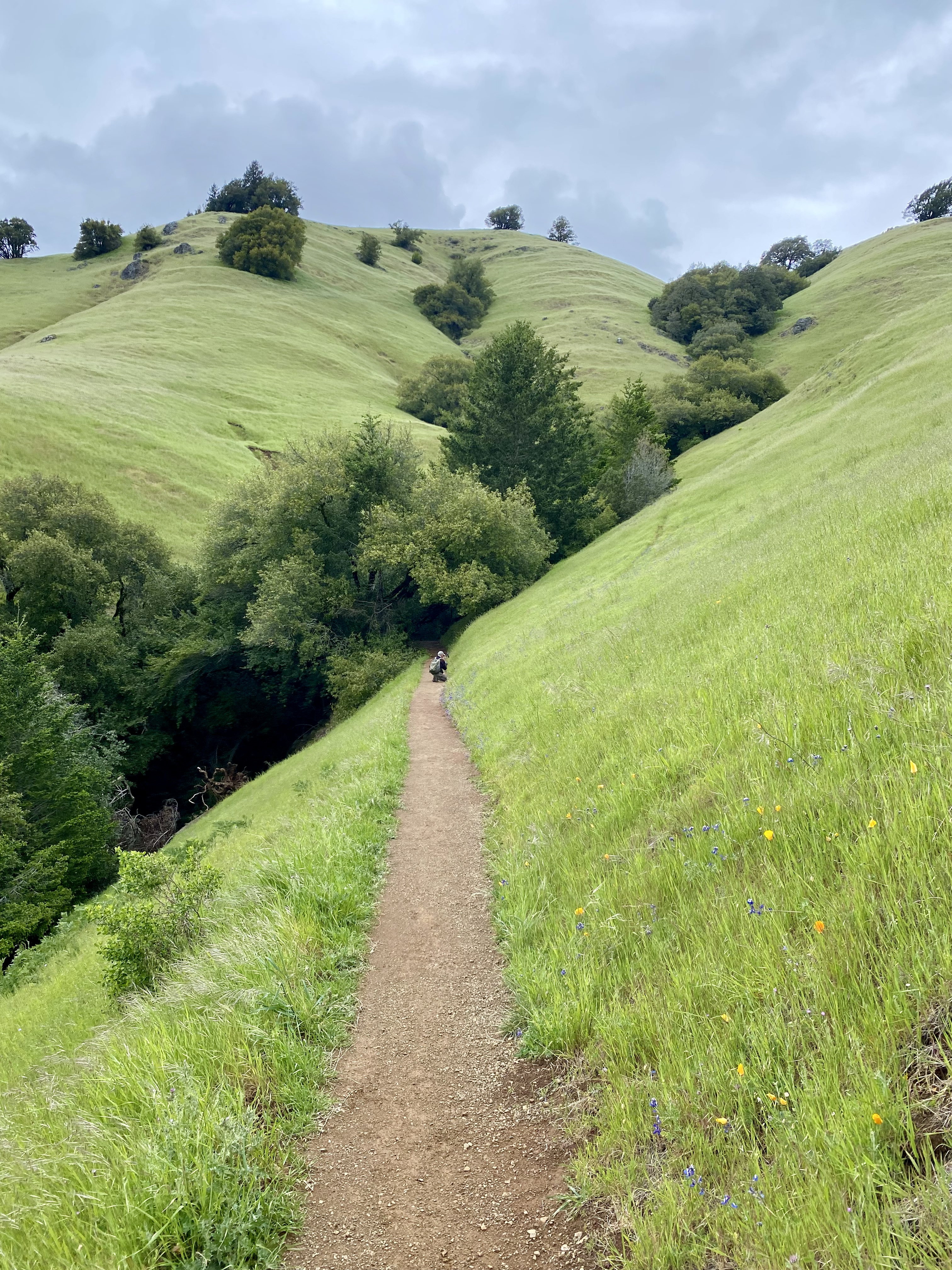
Looking south toward San Francisco, Photographing flowers on the west slope
I try to live by this advice as I hike around our beautiful Bay Area open spaces. I joined a hiking group whose average age is 80. At 74 I’m one of the young ones. One woman at 93 still leads us on seven-mile hikes. We stay together to help each other in case of inevitable disasters (I’ve had a couple of falls this season but didn’t break anything). We learn and delight in the flowers, although with my poor memory I must relearn them every year (I think there’s something very Zen about that). And perhaps our old age inspires us to go light in its many senses. I took these photos on a Mt. Tam hike on the Dipsea, Steep Ravine, Coast View and Matt Davis trails in early May.
I plan to celebrate this summer solstice by joining the circumTambulation on Sunday, June 23. Please join me. For more information, visit: CircumTambulation.
My Regular Pagan Holiday Greeting: Celebrating Beltane May 1
Mary Ellen Pleasant, the mother of California civil rights, is associated with the pagan holiday Beltane because she once owned and lived at Beltane Ranch, here in Sonoma County. It is now recognized as a Black historic site by the National Park Service. Once the richest Black woman in America, her wealth was stolen and she died a pauper in 1904. She is buried in the Tulocay cemetery in Napa.
I wrote about Pleasant last year on Beltane, but I wasn’t finished thinking about her. She is a supremely important person in California history, but one who has been largely forgotten. I’m all about resurrecting her memory.
I refer to her as MEP because that is how she signed the note found in the pocket of John Brown before he was hanged for treason and inciting a slave rebellion in 1859. The note read, “The ax is laid at the foot of the tree. When the first blow is struck, there will be more money to help.” MEP had financed Brown’s raid on Harper’s Ferry with a donation of what today would be a million dollars. Because her initials were read as WEP, she was never caught by Virginia authorities.
MEP was born in the East where she worked to bring slaves up north on the underground railroad until slavers threatened her. Along with a number of fellow abolitionists, she migrated to California in 1850. She sailed first to New Orleans where she continued to help people to flee slavery. During her short time there she connected with the legendary voodoo queen Marie Laveau. She left the city just as she was about to be captured for helping runaway slaves.
The party landed in San Francisco where abolitionists found plenty of work to do. In California of the 1850s the law allowed any Black person who did not have proper papers to be sold into slavery. Slave catchers and slave owners came west looking for runaways. Slave owners who arrived in California before September, 1850 were allowed to keep their slaves as indentured servants.
My wife’s family traces their ancestry to Peter Burnett, the first elected governor of California, but of this they are not proud. Burnett, a Missouri immigrant, slave owner and white supremacist, promoted some of California’s most racist laws including enabling the enslavement and genocide of American Indians, the Chinese Exclusion Act, and a push for the total exclusion of Blacks from the state. Earlier, as a judge in Oregon territory, he signed the first exclusion laws which required all Blacks to leave the territory or be flogged.
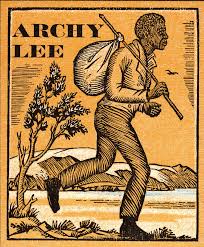
Burnett and MEP were destined to tangle. At the time Blacks were not allowed to testify in court. MEP helped get this law changed, but in the meantime she defended and hid Blacks unfairly captured. She paid the legal bills of young Archy Lee, brought as a slave from Mississippi, a slave state, to California, a free state, in 1857.
In the first case, Lee was declared free, as California allowed only “transient” slave owners to retain their slaves. Then, in an appeal to the state supreme court, Peter Burnett (by this time he was a member of the court) authored and signed the court’s decision to allow the slaveholder to leave the state with Lee as his slave.
From the court ruling: “It must be concluded that, where slavery exists, the right of property of the master in the slave must follow as a necessary incident. This right of property is recognized by the Constitution of the United States.”
Californians were outraged, and abolitionists boarded the ship to rescue Lee as it was leaving the state. A federal court overturned the Burnett decision, but then the slaveholder charged that Lee was in violation of the Fugitive Slave Act of 1850. A final trial declared Lee to be a free man. Archy Lee joined an expedition of African Americans who resettled in Canada.
Burnett was only governor for a year, then on the supreme court for less than a year, but he and other Southern whites impressed racist ideology on California in that short time. Reading the history, I’m truly amazed that a failed shop owner who had fled Missouri in debt could leave such a smear on the new state. California citizens have since learned the history and taken Burnett’s name off public buildings.
I wanted to see MEP’s grave so my friend Joan and I made the pilgrimage to Napa this spring. When we visited, the cherry trees surrounding it were in full bloom. Tucolay is a beautiful big cemetery and MEP’s grave is situated in a lovely corner.
When my friend Bill had visited last year, the gravestone was covered with voodoo icons like skulls with a vase of black roses. Icons had been glued right onto the stone, obscuring the inscription. Was it the work of a modern voodoo cult that surrounds her because of her association with Madame Leveau? At my visit the skulls had been removed, but traces of glue remained.
MEP said, “Before I pass away, I wish to clear the identity of the party who furnished John Brown with most of his money to start the fight at Harpers Ferry and who signed the letter found on him when he was arrested.”
She said it was the most important and significant act of her life, a life spent working to end human slavery.
On Beltane we celebrate the life and work of MEP and we also devise our own rituals to acknowledge the changing of the seasons. Our winter was cold and wet—about twice as rainy as normal. There was no spring; we graduated into summer on easter weekend. The sun came out with a vengeance and all the buds and flowers that had been patiently waiting for it burst forth in profusion. Grass of every variety grew tall. Lawn mowers revved. Fence lizards emerged. Ants vacated the kitchen. Bees and pollinators are waking up.
On Easter, instead of hunting for eggs, we concocted a ritual with friends who periodically drink Prosecco with us. It’s Linda’s job to pop the corks, and they can travel far into the garden. We hunted for corks instead of eggs. This, we expect, will become an annual custom.
I’ve just picked the last of the oranges and am about to start harvesting artichokes. We planted flowers and vegetables. I put away my warm slippers and took out my flip flops. I kissed the gloves I’d worn all winter, thanked them for warming my hands on many chilly hikes and tucked them into a drawer.
They nearly died in the 2017 Tubbs fire that destroyed their home
Judy (L) and Pam
As Pam Bates and Judy Helfand celebrate their 40thyear together they marvel that they are still alive to do so. They nearly perished in the fire that destroyed their Sonoma County home in 2017 and killed 44 people.
A fire sculpture hangs from a blackened walnut tree. The farm was once a walnut orchard
“We were in bed hard asleep when a neighbor called to tell us fire was coming over the ridge. Then the electricity went off. Where we live that means you have no lights andno water,” said Pam. They barely had time to dress and throw a few things in the car. Judy grabbed photo albums. They gathered up the two dogs and the one cat they could find, let the goats and horses out of the barn, leaving the chickens locked in to protect them from predators.
Pam distracts a hen while she gathers eggs
Pam remembered, “It was really windy that night. As I was on my way down to the barn I looked up and saw undulating red-hot embers floating over my head. That was really scary. I could see an orange glow coming over the hill moving very fast.”
They drove out through flames; smoke so thick they couldn’t see the road in front of them. “I’ll never get over that experience,” said Pam. “We got through it but I’ll never get over it.”
Path of the fire
The fires burned for a week and when Judy and Pam were finally able to sneak back to their 20-acre property they found their house, barn and outbuildings had burned to the ground. The horses and goats were singed but still alive. They had lost only one cat, their parrot and the chickens. “And everything else,” added Pam.
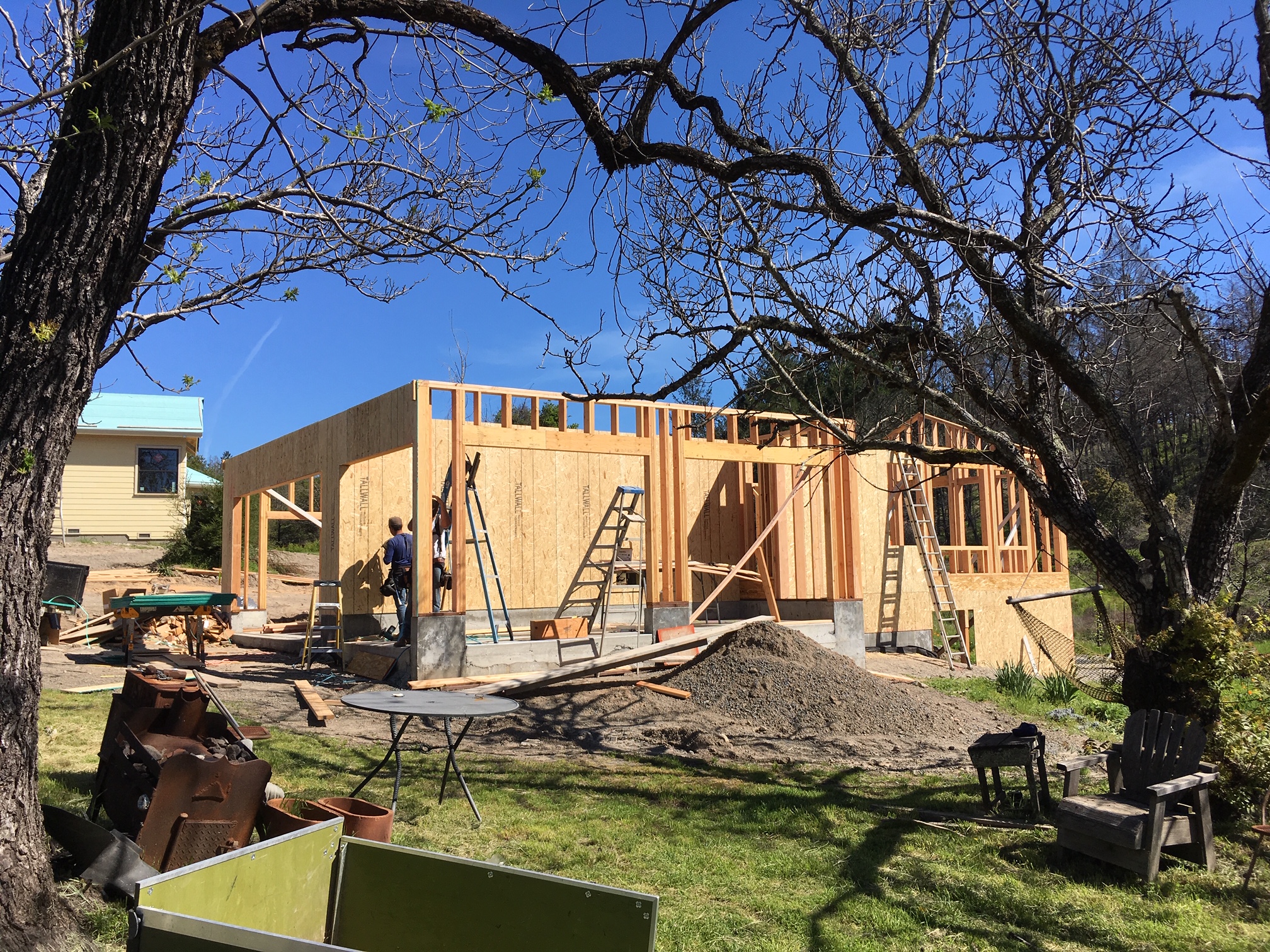
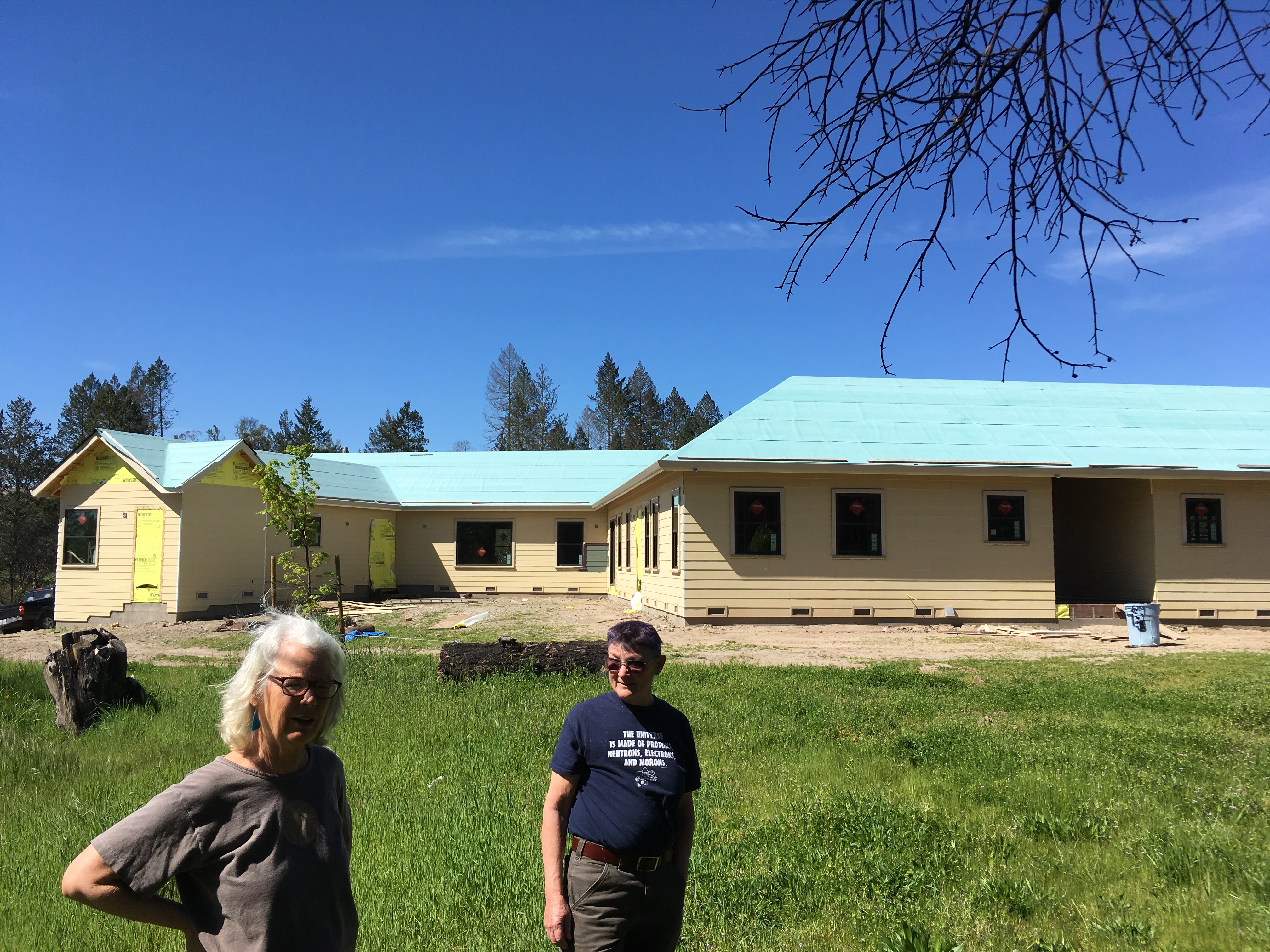
All roughed in and ready for sheetrock
A year and a half later the couple has nearly finished rebuilding the farm they’ve called home for four decades. They bought a used motor home, parked it on the land and got to work, employing a contractor to build two yurts and a chicken house first, then the house and a garage/shop. Judy has planted a flourishing garden. The 25 new chickens are laying; many of the trees are recovering. Pam estimates construction will be finished by November. “And we’re still speaking to each other,” added Pam.
Pam and Judy’s temporary home
They met at a Women Against Rape meeting. “Judy was married to a man and seven months pregnant. I saw her across the room and thought she was beautiful,” remembered Pam.
The new garage/shop takes shape
Pam is a phenomenon in the tradeswomen community. She retired at 60 after 30 years as a union pipe fitter, one of few women to hang in through harassment and sexism till retirement from the trade. Judy is active with Racial Justice Allies of Sonoma County. She retired after teaching at Santa Rosa Junior College for many years. They have two kids, and grandkids who visit often.
The new house will have fire-resistant siding and roof.
Now green hills and blooming flowers mask the immense pain and suffering the fires inflicted on Northern California. For this old lesbian couple they symbolize renewal and a new chapter in life.










 tradeswomn musings