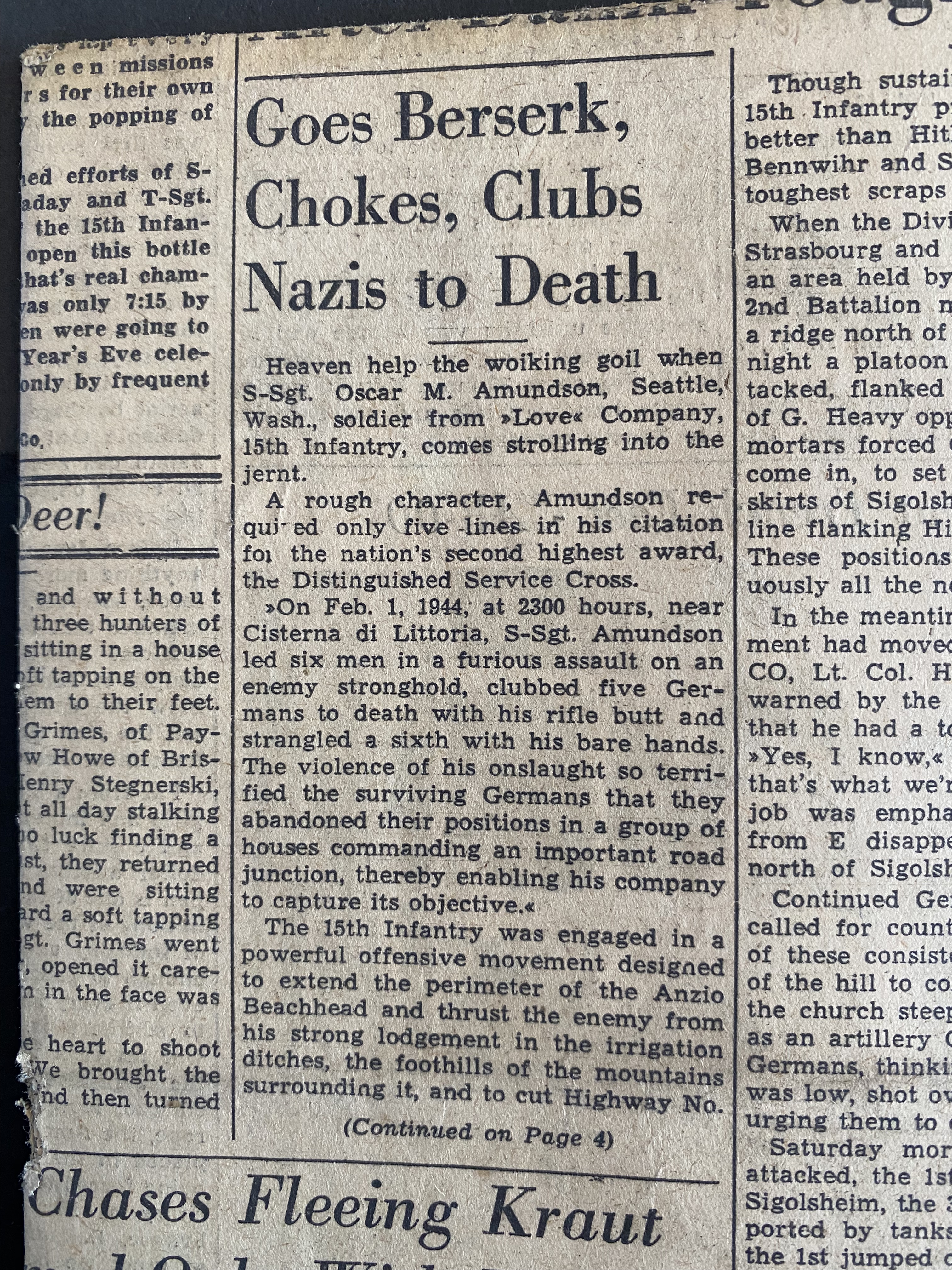
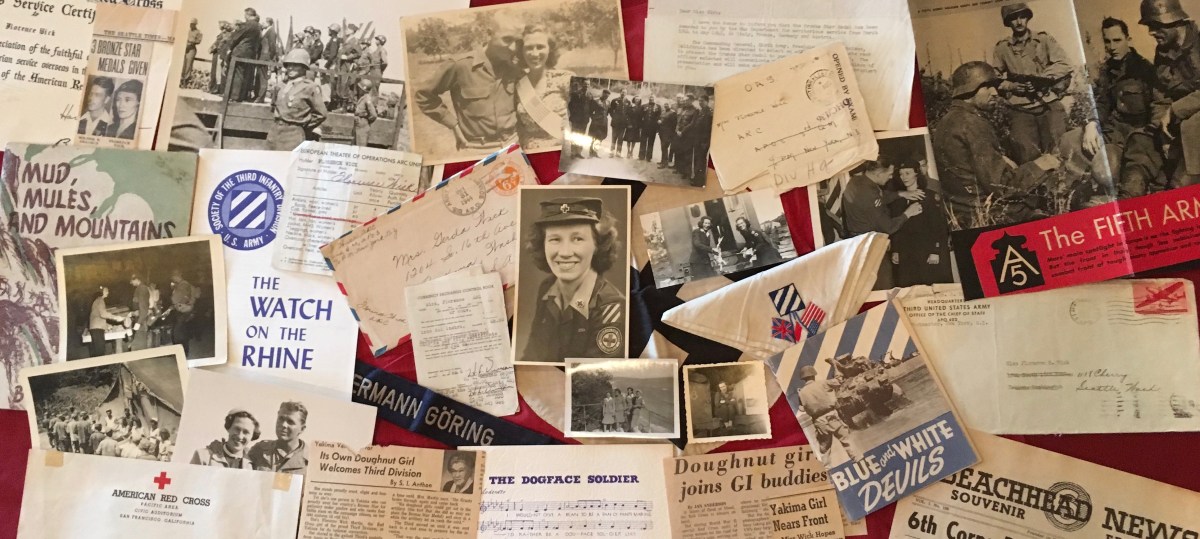
The only photo on this page, of the shelled St. Die, was presumably taken by Flo. There is also a copy of the Third Division FrontLine newspaper which tells the story of a soldier from Seattle who killed several Nazis in hand-to-hand combat. Probably Oscar Amundson was someone she knew from her home state of Washington.
Photo: Dogface Soldier Collection
The FrontLine newspaper was started in World War II. Published weekly, it is still the official periodical for the Third Infantry Division.
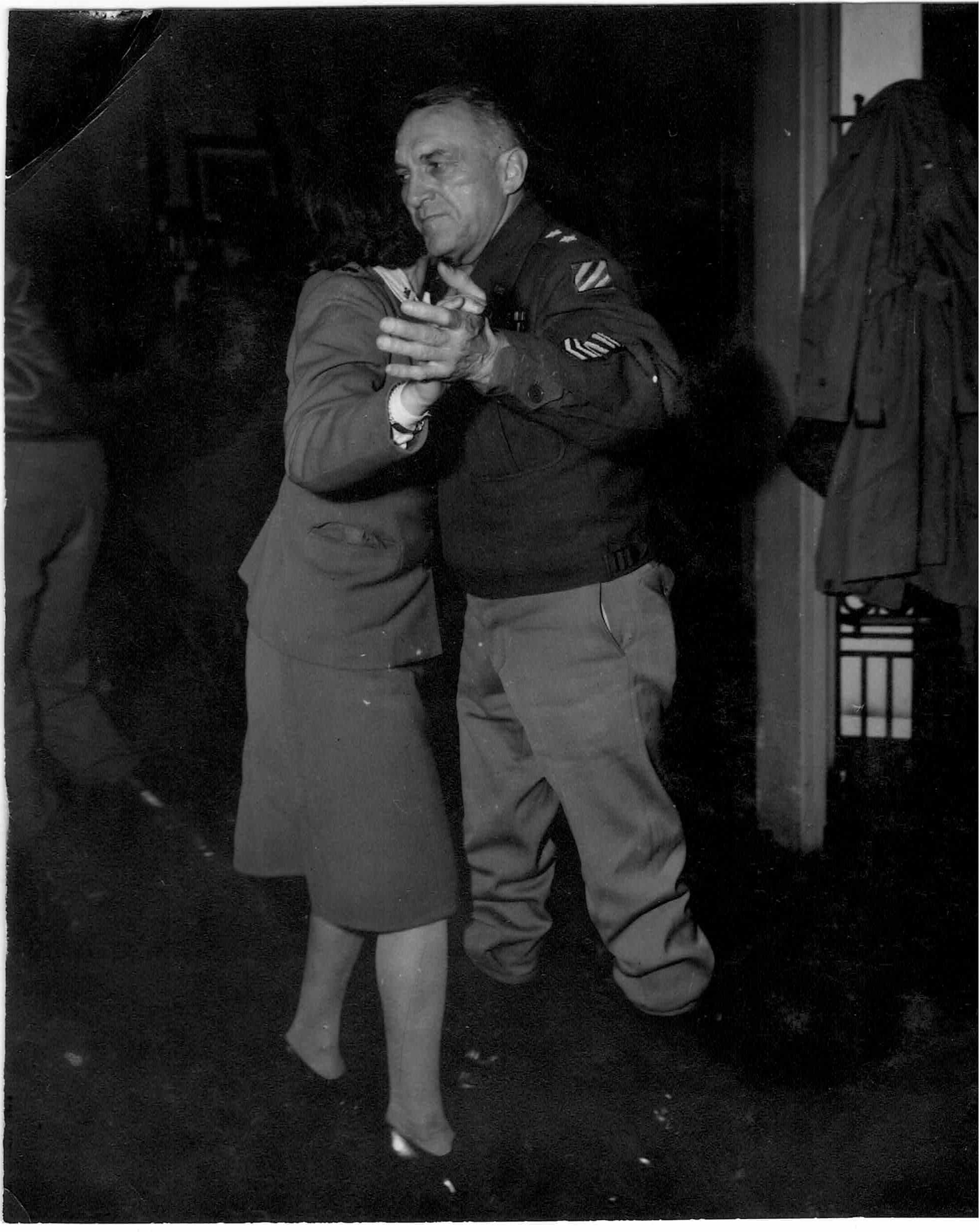
Flo and crew attend officers party at Division Headquarters
My Mother and Audie Murphy Ch. 50
In January, 1945, the Third Division headquarters moved to the town of Sainte-Marie-Aux-Mines, known for its iron mines from the time of Roman occupation. This region of Alsace-Lorraine has been passed back and forth like a football between empires for centuries and is still characterized by a blend of German and French influences. After the 1870-71 Franco Prussian war, Alsace was annexed by Germany and became a part of the unified German Empire as a formal Reichsland, or imperial territory. After World War I the victorious Allies detached it from Germany and the province became part of the Third French Republic. Occupied and annexed by Germany during World War II, it was returned to France by the Allies at the end of the war.
I don’t see Flo in these pictures, so perhaps she was the photographer. She wrote that she was using a captured German camera so she may have had it at this point. There’s Liz sitting next to Gen. Iron Mike O’Daniel, who is also pictured dancing with two different women I don’t recognize. The other clubmobilers must have been there but their backs are turned to us.
“Total damage: one volkswagon and 1500 donuts,” so read unit B’s report of accident. Back of the simple statement, however, was more than meets the eye.
Sent to serve an artillery unit of the infantry division to which they are attached, Florence Wick and Janet Potts took off for the assignment in their captured German jeep or volkswagon.
Liz and Flo with the captured VW jeep. Later it became The Thing
Down the road they went, bounding happily along in the mud. The car ran smoothly while the girls served their coffee and then things began to happen.
“After covering part of the battalion,” Miss Wick reports, “our car caught on fire from a short in the wiring system, and a few minutes after we had gone out the only door in front that worked, the gas tank exploded and threw gasoline across the highway and held up traffic for several minutes.”
Nothing daunted, the girls thumbed a ride back to their donut shop, a little shaky, then started out again with more donuts and covered the balance of their day’s assignment.
After the war, Flo still drove Volkswagens
Flo developed a hatred for Germans; they killed her fiancé and many of her friends. But she wasn’t one of those war survivors who refused to drive German-made cars after the war. She hated krauts, but she loved their cars.
At the start of their service the clubmobilers were told they would be issued a 2 ½ ton truck retrofitted with a kitchen and equipment for making coffee and donuts. But they travelled through Italy and France before they finally got their truck in Germany. Until then the women had to scrounge vehicles in which to carry their donuts to the troops. They used any vehicle they could get their hands on; for a while it was a recommissioned ambulance. Later they used a captured German Volkswagen. It seems this was not the vehicle that blew up. Flo notes that they left the Volks behind when they crossed the Rhine into Germany.
Flo sent the photo to Wagen Wheels, the Volkswagen magazine, in 1973. She wrote to them:
“Leaning on their ‘donut delivery wagon’ are Liz Elliott of Manhattan, New York, and Flo Wick of Yakima, Washington, donut gals with the American Red Cross in World War II. They were attached to the famed Third Infantry Division which left from home base at Fort Lewis, Washington in 1942 for North Africa, thence to Sicily, Anzio, Rome, France and Germany, ending the war in Salzburg, Austria in 1945 and with more Congressional Medals of Honor than any other unit in World War II (a majority posthumous). Most famous Congressional Medal holder, Audie Murphy, later made his movie, “To Hell and Back” in the Yakima area.
“Their vehicle is an original People’s car (Volkswagen) which the German people bought, contributed to the Fatherland for the war with the promise that after the war (and victory, of course), their car would be returned to them.
“Fortunately, the American and British armies were able to spoil their plans and when this particular VW “German jeep” was captured in France in 1944 it was presented to the 3rd Division’s four Red Cross girls who converted it into a donut wagon in which they delivered Red Cross donuts to units of the combat division in all the best mountains and fields of France. Later, after crossing the Rhine into Germany and leaving the Volks behind, they had a more military vehicle in which to deliver donuts—a 2 ½ ton clubmobile truck.
“Flo Wick, Red Cross Clubmobile Captain, from Yakima, Washington is now Mrs. Carroll Martin of that city—mother of a daughter and three sons—daughter and eldest son college students. She is the happy owner of a VW Squareback in which she commutes from her home in Yakima’s West Valley to her office in Selah, some 15 miles, every day. There are two other VWs in the Martin family—one, another Squareback, used by the 19-year-old son, and the other, a red Beetle, operated by the youngest son, a junior in high school. None of these, however, can match the ugly little original for stamina and glamor. After all, not many VWs have “fought” on both sides of World War II!”
In 1944, while in France, the Third Division “liberated” one of the Wermacht’s famous Kubelwagens. A second incarnation was called The Thing.
Flo’s story was published in the 1973 Wagen Wheels magazine.
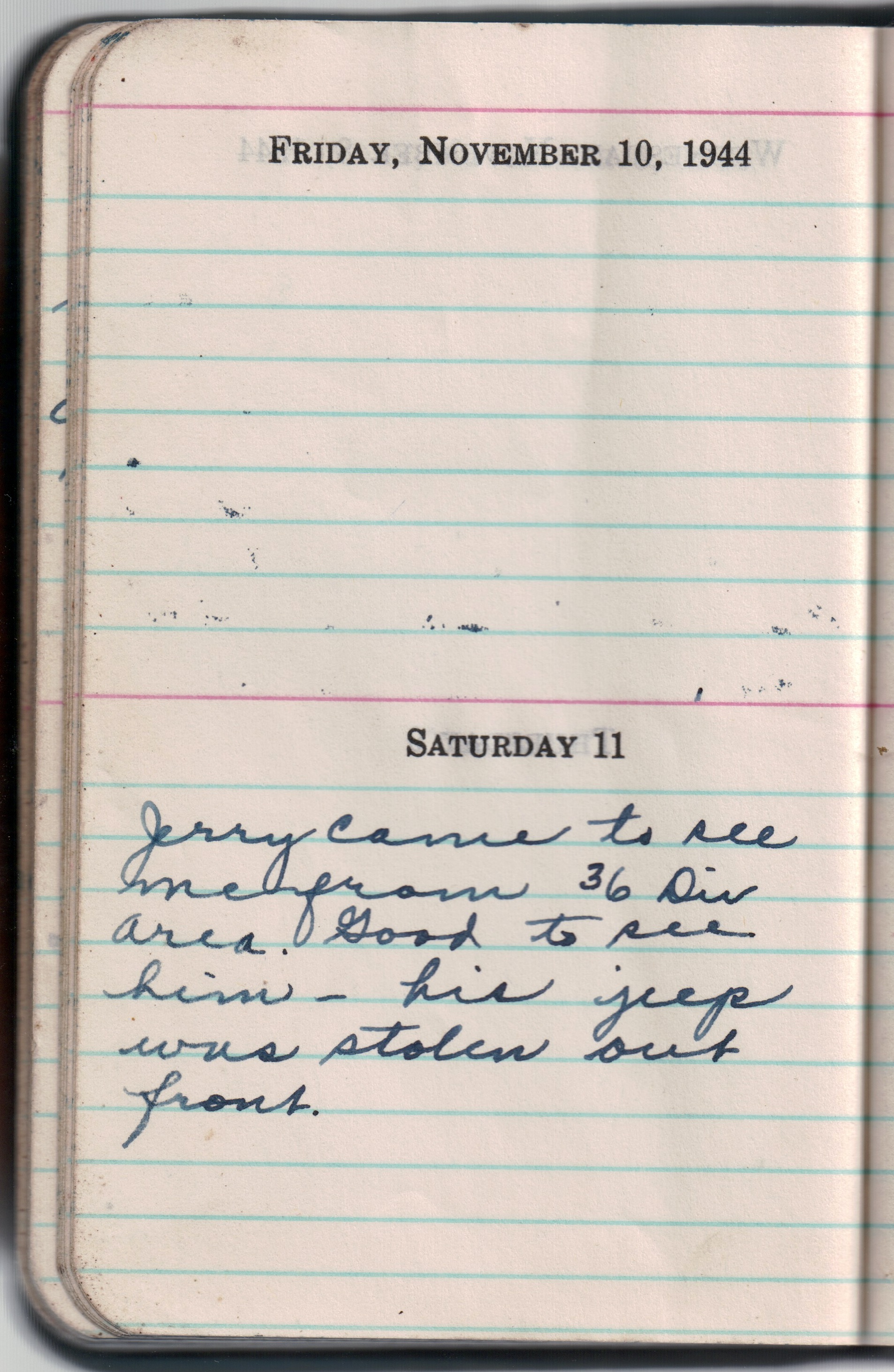
Flo had written her mother after Gene’s death that she planned to go to Paris to visit her sister Eve who worked as an Army nurse in a hospital there. She may have done so but there is no record of it in her diary or album. Her final three diary entries note that she attended a dance in Epinal on Nov. 1. Then she visited with boys from Gene’s company Nov. 11 and 12. If she traveled to Paris in the meantime, it can’t have been a happy trip, but she would have been glad for comfort from Eve and her ARC friend Janet Tyson, who traveled with her.
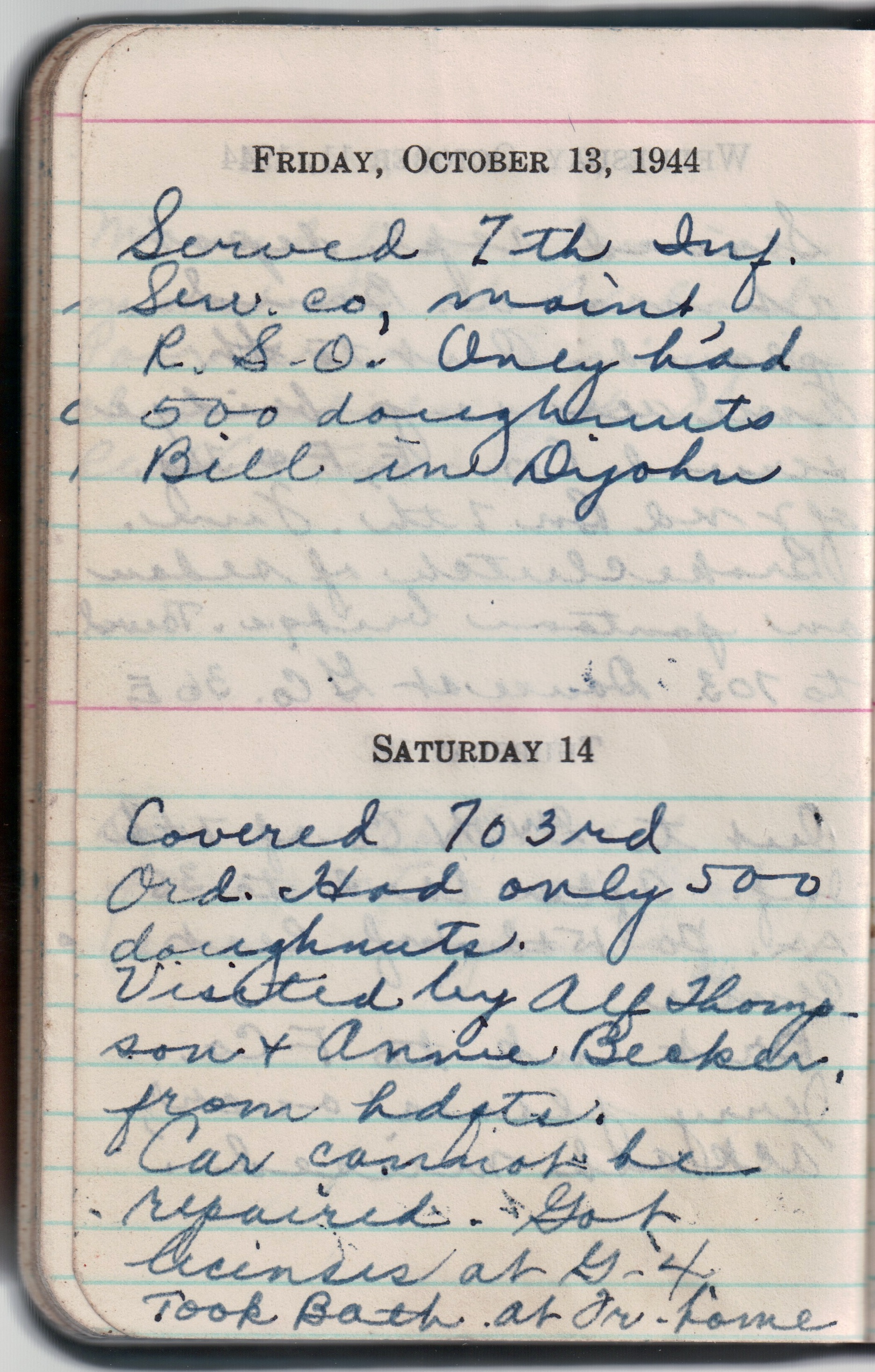
The last three entries in Flo’s diary
November 1944 in the Vosges mountains was cold and rainy, presaging a bad winter. In a letter to her mother published in her hometown paper, Flo celebrated the dogface soldiers and chastised Americans and the media in the States for thinking the war was near its end.
Florence Wick Writes
Miss Florence Wick, who is with the American Red Cross in France, writes to her mother:
“Things have slowed down considerably now though, and the boys are having a tough fight. The weather is cold here, and winter looks discouraging in that respect. It rains a lot, which makes it miserable, but we get used to it, and to wading in mud. Every once in a while the sun will come out, and that’s wonderful.
We are up quite far and are serving doughnuts every day, and keeping very busy. It is hard to see these boys come out of the lines dirty, cold, tired and old, but we do have a chance to spread a little cheer before they have to go back again. God bless the ‘dog faces’. They are winning this war mile by mile, and dying too. There is none like them. They are so sick of it all, but they are good soldiers, and everyone at home should appreciate what they are doing and pray for them all daily. They have a very hard fight ahead of them, and in winter, that’s tough.
People at home shouldn’t take the papers too literally–the war is definitely not over yet, and they had better carry on as they have been doing and not relax any effort. I wish they could see their own boys for just one day during combat, or eat the C ration these kids eat, and they wouldn’t talk of an early end to the war.”
Liz Elliott’s drawing illustrates a typical challenge for the clubmobile workers
Even as soldiers were dying all around them, the death of Flo’s fiancé, Gene, on October 28, 1944, came as a horrific shock. In a letter to her mother, Flo wished she could just go home. But she wasn’t a quitter, and she even stayed in Europe through the post-war occupation, returning to the U.S. in March, 1946, nearly a year after the war’s end.
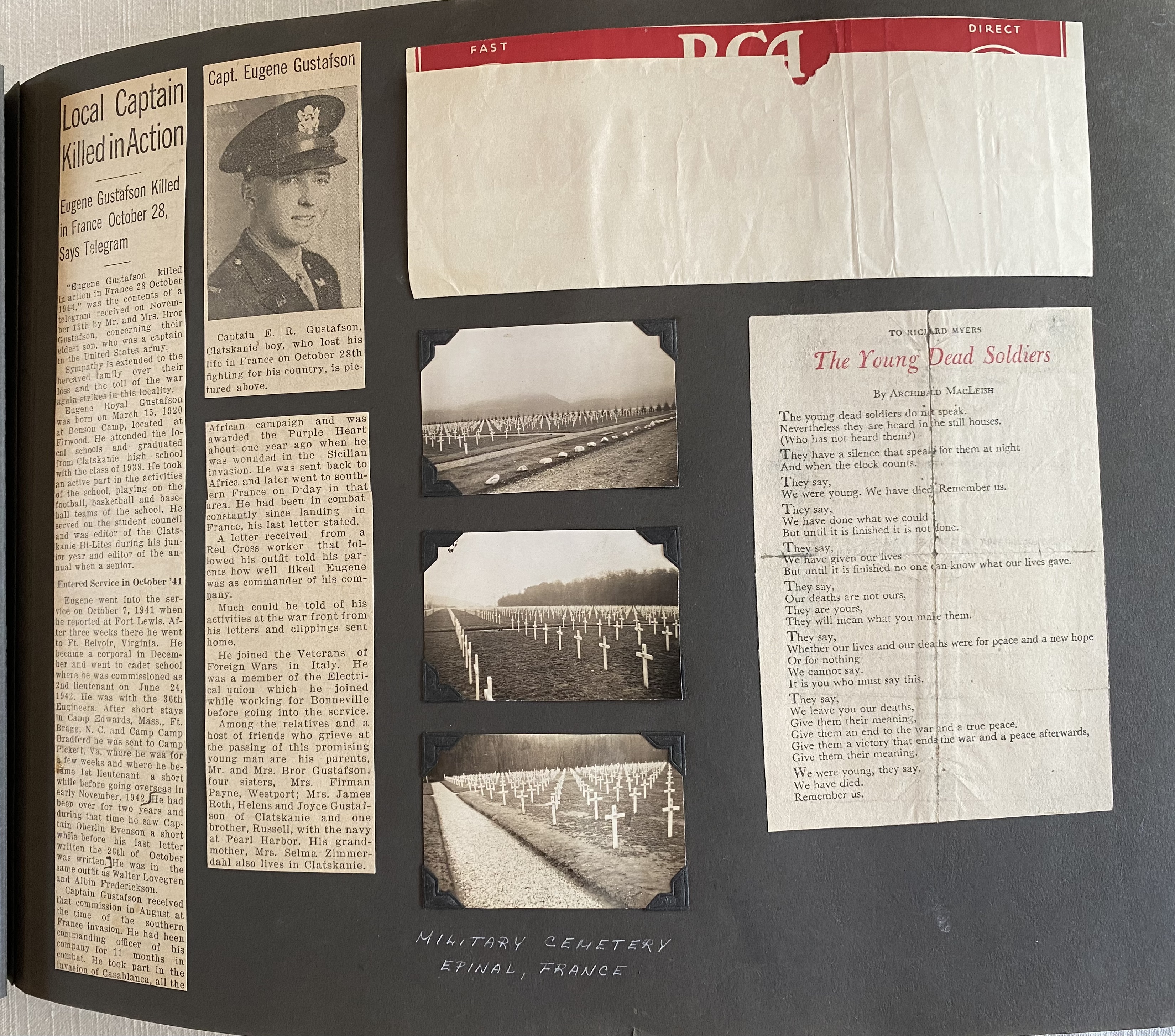
Back home, making her album, she devoted a page to Gene with the obituary from his hometown newspaper, and the poem by Archibald MacLeish, The Young Dead Soldiers. He was buried in a military cemetery in Epinal, France.
A page in Flo’s album
Reading Gene’s obituary gave me a fuller picture of the man. I learned some things:
He was born in a “camp” in Oregon in 1920—probably a lumber camp.
He had one brother serving in the Navy and four sisters back home. He was a jock, sure—but also the editor of his high school newspaper in Clatskanie, Oregon.
Before the Army, Gene had been a union electrician with the Bonneville Power Administration–a working class guy.
His military training was intense—taking him from Washington to Virginia, then on to Massachusetts, North Carolina, and back to Virginia again. He enlisted in October 1941 and was sent overseas in November 1942. A year of preparation for a war he would not return from.
I learned he was wounded during the Sicilian invasion and awarded a Purple Heart, and that official news of his death didn’t reach his family until two weeks later.
Learning these things made Gene feel more real to me—not just as a name in someone else’s story, or a loss recorded in a diary, but as a whole person with a life that mattered. I wish I could’ve met him. In some small way, reading his obituary felt like I did.
Gene’s obituary published in his hometown paper
Local Captain Killed in Action
Eugene Gustafson Killed in France October 28, Says Telegram
“Eugene Gustafson killed in action in France 28 October 1944,” was the contents of a telegram received on November 13th by Mr. and Mrs. Broer Gustafson, concerning their eldest son, who was a captain in the United States army.
Sympathy was extended to the bereaved family over their loss and the toll of the war again strikes in this locality.
Eugene Royal Gustafson was born on March 15, 1920 at Benson Camp located at Firwood. He attended the local schools and graduated from Clatskanie high school with the class of 1938. He took an active part in the activities of the school, playing on the football, basketball and baseball teams of the school. He served on the student council and was editor of the Clatskanie Hi-Lites during his junior year and editor of the annual when a senior.
Entered service in October ‘41
Eugene went into the service on October 7th, 1941 when he reported at Fort Lewis (WA). After three weeks there he went to Fort Belvoir VA. He became a corporal in December and went to cadet school where he was commissioned as 2ndlieutenant on June 24th 1942. He was with the 36th Engineers. After short stays in camp Edwards MA, Fort Bragg NC and Camp Bradford, he was sent to Camp Pickett VA where he was for a few weeks and where he became 1st lieutenant a short while before going overseas in early November 1942. He had been over for two years….
Captain Gustafson received that commission in August at the time of the southern France invasion. He had been commanding officer of his company for 11 months in combat. He took part in the invasion of Casablanca, all the African campaign and was awarded the Purple Heart about one year ago when he was wounded in the Sicilian invasion. He was sent back to Africa and later went to southern France on D-Day in that area. He had been in combat constantly since landing in France, his letter stated.
A letter received from a Red Cross worker that followed his outfit told his parents how well liked Eugene was as commander of his company.
Much could be told of his activities at the war front from his letters and clippings sent home.
He joined the Veterans of Foreign Wars in Italy. He was a member of the electrical union which he joined while working for Bonneville before going into the service.
Among the relatives and a host of friends who grieve at the passing of his promising young man are his parents, four sisters, and one brother, Russell with the Navy at Pearl Harbor. His grandmother, Mrs. Selma Zimmerdahl also lives in Clatskanie.
Of course the “Red Cross worker that followed his outfit” referenced in the obit must have been Flo. I wonder how she felt about being described that way.
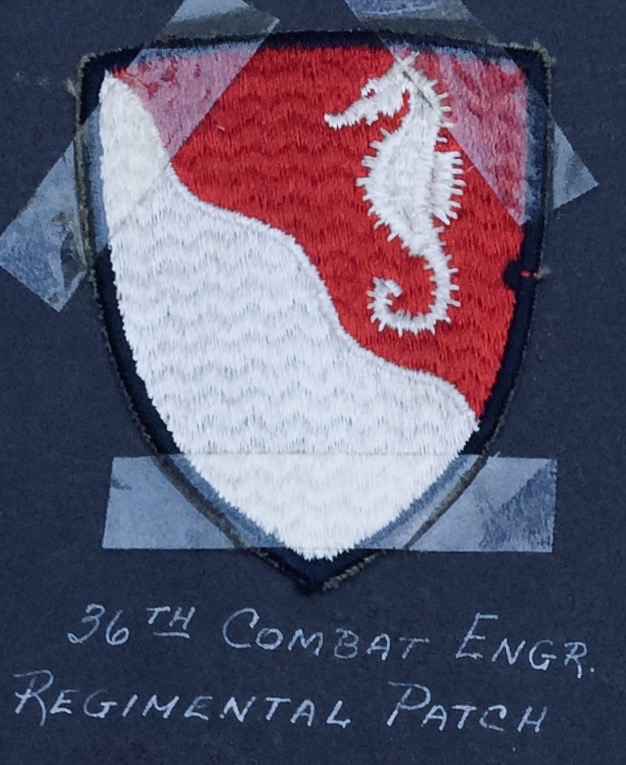
Gene’s regimental patch. The seahorse is a nod to their training in amphibious assault and support operations. The red and white colors of the shield represent the Corps of Engineer regimental colors.
I’m finding it so very difficult to tell this story. Thinking about war all the time takes a toll on the psyche.
This morning, before sitting down to write, I went to a protest at the local veterans clinic. We were there to demand an end to cuts to the Veterans Administration. Many of the protesters—like the woman who organized it—are vets themselves. There’s always music at these gatherings: sometimes a live band called Good Trouble, sometimes just a boombox. I usually love to dance, to sing along. But lately, the old anti-war songs catch in my throat.
I’m gonna lay down my sword and shield, Down by the riverside. I ain’t gonna study war no more.
War! What is it good for? Absolutely nothing.
John Lennon singing Give Peace a Chance.
They all make me cry now, and when you’re crying, it’s hard to sing. We’ve been singing these songs for so damn long. All my adult life, since I was a college student protesting the Vietnam War in the 1960s. Flo protested with me. She was a patriot, but her time in Europe changed her. The war turned her against war.
Flo’s Diary Tells the Story
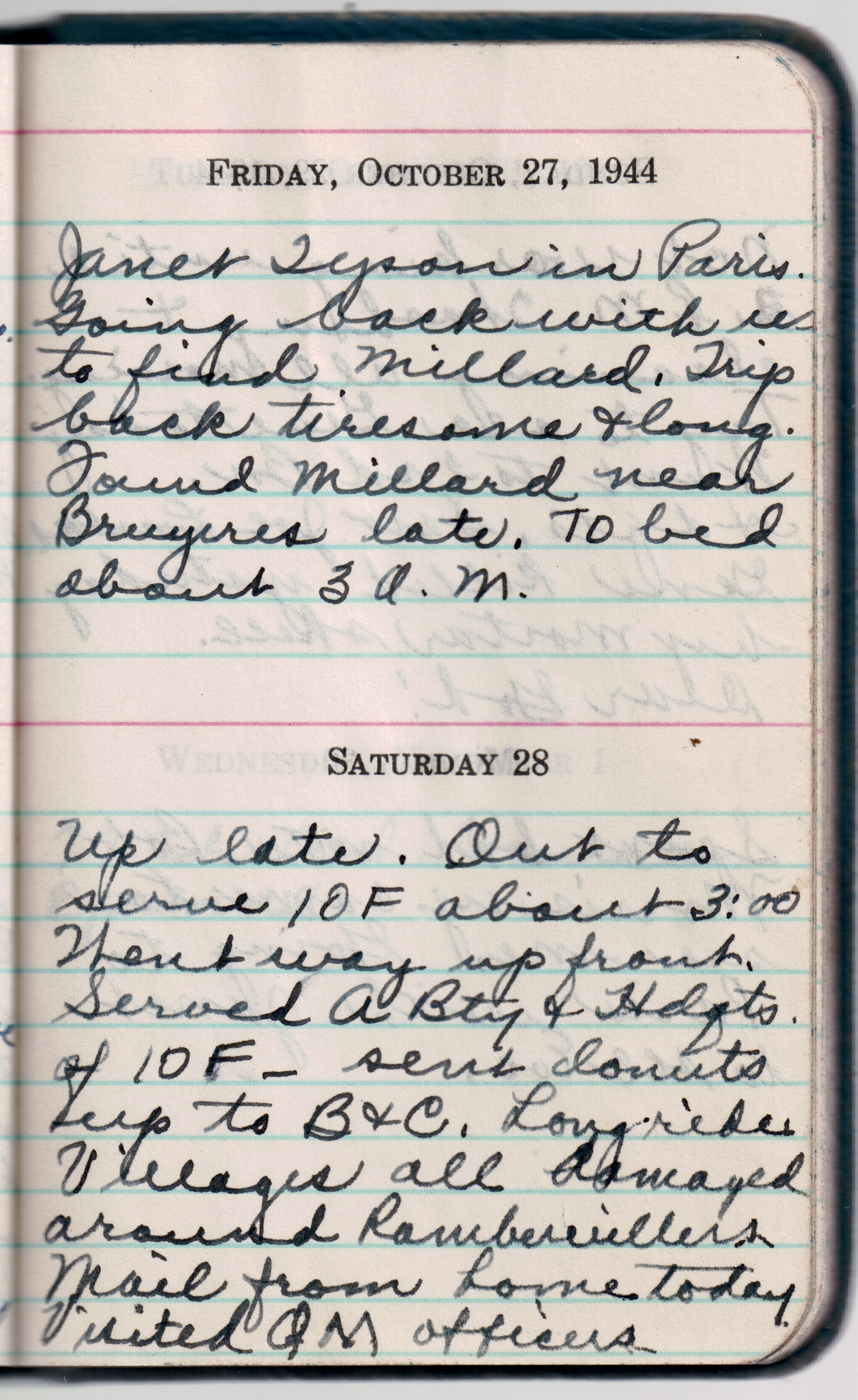
Flo and her crew had just returned from a brief trip to Paris before getting back to work, serving donuts in remote villages. Still hoping to see her fiancé Gene, Flo went to the Third Battalion headquarters. There, a major gave her the news: Gene had been killed by a mortar shell.
“Dear God!” she wrote in her diary.
Those were among the last words she wrote in it. Except for a few brief notes, the rest of her wartime diary is blank. From here on, I have only the letters she saved, and newspaper clippings pasted into her album, to help me tell the rest of her story.
My grandmother, Gerda, saved the letter Flo wrote to her.
Sun. nite Oct. 29
Dearest Mom–
I need you so! I just learned that Gene was killed yesterday at the front–in fact, I was at his battalion headquarters, a short distance back, this afternoon and the major broke the news to me. I can’t believe it; I just saw him a few days ago–before we left for Paris–and everything seemed wonderful. He was hit by a mortar shell and died very quickly. Oh, Mom, I loved him so much–he was so wonderful to me–and so attractive and fine. He was his mother’s favorite and the family “mainstay”–it will break her heart–and mine too. Right now I want to come home and see you–that would help. I had so much faith that this time, things would work out and I am so sure he was the “right” person. I’ve prayed for him and his safety, but war is such an evil thing, prayers don’t help much, I’m afraid.
I’m trying very hard to believe in all the things you taught me, but it certainly is hard. Perhaps now I realize, a little, how you felt when Daddy died, though it isn’t quite the same. Gene had sent home for rings for me and wanted so much to get married and have children–like all these men over here who are fighting and dying every day.
I wish there were a church to go to around here–it would help me, I think. Funny how that is what you need when these things happen. Everything is blank and black ahead right now and the shock has been terrific. Of course it will wear off and I will accept it, but it is very, very hard. I didn’t realize how much he meant until I heard the tragic news, but I am glad we had so many good times and that I made him happy for a few months. You would have loved him, Mom; he was so big and handsome and good to everyone. His boys are heartbroken–the whole battalion was shocked. I have so many friends among the 36th engineers and they are wonderful to me. It doesn’t bring Gene back, tho, and I can’t feel much of anything.
I may go up and see Eve again for a few days; it will help to see her–she was so nice to us girls when we were there.
Am glad you finally got my letters, Mom; it was worrying me that you didn’t hear, but mail service has been perfectly terrible. I hope they all catch up with you soon. Can’t write anymore right now. I’ll try to be brave. Pray for me, Mom.
Love, Florence
Mon. A.M. Forgot to tell you in the excitement that I ran into Janet Tyson in Paris! She drove back with us and we took her to her husband’s camp–his division is right with ours. She dropped by this morning and talked me into going back to Paris for a few days to be with her and Eve. I don’t know what is best, but I’m on my way there and may feel better.
I read the second chapter of Timothy and thought of Gene where it says “I have fought the good fight”–he certainly did! I am trying to draw on those “inner resources” but it is so hard and I shall miss him so much. Write me.
All my love, Florence
Susan Jenson remembered her mother Janet saying, “Flo, like the rest of them, suffered loss. So sad to finally find Gene—only to lose him.”
Paris—cultural capital of the world—was a dream destination, even in wartime. Everyone in Flo’s Red Cross crew wanted to see it. They’d heard about the food, the fashion, the grandeur. Who wouldn’t want a taste of it, especially after months of mud, cold, and war?
Liz Elliott’s drawing
In October 1944, Flo and her crew made the trip. It’s unclear why they chose to go just then—or why they stayed only two days—but they made the harrowing drive from the Vosges. Though the route avoided the front lines, it was still far from safe.
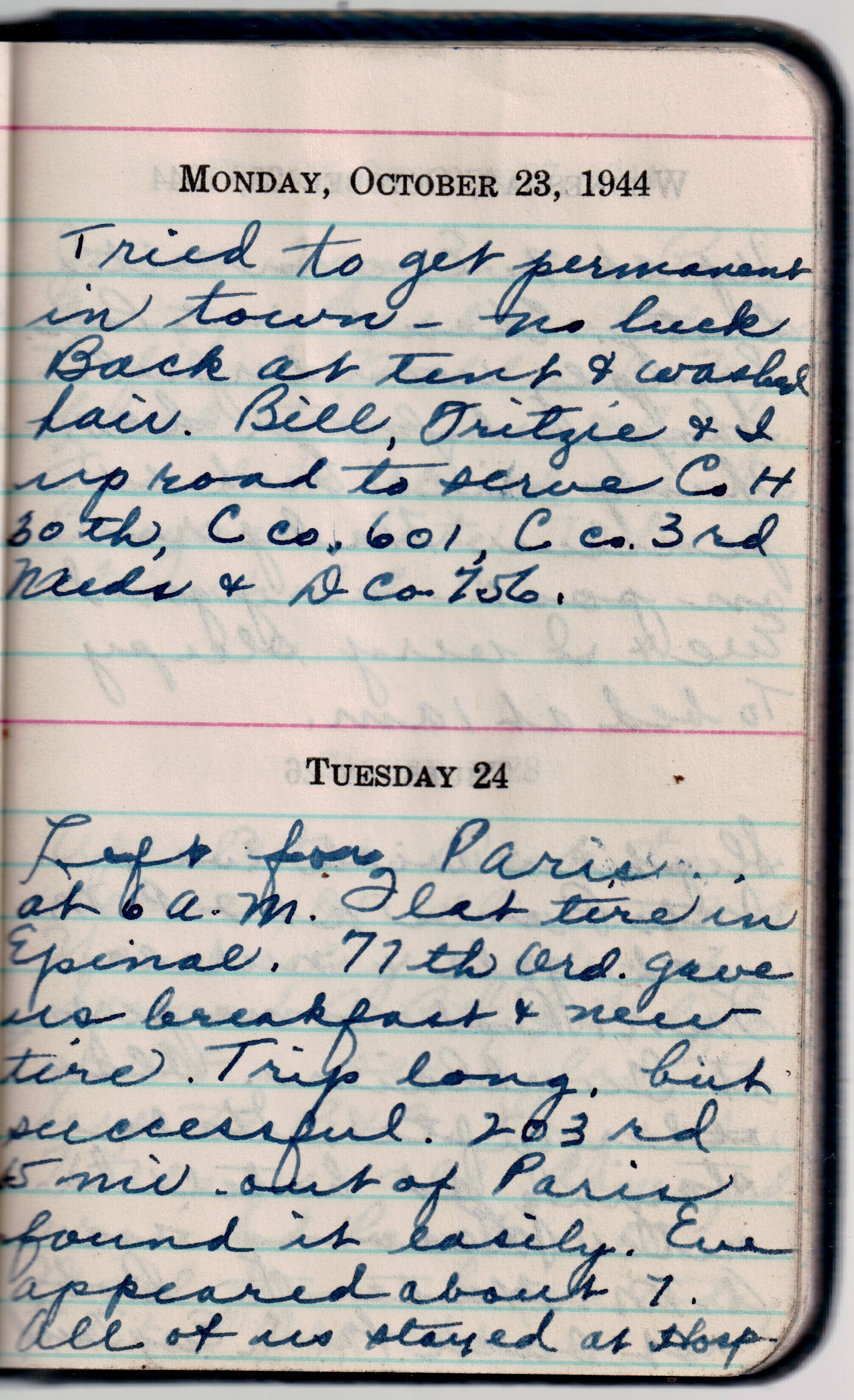
According to Flo’s diary, they left at 6 a.m. and got a flat tire in Épinal. Luckily, the 77th Ordnance gave them a new tire—and breakfast. “Trip long, but successful,” she wrote. Successful how? I can’t help but wonder if this was the trip my cousin later referred to—when Flo supposedly went to Paris for an abortion.
The group’s main stop was the 203rd Army Hospital, about 15 miles outside the city, where Flo’s sister Eve was working as a nurse. Flo noted that they found the hospital easily and spent the night there. Eve, on night duty, didn’t appear until around 7 p.m.
Flo’s diary
The next day, they went into Paris. “Simply wonderful,” Flo wrote. “Shopped for 2 hours. Things nice but expensive.” She also had a perm done “on post—very good.” But I wonder—was that all she had done that day?
After my mother died, I asked her sister Eve about the abortion story. Eve said she didn’t know anything about it. But she recalled that Flo once told her she’d miscarried while lifting heavy equipment. The original story came from their other sister, Ruth—who, according to her daughter, had been sworn to secrecy. It’s possible Flo never told Eve, perhaps fearing she couldn’t keep the secret.
Still, from the diary it seems Flo and Eve spent most of that day together, which makes it hard to imagine that Flo had a medical procedure without Eve noticing. That night, she wrote, “Eve and I very sleepy. To bed at 1 a.m.”
The following afternoon, Flo returned to the city with “gals and nurses.” They shopped again, bought gifts, and enjoyed themselves. “Leaving in am. Hate to,” she wrote.
She also noted, “Bob not back from England.” That was Eve’s husband, also in the military.
Flo did return to Paris later, so perhaps the abortion took place on a different trip. Maybe this one really was just for sightseeing, shopping, and a little time with her sister. Or maybe it was something more—something she chose never to write down.
October, 1944.The four-woman crew gets to work, Flo sees Gene before his company goes in the lines, clubmobilers get up near the front lines and they move to a new camp.
Flo’s diary (pinch out to read)
A note here about the challenge of research: In 1973, a fire at the National Personnel Records Center (NPRC) destroyed 16-18 million official military personnel files. Among them were the archived records of the Clubmobile program, making modern-day research into these women’s service difficult.
From Flo’s album
One helpful resource is The Clubmobile—The ARC in the Storm: A Personal History of and by the Clubmobilers in the European Theater of War During WWII, compiled by Marjorie Lee Morgan. The book includes interviews, diary entries, and photographs. But it focuses solely on the European Theater and omits those who served in the North African and Italian Theaters—even though many of those women, like my mother, also served in France, Germany, and Austria. And these women were the first to enter France and Europe. The book even includes a list of clubmobilers, but no names from the North African/Italian Theater appear, except Forence Wick on the inactive list.
With help from my brother Don, I was able to find some information on Janet Potts and even contacted her daughter. But so far, we’ve found nothing definitive about Fritzie Hoglund (or possibly Hoagland). A newspaper clipping pasted into Flo’s album says Fritzie was from Berkeley, California.
Janet Jenson (née Potts)
Born in New Rochelle, New York, Janet graduated from the Brearley School, attended Barnard and Columbia, and joined the Red Cross in 1944. An accomplished equestrian, she rode in a Third Division “rodeo” at the end of the war.
Janet was one of eight sisters—three of whom served in the Red Cross during the war. Janet was the only one who went to Europe, while the two others served in the South Pacific.
She married Lloyd Jenson in 1946 and had two daughters. Her daughter Susan Jenson told me that Janet often spoke of Flo and that her mother also made a wartime album, which she plans to go through.
Janet’s daughter wrote, “I personally think there’s far too much focus on donuts in the way the clubmobilers’ work is remembered. These women were brave and generous souls who took on a difficult and emotionally demanding role, offering comfort to exhausted and traumatized troops. As my mother often said, the French sometimes mistook them for camp followers—a euphemism for prostitutes. They had no idea what these women were really doing. But for many soldiers, these were the last warm smiles they ever saw.
“Janet always had kind things to say about Flo. I can imagine the two of them together in a jeep, laughing. It was an adventure—but also full of heartbreak.”
Janet died in 2011, in Denver at age 96.
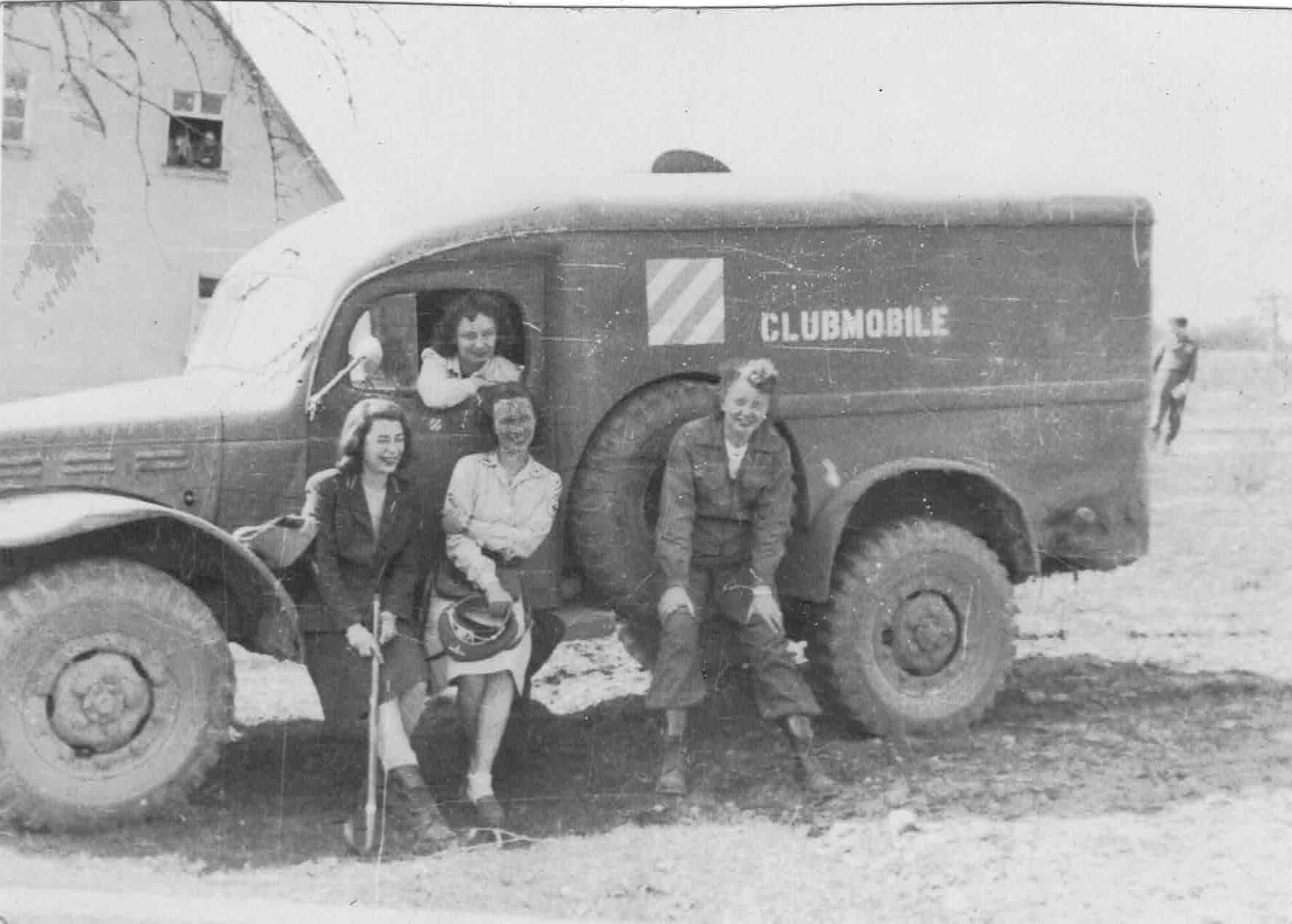
Liz, Flo, Fritzie and Janet (in clubmobile)
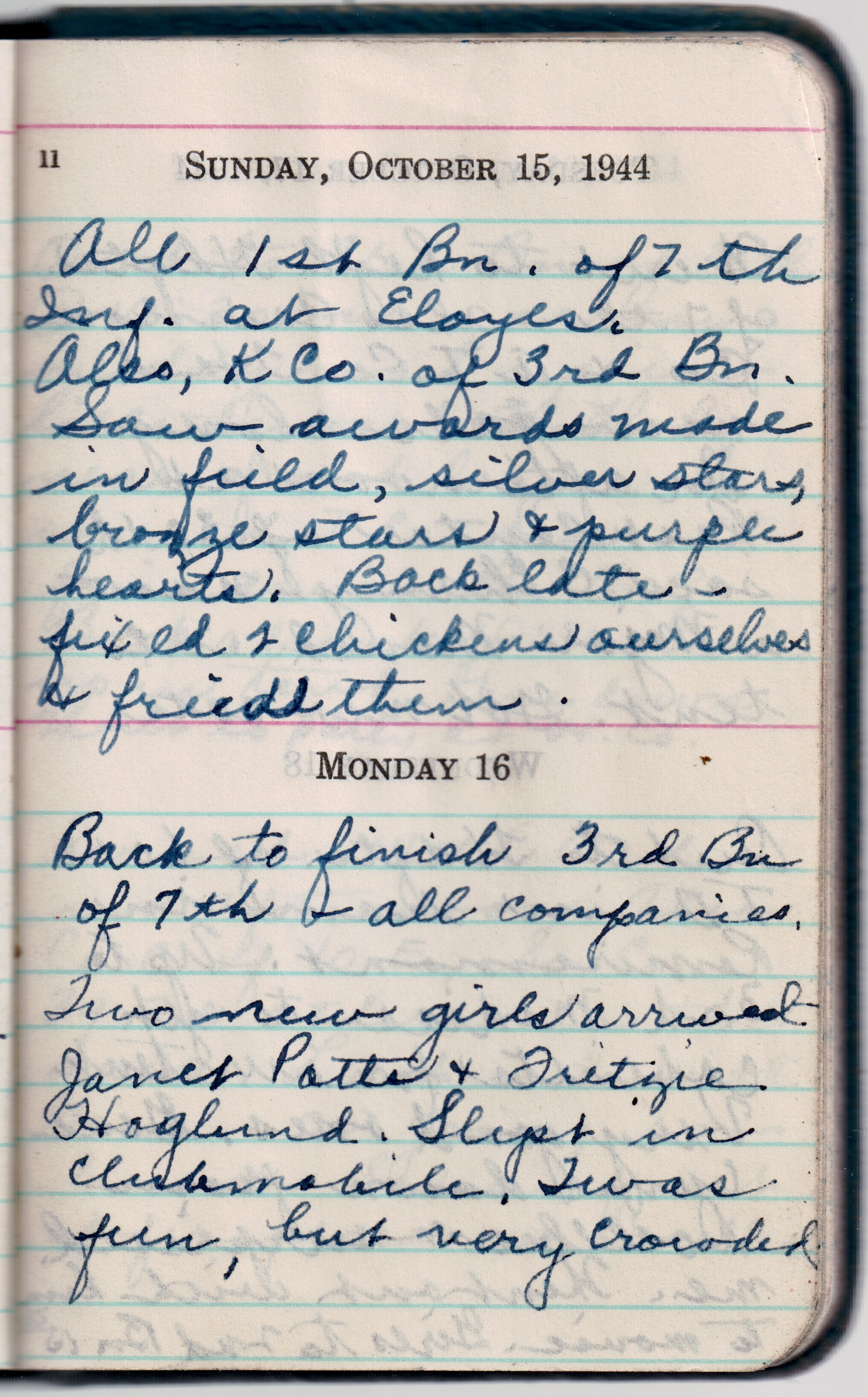
The new four-woman crew slept in the clubmobile. Flo wrote in her diary, “It was fun, but very crowded.” Later, they were issued a tent and new cots.
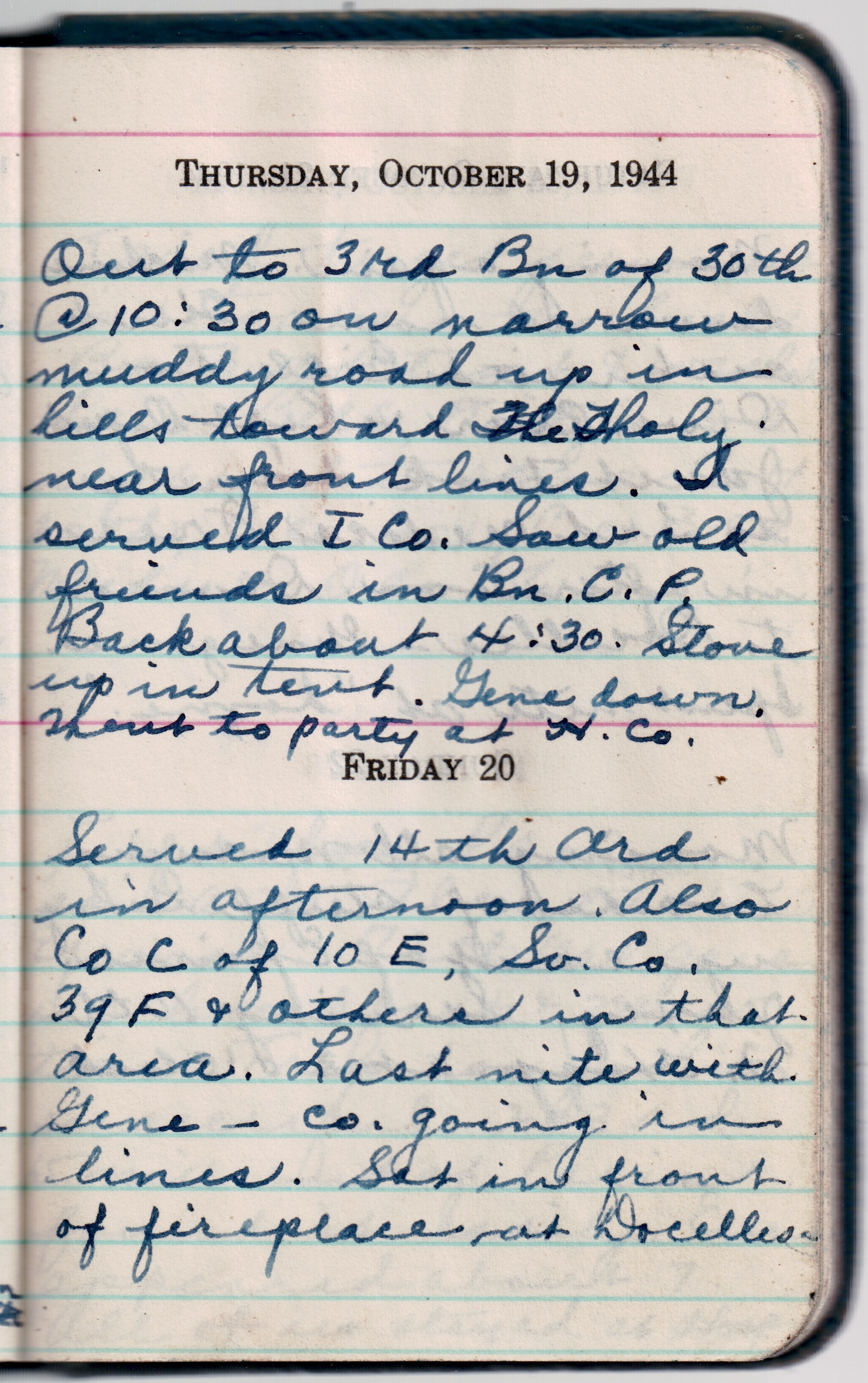
At one point, Flo’s fiance Gene came down from Docelles and surprised her. “Went out to a movie with him,” she wrote. She saw him again on October 19. Then on October 20: “Last night with Gene—co. going in lines. Sat in front of fireplace at Docelles.” The next day in a free afternoon, she drove back to Docelles maybe with the hope of seeing him one last time. She wrote: “Gene gone. Spent night at ‘home.’”
The following morning, Flo and the crew spent hours loading and moving supplies—the clubmobile was relocating to an area near Épinal.
October 1944. Flo’s diary is blank from October 2 to October 7, 1944. There’s no way to know what happened during that time, but there are clues. My cousin told me that at some point during the war Flo went to Paris for an abortion. I wrote about it here: https://mollymartin.blog/2022/04/16/solving-a-wwii-era-mystery/. The city had been liberated in late August and it would have been possible for Flo to travel there and back in five days. Flo stayed in touch with her sister, Eve, who was serving as an Army nurse in a Paris hospital. Eve told me that Flo had also suffered a miscarriage while hauling heavy equipment. Flo never wrote about any of it in her diary, and she never spoke of it later. But whatever happened during that week, it was serious enough to stop her from writing altogether.
Flo’s diary (pinch out to read)
By October 8, Flo and Liz were back in action, serving hundreds of donuts to American troops every day. They had moved from Remiremont to nearby Saint-Nabord, a grim, war-torn area where they now lived in their clubmobile. One day they drove to Luxeuil for photos. Another day they served the replacement depot while a military band played. And then they bounced across a pontoon bridge into Saint-Amé, until their battered old sedan gave out. The clutch snapped halfway over the bridge and couldn’t be repaired.
During this time, they served the 15th Infantry—Audie Murphy’s unit—a couple of times. The men were quiet, polite, exhausted. After some hard battles, the 15th was finally getting a little rest. But Murphy was not among them. He had been wounded in the fight for Cleurie Quarry. At the aid station, he learned that nearly his whole platoon had been wiped out the night before. Because of the rain and mud, the wounded men could not be evacuated for three days. At the hospital Murphy learned gangrene had resulted. He would be out of commission until January.
In breaks from battle, the army handed out medals. The Third Division took home more than any other. This would be Murphy’s third purple heart.
Flo was able to see her fiancé Gene occasionally, as his unit, the 36th combat engineers, was stationed nearby. They met for church, a dance and meals at his camp. They planned to marry by Christmas and he had ordered rings for them.
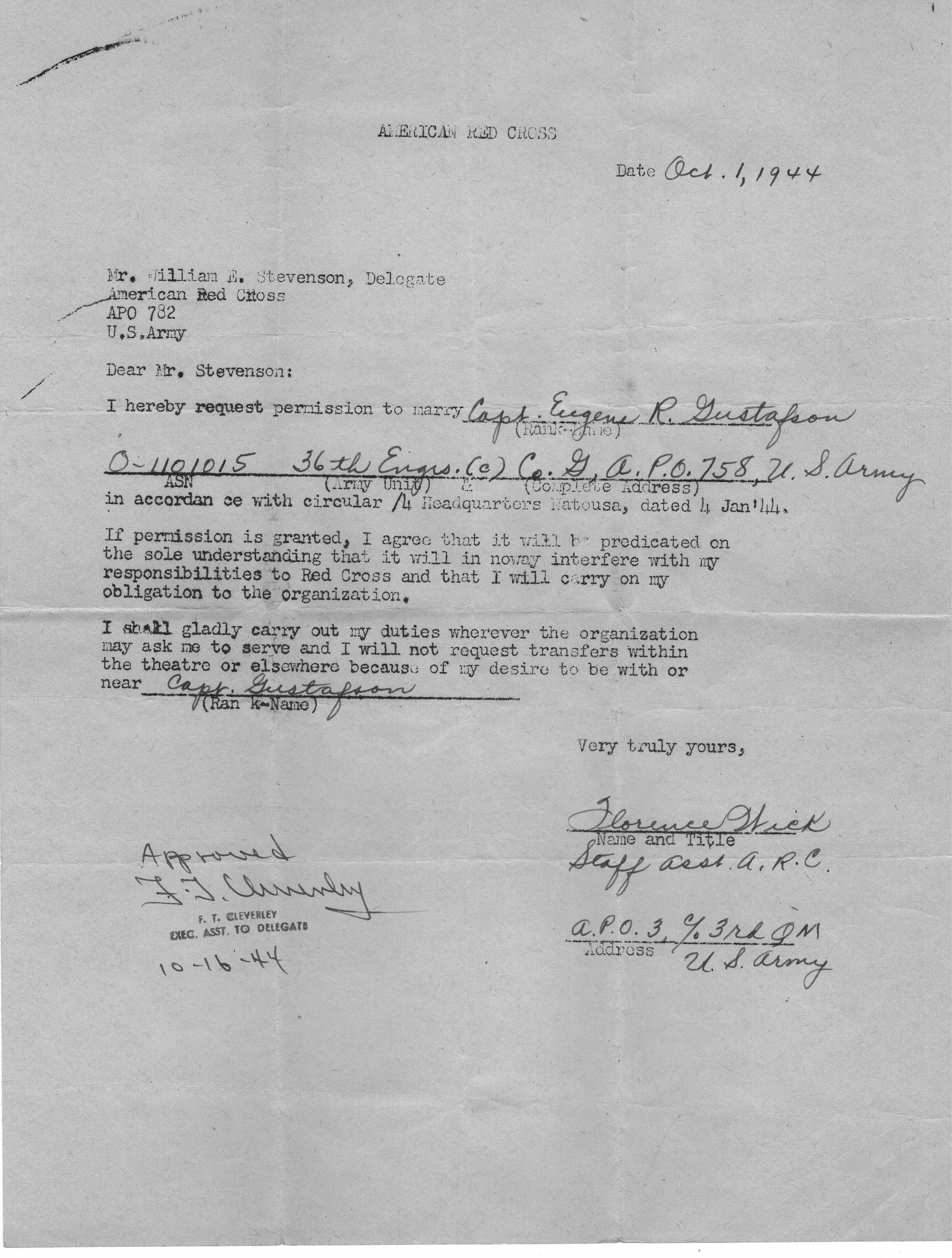
Form letter asking for permission to marry
On October 1, Flo sent a formal request to William Stevenson at Red Cross headquarters for permission to marry Gene. The form letter says,
“If permission is granted, it will be predicated on the sole understanding that it will in no way interfere with my responsibilities to Red Cross and that I will carry on my obligation to the organization. I shall gladly carry out my duties wherever the organization may ask me to serve and I will not request transfers within the theater or elsewhere because of my desire to be with or near Capt. Gustafson.”
In her accompanying letter, Flo had again managed to put her writing skill into practice. Whatever she wrote convinced the ARC. She received permission to marry in a warm letter from Eleanor “Elly” Parker, Director of Staff Welfare, dated October 23.
She wrote, “Thanks very much for your nice letter and I feel much more comfy issuing your marriage approval after having your explanation of exactly what is happening….You sound well surrounded by friends and family in France and I am glad you enjoy being there….I imagine that you are terribly busy and very hard at work under pretty trying cricumstances….
Permission granted and our shoes are boring (sorry)
Apparently Flo also had asked about getting some shoes after her nice shoes were stolen in Italy. But Elly Parker wrote that all they have at the PX are “regular black Red Cross shoes.” Not exactly what Flo, a lifelong shoe queen, had in mind.
On October 12, German planes flew overhead. Everyone looked up at the roar, held their breath as the anti-aircraft fire opened up—and missed.
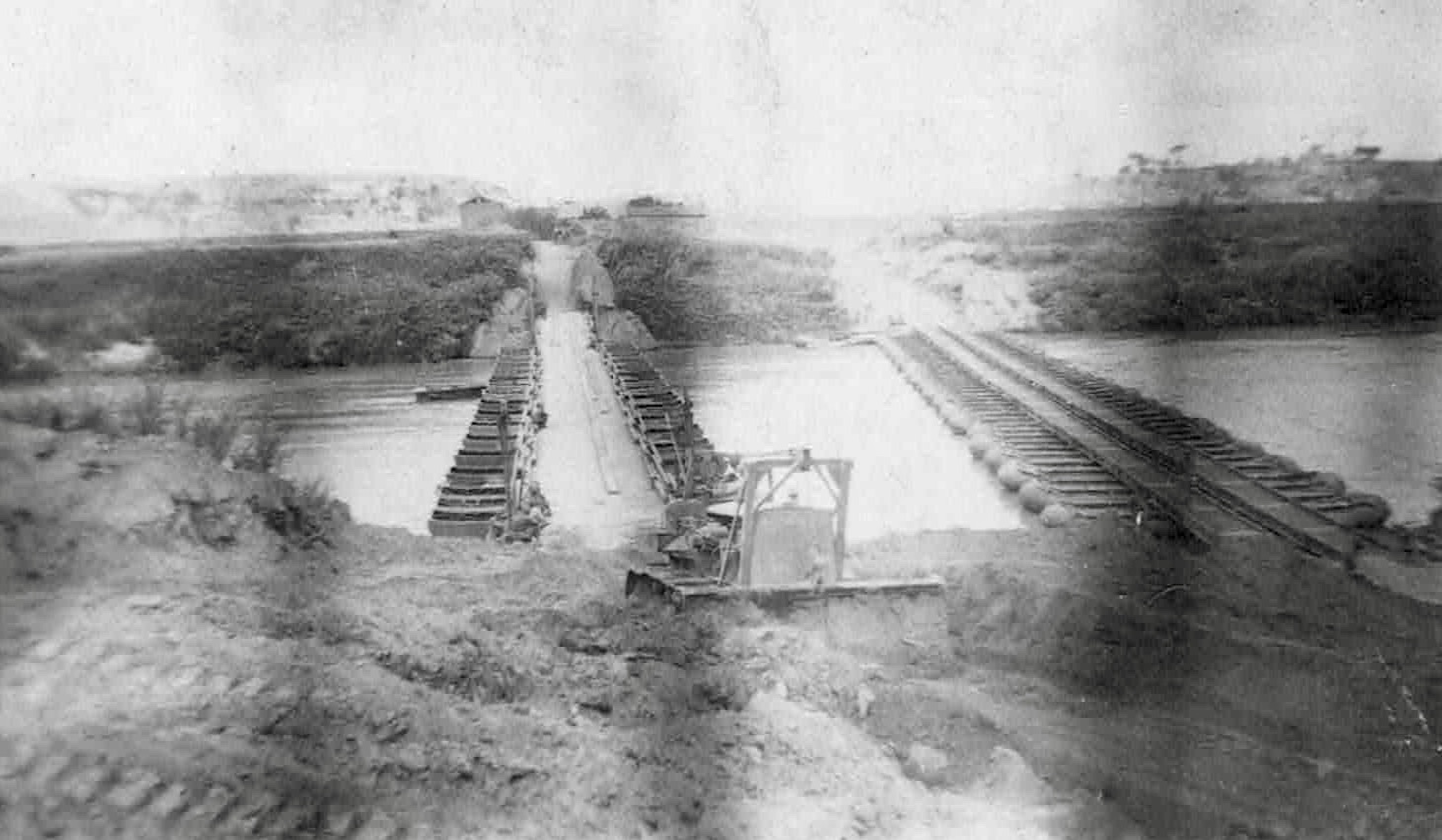
One page in Flo’s album is devoted to the combat engineers—soldiers whose construction work enabled the army to move men, machines, and supplies into active war zones.
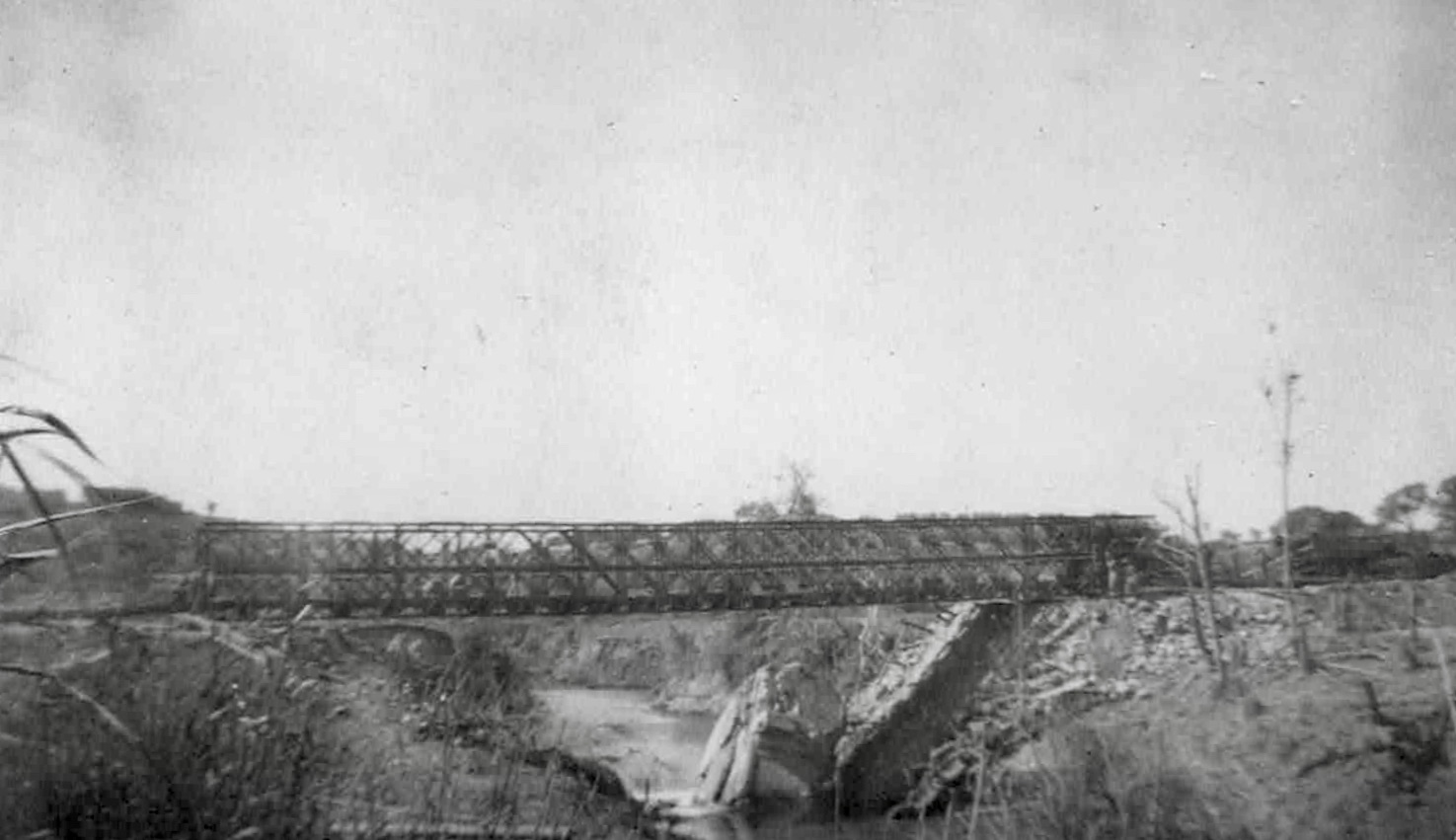
Bailey Bridge at Monto Alto above Rome, Topping out
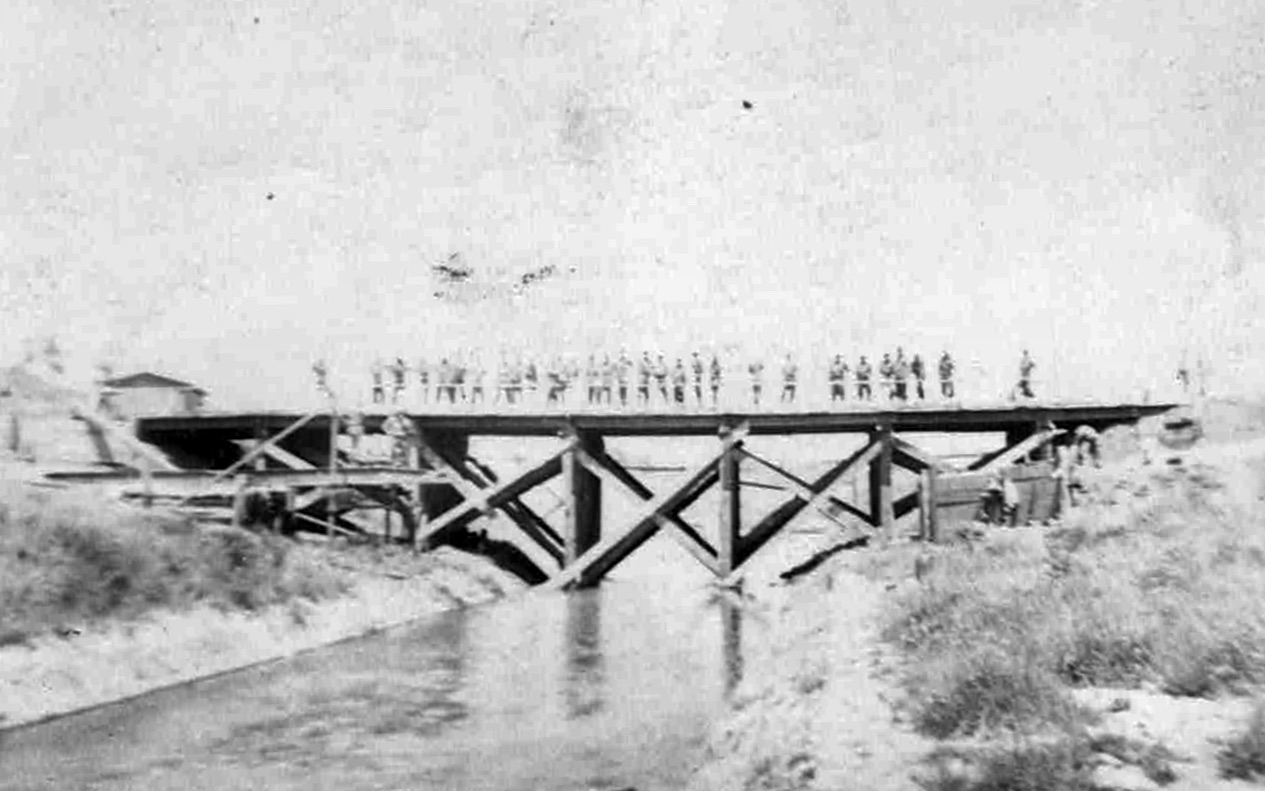
Combat engineers were tasked with everything from building roads and bridges to clearing mines, digging tunnels, demolishing obstacles, and performing emergency construction under fire. Their work was both strategic and dangerous, often done at the front lines or just behind them.
Constructing a bridge across Mussolini canal, Pontoon bridges across the Tiber River in Rome
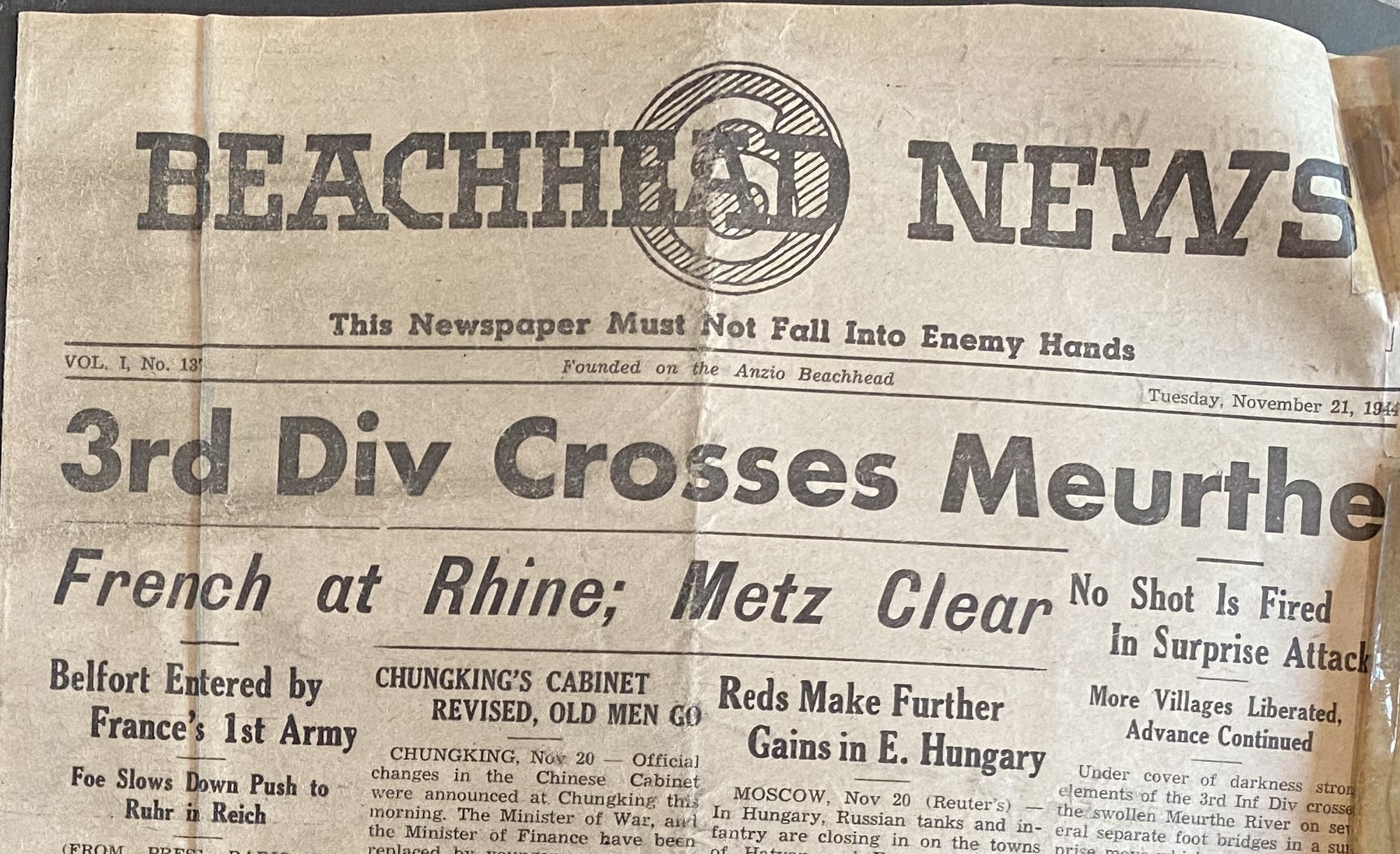
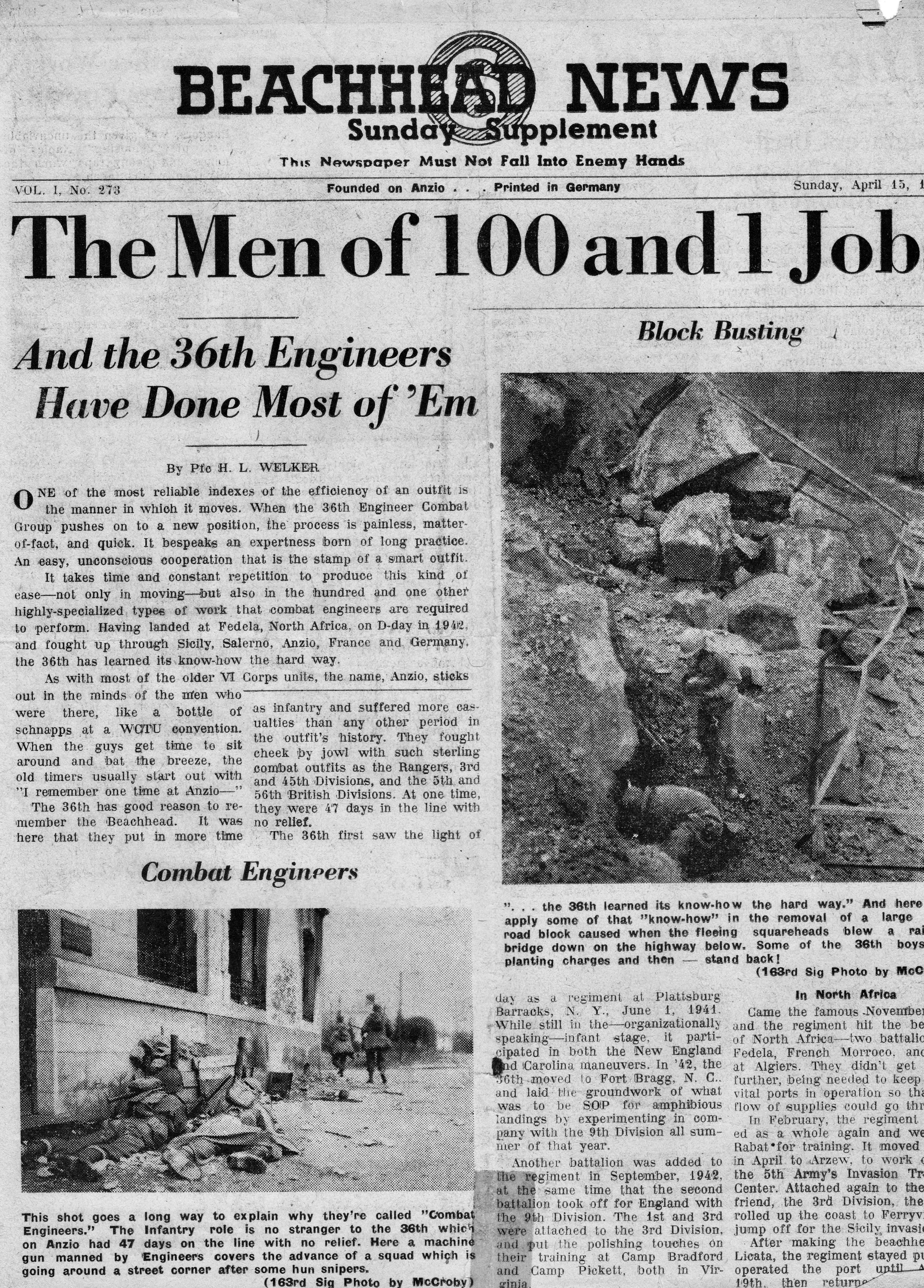
Flo’s fiancé, Gene, served with the 36th Engineer Combat Group. The engineers were proud of their mission, and Gene gave Flo photos of some of the bridges his unit built. She carefully arranged them in her album, alongside a special edition of Beachhead News from April 15, 1945, dedicated to the 36th.
From Beachhead News
The Men of 100 and 1 Jobs—And the 36th Engineers Have Done Most of ’Em
“One of the most reliable indexes of the efficiency of an outfit is the manner in which it moves. When the 36th Engineer Combat Group pushes on to a new position, the process is painless, matter-of-fact, and quick. It bespeaks an expertness born of long practice—an easy, unconscious cooperation that is the stamp of a smart outfit.
It takes time and constant repetition to produce this kind of ease—not only in moving—but also in the hundred and one other highly specialized types of work that combat engineers are required to perform. Having landed at Fedala, North Africa, on D-Day in 1942, and fought up through Sicily, Salerno, Anzio, France, and Germany, the 36th has learned its know-how the hard way.”
The article goes on to chronicle the unit’s contributions across multiple campaigns—a record of grit and expertise that Flo proudly preserved.























 tradeswomn musings