The winter of 1943-44 had been mild in Yakima with less than the usual snow. On March 30, some fruit trees already bloomed in the orchards of the Yakima Valley, but frost warnings loomed and could result in a smudge night with fires lit in the orchards to keep the buds from freezing. It was a Thursday and tomorrow would mark the last day of Flo’s workweek at the Washington State Highway Department where she had been a stenographer for 13 years.
“You got a telegram!” sang her sister Betty as Flo pulled the car into the family driveway.
Flo had been anticipating this telegram, eagerly awaiting news on her application to the American Red Cross (ARC) overseas program. She opened it carefully.
It read:
APPLICATION OVERSEAS STAFF ASSISTANT ACCEPTED. EMPLOYMENT CONTINGENT UPON RECEIPT AVAILABILITY CERTIFICATE. FORWARD TENTATIVELY SCHEDULED WASHINGTON TRAINING MONDAY APRIL 17TH. LETTER FOLLOWS=
ESTHER BRISTOL.==
Throwing her purse and coat on a chair in the entryway, Flo ran to the kitchen to show their mother, Gerda.
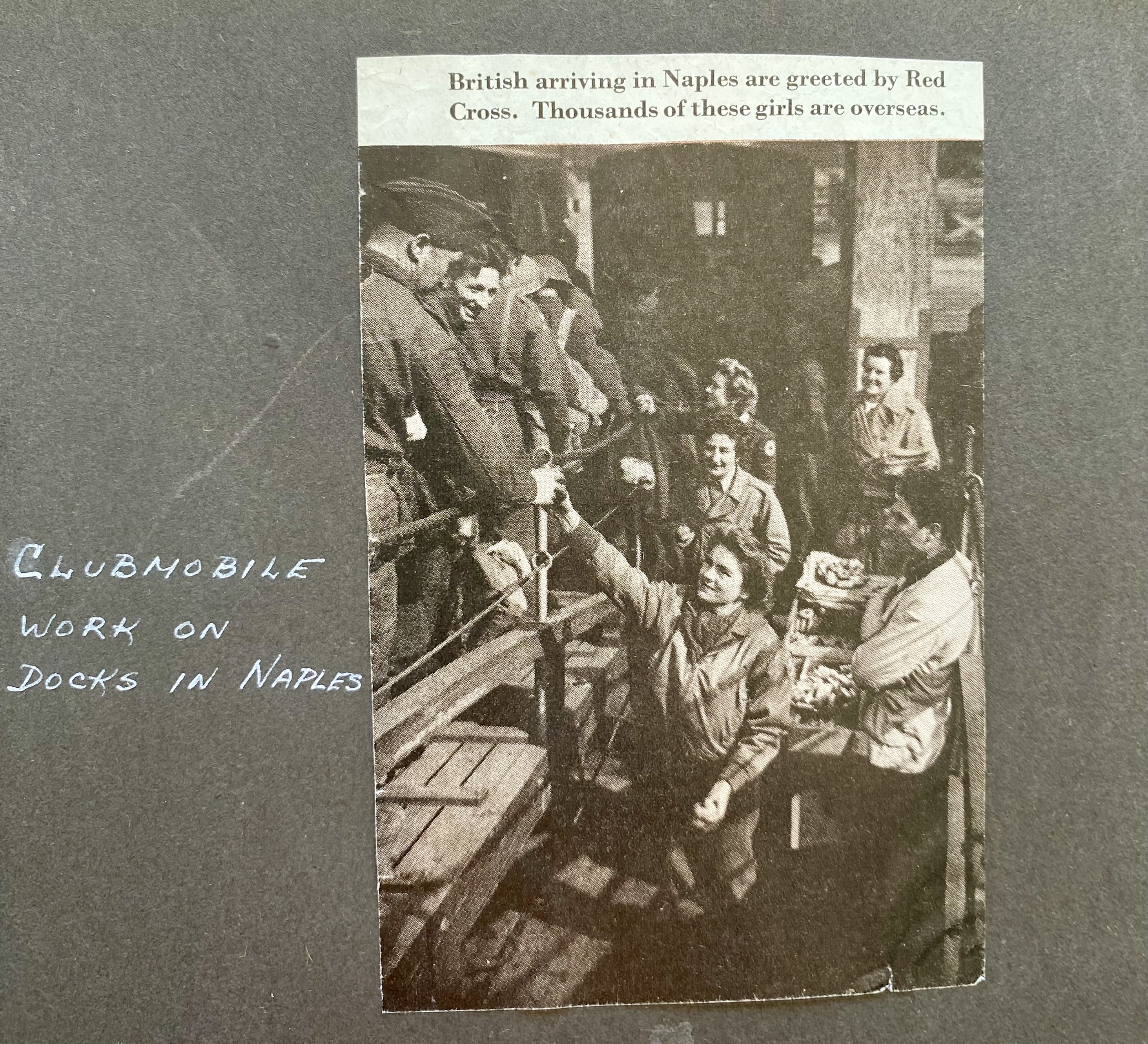
Flo had signed up for the ARC program as soon as she’d heard about it. She badly wanted to be in Europe where her sister Eve was already working as an Army nurse. Eve had written that when their troop ship had docked in Guroch, Scotland on January 7, they were met by a clubmobile with ARC women handing out donuts and coffee.
The ARC had rolled out the clubmobile model in England in 1942 with repurposed buses modified as mobile canteens and now the program was to be expanded into the European theater of the war. The clubmobile “donut girls” were envisioned as one element that would keep American soldiers willing to fight and die on foreign soil.
In February 1944, a Life magazine article had described the ARC women as “handpicked for looks, education, personality and experience in recreational fields. They are hardy physically and have a sociable, friendly manner.” The qualifications included a high level of education, being between 25 and 35 years old, an upbeat attitude, social skills, and good health. The women were chosen for their attractiveness, embodying the wholesome, well-scrubbed appearance of the girl next door. Nearly all were unmarried. Flo had immediately pictured herself among them.
Handing out donuts from the Life Magazine story
Flo and her youngest sister Betty still lived at home, contributing their earnings to the family kitty. Gerda had found work at a fruit processing plant, and they had taken in boarders to make ends meet since their father, Ben, had died five years earlier. Times had been tough, but their finances had stabilized, and the ARC job paid $150 a month. Flo could send most of her paycheck back home.
Flo wondered what her father would have said, although she thought she knew the answer. Her father would have been proud of her decision to do her part for the war effort. He was a Norwegian immigrant, and a patriotic American.
To apply for the job of ARC overseas Staff Assistant, women were required to have at least two years of college education. White skin was an unwritten modifier, although there were some Black women recruited to work with segregated Black troops. Flo was 30 in 1944. She met the minimum qualifications except for the college education part. But Flo had mastered a skill that she would use throughout her life. She knew how to write a convincing letter. She was sure that she could show the ARC that she was just as qualified as any college educated woman.
The application process had been rigorous. Besides a written application, Flo included reference letters from her employers, the Presbyterian minister, and members of the Business Professional and YWCA groups where she was active. She passed a medical fitness exam and traveled to Seattle for an in-person interview.
Pasted in Flo’s album from the Life Magazine story
Flo understood that the college requirement was based on class. The ARC aimed to hire middle or upper-class “girls.” In her application letter, Flo emphasized her middle-class status, morality, and responsibility as a church-going citizen. During the interview, she felt they had been impressed.
Other opportunities existed for women to become involved in the war, but most were situated in the U.S. You could volunteer to roll bandages, but for that you received no pay, so those who volunteered tended to be women of means or women supported by husbands. You could join the Women’s Auxiliary Army Corps (WAC), which did pay a salary about the same as the ARC. But WAC was not well thought of only because many people did not believe women should be involved in war, or even serve close to it. Few WACs were sent overseas, mostly performing office work to free men for combat roles.
The ARC flew under the radar because, even though the jobs were paid, the women were referred to as “girls” and “volunteers.” And the ARC was associated with nursing, which incited no prejudice. It was ok for women to take care of wounded soldiers as long as they weren’t allowed to fire the guns. As it turned out, the ARC women would be the first American women to fire guns in combat and Flo would be among them.
Flo knew she could be sent anywhere the war raged: the Pacific, England, North Africa, even India. She hoped for Europe where most of the fighting was. She had always dreamed of traveling to Europe. But she resolved to accept with enthusiasm whatever her assignment turned out to be.
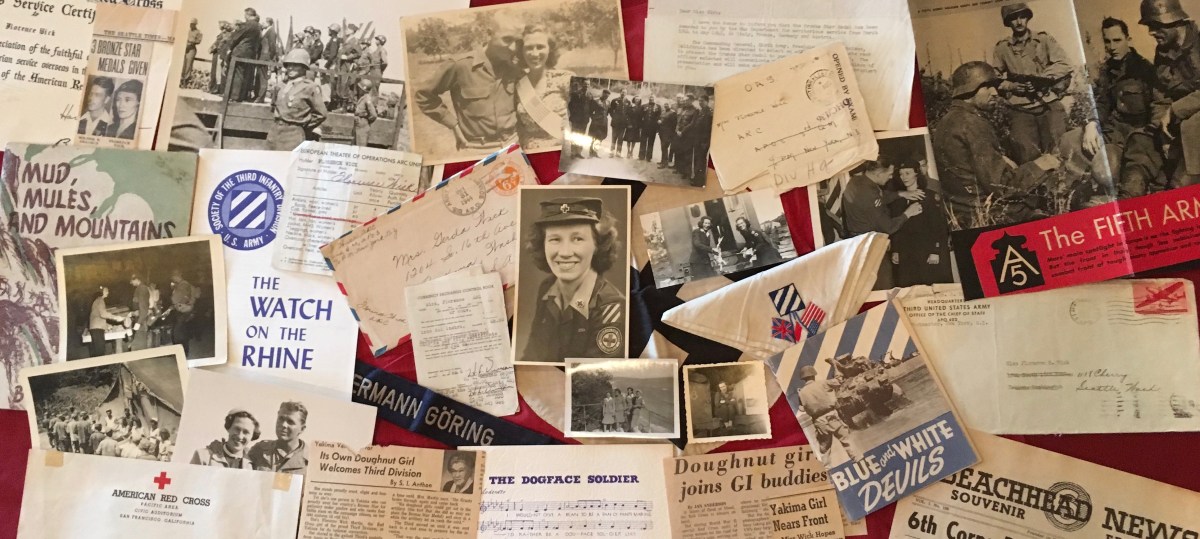
The photo album that my mother, Flo Wick, shared with Audie Murphy when they reconnected in 1955 is massive. The scrapbook is filled with photographs, newspaper clippings, letters, and travel paraphernalia and it tells the story of Mom’s two years as an American Red Cross (ARC) “donut girl” in Europe during World War II.
It also tells the story of the Third Infantry Division, the only American division that fought the Nazis on every front—North Africa, Sicily, Italy, France, and Germany. “The Fightin’ Third” had more casualties—nearly 35,000—than any other division, and it holds the record for high combat citations.
Throughout our childhoods my brothers and I pulled out the album, looked through it, and listened to our mother’s war stories. We kids especially liked the sketches by Flo’s comrade Liz Elliott of the everyday lives of the “donut gals.”
When my mother died in 1983 at the age of 70, I claimed the album and it’s been stored in garages and closets ever since, occasionally brought out for perusal by relatives or friends with an interest in World War II. For a time, it lived in a mold-infected storage room and so it was infected along with other archives. I exposed each page to sunlight in an effort to reduce the mold and that helped, but when I really wanted to examine the book, I donned a respirator to avoid breathing in clouds of invisible mold spores.
Mom was a scrapbook maker and for that I am now grateful as I try to piece together the events of her life during the war. Perhaps she had the idea for the album even before she sailed to Europe on a hospital ship in May 1944. I do know that the act of putting it together when she returned home after the war in 1946 salved her sadness at the deaths of so many and helped her readjust to life stateside where it seemed Americans had moved on and no longer wanted to think or talk about the war.
Recently I went through the album page by page, photographing all. That’s when I discovered that Flo had had a friendship with Audie Murphy that began somewhere in France when she served him donuts and continued after the war.
This story follows two narratives: one chronicles Flo Wick and the other chronicles Audie Murphy. They were both attached to the Third Division but mostly in different parts of the North African and European theaters. Their paths intersect in the Vosges mountains of France and as the Third pushed its way into Germany. For Audie’s tale I’m referencing his autobiography To Hell and Back, as well as letters and artifacts saved in Flo’s album.
A Little Background
She came of age during the Depression
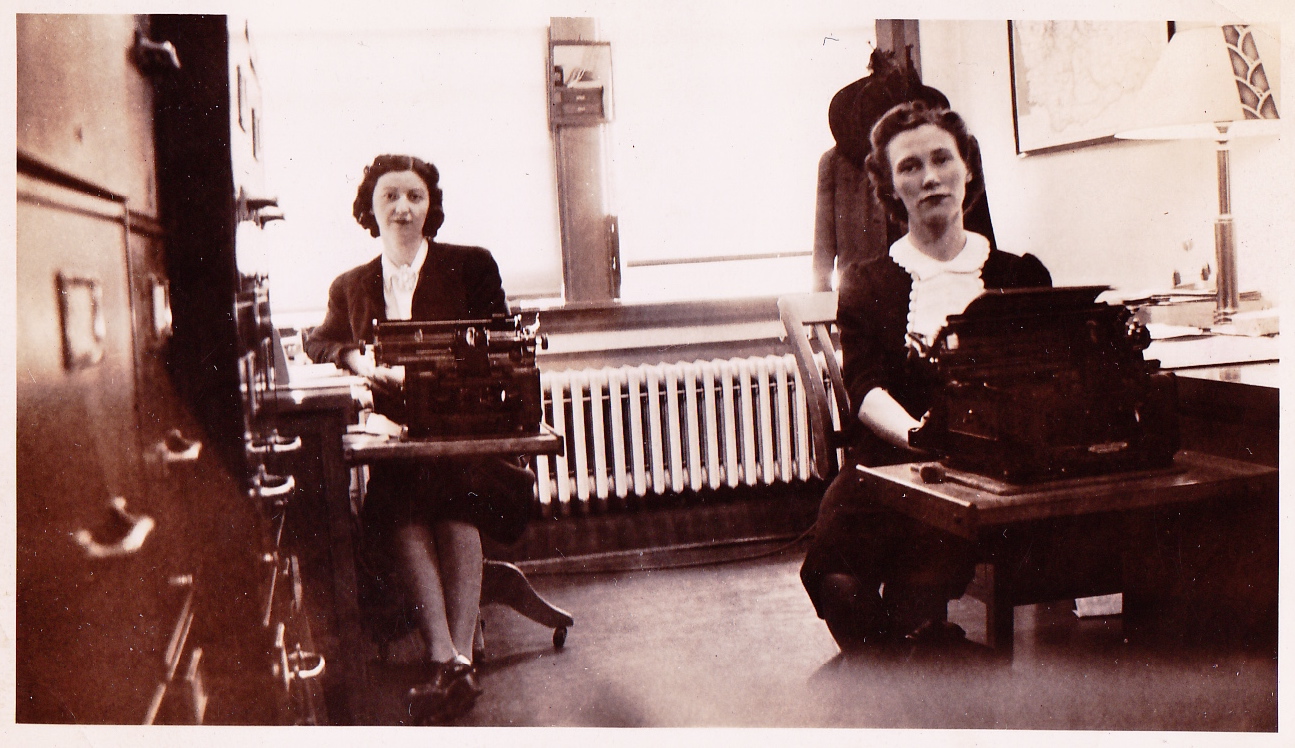
Born in 1913, Florence Wick had graduated high school at 16 after being allowed to skip ahead a grade. Her class graduated in 1929½. Flo was excited about the prospect of going to college. She planned to enroll at the state college, but the Great Depression intervened. Instead, she completed a secretarial course at a trade school. At 17 she started working to help support her family. In 1931 she found a job as a stenographer for the Washington State Department of Highways.
Flo (R) at the Highway Dept.
By the time she learned about the ARC program, Flo had been working full time at that job for more than a decade. No doubt she was ready to do something else—maybe anything else. This seemed like an opportunity to travel outside of Washington State and to see other places in the world. And she was anxious to help the war effort.
He always wanted to be a soldier
Flo’s photo of Audie 1945
Even as a little boy Audie Murphy had wanted to be a soldier. His share cropper father abandoned his mother and their children leaving the family destitute. Then, when he was 16, his mother died. Born in 1925, the seventh of twelve kids, Audie tried to provide for the others, dropping out of school in fifth grade to pick cotton for a dollar a day. But he knew he had to get out of Farmersville, Texas. He tried to join the paratroopers and the Marines, but was told he was too short at five feet five. The Army took him and trained him to be a soldier. The baby-faced kid earned the nickname Baby. He was already a good shot, having fed the family with wild game. He couldn’t wait to shoot the enemy.
Murphy was assigned to the Third Division, then part of the Third Army under the command of General George Patton. He joined them in Sicily in 1943, on the way from Morocco and North Africa. They would fight their way through Italy and France into Germany. Murphy would be one of a very few of his company left standing and would become the most decorated American soldier of the war.
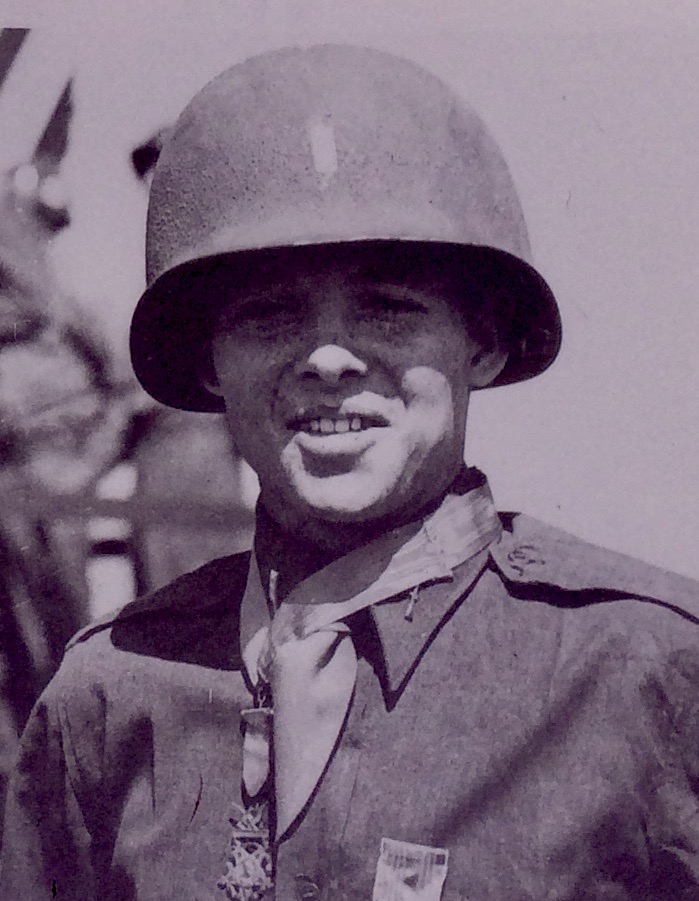
“When are we going to get some more donuts?” asked Audie Murphy of the photographer after he received the highest of all military honors, the Congressional Medal of Honor, in the field in Salzburg, Germany.
Flo’s photo of Audie Murphy receiving the Congessional Medal of Honor
It was 1945 and the photographer was my mother, Florence Wick. She had been serving as a Red Cross “donut girl” with the Third Infantry Division in the Europe. She had met Murphy and served him donuts somewhere in France.
That photograph was the only one taken of Murphy at the awards ceremony and it was published worldwide and used to recreate the scene for the movie of his life story, “To Hell and Back.”
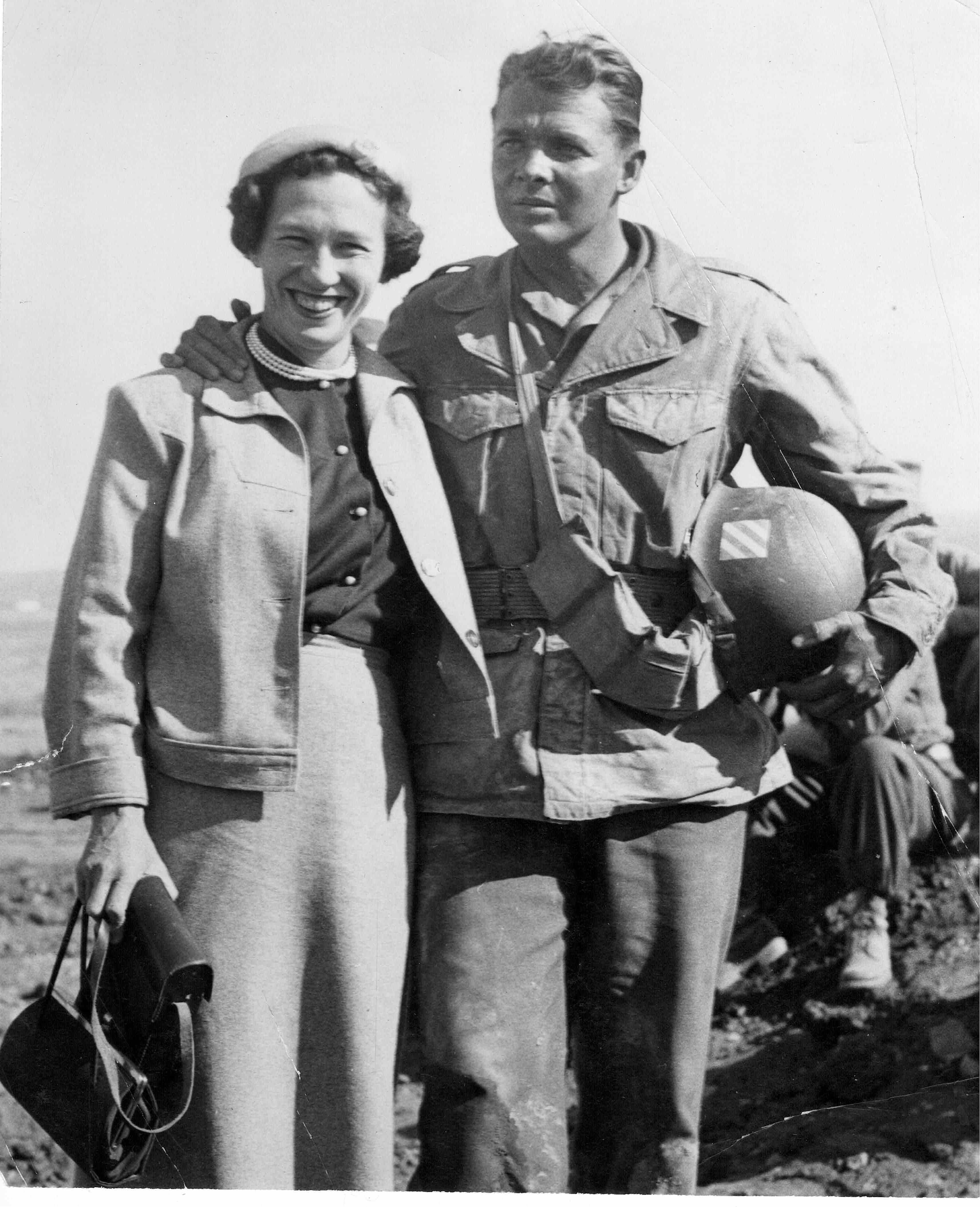
1955 Flo and Audie reconnected on the movie set of To Hell and Back. Photo by Rollie Lane. The photo at top is the one taken by Flo at the awards ceremony in Salzburg in 1945.
The most decorated soldier of WWII, Audie would cross paths with Flo again ten years later when he came to our hometown of Yakima, Washington to film the movie. There at the Yakima Firing Center the two of them looked through the scrapbook Flo had compiled of her adventures and heartbreaks in the European theater.
Now I have that scrapbook. It’s gigantic and weighs 25 pounds. I have wanted to use its contents to tell my mother’s story, but the project is overwhelming. Maybe I can start with Audie.
Audie Murphy was known worldwide after the war. He had a huge fan club and maybe still does (he died in 1971). One of his fans recently got in touch with me and asked if I could supply more stories and pictures. Yes! Flo stayed in touch with Audie. She corresponded with his biographer, his associates and those putting together a memorial in Texas. She saved mementos and newspaper clippings.
As for her photo that became famous, she gave it freely and others took credit. A post-war letter she saved warns that others are charging for the use of her photo. She never received credit.
The most personal most shocking secret my mother never told me I had to find out from my cousin Sandy.
In 1974 Sandy had just returned from a decade working for the U.S. Army in Germany. She came home and she came out, returning with a female lover and a seven-year-old stepson. Sandy is ten years older than I, and so represents a generation of lesbians different from mine, women forced to live in the closet before the gay liberation and feminist movements burst upon our scene. Running away to Europe had been a good way to keep her secret.
Flo in her Red Cross uniform. She wasn’t a nurse. She ran a “clubmobile.”
Sandy and I hung out together in Seattle and one night after a bit too much whiskey (she’s been sober now for many years) she asked me if I’d ever heard the story about my mother’s trip to Paris during the war. My mother, Flo, had told me many stories about working for the American Red Cross as a “donut girl” during World War II in Europe, but I’d never heard that one.
“What was so special about a trip to Paris?”
“Did you know Flo had an abortion?”
“Wow! No kidding! She never told me. How do you know?
“Mom told me. I guess she was sworn to secrecy, but she couldn’t keep the secret. She had to tell someone.”
Sandy’s mother, Ruth, had told her that my mother had traveled from the front lines to Paris, where their sister Eve was working as an Army nurse, to get an abortion. This would have been in the fall of 1944. I had many questions, but Sandy couldn’t answer most of them. We speculated about who the father was and whether Eve had been involved in the abortion.
I was shocked. Flo and I were close and I couldn’t believe she hadn’t told me, her only daughter, about this significant part of her own history.
When Sandy told me the story of the abortion, my mother was still living and she still had three living sisters. I had time and abundant resources. I resolved to find out the answers.
There were times during my childhood when Flo talked about her experiences in Europe. She showed us kids the big scrapbook she had made after the war and I remember looking through it often. Our favorite part was a series of colored pencil drawings made by Liz, one of the Red Cross gals she traveled with in the Army’s Third Division. They showed the “girls” washing their hair in helmets, peeing by the side of the road, driving big trucks, and roughing it in tents. It wasn’t until I opened the album again as an adult that I looked more carefully.
Flo did a pretty good job of documenting her time in Europe, taking photographs with a tiny Minox camera. She had traveled on a hospital ship to Italy in 1944. Her Red Cross unit followed General Mark Clark into Rome as it was liberated by the Allies. She was in France, Germany and Austria as well. She was the only person to photograph the field ceremony honoring war hero Audie Murphy and the photo from her album was later used in the making of a movie about him. She got lots of street cred from that, and several post-war newspaper stories about it are included in her album.
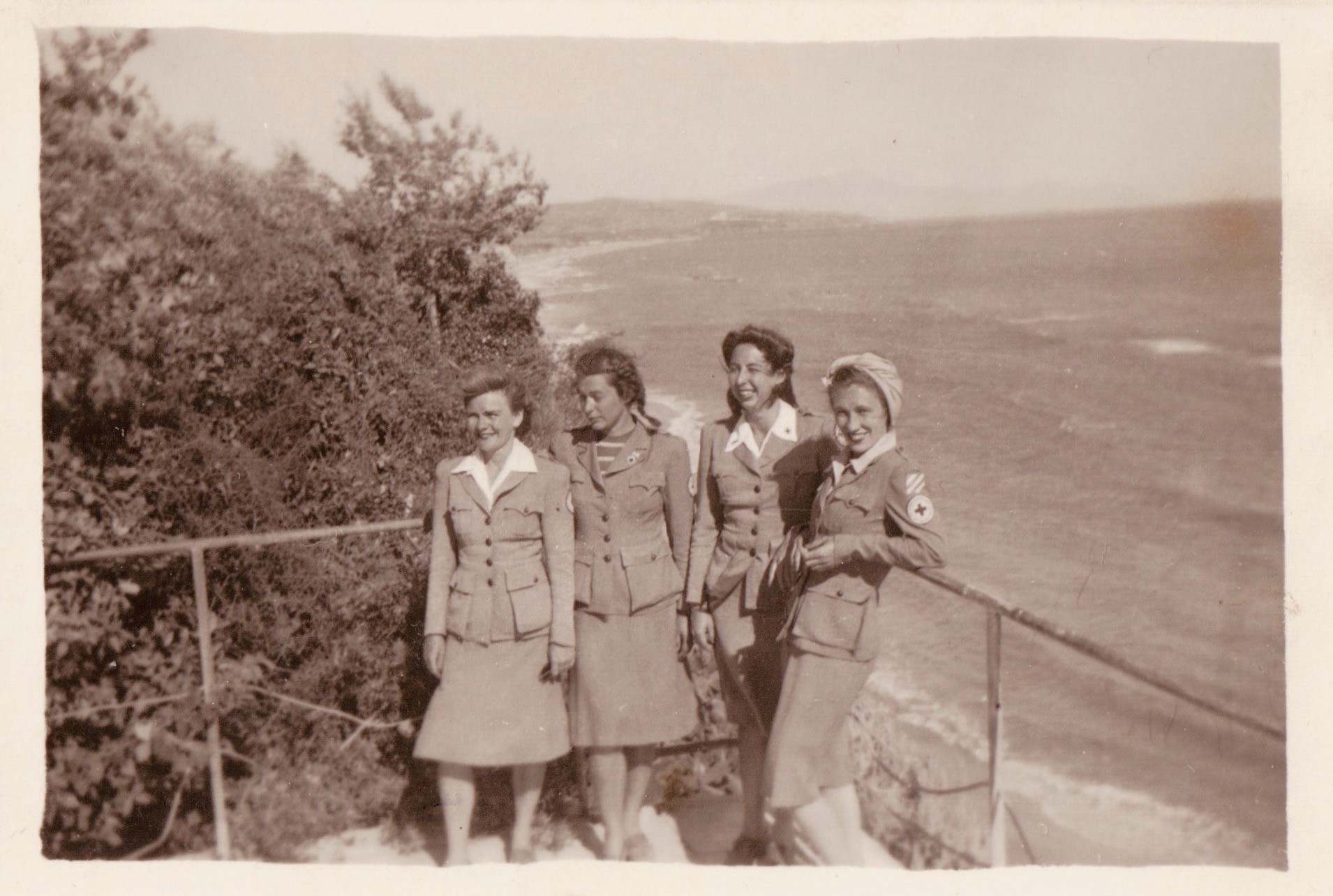
1944 Flo was captain of this crew. The clubmobile was a two-ton truck outfitted with a kitchen to make coffee and donuts for soldiers returning from the front. L-R Isabella Hughes (Jingles), Elizabeth Elliott (Liz), Dorothy Shands (Dottie), Florence Wick (Flo) in Italy
She hated Nazis and that translated into a hatred of Germans, whom she called Krauts. She distrusted Germans as a people, and believed they were all culpable for war crimes, even and maybe especially, those who claimed ignorance. She had witnessed the liberation of Dachau and took pictures, which were “lost” by a German photo shop. But she didn’t really talk about that part of the war until the 70s, sparked by a TV show, QBVII, based on a novel by Leon Uris. That discussion of concentration camp life allowed her to start thinking and writing about her experiences again. But until then she didn’t talk about the Holocaust and of course her album contained no pictures that might have induced questions from us kids.
She did tell us about her fiancé who was killed by a mortar shell, but she didn’t say much. Most of what I know I learned from the album, which includes photos of her and her fiancé, Gene, and letters from his mother in Oregon. There are also letters from other paramours, but she was clearly heartbroken by Gene’s death and not interested in settling down with any other, at least then.
Was she pregnant when he was killed? Did she have an abortion in Europe? Why wouldn’t she ever tell me about it? Why couldn’t I ever bring myself to ask her point blank?
In 1979, Flo and I traveled to Sweden and Norway together to visit our relatives and visit the town in Norway where her father was born. We felt particularly familial. This seemed like a good time to ask and I put some thought into how to approach the question. I didn’t think she would give me a straight answer if I asked her directly. I would have to work up to it.
Me: It must have been difficult to avoid getting pregnant while you were with the Red Cross. Did they issue you birth control?
Her: What!!
Ok, poor opening line, I know. I guess I was implying that she had sex with lots of men. Which would have been understandable. That’s what I was doing.
I felt her withdraw and knew, I think, that she would not have told me the truth even if I’d asked point blank. I didn’t have a Plan B.
In 1983, my mother died without ever giving up the story. But there were still two living sisters, Eve, the nurse, and Ruth, to whom she had told the story. Ruth wrote me a note after a story of mine was published in an anthology about the deaths of our mothers. The story was about Flo’s funeral. Ruth took issue with some of the “facts” of my story. I wrote back to say, essentially, this is my story and I get to tell it my way. If you want your story told, write it. Ruth responded with a wonderfully detailed descriptive story about her childhood. This made me hopeful she might “remember” other details about the family. Might she tell me something more about Flo’s trip to Paris?
After I got Aunt Ruth’s letter, I considered how to respond. Should I start with trivia and slowly up the ante before she caught on? Should I just blurt out what I wanted to know and hope for the best? I decided on a compromise strategy. I did come right out and ask the Paris question, mixed in with a few other family history questions.
I don’t believe I ever heard from Ruth again, except she did send me Xmas cards every year, filled with trivia. Then she died.
Aunt Eve must know something, I reasoned. After all, she had been in Paris when Flo visited right after her fiancé was killed. Eve, the nurse, was terribly practical. She also had a knack for talking non-stop over anyone about her boys and her cats. I didn’t think she would lie to me. She asked me to edit a personal history she had written about her time as a nurse in WWII and I used that opening to question her.
When I finally asked the question Eve seemed genuinely perplexed. She knew Flo had been pregnant. Was she pregnant by the fiancé who died? No, Eve didn’t think so. Well, who was the father then? She thought it might have been another guy Flo was dating. Really? I’m thinking: your fiancé dies, you are disconsolate, and then you get pregnant by another guy? I didn’t think so. But Eve remembered that Flo had told her she had miscarried while carrying heavy packages when moving to a new camp. She didn’t think Flo had had an abortion at all. My assumption that Ruth had gotten the information from Eve did a back flip. Flo hadn’t told Eve! She had only told Ruth, her closest sister, and sworn her to secrecy.
Flo and I got feminism together. As every new book came out about the movement, we rushed to the bookstore to buy it. I still have my copy of Sisterhood is Powerful, which she inscribed to me. She got angry about how she was treated at work. She was paid too little for what she did. When I went through her things after she died, in her jewelry box was a little pad of notes that could be pulled off, licked and stuck on something. They read “This Insults Women.” So many things then insulted women. We were sticking stickers on the world.
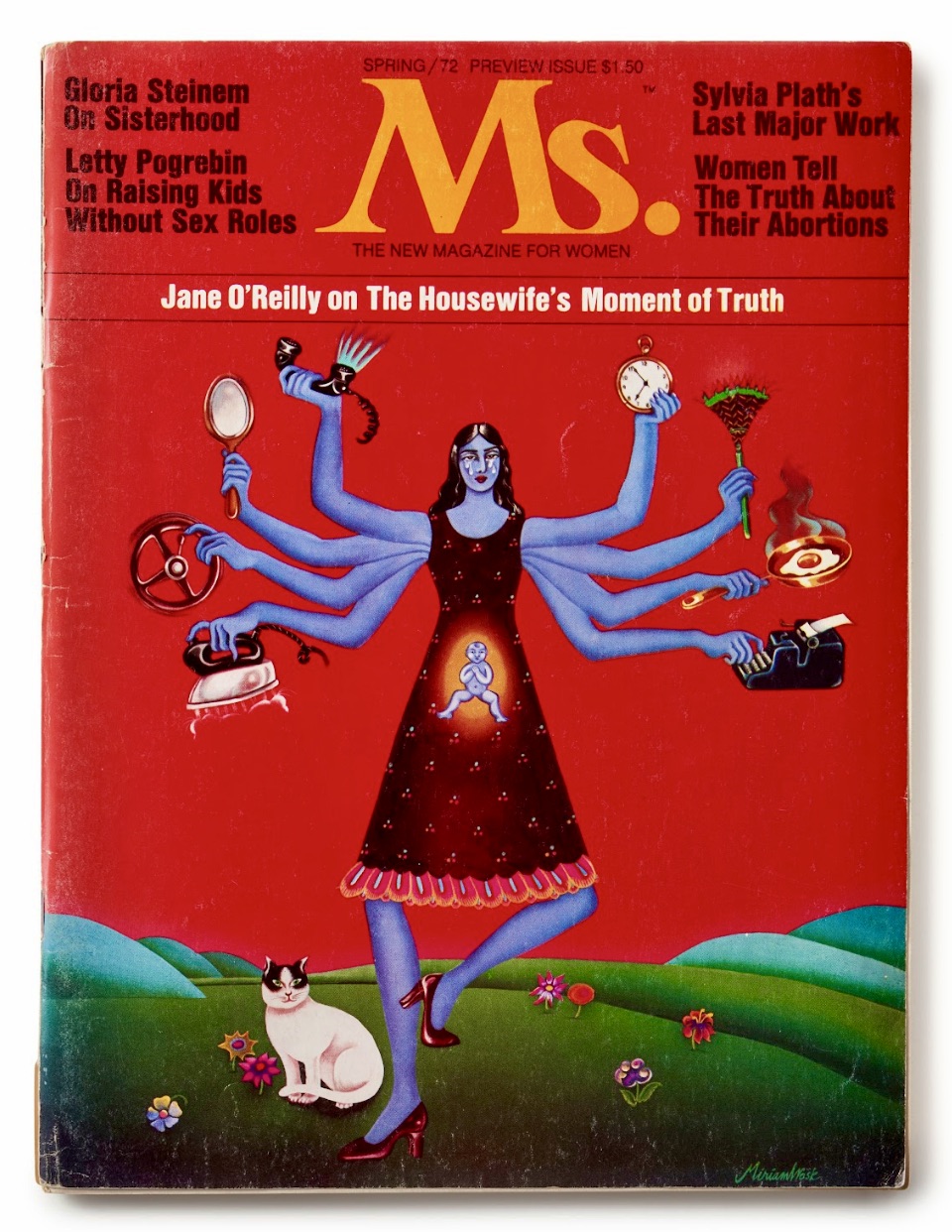
Women Tell the Truth About Their Abortions 1972
In 1972 the first Issue of Ms. Magazine was published. Flo had kept it and I found it in her collections. In the very first issue was a section about abortion. Famous women, so many of them, admitted publicly to having had an abortion. It was liberating! Until then abortion was not talked about. I didn’t imagine at that time that my mother had had abortions. I myself had been very careful not to get pregnant. But by the time I became sexually active, birth control pills had become available and I made sure I was on them before I chose to have sex with men. It seemed to me that getting pregnant would be the end of my world. In high school (before I ever had sex) I once asked my parents what they would do if I got pregnant. They said they would find an abortionist. Later, when I became a feminist activist in college, I realized this was not so easy.
I wondered if my dad knew about Flo’s trip to Paris and the abortion. After Flo died, he came to visit me in San Francisco with one of his many girlfriends.
“Hey, tell me something. Did you know Flo had an abortion when she was in Europe?”
He said he hadn’t known, but, he said, “I bet I know something that you don’t.”
“What?”
“She had an abortion before you were born. We had just gotten married and we didn’t see how we could afford kids. I drove her to Portland for the abortion.”
I was flabbergasted. Here was another secret she had kept from me! Now I wonder if my parents were even married then. In 1947 you didn’t go around telling folks you were pregnant and unmarried. Also, we could never believe anything Dad said; he was full of blarney.
Later I learned of Ruth Barnett, the abortionist who ran her business in Portland from 1918 to 1968. After she became pregnant in 1911 at 16 and had an abortion, she was convinced that all women should have the opportunity to receive an abortion if they wanted one. Barnett was the target of frequent raids, and was in and out of jail, but she kept it going for 50 years, retiring only after being convicted and sent to prison.*
Flo had kept the story of both her abortions secret from me, and she’d kept the Paris abortion secret from her husband all her life. Was she afraid of having to talk about Gene, the love of her life, to her husband? Maybe, like the concentration camps, she just didn’t want to go there again. Or maybe the shame was too deep.
World War II was a global conflict on an unprecedented scale. Women all over the world were recruited to serve the armed forces in many different roles. Approximately 400,000 American women served in the armed forces. What did the Army do when they got pregnant? While I have no proof, I believe it offered abortions to those who didn’t want to bear children. I hope so. I hope my mother didn’t have to seek an underground abortion in Paris.
*Ruth Barnett memoir: They Weep on My Doorstep. Also The Abortionist: A Woman Against the Law by Rickie Solinger
World War Two, the defining feature of my parents’ generation, affected my generation too. Maybe more than we know.
The Sound of Nazis
I was 15 going on 16, a sophomore in high school. It was 1965 and the Sound of Music was opening at the Capitol Theater in downtown Yakima. My mother offered to drive me and three girlfriends to see it.
Did my mother already know the story of Maria Von Trapp? Probably she knew of the post-war memoir or the 1959 Rogers and Hammerstein stage musical (she subscribed to the New Yorker magazine after all.) But whenever she learned of the story she must have wanted to see it. She had worked as a Red Cross “donut girl” in Europe during the war, passing out donuts to the troops on the front lines in Italy, France and Germany. She had lost her fiancé to a German land mine just days before they were to be married. She had witnessed the liberation of Dachau.
My girlfriends and I didn’t know the story. We were just excited to see the movie.
What a treat! We lived on the west side of town, out amidst the orchards and ranches. Our high school sat in the middle of an apple orchard. So getting anywhere required a car, even though in those days the school bus did pick us up and drop us off daily, but only after an hour spent driving around in the sticks.
The town of Yakima, Washington didn’t yet have a mall and so people still got dressed up when they went downtown to go shopping or see a movie at the Capitol Theater. When it was built in 1920 it had been the biggest and most ornate theater in the Northwest with seats for 2000.
By 1965 girls and women were no longer required to wear dresses, hats and gloves downtown. At school we were required to wear skirts, but on Saturdays we could wear play clothes—pedal pushers (zippers on the back or side only) and penny loafers with ankle socks. My mother still wore housedresses, even to clean the house, but she put on a polyester pantsuit to go to the movies.
We were teenagers, no longer children—young women really. Ponytails had metamorphosed into sleek pageboys and flips, which required sleeping on huge hair curlers. I had just converted to the popular flip, like a pageboy but flipped up at the ends instead of under. Beehive hairdos were in. You achieved a fuller look by ratting the hair, then combing over until it looked smooth.
We looked at the Simplicity pattern catalog to see what the new styles would be; Simplicity was remarkably prescient about fashion. Then we would just sew it. A-line dresses were comfortable and exceedingly easy to sew. Paisley was big. Hip hugger bell bottoms were popular and I made myself a pair with bright flowers in pinks and yellows.
Music didn’t move me like it did some others. I didn’t like my mother’s opera records or any of the odd assortment of 78 rpm records in her collection. As for popular music I just went with the flow, collecting 45 rpm records and playing them on a tiny square record player. The Beatles were big and we danced to “Love Me Do” and “Please Please Me.” My favorite 45 was “Chains” sung by the Cookies, a three-member group of Black women.
my baby’s got me locked up in chains
and they ain’t the kind that you can see, yeah
I didn’t know then that it was written by Carole King and Gerry Goffin.
I was a bit of a skeptic even then, irritably literal and unimaginative. My friend Susie had gone to the Beatles concert in San Francisco the year before and told me she couldn’t stop screaming while the group was singing. I asked her why girls do that. She couldn’t explain it; she said you just felt like it. I tried hard to understand but I really didn’t get it. Why would anyone scream while listening to music?
However, we were singers. We had formed a group called The Nonettes in eighth grade (there were nine of us). We sang Hootenanny songs like “500 Miles” and popular songs like “Winter Wonderland.” We hadn’t yet heard the Rodgers and Hammerstein music from the Sound of Music but we would learn it, since we were buying the Hi-Fi 33 rpm album after the show.
I was drawn into the musical immediately. What teenage girl would not identify with Maria—too exuberant to be a nun, too in love with the natural world to be ladylike. Did my girlfriends and I see ourselves as a problem to be solved?
The captain was like everyone’s father—militaristic, distant, full of orders, strict. But it was hard not to like the nuns even if they did kick Maria out of the convent.
We knew that booing at the movies was rude behavior, but we all booed silently when the baron’s lady friend and the children’s stepmother-to-be appeared. She would make a terrible mother to those children! Maria was so much better.
When the Nazis came on screen I heard what sounded like a low murmur coming from my mother. “Krauts,” she growled under her breath.
Then during the scene where the family is hiding from the ersatz boyfriend, she snarled, “Bastard.”
I felt myself flush. Talking in the movie theater was strictly forbidden and everyone sitting near us could hear my mother. They were turning around to shush her. Had my mother set out to embarrass me in front of my girlfriends?
I turned to frown at her. She sat on the edge of her seat with a death grip on the arm rests, her face twisted in anger. It was only then—20 years after the end of the war—that I began to see the depth of trauma my mother and many of our parents had experienced. Joan’s father, a bomber pilot, lost his mind. Rachel’s parents, having survived a concentration camp, could not talk about the war. My father and others viewed parenting as an extension of basic training.
It would take many more years to understand how my girlfriends and I—the next generation—were also deeply affected by the war that ended before we were born. #
“We are all at fault for allowing it to happen“
My mother wasn’t able to talk about the Nazis’ crimes against humanity until the program QB VII came on TV in 1974. Then she wrote this letter to the editor.
It is massive, about the size of a small suitcase, with a dark blue padded leather cover now, 70 years later, quite beat up. It weighs 25 pounds. Throughout our childhoods my brothers and I pulled it out, looked through it, listened to our mother’s war stories. The scrapbook is filled with photographs, newspaper clippings, letters, travel paraphernalia and it tells the story of Mom’s two years as an American Red Cross (ARC) “donut girl” in Europe during World War II. With a crew of three other women she drove a clubmobile, a truck retrofitted with a kitchen, near the front lines, making and serving coffee and donuts to soldiers of the Third Infantry Division in Italy, France, Germany and Austria.
Mom was a scrapbook maker and for that I am now grateful as I try to piece together the events of her life. Perhaps she had the idea for the album even before she sailed to Europe on a hospital ship in May 1944. I do know that the act of putting it together when she returned home after the war in 1946 salved her sadness at the deaths of so many and helped her readjust to life stateside where it seemed compatriots had moved on and no longer thought about the war.
When my mother, Flo, died in 1983 at the age of 70, I claimed the album and it’s been stored in garages and closets ever since, occasionally brought out for perusal by relatives or friends with an interest in World War II. For a time it lived in the mold-infected storage room and so it was infected along with other archives. I’ve exposed each page to sunlight in an effort to reduce the mold and that’s helped, but when I really want to examine the book I don a respirator to avoid breathing in clouds of invisible mold spores.
In trying to understand the World War II era, my ongoing research includes reading about this historical period and the books I know Flo was reading during the 30s and 40s. Her saved scrapbooks from the 1930s give many clues to what she was thinking and reading, setting the stage for the advent of the 1940s and the war. I’ve found useful artifacts in boxes saved by my brother Don and my cousin Gail. Don dug out a box of Flo’s essays and letters-to-the-editor from the 1960s to the 1980s that I had thought were lost. We have precious few of her personal letters, but my cousin recently found two letters written to her mother, Flo’s sister Ruth, from Europe in 1944! Don, the family historian, has helped me track down information about Flo’s clubmobile comrades. They are now all dead, but I’m in touch with one of their daughters, who is providing another perspective on the “donut girls.” I’ve read accounts of their experiences, although I haven’t found one that mirrors Flo’s particular journey. And I’ve read the stories of men who served in the Third Infantry Division, to which Flo’s clubmobile was attached.
I’ve dreamed of traveling to Europe to trace Flo’s route through towns and battlegrounds. Someday I may do that but I’m thankful that now I can take a virtual trip right here on my computer.
At Dachau at war’s end my mother photographed stacks of corpses left by the fleeing Nazis. She was focusing on the bottom layer when she caught the movement of a human hand through the camera’s viewfinder. Her screams brought others, but of course, nothing could be done to save these victims of the Nazi holocaust. She later wrote: “…I wondered how many potential Mendelssohns and Einsteins there were among those wretched skeletons, and if, perhaps, the great Goethe might be turning in his grave about this modern and depraved Mephistopheles, Adolf Hitler, and what he had done to Goethe’s Germany.”
Mom in uniform
The question has haunted both my mother’s generation and my own post-war generation: How could a culture that produced such artistic and intellectual genius fall to such depths of depravity? And how do we keep it from happening to our own culture?
I know. Heavy, right? But I can’t help it. This is what I can’t stop thinking about in the emerging Trump era as I examine my mother’s scrapbook from her time in Europe during World War II. How did ordinary Germans ease Hitler’s rise to power? Why do people vote for demagogues?
My mother never found the answers to these questions, but she never stopped searching for them. I believe she would say that we must keep imagining a better world and remain active and involved citizens. In that regard she was a good role model who believed that knowledge of history can help us navigate our present. Although she was constantly disappointed that history was so seldom consulted by our leaders and policy makers.
I want to learn how the war affected my mother’s thinking. I’m also interested in what influenced her to become the person she was, a liberal thinker in the sea of conservative backwardness of Eastern Washington. I aspired to become my mother’s daughter. But what made her that way? Who was she, really?
I know she didn’t always tell me, her only daughter, everything. What secrets did my mother take to her grave? How did her experiences in the war shape her life and the lives of her generation and how did that history shape me and my generation? These are some of the questions I hope to explore as I attempt to tell about her two years in Europe during the war working as a Red Cross “donut girl.”
Mostly I’m just interested in my mom’s story. It’s a good one.










 tradeswomn musings