Born in Oregon, Buried in France

Remembering Eugene Gustafson

My Mother and Audie Murphy Ch. 44

To return to the start of this series, My Mother and Audie Murphy: https://mollymartin.blog/2024/11/04/my-mother-and-audie-murphy/

Even as soldiers were dying all around them, the death of Flo’s fiancé, Gene, on October 28, 1944, came as a horrific shock. In a letter to her mother, Flo wished she could just go home. But she wasn’t a quitter, and she even stayed in Europe through the post-war occupation, returning to the U.S. in March, 1946, nearly a year after the war’s end.

Back home, making her album, she devoted a page to Gene with the obituary from his hometown newspaper, and the poem by Archibald MacLeish, The Young Dead Soldiers. He was buried in a military cemetery in Epinal, France.
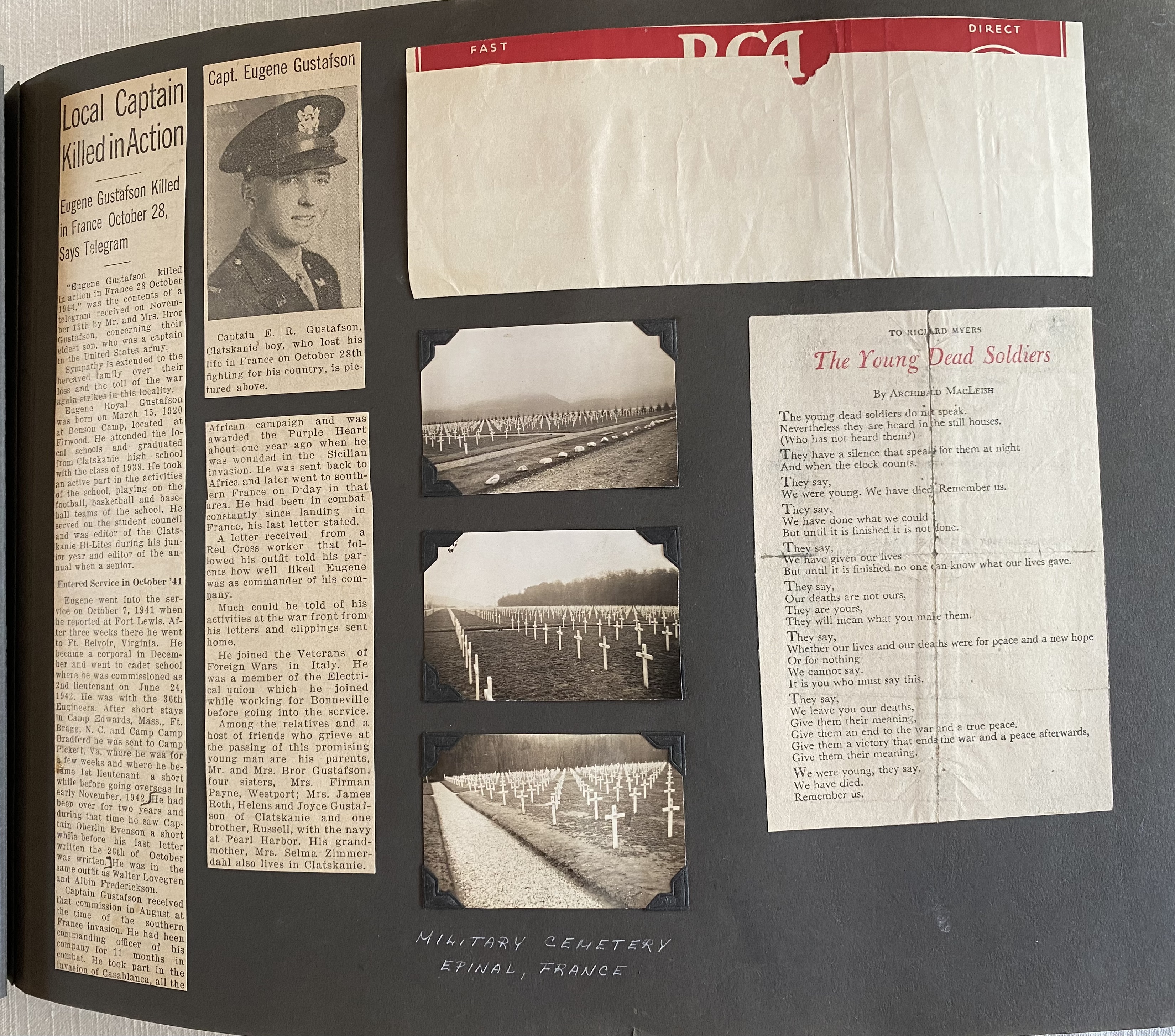
A page in Flo’s album

Reading Gene’s obituary gave me a fuller picture of the man. I learned some things:

He was born in a “camp” in Oregon in 1920—probably a lumber camp. 

He had one brother serving in the Navy and four sisters back home. He was a jock, sure—but also the editor of his high school newspaper in Clatskanie, Oregon. 

Before the Army, Gene had been a union electrician with the Bonneville Power Administration–a working class guy. 

His military training was intense—taking him from Washington to Virginia, then on to Massachusetts, North Carolina, and back to Virginia again. He enlisted in October 1941 and was sent overseas in November 1942. A year of preparation for a war he would not return from.

I learned he was wounded during the Sicilian invasion and awarded a Purple Heart, and that official news of his death didn’t reach his family until two weeks later. 

Learning these things made Gene feel more real to me—not just as a name in someone else’s story, or a loss recorded in a diary, but as a whole person with a life that mattered. I wish I could’ve met him. In some small way, reading his obituary felt like I did.

Gene’s obituary published in his hometown paper

Local Captain Killed in Action

Eugene Gustafson Killed in France October 28, Says Telegram

“Eugene Gustafson killed in action in France 28 October 1944,” was the contents of a telegram received on November 13th by Mr. and Mrs. Broer Gustafson, concerning their eldest son, who was a captain in the United States army.

Sympathy was extended to the bereaved family over their loss and the toll of the war again strikes in this locality.

Eugene Royal Gustafson was born on March 15, 1920 at Benson Camp located at Firwood. He attended the local schools and graduated from Clatskanie high school with the class of 1938. He took an active part in the activities of the school, playing on the football, basketball and baseball teams of the school. He served on the student council and was editor of the Clatskanie Hi-Lites during his junior year and editor of the annual when a senior.

Entered service in October ‘41

Eugene went into the service on October 7th, 1941 when he reported at Fort Lewis (WA). After three weeks there he went to Fort Belvoir VA. He became a corporal in December and went to cadet school where he was commissioned as 2ndlieutenant on June 24th 1942. He was with the 36th Engineers. After short stays in camp Edwards MA, Fort Bragg NC and Camp Bradford, he was sent to Camp Pickett VA where he was for a few weeks and where he became 1st lieutenant a short while before going overseas in early November 1942. He had been over for two years….

Captain Gustafson received that commission in August at the time of the southern France invasion. He had been commanding officer of his company for 11 months in combat. He took part in the invasion of Casablanca, all the African campaign and was awarded the Purple Heart about one year ago when he was wounded in the Sicilian invasion. He was sent back to Africa and later went to southern France on D-Day in that area. He had been in combat constantly since landing in France, his letter stated.

A letter received from a Red Cross worker that followed his outfit told his parents how well liked Eugene was as commander of his company.

Much could be told of his activities at the war front from his letters and clippings sent home.

He joined the Veterans of Foreign Wars in Italy. He was a member of the electrical union which he joined while working for Bonneville before going into the service.

Among the relatives and a host of friends who grieve at the passing of his promising young man are his parents, four sisters, and one brother, Russell with the Navy at Pearl Harbor. His grandmother, Mrs. Selma Zimmerdahl also lives in Clatskanie.

Of course the “Red Cross worker that followed his outfit” referenced in the obit must have been Flo. I wonder how she felt about being described that way.
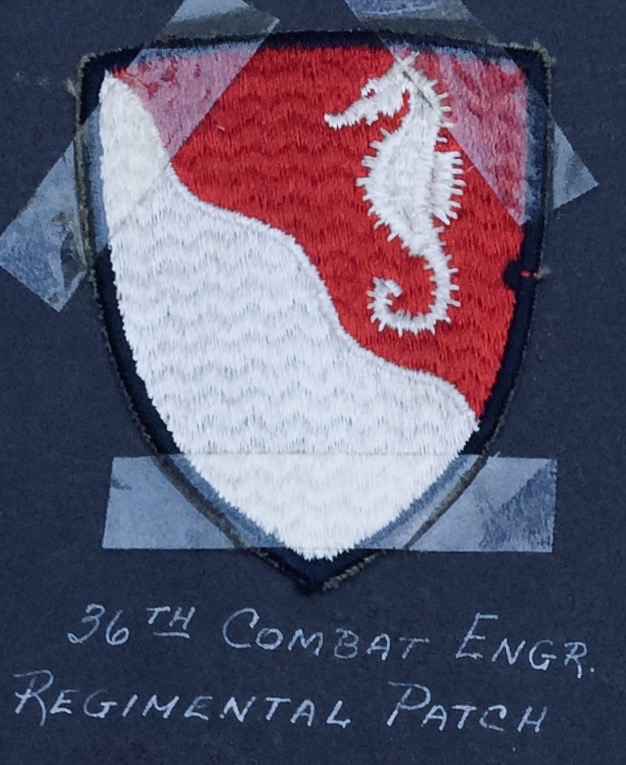
Gene’s regimental patch. The seahorse is a nod to their training in amphibious assault and support operations. The red and white colors of the shield represent the Corps of Engineer regimental colors. 


Ch. 45: https://mollymartin.blog/2025/08/06/a-cold-rainy-november/
What Do Combat Engineers Do?

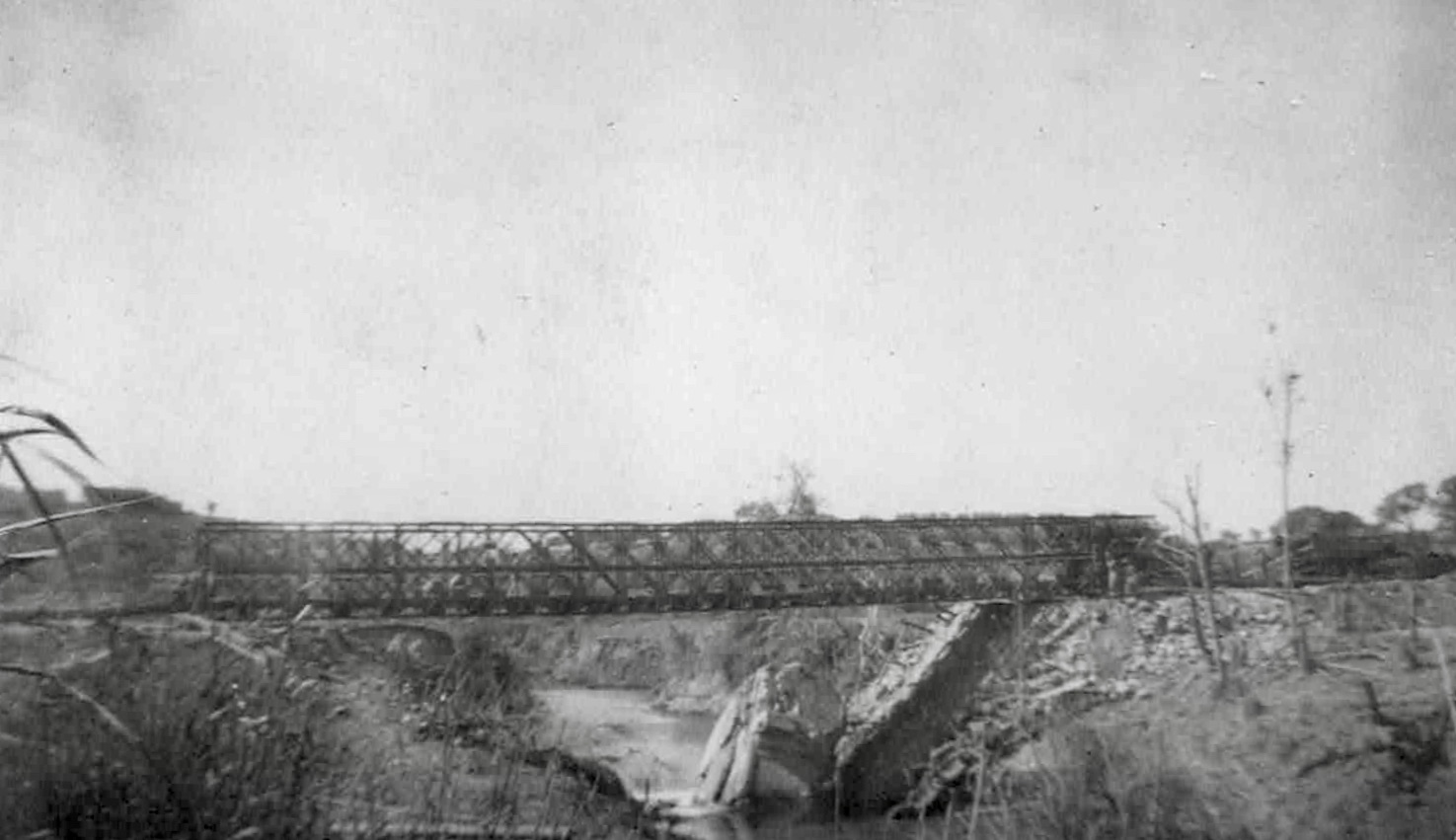
Gene Built Bridges

My Mother and Audie Murphy Ch. 38

One page in Flo’s album is devoted to the combat engineers—soldiers whose construction work enabled the army to move men, machines, and supplies into active war zones.

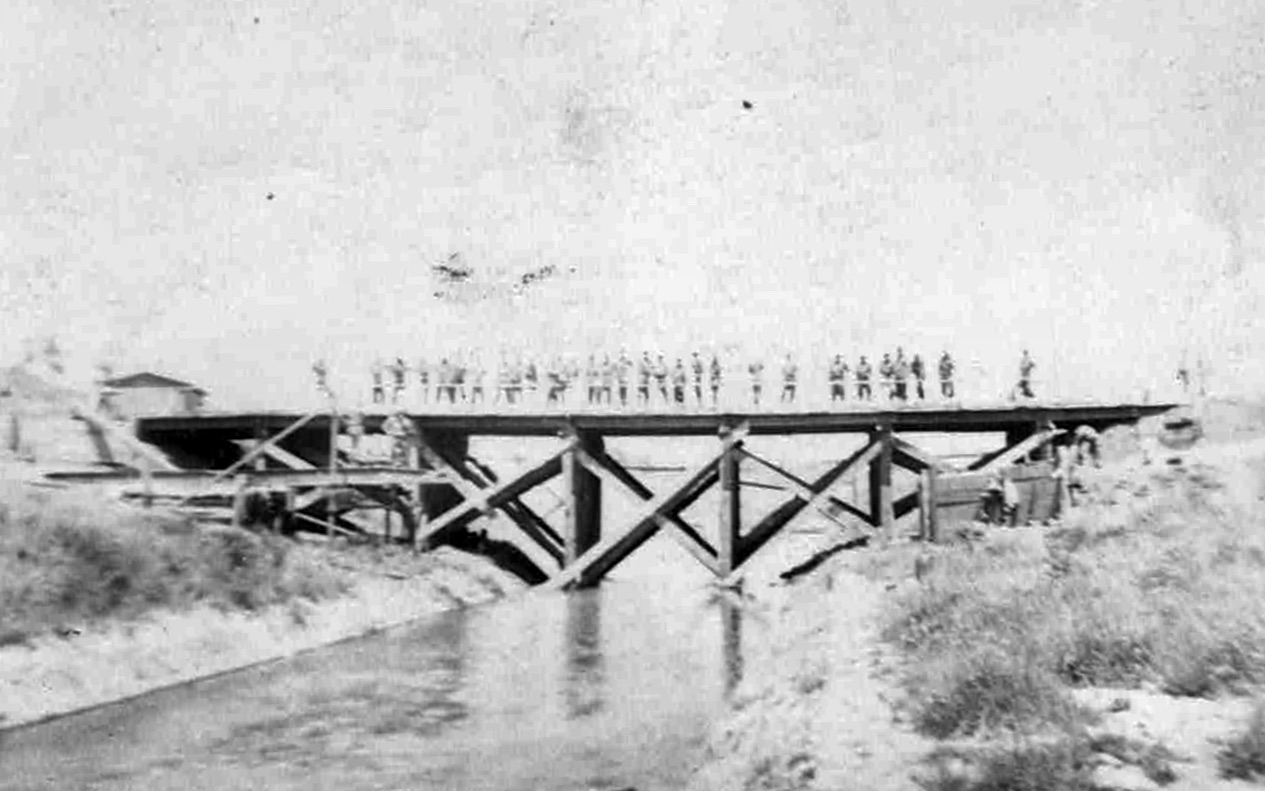
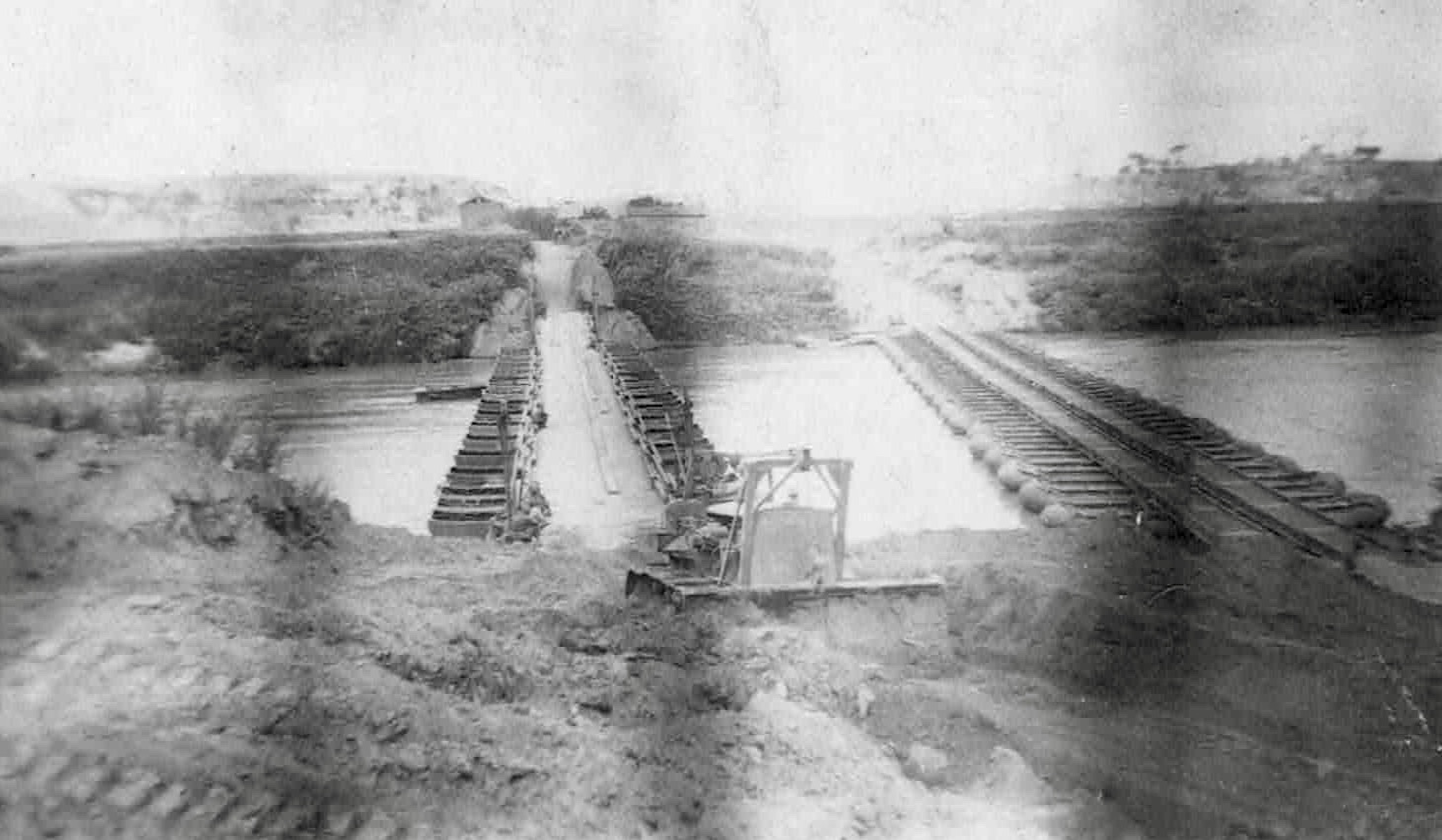
Bailey Bridge at Monto Alto above Rome, Topping out

Combat engineers were tasked with everything from building roads and bridges to clearing mines, digging tunnels, demolishing obstacles, and performing emergency construction under fire. Their work was both strategic and dangerous, often done at the front lines or just behind them.

Constructing a bridge across Mussolini canal, Pontoon bridges across the Tiber River in Rome

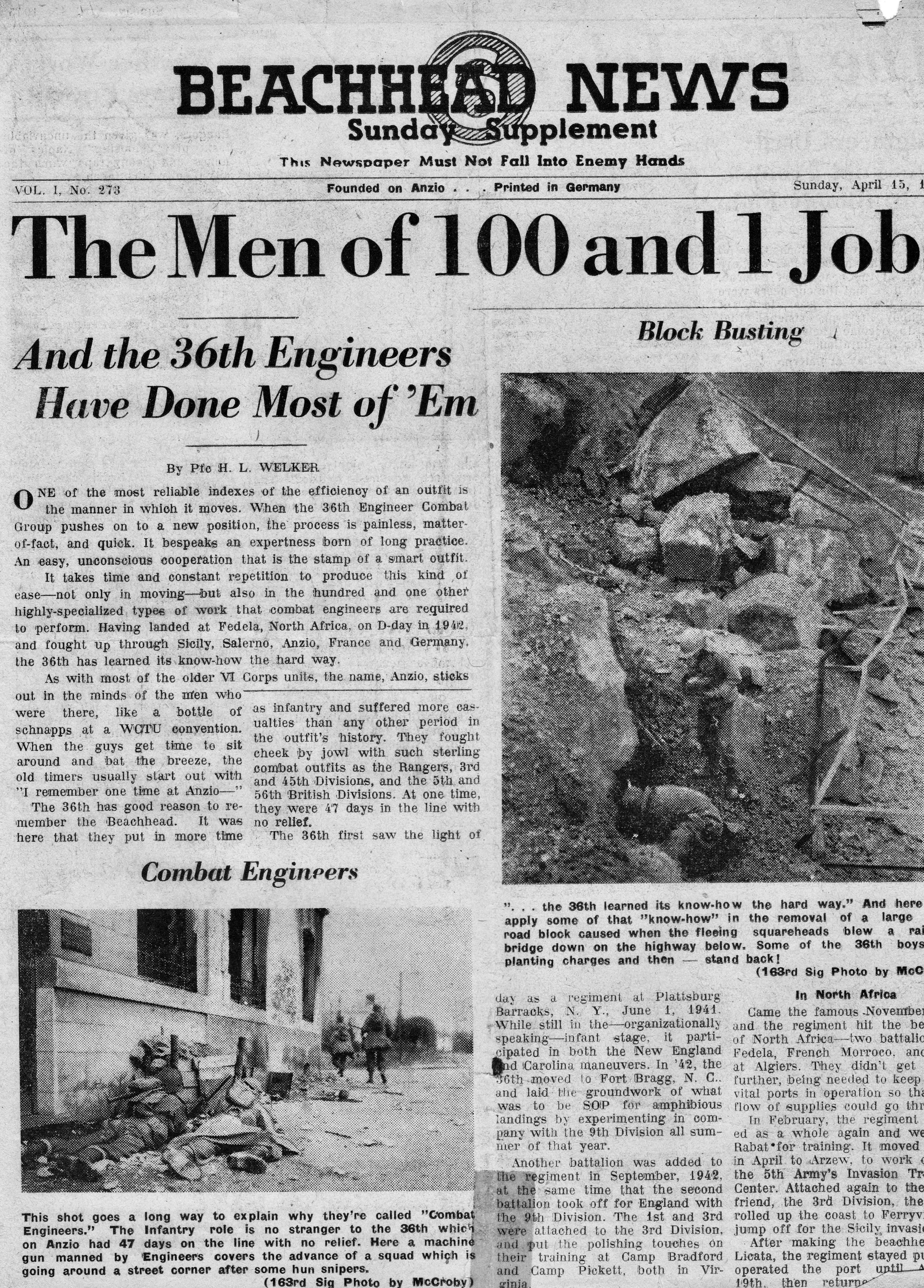
Flo’s fiancé, Gene, served with the 36th Engineer Combat Group. The engineers were proud of their mission, and Gene gave Flo photos of some of the bridges his unit built. She carefully arranged them in her album, alongside a special edition of Beachhead News from April 15, 1945, dedicated to the 36th.

From Beachhead News

The Men of 100 and 1 Jobs—And the 36th Engineers Have Done Most of ’Em

“One of the most reliable indexes of the efficiency of an outfit is the manner in which it moves. When the 36th Engineer Combat Group pushes on to a new position, the process is painless, matter-of-fact, and quick. It bespeaks an expertness born of long practice—an easy, unconscious cooperation that is the stamp of a smart outfit.

It takes time and constant repetition to produce this kind of ease—not only in moving—but also in the hundred and one other highly specialized types of work that combat engineers are required to perform. Having landed at Fedala, North Africa, on D-Day in 1942, and fought up through Sicily, Salerno, Anzio, France, and Germany, the 36th has learned its know-how the hard way.”

The article goes on to chronicle the unit’s contributions across multiple campaigns—a record of grit and expertise that Flo proudly preserved.

Ch. 39: https://mollymartin.blog/2025/07/13/flo-and-gene-permitted-to-marry-2/

Dance with All, but Don’t Fall

My Mother and Audie Murphy Ch. 20

They were told to dance with all the boys—but fall for none. Red Cross rules were clear: dating was fine, as long as the man wore officer’s stripes. Enlisted men were off-limits.

By day, the women drove from camp to camp serving donuts. By night, they danced—sometimes until midnight, then back on their feet by 3 a.m. when the troops came off the line. It was often exhausting, but it was the job.

Flo did her duty. She danced with everyone. Her diary mentions a rotating cast of names—Gus, Buzz, Captain Chaney, Pvt. Rotter, Rick, Stonie, Lt. Phillips, and a handful of Yakima boys. She even dined with Gen. O’Daniel. But her heart stayed untouched.

Until Gene.

She met him in June at the Third Division bivouac at Pozzuoli while serving the 36th Engineers. The first hint shows up in her diary on July 13:  

“Date with Lt. Gustafson at 36E dinner and swimming at beach. Fun.”

From there, something shifted.

Flo serving the 36th Engineers

July 21:  

“Too many parties tomorrow nite; am involved.” 

She didn’t say his name, but by then, it was clear. She had a boyfriend.

Flo, once a secretary fluent in shorthand, sometimes switched to code in her diary. On July 23, in those secret curves and loops, she wrote:  

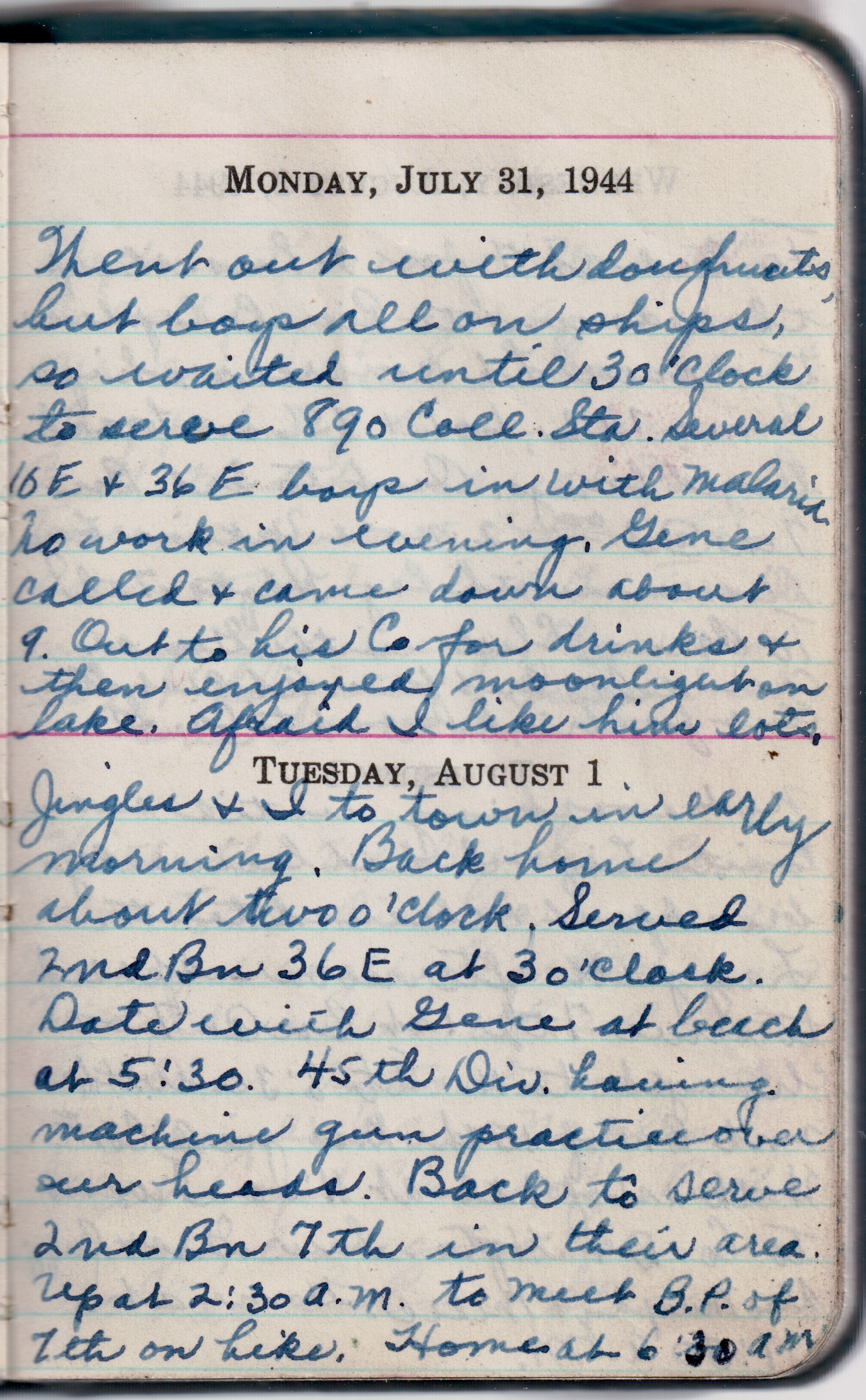
“Gene asked me to marry him today.”

The next day:  

“Gene down at 9:30. Looked at moon by the lake.”

The war made everything urgent. The ARC discouraged marriage, but love had its own rules. On July 28, she confessed:  

“Hate to think of the new invasion. He wants to give me a ring.”  

And then,  

July 31: “Afraid I like him lots.”  

August 6 in shorthand: “Decided I want to marry him.”

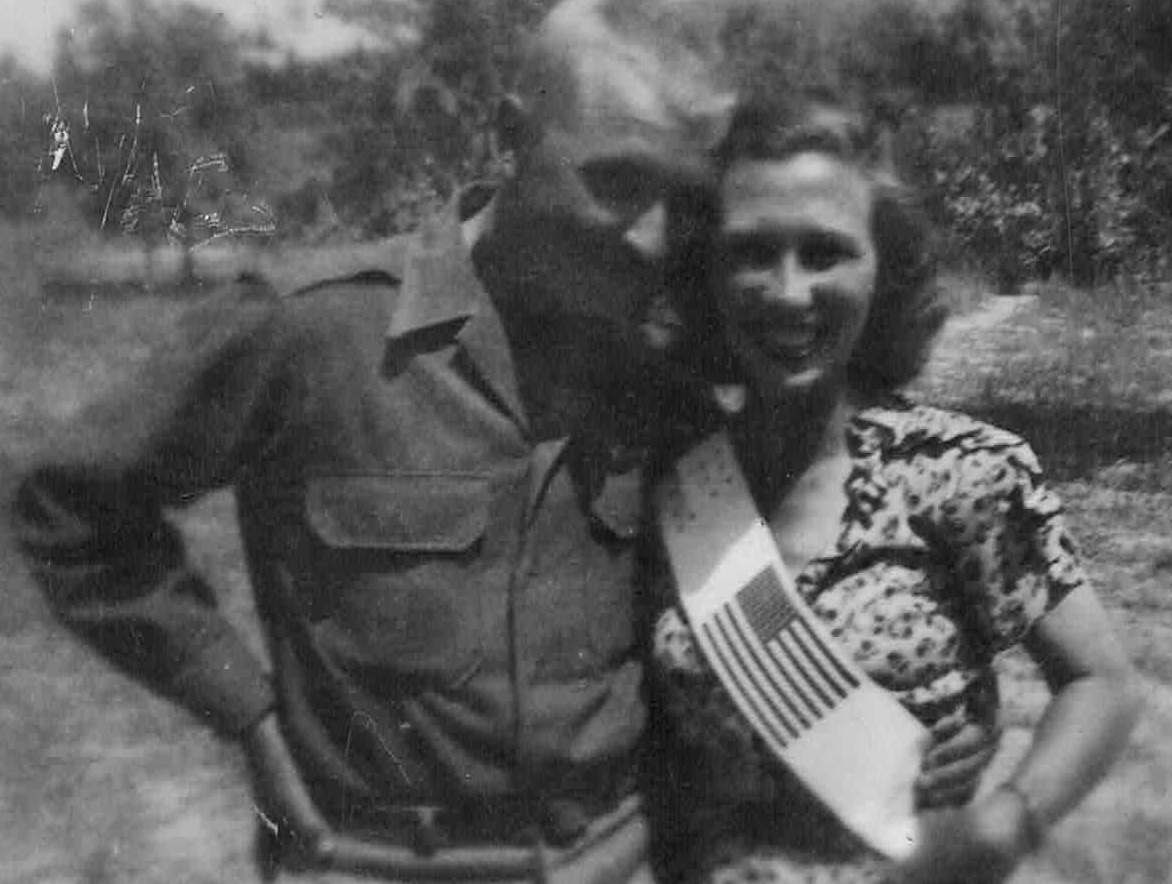
Gene Gustafson and Flo. She is wearing the armband used in the southern France invasion.

Flo had no shortage of admirers. She made friends easily, and turned down suitors gently. One woman joked that a soldier, refused by her, turned around and proposed to her friend—who accepted on the spot. It was that kind of war.

On August 7, as Gene prepared to ship out:  

“Last date with Gene. Love him in spite of resolve.”

Flo captioned this picture “Gene’s home at Anzio.”

In a letter to her sister Ruth, she tried to make sense of it all:  

“He’s big, very blonde, nice-looking, Swedish on both sides, and an engineer, as well as an Oregonian. It’s almost too perfect a set up and I don’t know just how it will materialize, but he wants to get married as soon as the army and Red Cross will let us. You would like this man and Mom especially, would approve. We’ve talked of going through Sweden before we come home but one never knows here. 

War does some peculiar things though, and we have no idea when we will get together again, or, of course, if he will survive this mess. The only thing I can do is borrow your philosophy that if it is to be, it will be!” 

Ch. 21: https://mollymartin.blog/2025/04/17/she-liked-opera-they-liked-jazz/