On Leave: Sorrento and Capri

My Mother and Audie Murphy Ch. 23

After Goodbyes, Four Days of Bliss

August 1944 was a month of waiting. The men Flo and her friends had waved off were now at sea, sailing toward the battlefields of Southern France. Their D-Day, scheduled for August 15, loomed heavy in the minds of the Red Cross women left behind. It might be weeks, they were warned, before the coast was clear enough for them to follow. On August 8, the women moved from the camp at Pozzuoli to a residence next to headquarters in Naples.

After days of stifling heat and restless worry in Naples, the women were granted leave. Flo, Dottie, and Isabella fled to Sorrento, trading the grit and noise of the city for something closer to paradise. Flo captured it all in a letter home:

A page from Flo’s album. Which one of these guys is the cute French officer? She didn’t save the letters that were in the envelopes. What did he write? Pinch out to look more closely.

“We have been resting for several days and spent four wonderful days at Sorrento in a lovely old hotel, which is now an officers rest camp. It was peaceful and lovely down there after the hot, noisy, dirty city and seemed like a different world. We were in bathing suits and shorts most of the time, swimming and sailing. They not only have white sails on the boats, but red, Blue and terra-cotta. It is a picturesque site – the sailboats skimming along on that blue, blue water with veri-colored sails. 

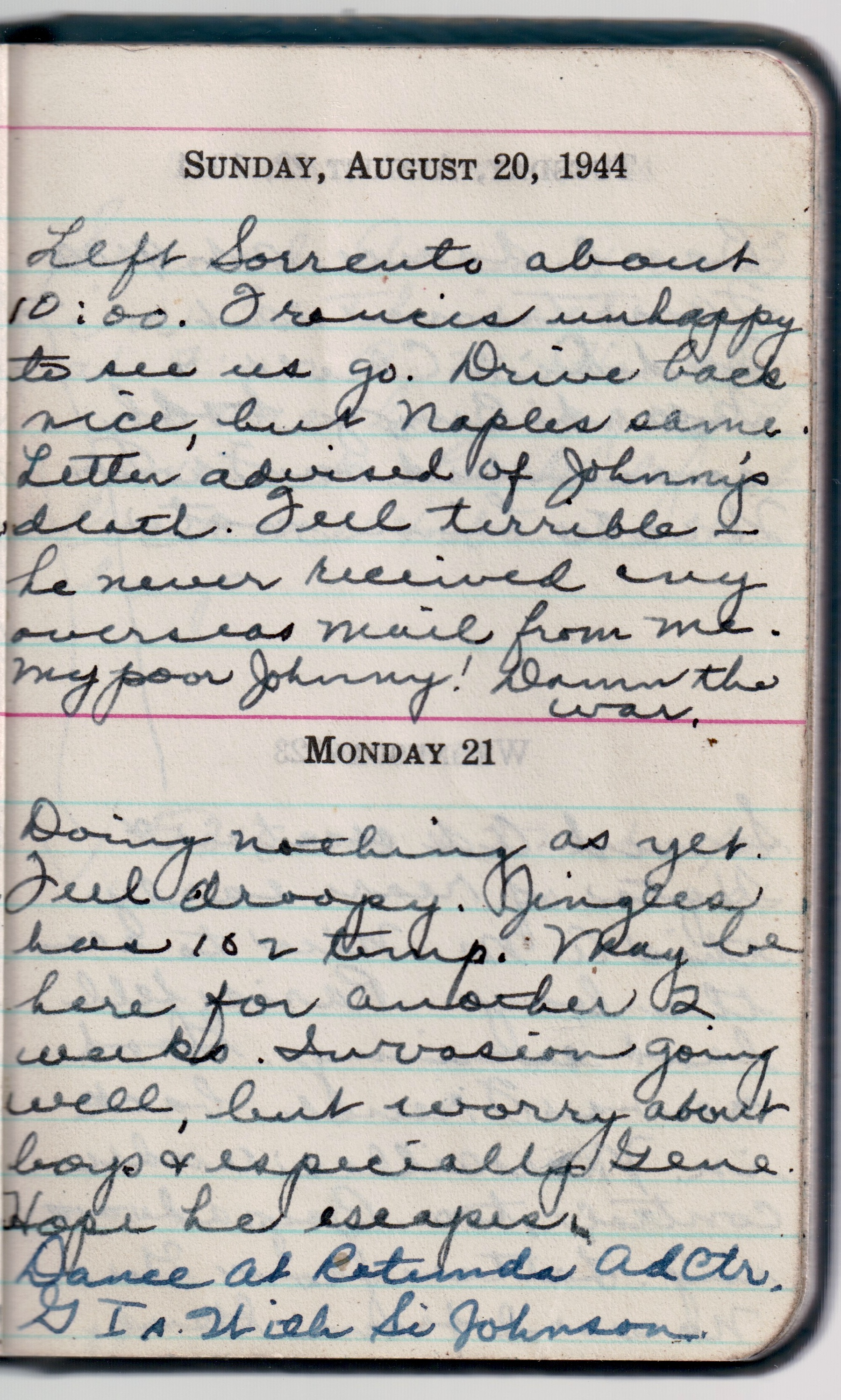
In her diary Flo wrote about her flirtation with a cute French officer in Sorrento. She called him a “very romantic boy.”

“Italy has its good points and they are nearly all scenery. We took the one-day boat excursion trip to Capri and it is as romantic and lovely as all the songs and posters say. It is out of this world and is surrounded by the clearest, bluest water I’ve seen. The island itself is quaint– abounding in all kinds of flowers, trees, lovely shrines and cathedrals, which date back to the 15th century. 

“To make my few vacation days even more unusual and romantic, I met a cute French officer, who made a big hit with all – male and female – staying at the hotel. He spoke a very few words of English and I no French, but we got along beautifully and I took a great deal of kidding about it. Even in his broken English, he was quite a smoothie, and so sincere about it all. They are such sentimentalists, but confidentially I prefer them to the English.” 

Flo wrote about their trip to Sorrento and Capri in her diary

They sailed to Capri, where the sea was so blue it looked unreal, and the hillsides spilled over with flowers and ancient shrines. Flo met a young French officer, charming even in broken English, and spent a day with him swimming, sailing, and dancing under the southern sun.

In her diary, she noted the date — August 15 — and scribbled the words: “Hope 3rd Div. okey.” She took a drive along the Amalfi coast, marveling at the villages clinging to cliffs above the sea. For a moment, the war felt far away, almost unreal.

But when the four days ended, reality closed back around them. Returning to Naples, Flo and the others slipped once more into the long, anxious business of waiting — and worrying about the boys they had left behind. She wrote in her diary, “May be here for another two weeks. Invasion going well, but worry about boys and especially Gene. Hope he escapes.”

Ch. 24: https://mollymartin.blog/2025/05/02/operation-dragoon-the-landing/

Loose Lips Sink Ships

My Mother and Audie Murphy Ch. 11

May, 1944. On the Ship to Naples 

“Loose lips sink ships.” That was the mantra drilled into the heads of American Red Cross (ARC) women during their training in Washington, D.C. If the FBI discovered that a secret had leaked because of something you said or wrote, you were sent home. 

One instructor drove the point home with a cautionary tale: An ARC worker had called her parents in Montana, mentioning that she was in Colorado on her way to San Francisco. Her mother told the butcher, who told someone else, and within three hours, the FBI had traced the leak back to her. As a result, an entire convoy was delayed. 

Flo took these warnings seriously. While she wrote to her mother in Yakima regularly, she was careful never to include anything that might be considered classified.  

The Pentagon, opened 1943, displaced a Black town.

Fast-Tracked for War  

The usual six-week training program had been slashed to just two weeks to push the women through faster. The military issued them canteens, helmets, and web belts, alongside yet another round of security warnings. Phone calls and letters were discouraged. Training even covered how to handle a poison gas attack, complete with gas mask drills.  

Flo and her cohort began training on April 17, 1944. By May 8, they had their embarkation orders. On a warm May morning, the ARC women, clad in winter uniforms, marched two abreast to Union Station, where they boarded a train to New York City. From Penn Station, they were shuttled by bus to Brooklyn and housed at the massive St. George Hotel. There, they waited—alongside countless other uniformed Americans—until it was time to ship out.  

No one knew where they were going. Not even the ship’s officers were told their destination. Only the captain held that information, as wartime security dictated.  

The HNHS Atlantis

Aboard the HMHS Atlantis 

Flo’s ship, the HMHS Atlantis, was a British hospital vessel that had already survived encounters with German U-boats. The Germans ignored Geneva Convention rules that forbade attacking hospital ships—these vessels made tempting targets. During submarine alerts, the Atlantis would zigzag wildly to evade torpedoes.  

Once aboard, Flo learned that her destination was Italy, where she had been assigned to the North Africa theater. The ship carried British engineers, fellow ARC workers, and stacks of Italian phrasebooks. Flo tried to pick up a bit of the language during the long voyage.  

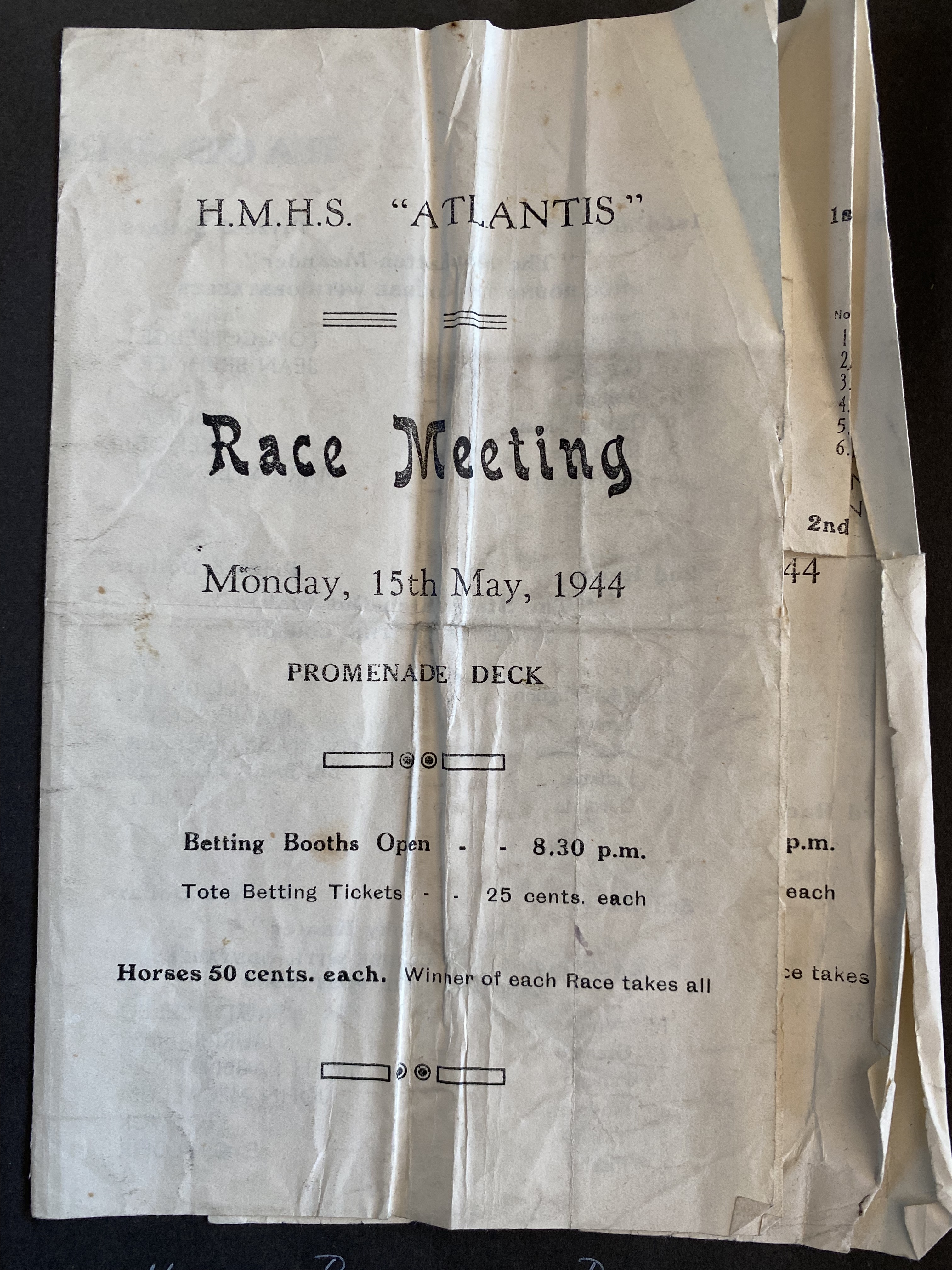
Crossing the Atlantic took nearly three weeks. To pass the time, Army journalists produced a daily mimeographed newsletter, Red Cross Currents, a few copies of which Flo saved in her scrapbook. She also kept menus and records of shipboard activities, which included:  horse racing (the cardboard variety), a contract bridge tournament, shuffleboard, deck quoits, “angell golf”, ping pong and deck tennis. Prizes were cartons of cigarets. 

Flo documented her voyage with snapshots—sunbathing with English engineers, uniformed officers on deck. Among the clippings in her album was an image of the newly built Pentagon, a source of national pride. What the public hadn’t been told, however, was that its construction had wiped out Queen City, a thriving Black town in Arlington, Virginia. The residents of the town were descendants of the residents of Freedman’s Village, which had been established by the federal government during the Civil War as a home for displaced freed slaves.

Letters, Friendships, and Missed Meetings  

Flo befriended an Irish engineer who worked on the ship, R.H. Wilkinson. They kept in touch throughout the war, attempting—but failing—to meet again. In August 1945, after the war had ended, Wilkinson wrote to her, reminiscing about their time on the Atlantis and asking for copies of photos to complete his scrapbook. He had since been deployed to the Pacific and was now stationed on the India run, where, as he put it, it was “very hot!” If she ever made it to Belfast, he promised, she would receive a true Irish welcome.  

Flo never did make it to Ireland.  

Sunning on the deck. Flo in the middle

First Glimpse of Naples 

As the Atlantis steamed past the lush, romance-laden Isle of Capri into Naples harbor, the passengers got their first look at war-torn Italy. The harbor was in ruins, bombed repeatedly during the Allied campaign to drive out the Germans. Though much of the destruction was confined to the waterfront, Naples itself—dirty, crowded, and overrun with American troops—had changed dramatically.  

A military-issued guide described the city in blunt terms:  

“The city of 1,000,000 still is the filthy, teeming tourist town, and now prices have trebled with the advent of thousands of Americans. There are gimcrack souvenirs, phoney tortoise-shell, dangerously bad wine and brandy, poor but expensive waterfront restaurants.

There are trips to Pompeii and Herculaneum, tours of Naples, and excursions up the slopes of Vesuvius (ARC trips). There’s an Allied Officers’ Club (dinner, drinks, dance, romance), an 82% venereally infected civilian population, an opera company and a symphony; buses, cabs, suburban trains; oranges, tangerines, grapes, lemons, and apples.  

And 50 miles to the northwest there is a war, of which occasional bombers remind Neapolitans on infrequent nights of the dimout.”

Stamped at the bottom: 

NO – SORRY – YOU CAN’T MAIL THIS PAPER HOME.  

From a Life Magazine story pasted in Flo’s album

A New Reality  

Flo later wrote to her mother, “The Rock of Gibraltar was the only stop our ship made on the way over, and it looked exactly like all the pictures we’ve seen. The Isle of Capri, I saw in a very early morning light, and it looked even more romantic that way.”  

In lovely spring weather they sailed into Naples May 27, 1944. Allied bombing over the course of many months had destroyed much of the ancient city. Of course, the port had been a prime target and so what the passengers of the Atlantis saw when they first laid eyes on Italy was the ruins of war, patched ably by the American engineers. For Naples was now in Allied hands. The Nazis had retreated north.

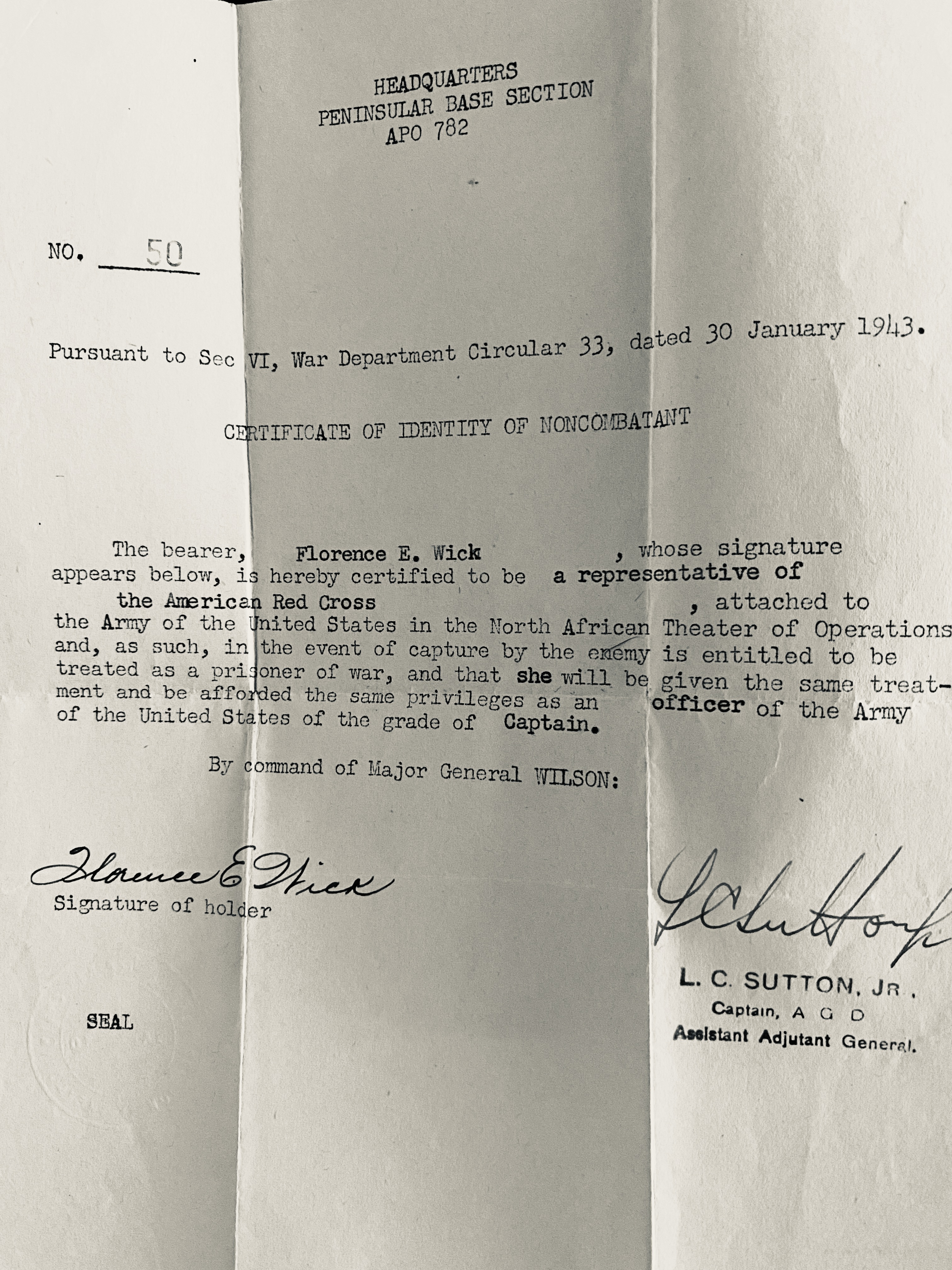
In event of capture, she will be treated as a captain.

Ch. 12: https://mollymartin.blog/2025/03/01/attack-at-anzio/

A Reprieve and a Little R&R

My Mother and Audie Murphy Ch. 10

Naples suffers bombing by all

Autumn, 1943. After many weeks on the front lines, Audie Murphy and his squad are given a reprieve.

Crawling with filth and exhausted to the bone, they are pulled out of the lines in mid-November. The valley below is now clear of the enemy; Mount Lungo has fallen. From its heights, they look toward Cassino. The war drags north, its roar receding into the distance. Burial squads already move across the slopes, searching for the bodies of men who have received their final order to go forward.

As the squad makes its way on foot down a shell-torn road, the relief is almost intoxicating. Despite the lateness of the season, the day is bright and mild. A breeze whispers through the trees, and the solid earth beneath their boots feels strangely kind. The simple rhythm of marching renews their spirits. They look at one another with foolish affection, aware that they have been handed back life.

They are transferred to a camp with tents and two full meals a day. Orders soon come down: amphibious training at a beachhead near Naples. Discipline tightens, and day and night they drill against an unseen enemy. Fully armed, they wade through surf up to their hips and crawl belly-down through marshes, their clothes crusted with salt and mud.

Bombing of Naples

None of the troops know what the training will lead to. Rumors fly. Are they being prepared for an assault on southern France, to be sent to England for a cross-channel D-Day, for assault on some new beachhead? The dogface soldiers are always strangers to the plan.

The mood darkens. Many are certain they are being prepared for slaughter. Tempers fray, and old comrades come to blows over small provocations.

Murphy’s squad gets overnight passes to Naples.

Poor Naples. The city endures relentless bombing raids from 1940 into 1944. While under German control, the Allies bombard it continuously—first the French, then the British, and finally American bombers. Italy surrenders to the Allies on September 8, 1943, but the Germans refuse to relinquish their hold, murdering civilians and those who resist the ongoing occupation.  

Then, the citizens of Naples rise up against the Nazi forces. They successfully disrupt German plans to deport Neapolitans en masse to work camps, destroy the city, and block the Allies from securing a strategic foothold. A spontaneous insurrection erupts, and despite limited weapons and organization, the Neapolitans force the German troops to retreat just before Allied forces arrive.  

This dramatic rebellion is later depicted in Nanni Loy’s 1962 film “The Four Days of Naples”, which earns Oscar nominations for Best Foreign Film and Best Screenplay.  

Even after Naples falls to British and American forces on October 1, 1943, the bombing continues. The Germans respond with a scorched-earth campaign, destroying communication and transportation networks, water and power grids, and mining buildings. They burn the state archives of Naples and the national library, sink ships in the harbor, and leave devastation in their wake. Within a week of its capture, however, the Allies manage to reopen the port, restoring vital access to the city.

On the night that Murphy and his squad rest and recreate in Naples, there is an air raid. Murphy doesn’t drink or smoke, but his men get drunk, and one gets rolled by a hooker, returning to camp without his coat, gear and money. Murphy is set up with a date, but he sleeps through it and the air raid as well.

Winter settles over Naples. The clock strikes three. Light from a low January sun creeps along stone walls and rooftops. The war is still close enough to feel—but for the moment, Murphy and his men live, rest, and wait for whatever comes next.

From Life Magazine October 18, 1943

“Last week Italy’s autumn rain was soaking the plain of Campania. It dripped on the date and peach trees, on vineyards heavy with unharvested grapes, and on the rich bottom lands north of Naples. It trickled down the necks of British and American soldiers slogging across the marshes toward the Volturno river and chilled the Germans, dug into foxholes across the river, in the shadow of Mount Massico. Somewhere in that area in the rain, the Germans would try to halt the relentless Allied advance. If they failed, the road to Rome would be open.

Behind the lines, Naples, slowly and painfully returned to normal. But the wounds of battle would not be healed for many months. The city was still practically without water, gas or electricity. In one terrible explosion on October 7, more than 100 civilians were killed when a delayed-action German mine destroyed the post office. Hungry, homeless children wandered the streets, and there was no medicine in the hospitals. German demolition squads have made a shambles of the waterfront. Shops were looted, the telephone building blown up, the University fired, and the tourist hotels ruined by Nazi troops before their retreat.”

Chapter 11: https://mollymartin.blog/2025/02/24/loose-lips-sink-ships/