Pozzuoli, Italy—In the sweltering summer of 1944, the 3rd Infantry Division assembled near this small resort town, joining the 36th and 45th Divisions in preparation for a high-stakes amphibious invasion of southern France. These battle-hardened troops, fresh from the grueling Anzio campaign and the march to Rome, were now under the Seventh Army’s command, sharpening their combat readiness for the next major offensive.
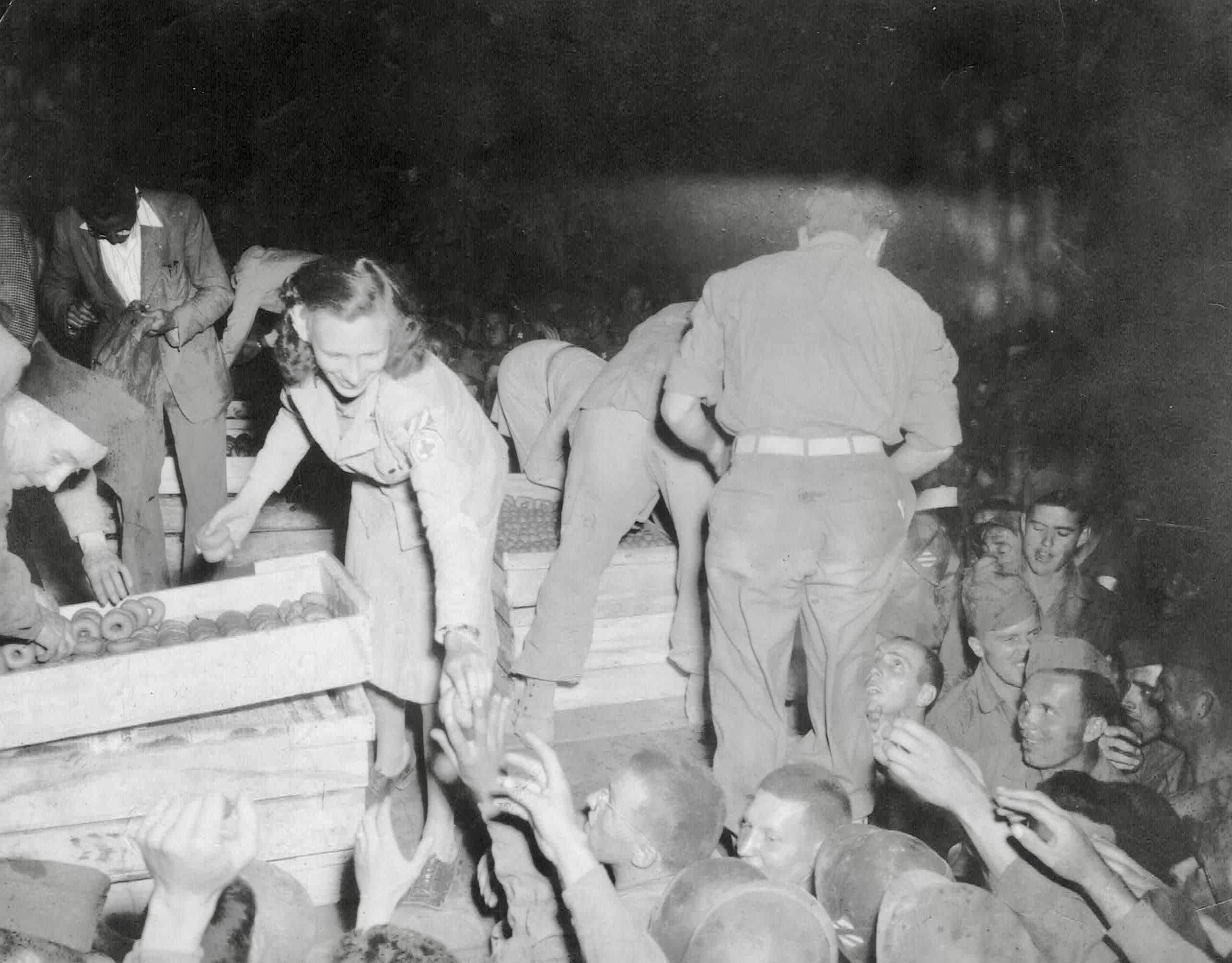
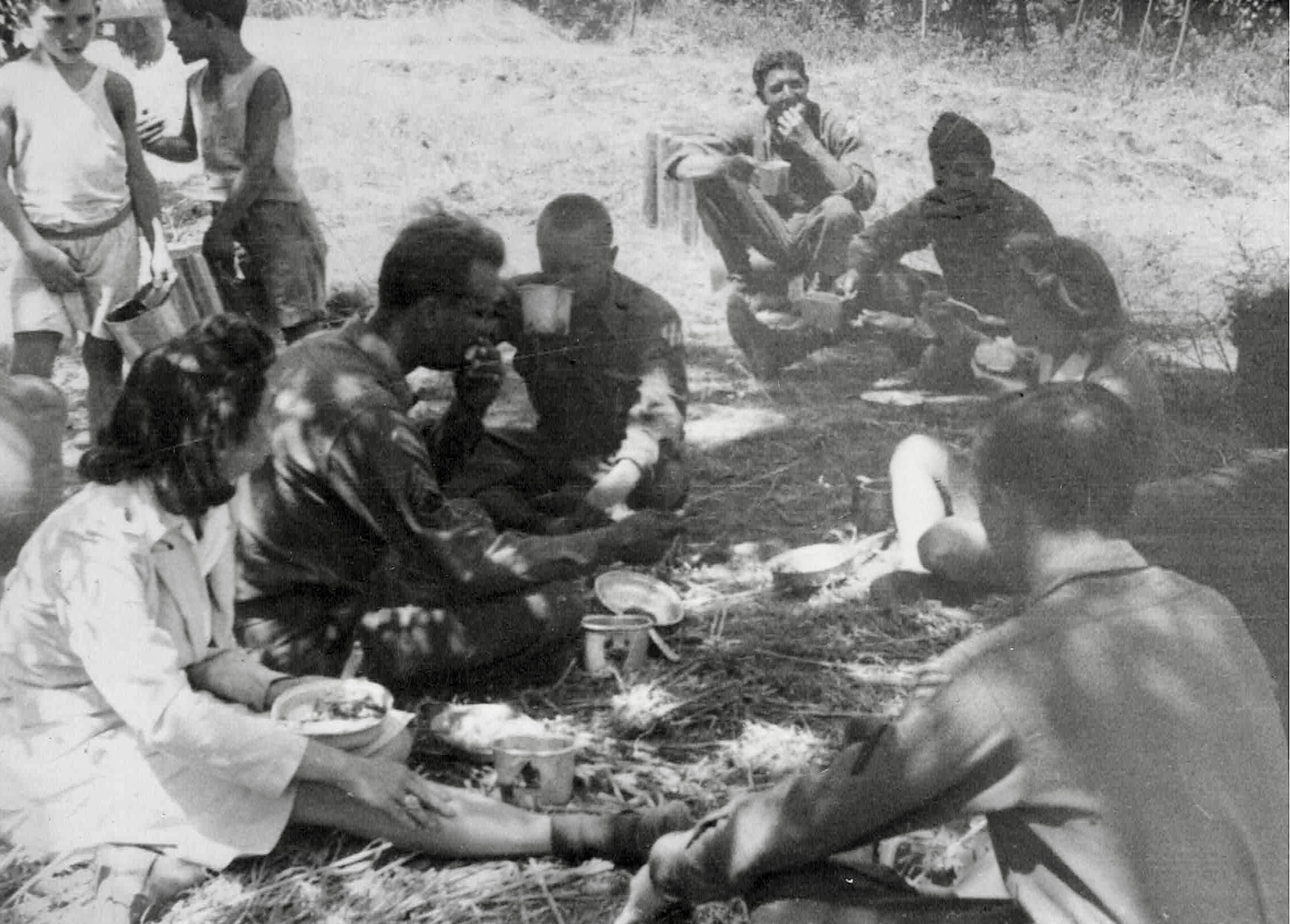
(L-R) Flo, Dottie and Jingles serve the 803rd Ordnance Co.Flo hands out donuts with a smileIsabelle Hughes serves soldiers on the docks returning from a training missionLunch with the “boys”
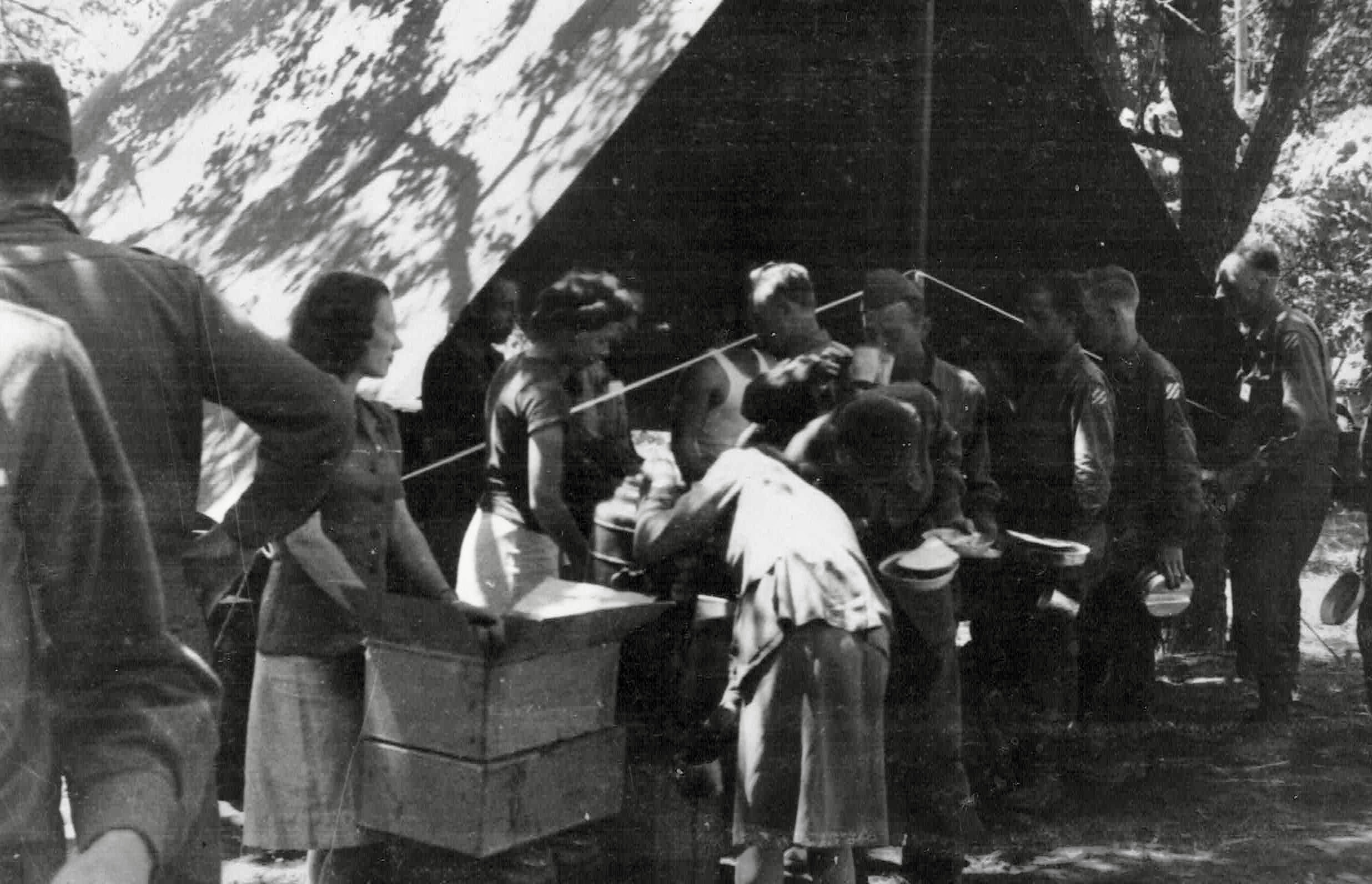
Among them was an unassuming but vital group—Flo and her clubmobile squad—who arrived in June to serve the men a taste of home: fresh donuts and hot coffee. Stationed in a sprawling tent city, these women had to get creative without a clubmobile truck, the specially outfitted vehicle designed for donut-making on the go. Instead, they improvised, scrounging up transportation and setting up makeshift field canteens in the dusty camps where soldiers could grab a sweet treat before heading back to drills. They were assisted by “donut boys,” soldiers who manned the donut machine in a tent kitchen.
Flo on the leftFlo and the “boys”Isabella, Flo and Dottie serving at bivouacFlo serving at night
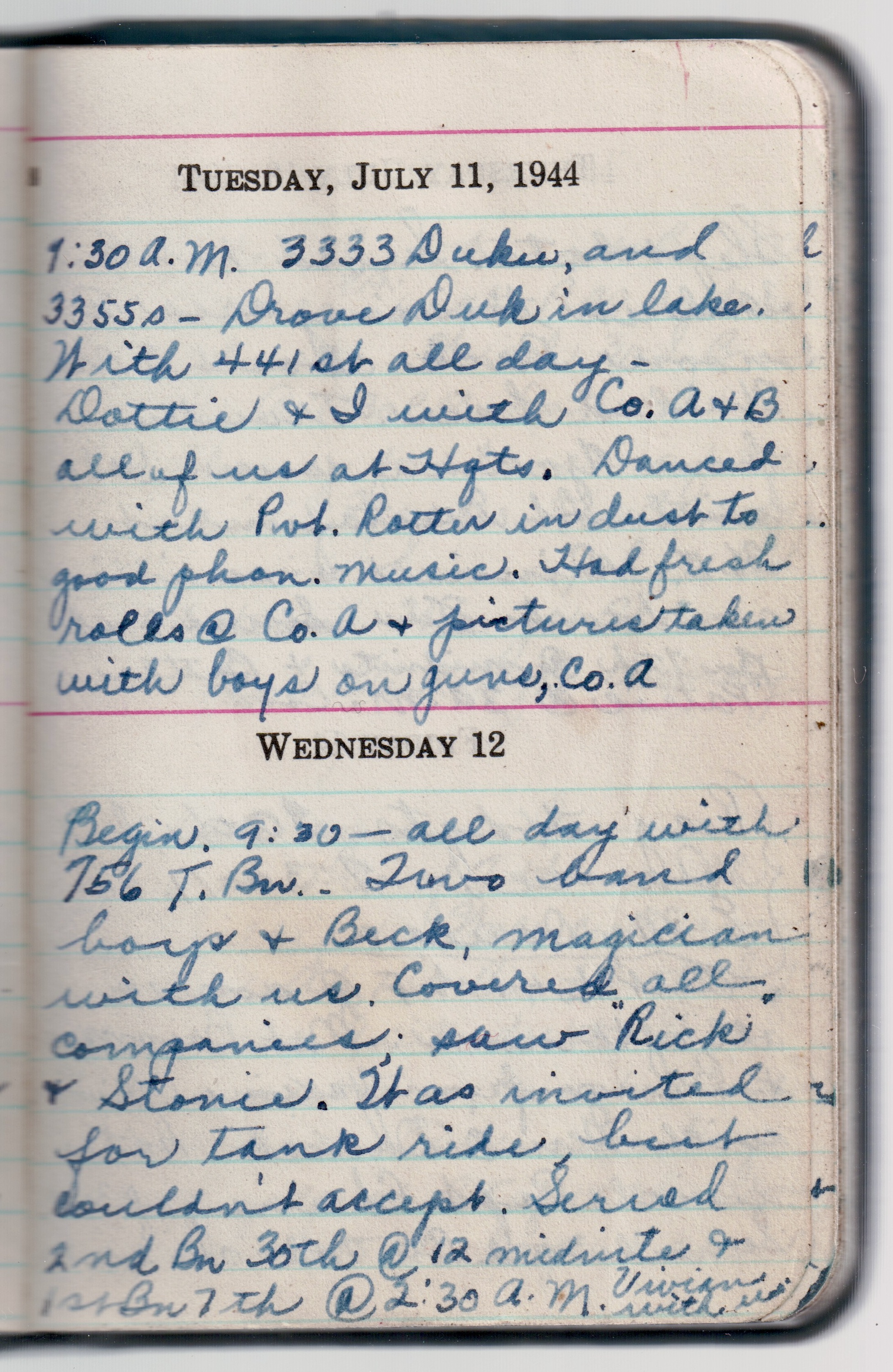
Flo meticulously recorded her daily work in a diary that read like a military log, listing the units she and her team served, often during the darkest hours of the night. Her notes mentioned names that would later be etched in history: the 1st Battalion of the 30th Infantry Regiment, the 441st Co. A+B, the 9th Field Artillery, the 36th Combat Engineers. On one occasion, on July 16, she may have even handed a donut to a young soldier named Audie Murphy—the future war hero and Hollywood star—though she dryly noted the day as “quite dull.” Murphy, in his autobiography, recalled the 1st Bn. 15th completing amphibious training earlier in the year, which likely explains their limited encounters at Pozzuoli.
One entry stood out: service to the 442nd Ack Ack (Anti-Aircraft Battalion), part of the legendary segregated Japanese American 442nd Regimental Combat Team. These soldiers, despite facing discrimination at home, were training for a mission that would cement their reputation as one of the most decorated units in U.S. military history.
Flo’s diary (pinch out to read)
Photographs from this period, many taken by the 3rd Signal Company, capture Flo and her fellow workers hard at work. These combat photographers, who had joined the division at Anzio, developed and printed their images in a darkroom trailer, documenting the war in vivid, unfiltered detail. Their images offer a rare glimpse into the everyday moments behind the front lines. For more see dogfacesoldier.org, a website dedicated to their photos and the 3rd Division.
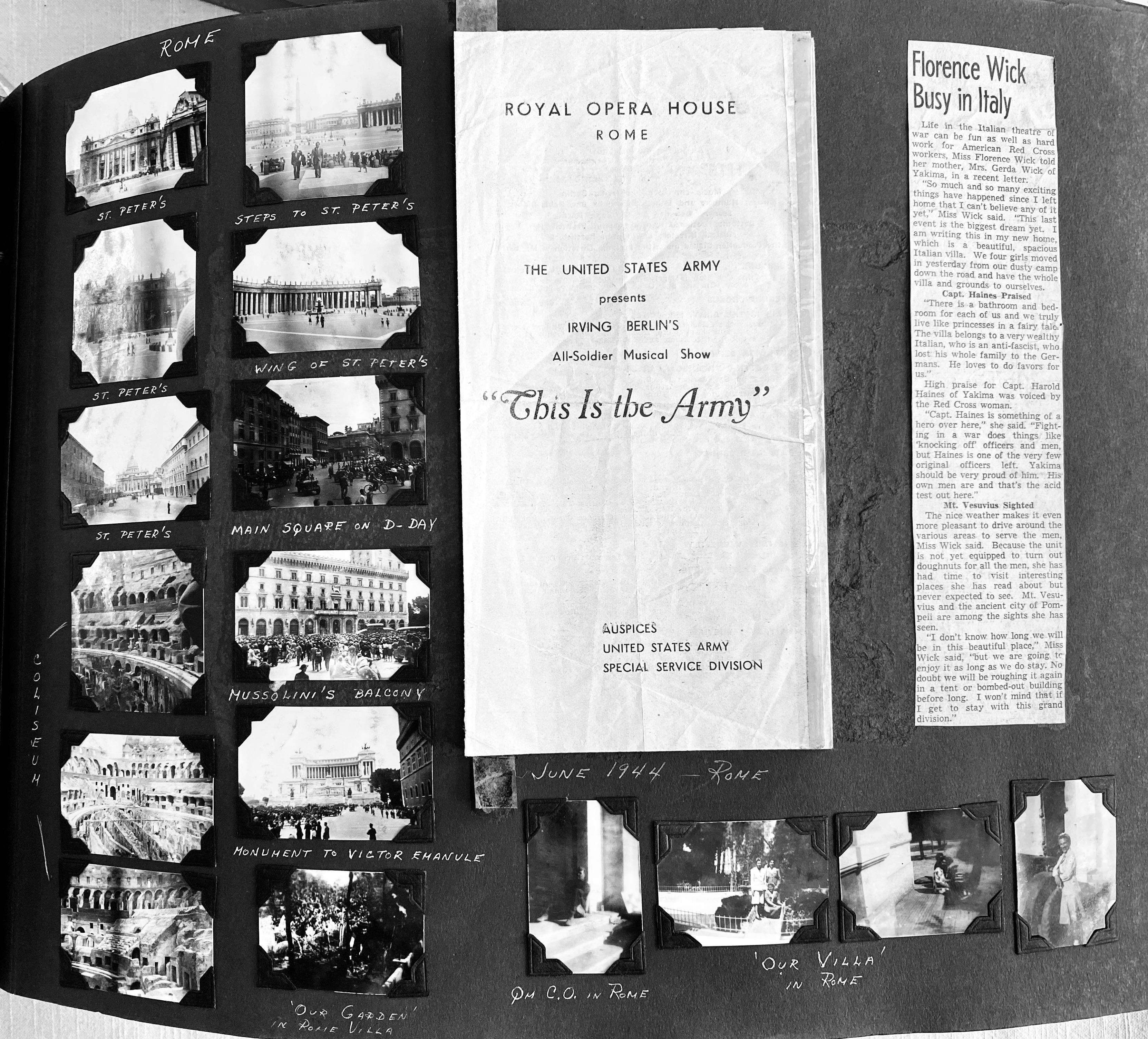
June, 1944. Flo saw This is the Army at the Royal Opera House in Rome
My Mother and Audie Murphy Ch. 17
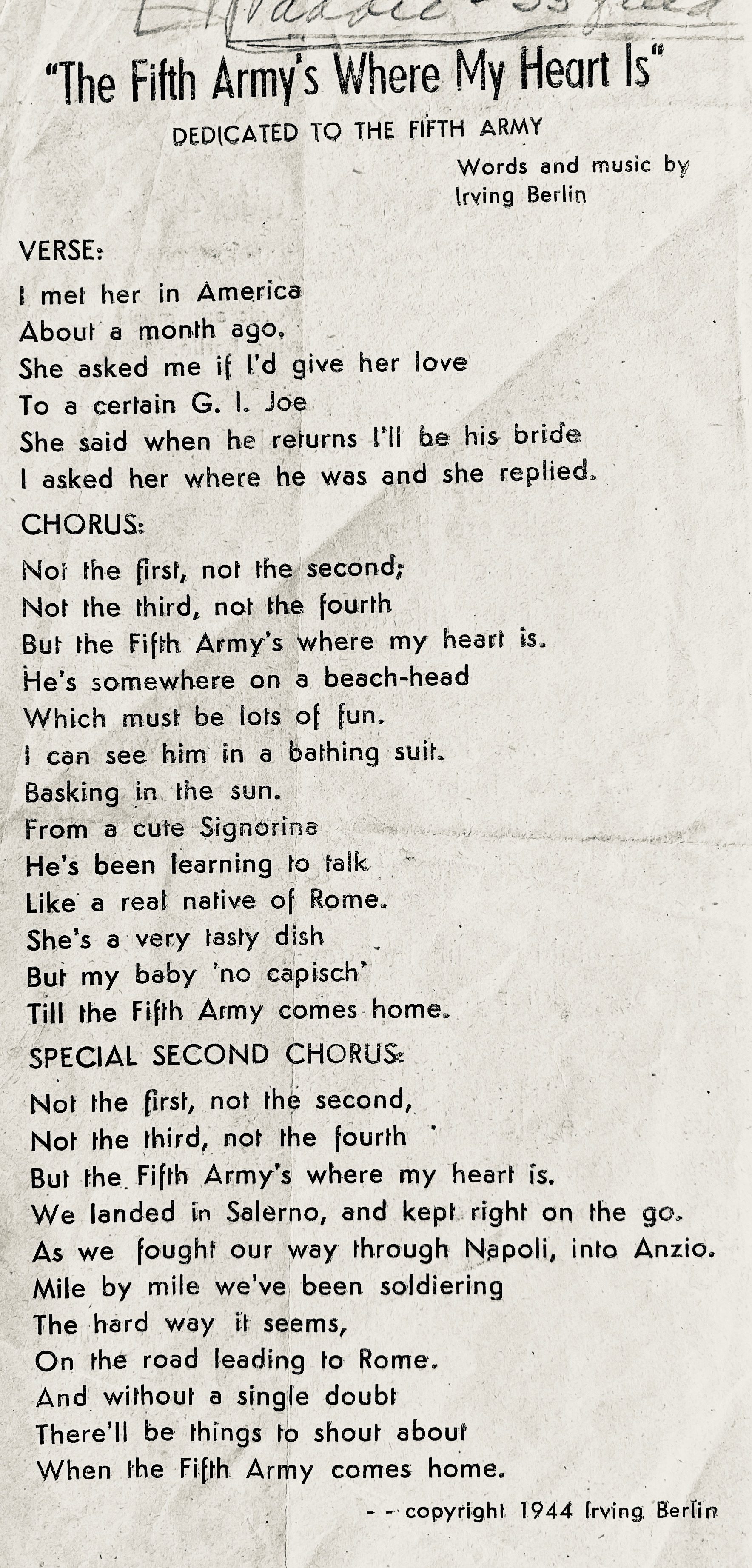
Drag, blackface, racial integration, “too many Jews”—they’re all part of the complicated legacy of Irving Berlin’s wartime musical revue, This Is the Army.
Berlin conceived the show in 1941, even before the U.S. entered WWII. It was a follow-up to a production he had staged during WWI in 1917.
This Is the Army premiered on Broadway in 1942, featuring a cast of 300—enlisted men who could sing and dance. The show then toured the U.S. before traveling to military bases worldwide, running until October 1945.
Berlin originally planned to open the show with a minstrel number, as he had in 1917, but director Ezra Stone pushed back. “Mr. Berlin,” he said, “I know the heritage of the minstrel show. Those days are gone. People don’t do that anymore.” Berlin eventually agreed to cut blackface from the stage production, though the number remained in the 1943 film adaptation.
Members of the This Is the Army unit rehearse “That’s What the Well-Dressed Man in Harlem Will Wear.” (NARA, 111-SC-140528)
Yet Berlin also made a bold move for the era: he insisted on integrating the show. At a time when the U.S. military remained segregated, This Is the Army became the only integrated unit in uniform. He even wrote a song specifically for Black performers.
Not all of Berlin’s decisions were as progressive. During the tour, he stunned cast members by complaining that there were “too many Jews in the show and too many of Ezra Stone’s friends.” The remark shocked those present—was the son of a cantor really saying this? For the soldier-performers, the fear was immediate: any cuts to the cast meant reassignment to the front lines.
The show’s use of drag also drew criticism. Warner Brothers, which produced the film version, worried that the female impersonators would limit its international release. “Female impersonators do not exist in Latin America,” claimed one misinformed studio memo. The studio also feared that images of U.S. soldiers in dresses would become enemy propaganda. In response, the film drastically reduced the female impersonators’ roles.
On June 4, 1944, Allied troops took Rome. Just six days behind them, This Is the Army rolled into the city on trucks. Later that month, the company took up residence at the Royal Opera House, performing twice daily.
The show was a global phenomenon, raising millions for the Army Emergency Relief Fund and leaving a lasting legacy.
June, 1944. From Murphy’s autobiography, To Hell and Back:
There is no triumph in Rome. The city is only another objective along an endless road of war. During the long, bitter months on the Anzio beachhead, the men dreamed of entering Rome in celebration. They imagined drinking, swaggering through its streets, losing themselves in indulgence and release. But when the city finally falls and they do enter, the feeling is nothing like victory. They pitch their tents in a public park and sleep with a depth that borders on collapse, waiting for something like life to return to their bodies.
They move through Rome like ghosts. The grand architecture and ancient monuments hold no power to lift the heart. Murphy feels as if he has been briefly spared from death, but the sparing brings no relief. Joy is impossible until the war is truly over. On the streets, surrounded by civilians, he feels lonelier than he did in the mud and gun smoke of the front. The men know others are still fighting to the north, and their thoughts remain with them.
As the front lines move forward, rear-echelon troops flood into the city. Their clean uniforms and easy laughter provoke an irrational resentment. The infantry still carry the smell of mud, cordite, smoke, and decay. They look at the rested, polished soldiers and feel a gulf that cannot be crossed.
One night, the resentment turns into a brawl. Murphy and his men clash with a group of air corps troops in a café. Chairs break, glass shatters, and bodies slam across tables until the military police arrive and shut it down. The MPs warn them not to return.
Day by day, Rome becomes less meaningful. The men begin drifting back to camp earlier, choosing their own company over the city. They gather in small groups as dusk settles, sharing bottles of wine. The songs they sing together come from home, from childhood, from a world untouched by war. The singing softens something inside them—feelings that have been buried beneath survival. The tenderness is temporary. It disappears the moment the order comes to shoulder their weapons and move again.
They leave Rome for another training ground, not knowing what operation lies ahead. Rumor fills the silence, but certainty is impossible.
Their next destination is the coast of southern France.
Colonialism: the violent seizure of land, the domination of people, the erasure of cultures. It is the practice of extending and maintaining political and economic control over another people, typically through displacement, suppression, and destruction.
While researching pre-christian seasonal celebrations around the world, I keep running into the same brutal reality: colonialism didn’t just conquer people—it annihilated their histories, their traditions, and their sacred knowledge. Lately, I’ve been searching for evidence of spring rituals in Latin America, only to find that much of what once existed has been deliberately erased.
European colonial invasion of the Americas was not just a conquest—it was an extermination. The very term “pre-Columbian” grates, as if history only begins with Columbus’s arrival, ignoring the fact that indigenous civilizations flourished for millennia before European diseases and massacres decimated their populations.
Nowhere is this erasure more apparent than in the destruction of Mayan knowledge. In the 16th century, Spanish catholic priests set fire to nearly all Mayan codices, incinerating vast repositories of scientific, spiritual, and astronomical understanding in a frenzied effort to impose christianity. Only a handful of these texts survived. What remains is a civilization whose intellectual and architectural brilliance we can only glimpse—its great stone pyramids standing defiantly even as its written history was reduced to ashes.
Can you see the shadow image of the serpent? Photo: Chichen Itza
Yet, despite this attempted obliteration, traces of indigenous traditions persist. In Mexico, celebrations of the spring equinox remain deeply connected to pre-Hispanic heritage, even as they blend with modern religious elements. Across the country, people gather for festivales de primavera, celebrations that embrace the new season and pay homage to a past that refuses to be forgotten.
Chichén Itzá in Yucatán remains the most famous site for these celebrations. Every spring, thousands of people come to witness the astonishing spectacle of light and shadow on the Kukulcán pyramid. Designed with mathematical precision, the structure casts shadows that create the illusion of a serpent slithering down its steps during the equinox. This event is not a coincidence—it is the result of a civilization that understood celestial mechanics better than many modern observers. The pyramid, built in the 12th century CE, stands as a testament to Mayan brilliance, though the city of Chichén Itzá itself dates back to 550–800 CE.
Another important site is Teotihuacan, where thousands—often dressed in white—gather to greet the equinox. With arms raised to the sun, they take part in rituals of purification and energy renewal, honoring the sacred astronomical knowledge that once made this city one of the most important spiritual centers in Mesoamerica.
Mexican equinox celebration. Photo: kunuk hotel
I plan to adopt the tradition of wearing white on the spring equinox. I still have my white jeans and jacket, bought in anticipation of Hillary Clinton’s 2016 presidential victory. White is also the color of the women’s suffrage movement, and it seems we might need to again fight for the right to vote. Trump and his allies would like to take us back to the 18thcentury. I’ll be holding onto my suffrage gear as we witches resurrect our hexes.
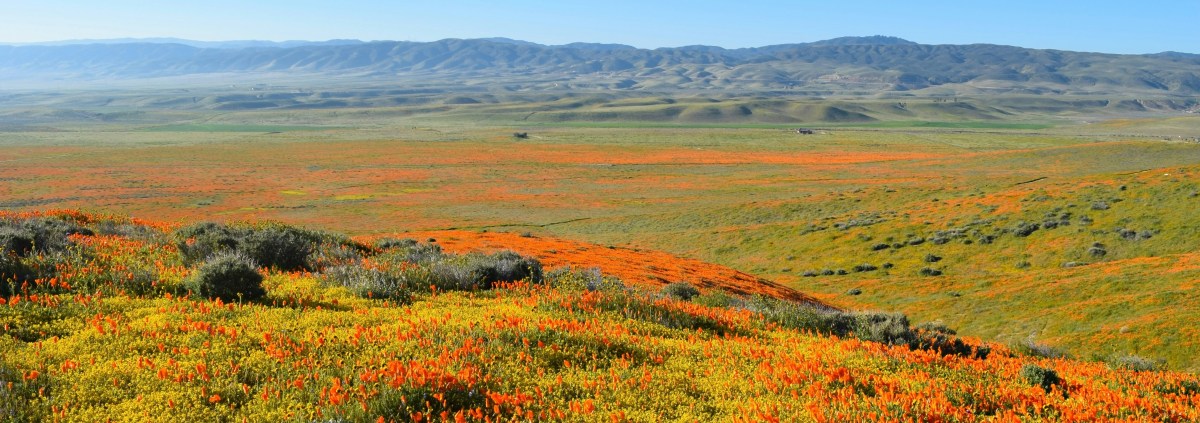
The vernal equinox this year falls on March 20. Holly and I will be visiting our exes in San Bernardino County’s high desert. My brother Don and his husband John will join us on their way back from Mexico to Vancouver. We hope the poppies in Antelope Valley will be in bloom, though the lack of recent rains might mean disappointment.
This winter, California has experienced what our weather guru, Dr. Daniel Swain calls hydroclimatic whiplash—extreme shifts between wet and dry weather, an increasingly common global phenomenon. Sonoma County saw zero rainfall in January. Then, in February, while dry Los Angeles burned in the worst wildfire in its recorded history, Northern California was drowning. Though the flooding wasn’t the worst ever, two people died, reminding us to take road warnings seriously: Don’t Drown. Turn Around.
Swain frequently references the Great Flood of 1862, when California, lacking big dams, saw the town of Sacramento submerged. Before colonization, the Central Valley was essentially a giant swamp, and California’s climate has always swung between extremes since it was first monitored in the mid-nineteenth century.
California winter holds some other surprises. February is skunk mating season and, driving around Sonoma County, we see bumper skunk roadkill. They traipse through our garden and they are welcome visitors, eating mice and grubs. Nearsighted but with a keen sense of smell and hearing, they are quite beautiful. Skunks are nocturnal and so we see them only on trips to and from the hot tub at dawn and dusk, which is where Holly encountered one. She didn’t see it until the tail was raised. Too late! The resulting stink resonated in our house for a week. She had to throw away her robe and slippers, which never recovered. Now we stop and look both ways before crossing the deck to the hot tub.
Spring equinox is a time of renewal, balance, and resistance. Let’s celebrate it in ways that honor the past while reclaiming our future.
Poppies landscape photo: Pamela Heckel on Unsplash
Flo is one of the first to enter the city after Nazis retreat
My mother and Audie Murphy ch. 15
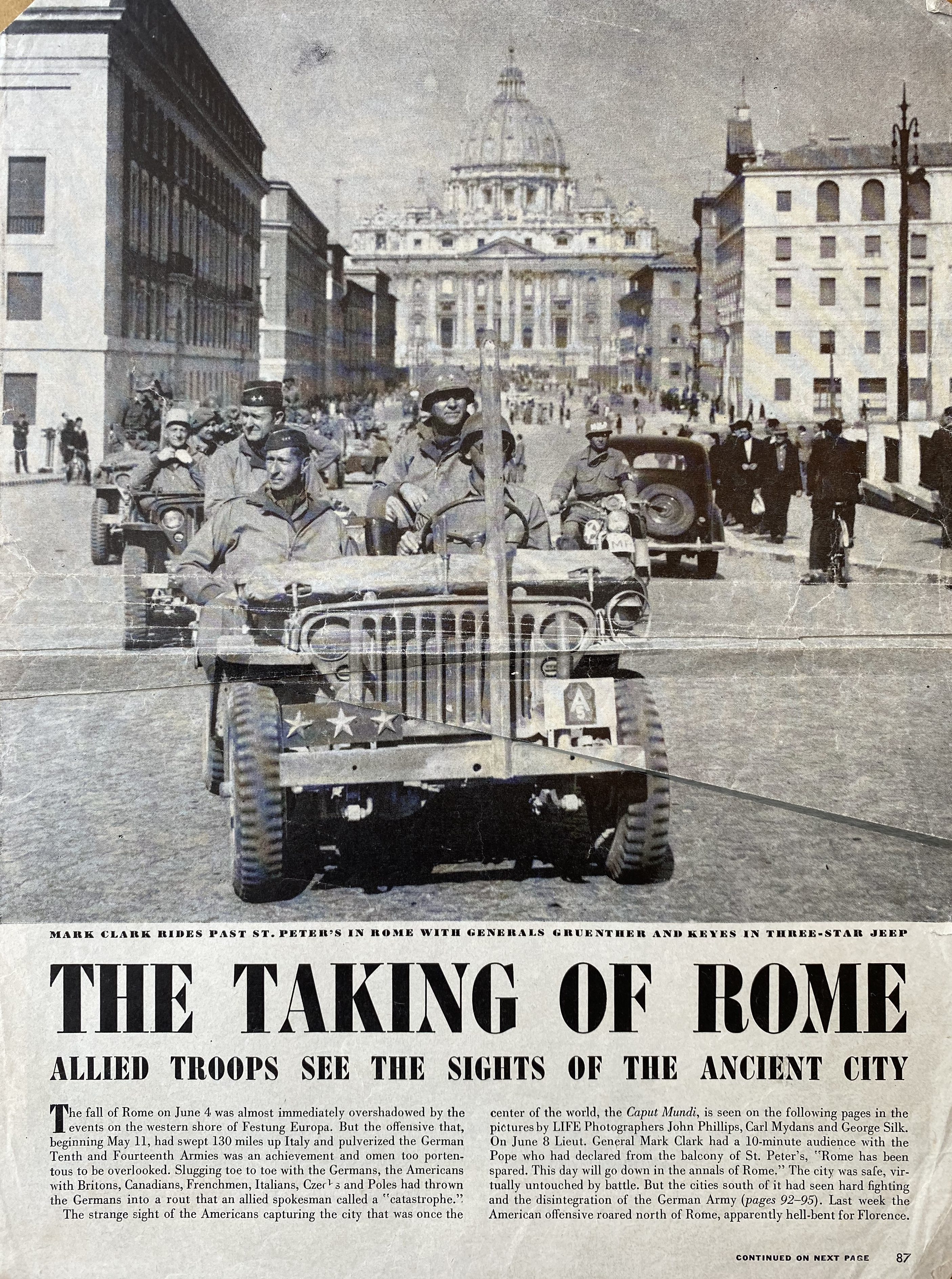
The city of Rome was liberated by Allied troops June 4, 1944. Flo got to Rome the next day, June 5. She told me she was proud to come into the city with General Mark Clark and the U.S. 5th Army. The Third Division had taken big hits in battles at Anzio and on the Italian coast. Rome would be an easy victory, a source of prestige for the leaders and pride for infantrymen recovering from those battles. Later, historians and Allied commanders agreed that Clark’s decision to march into Rome instead of cutting off a large part of the retreating German army was a major blunder, extending the war for maybe another year. In any case, the liberation of Rome was overshadowed by the D-Day landings on the beaches of Normandy in northern France on June 6.
A page in Flo’s album. She saw the Irving Berlin show in Rome
Flo kept detailed notes in a tiny pocket-sized diary. This was the first entry.
Monday June 5, 1944
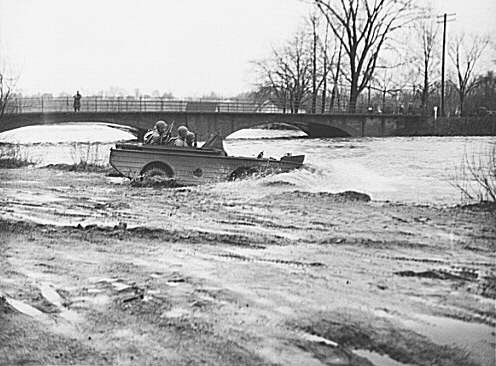
Came into Rome in amphib Jeep with Frank Gates.
They were traveling from the camp at Pozzuoli, a seaside town on the Gulf of Naples where they’d been bivouacked with the Third Division. At first I imagined that they drove the 138 miles on the bombed out rutted roads. But these amphibious jeeps were faster in the water than on land, so now I’m thinking they traveled on the water. Amphib jeeps were used by the Third Division because they were training for an amphibious landing in France that would take place in August.
photo: Wiki commonsPhoto:Ford GPA trials Unknown author – Library of Congress
The amphibious jeep. There were about 12,000 built by Ford.
Flo didn’t make note of who was with her and Frank Gates, but I’m imagining all four of the American Red Cross women in her group went to Rome together. Gates was able to secure a promise from a rich anti-Nazi Roman to allow the ARC clubmobilers to stay in his fancy villa. The four women moved in soon after. The man did much to make them comfortable.
I wasn’t able to find information about Frank Gates but I believe he was Flo’s boss, the Red Cross director on the Italian front whose job was to establish ARC canteens and clubs near the front lines of fighting. He would be driving around Rome to look for suitable buildings in which to house the clubs.
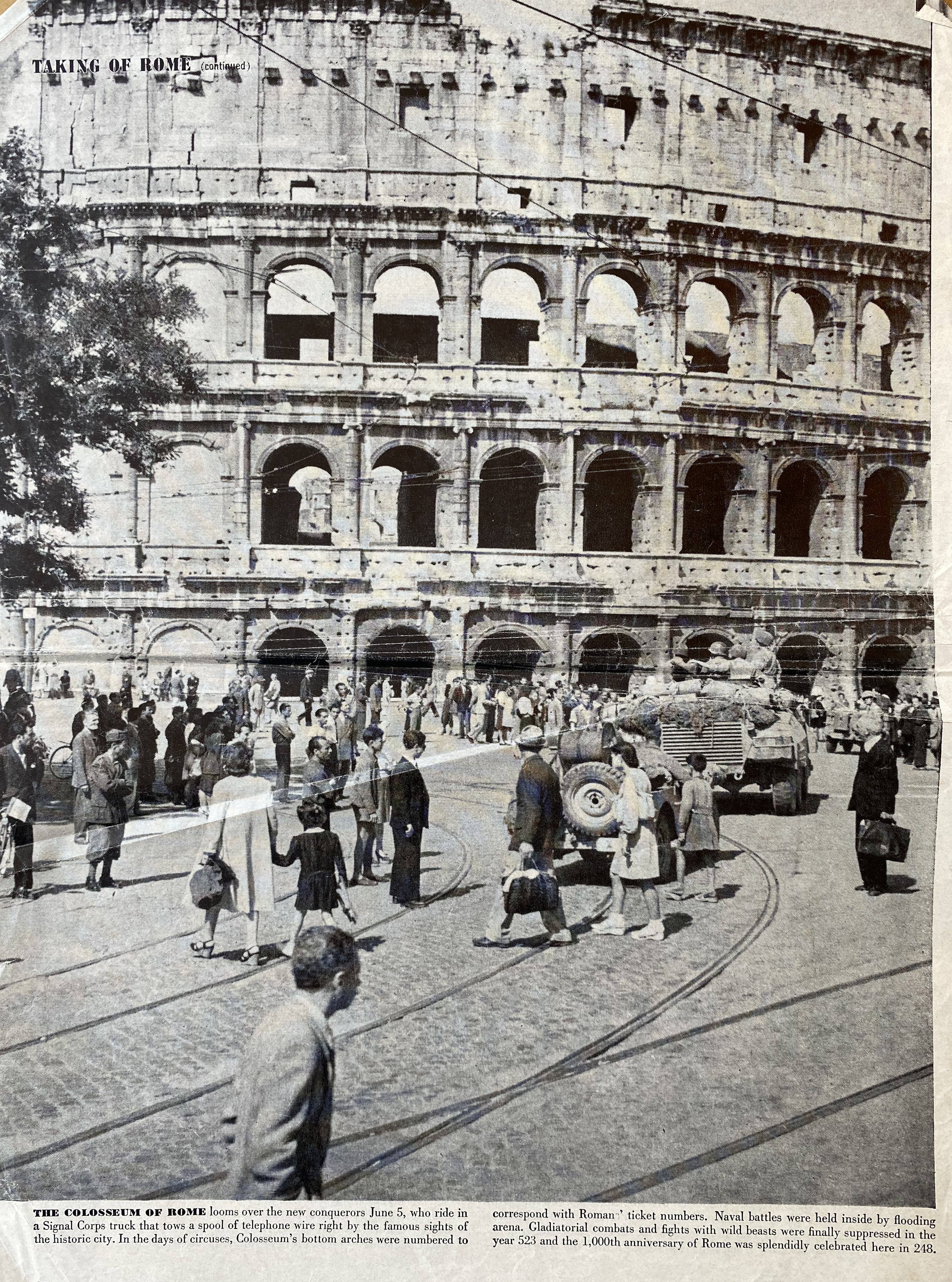
Unlike Naples, which had been bombed for years, Rome had been spared from widespread destruction by the Nazis in part due to its declaration as an “open city” by the Italian government and the efforts of the Vatican to protect it, which led to a relatively peaceful occupation and liberation. No one, perhaps not even the Nazis, wanted to be responsible for destroying that historic city.
The 1945 Italian film Rome, Open City, directed by Roberto Rossellini, takes place during the Nazi occupation of Rome. It was one of the first post-war Italian films to gain major acclaim internationally.
The ARC women were some of the first Americans to move into Rome. Before Allied troops started coming in, they had the city almost to themselves and set about seeing all the tourist sights. Flo wanted to see all the famous architectural treasures she had read about as a child.
From a report in the Yakima Herald-Republic
Florence Wick busy in Italy
Life in the Italian theatre of war can be fun as well as hard work for American Red Cross workers, Miss Florence Wick told her mother, Mrs. Gerda Wick of Yakima, in a recent letter.
“So much and so many exciting things have happened since I left home that I can’t believe any of it yet,” Miss Wick said. “This last event is the biggest dream yet. I am writing this in my new home, which is a beautiful, spacious Italian villa. We four girls moved in yesterday from our dusty camp down the road and have the whole villa and grounds to ourselves.
“There is a bathroom and bedroom for each of us and we truly live like princesses in a fairy tale. The villa belongs to a very wealthy Italian, who is an anti-fascist, who lost his whole family to the Germans. He loves to do favors for us.”
High praise for Capt. Harold Haines of Yakima was voiced by the Red Cross woman.
“Capt. Haines is something of a hero over here,” she said. “Fighting in a war does things like ‘knocking off’ officers and men, but Haines is one of the very few original officers left. Yakima should be very proud of him. His own men are and that’s the acid test out here.”
The nice weather makes it even more pleasant to drive around the various areas to serve the men, Miss Wick said. Because the unit is not yet equipped to turn out doughnuts for all the men, she has had time to visit interesting places she has read about but never expected to see. Mt. Vesuvius and the ancient city of Pompeii are among the sights she has seen.
“I don’t know how long we will be in this beautiful place,” Miss Wick said, “but we are going to enjoy it as long as we do stay. No doubt we will be roughing it again in a tent or bombed out building before long. I won’t mind that if I get to stay with this grand division.”
The ARC women didn’t stay in the villa in Rome very long. By July 9 Flo is back in the camp, writing in her diary about cleaning their tent.
Fear is moving up with us. Fear is right there beside you.
My Mother and Audie Murphy Ch. 14
Audie Murphy’s autobiography To Hell and Back was shaped in collaboration with David McClure, a Hollywood writer who served in the Army Signal Corps and knows firsthand the shock of war. The book centers on the ordinary infantrymen of the Third Division, capturing their humor, fatalism, and endurance. In the battle scenes, the tone sharpens. At Anzio, Murphy describes the brutal churn of attack and counterattack in a landscape where the ground itself seems to resist survival.
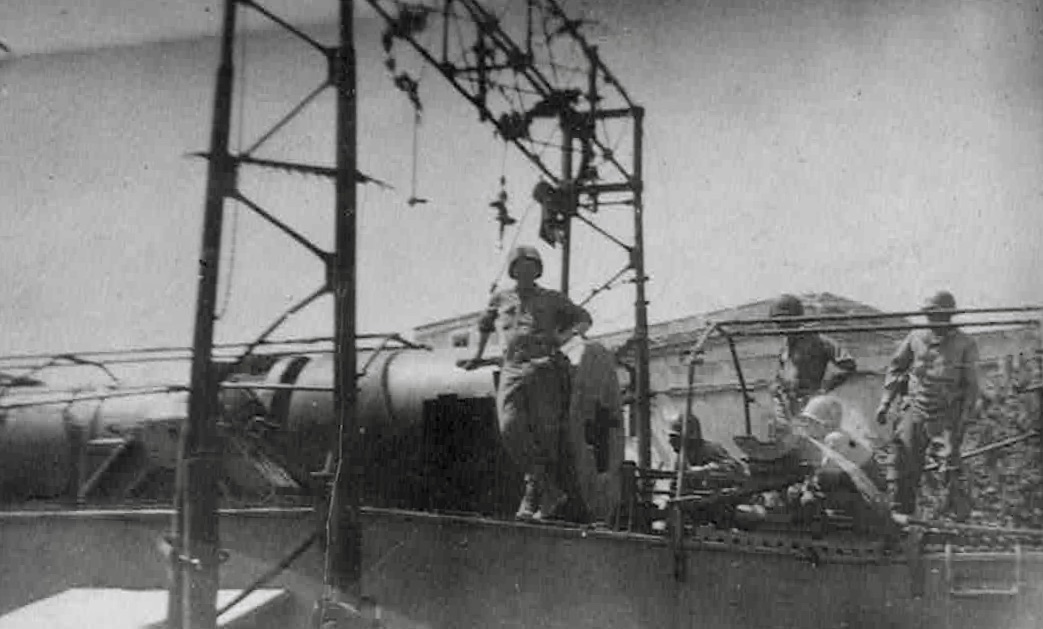
“Anzio Annie” was a massive World War II German rail gun, used to bombard US and British forces during the 1944 Anzio landings.It was one of the largest land-based cannons ever built. It fired shells that weighed 550 pounds. Image: NARA
“Light trembles in the east. To our left, an artillery dual is growing fiercer. We hear the crack and thunder of our own guns; the whine and crash of incoming German shells. (A soldier) stands in his chest deep foxhole and leans with his elbows on the bank. He studies the eastern horizon and shakes his head in mock ecstasy. “Gee!” says he, “another beautiful day.”
By afternoon, the order comes: attack!
“Fear is moving up with us. It always does. In the heat of battle it may go away. Sometimes it vanishes in a blind, red range that comes when you see a friend fall. Then again, you get so tired that you become indifferent. But when you are moving into combat, why try fooling yourself. Fear is right there beside you….
“I am well acquainted with fear. It strikes first in the stomach, coming like the disemboweling hand that is thrust into the carcass of a chicken. I feel now as though icy fingers have reached into my mid-parts and twisted the intestines into knots….”
Hidden in a railway tunnel, the Anzio Annie guns started firing at the Anzio beachhead in February and were not discovered until May. Image from Flo’s album
Speech dies away as they approach the enemy line. Artillery fire slackens, and the men check their weapons one last time. Scouts creep forward. Everyone waits for the first eruption.
“This is the worst moment. Just ahead the enemy waits silently. It will be far better when the guns open up. The nerves will relax; the heart, stop its thumping. The brain will turn to animal cunning. The job lies directly before us: destroy and survive.”
The scouts signal them on. Just as they inch forward, two hidden flakwagon guns open fire. One scout is hit squarely in the chest; his upper body disintegrates in an instant. The 20 mm shells, designed for aircraft, are used here against men, each strike exploding on impact. There is no time to think; the entire landscape erupts with automatic fire. Branches shear off the trees overhead. Bullets pitch into the earth. Two men in the open scramble for the shelter of a small rise, but the gunner finds his range. They collapse, still at last.
Annie’s threat was physical, but also psychological. The troops lived in constant fear of the next shell whose passage was compared to a freight train passing overhead. It could blast a whole big enough to swallow a jeep.Image from Flo’s album
The scouts signal them on. Just as they inch forward, two hidden flakwagon guns open fire. One scout is hit squarely in the chest; his upper body disintegrates in an instant. The 20 mm shells, designed for aircraft, are used here against men, each strike exploding on impact. There is no time to think; the entire landscape erupts with automatic fire. Branches shear off the trees overhead. Bullets pitch into the earth. Two men in the open scramble for the shelter of a small rise, but the gunner finds his range. They collapse, still at last.
A massive shell shrieks overhead and Murphy dives into a roadside ditch. The blast lifts him, knocks him senseless, then dumps him back into the mud. When he crawls forward to check the man beside him, the soldier lies dead with no visible wound—killed by pure concussion. Murphy marks the body for the burial team, driving the bayonet into the bank and tying a strip of white cloth to its tip.
German artillery intensifies. The earth becomes a furnace of shrapnel and fire. Limbs and fragments of bodies fall back to the ground with the dirt. Night offers no rest. The foxholes are cold, wet, and shallow. Rumors spread that the entire front has been forced back. The men are told they will attack again in the morning.
Exhausted and hollow-eyed, they rise. The numbness of survival replaces fear. When the order comes, they move like machines. German artillery meets them immediately, and the men spread across open fields, advancing from one shell crater to the next. Medics, unarmed and clearly marked, fall beside the wounded they are trying to save. The cycle continues: advance, retreat, advance, retreat. After three days, not a single yard of ground has been gained.
There were two of these guns. Once they were captured, soldiers climbed on them “like game hunters who had bagged two rogue elephants.” Image from Flo’s album.
This was the story of Anzio. The Allies made the first amphibious landing on the beachhead on January 22, 1944 and the battle didn’t officially end until the liberation of Rome June 4, 1944.
The 3rd Infantry Division suffered over 900 casualties in one day of combat at Anzio. This was the highest number of casualties suffered by any US division in a single day during the war. The Allies sustained 40,000 casualties at Anzio.
The battle leaves no one unchanged. Anzio becomes not just a place, but a memory carved in mud, smoke, concussion, and loss—the memory of men who advance, fall, rise again, and return to the line because there is no choice except forward.
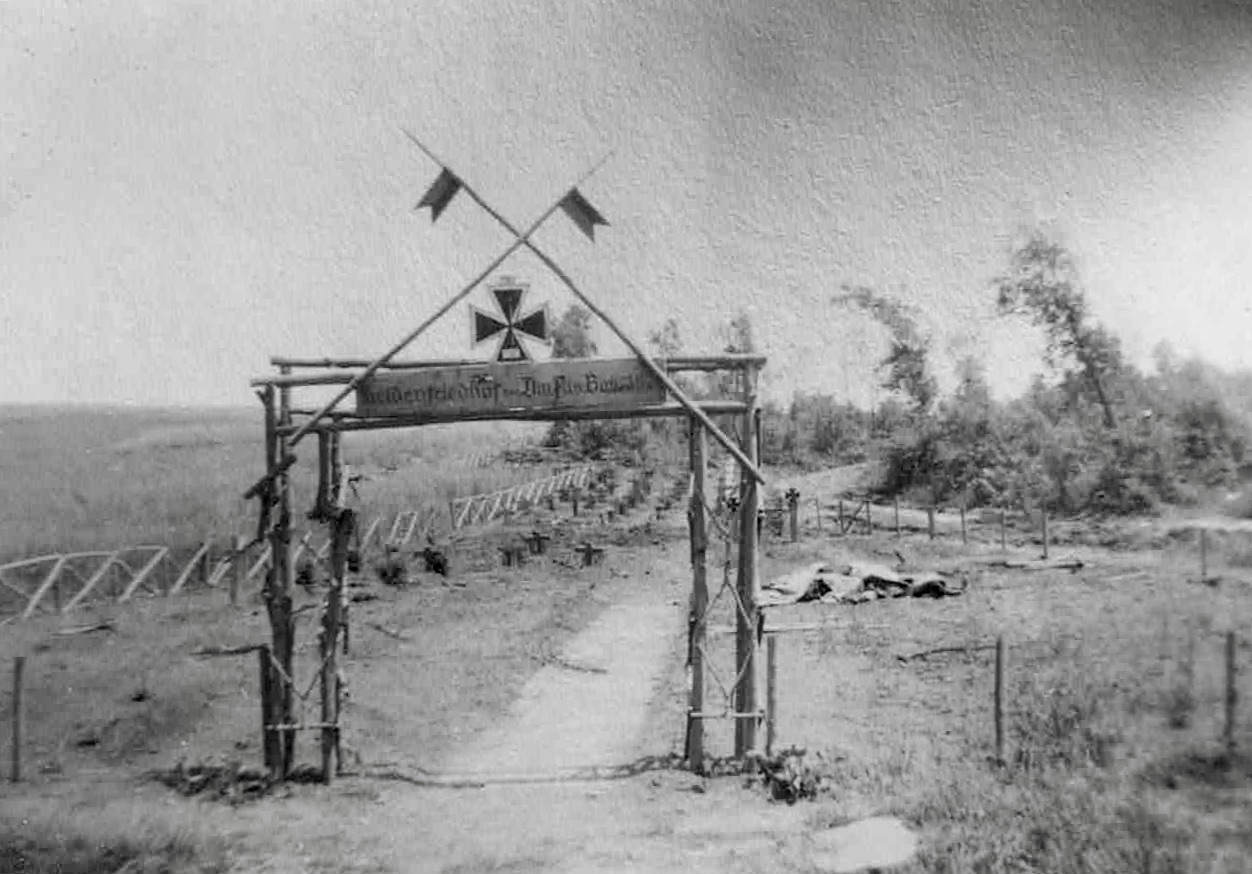
Flo captioned this picture “Kraut graves.” The Nazis sustained 43,000 casualties at Anzio.
Quotes are from Audie Murphy’s autobiography, To Hell and Back
Her letters home are published in the Yakima paper
My Mother and Audie Murphy ch. 13
Miss S.I. Anthon was a family friend who visited and sent Christmas cards throughout my childhood. She reminded me of the BBC version of Agatha Christie’s sleuth, Miss Marple. She was unmarried, was short with short curly hair, and (during the 1950s and 60s) dressed in a straight no-nonsense mid-calf-length skirt, blouse, vest and suit jacket and those low-heeled sturdy shoes worn then by women of a certain age. She usually wore a hat (women wore hats in those days). We always called her Miss Anthon. She was a reporter for the local newspaper, the Yakima Republic, later the Yakima Herald-Republic.
Soester (sister in Danish) I. Anthon was born in Denmark in 1890 and she lived in Yakima’s Scandinavian neighborhood. She was a neighbor as well as a mentor to my mother, and she shared Scandinavian roots with the Wick family. By 1930 Miss Anthon was the managing editor of the Yakima Republic, the evening newspaper, a rare accomplishment for an immigrant woman whose first language was not English. For many years she wrote a column called “Daily Mirror of Life in Yakima,” and during the war she reported on the activities of local men and women serving overseas.
When Flo wrote home from Europe, her mother, Gerda, would share the letters with Miss Anthon, who would write them up into news stories. While few of Flo’s actual letters to her mother survive, Miss Anthon’s clipped stories are pasted throughout Flo’s WWII album.
A page in Flo’s WWII album
One of Miss Anthon’s earliest reports quotes Flo’s descriptions of her first weeks in Italy.
June, 1944.
Headline: Yakima Girl Now in Italy. Miss Wick Tells About Her Tasks
Miss Florence Wick, who recently landed in Italy as a member of an American Red Cross clubmobile staff, is getting broken into her work “by passing out doughnuts and a smile,” she writes her relatives here.
“Several of us clubmobile girls are billeted at present in an old Italian hotel,” she says. “It has such incongruous items in it as a huge crystal chandelier and ornate gold valances over the doors. As in all Europe, the plumbing leaves much to be desired and warm water is rare enough to cause excitement.
“We have a sweet little Italian girl who acts as maid, does our laundry and tries very hard to learn English. She even goes to school after working all day. They are so poor here. It makes our standard of living seem even higher and makes us all appreciate the U.S. more than ever.
“I saw some of the Italian country-side in a tour and find it very pretty and picturesque. The fruit trees (cherries and apricots) remind me of Yakima.
“The trains are small and have only two or three cars on them. They are more like our street cars.
“Clubmobile will give me an opportunity to see more of Italy than just club work and although we clubmobile gals won’t be as settled and won’t be able to dress up as much, I think we will get a greater experience.”
“I have had some interesting talks with the men—both officers and G.I.’s. Some have had some harrowing experiences. They can always laugh and ‘sling a line,’ regardless, and the ‘purple heart’ boys do the best of any.
“The Red Cross service men’s club here is the nicest I’ve ever seen and the boys really appreciate it. There haven’t been many West Coast boys through here, but when I run into them, I’m as pleased as they are. All the others seem to think Washington state is out of this world.”
Flo was assigned to a clubmobile group of four women, and she was designated captain of the group, which included Isabella Hughes (Jingles) of Baltimore, Elizabeth Elliott (Liz) of New York City, and Dorothy Shands (Dottie) of Greenville, Miss.
L-R Isabella Hughes (Jingles), Elizabeth Elliott (Liz), Dorothy Shands (Dottie), Florence Wick (Flo). Flo wrote “Overlooking a lovely Mediterranean beach. The villas along here were all bombed and ruined.”
Flo and her team were first stationed near Naples in an old Italian hotel from the time her ship docked May 28, 1944. It seemed like the ARC was not quite ready for their arrival. The women just sat around for several days before the ARC could figure out what to do with them. They had started to feel like they’d been hired as concubines when they finally got an assignment. Rather than driving a two-and-a-half-ton truck around Italy like the other Europe-based clubmobilers, they would be bivouacked with the Third Infantry Division of the Army. The tent city was near the town of Pozzuoli, on the sea, just north of Naples, where the soldiers trained for an amphibious landing in France.
Goodbye hotel with crystal chandeliers, maid and laundry service. Hello Army tents with cots and bedrolls.
A Familiar Voice in the Blackout
The company had just arrived in Naples, one of thousands of American and British units flooding into the battered port city. Their first stop was the American Red Cross club, a welcome sight after weeks on the move.
Inside, amid the clatter of cups and typewriters, he scanned the lists of newly arrived Red Cross women. There it was — a familiar name. An old girlfriend from back home. The war had scattered them across oceans, and now fate had brought them to the same city. But there was no time to find her. Orders came down; the company had to move.
That night, the air raid sirens began. The Germans, retreating north, were still pounding the city, shelling the docks and rail lines. The blackout was immediate — every light extinguished. Hundreds of soldiers, nurses, and civilians poured from buildings into the damp mouth of a tunnel carved into the hillside.
It was pitch dark. The air was thick with fear, sweat, and the echo of boots. Then, through the chaos, he heard a voice. Her voice.
He called her name, and she called back. In the darkness, they moved toward each other, guided only by sound. They reached out — a hand, a sleeve, a touch — and for a moment, found each other. They couldn’t see a thing, but they laughed softly in disbelief. Two people from the same small town, meeting again by chance in the middle of a war, in total darkness.
When the shelling stopped, the crowd dispersed into the shattered streets, and they lost each other again.
They wouldn’t see each other until after the war, back home, this time in daylight.
The woman was my mother, Florence Wick. The man was (later) my uncle Morton Werner. He married Flo’s sister, Ruth. They each told this story many times, marveling at the happenstance.
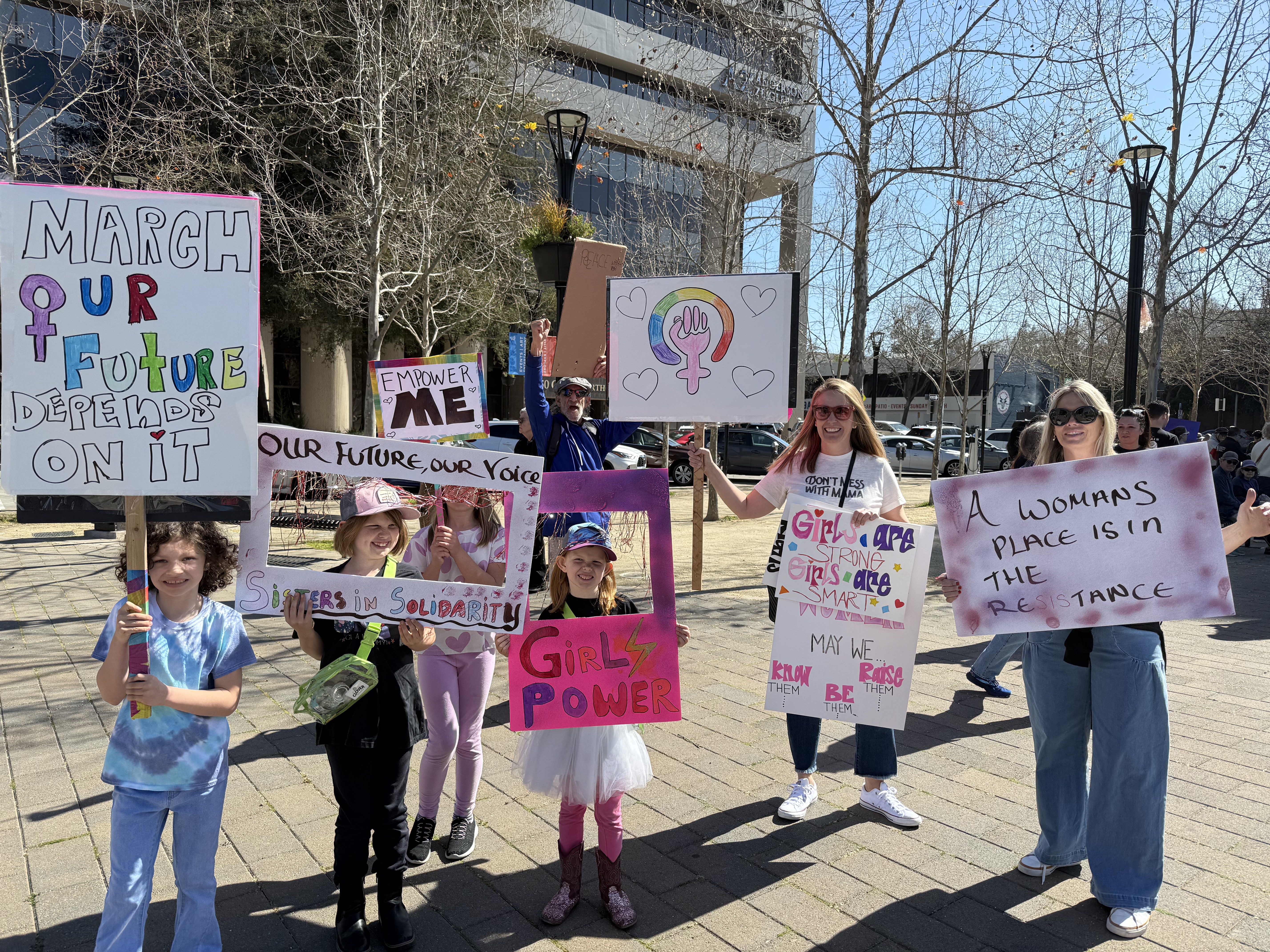
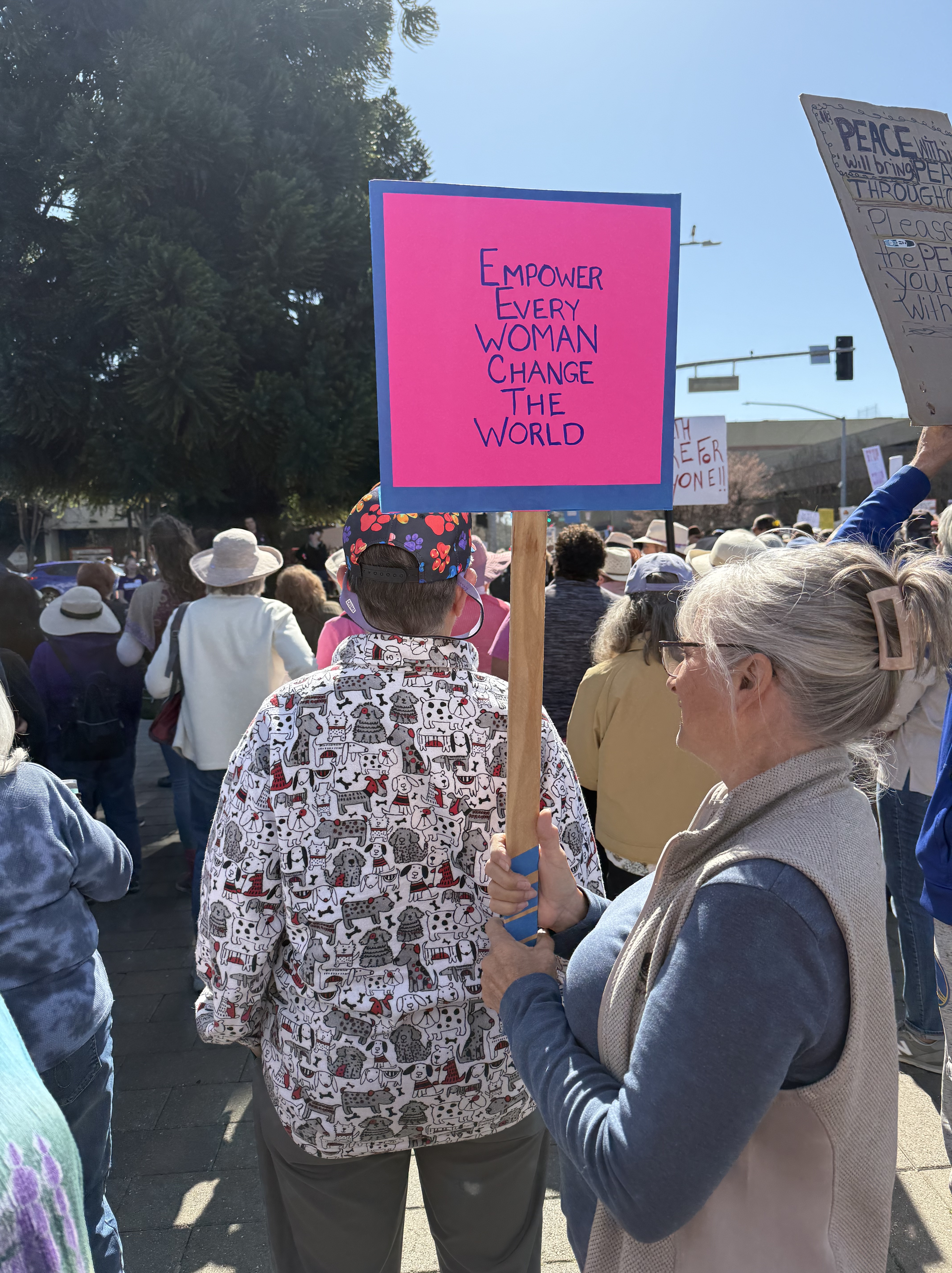
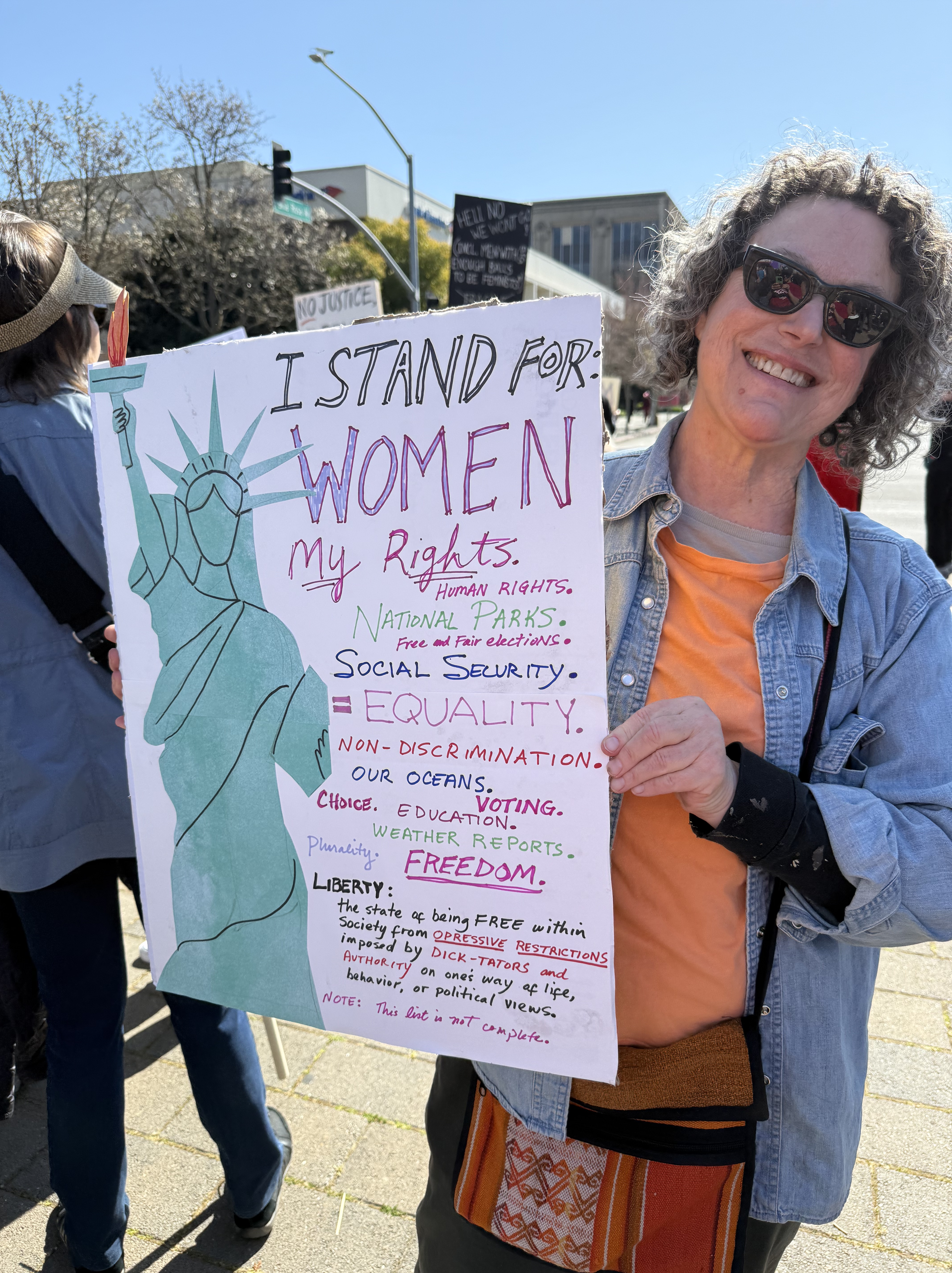
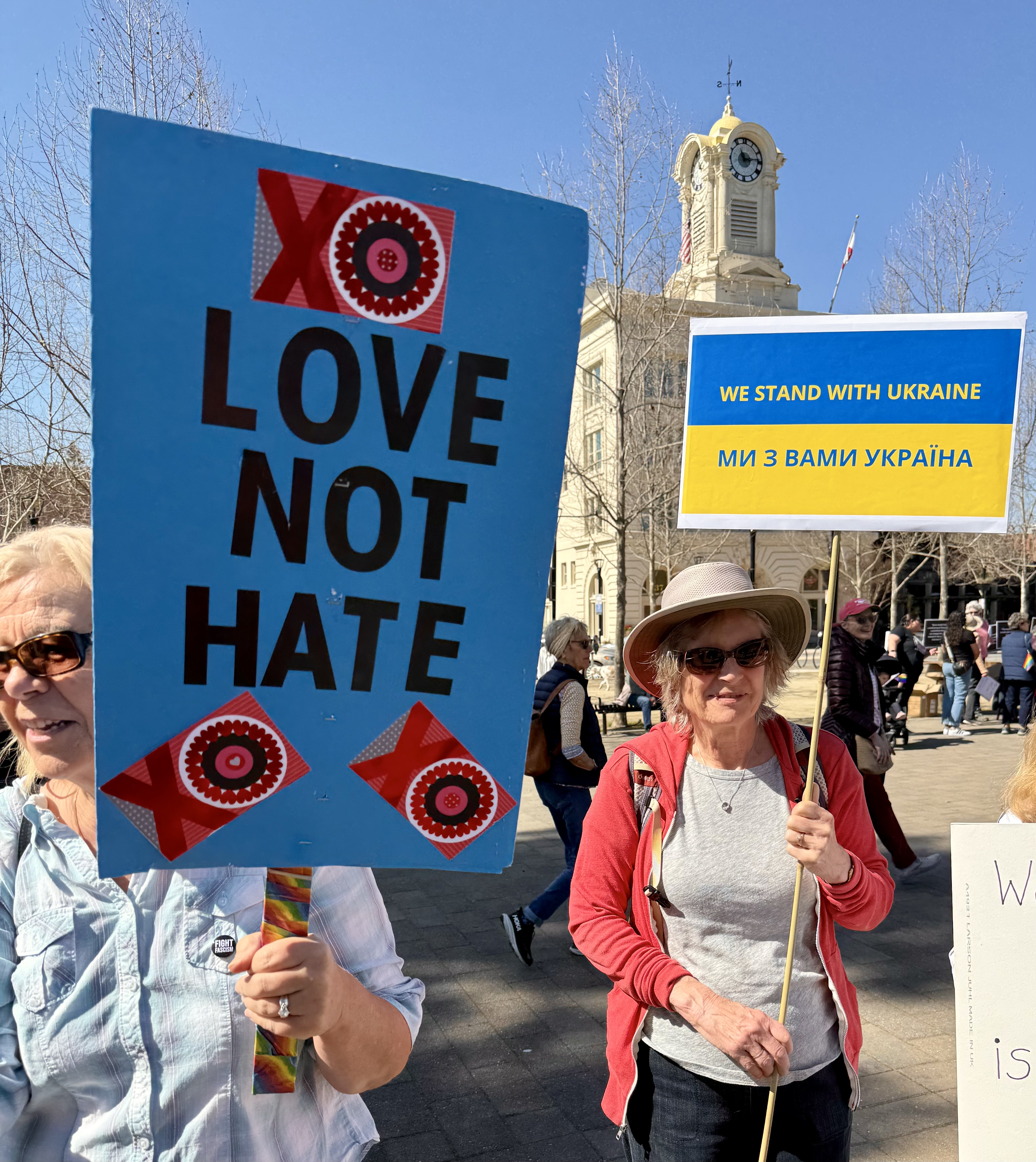
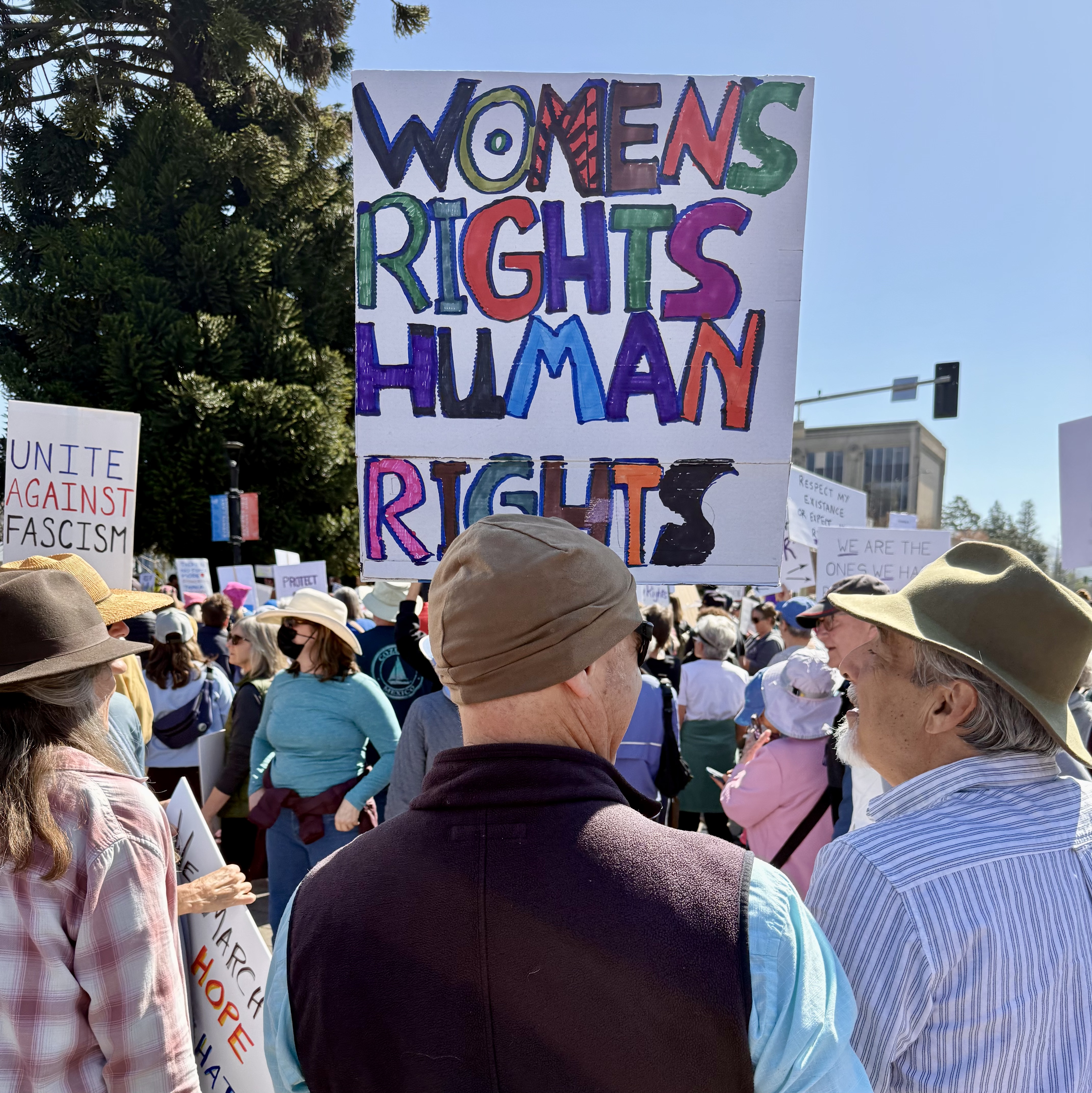
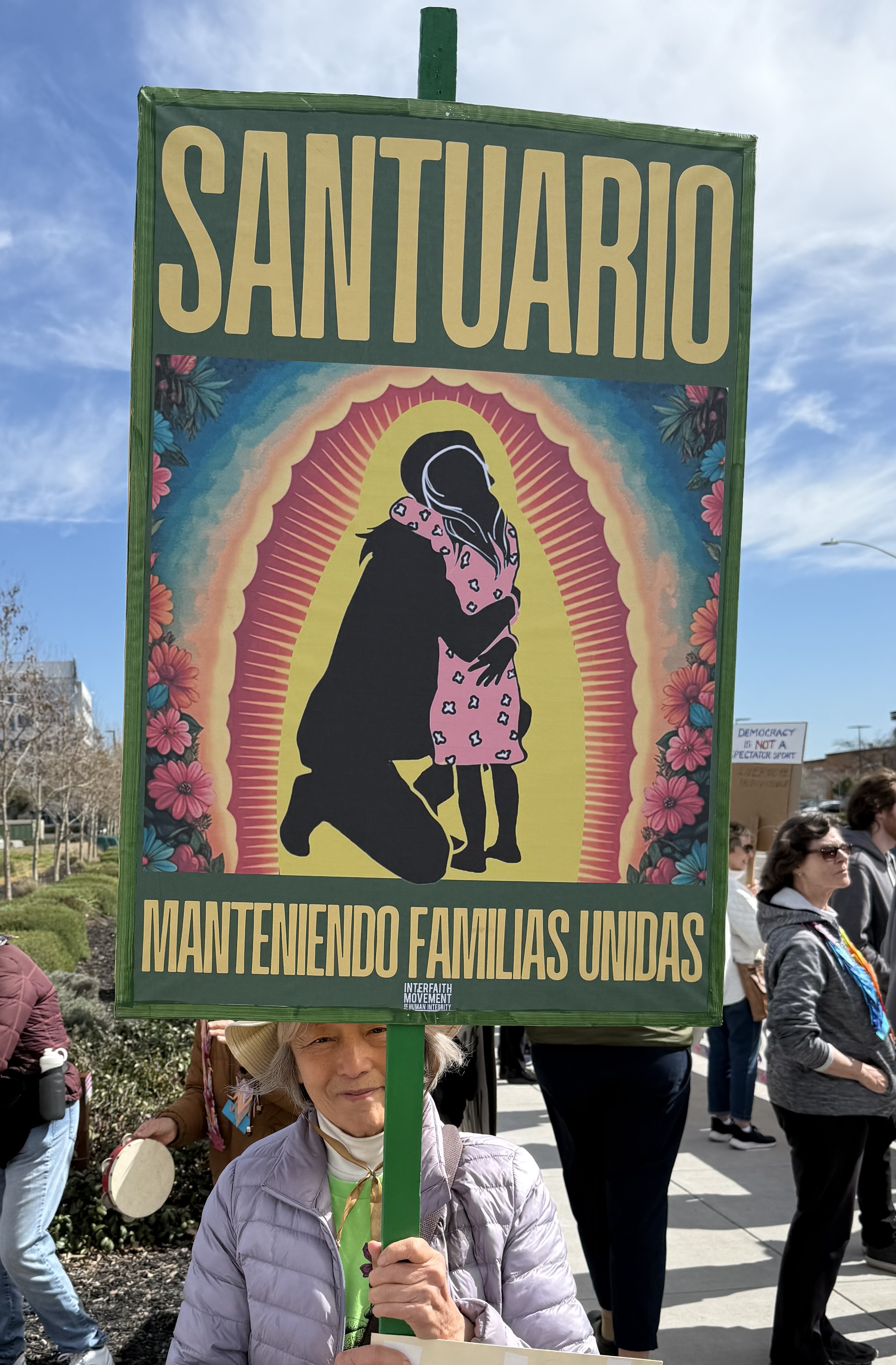
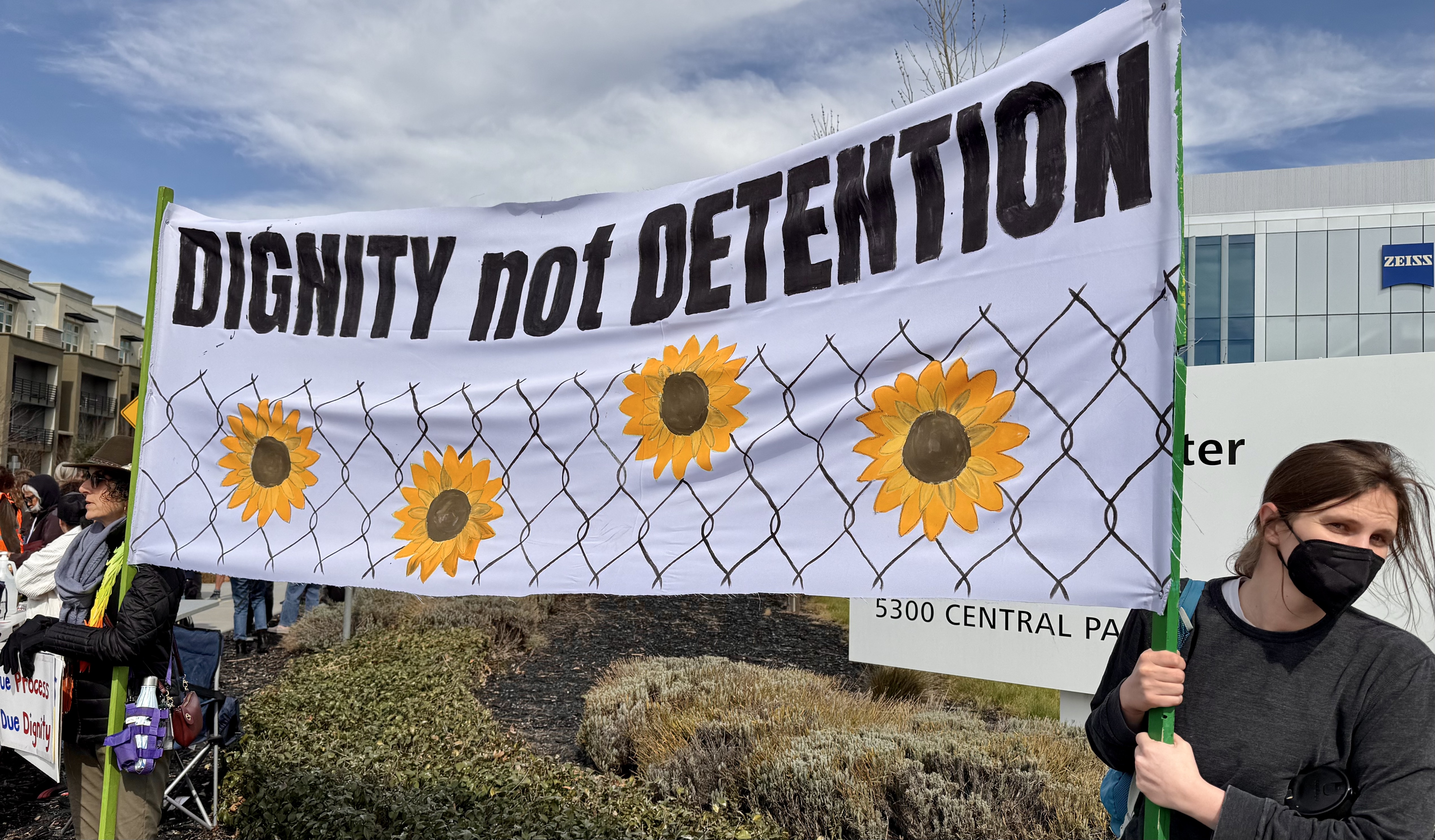
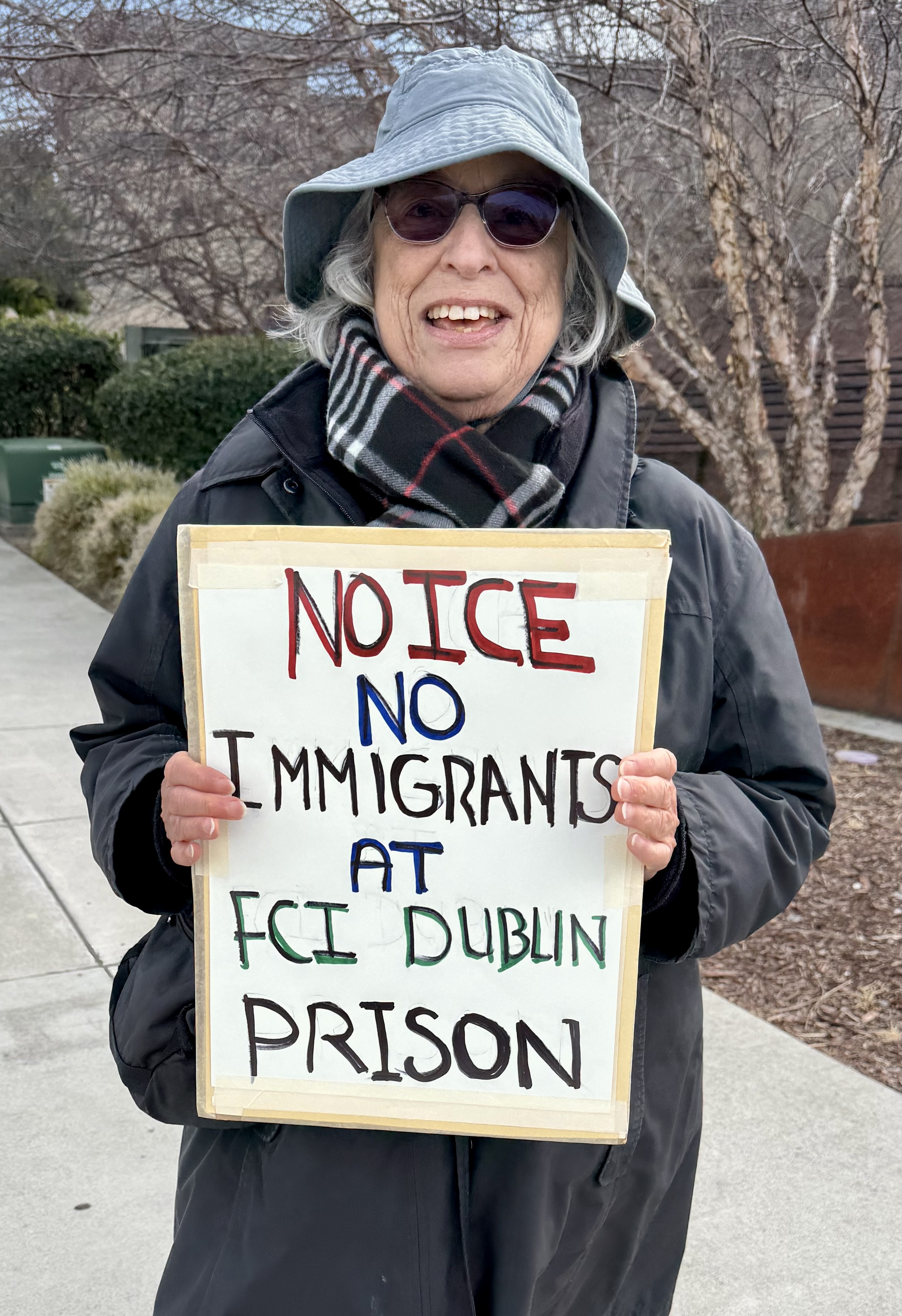
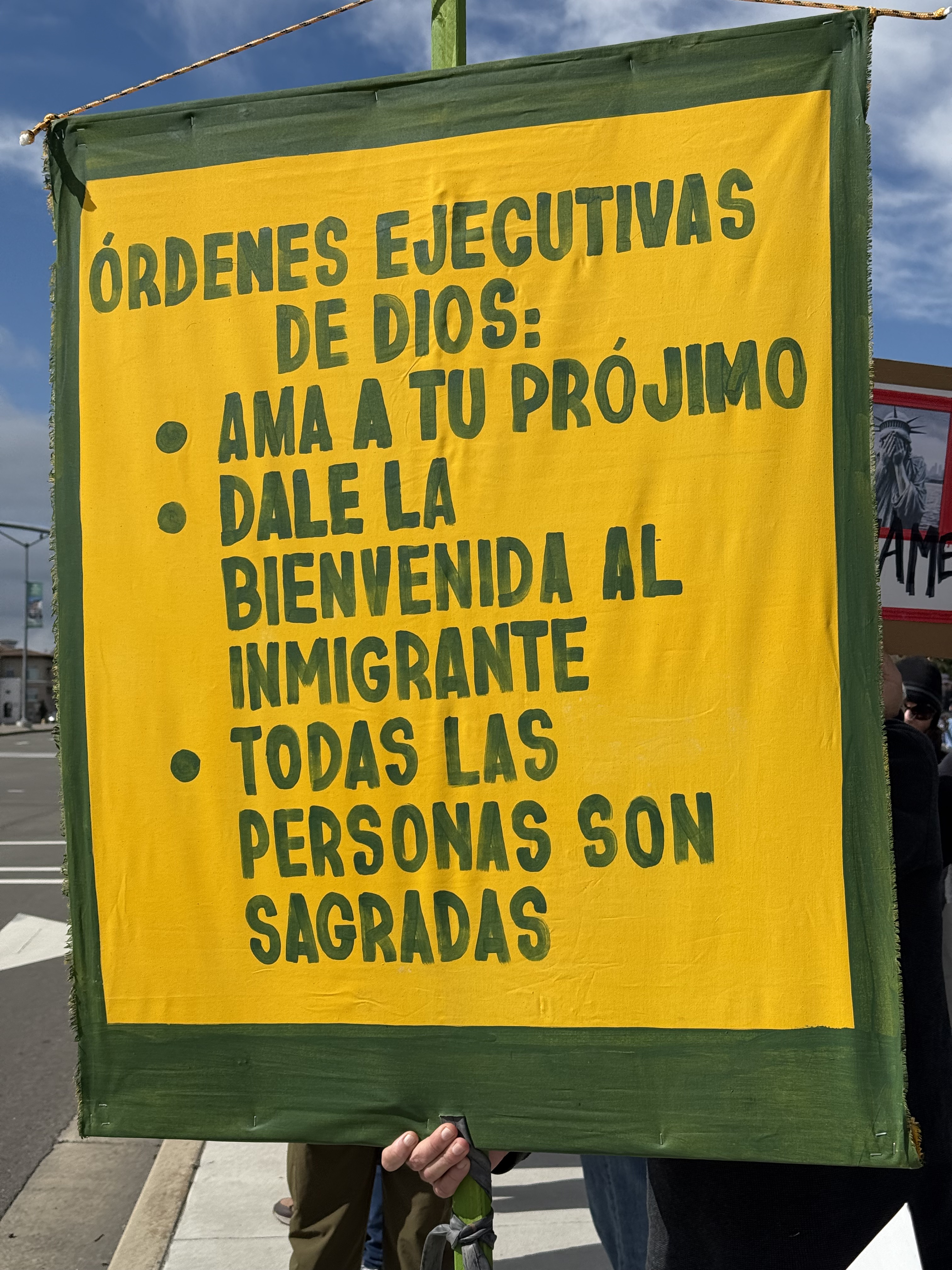
The federal prison at Dublin CA was closed last year following years of prisoner abuse and neglect. The feds now want to reopen it to house immigrants detained by U.S. Immigration and Customs Enforcement (ICE). Hundreds of community members protested the plan March 1, 2025.
Malaria returns and Murphy confronts “Old Army” authority
My Mother and Audie Murphy ch. 12
January 1944. The squad is engaged in simulated combat. For three days they storm a dummy beachhead. They leap from landing craft and, falling, crawling, and firing, advance upon assigned objectives. Then the maneuvers end abruptly. The men are placed on strict alert, confined to the company area, and given one day of rest except for a final inspection of equipment. They recognize the signs. Everyone whispers “tomorrow.” Chaplains hold services. Letters are written with particular care. Still, no one knows the destination.
Murphy is sick again with malaria. Refusing to complain, worried that it will seem he’s trying to avoid combat, he’s finally turned in by a man in his squad. With a temperature of 105, he’s sent to a hospital in Naples.
Then, after less than a week in hospital, Murphy is among a boatload of replacements headed for Anzio. Murphy can’t wait to rejoin his squad. He has missed the first several days of the Anzio attack.
From a Life Magazine story in Flo’s album
Ignoring orders to stay in camp, he walks toward the front. In a farmhouse where the command post has been set up, he learns that several men in his squad have been killed or maimed. Just as he feared, the Nazis have devastated his group, soldiers who have become like family after surviving the hell of war together.
At divisional headquarters, Murphy encounters the old hierarchy of the Army. A regular army sergeant, irritated by the informality of wartime soldiers, confronts him and orders him to unload his pack for a work detail. Murphy refuses. The sergeant threatens discipline; Murphy tells him to come find him at the front if he wants to press the issue. Slinging his carbine over his shoulder, he turns and heads up the road marked with the blue diamond of his regiment.
Americans at home depended on Life Magazine for news of the war.
That night, on the way to Cisterna, Murphy leads another reconnaissance patrol behind enemy lines. They discover that the Germans are moving tanks in–an ominous sign.
He reports to the lieutenant’s dugout. The lieutenant sits in a deep muddy hole, the roof made of poles, grass, and sod. Water seeps in from the sides. Bandoleers of cartridges and a case of grenades lie stacked in the corner. He looks as though he has not slept in days.
This, now, is home. A foxhole. Mud, cold, and the sound of artillery. The front line stretches ahead into darkness, and there is no certainty of what tomorrow will bring—only that tomorrow is coming.














































 tradeswomn musings