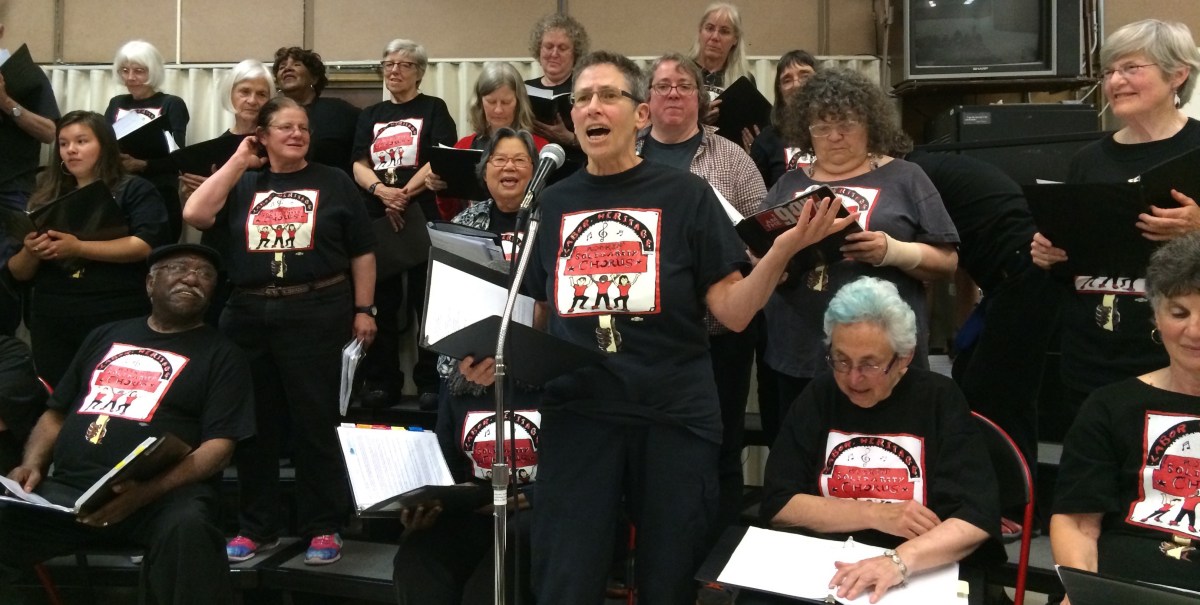
 On November 7, the Labor Chorus appeared with the Joe Hill Roadshow, a varying collection of musicians and spoken word artists traveling the country to remind us about Joe Hill and our labor history. It was our pleasure to back up the amazing performers David Rovics, Chris Chandler and George Mann. If the Joe Hill Roadshow is coming to your area, go see it. The show is now touring the West.
On the 100th anniversary of the execution of labor hero and songwriter Joe Hill, I’ve been reminiscing about our little chapter of the Industrial Workers of the World (Wobblies) in Pullman, Washington in the early 1970s. I still have my dues book in a box somewhere. We all had Little Red Songbooks and I remember we used to meet in a basement (must have been Koinonia House, where many radical gatherings took place) and sing the Wobbly songs. Most of us were students at Washington State University along with a few faculty members.
The IWW was headquartered in Chicago then (it has moved back to Chicago from San Francisco) and we would send to the international office for union materials, which seemed to have been stored there since the 1920s. My dues book had a space for the year that read 192_. You had to fill in which industry you worked in. That confused me until another member filled in Education. That’s when I understood that Education is an industry. Duh! There were wonderful pen and ink posters that were shipped in cardboard tubes too.
On the 100th anniversary of the birth of the IWW in 2005, I went to a celebration and conference at UC Santa Cruz. I went because I knew Archie Green would be there. Archie was a labor historian and folklorist who was singlehandedly responsible for the American Folklife Preservation Act. I had worked with both of Archie’s sons who were electricians in my IBEW local. One was an electrical inspector with me, but I could never get him to introduce me to Archie. I had to go to this public event to meet him.
I think it was Labor Day, 2007, when Archie was 90, that was declared Archie Green Day in SF. The Labor Archives and Research Center hosted a celebration at the ILWU local 34 hall. Archie stood onstage and spoke about his new book, which had just been published, The Big Red Songbook. He told us that this guy whom his parents had known through the Workman’s Circle in NYC had started the project of compiling all the Wobbly songs and their history. This guy, John Neuhaus, was dying of cancer in 1958 and when Archie went to visit him in the hospital he made Archie promise to finish the project. It only took him 49 years. Of course I have an autographed copy.
Archie became my mentor. He promised he would fund a book project about the history of the tradeswomen movement if I could just get the goddamned manuscript written. I submitted an outline and we argued about the focus. I interviewed Archie and learned that his Jewish family had emigrated from Ukraine and his father had been in the 1905 revolution. Archie was a fierce mentor. Two weeks before he died he was kicking my butt about the book. I said by the time I get the manuscript finished, books will be extinct (it’s still unfinished)
Heres’ the thing: I’m still singing the old Wobbly songs! A couple of years ago I joined the Rockin’ Solidarity Labor Heritage Chorus (the name might even be longer than that. I can never remember). It’s part of a subculture of labor choruses, still here but dwindling. I regret that I didn’t get involved sooner.
The guy who was the inspiration for that little subculture in the Bay Area was Jon Fromer, a singer/songwriter who had worked on a TV show called We Do The Work and organized the Bolshevik Café, a kind of Commie variety show. The twice-yearly Bolshevik Café had been the project of the Billie Holiday sect of the CPUSA. Commies who knew how to put on a show! I got there as often as I could. One time I spotted Angela Davis in the audience. Jon also founded the annual Western Workers Cultural Heritage Festival in 1987. Volunteers have taken on the organizing, but the old commies are aging and 2016 will be the last year. It’s held on Martin Luther King Jr. weekend at the Plumbers’ Hall in Burlingame. Jon died a couple of years ago. I hadn’t gone to the Heritage Fest until I joined the chorus and we performed there, though I knew about it. Like much of the remnants of the Left, it’s a rather insular group of old timers with a tiny sprinkling of younger folks.
The work is carried on by people like my chorus director, Patricia Wynne, who founded our chorus in 1999. Although, she’s no spring chicken either. Most of the chorus members are old people—mostly labor activists–like me. We come out to sing at picket lines and demonstrations along with Occupella, a little group that formed during Occupy, which includes the daughter of Malvina Reynolds who is now 80 years old herself, and the Brass Liberation Orchestra, a lefty marching band.
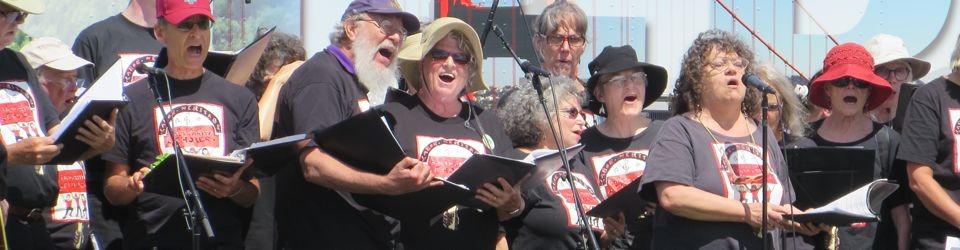 Pat has of late taken to writing what I call operas for lack of a better term. They are stories told with song and spoken words. My favorite production was taken from The Warmth of Others Suns. We sang with Vukani Mawethu, a local group that sings South African choral music. For me this was our most inspirational “opera” because these old black people—members of both choral groups–got up on stage and told their own personal stories of migrating from the South. Two of them, Alex and Harriet Bagwell, were old CP members who I first heard sing at the Bolshevik Café. Very accomplished musicians, they will be singing with our chorus again for the next opera, about working women. I’ve written a song for it about the crappy jobs I did before becoming an electrician (called Sister in the Brotherhood) and Pat put it in the program.

I can carry a tune, but I’ve got a lot to learn about being a singer. It turns out I’m a belter, like Ethel Merman. I always knew I had a loud voice but who knew it translated to singing? I call myself a failed alto because, although my goal was to learn to sing a part, my old brain never got good enough at it and I finally joined the soprano section so I can sing the melody. Sometimes I have to strain to reach the high notes.
Some of the old songs are kind of hokey and the music rather boring, but some—especially the old Joe Hill rewrites of old Christian hymns—I just love to sing. Some I remember from those basement sing-ins in Pullman, like The Preacher and the Slave. “You will eat by and by in that glorious land above the sky.” I especially love the Wobbly Doxology. “Praise boss whose bloody wars we fight. Praise him, fat leech and parasite!” Instead of Amen at the end of the song, we sing “Aww Hell!” But I never learned Rebel Girl, about Elizabeth Gurley Flynn, probably because we couldn’t stomach the condescending attitude toward women. “She’s a precious pearl.” Blech! My chorus sings it, but with some changed lyrics to make us feminists happy.



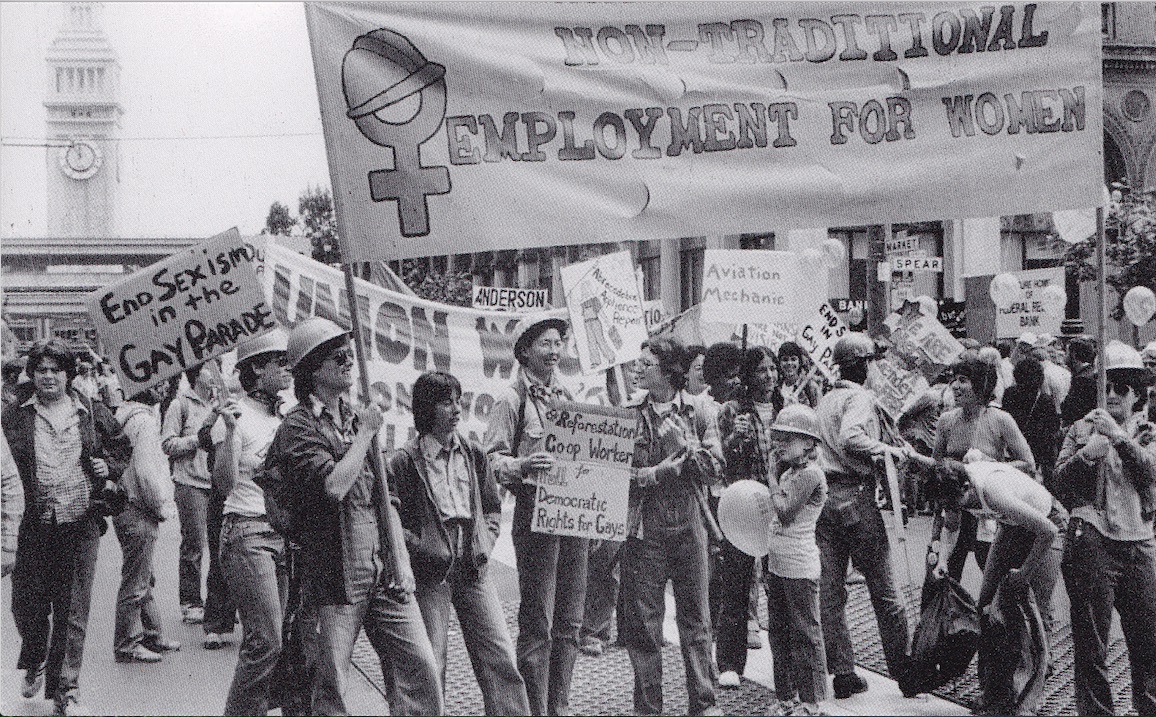
 ay Area activists first formed Nontraditional Employment for Women (NEW) as a project of Union Women’s Alliance to Gain Equality (Union WAGE), a nonprofit organization for working women which included housewives, unemployed, retired, and women receiving welfare.
 In 1979, Tradeswomen Inc., a 501c-3 nonprofit, was organized by a group of advocates including Madeline Mixer, director of District IX of the Women’s Bureau, US Department of Labor; and Susie Suafai, director of WAP. The goal was to access money to expand the already successful WAP project that was placing women in Bay Area union apprenticeship programs. For a short time, under President Jimmy Carter, construction jobs opened up to women. But after Ronald Reagan’s election in 1980 everything changed. The Reagan administration immediately dismantled and defunded whatever affirmative action programs it could, and stopped enforcing regulations already on the books.
 tradeswomn musings