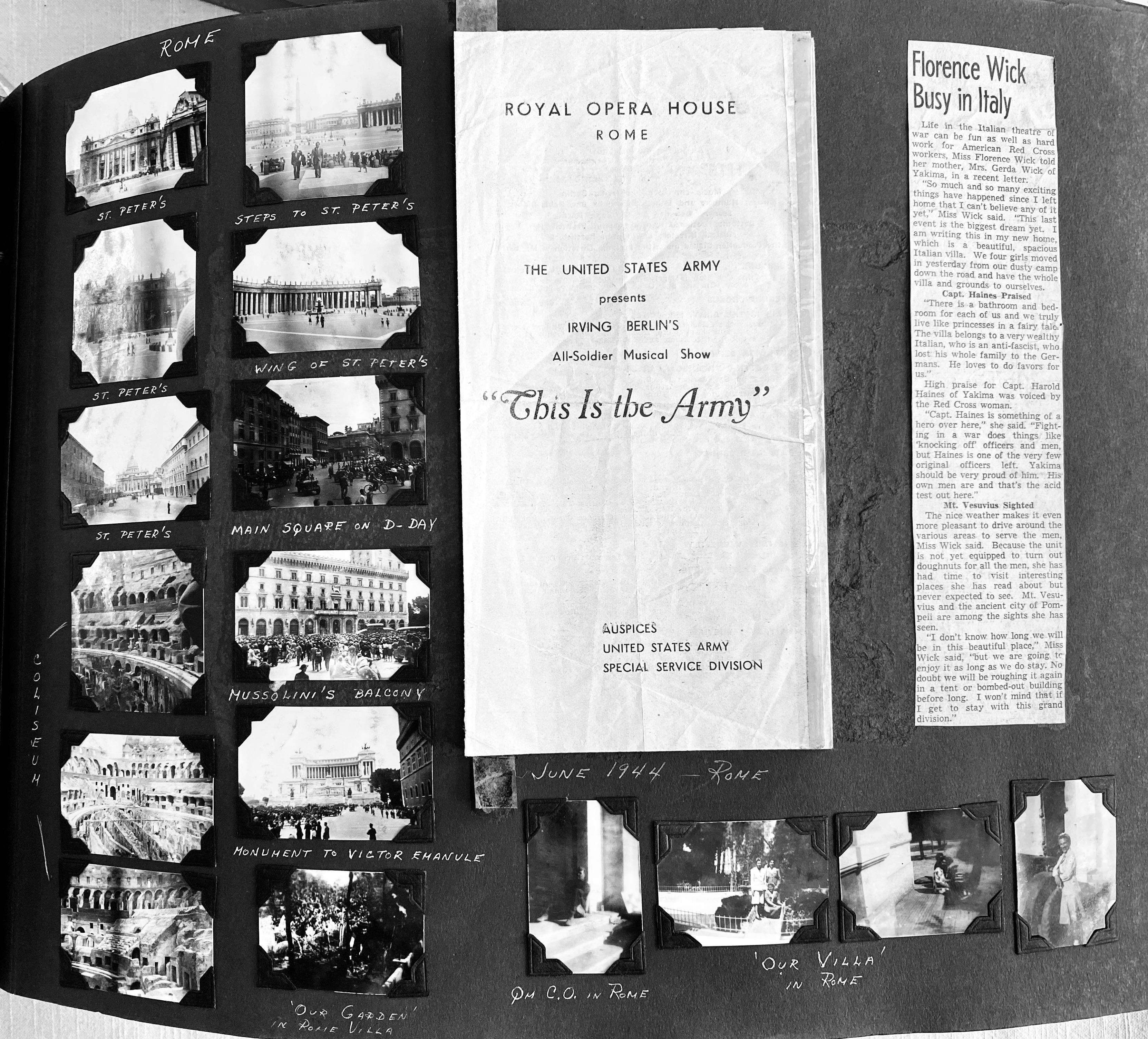
June, 1944. Flo saw This is the Army at the Royal Opera House in Rome
My Mother and Audie Murphy Ch. 17
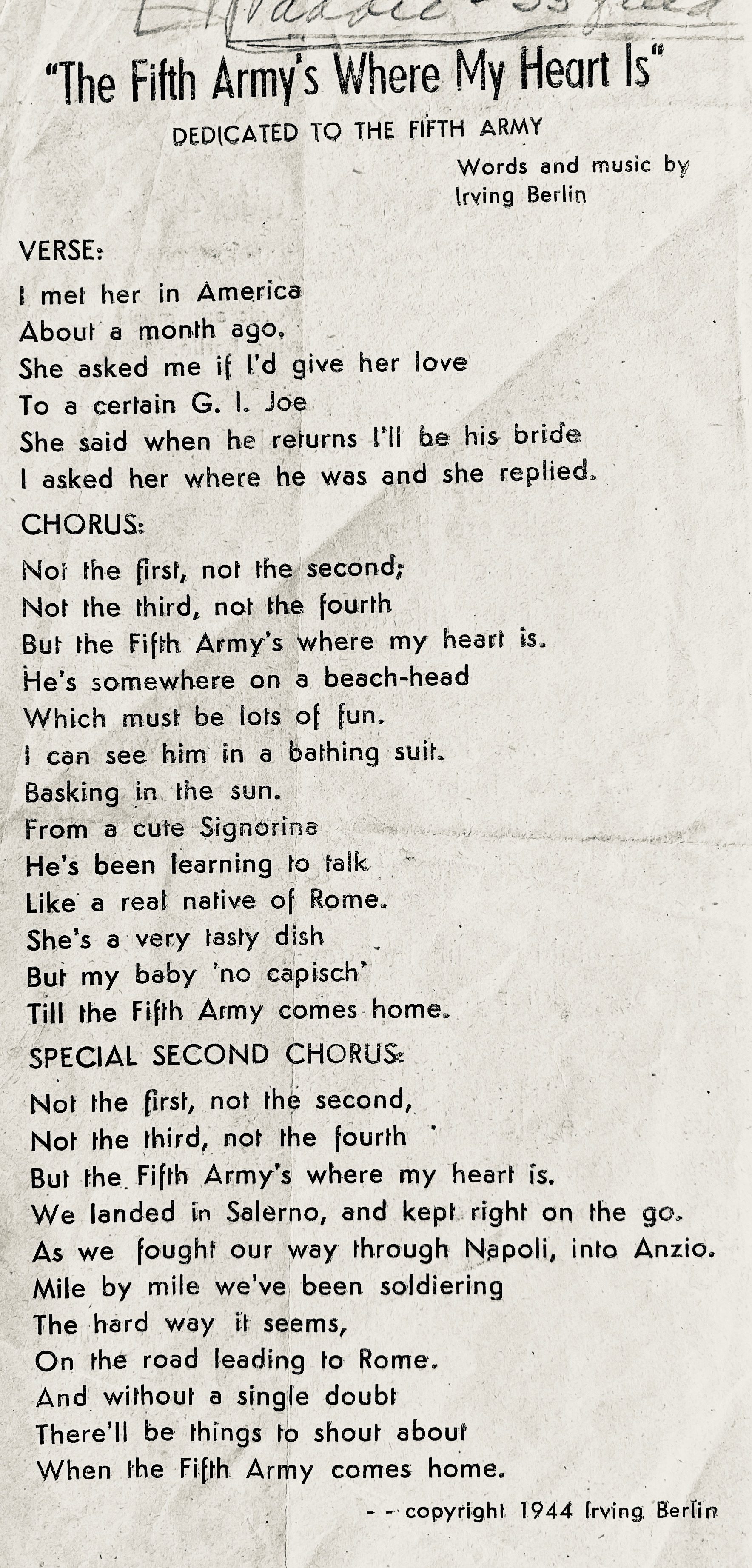
Drag, blackface, racial integration, “too many Jews”—they’re all part of the complicated legacy of Irving Berlin’s wartime musical revue, This Is the Army.
Berlin conceived the show in 1941, even before the U.S. entered WWII. It was a follow-up to a production he had staged during WWI in 1917.
This Is the Army premiered on Broadway in 1942, featuring a cast of 300—enlisted men who could sing and dance. The show then toured the U.S. before traveling to military bases worldwide, running until October 1945.
Berlin originally planned to open the show with a minstrel number, as he had in 1917, but director Ezra Stone pushed back. “Mr. Berlin,” he said, “I know the heritage of the minstrel show. Those days are gone. People don’t do that anymore.” Berlin eventually agreed to cut blackface from the stage production, though the number remained in the 1943 film adaptation.
Members of the This Is the Army unit rehearse “That’s What the Well-Dressed Man in Harlem Will Wear.” (NARA, 111-SC-140528)
Yet Berlin also made a bold move for the era: he insisted on integrating the show. At a time when the U.S. military remained segregated, This Is the Army became the only integrated unit in uniform. He even wrote a song specifically for Black performers.
Not all of Berlin’s decisions were as progressive. During the tour, he stunned cast members by complaining that there were “too many Jews in the show and too many of Ezra Stone’s friends.” The remark shocked those present—was the son of a cantor really saying this? For the soldier-performers, the fear was immediate: any cuts to the cast meant reassignment to the front lines.
The show’s use of drag also drew criticism. Warner Brothers, which produced the film version, worried that the female impersonators would limit its international release. “Female impersonators do not exist in Latin America,” claimed one misinformed studio memo. The studio also feared that images of U.S. soldiers in dresses would become enemy propaganda. In response, the film drastically reduced the female impersonators’ roles.
On June 4, 1944, Allied troops took Rome. Just six days behind them, This Is the Army rolled into the city on trucks. Later that month, the company took up residence at the Royal Opera House, performing twice daily.
The show was a global phenomenon, raising millions for the Army Emergency Relief Fund and leaving a lasting legacy.
Flo is one of the first to enter the city after Nazis retreat
My mother and Audie Murphy ch. 15
The city of Rome was liberated by Allied troops June 4, 1944. Flo got to Rome the next day, June 5. She told me she was proud to come into the city with General Mark Clark and the U.S. 5th Army. The Third Division had taken big hits in battles at Anzio and on the Italian coast. Rome would be an easy victory, a source of prestige for the leaders and pride for infantrymen recovering from those battles. Later, historians and Allied commanders agreed that Clark’s decision to march into Rome instead of cutting off a large part of the retreating German army was a major blunder, extending the war for maybe another year. In any case, the liberation of Rome was overshadowed by the D-Day landings on the beaches of Normandy in northern France on June 6.
A page in Flo’s album. She saw the Irving Berlin show in Rome
Flo kept detailed notes in a tiny pocket-sized diary. This was the first entry.
Monday June 5, 1944
Came into Rome in amphib Jeep with Frank Gates.
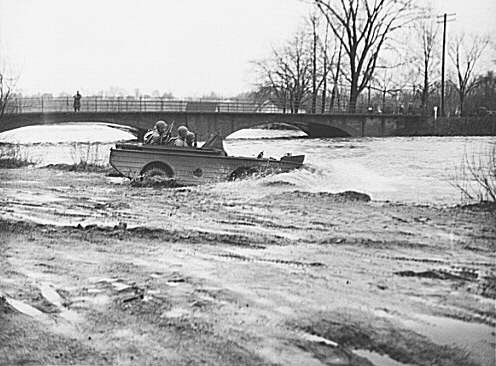
They were traveling from the camp at Pozzuoli, a seaside town on the Gulf of Naples where they’d been bivouacked with the Third Division. At first I imagined that they drove the 138 miles on the bombed out rutted roads. But these amphibious jeeps were faster in the water than on land, so now I’m thinking they traveled on the water. Amphib jeeps were used by the Third Division because they were training for an amphibious landing in France that would take place in August.
photo: Wiki commonsPhoto:Ford GPA trials Unknown author – Library of Congress
The amphibious jeep. There were about 12,000 built by Ford.
Flo didn’t make note of who was with her and Frank Gates, but I’m imagining all four of the American Red Cross women in her group went to Rome together. Gates was able to secure a promise from a rich anti-Nazi Roman to allow the ARC clubmobilers to stay in his fancy villa. The four women moved in soon after. The man did much to make them comfortable.
I wasn’t able to find information about Frank Gates but I believe he was Flo’s boss, the Red Cross director on the Italian front whose job was to establish ARC canteens and clubs near the front lines of fighting. He would be driving around Rome to look for suitable buildings in which to house the clubs.
Unlike Naples, which had been bombed for years, Rome had been spared from widespread destruction by the Nazis in part due to its declaration as an “open city” by the Italian government and the efforts of the Vatican to protect it, which led to a relatively peaceful occupation and liberation. No one, perhaps not even the Nazis, wanted to be responsible for destroying that historic city.
The 1945 Italian film Rome, Open City, directed by Roberto Rossellini, takes place during the Nazi occupation of Rome. It was one of the first post-war Italian films to gain major acclaim internationally.
The ARC women were some of the first Americans to move into Rome. Before Allied troops started coming in, they had the city almost to themselves and set about seeing all the tourist sights. Flo wanted to see all the famous architectural treasures she had read about as a child.
From a report in the Yakima Herald-Republic
Florence Wick busy in Italy
Life in the Italian theatre of war can be fun as well as hard work for American Red Cross workers, Miss Florence Wick told her mother, Mrs. Gerda Wick of Yakima, in a recent letter.
“So much and so many exciting things have happened since I left home that I can’t believe any of it yet,” Miss Wick said. “This last event is the biggest dream yet. I am writing this in my new home, which is a beautiful, spacious Italian villa. We four girls moved in yesterday from our dusty camp down the road and have the whole villa and grounds to ourselves.
“There is a bathroom and bedroom for each of us and we truly live like princesses in a fairy tale. The villa belongs to a very wealthy Italian, who is an anti-fascist, who lost his whole family to the Germans. He loves to do favors for us.”
High praise for Capt. Harold Haines of Yakima was voiced by the Red Cross woman.
“Capt. Haines is something of a hero over here,” she said. “Fighting in a war does things like ‘knocking off’ officers and men, but Haines is one of the very few original officers left. Yakima should be very proud of him. His own men are and that’s the acid test out here.”
The nice weather makes it even more pleasant to drive around the various areas to serve the men, Miss Wick said. Because the unit is not yet equipped to turn out doughnuts for all the men, she has had time to visit interesting places she has read about but never expected to see. Mt. Vesuvius and the ancient city of Pompeii are among the sights she has seen.
“I don’t know how long we will be in this beautiful place,” Miss Wick said, “but we are going to enjoy it as long as we do stay. No doubt we will be roughing it again in a tent or bombed out building before long. I won’t mind that if I get to stay with this grand division.”
The ARC women didn’t stay in the villa in Rome very long. By July 9 Flo is back in the camp, writing in her diary about cleaning their tent.
Her letters home are published in the Yakima paper
My Mother and Audie Murphy ch. 13
Miss S.I. Anthon was a family friend who visited and sent Christmas cards throughout my childhood. She reminded me of the BBC version of Agatha Christie’s sleuth, Miss Marple. She was unmarried, was short with short curly hair, and (during the 1950s and 60s) dressed in a straight no-nonsense mid-calf-length skirt, blouse, vest and suit jacket and those low-heeled sturdy shoes worn then by women of a certain age. She usually wore a hat (women wore hats in those days). We always called her Miss Anthon. She was a reporter for the local newspaper, the Yakima Republic, later the Yakima Herald-Republic.
Soester (sister in Danish) I. Anthon was born in Denmark in 1890 and she lived in Yakima’s Scandinavian neighborhood. She was a neighbor as well as a mentor to my mother, and she shared Scandinavian roots with the Wick family. By 1930 Miss Anthon was the managing editor of the Yakima Republic, the evening newspaper, a rare accomplishment for an immigrant woman whose first language was not English. For many years she wrote a column called “Daily Mirror of Life in Yakima,” and during the war she reported on the activities of local men and women serving overseas.
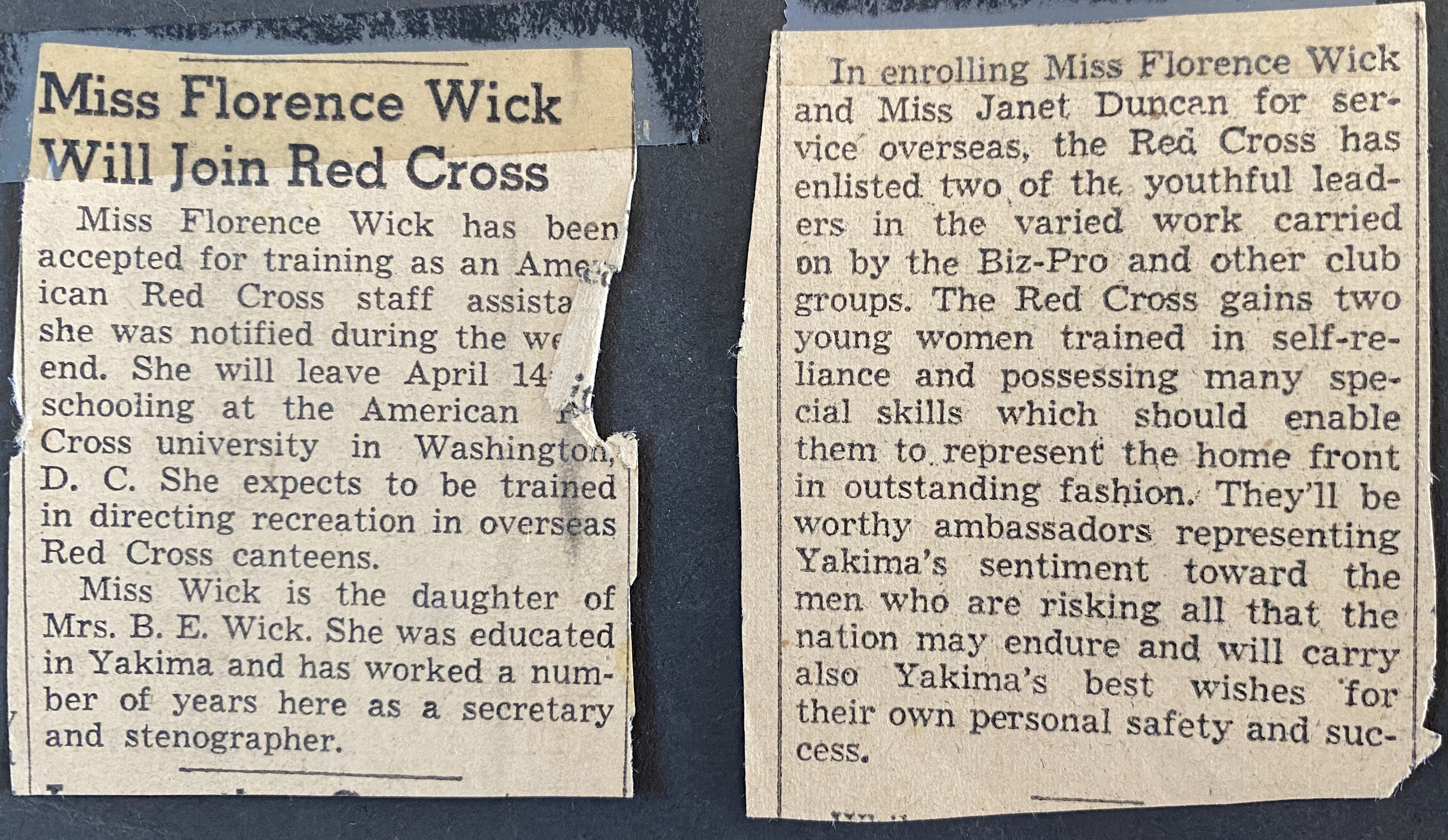
When Flo wrote home from Europe, her mother, Gerda, would share the letters with Miss Anthon, who would write them up into news stories. While few of Flo’s actual letters to her mother survive, Miss Anthon’s clipped stories are pasted throughout Flo’s WWII album.
A page in Flo’s WWII album
One of Miss Anthon’s earliest reports quotes Flo’s descriptions of her first weeks in Italy.
June, 1944.
Headline: Yakima Girl Now in Italy. Miss Wick Tells About Her Tasks
Miss Florence Wick, who recently landed in Italy as a member of an American Red Cross clubmobile staff, is getting broken into her work “by passing out doughnuts and a smile,” she writes her relatives here.
“Several of us clubmobile girls are billeted at present in an old Italian hotel,” she says. “It has such incongruous items in it as a huge crystal chandelier and ornate gold valances over the doors. As in all Europe, the plumbing leaves much to be desired and warm water is rare enough to cause excitement.
“We have a sweet little Italian girl who acts as maid, does our laundry and tries very hard to learn English. She even goes to school after working all day. They are so poor here. It makes our standard of living seem even higher and makes us all appreciate the U.S. more than ever.
“I saw some of the Italian country-side in a tour and find it very pretty and picturesque. The fruit trees (cherries and apricots) remind me of Yakima.
“The trains are small and have only two or three cars on them. They are more like our street cars.
“Clubmobile will give me an opportunity to see more of Italy than just club work and although we clubmobile gals won’t be as settled and won’t be able to dress up as much, I think we will get a greater experience.”
“I have had some interesting talks with the men—both officers and G.I.’s. Some have had some harrowing experiences. They can always laugh and ‘sling a line,’ regardless, and the ‘purple heart’ boys do the best of any.
“The Red Cross service men’s club here is the nicest I’ve ever seen and the boys really appreciate it. There haven’t been many West Coast boys through here, but when I run into them, I’m as pleased as they are. All the others seem to think Washington state is out of this world.”
Flo was assigned to a clubmobile group of four women, and she was designated captain of the group, which included Isabella Hughes (Jingles) of Baltimore, Elizabeth Elliott (Liz) of New York City, and Dorothy Shands (Dottie) of Greenville, Miss.
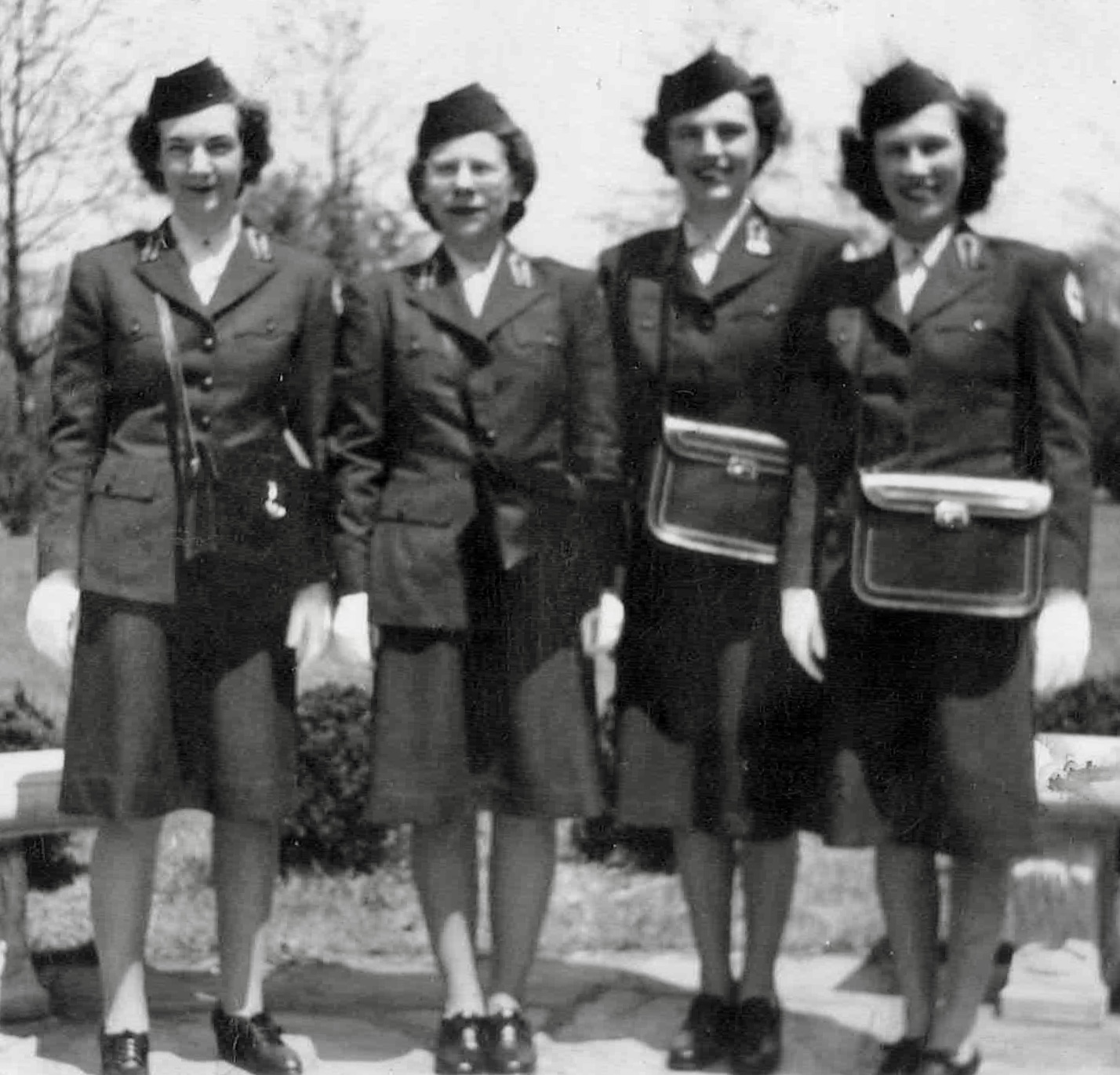
L-R Isabella Hughes (Jingles), Elizabeth Elliott (Liz), Dorothy Shands (Dottie), Florence Wick (Flo). Flo wrote “Overlooking a lovely Mediterranean beach. The villas along here were all bombed and ruined.”
Flo and her team were first stationed near Naples in an old Italian hotel from the time her ship docked May 28, 1944. It seemed like the ARC was not quite ready for their arrival. The women just sat around for several days before the ARC could figure out what to do with them. They had started to feel like they’d been hired as concubines when they finally got an assignment. Rather than driving a two-and-a-half-ton truck around Italy like the other Europe-based clubmobilers, they would be bivouacked with the Third Infantry Division of the Army. The tent city was near the town of Pozzuoli, on the sea, just north of Naples, where the soldiers trained for an amphibious landing in France.
Goodbye hotel with crystal chandeliers, maid and laundry service. Hello Army tents with cots and bedrolls.
A Familiar Voice in the Blackout
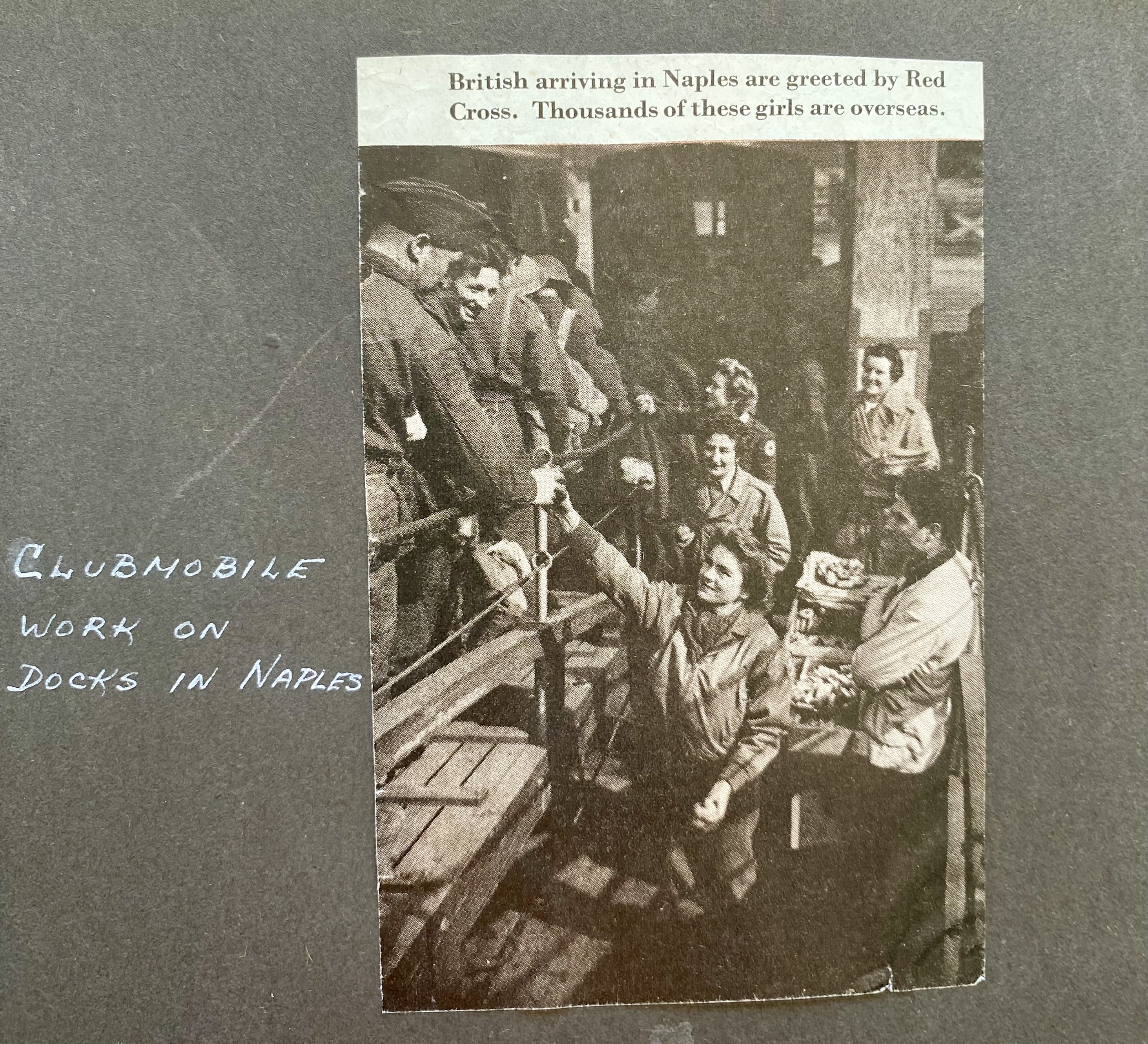
The company had just arrived in Naples, one of thousands of American and British units flooding into the battered port city. Their first stop was the American Red Cross club, a welcome sight after weeks on the move.
Inside, amid the clatter of cups and typewriters, he scanned the lists of newly arrived Red Cross women. There it was — a familiar name. An old girlfriend from back home. The war had scattered them across oceans, and now fate had brought them to the same city. But there was no time to find her. Orders came down; the company had to move.
That night, the air raid sirens began. The Germans, retreating north, were still pounding the city, shelling the docks and rail lines. The blackout was immediate — every light extinguished. Hundreds of soldiers, nurses, and civilians poured from buildings into the damp mouth of a tunnel carved into the hillside.
It was pitch dark. The air was thick with fear, sweat, and the echo of boots. Then, through the chaos, he heard a voice. Her voice.
He called her name, and she called back. In the darkness, they moved toward each other, guided only by sound. They reached out — a hand, a sleeve, a touch — and for a moment, found each other. They couldn’t see a thing, but they laughed softly in disbelief. Two people from the same small town, meeting again by chance in the middle of a war, in total darkness.
When the shelling stopped, the crowd dispersed into the shattered streets, and they lost each other again.
They wouldn’t see each other until after the war, back home, this time in daylight.
The woman was my mother, Florence Wick. The man was (later) my uncle Morton Werner. He married Flo’s sister, Ruth. They each told this story many times, marveling at the happenstance.
“Loose lips sink ships.” That was the mantra drilled into the heads of American Red Cross (ARC) women during their training in Washington, D.C. If the FBI discovered that a secret had leaked because of something you said or wrote, you were sent home.
One instructor drove the point home with a cautionary tale: An ARC worker had called her parents in Montana, mentioning that she was in Colorado on her way to San Francisco. Her mother told the butcher, who told someone else, and within three hours, the FBI had traced the leak back to her. As a result, an entire convoy was delayed.
Flo took these warnings seriously. While she wrote to her mother in Yakima regularly, she was careful never to include anything that might be considered classified.
The Pentagon, opened 1943, displaced a Black town.
Fast-Tracked for War
The usual six-week training program had been slashed to just two weeks to push the women through faster. The military issued them canteens, helmets, and web belts, alongside yet another round of security warnings. Phone calls and letters were discouraged. Training even covered how to handle a poison gas attack, complete with gas mask drills.
Flo and her cohort began training on April 17, 1944. By May 8, they had their embarkation orders. On a warm May morning, the ARC women, clad in winter uniforms, marched two abreast to Union Station, where they boarded a train to New York City. From Penn Station, they were shuttled by bus to Brooklyn and housed at the massive St. George Hotel. There, they waited—alongside countless other uniformed Americans—until it was time to ship out.
No one knew where they were going. Not even the ship’s officers were told their destination. Only the captain held that information, as wartime security dictated.
The HNHS Atlantis
Aboard the HMHS Atlantis
Flo’s ship, the HMHS Atlantis, was a British hospital vessel that had already survived encounters with German U-boats. The Germans ignored Geneva Convention rules that forbade attacking hospital ships—these vessels made tempting targets. During submarine alerts, the Atlantis would zigzag wildly to evade torpedoes.
Once aboard, Flo learned that her destination was Italy, where she had been assigned to the North Africa theater. The ship carried British engineers, fellow ARC workers, and stacks of Italian phrasebooks. Flo tried to pick up a bit of the language during the long voyage.
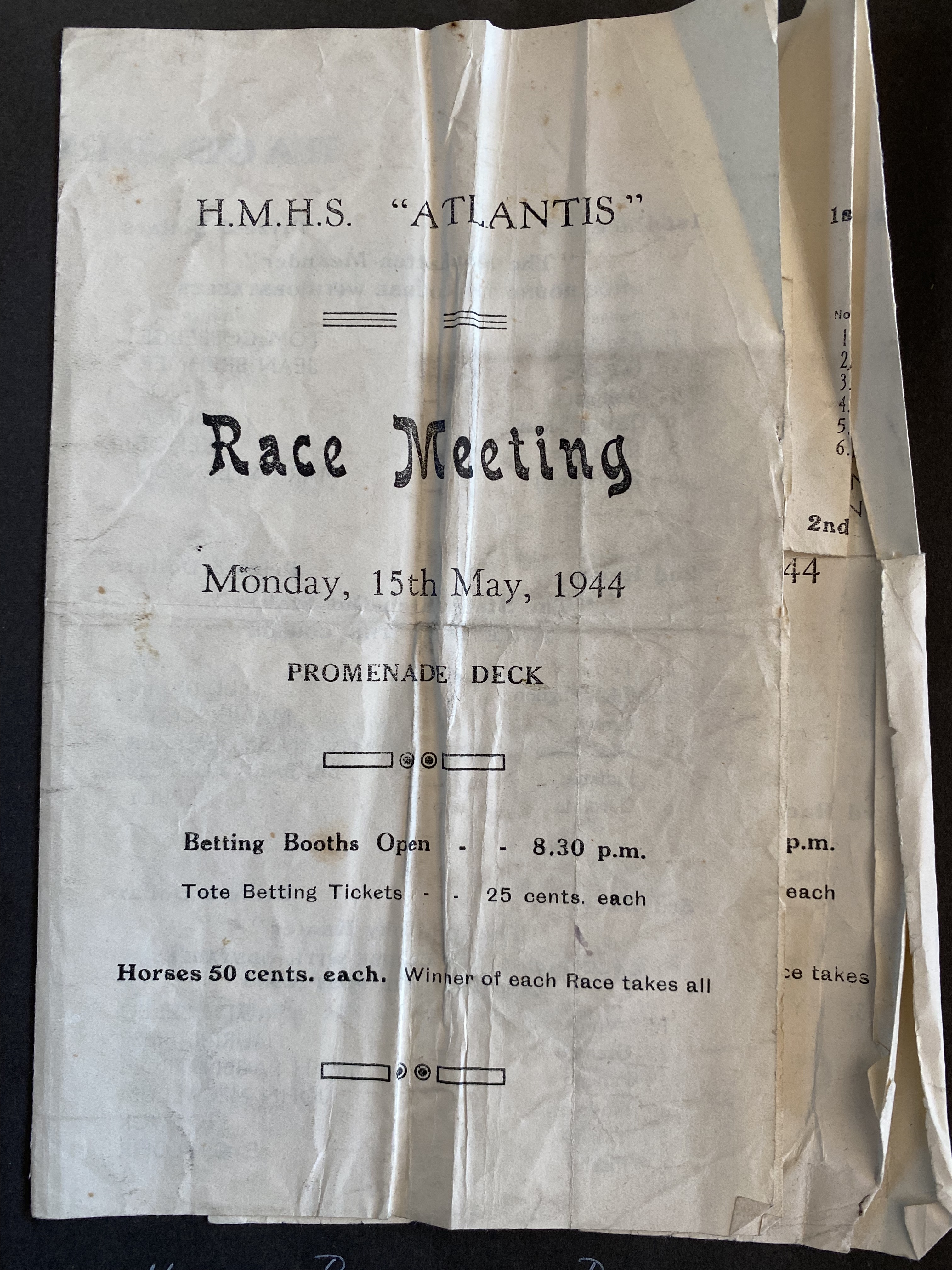
Crossing the Atlantic took nearly three weeks. To pass the time, Army journalists produced a daily mimeographed newsletter, Red Cross Currents, a few copies of which Flo saved in her scrapbook. She also kept menus and records of shipboard activities, which included: horse racing (the cardboard variety), a contract bridge tournament, shuffleboard, deck quoits, “angell golf”, ping pong and deck tennis. Prizes were cartons of cigarets.
Horserace program
Flo documented her voyage with snapshots—sunbathing with English engineers, uniformed officers on deck. Among the clippings in her album was an image of the newly built Pentagon, a source of national pride. What the public hadn’t been told, however, was that its construction had wiped out Queen City, a thriving Black town in Arlington, Virginia. The residents of the town were descendants of the residents of Freedman’s Village, which had been established by the federal government during the Civil War as a home for displaced freed slaves.
Letters, Friendships, and Missed Meetings
Flo befriended an Irish engineer who worked on the ship, R.H. Wilkinson. They kept in touch throughout the war, attempting—but failing—to meet again. In August 1945, after the war had ended, Wilkinson wrote to her, reminiscing about their time on the Atlantis and asking for copies of photos to complete his scrapbook. He had since been deployed to the Pacific and was now stationed on the India run, where, as he put it, it was “very hot!” If she ever made it to Belfast, he promised, she would receive a true Irish welcome.
Flo never did make it to Ireland.
Sunning on the deck. Flo in the middle
First Glimpse of Naples
As the Atlantis steamed past the lush, romance-laden Isle of Capri into Naples harbor, the passengers got their first look at war-torn Italy. The harbor was in ruins, bombed repeatedly during the Allied campaign to drive out the Germans. Though much of the destruction was confined to the waterfront, Naples itself—dirty, crowded, and overrun with American troops—had changed dramatically.
A military-issued guide described the city in blunt terms:
“The city of 1,000,000 still is the filthy, teeming tourist town, and now prices have trebled with the advent of thousands of Americans. There are gimcrack souvenirs, phoney tortoise-shell, dangerously bad wine and brandy, poor but expensive waterfront restaurants.
There are trips to Pompeii and Herculaneum, tours of Naples, and excursions up the slopes of Vesuvius (ARC trips). There’s an Allied Officers’ Club (dinner, drinks, dance, romance), an 82% venereally infected civilian population, an opera company and a symphony; buses, cabs, suburban trains; oranges, tangerines, grapes, lemons, and apples.
And 50 miles to the northwest there is a war, of which occasional bombers remind Neapolitans on infrequent nights of the dimout.”
Stamped at the bottom:
NO – SORRY – YOU CAN’T MAIL THIS PAPER HOME.
From a Life Magazine story pasted in Flo’s album
A New Reality
Flo later wrote to her mother, “The Rock of Gibraltar was the only stop our ship made on the way over, and it looked exactly like all the pictures we’ve seen. The Isle of Capri, I saw in a very early morning light, and it looked even more romantic that way.”
In lovely spring weather they sailed into Naples May 27, 1944. Allied bombing over the course of many months had destroyed much of the ancient city. Of course, the port had been a prime target and so what the passengers of the Atlantis saw when they first laid eyes on Italy was the ruins of war, patched ably by the American engineers. For Naples was now in Allied hands. The Nazis had retreated north.
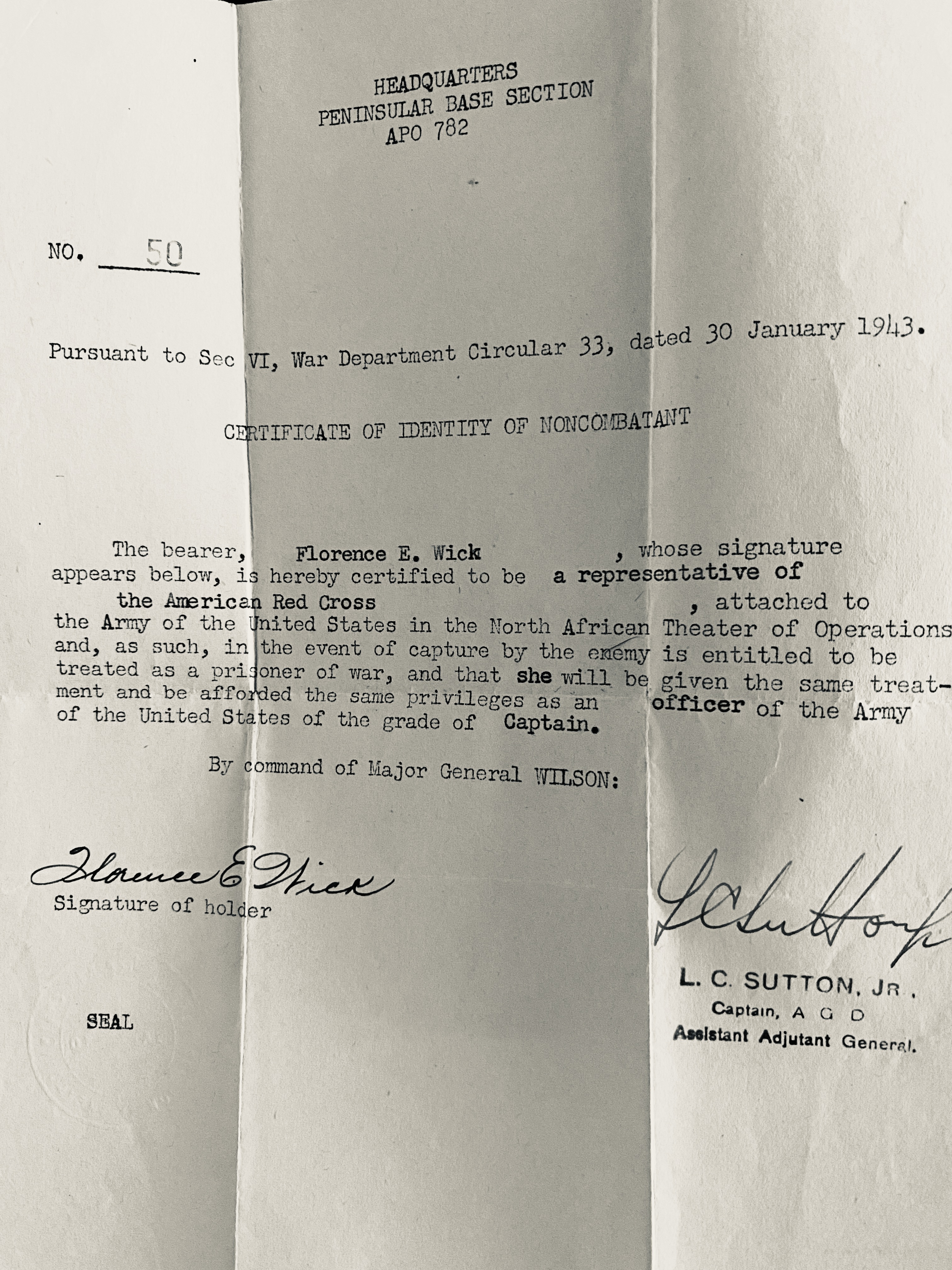
In event of capture, she will be treated as a captain.
On Monday morning April 17, 1944 the three women from Washington state reported for training at the American University campus. They checked into a large classroom full of milling women and immediately lost track of each other. In the din Flo could hear accents from all over the country, and as she met and talked with the recruits, she was impressed by their high level of education and abilities.
At graduation, Flo was photographed with her Washington State counterparts–the Suksdorf twins and a woman from Seattle, Josephine Ryan. Flo at right.
That first day was mostly filled with speeches from ARC directors, none particularly memorable. Then, the trainees fell into a routine: up at 6am, lectures and exams starting at 8am.
One instructor they dubbed Theda Bara. She was a thin older woman, hair drawn severely back from her face, who had served in France during “the last show” as she called the Great War. She warned of the pitfalls and perils women face in situations where they are sometimes outnumbered by men 100 to 1.
The women were admonished to date only officers and to “be careful not to let your heads be turned by all the attention.”
“As ARC staff assistants you are considered officers if captured, the equivalent of second lieutenants, and you are covered by the international rules of war,” she told them.
The women were allowed extra time to shop and they needed it. They hadn’t realized there was so much shopping involved–at their own expense. They were given one set of summer and winter Class A uniforms (dresses and skirts only; no pants), which they would need to have fitted. Flo was also issued a trench coat type raincoat, and a heavy topcoat with removable red lining. The Red Cross paid for the uniforms, but the women had to pay for a long list of required clothes and equipment. The list specified exactly how many white blouses, socks, cotton underpants, girdles, and cotton gloves they would need, plus odd items like canteen, web belt, musette bag (a shoulder bag, like a purse), boots, duffle bag and foot locker, leaving them to scurry all over town to track down every item on the list.
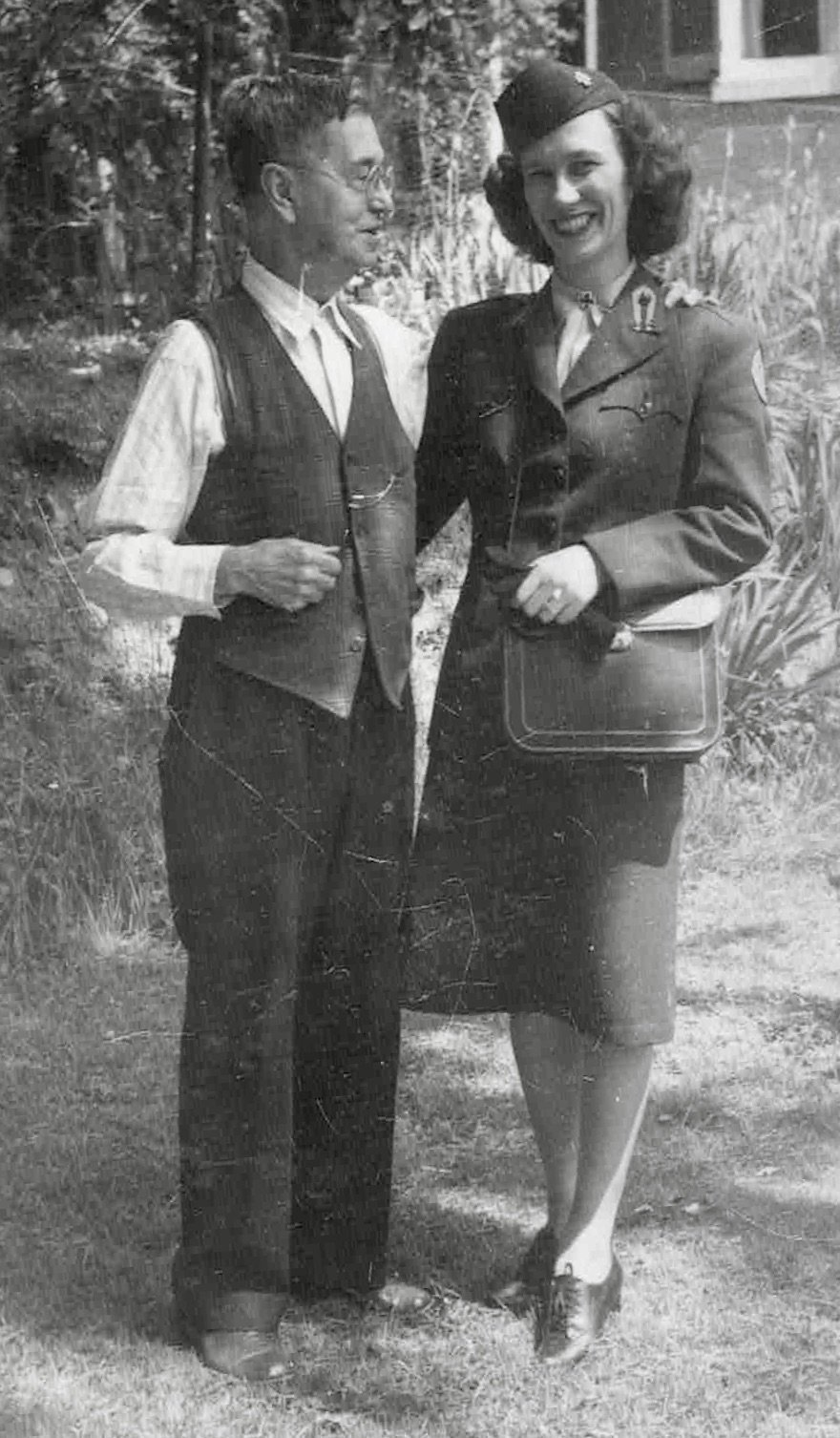
In her new uniform with “uncle” Alf
Once she had been fitted for her new uniforms, Flo paid a visit to “Uncle” Alf. The Wick family’s dear old friend, Alfred May, lived in Washington and Flo had telegrammed him of her arrival. She hadn’t seen her gay “uncle” since he had visited the family in 1929 when her father was still alive. Uncle Alf had been her father Ben’s partner in the family chicken farm business in Oregon and he was a presence in the four daughters’ lives until the business went bust and he joined the Navy in WWI. Alf, the son of a costume making English family–whose clients it was said had included the Queen–had dressed the girls and himself in Shakespearean outfits and produced plays. Flo had made a quite passable Hamlet. Alf was still living with the family who had taken him in, though he had retired from his job at the Naval Academy. Flo and Alf were photographed together in front of Alf’s apartment.
Back at the training school, a teacher admonished the women. “Once you get orders you’re incommunicado until you reach your destination, which might take as long as two months.”
On the packed trains from Yakima to Chicago and Chicago to D.C. were many others traveling to war. It seemed to Flo like the whole country was traveling east. Many on the train were wives of servicemen. Some fellow travelers were American Red Cross workers. Two sisters, identical twins, got on at Spokane on Washington’s far eastern border. Louise and Lucine Suksdorf grew up in the tiny Eastern Washington town of Rosalia. They were heading to D.C. and the ARC training school as well, and the women bonded immediately.
Flo was no rube. She had taken the train cross-country to YWCA meetings in Columbus, Chicago and Minneapolis, and she’d visited New York City in 1941. She had disembarked at Grand Central Station, the biggest train station in the country, but that was before the U.S. had entered the war. Nothing prepared her for Washington’s Union Station in April 1944, ground zero in war-related transport.
Stepping down from the train, the women found themselves in what felt like an anthill. The Beaux Arts vaulted ceiling arches of the station lent a turn-of-the-century air to the scene of rushing bodies down on its marble floors. They were just three of thousands (millions?) of people milling in all directions. The station itself was alive with frantic activity, its denizens dressed mostly in khaki uniforms. Soon, Flo would be one of them, shipping out to some unknown theater of war, somewhere in the world.
Washington, D.C. Interior view of the Union Station with Office of War Information (OWI) poster in the background reading Americans will always fight for liberty. Gordon Parks, 1912-2006, photographer. Library of Congress
The women had heard that the presidential suite in Union Station had been converted to a USO club during the war. They had to see it. Explaining at the door that they were about to enter service as ARC workers, they were ushered into the suite, admiring the opulent decorations. Service members in uniform lounged on leather-covered chairs and couches. They played cards and chatted at tables. This would not be Flo’s last encounter with the USO. She would work with the USO during her ARC service and she would later direct her own USO club back in Yakima after the war.
The Suksdorf sisters had received the same ARC letter as Flo and they would be staying at the same place while they went through the two-week training for overseas service workers. The Burlington Hotel was on 14th NW in downtown Washington, near the American University where they would attend training classes. The women succeeded in catching a cab to their destination, which was only a few blocks from the White House.
The women knew not where in the world they would be sent to work, but they kept close track of the war, raging in countries around the world. In April, 1944, in Europe and the Pacific, the war heated up. Bombs were dropped on cities; on April 18, the Allies dropped more than 4000 tons of bombs over Germany, the highest single-day total of the war so far. Submarines, liberty ships and destroyers were torpedoed and sunk, British and Indian forces fought against a Japanese offensive, Japan launched a series of battles against China, and Soviet forces invaded Romania. Hungarian authorities ordered all Jews to wear the yellow star. On the Italian front, the bloody battle for Anzio advanced.
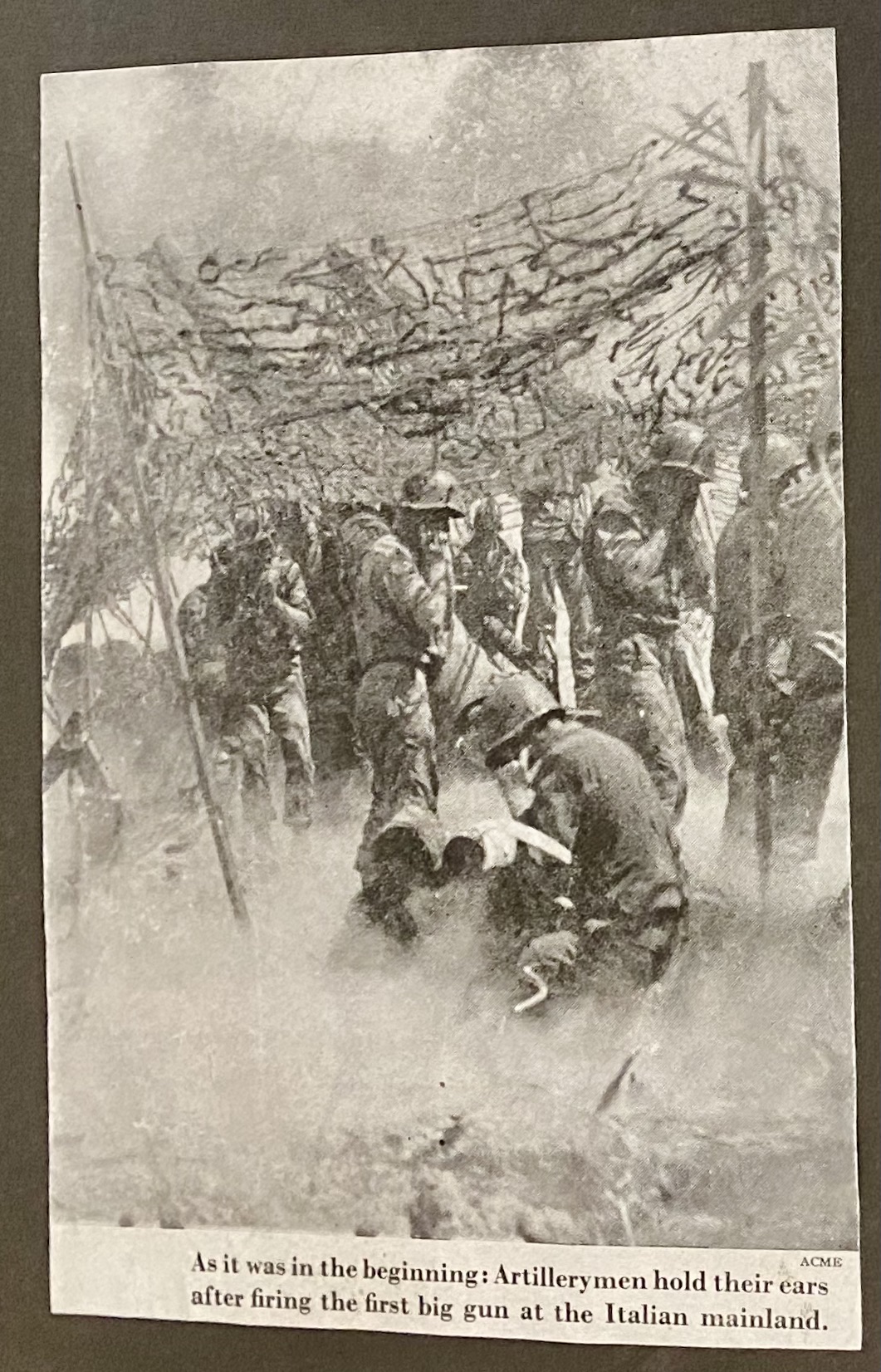
October 1943. Murphy lands at Salerno during the Allied invasion of the mainland.
Clip from a Life Magazine story pasted in Flo’s WWII album
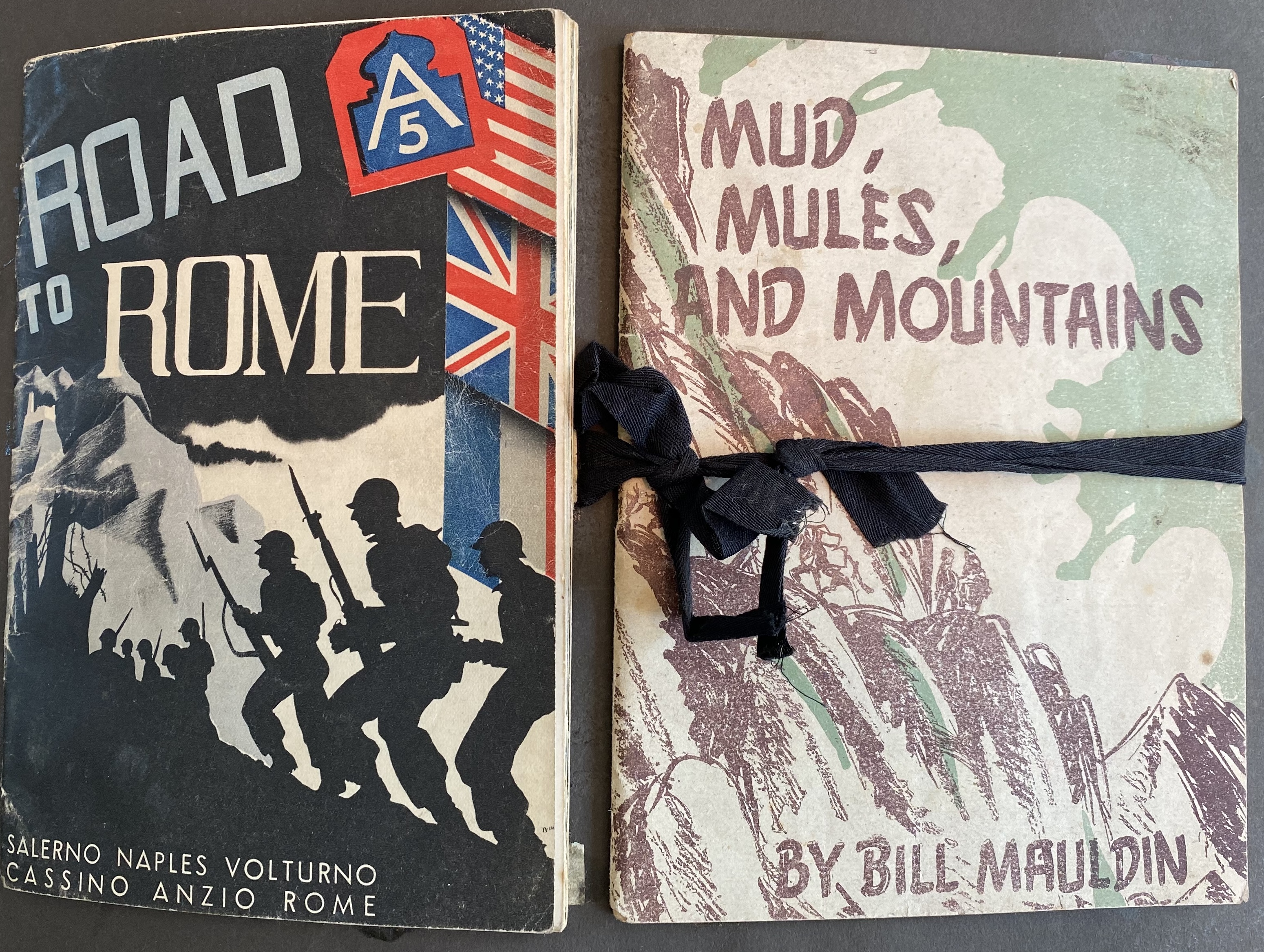
Italy has surrendered, and the road to Rome appears deceptively simple. Yet, the journey is anything but straightforward. Many thousands of lives will be lost on the road to the Eternal City.
“We land with undue optimism on the Italian mainland near Salerno. The beachhead, bought dearly with the blood and guts of the men who preceded us, is secure….We are prepared for a quick dash to Rome,” wrote Murphy in his autobiography, To Hell and Back.
This was far too optimistic. The Third Division will be fighting and dying on the Italian beaches and mainland until May, 1944.
The troops of the Third Division must first push through Salerno, cross the Volturno River, and take Anzio, Mignano, Cassino, and Cisterna before they can approach Rome.
Audie Murphy leads a small, diverse squad of men. Among them are an Italian immigrant, a Cherokee Indian manning the machine gun, an Irishman, a Pole, a Swede, and a Smoky Mountain bootlegger.
Members of Murphy’s squad begin to fall almost immediately. One soldier hesitates under heavy Nazi fire as he runs for a bridge and is cut down. The squad carries his body to the highway where it can be easily found.
“In death, he still bears the look of innocent wonder. He could not have lived long after tumbling. The bullet ripped an artery in his throat,” wrote Murphy.
Another fighter takes out a German machine gun nest and a foxhole with grenades, killing five Germans.
From Flo’s WWII album
The small victory is short-lived.
Later, the five remaining men find themselves trapped in a cave, surrounded by the enemy. The cave is infested with fleas, and the men are bitten mercilessly as they wait, parched and desperate.
We come to know and care for the men in Murphy’s squad, only to witness their deaths or injuries that force them out of the fight. Murphy becomes the last man standing at the end.
“All my life I wait to come to Italy,” says the Italian soldier. “I write my old man that the country stinks. Wait till you get to Rome, he says. Wait’ll you see your grandfather’s place. Then you’ll see the real Italy.”
The Italian never makes it to Rome. After three days without water, he breaks under the strain, running out of the cave only to be hit and killed by enemy fire. “He has come home to the soil that gave his parents birth,” wrote Murphy.
Finally, American troops break through the German lines and rescue the remaining men. Relief arrives with rations, water, and ammunition.
The next morning, they cross the Volturno River and join the push toward their next major objective: the communications center at Mignano.
Quotes are from Audie Murphy’s autobiography, To Hell and Back.
March 31, 1944 began as a black day in Yakima. Farmers had lit smudge pots in the orchards during the night to protect delicate buds from frost. The fuel, which included old tires, diesel oil and whatever could be found to burn, had left a black oily residue on the landscape. The white horse in the field down the street was now charcoal black. And the polluted air had seeped inside houses, coating everything.
The local Yakima paper kept track of citizens in the war. From Flo’s album.
When Flo awoke and blew her nose, the snot was black. Still, for her the day was a happy one. In two weeks she would be in Washington D.C. starting a new job as an American Red Cross (ARC) staff assistant. Today she would tell her boss that next week would be her last. She would give herself a week to get to D.C., taking the train to Chicago and staying overnight there. It would be the start of an exciting adventure and she could hardly wait to get started.
The ARC telegram that had come the day before said she would receive a letter with more details. She would have to send some telegrams herself to let friends and relatives know this good news. Her best friend, Molly, now working in Seattle, would need to know. And so would her sister Eve, stationed as a U.S. Army nurse at a hospital in Burford, England.
At work, the engineers were full of congratulations and good wishes. For them it was nothing new. Employers all over the country were having to deal with workers leaving for the war, either as draftees or volunteers. The U.S. had already been at war for more than two years, since Japan bombed Pearl Harbor December 7, 1941. The Europeans had been at war since September 1, 1939 when Germany invaded Poland.
A page in Flo’s WWII album
In January, 1944 the Third Infantry Division had landed at Anzio, Italy and the campaign had become a stalemate, costing heavy losses on both sides. The Allies would not rout the Nazis there until May.
Flo agreed to finish out the next week to train her stenographer replacement, and she was happy to have one more week’s pay, but now that she knew she was leaving, she couldn’t wait to be finished with the Washington State Highway Department. It had been a fine place to work for more than a decade, but she was ready for new challenges. And she would have many.
When she got home that evening, her sister Betty ran from the house waving an envelope.
Flo, still in her coat, opened the envelope carefully, thinking she would save the letter for a future scrapbook. Her life was about to change and she wanted to remember this moment.
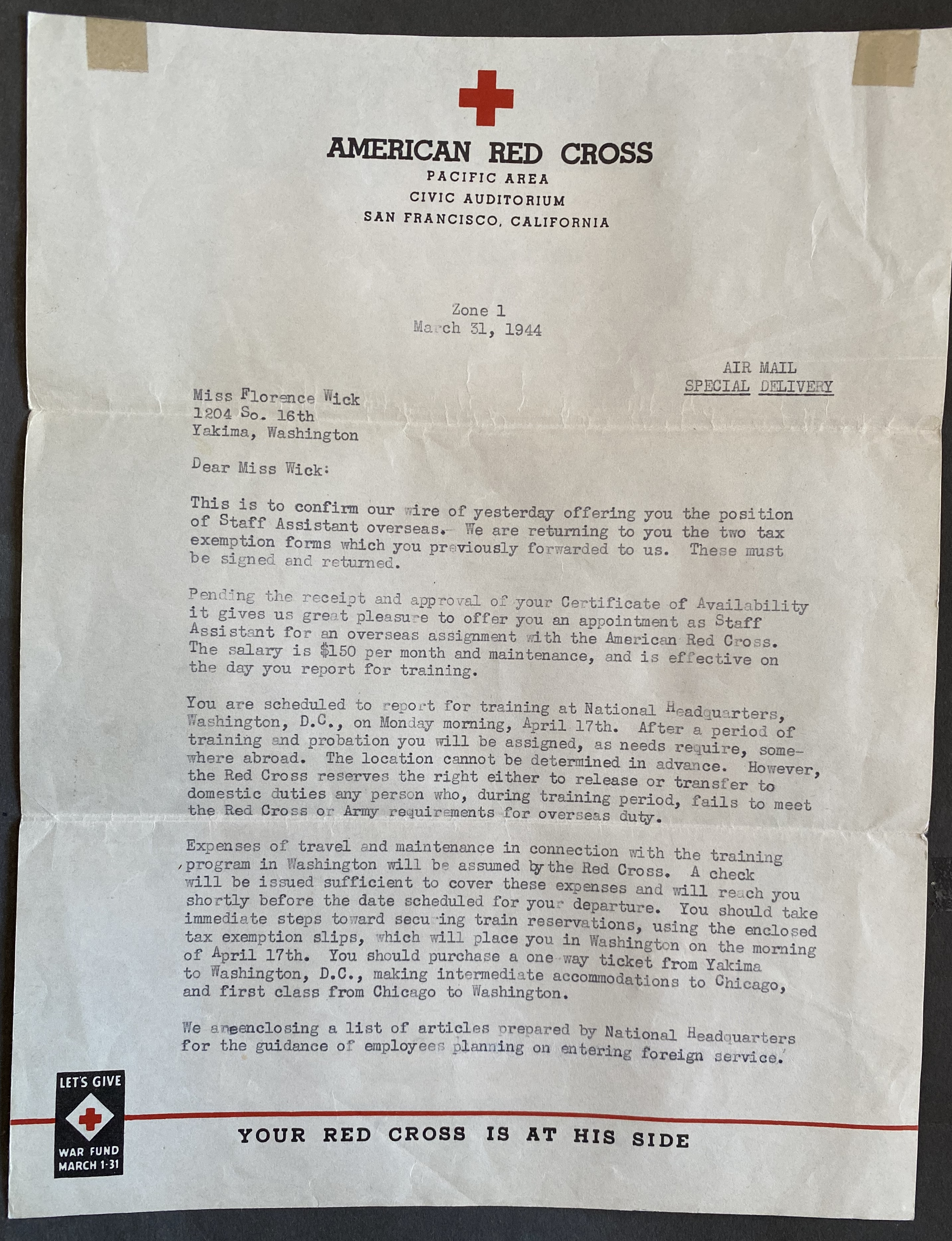
The letter was headed American Red Cross, Pacific Area, Civic Auditorium, San Francisco, California. It read:
“Dear Miss Wick:
This is to confirm our wire of yesterday offering you the position of Staff Assistant overseas.”
The “salary of $150 per month and maintenance” would be effective the day she was to report for training, April 17, 1944.
“You are scheduled to report for training at National Headquarters, Washington, D.C., on Monday morning, April 17th. After a period of training and probation you will be assigned, as needs require, somewhere abroad. The location cannot be determined in advance. However, the Red Cross reserves the right either to release or transfer to domestic duties any person who, during training period, fails to meet the Red Cross or Army requirements for overseas duty.”
“Expenses of travel and maintenance in connection with the training program in Washington will be assumed by the Red Cross. A check will be issued sufficient to cover these expenses and will reach you shortly before the date scheduled for your departure. You should take immediate steps toward securing train reservations, using the enclosed tax exemption slips, which will place you in Washington on the morning of April 17th. You should purchase a one-way ticket from Yakima to Washington, D.C., making intermediate accommodations to Chicago, and first class from Chicago to Washington.”
It was signed by (Miss) Esther Bristol, Assistant to the Director. The letter came with a list of “articles prepared by National Headquarters for the guidance of employees planning on entering foreign service.” The list of items included everything the ARC thought a woman would need for a year abroad, such as four girdles(!), sanitary napkins, and panties.
Flo resolved to do whatever was necessary to carry out her job to the best of her ability. She would respond by collect wire as instructed and then she would be officially in the Red Cross.
Their mother, Gerda, was in the kitchen cooking dinner for her daughters and their two boarders, female students at the community college.
She promised her daughter that she would write, and keep her supplied with homemade Swedish cookies.
They nicknamed him Baby and he couldn’t shed the tag. Audie Murphy had to fight for his place in combat. From the beginning of his military journey, he faced skepticism at every turn. Rejected by the Marines and paratroops, he was finally accepted by the infantry.
Battle route of the Third Infantry Division
Immediately his first commanding officer tried to shove him into a cook and baker’s school where the going would be less rough.
“That was the supreme humiliation. To reach for the stars and end up stirring a pot of C-rations. I would not do it. I swore that I would take the guardhouse first. My stubborn attitude paid off. I was allowed to keep my combat classification; and the Army was spared the disaster of having another fourth-class cook in its ranks,” he wrote in his autobiography.
In training, officers took one look at his skinny body and boyish face and tried to steer Murphy away from the front lines. At Fort Meade, one well-meaning officer attempted to save him from combat altogether by assigning him a clerical position at the post exchange. Again he stuck to his guns.
In July, 1943 he made it to the front in Sicily, but his youth and appearance worked against him even there. He was transferred to headquarters to serve as a runner. But Murphy wouldn’t stay away from the action. He repeatedly sneaked off on patrols and scouting missions. His determination eventually forced his commander’s hand. He was promoted to corporal.
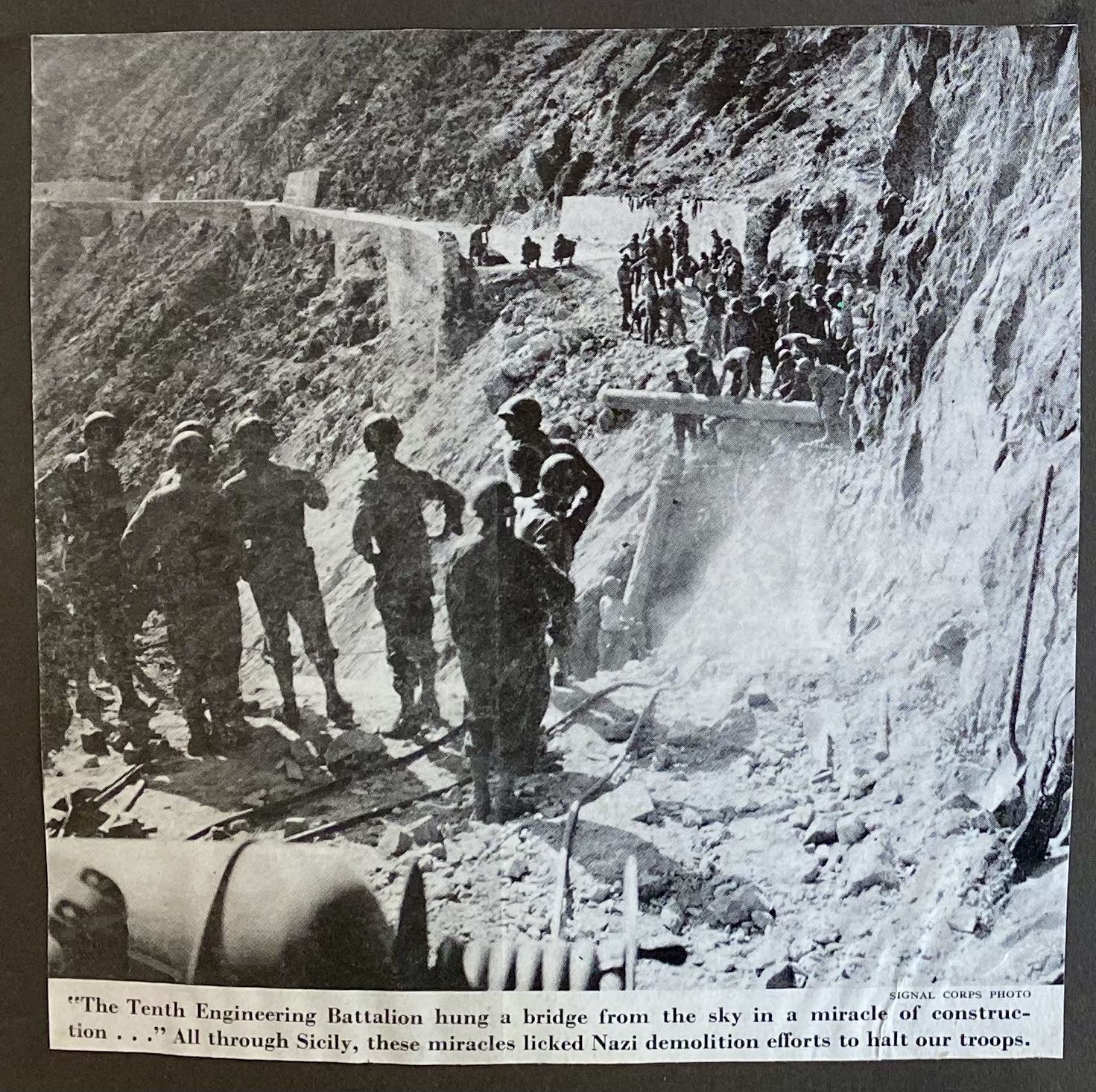
Life Magazine photo essay posted in Flo’s album
By then, Murphy had already missed his chance to fight in North Africa. His convoy had docked in Casablanca only after the battles were over. Instead of combat, he endured more training—much to his frustration. “I just wanted to fight,” he later said.
Murphy finally got his chance in Sicily, but it was far from the glory he had imagined as a boy.
On his first day in combat, a mortar attack killed a young soldier sitting nearby. A boom, a whistle, the earth shakes, and the boy falls from the rock where he was sitting, just taking a break. As simple as that. One minute you’re sitting on a rock. The next minute you’re dead.
This was not the war Murphy had dreamed of. He had imagined men charging gallantly across flaming hills. Bugles blew, banners streamed, and the temperature was mild. Enemy bullets always miraculously missed, and his trusty rifle always hit home. As a kid, the dream was his escape from a grimly realistic world of poverty.
But now, as he trudged across the Sicilian battlefield, sweat soaking his uniform, his boyhood fantasies were shattered.
“Maybe my notions about war are all cockeyed. How do you pit skill against skill if you cannot even see the enemy? Where is the glamour in blistered feet and a growling stomach? And where is the expected adventure? Well, whatever comes, it was my own idea. I had always wanted to be a soldier,” he wrote.
His skill with a rifle, however, did not go unnoticed. In one skirmish, Murphy shot two German officers from their horses with two clean shots. He had shed his first blood. But he felt nothing except a weary indifference.
Even as malaria struck and forced him into a field hospital for a week, Murphy returned to the lines. The disease would haunt him throughout the war, but it didn’t stop him.
He had loved the idea of war, but it didn’t take long to hate the real thing.
“The Sicilian campaign has taken the vinegar out of my spirit. I have seen war as it actually is, and I do not like it. But I will go on fighting,” he wrote.
*Quotes are from Audie Murphy’s autobiography, To Hell and Back
The winter of 1943-44 had been mild in Yakima with less than the usual snow. On March 30, some fruit trees already bloomed in the orchards of the Yakima Valley, but frost warnings loomed and could result in a smudge night with fires lit in the orchards to keep the buds from freezing. It was a Thursday and tomorrow would mark the last day of Flo’s workweek at the Washington State Highway Department where she had been a stenographer for 13 years.
“You got a telegram!” sang her sister Betty as Flo pulled the car into the family driveway.
Flo had been anticipating this telegram, eagerly awaiting news on her application to the American Red Cross (ARC) overseas program. She opened it carefully.
It read:
APPLICATION OVERSEAS STAFF ASSISTANT ACCEPTED. EMPLOYMENT CONTINGENT UPON RECEIPT AVAILABILITY CERTIFICATE. FORWARD TENTATIVELY SCHEDULED WASHINGTON TRAINING MONDAY APRIL 17TH. LETTER FOLLOWS=
ESTHER BRISTOL.==
Throwing her purse and coat on a chair in the entryway, Flo ran to the kitchen to show their mother, Gerda.
Flo had signed up for the ARC program as soon as she’d heard about it. She badly wanted to be in Europe where her sister Eve was already working as an Army nurse. Eve had written that when their troop ship had docked in Guroch, Scotland on January 7, they were met by a clubmobile with ARC women handing out donuts and coffee.
The ARC had rolled out the clubmobile model in England in 1942 with repurposed buses modified as mobile canteens and now the program was to be expanded into the European theater of the war. The clubmobile “donut girls” were envisioned as one element that would keep American soldiers willing to fight and die on foreign soil.
In February 1944, a Life magazine article had described the ARC women as “handpicked for looks, education, personality and experience in recreational fields. They are hardy physically and have a sociable, friendly manner.” The qualifications included a high level of education, being between 25 and 35 years old, an upbeat attitude, social skills, and good health. The women were chosen for their attractiveness, embodying the wholesome, well-scrubbed appearance of the girl next door. Nearly all were unmarried. Flo had immediately pictured herself among them.
Handing out donuts from the Life Magazine story
Flo and her youngest sister Betty still lived at home, contributing their earnings to the family kitty. Gerda had found work at a fruit processing plant, and they had taken in boarders to make ends meet since their father, Ben, had died five years earlier. Times had been tough, but their finances had stabilized, and the ARC job paid $150 a month. Flo could send most of her paycheck back home.
Flo wondered what her father would have said, although she thought she knew the answer. Her father would have been proud of her decision to do her part for the war effort. He was a Norwegian immigrant, and a patriotic American.
To apply for the job of ARC overseas Staff Assistant, women were required to have at least two years of college education. White skin was an unwritten modifier, although there were some Black women recruited to work with segregated Black troops. Flo was 30 in 1944. She met the minimum qualifications except for the college education part. But Flo had mastered a skill that she would use throughout her life. She knew how to write a convincing letter. She was sure that she could show the ARC that she was just as qualified as any college educated woman.
The application process had been rigorous. Besides a written application, Flo included reference letters from her employers, the Presbyterian minister, and members of the Business Professional and YWCA groups where she was active. She passed a medical fitness exam and traveled to Seattle for an in-person interview.
Pasted in Flo’s album from the Life Magazine story
Flo understood that the college requirement was based on class. The ARC aimed to hire middle or upper-class “girls.” In her application letter, Flo emphasized her middle-class status, morality, and responsibility as a church-going citizen. During the interview, she felt they had been impressed.
Other opportunities existed for women to become involved in the war, but most were situated in the U.S. You could volunteer to roll bandages, but for that you received no pay, so those who volunteered tended to be women of means or women supported by husbands. You could join the Women’s Auxiliary Army Corps (WAC), which did pay a salary about the same as the ARC. But WAC was not well thought of only because many people did not believe women should be involved in war, or even serve close to it. Few WACs were sent overseas, mostly performing office work to free men for combat roles.
The ARC flew under the radar because, even though the jobs were paid, the women were referred to as “girls” and “volunteers.” And the ARC was associated with nursing, which incited no prejudice. It was ok for women to take care of wounded soldiers as long as they weren’t allowed to fire the guns. As it turned out, the ARC women would be the first American women to fire guns in combat and Flo would be among them.
Flo knew she could be sent anywhere the war raged: the Pacific, England, North Africa, even India. She hoped for Europe where most of the fighting was. She had always dreamed of traveling to Europe. But she resolved to accept with enthusiasm whatever her assignment turned out to be.













 tradeswomn musings