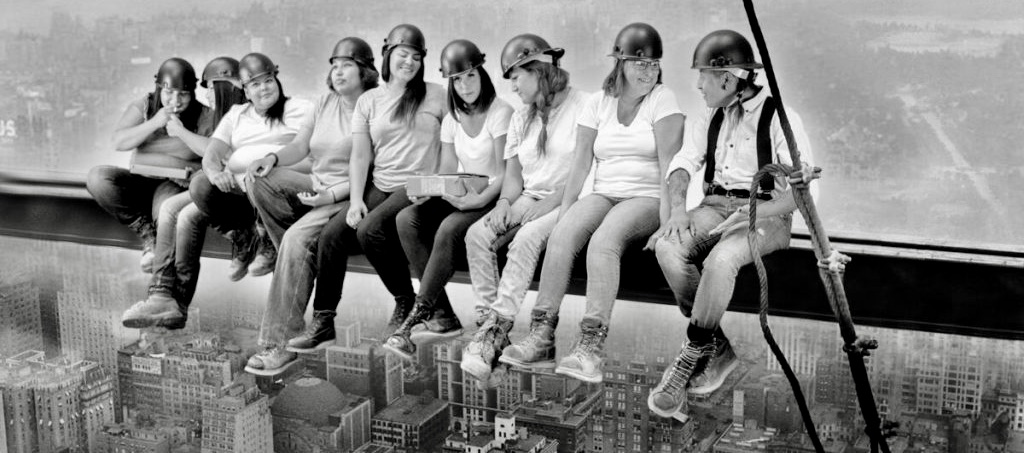
Indigenous women in Ironworkers Local 725, Canada. Photo: Lightframe
Tradeswomen Reject Union’s Capitulation
Tradeswomn Inc. is a nonprofit I helped found in 1979. Still going strong, the organization helps women find jobs in the union construction trades. Here’s the text of a speech I gave October 30, 2025 at Tradeswomen’s annual fundraising event.
Sisters, we’ve come a long way.
When we first started Tradeswomen Inc., we had one goal: to improve the lives of women — especially women heading households —by opening doors to good, high-paying union jobs.
It took us decades to be accepted by our unions. Decades of proving ourselves on the job, standing our ground, demanding a seat at the table.
And now — by and large — we’re there. We are leaders. Business agents. Organizers. Stewards. We have changed the face of the labor movement.
But sisters, we are living in a dangerous time.
Our own federal government is attacking the labor movement. And we cannot look away.
We all know that Donald Trump is gunning for unions. Project 2025 is his blueprint — a plan to dismantle workers’ rights and roll back decades of progress.
Let me tell you some of what’s in that plan.
It would roll back affirmative action, regulations we worked so hard to secure, Allow states to ban unions in the private sector, Make it easier for corporations to fire workers who organize, And even let employers toss out unions that already have contracts in place.
It would eliminate overtime protections, Ignore the minimum wage, End merit-based hiring in government so Trump can pack the system with loyalists, And — unbelievably — it would weaken child labor protections.
Sisters and brothers, this is not reform. It’s revenge on working people.
And yet, too many union members still vote against their own interests. Why? Because propaganda works. Because we are being lied to — by the media, by politicians, by billionaires who want to divide us.
That means our unions must do more than just bargain wages. We must educate. Engage. Empower. Because the fight ahead isn’t just about contracts It’s about truth.
We women have proven ourselves to be strong union members — and strong union leaders.
We’ve built solidarity. We’ve organized. We’ve made our unions more inclusive and more reflective of the real working class.
And now it’s time for our unions to stand with us.
Many of our building trades unions have stood up to Trump, and to anyone who would divide working people.
But one union — the Carpenters — has turned its back on us.
The Carpenters leadership has disbanded Sisters in the Brotherhood, the women’s caucus that so many of us fought to build.
They have withdrawn support from the Tradeswomen Build Nations Conference, the largest gathering of union tradeswomen in the world. They’ve withdrawn support for women’s, Black, Latino, and LGBTQ caucuses claiming they’re “complying” with Trump’s executive orders.
That’s not compliance. That’s capitulation.
But the rank and file aren’t standing for it.
Across the country, Carpenters locals are rising up, passing resolutions to restore Sisters in the Brotherhood and to support Tradeswomen Build Nations.
Because they know: You don’t build solidarity by silencing your own. And our movement — this movement — is built on inclusion, not fear.
While the Carpenters’ leadership retreats, others are stepping up.
The Painters sent their largest-ever delegation — nearly 400women —to Tradeswomen Build Nations this year.
The Sheet Metal Workers are fighting the deportation of apprentice Kilmar Abrego Garcia. The Electricians union is launching new caucuses, organizing immigrant defense committees, and they are saying loud and clear:
Every worker means every worker.
Over a century ago, the IWW — the Wobblies — said it best:
“An injury to one is an injury to all.”
That’s the spirit of the labor movement we believe in —and the one we will keep alive.
Our unions are some of the only institutions left with real power to stand up to the fascist agenda of Trump and his allies.
We have to use that power — boldly, collectively, fearlessly.
Because this fight is about more than paychecks. It’s about democracy. It’s about equality. It’s about whether working people — all working people — will have a voice in this country.
Sisters and brothers, we’ve built this movement with our hands, our sweat, and our solidarity.
Now — it’s time to defend it. Together. Solidarity forever!
The envelope delivered to my small flat in San Francisco’s Mission District, shared with three other women, was fat with a far away return address. I knew what it contained even before opening the envelope—a cry for help—and I also knew there would be nothing I could do about it.
I was already involved in the tradeswomen movement when I relocated to San Francisco from Seattle in 1976. As a publicly identified tradeswoman activist, I would get letters from women all over the country complaining of horrific harassment and discrimination in nontraditional jobs. I felt powerless. We didn’t even have an organization, let alone a program to help. What these women needed was a good lawyer.
During the 1970s, we activists formed organizations all over the country. In 1979 we started a nonprofit, Tradeswomen Inc., to provide support and advocacy for tradeswomen, but we weren’t able to secure funding. With no staff we were run by volunteers—unemployed tradeswomen.
Enter Equal Rights Advocates (ERA), a law firm begun in 1974 by feminist lawyers with a focus on defending women’s employment rights. I remember sitting around on the floor in somebody’s living room in the late ‘70s strategizing about how to open up jobs to women that had traditionally belonged to men. That’s when I met Judy Kurtz, a staff attorney at ERA, and we began to collaborate. Later I served on the ERA board of directors for many years.
Looking at the Big Picture
Ours was an anti-poverty strategy. The feminization of poverty was a popular buzzword (still applicable today). Women, especially female heads of households, were becoming poorer and poorer in relation to men. Well-paid union jobs in the construction trades could lift up our gender if we could open them to women. Apprenticeship programs in the construction trades like electrical, plumbing, carpentry, ironwork, and operating engineer only require a high school diploma or a GED to enter. Then the training is free and the apprentice works and earns a wage while she is in school. There are no college loans to repay. We saw these jobs as a path to financial independence for women.
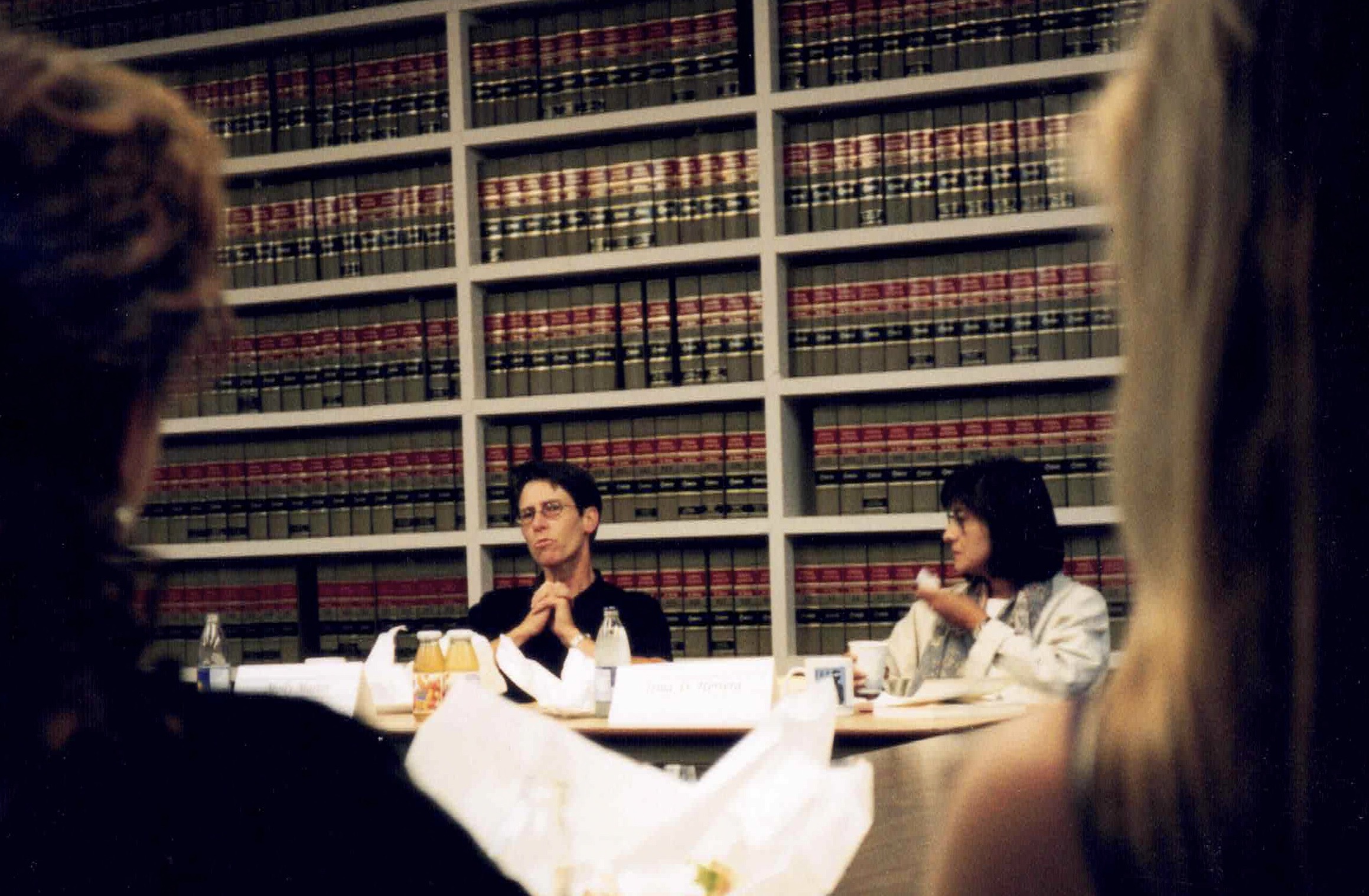
Brown bag discussion at ERA with me and Director Irma Herrera
ERA had been part of a national class action lawsuit against the US Department of Labor which resulted in the creation of federal goals and timetables for women and minorities in the construction trades. New regulations took effect in 1978. The goal was to have 6.9 percent of the construction workforce be women on federally funded jobs. Having federal law on our side buoyed us while Jimmy Carter was president, but as soon as Ronald Reagan took office in 1981, federal affirmative action laws and guidelines were no longer enforced. We had to be creative. We decided to focus on the state level where there was still some commitment to enforcing affirmative action regulations.
Focus on California
Tradeswomen Inc. was fortunate to work with lawyers who were willing not only to take our individual cases, but also to help us strategize about using class action lawsuits to desegregate the workforce. We wanted to make law, to actually create change.
The building trades in California include about 35 apprenticable trades and each trade has a union with different rules, and each union has many locals throughout the state. Not a single apprenticeship program out of hundreds in the state was even close to meeting goals for women’s participation. What could we do to get them to comply?
By 1980 we had some history with all the players. Our partner, Women in Apprenticeship Program (WAP), was placing women into trades apprenticeships in California, working with the apprenticeship program directors and compliance officers.
The unions were a huge barrier to women but we chose not to take legal action against unions. Our goal was to work with unions, be part of the union movement. Besides, there were so many! So we decided to sue the enforcer.
Suing the State
The State Division of Apprenticeship Standards (DAS) oversees apprenticeship programs and is charged with enforcing affirmative action goals, but they would routinely give a pass to programs that claimed to have made a “good faith effort” to meet the goals. Partnering with Tradeswomen Inc., ERA filed suit against DAS for failure to enforce the goals. The lawsuit resulted in a requirement that the state produce quarterly statistical reports which allowed us to evaluate their progress. We might have had some small impact on the DAS, but we had to take them back to court for contempt five years later. Nothing had really changed.
Then we took on the DAS through the Little Hoover Commission, which investigates state government operations. The public testimony of many tradeswomen got attention, even an article in the New York Times. The investigation ended with DAS getting its funding cut by the Republican administration, which did nothing to help our cause.
Then came a period when DAS made a big turnaround on our issues. It was during the administration of Gray Davis, the Democratic governor elected in 1999. He was only in office for three years when the Republicans mounted a successful recall campaign against him. Davis appointed a friend of tradeswomen to head the DAS, Henry Nunn, a Black man from the painters’ union. Suddenly there was some funding to promote women in trades and we partnered with the state agency to sponsor some great programs, like the dedication of the Rosie the Riveter park in Richmond where we got to commune with the Rosies, and a trades day for Bay Area high school students. We loved working with the DAS staff, a bunch of smart feminists. But when Arnold Schwarzenegger took over as governor, he brought back into state government all the guys from the previous Republican Wilson administration, and Henry Nunn was axed. It did show us that the state could do the right thing with the right leadership. It also reinforced our impression that Democrats are way different from Republicans.
Part of the Civil Rights Movement
From the very beginning we saw ourselves as part of the larger movement for civil rights and we worked in coalition with other civil rights groups to publicize and also to defend affirmative action programs. In 1977 we were active in a coalition that formed around the Bakke case, which upheld affirmative action in college admission policy. We also partnered with ERA and other civil rights organizations to oppose proposition 209, the anti-affirmative action initiative in 1996 (we lost, and a proposition to overturn 209 in 2020 lost). Some of our partners in the West Coast coalition included Bill McNeill of Employment Law Center; Joe Hogan, retired OFCCP; Tse Ming Tam of Chinese for Affirmative Action (CAA) and their founder Henry Der; Eva Paterson of the Lawyers Committee for Civil Rights; and Superlawyer Brad Seligman. These are luminaries in the social justice sphere and we were so lucky to have their support.
Tradeswomen Monitoring Network
We also collaborated on other projects involving coalition partners like trades unions and the Human Rights Commission. We went to lots of meetings of DAS and its community body, the California Apprenticeship Council to make the labor community aware of their responsibilities. Susie Suafai, who had directed WAP, was hired to monitor the Oakland federal building project—one of the few projects to meet federal affirmative action goals.
This willingness of ERA to use staff time to advocate for us as well as litigate was a huge plus. Litigation was important to our movement, creating the original goals and timetables and affirmative action regulations so crucial for women’s entry into these jobs. But we knew well that litigation alone does not make a movement.
As class action lawsuits became harder to win, and courts were filled with Republican-appointed judges, litigation was a less effective strategy for change. Tradeswomen and ERA continued to look for ways to work together. In the early 2000s we applied together for a grant from the Ford Foundation. ERA received the grant, but Tradeswomen saw none of the money, nor did any program result as far as we could tell. We felt used and the relationship foundered. Another casualty of this fight for funding was ERA’s relationship with the Employment Law Center, a partner in the DAS suit and other related discrimination lawsuits. ELC was directed by Joan Graff, another hero in our battle for affirmative action. This is just one example of how the fight for funding pitted organizations with similar goals against each other.
The ‘80s saw the decline of affirmative action. The ‘90s was a period of working to keep in place the laws and regulations we had fought so hard for, even though they weren’t being enforced. President Clinton appointed Shirley Wilshire as head of OFCCP. She came out of National Women’s Law Center, one of our coalition partners.
We put together a national coalition to pressure the OFCCP to enforce the regulations and increase the percentage of women on federal contracts. We had the support of the White House, but Congress was controlled by Republicans. We planned to file an administrative petition asking for higher goals for women and enforcement of federal regulations, but Wilshire and federal officials argued that we should keep our heads down and hope that Congress didn’t notice and remove the enforcement regulations entirely.
Tradeswomen activists learned about the laws that affected us and we continued to pay attention to the law as it changed through the years. The biggest change for us on a day-to-day level was that sexual harassment was made illegal. This happened not through the passage of a single law, but through a series of court cases with a lot of nudging from the feminist movement. The work of Eleanor Holmes Norton was key.
Today we still rely on ERA and feminist lawyers to push the federal government to meet its affirmative action goals on declared“mega projects” (the only goals still in effect in California). We have entered a period of backlash. While trades have opened up to women technically, we still face discrimination and our ways of fighting back have been restricted.
As the director of the Women’s Bureau District IX of the U.S. Department of Labor, and long after her retirement, Madeline was a friend to tradeswomen and women who sought jobs in nontraditional blue-collar work.
Madeline was an avowed feminist and for a time during the Reagan administration she lost her job because of it. Feminism ran in the family. She told me her mother, who lived to be 101, had been a suffragist and organized to get women the vote.
I think Madeline’s life goal was to make it possible for women to have access to jobs that could make them independent of men. Her own life experience as a divorced mother of a young child was the driving force behind her feminism. At the time women didn’t have so many options.
Madeline and her daughter Christie at the UC Berkeley Women’s Faculty Club
With mom and one of her big sisters
As a UC Berkeley student Madeline was active in student government
I met Madeline in the 1970s soon after I moved to San Francisco. As an activist trying to break barriers to women in the construction trades, I was pointed to Madeline’s office in the old federal building. There I found her in a small room with one secretary as staff. The Women’s Bureau (established in 1920) has been virtually defunded by recent Republican administrations, but even then funding was shallow.
Long before tradeswomen had an office or a staff, Madeline allowed us to use a conference room in her building for meetings on Saturdays. Fifty women might show up and we’d host a wide-ranging discussion that often focused on sexual harassment (we called it gender harassment then; there were no laws prohibiting it) and isolation on the job. We tackled the issues of race and class, strategizing how to build an organization and a movement.
Madeline talking with Jane Beelby, who made a career as an elevator constructor, 1970s
Speaking to a gathering of tradeswomen, 1970s
Acknowledging her fans at a tradeswomen conference, 1980s
Madeline understood the importance of communicating as a way to to support each other and organize. We had the idea of a newsletter for tradeswomen, something that could connect us and help women find jobs in the trades. We began publishing Trade Trax newsletter out of Madeline’s office. It was a monthly two-page tract that volunteers mimeographed, folded and mailed. We charged $1 to get on our mailing list and a couple hundred women paid their buck.
In 1980, while Jimmy Carter was still president, Madeline called me with the news that some big mucky muck from the Department of Labor was coming to town. She asked me to put together a proposal to fund a newsletter or magazine. We were granted about $5000 and Tradeswomen Magazinewas born. The grant didn’t pay for staff, only printing and mailing, and tradeswomen volunteers wrote it, then typed it into columns and pasted it up one Saturday every three months. We published it for nearly two decades. It was the principal way tradeswomen communicated with each other around the country and the world during the 80s and 90s.
Later, after she retired, Madeline funded, out of her own pocket, the newsletter Pride and a Paycheck, edited by Sue Doro, which is still being published.
In 1979, Madeline, along with Susie Suafai and other advocates, founded the nonprofit organization Tradeswomen Inc., still going today. It was Madeline who first thought of the term tradeswoman.
With Esther Peterson, director of the Women’s Bureau under JFK
I know there were many other projects Madeline championed, but she always kept us in her sights. When Tradeswomen Inc. foundered for lack of funding, as often happened, Madeline could always be counted on to slip us enough money to pay our staff person or to help us find grant funding to keep us afloat.
Madeline was an inspiration to us all partly because she never turned her back. In the early 70s she grabbed on to the issue of women in construction and didn’t let it go for half a century. Class tensions arose between tradeswomen and our advocates. We were a fiercely independent tribe and many of us didn’t trust government officials or academics or lawyers, even the ones clearly on our side. Not everyone appreciated the federal government and its representatives. But Madeline hung in there with us.
Our association was long and fruitful. We appreciated Madeline and we honored her frequently. At one event I introduced her as having witnessed more of my relationships and breakups than my own mother had. Madeline never lost her sense of humor. She reminded me that she was much younger than my mother. But, of course, she could have been my mother. We were about 20 years apart in age.
Madeline also roped her husband Joe into helping tradeswomen. He was an experienced grant writer and participated in many long fundraising meetings with us. Joe died in January after a short illness.
Madeline Mixer, never a tradeswoman herself, was arguably the most important brick in the house tradeswomen built. Her legacy of advocacy highlights the importance of collaboration. She never stopped believing in us.
“Why didn’t the women’s movement ever embrace our struggle to bring women into nontraditional jobs? I never understood that and I still don’t.”
Susie Suafai, a longtime tradeswomen advocate, posed this question to me at the Women Build Nations conference in Chicago last spring. I can’t always catch up with Susie in the San Francisco Bay Area so I was happy to find her sitting alone at the conference where 1500 tradeswomen and allies convened in Chicago April 29-May 1, 2016. I sat down with her and learned things about her that I had never known in all our 35 years of working together.
Susie (R) working registration at the Women Build California Conference
Susie is a large woman, now with graying hair, and still formidable. She punctuates sentences with a chuckle. I guess she’s mellowed as she’s aged, but I remember her as powerful, brusque, businesslike, intimidating and a bit cynical. It seemed to me that arranging a meeting with Susie was like consulting the Oracle. She was the goddess of employment development. Susie was, and is, the one who understood the big picture, employment trends on a regional scale. Early on she learned the workings of the apprenticeship system, and understood them better than the men who ran it. I remember a workshop that Susie led in the mid-70s. She laid out the complicated apprenticeship system for us tradeswomen activists, taught us who were the men in power and how to approach them with our demands. Susie was passing on what she had learned to a generation of feminist activists.
Susie Suafai came to California via American Samoa and Hawai’i. She was studying history at San Francisco State University and fell into a job at Advocates for Women when she was asked to help prepare women for apprenticeship testing in 1974. Advocates, in San Francisco, had won one of two demonstration grants from the US Department of Labor to see if women could be recruited to construction work. The other was in Denver, Colorado. These were the first two federally funded experiments to recruit women to do this work. Susie went on to help place hundreds of women into union construction apprenticeships in the Bay Area and she later became the director of Women in Apprenticeship Program, which had spun off from Advocates for Women in 1976. She also spent about five years in Los Angeles working at the Century Freeway Project recruiting women into the trades. Electrician and filmmaker Vivian Price made a film about that project, called Hammering It Out. Susie was planning to be a history teacher but she ended up being an employment advocate, and there are many tradeswomen who credit her with creating their careers.
We are about the same age. I’m in my mid-60s and I am retired as an electrician and an electrical inspector but Susie continues working at her trade of employment advocacy. She’s now working part-time for Tradeswomen Inc. to invent new ways to bring women into the construction trades.
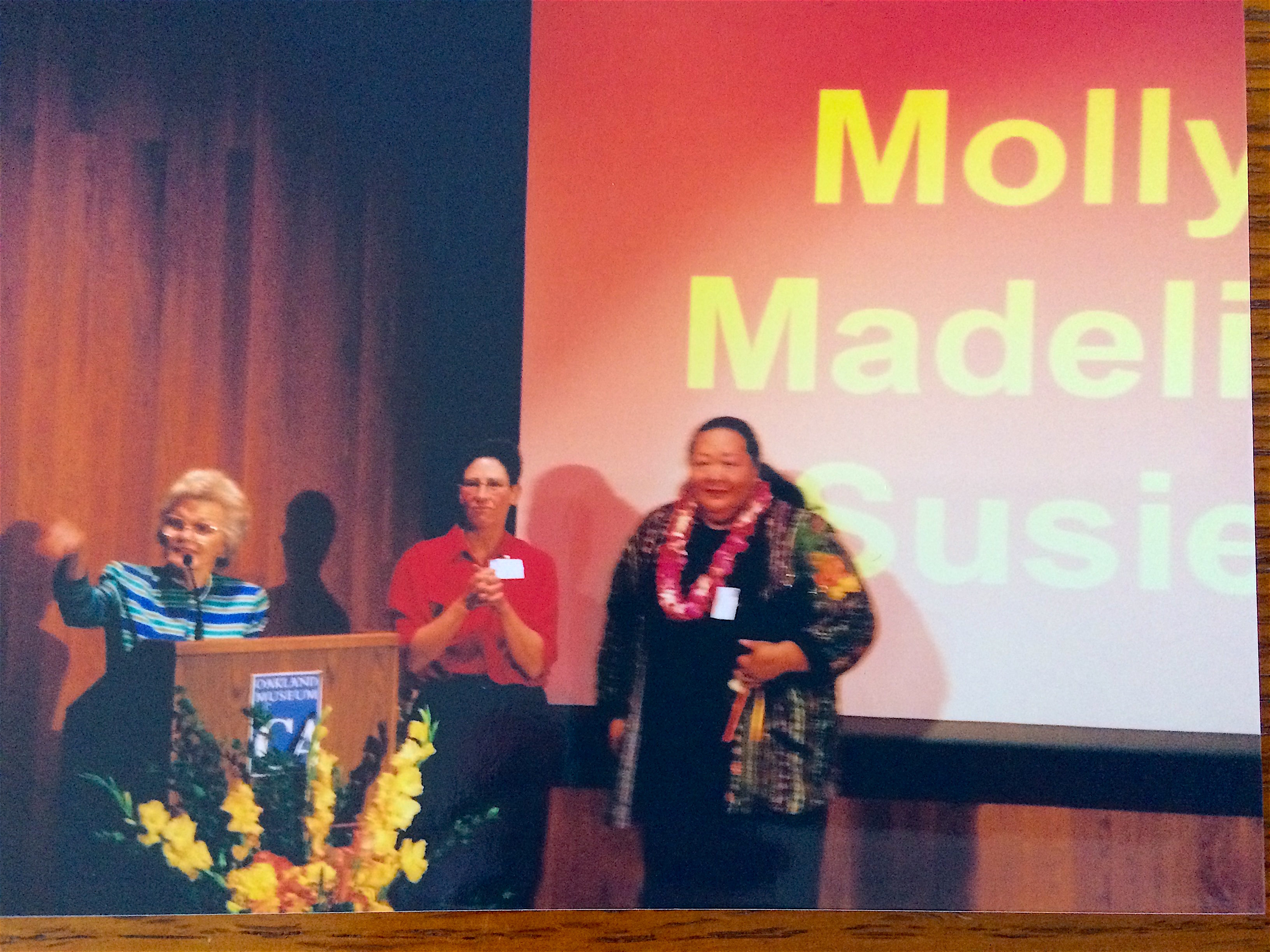
Madeline Mixer, Susie and I being honored at Tradeswomen Inc.’s 25th anniversary gala in 2004
Now, about Susie’s question, which is also my question: why didn’t the women’s movement embrace the tradeswomen’s movement? First, when people criticize the women’s movement for leaving out tradeswomen, I always object. I say we were the women’s movement and we are the women’s movement. I never felt separate from the women’s movement. I always felt like I was in the middle of it, like I was part of it.
Like Susie, as a young feminist I thought that employment was the bottom line for women. If you couldn’t get a decent paying job you could not be independent. A young woman in my history workshop at the conference voiced the issue. “If you have a good job, you don’t have to depend on a man. Once you have a trade, you can be financially independent.” It’s the same thing we said to each other in 1970.
My mother had very few choices and worked as an underpaid secretary all her life. My generation had some better choices but not many. Most often cited were teacher, nurse or secretary. In the 1970s I found other feminists who agreed with me about the importance of work. We founded organizations and allied with lawyers and advocates willing to help us fight for laws and regulations to end employment discrimination.
Though I participated in the other struggles of the feminist movement for abortion rights, for childcare, for equality in marriage, for an end to rape and discrimination, I still felt the jobs issue was primary. And for women who did not have access to a college education, trades jobs and jobs in the construction industry made a whole lot of sense. Ours was an anti-poverty movement. We talked a lot about what we called the feminization of poverty. Statistics showed that female single heads of households were getting poorer. We thought introducing women to trades jobs could reduce that trend.
Our issue was not at the top of the feminist movement’s list and I think there were many factors that contributed to invisibility. Partly it’s about class. The leaders of the feminist movement, mostly college-educated women, could not imagine themselves doing construction work and they probably did not have family members who were construction workers. Few of us knew how much money union construction workers made. For many Americans the idea of working construction was considered a step down. But workers with union contracts make more money than nonunion workers. And, in general, “men’s jobs” pay far more money than “women’s jobs.” Susie figures she would have made a lot more money in construction than she did in the nonprofit world.
It wasn’t like tradeswomen didn’t try to fit into feminist coalitions. I made many attempts to collaborate with other women’s organizations like NOW and like the San Francisco Commission on the Status of Women (COSW) of which I was a member in the 1990s. They didn’t brush me off, but they already had other projects. COSW was focused on domestic violence, a cause championed by local lesbian activists Del Martin and Phyllis Lyon, and they had created a successful network of organizations. It made sense to not spread ourselves too thin. But at least I was able to expand COSW’s attention to the issue of on-the-job sexual harassment, a universal concern of tradeswomen.
Tradeswomen collaborated with feminist lawyers—in the Bay Area Equal Rights Advocates and Employment Law Center—to secure rights to equal employment. In these efforts we had great success during the 1970s. We joined in coalition with racial minorites to fight the dismantling of affirmative action laws and regulations. In this, too, we were mostly successful. But having laws and regulations on the books is useless when they are not enforced, a strategy employed by Reagan/Bush. At that point the returns on our activism diminished, as did our support.
Funders didn’t take us seriously. I remember traveling to New York in the early 90s and meeting with the Ms. Foundation seeking funding for our efforts. The young woman I met with seemed anxious to find a way to not fund us and to get me out of her office. She categorized our organizations as “associations” and so not fundable. But I felt her rejection had more to do with other factors.
The barriers to women in the construction industry were seen as too great to spend resources on for too little gain. In fundraising meetings with the Women’s Foundation in San Francisco Tradeswomen Inc. was told that projects they had funded to support getting women into the trades had failed in the past and they had decided too few women were impacted by these projects. Many just did not think it was possible for women to do these jobs and to be happy doing them. But maybe that’s because most of the organizers couldn’t see themselves being happy doing them. They (and we) had internalized sexism and self hate. But organizers were also practical. They (and we) strategized to find ways to impact the greatest number of women.
A big part of our campaign to get women into the construction trades rested on the ability to get the word out to women about the money that could be made in these jobs. We needed the help of feminist and labor media to spread the word. Until the turn of the 21st century labor unions in the trades wanted nothing to do with us. We were accused of taking men’s jobs. But I think feminist publications could have made more of an effort to tell our story. Whenever an article did appear in a publication with a big subscription base (as in Ebony), hundreds of inquiries came in. High wages were a big draw. But traditional women’s magazines were only interested in matters of style, such as makeovers for women with “hard hat hair.”
Our fortunes changed after President Jimmy Carter left office. While some nontraditional jobs like bus driver began including women, we soon realized our efforts at integrating the construction trades were failing after Reagan took office in 1981 and began dismantling affirmative action programs.
Susie corrected me: “It’s true we lost footing during the second half of Reagan’s administration but we also made some headway in the first four years of his administration. At the end of the day, Title VII (of the 1964 Civil Rights Act) was and is the law of the land and we were willing to and are still willing to challenge under Title VII.” It’s this optimism that keeps Susie going, and the conviction that we can still improve the lives of women by helping them make careers in the trades.
In retrospect, whether or not we were dissed by the women’s movement seems a moot point. The women’s movement was an amorphous collection of activists with little money and few institutions. The partner with real money and power that could have helped our movement succeed is the federal government. The institutions we built in the 1970s never recovered from Reagan’s slashing of affirmative action and job training programs. I believe our efforts to bring a critical mass of women (at least ten percent) into construction trades would have succeeded if the Carter Administration’s programs that we fought so hard for had been left in place. As it is, the percentage of workers in the construction trades who are female has stayed at around two percent, roughly the same as it was in 1981 when Reagan took office.





 tradeswomn musings