My First Day Local 6

“Martin, take a break!”

I had been busy moving a cart full of wire spools, following the foreman’s orders. I looked up to see my coworkers sitting in a row on a platform drinking coffee. Shit. Nobody told me about coffee break. It was 10:05. Later I would learn that the 10-minute coffee break was a hard fought clause in the union contract. To work through coffee break was to break down conditions for the entire crew. I had needed a mentor but nobody told me anything.

Louise M. Davies Symphony Hall where I worked for two days

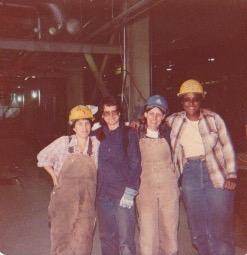
When I had heard that the San Francisco electricians union, IBEW Local 6, was looking for journeyman hands at $17 an hour I resolved to figure out how to get in. San Francisco was experiencing a construction boom in 1980 and the union hall was empty. Local 6 had put out a call for experienced electricians. If the union could not supply skilled workers to the contractors, the contractors would have to find them, and the union was doing everything it could to maintain control of the hiring process. By that time I’d been working almost four years as a nonunion electrician with two different companies. I’d graduated from a CETA* training program in Seattle where I had learned wiring basics and how to read the electrical code like a dictionary to find out what I didn’t know. I certainly felt like a journeywoman.

The deal was you put together a resume and went before the union executive board to prove you really had experience. The E board was six men sitting around a table. After a few questions about the mechanics of wiring, they approved me, but I knew they were desperate for hands. I was put on Book Five. It was all about seniority. It worked like this: Book One was local San Francisco hands who had graduated from the union apprenticeship. Book Two was journeymen from other locals in the U.S. I don’t know what Books Three through Five were, but the bigger your book number, the less seniority you had. Book Five was for the dregs. Last hired, first fired. You knew if you got laid off you might never get out through the union hall again.

My number came up on a foggy day in mid-August and I followed instructions to get my butt and my tools down to the union hall. I had to rent my lover’s beat up VW bug, as I didn’t have a car. Annie was one of the few dykes I knew who owned a car, and she charged us dearly for its use, but I had no choice. My toolbox was too heavy to lug onto the bus. I only had to drive from Balmy Alley in the Mission to the hall on Fillmore Street in the Haight, but weather and mechanical issues combined to nearly defeat me. The thick summer fog lay heavily on the city, obscuring my view of the streets. It landed in tiny drops on the windshield, coalescing and running down like rain, which might have been ok had the windshield wipers not been broken. You had to stick your arm out the window and operate them by hand. Miraculously I made it to the union hall without crashing.

The union had erected the single story modern brick-faced hall at the southern end of Fillmore Street behind the New Mint in what had been the ghetto, a neighborhood of decaying Victorians that the white brothers derided as the FillMo’. Dispatch took place in the basement of the hall. The dispatcher, a bald fat guy in a white shirt no tie, read down a list, yelling the names. When he got to mine, I approached the window and got a slip with the job information. I was to go to the symphony hall at Civic Center, a big job nearly at its end. I heard the contractor was facing penalties for going over the allotted time. Or maybe he was already paying penalties.

At the job site I checked in with the electrical foreman whose “office” was in a basement room. The symphony hall was topped out, all the concrete had been poured, the roof and exterior walls finished. But the interior finishes, including sheetrock, were still to be done so workers’ paths through the building went right through the fastest routes, around metal studs and through ghost walls yet to be finished. In the cavernous hall, workers from a dozen trades rushed around making finishing touches on the rough building. The job had that fresh smell of new concrete.

On my first day, the shop steward called a meeting of the crew in the basement where the contractor’s big gang boxes were stored. I’d never been in one place with so many electricians. I counted 25, but they filled up this space and seemed like more. The carpenters were taking a strike vote and they wanted the support of the other trades. I didn’t have to be told not to cross a picket line. But I sensed the brothers were worried about me. I was an unknown quantity and I’d worked nonunion.

My job was to do what I was told and keep my mouth shut. For $17 an hour I could do that. The foreman instructed me to move bundles of conduit from one floor to another. In this endeavor I had a partner, another Book Five hand, a black guy. We were probably the only female and only black on the whole job, certainly among the electricians. We immediately  bonded and I felt I could count on him to stand up for me if harassed, and I would sure have his back.

Conduit is manufactured in diameters from a half inch and up, cut in ten-foot lengths and bundled. I learned to pick up the bundle and, like a weight lifter, heft it up to my shoulder in one clean lift. By the end of that day my shoulder was so sore from carrying pipe that I brought a towel to work the next day to give me a little padding. But the next day I was put on a different floor and instructed to vacuum out floor boxes. Fine with me. Near the end of the day the foreman approached me and handed me a blue paper. Not a pink slip, a blue slip. Same thing. I was laid off. I’d never used a tool, never seen a blueprint.

Even after only two days, I was crushed. There’s nothing like the bummer of getting a layoff notice even if you’re looking forward to the layoff. I felt lucky in a way, as I knew the carpenters were planning to go out on strike the following day and I would never cross a picket line, so I’d probably lose the job anyway. With a layoff notice I could apply for unemployment.

Did the contractor hire a bunch of hands just to show they’d made a good faith effort to meet the contract deadline? Was I laid off because they thought they couldn’t trust me to not cross the picket line, or was the foreman doing me a favor by laying me off before the strike? There was no one to ask.

*Comprehensive Employment and Training Act

Why Appointments Matter

In my world of tradeswomen, unions, building trades, apprenticeship and worker safety, the appointments made by governors and presidents matter. The people who actually do the work of government, the staff that we community-based organizations seek to partner with, influence the success of our missions and the strategies we employ a great deal.

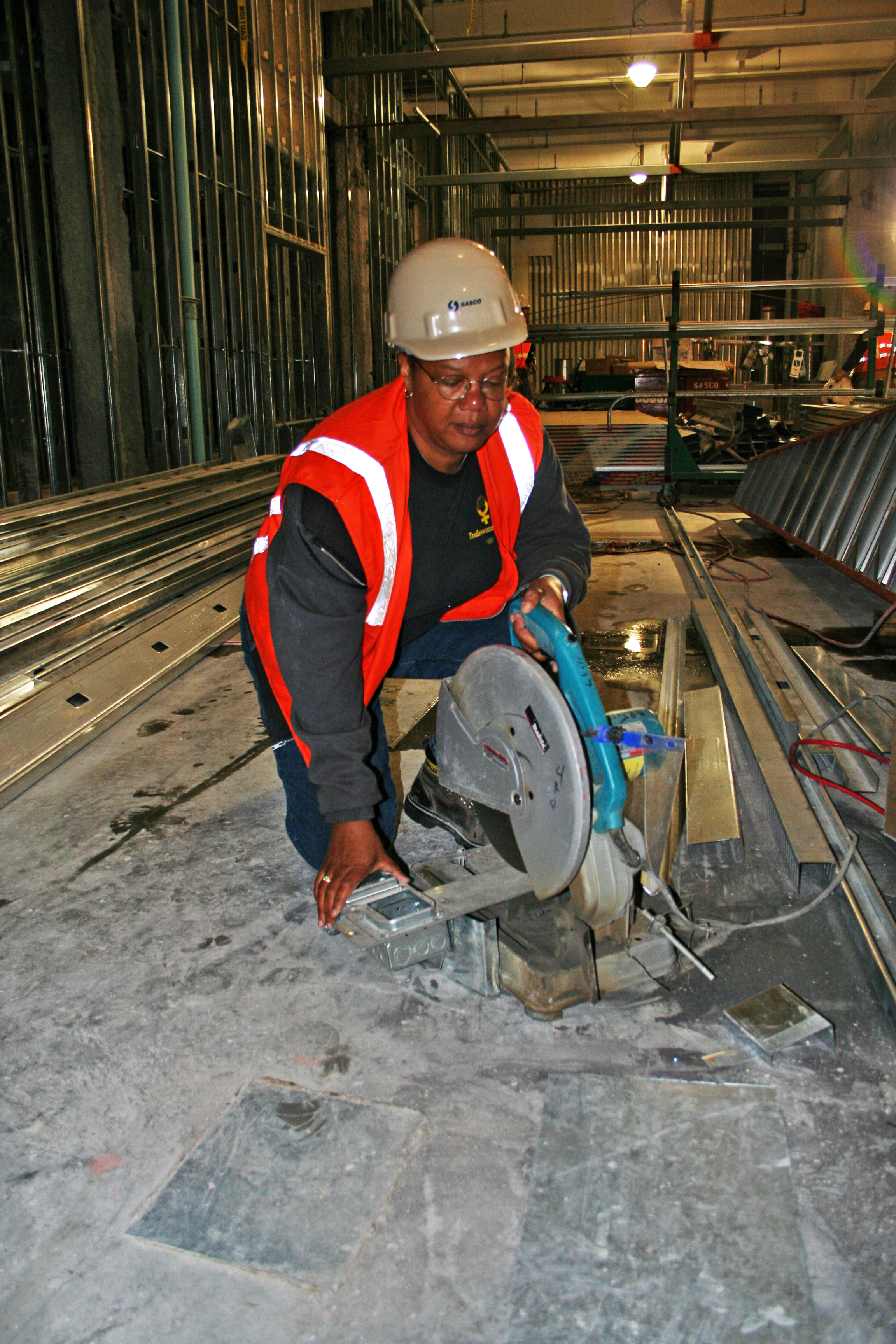
Me and Amy Reynolds posing as Rosies at a Rosie the Riveter event

In the week after the election, comparing Trump to the one-time California governor, my good friend suggested that Arnold Schwarzenegger wasn’t so bad after all. He was pretty bad, I said.

My friend hadn’t had to work with people in the state government during the Schwarzenegger administration but I did and I know what happened in our state. It wasn’t just that our governor was accused of manhandling women and fathered a child out of wedlock with his maid. I would certainly prefer that men who have so little regard for women not be elected to office. But I’m most concerned with the people they appoint to government positions and the policies they promote and enact.

Before our Democrat governor Gray Davis was overthrown by a Republican cabal financed by Daryl Issa, I had been working with people in the Division of Apprenticeship Standards (DAS) and its parent the Department of Industrial Relations (DIR) to help women enter the construction trades through union apprenticeships. We rejoiced when one of our own was appointed to head the DAS, Henry Nunn, a black man who had been the apprenticeship director for the painters union. I had met him when we were interviewed together on a public TV program. By that time, Tradeswomen had been fighting with the DAS to pressure them to enforce state affirmative action regulations for decades. We had even filed a lawsuit against the department in 1981, which got us little. But Henry Nunn understood the necessity of overcoming the sexist racist hiring practices in the building trades and he brought on a staff that really cared about these issues. Our nonprofit, Tradeswomen Inc., built a great working relationship with these folks who took seriously their pledge to make working people’s lives better.

During Davis’ administration, we proposed to the DAS staff that we work together on projects promoting apprenticeship around the state. State regulated union apprenticeships offer the best training and highest paid jobs in construction. Among our joint projects was an apprenticeship fair for high school students that included women and girls that the DAS planned to roll out around the state.

After Governor Davis was recalled, Henry Nunn and his staff lost their jobs. Schwarzenegger, an actor with no government experience, essentially replaced department heads with the previous Republican governor Pete Wilson’s people. Republicans, in the state and nationally, have shown little interest in our issues or in enforcing affirmative action regulations. Under Republican administrations working people and tradeswomen have suffered.

When Jimmy Carter was president, tradeswomen were optimistic that new affirmative action regulations would increase our numbers, and they did. It turns out having the federal government in your corner is a huge advantage. We had reason to hope that women would soon achieve a critical mass in the construction trades.

Sister electricians at the Women Building the Nation conference

And then came Reagan. At a recent exhibit of his photos of striking fruit pickers, journalist David Bacon reminded us that 40 percent of union workers voted for Reagan. Talk about voting against your own interests! Reagan had made his reputation as a union buster, so it was no surprise when the first thing he did was start busting unions. He also immediately began to dismantle and defund job training and affirmative action programs.

Tradeswomen saw that women and minorities were being targeted but still we attempted to work with the administration. At one point in the early 1980s, plumber Amy Reynolds even arranged for us to meet with Reagan’s Department of Labor representative, a guy named John Fox, who sat down with us in our tiny office in the Tenderloin. He seemed proud that he had had no prior experience with labor issues. He had been a basketball star (he said) who had worked on Reagan’s election campaign. Fox, and others in Reagan’s Labor Department we later met with in Washington DC, made it clear that their priority was to disempower unions. Because apprenticeship programs are joint projects of unions and industry, they intended to rid the system of union influence. They referred to construction jobs as “men’s work.”

Now, a month after the election of Trump, I suspect my friend is past hoping that he “won’t be so bad.” His appointments are looking far worse than Reagan’s. It’s fair to say that Trump’s appointments violate every ethical standard and it’s easy to predict that women, minorities, working people and all Americans except the 1% will be the losers.

I Find Eddie’s Last Name and More

Chapter Three

I had given up finding out any more about my mother’s admirer, Edna L. Then, looking through a box of family photos and letters that my brother Don had taken with him to Vancouver BC, I found another scrapbook made by my mother. This was mostly high school-era, 1920s-1930 (Flo had graduated in the class of 1929½). But Flo had tucked mementos from other decades into it. Among the high school graduation notices I was delighted to find another note from Eddie (as she sometimes signed her name) in her now familiar diminutive handwriting. It was an invitation to a party during the Columbus YWCA conference. It said:

In the Wick and Lauterbach den

On Wednesday night at half past ten

We hope you’ll join us for a spree

To give us one more Council memory

Then there is one of Eddie’s cute stick figure drawings—two skirted figures with F and E written underneath. At the bottom it says, “Just to be sure that my roommate will be here to act as co-hostess with me.” While they were roommates Eddie could never keep Flo at home it seems. It was written on the Neil House stationery and dated April 27, 1938.floeddie

I had found Eddie’s last name—Lauterbach—the one thing I’d been searching for in the scrapbooks, the one thing I needed in order to find out more about the woman with a crush on my mother! I was so happy I danced around the house singing her name.

Googling her name got me to the Edna A. Lauterbach scholarship fund for the education of nurses. She was a nurse who championed home care. Then I started making up stories. I imagined Edna was an important historical figure, an organizer. Perhaps she had been a speaker at the conference. I imagined she traveled around the country on speaking tours seducing women in every town. I wondered whether Eddie had had lots of lovers, or no lovers at all. Was she the archetype of the lonely lesbian who never found her mate? Was it hard to seduce women in the 1930s?

I wrote to the scholarship fund to see if they could provide more biographical information. The marketing director got right back to me saying it was a different person, as the age didn’t match up. This Edna Lauterbach was not even born until after the meeting in Columbus took place. Scratch her and all my associated fantasies.

Then Don and I got on the computer and looked at census records. We found an Edna R. Lauterbach, born in 1900 and died in August 1979 who lived her entire life in Brooklyn, NY, after 1930 in a 43-unit apartment house on 88th Street. I found pictures of the building, built in 1926, online. The apartments now sell in the million-dollar range, so I’m guessing the neighborhood was gentrified long ago. But when the Lauterbach family moved in, this would have been a working class neighborhood. Edna had two sisters, one named Gertrude. This was a deciding clue, as her sister Gertrude had been mentioned in one of the other notes found in Flo’s scrapbooks. Don found records for Edna in the 1910, 1920, 1930 and 1940 censuses. In all, she was single and living in the family home. By 1940 their father (a truck maker whose parents had emigrated from Germany) had died, but the three sisters were all still unmarried, in their thirties and living at home with their mother. A household of old maids! Perhaps all the sisters were lesbians.

According to the census, Edna worked in advertising. She was there for the Mad Men era, although she would have been 60 years old in 1960. I imagine her as the staid older secretary who runs interference for her philandering boss while correcting his spelling and grammar and making him look good. She may have worked in the industry until she retired, possibly at the same job. Had she remained a closeted lesbian all her life? Was she part of a lesbian subculture and if so, where was it centered? No doubt the environs of New York City afforded more possibilities than those of smaller towns. But I’m imagining big lesbo parties through the decades at the apartment on 88th Street in Brooklyn on the parents’ bowling nights.

It turns out Edna R. Lauterbach wasn’t anybody famous. I couldn’t even find a funeral notice for her, although we did learn that she is buried in the famous Brooklyn Greenwood cemetery with some 560,000 others. She was a workingwoman, a stenographer, who managed to keep a job through the Great Depression. In 1939 she worked in advertising 44 hours per week and 52 weeks in the year. Her income was $2040 that year.

Her parents were ethnically German and my guess is they were not Jewish. The YW is a Christian women’s organization, but it did work with Jewish groups against anti-Semitism and to prod the government to increase numbers of Jewish refugees allowed into the U.S. during the Nazi era. Jewish women did join the YW, but usually as members of the Biz-Pro groups or associated Jewish organizations.

Edna Lauterbach and my mother were two of the thousands of workingwomen who benefited from their membership in the Business and Professional Women’s organizations under the umbrella of the YWCA. One benefit was being able to make friends with other workingwomen from around the country.

Eddie surely had a giant crush on Flo and my heart aches as I read her letters. My mother never revealed that she’d had a sexual relationship with another woman but when I came out to her in the 1970s she did confess that she had known lesbians. And the name Edna Lauterbach is vaguely familiar to me. Did Flo tell me about her? I can’t remember. But it seems as if they kept up the friendship for some years at least. What was the nature of their relationship? They were certainly close friends, and possibly lovers, although I found no conclusive proof.

I have no evidence that they ever saw each other again after 1941 when Flo traveled to New York to visit Eddie. My mother returned to her hometown of Yakima, Washington where (after a stint in Europe with the Red Cross during WWII) she married, raised four kids and lived the rest of her life. Edna L. lived out her life in her family home on 88th Street in Brooklyn.

There is so much more I want to know about my mother’s admirer. Did she frequent the lesbian bars in Manhattan? Was she involved in the blooming lesbian feminist culture in the 1970s? Did she continue to be active in the YWCA? I do know that, even if she and my mother were lovers, the affair would have been long-distance and periodic. And perhaps Eddie’s attentions were not returned at all.

Dearest Eddie, I hope you found love in your lifetime. I hope you found a woman who could love you back.

Chapter 4: https://mollymartin.blog/2022/08/03/who-was-my-mothers-lesbian-admirer/

Looking for My Mother’s Lover

My mother's scrapbook
My mother’s scrapbook

Chapter Two

Among the many questions I wish I could have asked my mother: When did you first have sex? Were you ever attracted to a woman?

We came of age at very different times. My mother turned 20 in 1933, the nadir of the Great Depression. I was 20 in 1969, the zenith of the Countercultural Revolution.

As close as we were, there were things her generation just didn’t talk about—private things. My generation talked about everything, even things that probably should have been kept private.

Whether or not my mother was ever attracted to a woman, I have found evidence that at least one woman was attracted to her. After I discovered the letters from Edna L., my mother’s ardent admirer, I searched in vain for her last name and any identifying information in Mom’s scrapbooks. They had roomed together in the Neil House Hotel in Columbus, Ohio for the national YWCA convention in April 1938. But “Eddie” (as she often signed her name) suggests in one note that they had met the previous year at a YW conference in Chicago.northwest

“It has been fun to continue our friendship begun in Chicago (or even earlier) and I hope we shall be friends far into the future,” wrote Eddie.

I can’t imagine what Eddie means by “even earlier.” I didn’t think Flo had traveled east from Washington State before the Chicago trip, but I have one piece of evidence that suggests otherwise. She gave me a small painting and wrote on the back, “Bought at Dayton’s in Minneapolis in the 1930s. Sent to daughter Molly in San Francisco 2/82. Flo Martin.” So perhaps there had been previous meetings where they connected that Flo had not recorded in the scrapbooks. Had Flo and Eddie schemed for a year to room together in Columbus? They must have planned ahead at least.tuckin

So, my new obsession: Edna L. Reading her love notes to Flo warmed my heart and I began to identify with Eddie who slyly references “baths” and late-night “tuckin’ in” (her quotes, not mine). From reading her notes, I conclude she wanted to seduce my mother. Did she?

Some things I know about Eddie: She lived in New York. She was participating in the YWCA conference, so she could have been active in a Business and Professional Women’s Club, as was Flo, or in the YW. Chances are that Eddie was older than Flo, who was only 24 when they roomed together in Columbus. One clue I found in Eddie’s letters: they are literate with perfect spelling and punctuation. This suggests that she worked in an office and not a factory.cometoNY

What did she look like? My mother’s scrapbooks from the 1930s are filled with pictures, but as far as I can tell there are none of Eddie or the YW conferences. But who knows? Flo didn’t caption anything in these early scrapbooks. In trying to imagine how Eddie looked, I could not even assume that she was white. Even in 1938, the YW strove to include racial minorities.

Participating in these conferences must have felt to my mother and her comrades like early feminist gatherings did to my generation of feminists. The meetings were focused on making institutional changes to give women and minorities more comprehensive rights. These women were leading a movement for social change, just as we did. The artifacts Flo saved in her scrapbooks show that many of these women built loving friendships with each other. The warmth expressed in their greetings illustrates deep feeling. From receipts she saved, I see they sent flowers to each other as thank yous, a practice I wish in retrospect my generation of feminist activists had adopted.youretops

The Columbus conference was a continual round of meetings. In her love notes Eddie grumbles about not getting to see Flo back at the room until late at night.

“Aren’t we having a good time even though I have to sit up nights and wait for a chance to see you?”

“I certainly am enjoying being with you—even if I don’t have that opportunity ‘cept in the wee hours mostly, after I’ve tucked you in. I’ll be tuckin’ you in any minute now when you get back from your meeting on findings…”

Apparently the meetings went long into the night. Another participant noted, “Here’s to more 2am meetings.”

Flo had saved the banquet book from the YW convention and its inside covers were filled with inscriptions from attendees. Altogether there are 27 signatures. Nicknames were popular and they seem to have nicknamed Flo “Cricket.”

They all signed their full names, except Eddie who signed “Love—Eddie.” It’s an indication that their relationship was special, but disappointing for me because Eddie never signed her last name.

In the banquet book Eddie wrote: “Dearest Florence—You are one grand girl and a swell pal! These interludes of Council and Convention will always be happy memories because you shared them with me. I hope you’ll “bother” me “for years to come” and some day I’m coming to see you in the Northwest! Love—Eddie L.”

Did Eddie ever visit the Northwest? There is nothing in my mother’s scrapbook to suggest that she did. But items she saved show that Flo visited Eddie in New York in 1941. There are menus from the Swiss Village Inn and Struppler’s (next to the Cordova 917 Grand Ave.) I found a cocktail napkin from Jack Dempsey’s Broadway Bar and Cocktail Lounge, “Meeting Place of the World.” She kept a newspaper article citing record heat in NYC, a humid 91 degrees on the hottest Sept. 10 in a decade. There’s also a receipt from Sweden House Inc. (Swedish decorative arts) at Rockefeller Center for $1.53 dated 9/10/41, and a receipt for a single person at the Taft Hotel, 7th Ave at 50th St. NYC, and a menu from the Taft Grill.

The Taft Hotel, a 22-story high-rise built in 1926, was one of New York’s premiere tourist hotels with 2000 rooms right on Times Square at Radio City in Midtown. My mother, a small-town gal from Yakima, Washington, must have been thrilled to stay in such a glamorous big city accommodations. I bet she had a great view from room 1045.

How could my mother afford this trip? Had she been saving pennies for three years while working full time and helping to support her family? I could never afford to stay in hotels as a young working person, nor could my family afford hotels when I was growing up. On vacations we drove to the Cascade Mountains and pitched a tent. When I traveled I always arranged to stay in the homes of friends or comrades. It made me wonder if Eddie had chipped in to pay for the room at the Taft Hotel. Or maybe Eddie sprang for the hotel while Flo paid for the train trip. Perhaps she and Eddie had been corresponding furiously for three years, planning this tryst.

Flo also saved a Christmas gift card in its envelope from Macy’s New York. It is signed “With much love to you, Wickie dear—Edna L.”

There’s another note on a card with a monogramed L with no date: “My best love to a very good pal—Edna L.”

Then there’s a note that reads “Florence dear—Just got tickets for Watch on the Rhine—only chance it seems—Gertrude (my sister) will be joining us—will call you about meeting for dinner & theater tomorrow night. Edie L. (The play, by Lillian Hellman, won the New York Drama Critics prize in 1941).

Did Flo travel to New York just to visit Eddie? I can’t find any evidence of meetings of the YWCA or Biz-Pro in NYC in September 1941. Did she stay in a hotel and not with Eddie because she and Eddie wanted a place to be alone?

roundpic
Painting bought in Minneapolis

From the evidence, it looks like Flo travelled to New York by herself. In those days you could take the North Coast Limited on the Northern Pacific Railway all the way from Yakima to Chicago. Then you transferred to the Pennsylvania Railroad for the final leg to New York. Of course, by this time Flo was a veteran train traveler, having already been to Chicago, Columbus and Minneapolis.

As much as I’ve fantasized about my mother’s lesbian affair, I think the evidence is mixed. It wasn’t just that Flo had had lots of boyfriends, or that she married a man. That’s a story many lesbians tell. While I never married a man, I spent a decade experimenting with heterosexual sex before I came out.

picback
Flo’s inscription on the back of the painting

My mother definitely struggled with homophobia. As liberal as she was politically, Flo had difficulty accepting that my brother and I are gay. He came out first and she felt justifiably burdened by the widely accepted Freudian theory that mothers are responsible for sons’ homosexuality. Then, when I came out a few years later, she at first chalked it up to a phase I was going though. Could that be because she went through a lesbian “phase” herself?

I made up all sorts of sensational stories about Eddie and Flo from the information I found in the scrapbooks. But since Eddie’s last name remained unrecorded, I gave up learning any more about her. Whatever happened between Flo and Eddie, I’m sure my mother had to wrestle with her own internalized homophobia and that of the dominant culture. At that time, in the 1930s, homosexuality was highly stigmatized and even in the big city of New York, lesbians stayed closeted to protect their jobs and reputations, meeting mostly at private house parties.

There remains the possibility that Flo was deeply in denial about her attraction/affair. I have some evidence to support this theory. My mother’s sister, Ruth, also had gay children and, while much more politically conservative, Ruth took a stand when her Presbyterian church excluded gays. She was proud of her gay kids and publicly quit the church in support of them. But she complained to me that she could never get my mother to talk about the issue. She couldn’t understand why Flo, her closest sister, had shut her out, especially with regard to a subject they both shared. I never understood this. I just assumed it had to do with Flo’s avoidance of the personal like so many in her generation, but perhaps my mother feared that her own sexual past would be revealed.

Did Flo have an affair with Eddie? I’ll never know for sure. If she were still alive, I think I could ask her now. When she died in 1983 at the age of 70, I still felt restrained from asking personal questions that I knew she would refuse to answer. Then again, maybe she never would have revealed the truth. She believed some things are best kept private.

Chapter 3 I find Eddie’s last name and more: https://mollymartin.blog/2016/11/27/i-find-eddies-last-name-and-more/

Nuns Take the Castro

When sing-along movies became a big thing in the early 2000s they would sell out little-used movie houses. People dressed in theme costumes waited in long lines with their kids to get in at venues all over the country. In San Francisco the place to sing along with musicals was and still is the Castro Theater, the 1920s-era movie theater in the heart of the gay district. What could be better than flaunting your clever musical movie costume on Castro Street?

It helped if you knew all the words to all the songs. My girlfriend Barb, a survivor of Catholic schools whose first love had always been nuns, knew all the words to all the songs in “The Sound of Music” and when it came to the Castro she insisted we go as nuns. I was game but, having grown up Protestant, clueless.

My only experience with nun habits prior to our adventure had been the Sisters of Perpetual Indulgence. The Sisters, a group of flamboyant gay men, formed in the 1970s partly as an antidote to the anti-gay misogynistic backward teachings of the Catholic church. They dress in outrageous nun costumes and worked hard to make the AIDS crisis visible when it was ignored by the powers that be. I love the Sisters, still a presence in San Francisco and especially the Castro. It was at a Sisters event in the early 80s called Holy Daze (including a mix of religious cults) where I learned about the plagues of Egypt and how to counteract the curses by declaring feh! and flipping wine at one another until you are covered with wine. Our plagues were things like union busting and Reaganomics. On the stage was set a long table with 12 “apostles” including The Cosmic Lady who we would see in the Mission handing out flyers with a picture of the Milky Way and an arrow with the slogan “You Are Here.”

Barb took charge of the costumes, which she announced would reflect the Catholic order of her hometown in southern Indiana, the nuns who were her teachers in Catholic schools. Her own aunt had taken the veil and so Barb knew exactly what the wimples, scapulars and associated habit parts looked like. No Sisters of Perpetual Indulgence influence here with elaborate headpieces and drag queen makeup. We would look like the real thing, authentic representatives of the Order of St. Benedict from the convent on the hill in Ferdinand, Indiana.

I was dispatched to second-hand stores in the Mission to pick up long-sleeved black dresses to serve as tunics or robes. That was the easy part. On a stormy Saturday we assembled material to create the wimples, veils and coifs. Barb, a crafty gal who was always good at making things, dove into the project with great zeal. Perhaps she was finally realizing a long-held dream: some part of her had always wanted to be a nun, or at least to be seduced by one. My own part in this play was becoming clearer.

We worked all day on the project and when it was finished we were delighted with the results. Modeling the habit put me in touch with its medieval origins. The wimple covered my ears and blocked my hearing, cloistering me from the world.

On the day of the sing-along we got dressed early so we could show our friend Pat (also an ex-Catholic) our new personas. The final touch—black leather combat boots, just visible below the long tunics. In the spirit of both the Sisters of Perpetual Indulgence and the Sisters of St. Benedict we chose our names as brides of Christ. I was Sister Mary Mollybolt (in reference to my tradeswoman background) and Barb was Sister Barbwire. As it turned out, we should have reversed our names, as I was to be the bad nun and she the good. An important part of my costume was the wooden ruler I carried, slapping it on my palm menacingly. Barb couldn’t stop laughing; she was so delighted to finally be a nun.

Bad nun good nun
Bad nun good nun

Pat took our picture before we tripped over to the Castro. We made a great team, and I wondered if nuns teamed up in pairs the way cops do to interrogate or dispense punishment. I was getting into my role as the bad nun.

The Castro District is a place where adults can show up in just about any costume and not cause so much as a second look. Even on days when nothing special is happening, the Castro can feel like Halloween. We felt right at home strolling the street as nuns, along with others dressed as characters in the “Sound of Music”—the children dressed in curtains, even a mountain range.

We had arrived with plenty of time to eat dinner and so dropped in to a local eatery. The other patrons seemed shocked by our presence. We thought it was obvious that we were fake nuns. After all, the combat boots were visible elements. And this was the Castro. But our nun costumes sent some of the Catholics at this place back to their trauma-filled childhoods. They were really disturbed by my ruler. As we stood waiting for a table, people began approaching us and telling us stories of their encounters with the nuns and the Catholic Church. One woman recalled being hit with such a ruler as a kid. We became a means for these people to talk about the trauma they’d suffered at the hands of the Catholic Church. They had to tell us their stories. A man recalled his abusive Catholic education in Germany. They couldn’t stop. I was fascinated. We had become conduits for their emotions.

The scandal of priests’ child abuse in the Catholic Church had been ongoing and the Boston Globe would break the big story about child sexual abuse in the Boston archdiocese shortly after our foray into the Castro as nuns. But we got a sense of the underlying culture that night. Nuns are a powerful representation of the Catholic Church and abuse it dealt to its parishioners. Folks felt that they had to confess to us—dressed as nuns—their stories of abuse.

The sing-along was all that we’d imagined. We got to belt out How Do You Solve a Problem Like Maria? and all the other songs. We didn’t enter the costume contest. Compared to all the other imaginative costumes, the abundant nuns were rather boring. The mountain range consisting of nine mountains won a prize. We had great fun, but the most memorable part of my night as a nun turned out to be our inadvertent unleashing of traumatic memories among the people we encountered.

My Post-Election Breakdown

The 2016 presidential election disturbed me deeply as it did my friends and family, but it was only when we began driving away from San Francisco on Friday that I got in touch with just how deeply.

Holly and I were making our annual trek to the San Francisco Mycological Society’s mushroom foray at a rustic camp near the town of Mendocino, a trip we always enjoy even if we don’t find edible fungi. We look forward to the peaceful quiet of the redwood forest and quirky company of the fungi crowd at the old WPA-built retreat.

But as we drove further and further into the country I felt my anxiety rising. I began to feel vulnerable in a way that reminded me of how it felt to be gay in the 1970s. Even in San Francisco gay men and lesbians were being attacked and murdered on the streets. We warred with the cops, who invaded our bars and gathering places. We certainly couldn’t count on them for protection. Just holding your lover’s hand in public required courage, but we were young and (I speak for myself) confrontational.

This sudden unsafe feeling made me ask myself how long I had been feeling safe. It had happened so gradually I hadn’t even noticed but the past 40 years have brought changes in San Francisco, and I venture to guess around the country, that have combined to make us feel safer. Gay people, as a result of our own activism, now hold public office, run influential organizations and businesses. We no longer feel the need to be closeted in order to keep our jobs. We are such a part of our city’s civic life that we no longer can claim to be outsiders.

But we live in a blue bubble in the dense coastal cities. Already friends in rural areas and red states (how did the Republicons steal the color red too?) are posting stories of anti-gay attacks.

I’m not a crier, but by the time we got to Booneville I was weepy on my way to hysterical. Standing in line at a cafe I struck up a conversation with the woman in front of me who was black. I told her I was glad she was there. I was feeling that somehow the presence of this black woman would create a safe space. I was just thankful that I was not surrounded by white men, Trump’s people. I know. Completely irrational. The woman I spoke to was with her husband, a white man. She assured me that he is with her. She told me she is a counselor for kids and that many of the kids are terrified that they or their parents will be deported. Tears streamed down my face as I babbled incoherently about how we need to protect the undocumented. We need to re establish the networks we built during the Reagan wars in central America. We need to immediately develop institutions to keep people safe.

I weep for all people in my country who are vulnerable to attack in the new era of Trump. I will do whatever I can to protect you. We must do the best we can to keep each other safe.

Women Carpenters in 1903

My friend and sister writer, Pam Peirce, is doing deep research for a book about her Indiana family and came across an article in the 1903 Indianapolis News titled “What Hoosier Women are Doing.” It’s a list of occupations with numbers of women for each: “There are thirty-four women dentists in Indiana.” My guess is that it was compiled from the 1900 census. Pam passed it along to me, noting that in that year “Seven women carpenters belong to the building trades of Indiana.”

Unfortunately, the clipping is out of focus, but it is still readable. I can see that “Four women in Indiana are cabinet makers, and eight work in saw and planing mills. Indiana has two women blacksmiths and ten women machinists. Nine women work in the coal mines of Indiana. Two women are marble and stone cutters.” I wonder if any of these female crafts workers were allowed to join unions.

“Seven women carpenters belong to the building trades of IndianaFour women in Indiana are cabinet makers, and eight work in saw and planing mills. Indiana has two women blacksmiths and ten women machinists. Nine women work in the coal mines of Indiana. Two women are marble and stone cutters.”

We know that women have worked in the trades since before this country was founded. Still, I’m surprised that Hoosier women had such a good representation in the trades in 1903. In contrast, there were about 6,000 washerwomen and 2,000 stenographers.

Pam also turned me on to a book, The Fair Women: The Story of the Women’s Building at the World’s Columbian Exposition, Chicago 1893. The World’s Columbian Exposition included amazing exhibits of the results of women’s activities–in the arts, industry, science, politics and philanthropy. Most of these were housed in the Woman’s Building, which was designed, decorated and administered entirely by women.

womensbldgcover
Handbill for the Women’s Building

In the book there is quite a bit of information about two women who were hired to do sculptures for the outside of the women’s building. One was Enid Yandell, who designed the caryatids, 24 identical female figures that held up the roof garden. It is said that the male workers with whom she shared a studio accepted her “without question.” One of the women managing the project said “Perhaps owing to the fact that almost all the workers were foreigners, and abroad it is not so unusual for women to do industrial work.”

At a party, Enid later had a wonderfully funny discussion about the propriety of women working with the widow of President Grant, who was prejudiced against Enid as soon as she heard that she was a “stonecutter.” Apparently the widow was still angry that her husband had spent too much time with a 15-year-old sculptor (Vinnie Ream Hoxie) who was doing a sculpture of Lincoln. Enid went on to have a career as a sculptor and in 1898 became the first woman to join the National Sculpture Society.

womansbuilding172
The Women’s Building

More sculptural work on the Women’s Building was awarded to 19-year-old Alice Ridout, who lived in San Francisco where she worked in the studio of Rupert Schmid. It took the fair managers months to convince her to come to Chicago to do her work on the sculptures they required, but she did it.

Susie Suafai: Still Advocating

“Why didn’t the women’s movement ever embrace our struggle to bring women into nontraditional jobs? I never understood that and I still don’t.”

Susie Suafai, a longtime tradeswomen advocate, posed this question to me at the Women Build Nations conference in Chicago last spring. I can’t always catch up with Susie in the San Francisco Bay Area so I was happy to find her sitting alone at the conference where 1500 tradeswomen and allies convened in Chicago April 29-May 1, 2016. I sat down with her and learned things about her that I had never known in all our 35 years of working together.

conftable
Susie (R) working registration at the Women Build California Conference

Susie is a large woman, now with graying hair, and still formidable. She punctuates sentences with a chuckle. I guess she’s mellowed as she’s aged, but I remember her as powerful, brusque, businesslike, intimidating and a bit cynical. It seemed to me that arranging a meeting with Susie was like consulting the Oracle. She was the goddess of employment development. Susie was, and is, the one who understood the big picture, employment trends on a regional scale. Early on she learned the workings of the apprenticeship system, and understood them better than the men who ran it. I remember a workshop that Susie led in the mid-70s. She laid out the complicated apprenticeship system for us tradeswomen activists, taught us who were the men in power and how to approach them with our demands. Susie was passing on what she had learned to a generation of feminist activists.

Susie Suafai came to California via American Samoa and Hawai’i. She was studying   history at San Francisco State University and fell into a job at Advocates for Women when she was asked to help prepare women for apprenticeship testing in 1974. Advocates, in San Francisco, had won one of two demonstration grants from the US Department of Labor to see if women could be recruited to construction work. The other was in Denver, Colorado. These were the first two federally funded experiments to recruit women to do this work. Susie went on to help place hundreds of women into union construction apprenticeships in the Bay Area and she later became the director of Women in Apprenticeship Program, which had spun off from Advocates for Women in 1976. She also spent about five years in Los Angeles working at the Century Freeway Project recruiting women into the trades. Electrician and filmmaker Vivian Price made a film about that project, called Hammering It Out. Susie was planning to be a history teacher but she ended up being an employment advocate, and there are many tradeswomen who credit her with creating their careers.

We are about the same age. I’m in my mid-60s and I am retired as an electrician and an electrical inspector but Susie continues working at her trade of employment advocacy. She’s now working part-time for Tradeswomen Inc. to invent new ways to bring women into the construction trades.

25thanny
Madeline Mixer, Susie and I being honored at Tradeswomen Inc.’s 25th anniversary gala in 2004

Now, about Susie’s question, which is also my question: why didn’t the women’s movement embrace the tradeswomen’s movement? First, when people criticize the women’s movement for leaving out tradeswomen, I always object. I say we were the women’s movement and we are the women’s movement. I never felt separate from the women’s movement. I always felt like I was in the middle of it, like I was part of it.

Like Susie, as a young feminist I thought that employment was the bottom line for women. If you couldn’t get a decent paying job you could not be independent. A young woman in my history workshop at the conference voiced the issue. “If you have a good job, you don’t have to depend on a man. Once you have a trade, you can be financially independent.” It’s the same thing we said to each other in 1970.

My mother had very few choices and worked as an underpaid secretary all her life. My generation had some better choices but not many. Most often cited were teacher, nurse or secretary. In the 1970s I found other feminists who agreed with me about the importance of work. We founded organizations and allied with lawyers and advocates willing to help us fight for laws and regulations to end employment discrimination.

Though I participated in the other struggles of the feminist movement for abortion rights, for childcare, for equality in marriage, for an end to rape and discrimination, I still felt the jobs issue was primary. And for women who did not have access to a college education, trades jobs and jobs in the construction industry made a whole lot of sense. Ours was an anti-poverty movement. We talked a lot about what we called the feminization of poverty. Statistics showed that female single heads of households were getting poorer. We thought introducing women to trades jobs could reduce that trend.

Our issue was not at the top of the feminist movement’s list and I think there were many factors that contributed to invisibility. Partly it’s about class. The leaders of the feminist movement, mostly college-educated women, could not imagine themselves doing construction work and they probably did not have family members who were construction workers. Few of us knew how much money union construction workers made. For many Americans the idea of working construction was considered a step down. But workers with union contracts make more money than nonunion workers. And, in general, “men’s jobs” pay far more money than “women’s jobs.” Susie figures she would have made a lot more money in construction than she did in the nonprofit world.

It wasn’t like tradeswomen didn’t try to fit into feminist coalitions. I made many attempts to collaborate with other women’s organizations like NOW and like the San Francisco Commission on the Status of Women (COSW) of which I was a member in the 1990s. They didn’t brush me off, but they already had other projects. COSW was focused on domestic violence, a cause championed by local lesbian activists Del Martin and Phyllis Lyon, and they had created a successful network of organizations. It made sense to not spread ourselves too thin. But at least I was able to expand COSW’s attention to the issue of on-the-job sexual harassment, a universal concern of tradeswomen.

Tradeswomen collaborated with feminist lawyers—in the Bay Area Equal Rights Advocates and Employment Law Center—to secure rights to equal employment. In these efforts we had great success during the 1970s. We joined in coalition with racial minorites to fight the dismantling of affirmative action laws and regulations. In this, too, we were mostly successful. But having laws and regulations on the books is useless when they are not enforced, a strategy employed by Reagan/Bush. At that point the returns on our activism diminished, as did our support.

Funders didn’t take us seriously. I remember traveling to New York in the early 90s and meeting with the Ms. Foundation seeking funding for our efforts. The young woman I met with seemed anxious to find a way to not fund us and to get me out of her office. She categorized our organizations as “associations” and so not fundable. But I felt her rejection had more to do with other factors.

The barriers to women in the construction industry were seen as too great to spend resources on for too little gain. In fundraising meetings with the Women’s Foundation in San Francisco Tradeswomen Inc. was told that projects they had funded to support getting women into the trades had failed in the past and they had decided too few women were impacted by these projects. Many just did not think it was possible for women to do these jobs and to be happy doing them. But maybe that’s because most of the organizers couldn’t see themselves being happy doing them. They (and we) had internalized sexism and self hate. But organizers were also practical. They (and we) strategized to find ways to impact the greatest number of women.

A big part of our campaign to get women into the construction trades rested on the ability to get the word out to women about the money that could be made in these jobs. We needed the help of feminist and labor media to spread the word. Until the turn of the 21st century labor unions in the trades wanted nothing to do with us. We were accused of taking men’s jobs. But I think feminist publications could have made more of an effort to tell our story. Whenever an article did appear in a publication with a big subscription base (as in Ebony), hundreds of inquiries came in. High wages were a big draw. But traditional women’s magazines were only interested in matters of style, such as makeovers for women with “hard hat hair.”

Our fortunes changed after President Jimmy Carter left office. While some nontraditional jobs like bus driver began including women, we soon realized our efforts at integrating the construction trades were failing after Reagan took office in 1981 and began dismantling affirmative action programs.

Susie corrected me: “It’s true we lost footing during the second half of Reagan’s administration but we also made some headway in the first four years of his administration. At the end of the day, Title VII (of the 1964 Civil Rights Act) was and is the law of the land and we were willing to and are still willing to challenge under Title VII.” It’s this optimism that keeps Susie going, and the conviction that we can still improve the lives of women by helping them make careers in the trades.

In retrospect, whether or not we were dissed by the women’s movement seems a moot point. The women’s movement was an amorphous collection of activists with little money and few institutions. The partner with real money and power that could have helped our movement succeed is the federal government. The institutions we built in the 1970s never recovered from Reagan’s slashing of affirmative action and job training programs. I believe our efforts to bring a critical mass of women (at least ten percent) into construction trades would have succeeded if the Carter Administration’s programs that we fought so hard for had been left in place. As it is, the percentage of workers in the construction trades who are female has stayed at around two percent, roughly the same as it was in 1981 when Reagan took office.

Remembering Kathy Mazza, Yamel Merino, and Moira Smith

Remembering female first responders who died on 9-11. Words and photos by Susan Eisenberg. I’m republishing her blog, On Equal Terms, from September 11, 2016.

susaneisenberg's avatarOn Equal Terms

 tributetour9tributetour1tributetour2tributetour10tributetour11
tributetour3
tributetour4
tributetour6

Kathy Mazza, Port Authority Officer, NYC The first female Port Authority Officer to be killed in the line of duty, Captain Kathy Mazza died while evacuating people from Tower One of the World Trade Center on September 11. Her clear-headed decision to shoot out the glass in the lobby, enabled hundreds to exit more swiftly. Three percent of the Port Authority Police Department perished that day. Having earned a nursing degree before joining the PAPD, Kathy rose through the ranks and became the first female commandant of the Training Academy, leading its emergency medical programs. The regional Emergency Medical Services Council of New York City named her the 1999 Basic Life Support Provider of the Year.
Kathy Mazza

Yamel Merino, Emergency Medical Technician, NYC. Born to Dominican immigrant parents, Yamel Merino earned her EMT certification at Westchester Community College where she received the Chancellor’s Award for scholastic excellence. She…

View original post 308 more words

Wells Fargo Steals Our Wealth

When I read news today of Wells Fargo’s illegal banking practices that resulted in $185 million in fines and the firing of 5,300 employees (but no cost to higher ups–of course they blamed workers), it reminded me of Wells Fargo’s deep involvement in the financial crisis, their theft of citizens’ wealth and homes. Wells was one of the worst actors and our Occupy coalition targeted them in dozens of protests. Here is a year-end letter I wrote to friends from 2012. Several of the dedicated leaders in the photos have since died. Lest we forget.

Homes in Foreclosure

For me 2012 was the year of Occupy. During Thanksgiving week 2011, I had walked over to the Bayview, an adjacent neighborhood, to protest home foreclosures. The action was more like a neighborhood feast, with turkey and trimmings served up from tables set out on the sidewalk. I learned that there were eleven homes in foreclosure on one block of Quesada Street, and I joined ACCE, the Alliance of Californians for Community Empowerment. There I also saw some folks from my own neighborhood, Bernal Heights, and we began asking each other if there were home foreclosures in our neighborhood and wondering how we could find out.

Cops guarding Josephine Colbert's home from Occupiers
Cops guarding Josephine Tolbert’s home from Occupiers

Two days later I got a call from an ACCE volunteer. One of the foreclosed homeowners, 75-year-old cancer survivor and childcare provider Josephine Tolbert, had been locked out of her house while she was shopping. Still inside her house were diabetes medication, diapers for the child in her care, essentially everything she owned. An impromptu press conference was being called for the following morning at her house in Visitacion Valley.

I picked up a couple of my neighbors and we got there early to be greeted by a phalanx of rather sheepish looking cops who apparently thought we were planning to re-occupy Josephine’s home. Actually reoccupying was not a bad idea, one that we would use several times in the coming year. This time the idea was to get the word out and create public sympathy for Josephine, who explained that the bank had already sold the house to an investor.

We filled the room
We filled the room

I admit to walking around being outraged most of the time, but this situation really got to me. How could this be happening in the prosperous US of A? And why was keeping an old woman from getting back into her home the most important charge of the SFPD? Why does my tax money pay for the county sheriff to evict people from their homes so predatory banks can foreclose on them and auction their property?

Occupy Bernal leaders

That week we picketed a restaurant owned by the new owner of Josephine’s home, convinced him to sell it back to B of A, and got her back in her home. Our pressure helped her fight for an affordable loan modification. We won and I was hooked.

We discovered 88 homeowners on a foreclosure list in our own small neighborhood. Soon after we called a meeting at the Bernal Heights Neighborhood Center (the center itself is a result of neighbors organizing since the seventies). Sixty-five people (many of them over 65) packed the dining hall, and Occupy Bernal was born.


We learned that an audit of homes facing foreclosure by San Francisco’s assessor-recorder showed 84% of loans contained legal violations, but litigation was not working to save homes. These banks are now too big to sue. The only way to keep our neighbors in their homes was to act collectively.


Once we had the list of foreclosed homes we just knocked on people’s doors asking them if they wanted to fight the banks. By this time many folks had already lost their homes. Finding buildings empty with eviction signs on the doors saddened me. The banks’ greed had already changed the composition of my own neighborhood. Most of the people in foreclosure, we discovered, were people of color. Bernal Heights was becoming less diverse daily. This knowledge strengthened our resolve and shortened our timeline. It felt like we were rushing to save the character of our neighborhood.

Waiting for the sheriff and eviction

People’s foreclosure stories were as varied and complicated as the banks’ scams, but they usually came down to disability, job loss, death, divorce. Hard luck stories with no safety net. You get laid off, you can’t make the balloon payment. You get divorced and need to refinance the home that’s already paid off and you’ve lived in for 40 years. Then you’re sold a pick-a-payment loan and you’re urged to pick the lowest payment, interest only with increasing principal. Suddenly your $100K loan turns into $400K. You submit loan modification papers and the bank loses them—over and over. Every time you call them, you must talk to a new person, explaining your case over and over. Your bank refuses to talk to you or they tell you the only way they can help you is if you stop making payments. Then they foreclose. They sell your home at auction. Without notifying you.

My neighbor whose home was saved from foreclosure
My neighbor German whose home was saved from foreclosure

Here’s the thing: I got to know all these people personally and then I couldn’t look away. They are the face of this huge financial crisis that the perpetrators have survived. More than survived—they are making billions! But we are fighting back.

I could tell you about many more victories. The regular Saturday foreclosure fighter meetings typically attract 40-50 people. We learn with regularity that the pressure we have put on the banks has resulted in an affordable loan modification and that a family will not be evicted after all. People are fighting for their homes, and in the process growing from beaten and ashamed victims to articulate involved community leaders.

Protesting student debt

After a year of working at this we know that what brings the banks to the negotiating table is pressure from the community. The most effective thing we do is to call and email the banks when a home is at risk of being auctioned. Anyone can do it and I urge you all to join in these protests. Go to www.calorganize.org to sign up to receive updates and to join ACCE or make a contribution.

Here are a few highlights of our accomplishments in 2012:

ACCE members across California rallied to support the passage of the strongest anti-foreclosure legislation in the country, the California Homeowner Bill of Rights. In San Francisco, we built a Foreclosure Fighter group of over 150 active fighters. We’ve won over 20 permanent loan modifications resulting in close to $1 million in principal reduction.  We’ve also stopped the auctions of hundreds of homes in San Francisco. We planned and executed well over 100 bank actions in the last year. A year after the launch of Occupy Our Homes and Occupy Bernal the narrative has shifted from blaming individual borrowers to blaming banks and demanding bank accountability. I’m proud to be an activist in this movement.

capitalism