As the director of the Women’s Bureau District IX of the U.S. Department of Labor, and long after her retirement, Madeline was a friend to tradeswomen and women who sought jobs in nontraditional blue-collar work.
Madeline was an avowed feminist and for a time during the Reagan administration she lost her job because of it. Feminism ran in the family. She told me her mother, who lived to be 101, had been a suffragist and organized to get women the vote.
I think Madeline’s life goal was to make it possible for women to have access to jobs that could make them independent of men. Her own life experience as a divorced mother of a young child was the driving force behind her feminism. At the time women didn’t have so many options.
As a UC Berkeley student Madeline was active in student government
With mom and one of her big sisters
Madeline and her daughter Christie at the UC Berkeley Women’s Faculty Club
I met Madeline in the 1970s soon after I moved to San Francisco. As an activist trying to break barriers to women in the construction trades, I was pointed to Madeline’s office in the old federal building. There I found her in a small room with one secretary as staff. The Women’s Bureau (established in 1920) has been virtually defunded by recent Republican administrations, but even then funding was shallow.
Long before tradeswomen had an office or a staff, Madeline allowed us to use a conference room in her building for meetings on Saturdays. Fifty women might show up and we’d host a wide-ranging discussion that often focused on sexual harassment (we called it gender harassment then; there were no laws prohibiting it) and isolation on the job. We tackled the issues of race and class, strategizing how to build an organization and a movement.
Madeline talking with Jane Beelby, who made a career as an elevator constructor, 1970s
Speaking to a gathering of tradeswomen, 1970s
Acknowledging her fans at a tradeswomen conference, 1980s
Madeline understood the importance of communicating as a way to to support each other and organize. We had the idea of a newsletter for tradeswomen, something that could connect us and help women find jobs in the trades. We began publishing Trade Trax newsletter out of Madeline’s office. It was a monthly two-page tract that volunteers mimeographed, folded and mailed. We charged $1 to get on our mailing list and a couple hundred women paid their buck.
In 1980, while Jimmy Carter was still president, Madeline called me with the news that some big mucky muck from the Department of Labor was coming to town. She asked me to put together a proposal to fund a newsletter or magazine. We were granted about $5000 and Tradeswomen Magazinewas born. The grant didn’t pay for staff, only printing and mailing, and tradeswomen volunteers wrote it, then typed it into columns and pasted it up one Saturday every three months. We published it for nearly two decades. It was the principal way tradeswomen communicated with each other around the country and the world during the 80s and 90s.
Later, after she retired, Madeline funded, out of her own pocket, the newsletter Pride and a Paycheck, edited by Sue Doro, which is still being published.
In 1979, Madeline, along with Susie Suafai and other advocates, founded the nonprofit organization Tradeswomen Inc., still going today. It was Madeline who first thought of the term tradeswoman.
With Esther Peterson, director of the Women’s Bureau under JFK
I know there were many other projects Madeline championed, but she always kept us in her sights. When Tradeswomen Inc. foundered for lack of funding, as often happened, Madeline could always be counted on to slip us enough money to pay our staff person or to help us find grant funding to keep us afloat.
Madeline was an inspiration to us all partly because she never turned her back. In the early 70s she grabbed on to the issue of women in construction and didn’t let it go for half a century. Class tensions arose between tradeswomen and our advocates. We were a fiercely independent tribe and many of us didn’t trust government officials or academics or lawyers, even the ones clearly on our side. Not everyone appreciated the federal government and its representatives. But Madeline hung in there with us.
Our association was long and fruitful. We appreciated Madeline and we honored her frequently. At one event I introduced her as having witnessed more of my relationships and breakups than my own mother had. Madeline never lost her sense of humor. She reminded me that she was much younger than my mother. But, of course, she could have been my mother. We were about 20 years apart in age.
Madeline also roped her husband Joe into helping tradeswomen. He was an experienced grant writer and participated in many long fundraising meetings with us. Joe died in January after a short illness.
Madeline Mixer, never a tradeswoman herself, was arguably the most important brick in the house tradeswomen built. Her legacy of advocacy highlights the importance of collaboration. She never stopped believing in us.
It’s happening in the town of Santa Rosa this year for the first time in ages, a move from the River town of Guerneville. We rode downtown on our bikes (on Humboldt Street, the designated bikeway) and left them for safe keeping with the Bicycle Coalition valet service. We camped at Beer Baron where we met up with friends T and JJ so we could watch the parade and imbibe in the shade (temp is 89 degrees!)
One of the most creative contingents was Church Ladies (and Gents) for Gay Rights, dressed in big hats and long skirts, whose schtick involved waving white handkerchiefs.
Lesbian square dancers rocked it, boys and girls in colorful skirts danced down the street. Parents and kids were big, as always.
I loved the couple with the 40 years together sign.
After the (mercifully short) parade, we walked around and checked out the booths at Courthouse Square. Our friend Ruth Mahaney sat at the Lesbian Archives booth where hordes of lesbians were competing to identify lesbians in old pictures of softball teams from the 70s. “I was lovers with her!” someone proclaimed.
A bunch of tradeswomen activists organized Washington Women in Trades in 1978 and its been sponsoring the Women in Trades Career Fair annually ever since. This was its 39th year and I was delighted to be in Seattle last weekend to see the biggest women’s trades fair ever.
A man came up to me and said proudly, “That’s my daughter on the poster.”
The first T-shirt made by Seattle Women in Trades, 1974
Using a computer simulation to teach spray painting
She’s giving them a pep talk. You can do it!
I met up with Connie Ashbrook, the recently retired director of Oregon Tradeswomen Inc., one of the most successful recruitment and training organizations in the country. She introduced me to some of the Northwest tradeswomen movers and shakers.
Connie Ashbrook and Betty Lock, retired regional USDOL Women’s Bureau director
Nettie Doakes works the WWIT table
My favorite part was the demonstrations. You could fire up the chain saw. You could don climber’s gear and the women of Seattle City Light would teach you how to climb a pole. Sit up in the cab of a big truck. Try walking on stilts with the painters. The welders showed me how to use the plasma cutter.
The show was at Seattle Center, home of the space needle, so Connie and I had to go up. I had a vision of drinking a fancy beer while taking in the 360 degree view of the city and the sound. But the space needle was a construction site in the middle of a major renovation! That meant we got to watch the glaziers installing thick glass windows. Cool. And there was a woman on the crew!
Al Crosby didn’t gain fame until we had all left Washington State University and the little town of Pullman, out in the middle of the wheat fields. All our changes were there.
Al was the rare professor who bridged the generation gap and communed with us students. He even lived with us for a time in the Rosa Luxemburg Collective, a 40-something among us 20-something student radicals. I’m not sure I ever adequately apologized for that inedible garbanzo loaf. If any of you Rosa communards are reading this, I’d like to do so now. In my defense, I was stoned on acid.
Those were turbulent times. We vigorously protested the war in Vietnam and the bombing of Cambodia, the genocidal impulses of our rogue government. But our big student strike in the spring of 1970 was about racism. The university administration met our demand for a Black Studies program and Al, the white guy with the Boston accent, was tapped to teach Black History. That changed his life, and he changed our lives.
Thirty-five years later I was reading Charles Mann’s book 1491: New Revelations of the Americas Before Columbus and I kept seeing Alfred Crosby referred to in footnotes. Could it be OUR Al? Of course, by then I could google him. I learned that Al’s 1972 book The Columbian Exchange had revolutionized the way historians view history! Al invented the concept of environmental history. He wrote a few other books as well, including Ecological Imperialism and a little history of explosions, Throwing Fire. He had become an expert on the flu epidemic of 1918 and I just saw him interviewed on PBS American Experience.
Some of us old communards got in touch and began a correspondence. Al had retired and was living with his wife Fran Karttunen on Nantucket Island. That’s where he died, of Parkinson’s disease, at Our Island Home where he had lived for two years.
Fran wrote to me: Al drew his last breath on March 14. There had been a tremendous wind and snow storm. Al waited out the storm and when it had passed and the sun was shining on fresh snow, Al followed Stephen Hawking into some other dimension where I would like to think of the two of them sharing a good laugh at the universe.
So many friends–young and old–have died in the last couple of years, I feel like the obituary has become my primary genre. Writing about my friends has helped me to remember their lives, to cope with grief and to tell their stories to the world. I’m delighted that the New York Times included my tribute to Chuck Cannon in its online Magazine section The Lives They Loved. Chuck was a lovely person and I was so glad to know him, even late in his life.
When I read the actress Salma Hayek’s op-ed in the New York Times about her stressful relationship with Harvey Weinstein, I had an immediate flash of recognition. When he ordered her to film a sex scene, she had a physical breakdown. She called it a nervous breakdown.
“My body began to shake uncontrollably, my breath was short and I began to cry and cry, unable to stop, as if I were throwing up tears. My mind understood that I had to do it, but my body wouldn’t stop crying and convulsing.” Then she started throwing up. Her reaction wasn’t just about doing a sex scene. It was the result of many years of physical and (mostly) psychological harassment from this powerful man.
Harassment and bullying can cause stress that manifests in physical health problems that affect our work and lives. Women in male-dominated fields like construction understand this connection between stress and physical illness because it happens to us.
In 1981 I worked as the only female electrician on a big construction site in San Francisco. Two other women also worked on that site and we sought each other out at lunch breaks. Cece, a black woman, was one of the very first of us to make it into the elevator constructor trade. She was a “helper.” She told me stories about her relationship with her violent white supremacist journeyman that made me fear for her life. Juanita, a carpenter, was Mexican-American. I saw comments about her written in the porta potties. “The little woman carpenter takes it in the ass.” Then others had crossed out ass and written in other orifices. It was a game with the men and it appeared they all participated.
As the weeks went on, both these women began having health problems. Cece disappeared from the job and I learned she had fallen ill with some undiagnosable stomach ailment and landed in the hospital (she had to leave her trade as a result). Then Juanita, who seldom was able to eat much at lunch, didn’t come to work one day.
My tool buddy on that job—the only guy who would work with me—had my back. But one day he decided to drag up—to quit the job—and I was left on my own. Without my protector, I too became ill and had to leave the job.
All three of us women had worked hard to get into our trades and we were proud of our status as the first females. We were determined to succeed. But even though our minds told us we had to go to work, our bodies rebelled. We were forced to leave in spite of our commitment to stay.
The same thing happened to Shannon Faulkner, the first woman to be admitted to the Citadel military academy in 1995. She was well prepared physically, but it was the stress and its physical manifestations that did her in. She dropped out after four days of pledge week citing emotional and psychological abuse and physical exhaustion. She was derided by men as a wimp and by women because she made us look bad. Few believed that the stress of a hostile environment caused her failure.
As a young feminist I tried responding to male groping by groping back, pinching male butts at parties, just as I’d been pinched. I treated all men equally, pinching and groping without discrimination. That got me in trouble with male friends who were outraged—partly at my forwardness (women can’t do that!), but also that I’d think they might do that to women. They really didn’t like being treated as objects. Well, neither did I. It’s the opposite of sexy.
So, ok, some men don’t grope women. All men are not afflicted with frotteurism, the psychologists’ word for the desire to grope unconsenting victims. But, as we’re now learning, oh so many are. My father was one.
I saw him do it. One time at the end of a party in the grange hall, he walked up behind a woman who was taking dishes into the kitchen and grabbed her breasts with both hands in a kind of bear hug. She just kept walking and I yelled at him. I don’t think he even knew who that woman was. He was drunk, so that was his excuse, but he didn’t apologize or even seem to think he needed an excuse. WTF Dad!
And there were many other times, when we gathered in groups and alcohol was present. With Dad, alcohol was always present.
In 1978 my parents traveled to visit me in my collective house of four lesbians in San Francisco. I wasn’t yet out to Dad as gay and my mother asked me not to tell him. She made the argument that she would be the one to have to deal with him when they got home and she was only saving herself trouble. That made sense to me, but I refused to take down the lesbo posters or change anything about our lifestyle. Every day I’d ask Mom if Dad had figured it out yet. He never did (I came out to him a few years later).
By the end of the first day my dad had visited all the bars in the neighborhood, made friends with all the barflies and picked out his favorite bar where he would hang while Mom and I went to the theater or did only-in-San Francisco things.
One evening my roommate pulled me aside to tell me my father had groped her. I was stunned. You invite your father into your house and he gropes your housemates?! I struggled to understand. What was motivating him? Who would not see this as totally inappropriate, or at least extremely rude behavior? But, as I remember, he never apologized, even after being confronted. He wanted to pretend it didn’t happen. I wonder if my father would have groped my roommates if he’d known that we were all lesbians, but I doubt that knowledge would have made a difference.
In every other way Dad behaved like a proper gentleman, a courteous guy who seemed to want everyone to be comfortable. He didn’t swear and wasn’t happy when I took up swearing. He used to lecture me that it takes fewer face muscles to smile than to frown. He believed in smiling and I’ve come around to his view. I just hated it when men told me to smile, which happened with regularity in my work as an electrician.
Dad was a working class guy who never finished high school, but he wasn’t closed-minded. He believed in equality of the sexes and was politically progressive. Of course, he and all of us kids were influenced by my mother, an accomplished woman who’d made her own way in the worlds of work and war for many years before marrying.
My father was a product of his times from a generation of men who could be categorized by the female body parts they most ogled. George H.W. Bush is a butt man. Dad was a tit man. They were born ten years apart—GHWB in 1924 and my father in 1914, so I’d say they were of the same generation in which popular culture permitted and encouraged ogling and even physical violence against women. Men aspired to be “David Cop-a-Feel.” Beating wives and children was accepted practice.
We all have a natural curiosity about people’s bodies. I’ve always been fascinated by bodies in the public baths or sauna. They are so varied! And we are usually so clothed! But, although I believe consensual touching is something no human should be without, I never had an unrestrained desire to touch them, men or women.
One theory about groping comes down to something called projective identification. According to psychologists it’s a pretty common process in human nature that basically means you attempt to make others feel a way you don’t want to feel yourself. The desire to grope unconsenting victims, frotteurism, is a paraphilia. Paraphilia is intense sexual interest and arousal by objects, body parts, fantasies, or situations that do not ordinarily stimulate sexual desires. Masochism or a foot fetish, for example, are paraphilias. Was groping an affliction that my father could not overcome? Is it really a sickness? Is there a cure? (apparently not–all these rehab programs are bullshit). But of course it’s much more complicated and we all acknowledge there’s an underlying power dynamic. Dad called himself a feminist and I think he truly did like women, but some Neanderthal part of him must have seen women as less than.
I still struggle to understand. Was my father even aware of his reputation as a groper, or did he practice self-deception? Was he ever ashamed? What was going on in his head? How did he rationalize this behavior? Did he know he was causing women discomfort? What did he think was going on for them? I did have some heart-to-hearts with him, but never on this subject.
Women in general don’t get it. We are from different cultures in a way. Men’s behavior is reinforced within their own male culture. But when I ask male friends to explain the disgusting behavior exhibited by their gender, they claim to be as perplexed as I, saying it’s a sickness or that (other) men do it just to see if they can get away with it.
This is some odd tic of the male of the species that just doesn’t resonate with me. It’s like daddy from another planet. The same species, but different. I can’t really explain it and I bet if I could ask my dad, he couldn’t either.
Funerals and memorials can be good places to reconnect with old friends and colleagues. The last time I saw tradeswoman foremother Mary Garvin was more than a decade ago at a memorial for our dear friend and advocate Cindy Morano (of Wider Opportunities for Women) in Oakland. Now I’ve learned that Mary Garvin has died.
Mary was a very early tradeswoman activist. She worked as an electrician’s apprentice and as a carpenter in San Francisco before moving to New York where she organized the Women in Apprenticeship Project, which later became Nontraditional Employment for Women. Mary was involved in the U.S. Department of Labor lawsuit that established goals and timetables for women in construction in 1978.
I worked with Mary in an early attempt to form a national tradeswomen organization in the 1970s along with Susie Suafai, Cris McCullough and others. She had the energy of ten of us and seemed to never sleep. I remember Cris admonishing her not to call after 9 at night. “Tradeswomen have to get up early!”
From her obituary in the Tallahassee Democrat I learned that at 16 Mary moved from her home in Illinois to the infamous Wheeler Ranch in Sonoma County where she built her own house and lived for several years. Googling the Wheeler Ranch got me to fascinating stories about the commune and its hippie denizens.
Throughout her life Mary was committed to progressive causes. She had moved to Florida to work at protecting Florida’s caves. She is remembered by friends as “versatile, accomplished, self-reliant, generous, persistent and courageous.” I remember her as a hell of a lot of fun to work with, a committed sister in our struggle to integrate the construction trades.
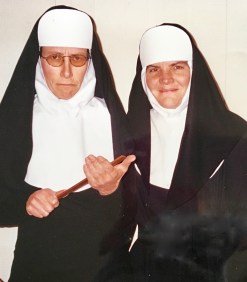
I think of the catholic church as a dangerous cult and that perspective was only reinforced when I watched the movie The Novitiate, about a cloistered order of nuns and its response to the directives of Vatican II in the early 1960s. From the movie, directed by Maggie Betts, I learned that 90,000 nuns left the church after Vatican II, which devalued nuns and left them without support of the church.
Barb and I as bad nun good nun
The protagonist is a 17-year-old novice played by Margaret Qualley, but the star of the show is the angry, strict mother superior played with force by Mellissa Leo (remembered fondly as the lawyer in Treme). She represents the old habits and choses to ignore the new catholic rules until the cigarette-smoking, newspaper-reading archbishop visits and “suggests” she begin implementing the protocols if she wants to keep her job. We learn that she has never set foot outside the convent in 40 years and we sympathize with her bitterness and frustration.
Some of the old disciplines that must be abandoned include the medieval practice of self-flagellation. In this order the novice must ask the reverend mother for the “discipline,” a stranded leather whip with knotted ends and she must tell mother the fault or lapse that deserves punishment. Another curious practice is an activity in which each novice kneels in the middle of a circle of kneeling novices and confesses her faults to the reverend mother. In an odd way it resembles the encounter groups that were just taking off in that era.
All who lived in the cloistered convent observed hours of silence and they developed a sign language to communicate. The novices spent time on their knees or crawling on hands and knees or prostrate on the floor in penance for sins against god. Touching other human beings was strictly forbidden. But the protagonist, sister Cathleen, seeks comfort in the infirmary after having starved herself in penance for a sexy dream. She hugs and kisses another novice, who it seems has been transferred here because of lesbian exploits in another order. And so the constant undercurrent of sexual attraction finds expression and then contrition. Guilt abounds.
For me, the catholic church represents a historically misogynist institution bent on maintaining control over women, our bodies, our reproductive lives, even our intimate relationships. It damages not just catholics, but all women and the cultures we live in all over the world. Hate is not too strong a word for my feelings, especially since the church continues its anti-woman postures and politics.
I believe no one truly recovers from catholic propaganda, especially when immersed as a child. The dictionary’s alternate meaning of propaganda: “A committee of cardinals of the Roman Catholic Church responsible for foreign missions, founded in 1622 by Pope Gregory XV.”
My latest favorite T-shirt shows two punks of indeterminate gender kissing. Its message is in Cyrillic script. I asked my friend Shelby, who had lived in Russia for a year, to translate, but she wasn’t able to make sense of it. Then recently I was wearing it when I encountered a Russian woman at a party celebrating the 100th anniversary of the Russian Revolution. She gladly translated its message.
Shut up! Shut up! Punk out!
Now that I know its message is from the Pussy Riot era, I love the T-shirt even more. Wearing it on the anniversary of the 1917 revolution conjures thoughts of tangled Russian history.
I’ve been thinking about Russia a lot as I’ve been grieving the death of my friend Shelby Morgan. Shelby was a Russophile who loved Russian culture and the Russian people. She was deeply influenced by the poet Anna Ahkmatova.
I interviewed Shelby as she was dying of ovarian cancer. The story of her life is fascinating and I learned so much that I had not known. I was especially interested in how she became radicalized and why she joined the Communist Party.
Shelby Morgan was born in 1949. Her birth day, May 19, was the same birth day as Ho Chi Minh, Malcolm X and Augusto Sandino. When she walked into Modern Times Bookstore in San Francisco and saw a poster with the date and pictures of all of them, she knew she was destined to be a revolutionary.
Shelby Morgan
Shelby was born and raised in Corning, a little Arkansas town on the Mississippi Delta. It was flat farming country, hot and muggy. Her father was a traveling fertilizer salesman.
Growing up a white girl in the South during the Civil Rights Movement colored Shelby’s political development. The forced integration of Little Rock Central High in 1957 when she was eight years old stunned her.
“I remember saying to my mom, ‘why would people act this way just because of skin color?’ Mom said, ‘It makes no sense.’ That was a very big deal to me.”
Because the Arkansas education system was so terrible, her parents sent her to a boarding school for white young ladies in Memphis, Tennessee in 11th grade (1966-67). Most of the students were from Mississippi and Alabama where schools had just been integrated, so their parents sent them there to get them out of the integrated public schools.
Shelby landed in San Francisco in the early 1970s. Her first job was at the Exploratorium where she worked with its founder, Frank Oppenheimer. The younger brother of J. Robert Oppenheimer, he had been blacklisted during the McCarthy era.
“He would play the flute while I played piano. We had a sweet little friendship going on. He was an old man at that point, an old commie. His atonement for his brother Robert’s involvement with the atom bomb was to start the Exploratorium.”
She joined the Communist Party in 1978.
“I was totally anti-capitalist at this point and even with the disaster that the Left was in at that time, there was an international movement and it was just thrilling to me. I just felt this was where the good work was being done. And it was fun. Man, did I have fun. The people were just great.”
By that time, most of the older generation of commies had left the Party after learning of Stalin’s purges.
“The old commies, people who’d left the Party, said ‘what about Czechoslovakia?’ We knew about all the atrocities. And I, because of my gender training, said I’d leave the theoretical issues up to the leadership who were primarily male. I said I’m about doing the work on the ground. And I just turned my back to it. It was only years later I started thinking I have to hold myself accountable for this too.”
Communists and others around the world were encouraged by Mikhail Gorbachev’s promise of reforms after he was elected to leadership of the Soviet Union in 1985. When the era of perestroika and glasnost arrived, “we were hot for Gorbachev. I didn’t officially drop out of the Party till we moved to Russia in 1990.”
Perestroika postage stamp 1988
Shelby’s husband at the time, Dan, was accepted to do research in Russia. They took their four-year-old daughter, Sarah, with them to Russia in 1990. They came back one week before Gorbachev was overthrown in 1991.
“It was a very Interesting and difficult year. We were in Leningrad (now called Saint Petersburg, the cultural capital and the second largest city in Russia). This is hard to talk about because it was so difficult. Russians were really suffering at that point. For the first four months I was living the life of a Soviet woman, so while Dan was in the archives at the University of Leningrad, I would wait in line. There was no food to be had. You would go into a store and the shelves would be literally empty. I would stand in line for a soup bone and cabbage for two hours. We lived off cabbage soup. Fortunately Sarah got fed three days a week at school. After four months we got diplomatic coupons so we could shop. Even then I had to ride a bus across town for an hour to shop. Buses were so crowded. To get on you would have to push people. Sarah was sick all the time with earaches. The clinics and hospitals were filthy. They had no equipment, not even syringes. There was no hot water. I had to boil water to bathe and to wash clothes.
In 1991 the Soviet Union was in a severe economic crisis. The government was collapsing.
“We lived a block from Red Square in Leningrad. People were burning effigies of Gorbachev in the square. I remember standing in Red Square just sobbing. My dreams were dashed. Then Dan went to another city for a while to do research and left Sarah and me in Leningrad after we’d only been there a couple of months. My Russian was very poor. The Iraq war broke out. The American embassy called us together and told us we had to be really careful, lay low, watch your back. Sure enough one night someone threw a rock through Sarah’s bedroom window. I was just terrified.”
“I had a job teaching psychology (Transactional Analysis) at U of Leningrad. The Russians were hungry for input from the West. Psychology was dismal there. I also taught at a collective called Harmonia and did a Radical Therapy (RT) group.”
Her husband was researching a biography of the physiologist Ian Pavlov.
“When the summer came around, we moved out to the country to Pavlov’s daughter’s house in Komarovo on the Finnish-Soviet border. Stalin had built a village there for artists and intellectuals. It was where Pushkin had lived along with other famous artists and writers. I was really happy there. It was a sweet village with pine and birch trees and a beautiful lake. We used to pick berries. There were no cars. Most people caught a train between Leningrad and Komarovo. Everyone rode bikes there. On the way to the lake there was an old graveyard with old crosses and tombstones where the great female Russian poet, Anna Akhmatova, was buried. My father died then just as the government was changing and I couldn’t get a plane back. This was just weeks before Gorbachev was overthrown. Everything was shut down. So I hung out at Akhmatovas’s grave to mourn my dad.”
Akhmatova’s grave
As her marriage dissolved and she mourned her father’s death, Shelby watched as anti-Gorbachev forces grew. In Leningrad she heard tanks rumbling by on the cobblestone street outside their window.
“We were supposed to come back in September but I started thinking about getting Sarah in kindergarten so we came back early or else we would have been there (on August 19, 1991) when Gorbachev was actually overthrown.”
“We knew it was going to happen just the way it did because there was no civil society to butt up against the government and the mafia. Because it was so heavily state run.”
In the States Shelby worked as a youth counselor, a union organizer, in electoral politics, in the anti-apartheid movement, in the non-profit world, sometimes the only white person on staff. Shelby’s anti-capitalist outlook influenced her work in the Radical Therapy Movement.
“The theory was you should work only with people in groups, not individuals because unhappiness in life was not based on mental illness. It was a result of alienation from meaningful work, from community, from your body, from meaningful relationships. It was a way to anti-pathologize people’s unhappiness, a total anti-medical model of psychology.
“The reason people have trouble doing that: we grow up under capitalism, which is based on the idea that some people have to win, some have to lose. It’s based on competition and we carry that into our relationships. So RT developed this set of skills to teach people to have cooperative rather than competitive relationships. Radical Therapy was really key to building a mediation movement.”
Finding a time to interview Shelby was not easy. Even as she was dying, she was organizing, working for single payer health care, marching in demonstrations against Trump and for equality and justice. She was a lifelong activist and she is dearly missed by a large community of friends and comrades.
Shelby Morgan died August 28, 2017
Anna Akhmatova
Akhmatova
From Wikipedia I learned that the poet Anna Akhmatova remained in Russia during the revolution and until her death in 1966. For long periods she was in official disfavor, and many of her relatives and friends fell victim to Soviet political repression.
In February 1917, the revolution started in Petersburg (then named Petrograd); soldiers fired on marching protestors, and others mutinied. In a city without electricity or sewage service, with little water or food, they faced starvation and sickness. Ahkmatova’s friends died around her and others left in droves for safer havens in Europe and America. She had the option to leave, and considered it for a time, but chose to stay and was proud of her decision to remain. She wrote of her own temptation to leave:
A voice came to me. It called out comfortingly.
It said, “Come here,
Leave your deaf and sinful land,
Leave Russia forever,
I will wash the blood from your hands,
Root out the black shame from your heart,
[…] calmly and indifferently,
I covered my ears with my hands,
So that my sorrowing spirit
Would not be stained by those shameful words.
— When in suicidal anguish, trans. Jane Kenyon
Russia on My Mind
On the revolution’s centenary I’ve been thinking about Russia as I read articles by the prolific journalist Masha Gessen and The Unwomanly Face of War by Pulitzer Prize winner Svetlana Alexievich who chronicles stories of Soviet women soldiers in World War II. Then I picked up the Smithsonian magazine to read a compelling piece by Ian Frazier, Whatever Happened to the Russian Revolution. https://www.smithsonianmag.com/history/what-ever-happened-to-russian-revolution-180964768/. He condenses the history for us in between reminiscences of his travels to Russia in the last 24 years.
There are many lessons here. I hope we Americans can learn them soon enough to avoid contemporary political catastrophes.











 tradeswomn musings