“OUT OF THE LINE, Nancy, France” Flo wrote on this album page, where she pasted a handful of invitations from February and March 1945. The front was quiet for a spell, and for a few precious days it was party time.
In Belleville, just north of Nancy, the French put on a parade with bands playing and troops marching in review. The 30th Infantry Regiment hosted a couple of lively dances too.
The best invitation, though, was a tongue-in-cheek “battle order” for a party called Plan Jitterbug, issued from 7th Infantry headquarters with Colonel Heintges in command. Under Intelligence it warned that “numerous Wolves in the Stag Line” would be present and could only be defeated by outmaneuvering their flanking moves and cut-ins. At the bar, one could expect “a normal amount of obstacles and confusion.”
Under Attachments the orders promised “several pretty nurses and Red Cross women,” advising “close cooperation with these units” for the evening’s success. Escorts and proper infantry protection were guaranteed.
It was all in good fun—a way to laugh, flirt, and dance before heading back into the seriousness of war. The parties in Nancy marked the end of the campaign in France. From there, the Third Division would soon cross into Germany.
It’s easy to picture the American forces in WWII as all white. Wartime photographs, newsreels, and official histories rarely show otherwise. Flo’s own scrapbook from two years overseas with the American Red Cross and the Third Division contains no mention or images of Black soldiers.
Yet more than one million Black men and women served in the U.S. armed forces during the war. Their service was essential, though often invisible. Flo herself was no stranger to racial injustice—before the war she had been active in the YWCA’s anti-racism campaigns and in efforts to integrate the organization.
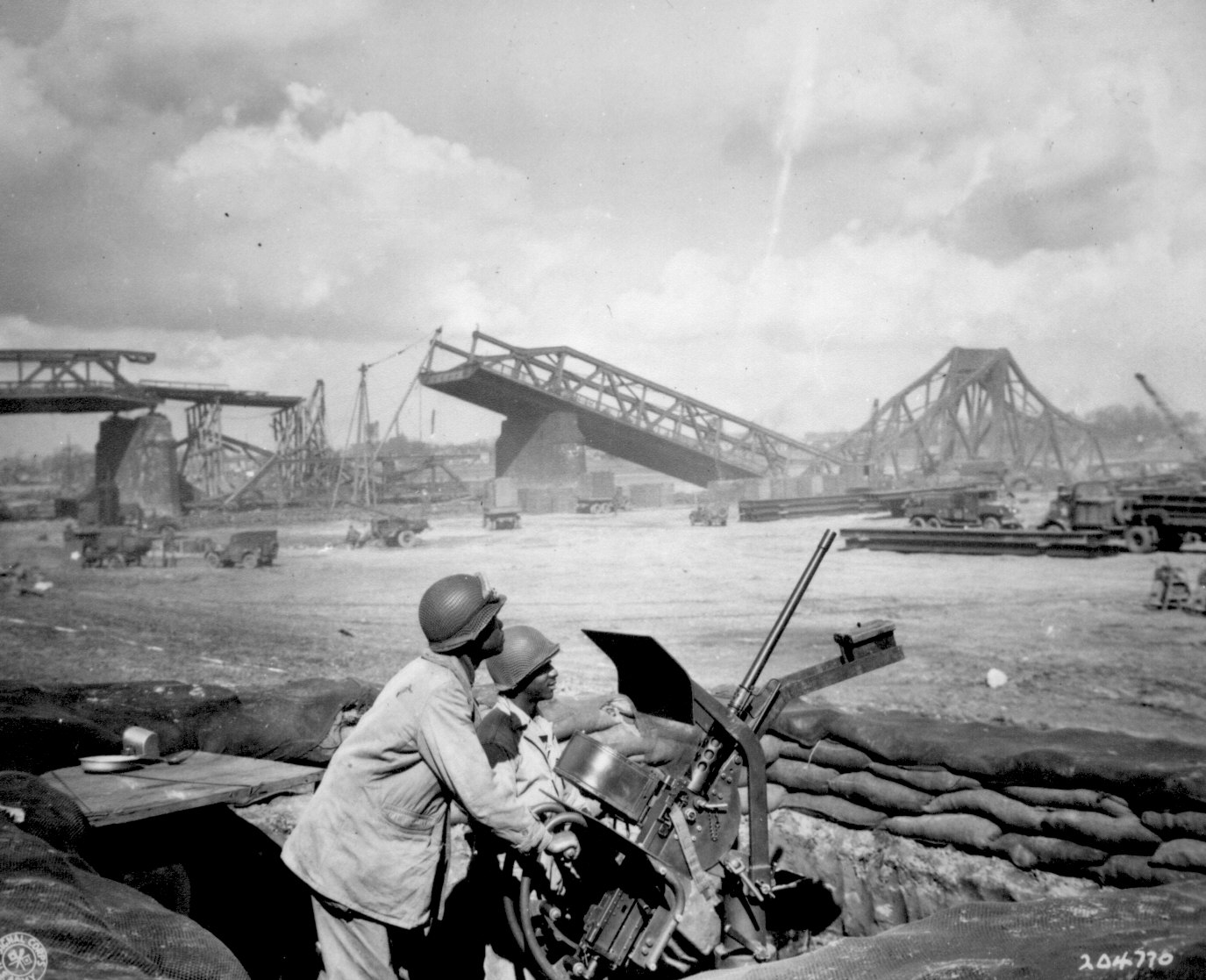
Pvts. George Cofield and Howard J. Davis guard a newly-constructed bridge site over the Rhine River, built by U.S. Ninth Army Engineers. March 30, 1945. Photo: NARA
Historian Matthew F. Delmont, in Half American, argues that the United States could not have won the war without the contributions of Black troops. At the outset, however, the military tried to exclude them entirely. The Army, dominated by white supremacist segregationists, turned away Black volunteers after Pearl Harbor. Officials feared the political consequences of arming Black men. But as the war expanded, the need for manpower forced a compromise: a segregated military.
Many training camps were located in the South, where local white residents often harassed or assaulted Black soldiers. Abroad, Black Americans saw stark parallels between Nazi ideology and U.S. racial laws. The Pittsburgh Courier, a Black newspaper read nationwide, launched the “Double Victory” campaign—calling for victory over fascism overseas and victory over racism at home.
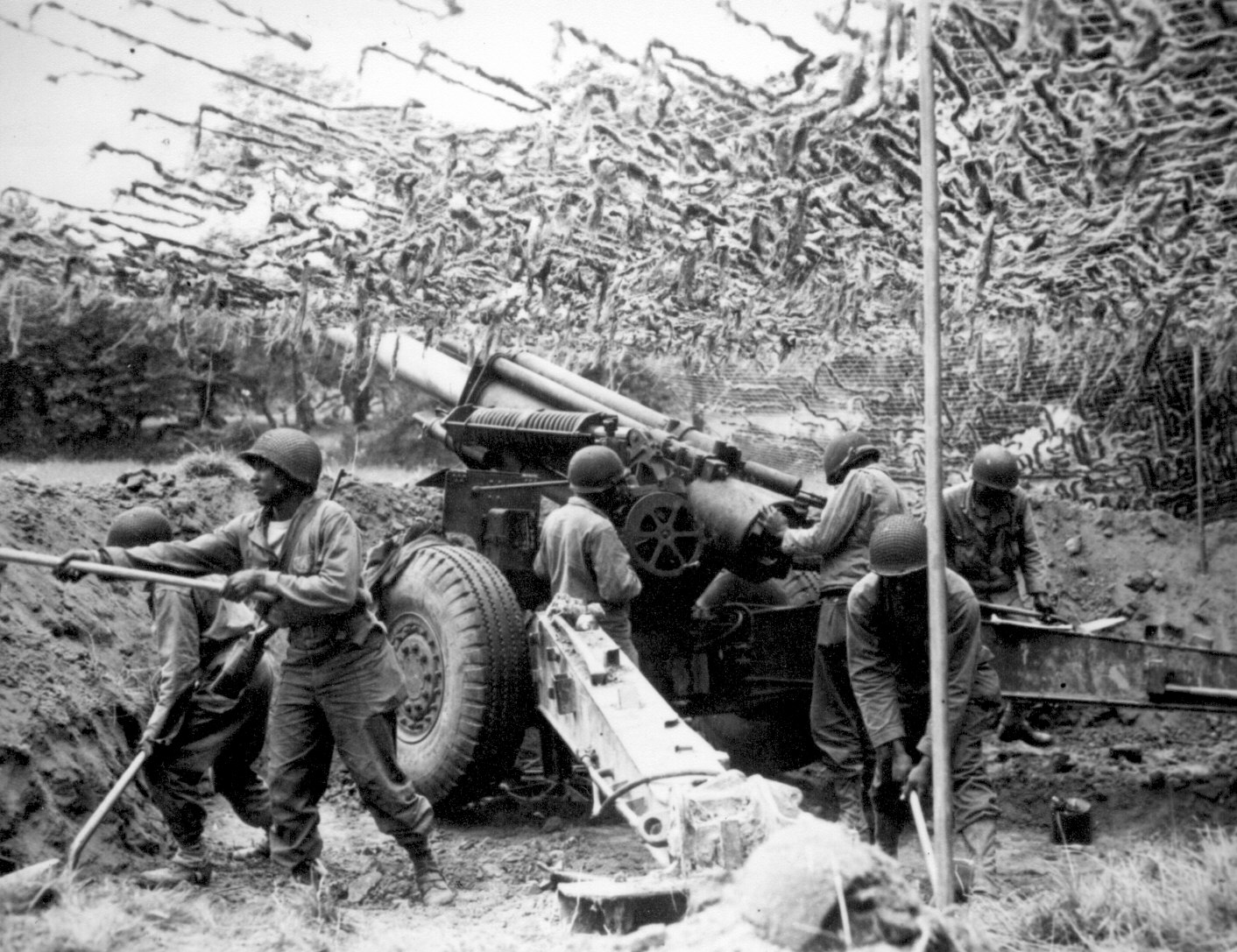
Troops of a field artillery battery emplace a 155mm howitzer in France. They have been following the advance of the infantry and are now setting up this new position. June 28, 1944. NARA
Segregated combat units fought bravely despite facing discrimination from their own commanders. The 92nd Infantry Division served in Italy beginning August 1944, possibly crossing paths with the Third Division. The Montford Point Marines, the 761st “Black Panther” Tank Battalion, and the celebrated Tuskegee Airmen also saw combat. Black soldiers fought and died at Normandy, Iwo Jima, and the Battle of the Bulge.
Cpl. Carlton Chapman, a machine-gunner in an M-4 tank, attached to a Motor Transport unit near Nancy, France. 761st Mt. Bn. November 5, 1944. NARA
Most, however, served in unheralded but vital support roles. They built roads, hauled supplies, cooked, repaired equipment, and maintained the machinery of war. Seventy percent of all soldiers in U.S. supply units were Black. “WWII,” one historian wrote, “was a battle of supply,” and these troops kept that battle moving. There was even an all-Black American Red Cross contingent that ran segregated service clubs for Black troops.
The U.S. military and press often hid these contributions. Photographers were instructed to avoid showing Black soldiers in official images. When the war ended, Black veterans returning to the South were targeted for violence—beaten, harassed, and in some cases murdered—for wearing their uniforms. This had happened after WWI, and it happened again. Many veterans, like decorated soldier Medgar Evers, became leaders in the postwar civil rights struggle.
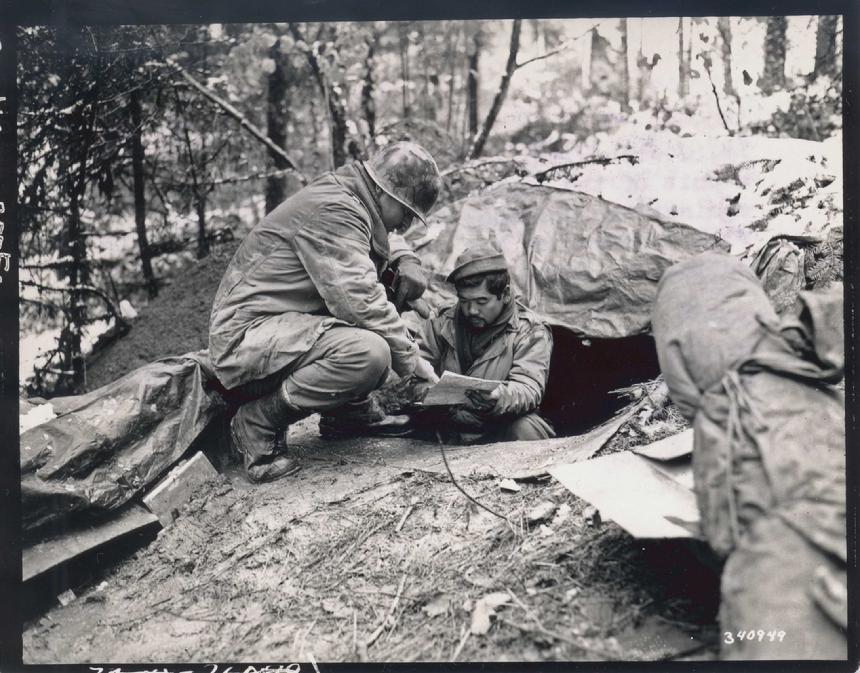
Lt. Joseph W. Hill of Pine Bluff, Ark., commanding a unit of the Japanese-American Team in action against the Germans, discusses enemy positions with a member of his unit. Company “F”, 2nd Battalion, 442nd Regiment (Combat Team). 13 Nov 1944, St. Die Area, France Signal Corps Photo (Musser) NARA
Alongside Black troops, the segregated 442nd Regimental Combat Team of Japanese American soldiers fought in the European Theater. Formed in 1943, the 442nd was made up largely of Nisei—second-generation Japanese Americans—many of whom had families incarcerated in U.S. internment camps. Beginning in 1944, they served in Italy, southern France, and Germany, becoming one of the most decorated units in U.S. military history.
The contributions of these segregated units—Black and Japanese American alike—were essential to Allied victory. Yet their service has been downplayed or erased from the dominant WWII narrative. Restoring these stories helps reveal a fuller, truer picture of the war that Flo witnessed.
It felt like fate. On our very first date, a hike in the hills above Muir Beach, Holly and I bonded over plants. She pointed out a lichen growing on an oak tree—Usnea. To identify it, she said, you snap a branch and pull it apart until you see the central cord inside.
Usnea on oak. Photo by author
Usnea is known by many names: old man’s beard, beard lichen, or beard moss. A sensitive bioindicator of air quality, it only thrives where the air is clean and unpolluted. For centuries, it has been used in traditional medicine to treat wounds and infections. Today it’s still valued—for easing sore throats, helping wounds heal, reducing fevers and pain, even as a possible cancer-fighting agent.
Holly, now my wife, is a witch and an herbalist. She first learned about Usnea from a teacher of medicinal plants, and today her garden overflows with remedies.
The fall equinox—Mabon—is our time to harvest herbs and brew up remedies. Holly stirs up her bite balm, a salve for every kind of skin irritation, while I turn to cannabis. Since I don’t smoke, I’ve studied the alchemy of decarboxylation: gently heating the herb to unlock its powers before infusing it into oils for cooking.
NettleComfreySelf Heal
Some of the herbs in Holly’s garden. Photos by author
Together we blend teas from garden herbs. Our MoHo Blend we make from nettle, comfrey, and lemon balm. Comfrey mends bones; nettle brims with minerals; lemon balm lifts the spirit. Holly grows native yarrow, too, and last week she showed me how to stop a cut from bleeding: chew a fresh leaf and press it to the wound.
Some of the ingredients for bite balm. Photos by author from 2022
This season, I’m also harvesting and drying figs. Sonoma County is fig country, rich with varieties—Black Mission, Brown Turkey, green Kadota, Adriatic. The fig in our own garden is called Celestial: small, pink-fleshed, and honey-sweet. I can’t resist foraging (with permission) from neighbors’ trees, and the green figs from the tree across the street are my favorite treat.
Earlier in the summer we dried peaches from our little orchard. We peeled and cored the apples that hang over from next door, simmered them into apple sauce and pie fillings for the freezer, and pressed the rest into juice with friends. These harvest gatherings always feel like old-time rituals, neighbors bound by fruit, labor, and laughter.
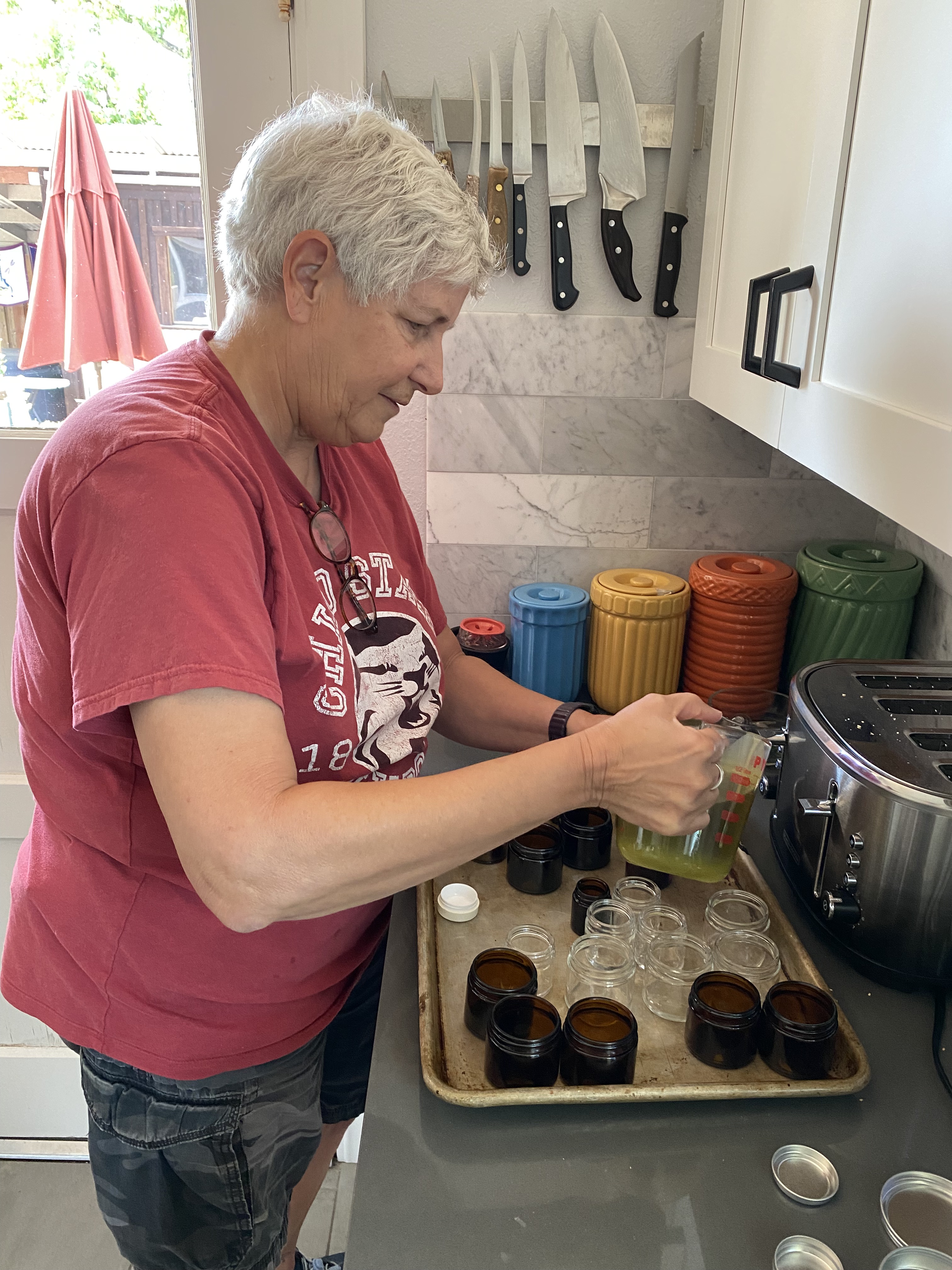
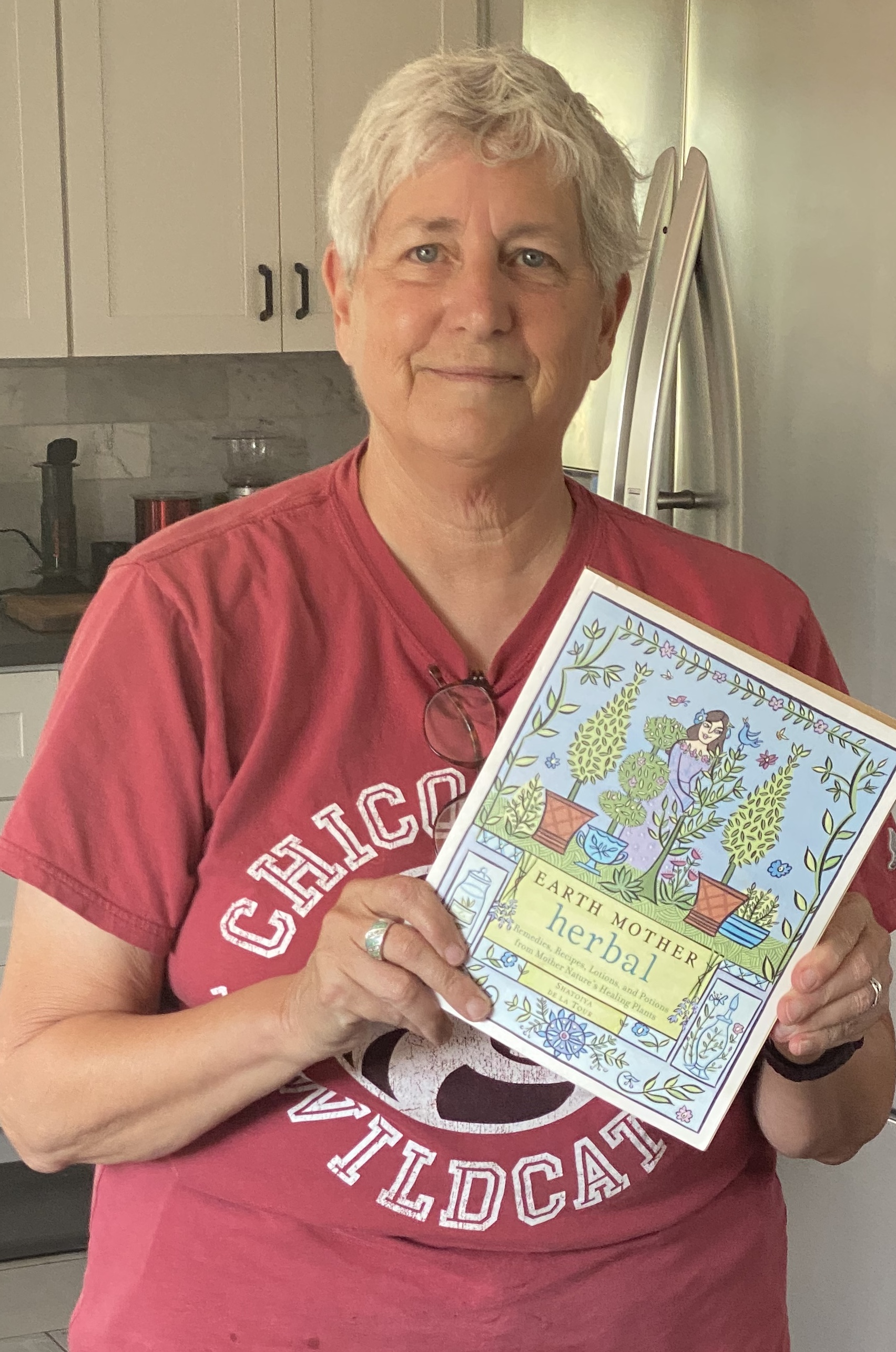
Holly pouring the final productOne of many reference books
Our garden is more than soil and stems. It is a living grimoire—a book of green magic—where medicine, ritual, and daily life are entwined. Harvesting and making are rituals of resistance too: an antidote to the anxiety of a world slipping toward fascism. To touch leaf, fruit, and root is to salve our spirits, to root ourselves again in Mother Earth.
Searching through archives kept by my cousin Gail (our mothers were sisters), I was delighted to find two letters written by my mother, Flo, to her mother, Ruth–one in August, 1944 and the other dated February 1, 1945. These have helped to give a more personal perspective to the ARC women’s lives. Here Flo muses about death and war while describing everyday life of the clubmobilers in the French mountains. She reveals that the wedding rings her fiance Gene had ordered from home had arrived the day after he died.
February 1, 1945
Dearest Ruth:
“Your letter of December 4 just reached me a few days ago – mail has had no priority and many of my Christmas greetings and cards arrived just now. However, packages came through well and I had all of yours from home in time. Thanks for the grand gifts, Ruthie – they were so appreciated. The sweatshirt was the envy of everyone (we wear them with our clubmobile uniforms) and I love the slip and underwear. Was down to “Rock bottom.” Your cake was eaten so quickly, all I can remember was that it was very good.
(Flo admires pictures of Ruth’s three girls)
“Thanks for the sympathy and your philosophical comments. I’ve “recovered” if you can call it that, but it was a cruel shock, and I wouldn’t want to go through it again. We see friends “go” so often these days that death is close always, though it never ceases to be tragic and futile. Gene’s first sergeant, a fine, handsome boy, who has a lovely wife and darling three-year-old daughter, and who was always so good to me, has been killed in the last few days. That’s the way it goes – they leave one by one, particularly in a combat outfit like theirs and my division. The few who have survived almost 3 years of constant fighting, are very tired and should go home, but probably won’t until the war is over.
“Gene’s family write to me often and find it hard to believe he is gone. They are sending me the rings he bought and which arrived over here the day after he was killed and were returned to them. Somehow, I don’t want them, but they think I should have them.
“We are in the mountains and have had a lot of snow the last month but a very welcome chinook wind has melted much of it, which makes driving on these roads less hazardous. Evidently the French ski a great deal around here and there are some attractive ski places, as well as good slopes. I never seem to have time to try them out, but some of the boys did and had a fun time.
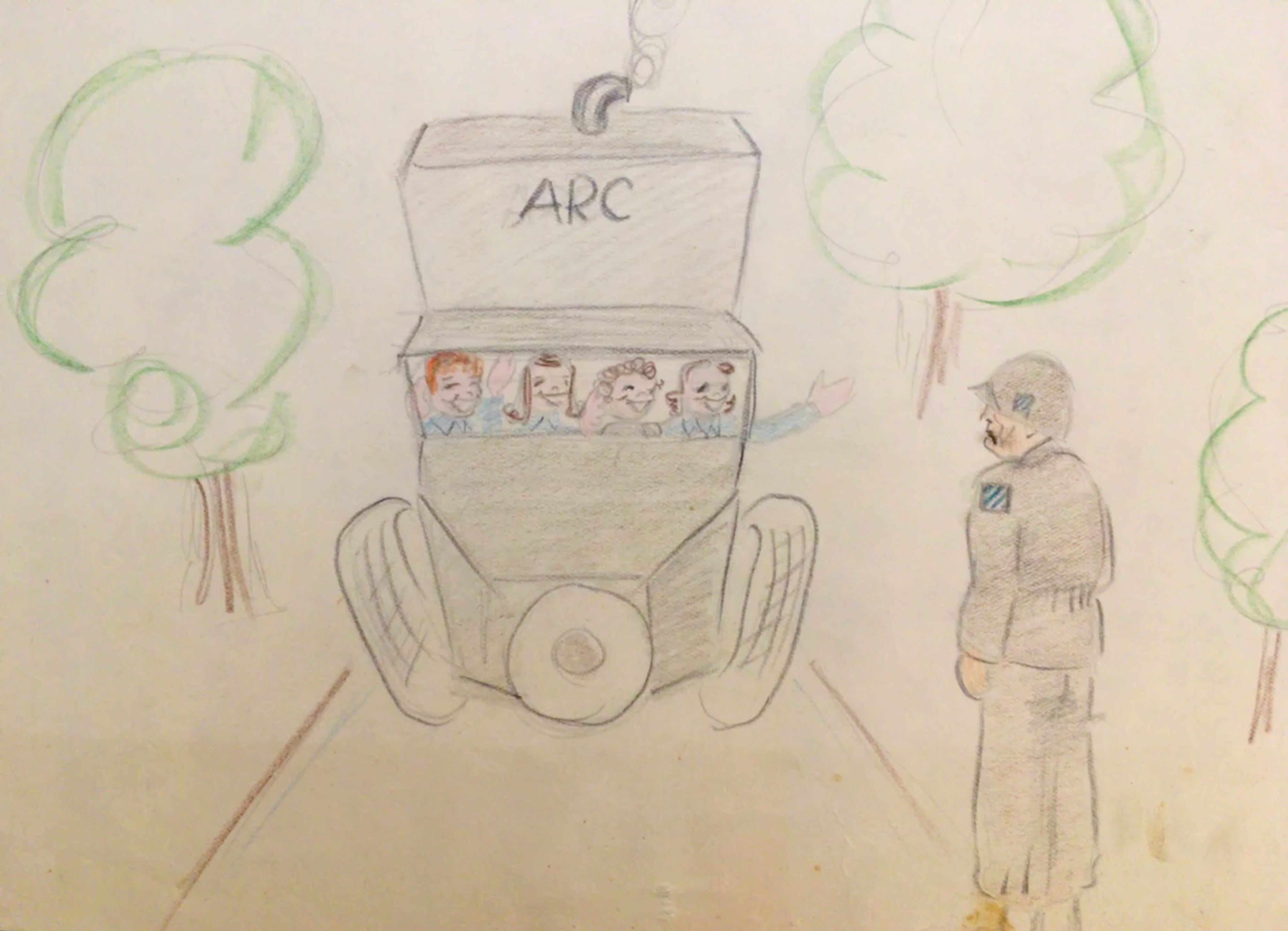
Drawing by Liz Elliottneeds no explanation
“Our infantry is “busy” as usual, and we are waiting to see them and feed them donuts again. It is always hard, after a session in the lines, to see them again and find friends are missing.
“After a brief session of gaiety in Strasbourg our social life has been reduced to practically nil. Contrary to many ideas, we do not indulge in much social activity; the men are pretty well occupied, you know, and it is only when they have a brief rest that we have a dance or two.
“We continue moving frequently and just made another one today. Lately we have been living in French homes and are coming to know the natives quite well. I can’t speak much French, but can understand it quite well when they slow down to 50 mph instead of 90.
“Right now we have rather cramped quarters in a home which is filled with refugees who were burned out of their homes when the Germans left. Many of these people have lost everything and many, of course, being Alsatian, are torn between being Frenchmen or Germans.
“We’ve been “up front” a few times – within a few hundred yards and within firing range, but it looks no different from any other place, unless the towns have been shelled (and most of them have). There are no trenches, like the last war, And much of the time, it moves so fast, there are no foxholes either, though they “dig in” if they are holding a line. We were shelled in one of the villages the other day, though it happened so quickly, we didn’t have time or sense enough to be frightened. It isn’t fun, even if it seemed funny afterwards.
“There have been setbacks for the Americans in France, but we are happier about the situation now and the Russian drive is encouraging too. I doubt if I will be home for some time yet, but then, I certainly won’t be among the first to leave.
“My package – sent to Mom – with gifts for you all should have reached you by now. I hope they serve the purpose; it is difficult to find anything worthwhile here – their stores and supplies have been hard-hit.
“I like to hear about your kids and other news of the people at home. Betty doesn’t write very often, but mom is wonderfully faithful and takes care of me over here almost as well as she did at home.
“If there are any of my clothes – hats, shoes etc. that you can wear and want to, help yourself, because they will be out of style when I get home and I’d like to have you get some use out of them. Just go down and see what you can use.
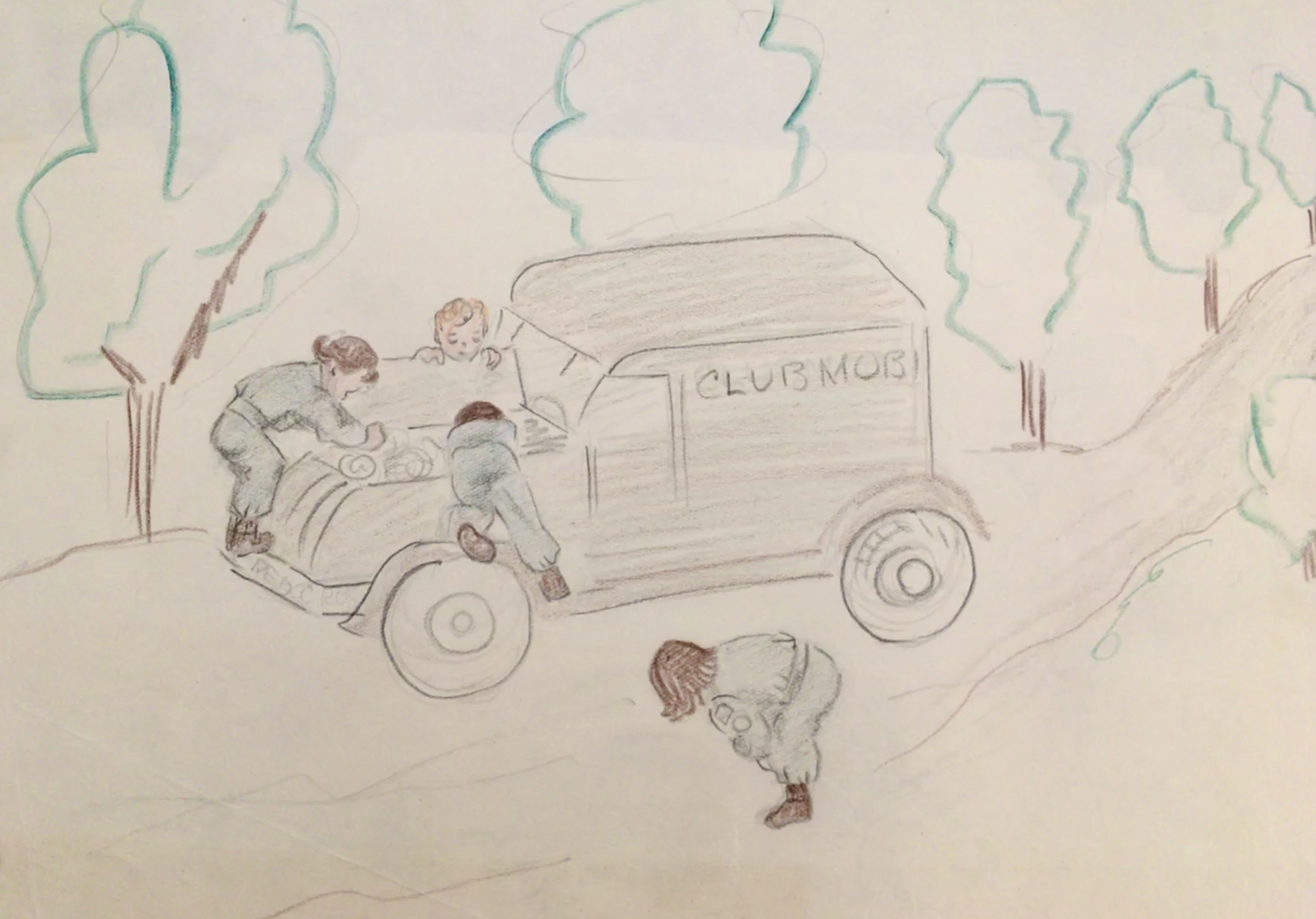
You had to be a mechanic too. Drawing by Liz
“Very seldom see a movie (last one was “A guy named Joe” which I saw with Gene and which he didn’t like; he was killed a few days later and the show haunted me).* They have very few good ones and very few period. Read seldom, too, and even more seldom hear a radio, so you see my mode of living and entertainment has changed considerably.”
*(This was a popular war movie starring Spencer Tracy, Irene Dunne and Van Johnson about an American pilot who is killed when his plane goes down after bombing a German aircraft carrier. Then he is sent by “the general” back to earth to train a pilot in the South Pacific war. At the end he’s still dead. The Irene Dunne character gets to fly planes too. The screenwriters were Dalton Trumbo and Frederick Hazlitt Brennan.)
“We have the fellows at the 2.M. (not sure what this means) in quite a bit, toot around the country in our jeep whenever we can and manage to never be bored, which keeps us happy, I suspect.
“I like the work and love the boys. Life gets very simple and fundamental, if you can understand that, and we share many of the same experiences, which makes everyone a friend.
“Eve was fine but busy, and Paris is the same lovely lovely city, though they have food shortages, little fuel and all that. It didn’t seem too unusual to see Notre Dame Cathedral on Christmas morning, but in years to come it will be quite a recollection. Eve and Janet were very good to me and it was like home to see them. Janet’s husband was wounded tho not seriously and she was quite upset. I hope to go back in the spring– It would be even nicer there then in the lovely park.”Maybe my own luck will change one of these days; at least I can share sorrow and sincerely sympathize with others who are hit by the tragedy of war. It makes me even a worse “softie,” but there are many to share itwith.”
Mom used to tell us kids stories from her time in the Red Cross in Europe and my brother Terry reminded me of a favorite.
Flo and her ARC team were driving their clubmobile toward the front lines to serve returning soldiers. Somewhere on a lonely French country road, far from anything resembling safety, the truck suddenly died. Though they’d been trained in basic vehicle repair, nothing they tried would bring it back to life. In the distance, artillery boomed, each blast sounding closer than the last. The four women stood with the hood up, poking and prodding, running through every trick they’d been taught.
Then an American Army jeep rattled up. The sergeant driving had such a thick New York accent they could barely understand him, but he clearly knew his way around an engine. He took a quick look under the hood and announced, with total confidence, “It’s the coils, goils.” The line struck them as so absurd they collapsed into hysterical laughter. The sergeant, baffled, had no idea what was funny. Moments later the truck roared back to life, and they got out of there as fast as they could.
First 3rd Division Medal of Honor Recipient Killed in Action
My Mother and Audie Murphy Ch. 55
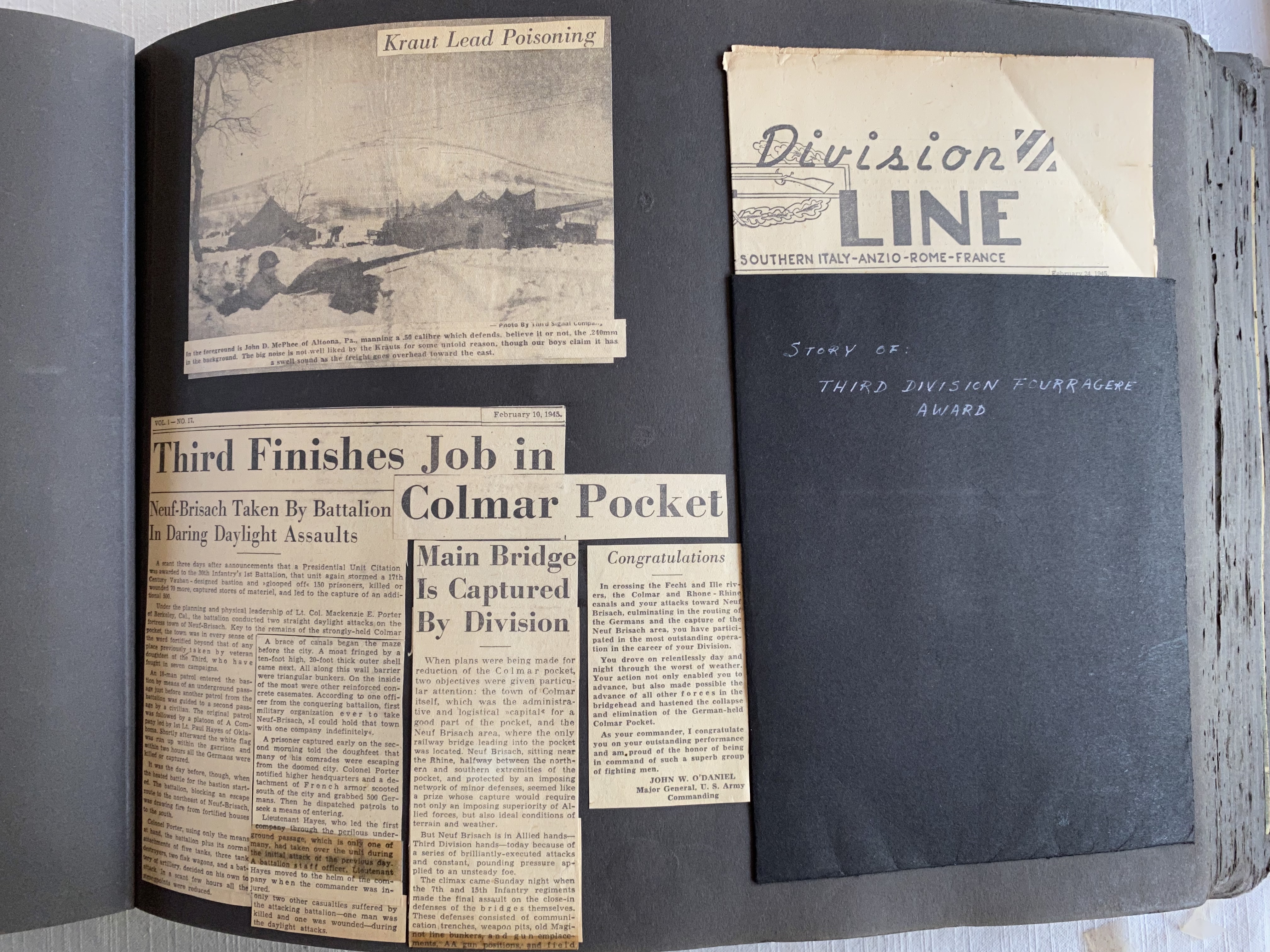
Flo devoted a page in her album to the first Third Division Congressional Medal of Honor award recipient, Lt. David Waybur or Piedmont, California. She noted that he was killed in action near the end of the war in March, 1945.
Page in Flo’s album. Pinch out to read the whole story.
From the story: The Army, chances are, will never be a great writer. Its taciturn prose travels on a punchless belly. But some of the most spectacular stories of this war are being scribbled on battlefields in the sparse, lean, GI prose of army officers writing to headquarters of the heroism of men unto them.
Such a story is told in the recommendation for a citation for Lieutenant David C Waybur, 24… A graduate of Piedmont high school, a former grocery clerk, David Waybur enlisted in the army at the end of his second year at the University of California in 1940. Three years later, in the dead of night, young Waybur rode to army immortality at the head of a little fleet of three jeeps and fought, jeeps versus enemy tanks, a never-to-be-forgotten engagement beside a blown up bridge in Sicily.
Audie Murphy also received the Congressional Medal of Honor, the highest US military decoration for valor, awarded by the President in the name of Congress.
ARC Women the Only American Females to Shoot in WWII
My Mother and Audie Murphy Ch. 54
The page from Flo’s album
American women were strictly forbidden from shooting guns during WWII or serving in any combat position. The WACs, the Women’s Army Corps, were disparaged because Americans thought they would be too close to war and women should be protected from war. The ARC women flew under the radar because they were referred to as volunteers (even though it was a paying job), and as “girls” and because they primarily worked as nurses. Their carefully crafted image was as noncombatant helpers of soldiers, humanitarian aid workers, not fighters.
the American Red Cross worked hard to establish these women as safe and non-threatening to the social norms of the time. In so doing, it allowed them to gain access to battle and combat to an extent no American women had before.
The Allies and Germany had lost such extensive manpower during the First World War that women were allowed much more active military roles in the Second World War. Unlike American women, Soviet women were fighters on the front lines of the war.
“Janet and our jeep”
As it turned out, the ARC clubmobilers may have been the only American women in the war who actually shot guns. They were closer to the front lines of the war than any other women.
They also experienced many close escapes during their tour of duty with the Third Division.
Flo and her comrades got the chance to shoot in the freezing winter of 1944-45, during some of the hardest fighting of the war. In the Colmar Pocket outside of Neuf-Brisach they volunteered to go on patrol on the Rhine with an artillery and mortar FO (field operations) party. They also visited the mortar OP (observation post) and threw a smoke screen from the sand-bagged position.
Because the clubmobilers saw the soldiers and worked with them daily, the women were seen as part of the team. The men wanted to show them what it was like on the front line and the women wanted to be part of the action. Their comrades showed the women how to shoot.
Photos of her from that day show she was wearing the ARC regulation uniform—a skirt—while lying in a trench aiming a rifle.
“Ostheim, Alsace”
I don’t know whether Flo had ever shot a gun, but she was part of a hunting and fishing culture in the Northwest, so she may have. I have a picture of her posing with a deer carcass and holding a rifle taken after the war.
Flo was quoted in a newspaper article: “We all had a case of scratched knees, mud casts, and aching muscles after that.”
Still another time after they had sweated out the ride to the battalion CP (command post) the men refused to come out of their holes for donuts because of the heavy shelling.
It was during this trip while darting in and out of the smoke screen, that they went into a town that was ominously quiet. Recognizing the symptoms, they hastily left the place. That afternoon they found out the town had just fallen. It had been occupied by the Krauts during their visit.
When the Seventh Regiment was in Beblenheim, Alsace, the clubmobilers visited and fed a novel, so-called, “Doggie Rest Camp.” There two men at a time came in from their positions for a few minutes each to wash up, and put themselves in shape.
“Colmar”
According to the newspaper report, “The quartet is not now up to combat strength as Miss “Fritzie” Haugland, Berkeley, Calif. is hospitalized, but her three running mates are doing a fine job…. They are just what their patch proclaims—part of the outfit.”
The letter from another admirer Flo pasted on this page
Letters from Third Division friends confirm that the clubmobilers’ exploits were dangerous and put them in the line of fire.
On Jan 31, 1945, Lt. Col.Chaney wrote: Please don’t be as reckless as you have been, and stay out of range of shell fire.
Sincerely, Chaney
On March 5, 1945, Mel wrote:
Yes, I can well imagine your time is not your own, particularly when the Div. is getting their well-earned respite from the 88’s. Your own “combat time” was hardly a surprise to me. To me, you were the type that would do such a thing, just for the hell of it! Stick to your donuts, honey, and let others do the OP shift—I’d hate to lose such a good letter writer so soon—believe me!
After the war Larry Lattimore wrote:
Oh yes, Agolsheim, did you know that was the second big attack in which I had acted in the capacity of C.O.? Golly! But after things finally quieted down, I enjoyed that little town. That was the first time we ever had any fun on the Rhine River. About that big white goose—we did cook it, we did eat it, and it was good! Do wish Col. Chaney had let you stay long enough to have some. Do you remember that little courtyard in front of my C.P.? About 15 minutes after you left, three 120 MM mortar shells landed in the center of that courtyard. Lucky no one was hurt but those shells sure shot hell out of our rations. I shudder to think what would have happened had those shells come in while you were still there. C’est la Guerre!
Third Division fights its toughest battle of the war
My Mother and Audie Murphy Ch. 53
The fight for the Colmar Pocket rages through late January 1945, a brutal campaign largely overshadowed by the final days of the Battle of the Bulge. Audie Murphy, then a young lieutenant in the 15th Infantry Regiment, endures the worst days of his war.
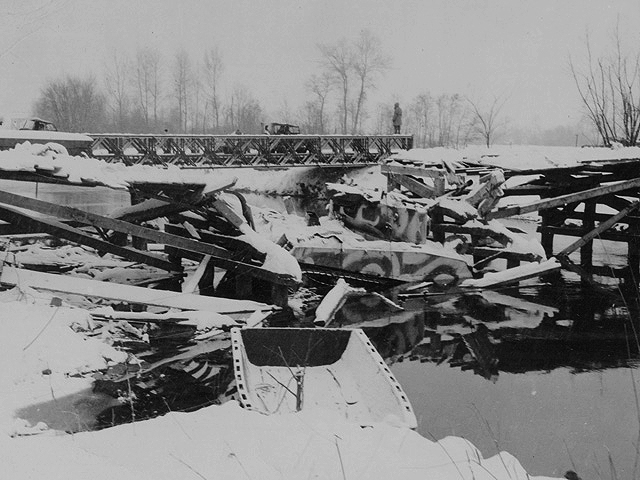
Bailey bridge built next to the bridge over the Ill Riverdestroyed by a tank falling in. Photo: Dogface
Through the freezing night he and his men take turns on watch. He nods off, his hair freezing to the ground, and wakes with a jerk when gunfire cracks, leaving patches of hair in the ice. By morning, a bridge over the Ill River is finally usable; a few tanks cross to join them—comforting, but also a sign that there will be no retreat.
They form up for another attack. The quiet woods erupt—mortars, machine guns, rifle fire. Murphy watches two lieutenants leap into the same foxhole; a shell follows them in and ends their lives instantly. He is knocked down by another blast, his legs peppered with fragments, but still able to fight. Tanks push forward, only to be hit and burst into flames. Crewmen stumble out, burning, screaming, cut down by enemy bullets as they roll in the snow.
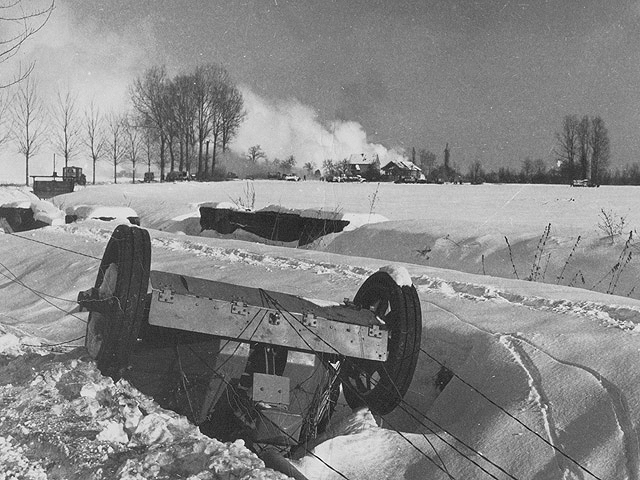
Communications wire strung over German materiel. Photo: Dogface soldier collection
By nightfall the company is shattered. They huddle in the cold, eating greasy rations, waiting for ammunition and replacements. Company B has lost 102 of its 120 men; every officer but Murphy is gone. With only seventeen men left in his zone, he receives orders: move to the edge of the woods facing Holtzwihr, dig in, and hold.
The ground is too frozen to dig, so they stamp along the road to stay warm, waiting for daylight—the most dangerous hour. Their promised support does not arrive. Two tank destroyers move up, but by afternoon the situation worsens. Six German tanks roll out of Holtzwihr and fan across the field, followed by waves of infantry in white snowcapes.
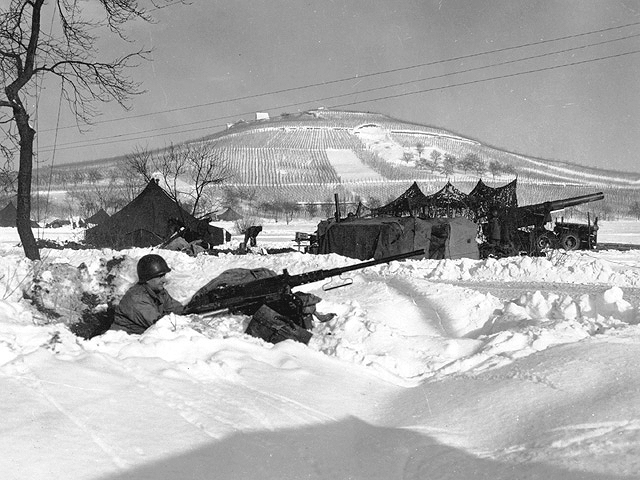
Crew with an 8 inch howitzer and a heavy machine gun. Photo: Dogface soldier collection
One tank destroyer slides uselessly into a ditch; the crew bails out. Artillery begins to fall on Murphy’s position. A tree burst wipes out a machine-gun squad. The second tank destroyer takes a direct hit; its surviving crew staggers away. Murphy realizes the line is collapsing. Of 128 men who began the drive, fewer than forty remain, and he is the last officer. He orders the men to pull back.
While directing artillery fire by telephone, he fires his carbine until he runs out of ammunition. As he turns to retreat, he sees the burning tank destroyer. Its machine gun is intact. German tanks veer left, giving the flaming vehicle a wide berth. Murphy drags the field phone up onto the wreck, hauls a dead officer’s body out of the hatch, and uses the hull for cover.
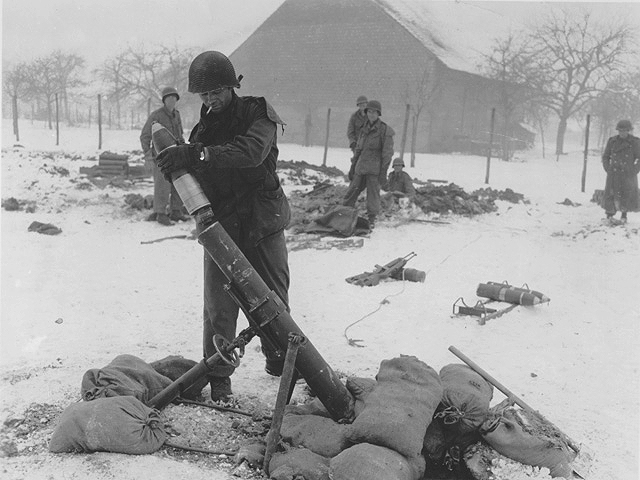
Loading an M-2 chemical mortar. Photo: Dogface soldier collection
From the turret he mans the machine gun, calling artillery on the field while firing into the advancing infantry. Smoke swirls; the heat of the fire warms his frozen feet for the first time in days. He cuts down squad after squad, sowing confusion; the Germans cannot locate him and expect the burning vehicle to explode at any moment.
When the smoke lifts briefly, he spots a dozen Germans crouched in a roadside ditch only yards away. He waits for the wind to clear the haze, then traverses the barrel and drops all twelve. He orders more artillery. Shells crash around him; the enemy infantry is shredded, and the German tanks pull back toward Holtzwihr without support.
A tank destroyer in the Colmar battle. Photo: Dogface soldier collection
Another bombardment knocks out his telephone line. Stunned, Murphy finds his map shredded with fragments and one leg bleeding. It hardly registers. Numb and exhausted, he climbs off the tank destroyer and walks back through the woods, indifferent to whether the Germans shoot him or not.
Stretcher crew of medics. Photo: Dogface soldier collection
Murphy was 19 years old.These are the actions that win him the Congressional Medal of Honor.
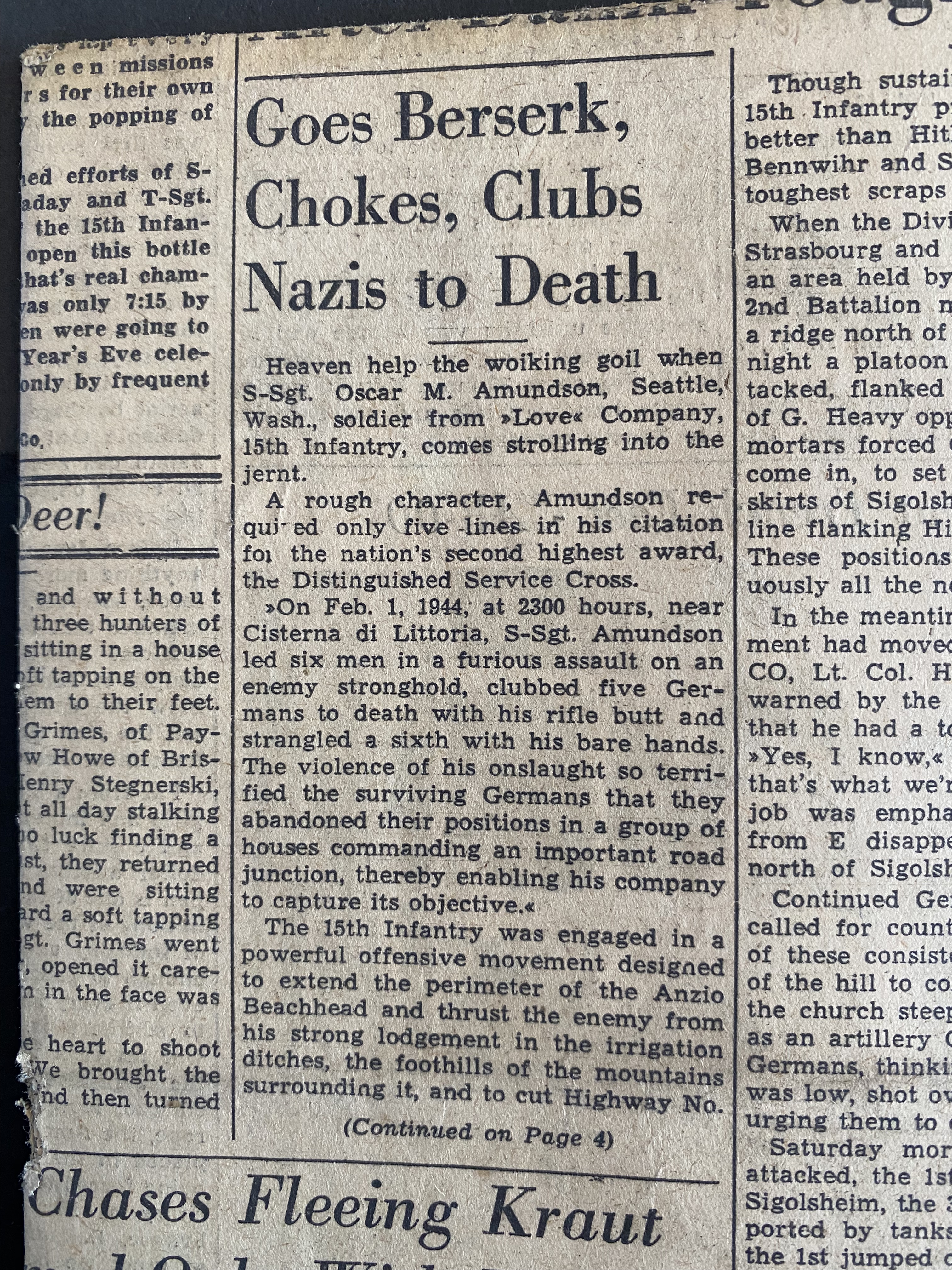
The only photo on this page, of the shelled St. Die, was presumably taken by Flo. There is also a copy of the Third Division FrontLine newspaper which tells the story of a soldier from Seattle who killed several Nazis in hand-to-hand combat. Probably Oscar Amundson was someone she knew from her home state of Washington.
Photo: Dogface Soldier Collection
The FrontLine newspaper was started in World War II. Published weekly, it is still the official periodical for the Third Infantry Division.














 tradeswomn musings