Heated Rivalry has got me thinking about the gym among other things
Watching Heated Rivalry, a series about gay hockey players, stirred up memories of my own athletic life. I competed in the Olympics too—the Gay Olympics. Well, we couldn’t call them that after we lost the right to the name in court, so they became the Gay Games. Alliterative. Less grand. Same spirit.
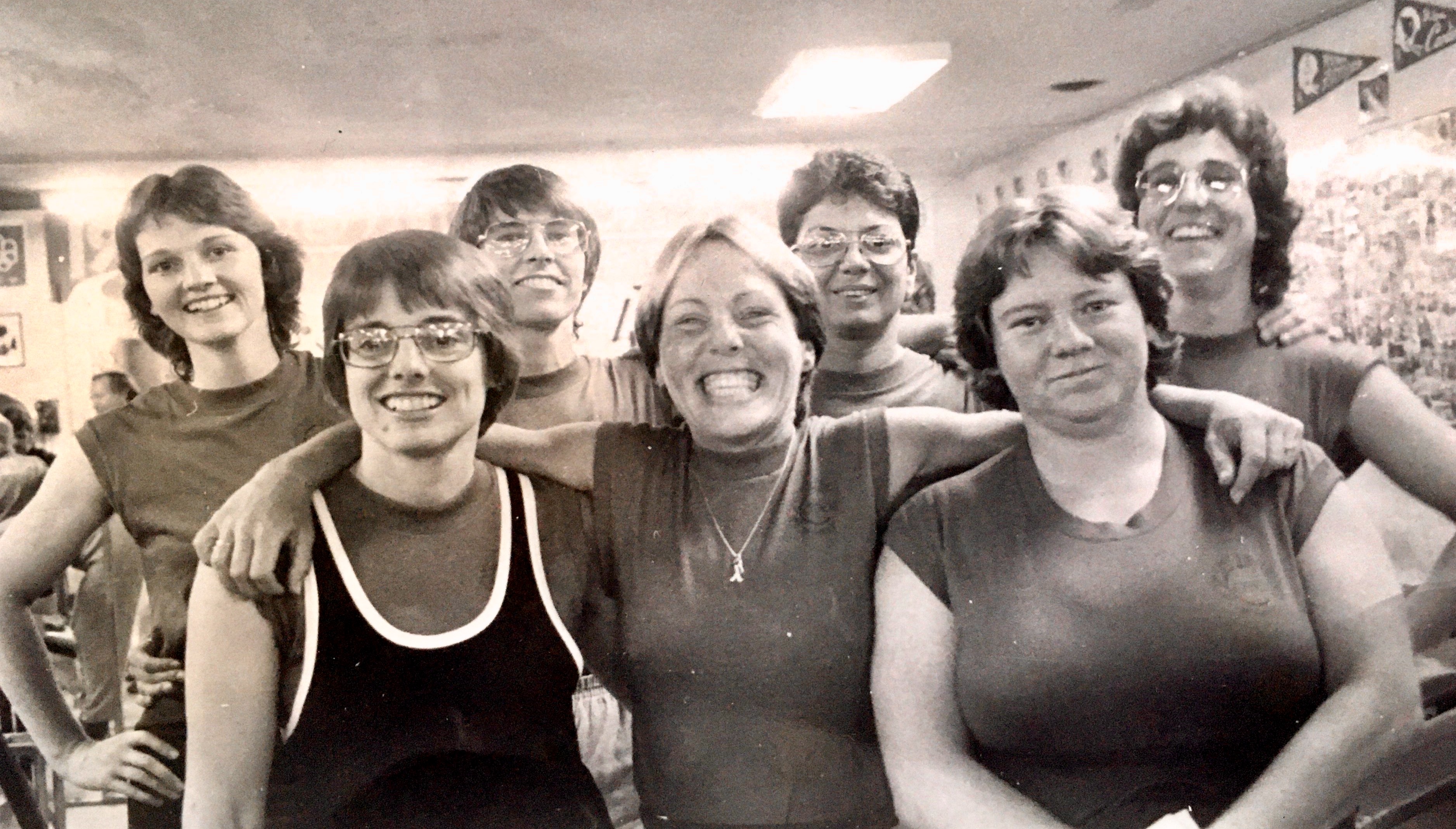
Me and my team of lesbian power lifters, Gay Games 1982
At the Gay Games in different years, I was a powerlifter, a wrestler, and a rower. But more than that, I was part of something new. The Gay Games didn’t just raise the aspirations of queer athletes; they lifted up women’s sports in ways the mainstream world hadn’t yet imagined. Women had never competed in powerlifting at the Olympics before women competed in the Gay Games. When my small crew of gym-going lesbians formed a team to compete in the first Gay Games in 1982, we were pioneers. Women’s powerlifting wouldn’t enter the official Olympics until 2000, at the Sydney Games. We were nearly two decades ahead of the curve. Of course it was us lesbians.
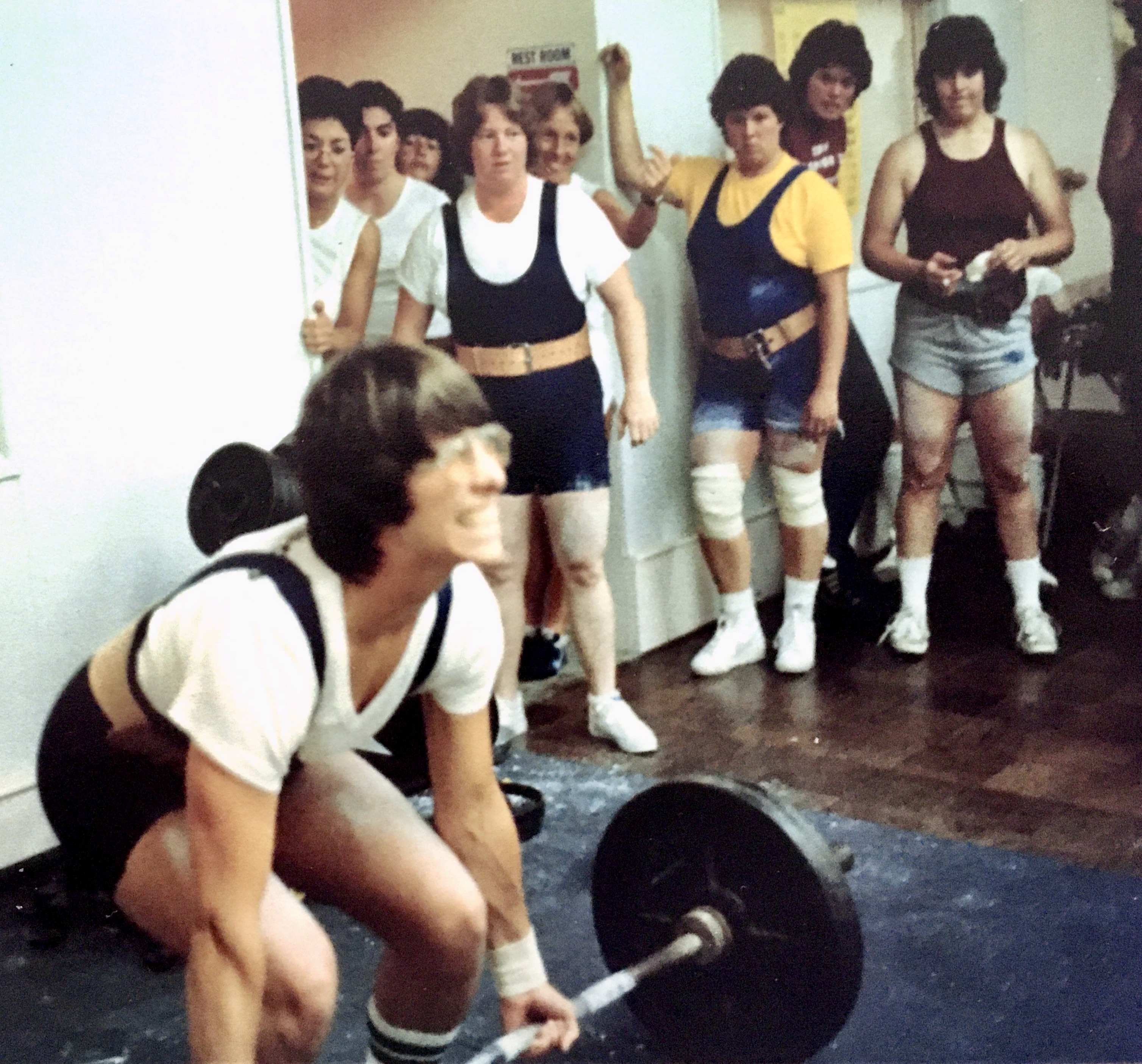
Teammates watch my dead lift 1982 Gay Games
My journey into weightlifting began in San Francisco in the mid-1970s, when I was working construction and needed to get stronger. I don’t remember exactly how the idea came to me—women simply didn’t lift weights back then—but I started going to the gym with my friend Jill for moral support. At first, we trained at the Sports Palace in the Mission, which had been an all-men gym. They didn’t even have a women’s changing room or bathroom. The owner tacked up a sheet of plywood in the corner so we could change behind it.
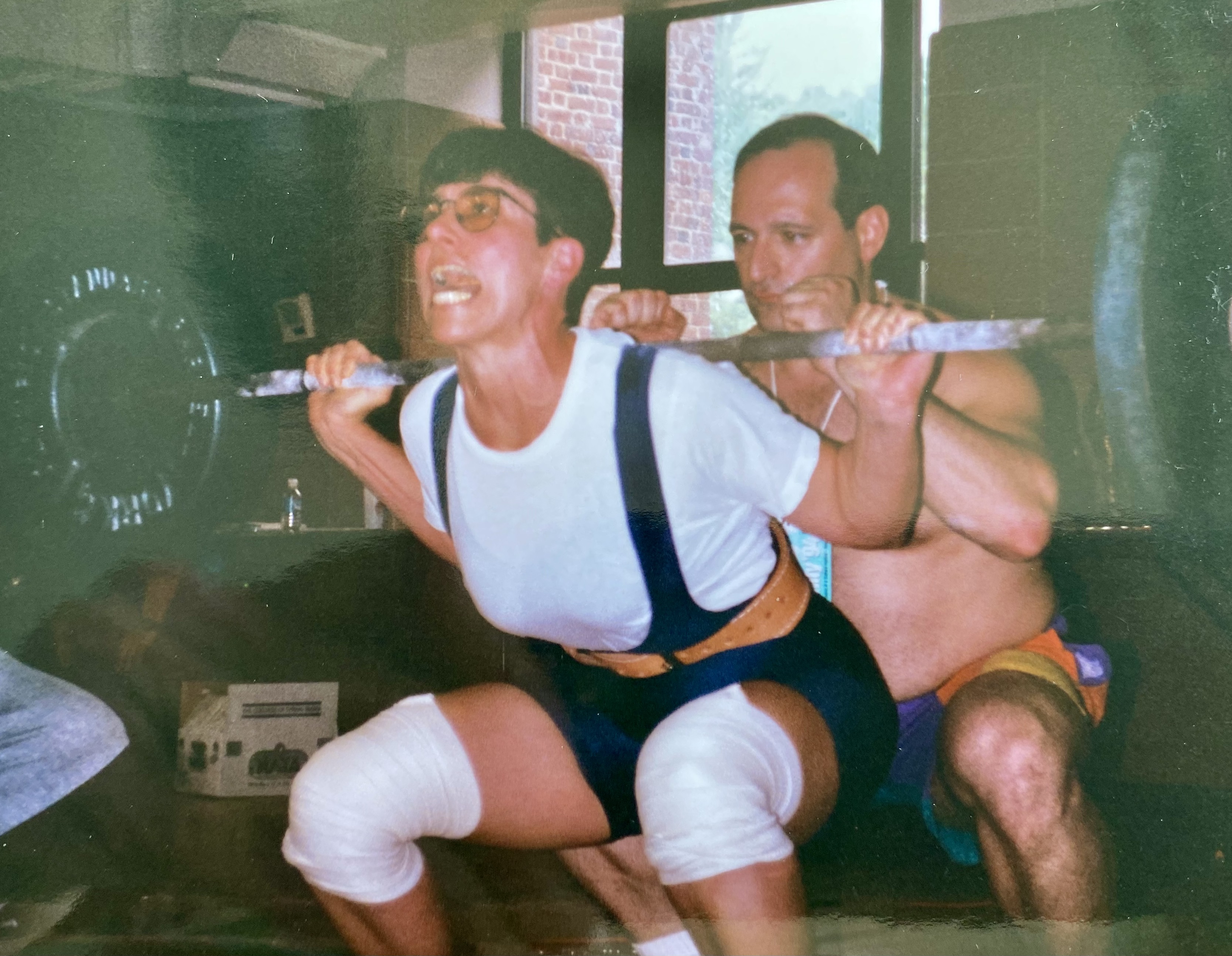
The squat, Gay Games NYC 1994
The men didn’t exactly welcome us. They didn’t like the sound of women’s voices, or having to share equipment, or having us “work in” on their sets and move their heavy weights. So when Betty Doza opened the Women’s Gym in 1979, in a storefront next to the Swedish American Hall on Market Street, I crossed over immediately.
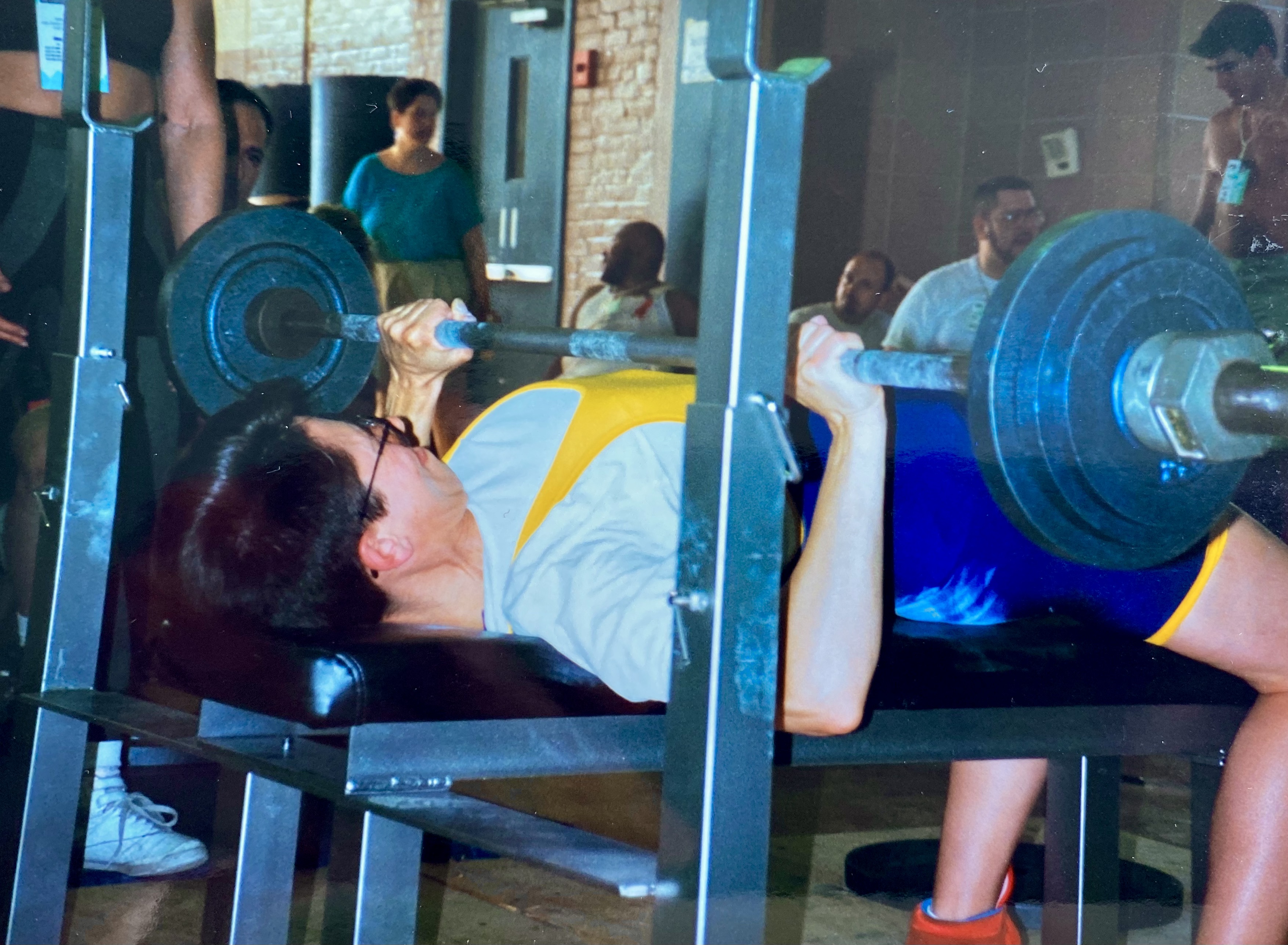
Bench press Gay Games NYC 1994
The Women’s Gym had shiny new machines upstairs, but the real action was in the basement where the serious lifters gathered. Until then, I had only learned the three Olympic power lifts—bench press, squat, and deadlift—because those were the only lifts women were officially allowed to compete in. But downstairs, women were doing the clean and jerk and the snatch. These were lifts we’d been banned from performing, so we taught each other proper form. Coaching was essential. Done wrong, those lifts could seriously injure you. It felt like sneaking gin in a Prohibition-era speakeasy—dangerous, forbidden, intoxicating.
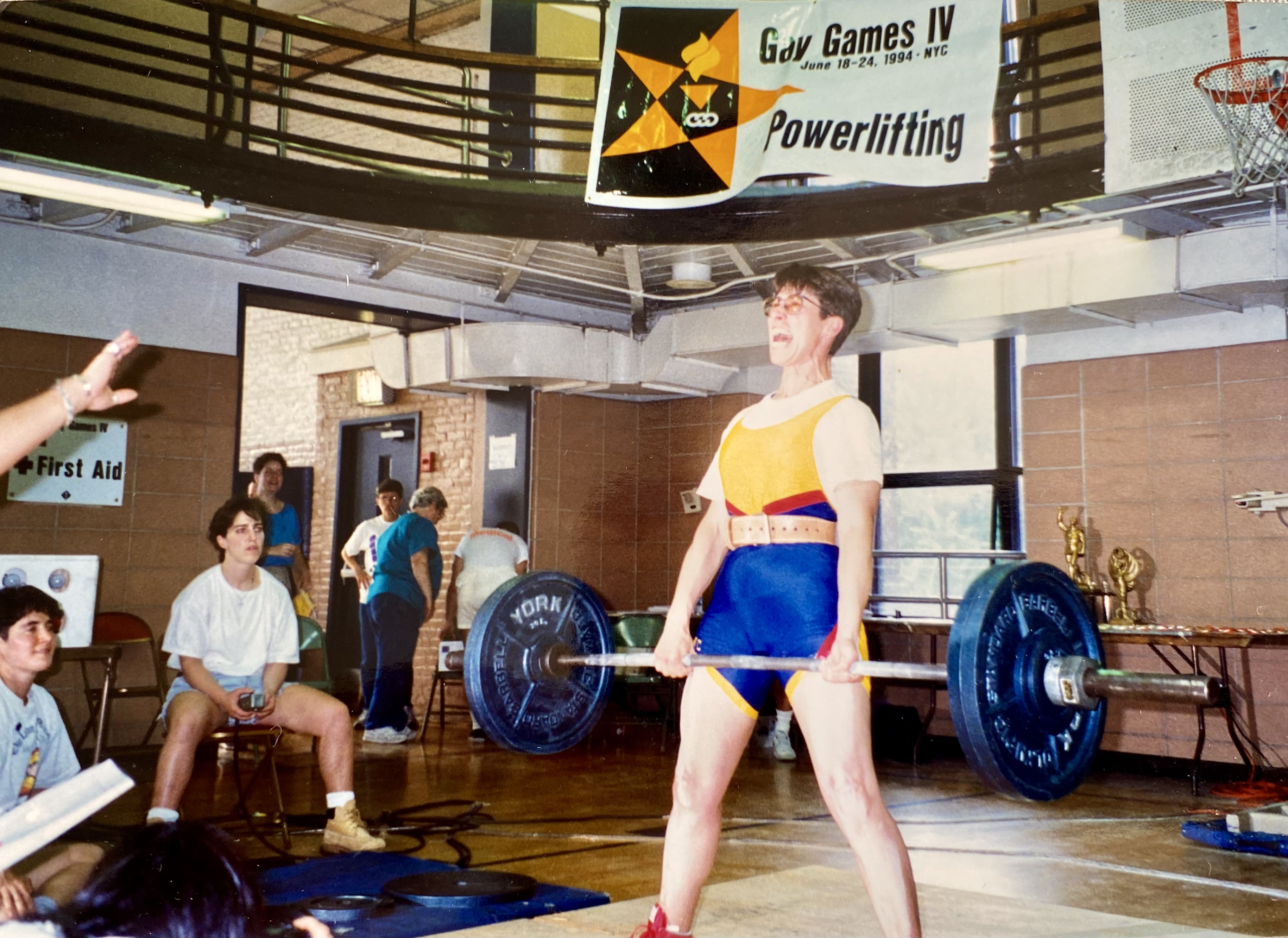
Dead lift Gay Games NYC 1994. I had changed to a wide stance.
The Women’s Gym became a training ground for women who wanted to be firefighters, cops, and competitive athletes. There are two very different branches of weightlifting: bodybuilding and powerlifting. Bodybuilding is about appearance—sculpted, ripped muscles, thinness, aesthetics. Powerlifting is about strength: how much weight you can move in three lifts. You can be fat and be a powerlifter. That distinction mattered.
I competed in the 148-pound class, usually weighing about 144, and spent my time trying to gain weight. Every pound meant more leverage, more power. While other women obsessed over dieting, I complained that I couldn’t put weight on. They thought I was strange.
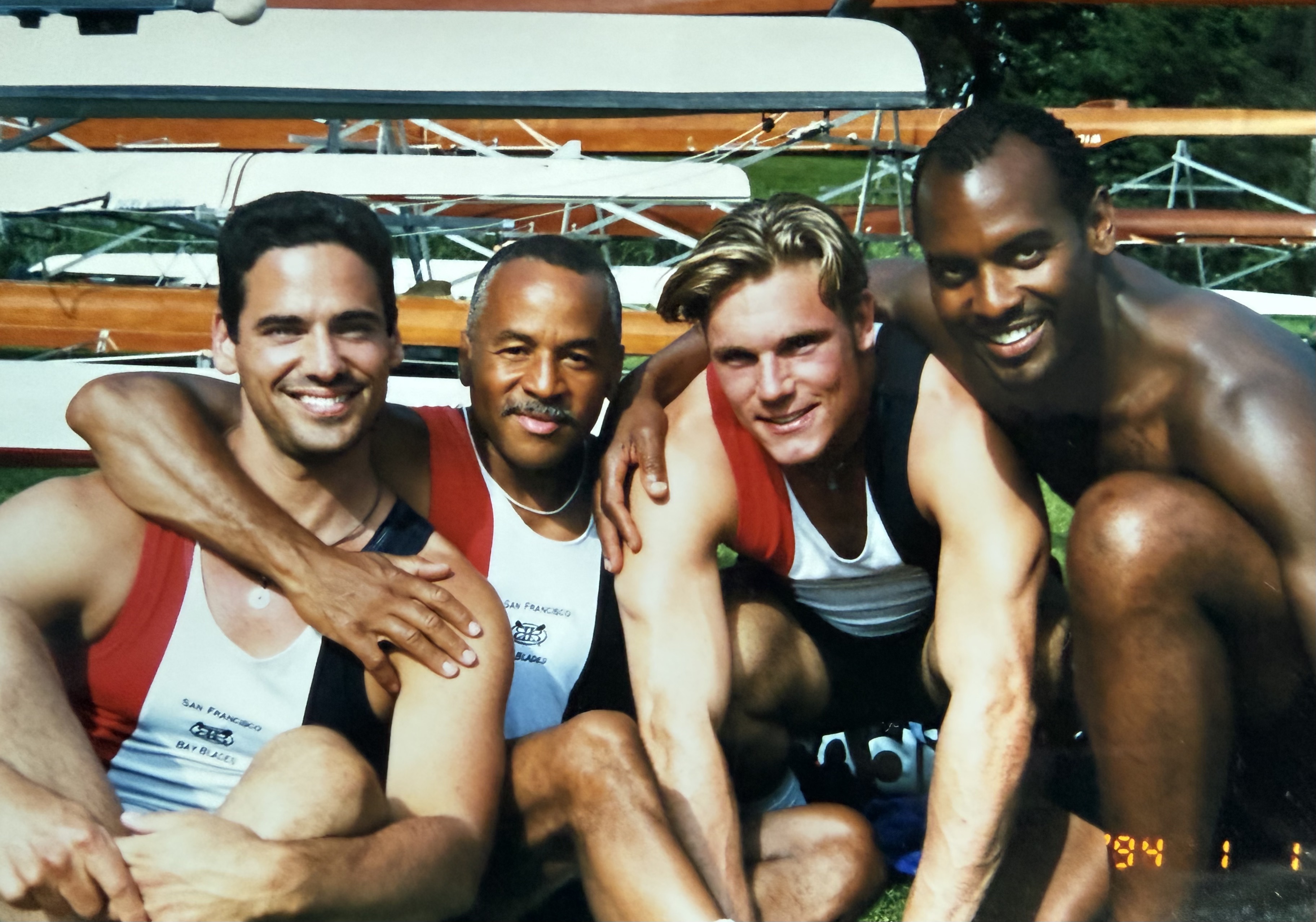
My rowing team, the Bay Blades, had some cute men too.
After workouts, we crossed Market Street to Leticia’s, a gay Mexican restaurant, for margaritas and nachos. We were strong, and we knew it. We were powerful. We were a team. There were about ten of us training together for the 1982 Gay Games in San Francisco. I’ve forgotten most of their names now, but I remember the feeling: solidarity, purpose, pride.
The 1982 Gay Games may have been among the first major powerlifting competitions for women anywhere. That year marked the beginning of what would become an international movement. We didn’t really care about medals—we were just thrilled to compete, to exist publicly as strong queer women. But I did come home with gold, besting a woman from the Netherlands.
Twelve years later, in 1994, I competed again as a powerlifter at the Gay Games in New York City. I was lifting more than I had in ’82, but the field had changed completely. The women I competed against were world-class athletes, capable of lifting three times my best numbers. Women’s powerlifting had exploded!
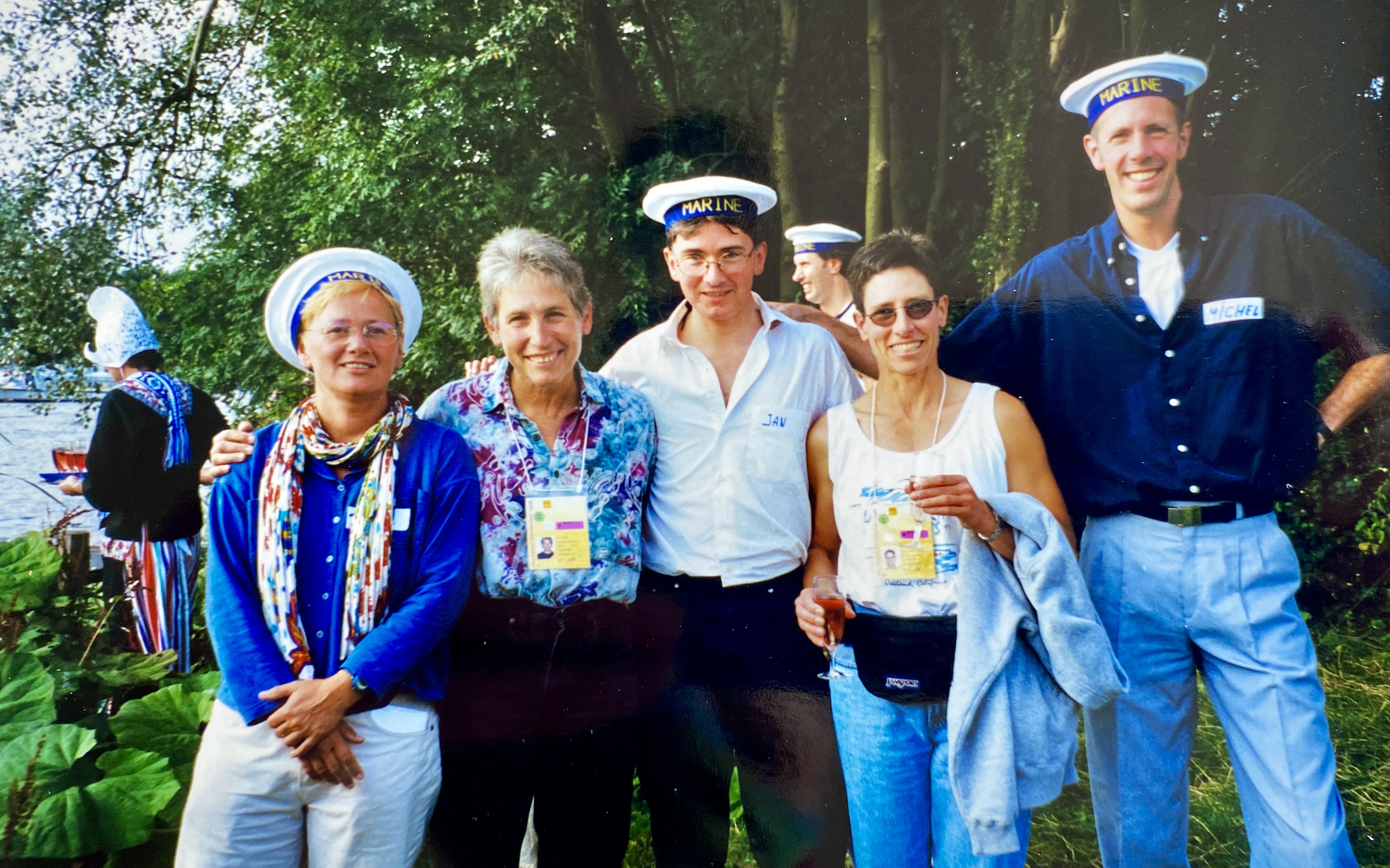
In Amsterdam the Dutch rowers greeted us in navy caps and with champagne. Nancy Stoller (L) and me with some of our hosts. 1998
The Women’s Gym didn’t survive. Men sued, claiming discrimination, and eventually won. But for a few glorious years, it was a sanctuary—a place where women could build strength, community, and defiance. The Gay Games and the Women’s Gym together cracked open a door that could never again be closed.
We weren’t just training our bodies. We were reshaping what women, and especially queer women, were allowed to be.
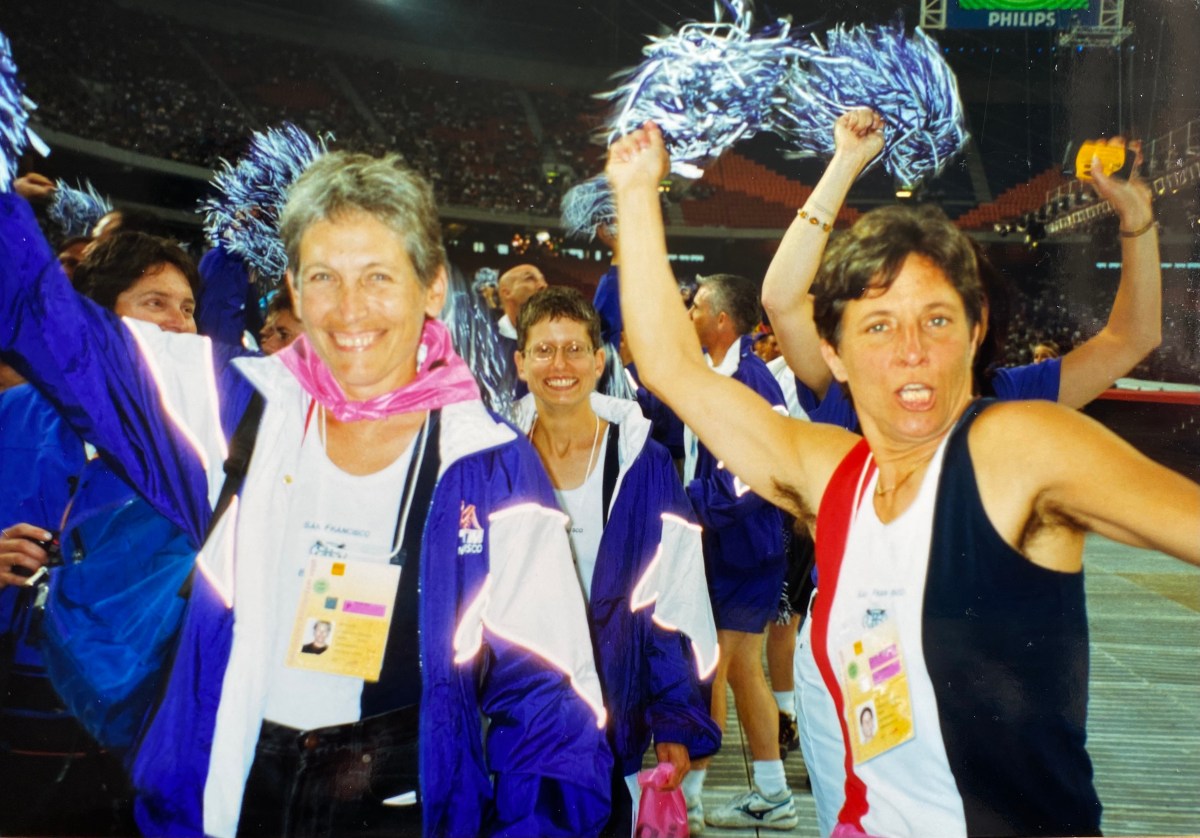
In the top picture, marching into the stadium are Nancy Stoller (L) and Helen Vozenilek of the Bay Blades rowing team. Amsterdam 1998.
On Soyal Native Americans marked the shortest day of the year
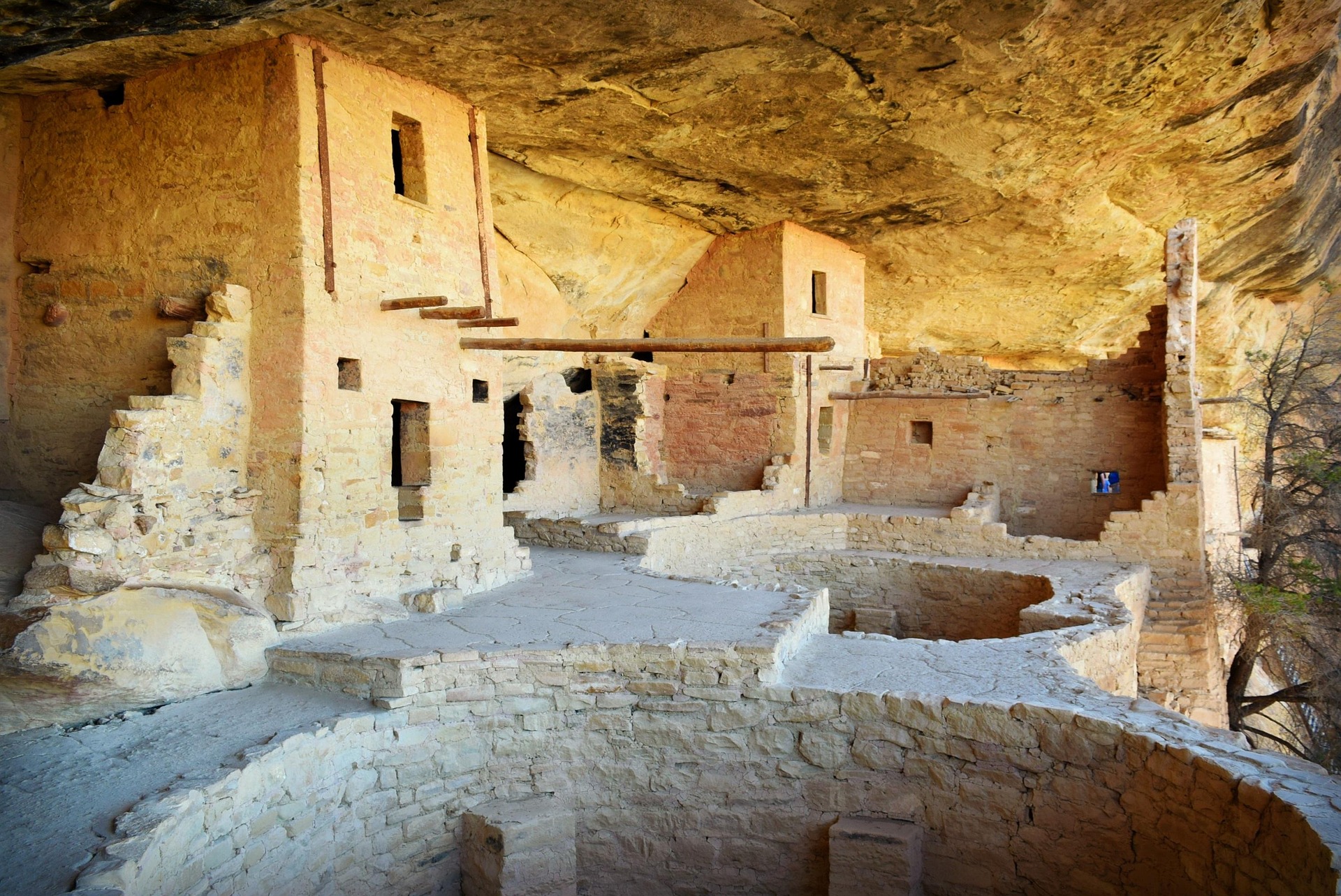
Cliff Palace in Mesa Verde National Park, Colorado. Photo by Judson McCranie. (CC BY-SA 3.0) It is believed that ancestors to the Hopi built and lived in Cliff Palace from about 1200 to 1300 C.E.
My Regular Pagan Holiday Post: Winter Solstice
My queer family chooses to forgo holidays shaped by a christian tradition steeped in homophobia and misogyny—a church that has long covered up sexual abuse against children and parishioners while scapegoating queer people. Recent comments by Pope Francis only underline this contradiction, reaffirming the catholic church’s ban on ordaining gay men and punishing and defrocking priests who question that policy or support what it calls “gay culture.”
So we create our own rituals instead—queer, chosen-family–centered traditions. We look to other cultures for inspiration, especially pagan and pre-christian practices that honor the natural world and community rather than dogma.
We can learn much from Native Americans that might help us through what is shaping up to be a particularly dark period in our history and present.
Soyal: Winter Solstice and Renewal
On the winter solstice, Hopi and Zuni peoples perform a ceremony with the intention of achieving unity and strengthening community. Soyal is held on the shortest day of the year. It marks the symbolic return of the sun, the turning of the seasonal wheel, and the beginning of a new spiritual cycle. Soyal is a time of purification, prayer, and renewal, when the community prepares itself—spiritually and socially—for the year ahead.
In the days before Soyal, families create pahos, prayer sticks made with feathers and plant fibers, which are used to bless homes, animals, fields, and the wider world. Sacred underground chambers, called kivas, are ritually opened to mark the beginning of the kachina season. The kachinas are understood as spiritual messengers who carry prayers for rain, health, balance, and right living. Songs, dances, offerings, and storytelling strengthen community bonds and pass ethical teachings from elders to children.
Soyal also dramatizes the struggle between darkness and light. Through symbolic dances and ritual objects, such as shields representing the sun and effigies symbolizing destructive forces, the community enacts the tension between chaos and order, drought and rain, winter and warmth. The message is not that darkness must be destroyed, but that it must be faced, respected, and brought back into balance.
The solstice itself becomes a sacred pause: a moment when time feels suspended and people are invited to examine their lives. It is a season for letting go of harmful habits, reconciling conflicts, offering forgiveness, and setting intentions rooted in responsibility rather than personal gain. Gifts are exchanged not as possessions, but as blessings and goodwill.
Creating Our Own Rituals
Soyal reminds us that human life is meant to move in natural cycles, not endless acceleration. Rest is not weakness; it is a form of wisdom. Renewal begins with humility, gratitude, and shared responsibility. Personal healing is inseparable from the health of the community and the land.
The enduring spiritual mission expressed through Soyal is the same across Hopi villages: to promote and achieve the unity of everything in the universe.
While that vast unity may be beyond our vision, we, too, seek to strengthen our community and mark the return of light. At winter solstice, we gather ourselves and our loved ones, shaping rituals that keep us connected to one another and to the slow turning of the year. We invite friends to help us trim our solstice tree, contribute to the local food bank, have neighbors over for hot chocolate, read poetry and stories aloud, bake cannabis edibles, host impromptu living room dance parties, cook savory soups, plant flower bulbs. With neighbors, we make signs and join street protests to raise our voices against fascism. We look for the sacred in everyday life.
She was a lesbian who played in San Francisco 1952-2020
Found in Jackie’s cluttered house
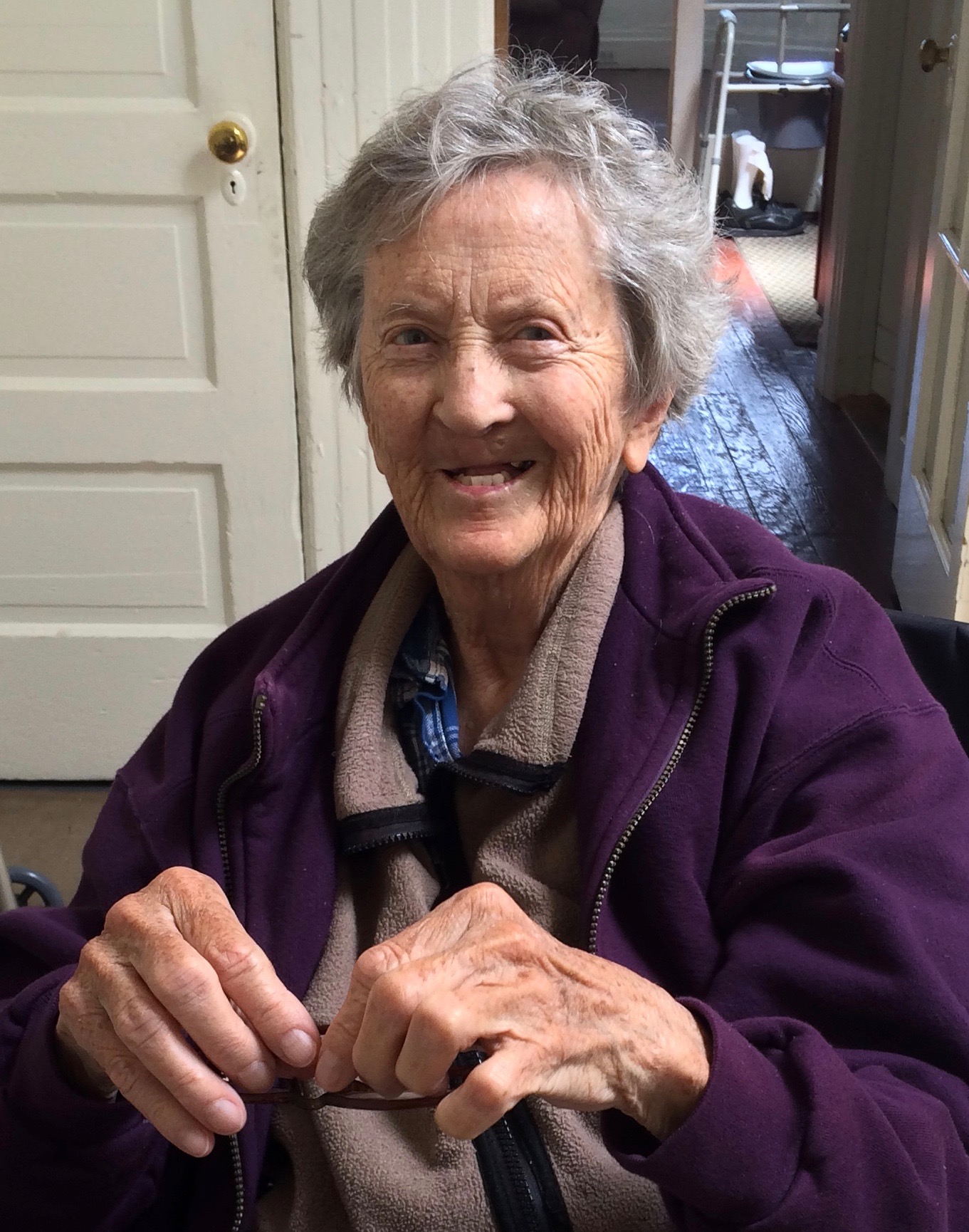
She was an old-time dyke, although I never heard her use that word, nor the word lesbian to describe herself. She did call herself kiki, meaning neither butch nor femme. She may have called herself a character. I know the rest of us did.
Jackie Jones told me music saved her life. Music was certainly the theme of her life.
I first encountered Jackie at the Alemany Farmers Market in San Francisco where she played music every Saturday. She was a one-woman band playing the saw and a selection of hand-made instruments along with a dancing cat that she manipulated with her foot.
Jackie at the farmers market. Photos by author
She made the cat contraption out of plywood, springs, bike parts and wire. She painted the cat lavender with a sparkly G-string and stars where nipples would be. The cat had articulated limbs so Jackie could make it tap dance while the arms swung around. She recorded her own back up music and played it on a portable tape deck. She only played music from the 1920’s, songs like Bicycle Built for Two, Bye Bye Blues, and The Charleston.
Kids loved the dancing cat and always wanted to touch it so Jackie invented ways to discourage them. She talked about glueing a tack on the top of the cat’s head to pop their balloons. She wasn’t fond of kids, and when the kids moved on and we got close she would change song lyrics to bawdy and gay themes.
She rewrote the words to “Wait till the Sun Shines Nellie.” Her version went “Wait till your son turns nelly, and the neighbors start to talk.” The last line was “Gay is grand!”
Jackie always wore the same clothes—a John Deere trucker’s cap, a blue plaid shirt and jeans. Her front teeth were gone and she had false teeth that fit badly, which she only wore when in public.
Jackie lived in our neighborhood of Bernal Heights, but even though my lover and I invited her to dinner at our house, she never would let us into her house. She was an admitted hoarder.
Jackie owned two houses side by side on Manchester street, bought at a time when Bernal Heights housing was cheap. She lived in one and rented out the other, one of several on that street only 12-and-a-half-feet wide (most lots are 25 feet wide).
From Pensacola to New Orleans
Born in 1926, Jackie grew up in Florida, graduating from high school in 1944.
She said, “I remember in Pensacola listening to music with the Black maid that my mother hired. She would dance around with the broom to Ella Fitzgerald singing “A Tisket a Tasket,” then be back to ‘yes maam’ and sweeping when Mom came back.”
Jackie loved music from an early age and yearned to play it, but her parents scoffed and refused to pay for an instrument or lessons. Undaunted, Jackie saved her 35 cent-a-week allowance until she accumulated enough to buy an accordion from the Navy Exchange store. She spent hours in her room, teaching herself to play.
Jackie in her little house
After WWII, Jackie left home and moved to New Orleans. Living in the French Quarter, she held various day jobs to earn her $20 a month rent. At night, she would beg bands to let her sit in just to get experience.
Jackie’s first paid gig was $3 a night, playing her accordion for eight hours straight with a country band. She learned other instruments–guitar, then drums and vibraphone. By the late 1940s, she was supporting herself as a working musician, entertaining at bars, strip clubs and dances throughout New Orleans.
Her Journey West
In 1952, Jackie drove her 1948 woody station wagon west, coming first to Los Angeles, where she didn’t last long. She said, “Where I came from in New Orleans, people see you on the street and say ‘Hi! How are you.’ In LA, you say Hi, they just about call the cops on you.”
After six weeks in LA she couldn’t take any more of the place so she headed up north to San Francisco. There the people were friendly, they didn’t all look alike, folks were helpful, there were lots of bohemians, and she was able to get a job quickly. She never went back to LA.
Rubbing shoulders with the Beats
Jackie loved San Francisco but had problems finding permanent housing. Landlords did not want to rent to lady musicians, particularly the kind that wore pants and rode a motor scooter.
She bounced from rooming house to residential hotel, from day job (taxi driver, assembly-line worker) to music job (guitar at the Town Pump bar, accordion at the 1954 opening of San Francisco International Airport).
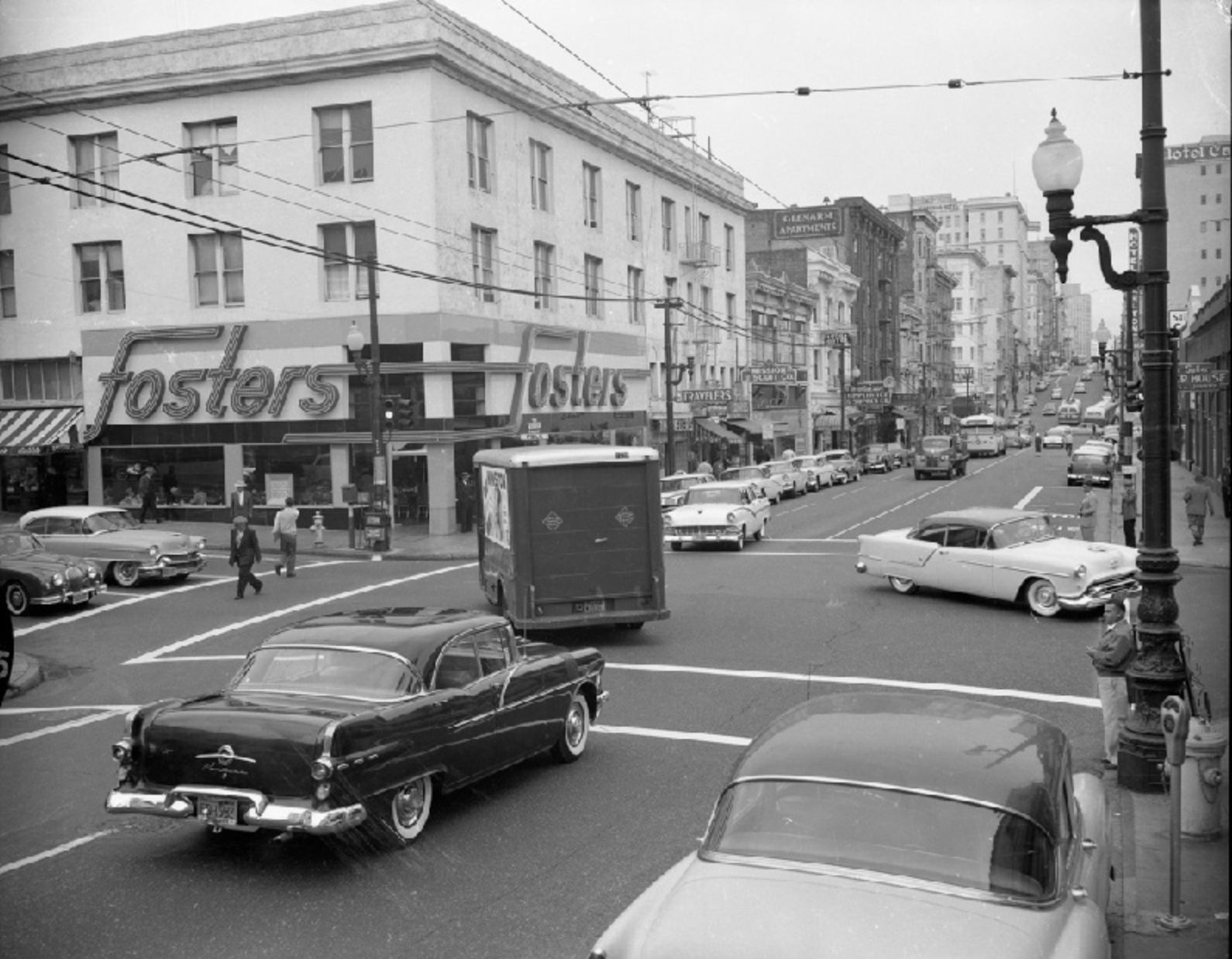
Fosters Cafeteria, downstairs from where she lived at Polk and Sutter, was open 24 hours and the bohemians hung out there. She met Alan Ginsberg and other Beats there. She became friends with ruth weiss (poet, performer, playwright and artist) when ruth worked the bar at the Wildside (a lesbian bar) in North Beach. Ruth traveled with Jack Kerouac and read her poetry around Europe and the US.
Fosters cafeteria 1956. Photo: Open SF History (wnp14.12640; Courtesy of a Private Collector)
In her spare time, Jackie attended City College of SF and SF State College, graduating with a physical science degree in 1962. In 1964, desperate for a steady paycheck, she became a mail sorter at Rincon Annex Post Office and worked there for 10 years.
But Jackie never stopped making music, working with anyone who’d hire her. She played accordion at the city’s Russian festivals and Columbus Day celebrations. She played drums for the Cockettes’ midnight shows and Kimo Cochran’s Polynesian dancing.
She played country guitar at Bay Area military bases with Faye Wayne and her Rhythm Roundup Girls, and Lady of Spain on the accordion at the Fairmont Hotel with a Latin trio. Dressed as a witch, she played Halloween gigs at the Randall Jr. Museum at an annual party for kids. Later in life she was asked to contribute her homemade music to a show at the San Francisco Museum of Modern Art.
Early lesbian culture
Jackie felt she never fit in the lesbian communities of New Orleans or San Francisco. She told me she thought the dykes in New Orleans in the 1950s fell into two groups: the fighters and truck driver type, and the professionals who needed to protect their reputations; they wore dresses and were in the closet. Jackie didn’t fit into either of those categories.
Lesbian bars didn’t hold much appeal. In those days in San Francisco women couldn’t get served if they wore jeans. They’d throw you out, she said. She never went to the lesbian bar the Paper Doll (San Francisco’s first lesbian bar, owned by Charlotte Coleman). “You’d see women wearing skirts, holding hands going in there. They were snotty to me. There was another lesbian bar called Peg’s Place. They had a room in the back and there was a little window in the wall where somebody watched you to make sure you weren’t touching,” she said.
She was a maker
House parties were no better. One Halloween the well-known San Francisco bar owner Ricki Streiker threw a party where all the dykes wore dresses and were not in costume. Jackie came in drag with a mustache. Drag had not yet caught on and she wasn’t invited back.
The only person Jackie had liked at that party was Pat Bond, the out lesbian actor who wrote and performed one-woman plays. She went home one night with Pat. They didn’t have sex; they talked all night instead. “I liked her mind,” said Jackie.
Jackie never had a long-term relationship. She had a lot of “bed friends.” I asked if that was the same as fuck buddies. Yes, she said. She would go on “sex binges” but there weren’t all those diseases out there then, she said.
“I went to the bohemian places where you had artists and a mix of interesting people. I liked the Black Cat best,” she said. “Gene Krupa came in once to the Black Cat, also Carson McCullers. Then the bar became gay when José Sarria (an early San Francisco drag queen) started his shows. I once played a show with José as his drummer. He was a nice guy. The music thing opened doors for me,” she said. “That’s why I like San Francisco.”
José Sarria performing at the Back Cat in 1958 |from José Sarria Papers| Courtesy of GLBT Historical Society
Later Jackie’s trademark instrument was a carpenter’s saw that she rubbed with a violin bow. One time Jackie came over to visit. We had several hand saws hanging in our garage/shop. Jackie pulled each out and tried it. “This one will make a good instrument,” she declared. She offered to teach us how to play the saw and we both tried. But playing the saw is hard!
Aging in place
In 2013 Jackie fell in her house, breaking her ankle and knee. But rather than call 911 and risk the fire department whisking her away to some rehab place that might never let her go back, she called some friends. She knew that if anyone from the city saw her house—the lair of a hoarder—they’d never let her back in. So, instead her friends helped her get over the back fence and into her smaller house, which was then empty of tenants.
The 12-and-a-half-foot-wide house was a studio up a flight of stairs in its original condition but otherwise in pretty good shape. The little house had two big advantages: it was not full of junk. Also, friends were now invited to visit.
When I’d visit Jackie, we would talk about musical instruments and how she made them, keys for different types of music, and what the lyrics to a song really meant. She would tell me about old time musicians she admired.
Jackie followed the careers of the Duncan sisters, Rosetta and Vivian Duncan. Rosetta was a lesbian. The white girls had a vaudeville act called Topsy and Eva that they created in 1923 about a white child and a Black child with Rosetta in blackface. It was a musical comedy derived from the novel Uncle Tom’s Cabin.
“Once I was in a show with Vivian who played Little Eva,” said Jackie. “She played the piano, sang and did comedy.” The show was a takeoff on the movie All About Eve. Charles Pierce played the part of the actress. It was at California Hall (where the infamous 1965 gay New Year’s ball took place). “I love that I can look back on doing these things,” she said.
One of Jackie’s favorite entertainers was Hadda Brooks, who ended up playing for gay audiences as she got older. “That’s My Desire” was her big number. Billed as “Queen of the Boogie,” the vocalist, pianist and composer was big in the 1940s and 50s, then made a comeback in the 90s.
We talked about death. Jackie wondered what will happen to her stuff when she dies. I was finally allowed to go into Jackie’s big house when she asked if I could help her clear it out. Every room was crammed full of junk—old computers, musical instruments, paper, clothes. There were machines that I couldn’t identify.
She had 12 guitars–none complete, some banjos, three accordions, electronics. She had 25 turntables because she was afraid she wouldn’t be able to get the needles. She kept dozens of instruments that she hoped to fix someday, inventing new musical instruments, experimenting with new sounds. She would scour the salvage yard and hardware stores for parts for her inventions and I was sent on trips to her favorite hardware store for particular screws and parts. Jackie didn’t want to get rid of anything because, she said, she might need it for something she was making or inventing. Having to let go of anything was so painful for her that the house never did get cleaned out.
We talked about the old days before gay liberation. Jackie didn’t have a partner, but she was was lucky to have the love and attention of her good friend Pauline, a sister musician who helped and supported her for 30 years.
Pauline wrote: “Jackie has always had a wary streak, not wanting folks to know all her business. I think it goes back to those ugly days in the 1940s and 1950s when she saw that being outed as gay could mean being arrested, having your name in the paper, losing your job, your residence, your family, etc.
“I’d say some of that fear still prevails. We recently had a fill-in caregiver who Jackie later told me asked her all these prying, straight-lady questions about her background: Why did Jackie never marry? Why doesn’t Jackie have her own family to look after her instead of this friend, Pauline? Didn’t Jackie ever want to have kids? Jackie gave the lady some bland answers but she wasn’t going tell her, “I’m gay. I wasn’t interested in husbands, kids and marriage.”
“Hell, Jackie didn’t tell her own family she was gay, they just thought she was weird, eccentric, and bohemian, and that was bad enough. In the 1940s, when her brother-in-law heard that Jackie was living in the French Quarter and working as a musician there, he told his wife to break off contact with Jackie because ‘We don’t associate with those kinds of people.’
“Why isn’t your family looking after you, Jackie? Because they were bigoted, small minded, homophobic assholes. Why don’t you want to tell people you’re gay, Jackie? Because there are still a lot of bigoted, small minded, homophobic assholes out there.
“Jackie has great survival instincts and is still following them. She is very proud of the fact that she never got arrested on a morals charge (or any other charge) back when plenty of her gay and lesbian friends were being pulled out of bars and thrown into paddy wagons.”
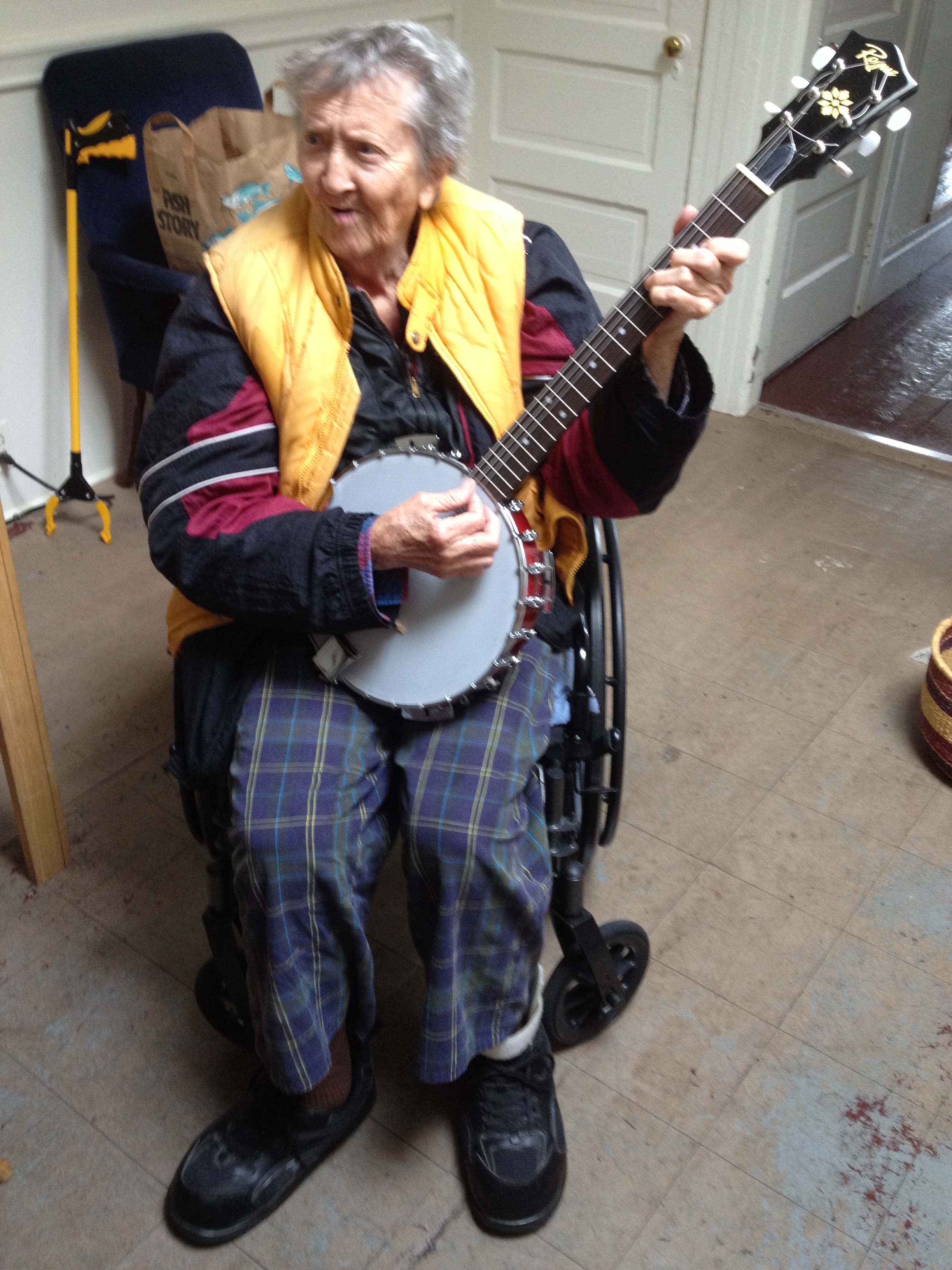
Jackie gave me banjo lessons. Photo of Molly by Barb Schultheis
Jackie never had to go to a nursing home. She lived with caretakers in the little house till she died in 2020 at the age of 93. Her friend Pauline was there when she died.
From the invitation to Jackie’s memorial: “Friends and neighbors of Jackie are invited to attend and celebrate Jackie. Per Jackie’s instructions, this is NOT to be a religious event but a party. All musicians are asked to bring their instruments so we can remember Jackie musically. By Jackie’s specific request, NO religious music of any kind is to be played. However, we welcome jazz, standards from the 20s and 30s, Latin, country-western, and any other music that swings.”
Jackie Jones was someone who discovered her passion, music, at an early age, and she never lost her love and enthusiasm for it. Music was the focus of her life: performing it, listening to it, collecting sheet music and instruments, arranging it, practicing it, recording it. Jackie had lovers but never had any girlfriends. That’s because she had found her great, all-consuming love…music.
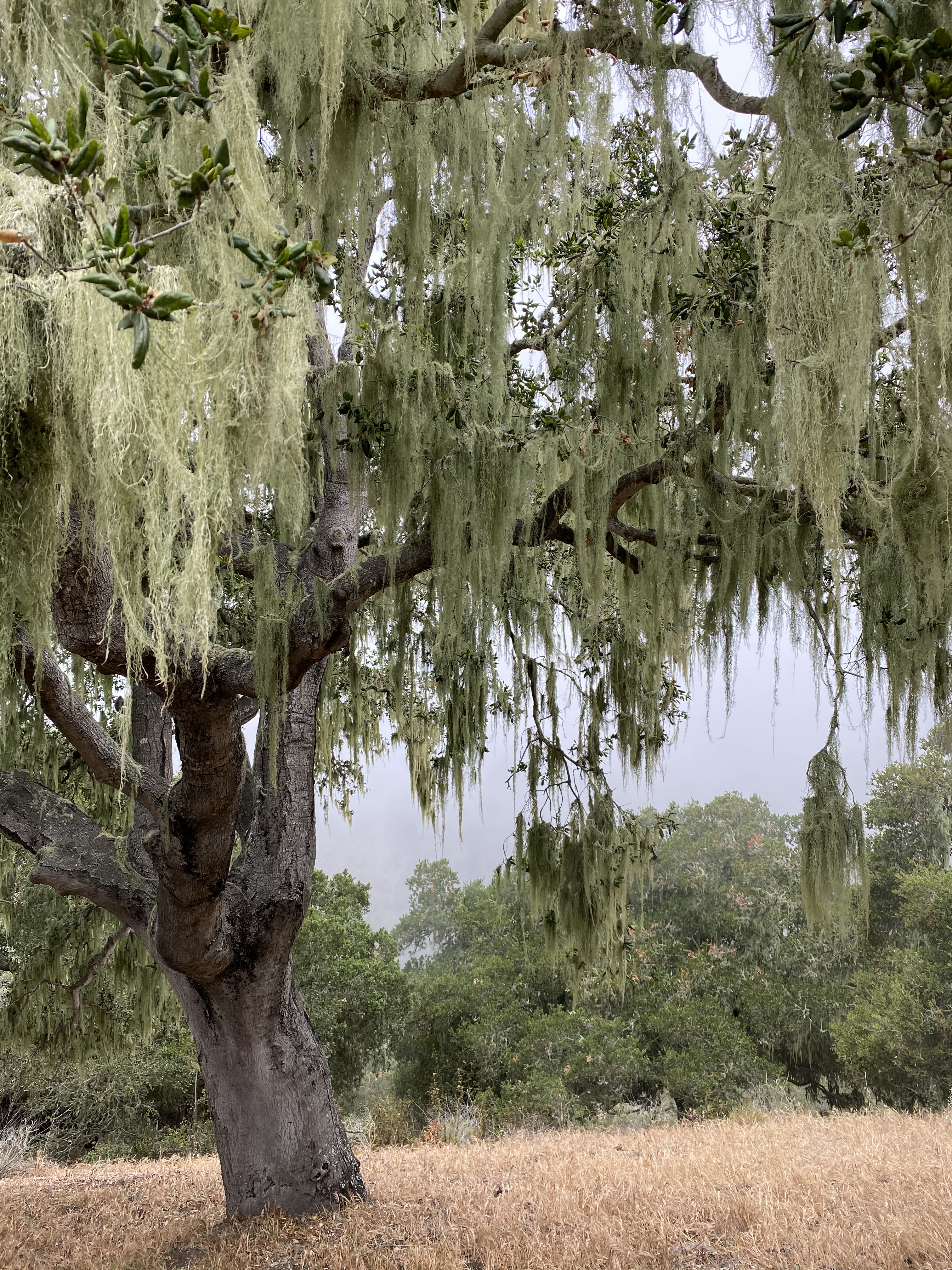
It felt like fate. On our very first date, a hike in the hills above Muir Beach, Holly and I bonded over plants. She pointed out a lichen growing on an oak tree—Usnea. To identify it, she said, you snap a branch and pull it apart until you see the central cord inside.
Usnea on oak. Photo by author
Usnea is known by many names: old man’s beard, beard lichen, or beard moss. A sensitive bioindicator of air quality, it only thrives where the air is clean and unpolluted. For centuries, it has been used in traditional medicine to treat wounds and infections. Today it’s still valued—for easing sore throats, helping wounds heal, reducing fevers and pain, even as a possible cancer-fighting agent.
Holly, now my wife, is a witch and an herbalist. She first learned about Usnea from a teacher of medicinal plants, and today her garden overflows with remedies.
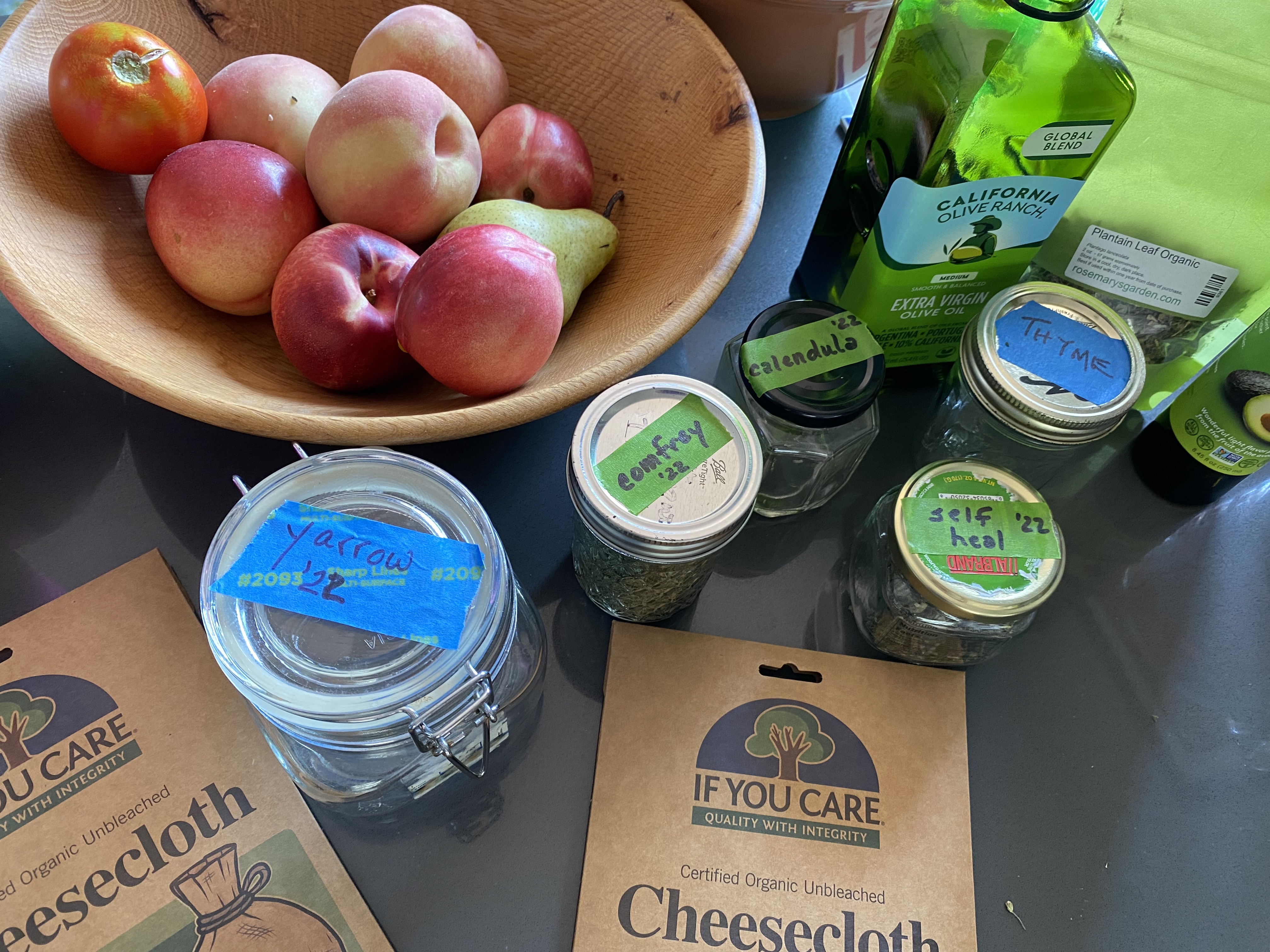
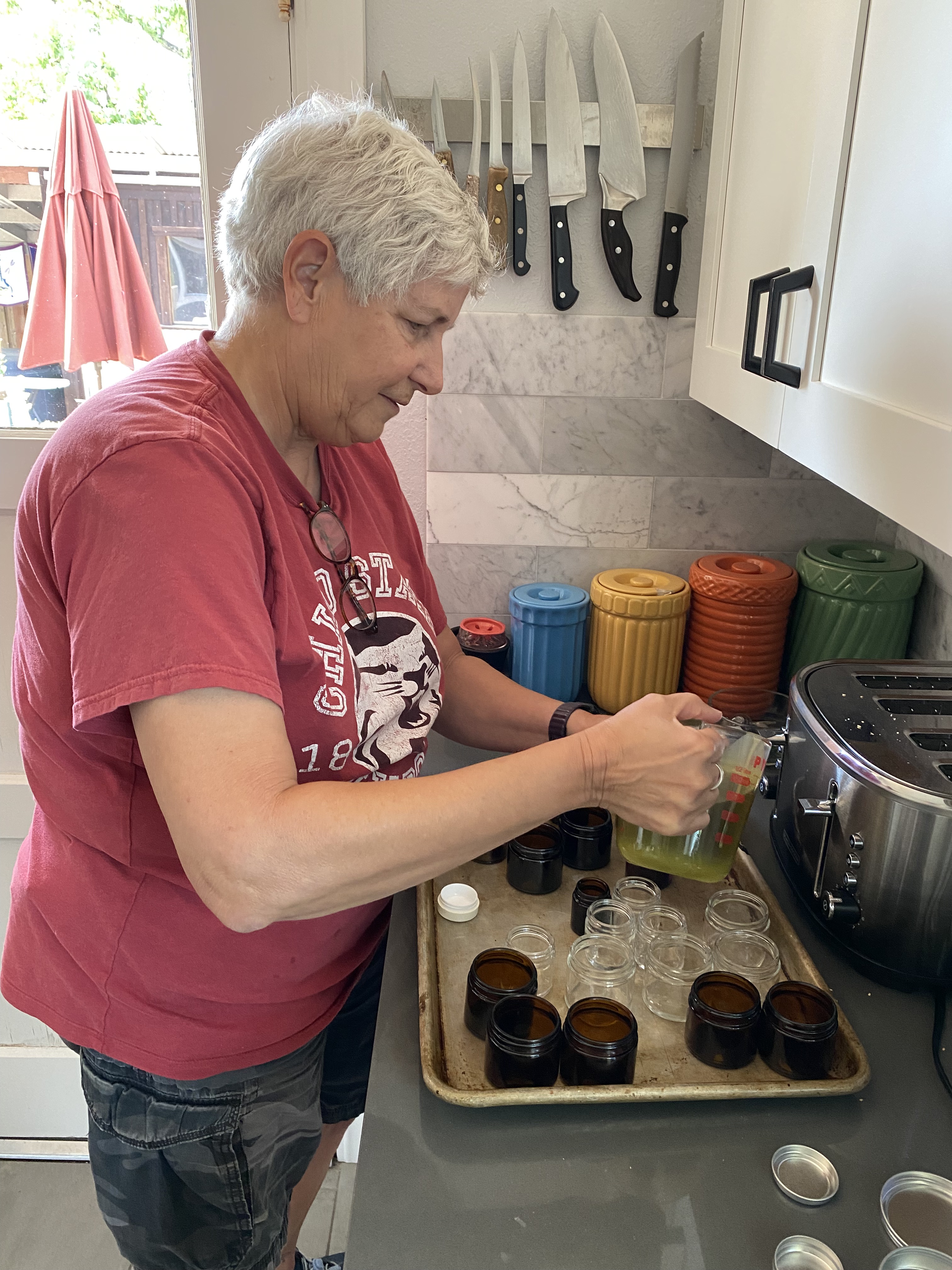
The fall equinox—Mabon—is our time to harvest herbs and brew up remedies. Holly stirs up her bite balm, a salve for every kind of skin irritation, while I turn to cannabis. Since I don’t smoke, I’ve studied the alchemy of decarboxylation: gently heating the herb to unlock its powers before infusing it into oils for cooking.
NettleComfreySelf Heal
Some of the herbs in Holly’s garden. Photos by author
Together we blend teas from garden herbs. Our MoHo Blend we make from nettle, comfrey, and lemon balm. Comfrey mends bones; nettle brims with minerals; lemon balm lifts the spirit. Holly grows native yarrow, too, and last week she showed me how to stop a cut from bleeding: chew a fresh leaf and press it to the wound.
Some of the ingredients for bite balm. Photos by author from 2022
This season, I’m also harvesting and drying figs. Sonoma County is fig country, rich with varieties—Black Mission, Brown Turkey, green Kadota, Adriatic. The fig in our own garden is called Celestial: small, pink-fleshed, and honey-sweet. I can’t resist foraging (with permission) from neighbors’ trees, and the green figs from the tree across the street are my favorite treat.
Earlier in the summer we dried peaches from our little orchard. We peeled and cored the apples that hang over from next door, simmered them into apple sauce and pie fillings for the freezer, and pressed the rest into juice with friends. These harvest gatherings always feel like old-time rituals, neighbors bound by fruit, labor, and laughter.
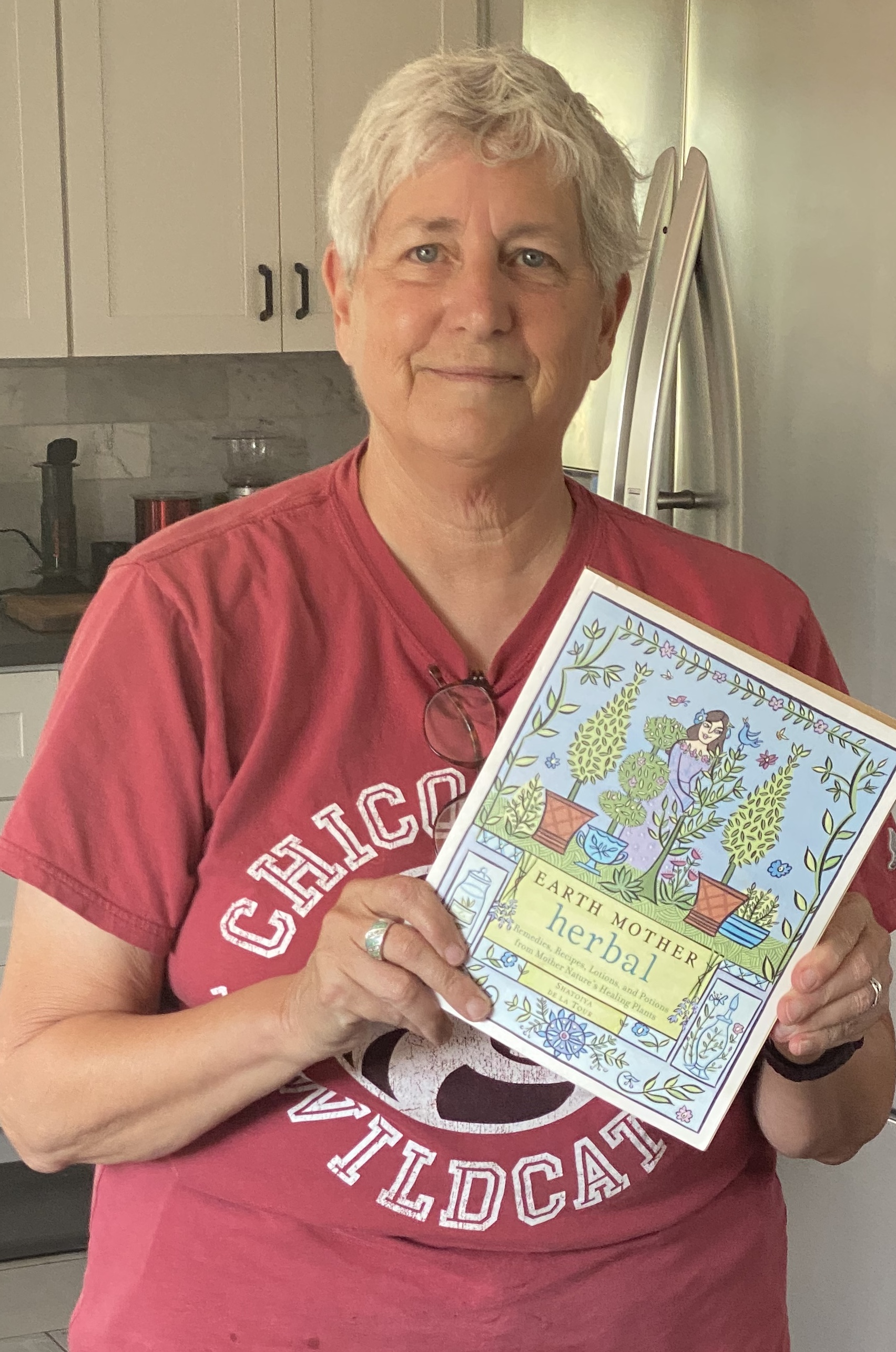
Holly pouring the final productOne of many reference books
Our garden is more than soil and stems. It is a living grimoire—a book of green magic—where medicine, ritual, and daily life are entwined. Harvesting and making are rituals of resistance too: an antidote to the anxiety of a world slipping toward fascism. To touch leaf, fruit, and root is to salve our spirits, to root ourselves again in Mother Earth.
August 1 marks the traditional Celtic holiday of Lammas, the first harvest festival on the pagan Wheel of the Year. According to the National Day Calendar, August 1 is also National Girlfriends Day. Judging by the ads, it might seem like a holiday invented to sell wine glasses and diet aids, but I plan to celebrate it anyway.
What does “girlfriend” mean in lesbianland?
In lesbianland, the word girlfriend carries a lot of weight, and a lot of meanings. It can refer to a platonic friend, a lover, or something in between. Back in the day, it usually meant lover. There simply weren’t enough words to describe us dykes or the nuanced ways we related to each other. For a while, we adopted partner, but that often got confused with business partner.
Girlfriends for 40 years, my friends Char and Eileen finally got to be wives.
Very few of us used the word wife, and I never liked it.
As a budding feminist, I wanted no part of marriage. Wives, in my mind, were helpmeets, baby factories, second-class citizens. Property. In some states, it was still legal to kill your wife for adultery. Spousal rape wasn’t outlawed. Until 1974, women in the U.S. couldn’t even get credit in our own names. Before that, we had to depend on husbands.
The feminist movement changed all that. But I still never wanted to be a wife.
Girlfriend. Partner. Wife. Spouse.
Some lesbian couples still use the term girlfriend. They let their friends know they don’t like the term wife and don’t use it to refer to each other. Others in my Boomer generation have come up with alternatives. One couple calls each other spouse and spice.
But I’ve become a wife convert.
I’ve been married twice. Maybe three times.
My ex, Barb, and I went to Vermont after it became the first state to legalize same-sex civil unions in 2000. But in 2004, San Francisco Mayor Gavin Newsom opened the doors to same-sex marriage. Thousands of couples–ourselves included–flocked to City Hall. Even though it wasn’t yet legal at the state or federal level, it felt revolutionary. Queer couples, dressed in their finest, stood in line all day in the rain, in the sun, waiting for a marriage license. Bouquets, cakes and good wishes arrived from around the country. The whole city felt like a wedding party. As City workers, Barb and I even got trained to be wedding officials ourselves. A lovely gender-free ceremony was provided.
Barb and I first got married at a park in Vermont. With witnesses Jen and Michelle
Barb, then the San Francisco fire marshal, arranged for the SFFD chief, Joanne Hayes-White, to officiate our wedding in City Hall. In every room, in every hallway, people were saying vows. It was beautiful chaos.
As we walked through the metal detectors and the guard called me “sir,” I turned to Barb and said, “Well, I guess I get to be the husband.”
That was not fair. With her crew cut, she got misgendered as often as I did. Neither of us really wanted to be a wife. But in this country, being legally married means access to health insurance, tax benefits, hospital visits, and death benefits. There were–and still are–good reasons to marry.
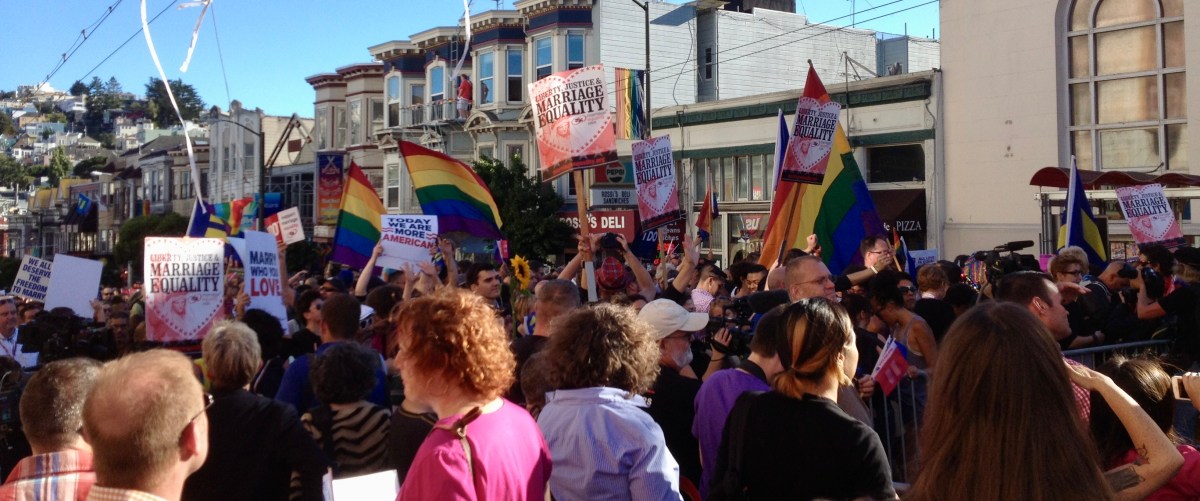
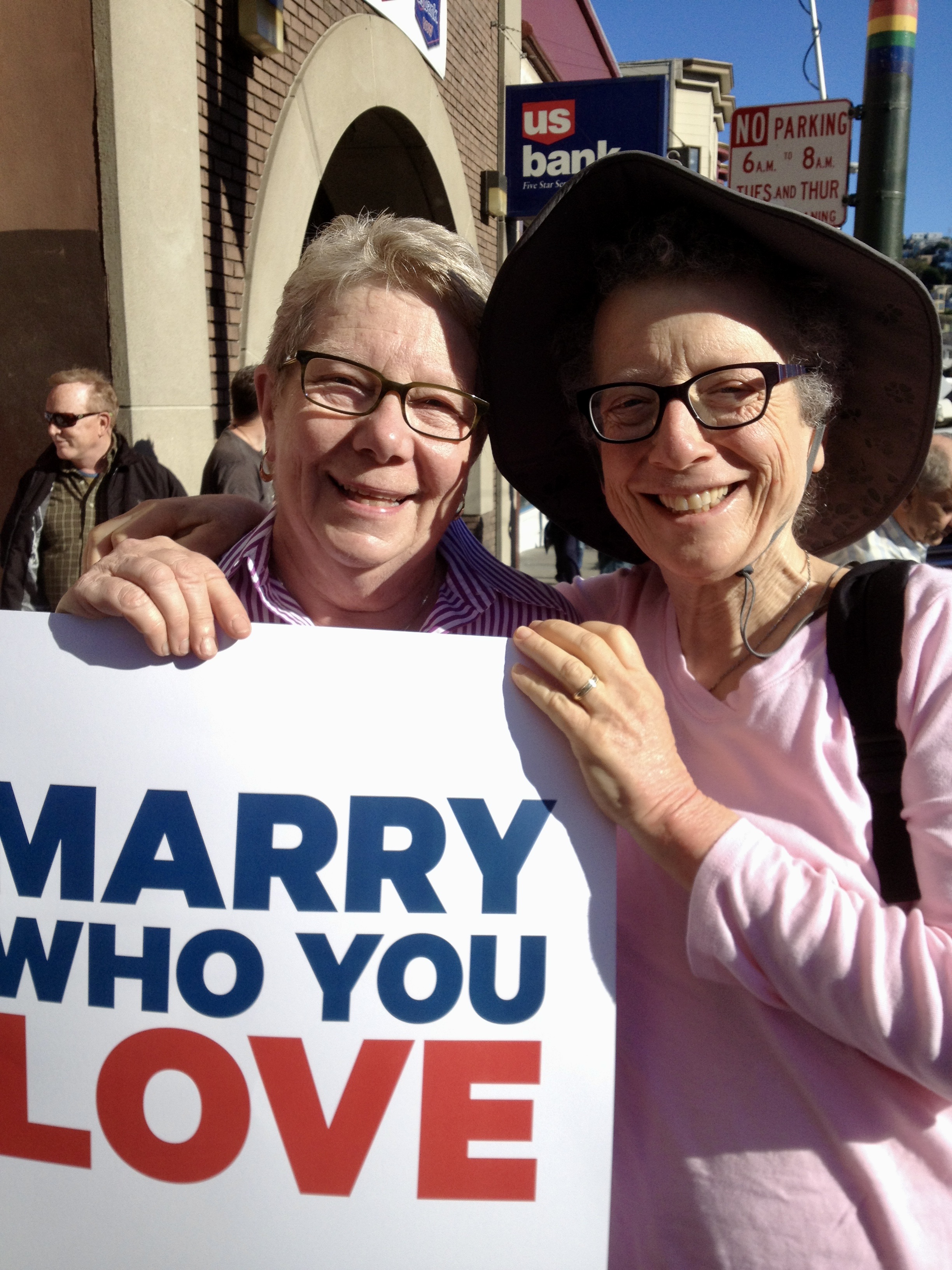
The road to legal gay marriage was long and convoluted, culminating with the 2015 landmark civil rights case Obergefell v. Hodges. But in 2013, United States v. Windsor overturned key parts of the Defense of Marriage Act (DOMA), reinstating same-sex marriage in California. (Thank you, Edie Windsor!) By then, Barb and I had broken up. But because of legal limbo, we hadn’t been able to divorce. When the Supreme Court’s decision came down, we all ran to the Castro to celebrate. People held signs that said “Freedom to Marry.” For us, it was also the freedom to divorce.
And then came Holly
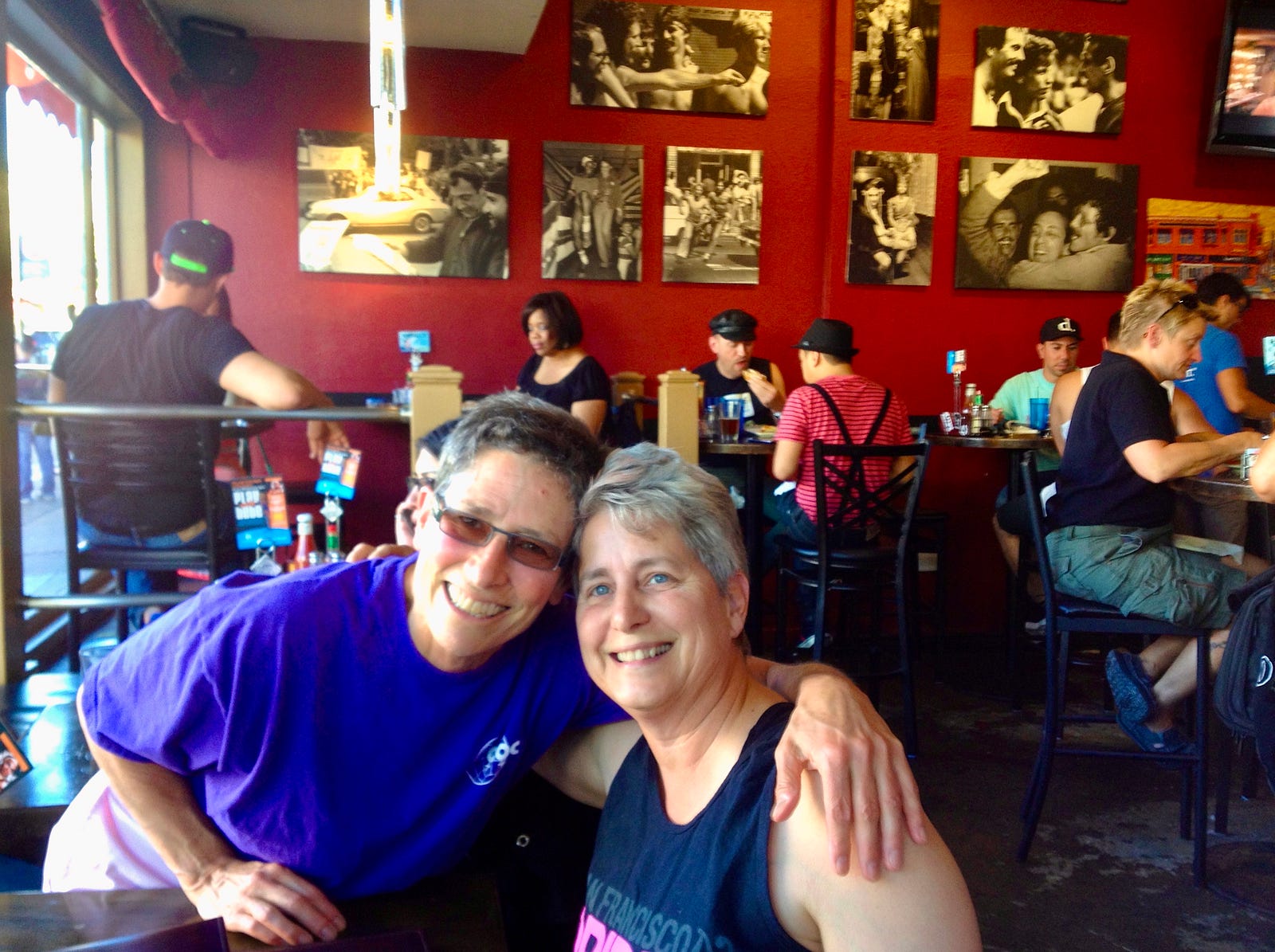
Holly and I celebrating on Marriage Equality Day at Harvey’s (named after Harvey Milk)
Holly and I were married on April 19, 2014, at Muir Beach–the site of our first date. The wedding was officiated by our gay cousin Richard, dressed in the robes of his Episcopal priest friend who had been defrocked for gayness. Witnesses were my brother Don and his husband John.
I love introducing Holly as my wife. It’s a simple, meaningful word. A word I once rejected. And, frankly, it helps when talking to straight people, and still sometimes provides a bit of shock value. Everyone knows what wife means.
Brother Don, Richard, Holly, me and John jump for joy at our Muir Beach wedding
Oh, and for the record, we introduced our exes to each other. They got married too.
How to describe our relationships with each other? We call ourselves Exes and Besties. But you could call us a gaggle of girlfriends.
Beards and Bushes and Leg Hair Inspired by a photo of Cathy Cade.
It was 1967, and I was a freshman at Washington State University, living in the dorms—tiny rooms where two people shared a space roughly the size of a generous closet. Once you pulled the beds out from the wall, you had about six inches of precious real estate between them. Cozy!
The bathrooms were shared among all the women on the floor. There was a communal bathtub where I’d perch, shaving my legs with a double-edged razor and a bar of soap. I hated it. I hated the shaving, I hated the blood, the injuries, the boxes of band aids needed for cuts. I’m pretty sure I clogged the drain more than once.
This was before the feminist movement really revved up, but some baby rebel deep inside me was already stretching her hairy legs. I decided to stop shaving. In fact, I committed to it scientifically—I posted a chart on the door of my dorm room and recorded the weekly growth of my leg hair.
What did my floormates think? I imagine they thought I was completely out of my mind. No one said much of anything, which either means they were too stunned to speak or too polite to comment on the inch-long leg hair I proudly tracked like it was a science fair project. Either way, I felt free. No more razors. No more blood. No more pretending to be a hairless woodland creature.
Later, in a collective house with three other dykes, we turned body hair into a competitive sport. Who had the hairiest legs and the most luxuriant bush? Our favorite outfit was just a vest. That’s it. No pants. No shirt. Just full-frontal follicular glory. Sadly, despite my natural abundance, I was not the hairiest. Mahaney’s glorious blond leg hair made her look like she was wearing angora leggings.
Years later, in another act of feminist rebellion, I ditched the bra. My breasts are ample and gravity is real, but so is back pain. Bras hurt my shoulders, and every one I tried felt like medieval armor built by men who’d never met an actual woman. At first, going braless felt like I was walking around topless at a PTA meeting. But eventually, I got used to the freedom—and the bouncing and the sweaty undertits.
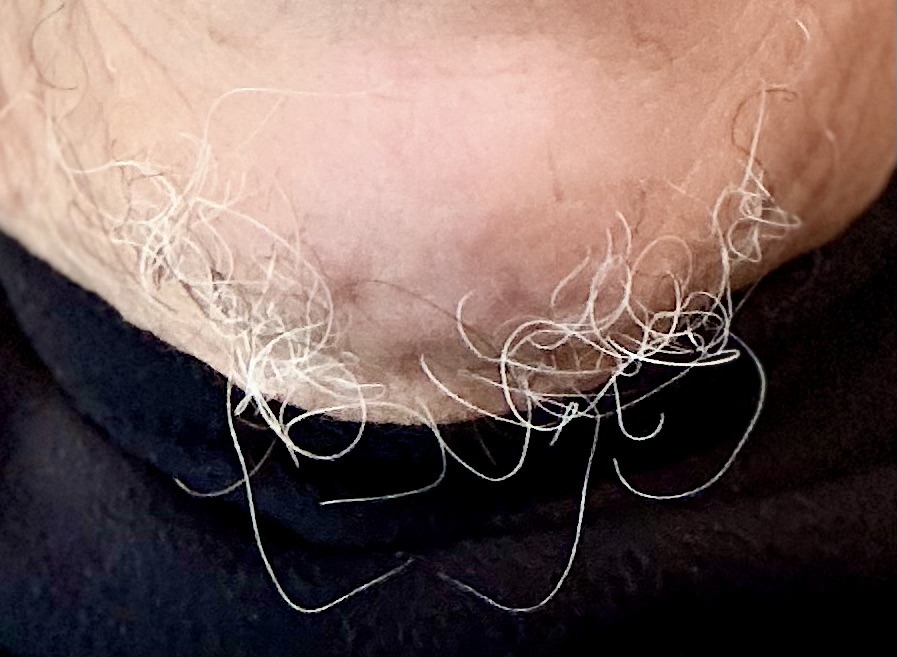
Then recently, inspired by a New York Times obituary photo of the celebrated bearded dyke photographer Cathy Cade, I decided: it’s beard time. I’d never grown one before, though I’d thought about it. My chin hair was never cute, but now that it’s gone gray, it’s looking rather distinguished. Professor Dumbledore meets anarchist grandma.
I asked my wife what she thought. Her response—paraphrased for the sake of civility—was essentially: “If you grow a beard, I will disown you, move to another state, and possibly enter witness protection.” She was not a fan.
But of course, that only made me want it more.
Now it’s grown in, and it’s introduced me to a whole new world. It came in at odd angles, curly, wiry, determined to defy gravity. One side’s a little fuller than the other, probably because I got electrolysis in the ’90s when I still cared what strangers thought. Regrets? Maybe. I could have had a resplendent full beard by now.
Still, I love playing with it. I twirl it, stroke it, and now completely understand why men do that—it’s like a built-in fidget toy. Plus, it moves in the wind. My chin hair dances! Who knew?
So far I’ve gotten no positive reactions to my beard. I thought men might appreciate it, so I asked two old man friends for their opinions. One said, “Cut it off.” The other said, “Trim it.” Translation: “We hate it.”
The best, most diplomatic, reaction I’ve gotten was, “It’s not something I would choose.” Ouch. One woman told me, “I pluck mine.” Been there. Plucking is a full-time job, and I’m on permanent vacation.
Then at an Old Lesbians retreat I met another bearded woman. A sister! She has been rocking facial hair for years. I asked what bosses and parents thought. She said her family had taken it in stride. Her mother didn’t mind the beard, but she insisted my friend wear a bra when she visited back home. Her boss at a medical facility had been a gay leather man who’d protected her from the higher ups.
There’s this fantastic TikTok group started by a Black woman for menopausal and post-menopausal women—listing all the things we no longer give a damn about: bras, makeup, body hair, expectations, decorum, patriarchy. I’m joining. I might even get the vest out again.
In the 2000s, I began to deconstruct my Bernal Heights home. In opening up the walls, I started to uncover the house’s history, leading me to an investigation into its owners and architectural evolution from the distant past to its having been bought by my lesbian collective in 1980. The story of 386 Richland Avenue is one of Bernal Heights, San Francisco, and California more broadly, speaking to themes of land ownership and development, the legacies of slavery, and the role each person has in shaping their neighborhood.
386 Richland Avenue 1980.Photo: Molly Martin
An old house holds the ghosts and remnants of all the people who have occupied it over the years. When you live in an old house I believe you must acknowledge all the people who have lived there and the people who built and worked on the house.
When I got to San Francisco in 1976, I decided there was no place I’d rather live. I had never owned a house before and really had no hope of ever owning a building in San Francisco until my living collective of four lesbians agreed to pool our money.
I got curious about the history of our Bernal Heights building as soon as we bought it in 1980. How old was it? Real estate records said it was built in 1900, but that is the default date for all San Francisco buildings built before the earthquake and fire of 1906 destroyed city building department records. So I knew it was probably built before 1900. It was always a weird looking building: three stories with three flats over a garage. Notice the weird roofline and window placement. What architect would design such a building?
I wanted to know who had lived there before me.
The Land Underneath
Ohlone village
The first human residents of this land of gently rolling grassy hills were the Ramaytush Ohlone. Hundreds of shell mounds have been uncovered all around the San Francisco Bay and there is evidence of a great Ohlone settlement at the mouth of Islais Creek, which once flowed just down the hill south of my house where Alemany Blvd and Interstate 280 now flow with traffic. Before progress changed its course and buried it, Islais Creek formed a deep gorge on the south side of my neighborhood of Bernal Heights. The creek was long ago undergrounded and replaced by freeways but the gorge remains.
I was delighted to learn that islay is an Ohlone word naming a native bush called the islais cherry (Prunus ilicifolia) that grew along the creek and still grows in forgotten corners of San Francisco. The shiny leaves look like a cross between holly and oak. And the fruit is edible. They were eaten by the Ohlone along with plentiful bay creatures, shellfish, fish, birds, deer, and other land animals.
Spain had laid claim to San Francisco and what it called Alta California in 1542. Starting in the 1760s the Spanish established missions from San Diego up to Sonoma along the king’s highway or El Camino Real, now Mission Street and Highway 82. The Spanish and the Indians they enslaved built San Francisco’s Mission Dolores in 1776, and so the road from San Jose and the south had come sometime before that. These are well-traveled pathways that extend quite far back in time.
After Mexico won independence from Spain in 1821, it secularized the Catholic missions. In order to receive a Mexican land grant, a man had to be a Catholic. But the land was not handed out to the church as it had been by Spain.
José Cornelio Bernal was granted a league, about 4,400 acres, by the Mexican government in 1839. José was the son of Juan Francisco Bernal who, with his family, arrived in San Francisco with the Spanish Anza expedition in 1776. José and his family were cattle ranchers, some of the original Californios. Over time they lost the land to squatters, lawyers, and bankers. The family first defaulted in 1859 to William Tecumseh Sherman, a banker before he became a Civil War general, who had loaned the Bernal patriarch money. The Bernals finally relinquished their last 25 acres to foreclosure in 1917. It marked the passing of the very last bit of San Francisco real estate from the families of original Mexican land grantees—the Californios.
The area south of the Mission including Bernal Heights was not platted until after the Civil War. At that time the lack of transportation infrastructure made lots hard to sell.
Large sections of southern San Francisco fell into the hands of the real estate developer François Louis Alfred Pioche. Pioche platted and developed much of southern San Francisco. A French financier, Pioche is described as a suave and cultured European who introduced fine French wine to San Francisco’s elite, an influential player who lived openly with his male lover and business partner, L.L. Robinson. No one is sure why he committed suicide in 1872.
Bernal Hill in 1875.Photo: Carleton Watkins, courtesy of California State Library
Carleton Watkins (1829-1916) was one of the most famous outdoor photographers of the American West. He also made many pictures of the growing city of San Francisco, like this one taken in 1875. From around Silver Avenue, looking north to Bernal Heights, the bare grasslands of southwest Bernal are revealed with the Mission District and the town of San Francisco in the distance. The prominent enclosure nearby is the site of St. Mary’s College. It faced Mission Road (now Street), the principal route at the time. College Hill Reservoir is the flat area near the center of the picture. The fenced circle denotes Holly Park, donated to the city in 1862 by the silver mining baron James Graham Fair. On the extreme right is the top of Bernal Heights. My house would be just to the right of this picture near the east edge of Holly Park.
Building 386 Richland
When we bought 386 Richland, the place was a mess. The most recent owner had “remodeled” by covering the walls and even wood window trim with quarter inch sheetrock. I’m an electrician. Trying to solve an electrical problem, I discovered live bare wiring between the sheetrock and tongue and groove finish wall in the kitchen of the lowest unit. This was very disturbing but I didn’t have time to demo the walls. That would have to wait 20 years until I retired.
One day I drilled a hole in a closet wall to pull some low voltage wiring. I used a four-inch hole saw and was surprised that when the saw got through a layer of sheetrock, it hit wood. When I finished I pulled the four-inch-round block of wood out of the saw. It was inch-thick redwood. I turned it over and found newspaper pasted to the inside, a primitive type of insulation. It was a racing form dated 1893. Well, that was a clue.
The San Francisco Call applied directly to redwood for insulation.Photo: Molly Martin
Someone told me the San Francisco Water Department records had been kept in a safe and survived the 1906 fire. All you had to do was ask at the headquarters. The clerk stepped into a big safe and brought out a single piece of paper, a Xeroxed copy of the permit, which said water was provided August 1, 1893. It was signed in a clear hand by the owner, G. Shadburne.
The document contained several other clues. The Spring Valley Water Company (we didn’t yet have a publicly-owned water department) supplied water to what was then a single-family building of 825 square feet. The property owner paid $10 in gold coin. Listed were two wash trays, one wash basin, one bath, one water closet and 30 square yards of irrigation. E. J. Fisk of the water company had charged for two cows and then apparently been convinced to erase them along with some other notes. Were the cows just visiting? Had a family been living at 386 Richland without running water? It would have been possible; there were several active springs on the hill and many early homes had been built without indoor plumbing. But while Shadburne could have bought the property earlier, all evidence points to 1893 as the year a building was first erected here.
George David Shadburne during the Civil War
From the census record I learned that the house’s owner in 1900 was George David Shadburne, a lawyer originally from Texas who had moved to San Francisco in 1868. He did all right for himself in San Francisco, well enough to be published as a person of note in the city’s blue book in 1894-95. He never lived at Richland Avenue, which he developed and rented out to poorer tenants. He lived instead in a tonier neighborhood on “California Hill,” and his business address was 429 Montgomery in downtown San Francisco, a building which he owned.
Shadburne might have been the original slumlord.
Once I had his name, I went to the San Francisco History Center at the San Francisco Public Library main branch where helpful librarians point you to volumes of historical data. Even though building department records were lost in the earthquake and fire of 1906, the history room contains a wealth of other supporting historical documents. I learned about the Sanborn insurance maps (most every city has them) and found that my neighborhood had been surveyed in 1905 and 1915.
A Sanborn Fire Insurance map showing the Holly Park tract in 1905
386 Richland is part of the Holly Park Tract. Development in Holly Park had only just started in 1905. Except for a small addition that was added to the rear of our building in 1961 (there was a building permit), the footprint is the same as today. It was still a single family dwelling then.
Sanborn map in 1915
By 1915 our neighborhood had been fully developed. Along with five neighbors I published a pictorial book about Bernal Heights history: San Francisco’s Bernal Heights. We learned that Bernal saw its greatest surge of development after the earthquake and fire of 1906. Some people moved earthquake shacks here and some built homes. By this time 386 had been turned into two flats, 386 and 386 1/2. Rather than a D, the map says 2F meaning two flats and adds the ½ to the address.
Deconstructing
Barb Schultheis building a shoring wall after we discovered that there were no studs in existing walls.Photo: Molly Martin
It wasn’t until the year 2000, 20 years after my original collective had bought the building, that I had the time and inclination—and also a partner who wanted to get her hands dirty—to begin to open walls and really see the structure. My then-partner Barb Schultheis and I started just a little kitchen remodel in my unit on the third floor. We opened one wall in the kitchen, pulling off many layers of finishes including sheetrock, oil cloth, and newspaper. What we found was worse than anything I’d imagined. Underneath it all was one-inch coarse sawn redwood planks, some as wide as 20 inches, and under the redwood was cross bracing and nothing else: no studs in this part of the third story apartment. And there was another story on top! The redwood was structural. We quickly built a shoring wall.
I’d never seen this building method. My carpenter girlfriend in New England called it a plank house, a more common style of building there in the 1800s.
Our demolition progressed to the front room of our unit. Here we found another construction method, more common in today’s buildings–platform construction. The walls had 2×4 studs 16 inches on center and the finish was lath and plaster.
As we deconstructed the building, we kept wondering why it is so oddly shaped, why construction methods differed from floor to floor and room to room, why floors were different heights in adjacent rooms, why floor and ceiling joists sometimes went north and south, sometimes east and west, why when wall coverings were removed we could see sky through cracks in the exterior walls.
Another clue: the staircase had been open and was closed in to create a third unit.Photo: Molly Martin
Then one day when I was standing across the street looking at the building I had an epiphany. Our home was never a plan in some architect’s mind. The different construction methods told us that these were different buildings, constructed at different times and later nailed together. It was a collection of buildings set on top of one another, cut off, pushed together, raised up, and without benefit of removal of siding, spiked together with a few big nails. Suddenly all the mysteries we’d cataloged made sense.
The old house had been turned so that its side, not the front, faced the street. Houses were often moved at the turn of the century. A builder would build a single-story house and later raise it up to add a second story. There were few systems like electrical and plumbing to disconnect as there are today. I believe this building was moved from another location where its rounded entryway faced the street. I propose that the three buildings were given to Shadburne or sold to him cheap.
Illustration of my “many buildings” theory
In this drawing I removed the double stairs to better see the different parts. I had always thought the oldest building, the yellow part, was the first house on the lot, but the square footage didn’t add up. Then I realized that the original 825 square foot house is the pink building turned so its side faces the street.
Here we can see three different buildings built with different construction methods: the yellow building had planks joined with square nails and no studs, insulated with 1893 newspapers. The pink building had modern platform construction, rolled nails (invented around the turn of the 20th century), and lath and plaster finish. The blue building below had old fashioned balloon framing with 4×4 studs 24 inches on center, also finished with redwood planks, but with rolled nails.
Our remodel progressed to the garage where we demolished a shelving unit made of old doors and metal pipes attached to a wall of sheetrock with no studs. Barb and I were standing at the base of a four-story building. We were right under three stories of kitchens with heavy appliances. We looked up to see the floor above bowing toward us. We rushed to build another shoring wall. That’s how we figured out that the bearing wall under all the kitchens had been removed! My search for building permits had uncovered a 1917 project to raise the building and add a garage. I believe the bearing wall was removed then. The building inspector didn’t notice. The building had been slowly falling down for a hundred years! So, with help from carpenter friends Carla Johnson and Pat Cull, we dug up the garage floor, poured a footing, jacked up the building, and built a new bearing wall.
Retired union carpenter Pat Cull oversaw our project and taught us much about carpentry.Photo: Molly Martin
Another shocking discovery resulted in more unplanned structural work: not one but two bearing walls had been removed to make way for the garage in 1917. Engineer Marg Hall helped us to understand the physics of load bearing (one test: have your girlfriend run up to the floor above and jump up and down) and did calculations required for the permit. I drew plans and waited in line at the Dept. of Building Inspection. This second un-wall we rebuilt as an engineered glue lam wood beam on posts.
Postcard found in the ceiling, maybe from 1903.Photos: Molly Martin
When Barb and I opened the ceiling above unit B, the third story, we found a crib full of about a ton of plaster that had been discarded when the buildings were tacked together (no wonder the ceiling was bowing). We had to remove it by hand, scooping it into buckets to take to the dump. This was the most disgusting job of the whole project. This postcard was in there. I asked Ancestry buffs brother Don Martin and cousin Richard Juhl for help researching this. They found John Hargens at this address in a 1907 city directory. He was an immigrant from Germany, born about 1868. His wife Minnie was also German which might account for the florid cursive. They lived at 386 in 1907 with their five children but moved to Santa Marina (a nearby street) in 1908. Did they move because of construction on 386? How did this postcard get into a pile of plaster left in the attic?
Some of the objects found in the walls, dating back as early as the 1800s, gave us clues to the tenants in different eras. Coffee can metal (bottom right) was used to patch holes in the fir floors.Photos: Molly Martin
Demolition was like an archeological dig and while we didn’t find anything valuable, we uncovered lots of clues about the building of the house. When I finally saw the wiring inside the walls, I couldn’t believe the building hadn’t burned down. In my time as an electrician and inspector I’ve seen the insides of a lot of walls in San Francisco but I’d never seen such hazardous wiring. Much of the building was wired with the equivalent of zip cord.
Thanksgiving 2000 was our last dinner party in my old apartment B. By Christmas I had moved up to Barb’s penthouse apartment and moved all my stuff out to the shed we’d built the year before, clearing room for the remodel. We spent the last days of December pulling apart my kitchen. Our four-story, three unit building required near complete rebuilding, a far more difficult task than simply constructing a new building from the ground up. If only I’d known what we were in for, I’d have sold the building. But there’s probably a real estate disclosure law requiring truth telling, so once we started, we had to forge ahead.
Rebuilding
In those first two years of destruction and construction of the lower two units, Barb and I did all the demolition, carpentry, and electrical work ourselves, with the help of many dear women friends. Scores of women helped us on this years-long project. We couldn’t look at the whole big project or we’d get depressed at the overwhelming amount of work ahead of us and think of suicide. Instead, we focused on each small project and celebrated whenever we finished framing a wall (virtually all the walls had to be reframed) or laying a subfloor in one room.
Carla Johnson jackhammers for new footing
In November of 2002 we celebrated having gotten the house closed up for winter and ready for sheetrock. Barb had taken off a couple of weeks in October and we’d worked our butts off replacing siding, installing new windows, patching, caulking, weatherproofing, and painting the back and west side of the building and rear stairs.
We knew the building was funky—the three-story utility “shed” which enclosed bathrooms had been added on at the turn of the 20th century with no foundation, so it had gradually separated from the main building over four inches near the top. Bad carpenters and handyman homeowners had been plugging the gap for 100 years. But we figured 21st century caulk might buy us a few more years. We decided we would tackle rebuilding the back of the house after this remodeling project was complete.
The rear side of 386 Richland before the storm; all of this work had to be torn down.Photo: Molly Martin
Then in mid-November 2002, the winter’s first storm hit. The four-story wood frame building had always moved in the wind. You’d lie in bed in a storm and feel it shimmy and buck on any floor (I’ve lived on all three and lying in bed in the bottom unit I could tell when the couple in the top unit were having sex), but especially on top. I figured it had survived a century and two big earthquakes probably because of its profound flexibility.
That night of the storm it felt like the building was on the verge of falling down. Of course! We’d removed all the many layers of wall coverings and completely gutted the two floors below. Like scotch tape and gum, the interior finishes had been holding us up. Upstairs in the top unit, lamps were swaying and everything was moving. We could see the glass in our living room windows bow in the wind and worried they might shatter. So we closed the blinds and finally went to bed, though I don’t think either of us got much sleep.
The storm caused plenty of damage in San Francisco and the area. Folks in some places were without power for weeks. I guess we were lucky. The only thing we had was water in places it didn’t belong—lots of water. One corner looked like a waterfall, and of course had been leaking for years. Only now with all the walls open could we see it. For Barb and me, this was the lowest point. It seemed as if the project would never end.
The upshot is we spent the next year tearing off the whole back of the building, including deck and stairs, and rebuilding it. All the new windows and doors we’d hung and trimmed (making casing by planing the salvaged redwood) had to be taken out, projects we’d sweated and cried over for hours and redone time after time as we learned the rudiments of carpentry.
Contractor John Burton reframing the roof.Photo: Molly Martin
To demo and rebuild the back of the building we hired a contractor, my old friend John Burton, who I’d worked with to remodel the People’s Cultural Center on Valencia Street in 1978.
We recycled the redwood stairs, reusing them as stairs when we could and building planter boxes with the rest. Barb and I bolted the foundation, put in hold-downs wherever we could to hold the various parts of the building together. Then we sheared all the open walls in the front of the building with plywood. The new rear walls have been sheared on the outside. Afterward in a windy storm I laid on the bed slightly disappointed that the house hardly moved at all.
My Local 6 electrician sisters and I showing off our tools. We were some of the first women to get into our trade.Photo courtesy of Molly Martin
With help from my women electrician sisters from International Brotherhood of Electrical Workers (IBEW) Local 6 and Local 617 I rewired the building and installed a 200 amp four-meter electric service. The job was signed off by city electrical inspector Sylvia Montiel, who had worked with me when we were electricians wiring high rises back in 1981.
The building’s plumbing–water, drains, waste, gas, and venting had to be replaced. I calculated the size of piping and drew plans. We installed on-demand water heaters in all the units, as well as heating systems. The two chimneys were demo’d and the tons of bricks recycled. We replaced all the windows, keeping only the existing old growth redwood sills.
Our remodel (perhaps it should be called a rebuild) took nearly a decade. The San Francisco Building Department granted us a building final and certificate of occupancy in 2009.
Legacies of 386 Richland
I didn’t learn much more about the house’s original owner, G. Shadburne, until the Internet made researching so much easier. He was a Confederate soldier, a captain who had been wounded, had spied for the Confederacy. During the summer of 1864 Shadburne became one of Wade Hampton’s notorious “Iron Scouts,” who hid along the Blackwater River just two miles from Grant’s lines near City Point, Va. Wearing Yankee uniforms, they skillfully eluded capture while they killed and captured Union pickets and couriers and interfered with wagon trains and telegraph lines. Shadburne also helped lead the Beefsteak Raid, stealing 2,500 head of Union cattle, Union supplies, and capturing 304 Yankee prisoners. Shadburne was captured on March 6, 1865, near Fredericksburg. He was sent to Fort Monroe, Va., then to Wallkill, a Union prison barge at City Point. Charged with being a spy, he faced hanging, but escaped on March 10th and returned to the Iron Scouts.
After the Civil War, like other Confederate slaveholders, he considered relocating to Brazil where slavery was still legal, but that didn’t work out. In 1868 Shadburne and his wife arrived in San Francisco where he opened a law practice. He gained a reputation as a bulldog litigator who never gave up until the last appeal failed and who was not above resorting to physical violence or verbal attacks on his opposing counsel.
The back of an 1858 appraisal of Shadburne’s property lists the names of his 20 slaves and their values.Image: Xavier University of Louisiana
Then I found an appraisal of Shadburne’s property from 1858 in Louisiana in the online archives of Xavier University of Louisiana. It lists the land he owned as well as his 20 slaves. What happened to them? When Shadburne moved to San Francisco slavery was illegal. I could find no evidence that he brought any of them with him. Tracing the lives of enslaved people is made difficult because only their first names and ages are recorded, sometimes with a note saying “cook” or “lame.”
Many of California’s settlers were Southerners and slave owners who sought to make California a slave state. Shadburne, who founded the Southern Society and immersed himself in civic projects, certainly contributed to the culture of San Francisco. He presented himself as a Civil War hero. He lived in San Francisco until his death in 1921.
Various owners followed Shadburne. Some actually lived there. But the property remained a rental, at least in part, in the working class neighborhood of Bernal Heights until my collective of four lesbians bought the building in 1980.
Lenders didn’t know what to do with four unmarried women buying a building together. Women had only just won the right to our own credit. We were tenants in common, not very common then, but now a common way for unrelated people to buy property together.
Lesbians Against Police Violence.Photo: Ruth Mahaney
My collective household was part of a movement. The collective living movement developed from a critique of the nuclear family and patriarchy. We sought to build alternatives. We envisioned a world without war, police violence, discrimination, imperialism, capitalism, and private property. We protested. But we also worked to build new institutions and new ways to live. For nearly 40 years of its 130-year history the building was a center of lesbian and women-centered culture and activism.
386 Richland after the remodel.Photo: Molly Martin
The lesbian collective slowly dissolved, but with numerous refinancings, 386 Richland helped the partners finance more woman-owned houses in San Francisco. I moved out of the building in 2018; today is a new chapter in Bernal history. The neighborhood, colonized by Californios, then working class immigrants from Ireland, Italy, and European countries, Communists and leftists, Mexicans and Latin Americans, and lesbians, is now being taken over by techies. The neighborhood of Bernal Heights has never been static since Europeans invaded.
As citizens and historians we don’t want to forget our own part in history. We all play an important part in shaping the culture of our neighborhood and our city.
Carpenter apprentice Outi Hicks was working on a job in Fresno, California in 2017 when she encountered continuing harassment from another worker there. She didn’t complain and no one stood up for her. Then her harasser attacked her and beat her to death.
We don’t know whether Outi (pronounced Ootee) was murdered because she was Black, lesbian or just female. But we do know that being all three put her at greater risk. Outi was 32 and a mother of three.
In response, tradeswomen organized Sisters Against Workplace Violence and worked with the Ironworkers Union (IW) to launch a program called Be That One Guy. The program’s aim is to “turn bystanders into upstanders.” Participants learn how to defuse hostile situations and gain the confidence to be able to react when they see harassment.
“Outi Hicks’ murder hit me hard,” says Vicki O’ Leary, the international IW general organizer for safety and diversity. “Companies and unions need to change the focus of their harassment policies and need to get tougher with harassers.”
Often the victim of harassment is moved to a different crew or jobsite in an effort to defuse the situation. But such a response actually punishes the victim and not the aggressor, who remains unaffected and may continue to harass other workers.
O’Leary says one of the most important parts of the program is when participants take the pledge:
“It only takes one guy to talk to the harasser or to file a complaint with the crew boss. It’s even better when the whole crew stands up together to end harassment, and we are now seeing this happen on job sites around the country,” says O’Leary. She tells of an apprentice who was being harassed by a supervisor. Seeing the harassment, everyone on the crew began to treat the supervisor the same way he was treating the apprentice. His behavior changed in a day.
The IW is rolling out the program through their district councils. They want to share it with other unions and, says O’Leary, they’re hoping general contractors will jump on.
Another anti-violence program started by tradeswomen and our allies also is specifically tailored to the construction industry.
ANEW, the pre-apprenticeship training program in Seattle, created its program, RISE Up, to counter the number of people, and especially women, who leave the construction trades because of a hostile work environment. ANEW director, Karen Dove, developed the program after meetings with contractors who would say “women just need tougher skin.”
The program focuses on empowering workers and employers to prevent and respond to workplace violence. It offers a range of services, including training sessions, risk assessments, and support for workers who have experienced violence.
Training sessions are designed to help workers and employers identify the warning signs of workplace violence and take proactive steps to prevent it. The training covers conflict resolution, de-escalation techniques, and the importance of creating a positive work environment.
The program is concerned with psychological well being and is now working with a union to develop mental health services for Black workers.
RISE Up also offers risk assessments to construction companies, which help them identify areas of their workplace that may be at higher risk of violence.
Marquia Wooten, director of RISE Up, says the program is designed to change the culture of construction. Wooten worked in the trades for ten years as a laborer and an operating engineer. “When I was an apprentice they yelled and screamed at me,” she says. She notes that men suffer from harassment too. “The suicide rate of construction workers is number two after vets and first responders,” she said. “Substance abuse is high in construction.”
ANEW partners with cities, public entities, unions, schools and employers. “They do want change in the industry,” says Wooten. Less workplace violence is good for the bottom line.
But training workers is not enough. Union staff needs training in how to respond to harassment as well. Liz Skidmore recently retired as business representative/organizer at North Atlantic States Regional Council of Carpenters. They created a training to help union staff members know what to do when a member complains.
“New federal regulations require that every person on the construction job who comes into contact with apprentices go through anti-harassment and discrimination training,” says Skidmore.
“Most of corporate America requires annual training about sexual harassment, but most trainers don’t know the blue collar world,” she says. Trainers can be classist. “To be effective, the trainer has to like these guys.”
While tradeswomen have long been virtually invisible on the front lines of the Feminist and Civil Rights Movements, we still are the ones who daily confront the most aggressive kind of sexism and racism in our traditionally male jobs. For going on five decades now we have been devising strategies to counter isolation and harassment at work and to increase the numbers of women in the union construction trades. Now we are working to educate the construction industry about how to end workplace violence. Women in construction are still isolated and often the only woman on the job. We need our brothers to act as allies.
As with women in construction, queer and transgender folks must depend on allies to stand up to bullies. We can’t do this by ourselves. The anti-violence programs developed by tradeswomen are programs that we queers can adapt to protect our communities.
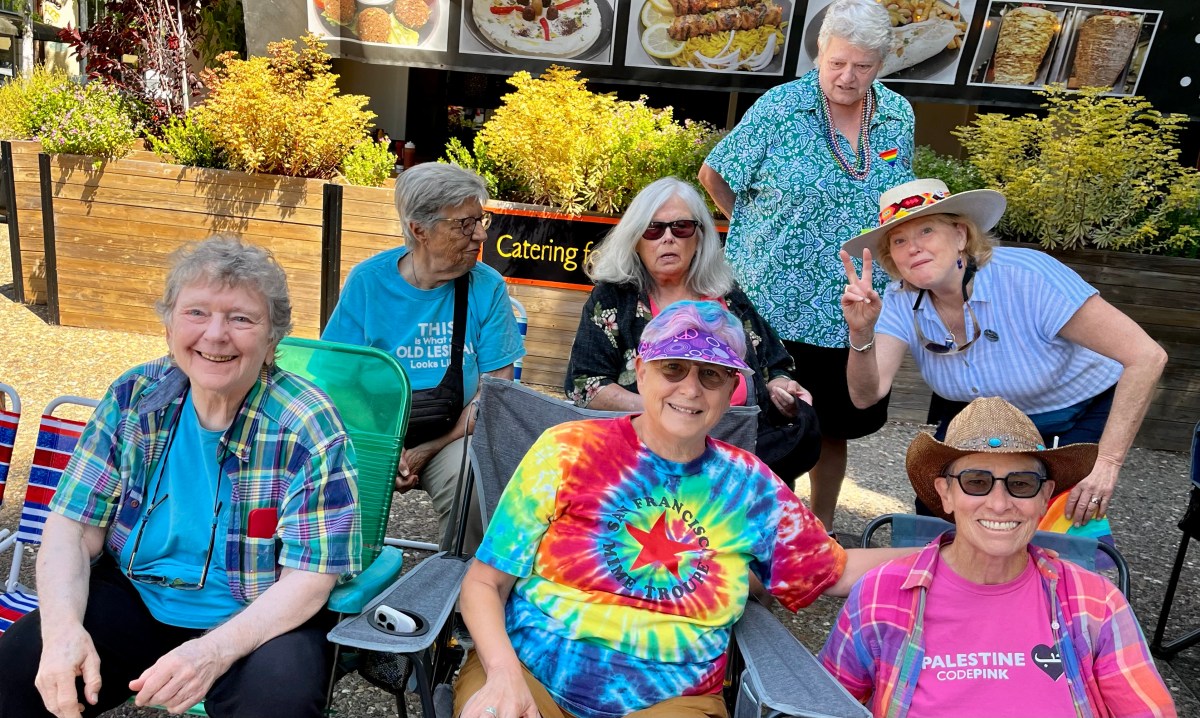
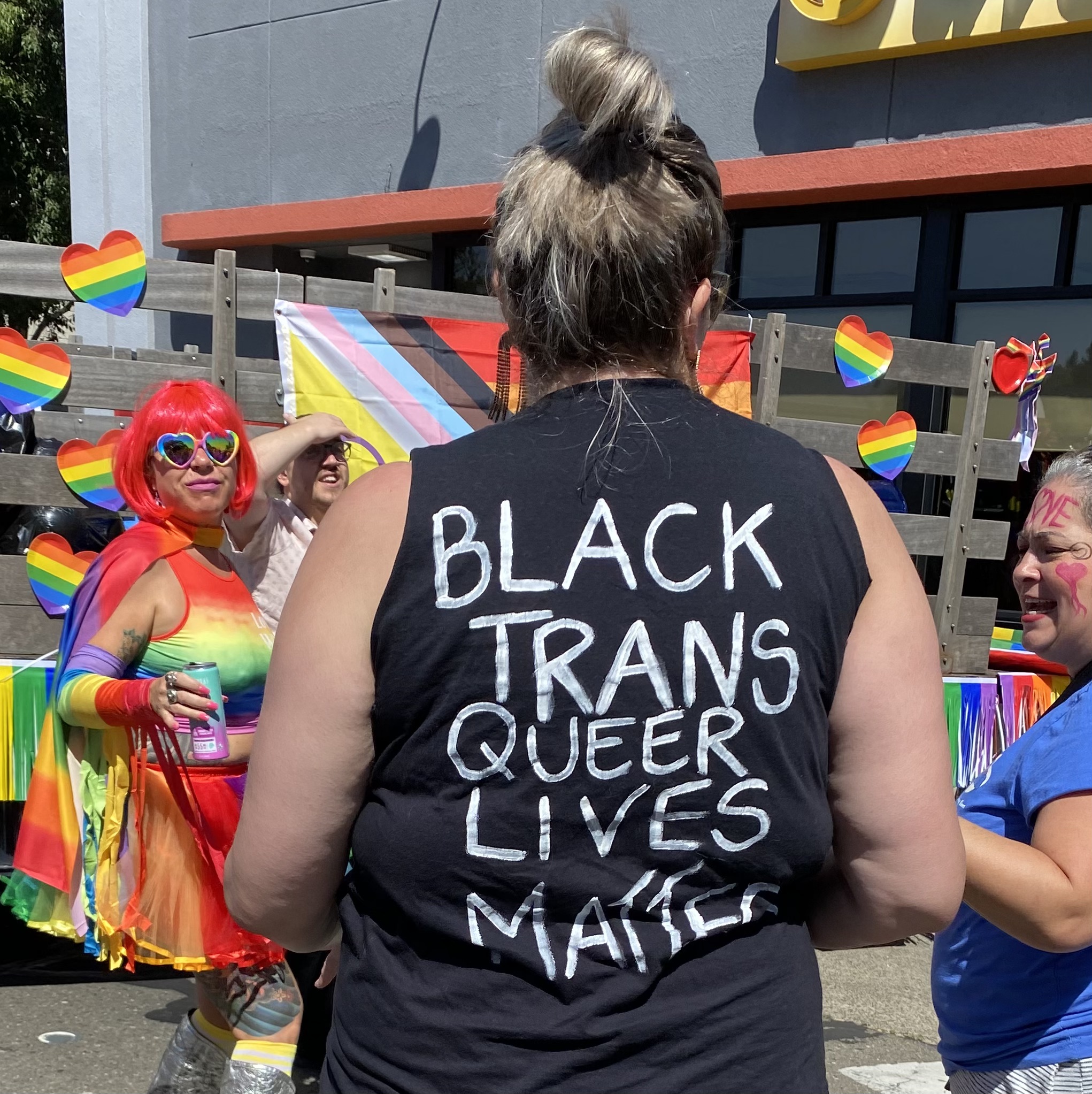
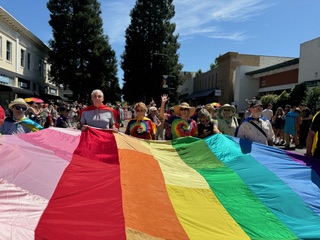
Our celebration took place in Santa Rosa, where we live, a city of 177,000. My honey, Holly (L), and I watched the parade with a group of friends. Afterward we checked out the booths and music at the town square. This year saw more marchers and watchers than ever. And if there were haters (as there have been in past years), I never saw them. The vibe was joyful.
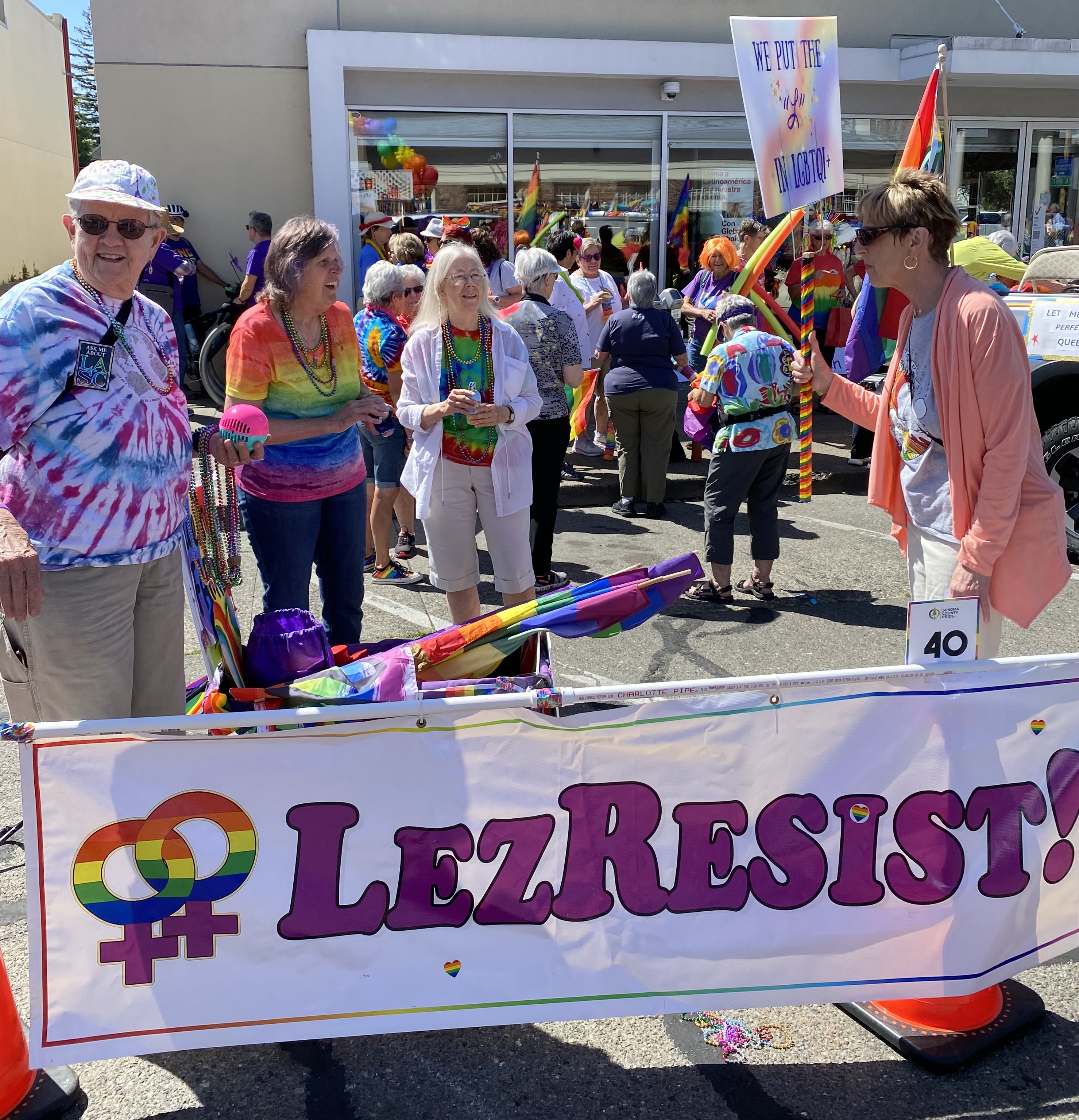
The theme this year was Heroes Sheroes and Queeroes. So there were lots of superhero capes among the marchers. The Sebastopol (a nearby small town) Senior Center volunteers made 60 capes with messages, and they won the Best Overall Float prize.
I think maybe there are more old dykes in Sonoma County than anywhere else in the world! We were well represented at Pride. A new organization just started called Senior Lesbians in Community (SLIC). I’m also a member of Old Lesbians Organizing for Change (OLOC) and Lesbian Reunion. The village of Oakmont, a retirement community, has its own lesbo contingent.
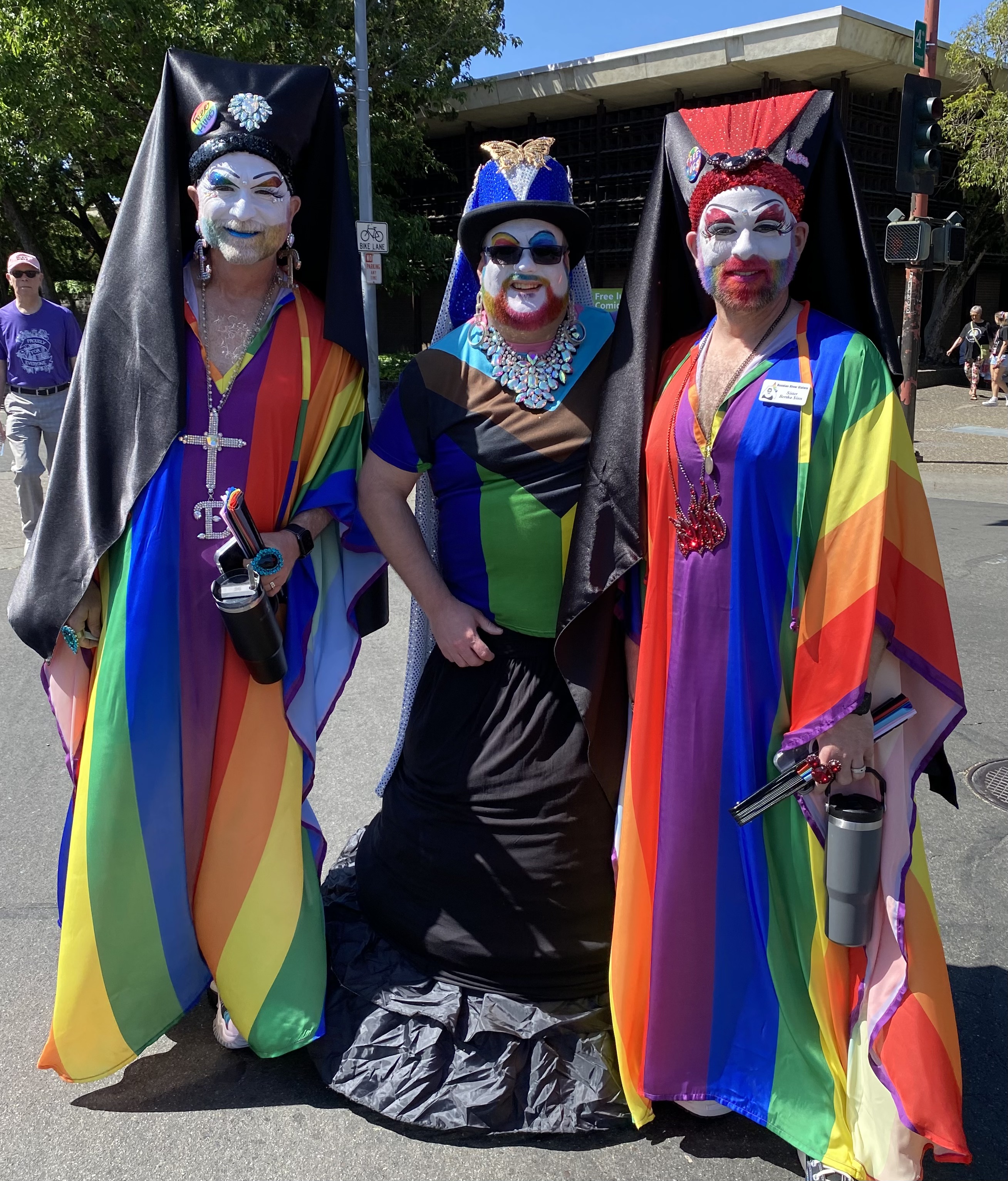
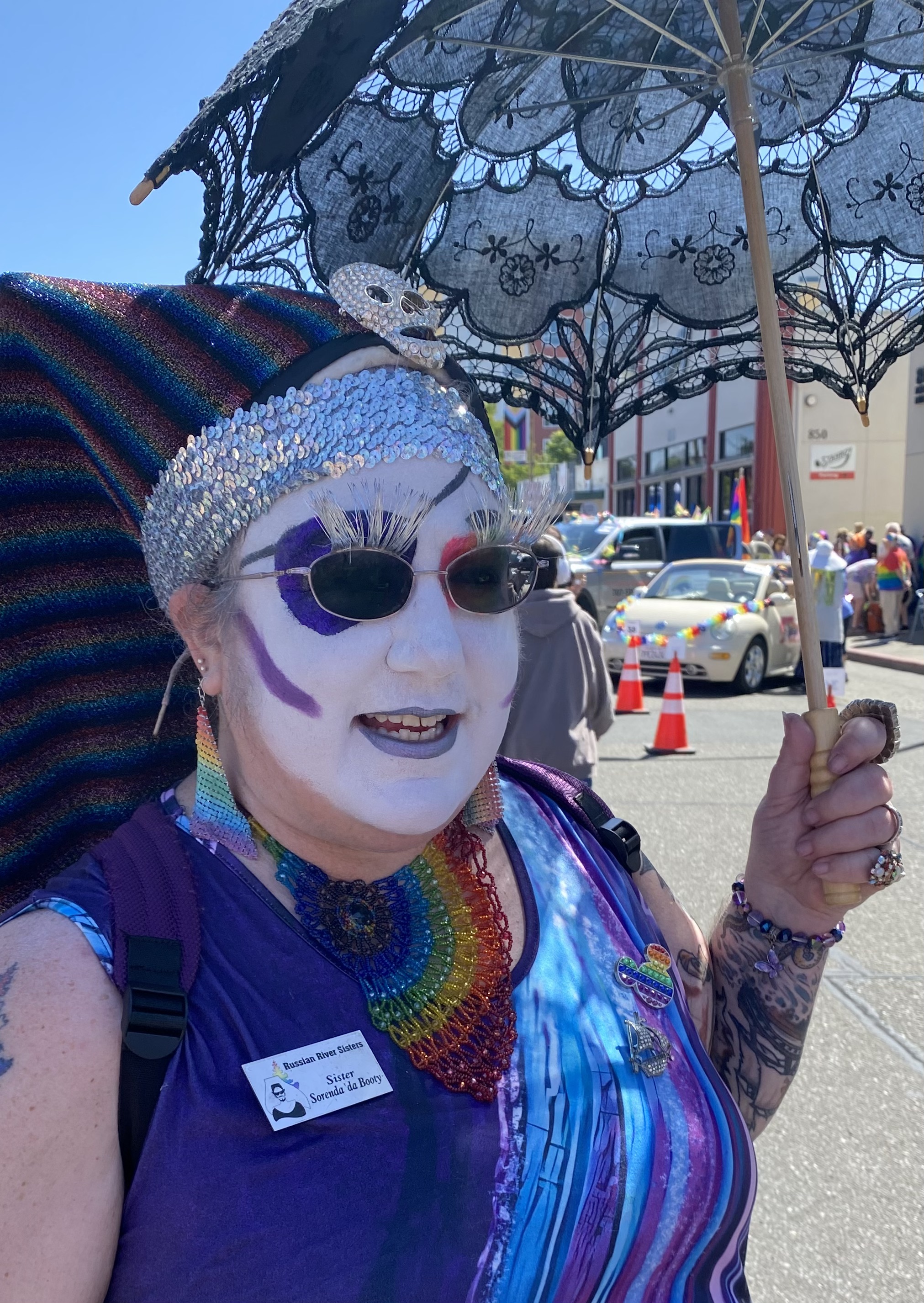
The Sisters of Perpetual Indulgence has a big congregation here in Sonoma County. They fundraise to support the comunity with fabulous parties, bingo games and campaigns. The Sisters were the sponsors of Gay Pride for many years when it was in Guerneville, a resort town on the Russian River.
So many queers, so little time!
The Democratic Party always shows up at Pride. They sponsor postcard writing parties to help get out the vote for Congressional races around the country. In California we are working to turn red districts blue this year.
As we construct our ofrendas for Day of the Dead, decorate our yards for Halloween and celebrate the pagan holiday Samhain, I’ve been thinking about two other holidays we celebrate this time of year–Indigenous Peoples’ Day and Thanksgiving. This is a story about how the meaning and celebrations of American holidays can evolve to reflect new understanding of our history.
As we learn more details about our history, in the last few years Americans have been rethinking the stories connected with Thanksgiving and Columbus Day.
My generation of students learned to recite, “In 1492 Columbus sailed the ocean blue.” We learned about the Nina, the Pinta and the Santa Maria and that Christopher Columbus “discovered America.”
In elementary school in the 1950s I participated in those Thanksgiving pageants in which you were either a Pilgrim—boys with black buckled hats and shoes, girls in long, aproned dresses and bonnets—or an Indian with feathered headband and tomahawk. The story we enacted was a peaceful meeting and feast between Indians and pilgrims just off the Mayflower. It was the beginning of a happy long relationship between settlers and Indians.
Sadly, almost all of what we were taught was incorrect and incomplete; the myth conveniently left out the parts about genocide, slavery and land theft.
It turns out that Christopher Columbus was a homicidal tyrant who initiated the two greatest crimes in the history of the Western Hemisphere–the Atlantic slave trade, and the American Indian genocide. It’s not dissing Italians to say we no longer venerate this colonizer. Over the last few decades, Columbus Day has evolved into Italian Heritage Day in many locales.
And we are witnessing a movement to honor Native peoples on Columbus Day. It originated in 1989 in South Dakota during its “Year of Reconciliation,” in an effort to atone for terrible history.
The phrase “merciless Indian savages” is written into the Declaration of Independence. That says all we need to know about how the founders of our country viewed the indigenous people in this land.
For centuries, the American government saw Indians as the enemy, sponsoring their slaughter and “removal.” Through a series of notorious atrocities, including the Trail of Tears, the Sand Creek Massacre and Wounded Knee, (and in California, our own Trail of Tears in 1863, and the Bloody Island Clear Lake massacre in 1850, among others) the United States adopted an official expansionist policy of discriminating against Native Americans in favor of encouraging white settlers in their territories. This policy led to the subjugation, oppression, and death of many Native Americans, whose communities still feel its effects. Only in 1924 were Native Americans allowed to become citizens of the United States, and it took decades more for all states to permit them to vote.
But as we Americans acknowledge this history, our contemporary view of Native Americans is changing.
Congresswoman Norma Torres (D-CA) has introduced legislation to establish Indigenous Peoples’ Day as a federal holiday. Now, at least 13 states and over 130 cities have adopted Indigenous Peoples’ Day or Native American Day. In 2021, President Joe Biden formally recognized Indigenous Peoples Day.
Here in Sonoma County indigenous people are well integrated into our local culture and community events. Tribes are consulted by land keepers and planners. Colleges, libraries and nonprofits sponsor classes about indigenous culture. My wife Holly and I attended the Indigenous Peoples’ Day gathering at Santa Rosa Junior College, which featured native dancing, music, drumming, food, speeches and vendors. The SRJC also has a native museum whose latest exhibit features the stories and art of local basket weavers.
As with Columbus, Americans have been taught a false narrative about Thanksgiving.
Two different early gatherings may have inspired the American Thanksgiving holiday. At the first, in 1621, Wampanoagwere not invited to the pilgrims’ feast, but heard celebratory gunshots and came to the aid of the colonists. They had formed a mutual defense pact. Once there, the Indians stayed and feasted, but the feast did not resolve ongoing prejudices or differences between them. Contrary to the Thanksgiving myth, this was not the start of any long-standing tradition between the settlers and the Wampanoag tribe. The myth doesn’t address the deterioration of this relationship, culminating in one of the most horrific colonial Indian wars on record, King Philip’s War.
Ironically, Thanksgiving as a holiday originates from the Native American philosophy of giving without expecting anything in return. The Wampanoag tribe not only provided food for the first feast, but also the teachings of agriculture and hunting. Corn, beans, wild rice, and turkey are some examples of foods introduced by Native Americans.
The first written mention of a “Thanksgiving” celebration occurs in 1637, after the colonists brutally massacred an entire Pequot village of 700 people, then celebrated their barbaric victory, giving thanks to their god.
During Reconstruction, the Thanksgiving myth allowed New Englanders to create the idea of bloodless colonialism, ignoring the Indian Wars and slavery. Americans could feel good about their colonial past without having to confront its really dark characteristics.
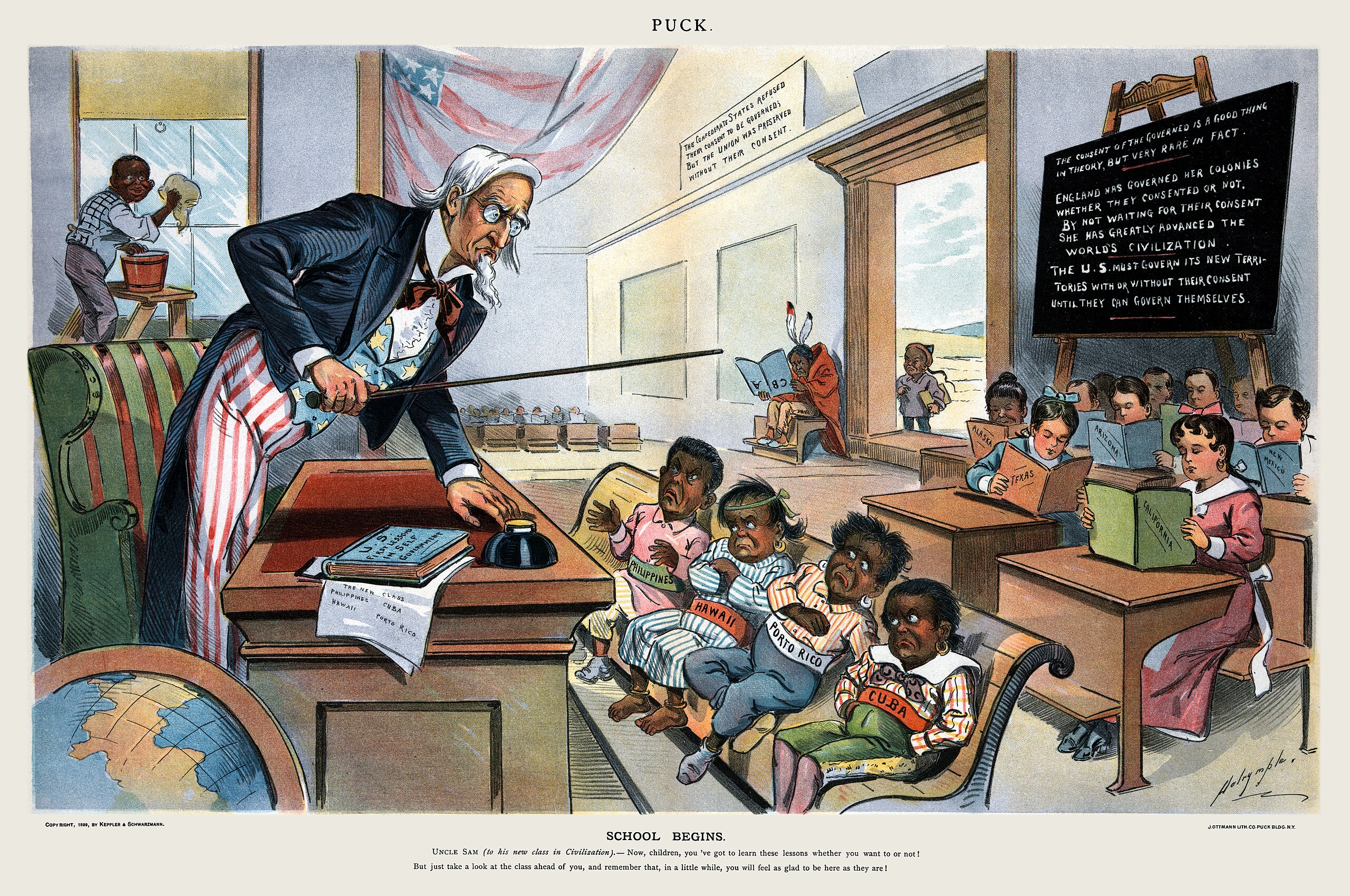
Now children you’ve got to learn these lessons whether you want to or not! Puck Magazine 1899.
For many Native Americans, Thanksgiving is a day of mourning and protest since it commemorates the arrival of settlers in North America and the following centuries of oppression and genocide.
Indian protests in the 1960s and 70s often attacked the Thanksgiving myth. In 1969 after natives took over Alcatraz, allies and Indians of all tribes came together for Unthanksgiving Day, a gathering that’s become a tradition, welcoming all visitors to a dawn ceremony on the island.
In 1970 during a Thanksgiving celebration in Plymouth, activists from the American Indian Movement stormed the Mayflower II ship and occupied it in protest. It was then that the United American Indians of New England recognized the fourth Thursday in November as a National Day of Mourning, to bring awareness to the long lasting impacts that colonization had on the Wampanoag and other Native American tribes. This year the in-person event will also be livestreamed.
Americans are told and we want to believe that we are the saviors of the world. But historical truth is far different.
Does the acceptance of Indigenous Peoples Day in place of Columbus Day and the updating of the Thanksgiving myth mean that we Americans are beginning to acknowledge our country’s history of imperialism and genocide? I hope so.
This time of year, and these two holidays, Thanksgiving and Indigenous Peoples Day, give us the opportunity to reflect on our collective history, to celebrate the beauty, strength, and resilience of the Native tribes of North America, and also to conduct our own rituals.
Long before settlers arrived, indigenous people were celebrating the autumn harvest and the gift of the earth’s abundance. Native American spirituality, both traditionally and today, emphasizes gratitude for creation, care for the environment, and recognition of the human need for communion with nature and others. I hope we can incorporate these ideals into our American harvest celebrations while we as a species still live.
Whether or not we cook a big turkey dinner, many of us practice Thanksgiving rituals. My and Holly’s ritual is to get together with our exes. We introduced them at a Thanksgiving dinner 13 years ago and they fell in love. We were surprised, and also delighted. Barb and Ana have become our exes and besties. We are participating in a lesbian tradition of incorporating our exes into our chosen families.
No matter where you are in North America, you are on indigenous land. In Sonoma County we live on unceded territory of the Pomo, Wappo and Coast Miwok tribes.
Good Samhain, Halloween, Day of the Dead and Thanksgiving to you all.
















 tradeswomn musings