Sonoma County Pride

It’s happening in the town of Santa Rosa this year for the first time in ages, a move from the River town of Guerneville. We rode downtown on our bikes (on Humboldt Street, the designated bikeway) and left them for safe keeping with the Bicycle Coalition valet service. We camped at Beer Baron where we met up with friends T and JJ so we could watch the parade and imbibe in the shade (temp is 89 degrees!)

One of the most creative contingents was Church Ladies (and Gents) for Gay Rights, dressed in big hats and long skirts, whose schtick involved waving white handkerchiefs.

IMG_6167

Lesbian square dancers rocked it, boys and girls in colorful skirts danced down the street. Parents and kids were big, as always.


I loved the couple with the 40 years together sign.IMG_6173 2

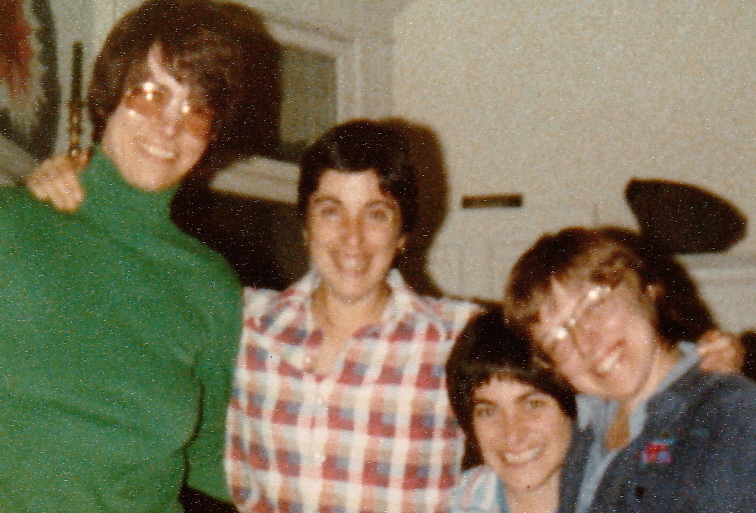
After the (mercifully short) parade, we walked around and checked out the booths at Courthouse Square. Our friend Ruth Mahaney sat at the Lesbian Archives booth where hordes of lesbians were competing to identify lesbians in old pictures of softball teams from the 70s. “I was lovers with her!” someone proclaimed.


Daddy From Another Planet

Photo by David Menidrey on Unsplash

As a young feminist I tried responding to male groping by groping back, pinching male butts at parties, just as I’d been pinched. I treated all men equally, pinching and groping without discrimination. That got me in trouble with male friends who were outraged—partly at my forwardness (women can’t do that!), but also that I’d think they might do that to women. They really didn’t like being treated as objects. Well, neither did I. It’s the opposite of sexy.

So, ok, some men don’t grope women. All men are not afflicted with frotteurism, the psychologists’ word for the desire to grope unconsenting victims. But, as we’re now learning, oh so many are. My father was one.

I saw him do it. One time at the end of a party in the grange hall, he walked up behind a woman who was taking dishes into the kitchen and grabbed her breasts with both hands in a kind of bear hug. She just kept walking and I yelled at him. I don’t think he even knew who that woman was. He was drunk, so that was his excuse, but he didn’t apologize or even seem to think he needed an excuse. WTF Dad!

And there were many other times, when we gathered in groups and alcohol was present. With Dad, alcohol was always present.

In 1978 my parents traveled to visit me in my collective house of four lesbians in San Francisco. I wasn’t yet out to Dad as gay and my mother asked me not to tell him. She made the argument that she would be the one to have to deal with him when they got home and she was only saving herself trouble. That made sense to me, but I refused to take down the lesbo posters or change anything about our lifestyle. Every day I’d ask Mom if Dad had figured it out yet. He never did (I came out to him a few years later).

By the end of the first day my dad had visited all the bars in the neighborhood, made friends with all the barflies and picked out his favorite bar where he would hang while Mom and I went to the theater or did only-in-San Francisco things.

One evening my roommate pulled me aside to tell me my father had groped her. I was stunned. You invite your father into your house and he gropes your housemates?! I struggled to understand. What was motivating him? Who would not see this as totally inappropriate, or at least extremely rude behavior? But, as I remember, he never apologized, even after being confronted. He wanted to pretend it didn’t happen. I wonder if my father would have groped my roommates if he’d known that we were all lesbians, but I doubt that knowledge would have made a difference.

In every other way Dad behaved like a proper gentleman, a courteous guy who seemed to want everyone to be comfortable. He didn’t swear and wasn’t happy when I took up swearing. He used to lecture me that it takes fewer face muscles to smile than to frown. He believed in smiling and I’ve come around to his view. I just hated it when men told me to smile, which happened with regularity in my work as an electrician.

Dad was a working class guy who never finished high school, but he wasn’t closed-minded. He believed in equality of the sexes and was politically progressive. Of course, he and all of us kids were influenced by my mother, an accomplished woman who’d made her own way in the worlds of work and war for many years before marrying.

My father was a product of his times from a generation of men who could be categorized by the female body parts they most ogled. George H.W. Bush is a butt man. Dad was a tit man. They were born ten years apart—GHWB in 1924 and my father in 1914, so I’d say they were of the same generation in which popular culture permitted and encouraged ogling and even physical violence against women. Men aspired to be “David Cop-a-Feel.” Beating wives and children was accepted practice.

We all have a natural curiosity about people’s bodies. I’ve always been fascinated by bodies in the public baths or sauna. They are so varied! And we are usually so clothed! But, although I believe consensual touching is something no human should be without, I never had an unrestrained desire to touch them, men or women.

One theory about groping comes down to something called projective identification. According to psychologists it’s a pretty common process in human nature that basically means you attempt to make others feel a way you don’t want to feel yourself. The desire to grope unconsenting victims, frotteurism, is a paraphilia.  Paraphilia is intense sexual interest and arousal by objects, body parts, fantasies, or situations that do not ordinarily stimulate sexual desires.  Masochism or a foot fetish, for example, are paraphilias. Was groping an affliction that my father could not overcome? Is it really a sickness? Is there a cure? (apparently not–all these rehab programs are bullshit). But of course it’s much more complicated and we all acknowledge there’s an underlying power dynamic. Dad called himself a feminist and I think he truly did like women, but some Neanderthal part of him must have seen women as less than.

I still struggle to understand. Was my father even aware of his reputation as a groper, or did he practice self-deception? Was he ever ashamed? What was going on in his head? How did he rationalize this behavior? Did he know he was causing women discomfort? What did he think was going on for them? I did have some heart-to-hearts with him, but never on this subject.

Women in general don’t get it. We are from different cultures in a way. Men’s behavior is reinforced within their own male culture. But when I ask male friends to explain the disgusting behavior exhibited by their gender, they claim to be as perplexed as I, saying it’s a sickness or that (other) men do it just to see if they can get away with it.

This is some odd tic of the male of the species that just doesn’t resonate with me. It’s like daddy from another planet. The same species, but different. I can’t really explain it and I bet if I could ask my dad, he couldn’t either.

Love the film, hate the church

I think of the catholic church as a dangerous cult and that perspective was only reinforced when I watched the movie The Novitiate, about a cloistered order of nuns and its response to the directives of Vatican II in the early 1960s. From the movie, directed by Maggie Betts, I learned that 90,000 nuns left the church after Vatican II, which devalued nuns and left them without support of the church.

2nuns
Barb and I as bad nun good nun

The protagonist is a 17-year-old novice played by Margaret Qualley, but the star of the show is the angry, strict mother superior played with force by Mellissa Leo (remembered fondly as the lawyer in Treme). She represents the old habits and choses to ignore the new catholic rules until the cigarette-smoking, newspaper-reading archbishop visits and “suggests” she begin implementing the protocols if she wants to keep her job. We learn that she has never set foot outside the convent in 40 years and we sympathize with her bitterness and frustration.

Some of the old disciplines that must be abandoned include the medieval practice of self-flagellation. In this order the novice must ask the reverend mother for the “discipline,” a stranded leather whip with knotted ends and she must tell mother the fault or lapse that deserves punishment. Another curious practice is an activity in which each novice kneels in the middle of a circle of kneeling novices and confesses her faults to the reverend mother. In an odd way it resembles the encounter groups that were just taking off in that era.

All who lived in the cloistered convent observed hours of silence and they developed a sign language to communicate. The novices spent time on their knees or crawling on hands and knees or prostrate on the floor in penance for sins against god. Touching other human beings was strictly forbidden. But the protagonist, sister Cathleen, seeks comfort in the infirmary after having starved herself in penance for a sexy dream. She hugs and kisses another novice, who it seems has been transferred here because of lesbian exploits in another order. And so the constant undercurrent of sexual attraction finds expression and then contrition. Guilt abounds.

For me, the catholic church represents a historically misogynist institution bent on maintaining control over women, our bodies, our reproductive lives, even our intimate relationships. It damages not just catholics, but all women and the cultures we live in all over the world. Hate is not too strong a word for my feelings, especially since the church continues its anti-woman postures and politics.

I believe no one truly recovers from catholic propaganda, especially when immersed as a child. The dictionary’s alternate meaning of propaganda: “A committee of cardinals of the Roman Catholic Church responsible for foreign missions, founded in 1622 by Pope Gregory XV.”

Radical Lesbian Foremothers

Longtime friends Angela Romagnoli and Lynn Stern were two of the foremothers of the Radical Lesbian movement. I sat down with them last November to record their story. Angie had been diagnosed with cancer and had undergone radiation and chemotherapy treatments. She died July 5, 2017. Angie leaves her wife of 39 years, Megan Adams, and their son Reese Adams-Romagnoli.

All three of us—Angie, Lynn and I—were born in the year 1949 and we all started college in 1967. We were all the oldest sibling in our families. We were all involved in radical politics in college and came out as lesbians. I was at Washington State University in Pullman, WA. They met at the University of Michigan at Ann Arbor. Their stories resonate with me even though U of M is far from the wheat fields of eastern Washington State. We were making the same revolution.

Angela and Lynn first met when Angie encountered Lynn sitting on her bed weeping with homesickness in their college dormitory. It was the fall of 1967 and both were 17. Lynn was very close to her family in Chicago, and especially her mother. It was the first time she had lived away from home. They were roommates the next year in another dorm and they became lovers in 1970. They broke up in in 1978, but their friendship has lasted ever since.

Both of these women—all three of us—came from liberal families and the historical moment radicalized us.

The oldest of six siblings, Angie grew up in a union household. Her family moved to Dearborn, Michigan, just outside Detroit, when she was in high school. Dearborn was a white town, but they had lived in a mixed-race town before that. They watched as the city of Detroit fell apart, as jobs left the area and red lining took its toll on black citizens. Angie went to a progressive high school where she developed a class analysis.

Lynn was the oldest of three siblings. Her family were liberals and secular Jews.

In 1967 the U.S. government was escalating the war in Vietnam. The student anti-war movement gained steam. Lynn and Angie went to a bunch of meetings, looking around campus for a group to join.

“We saw who was just talking and who was doing. We didn’t want to hear guys just jacking off,” said Angie. “We picked SDS (Students for a Democratic Society) because they were doing sit-ins and actions, talking to classes.”

They went to marches, broke windows. “I was a baseball player and had a great arm,” said Angie. One time Angie’s mother picked up Lynn’s jacket and the pockets were full of rocks. “You would put your lead pipe in the pocket of your pea coat.”

They wore combat boots, overalls. “We could strut our stuff. No bras,” remembered Angie. “You needed boots in Ann Arbor.”

One night they broke into the ROTC building on campus, trashed it and didn’t get caught. But the SDS had been infiltrated by cops and many demonstrators did get arrested, including their friend Nais (a mutual friend who now lives in San Francisco), also a student there.

“One time a phalanx of police scattered our march, arresting people. I was pulling the cops off people’s backs, but they didn’t arrest me,” remembered Angie.

By 1970, the women in SDS were pissed off, questioning the leadership and meeting dynamics. Feminists like Gayle Rubin came to SDS to talk and the women listened.

Although their recollections of how it happened differ, best friends Lynn and Angie became lovers in 1970. “We were happy. It was great,” effused Lynn.

“We were fed up with SDS,” said Angie. “That summer they said read Mao’s Combat Liberalism. That Cultural Revolution shit was offensive to me. I’m from the working class. I said the revolution is not coming around the corner. I wasn’t under an illusion.”

“We were still living in an SDS house in the summer of 1970, but we knew about the Radical Lesbians in New York and Berkeley,” said Lynn. Two of the New York women visited them and suggested they start their own radical lesbian collective.

We were isolated. We called up the two other lesbians we knew in town and we put an ad in the Michigan Daily. We got a meeting room on campus. Altogether ten people showed up. Gayle Rubin held up a book at the end of the meeting and said everyone should read this. It was The Story of O. (they both laugh) “We didn’t get it, didn’t even question her.”

So they had an organization, Ann Arbor Radicalesbians. “We hopped right from SDS to radical lesbians with no feminist group in between. Two hundred different women came to those meetings. “Judy Dlugacz (who later founded Olivia Records and Olivia Travel), was one of the first. ‘I’m writing a paper on lesbians,’ she said. Then she came back with a little curly-headed girlfriend,” laughed Angie.

“We organized the first lesbian softball team in the women’s league,” said Angie. “Martial arts was an extension of feminism.”

“We made a publication called the Purple Star. I wrote an article called The Personal is Political,” said Angie. “That was before the butch-femme diatribe. Our roommate confronted me and Lynn and said you are nothing but a butch-femme couple. I got mad and wrote an article. Lesbians and especially separatists were talking out of two sides of their mouths. On the one hand they overvalued everything that was butch. On the other hand we don’t want have anything to do with butch-femme heterosexual norms.”

Lynn said, “I cried when they called me a femme. I didn’t want to be in a straight relationship. It also made me feel less powerful. (to Angie) You got to be more powerful. I couldn’t play sports. I always knew I was cute and smart but wasn’t very outspoken. I felt I wasn’t successful.”

Angie defines butch as someone who had a high male identification as a child. “I don’t think anyone has all of one ID. Butch is a complex psychological construct. I definitely felt that applied to me. I was a super tomboy. There are a few in every elementary school. I got in trouble about what clothes to wear. Mom gave me Betsy Wetsy doll. I gave it to my sister. My friend who was catholic said she had a dream the virgin came to me and we will get turned into boys. I thought great!”

Lynn teased, “I remember the skirt she wore when we were working as waitresses in the union.”

Angie: “I had to wear a skirt to work so I just wore the same one every day.”

Angie: “We (Radicalesbians) went to other places like Bowling Green and gave talks to 500 people.”

Lynn: “You really have power, influence. We just talked about feeling like ourselves. We told them about how it came about.”

Asked about coming out as a lesbian, Lynn said, “It took a lot to come out to my parents. I couldn’t figure out how to tell my family. We were estranged. My mom said we were laughing at her.”

Angie: “I was really uncomfortable. I came out to them about 1973. We were totally dedicated to coming out here, there and everywhere.” Angie’s mom was always supportive. She never wanted to be left out of anything. Her mom was only 21 when she was born. “She liked to talk to everyone.”

Angie and Lynn lived together for nearly a decade, in various collective houses, always poor. One time four people slept in one room. “We weren’t monogamous. We had a lot of experimentation. I never really did respect nonmonogamy. It wasn’t for me. Group sex and…so stupid,” said Angie.

Then, in 1978 they broke up. It was traumatic.

Angie: “I was really lost.”

Lynn: “I thought it would be like my parents. They stuck by each other. To learn that it wasn’t forever, not what we thought.”

Angie: “We were so young, so inexperienced. We became merged. I felt like you resisted my having more separate things, separating more.”

Lynn stayed in Ann Arbor. Angie got together with Megan, her partner of 39 years. She moved to San Francisco in 1979, becoming a therapist and founding the first therapy group for survivors of sexual assault.

They never stopped being friends.

How the Lesbians Invaded

We had been powerless tenants, evicted with no recourse, and then we became agents of displacement. There was no in between.

My collective household of four lesbians had found a place on Castro Street, one of those original Victorians with high ceilings and elaborate wood trim, an abandoned coal fireplace and a parlor whose big sliding doors opened to double the size of the room. It was rumored that the apartment had come up for rent because the previous tenants had been busted for selling weed and were all in jail. We embellished the story to claim that the famous Brownie Mary had lived there. She may not have lived there, but she had certainly been there in spirit. It was the seventies; the Castro was becoming a gay men’s mecca. During our time there a housepainter engaged to paint our building ran a brothel turning tricks in the building’s storage room. He painted that building for months.

We fondly remember political gabfests at shared dinners, Seders in which we sang all the way through, inventive costumes at Halloween parties (in the year of Anita Bryant I came as a lesbian recruiter). For a time our costume du jour at home was simply a vest, a way to show off a billowing bush and legs as thickly furred as animal pelts (we were hairy and proud!). We danced and sang along to Stevie Wonder and Lavender Jane Loves Women. There was much laughing and also much crying. Passionate love affairs abounded. Hearts were opened, hearts were broken. Creating a new culture calls for invention. We tried out nonmonogamy, polyamory. We felt we were on the cutting edge of a cultural transformation.

dyke collective_0001
The original collective: me, Pam, Ruth S and Ruth M about 1978

When the gay male couple from New York, or maybe LA, bought the three-unit building in 1978 they immediately evicted us. We had no recourse; rent control was still a few years off. We found a smaller apartment on 29th Street just off Mission in the neighborhood we now call La Lengua. Our landlords were butchers, brothers who ran a shop on Mission right next to what later became Cole Hardware. Weirdly, the buildings on 29th Street and Mission Street were connected. Our apartment always smelled like dead meat, like something had died in the walls.

We liked the spot—right behind the Safeway parking lot and across the street from the Tiffany gas station. Pauline’s Pizza was just across Mission and Mexican restaurants like Mi Casa proliferated. I bought my work clothes at Lightstone’s; the post office was right next door. The building’s ground floor held a printer’s shop (it’s now a pot club) and the second floor was just a big meeting room that was rented by Union Women’s Alliance to Gain Equality (Union WAGE) which allowed other organizations like Tradeswomen, Gays for Nicaragua, Lesbians Against Police Violence and the Briggs Initiative opposition to meet there.

My collective of four politically active dykes—me, two Ruths and a Pam—was happy. We cooked and ate together and invited interesting people to share dinner. Jews and militant atheists ruled. I learned about Jewish culture. The Christmas tree was relegated to a bedroom. It was bliss, except that with visiting lovers and pets (one a gigantic great Dane) and parents and friends the place was just too small. Finally we decided that we either had to pool our money and buy a bigger place or split up the collective. Ruth M decided to pull up stakes and live with her lover and so my lover Nancy became part of our collective.

37 29th st
37 29th Street about 1978

We were earnest idealists; we were gay activists; we had just lived through the horrors of the Moscone Milk murders and Jonestown and the election of Reagan. We were committed to live ethically and, even in the midst of what felt like political chaos, we fervently believed we could change the world, ending US imperialism, racism, police violence, and discrimination against women and gays. We were part of a collective movement that emphasized cooperation and consensus decision-making, a radical departure from capitalist organization that resulted only in winners and losers.

We listed our requirements for the new house. Ruth had to have a garden. I desperately needed a garage to store my electrical contracting tools and supplies. We had to be close to public transportation. We didn’t want a fixer upper; no one had time for that and I was the only skilled tradeswoman. We were committed to collective living and we also fantasized about eventually dispensing with private property. What if we could donate the place to a land trust so that our dream of a lesbian nation could live on into future generations?

We negotiated a contract. What would happen if one of us died or ended up in jail or for some reason couldn’t make her payment? How would we sell and buy shares in the building? What if we needed to make repairs or improvements? We listed all contingencies. We were good at processing—we were lesbians!

We imagined a larger single-family house, one with four real bedrooms, but then when we found the three-unit place on the south side of Bernal Hill our imaginations blossomed. We would no longer have to share one bathroom and one kitchen, but we could still cook and eat together whenever we wanted. Instead of negotiating for time to call each of our telephone trees on our shared phone, each could have her own phone.

The listing price was $135,000, an incomprehensible amount. A hundred thousand then felt like like a billion now—you couldn’t get your head around it. Still, we dug deep and came up with the down payment, only because Pam was able to borrow money from her family. Then we wrote up a new contract to repay Pam by the month. We got pretty good at writing contracts.

As soon as we took possession in 1980, our place in the property hierarchy changed. We became agents of displacement. All three of the units were occupied. Each of us had to evict tenants before we could move in and none of us could afford to pay both rent and mortgage for long. Oh the contradictions! I talked with the couple in “my” unit, offering to help them find a new place. Our exchanges were friendly and civil, and they soon found new housing. But Ruth couldn’t even get the tenant in “her” unit to open his door, though she could hear him spewing expletives from the other side. She resorted to lawyers and eviction notices.

We weren’t the first lesbians to move to Bernal Heights. Political activist Pat Norman and her large family lived up the block. A lesbian couple had settled just around the corner on Andover. But there were four of us, and with friends and lovers coming and going we were hard to ignore. People in the neighborhood noticed. Homophobia took the form of nasty notes left on car windshields, DYKES graffiti on the building. Two neighbors who grew up on the block, guys about my age, made it clear they understood what we represented—a lesbian invasion. Years later, when our relationship had grown friendlier, one of them confided, “We were watching you.”

As much as we wanted to live collectively, the house on Richland restricted collectivity. Having separate apartments led to fewer shared meals, less knowledge of each other’s daily lives. I retreated into the dreaded merged lesbian couple relationship. After a few years the original members began to sell their shares and move out while others bought in. At the cusp of the 80s our world changed. That frantic hopeful creative collective time was ending.

But we are still here. Since the birth of our dyke-owned dream, we have aided the lesbian colonizing of San Francisco and particularly Bernal Heights. With each refinancing (too numerous to count) and buyout, our property underwrote the purchase of new female-owned houses. When we started, four single women buying property together was rare and suspect by financiers. Tenants-in-common was not a typical way to hold property. Since then it’s been adopted by the real estate industry as a way to make buying of increasingly expensive property possible for groups of unrelated individuals.

We were agents of change, the leading edge of a new wave of homeowners in the Mission and Bernal Heights. But change is not new to our neighborhood. As one of the authors of a small history of Bernal Heights, I researched its historic demographics. Irish squatters displaced the Mexican land grant Californios. European immigrants made homeless by the 1906 earthquake and fire moved earthquake shacks here and built new homes. Southern Italians colonized the north side of the hill. Germans, Swedes and Italians built churches here for ethnic congregations. Mexicans and blacks found a neighborhood free of racist covenants and restrictions, although Bernal was not outside redlining boundaries. During the economic downturn starting in 2008, big banks (locally based Wells Fargo gained our enduring hatred) evicted scores of homeowners, most of them people of color. Now houses on this block are selling for millions and the techies are moving in.

The life we built is changing. Pat Norman retired, sold her house and moved to Hawaii. My long-time friend on Andover, the first lesbian I met in the neighborhood, sold her house and moved to Oakland. And now I’m selling the apartment where I’ve lived for 37 years in order to colonize a neighborhood in Santa Rosa. Our particular experiment may be ending, but the neighborhood is still full of dykes.

In Bernal Heights, lesbians found an affordable generally accepting environment. At one time I heard that the neighborhood was home to more woman-owned property than any neighborhood in the country or in the world. Who knows; that may still be true.

Searching for Orrs

The name Orr implies an anonymous other, a potentially magical alternative to the status quo. At least that’s what we think in my extended family.

IMG_7942
My hunky bro and I, 1970s

Orr is my paternal grandmother’s maiden name and so hidden from us except that it is my brother Don’s middle name.

It was my brother searching for our family history who discovered that the Orrs have a gay gene. When he got on the ancestry websites he discovered quickly that others had already researched the Orrs. One of the first he encountered was a man who lived in San Francisco and Don called me, breathless.

“He lives in Noe Valley and I think he’s gay,” gasped my brother.

“Oh my goddess!” I exclaimed. “That’s practically next door to me. What makes you think he’s gay?” I know this about my brother: he has highly refined gaydar.

“I don’t know. Maybe it’s how he writes. I wrote to him and he got back to me. The ball’s in my court. What do I do now?”

IMG_7001
Cousin Richard in vestments. He presided at our wedding.

“Did you get his number? I’m calling him right now.” I know this about my brother: he’s shy where I am not. It was my family duty to follow up and make the call.

And that’s how we got to know Richard, our third cousin. We are all descended from William Burgess Orr and Catherine Hart Orr who lived in Iowa in the mid-nineteenth century.

Richard and I discovered we have friends in common. He lives within walking distance of me in San Francisco and I visit him often. On one visit he gave me a framed photo of our shared great great grandmother, Catherine. She looks sternly into the camera with steely blue eyes.

Richard became our ancestry guru, supplying research and stories about our shared ancestors. He confided that we have another “bent” cousin, Sherry, who lives in Colorado, his home state.

We began to throw around the idea of the gay gene, but it wasn’t until recently when another “bent” cousin surfaced that we decided our research is definitive. Her name is Deborah and she lives in Oregon. We’ve all arranged to meet up in San Francisco for a bent cousins dinner.

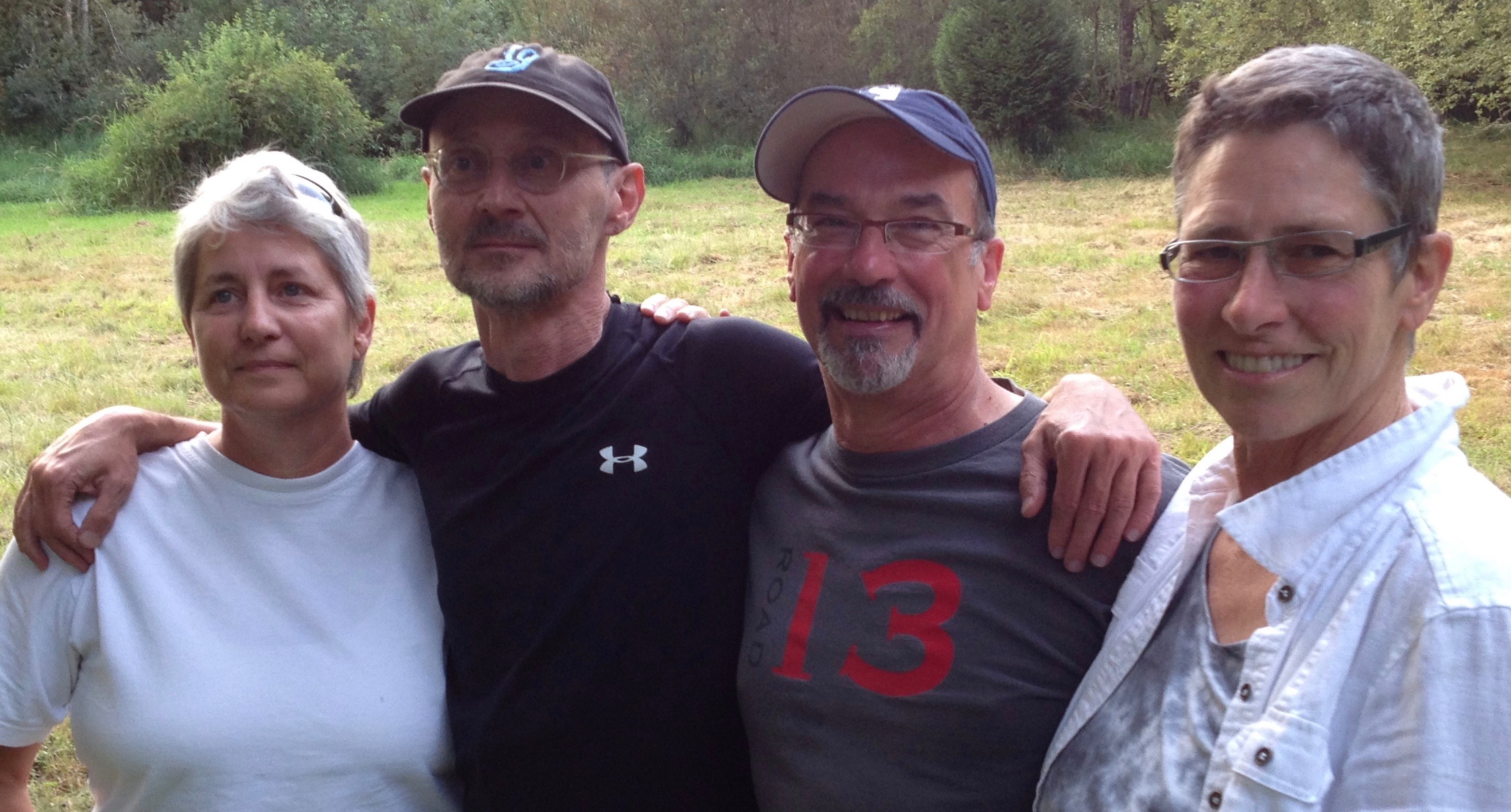
Now, whenever we meet an Orr we just assume we are related, especially if they are gay. We just know we are related to Tom Orr, the talented performer and lyricist who lives in Guerneville. Now that we know we share the gay gene, perhaps we can also claim to share the song-and-dance gene. I know this about my brother: he is a singer and a dancer.

IMG_8624
A few years later. Don and I (R) with spouses Holly and John


Still Standing

Ruth S was the first to live in the top floor apartment after our collective household of four lesbians bought the three-unit building on Richland Avenue. She confided that in big storms it felt like a boat on the sea. You could get seasick with the rocking.

386 Front
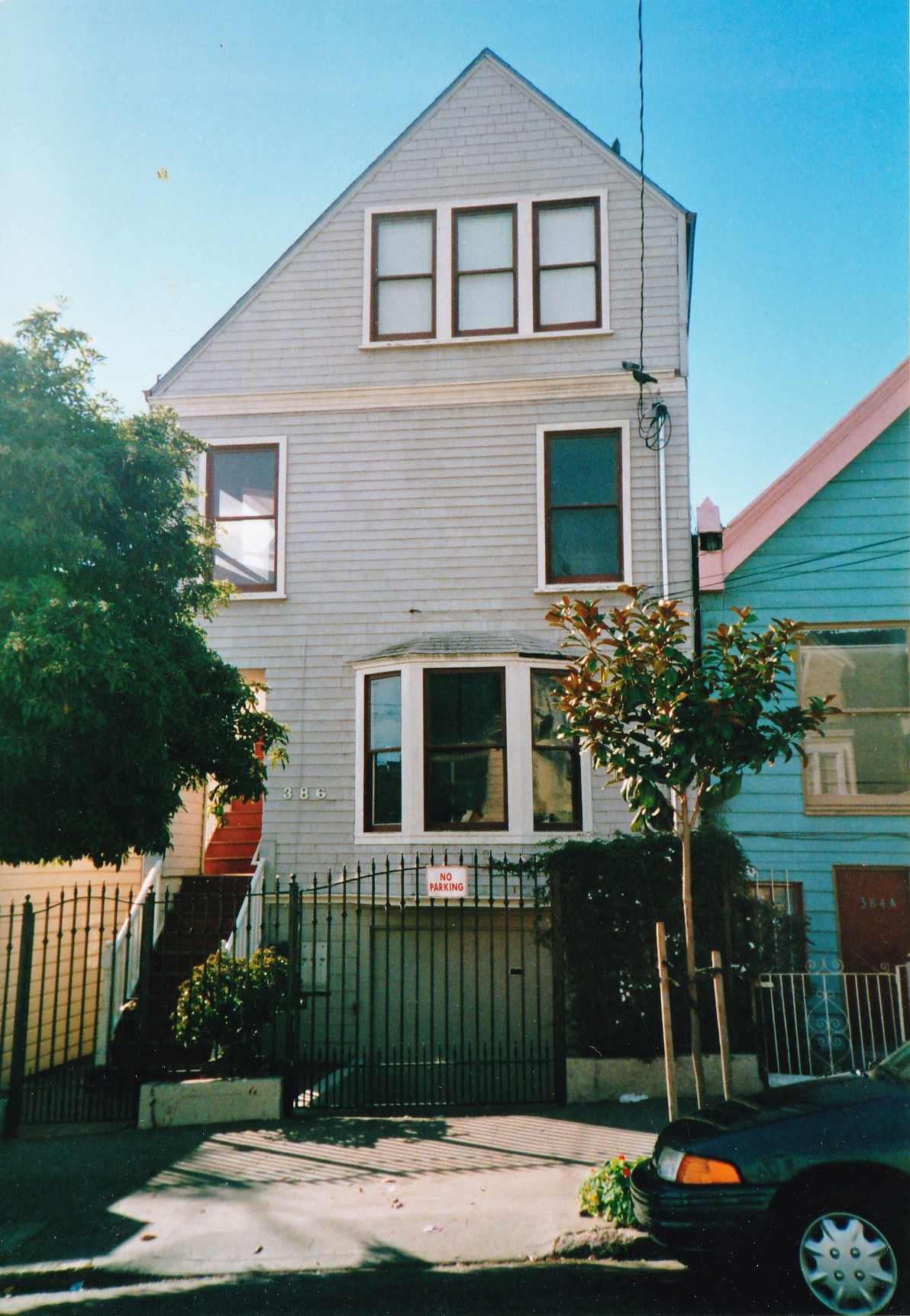
It’s a weird looking building

I’ve now lived in all the flats—A, B and C—and I can testify that Ruth was not exaggerating. One afternoon, lying on my bed in the far southern reaches on the lowest floor of the four-story building, I could feel a gentle rocking. It might have rocked me to sleep had I not been worrying about its source. There was no wind. I could see the blue sky from my window. Later I asked my partner D, whose bedroom was on the top floor in the far northern corner, what she thought might have caused it. Sex, she answered rather sheepishly. “We were having sex.”

As amusing as this was, to have knowledge of my house partners’ sexual habits by just lying on my bed in a distant part of the building, it concerned me greatly about the constitution of our home. Was it going to fall down? And if so, when?

With this question in mind, I invited one of my building inspection coworkers to come by and have a look (I didn’t tell him about the sex). I just felt there was something terribly wrong with the way this building had been constructed. What could the problem be and how might we fix it?

Of course he had no idea. The walls had long been closed and I didn’t at that time have the energy for a big project that included opening walls and inspecting structural members. But I had at various times opened pieces of walls to pull in low voltage wiring or to try to parse out what the builders might have had in mind.

I first moved into the lowest unit, apartment A, in 1980 with my lover Nancy. We noticed immediately that the kitchen floor’s angle was far steeper than, say, the angle of repose for raw eggs. Whenever we dropped anything liquid it would run so quickly from one side to the other that the cook would have to dive to the floor in order to catch it before it disappeared into the framing.

The interior had been finished, but badly. We could see that the previous owner had covered the kitchen with quarter inch sheetrock, painting it all a bright yellow so that no one would notice. The sheetrock covered the window trim, making you wonder what he had been trying to hide. Nancy was a carpenter and I an electrician. We couldn’t stand not knowing what was behind the quarter inch. And we wanted to even out the kitchen ceiling, which had a mysterious soffit hanging over the entrance door. One Saturday while I was away at a tradeswomen meeting, Nancy demo’d the soffit (it had seemed like a simple quick job) and I returned to a kitchen full of rats’ nest material and rat poison boxes from the 1920s. We could only guess that a previous owner had built the soffit around the rats’ nest to avoid cleaning it up. After that we did not open walls with such abandon.

RatsNest
Rats’ nest inside the ceiling

But later I did have to open the kitchen wall. Investigating a short, I opened electrical boxes trying to figure out where the kitchen outlet was fed from with no success. I finally pulled off a piece of the quarter inch sheetrock thinking I’d find a pipe or a piece of electrical cable leading to another outlet. Instead I found that someone (clearly not an electrician) had run not cable but two wires stapled directly to the wooden original kitchen wall and then covered the whole mess with the quarter inch sheetrock. The wires disappeared under the sheetrock. Where did they go? There was no telling. This discovery horrified me. No electrician or anyone concerned with fire hazard would ever have done such a thing. It meant that we could hang a picture on the wall and short out a circuit or start a fire. But there was nothing to be done then. I patched the sheetrock and made a mental note to never hang a picture on that wall. It wouldn’t be till 20 years later that I would have the money and gumption to open the walls to see what was really inside.

386 Richland
So that’s where the wire went!

After closing up the kitchen wall and vowing not to think about the wiring, Nancy and I lived together in Apartment A for a couple of years before experiencing a devastating breakup involving our mutual best friend who lived across the street. Nancy was the first of our original collective of four to be bought out.

We all had thought long and hard about all the possibilities of home ownership, drawing up a contract that spelled out how collective members would be bought out and how new owners would be chosen, how much monthly “rent” would cost and the amount of homeowners’ dues. We even consulted a lawyer from which we learned that contracts drawn up between people are whatever the people agree to. In other words, the lawyer was no help. What we failed to understand was the concept of equity as it relates to real estate. Our idea was that each member’s equity was equal to all the money she had put into the pot, including monthly mortgage payments. None of us had owned real estate. We didn’t understand that most of the payment went toward interest on the loan. So we ended up buying Nancy out for more than her actual equity. But it was a good lesson. We became real estate mavens.

Then I moved in to apartment B. At the culmination of a lovely housewarming dinner, I turned on the coffee maker and all the lights went out. The electrician’s house, my friends laughed, like the unshod cobbler’s kids. That was the start of a long journey of discovery that would shock my electrical sensibilities and make me wonder why the building had not burned down in an electrical fire long before my time here.

Wires live inside walls and ceilings and so without opening up walls it would be very difficult to understand what was going on, but I could surmise that the apartment was served by only a single circuit. That in itself was troubling and there was no way of knowing the quality of workmanship or the condition of the wiring. At least the old fuse panel had been replaced with a circuit breaker panel so the wires were protected from overload. I wasn’t prepared to start a construction project on my home at that time in the early 80s. That would have to wait until after my retirement as an electrical inspector. My job as an inspector required me to explain to other home owners and business owners that their faulty electrical wiring could cause a fire. Every time I said, “If you don’t fix this problem, a fire could result,” I would think to myself, “My own home could burn down!” I didn’t know the half of it.

Over the years collective members sold their shares, others bought in and sold out until I was the only one left. It wasn’t until the year 2000 that I had the time and inclination, and also a partner who wanted to get her hands dirty, to begin to open walls and really see the structure. What we found was worse than anything I’d imagined: no studs in half of the third story apartment, bearing walls cut off at the garage level causing the building to sag in the middle (the answer to the raw egg question), a monstrous electrical fire hazard.

As we deconstructed the building, we kept wondering why it is so oddly shaped, why construction methods differed from floor to floor and room to room, why floors were different heights in adjacent rooms, why floor and ceiling joists sometimes went north and south, sometimes east and west, why when wall coverings were removed we could see sky through cracks in the exterior walls.


Then one day when I was standing across the street looking at the building I had an epiphany. Our home was never a plan in some architect’s mind. It was a collection of buildings set on top of one another, cut off, pushed together, raised up, and without benefit of removal of siding, spiked together with a few big nails. Suddenly all the mysteries we’d catalogued made sense. Our four-story three-unit building had probably begun life as a homesteader’s shack in 1893, the year of the newspapers that had been pasted on interior redwood walls as insulation. We read the San Francisco Call as we uncovered the walls. 1893 was a very interesting year.

Single Life

At 71, my father, Carroll, has been single for two years.

“What’s it like?” I ask. “Do you think it’s different from single at 30, or 40?” I’m in a relationship at the moment, but considering the impermanence of modern lesbian relationships, this is information I intend to store for the future.

He looks at the sky and smooths his gray mustache. “Probably not,” he says.

We sit on the deck of his tiny trailer in a run-down resort in the California desert. We are drinking vodka and grapefruit juice, perhaps a bit too fast. Vodka is his drink, not mine. He likes whiskey, he says, but his system just can’t take it. Gin gives him an asthmatic reaction. But with vodka, he says, he’s never had a hangover.

He has returned home from his travels to a stack of mail and he reads it as we talk, half-glasses perched on his nose. “This GD insurance company. I’ve been fighting with them for months. Who’s this from? Oh, my friends the Carlsons. You remember Ben and Karen. They’re coming to visit.

I move the stack of mail around and spot an envelope with recognizable handwriting. It is a card from my brother, Don, a notoriously poor correspondent.

“Dear Carroll,” it says, “Hope you are enjoying life in the desert. Everything is fine up here. I recently moved into a new apartment with a new roommate, a college student at the university. I’m working really hard on the Little Theater production of Cinderella, and work is going fine. Hope you had a good holiday.”

“Have you talked to Don lately?” says Carroll.

“Not too long ago. He seems to be doing fine.” I don’t elaborate. Why should I explain, when Don does not, that he plays the part of the fairy godmother in Cinderella? I have met the new “roommate,” a young man who clearly does not have his own bed.

Carroll leans back in the old metal deck chair and gives me a look, but asks no more questions. He has never wanted to know the details of my brother’s private life, nor mine, and we have never told him in so many words.

“That was something, Liberace dying,” he says.

“Yes, it was sad.” What I think is Don hasn’t had the test. I’m terrified that he is positive. For a moment I wish I could talk to Carroll about it.

“I don’t think it’s right that people should be able to hide the cause of death like he did,” he says.

“I think it was a terrible thing they did to him,” I say. “He should have been allowed to die in peace.” Carroll makes some more protests, but he’s not much of a fighter and I don’t feel very argumentative at the moment.

I go back to riffling through his mail. “What’s this?” I say, turning over an envelope with flowery handwriting.

He has saved the good stuff for last. “From Irma,” he says, opening the envelope and scanning the card quickly. He passes it to me.

A teddy bear in a lacy bed looks forlornly out from the card. “I think of you daily and miss you enormously,” it says.

Somehow I have the feeling this thinking and missing is not reciprocal. “How sweet.” I take a swig.

I suspect Carroll had been seeing Irma before my mother died, but I try not to hold that against her. Carroll was a little too pushy about it was all, wanting everything to be okay. He insisted I meet her, and the one time I did, she seemed fine. She told me Carroll was the first man who’d appealed to her in fifteen years.

“You’re obviously putting some distance between you and Irma,” I say, pulling myself out of the chair.

“She drinks too much for me,” he says. “I tell her I think she’s an alcoholic and she doesn’t like that.”

“I was just getting up to freshen our drinks,” I say, thinking Irma’s habit must be serious. For as long as I can remember, Carroll has had a drinking problem. Cracked up two company cars. Always had a pint under the front seat. During my childhood many a dinner was eaten in the tension of his absence.

I duck into the trailer’s kitchen. “Are you trying to cut down?” I ask through the screen door as I assemble juice, vodka and ice.

“The doctor bugs me about it. I try to watch myself,” he says, “but when I’m with Irma I drink more. It’s harder to control. I don’t want to get mixed up with an alcoholic.”

“I think that’s smart,” I say, resisting the burden of my mother’s anguish.

The trailer is spare as a monk’s quarters. Only one picture—of my brother Terry’s children—is displayed on the kitchen table. There are no pictures of my mother or the four of us kids, and none of her things are here. She collected old things, I believe because she wanted a link with history. When she died, Carroll ignored our objections and sold the farm and the contents of our childhood home. “What do I want with things?” he’d said. “I’ll die soon anyhow.” Then he bought a pickup and went on the road. Later, he tried to make it up to me. “Take it,” he would say about objects I expressed interest in, but there was nothing I really wanted then.

I walk back out, hand him a drink, sit across from him and pick out another large envelope. “Who’s this from?”

He smiles, devilishly I think. “That’s Eleanor, my South Dakota girlfriend.”

This one has a serious message lettered on the front.

“I hope only that you can love me just the way I am,” it says. Inside a handwritten message adds, “I do hope someday this can be so.”

“What does this mean?” I ask.

He ponders the card. “Can’t figure it. She’s a pretty hippy gal. Maybe she thinks I want her to lose weight.”

“Why would she think that?”

“Oh, I’ve commented on it,” he says. A fat girl survivor of years of badgering from thin parents, I decide I’d rather not get into this.

“Who’s your girlfriend here, the one your neighbors were razzing you about?” I ask.

“Blanche? She’s a class above the rest in this place. Likes to have a good time. Likes to dance.”

I have never thought of Carroll as particularly handsome. But in his set he is the belle of the ball. Last night at the local resort dance he never lacked a partner. Women approached me and asked, “Is that your father? He sure is cute.” I haven’t seen such flirting since my generation of lesbians all discovered each other.

We look out on the slough, where fishers glide by in rowboats toward the Colorado River. Fish aren’t biting tonight. The local colony of ducks flap wings and chase each other in a frenzy of mating. I wonder why my father and I so often seem to find ourselves in the company of mating animals. I hope he senses my discomfort and doesn’t call attention to this ritual.

“The ducks are sure sexy tonight,” he says. “ ‘Let’s chase each other ‘round the room tonight.’ Ever heard that song? They played it at my sister Jesse’s fiftieth wedding anniversary.”

“It doesn’t look like much fun to me,” I say, watching a drake hold a hen under the water.

“Probably is for him,”  he says.

“So what about sex?” I plunge in. “Do these women you’re dating like sex?”

He’s pleased I asked this question, pleased to have a chance to talk about it, I think. “Hell, yes, sure they do. Irma can take it or leave it though. She can be cold but I don’t care about that. I was never one to demand sex. I never in my life said ‘I’m not getting any here, so I’m going somewhere else.’ ”

I’ve finished my drink and want another, but am afraid to break this train of thought. “What about Eleanor?” I ask.

“Now Eleanor is a different story. She’s quite a bit younger than me—fifties I guess. you know those middle-aged women, they’re sexy.”

“Yes I do,” I say, feeling middle-aged. “So you just returned from a tryst.”

“Well, you know my cousin Buford died. I had to go up to Sturgis. But the funny thing about Eleanor, she doesn’t want anyone to know. She’s real involved in the church, and she’s afraid someone will find out about us. I kind of get a kick out of it. She kicks me out by five o’clock so they won’t see me there in the morning. But she is something in bed. I tell her ‘if your church friends only knew what goes on in this house…’”

I have developed a sudden interest in a broken thumbnail and am picking at it intently.

“Eleanor thinks I’m really sexy,” Carroll says. “But I’m really not. You know, she expects too much of me. They all think I’m sexy. I can’t figure out why.” I rip the thumbnail off and it begins to bleed.

“So what about Eleanor? Are you getting serious?” I ask, sticking the thumb in my mouth to stop the bleeding.

“Naw. I know she’d like to get married, but I’m not gonna do it. Don’t you worry. I don’t intend to get married again.”

“What makes you think I’d worry? You’re an independent person. You can make your own decisions.”

I hug myself. The sun has gone down and the evening is suddenly cool.

“Well, what do you say we get cookin’?” Carroll raises his furry black eyebrows at me, gets up and moves into the trailer.

The prospect does not excite me. His bachelor diet of sausage, Spam and fried potatoes gives me heartburn. “Let’s try something different tonight,” I say, opening the refrigerator, which contains little more than ingredients for various alcoholic concoctions. I pull out the biggest thing in there, a heavy rectangular package. “What’s this?”

“Government cheese,” he says. They give it away to senior citizens every two weeks at the surplus store. I want you to take that with you when you go.

“No thanks. I could never eat all this. I live alone, remember?”

“No, I want you to take that.” He is using his sergeant voice. “I can get plenty more where that came from.”

“No, really, I don’t like processed cheese. I would never eat it.”

“You take that,” he insists. “Give it to your friends.”

“Look, I appreciate the offer,” I say. “Maybe we can cook something with it tonight. Does your oven work?”

He finds some matches and kneels down in front of the little propane stove while I start turning knobs on and off looking for the one that controls the oven. “I never did figure out how to use this thing,” he says.

I am watching as he works at lighting it when the air around his head explodes with a whoosh. He is knocked backwards and ends up sitting on the floor against a counter.

“Dad, Dad,” I yell. “Are you okay?” I get down in front of him and his eyes finally focus on me. I can see his thick eyebrows and lashes have been singed. He rubs the melted nubs of hair on his arm. I discover I am crying.

“Knocked the piss out of me, but I’m okay.” He looks puzzled.

“I’m kind of upset,” I blurt out. “I’m afraid Don might have AIDS. I can’t stand to lose him, too.”

Carroll’s face betrays no anger, only resignation. “He’s always gone for men, hasn’t he?”

“Yes,” I say, and more to atone for indiscretion than anything else, I add, “and I love women.”

“I don’t understand it,” he says, “but I’m glad you’ve been quiet about it.”

I give him a hand up, then wipe my eyes quickly on my shirt sleeve. He smoothes the ruff of hair around his bald head and tucks in his shirt. I decide to cook something on top of the stove.

“Hey, I want you to see something, he says. “Look at my gold nugget.” He pulls what looks like a huge nugget from his pocket. It is attached to a gold chain.

I’m immediately skeptical. One of his favorite pastimes is making up stories about found objects or people he sees in passing, or family history. Years pass and fiction melds with truth. “Where did you get this?” I laugh.

“Well, now, some people might think this is strange,” he says, eyeing me as he places it in my hand. “You know your mother had a lot of dental work done over the years and she had her teeth pulled the week before she died. This is made from her gold teeth. I want you to take it.”

I Find Eddie’s Last Name and More

Chapter Three

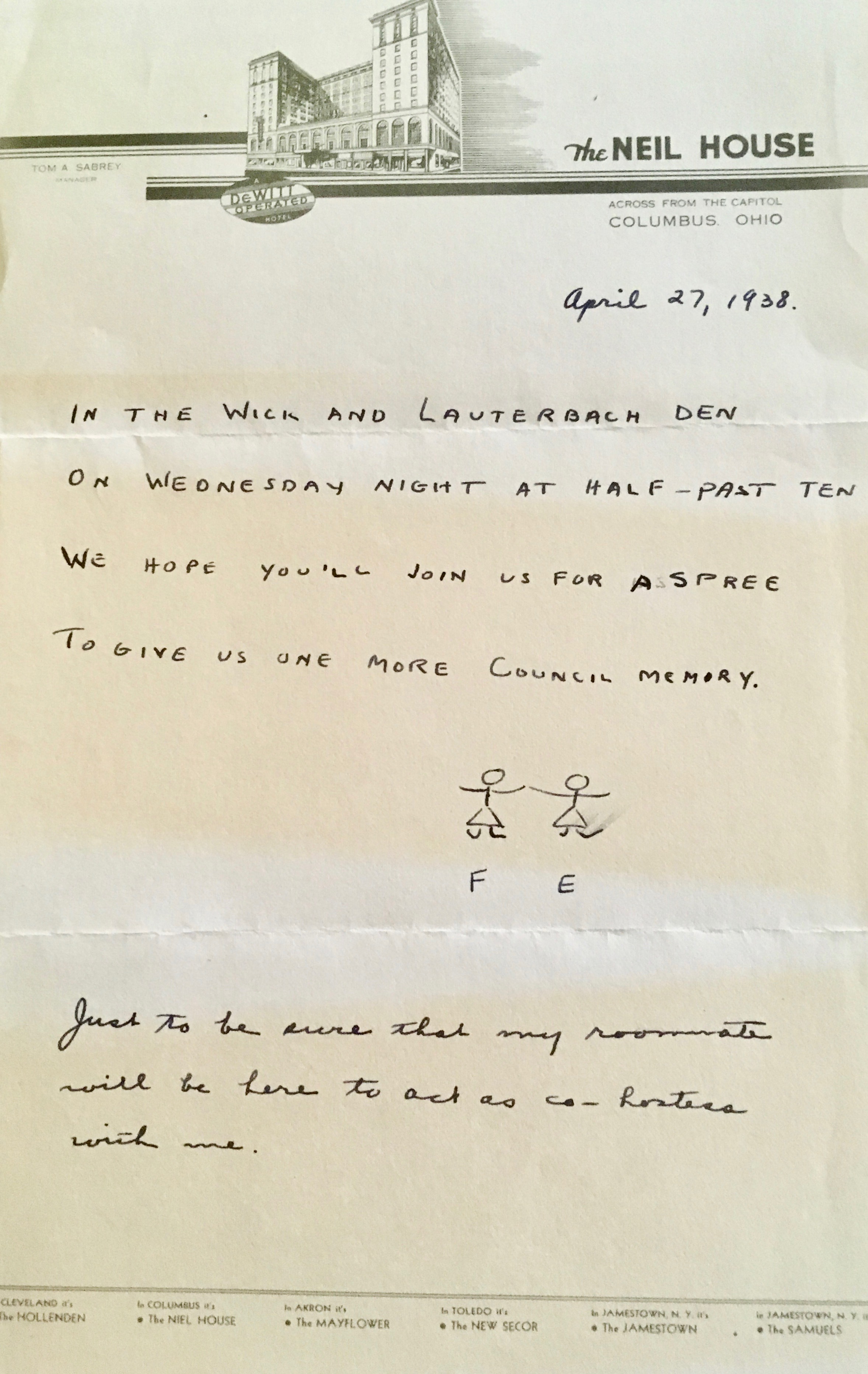
I had given up finding out any more about my mother’s admirer, Edna L. Then, looking through a box of family photos and letters that my brother Don had taken with him to Vancouver BC, I found another scrapbook made by my mother. This was mostly high school-era, 1920s-1930 (Flo had graduated in the class of 1929½). But Flo had tucked mementos from other decades into it. Among the high school graduation notices I was delighted to find another note from Eddie (as she sometimes signed her name) in her now familiar diminutive handwriting. It was an invitation to a party during the Columbus YWCA conference. It said:

In the Wick and Lauterbach den

On Wednesday night at half past ten

We hope you’ll join us for a spree

To give us one more Council memory

Then there is one of Eddie’s cute stick figure drawings—two skirted figures with F and E written underneath. At the bottom it says, “Just to be sure that my roommate will be here to act as co-hostess with me.” While they were roommates Eddie could never keep Flo at home it seems. It was written on the Neil House stationery and dated April 27, 1938.floeddie

I had found Eddie’s last name—Lauterbach—the one thing I’d been searching for in the scrapbooks, the one thing I needed in order to find out more about the woman with a crush on my mother! I was so happy I danced around the house singing her name.

Googling her name got me to the Edna A. Lauterbach scholarship fund for the education of nurses. She was a nurse who championed home care. Then I started making up stories. I imagined Edna was an important historical figure, an organizer. Perhaps she had been a speaker at the conference. I imagined she traveled around the country on speaking tours seducing women in every town. I wondered whether Eddie had had lots of lovers, or no lovers at all. Was she the archetype of the lonely lesbian who never found her mate? Was it hard to seduce women in the 1930s?

I wrote to the scholarship fund to see if they could provide more biographical information. The marketing director got right back to me saying it was a different person, as the age didn’t match up. This Edna Lauterbach was not even born until after the meeting in Columbus took place. Scratch her and all my associated fantasies.

Then Don and I got on the computer and looked at census records. We found an Edna R. Lauterbach, born in 1900 and died in August 1979 who lived her entire life in Brooklyn, NY, after 1930 in a 43-unit apartment house on 88th Street. I found pictures of the building, built in 1926, online. The apartments now sell in the million-dollar range, so I’m guessing the neighborhood was gentrified long ago. But when the Lauterbach family moved in, this would have been a working class neighborhood. Edna had two sisters, one named Gertrude. This was a deciding clue, as her sister Gertrude had been mentioned in one of the other notes found in Flo’s scrapbooks. Don found records for Edna in the 1910, 1920, 1930 and 1940 censuses. In all, she was single and living in the family home. By 1940 their father (a truck maker whose parents had emigrated from Germany) had died, but the three sisters were all still unmarried, in their thirties and living at home with their mother. A household of old maids! Perhaps all the sisters were lesbians.

According to the census, Edna worked in advertising. She was there for the Mad Men era, although she would have been 60 years old in 1960. I imagine her as the staid older secretary who runs interference for her philandering boss while correcting his spelling and grammar and making him look good. She may have worked in the industry until she retired, possibly at the same job. Had she remained a closeted lesbian all her life? Was she part of a lesbian subculture and if so, where was it centered? No doubt the environs of New York City afforded more possibilities than those of smaller towns. But I’m imagining big lesbo parties through the decades at the apartment on 88th Street in Brooklyn on the parents’ bowling nights.

It turns out Edna R. Lauterbach wasn’t anybody famous. I couldn’t even find a funeral notice for her, although we did learn that she is buried in the famous Brooklyn Greenwood cemetery with some 560,000 others. She was a workingwoman, a stenographer, who managed to keep a job through the Great Depression. In 1939 she worked in advertising 44 hours per week and 52 weeks in the year. Her income was $2040 that year.

Her parents were ethnically German and my guess is they were not Jewish. The YW is a Christian women’s organization, but it did work with Jewish groups against anti-Semitism and to prod the government to increase numbers of Jewish refugees allowed into the U.S. during the Nazi era. Jewish women did join the YW, but usually as members of the Biz-Pro groups or associated Jewish organizations.

Edna Lauterbach and my mother were two of the thousands of workingwomen who benefited from their membership in the Business and Professional Women’s organizations under the umbrella of the YWCA. One benefit was being able to make friends with other workingwomen from around the country.

Eddie surely had a giant crush on Flo and my heart aches as I read her letters. My mother never revealed that she’d had a sexual relationship with another woman but when I came out to her in the 1970s she did confess that she had known lesbians. And the name Edna Lauterbach is vaguely familiar to me. Did Flo tell me about her? I can’t remember. But it seems as if they kept up the friendship for some years at least. What was the nature of their relationship? They were certainly close friends, and possibly lovers, although I found no conclusive proof.

I have no evidence that they ever saw each other again after 1941 when Flo traveled to New York to visit Eddie. My mother returned to her hometown of Yakima, Washington where (after a stint in Europe with the Red Cross during WWII) she married, raised four kids and lived the rest of her life. Edna L. lived out her life in her family home on 88th Street in Brooklyn.

There is so much more I want to know about my mother’s admirer. Did she frequent the lesbian bars in Manhattan? Was she involved in the blooming lesbian feminist culture in the 1970s? Did she continue to be active in the YWCA? I do know that, even if she and my mother were lovers, the affair would have been long-distance and periodic. And perhaps Eddie’s attentions were not returned at all.

Dearest Eddie, I hope you found love in your lifetime. I hope you found a woman who could love you back.

Chapter 4: https://mollymartin.blog/2022/08/03/who-was-my-mothers-lesbian-admirer/

Looking for My Mother’s Lover

My mother's scrapbook
My mother’s scrapbook

Chapter Two

Among the many questions I wish I could have asked my mother: When did you first have sex? Were you ever attracted to a woman?

We came of age at very different times. My mother turned 20 in 1933, the nadir of the Great Depression. I was 20 in 1969, the zenith of the Countercultural Revolution.

As close as we were, there were things her generation just didn’t talk about—private things. My generation talked about everything, even things that probably should have been kept private.

Whether or not my mother was ever attracted to a woman, I have found evidence that at least one woman was attracted to her. After I discovered the letters from Edna L., my mother’s ardent admirer, I searched in vain for her last name and any identifying information in Mom’s scrapbooks. They had roomed together in the Neil House Hotel in Columbus, Ohio for the national YWCA convention in April 1938. But “Eddie” (as she often signed her name) suggests in one note that they had met the previous year at a YW conference in Chicago.northwest

“It has been fun to continue our friendship begun in Chicago (or even earlier) and I hope we shall be friends far into the future,” wrote Eddie.

I can’t imagine what Eddie means by “even earlier.” I didn’t think Flo had traveled east from Washington State before the Chicago trip, but I have one piece of evidence that suggests otherwise. She gave me a small painting and wrote on the back, “Bought at Dayton’s in Minneapolis in the 1930s. Sent to daughter Molly in San Francisco 2/82. Flo Martin.” So perhaps there had been previous meetings where they connected that Flo had not recorded in the scrapbooks. Had Flo and Eddie schemed for a year to room together in Columbus? They must have planned ahead at least.tuckin

So, my new obsession: Edna L. Reading her love notes to Flo warmed my heart and I began to identify with Eddie who slyly references “baths” and late-night “tuckin’ in” (her quotes, not mine). From reading her notes, I conclude she wanted to seduce my mother. Did she?

Some things I know about Eddie: She lived in New York. She was participating in the YWCA conference, so she could have been active in a Business and Professional Women’s Club, as was Flo, or in the YW. Chances are that Eddie was older than Flo, who was only 24 when they roomed together in Columbus. One clue I found in Eddie’s letters: they are literate with perfect spelling and punctuation. This suggests that she worked in an office and not a factory.cometoNY

What did she look like? My mother’s scrapbooks from the 1930s are filled with pictures, but as far as I can tell there are none of Eddie or the YW conferences. But who knows? Flo didn’t caption anything in these early scrapbooks. In trying to imagine how Eddie looked, I could not even assume that she was white. Even in 1938, the YW strove to include racial minorities.

Participating in these conferences must have felt to my mother and her comrades like early feminist gatherings did to my generation of feminists. The meetings were focused on making institutional changes to give women and minorities more comprehensive rights. These women were leading a movement for social change, just as we did. The artifacts Flo saved in her scrapbooks show that many of these women built loving friendships with each other. The warmth expressed in their greetings illustrates deep feeling. From receipts she saved, I see they sent flowers to each other as thank yous, a practice I wish in retrospect my generation of feminist activists had adopted.youretops

The Columbus conference was a continual round of meetings. In her love notes Eddie grumbles about not getting to see Flo back at the room until late at night.

“Aren’t we having a good time even though I have to sit up nights and wait for a chance to see you?”

“I certainly am enjoying being with you—even if I don’t have that opportunity ‘cept in the wee hours mostly, after I’ve tucked you in. I’ll be tuckin’ you in any minute now when you get back from your meeting on findings…”

Apparently the meetings went long into the night. Another participant noted, “Here’s to more 2am meetings.”

Flo had saved the banquet book from the YW convention and its inside covers were filled with inscriptions from attendees. Altogether there are 27 signatures. Nicknames were popular and they seem to have nicknamed Flo “Cricket.”

They all signed their full names, except Eddie who signed “Love—Eddie.” It’s an indication that their relationship was special, but disappointing for me because Eddie never signed her last name.

In the banquet book Eddie wrote: “Dearest Florence—You are one grand girl and a swell pal! These interludes of Council and Convention will always be happy memories because you shared them with me. I hope you’ll “bother” me “for years to come” and some day I’m coming to see you in the Northwest! Love—Eddie L.”

Did Eddie ever visit the Northwest? There is nothing in my mother’s scrapbook to suggest that she did. But items she saved show that Flo visited Eddie in New York in 1941. There are menus from the Swiss Village Inn and Struppler’s (next to the Cordova 917 Grand Ave.) I found a cocktail napkin from Jack Dempsey’s Broadway Bar and Cocktail Lounge, “Meeting Place of the World.” She kept a newspaper article citing record heat in NYC, a humid 91 degrees on the hottest Sept. 10 in a decade. There’s also a receipt from Sweden House Inc. (Swedish decorative arts) at Rockefeller Center for $1.53 dated 9/10/41, and a receipt for a single person at the Taft Hotel, 7th Ave at 50th St. NYC, and a menu from the Taft Grill.

The Taft Hotel, a 22-story high-rise built in 1926, was one of New York’s premiere tourist hotels with 2000 rooms right on Times Square at Radio City in Midtown. My mother, a small-town gal from Yakima, Washington, must have been thrilled to stay in such a glamorous big city accommodations. I bet she had a great view from room 1045.

How could my mother afford this trip? Had she been saving pennies for three years while working full time and helping to support her family? I could never afford to stay in hotels as a young working person, nor could my family afford hotels when I was growing up. On vacations we drove to the Cascade Mountains and pitched a tent. When I traveled I always arranged to stay in the homes of friends or comrades. It made me wonder if Eddie had chipped in to pay for the room at the Taft Hotel. Or maybe Eddie sprang for the hotel while Flo paid for the train trip. Perhaps she and Eddie had been corresponding furiously for three years, planning this tryst.

Flo also saved a Christmas gift card in its envelope from Macy’s New York. It is signed “With much love to you, Wickie dear—Edna L.”

There’s another note on a card with a monogramed L with no date: “My best love to a very good pal—Edna L.”

Then there’s a note that reads “Florence dear—Just got tickets for Watch on the Rhine—only chance it seems—Gertrude (my sister) will be joining us—will call you about meeting for dinner & theater tomorrow night. Edie L. (The play, by Lillian Hellman, won the New York Drama Critics prize in 1941).

Did Flo travel to New York just to visit Eddie? I can’t find any evidence of meetings of the YWCA or Biz-Pro in NYC in September 1941. Did she stay in a hotel and not with Eddie because she and Eddie wanted a place to be alone?

roundpic
Painting bought in Minneapolis

From the evidence, it looks like Flo travelled to New York by herself. In those days you could take the North Coast Limited on the Northern Pacific Railway all the way from Yakima to Chicago. Then you transferred to the Pennsylvania Railroad for the final leg to New York. Of course, by this time Flo was a veteran train traveler, having already been to Chicago, Columbus and Minneapolis.

As much as I’ve fantasized about my mother’s lesbian affair, I think the evidence is mixed. It wasn’t just that Flo had had lots of boyfriends, or that she married a man. That’s a story many lesbians tell. While I never married a man, I spent a decade experimenting with heterosexual sex before I came out.

picback
Flo’s inscription on the back of the painting

My mother definitely struggled with homophobia. As liberal as she was politically, Flo had difficulty accepting that my brother and I are gay. He came out first and she felt justifiably burdened by the widely accepted Freudian theory that mothers are responsible for sons’ homosexuality. Then, when I came out a few years later, she at first chalked it up to a phase I was going though. Could that be because she went through a lesbian “phase” herself?

I made up all sorts of sensational stories about Eddie and Flo from the information I found in the scrapbooks. But since Eddie’s last name remained unrecorded, I gave up learning any more about her. Whatever happened between Flo and Eddie, I’m sure my mother had to wrestle with her own internalized homophobia and that of the dominant culture. At that time, in the 1930s, homosexuality was highly stigmatized and even in the big city of New York, lesbians stayed closeted to protect their jobs and reputations, meeting mostly at private house parties.

There remains the possibility that Flo was deeply in denial about her attraction/affair. I have some evidence to support this theory. My mother’s sister, Ruth, also had gay children and, while much more politically conservative, Ruth took a stand when her Presbyterian church excluded gays. She was proud of her gay kids and publicly quit the church in support of them. But she complained to me that she could never get my mother to talk about the issue. She couldn’t understand why Flo, her closest sister, had shut her out, especially with regard to a subject they both shared. I never understood this. I just assumed it had to do with Flo’s avoidance of the personal like so many in her generation, but perhaps my mother feared that her own sexual past would be revealed.

Did Flo have an affair with Eddie? I’ll never know for sure. If she were still alive, I think I could ask her now. When she died in 1983 at the age of 70, I still felt restrained from asking personal questions that I knew she would refuse to answer. Then again, maybe she never would have revealed the truth. She believed some things are best kept private.

Chapter 3 I find Eddie’s last name and more: https://mollymartin.blog/2016/11/27/i-find-eddies-last-name-and-more/