Heated Rivalry has got me thinking about the gym among other things
Watching Heated Rivalry, a series about gay hockey players, stirred up memories of my own athletic life. I competed in the Olympics too—the Gay Olympics. Well, we couldn’t call them that after we lost the right to the name in court, so they became the Gay Games. Alliterative. Less grand. Same spirit.
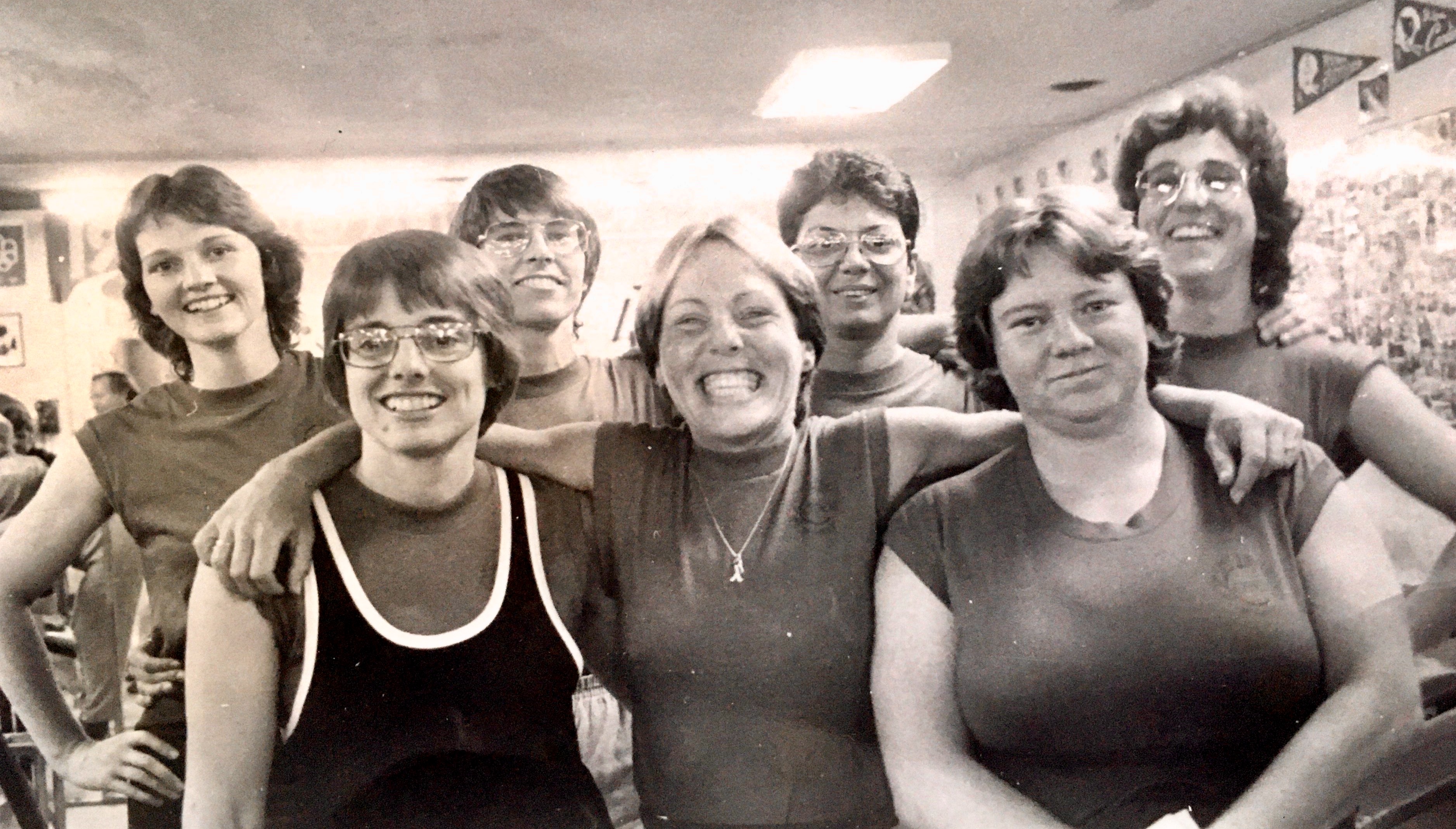
Me and my team of lesbian power lifters, Gay Games 1982
At the Gay Games in different years, I was a powerlifter, a wrestler, and a rower. But more than that, I was part of something new. The Gay Games didn’t just raise the aspirations of queer athletes; they lifted up women’s sports in ways the mainstream world hadn’t yet imagined. Women had never competed in powerlifting at the Olympics before women competed in the Gay Games. When my small crew of gym-going lesbians formed a team to compete in the first Gay Games in 1982, we were pioneers. Women’s powerlifting wouldn’t enter the official Olympics until 2000, at the Sydney Games. We were nearly two decades ahead of the curve. Of course it was us lesbians.
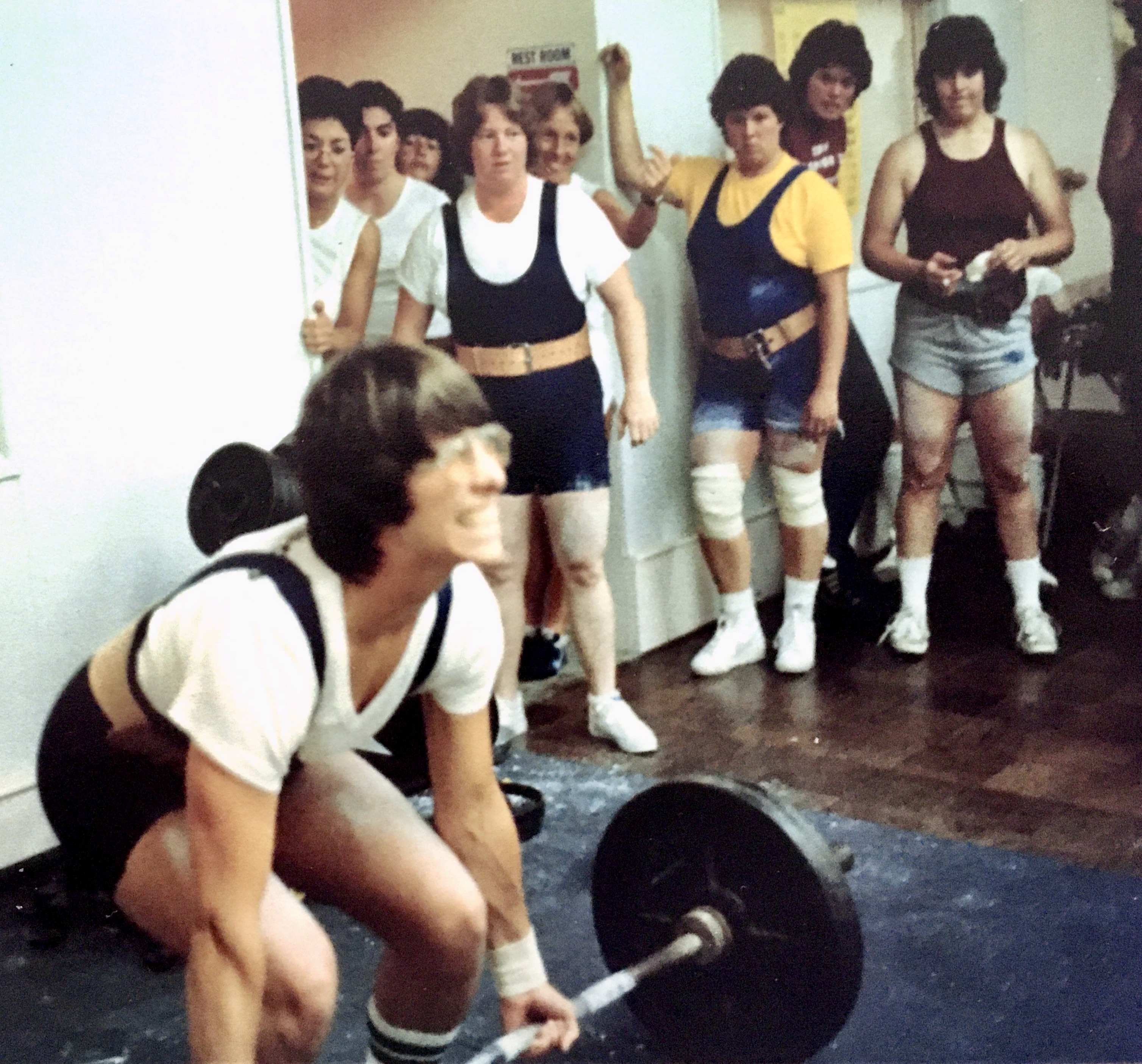
Teammates watch my dead lift 1982 Gay Games
My journey into weightlifting began in San Francisco in the mid-1970s, when I was working construction and needed to get stronger. I don’t remember exactly how the idea came to me—women simply didn’t lift weights back then—but I started going to the gym with my friend Jill for moral support. At first, we trained at the Sports Palace in the Mission, which had been an all-men gym. They didn’t even have a women’s changing room or bathroom. The owner tacked up a sheet of plywood in the corner so we could change behind it.
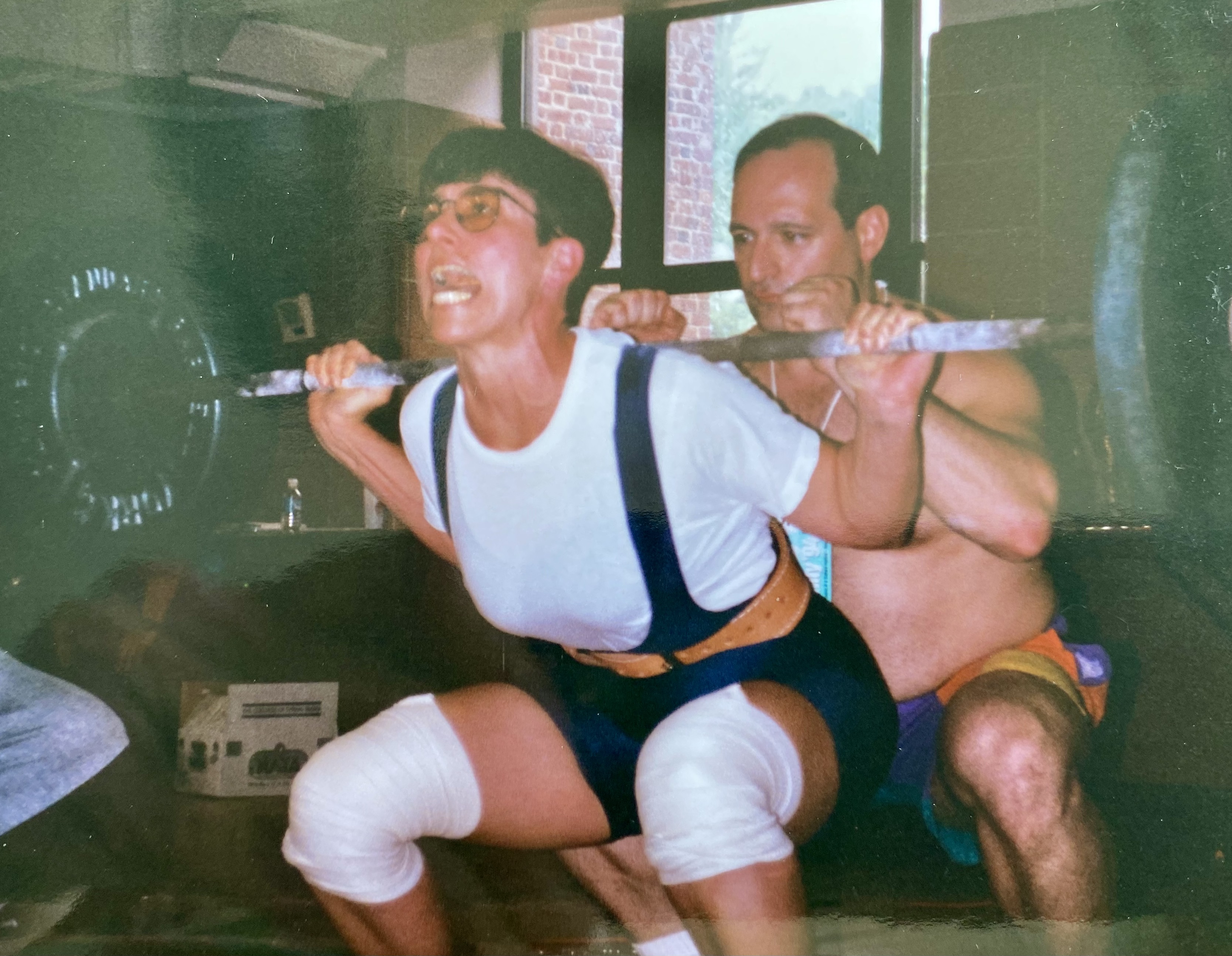
The squat, Gay Games NYC 1994
The men didn’t exactly welcome us. They didn’t like the sound of women’s voices, or having to share equipment, or having us “work in” on their sets and move their heavy weights. So when Betty Doza opened the Women’s Gym in 1979, in a storefront next to the Swedish American Hall on Market Street, I crossed over immediately.
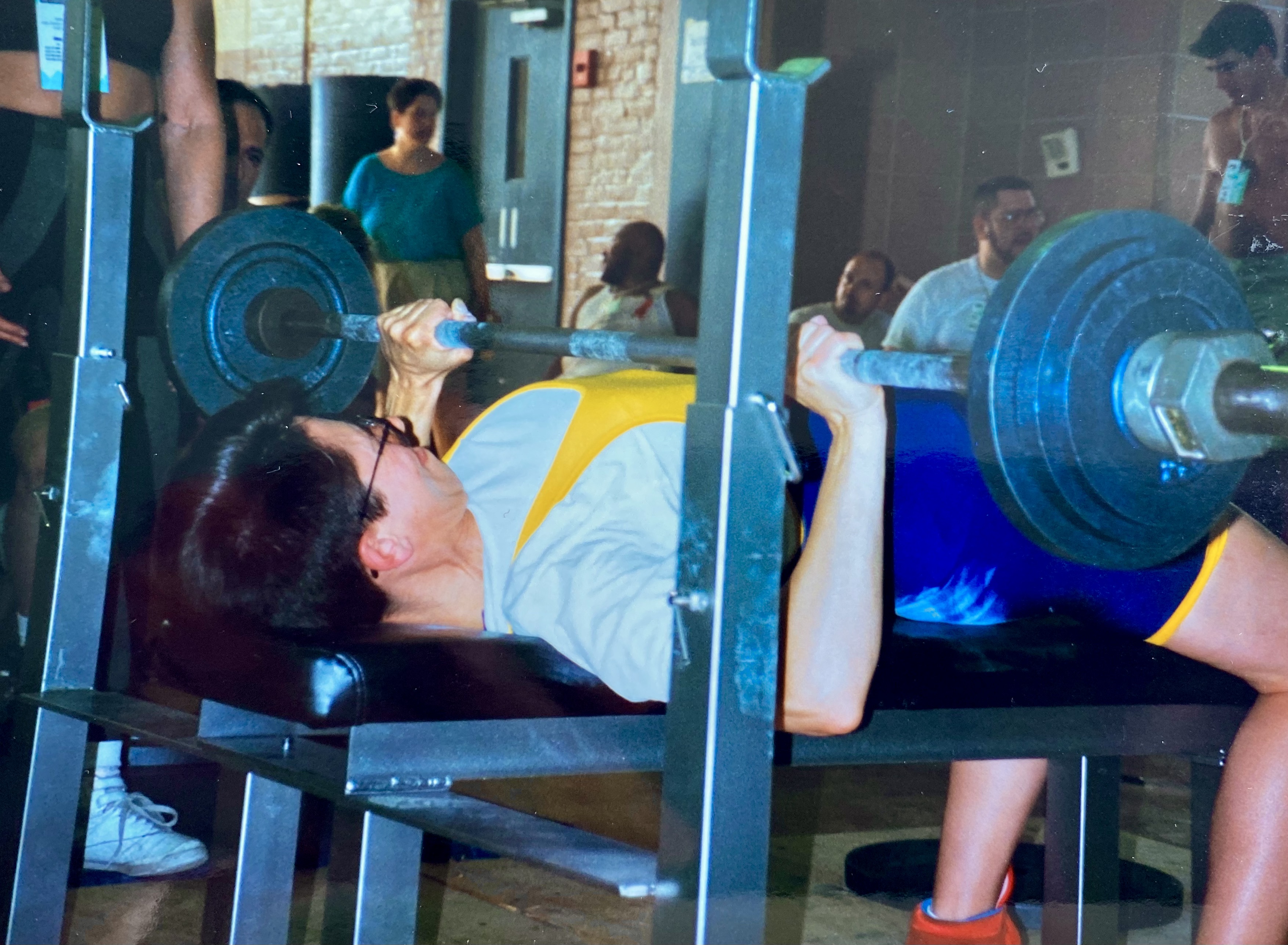
Bench press Gay Games NYC 1994
The Women’s Gym had shiny new machines upstairs, but the real action was in the basement where the serious lifters gathered. Until then, I had only learned the three Olympic power lifts—bench press, squat, and deadlift—because those were the only lifts women were officially allowed to compete in. But downstairs, women were doing the clean and jerk and the snatch. These were lifts we’d been banned from performing, so we taught each other proper form. Coaching was essential. Done wrong, those lifts could seriously injure you. It felt like sneaking gin in a Prohibition-era speakeasy—dangerous, forbidden, intoxicating.
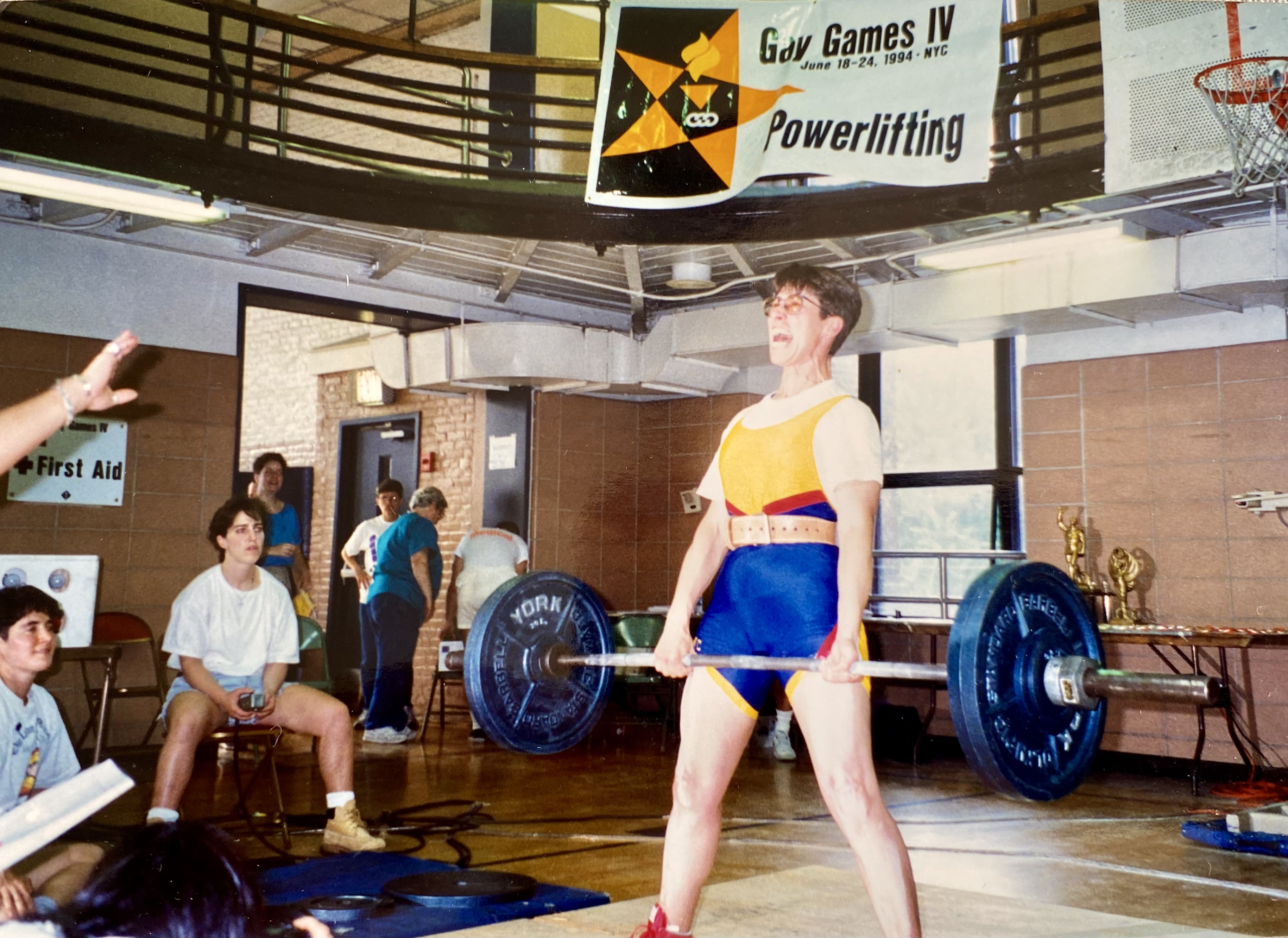
Dead lift Gay Games NYC 1994. I had changed to a wide stance.
The Women’s Gym became a training ground for women who wanted to be firefighters, cops, and competitive athletes. There are two very different branches of weightlifting: bodybuilding and powerlifting. Bodybuilding is about appearance—sculpted, ripped muscles, thinness, aesthetics. Powerlifting is about strength: how much weight you can move in three lifts. You can be fat and be a powerlifter. That distinction mattered.
I competed in the 148-pound class, usually weighing about 144, and spent my time trying to gain weight. Every pound meant more leverage, more power. While other women obsessed over dieting, I complained that I couldn’t put weight on. They thought I was strange.
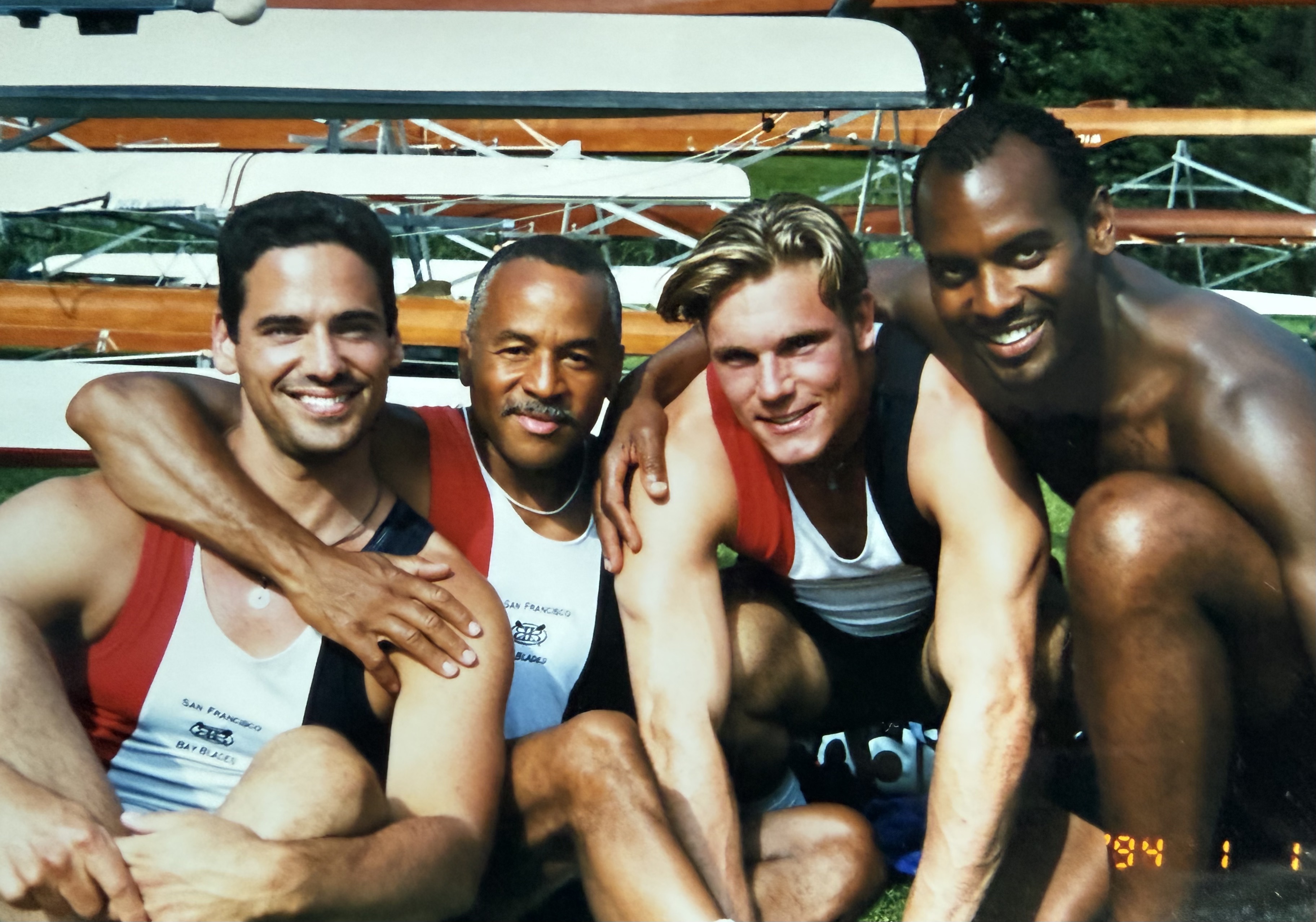
My rowing team, the Bay Blades, had some cute men too.
After workouts, we crossed Market Street to Leticia’s, a gay Mexican restaurant, for margaritas and nachos. We were strong, and we knew it. We were powerful. We were a team. There were about ten of us training together for the 1982 Gay Games in San Francisco. I’ve forgotten most of their names now, but I remember the feeling: solidarity, purpose, pride.
The 1982 Gay Games may have been among the first major powerlifting competitions for women anywhere. That year marked the beginning of what would become an international movement. We didn’t really care about medals—we were just thrilled to compete, to exist publicly as strong queer women. But I did come home with gold, besting a woman from the Netherlands.
Twelve years later, in 1994, I competed again as a powerlifter at the Gay Games in New York City. I was lifting more than I had in ’82, but the field had changed completely. The women I competed against were world-class athletes, capable of lifting three times my best numbers. Women’s powerlifting had exploded!
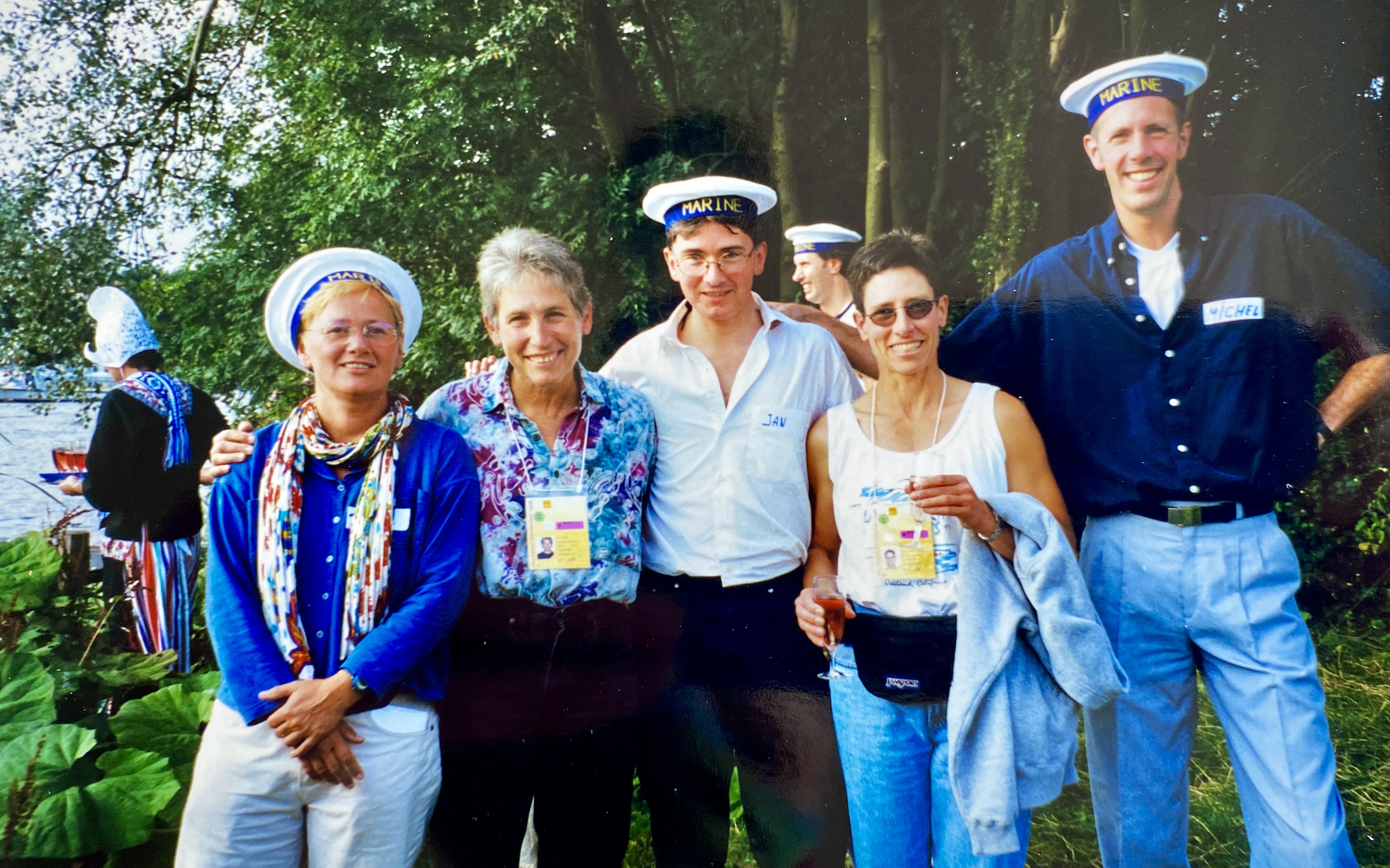
In Amsterdam the Dutch rowers greeted us in navy caps and with champagne. Nancy Stoller (L) and me with some of our hosts. 1998
The Women’s Gym didn’t survive. Men sued, claiming discrimination, and eventually won. But for a few glorious years, it was a sanctuary—a place where women could build strength, community, and defiance. The Gay Games and the Women’s Gym together cracked open a door that could never again be closed.
We weren’t just training our bodies. We were reshaping what women, and especially queer women, were allowed to be.
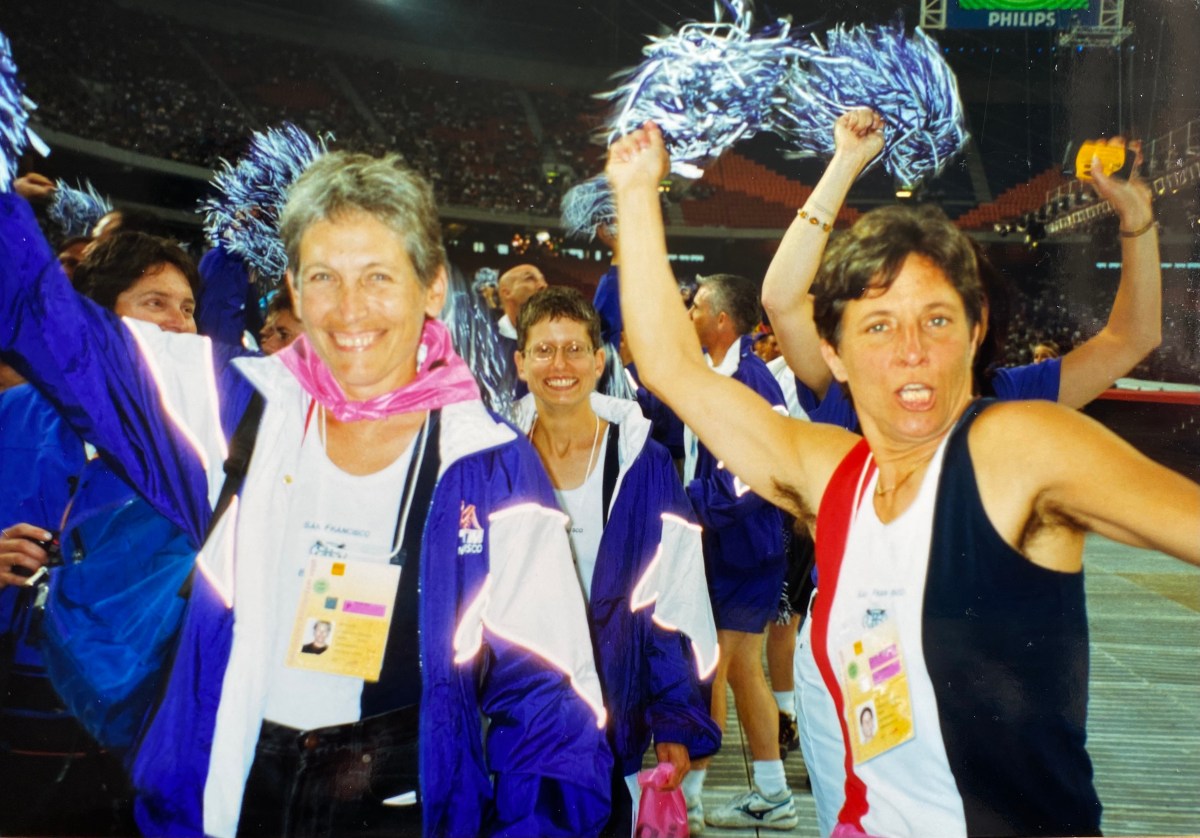
In the top picture, marching into the stadium are Nancy Stoller (L) and Helen Vozenilek of the Bay Blades rowing team. Amsterdam 1998.
She was a lesbian who played in San Francisco 1952-2020
Found in Jackie’s cluttered house
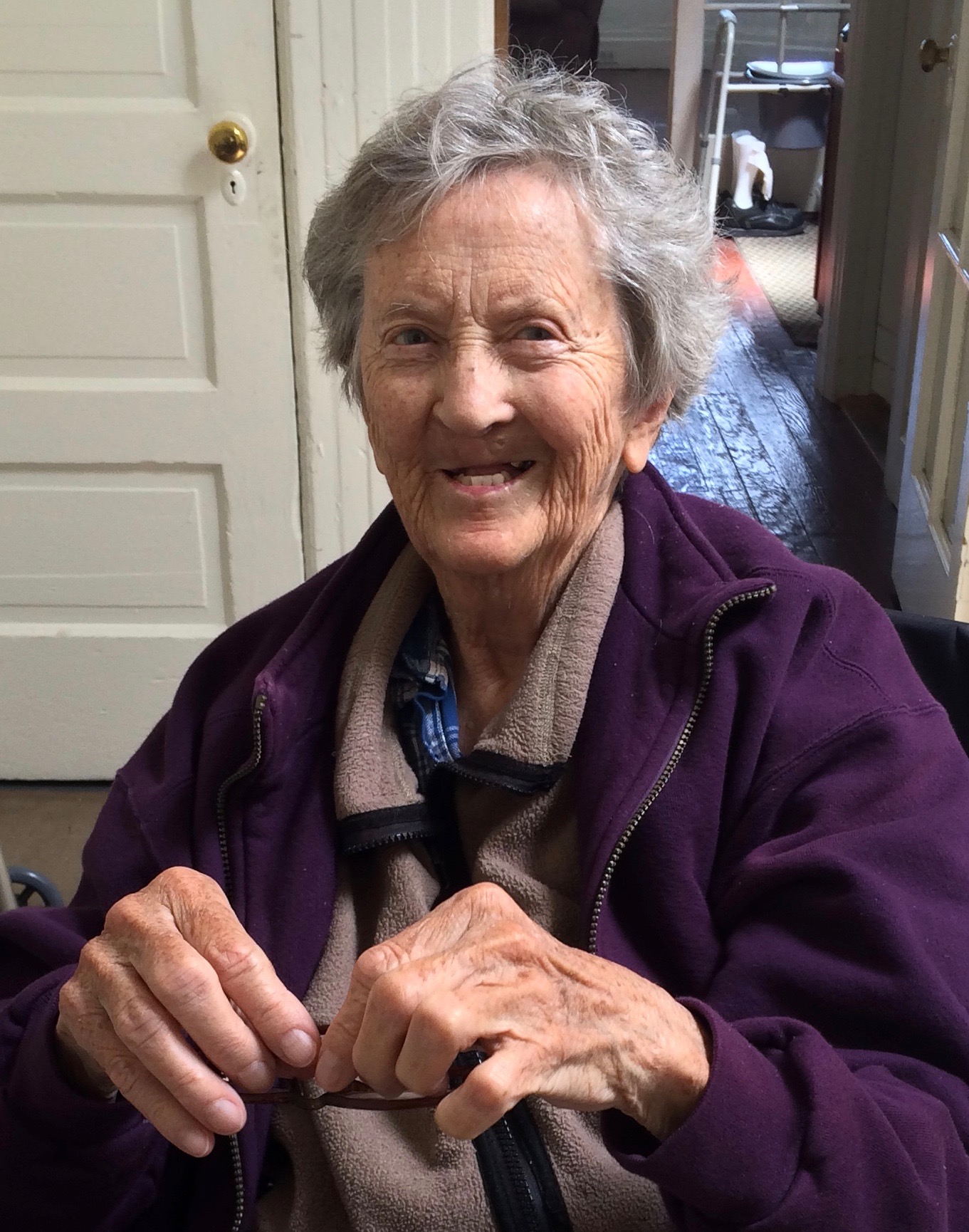
She was an old-time dyke, although I never heard her use that word, nor the word lesbian to describe herself. She did call herself kiki, meaning neither butch nor femme. She may have called herself a character. I know the rest of us did.
Jackie Jones told me music saved her life. Music was certainly the theme of her life.
I first encountered Jackie at the Alemany Farmers Market in San Francisco where she played music every Saturday. She was a one-woman band playing the saw and a selection of hand-made instruments along with a dancing cat that she manipulated with her foot.
Jackie at the farmers market. Photos by author
She made the cat contraption out of plywood, springs, bike parts and wire. She painted the cat lavender with a sparkly G-string and stars where nipples would be. The cat had articulated limbs so Jackie could make it tap dance while the arms swung around. She recorded her own back up music and played it on a portable tape deck. She only played music from the 1920’s, songs like Bicycle Built for Two, Bye Bye Blues, and The Charleston.
Kids loved the dancing cat and always wanted to touch it so Jackie invented ways to discourage them. She talked about glueing a tack on the top of the cat’s head to pop their balloons. She wasn’t fond of kids, and when the kids moved on and we got close she would change song lyrics to bawdy and gay themes.
She rewrote the words to “Wait till the Sun Shines Nellie.” Her version went “Wait till your son turns nelly, and the neighbors start to talk.” The last line was “Gay is grand!”
Jackie always wore the same clothes—a John Deere trucker’s cap, a blue plaid shirt and jeans. Her front teeth were gone and she had false teeth that fit badly, which she only wore when in public.
Jackie lived in our neighborhood of Bernal Heights, but even though my lover and I invited her to dinner at our house, she never would let us into her house. She was an admitted hoarder.
Jackie owned two houses side by side on Manchester street, bought at a time when Bernal Heights housing was cheap. She lived in one and rented out the other, one of several on that street only 12-and-a-half-feet wide (most lots are 25 feet wide).
From Pensacola to New Orleans
Born in 1926, Jackie grew up in Florida, graduating from high school in 1944.
She said, “I remember in Pensacola listening to music with the Black maid that my mother hired. She would dance around with the broom to Ella Fitzgerald singing “A Tisket a Tasket,” then be back to ‘yes maam’ and sweeping when Mom came back.”
Jackie loved music from an early age and yearned to play it, but her parents scoffed and refused to pay for an instrument or lessons. Undaunted, Jackie saved her 35 cent-a-week allowance until she accumulated enough to buy an accordion from the Navy Exchange store. She spent hours in her room, teaching herself to play.
Jackie in her little house
After WWII, Jackie left home and moved to New Orleans. Living in the French Quarter, she held various day jobs to earn her $20 a month rent. At night, she would beg bands to let her sit in just to get experience.
Jackie’s first paid gig was $3 a night, playing her accordion for eight hours straight with a country band. She learned other instruments–guitar, then drums and vibraphone. By the late 1940s, she was supporting herself as a working musician, entertaining at bars, strip clubs and dances throughout New Orleans.
Her Journey West
In 1952, Jackie drove her 1948 woody station wagon west, coming first to Los Angeles, where she didn’t last long. She said, “Where I came from in New Orleans, people see you on the street and say ‘Hi! How are you.’ In LA, you say Hi, they just about call the cops on you.”
After six weeks in LA she couldn’t take any more of the place so she headed up north to San Francisco. There the people were friendly, they didn’t all look alike, folks were helpful, there were lots of bohemians, and she was able to get a job quickly. She never went back to LA.
Rubbing shoulders with the Beats
Jackie loved San Francisco but had problems finding permanent housing. Landlords did not want to rent to lady musicians, particularly the kind that wore pants and rode a motor scooter.
She bounced from rooming house to residential hotel, from day job (taxi driver, assembly-line worker) to music job (guitar at the Town Pump bar, accordion at the 1954 opening of San Francisco International Airport).
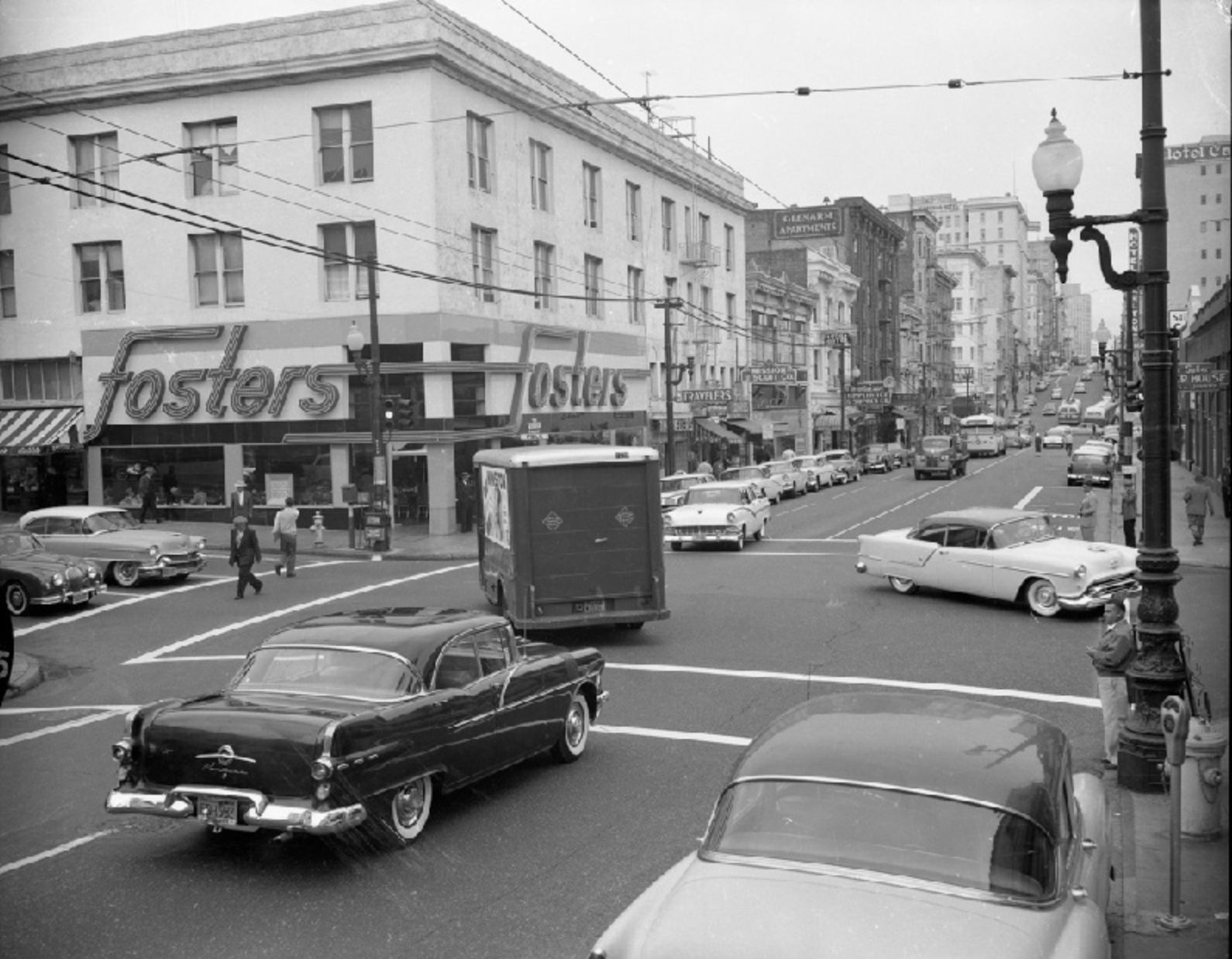
Fosters Cafeteria, downstairs from where she lived at Polk and Sutter, was open 24 hours and the bohemians hung out there. She met Alan Ginsberg and other Beats there. She became friends with ruth weiss (poet, performer, playwright and artist) when ruth worked the bar at the Wildside (a lesbian bar) in North Beach. Ruth traveled with Jack Kerouac and read her poetry around Europe and the US.
Fosters cafeteria 1956. Photo: Open SF History (wnp14.12640; Courtesy of a Private Collector)
In her spare time, Jackie attended City College of SF and SF State College, graduating with a physical science degree in 1962. In 1964, desperate for a steady paycheck, she became a mail sorter at Rincon Annex Post Office and worked there for 10 years.
But Jackie never stopped making music, working with anyone who’d hire her. She played accordion at the city’s Russian festivals and Columbus Day celebrations. She played drums for the Cockettes’ midnight shows and Kimo Cochran’s Polynesian dancing.
She played country guitar at Bay Area military bases with Faye Wayne and her Rhythm Roundup Girls, and Lady of Spain on the accordion at the Fairmont Hotel with a Latin trio. Dressed as a witch, she played Halloween gigs at the Randall Jr. Museum at an annual party for kids. Later in life she was asked to contribute her homemade music to a show at the San Francisco Museum of Modern Art.
Early lesbian culture
Jackie felt she never fit in the lesbian communities of New Orleans or San Francisco. She told me she thought the dykes in New Orleans in the 1950s fell into two groups: the fighters and truck driver type, and the professionals who needed to protect their reputations; they wore dresses and were in the closet. Jackie didn’t fit into either of those categories.
Lesbian bars didn’t hold much appeal. In those days in San Francisco women couldn’t get served if they wore jeans. They’d throw you out, she said. She never went to the lesbian bar the Paper Doll (San Francisco’s first lesbian bar, owned by Charlotte Coleman). “You’d see women wearing skirts, holding hands going in there. They were snotty to me. There was another lesbian bar called Peg’s Place. They had a room in the back and there was a little window in the wall where somebody watched you to make sure you weren’t touching,” she said.
She was a maker
House parties were no better. One Halloween the well-known San Francisco bar owner Ricki Streiker threw a party where all the dykes wore dresses and were not in costume. Jackie came in drag with a mustache. Drag had not yet caught on and she wasn’t invited back.
The only person Jackie had liked at that party was Pat Bond, the out lesbian actor who wrote and performed one-woman plays. She went home one night with Pat. They didn’t have sex; they talked all night instead. “I liked her mind,” said Jackie.
Jackie never had a long-term relationship. She had a lot of “bed friends.” I asked if that was the same as fuck buddies. Yes, she said. She would go on “sex binges” but there weren’t all those diseases out there then, she said.
“I went to the bohemian places where you had artists and a mix of interesting people. I liked the Black Cat best,” she said. “Gene Krupa came in once to the Black Cat, also Carson McCullers. Then the bar became gay when José Sarria (an early San Francisco drag queen) started his shows. I once played a show with José as his drummer. He was a nice guy. The music thing opened doors for me,” she said. “That’s why I like San Francisco.”
José Sarria performing at the Back Cat in 1958 |from José Sarria Papers| Courtesy of GLBT Historical Society
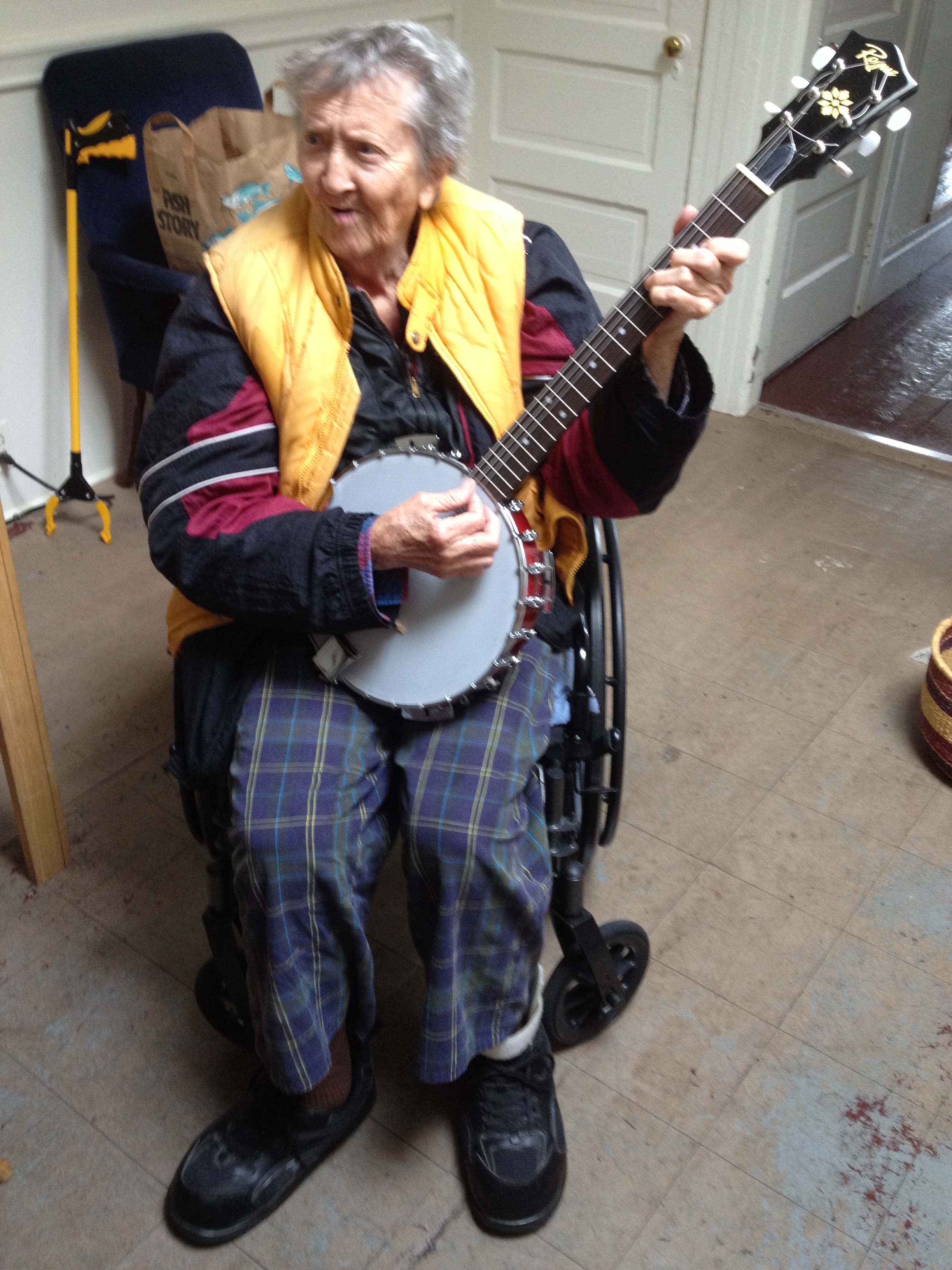
Later Jackie’s trademark instrument was a carpenter’s saw that she rubbed with a violin bow. One time Jackie came over to visit. We had several hand saws hanging in our garage/shop. Jackie pulled each out and tried it. “This one will make a good instrument,” she declared. She offered to teach us how to play the saw and we both tried. But playing the saw is hard!
Aging in place
In 2013 Jackie fell in her house, breaking her ankle and knee. But rather than call 911 and risk the fire department whisking her away to some rehab place that might never let her go back, she called some friends. She knew that if anyone from the city saw her house—the lair of a hoarder—they’d never let her back in. So, instead her friends helped her get over the back fence and into her smaller house, which was then empty of tenants.
The 12-and-a-half-foot-wide house was a studio up a flight of stairs in its original condition but otherwise in pretty good shape. The little house had two big advantages: it was not full of junk. Also, friends were now invited to visit.
When I’d visit Jackie, we would talk about musical instruments and how she made them, keys for different types of music, and what the lyrics to a song really meant. She would tell me about old time musicians she admired.
Jackie followed the careers of the Duncan sisters, Rosetta and Vivian Duncan. Rosetta was a lesbian. The white girls had a vaudeville act called Topsy and Eva that they created in 1923 about a white child and a Black child with Rosetta in blackface. It was a musical comedy derived from the novel Uncle Tom’s Cabin.
“Once I was in a show with Vivian who played Little Eva,” said Jackie. “She played the piano, sang and did comedy.” The show was a takeoff on the movie All About Eve. Charles Pierce played the part of the actress. It was at California Hall (where the infamous 1965 gay New Year’s ball took place). “I love that I can look back on doing these things,” she said.
One of Jackie’s favorite entertainers was Hadda Brooks, who ended up playing for gay audiences as she got older. “That’s My Desire” was her big number. Billed as “Queen of the Boogie,” the vocalist, pianist and composer was big in the 1940s and 50s, then made a comeback in the 90s.
We talked about death. Jackie wondered what will happen to her stuff when she dies. I was finally allowed to go into Jackie’s big house when she asked if I could help her clear it out. Every room was crammed full of junk—old computers, musical instruments, paper, clothes. There were machines that I couldn’t identify.
She had 12 guitars–none complete, some banjos, three accordions, electronics. She had 25 turntables because she was afraid she wouldn’t be able to get the needles. She kept dozens of instruments that she hoped to fix someday, inventing new musical instruments, experimenting with new sounds. She would scour the salvage yard and hardware stores for parts for her inventions and I was sent on trips to her favorite hardware store for particular screws and parts. Jackie didn’t want to get rid of anything because, she said, she might need it for something she was making or inventing. Having to let go of anything was so painful for her that the house never did get cleaned out.
We talked about the old days before gay liberation. Jackie didn’t have a partner, but she was was lucky to have the love and attention of her good friend Pauline, a sister musician who helped and supported her for 30 years.
Pauline wrote: “Jackie has always had a wary streak, not wanting folks to know all her business. I think it goes back to those ugly days in the 1940s and 1950s when she saw that being outed as gay could mean being arrested, having your name in the paper, losing your job, your residence, your family, etc.
“I’d say some of that fear still prevails. We recently had a fill-in caregiver who Jackie later told me asked her all these prying, straight-lady questions about her background: Why did Jackie never marry? Why doesn’t Jackie have her own family to look after her instead of this friend, Pauline? Didn’t Jackie ever want to have kids? Jackie gave the lady some bland answers but she wasn’t going tell her, “I’m gay. I wasn’t interested in husbands, kids and marriage.”
“Hell, Jackie didn’t tell her own family she was gay, they just thought she was weird, eccentric, and bohemian, and that was bad enough. In the 1940s, when her brother-in-law heard that Jackie was living in the French Quarter and working as a musician there, he told his wife to break off contact with Jackie because ‘We don’t associate with those kinds of people.’
“Why isn’t your family looking after you, Jackie? Because they were bigoted, small minded, homophobic assholes. Why don’t you want to tell people you’re gay, Jackie? Because there are still a lot of bigoted, small minded, homophobic assholes out there.
“Jackie has great survival instincts and is still following them. She is very proud of the fact that she never got arrested on a morals charge (or any other charge) back when plenty of her gay and lesbian friends were being pulled out of bars and thrown into paddy wagons.”
Jackie gave me banjo lessons. Photo of Molly by Barb Schultheis
Jackie never had to go to a nursing home. She lived with caretakers in the little house till she died in 2020 at the age of 93. Her friend Pauline was there when she died.
From the invitation to Jackie’s memorial: “Friends and neighbors of Jackie are invited to attend and celebrate Jackie. Per Jackie’s instructions, this is NOT to be a religious event but a party. All musicians are asked to bring their instruments so we can remember Jackie musically. By Jackie’s specific request, NO religious music of any kind is to be played. However, we welcome jazz, standards from the 20s and 30s, Latin, country-western, and any other music that swings.”
Jackie Jones was someone who discovered her passion, music, at an early age, and she never lost her love and enthusiasm for it. Music was the focus of her life: performing it, listening to it, collecting sheet music and instruments, arranging it, practicing it, recording it. Jackie had lovers but never had any girlfriends. That’s because she had found her great, all-consuming love…music.
August 1 marks the traditional Celtic holiday of Lammas, the first harvest festival on the pagan Wheel of the Year. According to the National Day Calendar, August 1 is also National Girlfriends Day. Judging by the ads, it might seem like a holiday invented to sell wine glasses and diet aids, but I plan to celebrate it anyway.
What does “girlfriend” mean in lesbianland?
In lesbianland, the word girlfriend carries a lot of weight, and a lot of meanings. It can refer to a platonic friend, a lover, or something in between. Back in the day, it usually meant lover. There simply weren’t enough words to describe us dykes or the nuanced ways we related to each other. For a while, we adopted partner, but that often got confused with business partner.
Girlfriends for 40 years, my friends Char and Eileen finally got to be wives.
Very few of us used the word wife, and I never liked it.
As a budding feminist, I wanted no part of marriage. Wives, in my mind, were helpmeets, baby factories, second-class citizens. Property. In some states, it was still legal to kill your wife for adultery. Spousal rape wasn’t outlawed. Until 1974, women in the U.S. couldn’t even get credit in our own names. Before that, we had to depend on husbands.
The feminist movement changed all that. But I still never wanted to be a wife.
Girlfriend. Partner. Wife. Spouse.
Some lesbian couples still use the term girlfriend. They let their friends know they don’t like the term wife and don’t use it to refer to each other. Others in my Boomer generation have come up with alternatives. One couple calls each other spouse and spice.
But I’ve become a wife convert.
I’ve been married twice. Maybe three times.
My ex, Barb, and I went to Vermont after it became the first state to legalize same-sex civil unions in 2000. But in 2004, San Francisco Mayor Gavin Newsom opened the doors to same-sex marriage. Thousands of couples–ourselves included–flocked to City Hall. Even though it wasn’t yet legal at the state or federal level, it felt revolutionary. Queer couples, dressed in their finest, stood in line all day in the rain, in the sun, waiting for a marriage license. Bouquets, cakes and good wishes arrived from around the country. The whole city felt like a wedding party. As City workers, Barb and I even got trained to be wedding officials ourselves. A lovely gender-free ceremony was provided.
Barb and I first got married at a park in Vermont. With witnesses Jen and Michelle
Barb, then the San Francisco fire marshal, arranged for the SFFD chief, Joanne Hayes-White, to officiate our wedding in City Hall. In every room, in every hallway, people were saying vows. It was beautiful chaos.
As we walked through the metal detectors and the guard called me “sir,” I turned to Barb and said, “Well, I guess I get to be the husband.”
That was not fair. With her crew cut, she got misgendered as often as I did. Neither of us really wanted to be a wife. But in this country, being legally married means access to health insurance, tax benefits, hospital visits, and death benefits. There were–and still are–good reasons to marry.
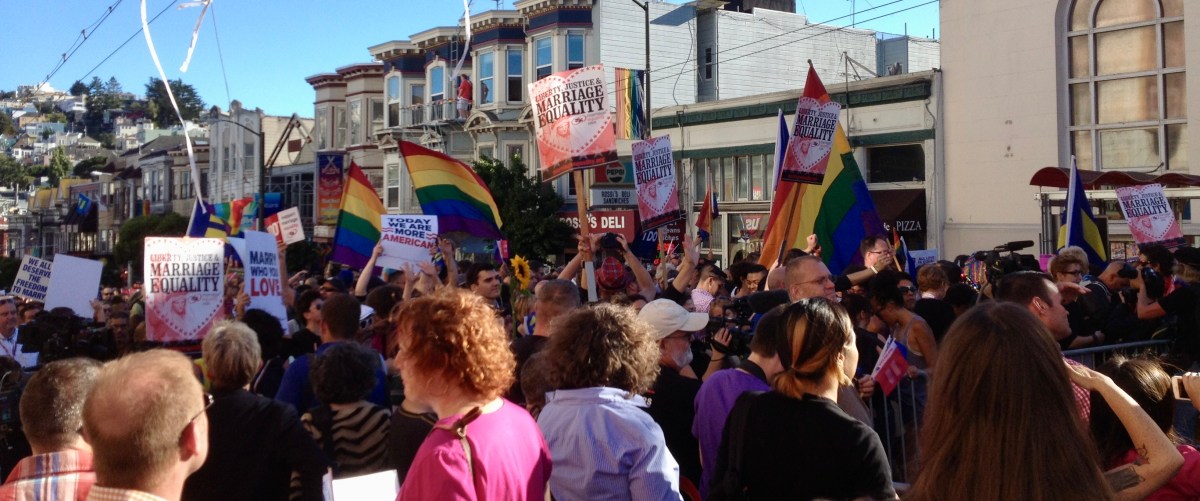
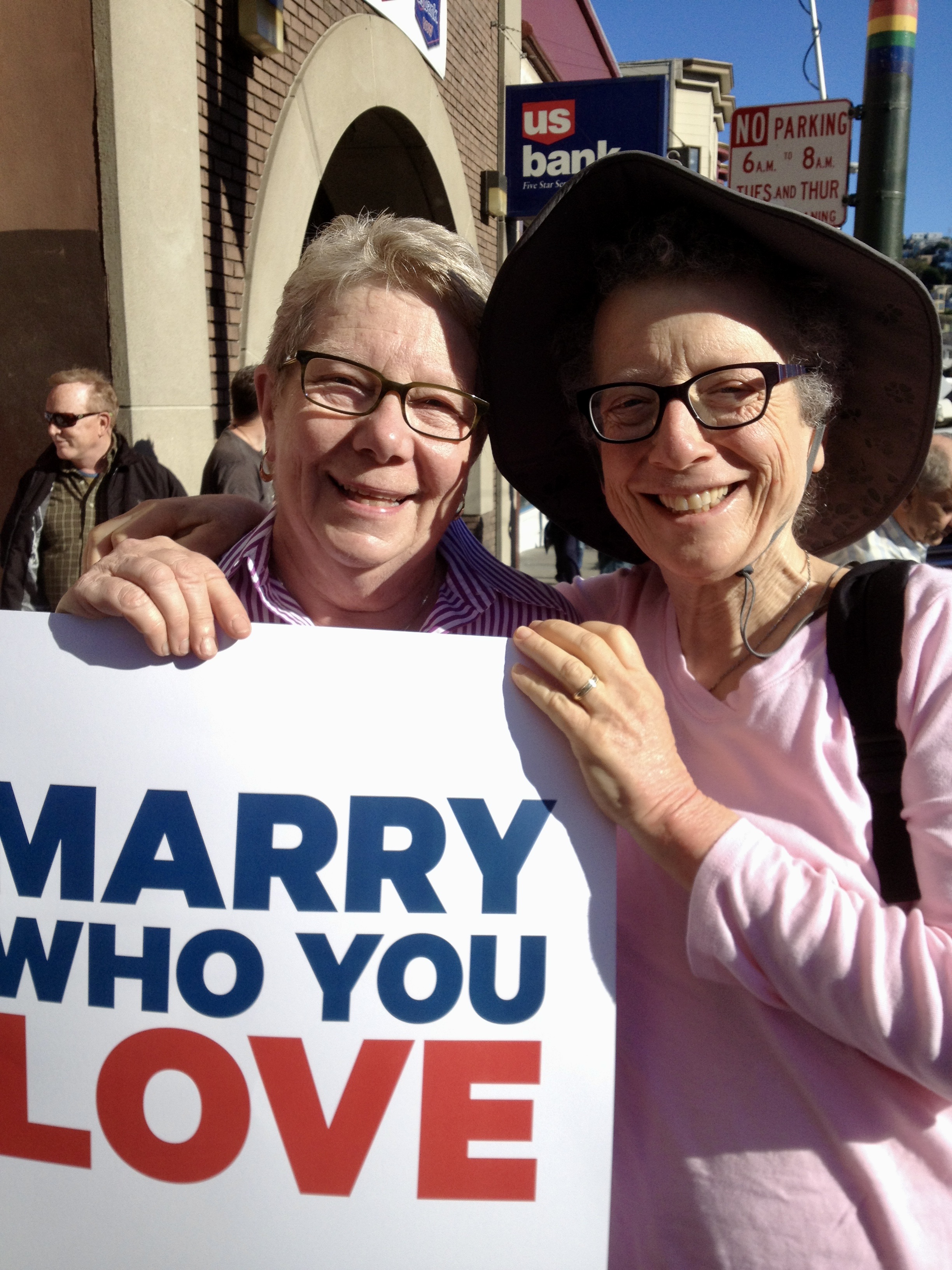
The road to legal gay marriage was long and convoluted, culminating with the 2015 landmark civil rights case Obergefell v. Hodges. But in 2013, United States v. Windsor overturned key parts of the Defense of Marriage Act (DOMA), reinstating same-sex marriage in California. (Thank you, Edie Windsor!) By then, Barb and I had broken up. But because of legal limbo, we hadn’t been able to divorce. When the Supreme Court’s decision came down, we all ran to the Castro to celebrate. People held signs that said “Freedom to Marry.” For us, it was also the freedom to divorce.
And then came Holly
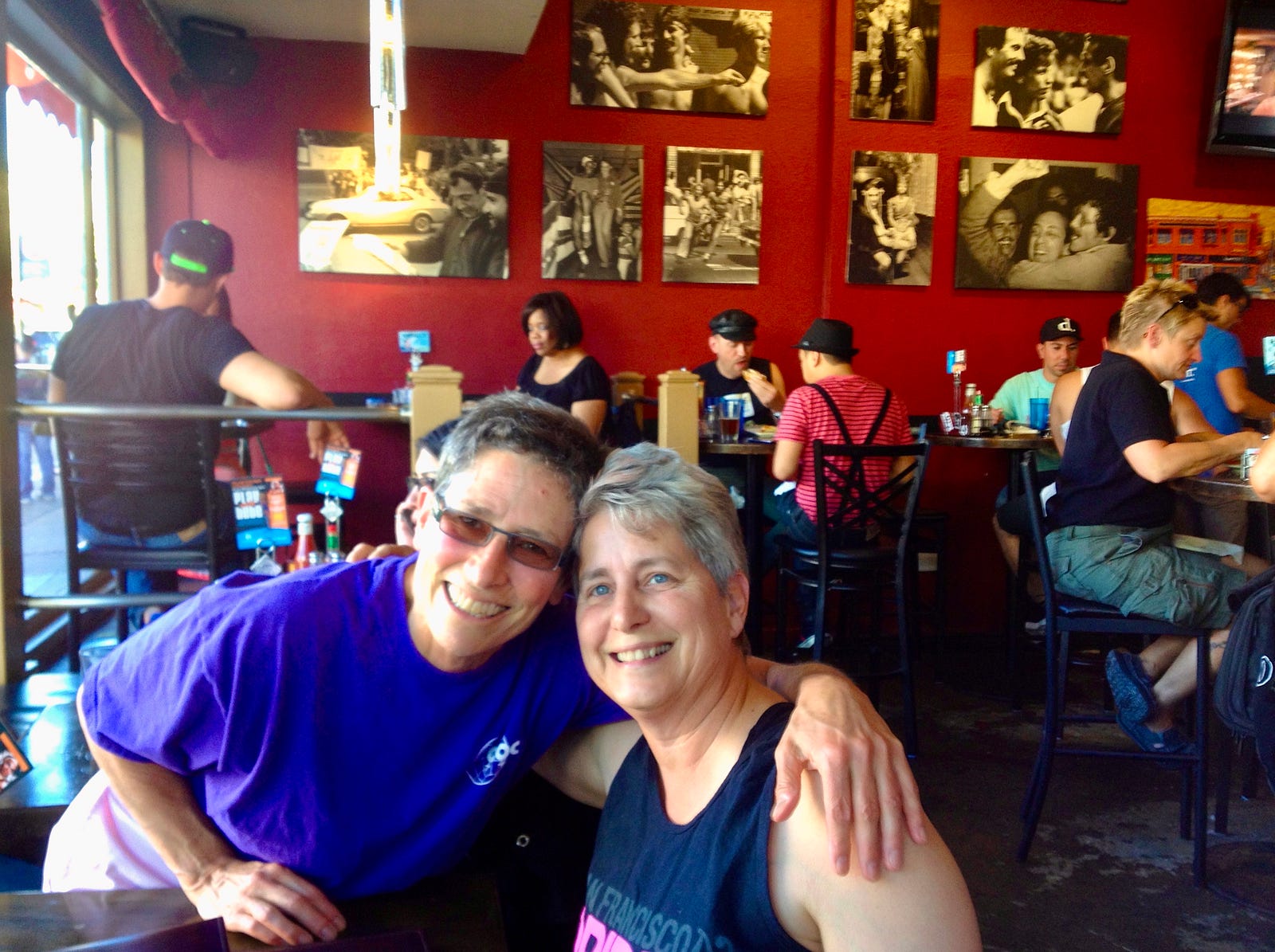
Holly and I celebrating on Marriage Equality Day at Harvey’s (named after Harvey Milk)
Holly and I were married on April 19, 2014, at Muir Beach–the site of our first date. The wedding was officiated by our gay cousin Richard, dressed in the robes of his Episcopal priest friend who had been defrocked for gayness. Witnesses were my brother Don and his husband John.
I love introducing Holly as my wife. It’s a simple, meaningful word. A word I once rejected. And, frankly, it helps when talking to straight people, and still sometimes provides a bit of shock value. Everyone knows what wife means.
Brother Don, Richard, Holly, me and John jump for joy at our Muir Beach wedding
Oh, and for the record, we introduced our exes to each other. They got married too.
How to describe our relationships with each other? We call ourselves Exes and Besties. But you could call us a gaggle of girlfriends.
Beards and Bushes and Leg Hair Inspired by a photo of Cathy Cade.
It was 1967, and I was a freshman at Washington State University, living in the dorms—tiny rooms where two people shared a space roughly the size of a generous closet. Once you pulled the beds out from the wall, you had about six inches of precious real estate between them. Cozy!
The bathrooms were shared among all the women on the floor. There was a communal bathtub where I’d perch, shaving my legs with a double-edged razor and a bar of soap. I hated it. I hated the shaving, I hated the blood, the injuries, the boxes of band aids needed for cuts. I’m pretty sure I clogged the drain more than once.
This was before the feminist movement really revved up, but some baby rebel deep inside me was already stretching her hairy legs. I decided to stop shaving. In fact, I committed to it scientifically—I posted a chart on the door of my dorm room and recorded the weekly growth of my leg hair.
What did my floormates think? I imagine they thought I was completely out of my mind. No one said much of anything, which either means they were too stunned to speak or too polite to comment on the inch-long leg hair I proudly tracked like it was a science fair project. Either way, I felt free. No more razors. No more blood. No more pretending to be a hairless woodland creature.
Later, in a collective house with three other dykes, we turned body hair into a competitive sport. Who had the hairiest legs and the most luxuriant bush? Our favorite outfit was just a vest. That’s it. No pants. No shirt. Just full-frontal follicular glory. Sadly, despite my natural abundance, I was not the hairiest. Mahaney’s glorious blond leg hair made her look like she was wearing angora leggings.
Years later, in another act of feminist rebellion, I ditched the bra. My breasts are ample and gravity is real, but so is back pain. Bras hurt my shoulders, and every one I tried felt like medieval armor built by men who’d never met an actual woman. At first, going braless felt like I was walking around topless at a PTA meeting. But eventually, I got used to the freedom—and the bouncing and the sweaty undertits.
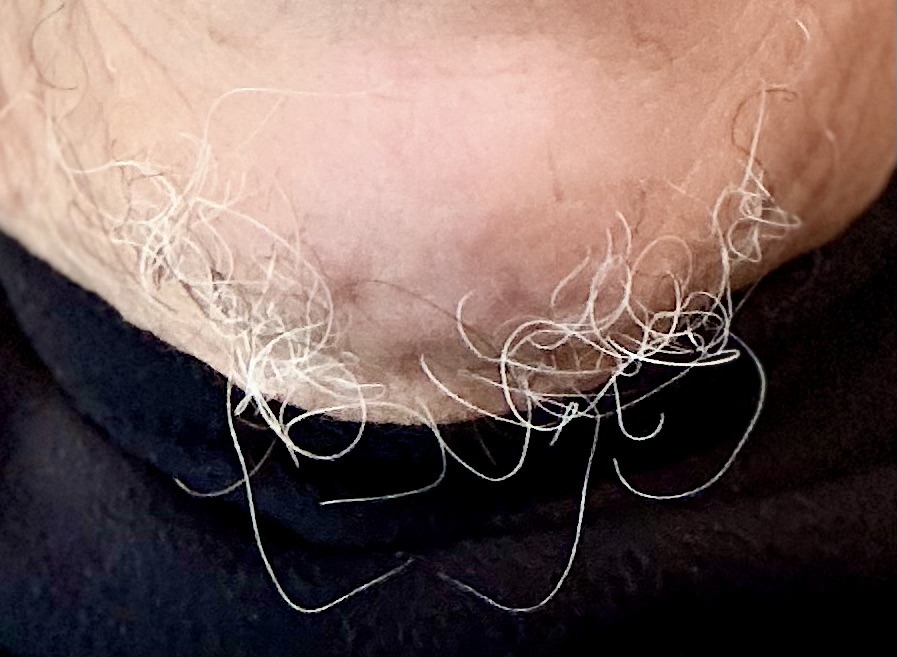
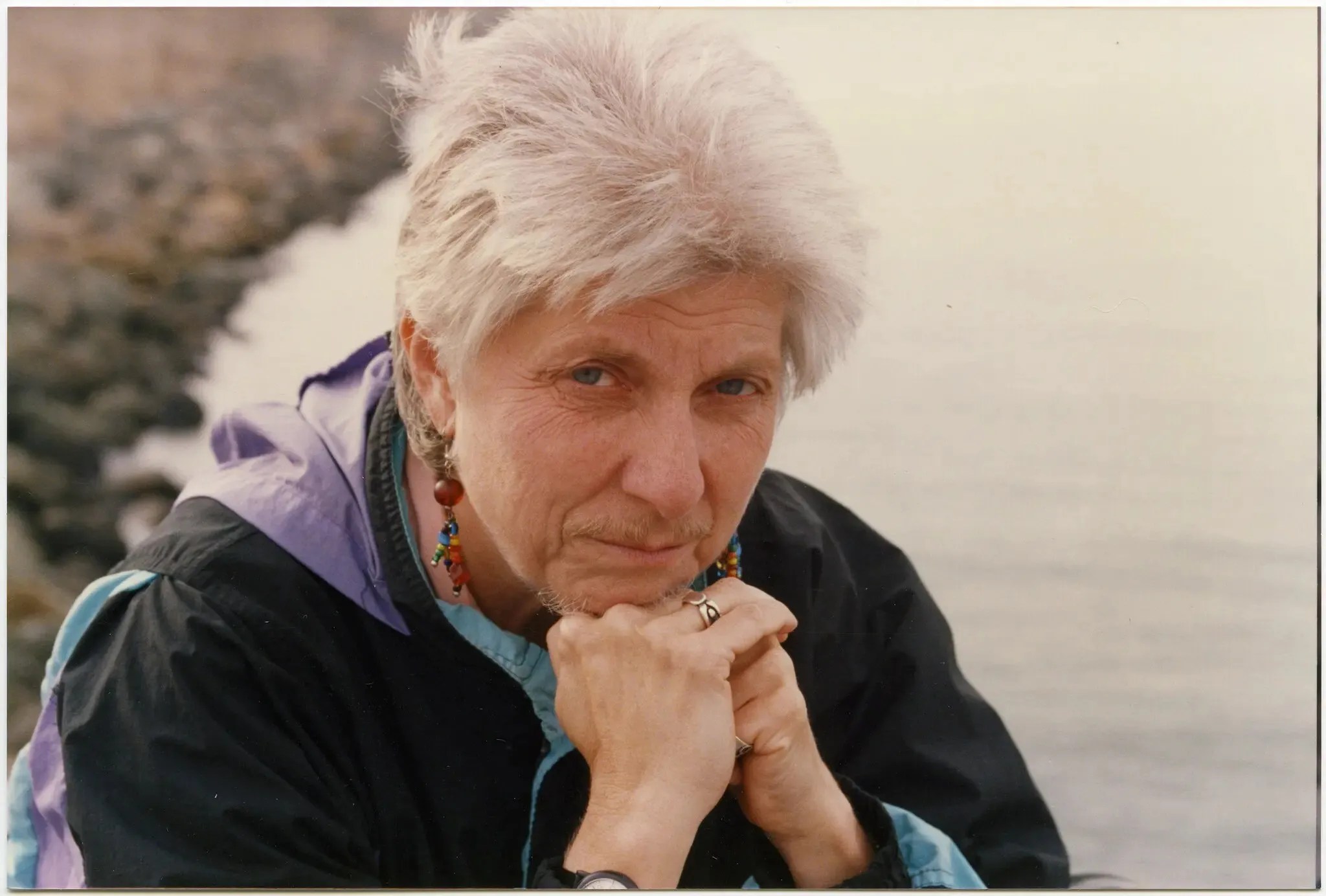
Then recently, inspired by a New York Times obituary photo of the celebrated bearded dyke photographer Cathy Cade, I decided: it’s beard time. I’d never grown one before, though I’d thought about it. My chin hair was never cute, but now that it’s gone gray, it’s looking rather distinguished. Professor Dumbledore meets anarchist grandma.
I asked my wife what she thought. Her response—paraphrased for the sake of civility—was essentially: “If you grow a beard, I will disown you, move to another state, and possibly enter witness protection.” She was not a fan.
But of course, that only made me want it more.
Now it’s grown in, and it’s introduced me to a whole new world. It came in at odd angles, curly, wiry, determined to defy gravity. One side’s a little fuller than the other, probably because I got electrolysis in the ’90s when I still cared what strangers thought. Regrets? Maybe. I could have had a resplendent full beard by now.
Still, I love playing with it. I twirl it, stroke it, and now completely understand why men do that—it’s like a built-in fidget toy. Plus, it moves in the wind. My chin hair dances! Who knew?
So far I’ve gotten no positive reactions to my beard. I thought men might appreciate it, so I asked two old man friends for their opinions. One said, “Cut it off.” The other said, “Trim it.” Translation: “We hate it.”
The best, most diplomatic, reaction I’ve gotten was, “It’s not something I would choose.” Ouch. One woman told me, “I pluck mine.” Been there. Plucking is a full-time job, and I’m on permanent vacation.
Then at an Old Lesbians retreat I met another bearded woman. A sister! She has been rocking facial hair for years. I asked what bosses and parents thought. She said her family had taken it in stride. Her mother didn’t mind the beard, but she insisted my friend wear a bra when she visited back home. Her boss at a medical facility had been a gay leather man who’d protected her from the higher ups.
There’s this fantastic TikTok group started by a Black woman for menopausal and post-menopausal women—listing all the things we no longer give a damn about: bras, makeup, body hair, expectations, decorum, patriarchy. I’m joining. I might even get the vest out again.
When sing-along movies became a big thing in the early 2000s they would sell out little-used movie houses. People dressed in theme costumes waited in long lines with their kids to get in at venues all over the country. In San Francisco the place to sing along with musicals was and still is the Castro Theater, the 1920s-era movie theater in the heart of the gay district. What could be better than flaunting your clever musical movie costume on Castro Street?
It helped if you knew all the words to all the songs. My girlfriend Barb, a survivor of Catholic schools whose first love had always been nuns, knew all the words to all the songs in “The Sound of Music” and when it came to the Castro she insisted we go as nuns. I was game but, having grown up Protestant, clueless.
My only experience with nun habits prior to our adventure had been the Sisters of Perpetual Indulgence. The Sisters, a group of flamboyant gay men, formed in the 1970s partly as an antidote to the anti-gay misogynistic backward teachings of the Catholic church. They dress in outrageous nun costumes and worked hard to make the AIDS crisis visible when it was ignored by the powers that be. I love the Sisters, still a presence in San Francisco and especially the Castro. It was at a Sisters event in the early 80s called Holy Daze (including a mix of religious cults) where I learned about the plagues of Egypt and how to counteract the curses by declaring feh! and flipping wine at one another until you are covered with wine. Our plagues were things like union busting and Reaganomics. On the stage was set a long table with 12 “apostles” including The Cosmic Lady who we would see in the Mission handing out flyers with a picture of the Milky Way and an arrow with the slogan “You Are Here.”
Barb took charge of the costumes, which she announced would reflect the Catholic order of her hometown in southern Indiana, the nuns who were her teachers in Catholic schools. Her own aunt had taken the veil and so Barb knew exactly what the wimples, scapulars and associated habit parts looked like. No Sisters of Perpetual Indulgence influence here with elaborate headpieces and drag queen makeup. We would look like the real thing, authentic representatives of the Order of St. Benedict from the convent on the hill in Ferdinand, Indiana.
I was dispatched to second-hand stores in the Mission to pick up long-sleeved black dresses to serve as tunics or robes. That was the easy part. On a stormy Saturday we assembled material to create the wimples, veils and coifs. Barb, a crafty gal who was always good at making things, dove into the project with great zeal. Perhaps she was finally realizing a long-held dream: some part of her had always wanted to be a nun, or at least to be seduced by one. My own part in this play was becoming clearer.
We worked all day on the project and when it was finished we were delighted with the results. Modeling the habit put me in touch with its medieval origins. The wimple covered my ears and blocked my hearing, cloistering me from the world.
On the day of the sing-along we got dressed early so we could show our friend Pat (also an ex-Catholic) our new personas. The final touch—black leather combat boots, just visible below the long tunics. In the spirit of both the Sisters of Perpetual Indulgence and the Sisters of St. Benedict we chose our names as brides of Christ. I was Sister Mary Mollybolt (in reference to my tradeswoman background) and Barb was Sister Barbwire. As it turned out, we should have reversed our names, as I was to be the bad nun and she the good. An important part of my costume was the wooden ruler I carried, slapping it on my palm menacingly. Barb couldn’t stop laughing; she was so delighted to finally be a nun.
Bad nun good nun
Pat took our picture before we tripped over to the Castro. We made a great team, and I wondered if nuns teamed up in pairs the way cops do to interrogate or dispense punishment. I was getting into my role as the bad nun.
The Castro District is a place where adults can show up in just about any costume and not cause so much as a second look. Even on days when nothing special is happening, the Castro can feel like Halloween. We felt right at home strolling the street as nuns, along with others dressed as characters in the “Sound of Music”—the children dressed in curtains, even a mountain range.
We had arrived with plenty of time to eat dinner and so dropped in to a local eatery. The other patrons seemed shocked by our presence. We thought it was obvious that we were fake nuns. After all, the combat boots were visible elements. And this was the Castro. But our nun costumes sent some of the Catholics at this place back to their trauma-filled childhoods. They were really disturbed by my ruler. As we stood waiting for a table, people began approaching us and telling us stories of their encounters with the nuns and the Catholic Church. One woman recalled being hit with such a ruler as a kid. We became a means for these people to talk about the trauma they’d suffered at the hands of the Catholic Church. They had to tell us their stories. A man recalled his abusive Catholic education in Germany. They couldn’t stop. I was fascinated. We had become conduits for their emotions.
The scandal of priests’ child abuse in the Catholic Church had been ongoing and the Boston Globe would break the big story about child sexual abuse in the Boston archdiocese shortly after our foray into the Castro as nuns. But we got a sense of the underlying culture that night. Nuns are a powerful representation of the Catholic Church and abuse it dealt to its parishioners. Folks felt that they had to confess to us—dressed as nuns—their stories of abuse.
The sing-along was all that we’d imagined. We got to belt out How Do You Solve a Problem Like Maria? and all the other songs. We didn’t enter the costume contest. Compared to all the other imaginative costumes, the abundant nuns were rather boring. The mountain range consisting of nine mountains won a prize. We had great fun, but the most memorable part of my night as a nun turned out to be our inadvertent unleashing of traumatic memories among the people we encountered.
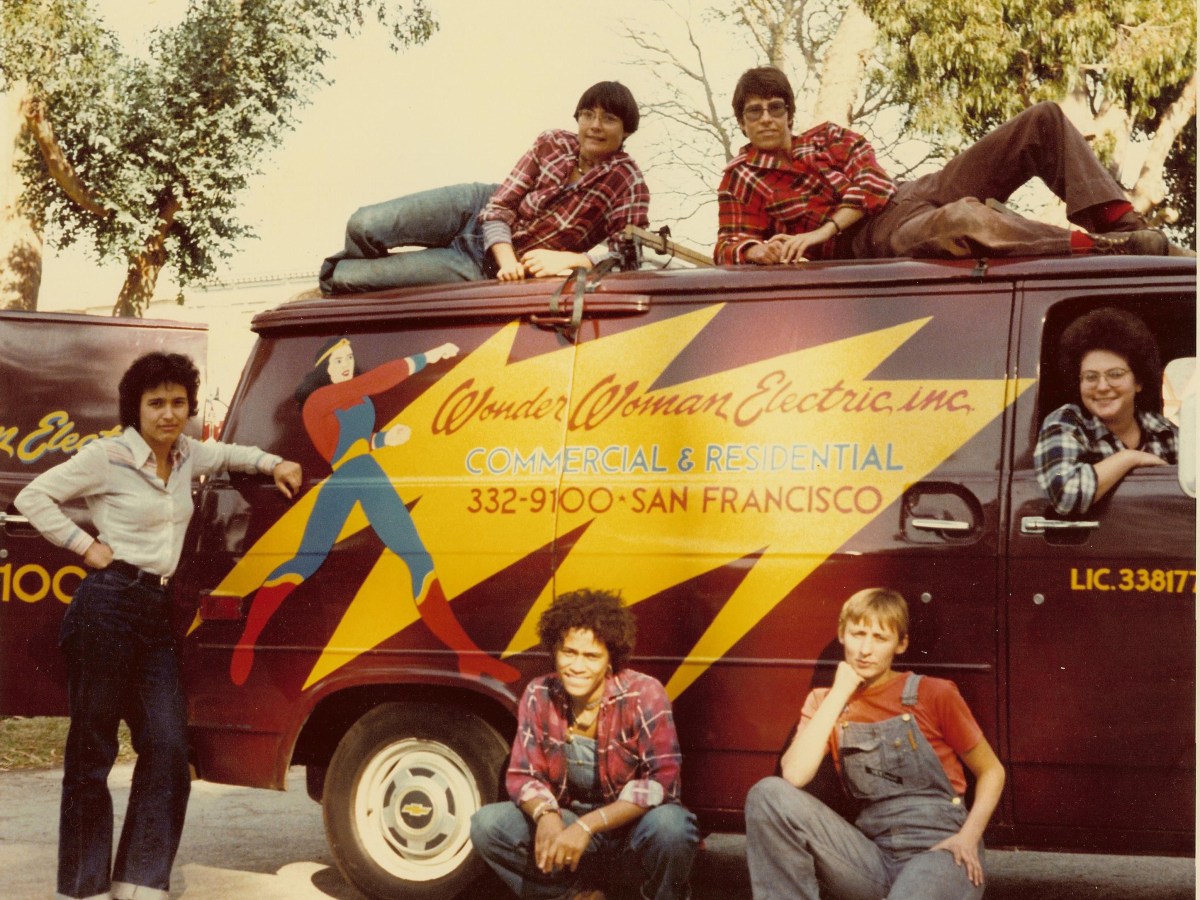
My first close-up encounter with drag queens took place in a Tenderloin bar when I worked as an electrician for Wonder Woman Electric in the late 1970s.
An all-female collective of electricians, we did mostly residential work. But our regular commercial accounts included some of the multitude of San Francisco gay bars. Each of the bars catered to a particular subculture in the larger gay community. Lesbians had a few bars and coffee houses. But bars for gay men proliferated. There were bars geared toward disco queens, the leather crowd, the sweater gays, uniform wearers, beach bunnies, cross dressers, fairies, bathing beauties–really more than I could even imagine.
One day in the middle of the week I was called to a hole-in-the-wall bar in the Tenderloin. When I finally found a place to park the Wonder Woman van, it was blocks away and I had to lug heavy tool bags through streets lined with junkies and drunks. This was the bad part of town.
I found the address on Turk Street, a nondescript brick front building. The door was locked, but I saw a discreet push-button near it. I pushed it and after a moment a beautiful young man, far more femme than I, greeted me. He wore matching coral pedal pushers, cardigan and mules with little heels. He did not look pleased to see me.
“I’m the electrician,” I said hopefully. “Ok,” he said, looking me over. Then his perfectly lipsticked mouth curled into a little smile. “Come with me. We’ve been waiting for you.”
A small town girl who’d only lived in San Francisco for a year or so, I had just barely come out as a lesbian and had little experience with drag queens, transsexuals or transvestites, especially not the big city kind.
Stepping from the gray Tenderloin street into that little bar was like entering the Harry Potter toy store at Christmas. Lights and colored decorations hung from the low ceiling. Glitter littered the grungy floor.
I was surprised to see a good number of patrons at the bar in the early part of the day. Some sat at the bar, some at tables, but all looked fabulous. Most were men dressed in women’s clothing. Some dressed as over-the-top made-up drag queens, but most looked more like the gals from the office across the street, dressed in low heels and conservative skirts and blouses. I thought I overheard one of them say “fish” which was pretty funny considering I was the butchest thing in the room, wearing a flannel shirt, jeans and work boots.
The bartender looked like a tough sailor just off the boat who’d thrown on a shoulder-length blonde wig and serious makeup—several shades of eye shadow and bright red lips outlined beyond their natural borders. He worked the bar in a tasteful tailored Donna Reed housedress, popped collar and pearls, and ran the joint with cutting sarcasm. I felt like I was encountering the Wizard of Oz and had to keep myself from jumping back like Dorothy did when she and her three cohorts first encountered him. A person could not help being intimidated.
“Here’s what we need,” he directed me. “I don’t want the patrons to use the bathroom without my permission. They get in there, lock the door and stay. And, honey, we all know what they do in there.” I could only speculate. Drugs? Sex? Probably both. Lesbians had been known to use the bathrooms in our bars for such purposes. Where else could a couple go? And if they were quick about it and others didn’t have to wait too long, we were usually forgiving.
The bartender continued, “I want to be able to push a button right here under the bar to unlock the bathroom door when someone wants to use it. Can you set that up?”
This drag queen was also a Control Queen! I looked around the room at the disapproving patrons. I was going to be responsible for limiting their bathroom privileges. I was already the villain and I hadn’t even done anything yet. But I was certainly capable of installing a push button and door lock. It would be all low voltage, so I’d just have to put in a transformer and run low voltage cable. I wouldn’t need to run pipe or install junction boxes. “I can do that,” I said.
I got to work, planning the job. Could I run the low voltage cable under the floor? Yes, said the bartender. There was a full basement. The beautiful young man ushered me down to the basement, a dank, spiderwebby space with a hundred years of grime on every surface. I had to figure out where to drill through the floor to run wires from the bar to the door lock. The job took me up and down the stairs and back to the van to retrieve materials. I focused on my work and I was relieved that the patrons went back to drinking and dishing.
Finally the job was finished. I emerged from the basement coated in its crud, looking more than ever like a construction worker.
“Let’s test it,” I said. I gave a nod to the bartender who pushed the button. The door buzzed open and, with a flourish, a patron entered the bathroom. It worked! Like electricians everywhere, I always got a thrill when I flipped the switch and my masterpiece (no matter how small) performed as intended. But I didn’t usually have an audience.
These patrons understood drama far better than I. The dramatic moment of the day was all mine. It was as if I were making my big entrance, walking down the runway, head held high. They had all been watching closely and when the door opened, they let out a big cheer.
“Jesus Christ, it’s 1979. Why do they need to get married? They’ve been living together for five years. No one in the family disapproves. Why do people feel compelled to have the state sanction their relationships?” Don let me rave. Neither of us could answer these rhetorical questions. He couldn’t have been any less enthusiastic about our brother Tim’s wedding than I was. We knew that neither of us would ever have a family wedding with all the attendant fussing, well-wishing, presents and cultural sanction, not that either of us would want one.
“You don’t suppose there’s any way we can get out of going,” he said in a resigned tone.
I considered this. Our attendance seemed like a small price to pay to avoid the disapprobation that surely would result from our absence. “We can stay in the background. At least we’re not being asked to be bridesmaids.”
I could hear my brother sigh on the other end of the phone. “To be a bridesmaid,” he said, “has always been a great fantasy of mine.”
“I see what you mean. If I could be best man, I could rent a tuxedo. Fuck! What will I wear?” Don was silent, and I knew he wasn’t worrying about what I’d be wearing.
“Don, if you’re thinking about wearing a dress, just forget it right now. This is not the big city or some trendy college community. This is cowboy country. You’ll get the shit kicked out of you.”
When we said goodbye, I wasn’t entirely sure I’d convinced him, and I wondered how my outrageous brother managed to stay alive without me as his constant bodyguard. He insistently challenged assumptions about dress and gender, which was a dangerous thing at a time when the moral majority felt its grasp on the reins of cultural definitions slipping.
The truth was, just by being my natural self, people—both children and adults—were always confronting me about the nature of my gender. They would yell out of windows or from cars as I walked by, “Are you a boy or a girl?” Or I would be mistaken for a gay man. “Faggot!” they would yell, and speed off before I could correct them: “You idiot! I’m a dyke!”
I had learned that knowledge of gender is extremely important to people. They need this information before they know anything else about you. And once they get you pegged, to be surprised makes them inexplicably angry. All their assumptions are suddenly being challenged. It’s like you’ve called into question some intensely personal assumptions about who they are in the world.
I figured the problem wasn’t me, but how people expected women to look and act. To be feminine required performing unnatural acts—shaving one’s body hair, wearing sticky make-up and carefully coiffed hair, being quiet, wearing odd clothes and uncomfortable shoes, walking with short picky strides. I had practiced these ritual gestures at one time, but the feminist movement had released me. I was free and I was never going back now.
An example of what women were expected to wear in the 1970s. Hot pants were required for many waitress jobs.
Unfortunately, my freedom from convention left me completely unprepared to dress for Tim’s wedding. I had no dress-up clothes. As a matter of principle I’d stopped wearing dresses in 1970. Since then the contents of my closet had been recycled from thrift stores. As a working electrician in those days of butch dykedom, I could just wash my flannel shirts and jeans and wear them to the bar. No one I knew ever got dressed up, and if they attended weddings, they never told me. So what does a nonconforming, revolutionary lesbian wear to a heterosexual wedding?
At the airport I searched the Nordic crowd of Seattleites for Don’s dark head. I never knew what to expect. He’d been a hippie with a thick ponytail and full beard last time I’d seen him, but personas changed from year to year. He was not at the gate and I wandered until I heard my name called from a waiting area.
Then I saw him, relaxing back into one of the lounge chairs like a queen, newly clean-shaven and wearing giant turquoise butterfly earrings, a flowing scarf wrapped around his shoulder-length hair, tied in back. “I thought it was time to relinquish my male privilege,” he smiled.
In the short 150 miles or so between Don’s home at the foot of the Olympic Peninsula to Yakima, the land cracks and dries up like the edges of those Janis Joplin posters you rehang in each new collective house. Snoqualmie Pass takes you from a rich, dripping, evergreen rain forest over the snow-capped Cascades, past ski resorts and the shorn heads of clear-cut hills in to the Kittitas Valley, flat pasture dotted with Black Angus cattle.
Up over the Manashtash Ridge, a new freeway replaced the winding two-lane road along the Yakima River. Beyond irrigation, only sagebrush–ubiquitous in the valley–flourishes. From the west side of the ridge you can see the town of Ellensburg surrounded by the patchwork of pastures, ground crops and brown earth, and above that the sharp white peaks of the Wenatchee Range. As you continue east, your nose dries up and your hair electrifies, the sky turns intense blue and if there are clouds they look like puffs of bleached cotton. Then, just before the Yakima Valley appears below, if you look to the south, you see the round, white tip of Mt. Adams peering over those dusty brown hills, incongruous.
On that March day the chill air cracked and the sagebrush cast bright shadows on patches of snow as Don drove the Subaru down into the valley past big cattle ranches and their animals with thick winter coats, then smaller farms, past apple and pear orchards just starting to bud.
Our mother, Flo, rushed out to meet us as we pulled into the gravel driveway. She was dressed in her usual polyester pantsuit in bright colors. We hugged her thin frame in turn. Then, as she stood back to look at him, she brushed my brother’s hair away from his face. “Don, I wish you would do something with your hair.” (He had diplomatically removed the scarf.)
Don frowned. “Oh, Mom.”
I thought Don’s hair was beautiful—thick and dark and curly. I’d always wished I had inherited that head of hair from our mother. I might be wearing mine in the same long style. Instead, I wore my straight brown hair short, lately in the shag style Jane Fonda popularized in the movie Klute.
“Ok, you guys, come on in,” she said, “I want you to see the new solar addition Tim put on the house.”
Flo was never much of a housekeeper, but she was a genius at making this century-old farmhouse feel like home. We had bought the run-down five-acre place when I was ten, and remodeled it ourselves. Flo had filled it with antiques she’d collected from junk stores before they were called antiques and priced to match. She always had to show us her new finds.
We visited for a while, then went out to say hello to our younger brothers Tim and Terry, whose four-wheel drive pickups were parked further up the driveway. My parents’ place, which sat down in a hollow, had several outbuildings, all painted Swedish red with white trim like the house. The big old barn had been converted to a garage. Next to it was the chicken house surrounded by its chicken-wire pen. On the other side of the garage was the three-stall horse barn on which I’d painted a stylized picture of a horse years ago. Between them was what we called the doghouse, a rectangular structure that was once a container crate. Someone had given it to my father years ago, and he set it on a slab and cut a door in it saying he’d have a place to go when he was in trouble with Flo. Over the years we’d fixed it up into a nice little apartment with electricity and running water and windows. All of us had used it at one time or another to get away from the house. I’d stayed there on summers home from college. For the past several years Tim and Diana had lived there together.
Tim answered the door, a tall, solid figure with a sparse beard and lanky brown hair. “Hey, how the fuck are you?” he said. We passed hugs around. “I’ve got some great pot this year. We’re just drying out a little.” He pointed to the toaster oven. “Smoke a joint?”
Don smiled. This was what he’d been waiting for. Yakima’s hot dry summers are perfect for growing pot. Tim and Terry grew fine pot when it didn’t get harvested prematurely in the middle of the night by one of their delinquent friends. One year they threw seeds around the farm indiscriminately and plants came up everywhere. One or two flourished in the middle of the gravel driveway.
We threw ourselves on the old foldout sofa. Terry passed out beers.
“So, what’s the plan,” I said to Diana. What family events are we signed up for?”
My girlfriends are giving me a shower tomorrow,” she said. “The wedding’s on Saturday. It will be fun, you guys. We’ll have dinner at the grange hall afterward, and Tim’s friend Duane plays in a band. We can all dance. Tim’s been taking dancing lessons.” Diana was a dancer and a ballet teacher. I don’t believe Tim had ever danced in his life or wanted to.
“What are you wearing,” I asked.
Diana waltzed over to the closet and pulled out a plain white dress that was made interesting by the triangular pieces of green hanging like stalactites from the hem. It reminded me of a costume I’d seen in a performance of Peter Pan. “I made it myself,” she beamed.
“It’s beautiful,” Don and I exclaimed in unison. We looked at Tim.
“Bought a suit,” he shrugged.
“It’s very handsome,” said Diana, replacing the dress in the closet and pulling out a blue suit. “We had trouble getting it to fit in the shoulders. He’s so wide.”
Tim sucked at the joint and then smiled sheepishly.
“Now don’t worry,” Diana said, “You’re going to look great.”
“I have to go shopping,” I said.
The next day my mother and I set out to find me a wedding outfit. Together we slogged through the department stores of my hometown, reliving painful memories of past shopping trips. I had never liked girls’ clothes, and could only be induced to wear a style my mother called “tailored.” Absolutely no frills or puckers. She’d understood. She’d never liked frilly clothes either. But she was five three and slender. I was five eight, and until my twenties, decidedly plump. More often than not, when I found the rare piece of clothing that suited me, it didn’t come in my size. This had always mystified me. I knew there were plenty of other big-boned gals like me, but the people who designed clothes hadn’t discovered us yet.
Remember the polyester big-collared shirts and beltless pants?
Sears was filled with nothing but polyester. Pants with no pockets and elastic waistbands. Over the years I’d developed a clothing checklist. I preferred natural fibers, and I wouldn’t wear pants if they had no back pockets. “Don’t be silly,” my mother said.
I was indignant. “I intend to wear these pants more than one time,” I reasoned. “Where will I put my wallet?”
At Montgomery Wards I insisted on starting in the men’s department. I liked the color of a greenish suit on the display and convinced the clerk to let me try it on in the men’s dressing room even though I knew what would happen. Those seventies-style men’s pants were not made for my body. In the size that fit comfortably on my thighs, the waist was inches too big. These were not the kind of pants you could cinch up with a wide belt. They were the kind with the self-belt made of the fabric to fit a man’s waist exactly. When I emerged from the dressing room my mother was not impressed. “Oh, Molly,” was all she said. I knew she was right. I felt like a used car salesman.
We arrived at the Bon Marche irritated and frustrated. The Bon Marche is the Macy’s of Yakima, WA—clothes to aspire to. My attention span for shopping had always been short. And we had never shopped at the Bon when I was a kid. It was out of our price range.
I began to sift through racks of Misses slacks while Flo checked to see whether all the suits had skirts. Suddenly there it was. A rack of pants with back pockets. I was so happy it took me a minute to discover that the pockets were only half-pockets, not really big enough for a wallet. Why they do that I’ll never understand. “Fuck, do they think putting regular-sized pockets in would cause us to grow penises?” I asked my mother.
“Why must you use that word,” she scowled. “Try them on.”
The pants did fit me better than the men’s. I actually liked how they looked, even though I was still pissed about the pockets. “I hate giving money to a clothing industry that refuses to meet my needs,” I said. But I was ready to compromise. I knew I’d never find anything better.
My mother returned with a navy polyester jacket, size 12. Women’s jackets are always too tight in the shoulders or too loose around my waist, but this one wasn’t bad. Before I could complain, she said, “I’ll buy you the jacket.”
Later she asked what shoes I’d be wearing. “Don’t worry,” I said, “I brought my Frye boots.”
Flo insisted I come to the shower, even though the boys didn’t have to. It was just as inane as I’d imagined. Diana was obliged to ooh and aah politely over every gift, no matter how useless. My mother had anticipated that I’d come to this heterosexual event empty-handed and resentful, so she’d bought a present from me. I was as surprised as Diana to discover I’d given her a set of wine glasses with their own rack. Flo never said a word about it.
The day of the wedding I was still searching for an appropriate shirt to wear with my new outfit. My father’s closet had always served me well in the past. We’re about the same size and he has short arms for a man. Whenever I’d visit, he’d send me away with several of his old shirts, which I’d wear with tails out over jeans until they began to fray right at the spots where my ample breasts stuck out the farthest. I found a tasteful light blue number with a faint check. I was looking for a tie when Don breezed into the bedroom. He was wearing bright pink pants and a purple jacket, a pink polo shirt and platform shoes. He sashayed over to the dresser, pulled back his flowing hair and began putting dangly earrings in his pierced ears.
Flo was right on his heels, and she closed the door behind her. “Don,” she wheedled, “I don’t ask you for many things, but I’m asking you not to wear those earrings.”
“Flo, stop making such a big deal out of it,” he said in that artificially low voice he uses when he’s annoyed. “I’m wearing the earrings.”
My mother looked like she might cry. I wished I could make her feel better but I was sworn to defend my brother. “I don’t understand why you must make things so hard for me,” she said. She threw up her hands and walked out.
Before the end of the evening when I felt compelled to admonish my drunken father to stop copping feels off the female guests, he had said to me that he thought I looked “sharp” in his shirt and tie.
Later, when we were dancing, I felt the only wardrobe mistake I’d made was not to wear a bra. I hadn’t thought pointy breasts would really go with my outfit, so I wore an undershirt and let the breasts seek their natural level, about halfway to my waist. But jumping around with no support was painful. Don and I were especially popular on the dance floor, in direct proportion to the amount of alcohol consumed by the wedding guests. I never lacked a partner. All the women loved me.











 tradeswomn musings