"If you don't know where you come from, you don't know where you're going." Sister Addie Wyatt
Author: Molly Martin
I'm a long-time tradeswoman activist, retired electrician and electrical inspector. I live in Santa Rosa, CA. molly-martin.com. I also share a travel blog with my wife Holly: travelswithmoho.wordpress.com.
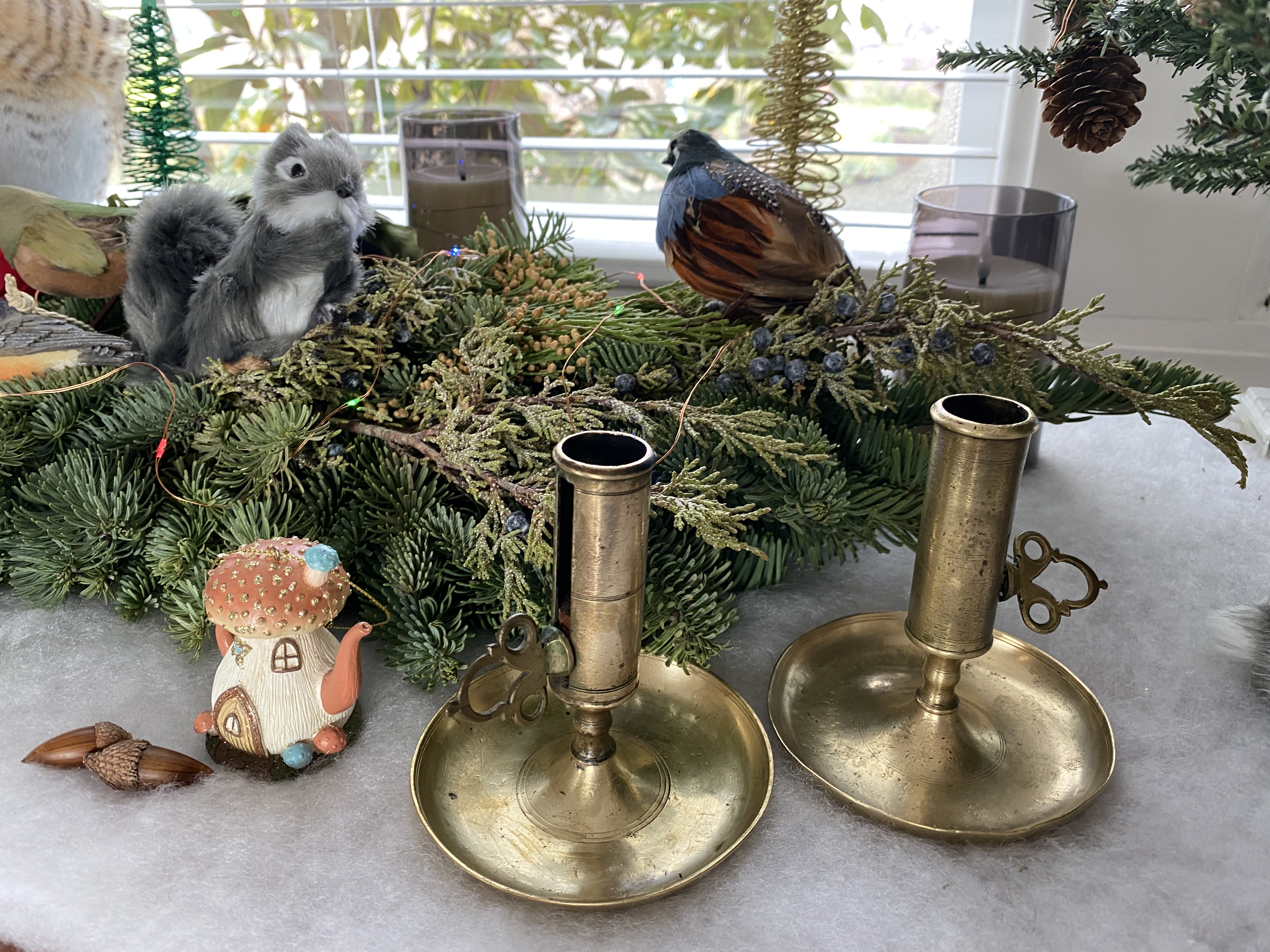
As I pulled down the box of Solstice ornaments from a high shelf in the garage, I wondered about the provenance of a pair of candlesticks. They were grungy from years of use, the brass darkened with candle wax. I thought Mom said they were from our Norwegian grandfather, who left Norway as a teenager and never went back. Did he bring them with him when he immigrated to the U.S.?
Looking carefully at the base I could see the maker’s mark stamped there. The letters SB, then a crown, then No 5. I went online and looked through databases of metalworks. That got me nowhere, so I asked my brother Don if he had any information. He didn’t remember the candlesticks but did remember that he’d discovered a Norwegian cousin on Ancestry who still lives near our grandfather’s place of birth. Their correspondence follows.
8. des. 2024 Don Orr Martin
To: Rune Aalberg
A question from your cousin in Canada (Don now lives in Vancouver B.C.)
Hello Rune–
We emailed each other a couple of years ago about shared genealogy. I am one of the Wick relatives (along with Shelly Harris). My grandfather from Klokkervik was Ben Wick (Bernt Evensen).
My sister Molly recently remembered two candle holders that she was told by our mother belonged to Ben. She got them out of storage and plans to clean them up and use them. We suspect they were brought to the US from Norway in the 1890s, but have no documentation. I am attaching 3 photos Molly sent me. She has been trying to identify the foundry markings without any luck. We wondered if you might have access to internet search information in Norway about these markings on the bottoms of the candlesticks. Probably brass. We are curious about their origin.
Your cousin,
Don
8. des. 2024 Rune Aalberg
Hi, Don!
The time runs fast, and I have seen your box in my e-mail App, but I have been busy with collecting names to the database on my father’s side. Never ending work /research.
I have announced on Facebook that someone in Canada wants to know about the candle lights. The mark SB should be easy to find for the right person. If not I go to a jeweler and ask there.
I hope the winter time is kind to you. Here we still see the green areas, but have also had a couple of white days.
Until next time Enjoy the Christmas time
Sun, Dec 8, 2024 Rune Aalberg
Hi! I have sent an e-mail to Swedish Skultuna. Yours are very look alike. Long link:
Thanks Rune. I really appreciate your help in tracking down the origin of these heirlooms. The link does indeed look a lot like the ones Molly has. It is very possible they are from Sweden where our grandmother lived until she was 17.
Our early winter has been pretty mild so far. No snow yet except in the nearby mountains. Lots of salmon returning to the rivers here. John and I love to hike the many trails in parks along the ocean and the local rivers. We are looking forward to our annual trip to Baja, Mexico. We’ll spend 2 months from late January to late March. It’s about a 3,000K drive one way, but a very interesting trip once you get past the US.
Hope you have a pleasant holiday,
Don
From:Rune Aalberg Date: Tue, Dec 10, 2024 Hi! I have not got an answer from the company, but a response on FB says it is this company: https://skultuna.com/en-no
Buy more 😉
SB = Skultuna Bruk (bruk can mean a farm, to use or meant for using, and they made products for daily usage). The crown mark is the swedish one. Take care of the candle lights and yourself, of course 🤗 Time to sleep for Rune 🥱
Our Norwegian cousin was right. The candlesticks are Swedish, made by a foundry that still exists and still sells the exact same product. We imagine that our grandmother, Gerda Wick (Persson), brought them with her when she immigrated to the U.S. in 1905. Candlesticks would have been a necessity before the advent of electric light.
From the Skultuna website:
Four centuries in the same place
The year was 1607, and King Karl IX could at last implement his long held plans for a Swedish brass industry. Refining copper into brass would reduce imports of brass and increase income from exports. The King had a man sent off on the Crown’s business to find a suitable location for a brass foundry, the choice fell on Skultuna, where the Svartån brook provided sufficient water power. Today, over four centuries later, the company still resides in the very same place in Skultuna. The first master braziers were called here from the brass foundries in Germany and the Netherlands, they also brought the technique on how to make large brass objects like chandeliers. The oldest known chandelier is in the Church of Our Lady in Enköping and is dated 1619. The journey throughout history has been rough at times, once the whole factory floated away with the spring flood and it has burnt down completely on at least three occasions.
Today you can follow them on Instagram, facebook and tiktok.
My Regular Pagan holiday post:Mysteries of Santaland
Even as a little kid, I was skeptical. The story is preposterous: a jolly rotund man in a red suit operates a workshop at the North Pole where elves make toys for children. On Christmas Eve, he loads them into a sleigh pulled by flying reindeer and delivers gifts to every child in the world by descending through their chimneys.
Did adults really expect us to believe that! How could that fat guy even get down a chimney? And what if you don’t have a chimney? And visiting every child in the world on one night! Give me a break. And how can wingless reindeer fly anyway? Wouldn’t it make more sense to harness a herd of Pegasuses,* or even a flock of owls? My parents were unable to satisfactorily answer these questions.
But it all starts to make sense when you look at the traditions of Arctic indigenous peoples. Turns out, Santa’s origins might involve a bit more…tripping.
Santa is a modern counterpart of a shaman, who consumed mind-altering fungi by drinking the urine of reindeer.
A Ten Thousand Year High
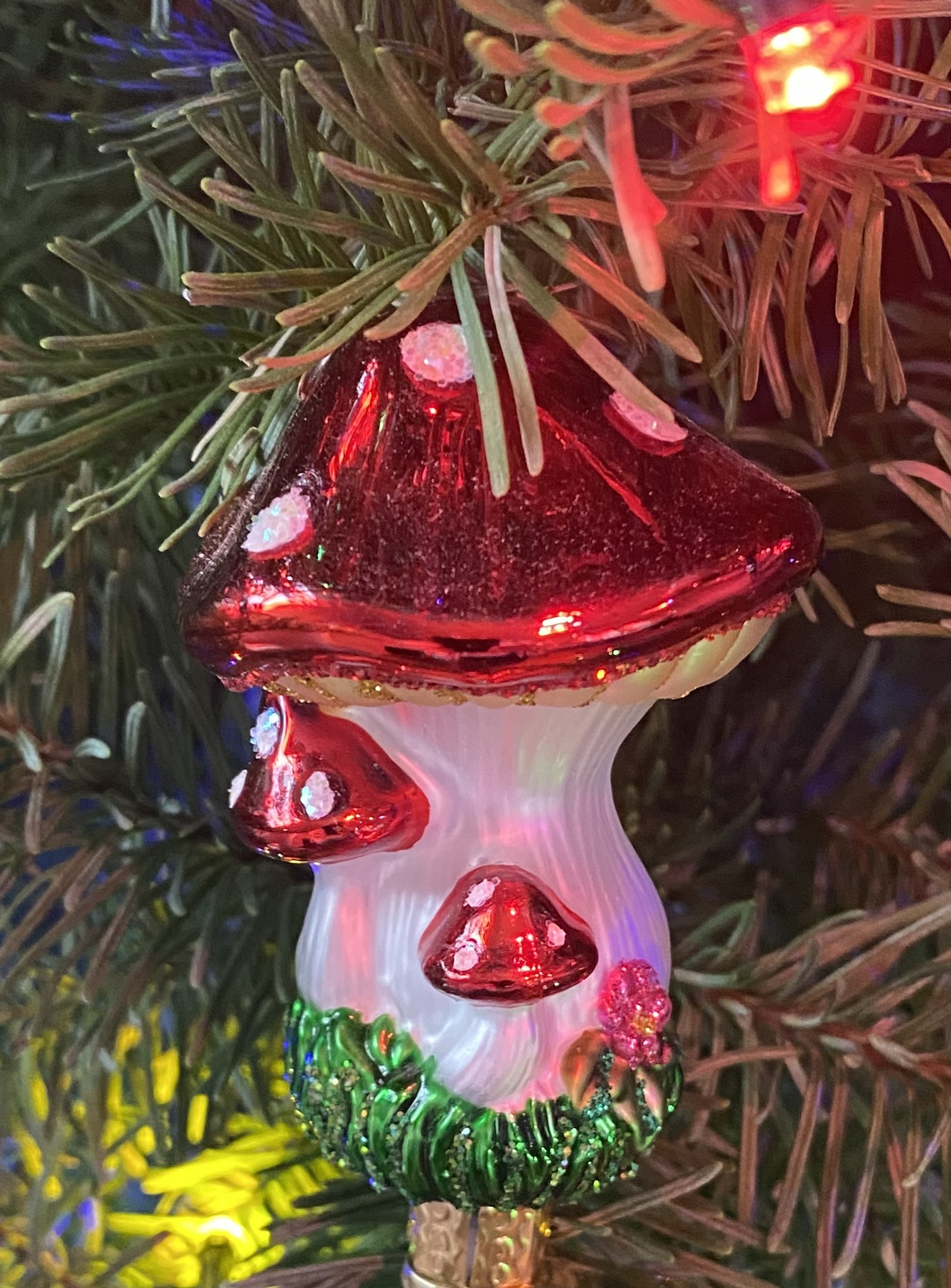
Santa’s story bears striking similarities to the winter solstice practices of Arctic shamans—specifically those of the reindeer herding Koryaks of Siberia and the Sámi of Sápmi (formerly called Lapland) who used hallucinogenic mushrooms in their winter solstice ceremonies. These shamans consumed the mind-altering Amanita muscaria mushroom—the iconic red-and-white fungus often depicted in Christmas decorations—to commune with the spirit world.
Shamanic rituals involving A. muscaria date back over 10,000 years. During Siberian midwinter ceremonies of Annual Renewal, shamans, dressed in red-and-white fur-trimmed coats and tall black boots, gathered the mushrooms from beneath sacred pine trees. These mushrooms are the fruiting bodies of fungi whose mycelial networks interlace with tree roots underground. The association of red mushrooms with green pine trees might explain the colors of Christmas.
Gifts of Vision and Insight
In winter, heavy snow often blocked the doorways of Arctic yurts, forcing shamans to enter through the roof. They slid down the central birch pole, carrying a bag of dried A. muscaria—a probable origin of Santa’s descent through chimneys with a sack of gifts.
Amanita muscaria, found growing under pine trees in Northern California. Photos by author.
After consuming the mushrooms or drinking the urine of reindeer that had eaten them, shamans would enter altered states of consciousness. Amongst the Siberian shamans, the reindeer was an animal spirit to journey with in their vision quests. The gifts shamans brought to their communities included the visions and insights from their psychedelic experiences, as well as portions of the mushrooms themselves.
Flying Reindeer Explained
Reindeer play a crucial role in this story. These animals can eat A. muscaria without suffering its toxic effects, metabolizing the mushroom’s compounds in a way that makes their urine safe—and still hallucinogenic—for humans to consume. Drinking reindeer urine allowed people to experience the mushroom’s psychoactive effects while avoiding its more unpleasant toxins.
The hallucinations induced by A. muscaria often include sensations of flying, contributing to the myth of Santa’s airborne sleigh and reindeer. After ingesting the mushrooms, the shamans were said to experience heightened senses, bursts of energy, the desire to sing, feelings of joy, and increased muscle tone, so any physical effort was easier to perform.
Stockings Hung by the Fire
Indigenous peoples dried their mushrooms on tree branches or by hanging them in socks near fires, practices reminiscent of today’s Christmas stockings. As with many pagan traditions, Christians appropriated these shamanic elements, attributing them to Saint Nicholas, a 4th-century Turkish bishop known for his generosity to children and the needy.
Incidentally, the plural of shaman is shamans, not shamen. There were female shamans among the indigenous peoples, just as there are in many cultures today.
Koryak shaman woman, photo from Jesup North Pacific Expedition 1900. (PD-US)
The Arctic shamans might have been jolly, but probably were not fat. That image was exploited in ad campaigns by Coca cola, starting in 1930 (although folks are mad that the company’s latest AI video ad focuses on trucks instead of Santa).
Mushrooms and Me
My own relationship with mushrooms is one of wonder and deliciousness. Wonder-ful because mushrooms are witchy and mysterious. Scientists estimate that as many as 95% of fungal species on Earth are still unknown! Many mushrooms are associated with particular species of trees, so in learning about ‘shrooms, we learn about the forest and its ecosystem too.
Deliciousness because I’ve foraged, eaten and enjoyed many mushrooms. But A. muscaria is not one of them. The poison is not a deadly one like some of the other Amanitas, but it does make you sick. And while I am curious about hallucinations, I’m not so curious about regurgitations.
Still, A. muscaria fascinates me, not just for its beauty but also for its potential. Recent research explores its psychoactive compounds, muscimol and ibotenic acid, for therapeutic uses. These compounds show promise in treating conditions such as stress, anxiety, insomnia, addiction, and even neurodegenerative diseases like Parkinson’s and Alzheimer’s.
Solstice Spirits
As the winter solstice approaches on December 21, I’m reminded of the deep connections between ancient rituals and modern traditions. So, whether you celebrate with a cup of cocoa or an appreciation for fungi, happy solstice to all—and to all a good long night.
*The proper plural of Pegasus is Pegasi but I like Pegasuses better
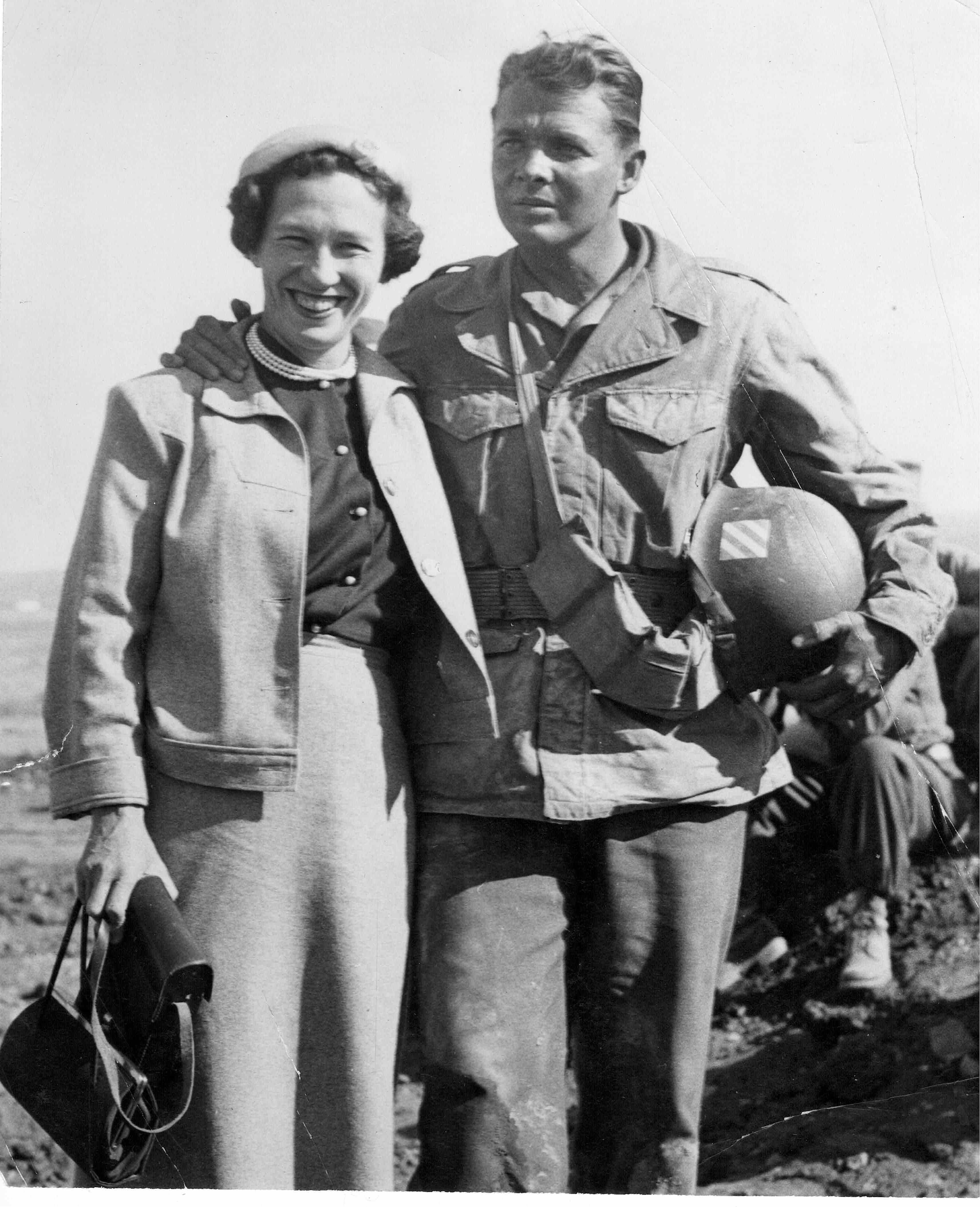
“When are we going to get some more donuts?” asked Audie Murphy of the photographer after he received the highest of all military honors, the Congressional Medal of Honor, in the field in Salzburg, Germany.
Flo’s photo of Audie Murphy receiving the Congessional Medal of Honor
It was 1945 and the photographer was my mother, Florence Wick. She had been serving as a Red Cross “donut girl” with the Third Infantry Division in the Europe. She had met Murphy and served him donuts somewhere in France.
That photograph was the only one taken of Murphy at the awards ceremony and it was published worldwide and used to recreate the scene for the movie of his life story, “To Hell and Back.”
1955 Flo and Audie reconnected on the movie set of To Hell and Back. Photo by Rollie Lane. The photo at top is the one taken by Flo at the awards ceremony in Salzburg in 1945.
The most decorated soldier of WWII, Audie would cross paths with Flo again ten years later when he came to our hometown of Yakima, Washington to film the movie. There at the Yakima Firing Center the two of them looked through the scrapbook Flo had compiled of her adventures and heartbreaks in the European theater.
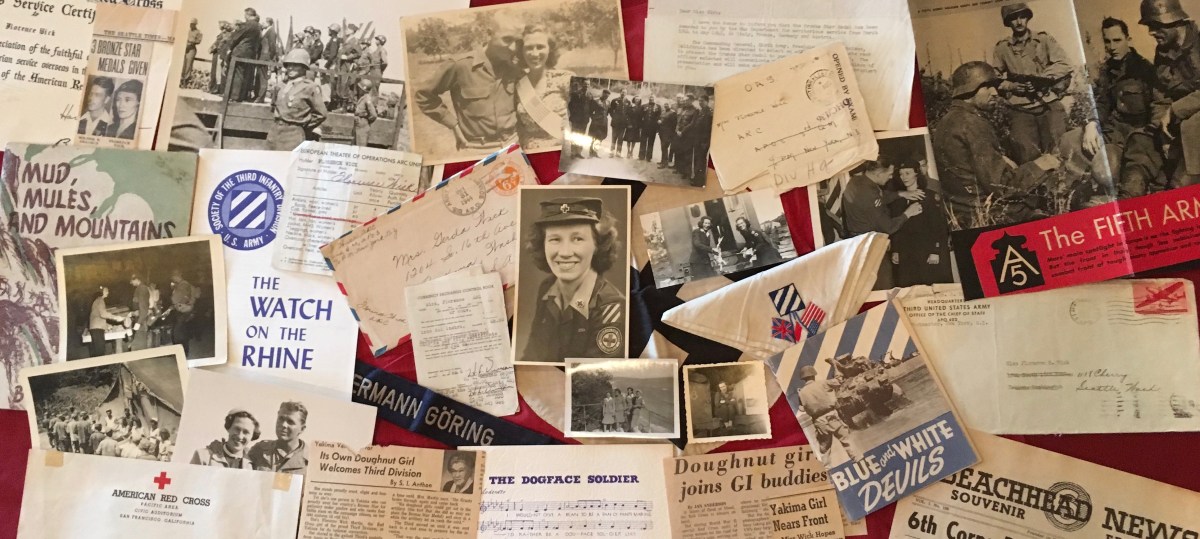
Now I have that scrapbook. It’s gigantic and weighs 25 pounds. I have wanted to use its contents to tell my mother’s story, but the project is overwhelming. Maybe I can start with Audie.
Audie Murphy was known worldwide after the war. He had a huge fan club and maybe still does (he died in 1971). One of his fans recently got in touch with me and asked if I could supply more stories and pictures. Yes! Flo stayed in touch with Audie. She corresponded with his biographer, his associates and those putting together a memorial in Texas. She saved mementos and newspaper clippings.
As for her photo that became famous, she gave it freely and others took credit. A post-war letter she saved warns that others are charging for the use of her photo. She never received credit.
by Molly Martin, Gail Sansbury, Elaine Elison, and the Bernal History Project
Dow Wilson of Painters Local 4, who was famously assassinated in 1966, standing in front of a picture of the writer and socialist Jack London.
Bernal Heights in San Francisco has always been called Red Hill, perhaps because it’s made of red rock—Franciscan formation chert—that once lay under the ocean.
More likely that moniker has to do with the large number of Reds who lived on the hill over the decades: Communists, Socialists, labor activists, and New Leftists.
Ever since it was colonized by Europeans, Bernal Heights, on San Francisco’s south end, has been a working class neighborhood. Slaughterhouses and tanneries proliferated along the creeks on the south and north sides of the hill before the turn of the 20th century. Breweries like the North Star on Army St. operated until the Volstead Prohibition act put them out of business in 1920.
This photo of Mission Street at Kingston was taken in 1906 during one of many carmens’ strikes of that era.
Bernal Hill never was home to much industry, but its two streetcar barns at the foot of the hill were the site of pitched battles during the carmens’ strike of 1907. In San Francisco’s deadliest strike, 26 people were killed and hundreds injured during the nine months the carmen were out. That year saw strikes in several unions, of women as well as men workers, and a general strike was nearly called. The city seemed on the verge of class war, with Market Street being the dividing line. It’s not hard to guess which side Bernal’s residents were on.
In the 2000s, neighbors came together to form the Bernal History Project and to research the history of our hill. We published a book, San Francisco’s Bernal Heights, and gave slideshow presentations around the city. In 2008 as part of the annual SF Labor Fest we gave a presentation called Reds on the Hill at the local bookstore, then Red Hill Books.
We chose to focus on six Bernal residents who had been active in labor struggles from the 1930s through the 1980s: Eugene Paton, Miriam Dinkin Johnson, Phiz Mezey, Dow Wilson, Bill Sorro and Giuliana “Huli” Milanese. These are the stories of working class people deeply committed to changing the world. They are six of many.
Thanks to the SF Labor Archives and Research Center, a rich source of information about union movements and working class life in the Bay Area, and the families of our subjects, especially Patty Paton Cavagnaro and Petrina Caruso Paton for their family albums.
She is a towering figure, casting mountains by flinging stones from her wicker basket. She is the crone goddess, ancient and wise, with flowing white hair and—some legends say—one eye in the center of her forehead. The Cailleach (pronounced kallyak), the Celtic goddess of winter, seizes control of the earth on November 1, at the pagan festival of Samhain (pronounced sow-in), and reigns until the thaw of spring. She governs the weather, especially storms, and with each step, she shapes the land.
The hag’s face is pale blue, cold like a corpse, her long white hair streaked with frost. Cloaked in a gray plaid, she appears worn by time, yet her power is immense. She is both creator and destroyer, molding the hills and valleys with her hammer, a deity tied to cycles of death and rebirth. Some say she has roots as ancient as the Indian goddess Kali.
As the harbinger of winter, the Cailleach has been feared and revered for centuries. On Imbolc, February 1, she is said to gather firewood for the remainder of winter. If the weather is clear and bright, it’s a sign she intends for the cold to stretch on, collecting plenty of wood to sustain her. But if the day is foul, people sigh in relief—the Cailleach sleeps, and winter’s end is near. Today, we mark this custom with Groundhog Day.
“Winter is coming”—a phrase popularized by Game of Thrones—is not just a warning of seasonal change, but a metaphor for scarcity, hardship, and the potential for conflict. The ominous truth is that winter is always coming, unless we are already in the thick of it. Perhaps, politically, we are.
The looming threat of a Trump presidency feels like the onset of a long, harsh winter. It keeps me awake at night. For decades, Republicons have skewed the game, and I’ve lived long enough to witness it firsthand. From voter suppression to outright vote theft, it’s been an ongoing battle. I was blown away by Greg Palast’s latest documentary, Vigilantes Inc.: America’s New Vote Suppression Hitmen, produced by Martin Sheen, George DiCaprio, and Maria Florio (Oscar, Best Documentary). He exposes the political history of racist Georgia Gov. Brian Kemp and his slave owning family. Stream it for free.
For those unfamiliar with Greg Palast, he’s a freelance journalist with a history of working for the BBC and The Guardian. His investigations predict that MAGA extremists may riot on December 11, the constitutional deadline for states to submit their final lists of electors. You can read more on his site: https://www.gregpalast.com/maga-militants-to-riot-on-december-11/
I’m sending this message before Samhain, hoping these warnings help to thwart the political winter ahead. We may already be in the storm’s grip, but awareness can help us weather it.
For those of you in Sonoma County, I hope you’ll join me at a Democracy Fair, sponsored by the Deep Democracy group of the North Bay Organizing Project. Get voter information about local and state propositions and races. Plus games and prizes! It’s happening this Friday October 18 from 4 to 7pm at the SRJC student center. Registering ahead will help us plan. Here’s the RSVP link: tinyurl.com/deepdemfair. (Apologies to those I’ve already sent this to.)
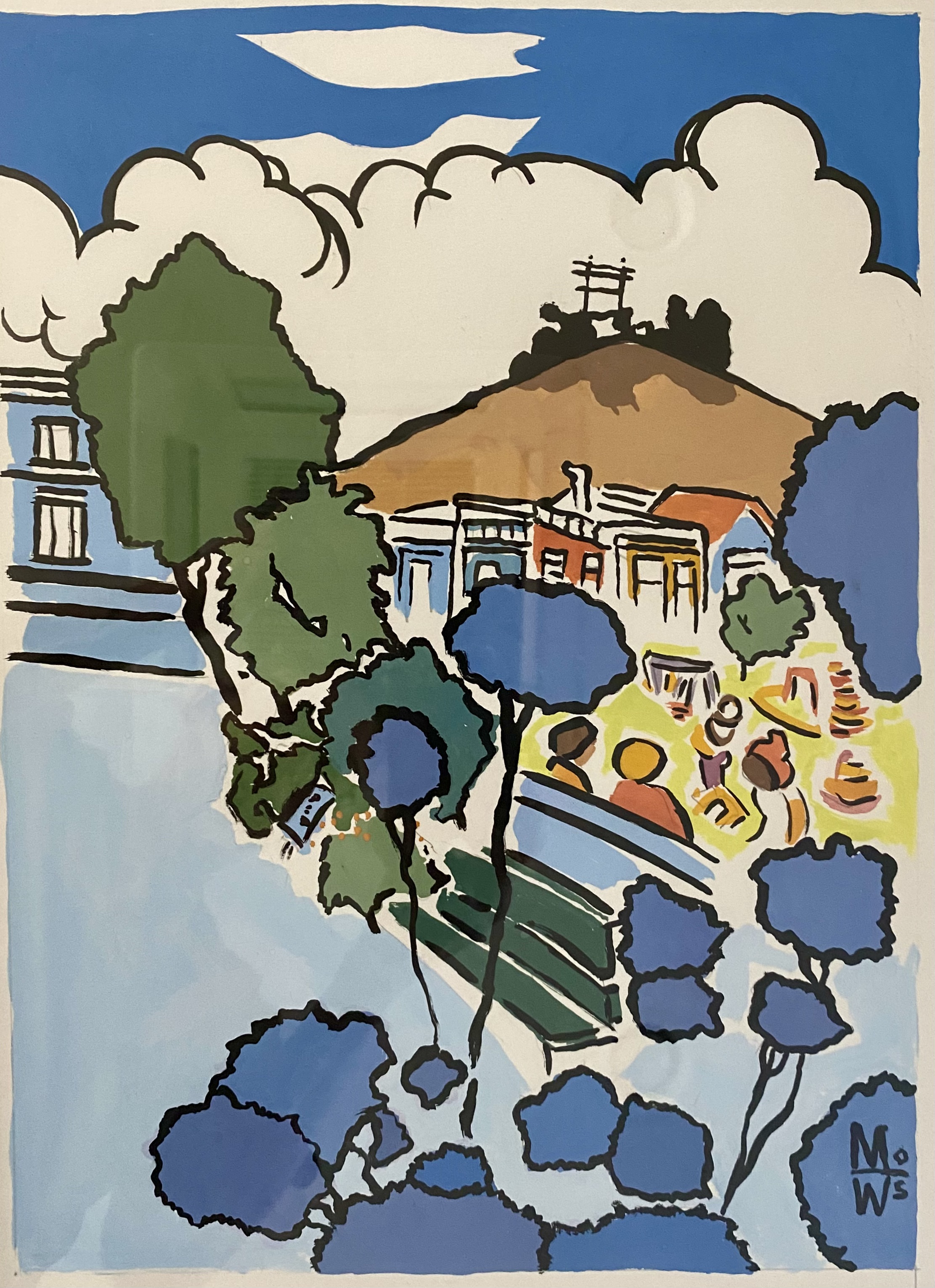
She was always working on art projects and her friends were often the lucky recipients of her creations. One of her gifts to me was this painting of Bernal Hill viewed from Precita Park where she lived. I lived on the opposite side of the hill. The painting had originally been framed in something she’d found at Scrap, but it fell apart over time. Recently, I rediscovered it in the garage and had it reframed. Now it’s hanging on the kitchen wall, and it’s a beautiful way to remember both Mary and our beloved San Francisco neighborhood.
Sending Samhain greetings to all.
Love, Molly (and Holly)
The top photo is by David Mirlea on Unsplash (having trouble with captions)
After I made it clear in a blog post that I support Kamala Harris for president, my neighbor texted me saying we are on opposite sides of the political spectrum and did I want to talk about it? She is part of an organization called Braver Angels whose mission is to bring Americans together to “bridge the partisan divide and strengthen our democratic republic.”
Well, yeah. I’d love to understand why anyone is planning to vote for a criminal misogynist racist incompetent ignorant vindictive idiot. I truly do want to understand.
We met at a local café where I asked her to lay out her thoughts.
We have much in common. We are about the same age (75). She has campaigned for social justice, and protested the Vietnam war. She was a student at SF State during the 1968 student and faculty strike. She voted against Hillary in 2016 because she was pro-war and Trump said he would end wars. Then she voted again for Trump in 2020.
She tells me she is a Quaker
Me: Do you go to quaker meetings? Are there Quakers who consider themselves Christian nationalists?
Yes, she has gone to meetings in many places. There are Quakers who want to walk a more middle line.
Where do you get your news?
Mostly from citizen journalists. People who report from the street. She mentions Tucker Carlson and other right-wing commentators.
She likes Vivek Ramaswamy. She says he went to Springfield Ohio to bring people together.
Why do you think he went there? What is he running for–a cabinet position?
He wanted to find out what is really going on.
He’s supporting Trump. How can he pretend to be nonpartisan?
He says they brought in too many immigrants.
The Haitians are legal immigrants.
No. they have “temporary protected status.” That’s different. They don’t all have jobs. Some of them hang out on the street.
Do you agree with trump’s plan to deport all immigrants?
There needs to be more oversight. We need to stop the rapists and felons. Send them back.
Trump is a convicted rapist. Should we send him back?
Social security. Trump wants to stop taxing it.
Yeah that’s what he says but the republicans have been saying for years they want to abolish it.
What about Kamala’s economic plans? (A republican talking point.)
You are treating trump like a regular candidate instead of a crazy guy who can’t string a sentence together and who promotes violence.
What do I think about RFK?
I liked him when he was an environmental lawyer. Now I think he’s lost his mind.
He only wanted people to have a choice about vaccination.
What about the republicans who would take away women’s vote? Who want to return to slavery?
She hasn’t heard much about them but knows about Mark Robinson in NC.
What about project 2025?
Trump is not involved with that.
You know that JD Vance, his VP candidate, wrote the introduction and the others involved were almost all on Trump’s staff?
She didn’t know that. It’s the Heritage Foundation she says.
We talked respectfully about many other issues. After an hour I have to go. I’m getting a little sick. We agree that we hate war. I shake her hand. She hugs me. She says see we do have something in common.
She tells me I should listen to Vivek. I tell her she should read and listen to different media. I send her a youtube clip from Trae Crowder the Liberal Redneck. Love that guy.
I still feel profoundly disturbed. We did not bridge the partisan divide nor strengthen the republic. For years the rest of us have been asking why any sane person could still support a con man like trump. My theory is that it’s the fault of the right wing media’s lies. And one thing this meeting has done is confirm my theory. Now I understand.
Gay Man Will Rollins Running Against Anti-Gay Incumbent
Californians will be sidelined again in the upcoming presidential election. With nearly 40 million residents, the state won’t play a decisive role in choosing the next president until the electoral college system is changed. Instead, the focus remains on swing states, leaving many Californians feeling left out, and me outraged again.
But we are not twiddling our collective thumbs. We’re shifting our attention to key down ballot races. A strong coalition, Mobilize—comprising Indivisible, California Grassroots Alliance, and others—is targeting six red districts in an effort to flip the House blue.
One candidate I’m particularly excited about is Will Rollins, who is openly gay and has a great shot at winning. When the districts were reorganized, he gained the queer-friendly city of Palm Springs in California’s 41st District. Rollins, a former federal prosecutor, is running again after nearly defeating Republican Ken Calvert, an incumbent with a long anti-LGBTQ voting record, in the last election. Polls show Rollins with a six point lead. https://willrollinsforcongress.com
I can’t vote for Will. I’m in a safe blue Congressional district. But, like hundreds of other Californians, I’m writing postcards to voters, getting out the vote, posting yard signs, and wearing my Kamala swag. Let’s paint Congress blue!
You can shake your fist at heaven, you can file your appeal
You can try to rise above it, you can crawl and you can kneel
No matter what life gives you, no matter what you steal
You cannot stop the turning of the wheel
Chorus from Jennifer Berezan’s song Turning of the Wheel
Naked ladies (Amaryllis belladonna), a ubiquitous and favorite fall flower
Sitting out in our yard on a lovely evening at the ides of August, Holly and I luxuriated in the garden’s summer radiance. The day was cooling as the sun retreated. Colorful zinneas and cone flowers bloomed and the fragrance of the rockrose bush enveloped us. Hummingbirds zipped back and forth. Finches and oak titmice populated the feeder. Towhees scratched the ground as mourning doves bobbed and cooed. It was a perfect summer evening.
But as we sat in our twin rockers, we both said, almost in unison, “I’m looking forward to the turning of the seasons.”
Summer, with its long, warm days and bountiful harvests, has been beautiful, but we’re ready for the change. Holly says that humans evolved with the rhythm of change, and that’s why we appreciate the wheel of the year turning.
Now, with the autumn equinox upon us, the new season begins. Pagans call this time Mabon, after the Welsh God who is the son of the Earth Mother Goddess.
Recently, I learned about the lunistice, the moment when the moon seems to pause, similar to the way the sun appears to stop at solstices before shifting direction. It’s a fascinating event, though hard to observe unless you track the moon regularly.
The major lunar standstill is marked by observing the extreme points where the moon rises and sets on the horizon, akin to watching the sun at solstices. Just as the sun’s position reaches its furthest northern and southern points at solstice, the moon does something similar every 18.6 years during a maximum lunistice—an event that occurs near equinoxes and eclipses, and it’s happening now!
This 18.6-year cycle is due to the moon’s orbital tilt and the gravitational pull of the sun, causing the moon’s orbit to swivel and vary its angle relative to Earth.
Excited, I reached out to the folks at Ferguson Observatory at Sugarloaf State Park to learn more. I was intrigued by the idea of “maximum lunistice,” thinking it sounded particularly special. But I learned something surprising: the minimum lunistices are actually more significant, especially in relation to tides.
The Observatory explained that during maximum lunistices, the moon is furthest from the celestial equator, resulting in less dramatic tides. However, minimum lunistices bring larger tides because the moon is closer to the equator’s gravitational bulge. But since “maximum” sounds more impressive, it tends to get more attention. The next minimum lunistice won’t be until 2034.
At an Old Lesbians retreat in the Mayacamas mountains as a group of us stargazed, I attempted to explain this lunar phenomenon but stumbled over the details. Honestly, I don’t fully grasp it myself. Yet, here’s what’s clear: ancient peoples understood this cycle.
Bronze Age societies, like those who constructed the megalithic monuments in Britain and Ireland, placed great significance on lunar standstills. Modern Neopagan religions find meaning in them too. Ancient cultures beyond the British Isles also recognized these events—sites like Chaco Canyon in New Mexico, Chimney Rock in Colorado, and the Hopewell sites in Ohio all feature alignments to the moon during lunar standstills.
As I write this, the full supermoon is rising with a partial lunar eclipse. The turning of the celestial wheel continues to fascinate us, just as it did our ancestors.
I’d like to call back summertime and have her stay for just another month or so
But she’s got the urge for going so I guess she’ll have to go.
From Joni Mitchell’s song Urge for Going
One of my favorite Joni Mitchell songs, Urge for Going, laments “summertime falling down.” Joni was thinking about snow and cold and pulling the blankets up to her chin. She sang, “All that stays is dying and all that lives is getting out.” But she was singing about winter coming in Canada. In California when I think about winter coming I think rain, which makes plants start to grow in the outdoors. It brings mushrooms, grass, new leaves and flowers. The cold coastal summer fog falls away and dust is dampend.
David Douglas, the Scottish botanist who traveled in North America in the 1830s (after whom the Douglas fir and other plants were named) remarked on how dead the Sonoma area was in summer. He collected plants in the winter and spring when they were growing and flowering.
These are some of the reasons we here in summer-dry California exclaim with anticipation “Winter’s coming!”
The autumn equinox takes place Sunday September 22. Wishing you all a fabulous fall season.
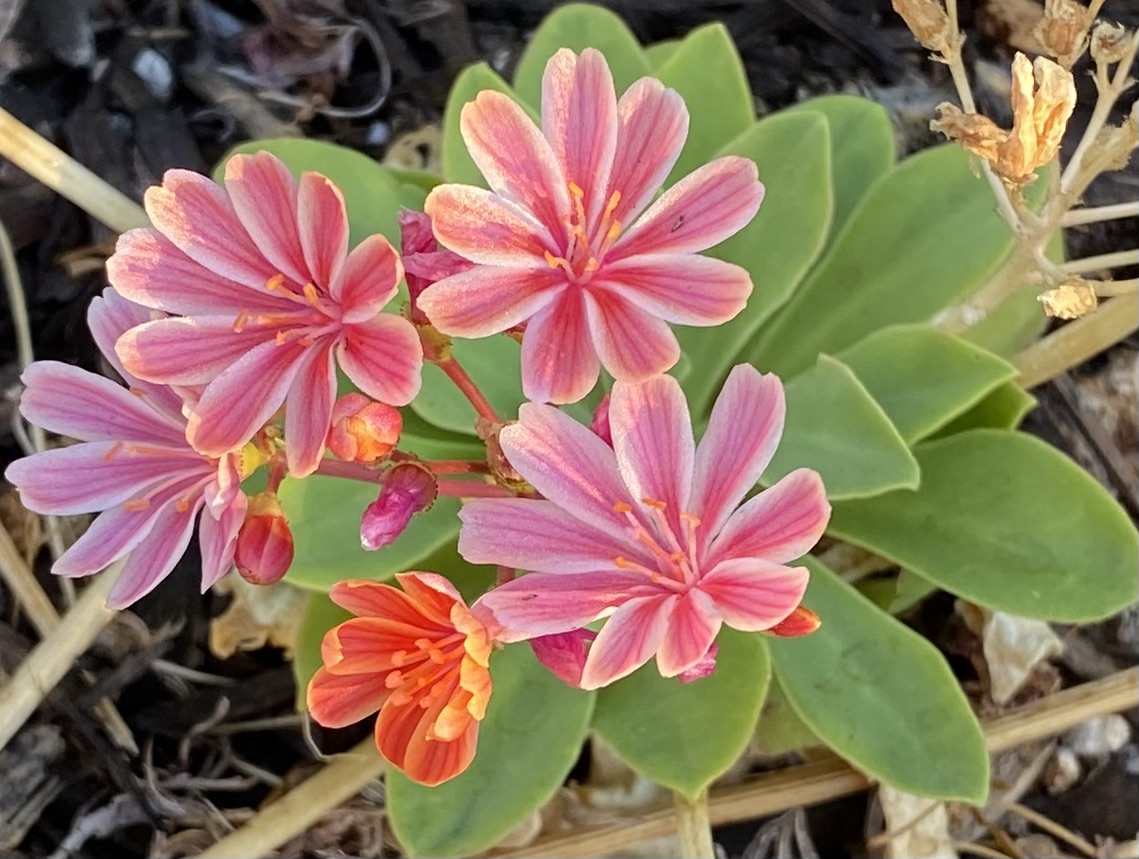
Lewisia, a native in our garden, named for Meriwether Lewis who encountered the species in 1806
In the 2000s, I began to deconstruct my Bernal Heights home. In opening up the walls, I started to uncover the house’s history, leading me to an investigation into its owners and architectural evolution from the distant past to its having been bought by my lesbian collective in 1980. The story of 386 Richland Avenue is one of Bernal Heights, San Francisco, and California more broadly, speaking to themes of land ownership and development, the legacies of slavery, and the role each person has in shaping their neighborhood.
386 Richland Avenue 1980.Photo: Molly Martin
An old house holds the ghosts and remnants of all the people who have occupied it over the years. When you live in an old house I believe you must acknowledge all the people who have lived there and the people who built and worked on the house.
When I got to San Francisco in 1976, I decided there was no place I’d rather live. I had never owned a house before and really had no hope of ever owning a building in San Francisco until my living collective of four lesbians agreed to pool our money.
I got curious about the history of our Bernal Heights building as soon as we bought it in 1980. How old was it? Real estate records said it was built in 1900, but that is the default date for all San Francisco buildings built before the earthquake and fire of 1906 destroyed city building department records. So I knew it was probably built before 1900. It was always a weird looking building: three stories with three flats over a garage. Notice the weird roofline and window placement. What architect would design such a building?
I wanted to know who had lived there before me.
The Land Underneath
Ohlone village
The first human residents of this land of gently rolling grassy hills were the Ramaytush Ohlone. Hundreds of shell mounds have been uncovered all around the San Francisco Bay and there is evidence of a great Ohlone settlement at the mouth of Islais Creek, which once flowed just down the hill south of my house where Alemany Blvd and Interstate 280 now flow with traffic. Before progress changed its course and buried it, Islais Creek formed a deep gorge on the south side of my neighborhood of Bernal Heights. The creek was long ago undergrounded and replaced by freeways but the gorge remains.
I was delighted to learn that islay is an Ohlone word naming a native bush called the islais cherry (Prunus ilicifolia) that grew along the creek and still grows in forgotten corners of San Francisco. The shiny leaves look like a cross between holly and oak. And the fruit is edible. They were eaten by the Ohlone along with plentiful bay creatures, shellfish, fish, birds, deer, and other land animals.
Spain had laid claim to San Francisco and what it called Alta California in 1542. Starting in the 1760s the Spanish established missions from San Diego up to Sonoma along the king’s highway or El Camino Real, now Mission Street and Highway 82. The Spanish and the Indians they enslaved built San Francisco’s Mission Dolores in 1776, and so the road from San Jose and the south had come sometime before that. These are well-traveled pathways that extend quite far back in time.
After Mexico won independence from Spain in 1821, it secularized the Catholic missions. In order to receive a Mexican land grant, a man had to be a Catholic. But the land was not handed out to the church as it had been by Spain.
José Cornelio Bernal was granted a league, about 4,400 acres, by the Mexican government in 1839. José was the son of Juan Francisco Bernal who, with his family, arrived in San Francisco with the Spanish Anza expedition in 1776. José and his family were cattle ranchers, some of the original Californios. Over time they lost the land to squatters, lawyers, and bankers. The family first defaulted in 1859 to William Tecumseh Sherman, a banker before he became a Civil War general, who had loaned the Bernal patriarch money. The Bernals finally relinquished their last 25 acres to foreclosure in 1917. It marked the passing of the very last bit of San Francisco real estate from the families of original Mexican land grantees—the Californios.
The area south of the Mission including Bernal Heights was not platted until after the Civil War. At that time the lack of transportation infrastructure made lots hard to sell.
Large sections of southern San Francisco fell into the hands of the real estate developer François Louis Alfred Pioche. Pioche platted and developed much of southern San Francisco. A French financier, Pioche is described as a suave and cultured European who introduced fine French wine to San Francisco’s elite, an influential player who lived openly with his male lover and business partner, L.L. Robinson. No one is sure why he committed suicide in 1872.
Bernal Hill in 1875.Photo: Carleton Watkins, courtesy of California State Library
Carleton Watkins (1829-1916) was one of the most famous outdoor photographers of the American West. He also made many pictures of the growing city of San Francisco, like this one taken in 1875. From around Silver Avenue, looking north to Bernal Heights, the bare grasslands of southwest Bernal are revealed with the Mission District and the town of San Francisco in the distance. The prominent enclosure nearby is the site of St. Mary’s College. It faced Mission Road (now Street), the principal route at the time. College Hill Reservoir is the flat area near the center of the picture. The fenced circle denotes Holly Park, donated to the city in 1862 by the silver mining baron James Graham Fair. On the extreme right is the top of Bernal Heights. My house would be just to the right of this picture near the east edge of Holly Park.
Building 386 Richland
When we bought 386 Richland, the place was a mess. The most recent owner had “remodeled” by covering the walls and even wood window trim with quarter inch sheetrock. I’m an electrician. Trying to solve an electrical problem, I discovered live bare wiring between the sheetrock and tongue and groove finish wall in the kitchen of the lowest unit. This was very disturbing but I didn’t have time to demo the walls. That would have to wait 20 years until I retired.
One day I drilled a hole in a closet wall to pull some low voltage wiring. I used a four-inch hole saw and was surprised that when the saw got through a layer of sheetrock, it hit wood. When I finished I pulled the four-inch-round block of wood out of the saw. It was inch-thick redwood. I turned it over and found newspaper pasted to the inside, a primitive type of insulation. It was a racing form dated 1893. Well, that was a clue.
The San Francisco Call applied directly to redwood for insulation.Photo: Molly Martin
Someone told me the San Francisco Water Department records had been kept in a safe and survived the 1906 fire. All you had to do was ask at the headquarters. The clerk stepped into a big safe and brought out a single piece of paper, a Xeroxed copy of the permit, which said water was provided August 1, 1893. It was signed in a clear hand by the owner, G. Shadburne.
The document contained several other clues. The Spring Valley Water Company (we didn’t yet have a publicly-owned water department) supplied water to what was then a single-family building of 825 square feet. The property owner paid $10 in gold coin. Listed were two wash trays, one wash basin, one bath, one water closet and 30 square yards of irrigation. E. J. Fisk of the water company had charged for two cows and then apparently been convinced to erase them along with some other notes. Were the cows just visiting? Had a family been living at 386 Richland without running water? It would have been possible; there were several active springs on the hill and many early homes had been built without indoor plumbing. But while Shadburne could have bought the property earlier, all evidence points to 1893 as the year a building was first erected here.
George David Shadburne during the Civil War
From the census record I learned that the house’s owner in 1900 was George David Shadburne, a lawyer originally from Texas who had moved to San Francisco in 1868. He did all right for himself in San Francisco, well enough to be published as a person of note in the city’s blue book in 1894-95. He never lived at Richland Avenue, which he developed and rented out to poorer tenants. He lived instead in a tonier neighborhood on “California Hill,” and his business address was 429 Montgomery in downtown San Francisco, a building which he owned.
Shadburne might have been the original slumlord.
Once I had his name, I went to the San Francisco History Center at the San Francisco Public Library main branch where helpful librarians point you to volumes of historical data. Even though building department records were lost in the earthquake and fire of 1906, the history room contains a wealth of other supporting historical documents. I learned about the Sanborn insurance maps (most every city has them) and found that my neighborhood had been surveyed in 1905 and 1915.
A Sanborn Fire Insurance map showing the Holly Park tract in 1905
386 Richland is part of the Holly Park Tract. Development in Holly Park had only just started in 1905. Except for a small addition that was added to the rear of our building in 1961 (there was a building permit), the footprint is the same as today. It was still a single family dwelling then.
Sanborn map in 1915
By 1915 our neighborhood had been fully developed. Along with five neighbors I published a pictorial book about Bernal Heights history: San Francisco’s Bernal Heights. We learned that Bernal saw its greatest surge of development after the earthquake and fire of 1906. Some people moved earthquake shacks here and some built homes. By this time 386 had been turned into two flats, 386 and 386 1/2. Rather than a D, the map says 2F meaning two flats and adds the ½ to the address.
Deconstructing
Barb Schultheis building a shoring wall after we discovered that there were no studs in existing walls.Photo: Molly Martin
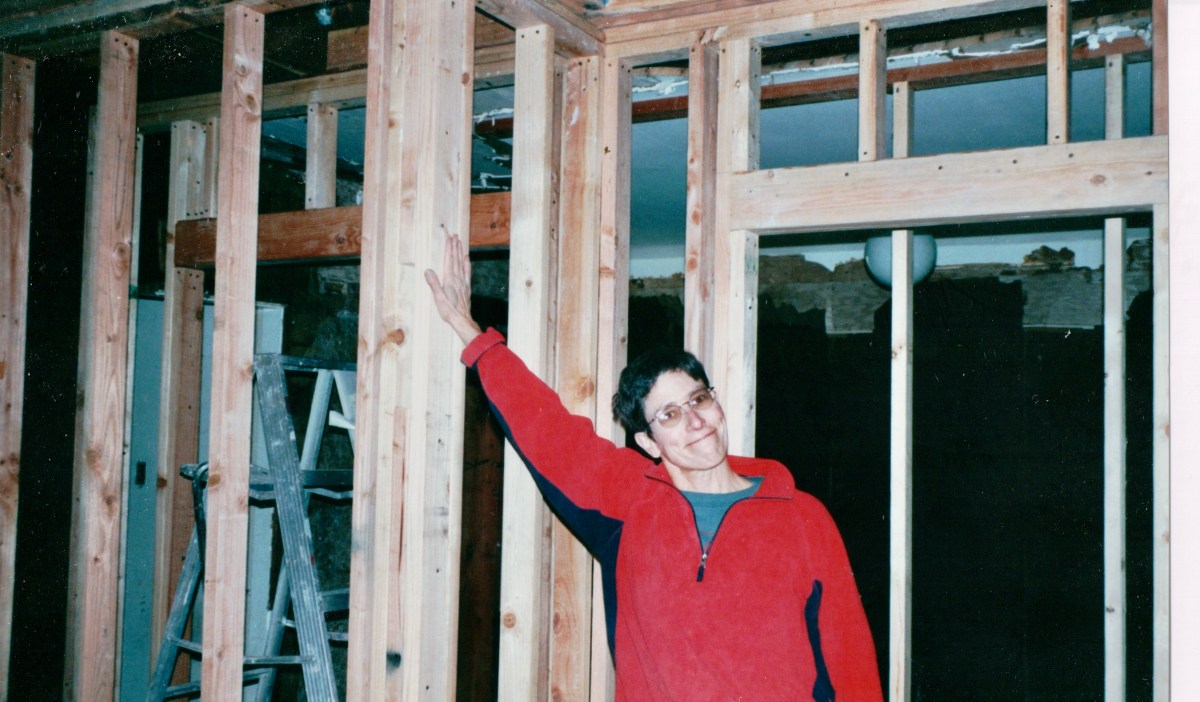
It wasn’t until the year 2000, 20 years after my original collective had bought the building, that I had the time and inclination—and also a partner who wanted to get her hands dirty—to begin to open walls and really see the structure. My then-partner Barb Schultheis and I started just a little kitchen remodel in my unit on the third floor. We opened one wall in the kitchen, pulling off many layers of finishes including sheetrock, oil cloth, and newspaper. What we found was worse than anything I’d imagined. Underneath it all was one-inch coarse sawn redwood planks, some as wide as 20 inches, and under the redwood was cross bracing and nothing else: no studs in this part of the third story apartment. And there was another story on top! The redwood was structural. We quickly built a shoring wall.
I’d never seen this building method. My carpenter girlfriend in New England called it a plank house, a more common style of building there in the 1800s.
Our demolition progressed to the front room of our unit. Here we found another construction method, more common in today’s buildings–platform construction. The walls had 2×4 studs 16 inches on center and the finish was lath and plaster.
As we deconstructed the building, we kept wondering why it is so oddly shaped, why construction methods differed from floor to floor and room to room, why floors were different heights in adjacent rooms, why floor and ceiling joists sometimes went north and south, sometimes east and west, why when wall coverings were removed we could see sky through cracks in the exterior walls.
Another clue: the staircase had been open and was closed in to create a third unit.Photo: Molly Martin
Then one day when I was standing across the street looking at the building I had an epiphany. Our home was never a plan in some architect’s mind. The different construction methods told us that these were different buildings, constructed at different times and later nailed together. It was a collection of buildings set on top of one another, cut off, pushed together, raised up, and without benefit of removal of siding, spiked together with a few big nails. Suddenly all the mysteries we’d cataloged made sense.
The old house had been turned so that its side, not the front, faced the street. Houses were often moved at the turn of the century. A builder would build a single-story house and later raise it up to add a second story. There were few systems like electrical and plumbing to disconnect as there are today. I believe this building was moved from another location where its rounded entryway faced the street. I propose that the three buildings were given to Shadburne or sold to him cheap.
Illustration of my “many buildings” theory
In this drawing I removed the double stairs to better see the different parts. I had always thought the oldest building, the yellow part, was the first house on the lot, but the square footage didn’t add up. Then I realized that the original 825 square foot house is the pink building turned so its side faces the street.
Here we can see three different buildings built with different construction methods: the yellow building had planks joined with square nails and no studs, insulated with 1893 newspapers. The pink building had modern platform construction, rolled nails (invented around the turn of the 20th century), and lath and plaster finish. The blue building below had old fashioned balloon framing with 4×4 studs 24 inches on center, also finished with redwood planks, but with rolled nails.
Our remodel progressed to the garage where we demolished a shelving unit made of old doors and metal pipes attached to a wall of sheetrock with no studs. Barb and I were standing at the base of a four-story building. We were right under three stories of kitchens with heavy appliances. We looked up to see the floor above bowing toward us. We rushed to build another shoring wall. That’s how we figured out that the bearing wall under all the kitchens had been removed! My search for building permits had uncovered a 1917 project to raise the building and add a garage. I believe the bearing wall was removed then. The building inspector didn’t notice. The building had been slowly falling down for a hundred years! So, with help from carpenter friends Carla Johnson and Pat Cull, we dug up the garage floor, poured a footing, jacked up the building, and built a new bearing wall.
Retired union carpenter Pat Cull oversaw our project and taught us much about carpentry.Photo: Molly Martin
Another shocking discovery resulted in more unplanned structural work: not one but two bearing walls had been removed to make way for the garage in 1917. Engineer Marg Hall helped us to understand the physics of load bearing (one test: have your girlfriend run up to the floor above and jump up and down) and did calculations required for the permit. I drew plans and waited in line at the Dept. of Building Inspection. This second un-wall we rebuilt as an engineered glue lam wood beam on posts.
Postcard found in the ceiling, maybe from 1903.Photos: Molly Martin
When Barb and I opened the ceiling above unit B, the third story, we found a crib full of about a ton of plaster that had been discarded when the buildings were tacked together (no wonder the ceiling was bowing). We had to remove it by hand, scooping it into buckets to take to the dump. This was the most disgusting job of the whole project. This postcard was in there. I asked Ancestry buffs brother Don Martin and cousin Richard Juhl for help researching this. They found John Hargens at this address in a 1907 city directory. He was an immigrant from Germany, born about 1868. His wife Minnie was also German which might account for the florid cursive. They lived at 386 in 1907 with their five children but moved to Santa Marina (a nearby street) in 1908. Did they move because of construction on 386? How did this postcard get into a pile of plaster left in the attic?
Some of the objects found in the walls, dating back as early as the 1800s, gave us clues to the tenants in different eras. Coffee can metal (bottom right) was used to patch holes in the fir floors.Photos: Molly Martin
Demolition was like an archeological dig and while we didn’t find anything valuable, we uncovered lots of clues about the building of the house. When I finally saw the wiring inside the walls, I couldn’t believe the building hadn’t burned down. In my time as an electrician and inspector I’ve seen the insides of a lot of walls in San Francisco but I’d never seen such hazardous wiring. Much of the building was wired with the equivalent of zip cord.
Thanksgiving 2000 was our last dinner party in my old apartment B. By Christmas I had moved up to Barb’s penthouse apartment and moved all my stuff out to the shed we’d built the year before, clearing room for the remodel. We spent the last days of December pulling apart my kitchen. Our four-story, three unit building required near complete rebuilding, a far more difficult task than simply constructing a new building from the ground up. If only I’d known what we were in for, I’d have sold the building. But there’s probably a real estate disclosure law requiring truth telling, so once we started, we had to forge ahead.
Rebuilding
In those first two years of destruction and construction of the lower two units, Barb and I did all the demolition, carpentry, and electrical work ourselves, with the help of many dear women friends. Scores of women helped us on this years-long project. We couldn’t look at the whole big project or we’d get depressed at the overwhelming amount of work ahead of us and think of suicide. Instead, we focused on each small project and celebrated whenever we finished framing a wall (virtually all the walls had to be reframed) or laying a subfloor in one room.
Carla Johnson jackhammers for new footing
In November of 2002 we celebrated having gotten the house closed up for winter and ready for sheetrock. Barb had taken off a couple of weeks in October and we’d worked our butts off replacing siding, installing new windows, patching, caulking, weatherproofing, and painting the back and west side of the building and rear stairs.
We knew the building was funky—the three-story utility “shed” which enclosed bathrooms had been added on at the turn of the 20th century with no foundation, so it had gradually separated from the main building over four inches near the top. Bad carpenters and handyman homeowners had been plugging the gap for 100 years. But we figured 21st century caulk might buy us a few more years. We decided we would tackle rebuilding the back of the house after this remodeling project was complete.
The rear side of 386 Richland before the storm; all of this work had to be torn down.Photo: Molly Martin
Then in mid-November 2002, the winter’s first storm hit. The four-story wood frame building had always moved in the wind. You’d lie in bed in a storm and feel it shimmy and buck on any floor (I’ve lived on all three and lying in bed in the bottom unit I could tell when the couple in the top unit were having sex), but especially on top. I figured it had survived a century and two big earthquakes probably because of its profound flexibility.
That night of the storm it felt like the building was on the verge of falling down. Of course! We’d removed all the many layers of wall coverings and completely gutted the two floors below. Like scotch tape and gum, the interior finishes had been holding us up. Upstairs in the top unit, lamps were swaying and everything was moving. We could see the glass in our living room windows bow in the wind and worried they might shatter. So we closed the blinds and finally went to bed, though I don’t think either of us got much sleep.
The storm caused plenty of damage in San Francisco and the area. Folks in some places were without power for weeks. I guess we were lucky. The only thing we had was water in places it didn’t belong—lots of water. One corner looked like a waterfall, and of course had been leaking for years. Only now with all the walls open could we see it. For Barb and me, this was the lowest point. It seemed as if the project would never end.
The upshot is we spent the next year tearing off the whole back of the building, including deck and stairs, and rebuilding it. All the new windows and doors we’d hung and trimmed (making casing by planing the salvaged redwood) had to be taken out, projects we’d sweated and cried over for hours and redone time after time as we learned the rudiments of carpentry.
Contractor John Burton reframing the roof.Photo: Molly Martin
To demo and rebuild the back of the building we hired a contractor, my old friend John Burton, who I’d worked with to remodel the People’s Cultural Center on Valencia Street in 1978.
We recycled the redwood stairs, reusing them as stairs when we could and building planter boxes with the rest. Barb and I bolted the foundation, put in hold-downs wherever we could to hold the various parts of the building together. Then we sheared all the open walls in the front of the building with plywood. The new rear walls have been sheared on the outside. Afterward in a windy storm I laid on the bed slightly disappointed that the house hardly moved at all.
My Local 6 electrician sisters and I showing off our tools. We were some of the first women to get into our trade.Photo courtesy of Molly Martin
With help from my women electrician sisters from International Brotherhood of Electrical Workers (IBEW) Local 6 and Local 617 I rewired the building and installed a 200 amp four-meter electric service. The job was signed off by city electrical inspector Sylvia Montiel, who had worked with me when we were electricians wiring high rises back in 1981.
The building’s plumbing–water, drains, waste, gas, and venting had to be replaced. I calculated the size of piping and drew plans. We installed on-demand water heaters in all the units, as well as heating systems. The two chimneys were demo’d and the tons of bricks recycled. We replaced all the windows, keeping only the existing old growth redwood sills.
Our remodel (perhaps it should be called a rebuild) took nearly a decade. The San Francisco Building Department granted us a building final and certificate of occupancy in 2009.
Legacies of 386 Richland
I didn’t learn much more about the house’s original owner, G. Shadburne, until the Internet made researching so much easier. He was a Confederate soldier, a captain who had been wounded, had spied for the Confederacy. During the summer of 1864 Shadburne became one of Wade Hampton’s notorious “Iron Scouts,” who hid along the Blackwater River just two miles from Grant’s lines near City Point, Va. Wearing Yankee uniforms, they skillfully eluded capture while they killed and captured Union pickets and couriers and interfered with wagon trains and telegraph lines. Shadburne also helped lead the Beefsteak Raid, stealing 2,500 head of Union cattle, Union supplies, and capturing 304 Yankee prisoners. Shadburne was captured on March 6, 1865, near Fredericksburg. He was sent to Fort Monroe, Va., then to Wallkill, a Union prison barge at City Point. Charged with being a spy, he faced hanging, but escaped on March 10th and returned to the Iron Scouts.
After the Civil War, like other Confederate slaveholders, he considered relocating to Brazil where slavery was still legal, but that didn’t work out. In 1868 Shadburne and his wife arrived in San Francisco where he opened a law practice. He gained a reputation as a bulldog litigator who never gave up until the last appeal failed and who was not above resorting to physical violence or verbal attacks on his opposing counsel.
The back of an 1858 appraisal of Shadburne’s property lists the names of his 20 slaves and their values.Image: Xavier University of Louisiana
Then I found an appraisal of Shadburne’s property from 1858 in Louisiana in the online archives of Xavier University of Louisiana. It lists the land he owned as well as his 20 slaves. What happened to them? When Shadburne moved to San Francisco slavery was illegal. I could find no evidence that he brought any of them with him. Tracing the lives of enslaved people is made difficult because only their first names and ages are recorded, sometimes with a note saying “cook” or “lame.”
Many of California’s settlers were Southerners and slave owners who sought to make California a slave state. Shadburne, who founded the Southern Society and immersed himself in civic projects, certainly contributed to the culture of San Francisco. He presented himself as a Civil War hero. He lived in San Francisco until his death in 1921.
Various owners followed Shadburne. Some actually lived there. But the property remained a rental, at least in part, in the working class neighborhood of Bernal Heights until my collective of four lesbians bought the building in 1980.
Lenders didn’t know what to do with four unmarried women buying a building together. Women had only just won the right to our own credit. We were tenants in common, not very common then, but now a common way for unrelated people to buy property together.
Lesbians Against Police Violence.Photo: Ruth Mahaney
My collective household was part of a movement. The collective living movement developed from a critique of the nuclear family and patriarchy. We sought to build alternatives. We envisioned a world without war, police violence, discrimination, imperialism, capitalism, and private property. We protested. But we also worked to build new institutions and new ways to live. For nearly 40 years of its 130-year history the building was a center of lesbian and women-centered culture and activism.
386 Richland after the remodel.Photo: Molly Martin
The lesbian collective slowly dissolved, but with numerous refinancings, 386 Richland helped the partners finance more woman-owned houses in San Francisco. I moved out of the building in 2018; today is a new chapter in Bernal history. The neighborhood, colonized by Californios, then working class immigrants from Ireland, Italy, and European countries, Communists and leftists, Mexicans and Latin Americans, and lesbians, is now being taken over by techies. The neighborhood of Bernal Heights has never been static since Europeans invaded.
As citizens and historians we don’t want to forget our own part in history. We all play an important part in shaping the culture of our neighborhood and our city.





























 tradeswomn musings