Lammas and Kamala

My regular pagan holiday post: Celebrating the Harvest

August 1, a day that marks the halfway point between the summer solstice and the autumn equinox, is celebrated as the first harvest festival in many parts of the northern hemisphere. The Celts called it Lughnasa or Lammas. Besides Lammas, pagans celebrate two later harvest festivals, Mabon at the fall equinox, and Samhain on November 1.

In Sonoma County we can harvest food year-round, so I guess you could say every pagan holiday is a harvest fest here. By the time August rolls around, we’ve already been celebrating for months. The first bite of every ripe fruit calls for celebration.  

Still blooming in our garden: epilobium, native buckwheat, aster. Hydrangea in shade

Growing up in Yakima, Washington, on the eastern side of the Cascade Mountains, I always knew when the fruit was ripe. Cherries were picked on July 4th, and I would gorge until I was sick. Grandma had an old-fashioned peach tree with fuzzy skin that had to be peeled, and those peaches didn’t ripen until late August. Pears came later, and apples weren’t ready until the end of September.

Here in Sonoma County, our Gravenstein apples ripen at the beginning of August! We celebrate the harvest at the Gravenstein Apple Fair. It’s taken me years to adjust to California’s seasons. There’s no real winter here—just fall and then, magically, spring! Winter is the rainy season, and summer is dry. As Pam Peirce says in her book, Golden Gate Gardening, there’s a secret season here. Many seeds can and should be planted in the fall, but I have to remind myself every year.

Last October, I planted sugar snap and snow peas, and by February I was eating them right off the vine. When I’d eaten them all, I planted sweet peas just to enjoy their beauty and fragrance. Beans came next. Our beans didn’t fare so well this year, thanks to moles. They don’t eat veggies, just meat (like worms, that is—think “moles = meat, voles = veggies”), but they tunnel near the roots and leave air gaps that kill the plants. I even saw the soil moving where I had just planted seeds. Needless to say, those beans never stood a chance.

Sunflower, zinnias doing well in the heat

Sometimes, I think gardening is like throwing dice. You never know what the next season will bring, but that’s what makes it interesting. The garden has a mind of its own.

After a couple of disappointing years where our tomato plants succumbed to wilt, this year is shaping up to be a winner. As soon as the first tomatoes are ripe, we celebrate with BLTs. This year, we enjoyed our first BLTs in the first week of July, slicing the Early Girls (my favorite variety).

There’s always something ripe and ready in our garden. We harvested navel oranges from our tree until June, then our neighbor gifted us a bag of Valencias, keeping us swimming in orange juice until mid-July! By August, the purple Santa Rosa plums are history, but the yellow plums from the tree we planted last year are still ripening. 

I’m a gleaner, and throughout the fall harvest season you’ll find me harvesting my own and neighbors’ pomegranates, figs and persimmons. 

Then there are grapes and wine, the primary crop here in adjoining Sonoma and Napa counties. La Paulée, a traditional Burgundian harvest celebration takes place in the Russian River Valley on August 2-3, when winemakers, chefs and enthusiasts of both will gather to celebrate wine and food. A centuries-old celebration once reserved for French vigneron and their harvest crews, La Paulée is a French variation of the Celtic pagan Lammas holiday, marking the end of the grape harvest.

Like all gardeners we have our favorite plants. We love a dry bean called Eye of the Goat, which I got from the West County Community Seed Exchange in Sebastopol. This all-volunteer group has created a seed garden and a community seed library supporting local gardeners with free, locally grown, open-pollinated, pesticide- and GMO-free seeds. Local seed saving means we can cultivate plants that thrive in our region, with each generation adapting more to the local environment. And as the seed industry consolidates, we can preserve heirloom seeds.

The seed exchange sponsors workdays in their garden and classes, but the most fun event is the annual seed swap in early spring at the Sebastopol grange hall.

Another early spring highlight is the annual scion exchange in February, sponsored by the California Rare Fruit Growers. They share free scion wood from all sorts of fruit trees and vines. Local farmers stand by to help you choose the best varieties for your location. I discovered the scion exchange years ago and got hooked on grafting. 

Global warming is rapidly changing our world here in NorCal. This year June and July were hotter than ever, and August and September are predicted to break more records. On July 22 (and 23), 2024, the hottest day on earth in recorded history, it was 99 degrees here. 

Cone flower (echinacea) petals burned, but native yarrow does well

We and our plants struggle with a warming climate. We’ve already had three heat waves this season and the hottest part of the summer is yet to arrive. Leaves are scorched and beans refuse to flower. Not many plants like 100-degree temperatures; even tomatoes protest.

And fire season started early with smoke blowing down from fires north of us. We may experience poor air quality till the rains start in November. The fire app, Watch Duty (download it if you haven’t already) shows scores of fires in California. The biggest is the Park Fire near Chico at 350,000 acres and growing. Oregon is burning. Practically the whole state of Idaho and much of Montana is under a red flag warning.

Climate change also brings new bugs to our northern climes. There’s a new mosquito in town and she takes no prisoners. She joins about a dozen varieties of mosquitos here. In past years they’ve died off with the advent of winter, but this year, due to a warm, rainy winter, they never left. Holly isn’t much affected by mosquitos, but if I’m in the yard, especially at dawn and dusk, they find me. I’ve had to give up hot tubbing because no matter how quickly I throw a robe on, they attack. They bite in my most vulnerable places! When I’m dressed, they go for my chin and ears. They are stealthy! I don’t hear them, and I rarely see them. I’m terribly allergic to their bites, which result in gigantic welts that itch for weeks. I scratch, and then they weep copious amounts of lymph fluid. So, though I hike every day, mosquitoes have kept me more indoors–not a bad thing when the temperature soars.

There is one more development we’re celebrating this harvest season. As we queers, feminists, pagans, progressives and people of color work to overcome the rise of the christian right, our election fears have lessened with the candidacy of Kamala Harris. Memes abound. I like MALA (Make America Laugh Again).

Now we must work to get her and down ballot Democrats elected! Election day this year is Tuesday November 5. That’s 95 days and counting.

We can Do it!

Here’s to a productive election season, and good Lammas to all.

The top photo is the view of sunset on a hot day over the Coast Range that we see from our street. The high point is called Black Mountain.

CircumTambulation Complete!

A Summer Solstice Walk Around Mt. Tamalpais

When I learned about the quarterly circumambulation of Mt. Tamalpais, I pledged to complete it for the summer solstice. A sister hiker, Dolores, agreed to join me.

The practice was begun in 1965 by poets Gary Snyder, Allen Ginsberg and Philip Whalen–a ritualized walking meditation around Mt. Tam. Following the traditional clockwise direction, they selected notable natural features along the way, performing Buddhist and Hindu chants, spells, sutras, and vows at each stop.

There are two walks, the longer one is 17 miles, the shorter 6.2 miles. At 89, Dolores was the oldest hiker, and I at 74 was likely the second oldest. We chose the shorter walk.

We met up at Rock Spring with about 40 long hikers, who had started earlier in the morning at Muir Woods. The temperature was a warm 74 degrees. Fog was coming in from the ocean down below us.

The short walkers join the long walkers for three of the nine stations. Our first stop was the serpentine rocks overlooking the ocean and the Golden Gate, where participants joined in ceremonial readings.

Ascending the serpentine hill; Leader Gifford Hartman reads a Gary Snyder poem to the group

In a poem, Gary Snyder advises us to learn the flowers. On this walk we did our best, focusing especially on native plants.

Few plants can grow in serpentine soil because of its high levels of toxic heavy metals, and low levels of water and nutrients. But a few plants have adapted to serpentine. Some grow right out of the rock.

Native buckwheat (Eriogonum luteolum), native cobweb thistle (Cirsium occidentale) and fog

Next we hiked on to Potrero Meadows for lunch and more readings. One hiker composed limericks just for us. Snyder envisioned the circumambulation as a joyful, creative endeavor, encouraging participants to be imaginative. He emphasized the importance of paying attention to the surroundings and oneself: “The main thing is to pay your regards, to play, to engage, to stop and pay attention. It’s just a way of stopping and looking — at yourself too.”

Walkers gathering at Potrero Meadow. In this area is mostly a Douglas fir, live oak and Bay laurel forest

Hiking through the Bay laurel leaves gave off a wonderful pungent menthol-like fragrance.

Watching for ticks in the meadow; native Mariposa lilies (Calochortus) and Ithuriel’s spear (Triteleia laxa) peeking out of the tall grass

Our next station was the serpentine cairn. We circumambulated the cairn, each tossing a stone upon it and chanting Women Life Freedom. Zan, Zendigi, Azadi.  

The chant was led by an Iranian-American woman. The spark for this chant and an uprising of Iranian women was the death of Mahsa Amini, a young Kurdish woman who died after being detained by Iran’s morality police for “improper hijab.”

For me this was the highlight of our trip. I was delighted to be led in this chant, joining Iranian women who have been risking their lives to protest for women’s rights and equality.

Dolores and the cairn (L); a closer look at the green serpentine rock

After that Dolores and I and three others went our own way, leaving the large group behind. We headed along the International trail toward the West Point Inn where I hoped to score a cold drink and maybe a popsicle.

California hedge nettle (Stachys bullata); Tanoak (Notholithocarpus densiflorus)

We saw lots of tan oak, the tree that has been devastated by sudden oak death (SOD). This species seems to be recovering. Soon the younger hikers walked on ahead of us. No problem we said. We have maps! Dolores and I continued together.

Me on the trail to the east slope; native chamise (Adenostoma fasciculatum) in bloom

We entered a plant community of chaparral, characterized by manzanita and scrub oak. Many of the native wildflowers had bloomed, but we found a few late bloomers.

Dolores with wooly sunflower (Eriophyllum lanatum), sticky monkeyflower (mimulus), lupine (Lupinus chamissonis)

Coming around to the east side of Tam we were treated to spectacular views of the Bay Area.

Looking toward Mt. Diablo (L) we could see smoke from north bay fires blowing into the Napa Valley. The city of Oakland on the far right.

More blooming plants greeted us.

Toyon (Heteromeles arbutifolia), mountain coyote mint (Monardella odoratissima)

I couldn’t stop taking pictures of the view.

The skyscapers of San Francisco appear above the fog right of center.

We’d been so looking forward to a rest stop at the West Point Inn but it was closed for a huge renovation. Some bikers and hikers hung around and we were able to refill water bottles from a spigot.

Built in 1904, it was once a stop on the Mill Valley and Mt. Tamalpais Scenic Railway.

From Old Railroad Grade we headed down the Rock Spring Trail to our starting point at Rock Spring, the final leg of our journey.

California aralia, the only member of the ginseng family native to California; Yerba Santa (Eriodictyon)

We were happy not to have to compete with bikes or horses on this trail.

Sign on the Rock Spring trail, Coast silk tassel (Garrya elliptica)

We knew we were close to the end of our circumTambulation when we came to the Mountain amphitheater, the 4,000-seat open air theater opened in 1913. This is the venue for the annual Mountain Play. Structures for this year’s play, Kinky Boots, were being struck. We were beat!

The Mountain Theater seats, taking a break near the end

Back on the road we got a bit lost. Which way to Rock Spring? We flagged down a passing car. Take that trail right there said the occupants. They were two of the young 17-mile circumabulators, already finished with their long walk!

We might have been slower but we made it!

CircumTambulation: A Ritual

My Regular Pagan Holiday Post: Summer Solstice

Circumambulation (from Latin “circum” meaning around and “ambulātus” meaning to walk) is the act of moving around a sacred object or idol. This practice is integral to Hindu and Buddhist devotional rituals (known in Sanskrit as pradakśiṇā) and is also present in Christianity, Judaism, and Islam.

Native bush lupine blooming on the west slope, Deep in the redwood forest

Seeking rituals associated with solstices, I discovered one right here in the Bay Area that has been ongoing since the 1960s at the iconic Mt. Tamalpais in Marin County.

My wife, Holly, introduced me to the circumambulation of Mt. Tam, having learned about it from the poet Gary Snyder, who initiated it. Unfamiliar with the term, I had to look it up. Once I did, I found myself repeating it because it’s such a cool word and fun to say.

A new bridge on the Steep Ravine Trail, Looking south at the golden gate and San Francisco

The Genesis of CircumTambulation

The circumTambulation (as it has been called) was started by Snyder, Philip Whalen, and Allen Ginsberg. They were inspired by ceremonial circumambulations that Snyder, and later Ginsberg, learned about during their travels in Japan, India, and Nepal. These men, part of the Beat movement, had studied Buddhism and aimed to introduce Eastern enlightenment to Western audiences.

In 1965, after a decade of studying Zen Buddhism in Japan, Snyder returned to California. He, along with Whalen and Ginsberg, embarked on a ritualized walking meditation around Mt. Tam. Following the traditional clockwise direction, they selected notable natural features along the way, performing Buddhist and Hindu chants, spells, sutras, and vows at each stop.

The hike spans 15 miles and is typically completed in a day. During summer, the long daylight hours are sufficient to finish the trek, while in winter, flashlights may be needed. I was relieved to learn that there is also a 6.2-mile option where participants can join the long walkers halfway.

Trail signs; View of redwoods, Bolinas and the Pacific Ocean

A Dive into Beat Poetry

Learning about this ritual led me to explore the Beat poets further. San Francisco and the Bay Area was ground zero for the Beats and they congregated here. Snyder lived in a shack on Mt. Tam’s southeast slope during the 1950s, where he was visited by other writers of the time.

This prompted me to read Jack Kerouac’s “The Dharma Bums,” which recounts his famous hike with Snyder over the mountain from Mill Valley to Stinson Beach and back. Kerouac also describes an epic three-day party at Snyder’s shack before Snyder’s departure to Japan in 1956. Although the shack was demolished long ago, the house still stands on the property in the Homestead neighborhood near the Pixie Trail. Commenters on AllTrails mention it’s not well maintained, but I still want to hike there.

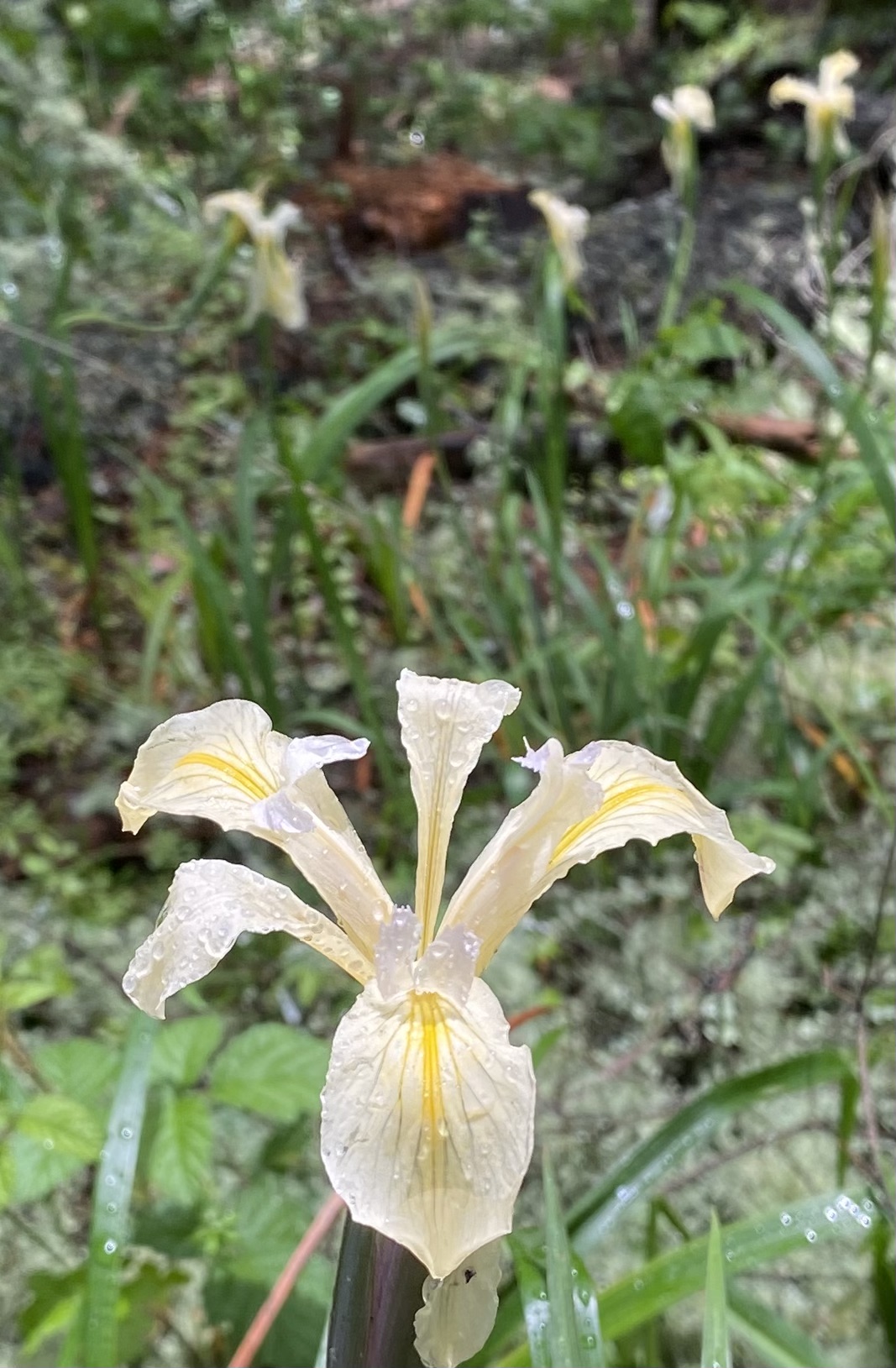
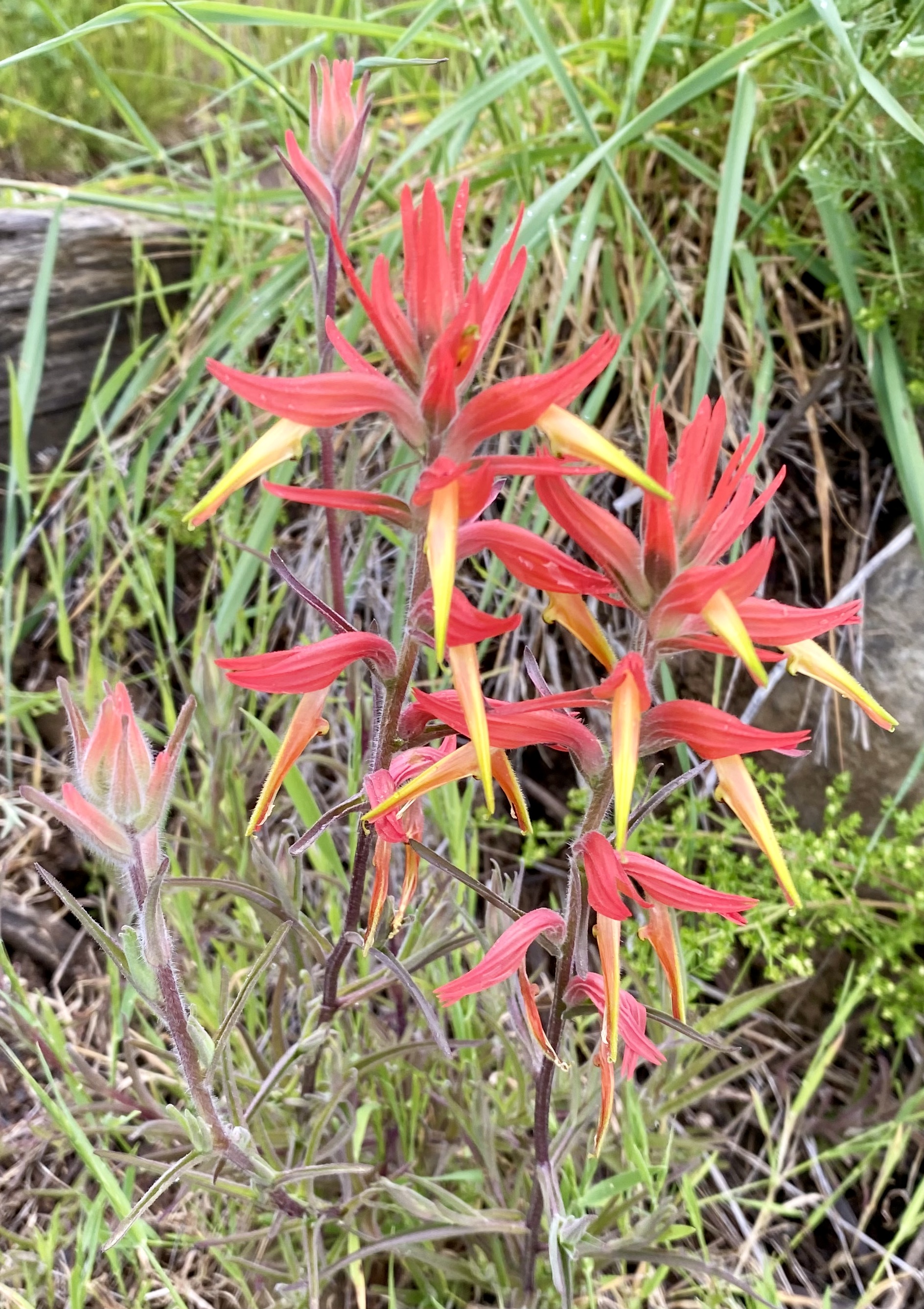
Native Douglas iris, cool paintbrush (a kind I’d never seen before)

Reflections on the Beats

As I trace the path of circumTambulation, I think about Snyder, Ginsberg, and the Beats. They were often egotistical and sexist, but also perhaps geniuses. Kerouac was likely schizophrenic, and Neal Cassady a “charismatic sociopath.” Much has been written and filmed about them, but women in their circle received little recognition until recently.

Through Snyder, I discovered the poet Joanne Kyger, who married him in 1960 in Japan and traveled with Snyder, Ginsberg, and his lover Peter Orlovsky to India, meeting the Dalai Lama. Kyger, a serious poet herself, recorded her travels in diaries published in 1981 as “The Japan and India Journals 1960-1964,” providing a rare female perspective on the male-centered Beat movement. Kyger settled in Bolinas and lived there until her death at 82 in 2017.

Despite being part of the same journey through Japan and India, Kyger is often omitted from accounts that only mention Snyder, Ginsberg, and Orlovsky. Her diaries are a testament to her presence and contributions during this significant period.

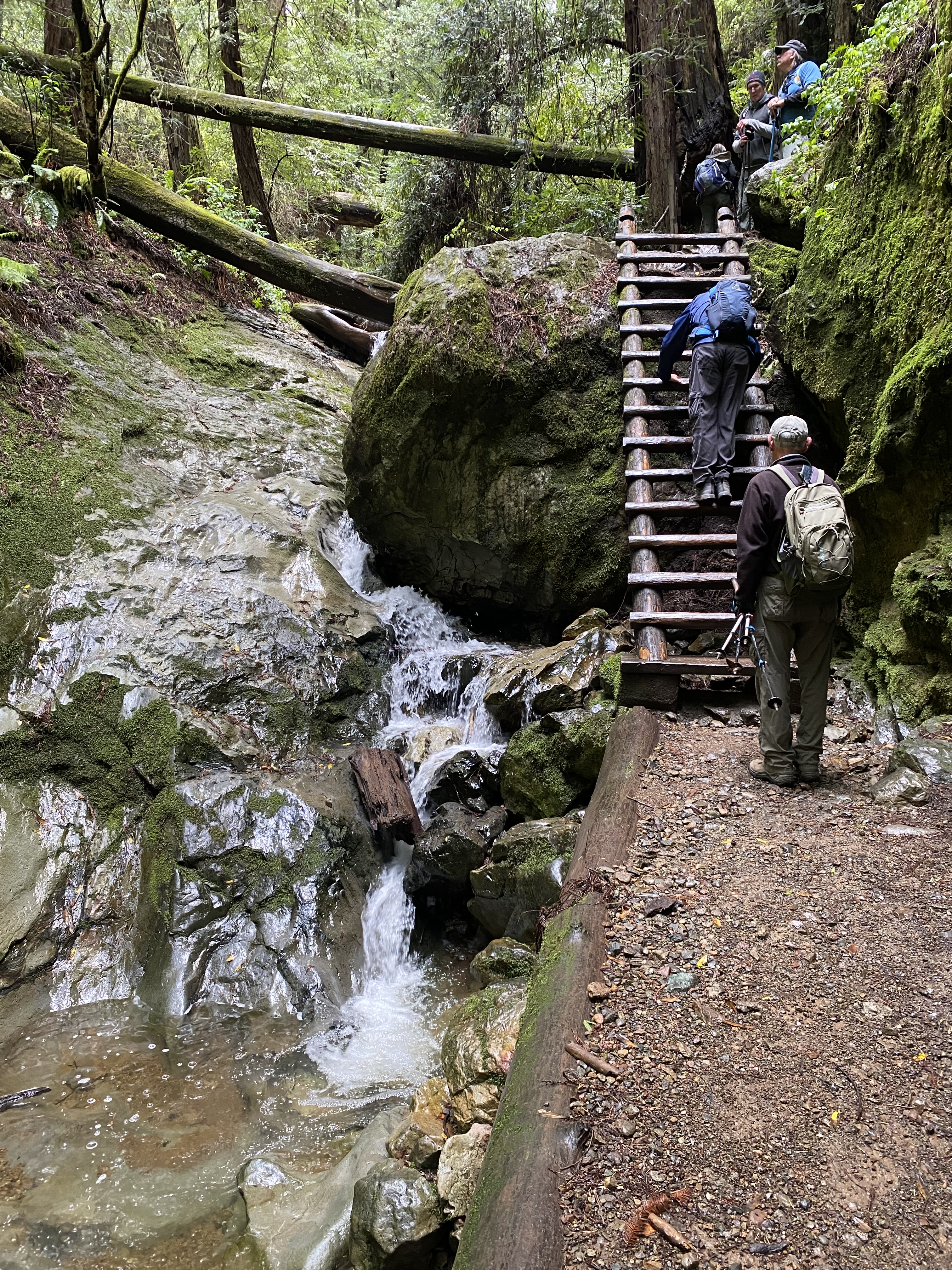
Climbing the ladder on the Steep Ravine trail

Continuing the Tradition

Snyder envisioned the circumambulation as a joyful, creative endeavor. He encouraged participants to be imaginative, stopping at points his trio had designated or choosing their own. He emphasized the importance of paying attention to the surroundings and oneself: “The main thing is to pay your regards, to play, to engage, to stop and pay attention. It’s just a way of stopping and looking — at yourself too.”

Since the fall of 1974, the circumambulation has taken place on each solstice and equinox (or the closest Sunday), starting and finishing at Muir Woods National Monument. The tradition has been led by dedicated guides, first Matthew Davis, then Laura Pettibone, and currently Gifford Hartman, a San Francisco-based educator and labor historian.

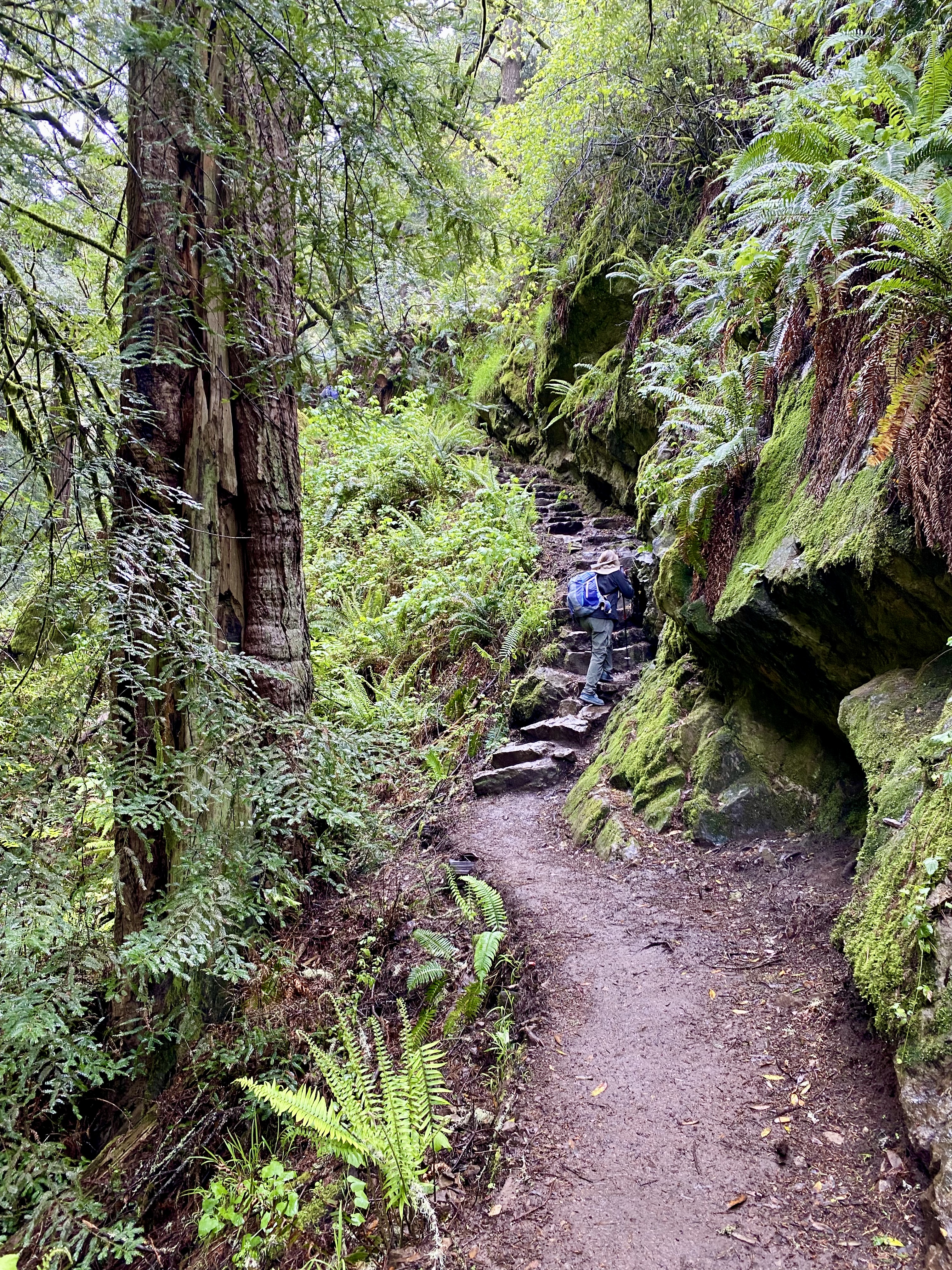
Lots of mosses and lots of steps

Historical and Spiritual Significance

Mount Tamalpais (tamal = west, pais = hill or mountain) is sacred to the native Coast Miwok people, as well as other native groups. Along with other mountains visible from Sonoma County—Sonoma in the Coast Range, Hood and Kanamota (St. Helena) in the Mayacamas Range, and Diablo (tuyshtak in Ohlone)—Mt. Tam retains its spiritual character.

The US military destroyed Mt. Tam’s summit in the 1950s, establishing a base and lookout during the Cold War. Gary Yost’s film “The Invisible Peak (hidden in plain sight)” explores this history https://www.youtube.com/watch?v=y6TA-jbZqQU. I also recommend Will Hearst III’s video about Snyder, “The Practice of the Wild.” https://vimeo.com/418682866

Embracing Tradition

The ending of Gary Snyder’s poem “For the Children” encapsulates the spirit of this tradition:

stay together
learn the flowers
go light

Looking south toward San Francisco, Photographing flowers on the west slope

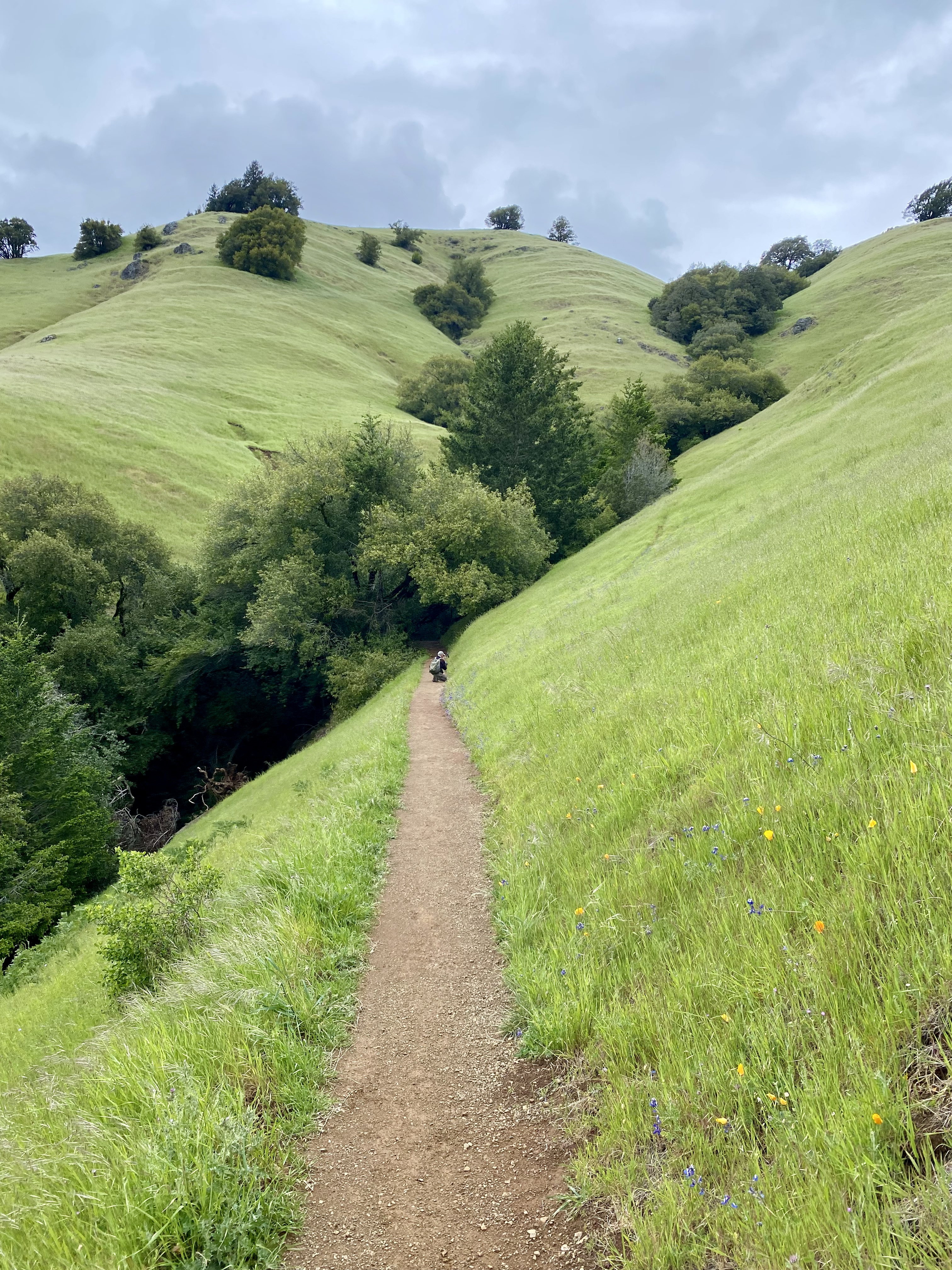
I try to live by this advice as I hike around our beautiful Bay Area open spaces. I joined a hiking group whose average age is 80. At 74 I’m one of the young ones. One woman at 93 still leads us on seven-mile hikes. We stay together to help each other in case of inevitable disasters (I’ve had a couple of falls this season but didn’t break anything). We learn and delight in the flowers, although with my poor memory I must relearn them every year (I think there’s something very Zen about that). And perhaps our old age inspires us to go light in its many senses. I took these photos on a Mt. Tam hike on the Dipsea, Steep Ravine, Coast View and Matt Davis trails in early May.

I plan to celebrate this summer solstice by joining the circumTambulation on Sunday, June 23. Please join me. For more information, visit: CircumTambulation.

Happy Solstice and Happy Pride!

Celebrating May Day

Demand for the eight-hour day inspires a world-wide holiday

My regular pagan holiday post

No one ever knew who threw the bomb that killed a cop during a peaceful rally. Then the police opened fire, killing seven more of their own and several bystanders. 

But the Powers That Be said someone had to pay. They arrested eight men and charged them with conspiracy. 

The accused, immigrants and anarchists, became convenient scapegoats in a city gripped by fear and suspicion. The mainstream media fanned the flames of anti-immigrant hysteria with sensationalized tales and outright lies.

As the trial unfolded, prejudice tainted the proceedings. The judge’s bias was palpable, and jurors were selected for their predispositions. Despite a glaring lack of evidence, the men were convicted.

Four were hanged. One committed suicide in prison. Others were given long sentences. 

The progressive governor, burdened by the knowledge of their innocence, commuted the sentences of the surviving men. Then he faced the wrath of voters who, swayed by fear and misinformation, ousted him from office in a bitter electoral battle.

It happened in Chicago in 1886, but to me it reads like today’s news. Except for the bomb. Our modern methods of murder are far more sophisticated.

Could history repeat itself in a modern age? 

I worry. The specter of prejudice still haunts our land, immigrants demonized, and dissent silenced. The media—mainstream and social–wields its influence with impunity, shaping public opinion with biased narratives and sensationalism. 

Meanwhile, our judiciary does not even try to conceal its corruption. The militarization of police forces and the epidemic of police violence create more distrust in those pledged to keep us safe. We won’t forget the killing of a 13-year-old boy, Andy Lopez, in Santa Rosa at the hands of a deputy sheriff.

So, yeah. It seems little human evolution has taken place since 1886.

At that 1886 Chicago rally, workers had agitated for the eight-hour work day, a movement then brutally crushed by employers with the help of federal, state and local police forces. With its leaders executed and imprisoned, the Chicago labor movement’s head was cut off. Labor lost that battle, but eventually won the war for the eight-hour day. Their slogan, written in a song of the time, was “Eight hours for work, eight hours for sleep, eight hours for what we will.”

The eight defendants were all thinking and articulate men, but the one I find most interesting is the one man who was not an immigrant, Albert Parsons. Born in Alabama in 1848, he traced his ancestry back to English colonists in 1632. Some ancestors fought in the American revolution.

Parsons moved to Texas and fought for the Confederacy during the Civil War. Then he realized he had fought for the wrong side. He called the war “the slaveholders’ rebellion.” 

He became a Republican, supporting Reconstruction efforts and running for office, making enemies of his former comrades and the KKK. Then he joined the socialist movement, eventually denouncing electoral politics and joining the anarchists and the labor movement. 

His marriage to Lucy Parsons (Gonzales), a Black woman, defied the norms of a society steeped in prejudice, and her activism would become legendary in its own right. As she led the campaign to win a new trial, one Chicago official called her “more dangerous than a thousand rioters.” 

Albert Parsons saw the connections between slavery and capitalism. He said: “My enemies in the southern states consisted of those who oppressed the black slave. My enemies in the north are among those who would perpetuate the slavery of the wage workers.”

What made Albert Parsons switch sides? I think it was working with previously enslaved people after the war and at the start of Reconstruction. He began to see things from their point of view. 

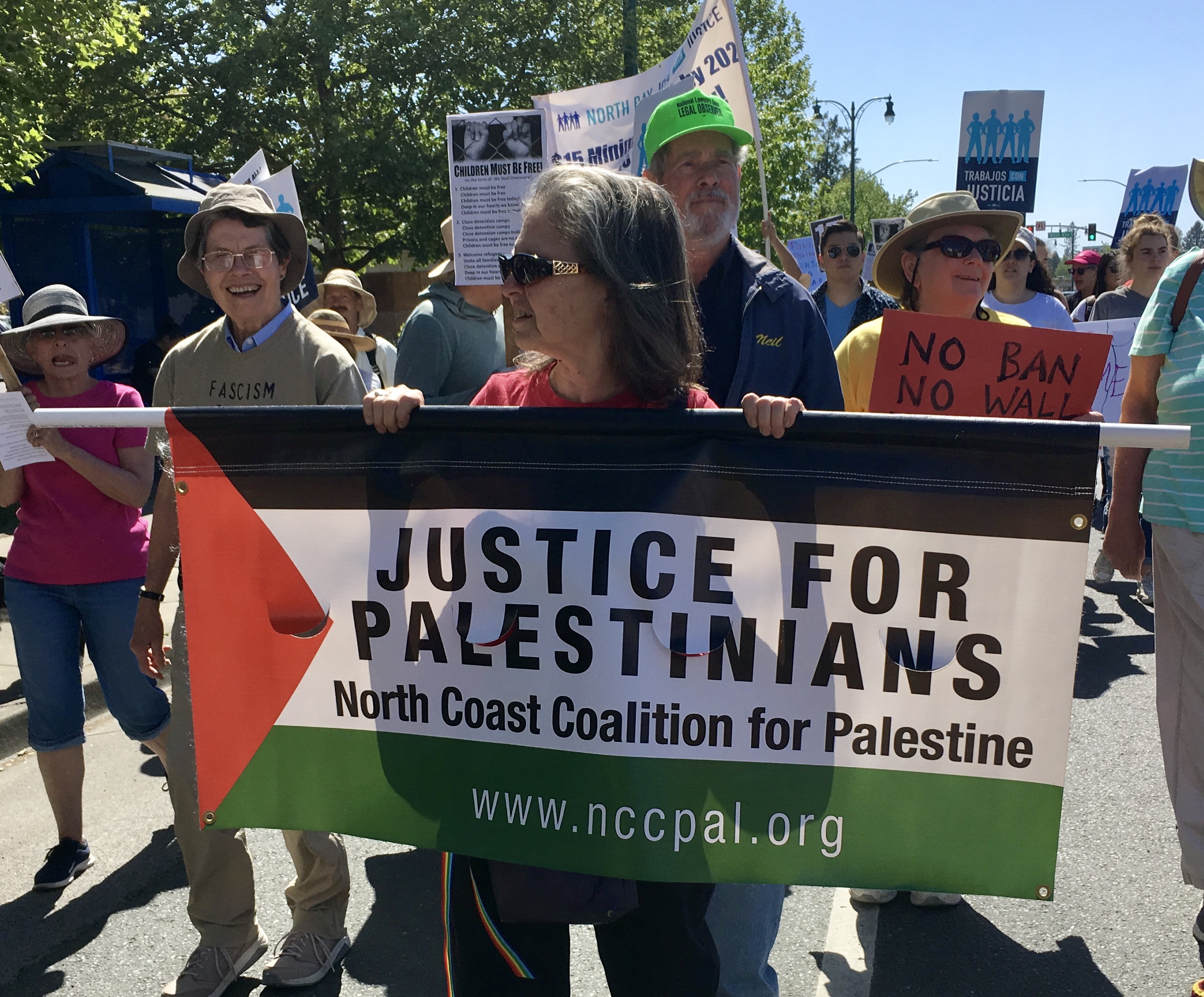
The Haymarket Affair, as the events in Chicago came to be called, inspired May Day, or International Workers Day, as a labor holiday in countries around the world on May 1. It was never a national holiday in the US because of ourgovernment’s resistance to encouraging worldwide working-class unity. But workers in the US celebrate May Day anyway, and it will be marked again this year in cities across the country.

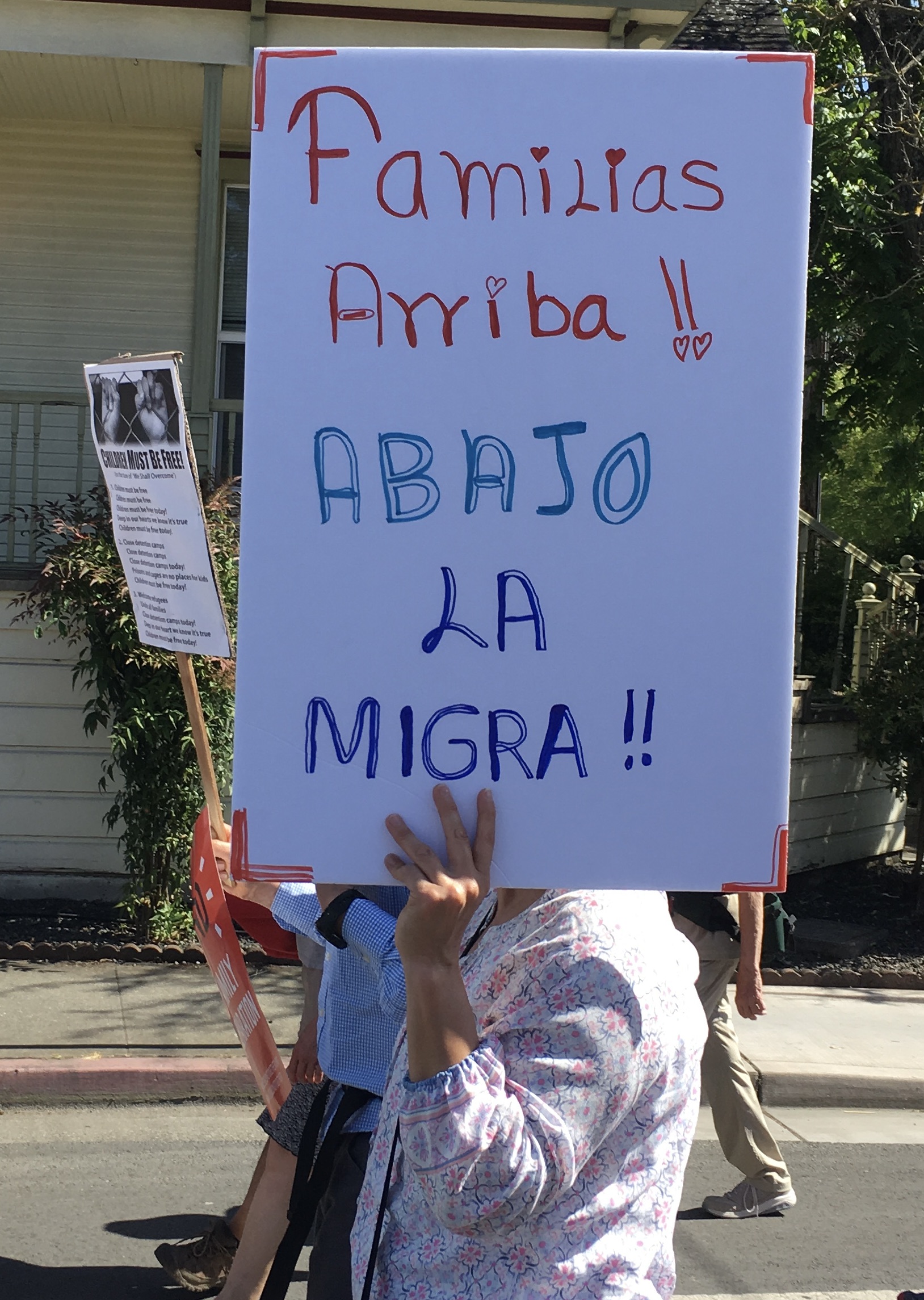
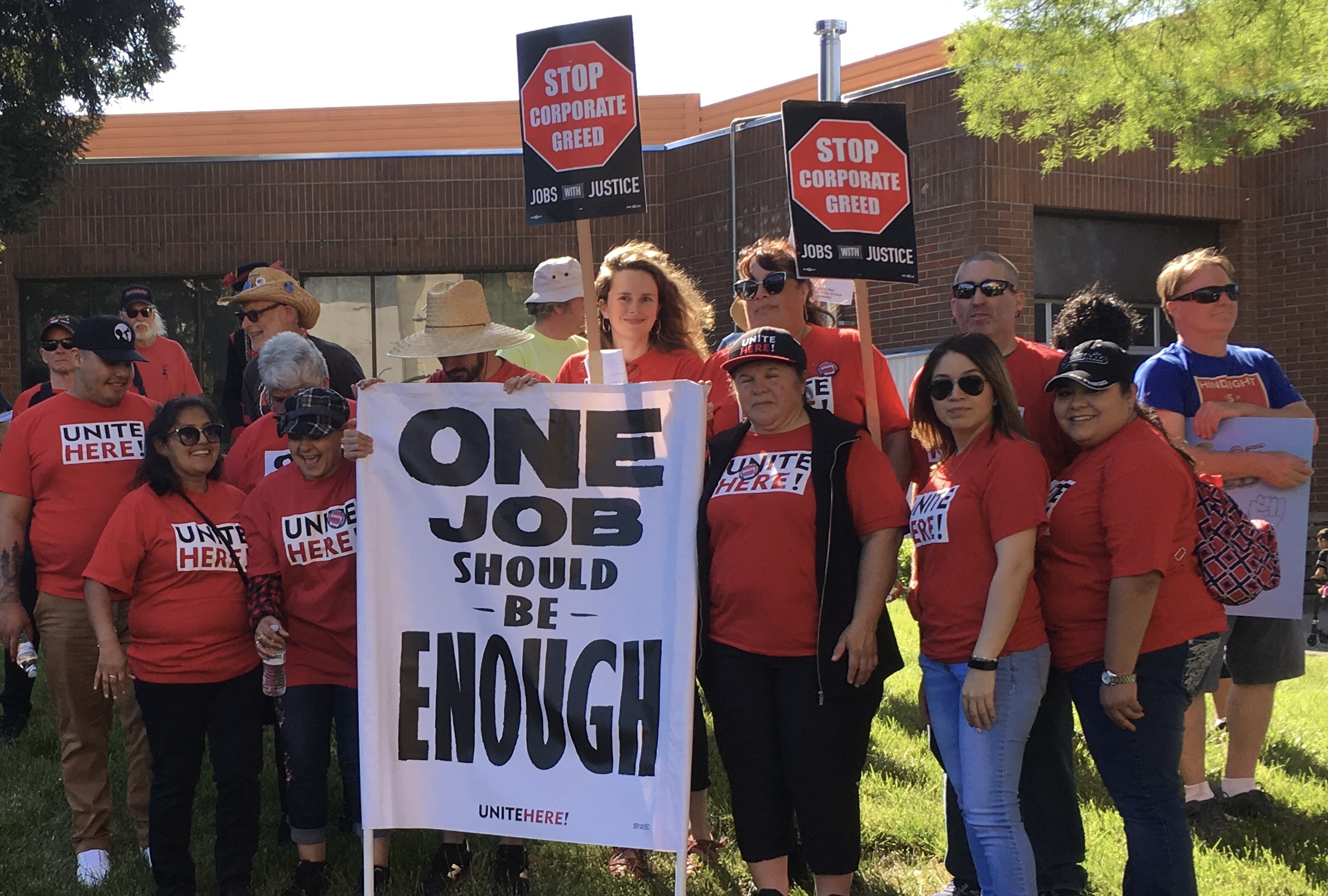
Photos are from the 2019 Santa Rosa May Day march

California Labor Councils are planning actions up and down the state. This year’s May Day actions are about solidarity across sectors as workers push for higher wages, stronger contracts, the right to join a union, and fight back against corporate greed.

Here in Sonoma County on May 1 we will be marching for “Immigrant Rights Are Human Rights” starting at the county sheriff’s office. Marchers will demand that the Sonoma County Board of Supervisors proactively advocate for a Path To Citizenship policy in Congress and also support a county ordinance which would prohibit any collaboration or information sharing between the Sonoma County Sheriff and Immigration Customs Enforcement (ICE).

The Haymarket Affair was a seminal moment in the struggle for workers’ rights. The martyrs of that turbulent era—Albert Parsons, August Spies, George Engel, and Adolph Fischer—must not be forgotten. Their legacy endures, inspiring movements for social justice and workers’ rights around the world. 

The Haymarket martyrs memorial and Lucy Parson’s grave at Forest Hill cemetery in Chicago

A happy Beltane and a revolutionary May Day to all!

We Survive Another Disaster

Celebrating Ostara, the Vernal Equinox

My regular pagan holiday post

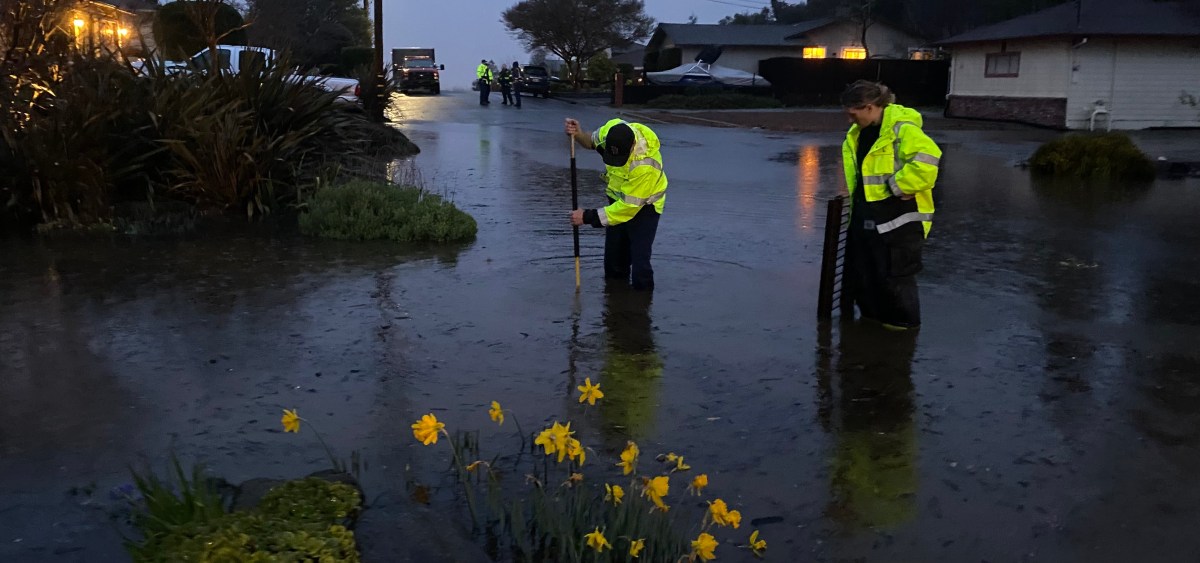
Holly keeps saying the water is rising but I am watching a movie. She says its rising really fast. She’s running around trying to find rubber boots. Oh man, the movie is almost done. But you don’t see how fast it’s rising she says. I look out the window and see that rain is pouring down and the street in front of our house is a lake. Ok where did I put my rubber boots? They have a zebra design (bought at Sebastopol hardware) so they shouldn’t be too hard to find in the mess that is our garage.

Our garage has been a mess for a long time. Goddess, how long has it been since we could actually park our Bolt in the car garage? Years, it’s been years. It’s always something. Lately it’s that Holly’s mom died and Holly had to clean out her stuff from Mom’s room at the assisted living place where she had lived for five years. Amazing how much stuff you can fit into one room. Now it’s in our garage, what’s left over after giving away what we could.

The boots are tucked in a corner of the garage, which is already flooding. Out in the driveway the water comes halfway up to the top of my boots. Holly has already soaked her short boots and has moved on to water shoes.

We think the problem is a blocked drain somewhere in the system. Neighbors are all out on the street and their nearby driveways are flooding too, but ours is the only house whose garage is flooding. Holly and I quickly move cardboard boxes out of the way of the water. Most of our stuff is stored in plastic boxes, but Mom’s stuff is not.

We stand in the open garage and watch as the fire department tries to free the drains. One of the firefighters is a woman! Our neighbor Chuck trots back and forth through the muck trying to explain how the drainage system works in the neighborhood. Chuck was here 20 years ago when this happened. The story goes that his car floated away, or maybe his car was just engulfed in water and the city paid to fix it. I move our car up further as far into the garage as the junk stored there will allow.

Out in the street in front of our house the firefighters are up to their knees in water and they are working to find the plugged drain. The water keeps rising. One young firefighter joins us in the garage to check on and calm us old ladies. We are a lot calmer that he is. He keeps saying how sorry he is. We keep saying it’s not his fault that our street is flooding.

Our sump pump turns itself on, the first time we’ve ever seen this happen. We usually have to help it along, pulling the bulb up by hand to make it work. That means the water under the house in the crawl space is rising too. The pump works hard to pump the water out of the crawl space and onto the flooded driveway. Then the water flows back under the house again. Futile. We worry that the crawl space water will rise up to the floor boards and come up through the wood floor. We imagine ourselves sloshing around the house in a foot of water. I mentally tally the cost of replacing the oak flooring. This could be a real disaster. We run around the house picking things up from the floor—computers, furniture, air filters. Holly folds up the colorful quilt our friend Linda just made for her and puts it up high in a closet.

It gets dark. Then the city arrives with a vacuum truck. The water begins to recede. They are still on the street the next day looking for the blockage. They tell me this magical truck also can blow out the blockage and that’s what they’re trying to do.

One of our neighbors, an engineer, meets with the city people to work on a solution. I say we need a drawing so we understand where the water goes. He says you can find it online but it is incorrect. The system was designed to drain the water in the opposite direction than it is draining! He is pressuring the city to fix the drainage system so flooding does not become a neighborhood ritual.

In the six years we’ve lived here we’ve survived fire (the neighborhood was evacuated in the Tubbs fire in 2017 and we self-evacuated in 2019 and 2020), and an earthquake on the Rogers Creek fault which runs very near our house, if not under it. But we never thought we’d have to worry about flooding. We live on a hill! Come to find out there’s a dip at the top of the hill right where our house sits. 

Now we are calling ourselves the Dips on the Hill.

We fervently hope that flooding does not become a routine disaster on our block and with that in mind we are not inventing any associated rituals. But we did partake in an annual spring ritual especially festive in the gay community–watching the Oscars. Sonoma County’s party takes place at the Rialto theater in Sebastopol. It’s a benefit for Food for Thought, a food bank started in 1988 to serve people with AIDS. Lesbians, like our friend Jude Mariah, were the early organizers. Still going strong, it’s a free service that depends on volunteers to deliver healthy meals to all community members with serious illnesses, more than 4000 people last year.

The vernal equinox this year is March 19, the astronomical beginning of the spring season in the northern hemisphere. Pagans call it Ostara, a word that comes from the Anglo-Saxon goddess name, Eostre. Also the root of the word Easter.

Here in Sonoma County we are celebrating the last of the atmospheric rivers and the beginning of warm weather.

Happy Ostara!

Molly (and Holly)

Queering Lunar New Year

My regular pagan holiday letter

Dear Friends,

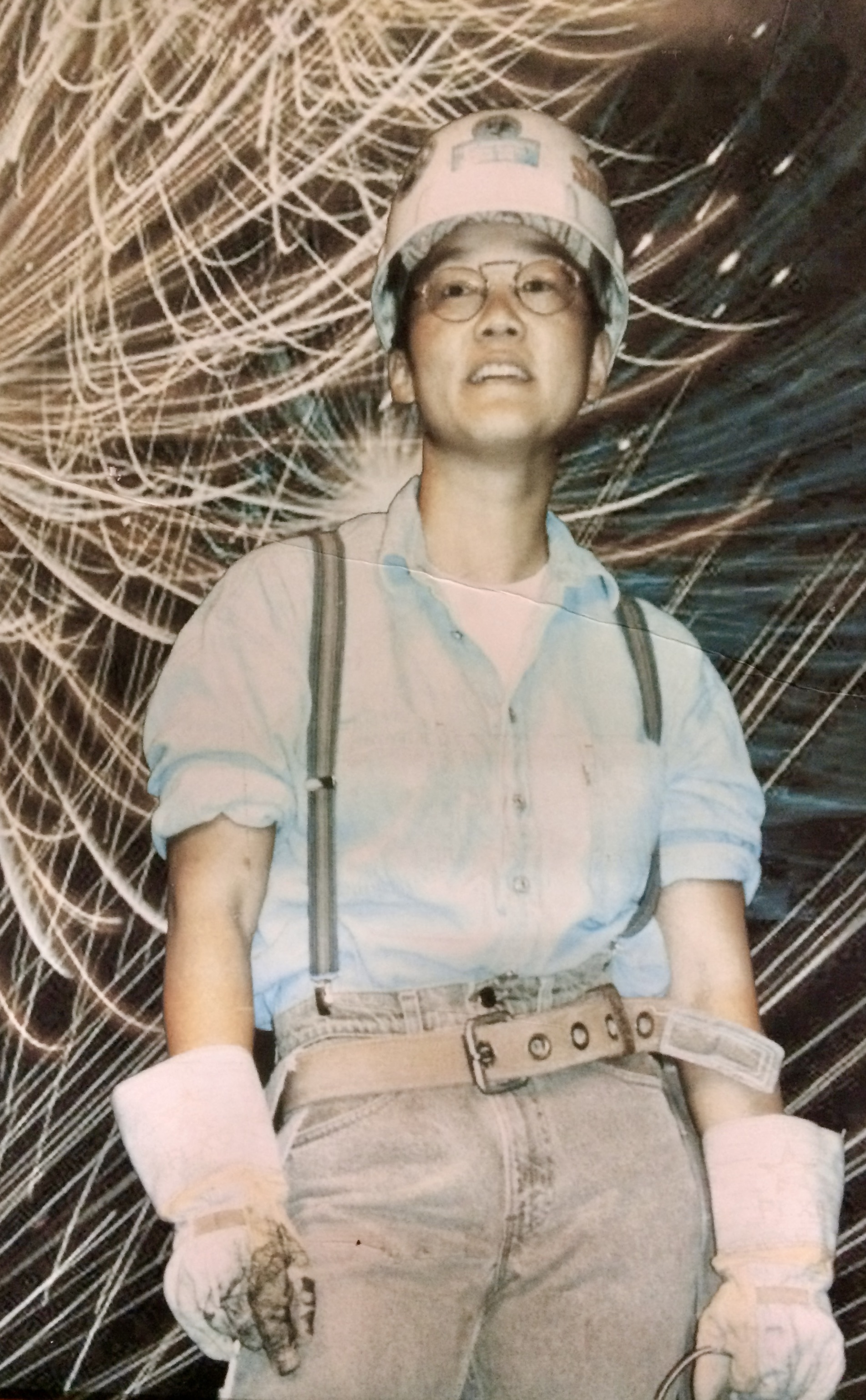
Ah, the legendary red envelope – a festive pocket-sized surprise filled with cash, making it rain luck on New Year’s Day. My memory holds onto that one special red packet, a gift from my friend MeiBeck, a tradeswoman sister, and an ironworker extraordinaire. 

Inside? A crisp two-dollar bill, because we’re both as queer as a two-dollar bill. With that red envelope, MeiBeck queered Chinese New Year, and confirmed me as a member of her fabulous queer family!

We were among millions of people celebrating the Lunar New Year, a serious party among East and Southeast Asian cultures–Chinese, Vietnamese, Korean, and more. The celebration can be traced back 4000 years.

Lunar New Year begins on the date of the second new moon after the winter solstice, which usually occurs December 21. This means that the first day of the Lunar New Year can take place anytime between January 21 and February 20. This year, the year of the dragon, the celebration kicks off on February 10. Forget one-day celebrations; this shindig lasts for 15 days, rocking the lunar party until the moon is full, at the lantern festival on the last day.

At Lunar New Year we celebrate the end of winter and the start of spring. Traditionally, New Year’s is all about family, ancestor honoring, feasting, dancing dragons, lanterns and of course fireworks! China traditionally marks Lunar New Year and other holidays with loud firecrackers to rid families and businesses of bad luck.

We all know that the Chinese invented fireworks. As the story goes, around 800 CE, an alchemist mixed sulfur, charcoal, and potassium nitrate (a food preservative) hoping to find the secret to eternal life. Instead, the mixture caught on fire, and gunpowder was born! When the powder was packed into bamboo or paper tubes and lit on fire, history had its first fireworks.

According to legend, the centuries-old New Year’s tradition was started to scare off demons. Fireworks helped drive away the mythological nian, a fierce lionlike beast that rose from the sea each New Year’s Day to feast on Chinese villagers and their livestock. Nian disliked loud noises and the color red, so villagers posted red signs on their doors and lit firecrackers. The ritual is still performed to ward off evil spirits.

My friend MeiBeck in her ironworker gear. Photo edit by Lyn Shimizu

I caught a double dose of airport fireworks during a long layover in Beijing—both landing pre-dawn and taking off that night. It was awesome! But that was before China’s state media cast the practice as an environmental faux pas, an air polluting indulgence. The state now urges families to use flowers and electronic substitutes instead.

Hundreds of Chinese cities have banned or restricted the use of pyrotechnics since 2018. Beijing extended a downtown fireworks ban across the entire city in 2022, allowing it to record its cleanest air on record since the monitoring of hazardous PM2.5 particles began in 2013.

Major Chinese cities organized official displays to ring in 2023. But across the country, members of the public celebrated China’s first post-COVID New Year by disregarding the ban. Social media images showed people shooting fireworks from the backs of mopeds and through car windows.

San Francisco, where I lived for 40+ years, has a large Asian population, and the Lunar New Year still paints the town red. Many neighborhoods are bustling in the lead up to the new year. The whole city celebrates. Last year San Francisco’s Chinatown had a five-hour long pyrotechnic display. 

San Francisco boasts the biggest Chinese New Year parade outside of Asia–a tradition since the gold rush days. And it’s not a solo act; every town around the Bay Area has its own Lunar New Year spectacle. We Sonoma County residents have a menu of celebrations to choose from.

Lunar New Year coincides with the pagan holiday Imbolc, heralding the start of spring. Here in northern California, February feels like the real New Year’s kickoff. Signs of spring are everywhere – blossoming trees, early flowers showing off. In December, as a solstice ritual, I planted hyacinths and tulips in our drought tolerant front yard. These bulbs do their thing in rainy spring, no watering needed. They will soon bloom. Right now, in the midst of an atmospheric river of rain, our daffodils are in full bloom.

While we won’t be setting off fireworks, there are many parts of this celebration we like to adopt.

In China everyone takes the first day of Lunar New Year off work. I wish I’d known this when I was still working. For retirees, I guess it’s a day to do whatever we feel like (much like every other day).

There is lots of feasting and we can totally get into that. I look forward to eating Chinese, Vietnamese and Korean food!

In the week before the new year, cleaning house takes priority, sweeping away any ill fortune and making way for incoming good luck. The Goddess of the Garage beckons us for a spring cleaning extravaganza.

And we will not forget the household deities traditionally honored at New Years–a nod to the Kitchen Witch and a shout-out to the Garden Goddess. It’s time to get the garden ready for spring planting.

This year I’m following MeiBeck’s example and queering the tradition of the red envelope. I found envelopes, Chinese lanterns and new year’s candy at the World Market. Now I just have to find $2 bills. There aren’t many in circulation but the U.S. government mint still prints them. I’ll give them to friends who, like me, are queer as a two-dollar bill.

However you celebrate, we wish you a Happy New Year.

Love, Molly (and Holly)

Taking Back Traditions

My Regular Pagan Holiday Post

Winter Solstice 2023

Dear Friends,

In 1977 I lived in a collective house with Jewish lesbians. Banning the Xmas tree from the living room was fine with me. I wanted to ban the holiday entirely. It took years to wean myself of all the expectations and burdens that the holiday brings. Finding the perfect gift for everyone, sending cards to dozens (I sent anti-Xmas cards), forced shopping amidst anxious crowds and booming Xmas music in the stores. To avoid the ubiquitous music I stopped shopping after October. It helped to join the Church of Stop Shopping.* 

I was a regular bah humbugger.

I already knew that the solstice holiday had been stolen from pagans by christians. But it took years for me to embrace the decorated tree again. Now I finally have, to the relief of my partner.

The solstice tree is an old pagan tradition–bringing a tree indoors and hanging things on it. Before the advent of electric lights, my Swedish ancestors actually put burning candles on the tree. I wonder how many house fires resulted.  Asking for a fire marshal friend.

Last year my wife Holly and I discovered that it made us happy to start getting into the solstice spirit early by buying our solstice tree when the tree farm opens for business the day after Thanksgiving. We did it again this year. Two years in a row makes it a ritual!

Now our sweet smelling fir tree is decorated to the hilt. As Holly danced around the tree hanging the ornaments and I watched from my recliner, we fondly remembered where we acquired each of them and what they represent. I still have the Santa and elf ornaments knitted by my Swedish grandmother. She decorated her tree with Scandinavian straw reindeer, wooden and homemade candy cane ornaments. 

Here in the MoHo household we are all about reimagining cultural institutions. If we can take back the tree, why can’t we reclaim other christian traditions? 

This year we decided to recycle Advent. 

Neither my childhood Presbyterian church nor Holly‘s evangelical sect practiced Advent. But I have a vague memory of seeing an Advent calendar in the home of a Catholic girlfriend. The idea of getting to open a little door with a gift inside for the whole month of December is enticing for a kid. Kind of like Hanukkah only longer and presumably better. Did the christians steal from the Jews too? Asking for some friends.

The word advent is derived from the Latin word adventus, meaning coming, which is a translation from Greek. We felt we needed another word for our pre-solstice holiday and we tried to come up with one. None of the synonyms work. Arrival, onset, appearance, approach, entrance. Holly likes the word Looming, but that sounds ominous to me. We both like Coming but it’s too confusing. So we decided to stick with advent for now, a perfectly nonreligious word which can be applied to any holiday, really. 

In the christian tradition Advent is a season. The traditional liturgical color for Advent is violet–so very gay! The Unitarian Universalist Association promotes four words for the four Advent Sundays of the month of December. A candle is lit each week to symbolize hope, peace, joy and love. We can get behind that! I do like the Unitarians. They take the prospect of peace seriously and show up at every peace march. 

Our takeover of Advent wasn’t a planned theft. It was rather inadvertent. We each secretly bought a wine advent calendar for the house. When they were both delivered on the same day, we discovered we had each bought the exact same thing!

The wine advent calendar is a cardboard box about 18 by 14 inches and about 7 inches deep, enough for little wine bottles laid on their sides. It has 24 doors, each with a number. You open one door a day and pull out a bottle. We celebrate each evening however we want, by reading a poem or just having a conversation. But there must be a toast. Our favorite: Cheers Queers!

Then, because we observe solstice and not Xmas we had to count back from December 21 instead of December 25. Because of poor math skills, we started on November 24—days early. Whatever. Once you start, you have to keep going. I think that’s what the liturgy says.

The wine comes in adorable small bottles, enough for one glass, so we are glad we got two calendars. Of course, this means we are committed to drinking a glass of wine every night until solstice or until the wine runs out and every door on the calendar is opened. We can do that!

Advent is all about anticipation of the great event—in this case solstice, or the longest night of the year, marking “astronomical winter” in the northern hemisphere, after which the light begins to return. It makes us think of the Carly Simon song, Anticipation. We are Boomers, after all.

Now we are pondering how to use the 48 cute wine bottles. Perhaps next year we shall gift all our friends with MoHo’s Special Herbal Elixir. What is that? We don’t yet know, but Holly has been experimenting with something called fire cider!

Now I’m embracing the solstice holiday and all our reclaimed pagan rituals that go with it. I’m finally enjoying the holiday season that I once eschewed.

Bah humbug no more!

Happy solstice to all and to all a good long night!

Love, Molly (and Holly)

*The Church of Stop Shopping calls consumerism “the biggest and baddest fundamentalist religion in the U.S.” Now, they’ve got some great music! https://revbilly.com/music/

Honoring Native Americans

Reinventing Some Holiday Myths

Dear Friends,

As we construct our ofrendas for Day of the Dead, decorate our yards for Halloween and celebrate the pagan holiday Samhain, I’ve been thinking about two other holidays we celebrate this time of year–Indigenous Peoples’ Day and Thanksgiving. This is a story about how the meaning and celebrations of American holidays can evolve to reflect new understanding of our history. 

As we learn more details about our history, in the last few years Americans have been rethinking the stories connected with Thanksgiving and Columbus Day. 

My generation of students learned to recite, “In 1492 Columbus sailed the ocean blue.” We learned about the Nina, the Pinta and the Santa Maria and that Christopher Columbus “discovered America.”

In elementary school in the 1950s I participated in those Thanksgiving pageants in which you were either a Pilgrim—boys with black buckled hats and shoes, girls in long, aproned dresses and bonnets—or an Indian with feathered headband and tomahawk. The story we enacted was a peaceful meeting and feast between Indians and pilgrims just off the Mayflower. It was the beginning of a happy long relationship between settlers and Indians.

Sadly, almost all of what we were taught was incorrect and incomplete; the myth conveniently left out the parts about genocide, slavery and land theft.

It turns out that Christopher Columbus was a homicidal tyrant who initiated the two greatest crimes in the history of the Western Hemisphere–the Atlantic slave trade, and the American Indian genocide. It’s not dissing Italians to say we no longer venerate this colonizer. Over the last few decades, Columbus Day has evolved into Italian Heritage Day in many locales. 

And we are witnessing a movement to honor Native peoples on Columbus Day. It originated in 1989 in South Dakota during its “Year of Reconciliation,” in an effort to atone for terrible history.

The phrase “merciless Indian savages” is written into the Declaration of Independence. That says all we need to know about how the founders of our country viewed the indigenous people in this land.

For centuries, the American government saw Indians as the enemy, sponsoring their slaughter and “removal.” Through a series of notorious atrocities, including the Trail of Tears, the Sand Creek Massacre and Wounded Knee, (and in California, our own Trail of Tears in 1863, and the Bloody Island Clear Lake massacre in 1850, among others) the United States adopted an official expansionist policy of discriminating against Native Americans in favor of encouraging white settlers in their territories. This policy led to the subjugation, oppression, and death of many Native Americans, whose communities still feel its effects. Only in 1924 were Native Americans allowed to become citizens of the United States, and it took decades more for all states to permit them to vote. 

But as we Americans acknowledge this history, our contemporary view of Native Americans is changing.

Congresswoman Norma Torres (D-CA) has introduced legislation to establish Indigenous Peoples’ Day as a federal holiday. Now, at least 13 states and over 130 cities have adopted Indigenous Peoples’ Day or Native American Day. In 2021, President Joe Biden formally recognized Indigenous Peoples Day. 

Here in Sonoma County indigenous people are well integrated into our local culture and community events. Tribes are consulted by land keepers and planners. Colleges, libraries and nonprofits sponsor classes about indigenous culture. My wife Holly and I attended the Indigenous Peoples’ Day gathering at Santa Rosa Junior College, which featured native dancing, music, drumming, food, speeches and vendors. The SRJC also has a native museum whose latest exhibit features the stories and art of local basket weavers. 

As with Columbus, Americans have been taught a false narrative about Thanksgiving.

Two different early gatherings may have inspired the American Thanksgiving holiday. At the first, in 1621, Wampanoagwere not invited to the pilgrims’ feast, but heard celebratory gunshots and came to the aid of the colonists. They had formed a mutual defense pact. Once there, the Indians stayed and feasted, but the feast did not resolve ongoing prejudices or differences between them. Contrary to the Thanksgiving myth, this was not the start of any long-standing tradition between the settlers and the Wampanoag tribe. The myth doesn’t address the deterioration of this relationship, culminating in one of the most horrific colonial Indian wars on record, King Philip’s War.

Ironically, Thanksgiving as a holiday originates from the Native American philosophy of giving without expecting anything in return. The Wampanoag tribe not only provided food for the first feast, but also the teachings of agriculture and hunting. Corn, beans, wild rice, and turkey are some examples of foods introduced by Native Americans.

The first written mention of a “Thanksgiving” celebration occurs in 1637, after the colonists brutally massacred an entire Pequot village of 700 people, then celebrated their barbaric victory, giving thanks to their god.

During Reconstruction, the Thanksgiving myth allowed New Englanders to create the idea of bloodless colonialism, ignoring the Indian Wars and slavery. Americans could feel good about their colonial past without having to confront its really dark characteristics.

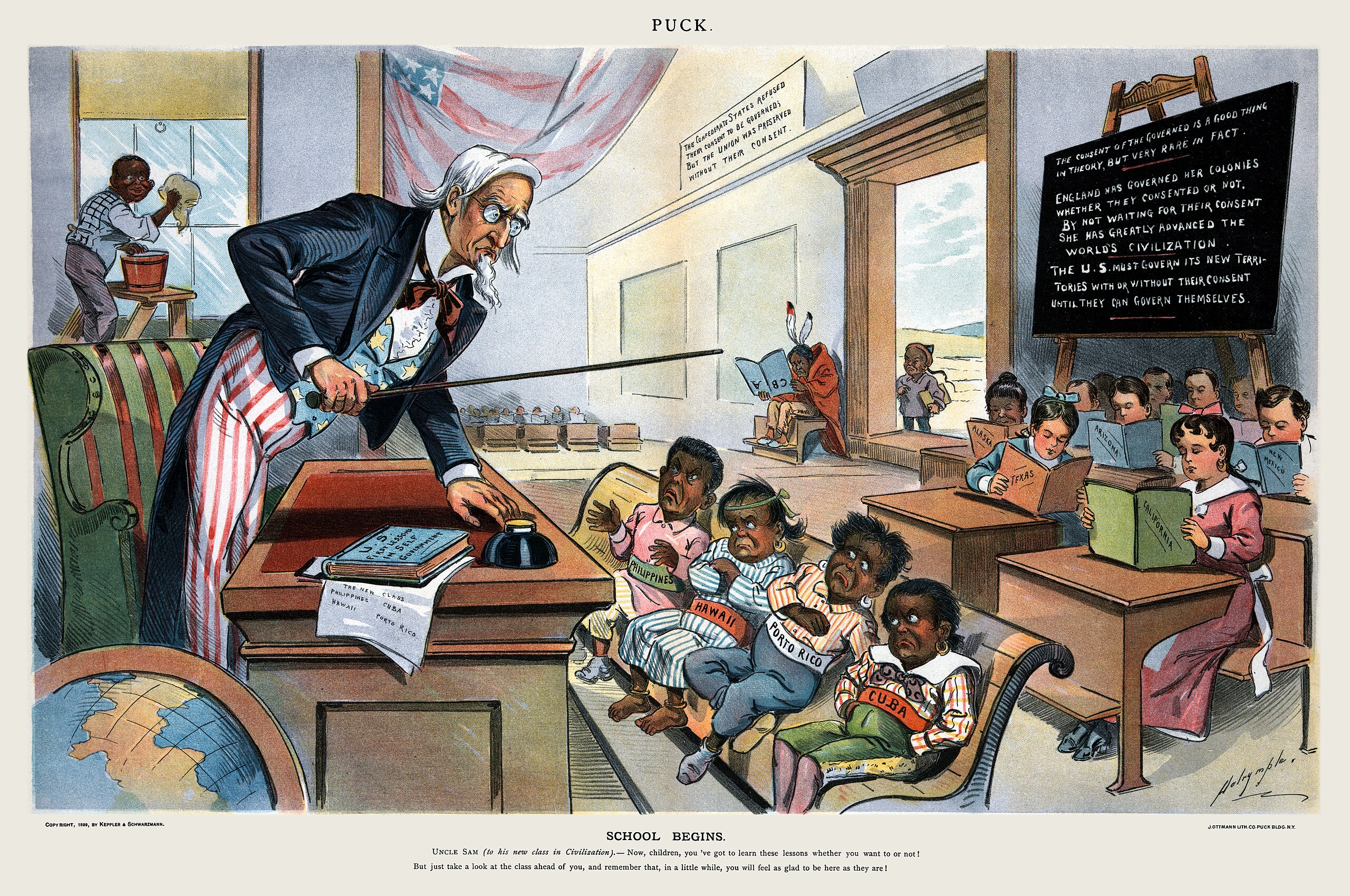
Now children you’ve got to learn these lessons whether you want to or not! Puck Magazine 1899.

For many Native Americans, Thanksgiving is a day of mourning and protest since it commemorates the arrival of settlers in North America and the following centuries of oppression and genocide.

Indian protests in the 1960s and 70s often attacked the Thanksgiving myth. In 1969 after natives took over Alcatraz, allies and Indians of all tribes came together for Unthanksgiving Day, a gathering that’s become a tradition, welcoming all visitors to a dawn ceremony on the island.

In 1970 during a Thanksgiving celebration in Plymouth, activists from the American Indian Movement stormed the Mayflower II ship and occupied it in protest. It was then that the United American Indians of New England recognized the fourth Thursday in November as a National Day of Mourning, to bring awareness to the long lasting impacts that colonization had on the Wampanoag and other Native American tribes. This year the in-person event will also be livestreamed.

Americans are told and we want to believe that we are the saviors of the world. But historical truth is far different. 

Does the acceptance of Indigenous Peoples Day in place of Columbus Day and the updating of the Thanksgiving myth mean that we Americans are beginning to acknowledge our country’s history of imperialism and genocide? I hope so.

This time of year, and these two holidays, Thanksgiving and Indigenous Peoples Day, give us the opportunity to reflect on our collective history, to celebrate the beauty, strength, and resilience of the Native tribes of North America, and also to conduct our own rituals.

Long before settlers arrived, indigenous people were celebrating the autumn harvest and the gift of the earth’s abundance. Native American spirituality, both traditionally and today, emphasizes gratitude for creation, care for the environment, and recognition of the human need for communion with nature and others. I hope we can incorporate these ideals into our American harvest celebrations while we as a species still live.

Whether or not we cook a big turkey dinner, many of us practice Thanksgiving rituals. My and Holly’s ritual is to get together with our exes. We introduced them at a Thanksgiving dinner 13 years ago and they fell in love. We were surprised, and also delighted. Barb and Ana have become our exes and besties. We are participating in a lesbian tradition of incorporating our exes into our chosen families. 

No matter where you are in North America, you are on indigenous land. In Sonoma County we live on unceded territory of the Pomo, Wappo and Coast Miwok tribes.

Good Samhain, Halloween, Day of the Dead and Thanksgiving to you all.

Love, Molly (and Holly)

Contemplating Death and Happiness

My Regular Pagan Holiday Post: Mabon, the autumn equinox

Rosh Hashana, the Jewish new year celebration that takes place near the autumnal equinox, is all about starting anew. But it’s also about contemplating death.

So says psychology professor David De Steno, who studies the ways emotions guide decisions and behaviors.

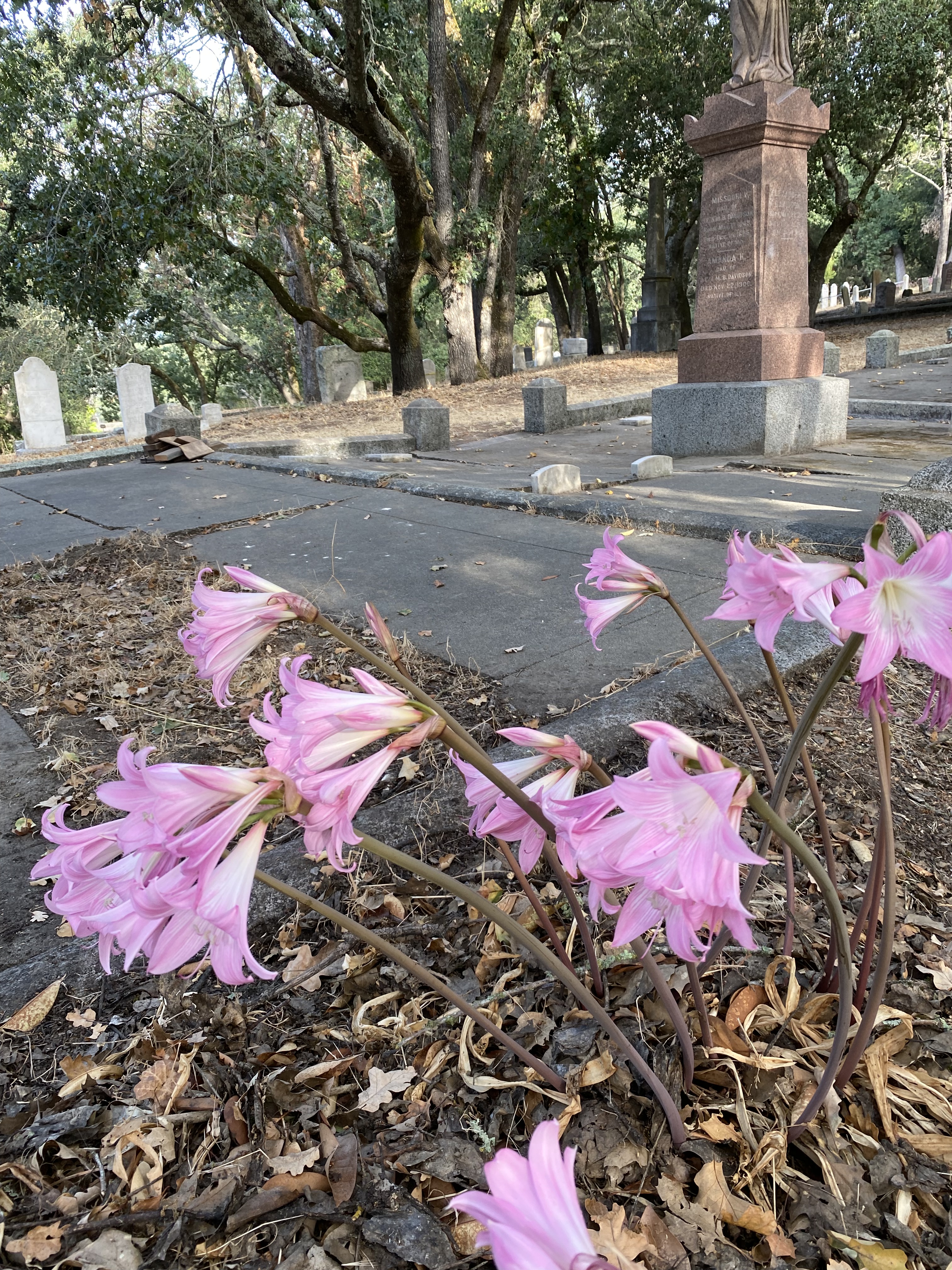
Naked Ladies blooming in Santa Rosa’s Rural Cemetery

I’m not Jewish, but I appreciate much that I’ve learned of the religion. Not the god part. As with any religion, we atheists and others can take the parts we like and leave the rest. 

DeSteno writes, “On Rosh Hashana Jews say prayers and listen to readings that celebrate the creation of the world and of human life. But Rosh Hashana also strikes a different, seemingly discordant note. Unlike so many other New Year’s traditions, the Jewish holiday asks those who observe it to contemplate death. The liturgy includes the recitation of a poem, the Unetaneh Tokef, part of which is meant to remind Jews that their lives might not last as long as they’d hope or expect. “Who will live and who will die?” the poem asks. “Who will live out their allotted time and who will depart before their time?

“But the particular brilliance of Rosh Hashana is that it combines thoughts of death with a new year’s focus on a fresh start. Temporal landmarks like the new year celebration offer the chance for a psychological reset. We can separate ourselves from past failures and imperfections — a break that not only prods us to consider new directions in life but also helps us make any changes more effectively.

“Contemplating death helps people make decisions about their future that bring them more happiness. This is an insight about human nature that the rites of Rosh Hashana capture especially well…”

We Get Happier as We Age

Across the globe, research shows, people’s happiness tends to follow a pattern through life. Happiness starts decreasing in one’s 20s, hits its nadir around age 50 and then slowly rises through one’s 70s and 80s, until and unless significant health issues set in.

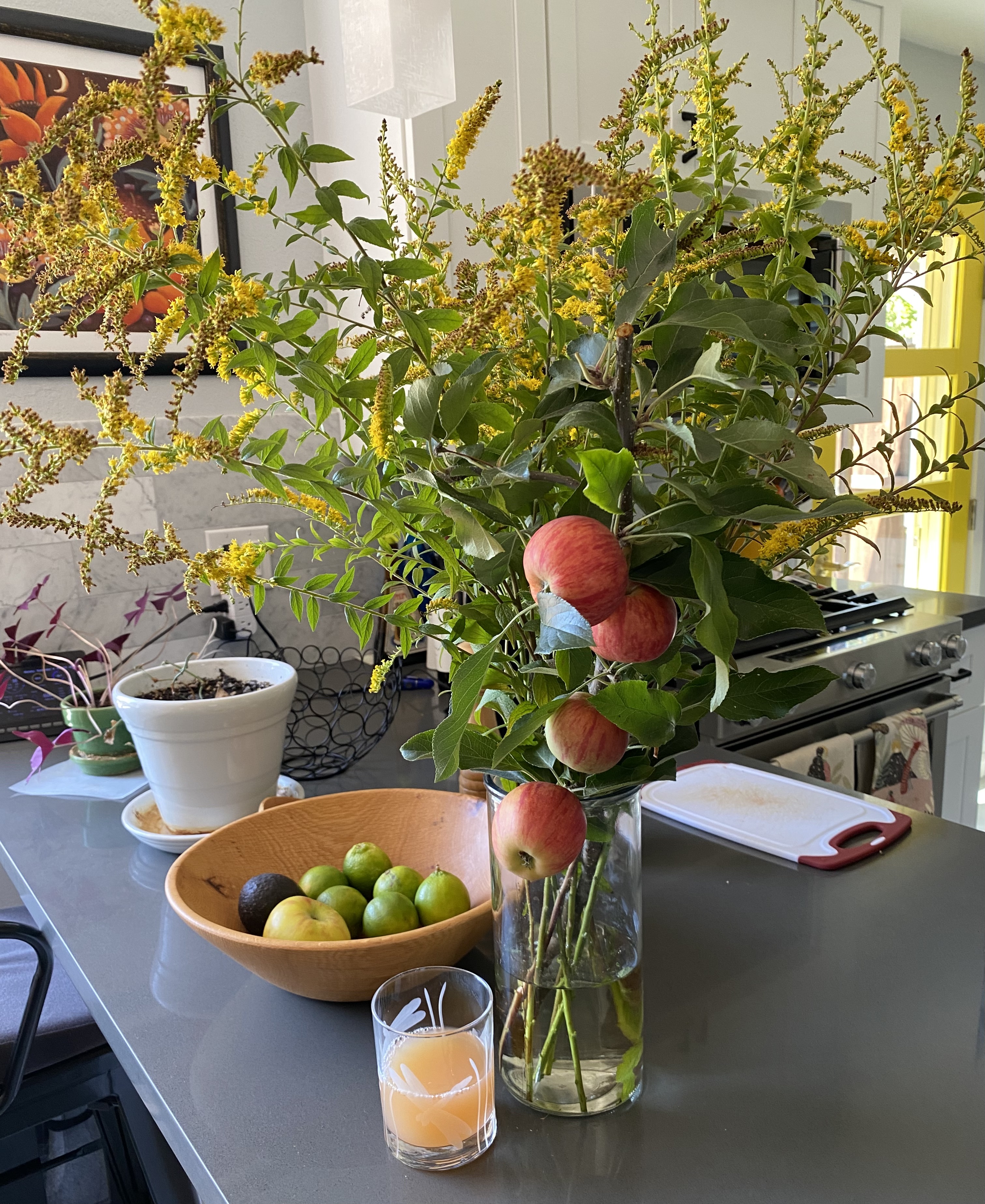
Goldenrod and Gravensteins. That’s juice pressed from our apples at Pam and Judy’s farm.

I see this in my group of old lesbians. Our recent gathering was a workshop about death and dying. Introducing ourselves, these women in their 60s, 70s and 80s reported on state of mind. We are happy! We are doing what we want to do. We are enjoying the last part of our lives. 

I’ve been contemplating death a lot lately. At this age, in my mid-70s, some of my contemporaries are dying. Every day I imagine that it could be my last. But that acknowledgement helps me to appreciate life.

Visiting my friend Cheryl Parker as she was dying of ovarian cancer and sick from chemo, I repeated an old chestnut, that I’d prefer to die quickly of a heart attack rather than suffer. She said something profound. 

“Don’t be so sure. Just think of all the love I’ve received and all the love I’ve given as I’m dying.” Cheryl lived just nine months from her diagnosis to her death. Much love flowed in all directions and my view of death was transfigured.

Beginning a New Year

It’s interesting that the Jewish new year takes place in the fall, as the natural world is beginning to die. I see beauty in the garden as plants go to seed and die back.  

But my careful attention to the garden recently led to an existential crisis.

I was washing aphids off the narrow leaf milkweed with a strong stream from the hose. Then I had an epiphany. What if monarch butterflies had laid their eggs on the plants and I was washing them off too? Monarchs, of course, are the reason we had planted milkweed in the garden in the first place.

A frittilary visited our garden. Photo by Holly Holbrook

We are participating in the Western Monarch Call to Action, started by scientists after the once populous iconic species reached an all-time low in 2018. They have been decimated by pesticides and habitat loss. 

Monarchs lay their eggs on milkweed and feed on the leaves. Milkweed is their only host plant, critical for their survival. The leaves contain cardiac glycosides which make them toxic to most mammals and birds (Do use gloves when handling the plant). So eating the milkweed protects the insects from predators, as the butterflies become toxic to them! 

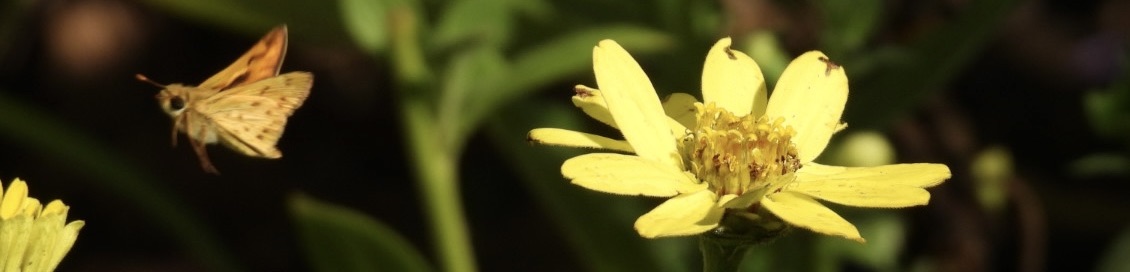
Sadly, this summer we have not seen one monarch in our garden, nor many other butterflies either. My wife Holly remembers encountering hundreds of skippers, the small orange brown and black butterflies, when she was a kid growing up in Santa Rosa. We’ve seen a few this summer, but their numbers are way down too.

It’s not just butterflies. Almost all insect populations have experienced steep decline worldwide in recent years. It turns out insects play an essential part in our natural world. We humans need them. If you want to help protect monarchs and all insects, stop using pesticides and poisons in the garden. And grow some milkweed. The best kind to grow here is narrow-leaf milkweed, but any kind (except tropical milkweed) will do.

Monarch butterfly. Photo by Josh Cotten on Unsplash

My concern about monarchs was laid to rest when I read that egg laying takes place mostly in the spring, and continues through the summer. Now that it is fall, I can stop worrying. Sonoma County Gardener Facebook page says just leave the aphids. They are part of the cycle of life and death.

Since the Call to Action began, the monarchs have multiplied. Our citizen action is working! I hope this can presage a new start for the monarchs. 

Happy new year dear friends! Rosh Hashanah is now over but I hope it’s not too late to say Shana tova

Invoking the Travel Goddesses

August 1, 2023 

My Regular Pagan Holiday Post: Lammas

It is the season for traveling in the northern hemisphere and I’ve been traveling along with millions of others, this year freed from covid restrictions. 

The Santa Rosa airport was packed with more people than I’ve ever seen there, and my destination, Seattle, was just as chaotic. I was one of very few folks wearing a mask. On the plane, people sitting around me discovered we are all from the same neighborhood. Two were flight attendants, relieved that they no longer are required to act as mask cops, risking physical confrontations with MAGAs (they wore masks).

My full flight was smooth and on time. At SeaTac I always rush through the baggage claim level to the far south end of the airport where I catch the bus to Kitsap peninsula towns and my destination, Gig Harbor. This time the bus was just boarding and there was an empty seat for me. My luck may have been the result of my friend Barbara Sjoholm’s invocation of (and my introduction to) the two Roman travel goddesses, Abeona and Adeona. The goddesses are often petitioned together to provide safe travels. 

Abeona–in Latin abeo means to depart—also indicates the birth of plant and animal life, including human beings.

Adeona–adeo means to return. “She who returns” is a goddess of plant and animal growth and death.

Betsy, Barbara and Cousin Gail

A prolific writer, Barbara has just published what I’d call her magnum opus, “From Lapland to Sápmi: Collecting and Returning Sámi Craft and Culture,” about the cultural history of the indigenous Scandinavian people. I know her from the murder mysteries she published in the 1980s and 90s, featuring a lesbian sleuth, Pam Nilsen. During covid she wrote and published two mysteries with an older lesbian protagonist, Cassandra Reilly. My cousin Gail, a student of Native American culture, is a big fan of Barbara’s writing about the Sámi, and I got to introduce them. At lunch in Port Townsend we met Barbara’s wife, Betsy Howell, who works for the US Forest Service and writes about it on her blog: https://betsylhowell.com/. She has a new book coming out in the fall. Mazel tov!

We Watch the Earth Burn

I left Santa Rosa as it was experiencing a heat wave. It was only 86 degrees when I arrived in Gig Harbor, also pretty hot for this time of year. For now, the West has mainly avoided heat domes and smoke from Canadian fires that have affected most of the rest of the country. Phoenix is experiencing nearly a month of temperatures above 110 degrees. July 4 was the hottest day in human history.

At one time I thought I would not live to see the effects of climate change, but the change is coming faster than anyone expected. It’s happening in my lifetime!

In California we worry this time of year about fire as well as heat. As a person with lung issues, I dread fire season and its smoky air, which starts earlier every year. It used to start in the fall with the diablo winds that come from the east. Our usual winds blow from the west, offshore, and while they contain pollution from China, they are not usually smoky.

On this trip I’m reuniting with my three brothers and two cousins. Then I’ll travel to Vancouver BC with my brother Don to commune with him and his husband. It’s gonna be great. 

Siblings Molly, Don, Tim and Terry

Celebrating the Cross Quarter Holiday

In the northern hemisphere, the autumn cross-quarter holiday was celebrated by the Celts as Lughnasa/Lammas on August 1. Astronomically the event occurs around August 6 or 7, the hottest time of the year in much of our hemisphere.

At Lammas we celebrate the harvest of first fruits. In Santa Rosa we’ve been harvesting beans for a while. Our first tomatoes are finally ripe. I look forward to summer BLTs and I ate the first one just before leaving town. The peaches are in the dehydrator. The neighbor’s apple tree that hangs over our fence is full of ripe Gravenstein apples. Holly made pies from the leftover last year’s apples so we’ll have room in the freezer for this year’s. Artichokes were prolific and I ate many but left some to flower. Bees love the purple-blue flowers and I love looking at them, but they are now over and the plants are ready to be cut down. 

At summer solstice I celebrated my mother’s birth day. On August 9 I mark her death day, which is also Nagasaki day, the day in 1945 when we, the Americans, dropped the atomic bomb on Nagasaki, Japan. August 6 was Hiroshima. 

Seen from Cousin Gail’s deck. Looking across Colvos Passage at Vashon Island

People all over the world mark the anniversary of the nuclear bombings. Some people fast from August 6 to 9, a nonviolent tradition to pause, reflect and create empathy for those who have suffered from nuclear weapons. Others fold 1,000 origami cranes, a long tradition in Japan, believed to bring a peaceful and healthy life. After the nuclear bombing, origami crane folding became an action for peace and nuclear abolition. It started in response to the story of Sadako Sasaki, a child who contracted leukemia from the radioactive fallout. She tried to make 1,000 cranes but died before she could finish. Her classmates finished the 1,000 cranes, then made crane making their message for peace, starting an international tradition. 

As we face threats of nuclear war and see a new arms race developing, this anniversary must remind us to strive for a nuclear free world.

If you haven’t read Hiroshima, John Hersey’s 1946 piece about the bombing, I recommend it. He personalizes the experience, telling the stories of six survivors. https://www.newyorker.com/magazine/1946/08/31/hiroshima

Sending best wishes for a safe and peaceful Lammas.