Still Standing

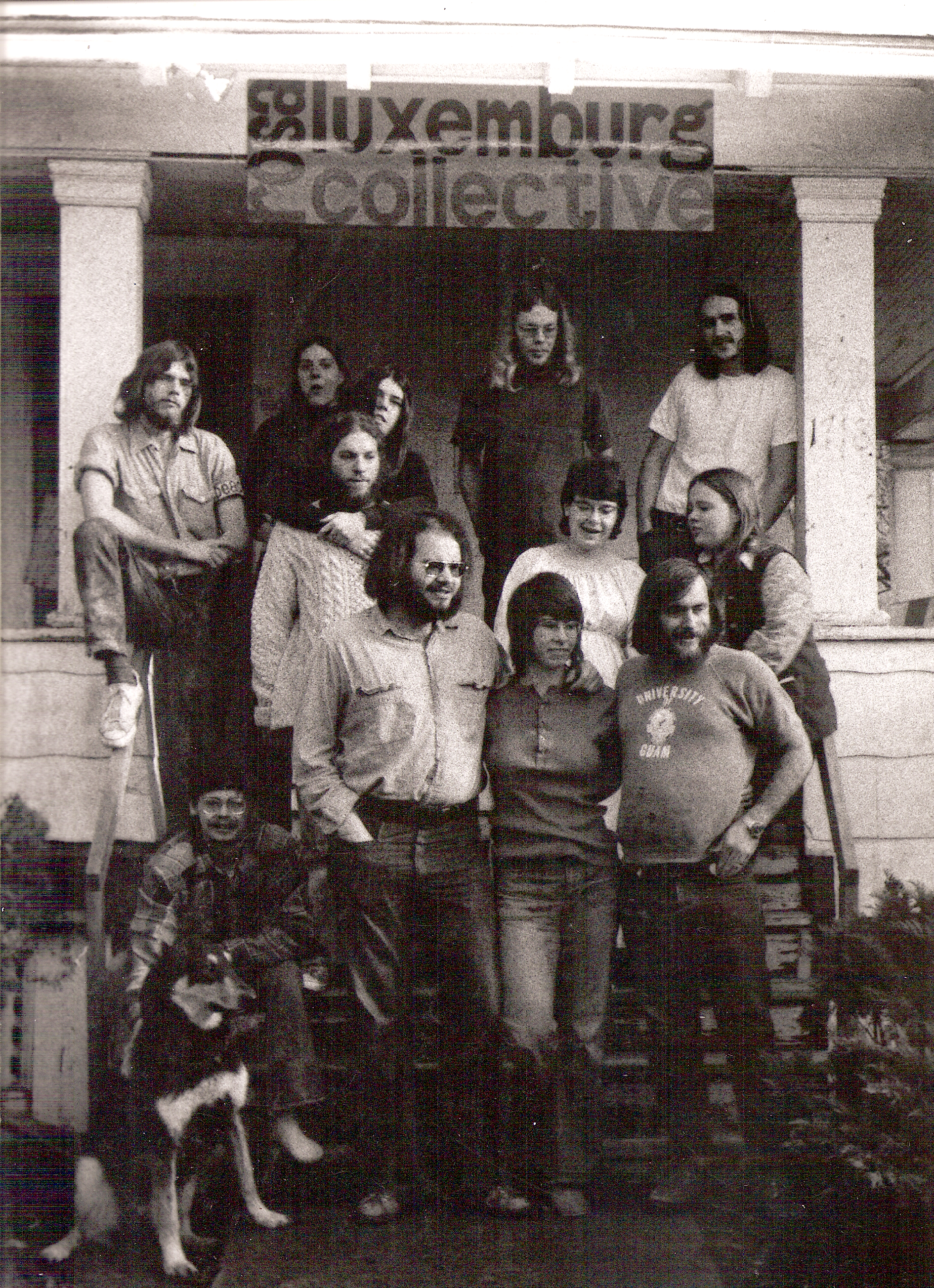
Ruth S was the first to live in the top floor apartment after our collective household of four lesbians bought the three-unit building on Richland Avenue. She confided that in big storms it felt like a boat on the sea. You could get seasick with the rocking.

386 Front
It’s a weird looking building

I’ve now lived in all the flats—A, B and C—and I can testify that Ruth was not exaggerating. One afternoon, lying on my bed in the far southern reaches on the lowest floor of the four-story building, I could feel a gentle rocking. It might have rocked me to sleep had I not been worrying about its source. There was no wind. I could see the blue sky from my window. Later I asked my partner D, whose bedroom was on the top floor in the far northern corner, what she thought might have caused it. Sex, she answered rather sheepishly. “We were having sex.”

As amusing as this was, to have knowledge of my house partners’ sexual habits by just lying on my bed in a distant part of the building, it concerned me greatly about the constitution of our home. Was it going to fall down? And if so, when?

With this question in mind, I invited one of my building inspection coworkers to come by and have a look (I didn’t tell him about the sex). I just felt there was something terribly wrong with the way this building had been constructed. What could the problem be and how might we fix it?

Of course he had no idea. The walls had long been closed and I didn’t at that time have the energy for a big project that included opening walls and inspecting structural members. But I had at various times opened pieces of walls to pull in low voltage wiring or to try to parse out what the builders might have had in mind.

I first moved into the lowest unit, apartment A, in 1980 with my lover Nancy. We noticed immediately that the kitchen floor’s angle was far steeper than, say, the angle of repose for raw eggs. Whenever we dropped anything liquid it would run so quickly from one side to the other that the cook would have to dive to the floor in order to catch it before it disappeared into the framing.

The interior had been finished, but badly. We could see that the previous owner had covered the kitchen with quarter inch sheetrock, painting it all a bright yellow so that no one would notice. The sheetrock covered the window trim, making you wonder what he had been trying to hide. Nancy was a carpenter and I an electrician. We couldn’t stand not knowing what was behind the quarter inch. And we wanted to even out the kitchen ceiling, which had a mysterious soffit hanging over the entrance door. One Saturday while I was away at a tradeswomen meeting, Nancy demo’d the soffit (it had seemed like a simple quick job) and I returned to a kitchen full of rats’ nest material and rat poison boxes from the 1920s. We could only guess that a previous owner had built the soffit around the rats’ nest to avoid cleaning it up. After that we did not open walls with such abandon.

RatsNest
Rats’ nest inside the ceiling

But later I did have to open the kitchen wall. Investigating a short, I opened electrical boxes trying to figure out where the kitchen outlet was fed from with no success. I finally pulled off a piece of the quarter inch sheetrock thinking I’d find a pipe or a piece of electrical cable leading to another outlet. Instead I found that someone (clearly not an electrician) had run not cable but two wires stapled directly to the wooden original kitchen wall and then covered the whole mess with the quarter inch sheetrock. The wires disappeared under the sheetrock. Where did they go? There was no telling. This discovery horrified me. No electrician or anyone concerned with fire hazard would ever have done such a thing. It meant that we could hang a picture on the wall and short out a circuit or start a fire. But there was nothing to be done then. I patched the sheetrock and made a mental note to never hang a picture on that wall. It wouldn’t be till 20 years later that I would have the money and gumption to open the walls to see what was really inside.

386 Richland
So that’s where the wire went!

After closing up the kitchen wall and vowing not to think about the wiring, Nancy and I lived together in Apartment A for a couple of years before experiencing a devastating breakup involving our mutual best friend who lived across the street. Nancy was the first of our original collective of four to be bought out.

We all had thought long and hard about all the possibilities of home ownership, drawing up a contract that spelled out how collective members would be bought out and how new owners would be chosen, how much monthly “rent” would cost and the amount of homeowners’ dues. We even consulted a lawyer from which we learned that contracts drawn up between people are whatever the people agree to. In other words, the lawyer was no help. What we failed to understand was the concept of equity as it relates to real estate. Our idea was that each member’s equity was equal to all the money she had put into the pot, including monthly mortgage payments. None of us had owned real estate. We didn’t understand that most of the payment went toward interest on the loan. So we ended up buying Nancy out for more than her actual equity. But it was a good lesson. We became real estate mavens.

Then I moved in to apartment B. At the culmination of a lovely housewarming dinner, I turned on the coffee maker and all the lights went out. The electrician’s house, my friends laughed, like the unshod cobbler’s kids. That was the start of a long journey of discovery that would shock my electrical sensibilities and make me wonder why the building had not burned down in an electrical fire long before my time here.

Wires live inside walls and ceilings and so without opening up walls it would be very difficult to understand what was going on, but I could surmise that the apartment was served by only a single circuit. That in itself was troubling and there was no way of knowing the quality of workmanship or the condition of the wiring. At least the old fuse panel had been replaced with a circuit breaker panel so the wires were protected from overload. I wasn’t prepared to start a construction project on my home at that time in the early 80s. That would have to wait until after my retirement as an electrical inspector. My job as an inspector required me to explain to other home owners and business owners that their faulty electrical wiring could cause a fire. Every time I said, “If you don’t fix this problem, a fire could result,” I would think to myself, “My own home could burn down!” I didn’t know the half of it.

Over the years collective members sold their shares, others bought in and sold out until I was the only one left. It wasn’t until the year 2000 that I had the time and inclination, and also a partner who wanted to get her hands dirty, to begin to open walls and really see the structure. What we found was worse than anything I’d imagined: no studs in half of the third story apartment, bearing walls cut off at the garage level causing the building to sag in the middle (the answer to the raw egg question), a monstrous electrical fire hazard.

As we deconstructed the building, we kept wondering why it is so oddly shaped, why construction methods differed from floor to floor and room to room, why floors were different heights in adjacent rooms, why floor and ceiling joists sometimes went north and south, sometimes east and west, why when wall coverings were removed we could see sky through cracks in the exterior walls.


Then one day when I was standing across the street looking at the building I had an epiphany. Our home was never a plan in some architect’s mind. It was a collection of buildings set on top of one another, cut off, pushed together, raised up, and without benefit of removal of siding, spiked together with a few big nails. Suddenly all the mysteries we’d catalogued made sense. Our four-story three-unit building had probably begun life as a homesteader’s shack in 1893, the year of the newspapers that had been pasted on interior redwood walls as insulation. We read the San Francisco Call as we uncovered the walls. 1893 was a very interesting year.

MUNI Stories: I Said, What Are You?

“Are your parents here in this country?” asked the garrulous drunk of the Chinese boys. The drunk, a florid, swarthy, affable man holding a big beer can, sat in the back of the 14 Mission bus. I sat to the left of the boys in seats with our backs to the side of the bus. We looked across to people sitting on the other side. It was a little like sitting around a dinner table but without the table.

“Yes,” said one boy. “We’re from here.”

I’d been swapping stories with the boys. They were clearly all-American. We had started assessing taco places as the bus sped up Mission Street on Sunday. A long line waited outside La Taqueria at 25th Street.

“It’s good, but not that good,” I said.

“Yeah,” said one of the boys. “I live in the Excelsior and there’s a great taco place out by Onondaga. The line is shorter. But my favorite is El Farolito.”

I could see this kid was a regular taco aficionado.

“No, really,” said the drunk. “When did you come from China?”

After that, the boys stopped interacting with him. But I couldn’t restrain myself, even though I could see others on the bus would prefer to ignore him. We continued to chat loudly about ethnicities.

“I’m Mexican,” he announced.

“I’m Scandinavian, but way back there,” I said, waving my arm toward ancestors in the distance.

I looked around at the others at our “table.” A young dark-skinned black man with a thin nose sat in the corner on the back bench frowning as he read Dale Carnegie’s How to Develop Self-Confidence and Influence People by Public Speaking. He looked so serious, I wanted to hug him. A young pale woman sitting across from me pretended to float in another universe, looking past me out the window with half-closed eyes. Next to her a beautiful well-dressed Latinx adjusted his ear buds and consulted his phone, multitasking. I knew he was paying nearly as much attention to us as he had to the product on his glossy, curly black mane, but he tried not to look up. He was enjoying the conversation. I kind of wanted to hug him too.

An old Mexican man sitting on my left was the only rider as obviously entertained by the drunk as I was. The drunk had been mostly talking to himself in Spanish and periodically the man on my left would translate for my benefit, then giggle. But the drunk also spoke fluent English. He wanted us to know that he was more than just Mexican. His family was Spanish.

“My grandmother in Spain had blue eyes and everything,” he announced.

“My Swedish grandmother had brown eyes,” I said. “I guess that’s where I got them. The purple hair is all mine, though. None of my people had purple hair.”

The drunk grinned, the Latinx smiled, the old guy sitting on my left giggled. The boys were still quiet, but as I got off at my stop, I thought I could see them smirking.

MUNI Stories: What Are You?

“What are you?” asked the Filipina lady sitting next to me at the bus stop. She looked to be about my age—grandmotherly. She was talking with her female friend who had been telling her a joke in Tagalog, and she was laughing uproariously. Then, when she saw me smile, she translated the whole joke for me into English. I confess I didn’t totally understand but I laughed anyway. She was trying so very hard to include me.

I thanked her for translating the joke and then she asked me, ”What are you?”

My MUNI stop at Richland and Mission Streets where all the most interesting people gather.

It took a minute to understand what she was asking. Put to me, this question has been about gender, usually asked by children. People often mistake me for a man. But once I open my mouth I’m seen as female, and we had already been talking, so I didn’t think this woman was asking after my gender.

It’s the same question white people are admonished not to ask people of color. White people don’t get asked that question. It’s often assumed we have no culture. But this woman knew I came from somewhere, and once I figured out that she was asking after my ethnicity, I was delighted to answer.

“I’m mostly Swedish and Norwegian. But I’m third-generation so I don’t know either of those languages. I’m sorry to say my only language is English,” I confessed, embarrassed.

“What languages did they teach you in school in the Philippines?” I asked her. She told me they had learned both Spanish and English. I asked about Tagalog. She said they didn’t have to study that because they already knew it. That sounded like the argument of colonialists to me—Filipinas being taught the language of the oppressors but not their native language in school. But the main thing I thought was that this woman from the far reaches of the imperialist project got a better education than I did, at least where languages are concerned.

I’m the beneficiary of the American school system in a country and culture that believes we are the center of the universe, so there is no need to learn other peoples’ languages. Funding the football team was the primary objective of our school board in Yakima, Washington. Art, music, language and girls’ sports were seen as secondary. Or in the case of girls’ sports, completely unimportant. About this, as a pre-Title IX kid, I am still angry. I coulda been a contenda!

I know some things have changed since I was a student out there in education land in the 1950s and 60s. I sure hope so, because it’s this way of thinking that reinforces the xenophobia and nativism plaguing us now.

A Civil But Chilling Exchange

On the plane, I sit next to an old guy, white hair, who is busily underlining the folded pages of USA Today as he reads. I finally have to ask him why. He tells me he reads, underlines and then gives the paper to his wife so she can read it and they can discuss at breakfast every morning. It’s his ritual, but he usually reads the Wall Street Journal. They had USA Today at the hotel where they were staying in Palo Alto. They had attended his grandson’s Stanford graduation. His wife is sitting across the aisle watching video.

We strike up a conversation. He wants to tell me about the Stanford Experience. I wonder to myself if it’s like the Jimi Hendrix Experience. But no. He paints a picture of privileged seclusion on a beautiful campus. The graduation ceremony was impressive. The mass spectacular.

A Catholic mass? At the graduation?

Well, yes, but there were masses for every religion.

I wonder to myself what the atheists did.

He wants to brag about his grandchildren who are serially graduating from colleges around the country, keeping him and his wife busy this season. They live in Florida on the west side. He was originally from Chicago.

I steer him away from grandchildren, who it seems are all whip smart, super athletes and excel at everything.

Stanford teaches critical thinking skills he says. We agree this is important.

What did you do before retiring?

I made a great career in the FBI, starting as an agent and working my way up. I worked all over, headed the FBI in South Carolina, worked in Washington DC for four years.

Ok, this is getting interesting, far better than grandchildren. He starts by condescending. Read, he says, pointing to the paper he is underlining.

I doubt USA Today will tell me about the FBI, I say.

He smiles. Well, you’re right about that.

Did you start under Hoover? What did you think of him?

He looks me over. His eyes are robin egg blue. You won’t agree with me. I never met him. I think he built a great organization.

What about all the people falsely accused during the McCarthy period whose lives were ruined?

No answer to that.

We start on immigration. He tells me he doesn’t think we should let Muslims in to the US. Their law is different from ours. They should stay in Muslim countries, but they all want to go to Germany. They want the free stuff. He starts to lecture about Shia, Sunni.

But don’t we have some responsibility for creating the refugee crisis? Have you seen the pictures of Syria? It’s a bombed out wasteland. Would you want to be sent back there? How is this different from our sending boatloads of Jews back to Germany to face Nazi extermination during WWII?

He says his wife is Jewish. FDR was an anti-Semite.

What about the Japanese incarceration?

In retrospect? Terrible. He doesn’t see the similarity.

He says he loves the Hispanics. They are Christian, they work hard, they come from a similar culture. They can assimilate. Muslims can’t.

What is your vision? Do you see this as a Christian nation? Is this a war for religious domination?

He wants to change to subject back to Stanford, but can’t remember a word. The problem with an old brain, he says, and I sympathize. He taps his wife’s shoulder to ask. She looks annoyed, pulls out an earbud and answers. We talk more about the Stanford Experience, but I can never get him to explain its essence.

Since retiring from the FBI he has worked as a legal ethicist in private business helping businesses to do the right thing.

Yeah, it hurts the bottom line if you’re getting sued all the time.

No it’s more than that. It’s about morals. He thinks Comey should have been fired immediately after Loretta Lynch had the private meeting with Bill Clinton on that plane. I don’t understand this, but get that he is not a Comey fan, that he thinks Comey was unethical.

Sometime later he is still underlining furiously. I wonder if this is a holdover from his FBI work. The headline on the print-out is “Trump’s Cheese in the Maze Strategy.” It comes from a right-wing site called Big League Politics which refers to the media as the Fake News Media.

You should read what I read, he says.

I ask how he thinks Trump is doing.

He wasn’t a Trump supporter in the beginning, but now he’s on board. Likes his style. Likes what he did with NATO. They have to pay their share. Thinks he sent North Korea a message.

He and his wife go to lectures, read about world affairs. They heard a lecture at the World Affairs Council where the speaker thought we ought to ally with Russia. They are another white country he said.

How does he reconcile this with our war in Syria?

The Kurds are doing the fighting. He likes the Kurds. But then there’s Turkey.

Do you think the Kurds should have their own homeland?

He starts to lecture about the history but doesn’t answer. Mentions Israel, Saudi Arabia.

Why are we selling arms to the Saudis? Those 9-11 guys were Saudi. Why are we so close to them? Are we sending them to war with Iran? Where do you see it leading? Will borders change? No answer to that.

What’s your vision? How do you see it ending? Do you think there’s any possible strategy other than war?

No.

We move to history. He thinks we should have kept fighting in Vietnam. We could have won that war with two more weeks.

What was the point? To open a market for American goods? We’ve done that. Do you think it would have been worth the tens of thousand of lives lost?

Yes, if we’d won. Were you against the war?

Yes, I was a protester.

My wife was too. But she’s come over to my side.

I wish I could talk to his wife. Has she come over in the interest of domestic tranquility?

We agree to disagree. It’s been a polite conversation and we agree we could keep talking for days. I’ve been the one asking questions. He hasn’t seemed particularly interested in me. But he asks me why I’m going to DC. I tell him about the Great Labor Arts Exchange and that my chorus is doing a performance about Paul Robeson. Do you know who he was?

No. The name is familiar.

My wife Holly thinks I should always introduce Robeson as the Old Man River singer. People don’t know who he was. I describe him as a football player, then as a singer and actor, a black activist, a communist.

Ah, he was a commie is all he says.

The FBI and US government harassed him and ruined his life.

We talk about travel. He has been to far more places in the world than I. They have a bucket list and are planning a trip to Israel, Jordan and Egypt in the near future.

The topic turns to health care. Beware single payer he says. The Canadians have to wait in line.

But isn’t that better than no healthcare? Rich people always have the option of paying for faster doctor visits. I’m a big fan of single payer and will work to get it in California.

Do you like Bernie Sanders?

I hesitate, thinking about the rift in the Democratic Party. Well, I consider myself a socialist. Yes.

As the long flight ends and we stand up, the people in seats around us chime in. They could hear our conversation. One says it’s just like her family. I say did it feel like Thanksgiving and apologize. Another says she is passionate about single payer. We introduce ourselves. Her name is Toni Rizzo and she has had a radio show in Mendocino County where she’s talked about healthcare often. The look on her face is pained, knowing. She’s talked to other guys like this.

It’s important to be passionate says the man.

As we wait to deplane he tells me all about his workout schedule, how strong he is at 70. I thought he was older. He wants to know if we need help with luggage. Asserting his physical dominance. I think he wants to arm wrestle. The last defense. I demur.

Sing loud he says as he departs.

I am left chilled by this experience. Here is a guy who claims to be a critical thinker, who claims to care about ethics, but who supports Trump, who believes we must exile Muslims, who thinks we should have kept fighting till we won the war in Vietnam, who thinks there is no answer to world problems other than war. We had a civil, respectful conversation. I really wanted to understand his point of view and now that I do, I’m horrified.

The episode reminds me of a favorite lyric from the Indigo Girls song “Tether

I kicked up the dirt, and I said to my neighbor
We keep making it worse, we keep getting it wrong.
He tucked in his shirt, he stood a little bit straighter
He said we need a few less words, dear, we need a few more guns


What Old Tradeswomen Talk About

My friend Marg was building a coffin for her friend Bob.

Marg was happy and excited that she could give back in this way, being a carpenter. But her project plans had to take into account her disability, a persistent back pain that had put an end to her career as a building inspector and that she now spends her life managing.

When we get together Marg and I often collaborate on inventions and engineer projects that never get built. But now she was actually completing one of them.

The funeral home had given Marg the dimensions of the concrete box that the coffin would have to fit into with the admonition that another coffin builder had exceeded the dimensions and at the burial the coffin had not fit.

At lunch with our retired carpenter friend Pat, Marg described her plan—a rectangular box rather than the typical hexagonal coffin shape. She used one four by eight sheet of plywood ripped lengthwise for the sides and ends. Another ripped sheet made the bottom and top. She made the handles with rope.

“I had the lumberyard rip the ply for me, to save my back,” said Marg. “I can still use a Skil saw for short lengths but I don’t do ripping anymore.”

She screwed a ledger around the inside of the box so the bottom could just be dropped in and sit on the ledger. I’m an electrician, not a skilled carpenter, so I was proud of myself for knowing that a ledger is the ribbon of wood attached to the framing of a wall that the floor hangs on. I could totally visualize it.

“What size plywood are you using?” asked Pat.

“Half inch,” said Marg.

“Cross bracing?” asked Pat.

“Well, no,” said Marg. “I don’t think it needs it. I used structural plywood. Anyway, the coffin is now at the funeral home.”

Pat and I looked at each other and each knew what the other was thinking. I imagined the bottom piece of plywood bending with the weight of Bob’s body, the ply slipping off the ledger and the bottom piece along with the body falling out the bottom of the coffin as it was lifted up.

A moment of collective panic ensued. Marg frowned. She is a worrier.

“I’m sure it will be fine,” said Pat.

Marg’s description of her liberal use of glue and screws eased my concern.

Marg says there have been great strides made lately in screw technology. Hex head screws that go in easily and you don’t have to pre-drill.

“Remember when we didn’t have battery-operated drills?” I said. “I had to reach into my tool belt for a hammer and an awl to start the hole, and then screw in the screw with an old fashioned slotted head screwdriver. In those days we used ¾ inch sheet metal screws to strap our pipe to plywood. I had awesome forearms. People noticed my forearms.”

“Yeah, I had an awesome back till I fell off that ladder,” said Marg.

“And my knees were once awesome,” said Pat, who was recovering slowly from a recent knee replacement.

We were just generally awesome.

Single Life

At 71, my father, Carroll, has been single for two years.

“What’s it like?” I ask. “Do you think it’s different from single at 30, or 40?” I’m in a relationship at the moment, but considering the impermanence of modern lesbian relationships, this is information I intend to store for the future.

He looks at the sky and smooths his gray mustache. “Probably not,” he says.

We sit on the deck of his tiny trailer in a run-down resort in the California desert. We are drinking vodka and grapefruit juice, perhaps a bit too fast. Vodka is his drink, not mine. He likes whiskey, he says, but his system just can’t take it. Gin gives him an asthmatic reaction. But with vodka, he says, he’s never had a hangover.

He has returned home from his travels to a stack of mail and he reads it as we talk, half-glasses perched on his nose. “This GD insurance company. I’ve been fighting with them for months. Who’s this from? Oh, my friends the Carlsons. You remember Ben and Karen. They’re coming to visit.

I move the stack of mail around and spot an envelope with recognizable handwriting. It is a card from my brother, Don, a notoriously poor correspondent.

“Dear Carroll,” it says, “Hope you are enjoying life in the desert. Everything is fine up here. I recently moved into a new apartment with a new roommate, a college student at the university. I’m working really hard on the Little Theater production of Cinderella, and work is going fine. Hope you had a good holiday.”

“Have you talked to Don lately?” says Carroll.

“Not too long ago. He seems to be doing fine.” I don’t elaborate. Why should I explain, when Don does not, that he plays the part of the fairy godmother in Cinderella? I have met the new “roommate,” a young man who clearly does not have his own bed.

Carroll leans back in the old metal deck chair and gives me a look, but asks no more questions. He has never wanted to know the details of my brother’s private life, nor mine, and we have never told him in so many words.

“That was something, Liberace dying,” he says.

“Yes, it was sad.” What I think is Don hasn’t had the test. I’m terrified that he is positive. For a moment I wish I could talk to Carroll about it.

“I don’t think it’s right that people should be able to hide the cause of death like he did,” he says.

“I think it was a terrible thing they did to him,” I say. “He should have been allowed to die in peace.” Carroll makes some more protests, but he’s not much of a fighter and I don’t feel very argumentative at the moment.

I go back to riffling through his mail. “What’s this?” I say, turning over an envelope with flowery handwriting.

He has saved the good stuff for last. “From Irma,” he says, opening the envelope and scanning the card quickly. He passes it to me.

A teddy bear in a lacy bed looks forlornly out from the card. “I think of you daily and miss you enormously,” it says.

Somehow I have the feeling this thinking and missing is not reciprocal. “How sweet.” I take a swig.

I suspect Carroll had been seeing Irma before my mother died, but I try not to hold that against her. Carroll was a little too pushy about it was all, wanting everything to be okay. He insisted I meet her, and the one time I did, she seemed fine. She told me Carroll was the first man who’d appealed to her in fifteen years.

“You’re obviously putting some distance between you and Irma,” I say, pulling myself out of the chair.

“She drinks too much for me,” he says. “I tell her I think she’s an alcoholic and she doesn’t like that.”

“I was just getting up to freshen our drinks,” I say, thinking Irma’s habit must be serious. For as long as I can remember, Carroll has had a drinking problem. Cracked up two company cars. Always had a pint under the front seat. During my childhood many a dinner was eaten in the tension of his absence.

I duck into the trailer’s kitchen. “Are you trying to cut down?” I ask through the screen door as I assemble juice, vodka and ice.

“The doctor bugs me about it. I try to watch myself,” he says, “but when I’m with Irma I drink more. It’s harder to control. I don’t want to get mixed up with an alcoholic.”

“I think that’s smart,” I say, resisting the burden of my mother’s anguish.

The trailer is spare as a monk’s quarters. Only one picture—of my brother Terry’s children—is displayed on the kitchen table. There are no pictures of my mother or the four of us kids, and none of her things are here. She collected old things, I believe because she wanted a link with history. When she died, Carroll ignored our objections and sold the farm and the contents of our childhood home. “What do I want with things?” he’d said. “I’ll die soon anyhow.” Then he bought a pickup and went on the road. Later, he tried to make it up to me. “Take it,” he would say about objects I expressed interest in, but there was nothing I really wanted then.

I walk back out, hand him a drink, sit across from him and pick out another large envelope. “Who’s this from?”

He smiles, devilishly I think. “That’s Eleanor, my South Dakota girlfriend.”

This one has a serious message lettered on the front.

“I hope only that you can love me just the way I am,” it says. Inside a handwritten message adds, “I do hope someday this can be so.”

“What does this mean?” I ask.

He ponders the card. “Can’t figure it. She’s a pretty hippy gal. Maybe she thinks I want her to lose weight.”

“Why would she think that?”

“Oh, I’ve commented on it,” he says. A fat girl survivor of years of badgering from thin parents, I decide I’d rather not get into this.

“Who’s your girlfriend here, the one your neighbors were razzing you about?” I ask.

“Blanche? She’s a class above the rest in this place. Likes to have a good time. Likes to dance.”
I have never thought of Carroll as particularly handsome. But in his set he is the belle of the ball. Last night at the local resort dance he never lacked a partner. Women approached me and asked, “Is that your father? He sure is cute.” I haven’t seen such flirting since my generation of lesbians all discovered each other.

We look out on the slough, where fishers glide by in rowboats toward the Colorado River. Fish aren’t biting tonight. The local colony of ducks flap wings and chase each other in a frenzy of mating. I wonder why my father and I so often seem to find ourselves in the company of mating animals. I hope he senses my discomfort and doesn’t call attention to this ritual.

“The ducks are sure sexy tonight,” he says. “ ‘Let’s chase each other ‘round the room tonight.’ Ever heard that song? They played it at my sister Jesse’s fiftieth wedding anniversary.”

“It doesn’t look like much fun to me,” I say, watching a drake hold a hen under the water.

“Probably is for him,”  he says.

“So what about sex?” I plunge in. “Do these women you’re dating like sex?”

He’s pleased I asked this question, pleased to have a chance to talk about it, I think. “Hell, yes, sure they do. Irma can take it or leave it though. She can be cold but I don’t care about that. I was never one to demand sex. I never in my life said ‘I’m not getting any here, so I’m going somewhere else.’ ”

I’ve finished my drink and want another, but am afraid to break this train of thought. “What about Eleanor?” I ask.

“Now Eleanor is a different story. She’s quite a bit younger than me—fifties I guess. you know those middle-aged women, they’re sexy.”

“Yes I do,” I say, feeling middle-aged. “So you just returned from a tryst.”

“Well, you know my cousin Buford died. I had to go up to Sturgis. But the funny thing about Eleanor, she doesn’t want anyone to know. She’s real involved in the church, and she’s afraid someone will find out about us. I kind of get a kick out of it. She kicks me out by five o’clock so they won’t see me there in the morning. But she is something in bed. I tell her ‘if your church friends only knew what goes on in this house…’”

I have developed a sudden interest in a broken thumbnail and am picking at it intently.

“Eleanor thinks I’m really sexy,” Carroll says. “But I’m really not. You know, she expects too much of me. They all think I’m sexy. I can’t figure out why.” I rip the thumbnail off and it begins to bleed.

“So what about Eleanor? Are you getting serious?” I ask, sticking the thumb in my mouth to stop the bleeding.

“Naw. I know she’d like to get married, but I’m not gonna do it. Don’t you worry. I don’t intend to get married again.”

“What makes you think I’d worry? You’re an independent person. You can make your own decisions.”

I hug myself. The sun has gone down and the evening is suddenly cool.

“Well, what do you say we get cookin’?” Carroll raises his furry black eyebrows at me, gets up and moves into the trailer.

The prospect does not excite me. His bachelor diet of sausage, Spam and fried potatoes gives me heartburn. “Let’s try something different tonight,” I say, opening the refrigerator, which contains little more than ingredients for various alcoholic concoctions. I pull out the biggest thing in there, a heavy rectangular package. “What’s this?”

“Government cheese,” he says. They give it away to senior citizens every two weeks at the surplus store. I want you to take that with you when you go.

“No thanks. I could never eat all this. I live alone, remember?”

“No, I want you to take that.” He is using his sergeant voice. “I can get plenty more where that came from.”

“No, really, I don’t like processed cheese. I would never eat it.”

“You take that,” he insists. “Give it to your friends.”

“Look, I appreciate the offer,” I say. “Maybe we can cook something with it tonight. Does your oven work?”

He finds some matches and kneels down in front of the little propane stove while I start turning knobs on and off looking for the one that controls the oven. “I never did figure out how to use this thing,” he says.

I am watching as he works at lighting it when the air around his head explodes with a whoosh. He is knocked backwards and ends up sitting on the floor against a counter.

“Dad, Dad,” I yell. “Are you okay?” I get down in front of him and his eyes finally focus on me. I can see his thick eyebrows and lashes have been singed. He rubs the melted nubs of hair on his arm. I discover I am crying.

“Knocked the piss out of me, but I’m okay.” He looks puzzled.

“I’m kind of upset,” I blurt out. “I’m afraid Don might have AIDS. I can’t stand to lose him, too.”

Carroll’s face betrays no anger, only resignation. “He’s always gone for men, hasn’t he?”

“Yes,” I say, and more to atone for indiscretion than anything else, I add, “and I love women.”

“I don’t understand it,” he says, “but I’m glad you’ve been quiet about it.”

I give him a hand up, then wipe my eyes quickly on my shirt sleeve. He smoothes the ruff of hair around his bald head and tucks in his shirt. I decide to cook something on top of the stove.

“Hey, I want you to see something, he says. “Look at my gold nugget.” He pulls what looks like a huge nugget from his pocket. It is attached to a gold chain.

I’m immediately skeptical. One of his favorite pastimes is making up stories about found objects or people he sees in passing, or family history. Years pass and fiction melds with truth. “Where did you get this?” I laugh.

“Well, now, some people might think this is strange,” he says, eyeing me as he places it in my hand. “You know your mother had a lot of dental work done over the years and she had her teeth pulled the week before she died. This is made from her gold teeth. I want you to take it.”

Rich in Tolerance, Generosity and the Spirit of Simple Living

Chapter Five

Flo was awakened in the middle of the night by some kind of howling. It sounded like an animal in distress. She was a light sleeper, so she gained consciousness quickly and it didn’t take long to realize the sound was coming from downstairs, inside the house. She threw a robe over her nightgown and rushed down the stairs, her feet brushing the bare floor.

The howling emanated from her parents’ bedroom. There she found Gerda doubled over at the side of the bed keening, holding her husband’s head. Ben’s face was gray but his expression peaceful. He had died in his sleep, painlessly at least, thought Flo. She embraced her mourning mother, hugging her for several minutes as Gerda wailed.

They had known this day would come, but that had not lessened the shock. Ben had been ill with heart trouble for some years and had been recovering from a recent heart attack.

Flo tried to comfort her distraught mother. She would have to take control of the situation. She would grieve later.

Betty and Ruth came out of their rooms at once to find Flo consoling their mother.

“What happened?” they wanted to know, but it was a question born of shock. They knew it was Ben.

“This will ruin my wedding,” wailed Ruth without thinking. Flo glared at Ruth.

Gerda sat on the bed, still sobbing. Her girls surrounded her and offered comfort.

“He said to me this morning that his heart felt hollow,” sobbed Gerda. “If we had taken him to the doctor he might still be with us.”

The Wick family about 1930

Flo was closest to Ben of all the daughters. He had set great store by her and made his high expectations clear. Flo had loved him dearly, sharing his appreciation of reading and politics. She was proud of both her immigrant parents for having worked so hard to make a life in a new country. They were exemplary Americans and she had tried to follow their example in her own life. Ben was only 58. What a sad thing that his life had been cut short so young. He had done his very best to support their family during hard times, taking any jobs he could find during WWI and then the Great Depression.

Life on the farm at Meadowview for the girls had been a delight. They were too young to do much work and so they got to play, as long as they stayed away from the train tracks, which ran nearby. Ben and Gerda cut the meadow with a scythe and pitched the grass into piles with pitchforks.

Gerda pitching hay

The haystacks had been such fun to play in, but now Flo was keenly aware of the work that had gone into harvesting the hay for their one cow. In her mind she could taste the tart fresh buttermilk that was left after Gerda had made butter and paddled it into the buttermolds. But as a child she was unaware of the effort that went into the making of butter. Gerda had to milk the cow twice a day every day and churn the butter by hand. Then it was stored under the floor through a trap door that Ben had made with a screen-covered frame for foods that needed to be kept cool.

Father Ben and girls

Gerda now had an “Easy” copper washing machine with an electrically operated wringer. She used two tubs for rinsing and bluing. But on the farm she had washed clothes outdoors by hand using a galvanized tub and washboard. Clothes were hung to dry outdoors in the summer and on lines strung across the kitchen in the winter. Flo remembered her mother hunched over her treadle sewing machine making clothes by kerosene lantern, and her father’s rounded back as he worked at keeping the books, squinting to see in the dim light.

Flo pulls the cart

Ben had grown delicious strawberries and now Flo was thinking too of the work that went into planting, irrigating, harvesting and marketing. She remembered the brooder house where Ben had incubated the eggs and the pens where rabbits were raised for sale. Ben had taken all the produce and animals to the little town of Junction City five miles away to sell. During the school year he had also worked as teacher and janitor in a one-room schoolhouse nearby teaching all eight grades. The farm had been a losing proposition, but had failed not for a lack of hard work. Their parents had given it their all before they had reluctantly sold it and moved into town where Ben found a teaching job. At heart he had been a teacher and artist, not a farmer. Still, after they moved to Yakima he and Gerda had worked the hop fields in the summers when Ben was not teaching. The family also worked picking brush in Gerda’s sister Ellen’s apple orchard in Selah. Aunt Ellen often “forgot” to pay the girls, but Ben had earned 15 cents an hour, $1.50 at the end of the day, enough to buy some bread and hamburger.

He had worked until his heart gave out. After that Gerda and the girls took over. Flo pictured Gerda mowing the lawn, sweating in the sun in her house dress and straw bonnet while Ben lay in the hammock they had put up for him on the front porch, his nitroglycerin nearby in case of an angina attack. Was he ashamed to be seen there by people driving by on 16th Avenue, a man loafing while his wife did the man’s work?

Had Ben regretted fathering five daughters and no son? He had never once indicated that, but friends and family made the assumption. One relative had even put in writing in a letter how tragic it was that there had been no boy. Flo would not allow herself to believe that her father had shared such thinking. Besides, she thought to herself, she had been the best son that Ben could ever have.

“Uncle” Alf’s Ode to the Lay of the Last Hen

The setting full moon shone an eerie light into the kitchen window where Flo led Gerda, sat her down and lit the wood stove to make coffee. The family had prepared for this day and knew they needed to make funeral arrangements quickly in such hot weather. The doctor must be contacted to certify the death. A funeral date must be agreed upon and relatives must be contacted. Ben had two brothers in the US. Erick had gone to the Yukon during the gold rush and still lived there in a one-room cabin. Flo took out a pencil and note pad and began making a list of out-of-town relatives who would have to be sent telegrams. Ben had a small insurance policy and Gerda hoped it would cover the cost of his funeral.

Their father was gone. Life would never be the same in the Wick household.

Flo’s eulogy for her father

Home for Dinner July 27, 1938

Chapter Four

Flo was thankful for her driver’s license and use of the family car. It gave her the freedom to attend Biz-Pro and YWCA events in other towns in the Northwest, and easier access to meetings and social events at the homes of friends. Having use of a car afforded real power, the kind of power that was mostly reserved for men. She had taken her driver’s test as soon as she turned 16 when she graduated high school in 1929, and she had been the family driver ever since.

She was the driver

Flo had even gotten good at fixing flat tires as they happened with regularity. She and her mechanic had recently solved the mystery of the 52 flat tires the Model A had suffered in recent years. They traced the cause to nails from the old wooden sidewalk on 16th Avenue that stuck up through the asphalt after the road was paved.

After Flo picked up Ruth at the county building, they stopped at the butcher’s shop on the west side of town to pick up Betty, who had taken over the shop’s bookkeeping for her father since his heart attack.

Gerda had dinner nearly ready when the three sisters arrived home. Flo found Ben sitting in the back yard at the foot of Gerda’s vegetable and flower garden in the shade of the big cherry tree reading the evening newspaper. She pulled up an Adirondack chair to sit with him.

Ben’s calligraphy revealed his patriotism

“How are you feeling, Dad?” Flo couldn’t help worrying about her father.

“Oh, I feel like I’m on the mend. Soon I’ll be out working in the hop fields again,” he joked. Ben had not been able to do any physical activity for the past three years because of heart trouble and now since his recent heart attack he was confined to a desk where he could do bookkeeping or a chair where he could sit and read or work on his art.

Flo recalled the family’s frequent trips to the Cascade Mountains to fish and swim in Bumping Lake and the Yakima River. The mountains of Washington reminded Ben of the Norwegian mountains and the landscape of his childhood. He had been born Bernt Evensen on a farm near the little fishing town of Borsa on a fiord about half way up the Norwegian coast. Ben’s favorite excursion in his adopted country had been to Mt. St. Helens to pick huckleberries in late summer. He loved camping at Spirit Lake just at the base of the mountain. Ben often drew the mountain and its lake and he had completed a tourist advertisement titled “See Washington First” with a pen-and-ink drawing of the mountain. There would be no trip to Mt. St. Helens to pick berries this season, thought Flo sadly.

Gerda, Ben, Elizabeth and Flo in the mountains, 1913

She took Ben’s arm and they walked through the bountiful garden filled with flowers. In the far corner was the spot where Ben had dug a little grave and buried the fetus that Gerda had miscarried some years before. The coroner had not reported the stillbirth so as not to charge them for any burial costs, and they were allowed to bury the remains themselves. Gerda had wrapped the fetus in the blanket she’d been knitting along with baby hat and booties. Had it survived, the baby would have been a boy.

The temperature had begun to cool off. Betty and Ruth brought an oilcloth and table settings out to the picnic table near the garden to avoid the heat of the kitchen where Gerda had been canning apricots and cooking much of the day.

Wiping her brow with a handkerchief, Gerda came out of the kitchen to sit with her family for a few moments before dinner. She still wore her long graying hair as she always had, braided in one long braid, wrapped in a bun and pinned on top of her head. She removed her wire-rimmed glasses and wiped them carefully on a hanky pulled from her apron pocket.

“You look a little peak-ed,” she addressed Flo, putting a hand on her daughter’s head and smoothing her hair. “Are you feeling alright, dear?”

“I’m just very happy to be home from that hot office. I feel all wrung out,” sighed Flo.

Ben emulated the artist Mucha

Gerda had made potato salad earlier in the day and put it in the icebox to cool. Ruth set it on the table along with freshly picked corn from the garden, boiled over the wood stove. With the stove already hot for canning, Gerda had also fried chicken in rendered fat. She had sacrificed the old hen that had stopped laying, chopping off her head with an ax, gutting her, then dipping the bird in hot water before plucking her. There was fresh butter, too, cucumbers in brine, and iced tea.

The family sat down to eat and Ben said the prayer. They could be thankful for many things. They had each other. Although the past six years since Ben had been let out of his teaching job had been hard times. Flo could not help but wonder if her father’s Democratic politics had played a part in his being laid off in 1932 at the nadir of the Depression. The superintendent had laid off a man with a wife and four children to support while keeping on a single woman in the commercial department of Yakima High School, very unusual at the time. Protocol required women, single or married, to be let out before any man.

“Remember when we went to high school together, Dad?” said Ruth. “You went to teach and we went to learn.”

Three of Ben’s daughters had attended Yakima High School while he taught business mathematics, bookkeeping and penmanship there. For Flo and Ruth there was no shame at having their father there, in fact for them it was rather comforting. But sister Eva could not contain her embarrassment when she overheard her friends making fun of her father’s foreign accent and calling him a blockhead. His office, such as it was, had been relegated to the basement, an indication of his low status.

“Remember when we met Orville Douglas your first year at the Yakima High School faculty picnic?” said Gerda. “And now he’s William O. Douglas and he’s been appointed to a big job in Washington DC. We met Mildred too, the woman he married.”

William O. Douglas, SEC Chair

“Yes, I was sorry to see them leave Yakima,” said Ben. “Mildred Riddle was the best Latin teacher Yakima High School ever had. She was quite an intellect.”

Ben had overlapped only one school year with William O. Douglas, who had taught English and coached the debate team, but soon enough they were known as the only two Democrats on the faculty. People joked that they were the only two Democrats in Yakima County. And now Douglas had been appointed by FDR to head the Securities and Exchange Commission. Their father’s friend from Yakima had gone to Washington DC and made it big. It gave them all hope.

Flo Goes to Work July 27, 1938

Chapter Three

Flo pulled the Model A into the gravel parking lot at the State Highway Department offices, a single-story brick building on a back street of the little town of Union Gap. Its just-watered closely cropped lawn sparkled in the morning heat, an oasis in dusty brown surroundings that had once been the location of the huge U&I Sugar plant.

northyakimariver
Union Gap and the Yakima River

Union Gap had been the original Yakima before the Northern Pacific Railway bypassed it in 1883. In 1884, in response to that snub, the whole town, over 100 buildings, was moved with rollers and horse teams four miles north along the Yakima River. After that, the new town of North Yakima grew while Union Gap remained a one-horse town just at the gap between Ahtanum Ridge and Rattlesnake Hills where the Yakima River flowed toward the Columbia.

The office building had stayed relatively cool during the night, but was already heating up when Flo arrived just before 8 a.m. Someone had set electric fans around the office to circulate the air. Temperatures above 100 degrees were not uncommon in the summer. People said it was a dry heat and that was supposed to somehow make it feel less hot. The district chief engineer had put in for an office air conditioner but the state chief’s office, located in the relatively cool western part of the state in Seattle, had not yet been convinced of the need.

Flo greeted her coworkers, all men since the other female stenographer had recently been laid off when she had married. Jobs during the Depression were reserved first for men, and married women were not allowed to work at all, unless the job was agricultural—picking fruit or sorting it in a packing warehouse. Plenty of women and children worked in the fields and orchards and lived in the surrounding labor camps.

“Good morning, Theron, how was your engineers’ meeting?” she asked the tall blond young man as she went to her desk.

“Very productive,” he replied. “I was elected president of the Engineers Association. Now I’m out to take over the world, one road at a time.”

Flo had been dating Theron B. Stone on and off. It was nothing serious, if you asked her, although he had clearly been courting her. They would go together to dances and engineering events. He had driven her and a group of friends to Snoqualmie Pass to witness the historic paving and widening of the highway that crossed the Cascade Mountains from western to eastern Washington. They’d all had a fine time picnicking near the summit.

But Theron had made some crucial errors. First he had given Flo a subscription to the Reader’s Digest after learning about her love of books. She had accepted gracefully, thinking all the while that anyone who really knew her would know she disdained the Reader’s Digest and that she would instead want to read the actual books themselves.

“The engineers have hairy ears. They live in caves and ditches. They screw their wives with butcher knives, the dirty sons of bitches.”

His other error was to reveal to her the secret motto of the engineers: “The engineers have hairy ears. They live in caves and ditches. They screw their wives with butcher knives, the dirty sons of bitches.” What did he expect her to do with this information? she wondered. How was she supposed to react to something that appeared to her to be disgusting, vile and, at the very least, inappropriate? She had smiled uncomfortably to conceal her shock and perhaps he had been sorry he’d said it. But the words could not be taken back. It had changed her view of the men she worked with. Could they really want to screw their wives with butcher knives (surely they didn’t really do it) and why would they want to do it in the first place? The whole thing was very puzzling, but she had not asked Theron to explain.

On the whole, Flo had a positive relationship with all who worked at the Highway Department. She had started working there just out of secretarial school at 18 and the men had teased her mercilessly. She was a naive rube in a sea of cynics. The practical jokers chose her, the youngest and smallest, as the butt of their endless pranks. The young stenographer’s face remained in a permanent blush for the first year she worked there. But she was a good sport and saw that the attention grew partly from the mens’ fixation on a pretty young woman in their midst. And now she was an old hand at 25. She knew them all and had learned how to play along.

The constant ribbing was one reason Flo had joined a women’s organization, Business and Professional Women. There she met other young workingwomen and they could commiserate about their jobs and talk about ways to improve them as well as just having fun with each other away from the men. The national organization fought against laws that prohibited married women from working and supported equal pay initiatives. Women’s pay was far less than men’s, even when they worked in the same jobs. Through Biz-Pro under the umbrella of the YWCA, Flo had already traveled to the big cities of Chicago, Columbus and Minneapolis as well as Seattle and towns in the Northwest. Her sojourns away from the small town of Yakima fed dreams of traveling to New York, Paris and London.

FloStenographer copy
Flo (R) at the Highway Dept.

Flo’s desk was a handsome oak government issue with three drawers on the right for typing paper and carbon paper, envelopes and typewriter ribbons. The shallow drawer above the space for her oak rolling chair held pencils and pens. Her best friend and most important tool was the Royal typewriter that sat on its stand next to her desk. It featured typewriter ribbon with both red and black colors. To get red she only had to lift the carriage with a lever. Flo’s mastery of the typewriter had grown during her year at secretarial school. She was a fast typist who made very few mistakes, and that was good as mistakes were not easy to fix. All letters were typed with two carbon copies. Each carbon would have to be pulled apart and erased with a typewriter eraser before being retyped, so it was far better not to make any mistakes at all.

When one of the engineers called her into his office, Flo took a steno notebook and pencil to record his thoughts in shorthand. Then she would recompose his letter using proper English and grammar as she typed it. The bosses, who often did not excel at writing letters, depended on her to make them look good.

The Washington State Highway Department was tasked with engineering, building and maintaining the state’s roads and highways. In 1938, teams of engineers were assigned to survey the state’s entire highway system. There were several high mountain passes and thousands of miles of roads under the department’s purview. Engineers were in demand in Washington in the 1930s as FDR’s New Deal funded infrastructure projects across the state, including the Grand Coulee Dam, bridges, sewers, stadiums and, of course, roads.

The office workers took lunch at noon daily, leaving one person to answer the phone during the half hour while the others ate. The men routinely brought their lunches to work, made daily by their wives or mothers. On nice days the workers could walk over to the Yakima River to eat lunch under a cottonwood tree. On this day Flo remained in the office with the electric fans rather than confront the blazing sun outside. Her mother had packed a butter sandwich, a tomato from the garden and some fresh apricots for her lunch.

Flo looked forward to lunch break when she could be alone with whatever book she was reading. Today it was Man’s Hope by Andre Malraux in a new English translation, about the Battle of Teruel in the Spanish Civil War. The war continued although things were looking bad for the Republicans. The fascists had bombed the town of Guernica the year before, killing hundreds of civilians in the historic first targeting of civilians by a military air force. It was the shape of things to come.

While typing up a chart for the roads survey report, a thing that required lots of underscores to make the horizontal lines, Flo felt a the dreaded hot gush of blood of her period. She was wearing a pad, but she knew from past experience that the pad might not absorb gushing menstrual blood. It could quickly stain her underwear and her skirt when it came out so fast. She grabbed her bag with its supply of Kotex and walked quickly to the bathroom, hoping it was free. There was one toilet room for all the employees in this office and very often it was in use, but she found the door unlocked. She rushed in and locked the door. Sitting on the toilet, she found that the blood had overwhelmed the pad and stained her underpants. The sight of the pad covered with bright red clots repulsed her and made her queasy. It sometimes seemed to her that her period was like birthing a baby every month. Nausea, vomiting, diarrhea and intense pain from cramping often came with it.
She was relieved that she had chosen a dark skirt to wear. When she examined it she found her skirt was still unbloodied. Luckily she had thought to bring an extra pair of underpants with her. She quickly washed out the bloody underpants, wrapped them in a wax paper bag and stuck them back in her bag. She used a wet paper towel to clean the insides of her thighs where the blood had seeped over the sides of the pad, then put on the clean underpants and a new pad. She wrapped the stained pad in a paper towel and pushed it to the bottom of the wastebasket hoping the used towels might absorb any smell. Then she swallowed two more aspirin from her bag with a glass of water from the sink. Someone was trying the door. She unlocked it and saw Theron there. She exited with as much aplomb as she could muster. The crisis had been averted although she still had four hours to go till the end of this workday and the possibility of another accident loomed.

The stifling afternoon moved along tortise-like. Flo downed more aspirin to dull the radiating pain. She desperately wished to lie down in a cool dark room. By the time the workday ended at 5:30, the office temperature was nearly as hot as it was outside. The thermometer on the wall read 85 degrees. After changing her Kotex pad once more, Flo bid goodnight to her coworkers and left the building to drive home. At least there was a slight breeze outside. She would pick up her sisters at their workplaces.

Breakfast at 16th Avenue July 27, 1938

Chapter Two

“Breakfast, girls,” called Gerda. She had already been out to open the chicken coop and the hens’ cluckings came through the open upstairs window. The smell of coffee boiling wafted up from the kitchen below where Gerda cooked breakfast on the wood-burning stove in the kitchen. Gerda always served coffee in the morning, and also as the Swedish custom, in mid-afternoon. This afternoon the coffee would be cooled with ice delivered weekly by the iceman. Betty and Flo made their way down the steep stairs.

The Wick family home on 16th Avenue So.

The family had taken out a mortgage for $3500 to buy the house on 16th Avenue South in 1921. It had been built by Gerda’s brother, Albin Lunstrum, who had brought his carpentry skills from Sweden. Most of the houses on Johnson’s Corner, the Swedish neighborhood, had been built by hand by Albin and his brother-in-law partner, Axel Jacobson. They were boxy two-story clapboard-clad frame houses with generous front porches, a popular style at the time. The family had come to Yakima after having failed at chicken farming near Roseburg, Oregon during WWI. When Ben was offered a teaching job at Yakima High School, Gerda was happy to join two sisters, two brothers and some cousins who had also immigrated from Sweden.

Ruth smiled good morning from her place at the dining room table which she had set for the family. She had fixed her light brown hair in a neat Marcel wave and she wore a floral cotton dress. Her well-scrubbed rosy cheeks shone with radiant good health.

“Don and I have set the date for our wedding,” she blurted. “I wanted to wait till you were all here to tell you. It will be August 30 at the Presbyterian Church. Of course I want my sisters to be bridesmaids.”

“Congratulations!” chorused her sisters, mother and father.

“Will there be time for Momma to make your dress?” asked Betty.

“Oh, I won’t need a dress. I can wear the suit she made me last year. It’s very stylish,” Ruth said.

“Gee, you’re in an awful hurry,” said Flo. “Where do you and Don plan to live?”

Ruth’s wedding announcement

“We’ll find an apartment in Yakima. Of course you know this is all your fault for introducing us.” Ruth was looking forward to having her own home, away from her bossy older sister.

Flo was happy for her sister, but worried about the family’s welfare. She silently calculated the loss of Ruth’s contribution to the mortgage payment. Ruth brought in $60 a month from her job and she could thank their father for that. He had rung doorbells for the Democrat running for county auditor who had won the seat in 1934 in the wake of FDR’s election two years before. Ruth got a patronage job and now she would lose it when she married. Women were expected to give up their jobs when they married and there were even laws prohibiting married women from working. She and Flo had paid the hospital bill for their father’s care after his coronary. If he ended up in the hospital again it would be all on Flo this time. Ruth would be a married woman starting her own family. At least with the vacated bedroom they would be able to house a boarder, thought Flo.

“Good morning Daddy. How are you feeling?” Flo bent to give her father a kiss on the cheek and a hug. At 58, Ben was looking old. His still abundant head of hair had turned from black to gray and his blue eyes seemed sunken.

“I’m feeling quite well today,” he answered. “Did you see that we got a letter from Eva yesterday? She says she’s doing well in her nursing program. I think my brother Erick’s loan to her was a good investment.” He had retrieved the morning Yakima Herald and was dividing the sections to be shared. Both Flo and Ben usually read a book or newspaper as they ate. For breakfast this day Gerda served homemade toast, boiled eggs she had collected from the little hen house and the first of the fresh apricots she had gleaned from the Pacific Fruit Packing Co. The canning season had begun and Gerda was preparing to get started on stone fruit. As hot as it was, this would still be a canning day. Gerda had procured boxes of culled apricots from her seasonal job as a fruit packer and they would spoil if held for processing. Apples, the primary crop of the Yakima Valley, did not ripen until the late fall.

Eva graduated from the nursing program at Swedish Hospital in Seattle

Flo scanned the front page. It seemed little news was good in this Depression year. Five of the Negroes who had been attacked earlier in the month by a mob of 200 whites in Wapato had filed a lawsuit against the local marshal, deputy marshal and the county sheriff for failure to enforce the law and protect them from the mob. (They would later lose in court.) The Anti-Japanese League, the American Legion and the Grange were still harassing Japanese farmers in the Lower Valley where they leased land on the Yakama Indian reservation.

“The American Legion is still trying to run the Japanese out of town,” said Flo. “No matter that they’ve been here longer than most of the Legionnaires.”

Abroad, Jews in Germany were being ordered to report to police to receive identification cards. The war in Spain continued, but, even with thousands of volunteers from around the world joining the Republicans to fight, Franco’s fascists were winning with Hitler’s help.

“Why won’t our government take a side in this war and send armaments?” asked Flo. “Can’t they see this is the ultimate fight for democracy?”

“I don’t think public opinion supports our intervention,” said Ben. “But that doesn’t mean it’s right.”

In Yakima, agriculture was always front-page news. The cherry crop, harvested in the first week of July, had been ruined by the hot weather.

“The farmers complain every year, no matter what the weather,” said Ben flatly. “It’s either too rainy in June or too hot in July.”

Orchardists and farmers nervously geared up for harvest season, hoping they would have enough migrant workers and that labor agitators demanding higher wages would stay out of the Valley. A strike by the Wobblies had been put down five years earlier and the stockade built to hold the strikers still stood downtown, daring any to stand up for better conditions in the fields and orchards. None had.

Farmers advertised for migrant labor and migrants traveled from Mexico and other states hoping to find work. They were housed in several labor camps called shacktowns. Some had tiny cottages built by the farmer. Others were built by the migrants themselves of scraps of wood and found materials. Growers did not want to let the migrants get too comfortable. They were urged to move on after harvest season.

Sisters Flo and Betty

After breakfast Flo would drive the family Model A to work at the State Highway Department in Old Yakima several miles away, dropping off Ruth at the county offices downtown. Betty would take the streetcar to her part-time bookkeeping job at the butcher’s on the west side of town. Ben had a summer break from part-time teaching jobs. Gerda had arranged for her sister Anna to come over to help her can the apricots.

Flo slid into the driver’s seat and put on the horn-rimmed glasses that corrected her nearsightedness so she could see to drive. Girls with glasses were seen as bookish and unattractive, and she only wore them when absolutely necessary, never when her photograph was being taken.

Flo sometimes imagined that the four sisters were like the sisters in Louisa May Alcott’s Little Women, although the comparison didn’t altogether work. They had lost a sister to typhoid fever just as the March sisters had lost Beth to scarlet fever, but Elizabeth had died at seven, not 17, and that was 18 years ago now. The Wick sisters hadn’t written and produced plays like the March sisters had and they weren’t genteel poor like the Marchs, just plain poor. But Flo saw herself in Jo, the tomboy reader, writer and intellect of the four. She pushed against the constraints of gender and rejected the idea of romance and marriage just as Jo had in her youth. As the oldest sister after Elizabeth’s death, Flo saw herself as the family caretaker, not in the traditional female role, but as the wage earner who took over the father’s role after he had been laid off from his teaching job six years before. The school superintendent who laid him off seemed to think that Ben’s four daughters could support the family and Flo took up the challenge.