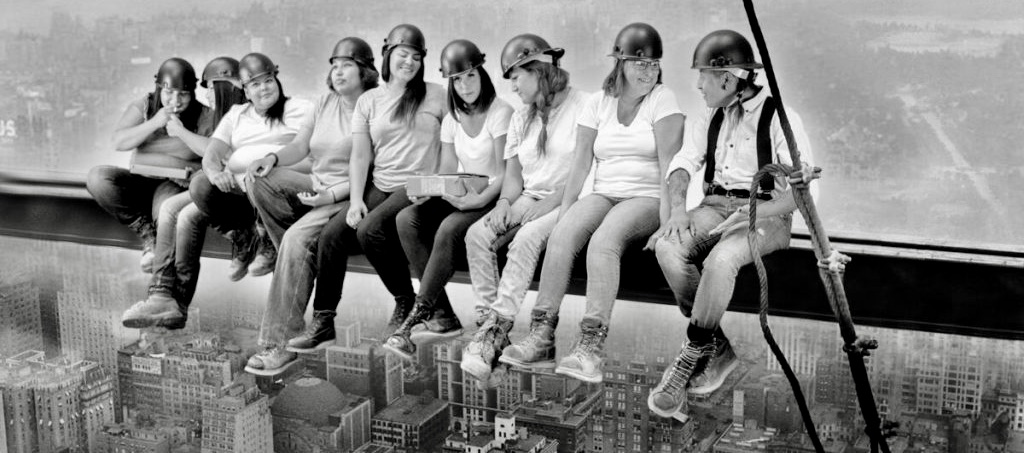
Indigenous women in Ironworkers Local 725, Canada. Photo: Lightframe
Tradeswomen Reject Union’s Capitulation
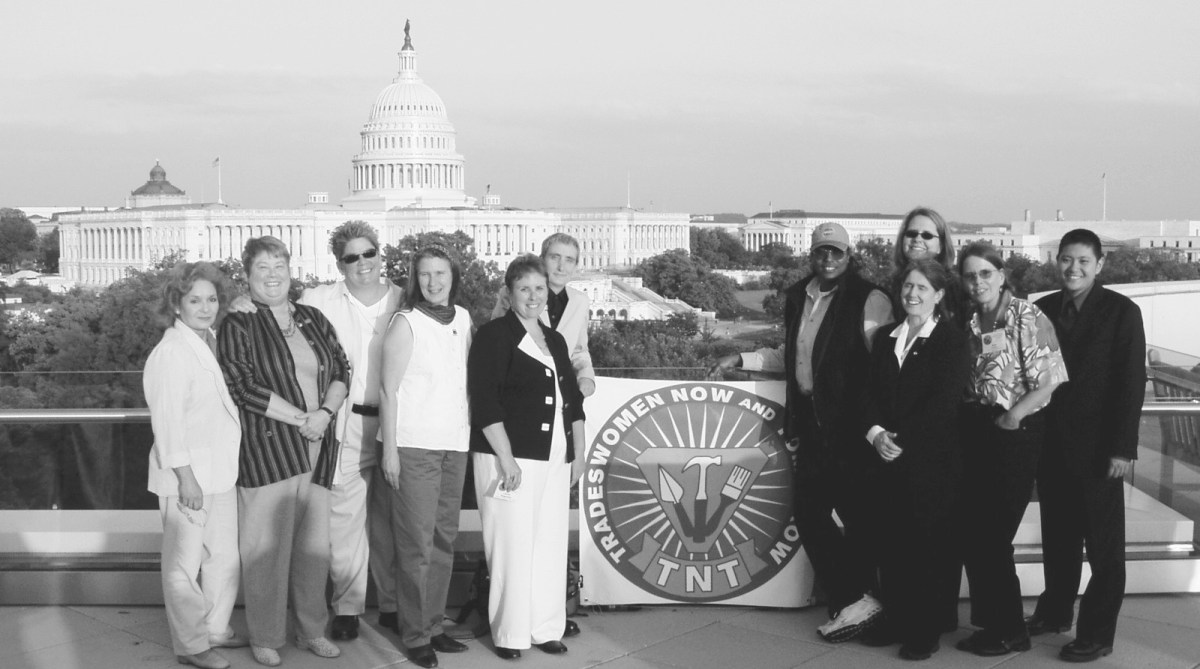
Tradeswomn Inc. is a nonprofit I helped found in 1979. Still going strong, the organization helps women find jobs in the union construction trades. Here’s the text of a speech I gave October 30, 2025 at Tradeswomen’s annual fundraising event.
Sisters, we’ve come a long way.
When we first started Tradeswomen Inc., we had one goal: to improve the lives of women — especially women heading households —by opening doors to good, high-paying union jobs.
It took us decades to be accepted by our unions. Decades of proving ourselves on the job, standing our ground, demanding a seat at the table.
And now — by and large — we’re there. We are leaders. Business agents. Organizers. Stewards. We have changed the face of the labor movement.
But sisters, we are living in a dangerous time.
Our own federal government is attacking the labor movement. And we cannot look away.
We all know that Donald Trump is gunning for unions. Project 2025 is his blueprint — a plan to dismantle workers’ rights and roll back decades of progress.
Let me tell you some of what’s in that plan.
It would roll back affirmative action, regulations we worked so hard to secure, Allow states to ban unions in the private sector, Make it easier for corporations to fire workers who organize, And even let employers toss out unions that already have contracts in place.
It would eliminate overtime protections, Ignore the minimum wage, End merit-based hiring in government so Trump can pack the system with loyalists, And — unbelievably — it would weaken child labor protections.
Sisters and brothers, this is not reform. It’s revenge on working people.
And yet, too many union members still vote against their own interests. Why? Because propaganda works. Because we are being lied to — by the media, by politicians, by billionaires who want to divide us.
That means our unions must do more than just bargain wages. We must educate. Engage. Empower. Because the fight ahead isn’t just about contracts It’s about truth.
We women have proven ourselves to be strong union members — and strong union leaders.
We’ve built solidarity. We’ve organized. We’ve made our unions more inclusive and more reflective of the real working class.
And now it’s time for our unions to stand with us.
Many of our building trades unions have stood up to Trump, and to anyone who would divide working people.
But one union — the Carpenters — has turned its back on us.
The Carpenters leadership has disbanded Sisters in the Brotherhood, the women’s caucus that so many of us fought to build.
They have withdrawn support from the Tradeswomen Build Nations Conference, the largest gathering of union tradeswomen in the world. They’ve withdrawn support for women’s, Black, Latino, and LGBTQ caucuses claiming they’re “complying” with Trump’s executive orders.
That’s not compliance. That’s capitulation.
But the rank and file aren’t standing for it.
Across the country, Carpenters locals are rising up, passing resolutions to restore Sisters in the Brotherhood and to support Tradeswomen Build Nations.
Because they know: You don’t build solidarity by silencing your own. And our movement — this movement — is built on inclusion, not fear.
While the Carpenters’ leadership retreats, others are stepping up.
The Painters sent their largest-ever delegation — nearly 400women —to Tradeswomen Build Nations this year.
The Sheet Metal Workers are fighting the deportation of apprentice Kilmar Abrego Garcia. The Electricians union is launching new caucuses, organizing immigrant defense committees, and they are saying loud and clear:
Every worker means every worker.
Over a century ago, the IWW — the Wobblies — said it best:
“An injury to one is an injury to all.”
That’s the spirit of the labor movement we believe in —and the one we will keep alive.
Our unions are some of the only institutions left with real power to stand up to the fascist agenda of Trump and his allies.
We have to use that power — boldly, collectively, fearlessly.
Because this fight is about more than paychecks. It’s about democracy. It’s about equality. It’s about whether working people — all working people — will have a voice in this country.
Sisters and brothers, we’ve built this movement with our hands, our sweat, and our solidarity.
Now — it’s time to defend it. Together. Solidarity forever!
The Black Freedom Movement and Tradeswomen History
I want to take us back in time and imagine a world, a culture, in which job categories were firmly divided between MEN and WOMEN. Women were restricted to pink collar jobs that paid too little to raise a family on or even to live without a man’s support. Even doing the same jobs, women were legally paid less than men. Married women were not allowed to work outside the home. Single women who found jobs as teachers or secretaries were fired as soon as they married. Black people were only allowed to work as laborers or house cleaners.
This was the world we fought to change.
Tradeswomen who have jobs today must thank Black workers who began the fight for jobs and justice.
The Black Freedom Movement has advocated for workplace equity since the end of the Civil War.
The movement gained power during and after WWII. A. Philip Randolph headed the sleeping car porters union, the leading Black trade union in the US. In 1940 he threatened to march on Washington with ten thousand demonstrators if the government did not act to end job discrimination in federal war contracts. FDR capitulated and signed executive order 8802, the first presidential order to benefit Blacks since reconstruction. It outlawed discrimination by companies and unions engaged in war work on government contracts. This executive order marked the start of affirmative action.
The fight to desegregate the workforce continued.
In the early 1960s in the San Francisco Bay Area, protesters organized successful picket campaigns against businesses that refused to hire Blacks, including the Palace hotel, car dealerships and Mel’s Drive-In. Many of the protesters were white students at UC Berkeley.
In August 1963, the march on Washington brought 200,000 people to the capitol to protest racial discrimination and show support for civil rights legislation. The civil rights act of 1964, signed into law by President Johnson, is the legal structure that women and POC have used to put nondiscrimination into practice.
But change did not come quickly or easily.
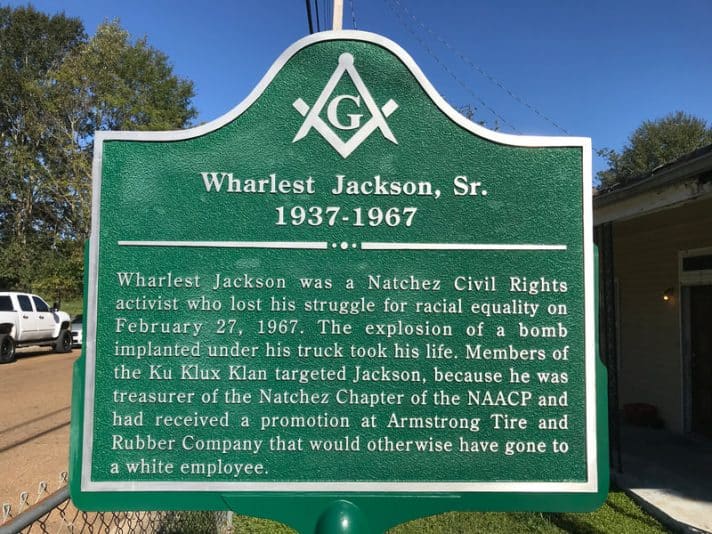
Black workers at a tire plant in Natchez Mississippi were organizing to desegregate jobs. The CIO, Congress of Industrial Organizations, supported them in this fight. In 1967, three years after the civil rights act became law, a Black man, Wharlest Jackson, who had won a promotion to a previously “white” job in the tire plant, was murdered by the KKK. They blew up his truck as he was driving home from work. No one was ever arrested or prosecuted for this crime.
Wharlest Jackson was the father of five. His wife, Exerlina, was among those arrested for peacefully insisting on equal treatment during a boycott of the town of Natchez’s white businesses. She was sent to Parchman penitentiary.
Jackson was just one of many who died for our right to be treated equally at work.
Tradeswomen are part of the feminist, civil rights and union movements. We continue to seek allies because we are few.
Discrimination has not ended, but, because of decades of organizing, our work lives have improved. We owe much to the Black workers who sought equity in employment for decades before us.
Wheelchairs were a highlight of my summer travel back home.
If you’ve never been disabled, it can be hard to appreciate disability. This is where construction workers have an advantage in sympathetic understanding. Most of us have been temporarily disabled at one time or other in our lives. We’ve had to butt crawl up the stairs, or learn to use the other hand with one arm in a sling, to navigate on knee scooters and crutches.
Buying lobbies. My first time in a store scooter. No crashes!
I’ve been temporarily disabled many times in my life, but returning from a trip to Maine was the first time I’ve ever gotten to ride in an airport wheelchair. It was awesome!
The wheelchair was a necessity after I sprained my foot getting out of bed. I know. Pretty dumb. I could tell my foot was asleep when I woke up, but I had to pee and thought I could walk on it. Not! I wonder why I’d never learned this lesson until now. Don’t try to walk if your foot is asleep! Wake it up first.
I had traveled to Maine to commune with the OTTERS (Old Tradeswomen Talking Eating and Remembering Shit). We are writing a book about the Tradeswomen Movement. For the last half century we have been agitating to help women enter the construction trades and other nontraditional jobs, and now we are recording our collective history.
OTTERS Dale McCormick, Elly Spicer, Ronnie Sandler, Lynn Shaw, Lisa Diehl, Liz Skidmore, me in front
It was great to see and hug my old friends from all over the country, many for the first time in years. Working together resulted in measurable progress on our book. We stayed in a beautiful country house. Plus we got our fill of lobbies (the Mainers’ word for lobster)!
Then the trip from Portland, Maine to Santa Rosa, California tested my enthusiasm for airplane travel.
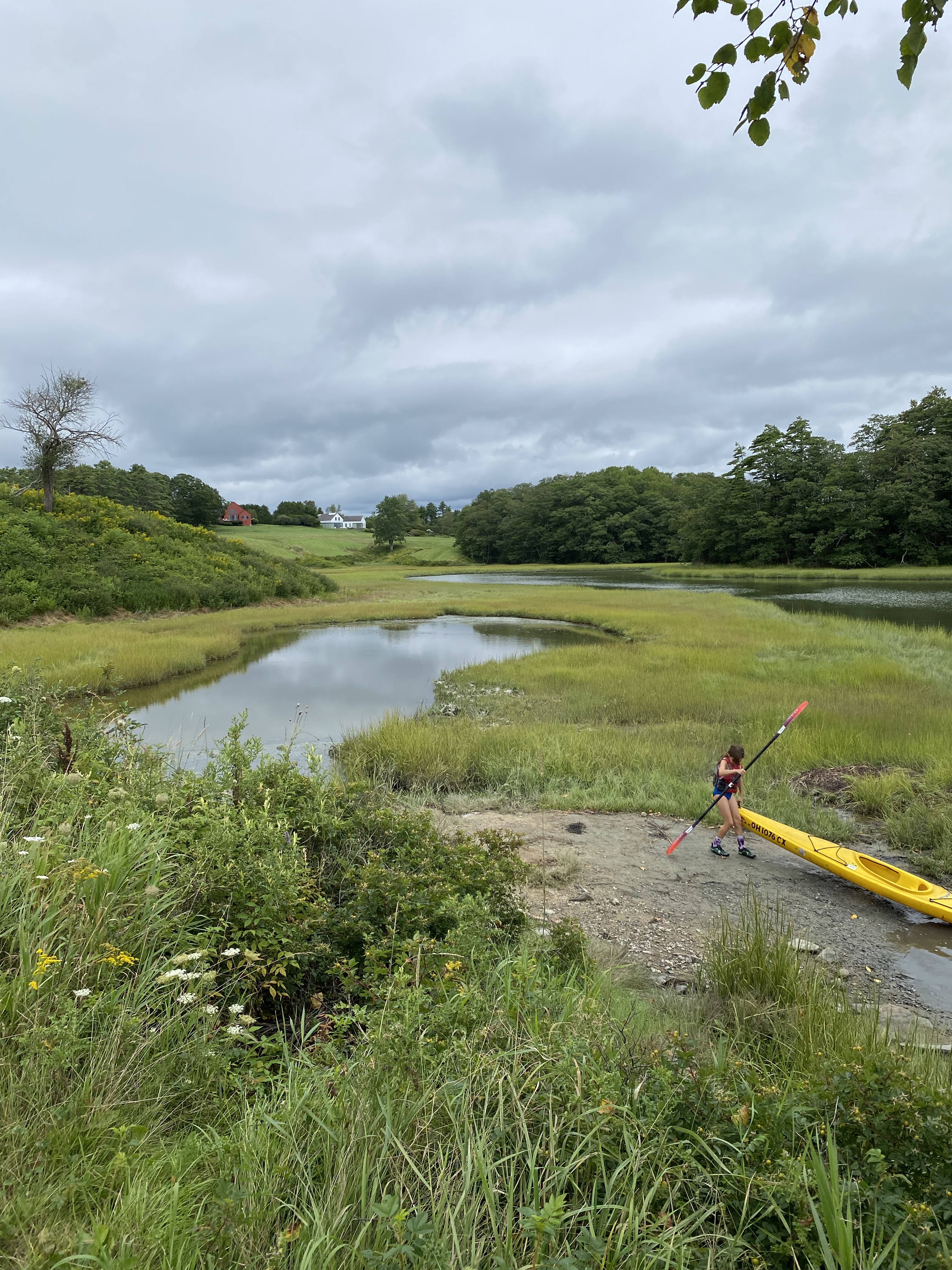
Our “cabin” is the red house, right near Wolf’s Neck Woods State Park
My long day of travel involved three airports. By the time I left Portland, on a warm muggy day, I still could not walk. My friend and Airbnb host, Marty Pottenger, loaned me a walker and, later, a cane. She suggested I call the airline to ask for wheelchair support. She drove me to the airport where I hobbled to the airline counter. She reclaimed the cane and I plopped into a streamlined wheelchair, pushed by a handsome gray-haired man. He said he was retired but worked at the airport two days a week to help make ends meet. I said, “Two days a week! That’s all any of us should have to work. The Wobblies called for a two-hour day but I think a two day week is better.” We talked about jobs we’d worked at as we crawled forward in the security line, and I realized it would have been hell standing in that line without the chair. He left me seated near the gate and went to pick up another disabled traveler.
I was relieved to be in the first group of passengers, those who need special assistance. My foot was healed enough to limp to my airplane seat without a cane.
My Airbnb host in South Portland, Marty Pottenger and her 1850 house
At the stopover in Charlotte, North Carolina there was one other disabled traveler besides me flying on to San Francisco. The young dreadlocked assistant grabbed both our wheelchairs at once, one in each hand, and pushed us at high speed through the packed airport. Charlotte is a big city of 880,000 people and its airport is huge. We flew through the foot traffic with some close calls, but never hitting any walkers. I felt like Casey Jones drivin’ that train. I wanted to see the airport art but was barely able to take in my surroundings. The distance from one gate to the other was far but we got there in plenty of time to make our flight.
At the San Francisco airport I was greeted by a man holding a wheelchair and a sign with my name on it. What service! This was another long trek that required an elevator. I was deposited right at the taxi stand where I caught a ride to a nearby hotel where my wife was waiting.
I had first planned to take the Santa Rosa airport bus, which runs till midnight from SFO but it would have left me at a bus stop two and a half miles from my house at 2am. I had thought I could walk home from there if necessary. Sometimes Uber and Lyft can be problematic at that time. But Holly came to my rescue. After a good night’s sleep she drove me home from the hotel the next day. Home looked pretty darn good and I’m relieved to be back on solid ground.
Reuniting with my activist buddies was wonderful but I wonder if I’m too old and crabby to fly across the country again. Flying used to feel like a fun adventure. Now it’s just a trial, this time made manageable by wheelchairs and their pushers.
I met her as part of a couple, Anne + Judy. They were both in the first class of women to break into the San Francisco Police Department after several years of pressure from the feminist community to integrate women.
There were two sides to this story. Some feminists thought cops were unredeemable and that women should never be cops. They said women would take on the racist and repressive world view of the police; they would be sullied by the job. I was an electrician and one of those working to get more women into nontraditional jobs. I thought women deserved access to those jobs and I even suspected that women might change the culture in the PD if given the chance.
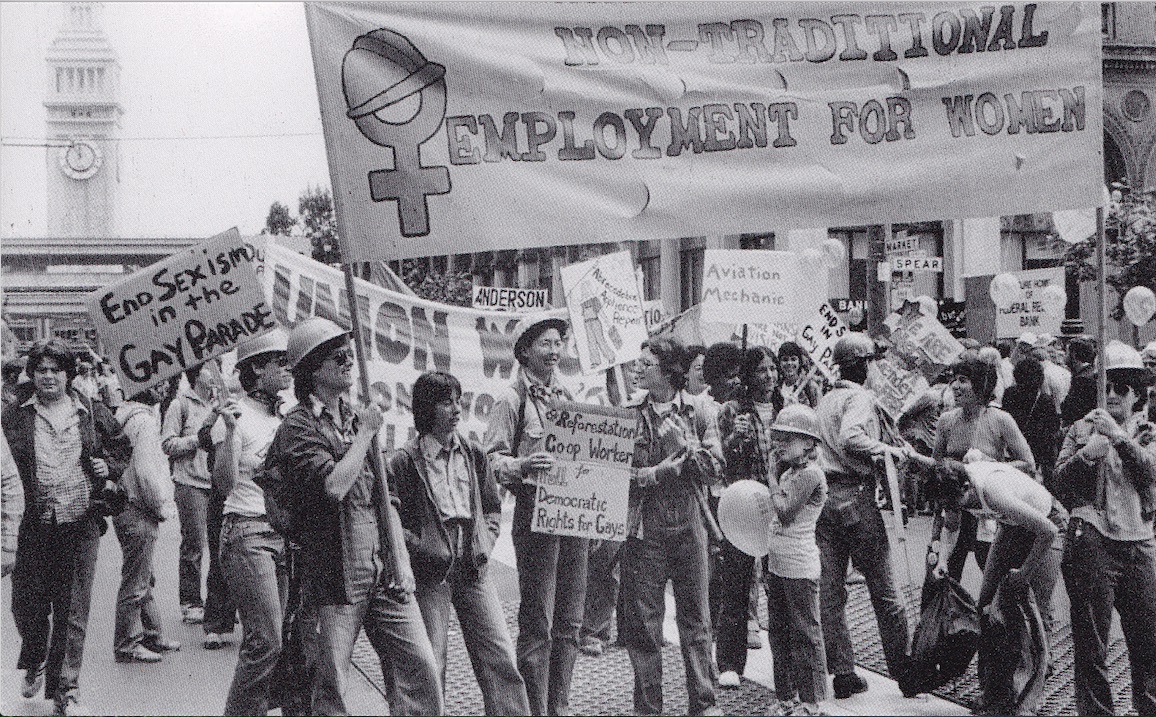
Kissing lesbians was a thing I did in June–Gay Month
Work life was tough for those first women, and they were on the front lines of the feminist movement to desegregate the workplace. They took the most shit from their male coworkers and bosses, who were almost all white back then in the 1970s. Men of color had been kept out too and the efforts of us activists to enforce affirmative action laws included all minority classes.
San Francisco 1979
Being in a relationship with another woman navigating the same sexist workplace was probably a main reason Judy and Anne both stayed in the PD and made good careers. My lovers, too, were women in the trades, the only people who really understood what I was going through at work. They provided the support I needed to survive on the construction site.
I knew Judy better than Anne. She was a feminist and out on the job as a lesbian. One time when I ran into her working the gay parade, I threw my arms around her and planted a big kiss on her lips. Yeah, you’re not supposed to do that to cops when they’re working. But kissing lesbians was a thing I always did in June–gay month. I was just so happy to be out in San Francisco, I had to pass around my good cheer.
I got to know Anne better in the early 90s after she and Judy had broken up. We had a mutual friend, a mystery writer, who used us both for expert background. (What kind of electric shock will kill a person? How would a killer behave in this situation?) I think the mystery writer was hoping there would be a spark of attraction when she introduced us. She confided to me that Anne was in a secret ongoing affair with a closeted columnist who wrote for the local paper. The columnist was also in a long-term relationship with a lover who did not know about Anne.
Are you following me here?
Lesbian relationships were tangled in that era as we thrilled to new freedoms and experimented with new models. Anne was the Other Woman and I was admonished not to tell anyone. I had practiced nonmonogamy zealously but eventually came to see that being the other woman, especially if you’re in love, spells heartache. I sympathized mutely. It can’t have been easy for her.
I had never tried to romance a cop
We bonded over the internet. I had a new 512K Mac and I wanted to learn to use email. Anne, who used the internet to research crimes and criminals, set me up on AOL. It was dial up. You had to understand acronyms like POP, HTTP and some other things like hardware and software. They all confused the hell out of me, never a tech wizard. I remember receiving my very first email message from Anne. She didn’t say anything sexy, but it was exciting, world changing!
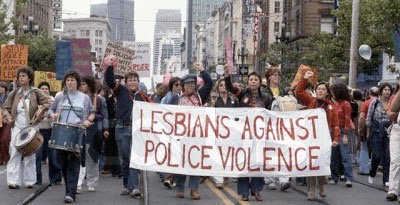
Was there an attraction? Well, sure. Anne was handsome, with shoulder-length dark hair and a muscular physique. She was handy. She had remodeled the Victorian house she owned in the Dogpatch neighborhood. I was impressed, and horny. But I had never romanced a cop. A veteran of protest marches, anti-war and anti-racism campaigns, I had been on the other side of many police barricades. I did not believe all cops were pigs as many did, but my generation of activists will never forget COINTELPRO, the police killing of Fred Hampton and so many others. Not to mention the attacks by the SFPD on our gay and lesbian bars and gathering places.
I was thinking about how I would undress her when she saw the stack of mail on my desk.
By that time I knew Anne well enough to know that we disagreed politically on just about everything. I figured she was one of those women who find it easier to not rock the boat and who identify with their male coworkers in order to survive on the job. Or maybe she’d been brought up in the 50s during the McCarthy era to hate communists. But, I reasoned, we didn’t have to talk politics. Maybe we could just have sex.
I managed to get Anne over to my house to help with AOL and I made lunch. An opening salvo. I imagined us moving into the bedroom after lunch.
I was thinking about how I would undress her when she saw the stack of mail on my desk. Right on top was a newsletter from the Committees of Correspondence, a democratic socialist group I was a member of.
“Are you a communist?” she asked, looking up.
She seemed surprised, but at that time I thought that most lesbians were leftists at least, if not communists. My friends and I were activists trying to rid the world of imperialism, racism and police violence. It wasn’t that weird.
“Well, yes,” I said. “Communist with a small c.”
“I could never be with a communist,” she sputtered.
“But,” I said, “you wouldn’t have to BE with me. We could just have sex.”
The look of horror on her face conjured the pain of the long-term other-woman relationship that I wasn’t supposed to know about. And probably she really did hate communists. She was a cop first and a lesbian second.
My disappointment didn’t last long. It never would have worked out. I hoped Anne would find the right woman, and I wondered if she would tell that woman about her own secret affair with the columnist. I never found out.
I first encountered Dar on a job site. The contractor had moved me there so he could meet affirmative action requirements for females on the job. This was a popular practice. Rather than just hiring more women, the company would hire one woman and move her around from job to job so monitors would count the same woman repeatedly. The job, a low-income housing project in Chinatown, received federal funding and so had to meet federal affirmative action goals for women and minorities. This was in 1980 when some regulators actually took affirmative action laws seriously and monitored job sites. Those days are long gone.*
Art by Victoria Hamlin
In those days women would often ignore each other when we were dispatched to the same job. We tried to be invisible and often, when there was only one of us, we got away with it. But as soon as two women started talking or working together, an undercurrent of anxiety rippled among the men. For a brief period on one job I got to work with a female apprentice.
“What do you two talk about?” asked one of the electricians. “Are you talking about the size of our dicks?”
This hadn’t occurred to me. Women might talk about the harassment we endured on the job or, more likely, how to work together to complete the job at hand. Dicks, drawn in profusion on the walls of the porta potties, did seem to hold a prominent place in the imaginations of some of our coworkers.
Kathryn (Kathy) Goodwin Photo Victoria Hamlin
Women knew that if we spoke to each other our male coworkers would notice. Straight women didn’t want to be painted with the dyke brush, and most lesbians were still in the closet and didn’t want the brush either. Dar didn’t worry about such implications. She was a big mouthy white woman with buck teeth and a head of bleached blond hair. On the job site you couldn’t miss her. She did not melt into the woodwork. My first day on that job, the Chinatown low-income housing project, she introduced herself as we passed each other on the deck.
“So you’re the affirmative action hire,” she said. “I guess they needed another chick.”
I wasn’t wild about being called a chick, but she had a point. Federal affirmative action regulations were the only reason I was on that job. Our short conversation made me think Dar didn’t like women any more than the men on the job did. She didn’t seem like a feminist sister.
Jake Calabro sewage treatment plant utility plumber. Photo Victoria Hamlin
For a couple of days I was pulling Romex through holes punched in metal framing. Then they pulled me off that job and put me on another where the regulations said they needed a woman. Fine with me. It all paid the same—a good wage previously reserved for men only. Dar was likely in the same boat. The plumbing contractors had a reputation for hiring even fewer women than the electrical guys. After they could check off the number of female hours worked, they could lay us off.
A couple of years later after a couple more layoffs, I scored a full-time maintenance job with the San Francisco Water Department. I worked out of a corporation yard in the southeast industrial area of the city, looking after all the motors that ran pumps that supplied water to the city. That’s when I ran into Dar again. She had been hired for a job in the plumbing division. The crews of plumbers worked installing new services all over the city, usually in big holes in the street. Or they might be required to repair a main break. The job was wet and muddy.
Molly Martin and Kathy Goodwin Photo Victoria Hamlin
I didn’t see much of Dar, as the plumbers were out of the yard working in the street all day. But I heard about her. A story in the grapevine told of Dar punching out a coworker who had harassed her while they worked in a trench. I never heard what was said. That was before the rule was imposed that fighting on the job would get you fired immediately. Dar was not the first plumber to make use of fists to manage a dispute, but she was the last to do so and avoid getting fired.
The day I saw the T-shirt was a maintenance nightmare for the water department. One of the big pump stations that housed 100 HP motors flooded. The motors sat in wells in the concrete floor and so were vulnerable to being overtaken by the quickly rising water. I could see it wouldn’t be long until the motors were under water. The team of plumbers worked fast to staunch the leak.
Carole Lee Photo Victoria Hamlin
My only job as electrician was to cut the power to the motors and that was just a matter of disconnecting circuit breakers in a huge panel on a higher level, though if the water rose high enough that panel, too, would be in peril.
That’s when I spotted Dar, down in the pit with a cluster of men. She wore a T-shirt with a message in big print:
Feeling a little sexy?
Go fuck yourself
No one said anything aloud about the message on Dar’s shirt, but it shocked me. I couldn’t imagine wearing it myself, as much as I agreed with the sentiment. I didn’t have the guts to wear that shirt.
I had to give Dar credit. Maybe she wasn’t my kind of feminist, but she was some kind of feminist.
Amy Gray Schlink Photo Victoria Hamlin
*Affirmative action in the construction industry really only lasted a short time before Reagan killed it. In California the death knell was dealt in 1996 when Ward Connerly put affirmative action on the ballot. In the meantime some of us were able to get a foot in the door and advocate for the hiring of more women. But women still make up only about three percent of the construction workforce. We were the forgotten recipients of affirmative action and we could benefit from a renewed commitment to it now as the Supreme Court threatens to end it entirely.
For the past several years I’ve been meeting on zoom with a group of old women trades workers and organizers as we discuss and record our collective history. We call ourselves the OTTERS (Old Tradeswomen Talking Eating and Remembering Shit). Since the 1970s we have fought to open jobs for women and minorities that had been closed to us, like construction work. Affirmative action was our issue and for a short time during Jimmy Carter’s administration, we had support from the federal government. Our fortunes reversed after the election of Reagan, whose labor policies were crafted to push women out of the workforce and back into the kitchen. Our vision of employment equity became much harder to realize, but we didn’t stop. We’ve created training programs and tradeswomen organizations that have opened opportunities for women all over the U.S. We wanted to thank President Carter for his part in the success of our movement, so we wrote him a letter.
The Honorable Jimmy Carter The Carter Center 453 Freedom Parkway NE Atlanta, GA 30307
Dear President Carter,
We are writing to thank you for supporting Affirmative Action and Equal Employment Laws while you were in the White House and beyond. More importantly, we want to thank you for enforcing those laws. It made a difference for us and so many other women who were able to enter the construction trades because of your commitment.
We are a group of older tradeswomen from around the country. We have come together to share stories, remember old times, and to document our history.
We are the OTTERS. Old Tradeswomen Talking, Eating and Remembering Sh#*.
During several of our meetings we were trying to figure out when and what was the ‘watershed’ moment when we began working together. We had been working in our respective states but then something happened. You may wonder what it was that brought us together and allowed us to begin meeting and working on a national level to reach out to women and Black, Indigenous, and People of Color (BIPOC) for training in trade and technical jobs.
We agreed it was, in large part, due to you and your administration’s commitment to equality. Enforcing the laws and ensuring those enforcement agencies were properly funded and staffed.
Many of our OTTERS members started Tradeswomen organizations that provide pre-apprenticeship training for women and find partnering with Habitat for Humanity a wonderful experience for our students. Many of us are still engaged in advocacy and still working toward a more diverse workforce. You continue to be an inspiration to all of us. Thank you.
Yours in Equity,
Lisa Diehl, West Virginia
United Brotherhood of Carpenters 7 years
Co-Chair 2nd National Tradeswomen Conference
Non-Traditional Advocacy 30 years
Founder, West Virginia Women Work
Dr. Lynn Shaw, California
Miner/Steelworker/Longshoreworker/Electrician: 25 years
Founder of WINTER, Women in Non-Traditional Employment Roles Los Angeles
Ronnie Sandler, New Hampshire
First woman in any of the building trades in Michigan 1976
Carpenter and contractor for 12 years
First woman to work highway construction in the state of New Hampshire
Designed and ran trades training programs for women Michigan, Vermont, and New Hampshire
On site compliance officer for Maine Department of Transportation 3 major bridge projects
Nettie Dokes, Washington
International Brotherhood of Electrical Workers Line worker 30+ years
First African American woman Line worker (high voltage electrician) in US
Seattle Women in Trades Executive Board 25+ years
Pre-apprenticeship instructor 15 years
President and CEO of Workforce Alchemist-a consulting firm for Women in Construction 5 years
Connie Ashbrook, Oregon
Elevator Constructor 17 years
Founder and Executive Director (retired) Oregon Tradeswomen Network
Dale McCormick, Maine
First woman Journeyman in US Carpenters Union, 51 years
Founder and Executive Director of Women Unlimited Maine
Northeast Women in Transportation
Elly Spicer, New York
United Brotherhood of Carpenters New York City, 35 years
Apprenticeship Training Director 3 years
Kathy Augustine, Ohio
Computer Systems Electronics Technician 15 years
Executive Director (retired) Hard Hatted Women, Cleveland 16 years
Kipp Dawson, Pennsylvania
Coal Miner 13 years
Public School teacher 23 years
Coal Miner and Activist in United Mineworkers of America 13 years
Coal Employment Project- Coal Mining Women Support Team since 1979
Betty Jean Hall, Florida
Executive Director & General Counsel
Coal Employment Project- Coal Mining Women Support Team 1977-1988
Lauren Sugerman, Illinois
Elevator Constructor 6 years
Founding Executive Director of Chicago Women in Trades 23 years
Founder and Director of the National Center for Women’s Equity in Apprenticeship and Employment
Marge Wood, Wisconsin
Plumber 12 years
United Association UA union member 35 years, Madison
Apprenticeship Consultant, WI Technical College System 24 years
Serving on the board of a law firm with a bunch of high-powered lawyers turned me from an articulate leader to a person who doubted my own abilities.
The non-profit law firms, Equal Rights Advocates (ERA) and Employment Law Center (ELC) partnered with my organization Tradeswomen Inc. (TWI) on critical projects during the 1980s. Our goal was equity in employment and specifically integrating the construction trades which had excluded women and people of color from high-paying jobs.
I loved the lawyers at ERA because they thought outside the box. They understood that social movements cannot be all about litigation and they were willing to work with us to try other tactics.
Sometime during the ‘80s, after having worked together on a lawsuit, I was invited to lunch by the director, Nancy Davis and staff attorney Judy Kurtz (it was a cheap Mexican place South of Market near the ERA offices). They sat me down and asked if I would like to join the ERA board of directors. I was delighted. I was surprised. I was flattered. Could they really want a tradeswoman activist to sit on their board with a bunch of big law firm attorneys? Of course I said yes.
I was no stranger to boards of directors. TWI had been a 501(c)3 since 1979 and I served on its board. At that time, I was also on the board of Women in Apprenticeship Program (WAP) along with another tradeswoman, carpenter Tere Carranza. But this was different. I would be the lone blue-collar worker among 10 or 15 attorneys. I did understand that my role on the board would be “client representative” and I was happy that ERA sought out such representation. I vowed to be the best client rep ever.
Rooms with a View
ERA board meetings took place in the high-rise offices of big San Francisco law firms where the board members worked, usually in the boardroom, always with an impressive view of the city. I could not stop oooing and ahhing and realized I never would have gotten into these exclusive places otherwise (except that as an electrical inspector I sometimes got to inspect high-rise construction sites). Occasionally they would be held in the crowded, run down ERA offices in the slummy South of Market neighborhood.
Unlike the TWI board meetings, where the board doubled as the staff (we called it a working board), ERA board meetings benefited from staff backup. We got a packet of material with minutes, agenda and background information. We got the benefit of expert consultants’ advice. Meetings were well organized and informative. I rarely had much to say.
My presence was more useful for fundraising. I would come to meetings with foundation program managers dressed in Carhartts, hard hat in hand, a real live example of ERA’s final product—a woman with a high paying trades job. My individual fundraising contacts were few, and I had already maxed out the contacts I had. Friends, I feared, would avoid me on the street so as not to be asked for money to support TWI, which was always in debt.
Still, I could make calls to moneyed folks when a list was handed to me during fundraising campaigns. We usually worked in pairs, and one time I sat at lunch with my comrade and asked a patron for $10,000 (we got it).
These forays into the world of wealthy lawyers sparked a range of mixed feelings and increased my awareness of class. I was constantly comparing the wealth of ERA (actually a rather poor nonprofit) to the poverty of TWI whose continued existence its board of directors was also responsible for. I wished I could take the list of potential donors and ask them to support TWI (I never did, of course). I knew I could make a good case. The truth was that our two organizations collaborated and we were all better for it.
I was already conscious of the class differences between me and the other ERA board members, but the difference in the fortunes of the two organizations strained them further. I was the poor relative, grateful for any crumbs that came my way. The feeling was especially magnified when we met with foundations. I remember a meeting with the representative of the Rockefeller Foundation at a time when Tradeswomen’s fortunes were sagging, one of the several times the organization nearly went under for lack of funding. The Rockefeller woman was young, chatty, dressed in fashionable New York attire (I wore my electrician work clothes). I felt so desperate in her presence that I had to keep myself from prostrating myself at her feet to beg for money.
Poor Forlorn and Angry
I had taken on the identity of my poor failing organization. I felt poor and forlorn—and angry.
During my years on the ERA board I did speak up occasionally when I thought a working class or lesbian voice needed to be heard. Lawyers, even progressive ones, can be conservative. One time the board president, who was a woman of color, gave me a dressing down right in the meeting.
“You are not the only person here who has faced discrimination,” she admonished me. Her public criticism stung. I honestly don’t know what I’d said to set her off. But I suddenly became aware of resentment flowing toward me and wondered if others on the board shared her feelings. I had thought myself a powerless person in this group. Suddenly I had power, if only negative power.
The ERA staff did appreciate my perspective and when the board president stepped down I was asked to take the position. But I had lost confidence in myself and I turned it down. What had happened to me? I certainly knew how to run a meeting, a skill I’d perfected as a kid in 4-H. I’d been leading meetings of tradeswomen for years.
Blow Up
I had never been close to the staff, or board of ERA for that matter. Staff attorney Judy Kurtz and I had a good professional relationship; we had worked together on many projects. Then, as happens with so many organizations, the founder’s impending retirement in part led to a blow up. The suggested reorganization didn’t work; the woman chosen for a newly created position was, as they say, a bad fit. I confess when I tried to discuss tradeswomen’s issues with her, she seemed clueless. Some staff resented not being considered for the position. In good faith, the leadership had hired outside the staff, seeking more diversity. But we suddenly realized how fragile relationships within the organization had become. I quickly got to know the staff and talked to them trying to understand what was happening. It was a mess. (Another issue was the plan to hire part time staff, possibly to avoid paying benefits.) Everybody was pissed off and some relationships never recovered. When the board, looking for a scapegoat, took aim at Judy, I resigned.
Tradeswomen Inc.’s relationship with ERA continued after I left the board, but the new board of directors had different ideas about the mission and goals of the law firm. They eschewed any activities not related to policy and litigation. ERA had been the leader in building coalitions within the civil rights community. For a small organization and constituency like tradeswomen, association with a larger civil rights community was necessary to achieve even notice, let alone long-term change. We felt privileged to be part of coalitions working to achieve racial and gender justice.
Also, all of us were aware that the power of organizations like ours was concentrated in the East. We were doing amazing work out here in the West, but few policy makers noticed.
Noticed by Ford
Tradeswomen continued to push ERA to help us fight discrimination in the building trades, and we got a chance at new programs when the Ford Foundation took notice in the early 2000s. The program manager was a friend of someone and that’s how we got an interview with her. ELC was also interested in the promised $600K. Tradeswomen participated in meetings, but program ideas seemed vague. We kept trying to get a better sense of them. The ERA rep who was working with us came with us to Denver for a national tradeswomen conference. All was happy. We were sisters in struggle. Only later did we find out that ERA was awarded the money with no stipulations to create programs for tradeswomen. We felt used by ERA. ELC got left out of the loop and this resulted in strained relations between the two law firms. Some staffers cut ties with ERA entirely. All over money. Of course, Tradeswomen had learned this lesson in the past. Funders, and especially the federal government, make all of our organizations compete for a tiny sum of money they allocate to programs.
Lessons for the Future
What did we learn from our years’-long collaboration with ERA and ELC?
*Small organizations like Tradeswomen need to find partners. We can’t do it alone.
*Litigation can be crucial to civil rights movements, but cannot be the only tactic.
*Relationships are important, more important than money.
*In our “classless society” class is still a thing.
The envelope delivered to my small flat in San Francisco’s Mission District, shared with three other women, was fat with a far away return address. I knew what it contained even before opening the envelope—a cry for help—and I also knew there would be nothing I could do about it.
I was already involved in the tradeswomen movement when I relocated to San Francisco from Seattle in 1976. As a publicly identified tradeswoman activist, I would get letters from women all over the country complaining of horrific harassment and discrimination in nontraditional jobs. I felt powerless. We didn’t even have an organization, let alone a program to help. What these women needed was a good lawyer.
During the 1970s, we activists formed organizations all over the country. In 1979 we started a nonprofit, Tradeswomen Inc., to provide support and advocacy for tradeswomen, but we weren’t able to secure funding. With no staff we were run by volunteers—unemployed tradeswomen.
Enter Equal Rights Advocates (ERA), a law firm begun in 1974 by feminist lawyers with a focus on defending women’s employment rights. I remember sitting around on the floor in somebody’s living room in the late ‘70s strategizing about how to open up jobs to women that had traditionally belonged to men. That’s when I met Judy Kurtz, a staff attorney at ERA, and we began to collaborate. Later I served on the ERA board of directors for many years.
Looking at the Big Picture
Ours was an anti-poverty strategy. The feminization of poverty was a popular buzzword (still applicable today). Women, especially female heads of households, were becoming poorer and poorer in relation to men. Well-paid union jobs in the construction trades could lift up our gender if we could open them to women. Apprenticeship programs in the construction trades like electrical, plumbing, carpentry, ironwork, and operating engineer only require a high school diploma or a GED to enter. Then the training is free and the apprentice works and earns a wage while she is in school. There are no college loans to repay. We saw these jobs as a path to financial independence for women.
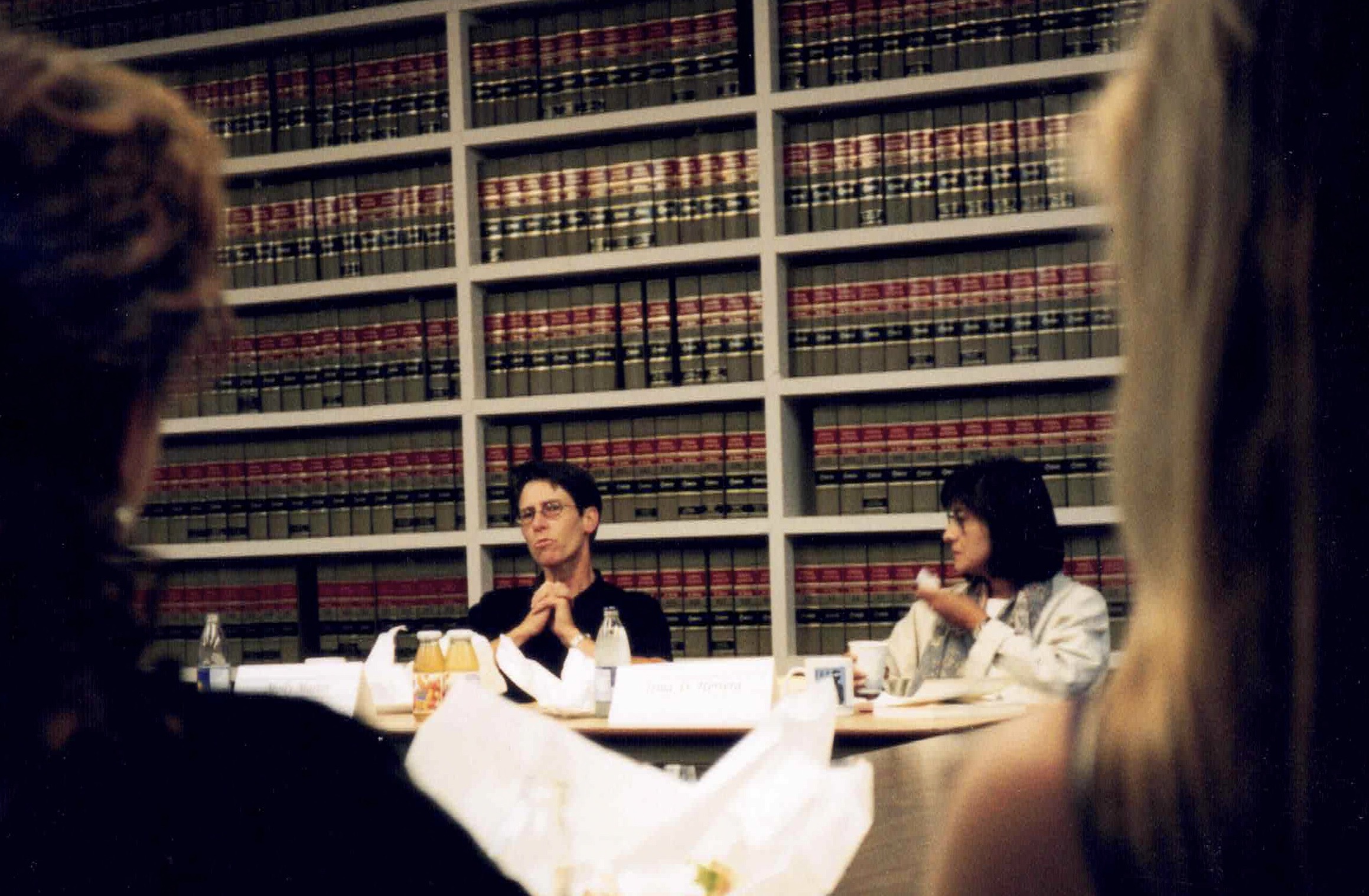
Brown bag discussion at ERA with me and Director Irma Herrera
ERA had been part of a national class action lawsuit against the US Department of Labor which resulted in the creation of federal goals and timetables for women and minorities in the construction trades. New regulations took effect in 1978. The goal was to have 6.9 percent of the construction workforce be women on federally funded jobs. Having federal law on our side buoyed us while Jimmy Carter was president, but as soon as Ronald Reagan took office in 1981, federal affirmative action laws and guidelines were no longer enforced. We had to be creative. We decided to focus on the state level where there was still some commitment to enforcing affirmative action regulations.
Focus on California
Tradeswomen Inc. was fortunate to work with lawyers who were willing not only to take our individual cases, but also to help us strategize about using class action lawsuits to desegregate the workforce. We wanted to make law, to actually create change.
The building trades in California include about 35 apprenticable trades and each trade has a union with different rules, and each union has many locals throughout the state. Not a single apprenticeship program out of hundreds in the state was even close to meeting goals for women’s participation. What could we do to get them to comply?
By 1980 we had some history with all the players. Our partner, Women in Apprenticeship Program (WAP), was placing women into trades apprenticeships in California, working with the apprenticeship program directors and compliance officers.
The unions were a huge barrier to women but we chose not to take legal action against unions. Our goal was to work with unions, be part of the union movement. Besides, there were so many! So we decided to sue the enforcer.
Suing the State
The State Division of Apprenticeship Standards (DAS) oversees apprenticeship programs and is charged with enforcing affirmative action goals, but they would routinely give a pass to programs that claimed to have made a “good faith effort” to meet the goals. Partnering with Tradeswomen Inc., ERA filed suit against DAS for failure to enforce the goals. The lawsuit resulted in a requirement that the state produce quarterly statistical reports which allowed us to evaluate their progress. We might have had some small impact on the DAS, but we had to take them back to court for contempt five years later. Nothing had really changed.
Then we took on the DAS through the Little Hoover Commission, which investigates state government operations. The public testimony of many tradeswomen got attention, even an article in the New York Times. The investigation ended with DAS getting its funding cut by the Republican administration, which did nothing to help our cause.
Then came a period when DAS made a big turnaround on our issues. It was during the administration of Gray Davis, the Democratic governor elected in 1999. He was only in office for three years when the Republicans mounted a successful recall campaign against him. Davis appointed a friend of tradeswomen to head the DAS, Henry Nunn, a Black man from the painters’ union. Suddenly there was some funding to promote women in trades and we partnered with the state agency to sponsor some great programs, like the dedication of the Rosie the Riveter park in Richmond where we got to commune with the Rosies, and a trades day for Bay Area high school students. We loved working with the DAS staff, a bunch of smart feminists. But when Arnold Schwarzenegger took over as governor, he brought back into state government all the guys from the previous Republican Wilson administration, and Henry Nunn was axed. It did show us that the state could do the right thing with the right leadership. It also reinforced our impression that Democrats are way different from Republicans.
Part of the Civil Rights Movement
From the very beginning we saw ourselves as part of the larger movement for civil rights and we worked in coalition with other civil rights groups to publicize and also to defend affirmative action programs. In 1977 we were active in a coalition that formed around the Bakke case, which upheld affirmative action in college admission policy. We also partnered with ERA and other civil rights organizations to oppose proposition 209, the anti-affirmative action initiative in 1996 (we lost, and a proposition to overturn 209 in 2020 lost). Some of our partners in the West Coast coalition included Bill McNeill of Employment Law Center; Joe Hogan, retired OFCCP; Tse Ming Tam of Chinese for Affirmative Action (CAA) and their founder Henry Der; Eva Paterson of the Lawyers Committee for Civil Rights; and Superlawyer Brad Seligman. These are luminaries in the social justice sphere and we were so lucky to have their support.
Tradeswomen Monitoring Network
We also collaborated on other projects involving coalition partners like trades unions and the Human Rights Commission. We went to lots of meetings of DAS and its community body, the California Apprenticeship Council to make the labor community aware of their responsibilities. Susie Suafai, who had directed WAP, was hired to monitor the Oakland federal building project—one of the few projects to meet federal affirmative action goals.
This willingness of ERA to use staff time to advocate for us as well as litigate was a huge plus. Litigation was important to our movement, creating the original goals and timetables and affirmative action regulations so crucial for women’s entry into these jobs. But we knew well that litigation alone does not make a movement.
As class action lawsuits became harder to win, and courts were filled with Republican-appointed judges, litigation was a less effective strategy for change. Tradeswomen and ERA continued to look for ways to work together. In the early 2000s we applied together for a grant from the Ford Foundation. ERA received the grant, but Tradeswomen saw none of the money, nor did any program result as far as we could tell. We felt used and the relationship foundered. Another casualty of this fight for funding was ERA’s relationship with the Employment Law Center, a partner in the DAS suit and other related discrimination lawsuits. ELC was directed by Joan Graff, another hero in our battle for affirmative action. This is just one example of how the fight for funding pitted organizations with similar goals against each other.
The ‘80s saw the decline of affirmative action. The ‘90s was a period of working to keep in place the laws and regulations we had fought so hard for, even though they weren’t being enforced. President Clinton appointed Shirley Wilshire as head of OFCCP. She came out of National Women’s Law Center, one of our coalition partners.
We put together a national coalition to pressure the OFCCP to enforce the regulations and increase the percentage of women on federal contracts. We had the support of the White House, but Congress was controlled by Republicans. We planned to file an administrative petition asking for higher goals for women and enforcement of federal regulations, but Wilshire and federal officials argued that we should keep our heads down and hope that Congress didn’t notice and remove the enforcement regulations entirely.
Tradeswomen activists learned about the laws that affected us and we continued to pay attention to the law as it changed through the years. The biggest change for us on a day-to-day level was that sexual harassment was made illegal. This happened not through the passage of a single law, but through a series of court cases with a lot of nudging from the feminist movement. The work of Eleanor Holmes Norton was key.
Today we still rely on ERA and feminist lawyers to push the federal government to meet its affirmative action goals on declared“mega projects” (the only goals still in effect in California). We have entered a period of backlash. While trades have opened up to women technically, we still face discrimination and our ways of fighting back have been restricted.
Al and I first met when I walked into the open door at Summit pump station. He was kneeling on the concrete floor painting one of the pump motors that supply water to the city of San Francisco. When he saw my figure standing in the doorway he jumped back, like I was there to assault him. That gave me a little jolt of power—that a man might be startled by me. Yeah, I thought to myself, I’m a big strong woman and men flinch at the sight of my form. But there was a safety issue. The pump stations are situated in remote parts of the city. And I wasn’t supposed to be there. Or, in reality, no one knew where I was at any particular moment. As the one electrician responsible for all the stations, I kept my own schedule, responding sometimes to complaints or work orders and sometimes just checking to make sure the electrical equipment was working.
“Hey,” he said, squinting at me in the sun glaring through the open door. “Who are you?”
“I’m the electrician. Who are you?” I answered. But I knew he was a stationary engineer. Painting motors is part of their job.
The corps of engineers worked out of the Lake Merced pump station where they reported to the chief engineer, Joe. I thought I’d met all of them at one or another pump station. But Al was a retiree just filling in for a coworker who was in rehab. I figured he was about three decades older than me, a small redhead still with a good bit of hair left. He reminded me of a leprechaun—little and cute. We liked each other immediately and over the course of a few months we became friends. Not the kind of friends who see each other outside of work. But we would share personal information that we might not share with others.
There was one other engineer I was tight with, Jesus, and he would sometimes meet up with me and Al at lunch break. Jesus was transitioning from male to female and had been taking hormones for a few months. He had saved up enough money for the operation and was in the process of scheduling it. Al told me Jesus had announced to their fellow engineers that he now wanted to be called Rosa.
“How did they react?” I asked, thinking that must have taken some courage.
“They looked at their hands and didn’t say anything,” he said. “Just some snickering.” Knowing that he was planning to transition, his coworkers had ignored Jesus and refused to talk to him. Now that he was Rosa, the treatment would be no different.
Jesus told me he had known he was really female from the time he was a child in Mexico. A generally happy person with a positive attitude, Rosa was positively delighted to finally be female, to be herself. I thought she radiated serenity.
I wish I could say the transition was seamless for me, that I found it easy to switch from Jesus to Rosa, but I found it difficult. I had gotten to know this person as Jesus and now it was like I was having to start all over again. The pronoun thing confounded me. Back in the day we feminists had pushed to rid the English language of male and female pronouns, but the idea never took hold. I dearly wished for those genderless pronouns whenever I screwed up, but Rosa was forgiving.
I was suspicious of most of the men at work. Let’s just say they didn’t welcome me, the lone female, into the fold. I tried to give them as little information about myself as possible, assuming it would be used against me. I knew that I could not be friends with these men. But I had begun to feel differently about Al and Jesus.
I learned that Al was married to a French woman, that they had no children. I learned that he had been around the world as a seaman. Like many of the engineers, Al had learned his trade in the Merchant Marines. I knew some things about the Merchant Marines—that the celebrated San Francisco Communist Bill Bailey had been one and that he was not the only commie. I knew that the mariners had performed a vital service in World War II, risking their lives to supply materiel to the fronts. I knew that, while they weren’t part of the military, the merchant navy had suffered a higher casualty rate than any branch of the military. Their boats were always being torpedoed. Then, after the war, they were attacked and denied any benefits because they were all branded as communists, which of course most of them were not. They were just civilian patriots willing to risk their lives to protect the lives of others.
I knew enough to gain some trust with Al before asking but I had to ask, “Were you a Communist?”
All I got was a wry smile, enough to let me know I should stop asking questions.
But that was enough for me. I call myself a communist with a small c, more of a new leftist. I’m always delighted to meet up with the old commies, for whom I have great regard. They don’t always want to admit past affiliations. Most of the Reds were disheartened by knowledge of Stalin’s murderous legacy. Many were hounded for years by Hoover’s FBI. Jobs were lost and lives ruined.
Now it was 1985, the depths of Reaganism, which made all of us minorities jumpy and skittish and gave our detractors permission to be openly hostile. The AIDS epidemic was ravaging San Francisco’s gay men’s community while Reagan refused to even acknowledge the disease. Women—feminists–had come under attack along with anyone who didn’t fit into the back-to-the-fifties scenario. Immigrants, transgender people and communists too. Maybe that’s why the three of us gathered, just to know we weren’t alone.
Jesus, now Rosa, had begun presenting as female, letting her hair grow and wearing women’s clothes. But she didn’t really look that different than before. We all wore work clothes. My work outfit consisted of boots, canvas work pants, a T-shirt with a flannel shirt over the top, and when it was cold a wool-lined vest or jean jacket. A hard hat was not required on this maintenance job and I didn’t have to wear a tool belt. I carried my hand tools in a leather tool bag. And I drove a truck painted Water Department colors, Kelly green and white, in which I carried wire, pipe, benders and all the other tools and material I might need. Rosa, when dressed in work clothes, looked like me.
Me in my San Francisco Water Department truck
Rosa was the first transgender person I got close to, but I was not completely naïve. Ire had been raised in the tradeswomen community when we learned of a transgender female carpenter in our midst. She had transitioned after working as an already skilled male carpenter. She was getting work while we were frozen out because we were women. The contractor got to count her as an affirmative action hire. It didn’t seem fair. Then there was a continuing dustup in the lesbian community about a transgender sound engineer who worked for Olivia Records, the women’s music company. She had been trained while still male. We women wanted to do everything ourselves, but we didn’t have the skills because we couldn’t access the training. It’s possible that when the engineer, Sandy Stone, was hired, there were no other female sound engineers. Some lesbians were quick to attack the individual, but most of us understood that our real enemy was the system that discriminated against women.
At lunch one day Al told us some war stories. He said he had survived a torpedo attack where some seamen had died. I tried to imagine his life on those ships. I’d heard the gay historian Allan Berube’s lecture and slide show about sailors and soldiers during the war. They were all having sex with each other, especially the sailors. I knew Al wasn’t gay but I suspected he’d participated in gay sex.
I had allowed myself to relax a little with Al and Jesus. I came out to them. We talked politics. We all hated Reagan. I had started to feel comfortable with these guys.
Then one day while Al and I worked together he confessed that his wife no longer wanted to have sex with him and he was super horny. Did I want to have sex with him? It wasn’t as if men at work had not come on to me before. This was the typical way they did it; they would complain about their wives and that would be the opening. But I was shocked to hear this from my friend Al. I’d been solidly in the friend category I thought. Suddenly I was in the gal toy category. Or was it the whore category? Weird.
I said, “Al you know I’m gay. I’m not attracted to men.” Which wasn’t entirely true. I’d lived much of my life as a practicing heterosexual.
“Well, maybe you have friends who might want to have sex with me,” he said. And for a moment I actually considered the question. I definitely had horny friends. But who might want to have sex with Al? What would his personal ad look like? “65-year-old leprechaun seeks sex with any female. Age not important. Nothing else important.”
Then I was grossed out thinking my friend Al wanted me to pimp out my women friends. Then I was disappointed that our friendship was not what I had thought it was.
“So you only have sex with women?” Al asked.
“Well yeah. That’s what being a lesbian means. Maybe I’m not as sexually fluid as you. I know what y’all did on those ships.”
No response except that wry smile again.
That interaction changed my relationship with Al, but he may not have even noticed. Like many men he lacked a certain amount of sensitivity. On the other hand, his size and his politics—his minority status in the world of men—engendered more empathy than most.
So now I started thinking Al was like all the other guys. I stopped feeling so safe around him. Not that he might attack me. No, I was pretty sure I could take him in a fight. I was bigger and I practiced karate. It was more that he didn’t value me, didn’t see who I really was, and so might not understand the need for discretion. I did know that just because someone is or was a Communist does not mean they are not sexist as hell.
For a while I didn’t cross paths with Rosa. I still saw Al out in the field and he would fill me in on Rosa’s transition. The surgery had gone well and Rosa was back at work. She was happy, even as her coworkers continued to give her the cold shoulder.
“I’m having trouble re-learning Jesus’s name,” I confessed. “I’m just not good at it. I get all confused with the pronouns and I keep saying him instead of her.”
This time Al’s response was sharp and I realized he must be doing his best to protect Rosa from harassment by the other engineers.
“She is Rosa now,” he said, “and you’ve got to call her by her name.”
It was an admonishment and I took it seriously. Al was worldly wise and maybe had known other transgender people. He knew how to be an ally. Could I really be learning something from this old white guy?
Autumn equinox greetings. My pagan holiday posts usually focus on our garden and the natural world–kind of an antidote to politics. But of course everything is political, even nature, and I’m immersed in the political world too. Like my proud immigrant grandmother I take voting seriously, especially now as we watch our voting rights being trampled.
We work to influence the coming presidential election, calling and writing postcards reminding voters in swing states to vote. Of course, what we do in California is of little consequence nationally but I worry about the consequences on a state level. Polls show that Proposition 16, the measure that would resurrect affirmative action, is headed for failure. Opponents have obscured its real intent. The discussion has revolved around race preferences in state colleges, but no one thinks about women in the construction trades. Here’s the letter I just sent to our local newspaper supporting Prop 16.
Dear Editor:
I am a woman who made a great career as a construction and maintenance electrician. I would never have gotten a job in the previously all-male, all-white industry without affirmative action. I’ve devoted my life to helping other women achieve success in the construction trades. Why? Because these union jobs pay wages substantially above what women can make in traditional female careers, decreasing the number of women (and children) in poverty.
Women got a foot in the door but we are still being denied entry to these jobs because of entrenched sexism and racism, especially after affirmative action was made illegal in California by the passage of Proposition 209 in 1996.
Proposition 16 on the November 3 ballot will overturn the 1996 law. Right now only about three percent of construction workers are women. That’s not enough. Women still experience isolation and harassment on the job. Working conditions in construction will not truly improve until discrimination ends and the numbers of women increase.
A YES vote on Proposition 16 will make programs like targeted recruitment for women and minorities possible again, restoring a level playing field for all.
Molly Martin, retired electrician
Then there are other propositions on the state ballot I fear will fail, so I’m already getting prepared for election letdown, a familiar feeling for those of us who support peace, justice and human rights.
Please vote yes on Prop 15 to restore property taxes on large commercial property, and yes on Prop 21 to allow local communities to decide whether to enact rent control (which is now prohibited statewide). And vote no on Prop 22. Don’t let Uber & Lyft turn this into a gig world where all workers are “independent contractors” and get no benefits.









 tradeswomn musings