The Canadian labor movement is ahead of the US in recognition of the issue of workplace violence, because of the Dec 6, 1989 Montreal Massacre of 14 women who were murdered that day at Ecole Polytechnique by a man who didn’t think women should be engineering students. There was a struggle then to get the Canadian Labour Council to recognize the issue, but the victory has carried forward.
IBEW Canada Statement Mourning the Loss of Amber Czech and Condemning Violence in the Workplace
Toronto, ON – November 17, 2025
Today, International Brotherhood of Electrical Workers (IBEW) Canada International Vice President Russ Shewchuk issued the following statement:
“IBEW Canada mourns the loss of 20-year-old welder Amber Czech, who was brutally attacked and killed at her workplace in Minnesota. We extend our deepest condolences to Amber’s family, friends, fellow workers and her community.
“Although Amber was not a member of the IBEW or affiliated Building Trades Unions (NABTU/CBTU), what happened to her should never happen to anyone—anywhere. And while this tragedy occurred in the U.S., the loss is deeply felt across our union community in Canada. It’s a stark reminder of the work we must keep doing to ensure such senseless acts never happen again.
“Violence has no place on our job sites, in our offices, or in our union. We owe it to Amber, and to every worker who has been harmed or threatened, to build safe, respectful, and inclusive working environments, free of violence and cruelty.
“IBEW Canada stands with all who advocate for ending gender-based violence, and all violence in the workplace. We commit to ongoing training, conversation and action that promote equity and dignity for all workers.”
The International Brotherhood of Electrical Workers (IBEW) represents approximately 70,000 members in Canada and 873,000 members and retirees in North America who work in a wide variety of fields, including construction, utilities, manufacturing, telecommunications, broadcasting, railroads and government. For more information, visitIBEWcanada.ca or IBEW.org
It’s time for our US labor unions to condemn workplace violenceand do something about it.
Indictment means possible life term for man accused of killing co-worker in Wright County workshop
One major labor organization noted that “violence like this rarely comes out of nowhere. It often follows a buildup that women in the trades know by heart.”
The man accused of killing a co-worker last month with a hammer in a Wright County workshop now faces a charge of first-degree murder and a potential life prison sentence in a slaying that drew outcry by advocacy groups for women in the trades.
A grand jury heard the case last week against David Bruce DeLong, 40, of Watkins, Minn., and indicted him on a charge of first-degree premeditated murder in connection with the attack in Cokato that killed 20-year-old Amber Mary Czech of Hutchinson, Minn.
The bludgeoning occurred on Nov. 11 at Advanced Process Technologies, which makes equipment used in food processing.
County Attorney Brian Lutes said the first-degree count carries a mandatory sentence of life in prison without parole. DeLong also faces a second-degree murder charge.
DeLong remains jailed in lieu of $2 million bail ahead of a court appearance Monday. The Minnesota Star Tribune has reached out to his attorney for a response to the allegations.
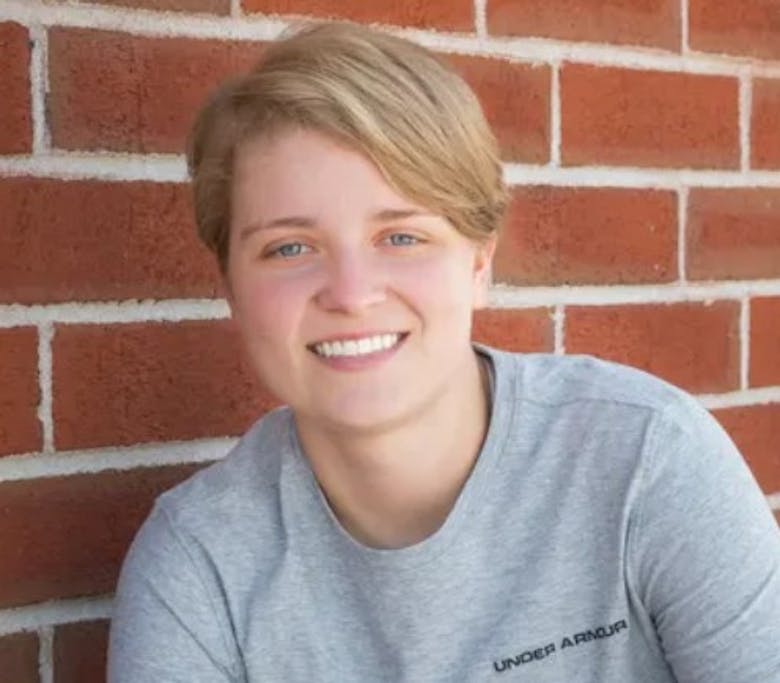
An online fundraising campaign started to cover funeral expenses noted that “Amber was a hardworking welder who took great pride in her craft and dreamed of building a bright future through her work. Her witty personality, positive attitude, and beautiful smile touched everyone who knew her.”
Numerous labor organizations decried the workplace killing of Czech, including the International Association of Sheet Metal, Air, Rail and Transportation Workers (SMART), with 230,000 members in North America.
“While not a SMART member … this tragedy is reverberating across the trades community and far beyond,” read a statement from the organization. “So many tradeswomen and gender-diverse workers are carrying the weight of this news.”
SMART went on to point out that “violence like this rarely comes out of nowhere. It often follows a buildup that women in the trades know by heart: harassment shrugged off, bullying tolerated, intimidation minimized, warning signs dismissed, fear of backlash, comments ignored, jokes explained away, the stares of resentment, and behaviors everyone chooses not to see until they can no longer look away.”
The Laborers’ International Union of North America (LIUNA), which counts 500,000 workers across many industries among its ranks, said in a statement, “When a young tradeswoman’s future is so violently crushed, we must look to the criminal justice system to do its job — but as brothers and sisters in the construction trades we must also do much, much more. … We must not only condemn the violence that took Czech’s life but also the attitudes and behavior that normalize an atmosphere of fear for too many construction craftswomen.”
Around 6 a.m., a caller to 911 said Czech was bleeding heavily from a blow to the head, and there was a bloody sledgehammer on the floor nearby. Emergency medical responders arrived and declared her dead at the scene.
A sheriff’s deputy identified DeLong as the suspected attacker. DeLong said to a man at the business “something to the effect of, ‘I hit her with your hammer. She is by your toolbox. She is gone,’” the complaint read.
Sheriff’s deputies reviewed surveillance video inside the business and saw DeLong walk from his workstation to Czech’s, grab a sledgehammer and swing it. The victim was out of view of the camera.
DeLong’s swings indicated that he targeted her once while she was standing and four more times after she fell to the floor.
After his arrest, DeLong confessed to killing Czech. He said he didn’t like her and had been “planning to kill [her] for some time,” the complaint continued.
The Fight Fight Fight for Decent Treatment by NFL Cheerleaders
I admit I was prejudiced. I was one of those feminists who thought cheerleaders were the antithesis of feminism, sucking up to powerful men and athletes, embodying or seeking to embody the male ideal of woman.
But then I saw the PBS film A Woman’s Work, about the struggle of the NFL cheerleaders for better wages and working conditions. Now I think some cheerleaders are feminist heroes.
The film documents their years-long campaign against wage theft by their employer, the National Football League. The NFL and its 32 franchises are worth $80 billion and yet, rather than do the right thing and pay their workers a decent wage, they round up their corporate lawyers and fight to keep women down. The industry, run by rich conservative old men, still views itself as untouchable. Now the cheerleaders are on the front line in the feminist struggle against male chauvinism, male privilege and toxic masculinity.
I’m a retired electrician who has fought for the last half-century to insure women’s entry to the skilled trades. The construction industry is the other side of the gendered employment coin. We were kept out of lucrative union construction jobs because of our gender. The bosses said we were not strong enough to do the work and they’re still saying it, even though we’ve been doing the work for decades. Of course just because the job is physically difficult does not mean a worker makes better pay. Quite the contrary. Plenty of women (and men) work at hard jobs for low pay. Union construction workers make good money because of union contracts.
Women wanted to work in construction for many reasons: We wanted to build something valuable, to learn a craft and take pride in it. Many of us chafed at being required to wear dresses, pantyhose and makeup to work. But the big reason was money. Men working in “men’s” jobs make way more money than women working in “women’s” jobs.
Watching this film I felt an immediate sisterhood with the cheerleaders. Their plight brought up questions for me: What do they, working in a “woman’s job” have in common with us women who work in the construction trades? The film asks “What is women’s work? What is men’s work?” Cheerleading was once the domain of men, that is until team owners realized sexy women shaking their booties could make money for them.
I didn’t know how bad it has been for cheerleaders. Maybe no one did. They were traditionally paid less than minimum wage and not paid for much of the work they did. Some teams paid them nothing at all. They were required to practice—wage free—for nine months before the season. And they were fined when late to practice. They were constantly scrutinized for body fat and rated on the size of body parts.
The film introduces us to three women from different NFL teams who chose to fight the NFL’s sexism. Lacy’s story is compelling. The product of a poor family in small town Alabama, she had always wanted to be a dancer and she began winning dance contests early on. The first to file a lawsuit, in 2014, she worked for the Oakland Raiders. A cheerleader in high school and college, Lacy was used to being paid for her work. “Louisiana Tech compensated us well,” she says. So it was a shock to find out the Raiders and the NFL didn’t value the cheerleaders even enough to pay minimum wage. The women didn’t get paid till the end of the year, and then not at all for the nine months of required practice sessions. Hair, nails, tan and required travel were out-of-pocket expenses. Waiting for her first paycheck to come, Lacy says she didn’t know all this.
Lacy retained the San Francisco law firm Levy Vinick Burrell Hyams, known for taking on major employment discrimination cases. I was pleased that the film includes interviews with the lawyers, all women. The firm’s symbol is Rosie the Riveter and their motto is “Who would Rosie hire?” Prominent in the office, besides numerous images of Rosie, is a picture of attorney Leslie Levy with Mary Dunlap, a civil rights hero in the San Francisco Bay Area. A well-known feminist and gay activist who died in 2003 at 54, Mary was a founder of Equal Rights Advocates, a law firm that we tradeswomen have worked with since the 1970s. Without our dedicated lawyers we could never have succeeded in integrating the construction trades. As with the cheerleaders, class action lawsuits were the basis of our ongoing struggle.
Also profiled is Maria who, along with five other cheerleaders, filed suit against the Buffalo Bills, a team that expected its cheerleading squad, the Buffalo Jills, to work for free. In response the NFL used tactics that employers typically use to fight unions. The Buffalo Bills team simply abolished its cheer squad. Then they blamed the women who filed the suit, using the divide and conquer tactic and bullying the others to opt out of the suit, which has still not been resolved.
Bailey Davis is the third cheerleader profiled in the film. She filed an EEOC complaint against the New Orleans Saints. Davis was one of the Saintsations, the Saints’ cheerleading squad. That is, until she posted a photo of herself in a one-piece lace bodysuit on her private Instagram account. The Saints fired the 22-year-old in 2018 for violating a code of conduct that prohibits cheerleaders from appearing nude, seminude or in lingerie. It wasn’t the only strict rule that Davis and her former colleagues had to follow—cheerleaders for the Saints can’t have players follow them on social media, must have private social media accounts and are required to leave parties or restaurants if players are there. The company says the rules are in place to prevent cheerleaders from being preyed on by players.
“The players have the freedom to post whatever they want to on social media,” Davis told the press. “They can promote themselves, but we can’t post anything on our social media about being a Saintsation. We can’t have it in our profile picture, we can’t use our last name for media, we can’t promote ourselves, but the players don’t have the same restrictions.”
The women who filed suit against the NFL were attacked mercilessly. “I just kept telling myself I’m doing the right thing,” says Lacy.
At the same time as it keeps a tight reign on the cheerleaders’ behavior, the NFL protects players charged with domestic violence. There’s a connection here. “Wage theft, sexual harassment and domestic violence are all about power,” say the lawyers.
Scenes later in the film show these women at home taking care of kids and husbands with a not-so-subtle message that all women’s work is undervalued. Here these women work for free and there is no time off.
Another issue, the sexual harassment and pimping of cheerleaders is only hinted at in the film, which focuses on labor issues like wages and working conditions. In 2018 Washington Redskins cheerleaders complained of being pimped out to male donors. “I don’t think they viewed us as people,” said one.
Football reeks of toxic masculinity. And having a posse of sexy females ready to do your bidding and totally under your control is just part of the deal. Women are seen by these men as sexual objects. Decades ago the Dallas Cowboys led the way in selling sex on the sidelines while paying the cheerleaders next to nothing. “It was a business,” said members of the squad. “And we were the merchandise.”
In the construction trades, after decades of fighting for equal treatment, our efforts are paying off. It took years to get our unions on board, but now they are partnering with women to improve working conditions. Because of our advances, when the #Metoo movement erupted I was shocked—not that sexual harassment existed in Hollywood and elsewhere, but that it was so widespread and institutionalized. The world of construction is changing, if slowly, and we are ahead of some industries.
The world of cheerleading is changing too. It’s now seen as a competitive sport that incorporates gymnastics with athletic dance. Millions of people watch and participate in worldwide competitions. The NFL needs to get with the program.
Lacy won her lawsuit, after four years of fighting, but many more lawsuits are in process. Ten teams have been sued so far. The NFL has met its match in cheerleaders. Lacy, who had not considered herself a feminist, now says, “I realize feminism is everything I’m fighting for—equal rights, equal pay, equal treatment.”
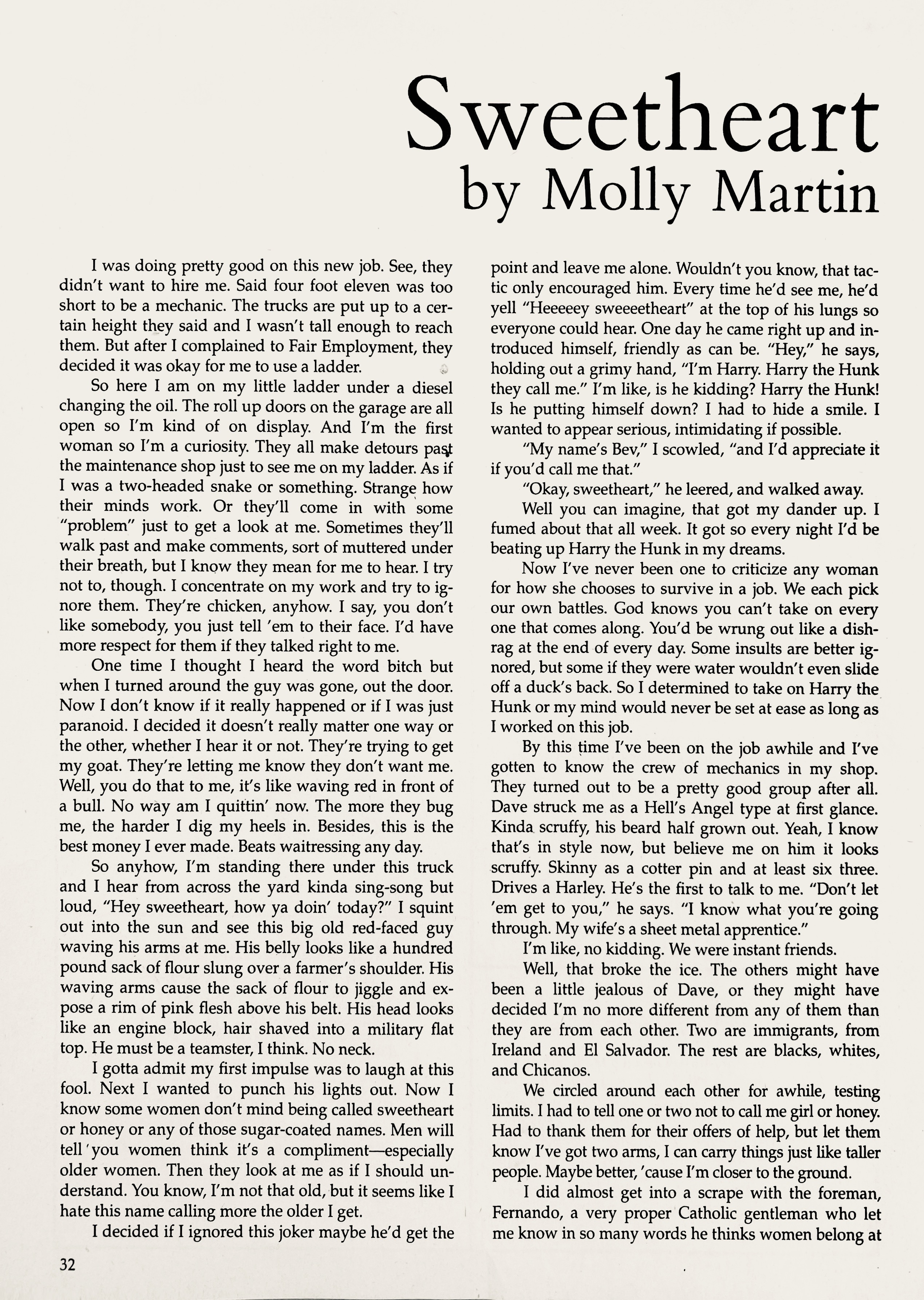
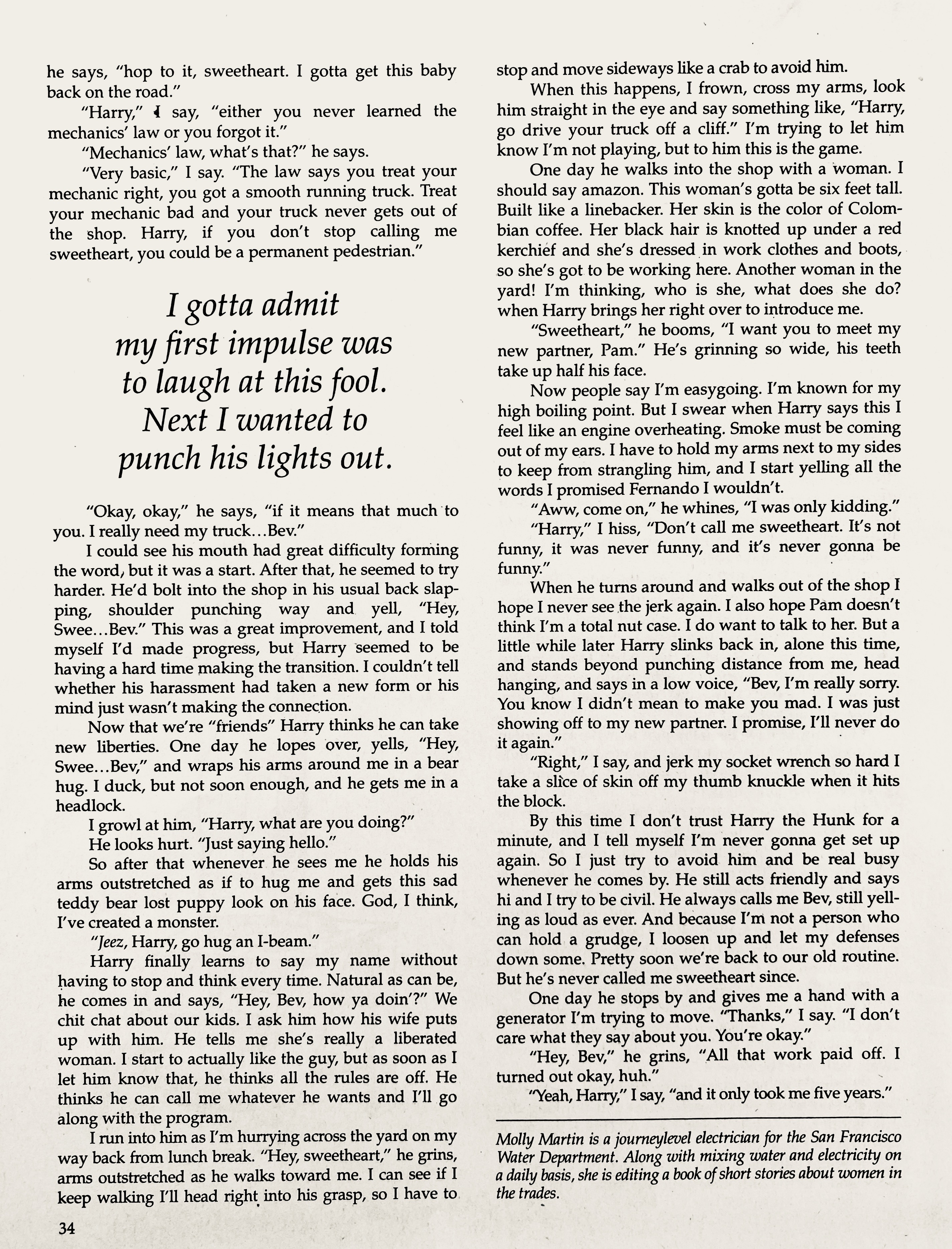
More on-the-job memories from 1980. This is a true story with names changed to make it fiction. Published in Tradeswomen Magazine, our means of communication in the 1980s and 90s.
I’ve been going through my collection of Tradeswomen magazines (published by volunteer tradeswomen 1981-1999) and thinking about how much of what we wrote still has relevance today. We started writing and talking about sexual harassment before the term was even in the mainstream lexicon and before we had any legal backing. We were truly foremothers in this fight, and our persistence has paid off in improved industry standards and better working conditions for women in the construction trades. Here’s a story we published in 1983.
Every woman has a retribution fantasy, what she would do to her harasser or rapist. She probably won’t tell you what it is but she has one, maybe many.
My group of tradeswomen activists not only imagined retribution, we planned and executed it. Perhaps corrective justice is a better choice of words.
We were an organized group of women who were trying our damndest to break barriers to nontraditional blue collar work. Men wanted to keep those high-paid jobs for themselves. So when one of us finally landed a job, we were subject to harassment with the aim of getting us to quit. At that time in the late seventiessexual harassment was not yet illegal and the term was not yet in popular use. We tradeswomen used the term gender harassment.
We were working at integrating the construction trades, bus driving, firefighting, policing, printing, dock work—all the jobs women had been kept out of. One job classification we focused on was ferryboat deckhand. Women had won a discrimination lawsuit, a judge had signed a consent decree, and a handful of women had broken into the trade. As with construction, you had to jump both the barriers of bosses and the union.
One of our biggest challenges was isolation on the job. Once you got hired, you were usually the only female there. We tried to combat isolation by recruiting more women and by organizing support groups wherever we were.
Annie McCombs was our gal on the ferries, having made it through the union process. A militant lesbian feminist with a take no prisoners attitude, Annie was committed to increasing the number of women on the waterfront, to truly integrating the trade. After five years as a ferryboat deckhand she had gained a reputation as someone who did not tolerate abuse.
Fear of violence was based on reality. A common myth among fishers and sailors was that a woman on your boat was bad luck. We had met a woman who had been thrown off a boat into the water by coworkers who intended to kill her for supposedly bringing bad luck.
Annie worked occasionally with another young woman, Patricia. She was American Indian, a lesbian and only 18 with little work experience. One day Patricia approached Annie and told her about a guy on the job who harassed her mercilessly. The harassment had turned violent when they worked together on the night shift. He had locked them in to a bathroom they were assigned to clean and shoved her up against the wall. Only the night watchman knocking on the door saved her from being raped. He assaulted her again the next night but she fought back and was able to break free.
Annie helped Patricia meet with her boss and the union rep, going through all the required motions. They got nowhere. The next step would be litigation, but we activists did not recommend women file individual lawsuits. That got you blacklisted and unemployed.
We resorted to direct action. Annie called a meeting and 30 women showed up. She told us about the situation and we began to strategize. How could we get this guy to back off and stop harassing our sister? We had heard about a group of women stripping a rapist naked and tying him to a pole in the middle of town. That was a great fantasy, but none of us was willing to take the chance of being arrested for assault. Whatever we did would have to be hands off. We also wanted our action to be collective, something we could all participate in. We needed to make sure this guy knew that what he was doing was wrong and that it had to stop. It would be great if the woman he had targeted could confront him directly, if we could help her feel safe enough to do that.
Jan, a tradeswoman sister, spoke up. We needed to confront this guy on our own terms in a place of our choosing, not at work. She suggested that one of us should get him on a date. This seemed crazy to me. I was never any good at picking up men, but other women in the group assured me it wasn’t that hard. Hadn’t we been trained all our lives to do this? Jan volunteered to be the bait and we worked out an elaborate plan for her to pick him up.
We would lure him to a secluded location in Golden Gate Park, surround him and let his victim confront him. I, for one, did not see how this was possible. How would we get him to the park?
Jan planned to invite him to a party at the deYoung Museum and make some excuse to get him to the nearby rose garden. The rose garden is surrounded by tall hedges, perfect for hiding behind. And it’s relatively dark. Our action would take place at dusk.
Word of the action got around and our planning meetings expanded to 50. Everybody wanted to be involved with this action. What militant feminist wouldn’t?
We considered the possibility that the harasser might have a gun. Annie knew that some deckhands carried handguns in their seabags. Many of us practiced karate and self-defense and we engaged martial arts experts to take command in case our perp responded violently. A woman was assigned to each limb and his head in case he reached for a gun or bolted. But unless he attacked, we were not to touch him.
Women volunteered for specific tasks: lookouts, runners, watchers from park benches. We would not leave Jan alone with the man and risk his assaulting another woman.
In the meantime, Annie had drawn up a map of the park with our location and planned out the timing. We were to hide in the bushes near the trail and pop out as he and Jan came by.
I was dubious. Could we really pull this off? There were so many variables. What if he didn’t go with Jan? What if he saw us in the bushes? What if the timing were hours off?
Fifty women had assembled some blocks away at a staging area in the Haight Ashbury when a carload of country women from Mendocino showed up. They had heard about the action through the lesbian grapevine. Now numbering more than 50, we all made our way to the rose garden.
We hid behind hedges and trees, waiting silently for maybe 20 minutes. Everybody knew the plan. I couldn’t believe it when I saw Jan and the guy walking down the trail. Jan really did it! Our butch dyke sister had transformed into a fetching het woman. She wore a pink sweater wrapped casually around her shoulders.
Just as they crossed in front of us the spotter blew a whistle, the designated woman stepped out into the trail, and then all the women materialized and circled the guy. Jan melted into the crowd.
My only job was to stand in place with a mean look on my face. I can tell you this is not so easy when one feels exhilaration.
Our chosen spokeswoman stepped forward menacingly. She addressed the harasser. “Don’t talk, just nod if you understand.”
A woman was assigned to remind him to nod. He did not need to be reminded.
“We know you have been harassing women on your job. We know where you live. We know the car you drive. If you continue to harass women we will come and get you,” she said.
I could see his knees shaking. It looked to me like he had peed his pants.
Patricia stepped forward but she was not able to speak. Her partner spoke for her, naming the harassment.
Finally the crowd of angry women parted and let the man out. He was ordered to return to his car and not to look back.
Our action had succeeded. We were jubilant. A cheer went up from the 50 women. Then we quickly decamped to an agreed-upon location for a post-mortem and to celebrate.
As for the harasser, he was not seen around the waterfront for several months. Later, when he took a part-time job with the company, he made sure to keep his head down when passing Annie or Patricia. Soon after that he disappeared altogether.
Sitting in my favorite chair in the living room of my newly remodeled condo, I heard the violent breaking of glass. It sounded like someone was throwing bottles on the sidewalk with great force. I couldn’t see anything out the front window so I put on shoes and went out there. That’s when I saw […]
The fight for affirmative action in the fire department
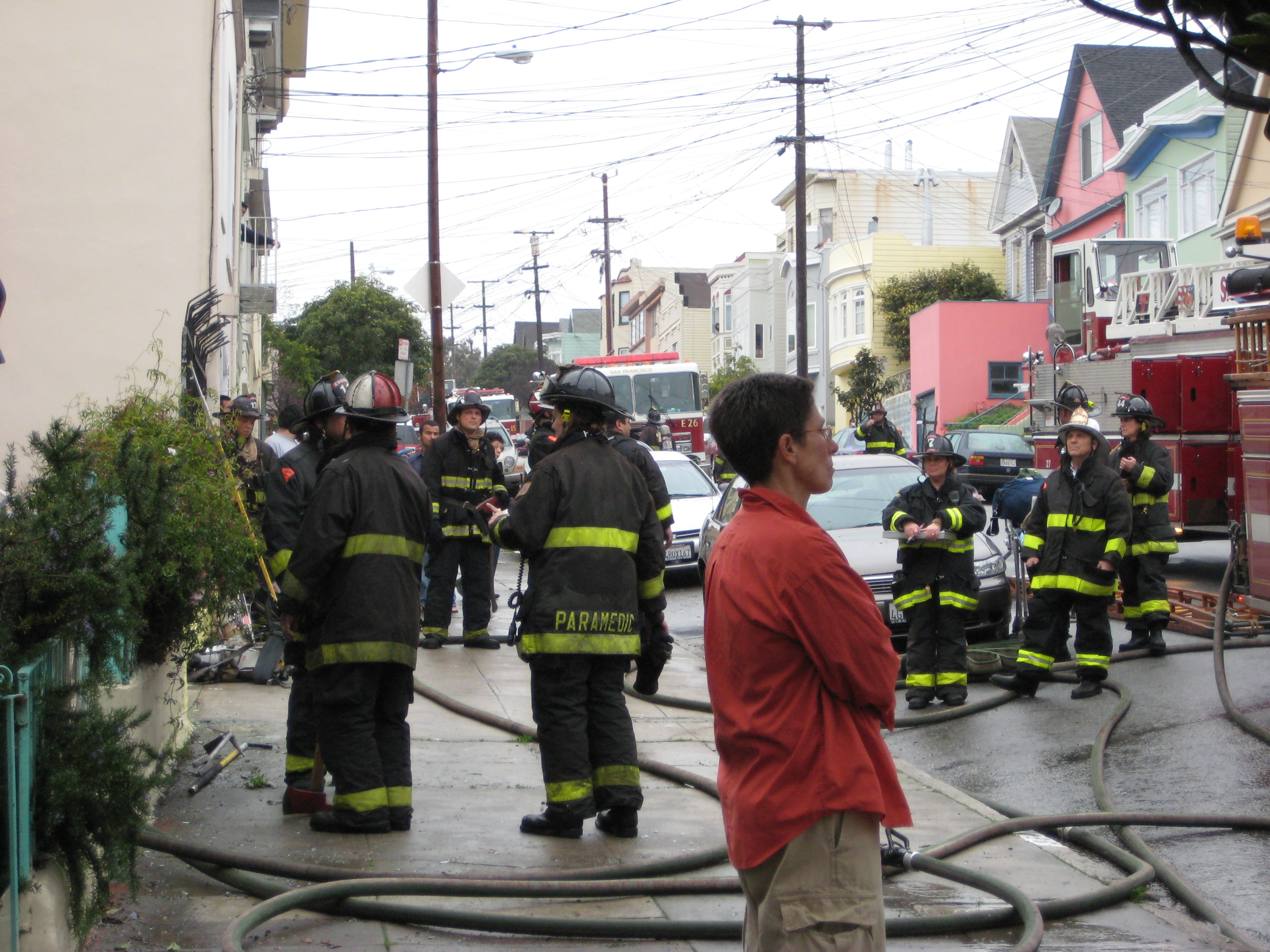
Sitting in my favorite chair in the living room of my newly remodeled condo, I heard the violent breaking of glass. It sounded like someone was throwing bottles on the sidewalk with great force. I couldn’t see anything out the front window so I put on shoes and went out there. That’s when I saw flames shooting from the next-door neighbor’s window, broken by the intense heat.
At the fire scene
The year was was 2009. After nearly a decade of work restoring and remodeling the three-unit building where I lived for 38 years in San Francisco, it nearly burned down that day.
I had brought my cell phone and immediately called 911. Someone had already called and the fire department said a truck was on the way. It seemed like it took forever but later I learned it had taken two minutes to come from our neighborhood firehouse at Holly Park.
A woman in a bathrobe emerged at a run from the ground level of the house next door. She had been in the shower when she smelled smoke. We knew that many people lived in the house. The owners of the single-family dwelling had divided it up into plywood cells with doors and locks, which they rented to Chinese immigrants, most of whom spoke no English. We had no idea how many people might be in the building.
I should add at this point that I hate firemen. Not firewomen, only the men. And not the firemen of color. Only the white men.
Whenever we have occasion to honor firefighters, which is lately often as the West has been burning up every year, I stand back and think to myself, I hate these mofos.
When I tell anyone I hate firemen, the reaction is always shock. “But there are some good men.” And to this I say yes I know but they’ve gotta prove it to me, just as I had to constantly prove to my male coworkers over and over at work in construction that all women are not stupid and weak. In the meantime I’m sticking with my prejudice, formed by years of interaction with woman-hating racists in the San Francisco Fire Department. I may never get over it.
My hatred has roots in the decades-long fight to integrate women and people of color into the department, formed by listening to the stories of female firefighters who had to live in the firehouses where they were hated, denigrated, physically attacked and whose lives were in danger from the men they worked with.
The idea that firefighters are heroes to be worshipped not only had an unfortunate effect on the culture at the firehouses, inflating already overinflated egos. It also made opposing the white men more difficult. They used the positive stereotype to their advantage, calling on the testimony of citizens whose lives and property had been saved.
Before women fought their way in to the SFFD, men of color experienced a racist culture and lack of safety in the department. The first black firefighter entered the department in 1955 as the result of a lawsuit. The San Francisco fire fighters union, local 798, and its international affiliate, possibly the most racist union in the country, waged a campaign to keep minorities and women out of the department. Once they got in, the union and the white men did whatever they could to make their lives miserable. Swastikas, confederate flags, death threats, excrement in boots, tampering with safety equipment, discriminatory entrance exams were some of the tactics. Robert Demmons, a black firefighter, sued the department for discrimination and the lawsuit later included women and other men of color as plaintiffs.
Although agitation to include women in these well-paid jobs began in the 1970s, the first women did not enter the department until 1987. In the lawsuit, women were lucky to draw a judge who saw that breaking the gender barrier required strong measures. In 1986 US District Court Judge Marilyn Patel issued a consent decree requiring the department to hire ten percent women. The SFFD resisted the decree but they had to comply. The ten percent goal for women was met in 1997 and the decree lifted.
Chief Bob Demmons
The person who files the lawsuit, whether in the trades or other professions, usually ends up dead or blacklisted, a martyr to the cause. Bob Demmons, who became president of the Black Firefighters Association, went to work every day thinking he might be killed. Several attempts were made on his life. We affirmative action activists thought Bob would end up as our martyr, but instead he was appointed chief of the department in 1996 by Mayor Willie Brown. The department was still a mess and Bob worked closely with women and other men of color to change the culture. He knew he would have only a short time before the union and racists got him removed and he moved as quickly as he could to bring in and promote more women and minorities. I think Bob did more than any other individual to make firefighter jobs available to women. He’s my hero.
We women did have a martyr, Anne Young, one of the first four women to be hired as firefighters, the first lesbian and also the first female lieutenant. Anne became the public face of women and so she endured the worst harassment.
I first met Anne at the Women’s Training Center gym in San Francisco where we both worked out. An electrician, I was involved in the fight for affirmative action, agitating to get women into the construction trades and other male-dominated jobs. She was 18 and already clear about her life goal. She was training to be a firefighter. Anne took entry exams at fire departments all around California and she landed a job at the Daly City fire department where she did well. But Daly City is small, with very few fires and emergencies. She set her sights on the big city of San Francisco.
Anne was smart and strong and she already had experience working as a firefighter. She easily passed the entrance exam and became one of the first women to enter fire college. Harassment started immediately. The day that the first women graduated, before they even started working as firefighters, white men were picketing out in the street, saying that women had taken jobs from them.
Bob Demmons and Anne Young began to collaborate. They both wanted a department that reflects the percentages of population that it serves, that could speak all its languages, that would have women helping women. By that time most of the calls were medical emergencies, not fires.
At the time women first got in, San Francisco’s 41 firehouses operated like a fraternity house row. Pornography was everywhere. Men watched porn on TV in the firehouses, which were scenes of hours-long cocktail parties and drinking contests. Bob showed Anne the granite wall with all the names of the firefighters killed in the line of duty. He pointed out names: “He was drunk, he was drunk, he was drunk.” They were dead because they were drunk at a fire.
Female firefighters constantly had to choose. Did you go along with the culture and drink with the boys, or follow the rules which disallowed drinking, and risk isolation? One woman drank with the boys and passed out at dinner. She was terminated, and the female firefighters support group failed to offer any support. They didn’t want to be associated with her.
Many women took the entrance tests and failed to pass. Many were terminated while on probation. One woman who made it in later committed suicide. The ones who stayed tried to be invisible, to not buck the culture. The other women in the SFFD did not necessarily support Anne.
As in construction, I don’t fault women for how they choose to survive. We’ve developed many survival strategies. You have a choice of joining the culture or objecting. The women who tried to be invisible and didn’t stick their necks out, who put up with the harassment or tried to be one of the guys, generally survived. Anne felt she couldn’t go along to get along. She felt pressure to make a choice every single day at work to represent every woman, represent every queer.
In the 1990s, before public shaming on the internet took hold, white male firefighters and retirees attacked females and minorities in a publication called the Smoke Eaters Gazette. They actually put in writing their horrible lies and distributed the paper to everyone in the department. We never learned who wrote and published it.
Anne was a union member, but when she found out the union was using her dues money to oppose affirmative action, she resigned from local 798 and joined the Black Firefighters Association, a slap in the face to the union and the white men.
A watershed moment came in 1988 when the women in the SFFD and Black Firefighters Association drove a fire truck in the gay parade, a first for the department, known for its homophobic culture. Anne Young was driving the truck. Cheers went up from the crowd. The black firefighters stood with the gay community politically in that moment. It took some courage for the straight black men to march in the parade. I was watching from the street and I cried. People on the sidelines were yelling, “Hey-hey, ho-ho, racism has got to go.” The guys were crying. Everyone was crying. It was an historic event.
Anne did well on tests. She had taken and passed many. When the lieutenants’ test came up she was urged to take it by the lawyers and the BFA (the consent decree was still in force). The chief of the department called her in to his office and told her she could have anything she wanted if she didn’t take the test.
In retrospect, she said, taking the lieutenants test and promoting was a mistake, the beginning of the end of her career. As a new lieutenant she worked a different firehouse every day. Some days the entire crew would call in sick, sending a clear message they didn’t want to work for her. Death threats were common. But when men on her crew tried to throw her off a roof, that was her breaking point. They could have gotten away with her murder. Firefighters fall off roofs. No one would have known she was pushed.
After that, Anne kept going to work, but she felt she could no longer do her job competently.
I’ve seen this happen to other women in male-dominated jobs when the everyday level of stress becomes too much for the body to bear. Your mind tells you to go to work but at some point your body rebels. You get sick or injured and you can no longer go to work. After she was nearly killed, Anne had what she called a nervous breakdown. One day she just couldn’t get out of bed. I think this was her body protecting her from harm.
Anne filed a lawsuit and there was a trial where she was called upon to paint the SFFD with a broad brush of discriminatory treatment. She didn’t get to talk about how much she loved the job, working with a team, saving lives. It had been her dream and she was really good at her job. She wasn’t able to focus on the good men who helped her. But, on the whole, even the good guys had refused to stand up for her and risk retaliation from the bad actors. They enabled the harassers.
Three years after filing suit, in 1995, Anne won the lawsuit and was awarded $300,000. But her career as a firefighter was finished. She lost her income, she lost her house. Trauma had infected her like a disease.
I thought of this history as I stood on the sidewalk and watched the house next door to mine burn. When the first fire truck arrived at the scene, the first firefighter who jumped off was a woman I recognized, Nicol Juratavac. She was working as a lieutenant that day. Among the firefighters were several women and men of color. One, a Chinese man, was the only person able to communicate with the next door building’s residents. Then a car pulled up with another woman I recognized, Denise Newman. She was working that day as a battalion chief. Of course, by that time in 2009 the chief of the department was a female, Joanne Hayes-White, appointed by Mayor Newsom in 2004.
Along with a congregation of feminist activists, I had shown up at city hall the day her appointment was announced. Newsom appointed a female police chief as well, which gave us all high hopes that the asshole culture could be turned around. And I do think some progress was made. Hayes-White stayed on the job for 15 years, long after Newsom had moved on up the political ladder. The SFFD women often clashed with her, but in general her policies and promotions were female friendly. Heather Fong, the police chief, hung in for ten years before the white men and the police union were finally able to run her out.
Wringing my hands and worrying that my newly remodeled building was about to go up in flames, I was grateful for the SFFD. And I had an epiphany: decades of fighting to make the department reflect San Francisco’s diverse population had paid off. The fire department had been integrated.
Now, a decade later, many of those first women have retired from the department with generous pensions. Some of them struggle with PTSD from years of harassment. Yes, the culture in the firehouses has changed for the better, but discrimination and harassment are still present. Anti-affirmative action laws passed in the 1990s make targeted recruitment illegal and make it difficult for California public safety entities to maintain the minimum number of women and minority employees that had been required by SFFD’s consent decree. There’s no guarantee that the department will not revert back to its old white male culture.
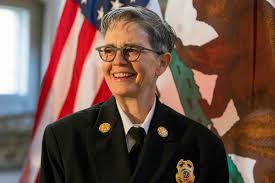
SFFD Chief Jeanine Nicholson
However, the new chief of the department, appointed in 2019, Jeanine Nicholson, a lesbian cancer survivor and also burn survivor, gives me hope that the department has changed for good. Still, I haven’t forgiven those white men.
I thank Bob Demmons, and especially Anne Young who sacrificed her career so other women could become firefighters. They were truly change makers.










 tradeswomn musings