I think of the catholic church as a dangerous cult and that perspective was only reinforced when I watched the movie The Novitiate, about a cloistered order of nuns and its response to the directives of Vatican II in the early 1960s. From the movie, directed by Maggie Betts, I learned that 90,000 nuns left the church after Vatican II, which devalued nuns and left them without support of the church.
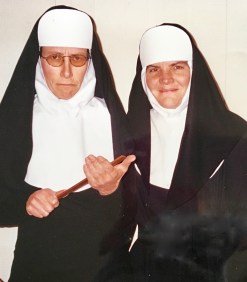
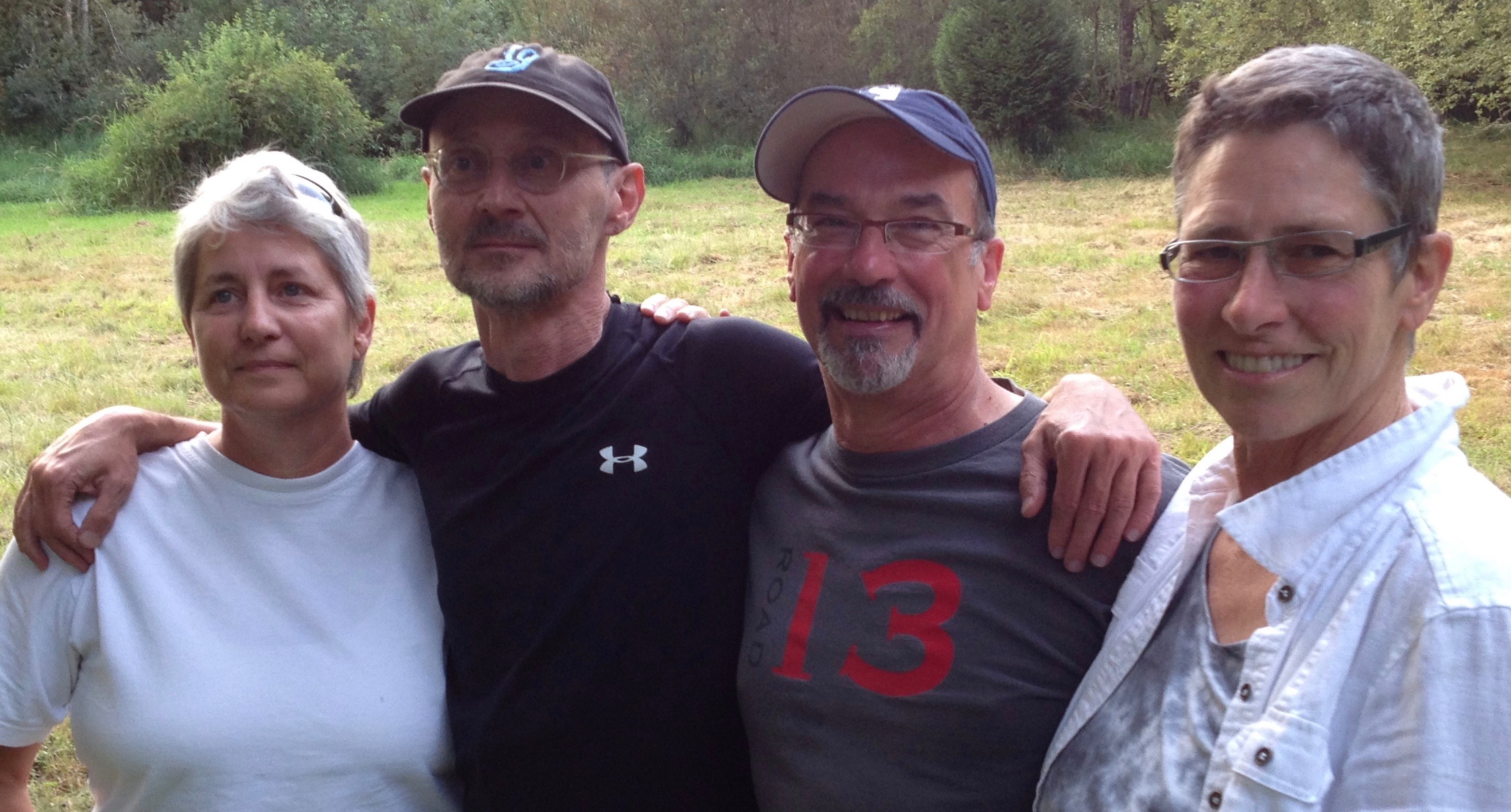
Barb and I as bad nun good nun
The protagonist is a 17-year-old novice played by Margaret Qualley, but the star of the show is the angry, strict mother superior played with force by Mellissa Leo (remembered fondly as the lawyer in Treme). She represents the old habits and choses to ignore the new catholic rules until the cigarette-smoking, newspaper-reading archbishop visits and “suggests” she begin implementing the protocols if she wants to keep her job. We learn that she has never set foot outside the convent in 40 years and we sympathize with her bitterness and frustration.
Some of the old disciplines that must be abandoned include the medieval practice of self-flagellation. In this order the novice must ask the reverend mother for the “discipline,” a stranded leather whip with knotted ends and she must tell mother the fault or lapse that deserves punishment. Another curious practice is an activity in which each novice kneels in the middle of a circle of kneeling novices and confesses her faults to the reverend mother. In an odd way it resembles the encounter groups that were just taking off in that era.
All who lived in the cloistered convent observed hours of silence and they developed a sign language to communicate. The novices spent time on their knees or crawling on hands and knees or prostrate on the floor in penance for sins against god. Touching other human beings was strictly forbidden. But the protagonist, sister Cathleen, seeks comfort in the infirmary after having starved herself in penance for a sexy dream. She hugs and kisses another novice, who it seems has been transferred here because of lesbian exploits in another order. And so the constant undercurrent of sexual attraction finds expression and then contrition. Guilt abounds.
For me, the catholic church represents a historically misogynist institution bent on maintaining control over women, our bodies, our reproductive lives, even our intimate relationships. It damages not just catholics, but all women and the cultures we live in all over the world. Hate is not too strong a word for my feelings, especially since the church continues its anti-woman postures and politics.
I believe no one truly recovers from catholic propaganda, especially when immersed as a child. The dictionary’s alternate meaning of propaganda: “A committee of cardinals of the Roman Catholic Church responsible for foreign missions, founded in 1622 by Pope Gregory XV.”
My latest favorite T-shirt shows two punks of indeterminate gender kissing. Its message is in Cyrillic script. I asked my friend Shelby, who had lived in Russia for a year, to translate, but she wasn’t able to make sense of it. Then recently I was wearing it when I encountered a Russian woman at a party celebrating the 100th anniversary of the Russian Revolution. She gladly translated its message.
Shut up! Shut up! Punk out!
Now that I know its message is from the Pussy Riot era, I love the T-shirt even more. Wearing it on the anniversary of the 1917 revolution conjures thoughts of tangled Russian history.
I’ve been thinking about Russia a lot as I’ve been grieving the death of my friend Shelby Morgan. Shelby was a Russophile who loved Russian culture and the Russian people. She was deeply influenced by the poet Anna Ahkmatova.
I interviewed Shelby as she was dying of ovarian cancer. The story of her life is fascinating and I learned so much that I had not known. I was especially interested in how she became radicalized and why she joined the Communist Party.
Shelby Morgan was born in 1949. Her birth day, May 19, was the same birth day as Ho Chi Minh, Malcolm X and Augusto Sandino. When she walked into Modern Times Bookstore in San Francisco and saw a poster with the date and pictures of all of them, she knew she was destined to be a revolutionary.
Shelby Morgan
Shelby was born and raised in Corning, a little Arkansas town on the Mississippi Delta. It was flat farming country, hot and muggy. Her father was a traveling fertilizer salesman.
Growing up a white girl in the South during the Civil Rights Movement colored Shelby’s political development. The forced integration of Little Rock Central High in 1957 when she was eight years old stunned her.
“I remember saying to my mom, ‘why would people act this way just because of skin color?’ Mom said, ‘It makes no sense.’ That was a very big deal to me.”
Because the Arkansas education system was so terrible, her parents sent her to a boarding school for white young ladies in Memphis, Tennessee in 11th grade (1966-67). Most of the students were from Mississippi and Alabama where schools had just been integrated, so their parents sent them there to get them out of the integrated public schools.
Shelby landed in San Francisco in the early 1970s. Her first job was at the Exploratorium where she worked with its founder, Frank Oppenheimer. The younger brother of J. Robert Oppenheimer, he had been blacklisted during the McCarthy era.
“He would play the flute while I played piano. We had a sweet little friendship going on. He was an old man at that point, an old commie. His atonement for his brother Robert’s involvement with the atom bomb was to start the Exploratorium.”
She joined the Communist Party in 1978.
“I was totally anti-capitalist at this point and even with the disaster that the Left was in at that time, there was an international movement and it was just thrilling to me. I just felt this was where the good work was being done. And it was fun. Man, did I have fun. The people were just great.”
By that time, most of the older generation of commies had left the Party after learning of Stalin’s purges.
“The old commies, people who’d left the Party, said ‘what about Czechoslovakia?’ We knew about all the atrocities. And I, because of my gender training, said I’d leave the theoretical issues up to the leadership who were primarily male. I said I’m about doing the work on the ground. And I just turned my back to it. It was only years later I started thinking I have to hold myself accountable for this too.”
Communists and others around the world were encouraged by Mikhail Gorbachev’s promise of reforms after he was elected to leadership of the Soviet Union in 1985. When the era of perestroika and glasnost arrived, “we were hot for Gorbachev. I didn’t officially drop out of the Party till we moved to Russia in 1990.”
Perestroika postage stamp 1988
Shelby’s husband at the time, Dan, was accepted to do research in Russia. They took their four-year-old daughter, Sarah, with them to Russia in 1990. They came back one week before Gorbachev was overthrown in 1991.
“It was a very Interesting and difficult year. We were in Leningrad (now called Saint Petersburg, the cultural capital and the second largest city in Russia). This is hard to talk about because it was so difficult. Russians were really suffering at that point. For the first four months I was living the life of a Soviet woman, so while Dan was in the archives at the University of Leningrad, I would wait in line. There was no food to be had. You would go into a store and the shelves would be literally empty. I would stand in line for a soup bone and cabbage for two hours. We lived off cabbage soup. Fortunately Sarah got fed three days a week at school. After four months we got diplomatic coupons so we could shop. Even then I had to ride a bus across town for an hour to shop. Buses were so crowded. To get on you would have to push people. Sarah was sick all the time with earaches. The clinics and hospitals were filthy. They had no equipment, not even syringes. There was no hot water. I had to boil water to bathe and to wash clothes.
In 1991 the Soviet Union was in a severe economic crisis. The government was collapsing.
“We lived a block from Red Square in Leningrad. People were burning effigies of Gorbachev in the square. I remember standing in Red Square just sobbing. My dreams were dashed. Then Dan went to another city for a while to do research and left Sarah and me in Leningrad after we’d only been there a couple of months. My Russian was very poor. The Iraq war broke out. The American embassy called us together and told us we had to be really careful, lay low, watch your back. Sure enough one night someone threw a rock through Sarah’s bedroom window. I was just terrified.”
“I had a job teaching psychology (Transactional Analysis) at U of Leningrad. The Russians were hungry for input from the West. Psychology was dismal there. I also taught at a collective called Harmonia and did a Radical Therapy (RT) group.”
Her husband was researching a biography of the physiologist Ian Pavlov.
“When the summer came around, we moved out to the country to Pavlov’s daughter’s house in Komarovo on the Finnish-Soviet border. Stalin had built a village there for artists and intellectuals. It was where Pushkin had lived along with other famous artists and writers. I was really happy there. It was a sweet village with pine and birch trees and a beautiful lake. We used to pick berries. There were no cars. Most people caught a train between Leningrad and Komarovo. Everyone rode bikes there. On the way to the lake there was an old graveyard with old crosses and tombstones where the great female Russian poet, Anna Akhmatova, was buried. My father died then just as the government was changing and I couldn’t get a plane back. This was just weeks before Gorbachev was overthrown. Everything was shut down. So I hung out at Akhmatovas’s grave to mourn my dad.”
Akhmatova’s grave
As her marriage dissolved and she mourned her father’s death, Shelby watched as anti-Gorbachev forces grew. In Leningrad she heard tanks rumbling by on the cobblestone street outside their window.
“We were supposed to come back in September but I started thinking about getting Sarah in kindergarten so we came back early or else we would have been there (on August 19, 1991) when Gorbachev was actually overthrown.”
“We knew it was going to happen just the way it did because there was no civil society to butt up against the government and the mafia. Because it was so heavily state run.”
In the States Shelby worked as a youth counselor, a union organizer, in electoral politics, in the anti-apartheid movement, in the non-profit world, sometimes the only white person on staff. Shelby’s anti-capitalist outlook influenced her work in the Radical Therapy Movement.
“The theory was you should work only with people in groups, not individuals because unhappiness in life was not based on mental illness. It was a result of alienation from meaningful work, from community, from your body, from meaningful relationships. It was a way to anti-pathologize people’s unhappiness, a total anti-medical model of psychology.
“The reason people have trouble doing that: we grow up under capitalism, which is based on the idea that some people have to win, some have to lose. It’s based on competition and we carry that into our relationships. So RT developed this set of skills to teach people to have cooperative rather than competitive relationships. Radical Therapy was really key to building a mediation movement.”
Finding a time to interview Shelby was not easy. Even as she was dying, she was organizing, working for single payer health care, marching in demonstrations against Trump and for equality and justice. She was a lifelong activist and she is dearly missed by a large community of friends and comrades.
Shelby Morgan died August 28, 2017
Anna Akhmatova
Akhmatova
From Wikipedia I learned that the poet Anna Akhmatova remained in Russia during the revolution and until her death in 1966. For long periods she was in official disfavor, and many of her relatives and friends fell victim to Soviet political repression.
In February 1917, the revolution started in Petersburg (then named Petrograd); soldiers fired on marching protestors, and others mutinied. In a city without electricity or sewage service, with little water or food, they faced starvation and sickness. Ahkmatova’s friends died around her and others left in droves for safer havens in Europe and America. She had the option to leave, and considered it for a time, but chose to stay and was proud of her decision to remain. She wrote of her own temptation to leave:
A voice came to me. It called out comfortingly.
It said, “Come here,
Leave your deaf and sinful land,
Leave Russia forever,
I will wash the blood from your hands,
Root out the black shame from your heart,
[…] calmly and indifferently,
I covered my ears with my hands,
So that my sorrowing spirit
Would not be stained by those shameful words.
— When in suicidal anguish, trans. Jane Kenyon
Russia on My Mind
On the revolution’s centenary I’ve been thinking about Russia as I read articles by the prolific journalist Masha Gessen and The Unwomanly Face of War by Pulitzer Prize winner Svetlana Alexievich who chronicles stories of Soviet women soldiers in World War II. Then I picked up the Smithsonian magazine to read a compelling piece by Ian Frazier, Whatever Happened to the Russian Revolution. https://www.smithsonianmag.com/history/what-ever-happened-to-russian-revolution-180964768/. He condenses the history for us in between reminiscences of his travels to Russia in the last 24 years.
There are many lessons here. I hope we Americans can learn them soon enough to avoid contemporary political catastrophes.
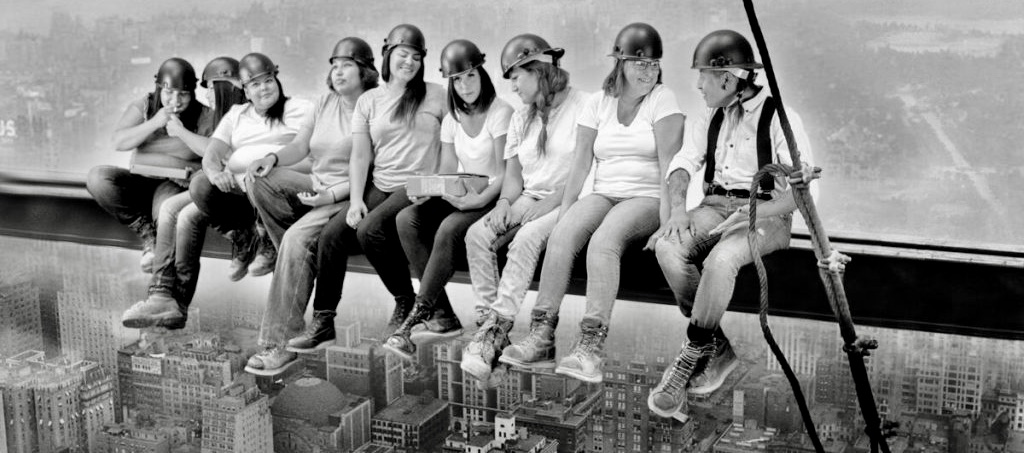
Indigenous women members of Ironworkers Local 725 Canada. Photo: Lightframe
In the wake of harassment allegations against sexual predators including movie moguls and our president, tradeswomen applaud women who are telling their stories and rising up against this outrage.
Women in male-dominated occupations have been fighting this fight for as long as we can remember. We’ve been on the front lines of the feminist movement for decades defending our sisters, supporting legislation to protect women against sexual harassment and helping employers and unions see their responsibility on this issue. We and our fight have been invisible except to each other. Every female construction worker has experienced harassment and all of us can say #Metoo.
Taped on the counter at my supply house, 1983. Sealtite is a type of electrical conduit.
In 1980 I worked as the only female electrician on a big construction job in San Francisco. That’s how it was for us then, and that’s how it still is. Women make up less than three percent of the construction workforce. We are often alone in a crowd of hundreds of men.
I would do my job, dressed in boots, hard hat and work clothes just like the men, looking over my shoulder anticipating violence and hostility. In the porta potties amidst the ubiquitous dicks drawn on the walls would be my name underneath the sentiment “I WANT TO FUCK YOU.” I was called “the cunt.”
I spent my working life in what we now call a hostile work environment. We had no word for it then. There was no recourse. You could complain to your foreman or your union rep but they would tell you that the harassment was your own fault and if you couldn’t take it you should leave the job. You loved the work and you loved the paycheck and so you kept your mouth shut and your head down. And you depended on male allies. My tool buddy on that job—the only guy who would work with me—was a Hispanic/native man whose family had been in California since it was still part of Mexico. He had my back.
Some things have changed since then and the changes are the direct result of feminist organizing. In the 1970s tradeswomen who had been the target of harassment began to bring lawsuits against employers. They lost. When the civil rights activist Eleanor Holmes Norton, as chair of the U.S. Equal Employment Opportunity Commission under President Jimmy Carter, released regulations declaring sexual harassment to be discrimination under federal law, women finally had legal backing.
Sister electrician Lyn Shimizu pointing out graffiti on the SF opera house job, 1997
In the 1986 Meritor Savings Bank v. Vinson case, the Supreme Court distinguished between and prohibited two kinds of sexual harassment. Quid pro quo harassment occurred when women were made offers such as a promotion in exchange for a sexual favor. Equally important, however, was the hostile environment harassment where men could make the everyday workplace into a place of threats, hostility, offensive images, abusive language. This is the kind of harassment tradeswomen most frequently endure.
The movie North Country dramatized conditions that led to the first class action sexual harassment lawsuit filed in 1988 by Lois Jensen and female miners at the Eveleth Taconite Company in Minnesota. After these women won a $3.5 million settlement, employers began to take notice. Our working conditions began to improve.
We were helped by a few dedicated lawyers. In San Francisco we were lucky to work with attorneys at Equal Rights Advocates and Employment Law Center. Other legal groups included the National Women’s Law Center and the NOW Legal Defense and Education Fund (today Legal Momentum).
That sexual harassment is now against the law is the one big change tradeswomen have noticed over the years that has improved our working lives in a male-dominated workplace. In many other ways our workplace environment hasn’t changed that much. We are still underemployed, last hired and first fired, often poorly trained and generally undervalued. Yet some tradeswomen have had successful careers and are retiring with good pensions. Some have become apprenticeship directors, union business agents, and chairs of state building trades councils. We have built organizations and networks across the country to improve our lot. I just returned from our national conference, this year in Chicago, Women Build Nations. It started as Women Building California, sponsored by the California Building Trades Council and Tradeswomen Inc. in 2001 and has now become international, this year sponsored by the National Building Trades Unions and Chicago Women in Trades. A record 1600 women and male allies attended. Workshops on sexual harassment were featured, as always. But the construction industry now has policies in place to train workers and to prevent harassment.
Tradeswomen are glad sexual harassment is now a mainstream issue, but for us it’s nothing new. We’ve been resisting for decades and still we persist.
We had been powerless tenants, evicted with no recourse, and then we became agents of displacement. There was no in between.
My collective household of four lesbians had found a place on Castro Street, one of those original Victorians with high ceilings and elaborate wood trim, an abandoned coal fireplace and a parlor whose big sliding doors opened to double the size of the room. It was rumored that the apartment had come up for rent because the previous tenants had been busted for selling weed and were all in jail. We embellished the story to claim that the famous Brownie Mary had lived there. She may not have lived there, but she had certainly been there in spirit. It was the seventies; the Castro was becoming a gay men’s mecca. During our time there a housepainter engaged to paint our building ran a brothel turning tricks in the building’s storage room. He painted that building for months.
We fondly remember political gabfests at shared dinners, Seders in which we sang all the way through, inventive costumes at Halloween parties (in the year of Anita Bryant I came as a lesbian recruiter). For a time our costume du jour at home was simply a vest, a way to show off a billowing bush and legs as thickly furred as animal pelts (we were hairy and proud!). We danced and sang along to Stevie Wonder and Lavender Jane Loves Women. There was much laughing and also much crying. Passionate love affairs abounded. Hearts were opened, hearts were broken. Creating a new culture calls for invention. We tried out nonmonogamy, polyamory. We felt we were on the cutting edge of a cultural transformation.
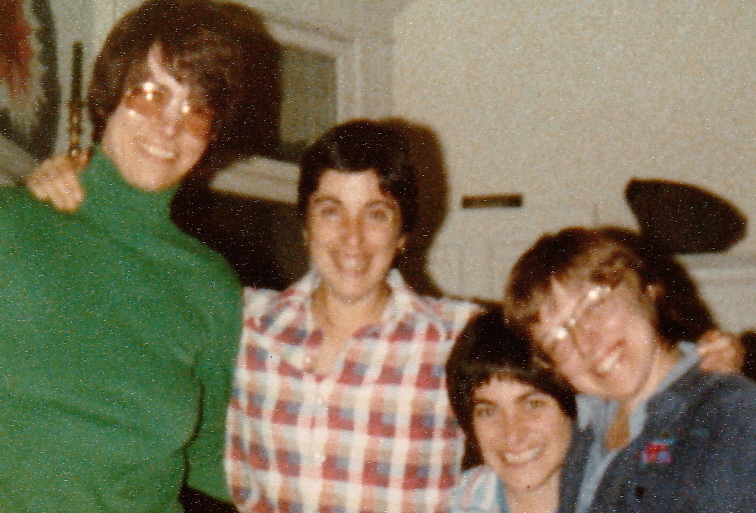
The original collective: me, Pam, Ruth S and Ruth M about 1978
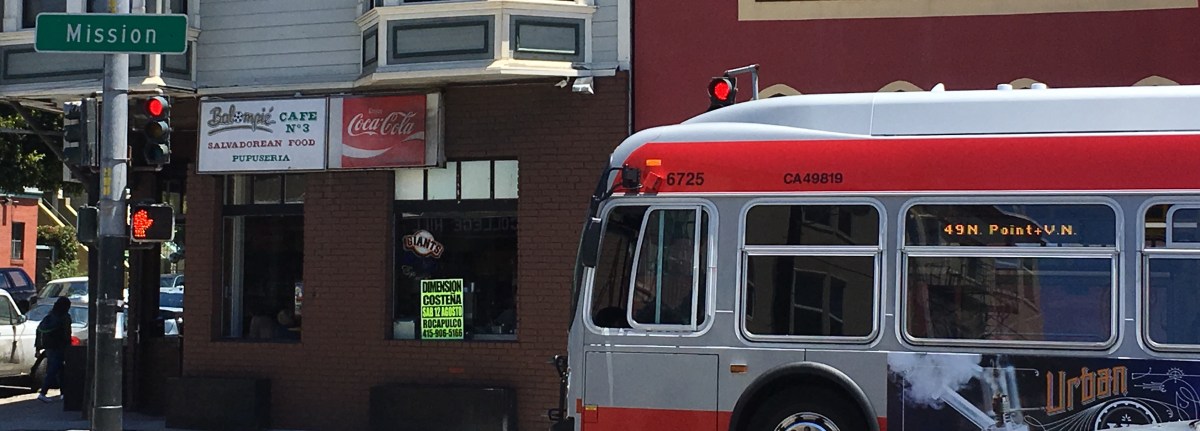
When the gay male couple from New York, or maybe LA, bought the three-unit building in 1978 they immediately evicted us. We had no recourse; rent control was still a few years off. We found a smaller apartment on 29th Street just off Mission in the neighborhood we now call La Lengua. Our landlords were butchers, brothers who ran a shop on Mission right next to what later became Cole Hardware. Weirdly, the buildings on 29th Street and Mission Street were connected. Our apartment always smelled like dead meat, like something had died in the walls.
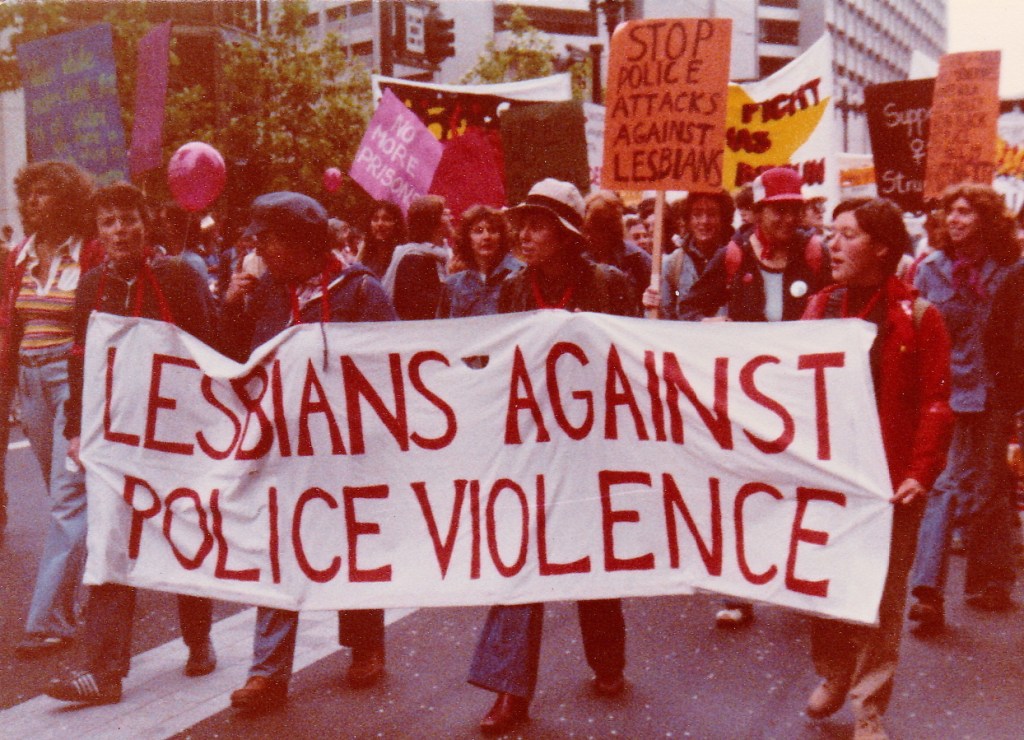
We liked the spot—right behind the Safeway parking lot and across the street from the Tiffany gas station. Pauline’s Pizza was just across Mission and Mexican restaurants like Mi Casa proliferated. I bought my work clothes at Lightstone’s; the post office was right next door. The building’s ground floor held a printer’s shop (it’s now a pot club) and the second floor was just a big meeting room that was rented by Union Women’s Alliance to Gain Equality (Union WAGE) which allowed other organizations like Tradeswomen, Gays for Nicaragua, Lesbians Against Police Violence and the Briggs Initiative opposition to meet there.
My collective of four politically active dykes—me, two Ruths and a Pam—was happy. We cooked and ate together and invited interesting people to share dinner. Jews and militant atheists ruled. I learned about Jewish culture. The Christmas tree was relegated to a bedroom. It was bliss, except that with visiting lovers and pets (one a gigantic great Dane) and parents and friends the place was just too small. Finally we decided that we either had to pool our money and buy a bigger place or split up the collective. Ruth M decided to pull up stakes and live with her lover and so my lover Nancy became part of our collective.
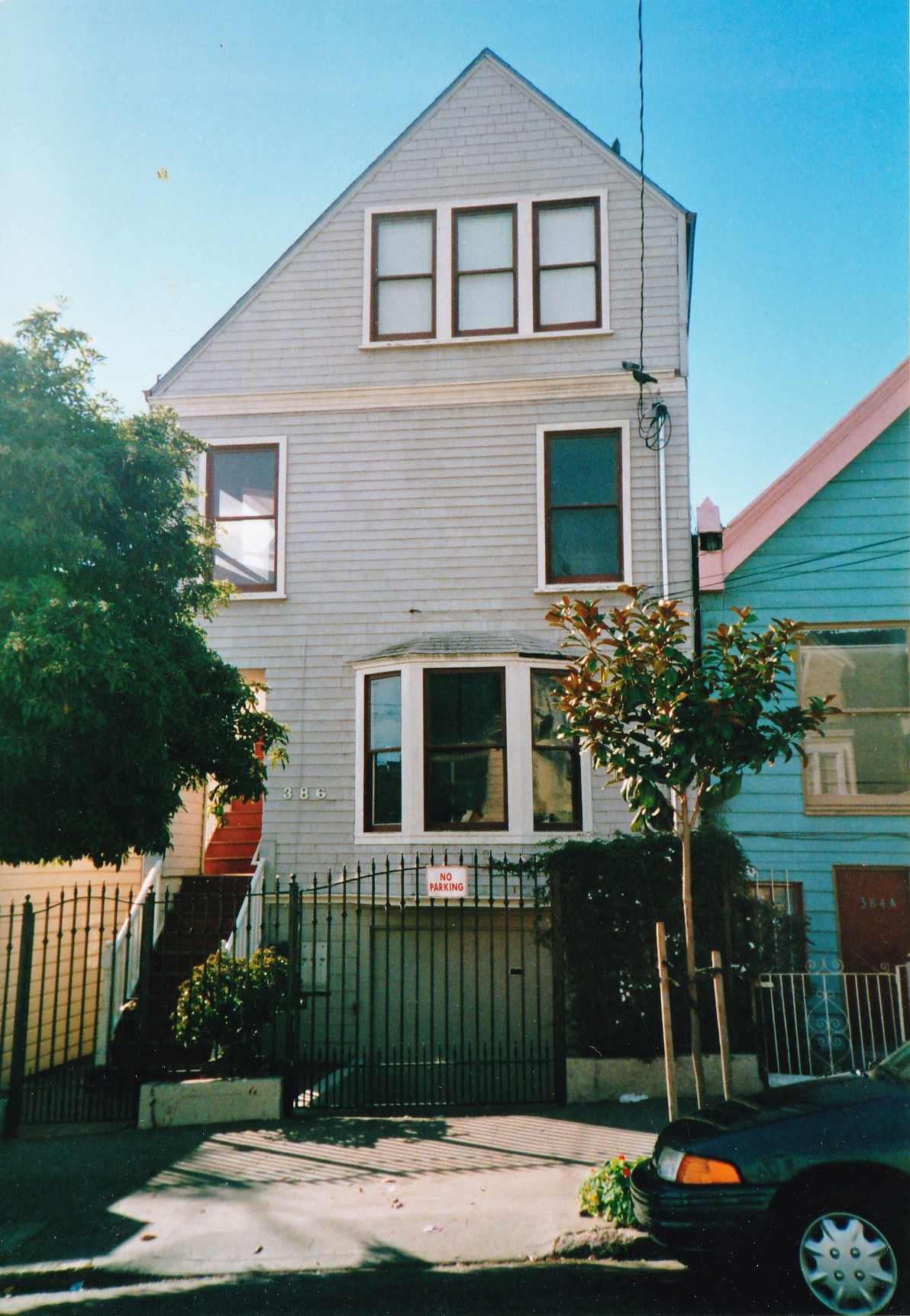
37 29th Street about 1978
We were earnest idealists; we were gay activists; we had just lived through the horrors of the Moscone Milk murders and Jonestown and the election of Reagan. We were committed to live ethically and, even in the midst of what felt like political chaos, we fervently believed we could change the world, ending US imperialism, racism, police violence, and discrimination against women and gays. We were part of a collective movement that emphasized cooperation and consensus decision-making, a radical departure from capitalist organization that resulted only in winners and losers.
We listed our requirements for the new house. Ruth had to have a garden. I desperately needed a garage to store my electrical contracting tools and supplies. We had to be close to public transportation. We didn’t want a fixer upper; no one had time for that and I was the only skilled tradeswoman. We were committed to collective living and we also fantasized about eventually dispensing with private property. What if we could donate the place to a land trust so that our dream of a lesbian nation could live on into future generations?
We negotiated a contract. What would happen if one of us died or ended up in jail or for some reason couldn’t make her payment? How would we sell and buy shares in the building? What if we needed to make repairs or improvements? We listed all contingencies. We were good at processing—we were lesbians!
We imagined a larger single-family house, one with four real bedrooms, but then when we found the three-unit place on the south side of Bernal Hill our imaginations blossomed. We would no longer have to share one bathroom and one kitchen, but we could still cook and eat together whenever we wanted. Instead of negotiating for time to call each of our telephone trees on our shared phone, each could have her own phone.
The listing price was $135,000, an incomprehensible amount. A hundred thousand then felt like like a billion now—you couldn’t get your head around it. Still, we dug deep and came up with the down payment, only because Pam was able to borrow money from her family. Then we wrote up a new contract to repay Pam by the month. We got pretty good at writing contracts.
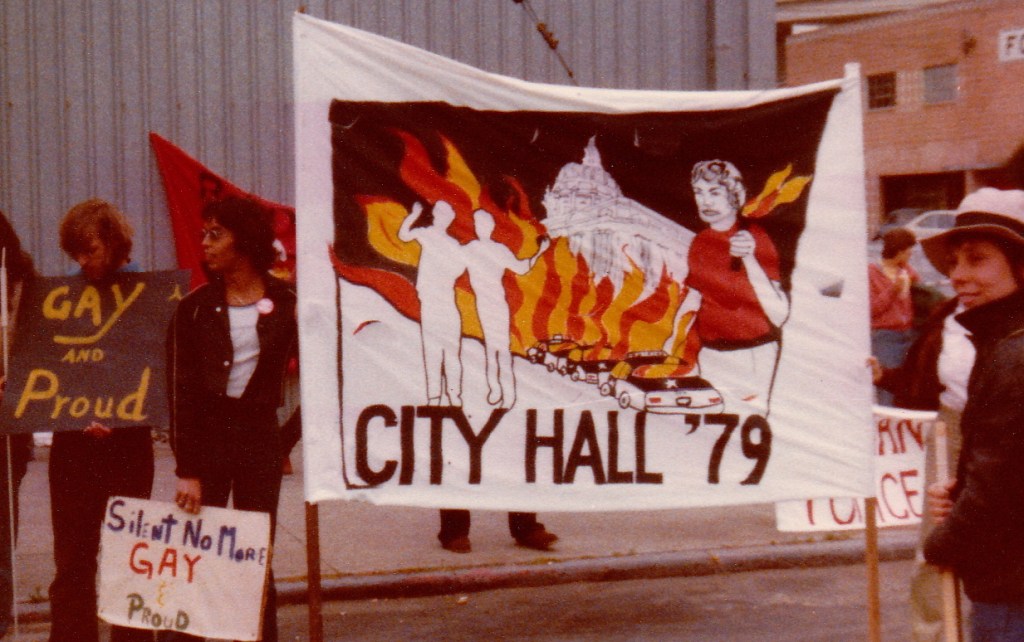
Banner by EG CrichtonPhotos by Barbara J. Maggiani
As soon as we took possession in 1980, our place in the property hierarchy changed. We became agents of displacement. All three of the units were occupied. Each of us had to evict tenants before we could move in and none of us could afford to pay both rent and mortgage for long. Oh the contradictions! I talked with the couple in “my” unit, offering to help them find a new place. Our exchanges were friendly and civil, and they soon found new housing. But Ruth couldn’t even get the tenant in “her” unit to open his door, though she could hear him spewing expletives from the other side. She resorted to lawyers and eviction notices.
We weren’t the first lesbians to move to Bernal Heights. Political activist Pat Norman and her large family lived up the block. A lesbian couple had settled just around the corner on Andover. But there were four of us, and with friends and lovers coming and going we were hard to ignore. People in the neighborhood noticed. Homophobia took the form of nasty notes left on car windshields, DYKES graffiti on the building. Two neighbors who grew up on the block, guys about my age, made it clear they understood what we represented—a lesbian invasion. Years later, when our relationship had grown friendlier, one of them confided, “We were watching you.”
As much as we wanted to live collectively, the house on Richland restricted collectivity. Having separate apartments led to fewer shared meals, less knowledge of each other’s daily lives. I retreated into the dreaded merged lesbian couple relationship. After a few years the original members began to sell their shares and move out while others bought in. At the cusp of the 80s our world changed. That frantic hopeful creative collective time was ending.
But we are still here. Since the birth of our dyke-owned dream, we have aided the lesbian colonizing of San Francisco and particularly Bernal Heights. With each refinancing (too numerous to count) and buyout, our property underwrote the purchase of new female-owned houses. When we started, four single women buying property together was rare and suspect by financiers. Tenants-in-common was not a typical way to hold property. Since then it’s been adopted by the real estate industry as a way to make buying of increasingly expensive property possible for groups of unrelated individuals.
We were agents of change, the leading edge of a new wave of homeowners in the Mission and Bernal Heights. But change is not new to our neighborhood. As one of the authors of a small history of Bernal Heights, I researched its historic demographics. Irish squatters displaced the Mexican land grant Californios. European immigrants made homeless by the 1906 earthquake and fire moved earthquake shacks here and built new homes. Southern Italians colonized the north side of the hill. Germans, Swedes and Italians built churches here for ethnic congregations. Mexicans and blacks found a neighborhood free of racist covenants and restrictions, although Bernal was not outside redlining boundaries. During the economic downturn starting in 2008, big banks (locally based Wells Fargo gained our enduring hatred) evicted scores of homeowners, most of them people of color. Now houses on this block are selling for millions and the techies are moving in.
The life we built is changing. Pat Norman retired, sold her house and moved to Hawaii. My long-time friend on Andover, the first lesbian I met in the neighborhood, sold her house and moved to Oakland. And now I’m selling the apartment where I’ve lived for 37 years in order to colonize a neighborhood in Santa Rosa. Our particular experiment may be ending, but the neighborhood is still full of dykes.
In Bernal Heights, lesbians found an affordable generally accepting environment. At one time I heard that the neighborhood was home to more woman-owned property than any neighborhood in the country or in the world. Who knows; that may still be true.
The name Orr implies an anonymous other, a potentially magical alternative to the status quo. At least that’s what we think in my extended family.
My hunky bro and I, 1970s
Orr is my paternal grandmother’s maiden name and so hidden from us except that it is my brother Don’s middle name.
It was my brother searching for our family history who discovered that the Orrs have a gay gene. When he got on the ancestry websites he discovered quickly that others had already researched the Orrs. One of the first he encountered was a man who lived in San Francisco and Don called me, breathless.
“He lives in Noe Valley and I think he’s gay,” gasped my brother.
“Oh my goddess!” I exclaimed. “That’s practically next door to me. What makes you think he’s gay?” I know this about my brother: he has highly refined gaydar.
“I don’t know. Maybe it’s how he writes. I wrote to him and he got back to me. The ball’s in my court. What do I do now?”
Cousin Richard in vestments. He presided at our wedding.
“Did you get his number? I’m calling him right now.” I know this about my brother: he’s shy where I am not. It was my family duty to follow up and make the call.
And that’s how we got to know Richard, our third cousin. We are all descended from William Burgess Orr and Catherine Hart Orr who lived in Iowa in the mid-nineteenth century.
Richard and I discovered we have friends in common. He lives within walking distance of me in San Francisco and I visit him often. On one visit he gave me a framed photo of our shared great great grandmother, Catherine. She looks sternly into the camera with steely blue eyes.
Richard became our ancestry guru, supplying research and stories about our shared ancestors. He confided that we have another “bent” cousin, Sherry, who lives in Colorado, his home state.
We began to throw around the idea of the gay gene, but it wasn’t until recently when another “bent” cousin surfaced that we decided our research is definitive. Her name is Deborah and she lives in Oregon. We’ve all arranged to meet up in San Francisco for a bent cousins dinner.
Now, whenever we meet an Orr we just assume we are related, especially if they are gay. We just know we are related to Tom Orr, the talented performer and lyricist who lives in Guerneville. Now that we know we share the gay gene, perhaps we can also claim to share the song-and-dance gene. I know this about my brother: he is a singer and a dancer.
A few years later. Don and I (R) with spouses Holly and John
Ruth S was the first to live in the top floor apartment after our collective household of four lesbians bought the three-unit building on Richland Avenue. She confided that in big storms it felt like a boat on the sea. You could get seasick with the rocking.
It’s a weird looking building
I’ve now lived in all the flats—A, B and C—and I can testify that Ruth was not exaggerating. One afternoon, lying on my bed in the far southern reaches on the lowest floor of the four-story building, I could feel a gentle rocking. It might have rocked me to sleep had I not been worrying about its source. There was no wind. I could see the blue sky from my window. Later I asked my partner D, whose bedroom was on the top floor in the far northern corner, what she thought might have caused it. Sex, she answered rather sheepishly. “We were having sex.”
As amusing as this was, to have knowledge of my house partners’ sexual habits by just lying on my bed in a distant part of the building, it concerned me greatly about the constitution of our home. Was it going to fall down? And if so, when?
With this question in mind, I invited one of my building inspection coworkers to come by and have a look (I didn’t tell him about the sex). I just felt there was something terribly wrong with the way this building had been constructed. What could the problem be and how might we fix it?
Of course he had no idea. The walls had long been closed and I didn’t at that time have the energy for a big project that included opening walls and inspecting structural members. But I had at various times opened pieces of walls to pull in low voltage wiring or to try to parse out what the builders might have had in mind.
I first moved into the lowest unit, apartment A, in 1980 with my lover Nancy. We noticed immediately that the kitchen floor’s angle was far steeper than, say, the angle of repose for raw eggs. Whenever we dropped anything liquid it would run so quickly from one side to the other that the cook would have to dive to the floor in order to catch it before it disappeared into the framing.
The interior had been finished, but badly. We could see that the previous owner had covered the kitchen with quarter inch sheetrock, painting it all a bright yellow so that no one would notice. The sheetrock covered the window trim, making you wonder what he had been trying to hide. Nancy was a carpenter and I an electrician. We couldn’t stand not knowing what was behind the quarter inch. And we wanted to even out the kitchen ceiling, which had a mysterious soffit hanging over the entrance door. One Saturday while I was away at a tradeswomen meeting, Nancy demo’d the soffit (it had seemed like a simple quick job) and I returned to a kitchen full of rats’ nest material and rat poison boxes from the 1920s. We could only guess that a previous owner had built the soffit around the rats’ nest to avoid cleaning it up. After that we did not open walls with such abandon.
Rats’ nest inside the ceiling
But later I did have to open the kitchen wall. Investigating a short, I opened electrical boxes trying to figure out where the kitchen outlet was fed from with no success. I finally pulled off a piece of the quarter inch sheetrock thinking I’d find a pipe or a piece of electrical cable leading to another outlet. Instead I found that someone (clearly not an electrician) had run not cable but two wires stapled directly to the wooden original kitchen wall and then covered the whole mess with the quarter inch sheetrock. The wires disappeared under the sheetrock. Where did they go? There was no telling. This discovery horrified me. No electrician or anyone concerned with fire hazard would ever have done such a thing. It meant that we could hang a picture on the wall and short out a circuit or start a fire. But there was nothing to be done then. I patched the sheetrock and made a mental note to never hang a picture on that wall. It wouldn’t be till 20 years later that I would have the money and gumption to open the walls to see what was really inside.
So that’s where the wire went!
After closing up the kitchen wall and vowing not to think about the wiring, Nancy and I lived together in Apartment A for a couple of years before experiencing a devastating breakup involving our mutual best friend who lived across the street. Nancy was the first of our original collective of four to be bought out.
We all had thought long and hard about all the possibilities of home ownership, drawing up a contract that spelled out how collective members would be bought out and how new owners would be chosen, how much monthly “rent” would cost and the amount of homeowners’ dues. We even consulted a lawyer from which we learned that contracts drawn up between people are whatever the people agree to. In other words, the lawyer was no help. What we failed to understand was the concept of equity as it relates to real estate. Our idea was that each member’s equity was equal to all the money she had put into the pot, including monthly mortgage payments. None of us had owned real estate. We didn’t understand that most of the payment went toward interest on the loan. So we ended up buying Nancy out for more than her actual equity. But it was a good lesson. We became real estate mavens.
Then I moved in to apartment B. At the culmination of a lovely housewarming dinner, I turned on the coffee maker and all the lights went out. The electrician’s house, my friends laughed, like the unshod cobbler’s kids. That was the start of a long journey of discovery that would shock my electrical sensibilities and make me wonder why the building had not burned down in an electrical fire long before my time here.
Wires live inside walls and ceilings and so without opening up walls it would be very difficult to understand what was going on, but I could surmise that the apartment was served by only a single circuit. That in itself was troubling and there was no way of knowing the quality of workmanship or the condition of the wiring. At least the old fuse panel had been replaced with a circuit breaker panel so the wires were protected from overload. I wasn’t prepared to start a construction project on my home at that time in the early 80s. That would have to wait until after my retirement as an electrical inspector. My job as an inspector required me to explain to other home owners and business owners that their faulty electrical wiring could cause a fire. Every time I said, “If you don’t fix this problem, a fire could result,” I would think to myself, “My own home could burn down!” I didn’t know the half of it.
Over the years collective members sold their shares, others bought in and sold out until I was the only one left. It wasn’t until the year 2000 that I had the time and inclination, and also a partner who wanted to get her hands dirty, to begin to open walls and really see the structure. What we found was worse than anything I’d imagined: no studs in half of the third story apartment, bearing walls cut off at the garage level causing the building to sag in the middle (the answer to the raw egg question), a monstrous electrical fire hazard.
As we deconstructed the building, we kept wondering why it is so oddly shaped, why construction methods differed from floor to floor and room to room, why floors were different heights in adjacent rooms, why floor and ceiling joists sometimes went north and south, sometimes east and west, why when wall coverings were removed we could see sky through cracks in the exterior walls.
Then one day when I was standing across the street looking at the building I had an epiphany. Our home was never a plan in some architect’s mind. It was a collection of buildings set on top of one another, cut off, pushed together, raised up, and without benefit of removal of siding, spiked together with a few big nails. Suddenly all the mysteries we’d catalogued made sense. Our four-story three-unit building had probably begun life as a homesteader’s shack in 1893, the year of the newspapers that had been pasted on interior redwood walls as insulation. We read the San Francisco Call as we uncovered the walls. 1893 was a very interesting year.
“Are your parents here in this country?” asked the garrulous drunk of the Chinese boys. The drunk, a florid, swarthy, affable man holding a big beer can, sat in the back of the 14 Mission bus. I sat to the left of the boys in seats with our backs to the side of the bus. We looked across to people sitting on the other side. It was a little like sitting around a dinner table but without the table.
“Yes,” said one boy. “We’re from here.”
I’d been swapping stories with the boys. They were clearly all-American. We had started assessing taco places as the bus sped up Mission Street on Sunday. A long line waited outside La Taqueria at 25th Street.
“It’s good, but not that good,” I said.
“Yeah,” said one of the boys. “I live in the Excelsior and there’s a great taco place out by Onondaga. The line is shorter. But my favorite is El Farolito.”
I could see this kid was a regular taco aficionado.
“No, really,” said the drunk. “When did you come from China?”
After that, the boys stopped interacting with him. But I couldn’t restrain myself, even though I could see others on the bus would prefer to ignore him. We continued to chat loudly about ethnicities.
“I’m Mexican,” he announced.
“I’m Scandinavian, but way back there,” I said, waving my arm toward ancestors in the distance.
I looked around at the others at our “table.” A young dark-skinned black man with a thin nose sat in the corner on the back bench frowning as he read Dale Carnegie’s How to Develop Self-Confidence and Influence People by Public Speaking. He looked so serious, I wanted to hug him. A young pale woman sitting across from me pretended to float in another universe, looking past me out the window with half-closed eyes. Next to her a beautiful well-dressed Latinx adjusted his ear buds and consulted his phone, multitasking. I knew he was paying nearly as much attention to us as he had to the product on his glossy, curly black mane, but he tried not to look up. He was enjoying the conversation. I kind of wanted to hug him too.
An old Mexican man sitting on my left was the only rider as obviously entertained by the drunk as I was. The drunk had been mostly talking to himself in Spanish and periodically the man on my left would translate for my benefit, then giggle. But the drunk also spoke fluent English. He wanted us to know that he was more than just Mexican. His family was Spanish.
“My grandmother in Spain had blue eyes and everything,” he announced.
“My Swedish grandmother had brown eyes,” I said. “I guess that’s where I got them. The purple hair is all mine, though. None of my people had purple hair.”
The drunk grinned, the Latinx smiled, the old guy sitting on my left giggled. The boys were still quiet, but as I got off at my stop, I thought I could see them smirking.
On the plane, I sit next to an old guy, white hair, who is busily underlining the folded pages of USA Today as he reads. I finally have to ask him why. He tells me he reads, underlines and then gives the paper to his wife so she can read it and they can discuss at breakfast every morning. It’s his ritual, but he usually reads the Wall Street Journal. They had USA Today at the hotel where they were staying in Palo Alto. They had attended his grandson’s Stanford graduation. His wife is sitting across the aisle watching video.
We strike up a conversation. He wants to tell me about the Stanford Experience. I wonder to myself if it’s like the Jimi Hendrix Experience. But no. He paints a picture of privileged seclusion on a beautiful campus. The graduation ceremony was impressive. The mass spectacular.
A Catholic mass? At the graduation?
Well, yes, but there were masses for every religion.
I wonder to myself what the atheists did.
He wants to brag about his grandchildren who are serially graduating from colleges around the country, keeping him and his wife busy this season. They live in Florida on the west side. He was originally from Chicago.
I steer him away from grandchildren, who it seems are all whip smart, super athletes and excel at everything.
Stanford teaches critical thinking skills he says. We agree this is important.
What did you do before retiring?
I made a great career in the FBI, starting as an agent and working my way up. I worked all over, headed the FBI in South Carolina, worked in Washington DC for four years.
Ok, this is getting interesting, far better than grandchildren. He starts by condescending. Read, he says, pointing to the paper he is underlining.
I doubt USA Today will tell me about the FBI, I say.
He smiles. Well, you’re right about that.
Did you start under Hoover? What did you think of him?
He looks me over. His eyes are robin egg blue. You won’t agree with me. I never met him. I think he built a great organization.
What about all the people falsely accused during the McCarthy period whose lives were ruined?
No answer to that.
We start on immigration. He tells me he doesn’t think we should let Muslims in to the US. Their law is different from ours. They should stay in Muslim countries, but they all want to go to Germany. They want the free stuff. He starts to lecture about Shia, Sunni.
But don’t we have some responsibility for creating the refugee crisis? Have you seen the pictures of Syria? It’s a bombed out wasteland. Would you want to be sent back there? How is this different from our sending boatloads of Jews back to Germany to face Nazi extermination during WWII?
He says his wife is Jewish. FDR was an anti-Semite.
What about the Japanese incarceration?
In retrospect? Terrible. He doesn’t see the similarity.
He says he loves the Hispanics. They are Christian, they work hard, they come from a similar culture. They can assimilate. Muslims can’t.
What is your vision? Do you see this as a Christian nation? Is this a war for religious domination?
He wants to change to subject back to Stanford, but can’t remember a word. The problem with an old brain, he says, and I sympathize. He taps his wife’s shoulder to ask. She looks annoyed, pulls out an earbud and answers. We talk more about the Stanford Experience, but I can never get him to explain its essence.
Since retiring from the FBI he has worked as a legal ethicist in private business helping businesses to do the right thing.
Yeah, it hurts the bottom line if you’re getting sued all the time.
No it’s more than that. It’s about morals. He thinks Comey should have been fired immediately after Loretta Lynch had the private meeting with Bill Clinton on that plane. I don’t understand this, but get that he is not a Comey fan, that he thinks Comey was unethical.
Sometime later he is still underlining furiously. I wonder if this is a holdover from his FBI work. The headline on the print-out is “Trump’s Cheese in the Maze Strategy.” It comes from a right-wing site called Big League Politics which refers to the media as the Fake News Media.
You should read what I read, he says.
I ask how he thinks Trump is doing.
He wasn’t a Trump supporter in the beginning, but now he’s on board. Likes his style. Likes what he did with NATO. They have to pay their share. Thinks he sent North Korea a message.
He and his wife go to lectures, read about world affairs. They heard a lecture at the World Affairs Council where the speaker thought we ought to ally with Russia. They are another white country he said.
How does he reconcile this with our war in Syria?
The Kurds are doing the fighting. He likes the Kurds. But then there’s Turkey.
Do you think the Kurds should have their own homeland?
He starts to lecture about the history but doesn’t answer. Mentions Israel, Saudi Arabia.
Why are we selling arms to the Saudis? Those 9-11 guys were Saudi. Why are we so close to them? Are we sending them to war with Iran? Where do you see it leading? Will borders change? No answer to that.
What’s your vision? How do you see it ending? Do you think there’s any possible strategy other than war?
No.
We move to history. He thinks we should have kept fighting in Vietnam. We could have won that war with two more weeks.
What was the point? To open a market for American goods? We’ve done that. Do you think it would have been worth the tens of thousand of lives lost?
Yes, if we’d won. Were you against the war?
Yes, I was a protester.
My wife was too. But she’s come over to my side.
I wish I could talk to his wife. Has she come over in the interest of domestic tranquility?
We agree to disagree. It’s been a polite conversation and we agree we could keep talking for days. I’ve been the one asking questions. He hasn’t seemed particularly interested in me. But he asks me why I’m going to DC. I tell him about the Great Labor Arts Exchange and that my chorus is doing a performance about Paul Robeson. Do you know who he was?
No. The name is familiar.
My wife Holly thinks I should always introduce Robeson as the Old Man River singer. People don’t know who he was. I describe him as a football player, then as a singer and actor, a black activist, a communist.
Ah, he was a commie is all he says.
The FBI and US government harassed him and ruined his life.
We talk about travel. He has been to far more places in the world than I. They have a bucket list and are planning a trip to Israel, Jordan and Egypt in the near future.
The topic turns to health care. Beware single payer he says. The Canadians have to wait in line.
But isn’t that better than no healthcare? Rich people always have the option of paying for faster doctor visits. I’m a big fan of single payer and will work to get it in California.
Do you like Bernie Sanders?
I hesitate, thinking about the rift in the Democratic Party. Well, I consider myself a socialist. Yes.
As the long flight ends and we stand up, the people in seats around us chime in. They could hear our conversation. One says it’s just like her family. I say did it feel like Thanksgiving and apologize. Another says she is passionate about single payer. We introduce ourselves. Her name is Toni Rizzo and she has had a radio show in Mendocino County where she’s talked about healthcare often. The look on her face is pained, knowing. She’s talked to other guys like this.
It’s important to be passionate says the man.
As we wait to deplane he tells me all about his workout schedule, how strong he is at 70. I thought he was older. He wants to know if we need help with luggage. Asserting his physical dominance. I think he wants to arm wrestle. The last defense. I demur.
Sing loud he says as he departs.
I am left chilled by this experience. Here is a guy who claims to be a critical thinker, who claims to care about ethics, but who supports Trump, who believes we must exile Muslims, who thinks we should have kept fighting till we won the war in Vietnam, who thinks there is no answer to world problems other than war. We had a civil, respectful conversation. I really wanted to understand his point of view and now that I do, I’m horrified.
The episode reminds me of a favorite lyric from the Indigo Girls song “Tether”
I kicked up the dirt, and I said to my neighbor We keep making it worse, we keep getting it wrong. He tucked in his shirt, he stood a little bit straighter He said we need a few less words, dear, we need a few more guns
Mom was no communist. There’s no evidence that she even flirted with the idea like so many did during the volatile period between the world wars. It was hard to find a communist in Yakima, Washington to flirt with. Unless you count William O. Douglas, the US Supreme Court justice, whom John Birchers dubbed “the only known communist in Yakima County.”
No, during my mother’s early life, the county was run by racist xenophobes whose mission was to Make America White Again.
In such a reactionary environment, how did my mother turn into a liberal? Trying to understand her politics, I’ve been investigating the history of her hometown, which is also my hometown. Yakima, on the dry eastern side of the state with a population of about 20,000, was a conservative place when my mother, Florence Wick, was growing up in the 1920s and 30s. Today, with about 91,000 people, it remains a red blot in a blue state whose population is concentrated on the west coast.
Eastern Washington is desert without irrigation
Catholic missionaries had settled in the valley and white settlers followed in the 1850s as the US Army drove the indigenous population onto a nearby reservation. The Indians had fiercely resisted in what were known as the Indian Wars of the 1850s. The Yakama (the tribe changed to this spelling) Indian reservation is home to several different groups that were forced to settle there in what we call the Lower Valley, a few miles south of the town of Yakima. The sagebrush country with fertile volcanic soil was partly developed and irrigated by Japanese immigrant farmers who began arriving before the turn of the 20th century.
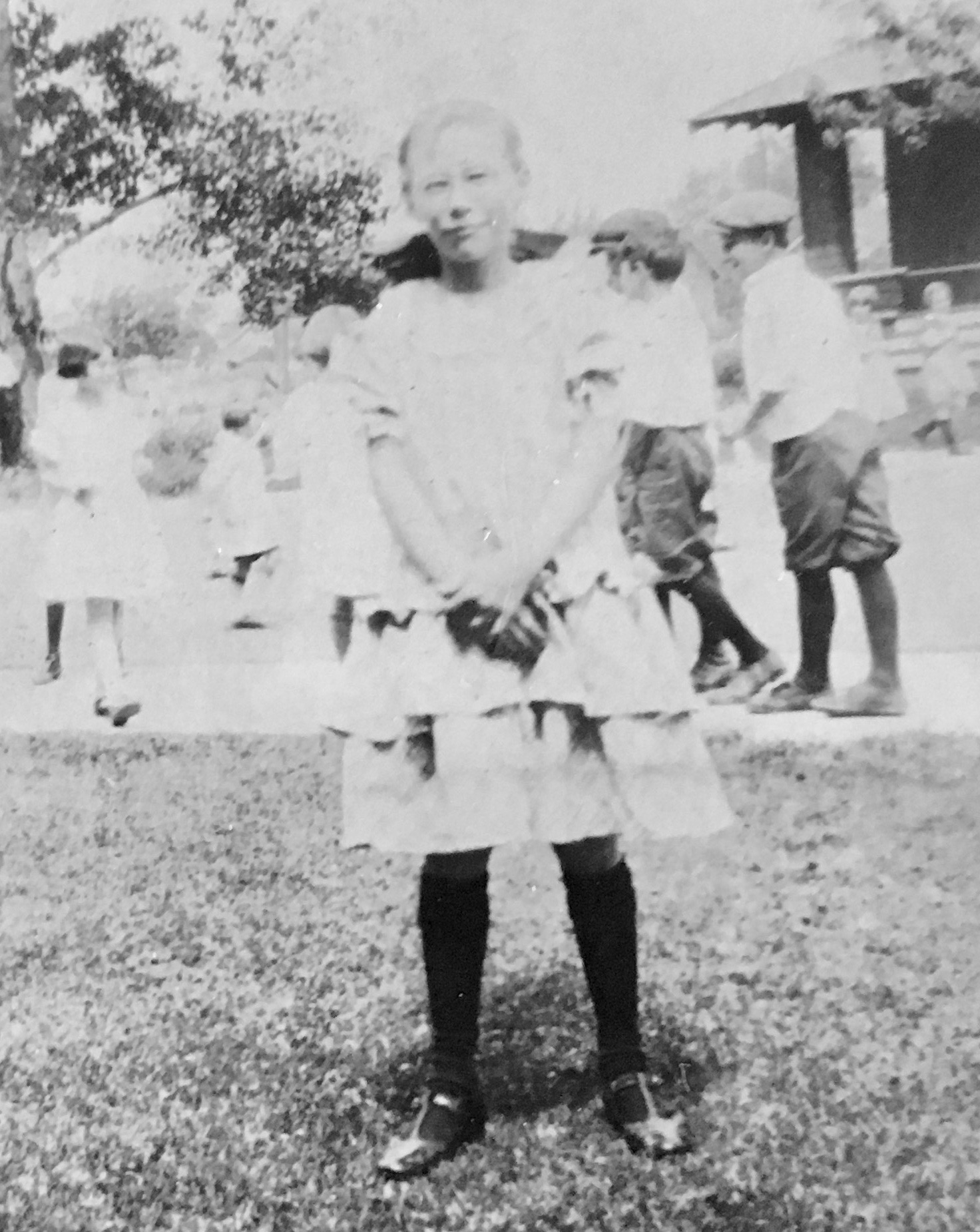
Florence Wick at school in the 1920s
Researching what life was like in my hometown in this period, I found a book written by Thomas Heuterman, who was my journalism professor at Washington State U. The Burning Horse: The Japanese Experience in the Yakima Valley 1920-1942, documents discrimination against the Japanese community in Wapato, a town on the Yakama reservation where the farmers leased land. In emails Prof. Heuterman told me he had been surprised to find what his research showed: a long history of racism and exclusion in the Yakima Valley.
He wrote: “I went into the project predicting that the Valley Japanese were an exception among all the prejudice of the era. That’s what I remembered as a child from my folks’ attitudes. But, as you know, I found just the opposite. Most of the Nisei (second generation) who have read the book also didn’t know that racism was going on; their folks had protected them from that too.”
Japanese farmers were persecuted relentlessly. Their houses, barns and crops were bombed and burned. Newspapers stoked the fires of racism. Prof. Heuterman’s research focused on stories in the local and state newspapers. Here is some of what he found. These were headlines in the Seattle Star during hearings to determine the fate of Japanese immigrants in Washington State in 1920.
WILL YOU HELP TO KEEP THIS A WHITE MAN’S COUNTRY?
JAPS PLANS MENACE WHITE CIVILIZATION
Japanese plans for expansion at the expense of the white race are a deeper menace to Caucasian civilization than were ever the dreams of Pan-German imperialists
In the 1920 version of fake news, testifiers at the hearings repeated lies about the Japanese and weird ideas about racial purity that were then amplified by newspapers across the state. A well-organized American Legion, the Veterans of Foreign Wars and the Anti-Japanese League perpetuated the apocryphal threat of the Yellow Peril. Then the Grange took up the cause. Anti-alien laws passed in Washington were modeled on those of California, which in turn had been promoted by influential Southern whites. The goal in Yakima was to drive all Japanese out of the valley.
Anti-immigrant sentiment reached a peak in the 1920s and 30s in the Yakima Valley and in the entire West. As a child and young adult, my mother must have been aware of it. I was shocked to learn that the KKK held a rally in 1924, which drew 40,000 people to a field outside the town after the state refused to grant them access to the state fairgrounds in Yakima. A thousand robed KKK members marched in the parade.
Farmers welcomed migrant laborers when labor was scarce. But when the economic cycle moved from boom to bust, these workers were targets of violence, forced removal and alien restriction laws. American workers who saw their jobs being taken by immigrants who would work for less were some of the worst perpetrators of racist violence. Racist organizations gained influence after World War I. In the Red Scare of 1917-20 nativism swept the whole country. During that time Alien and Sedition laws were used to deport hundreds of immigrants deemed by the government to be radicals, the anarchist Emma Goldman among them.
In Yakima, terrorism was directed at other groups as well as the Japanese. In 1933, the Industrial Workers of the World (the Wobblies) led a strike for higher wages of white migrant farmworkers that was put down by orchardists with pipes, clubs and bats. Then the strikers were marched five miles to a stockade that had been constructed in the middle of downtown Yakima. Some of those arrested were jailed for six months, and the stockade stayed up as a deterrent for a decade. In 1938, 200 men set upon blacks in Wapato, beating them and setting fire to one of their houses. Filipinos also became targets of harassment.
Congdon Castle
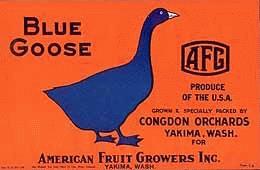
I grew up near the Congdon orchard where the 1933 strike took place. The owner’s summerhouse mansion was called Congdon Castle and as kids we thought it was haunted. No one really lived there except caretakers. The wealthy owners had always lived in another state. I have a vague memory of Flo telling us about the “battle of Congdon Castle.” She surely knew about it. The primary industry in Yakima, then and now, was agriculture and agriculture was always big news.
Congdon Orchards label
Probably my mother already knew which side she was on by the time these events occurred. Her parents, immigrants themselves from Sweden and Norway, can’t have felt completely safe. Family lore has her father enduring taunts for his foreign accent from students at Yakima High School where he taught commercial arts. Her father’s thinking surely influenced young Flo. She told me she remembered his troubled reaction to the execution of Sacco and Vanzetti, Italian immigrants whose incarceration lasted from 1920 to 1927. She was 14 years old when they were executed by the US government. Flo’s Norwegian father took the side of the immigrants, who most agreed had been falsely accused.
My mother’s family in about 1922. She is the one on the right with glasses.
This was the Yakima of my mother’s youth, a place where, if you read the newspapers, you could not escape the dominant paradigm. But by the time I was growing up in the 1950s and 60s, this history escaped us. Our family often visited Fort Simcoe, the restored Army fort on the Yakama reservation, but I never learned about the Indian Wars as a child. Indians and revolution were scrubbed from our textbooks and xenophobia persisted.
My brother Don remembers as a freshman in high school in 1967 defending the rights of Native Americans in history class. The popular teacher launched into a diatribe against him in front of the whole class. She said Indians had an inferior culture and deserved to be conquered. She said they were dirty, barbaric and uncivilized. She believed it was right of a superior culture to war against them and subjugate them. This was the inevitable march of history, she said. When Don told Flo about it she was outraged. She and the teacher had been friends but that killed their friendship.
The xenophobes in Yakima and elsewhere were able to successfully construct a racial identity, the “white race,” made from hundreds of diverse cultures, people who spoke different languages and dialects, people who had themselves been the victims of oppression, as a way to successfully divide the population. In his book, Irish on the Inside, Tom Hayden posits that Irish immigrants had more in common with blacks and slaves than the white rulers who starved and oppressed them. Before epigenetics became a thing, Hayden made the case that we have all been affected by the plight of our ancestors. “That the Irish are white and European cannot erase the experience of our having been invaded, occupied, starved, colonized and forced out of our homeland,” he wrote.
Hayden wanted to break the assimilationist mold among Irish Americans.“If Irish Americans identify with the 10 percent of the world which is white, Anglo American and consumes half the global resources, we have chosen the wrong side of history and justice. We will become the inhabitants of the Big House ourselves, looking down on the natives we used to be. We will become our nightmare without a chance of awakening from its grip.”
My grandparents had a strong immigrant identity, but the advantage they had is that they were, in the language of the American Legion, of the “white race.” The Legion, the KKK and others demanded to make America white again. I’ve no clue how the xenophobes felt about Southern Italians, but it seems that if you came from Europe you were ok with them. In Yakima, they reserved deepest hatred for Japanese. But they also scorned anyone not of the “white race.” The irony was that these invading whites had themselves displaced indigenous people and it’s difficult to understand how they failed to see this giant contradiction. The trick, of course, was to make them subhuman.
Flo with her precious books
That Flo’s parents identified as immigrants rather than white informed her understanding of the world. Flo was also a voracious reader and certainly was influenced by what she read. She spent hours at the Yakima public library, receiving her first library card at a young age and migrating to the adult section before children were allowed. She was one of those kids who took a flashlight to bed and often read under the covers at night.
Flo’s library card
She was also active in the YWCA, quite a progressive organization during that period just as it is today. Besides championing racial integration, the YW also lent support to Japanese families who were incarcerated during the war. Her involvement in the YW got Flo out of Yakima to meetings across Washington State and in the big cities of Chicago and Columbus, widening her worldview.
Flo’s father, Ben Wick, overlapped with William O. Douglas for a year in 1921-22 when they both taught at Yakima High School. Flo may have known Douglas as a child. She would have been nine years old when he got fed up with teaching school in Yakima and and left to make his fortune in the East. In any case, Flo admired Douglas greatly and I believe she shared his politics, which were shaped by class. He grew up fatherless and poor. When discussing how his personal experiences influenced his view of the law, Douglas said, “I worked among the very, very poor, the migrant laborers, the Chicanos and the IWWs who I saw being shot at by the police. I saw cruelty and hardness, and my impulse was to be a force in other developments in the law.”
He was no communist either but he did defend the concept of revolution in a 1969 screed. He is famously quoted in Points of Rebellion: “We must realize that today’s Establishment is the new George III. Whether it will continue to adhere to his tactics, we do not know. If it does, the redress, honored in tradition, is also revolution.” He survived two impeachment attempts.
When I asked my lawyer friend Judy Kurtz about Douglas she said, “Legal standing for trees!” He was famous for defending nature and the environment, often in dissenting opinions. She added, “I wish he was still on the court. God help us now.”
Douglas returned to our hometown later in his life and Flo and I ran into him and his wife Cathy in the 1970s. We had decided to splurge on lunch at the Larson Building, the town’s only high-rise, an elegant Art Deco architectural gem built in 1931. We spotted them as we walked into the lobby. “Justice Douglas, Justice Douglas,” my mother entreated as she ran up to him. He graciously remembered her father.
The wartime internment of Japanese did not happen in a vacuum. Finally, after decades of domestic terrorism, the American Legion and its ilk got their way. In June 1942, 1061 Japanese were evacuated from the valley, sent by rail to a processing center at the Portland livestock grounds, and then incarcerated at Heart Mountain, Wyoming for the remainder of the war—800 miles from home. Only a few resettled in the Yakima valley.
One of my heroes, the labor organizer Sister Addie Wyatt said, “If you don’t know where you come from, you don’t know where you’re going.”
This is where we come from. I fervently hope it is not where we’re going. I’m so glad people like immigrants and Americans of color, the Wobblies, my mother, my grandfather and William O. Douglas found the will to resist.
Whenever I visit my friend Madeline Mixer in Berkeley, we usually lunch at the UC Women’s Faculty Club on the campus. Madeline has been a member for decades, although she was never an actual member of the UC faculty. She was invited to join when she worked there as a statistician in the 1950s. No one can argue that Madeline is not a Bears fan. She was active in student government and served as vice president of the student body when she was a student there in the 1940s. Later Madeline worked as the regional chief of the US Dept. of Labor Women’s Bureau where she supported and defended tradeswomen. That’s where we met in the 1970s.
I love our lunches at the Women’s Faculty Club partly because of the great food. You don’t have to order the “salad bar” but I always do because it’s so tempting. I’m the kind of eater who wants to taste every dish, and the bar has so many choices, mostly vegetarian, with free range and locally sustainable everything. My compliments to the chef.
Madeline Mixer
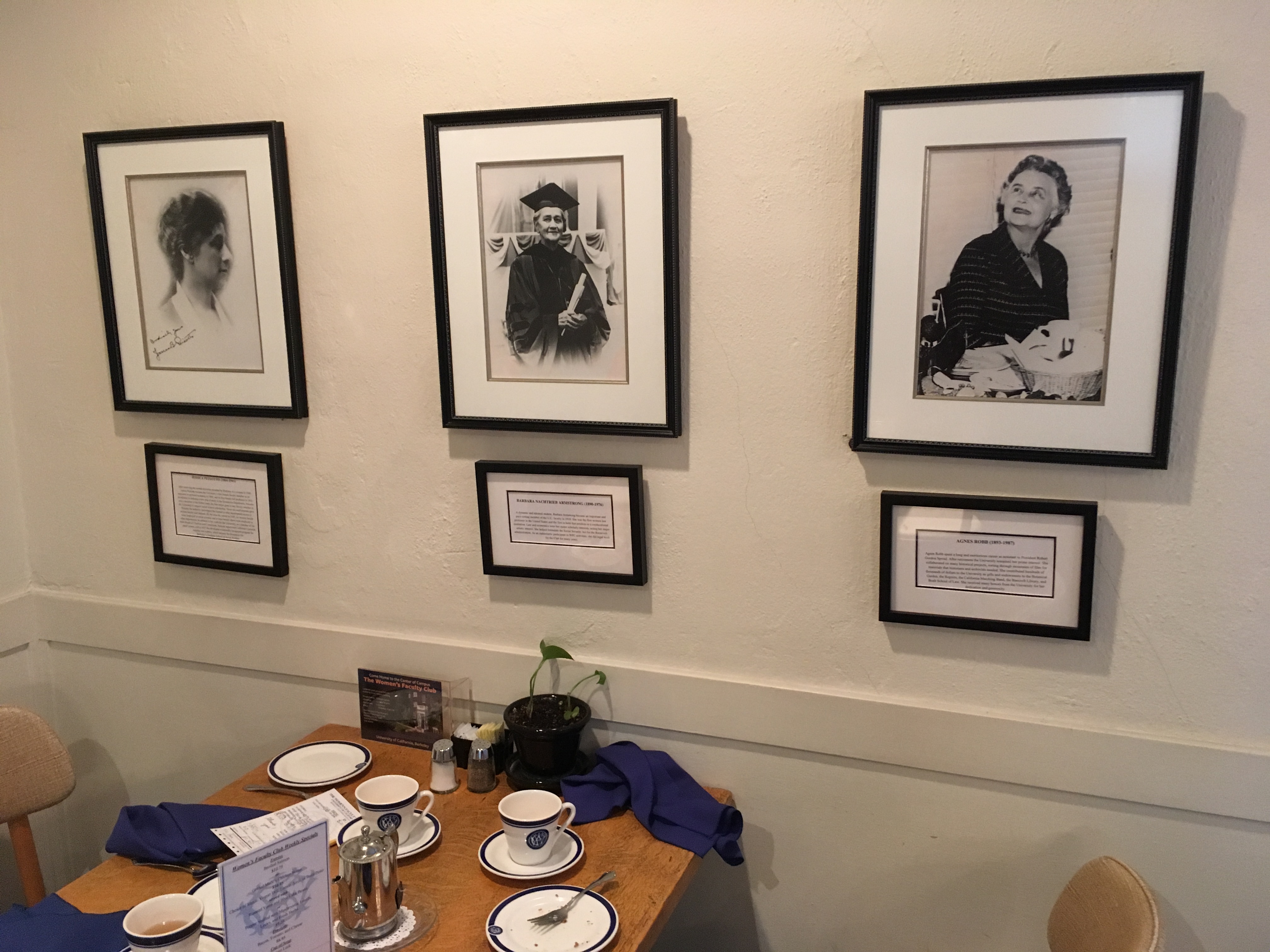
I’ve copied the short history of the club from its web page. The page also includes bios of some of Berkeley’s female faculty leaders. My heroine is Pauline Sperry, the first female professor of mathematics, who stood up to the state and refused to sign the anti-Communist loyalty oath in 1950. For that she was fired. http://www.womensfacultyclub.com/history.html
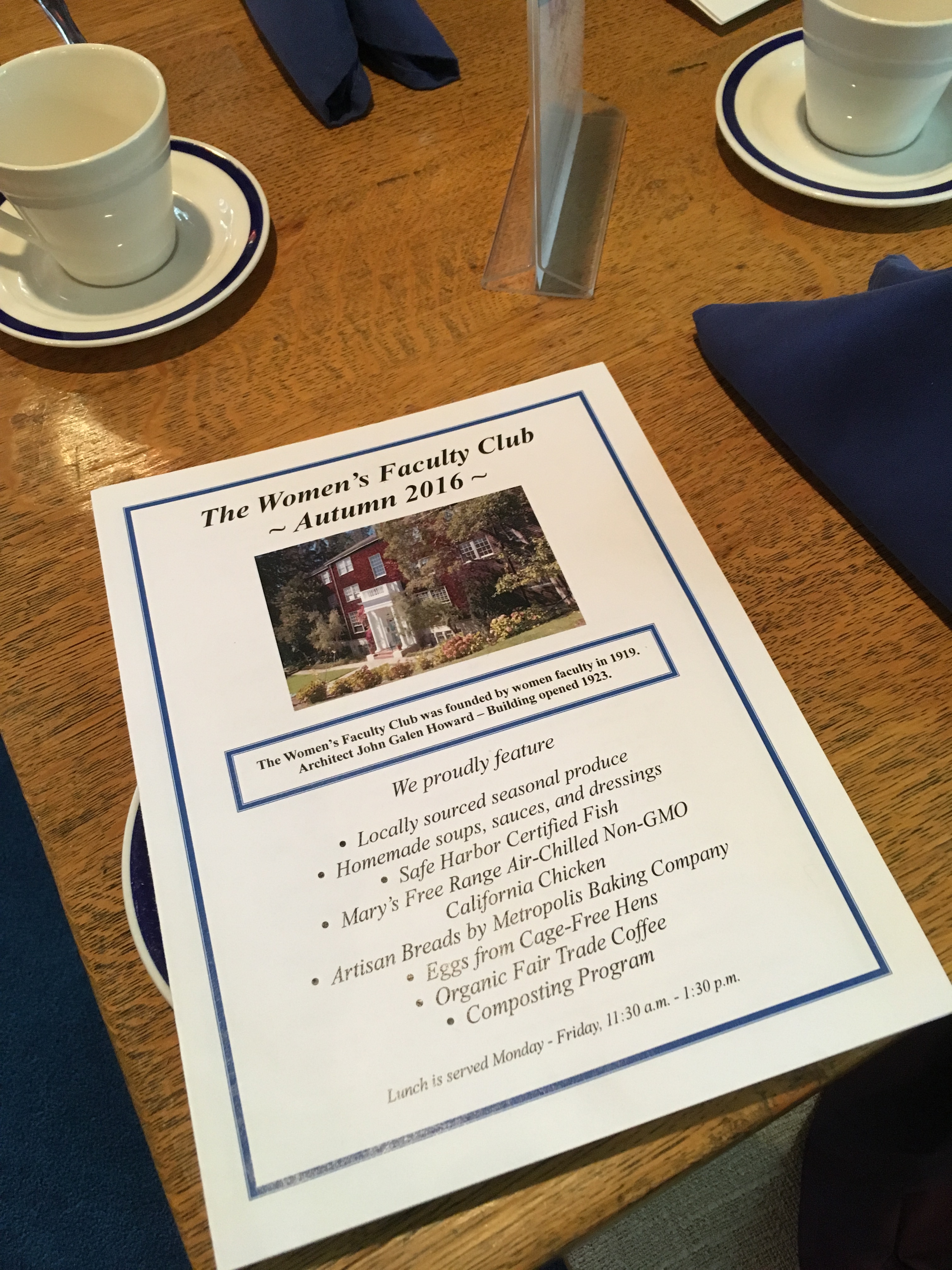
Women’s Faculty Club menu
The Women’s Faculty Club is the only women’s faculty club in the nation with its own building. It was conceived and formed through the initiative of Dean Lucy Ward Stebbins, the second Dean of Women on the Berkeley campus. In the fall of 1919 Dean Stebbins circulated an invitation to all women faculty to attend a small organizing meeting to discuss forming a group where “we might know all our colleagues better and have more opportunities to discuss our common interests.” This meeting was held at the Cloyne Court apartment of Dr. Jessica Peixotto, first female full professor at Berkeley.
At the time women were not allowed into the Men’s Faculty Club and the women members of the faculty felt the need “for a place of their own, as a refuge from the bustle and confusion on the campus.” After the first meeting the group held an organizing dinner and invited seventy-six women who were either faculty, worked in the University Library or held positions of administrative responsibility. No minutes were taken of this first dinner meeting but the seeds for the club had been planted. By December of 1919 a constitution and by-laws had been adopted and a seven-member Board of Directors elected. Dean Stebbins was elected the first President and the women began work on a financial plan to build a permanent club house.
Photos of groundbreaking female faculty hang on the walls
The women met for meetings and tea in a variety of locations and began to meet with both the representative for the Regents and the campus architect John Galen Howard. Howard was selected as the architect for the building and presented a number of plans. The Finance Committee and the Executive Building Committee were jointly responsible to raise the money and sell stock.
The building was completed in 1923 and after years of hard work the women now had a permanent home.