The Canadian labor movement is ahead of the US in recognition of the issue of workplace violence, because of the Dec 6, 1989 Montreal Massacre of 14 women who were murdered that day at Ecole Polytechnique by a man who didn’t think women should be engineering students. There was a struggle then to get the Canadian Labour Council to recognize the issue, but the victory has carried forward.
IBEW Canada Statement Mourning the Loss of Amber Czech and Condemning Violence in the Workplace
Toronto, ON – November 17, 2025
Today, International Brotherhood of Electrical Workers (IBEW) Canada International Vice President Russ Shewchuk issued the following statement:
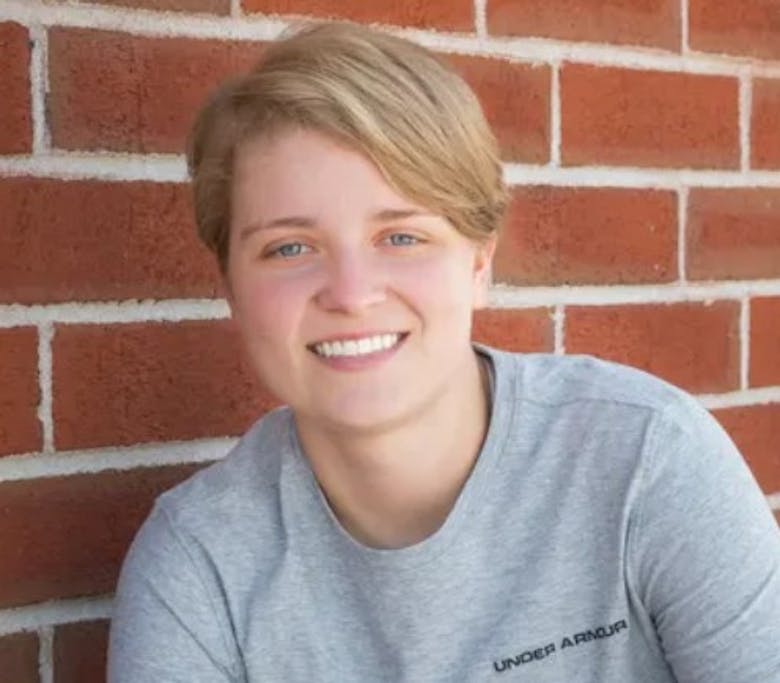
“IBEW Canada mourns the loss of 20-year-old welder Amber Czech, who was brutally attacked and killed at her workplace in Minnesota. We extend our deepest condolences to Amber’s family, friends, fellow workers and her community.
“Although Amber was not a member of the IBEW or affiliated Building Trades Unions (NABTU/CBTU), what happened to her should never happen to anyone—anywhere. And while this tragedy occurred in the U.S., the loss is deeply felt across our union community in Canada. It’s a stark reminder of the work we must keep doing to ensure such senseless acts never happen again.
“Violence has no place on our job sites, in our offices, or in our union. We owe it to Amber, and to every worker who has been harmed or threatened, to build safe, respectful, and inclusive working environments, free of violence and cruelty.
“IBEW Canada stands with all who advocate for ending gender-based violence, and all violence in the workplace. We commit to ongoing training, conversation and action that promote equity and dignity for all workers.”
The International Brotherhood of Electrical Workers (IBEW) represents approximately 70,000 members in Canada and 873,000 members and retirees in North America who work in a wide variety of fields, including construction, utilities, manufacturing, telecommunications, broadcasting, railroads and government. For more information, visitIBEWcanada.ca or IBEW.org
It’s time for our US labor unions to condemn workplace violenceand do something about it.
Indigenous women in Ironworkers Local 725, Canada. Photo: Lightframe
Tradeswomen Reject Union’s Capitulation
Tradeswomn Inc. is a nonprofit I helped found in 1979. Still going strong, the organization helps women find jobs in the union construction trades. Here’s the text of a speech I gave October 30, 2025 at Tradeswomen’s annual fundraising event.
Sisters, we’ve come a long way.
When we first started Tradeswomen Inc., we had one goal: to improve the lives of women — especially women heading households —by opening doors to good, high-paying union jobs.
It took us decades to be accepted by our unions. Decades of proving ourselves on the job, standing our ground, demanding a seat at the table.
And now — by and large — we’re there. We are leaders. Business agents. Organizers. Stewards. We have changed the face of the labor movement.
But sisters, we are living in a dangerous time.
Our own federal government is attacking the labor movement. And we cannot look away.
We all know that Donald Trump is gunning for unions. Project 2025 is his blueprint — a plan to dismantle workers’ rights and roll back decades of progress.
Let me tell you some of what’s in that plan.
It would roll back affirmative action, regulations we worked so hard to secure, Allow states to ban unions in the private sector, Make it easier for corporations to fire workers who organize, And even let employers toss out unions that already have contracts in place.
It would eliminate overtime protections, Ignore the minimum wage, End merit-based hiring in government so Trump can pack the system with loyalists, And — unbelievably — it would weaken child labor protections.
Sisters and brothers, this is not reform. It’s revenge on working people.
And yet, too many union members still vote against their own interests. Why? Because propaganda works. Because we are being lied to — by the media, by politicians, by billionaires who want to divide us.
That means our unions must do more than just bargain wages. We must educate. Engage. Empower. Because the fight ahead isn’t just about contracts It’s about truth.
We women have proven ourselves to be strong union members — and strong union leaders.
We’ve built solidarity. We’ve organized. We’ve made our unions more inclusive and more reflective of the real working class.
And now it’s time for our unions to stand with us.
Many of our building trades unions have stood up to Trump, and to anyone who would divide working people.
But one union — the Carpenters — has turned its back on us.
The Carpenters leadership has disbanded Sisters in the Brotherhood, the women’s caucus that so many of us fought to build.
They have withdrawn support from the Tradeswomen Build Nations Conference, the largest gathering of union tradeswomen in the world. They’ve withdrawn support for women’s, Black, Latino, and LGBTQ caucuses claiming they’re “complying” with Trump’s executive orders.
That’s not compliance. That’s capitulation.
But the rank and file aren’t standing for it.
Across the country, Carpenters locals are rising up, passing resolutions to restore Sisters in the Brotherhood and to support Tradeswomen Build Nations.
Because they know: You don’t build solidarity by silencing your own. And our movement — this movement — is built on inclusion, not fear.
While the Carpenters’ leadership retreats, others are stepping up.
The Painters sent their largest-ever delegation — nearly 400women —to Tradeswomen Build Nations this year.
The Sheet Metal Workers are fighting the deportation of apprentice Kilmar Abrego Garcia. The Electricians union is launching new caucuses, organizing immigrant defense committees, and they are saying loud and clear:
Every worker means every worker.
Over a century ago, the IWW — the Wobblies — said it best:
“An injury to one is an injury to all.”
That’s the spirit of the labor movement we believe in —and the one we will keep alive.
Our unions are some of the only institutions left with real power to stand up to the fascist agenda of Trump and his allies.
We have to use that power — boldly, collectively, fearlessly.
Because this fight is about more than paychecks. It’s about democracy. It’s about equality. It’s about whether working people — all working people — will have a voice in this country.
Sisters and brothers, we’ve built this movement with our hands, our sweat, and our solidarity.
Now — it’s time to defend it. Together. Solidarity forever!
Thick Skin: Field Notes from a Sister in the Brotherhood by Hilary Peach, Anvil Press, 2022
A woman navigating the challenges of the male workplace makes a good story and Hilary Peach does the genre proud in her new book, Thick Skin. A Canadian from BC, Peach writes of working for twenty years as a boilermaker on big projects in Canada and the U.S. She has worked at coal fired power plants, the tar sands in Alberta, pulp mills, gas plants, shipyards—big industrial power generating companies of all kinds, often staying in their company towns.
I enjoy reading about the work people do, especially hard dirty jobs like construction. In this book Peach tells us about the world of boilermakers, a subculture all its own. She describes the often difficult working conditions while she schools the reader about the intricacies and art of welding.
Most stories center on the men she works with, the psychopaths as well as the nice guys.
She encounters sexism and discrimination regularly as might be expected as the only woman among hundreds of men. But Peach always finds humor in the stories and often had me laughing out loud. Tradeswomen who go through the same challenges in our workplaces will delight in her creative comebacks and her various inventive ways of responding to harassment.
“How do we know it’s sexual harassment?” asks an apprentice.
“Just stop talking about your penises. That’s 80 percent of it,” say the women in the break room.
I loved this book. It’s well written and an engaging read with truly general appeal. And, of course, it reminds me of my own experience working construction.
Electricians, too, have a subculture of travelers, boomers, tramps, journeyworkers—those who travel around to different jobs—and my sisters and I used to dream of traveling. We thought it would be the greatest thing—that is until we heard from others who were on the road, mostly because they couldn’t get work in their own union locals. Sandy said she had to wear so many layers of clothes working in the Boston winter that her arms stuck straight out at her sides. Barbara of NYC told about burning refuse in high rises to keep warm and to help the concrete set, risking the hazards of smoke inhalation. Betsy complained of the Texas heat and miles of smelly porty potties.
Maybe we didn’t want to travel after all.
Hilary Peach does it for two decades—driving hundreds of miles, often in the driving rain or snow, to get to a job. Staying in work camps whose last century accommodations have been condemned and then reopened without remodel. Working 12 hour shifts happy for the overtime, working nights, working in cramped quarters in the freezing cold and boiling hot.
As the hard hat sticker says, “If you can’t stand the heat get the fuck out of the boiler.”
Peach does indeed develop a thick skin. A favorite maxim, repeated often:
“You don’t bleed in the shark pool.”
Later, as more women begin to come on to the jobs, they tell her conditions have improved. She writes, “When other women were on the job it made a remarkable difference. One other woman and you are no longer the freak, the anomaly. You have an ally. Three or more, and everything changes. We can no longer be isolated and targeted in the same way…Someone has to organize a second bathroom.”
Thank you Hilary Peach for making women look good out there and for paving the way for more women to enter this industry. A published poet, she’s now working on a novel. As boilermakers say at the end of a job, “See you on the next one.”
Molly Martin is a retired electrician whose latest book, Wonder Woman Electric to the Rescue, is available on Amazon and Kindle.
JOURNAL October 24, 1983 Pacific Heights Woman Strangled
I see the headline, then discover to my horror the woman was Sue Lawrence, a fellow electrician. Back home with Sandy gone to class and after a day full of questions from men at work I’m terrified at the prospect of my own victimization. That “nude body face down on the bed” could be mine. What if, as in some Agatha Christie plot, the murderer is going after all the female electricians in the city? Will I be next? In the shower, a most vulnerable state especially with a head full of shampoo and eyes closed, I imagine Ruth pounding on my door to be him. Panic strikes. I manage to wash shaking limbs.
***
I was not the only one terrified by Sue’s murder. Other female electricians in the city had the same thought. There were so few of us since union apprenticeship programs had just recently opened their doors to women after years of pressure and lawsuits. We were in the minority. We were not welcomed. We were scorned. We already felt vulnerable as women in an all-male work environment. Now this murder had us all freaked out.
Sue’s memorial was held at the Episcopal church just off Diamond Heights Blvd. We met Sue’s parents and heard a minister recite a rote speech, but we learned very little more about Sue than we already knew, which was not much.
Afterward we repaired to Yet Wah, a Chinese restaurant on the upper floor of the shopping center across the street. There the women electricians of the International Brotherhood of Electrical Workers (IBEW) Local 6 gathered to celebrate the life of our sister. We were joined by two or three tradeswomen from other crafts.
We had been working on construction sites that day but, as construction workers say to each other outside of work, we cleaned up pretty good. You couldn’t look at us and tell that we were electricians. I wore my only “good” outfit, a sports jacket with sleeves rolled up bought at Community Thrift, the gay secondhand store on Valencia Street. Paired with black jeans and a white shirt I could go anywhere.
My roommate Sandy was a fashion plate and took this opportunity to wear a dress, a fifties number with a pencil skirt. She had a tiny waist and large butt so she had trouble finding work clothes that fit. Manufacturers didn’t make work clothes for women. Away from work Sandy took refuge in skirts. She had always wanted to work in the fashion industry but couldn’t find a job there. She felt she didn’t fit in construction, but the money was a powerful incentive.
Others dressed in black funeral attire.
“Sharp,” said Alice when she bumped into Dale, who was wearing a suit and tie. “Very avant garde.”
Ten of us were seated around a big round table with a lazy susan in the middle for family style serving. As big plates of Gung Pao chicken and mu shu pork revolved, we collectively decompressed.
I had worked out of the Local 6 hall for a couple of years, but I had never encountered any of my sisters on the job. We were isolated and alone when at work. Our active support group of Local 6 women gathered monthly to share stories and to support each other. The sisters’ gatherings helped us feel not so alone. We had been pushing for a women’s caucus in our union local, a caucus with the union’s endorsement.
“So I got a cease and desist letter from the union,” said Sandy, whose thick Boston accent left us westerners chuckling. “They said if we don’t stop meeting they will kick us out. We are not an authorized caucus, and there’s no easy way for us to get authorized.”
“Are they serious?” said Joanne. “Would they really do that?”
The business manager kept a tight rein on the local. We heard those who attempted to challenge his leadership had been blacklisted, but it was hard to imagine the local disenfranchising its handful of female members. We had only just made our way in. At that time there were fewer than ten of us in the union local. We decided to keep meeting. But it was a clear message—the union was not our ally and we should not seek support there.
Sue Lawrence had entered the IBEW apprenticeship when she was only 18. She was about to graduate from the four-year program when she was raped and murdered by the stranger who broke into her parents’ house.
I knew Sue only from the sisters’ meetings. She didn’t talk much. I didn’t even remember having a conversation with her.
“She was weird,” said Dale. “A newspaper reporter called and asked about Sue. I didn’t know what to say. I think she was suffering from manic depression. But, hey, we all know you have to be a little bit crazy to go into the trades as a woman.”
Nods around the table. We all felt a little bit crazy.
“I know she struggled during her apprenticeship,” said Jan. “You know she started right out of high school. That’s rough. Younger women get more harassment. But she made it through and she was just about to turn out as a journeywoman.”
“The last project she worked on was that big housing complex at the ocean where Playland at the Beach used to be,” said Dolores. “She was the only woman working there.”
“I think she was struggling with her sexuality,” said Alice.
Sue was an enigma to all of us. Had any of us been there to support her? Maybe not to the extent we should have been.
Sue lived with her parents in the house she had grown up in on Green Street. I had driven by it just to see where she came from. It was a rich part of town that none of us frequented. Her parents had some money. Maybe Sue hadn’t fit into the box prepared for her. She was an unlikely electrician, but I knew several of them—women whose parents were doctors and who rebelled against parental expectations by going into construction.
Tradeswomen can’t get together without talking about discrimination and harassment we experience on the job. No one else really understands or wants to listen to our complaints.
“Can I be honest,” said Lynn. “Since Sue was murdered I haven’t slept well. I’m scared. Was Sue attacked because she was an electrician? Are we at risk of being attacked?”
We looked at each other. I hadn’t slept well either. We didn’t know anything about Sue’s killer. What was his motive?
Jennifer told us how she had been attacked and raped in her own house the year before. Sue’s death had been hard on her. The only female on her job, she couldn’t shake the thought that her coworkers might be abusers and rapists. She had stayed off the job and was terrified to go back to work where she felt profoundly unsafe. She confessed that she didn’t know how much longer she could stay in the apprenticeship.
“Maybe I have PTSD or something,” she said. “Whenever I think about going back to work I get the cold sweats. I’m starting to think I just can’t go back.”
Pat, who had started in one of the first apprenticeship classes of Local 6 women in 1978, complained about being dyke baited.
“One of the guys called me a bulldagger the other day,” she bellowed. Pat had a mouth on her. Maybe that’s how she survived.
Pat was married to a man and they had two young children. I had seen a picture of her at her graduation from the apprenticeship. She was standing next to her tuxedoed husband and dressed in a fancy gown made of filmy blue material like women might have worn to any other graduation ceremony. Even in that gown Pat looked like the butchest bull dyke we knew. She kept her hair short and had a stocky body. On the job in her work clothes and tool belt Pat radiated authority. How sad to have to put up with dyke baiting when you’re not even a dyke!
“Pat should officially be an honorary dyke,” I said. “She gets dyke baited just like us lesbians, maybe even more.”
And we all agreed. Dale stood and, pretending to wield a magic sword, touched Pat on both shoulders and declared, “Pat, I now dub you an honorary dyke. Your ID card will be mailed to you.”
And it was then that I truly understood that dyke baiting was not as much about lesbians as it was about ensuring that we all meet certain stereotypes of what men think women should look and act like. Dyke baiting on the job affected all of us, gay and straight.
The conversation turned to tradeswomen organizing. We had been making an effort to hire childcare for our meetings and conferences but it was a struggle. We had no budget so we resorted to passing the hat to hire a childcare worker. The dearth of childcare meant that some of our parent members had to bring their kids to meetings or stay home. The only woman at the table with kids, Pat supported a childcare initiative.
“But you’ve got a husband,” said Alice. “Why can’t he stay with the kids.”
“Yeah I’m married, but you’ve got a partner too,” countered Pat. “This is just discrimination against mothers. Do you want us in the group or not?”
Samantha, sitting across the table, sent me a look. We had been flirting for weeks. She was so damn cute, curly dark hair framing a round face, a small woman with a muscled frame. We had been lifting weights together at the Women’s Training Center on Market Street.
It was a period in my life when attractions proliferated and sometimes the attraction could not be ignored. Sam’s look required follow up. She politely excused herself from the table and I waited a moment before heading in the direction of the women’s room.
The bathroom had two stalls. I entered the one nearest the wall. Sam was close behind, gliding in and locking the door. Smiling, I caressed her firm delts. I knew how much she could bench. She was so hot. I gently pressed her back up against the door and lowered my head slightly. The kiss—long and soft—weakened my knees.
Others crowded into the bathroom.
“Hey, can I have some of that too,” called Dale, looking under the door at our four feet.
Busted!
We walked out with sheepish grins to a line of sister construction workers waiting for the stall.
“Get a room,” someone yelled.
They were taunting us but they were all laughing. And then we were laughing too, a practiced survival tactic.
***
JOURNALOctober 27, 1983 Sue’s memorial service and dinner with the women electricians afterward inspires me to see these women as my sisters in struggle. I feel our collective rage and hurt and vulnerability. When I tell them I imagine a plot against women electricians, all admit the same horrible fantasy. Jennifer who survived being raped and strangled in her own house last year is hardest hit but others tell of their terror at staying alone at home.
***
Though I conflate these events in my mind, it wouldn’t be until six years later that we would witness a mass killing of women who deigned to study what had been “men’s work.” On December 6, 1989, Marc Lepine entered a mechanical engineering class at the Ecole Polytechnique in Montreal and separated the women, telling the men to leave the room. He said he was “fighting feminism” and opened fire. He shot at all nine women in the room, killing six. He then moved through corridors, the cafeteria, and another classroom, targeting women. He slaughtered eight more before turning the gun on himself.
More on-the-job memories from 1980. This is a true story with names changed to make it fiction. Published in Tradeswomen Magazine, our means of communication in the 1980s and 90s.
In the wake of harassment allegations against sexual predators including movie moguls and our president, tradeswomen applaud women who are telling their stories and rising up against this outrage.
Women in male-dominated occupations have been fighting this fight for as long as we can remember. We’ve been on the front lines of the feminist movement for decades defending our sisters, supporting legislation to protect women against sexual harassment and helping employers and unions see their responsibility on this issue. We and our fight have been invisible except to each other. Every female construction worker has experienced harassment and all of us can say #Metoo.
Taped on the counter at my supply house, 1983. Sealtite is a type of electrical conduit.
In 1980 I worked as the only female electrician on a big construction job in San Francisco. That’s how it was for us then, and that’s how it still is. Women make up less than three percent of the construction workforce. We are often alone in a crowd of hundreds of men.
I would do my job, dressed in boots, hard hat and work clothes just like the men, looking over my shoulder anticipating violence and hostility. In the porta potties amidst the ubiquitous dicks drawn on the walls would be my name underneath the sentiment “I WANT TO FUCK YOU.” I was called “the cunt.”
I spent my working life in what we now call a hostile work environment. We had no word for it then. There was no recourse. You could complain to your foreman or your union rep but they would tell you that the harassment was your own fault and if you couldn’t take it you should leave the job. You loved the work and you loved the paycheck and so you kept your mouth shut and your head down. And you depended on male allies. My tool buddy on that job—the only guy who would work with me—was a Hispanic/native man whose family had been in California since it was still part of Mexico. He had my back.
Some things have changed since then and the changes are the direct result of feminist organizing. In the 1970s tradeswomen who had been the target of harassment began to bring lawsuits against employers. They lost. When the civil rights activist Eleanor Holmes Norton, as chair of the U.S. Equal Employment Opportunity Commission under President Jimmy Carter, released regulations declaring sexual harassment to be discrimination under federal law, women finally had legal backing.
Sister electrician Lyn Shimizu pointing out graffiti on the SF opera house job, 1997
In the 1986 Meritor Savings Bank v. Vinson case, the Supreme Court distinguished between and prohibited two kinds of sexual harassment. Quid pro quo harassment occurred when women were made offers such as a promotion in exchange for a sexual favor. Equally important, however, was the hostile environment harassment where men could make the everyday workplace into a place of threats, hostility, offensive images, abusive language. This is the kind of harassment tradeswomen most frequently endure.
The movie North Country dramatized conditions that led to the first class action sexual harassment lawsuit filed in 1988 by Lois Jensen and female miners at the Eveleth Taconite Company in Minnesota. After these women won a $3.5 million settlement, employers began to take notice. Our working conditions began to improve.
We were helped by a few dedicated lawyers. In San Francisco we were lucky to work with attorneys at Equal Rights Advocates and Employment Law Center. Other legal groups included the National Women’s Law Center and the NOW Legal Defense and Education Fund (today Legal Momentum).
That sexual harassment is now against the law is the one big change tradeswomen have noticed over the years that has improved our working lives in a male-dominated workplace. In many other ways our workplace environment hasn’t changed that much. We are still underemployed, last hired and first fired, often poorly trained and generally undervalued. Yet some tradeswomen have had successful careers and are retiring with good pensions. Some have become apprenticeship directors, union business agents, and chairs of state building trades councils. We have built organizations and networks across the country to improve our lot. I just returned from our national conference, this year in Chicago, Women Build Nations. It started as Women Building California, sponsored by the California Building Trades Council and Tradeswomen Inc. in 2001 and has now become international, this year sponsored by the National Building Trades Unions and Chicago Women in Trades. A record 1600 women and male allies attended. Workshops on sexual harassment were featured, as always. But the construction industry now has policies in place to train workers and to prevent harassment.
Tradeswomen are glad sexual harassment is now a mainstream issue, but for us it’s nothing new. We’ve been resisting for decades and still we persist.
Mom was no communist. There’s no evidence that she even flirted with the idea like so many did during the volatile period between the world wars. It was hard to find a communist in Yakima, Washington to flirt with. Unless you count William O. Douglas, the US Supreme Court justice, whom John Birchers dubbed “the only known communist in Yakima County.”
No, during my mother’s early life, the county was run by racist xenophobes whose mission was to Make America White Again.
In such a reactionary environment, how did my mother turn into a liberal? Trying to understand her politics, I’ve been investigating the history of her hometown, which is also my hometown. Yakima, on the dry eastern side of the state with a population of about 20,000, was a conservative place when my mother, Florence Wick, was growing up in the 1920s and 30s. Today, with about 91,000 people, it remains a red blot in a blue state whose population is concentrated on the west coast.
Eastern Washington is desert without irrigation
Catholic missionaries had settled in the valley and white settlers followed in the 1850s as the US Army drove the indigenous population onto a nearby reservation. The Indians had fiercely resisted in what were known as the Indian Wars of the 1850s. The Yakama (the tribe changed to this spelling) Indian reservation is home to several different groups that were forced to settle there in what we call the Lower Valley, a few miles south of the town of Yakima. The sagebrush country with fertile volcanic soil was partly developed and irrigated by Japanese immigrant farmers who began arriving before the turn of the 20th century.
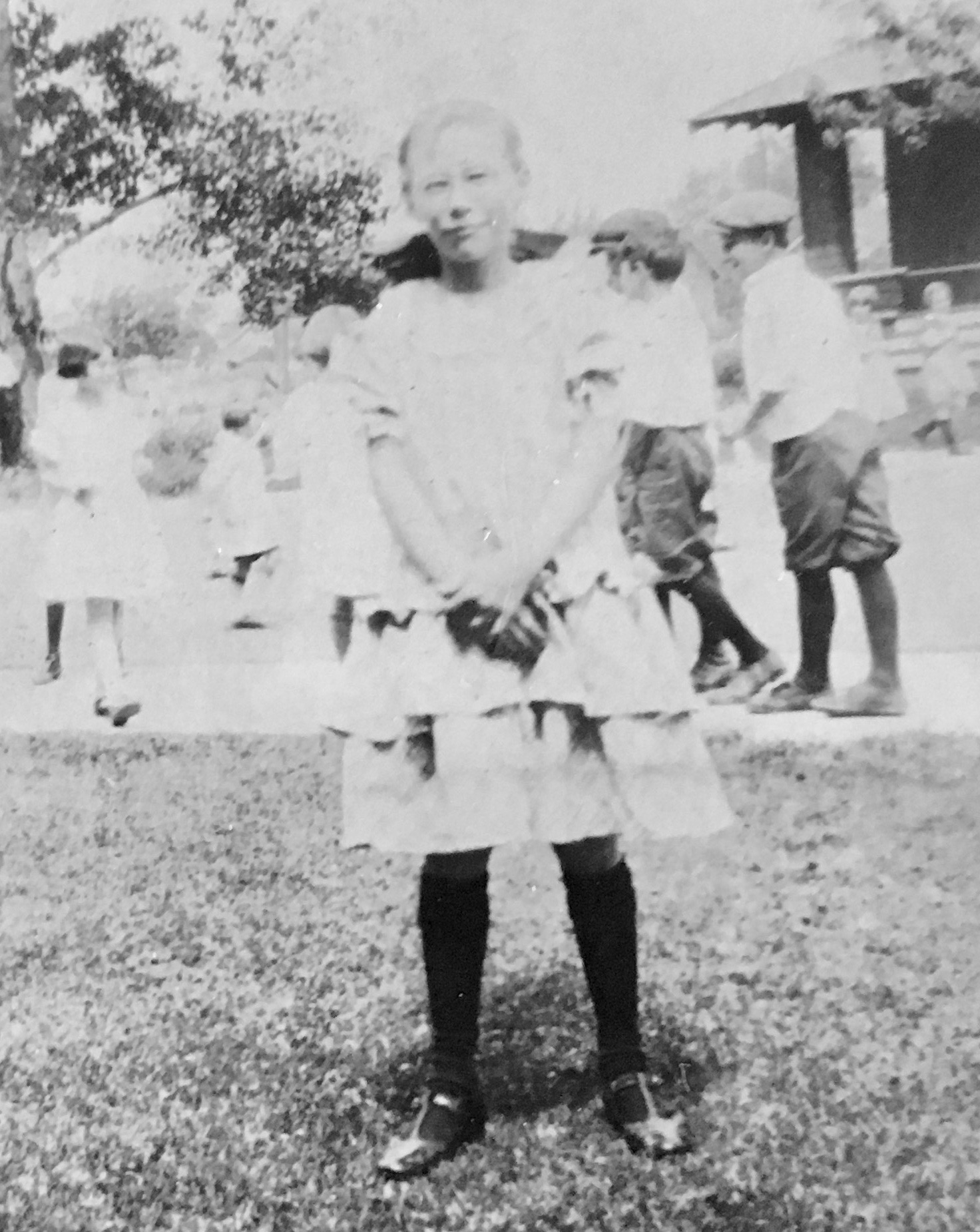
Florence Wick at school in the 1920s
Researching what life was like in my hometown in this period, I found a book written by Thomas Heuterman, who was my journalism professor at Washington State U. The Burning Horse: The Japanese Experience in the Yakima Valley 1920-1942, documents discrimination against the Japanese community in Wapato, a town on the Yakama reservation where the farmers leased land. In emails Prof. Heuterman told me he had been surprised to find what his research showed: a long history of racism and exclusion in the Yakima Valley.
He wrote: “I went into the project predicting that the Valley Japanese were an exception among all the prejudice of the era. That’s what I remembered as a child from my folks’ attitudes. But, as you know, I found just the opposite. Most of the Nisei (second generation) who have read the book also didn’t know that racism was going on; their folks had protected them from that too.”
Japanese farmers were persecuted relentlessly. Their houses, barns and crops were bombed and burned. Newspapers stoked the fires of racism. Prof. Heuterman’s research focused on stories in the local and state newspapers. Here is some of what he found. These were headlines in the Seattle Star during hearings to determine the fate of Japanese immigrants in Washington State in 1920.
WILL YOU HELP TO KEEP THIS A WHITE MAN’S COUNTRY?
JAPS PLANS MENACE WHITE CIVILIZATION
Japanese plans for expansion at the expense of the white race are a deeper menace to Caucasian civilization than were ever the dreams of Pan-German imperialists
In the 1920 version of fake news, testifiers at the hearings repeated lies about the Japanese and weird ideas about racial purity that were then amplified by newspapers across the state. A well-organized American Legion, the Veterans of Foreign Wars and the Anti-Japanese League perpetuated the apocryphal threat of the Yellow Peril. Then the Grange took up the cause. Anti-alien laws passed in Washington were modeled on those of California, which in turn had been promoted by influential Southern whites. The goal in Yakima was to drive all Japanese out of the valley.
Anti-immigrant sentiment reached a peak in the 1920s and 30s in the Yakima Valley and in the entire West. As a child and young adult, my mother must have been aware of it. I was shocked to learn that the KKK held a rally in 1924, which drew 40,000 people to a field outside the town after the state refused to grant them access to the state fairgrounds in Yakima. A thousand robed KKK members marched in the parade.
Farmers welcomed migrant laborers when labor was scarce. But when the economic cycle moved from boom to bust, these workers were targets of violence, forced removal and alien restriction laws. American workers who saw their jobs being taken by immigrants who would work for less were some of the worst perpetrators of racist violence. Racist organizations gained influence after World War I. In the Red Scare of 1917-20 nativism swept the whole country. During that time Alien and Sedition laws were used to deport hundreds of immigrants deemed by the government to be radicals, the anarchist Emma Goldman among them.
In Yakima, terrorism was directed at other groups as well as the Japanese. In 1933, the Industrial Workers of the World (the Wobblies) led a strike for higher wages of white migrant farmworkers that was put down by orchardists with pipes, clubs and bats. Then the strikers were marched five miles to a stockade that had been constructed in the middle of downtown Yakima. Some of those arrested were jailed for six months, and the stockade stayed up as a deterrent for a decade. In 1938, 200 men set upon blacks in Wapato, beating them and setting fire to one of their houses. Filipinos also became targets of harassment.
Congdon Castle
I grew up near the Congdon orchard where the 1933 strike took place. The owner’s summerhouse mansion was called Congdon Castle and as kids we thought it was haunted. No one really lived there except caretakers. The wealthy owners had always lived in another state. I have a vague memory of Flo telling us about the “battle of Congdon Castle.” She surely knew about it. The primary industry in Yakima, then and now, was agriculture and agriculture was always big news.
Congdon Orchards label
Probably my mother already knew which side she was on by the time these events occurred. Her parents, immigrants themselves from Sweden and Norway, can’t have felt completely safe. Family lore has her father enduring taunts for his foreign accent from students at Yakima High School where he taught commercial arts. Her father’s thinking surely influenced young Flo. She told me she remembered his troubled reaction to the execution of Sacco and Vanzetti, Italian immigrants whose incarceration lasted from 1920 to 1927. She was 14 years old when they were executed by the US government. Flo’s Norwegian father took the side of the immigrants, who most agreed had been falsely accused.
My mother’s family in about 1922. She is the one on the right with glasses.
This was the Yakima of my mother’s youth, a place where, if you read the newspapers, you could not escape the dominant paradigm. But by the time I was growing up in the 1950s and 60s, this history escaped us. Our family often visited Fort Simcoe, the restored Army fort on the Yakama reservation, but I never learned about the Indian Wars as a child. Indians and revolution were scrubbed from our textbooks and xenophobia persisted.
My brother Don remembers as a freshman in high school in 1967 defending the rights of Native Americans in history class. The popular teacher launched into a diatribe against him in front of the whole class. She said Indians had an inferior culture and deserved to be conquered. She said they were dirty, barbaric and uncivilized. She believed it was right of a superior culture to war against them and subjugate them. This was the inevitable march of history, she said. When Don told Flo about it she was outraged. She and the teacher had been friends but that killed their friendship.
The xenophobes in Yakima and elsewhere were able to successfully construct a racial identity, the “white race,” made from hundreds of diverse cultures, people who spoke different languages and dialects, people who had themselves been the victims of oppression, as a way to successfully divide the population. In his book, Irish on the Inside, Tom Hayden posits that Irish immigrants had more in common with blacks and slaves than the white rulers who starved and oppressed them. Before epigenetics became a thing, Hayden made the case that we have all been affected by the plight of our ancestors. “That the Irish are white and European cannot erase the experience of our having been invaded, occupied, starved, colonized and forced out of our homeland,” he wrote.
Hayden wanted to break the assimilationist mold among Irish Americans.“If Irish Americans identify with the 10 percent of the world which is white, Anglo American and consumes half the global resources, we have chosen the wrong side of history and justice. We will become the inhabitants of the Big House ourselves, looking down on the natives we used to be. We will become our nightmare without a chance of awakening from its grip.”
My grandparents had a strong immigrant identity, but the advantage they had is that they were, in the language of the American Legion, of the “white race.” The Legion, the KKK and others demanded to make America white again. I’ve no clue how the xenophobes felt about Southern Italians, but it seems that if you came from Europe you were ok with them. In Yakima, they reserved deepest hatred for Japanese. But they also scorned anyone not of the “white race.” The irony was that these invading whites had themselves displaced indigenous people and it’s difficult to understand how they failed to see this giant contradiction. The trick, of course, was to make them subhuman.
Flo with her precious books
That Flo’s parents identified as immigrants rather than white informed her understanding of the world. Flo was also a voracious reader and certainly was influenced by what she read. She spent hours at the Yakima public library, receiving her first library card at a young age and migrating to the adult section before children were allowed. She was one of those kids who took a flashlight to bed and often read under the covers at night.
Flo’s library card
She was also active in the YWCA, quite a progressive organization during that period just as it is today. Besides championing racial integration, the YW also lent support to Japanese families who were incarcerated during the war. Her involvement in the YW got Flo out of Yakima to meetings across Washington State and in the big cities of Chicago and Columbus, widening her worldview.
Flo’s father, Ben Wick, overlapped with William O. Douglas for a year in 1921-22 when they both taught at Yakima High School. Flo may have known Douglas as a child. She would have been nine years old when he got fed up with teaching school in Yakima and and left to make his fortune in the East. In any case, Flo admired Douglas greatly and I believe she shared his politics, which were shaped by class. He grew up fatherless and poor. When discussing how his personal experiences influenced his view of the law, Douglas said, “I worked among the very, very poor, the migrant laborers, the Chicanos and the IWWs who I saw being shot at by the police. I saw cruelty and hardness, and my impulse was to be a force in other developments in the law.”
He was no communist either but he did defend the concept of revolution in a 1969 screed. He is famously quoted in Points of Rebellion: “We must realize that today’s Establishment is the new George III. Whether it will continue to adhere to his tactics, we do not know. If it does, the redress, honored in tradition, is also revolution.” He survived two impeachment attempts.
When I asked my lawyer friend Judy Kurtz about Douglas she said, “Legal standing for trees!” He was famous for defending nature and the environment, often in dissenting opinions. She added, “I wish he was still on the court. God help us now.”
Douglas returned to our hometown later in his life and Flo and I ran into him and his wife Cathy in the 1970s. We had decided to splurge on lunch at the Larson Building, the town’s only high-rise, an elegant Art Deco architectural gem built in 1931. We spotted them as we walked into the lobby. “Justice Douglas, Justice Douglas,” my mother entreated as she ran up to him. He graciously remembered her father.
The wartime internment of Japanese did not happen in a vacuum. Finally, after decades of domestic terrorism, the American Legion and its ilk got their way. In June 1942, 1061 Japanese were evacuated from the valley, sent by rail to a processing center at the Portland livestock grounds, and then incarcerated at Heart Mountain, Wyoming for the remainder of the war—800 miles from home. Only a few resettled in the Yakima valley.
One of my heroes, the labor organizer Sister Addie Wyatt said, “If you don’t know where you come from, you don’t know where you’re going.”
This is where we come from. I fervently hope it is not where we’re going. I’m so glad people like immigrants and Americans of color, the Wobblies, my mother, my grandfather and William O. Douglas found the will to resist.
I had been busy moving a cart full of wire spools, following the foreman’s orders. I looked up to see my coworkers sitting in a row on a platform drinking coffee. Shit. Nobody told me about coffee break. It was 10:05. Later I would learn that the 10-minute coffee break was a hard fought clause in the union contract. To work through coffee break was to break down conditions for the entire crew. I had needed a mentor but nobody told me anything.
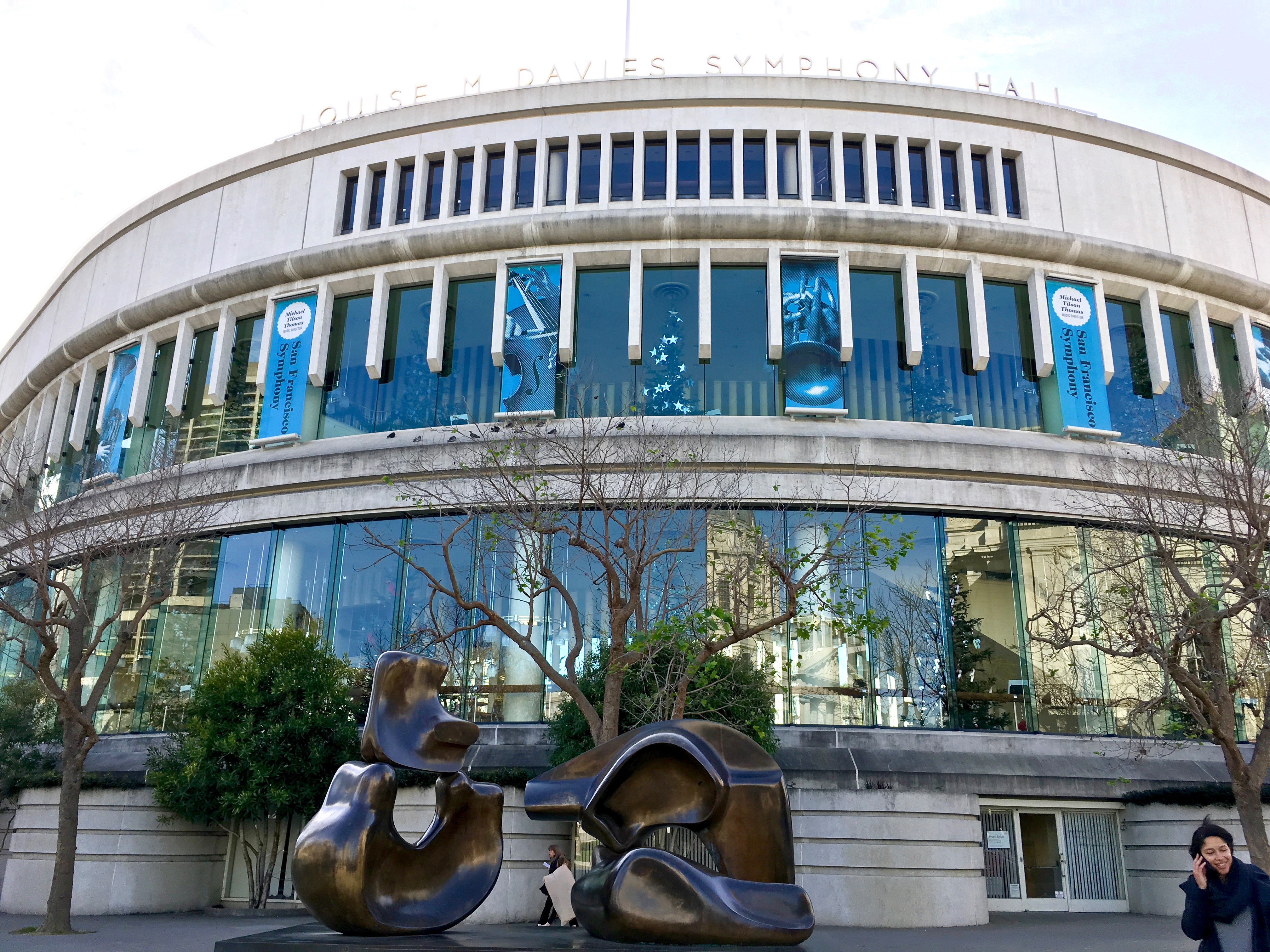
Louise M. Davies Symphony Hall where I worked for two days
When I had heard that the San Francisco electricians union, IBEW Local 6, was looking for journeyman hands at $17 an hour I resolved to figure out how to get in. San Francisco was experiencing a construction boom in 1980 and the union hall was empty. Local 6 had put out a call for experienced electricians. If the union could not supply skilled workers to the contractors, the contractors would have to find them, and the union was doing everything it could to maintain control of the hiring process. By that time I’d been working almost four years as a nonunion electrician with two different companies. I’d graduated from a CETA* training program in Seattle where I had learned wiring basics and how to read the electrical code like a dictionary to find out what I didn’t know. I certainly felt like a journeywoman.
The deal was you put together a resume and went before the union executive board to prove you really had experience. The E board was six men sitting around a table. After a few questions about the mechanics of wiring, they approved me, but I knew they were desperate for hands. I was put on Book Five. It was all about seniority. It worked like this: Book One was local San Francisco hands who had graduated from the union apprenticeship. Book Two was journeymen from other locals in the U.S. I don’t know what Books Three through Five were, but the bigger your book number, the less seniority you had. Book Five was for the dregs. Last hired, first fired. You knew if you got laid off you might never get out through the union hall again.
My number came up on a foggy day in mid-August and I followed instructions to get my butt and my tools down to the union hall. I had to rent my lover’s beat up VW bug, as I didn’t have a car. Annie was one of the few dykes I knew who owned a car, and she charged us dearly for its use, but I had no choice. My toolbox was too heavy to lug onto the bus. I only had to drive from Balmy Alley in the Mission to the hall on Fillmore Street in the Haight, but weather and mechanical issues combined to nearly defeat me. The thick summer fog lay heavily on the city, obscuring my view of the streets. It landed in tiny drops on the windshield, coalescing and running down like rain, which might have been ok had the windshield wipers not been broken. You had to stick your arm out the window and operate them by hand. Miraculously I made it to the union hall without crashing.
The union had erected the single story modern brick-faced hall at the southern end of Fillmore Street behind the New Mint in what had been the ghetto, a neighborhood of decaying Victorians that the white brothers derided as the FillMo’. Dispatch took place in the basement of the hall. The dispatcher, a bald fat guy in a white shirt no tie, read down a list, yelling the names. When he got to mine, I approached the window and got a slip with the job information. I was to go to the symphony hall at Civic Center, a big job nearly at its end. I heard the contractor was facing penalties for going over the allotted time. Or maybe he was already paying penalties.
At the job site I checked in with the electrical foreman whose “office” was in a basement room. The symphony hall was topped out, all the concrete had been poured, the roof and exterior walls finished. But the interior finishes, including sheetrock, were still to be done so workers’ paths through the building went right through the fastest routes, around metal studs and through ghost walls yet to be finished. In the cavernous hall, workers from a dozen trades rushed around making finishing touches on the rough building. The job had that fresh smell of new concrete.
On my first day, the shop steward called a meeting of the crew in the basement where the contractor’s big gang boxes were stored. I’d never been in one place with so many electricians. I counted 25, but they filled up this space and seemed like more. The carpenters were taking a strike vote and they wanted the support of the other trades. I didn’t have to be told not to cross a picket line. But I sensed the brothers were worried about me. I was an unknown quantity and I’d worked nonunion.
My job was to do what I was told and keep my mouth shut. For $17 an hour I could do that. The foreman instructed me to move bundles of conduit from one floor to another. In this endeavor I had a partner, another Book Five hand, a black guy. We were probably the only female and only black on the whole job, certainly among the electricians. We immediately bonded and I felt I could count on him to stand up for me if harassed, and I would sure have his back.
Conduit is manufactured in diameters from a half inch and up, cut in ten-foot lengths and bundled. I learned to pick up the bundle and, like a weight lifter, heft it up to my shoulder in one clean lift. By the end of that day my shoulder was so sore from carrying pipe that I brought a towel to work the next day to give me a little padding. But the next day I was put on a different floor and instructed to vacuum out floor boxes. Fine with me. Near the end of the day the foreman approached me and handed me a blue paper. Not a pink slip, a blue slip. Same thing. I was laid off. I’d never used a tool, never seen a blueprint.
Even after only two days, I was crushed. There’s nothing like the bummer of getting a layoff notice even if you’re looking forward to the layoff. I felt lucky in a way, as I knew the carpenters were planning to go out on strike the following day and I would never cross a picket line, so I’d probably lose the job anyway. With a layoff notice I could apply for unemployment.
Did the contractor hire a bunch of hands just to show they’d made a good faith effort to meet the contract deadline? Was I laid off because they thought they couldn’t trust me to not cross the picket line, or was the foreman doing me a favor by laying me off before the strike? There was no one to ask.
In my world of tradeswomen, unions, building trades, apprenticeship and worker safety, the appointments made by governors and presidents matter. The people who actually do the work of government, the staff that we community-based organizations seek to partner with, influence the success of our missions and the strategies we employ a great deal.
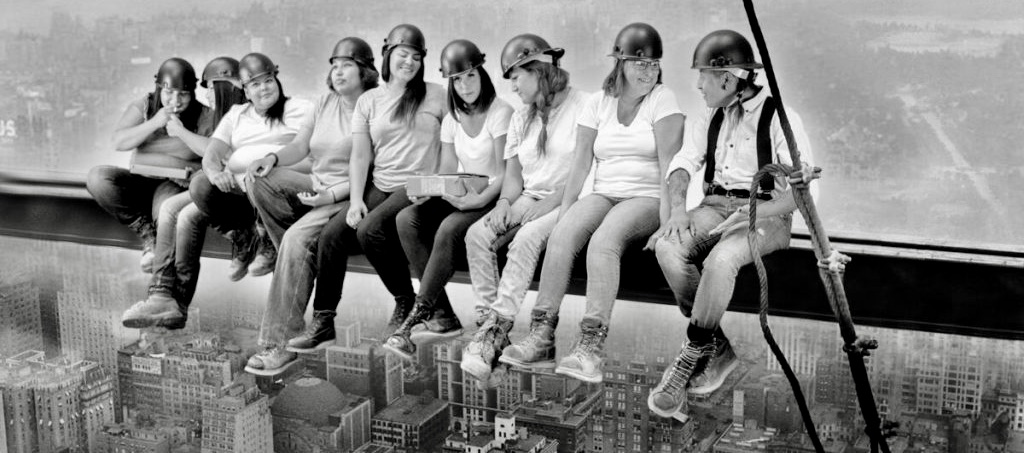
Me and Amy Reynolds posing as Rosies at a Rosie the Riveter event
In the week after the election, comparing Trump to the one-time California governor, my good friend suggested that Arnold Schwarzenegger wasn’t so bad after all. He was pretty bad, I said.
My friend hadn’t had to work with people in the state government during the Schwarzenegger administration but I did and I know what happened in our state. It wasn’t just that our governor was accused of manhandling women and fathered a child out of wedlock with his maid. I would certainly prefer that men who have so little regard for women not be elected to office. But I’m most concerned with the people they appoint to government positions and the policies they promote and enact.
Before our Democrat governor Gray Davis was overthrown by a Republican cabal financed by Daryl Issa, I had been working with people in the Division of Apprenticeship Standards (DAS) and its parent the Department of Industrial Relations (DIR) to help women enter the construction trades through union apprenticeships. We rejoiced when one of our own was appointed to head the DAS, Henry Nunn, a black man who had been the apprenticeship director for the painters union. I had met him when we were interviewed together on a public TV program. By that time, Tradeswomen had been fighting with the DAS to pressure them to enforce state affirmative action regulations for decades. We had even filed a lawsuit against the department in 1981, which got us little. But Henry Nunn understood the necessity of overcoming the sexist racist hiring practices in the building trades and he brought on a staff that really cared about these issues. Our nonprofit, Tradeswomen Inc., built a great working relationship with these folks who took seriously their pledge to make working people’s lives better.
During Davis’ administration, we proposed to the DAS staff that we work together on projects promoting apprenticeship around the state. State regulated union apprenticeships offer the best training and highest paid jobs in construction. Among our joint projects was an apprenticeship fair for high school students that included women and girls that the DAS planned to roll out around the state.
After Governor Davis was recalled, Henry Nunn and his staff lost their jobs. Schwarzenegger, an actor with no government experience, essentially replaced department heads with the previous Republican governor Pete Wilson’s people. Republicans, in the state and nationally, have shown little interest in our issues or in enforcing affirmative action regulations. Under Republican administrations working people and tradeswomen have suffered.
When Jimmy Carter was president, tradeswomen were optimistic that new affirmative action regulations would increase our numbers, and they did. It turns out having the federal government in your corner is a huge advantage. We had reason to hope that women would soon achieve a critical mass in the construction trades.
Sister electricians at the Women Building the Nation conference
And then came Reagan. At a recent exhibit of his photos of striking fruit pickers, journalist David Bacon reminded us that 40 percent of union workers voted for Reagan. Talk about voting against your own interests! Reagan had made his reputation as a union buster, so it was no surprise when the first thing he did was start busting unions. He also immediately began to dismantle and defund job training and affirmative action programs.
Tradeswomen saw that women and minorities were being targeted but still we attempted to work with the administration. At one point in the early 1980s, plumber Amy Reynolds even arranged for us to meet with Reagan’s Department of Labor representative, a guy named John Fox, who sat down with us in our tiny office in the Tenderloin. He seemed proud that he had had no prior experience with labor issues. He had been a basketball star (he said) who had worked on Reagan’s election campaign. Fox, and others in Reagan’s Labor Department we later met with in Washington DC, made it clear that their priority was to disempower unions. Because apprenticeship programs are joint projects of unions and industry, they intended to rid the system of union influence. They referred to construction jobs as “men’s work.”
Now, a month after the election of Trump, I suspect my friend is past hoping that he “won’t be so bad.” His appointments are looking far worse than Reagan’s. It’s fair to say that Trump’s appointments violate every ethical standard and it’s easy to predict that women, minorities, working people and all Americans except the 1% will be the losers.
As a young reader I took umbrage at authors who insisted on referring to mankind and men when discussing all humans including women. It didn’t help when librarians and teachers patiently explained to me that the words mankind and men were meant to include women. I didn’t believe it and I just stopped reading those writers. But I was still angry at the dominant paradigm. You couldn’t escape it.
When I found feminism, I found sisters who agreed with me. Women were being left out of history and the present by the use of sexist language. Several feminists developed genderless languages and pronoun replacements, which unfortunately never caught on. Today transgender activists seem to agree on replacing “she” and “he” with “they,” but I find it cumbersome and difficult to adopt.
Gender specific job titles have always rankled women who work in or aspire to work in male dominated jobs. If a job title ends in man like lineman, mailman, policeman, craftsman, draughtsman, we get the point that women do not belong and are not welcome in these jobs. Girls and young women understand that they should seek careers elsewhere.
Sisters in the Brotherhood
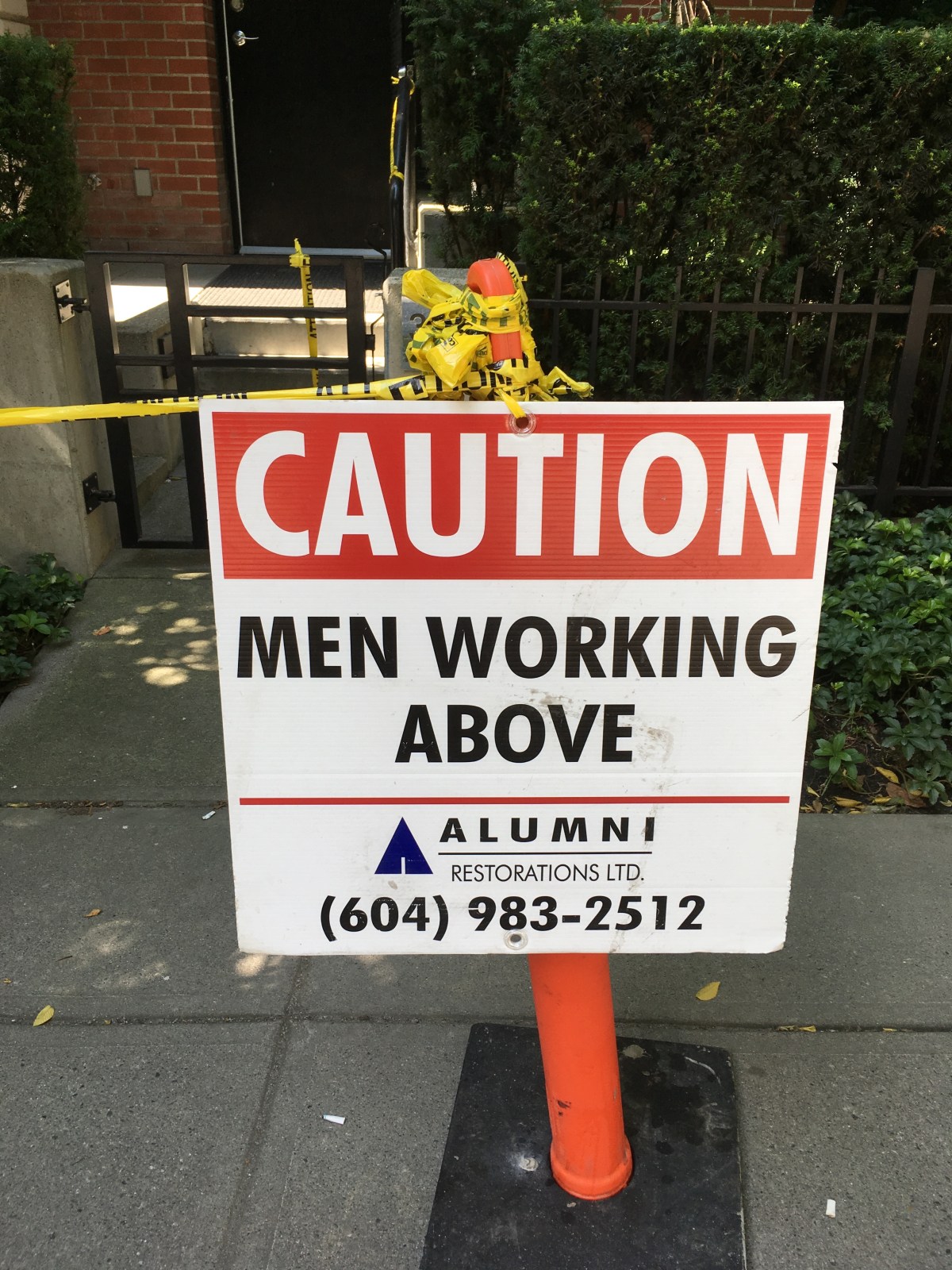
So much more inclusive than MEN WORKING
I was just lucky that electrician, my own trade, is already gender neutral. Visiting Mexico, I was delighted to learn that electrician in Spanish is electricista. We haven’t had to fight battles about carpenter, plumber, ironworker or sheet metal worker. Unfortunately, however, all these unions are brotherhoods by title and all except the painters, bricklayers and the longshore workers have refused to consider changing to a neutral term. Instead of International Brotherhood of Electrical Workers, how about International Union of Electrical Workers? Over the years sister electricians have floated the idea of getting the International to change its title to a more inclusive one, but the men in power refuse to entertain the idea. My one defiant act was to write my dues checks to the “International Sisterhood of Electrical Workers.” No one ever said anything and the checks were always cashed. I guess the bank doesn’t care what term we use.
The one union to do battle with its membership about the brotherhood issue was the Teamsters, 30 percent of whose 1.4 million members are women. A proposal to change brotherhood to a more inclusive term was put forward by the progressive president Ron Carey at an international meeting in 1996. Members were consulted about the idea and debated the issue for months in union publications, but Carey’s rival, James P. Hoffa opposed the change. He famously said, “It’s gender neutral. The definition of brotherhood is that it’s neutral.” Supporters of inclusion lost the vote, Hoffa took over as president, and the Teamsters remain a brotherhood.
Taking an Ax to Fireman
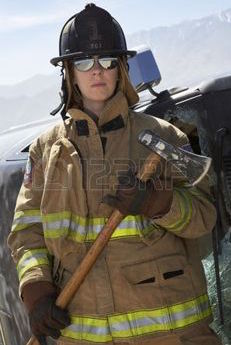
Feminists have spent many years trying to retrain reporters and speakers to use the term firefighter instead of fireman. Mostly we have been successful, but it takes letters to writers in all genres to make a change. The New Yorker magazine is one recalcitrant actor. I think those New Yorkers must look at their own backward fire department and think, “Why should I use a gender neutral term? There are no women.” And this is almost true. But their response should be embarrassment at their city’s failure to integrate its fire department.
Firefighting gear renders gender unrecognizable
I’ve written many letters to my daily newspaper, the San Francisco Chronicle, about this issue over the years. One of the most grievous examples was a column by Rob Morse, a writer with liberal politics whom I read regularly while he was published. After a big fire destroyed one of the buildings at the old Ghirardelli chocolate factory, Morse thanked the brave “firemen” who extinguished the blaze. Ironically, the photo of one of the working firefighters that appeared on the front page of the Chronicle was a picture of a female. You just couldn’t tell the gender because of all the protective gear she wore. My outraged letter to the editor was published but only with poor edits which made me look stupid. Still, it brought the issue to the editors’ attention. The Chronicle eventually changed its style to firefighter.
One example of the prevalence of this misuse of the word in the culture is in the comics. I’m a regular reader of the comic Luann, whose central character is a teenage girl (kudos!). I was heartened when the artist, Greg Evans, introduced a female character who becomes a firefighter and eventually dates Luann’s older brother. In the comic she also must contend with an abusive boyfriend, an issue that doesn’t often make it into the comics. Still, the artist continued to use the term fireman even when referring to that character. In my letter I praised the artist for creating this female character and tried to explain how using a gender-neutral descriptor would make her an even better role model for girls who read the comic. Presumably mine was not the only complaint. The comic eventually changed the term.
The firefighter argument is closest to my heart. Feminist activists in San Francisco battled for 16 years with the SFFD before women were allowed to work as firefighters. Then for 12 years I was partnered with a female firefighter who eventually became the SF fire marshal. I don’t always fault women in the gunsights for not fighting this battle. Working in a male-dominated culture you have to pick your battles and descriptive terms may not be the most important issue. That’s why it is imperative that feminist activists outside these workplaces pile on to push for change. When I worked in the SF Department of Building Inspection I had a cordial relationship with the fire inspectors I worked with (that’s where I met my now ex-partner). I didn’t hesitate to correct their language. When they didn’t change, I would greet them in the elevator, “How are the firewomen today?” That got their attention.
During my stint as the “fire marshal’s wife,” I saw these guys at parties and social events. Just like in the building trades, they had no second thoughts about insulting me or women in general, right to my face. When you first hear “Women can’t do the job, women shouldn’t be in the fire department,” etc., you are shocked, but the fortunate thing about continually being subjected to insults (as with sexual harassment) is that it gives you practice in responding. I was never great at quick retorts, but I got better with lots of practice.
My ex-partner said: “Every time I read the word fireman, it’s like a punch in the stomach. It reminds me of when my brother (four years older, bigger, and stronger) would punch me, then hold me at arm’s length by putting his palm on my forehead and I’d be swinging away at him, never able to land a punch back.”
Fishing for Fishers
Lately I’ve been addressing writers about the term fisherman. Fisher is such an obvious and easy choice and I can’t understand why speakers and writers are so resistant to change. It’s not just men. Women are just as argumentative. Except there’s not a very good argument. “We’ve always done it that way,” the typical response, just doesn’t cut it.
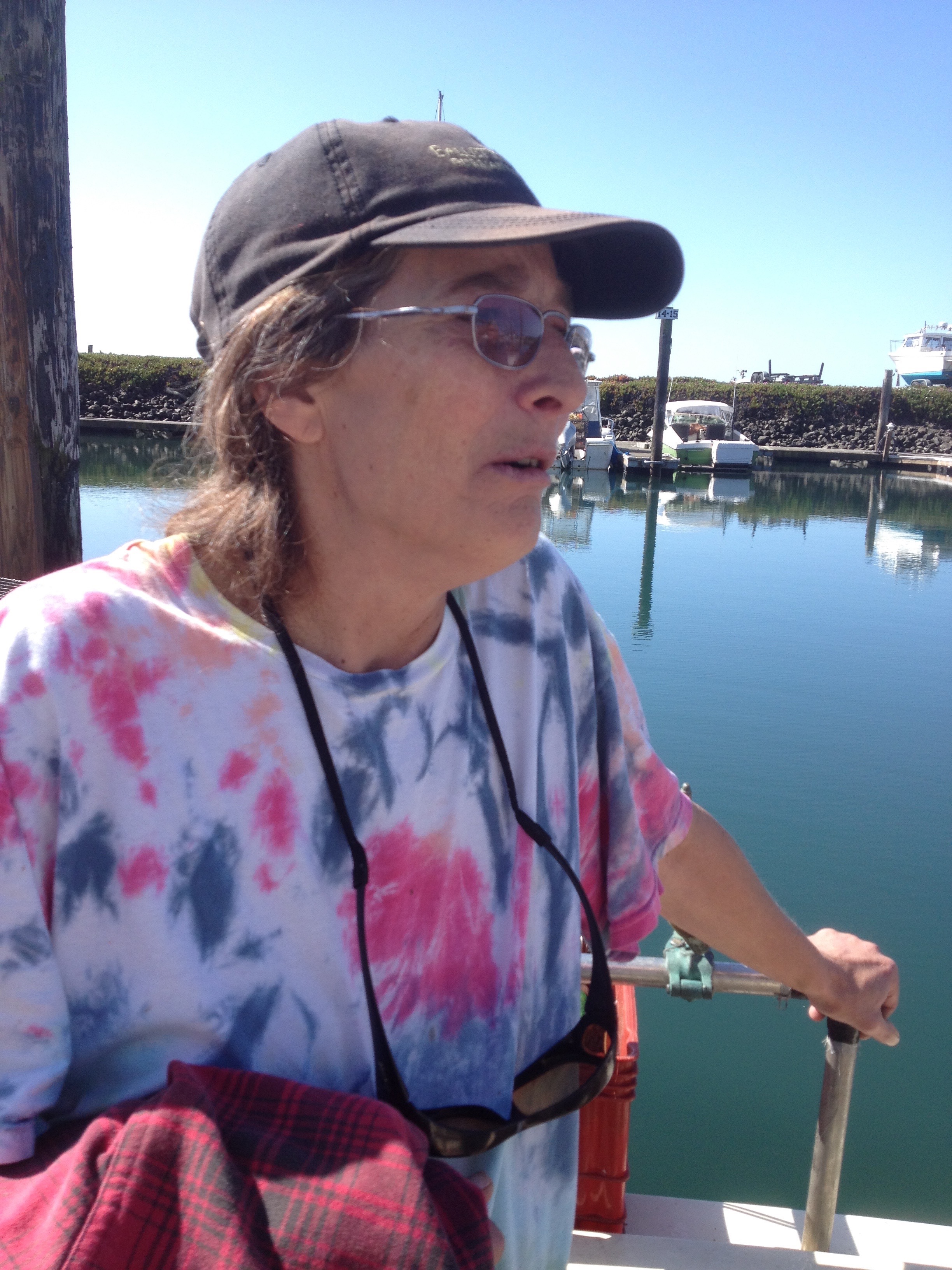
My fisher friend Tina Moreda on her boat at Bodega Bay Harbor
The last few times I’ve written to the Chronicle’s writers about the term fisherman (I love that the writer’s email address is listed at the end of the article), one didn’t reply, one wrote back to say simply “thank you,” and one wrote that she had thought of fisherman as a gender-neutral term.
Perhaps the reason this choice of words is ignored is that the fishing industry has been floundering and dying now for decades. Few choose to be fishers anymore, but I personally know women who integrated this industry in the 1970s and women who continue to make a living fishing. It’s still an important industry on the California coast, so the Chronicle runs fishing stories often. In recent stories, writers have used both the terms fisher and fisherman. I think my letters must have made an impact. They seem to be breaking their readers in slowly.
One wonders what they would think if all reporters were referred to as “newsmen.” Oh, wait. They were. And not that long ago.
News flash: From a story in The Guardian about the discovery of four new elements in the periodic table: “This article was amended on 4 January 2016. The reference to the new elements being “manmade” was changed to “synthetic” to follow Guardian style guidance on the use of gender-neutral terms.”
Postscript: This essay must be updated. Some unions have changed names but most are still brotherhoods. The laborers union changed to Laborers International Union of North America (LiUNA) in 2012. The Ironworkers do not use brotherhood in their name.









 tradeswomn musings