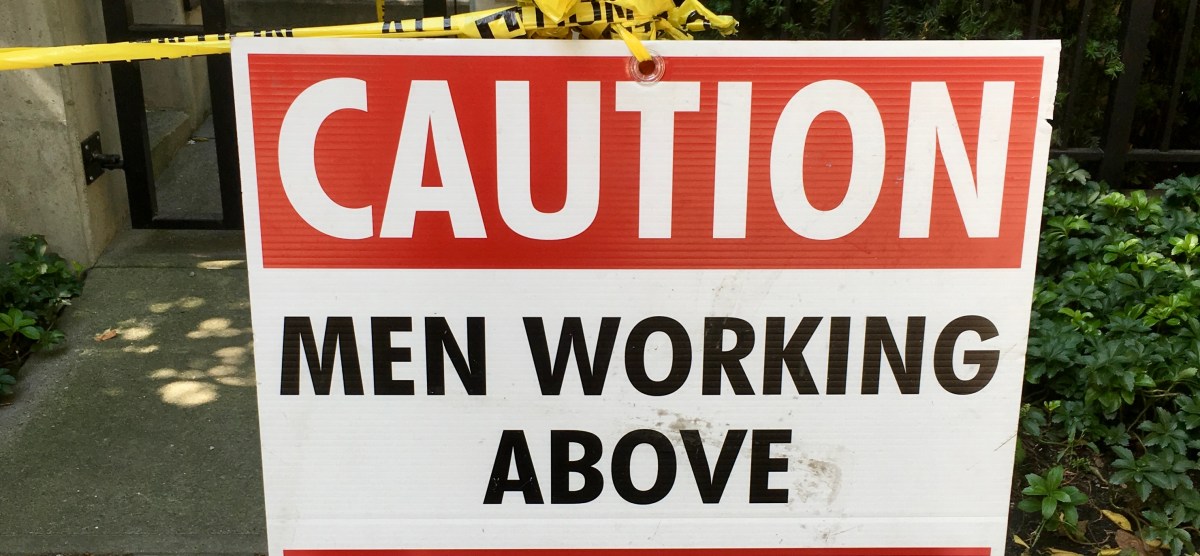
We imagine ourselves to be space travelers landing on a populated planet. We encounter living organisms with a well-developed culture. We wonder at their strange ways. As we work alongside them, we make an effort to adopt the culture, to fit in as best we can. In other ways we reject it, picking our battles. We are few and isolated, powerless, so we must become careful observers in order to protect ourselves.
In this culture competition is valued over cooperation. Its central tenet seems to involve establishing a pecking order, as with chickens. Woe to the one who falls to the bottom, who becomes the relentlessly picked on. Of course, our strategy is to stay under the radar and try to avoid the pecking order arrangement altogether. This is not always possible, but our differentness sometimes works to our advantage. It confuses them when they can’t immediately find a slot for us.
We speak the same language, but the words have different meanings. Topics of conversation seem designed to enable the game of one-upmanship. Slurs referring to another’s ethnic origins appear to be some sort of rite of passage. Or this may be associated with establishment of the pecking order. Weapons and war-like games assume great importance especially in the seasons when these games are played publicly. Boasting of ownership of machines, especially big ones, appears to be a way to increase position in the pecking order.
They name things after genitals and sex organs. There are nipples and studs and dicks and limberdicks, screwing and shut off cocks, male and female fittings, king studs, glory holes, screws and nuts, double hung, slab penetrations and butt joints and erection, base shaft and tip. We begin to think that nearly every word in our shared language contains a double meaning, often also referring to their own genitals or to the sex act.
Size matters in this culture. Although displaying genitals is taboo, the topic of genital size is paramount. Body size seems to contribute to pecking order status and is afforded much more importance than skill or especially intellectual capacity. In fact, intellectual prowess must be hidden in this culture to avoid low pecking order status. Presumably, the smart figure this out quickly and become proficient at pretending to be dumb.
While smartness can be covered up, small size cannot, and so the small are particularly prone to being picked on. The small have devised many strategies to avoid low pecking order status, but bonding together to form their own sub-group, an obvious possibility that we might employ, has not been one. Perhaps this indicates that the small also accept the dominant paradigm that their size makes them inferior. The typical response by the small is to develop what they call a “thick skin” and a pugnacious demeanor. Their insecurity makes them particularly difficult for us to work with, especially when we are the larger.
An important communication medium seems to be the walls of the elimination shacks. The creatures carry markers for drawing pictures and messages there. One often-depicted image is of their genitals. We try to understand what impulse might drive this primitive art. It appears to be a method of marking territory, as with dogs. We try to imagine ourselves painting our genitals on walls but find no equivalent in our own culture. We wonder at this practice, and think it may be intended to distress. To counter the practice, we follow behind with our own markers, making the genitals into faces with eyes and noses.
In our observations we look to find comparisons with other cultures. This species’ lifestyle bears more than a passing resemblance to canine culture. We notice that while they may exhibit friendly behavior when encountered alone, when they organize into packs they often become dangerously unfriendly. They see threats everywhere and might attack even when not threatened, just for the fun of it. The killing of other animals has acquired the level of a sport and is much discussed. We labor to avoid being seen as animals.
We begin to understand that we are not the only ones isolated here. Each member of this culture is, by design, alone in competition with the others. We wonder if anyone has ever taught them an alternative, that cooperation can be a marker of strength rather than weakness. We wonder if it’s too late.
Al and I first met when I walked into the open door at Summit pump station. He was kneeling on the concrete floor painting one of the pump motors that supply water to the city of San Francisco. When he saw my figure standing in the doorway he jumped back, like I was there to assault him. That gave me a little jolt of power—that a man might be startled by me. Yeah, I thought to myself, I’m a big strong woman and men flinch at the sight of my form. But there was a safety issue. The pump stations are situated in remote parts of the city. And I wasn’t supposed to be there. Or, in reality, no one knew where I was at any particular moment. As the one electrician responsible for all the stations, I kept my own schedule, responding sometimes to complaints or work orders and sometimes just checking to make sure the electrical equipment was working.
“Hey,” he said, squinting at me in the sun glaring through the open door. “Who are you?”
“I’m the electrician. Who are you?” I answered. But I knew he was a stationary engineer. Painting motors is part of their job.
The corps of engineers worked out of the Lake Merced pump station where they reported to the chief engineer, Joe. I thought I’d met all of them at one or another pump station. But Al was a retiree just filling in for a coworker who was in rehab. I figured he was about three decades older than me, a small redhead still with a good bit of hair left. He reminded me of a leprechaun—little and cute. We liked each other immediately and over the course of a few months we became friends. Not the kind of friends who see each other outside of work. But we would share personal information that we might not share with others.
There was one other engineer I was tight with, Jesus, and he would sometimes meet up with me and Al at lunch break. Jesus was transitioning from male to female and had been taking hormones for a few months. He had saved up enough money for the operation and was in the process of scheduling it. Al told me Jesus had announced to their fellow engineers that he now wanted to be called Rosa.
“How did they react?” I asked, thinking that must have taken some courage.
“They looked at their hands and didn’t say anything,” he said. “Just some snickering.” Knowing that he was planning to transition, his coworkers had ignored Jesus and refused to talk to him. Now that he was Rosa, the treatment would be no different.
Jesus told me he had known he was really female from the time he was a child in Mexico. A generally happy person with a positive attitude, Rosa was positively delighted to finally be female, to be herself. I thought she radiated serenity.
I wish I could say the transition was seamless for me, that I found it easy to switch from Jesus to Rosa, but I found it difficult. I had gotten to know this person as Jesus and now it was like I was having to start all over again. The pronoun thing confounded me. Back in the day we feminists had pushed to rid the English language of male and female pronouns, but the idea never took hold. I dearly wished for those genderless pronouns whenever I screwed up, but Rosa was forgiving.
I was suspicious of most of the men at work. Let’s just say they didn’t welcome me, the lone female, into the fold. I tried to give them as little information about myself as possible, assuming it would be used against me. I knew that I could not be friends with these men. But I had begun to feel differently about Al and Jesus.
I learned that Al was married to a French woman, that they had no children. I learned that he had been around the world as a seaman. Like many of the engineers, Al had learned his trade in the Merchant Marines. I knew some things about the Merchant Marines—that the celebrated San Francisco Communist Bill Bailey had been one and that he was not the only commie. I knew that the mariners had performed a vital service in World War II, risking their lives to supply materiel to the fronts. I knew that, while they weren’t part of the military, the merchant navy had suffered a higher casualty rate than any branch of the military. Their boats were always being torpedoed. Then, after the war, they were attacked and denied any benefits because they were all branded as communists, which of course most of them were not. They were just civilian patriots willing to risk their lives to protect the lives of others.
I knew enough to gain some trust with Al before asking but I had to ask, “Were you a Communist?”
All I got was a wry smile, enough to let me know I should stop asking questions.
But that was enough for me. I call myself a communist with a small c, more of a new leftist. I’m always delighted to meet up with the old commies, for whom I have great regard. They don’t always want to admit past affiliations. Most of the Reds were disheartened by knowledge of Stalin’s murderous legacy. Many were hounded for years by Hoover’s FBI. Jobs were lost and lives ruined.
Now it was 1985, the depths of Reaganism, which made all of us minorities jumpy and skittish and gave our detractors permission to be openly hostile. The AIDS epidemic was ravaging San Francisco’s gay men’s community while Reagan refused to even acknowledge the disease. Women—feminists–had come under attack along with anyone who didn’t fit into the back-to-the-fifties scenario. Immigrants, transgender people and communists too. Maybe that’s why the three of us gathered, just to know we weren’t alone.
Jesus, now Rosa, had begun presenting as female, letting her hair grow and wearing women’s clothes. But she didn’t really look that different than before. We all wore work clothes. My work outfit consisted of boots, canvas work pants, a T-shirt with a flannel shirt over the top, and when it was cold a wool-lined vest or jean jacket. A hard hat was not required on this maintenance job and I didn’t have to wear a tool belt. I carried my hand tools in a leather tool bag. And I drove a truck painted Water Department colors, Kelly green and white, in which I carried wire, pipe, benders and all the other tools and material I might need. Rosa, when dressed in work clothes, looked like me.
Me in my San Francisco Water Department truck. Photo: Janet Delany
Rosa was the first transgender person I got close to, but I was not completely naïve. Ire had been raised in the tradeswomen community when we learned of a transgender female carpenter in our midst. She had transitioned after working as an already skilled male carpenter. She was getting work while we were frozen out because we were women. The contractor got to count her as an affirmative action hire. It didn’t seem fair. Then there was a continuing dustup in the lesbian community about a transgender sound engineer who worked for Olivia Records, the women’s music company. She had been trained while still male. We women wanted to do everything ourselves, but we didn’t have the skills because we couldn’t access the training. It’s possible that when the engineer, Sandy Stone, was hired, there were no other female sound engineers. Some lesbians were quick to attack the individual, but most of us understood that our real enemy was the system that discriminated against women.
At lunch one day Al told us some war stories. He said he had survived a torpedo attack where some seamen had died. I tried to imagine his life on those ships. I’d heard the gay historian Allan Berube’s lecture and slide show about sailors and soldiers during the war. They were all having sex with each other, especially the sailors. I knew Al wasn’t gay but I suspected he’d participated in gay sex.
I had allowed myself to relax a little with Al and Jesus. I came out to them. We talked politics. We all hated Reagan. I had started to feel comfortable with these guys.
Then one day while Al and I worked together he confessed that his wife no longer wanted to have sex with him and he was super horny. Did I want to have sex with him? It wasn’t as if men at work had not come on to me before. This was the typical way they did it; they would complain about their wives and that would be the opening. But I was shocked to hear this from my friend Al. I’d been solidly in the friend category I thought. Suddenly I was in the gal toy category. Or was it the whore category? Weird.
I said, “Al you know I’m gay. I’m not attracted to men.” Which wasn’t entirely true. I’d lived much of my life as a practicing heterosexual.
“Well, maybe you have friends who might want to have sex with me,” he said. And for a moment I actually considered the question. I definitely had horny friends. But who might want to have sex with Al? What would his personal ad look like? “65-year-old leprechaun seeks sex with any female. Age not important. Nothing else important.”
Then I was grossed out thinking my friend Al wanted me to pimp out my women friends. Then I was disappointed that our friendship was not what I had thought it was.
“So you only have sex with women?” Al asked.
“Well yeah. That’s what being a lesbian means. Maybe I’m not as sexually fluid as you. I know what y’all did on those ships.”
No response except that wry smile again.
That interaction changed my relationship with Al, but he may not have even noticed. Like many men he lacked a certain amount of sensitivity. On the other hand, his size and his politics—his minority status in the world of men—engendered more empathy than most.
So now I started thinking Al was like all the other guys. I stopped feeling so safe around him. Not that he might attack me. No, I was pretty sure I could take him in a fight. I was bigger and I practiced karate. It was more that he didn’t value me, didn’t see who I really was, and so might not understand the need for discretion. I did know that just because someone is or was a Communist does not mean they are not sexist as hell.
For a while I didn’t cross paths with Rosa. I still saw Al out in the field and he would fill me in on Rosa’s transition. The surgery had gone well and Rosa was back at work. She was happy, even as her coworkers continued to give her the cold shoulder.
“I’m having trouble re-learning Jesus’s name,” I confessed. “I’m just not good at it. I get all confused with the pronouns and I keep saying him instead of her.”
This time Al’s response was sharp and I realized he must be doing his best to protect Rosa from harassment by the other engineers.
“She is Rosa now,” he said, “and you’ve got to call her by her name.”
It was an admonishment and I took it seriously. Al was worldly wise and maybe had known other transgender people. He knew how to be an ally. Could I really be learning something from this old white guy?
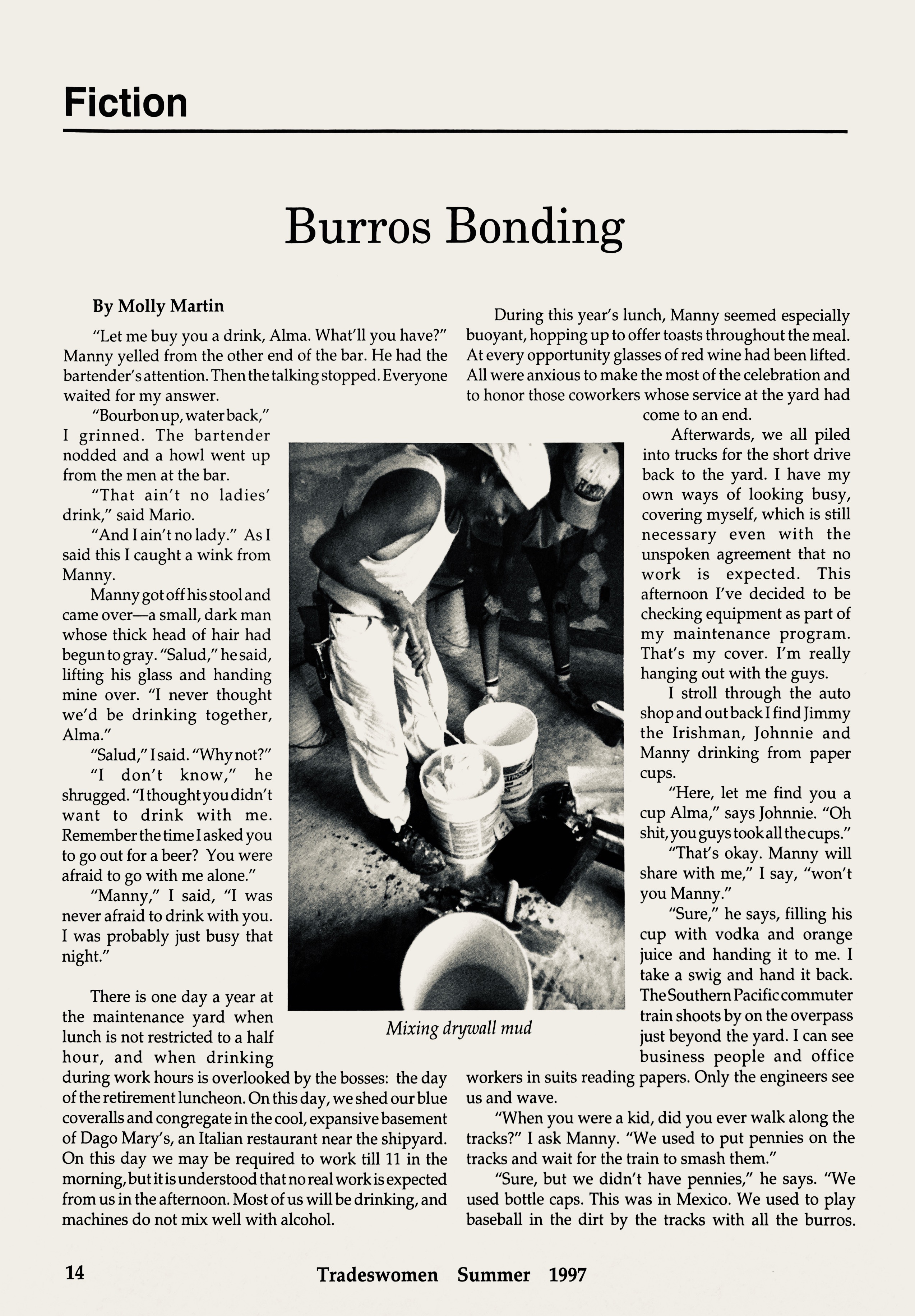
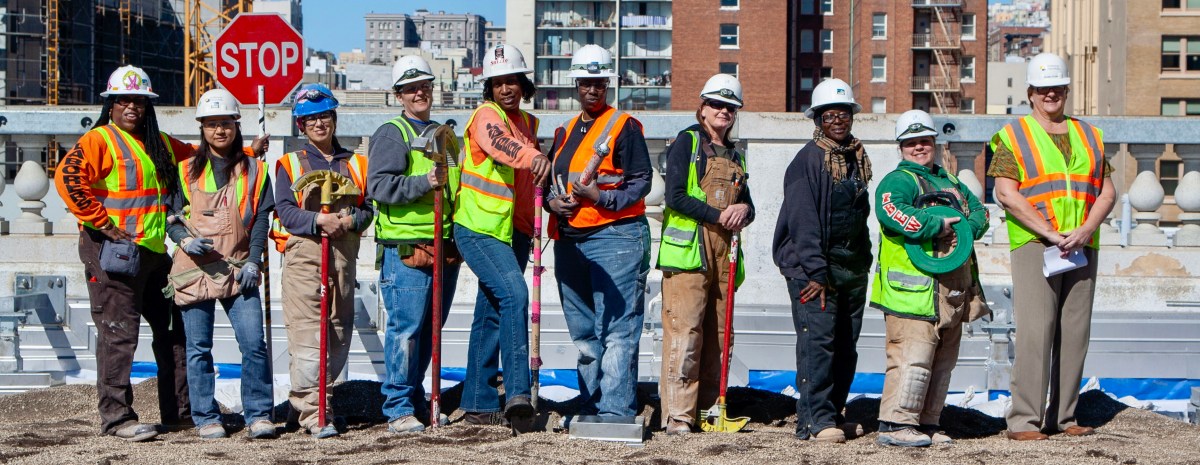
Here’s another story from Tradeswomen Magazine, published in 1997. Like all my fictional stories, it’s autobiographical. I was working as a maintenance electrician out of the San Francisco Water Department corporation yard. The photos are of women building a house in Florida.
They saw women as whiny, useless, money-grubbing weaklings
The culture of the construction site was manmade. No women had been involved in its creation and so we had to negotiate the best we could. I said to myself I had a father and three brothers, I should be able to fit in. I’d been a tomboy as a kid and thought I knew how to hang with males of the species. Every new job, each with a new group of guys, held new challenges.
I quickly learned that my coworkers thought women were incapable of doing the physically challenging work of construction. They brought to work a stereotype of women as whiny, useless, money-grubbing weaklings who needed a man to give them worth in the world. (Most of these guys were divorced and still angry at ex-wives). They repeated to me an old saying: If this work was easy, women and children could do it. Something told me that when they repeated it to each other, the word they used was not women.
“Cunt,” whispered the ironworker tying rebar next to me as I tied pipe to it. Then he quickly moved on. After I got over the shock, here’s what I thought: “Ironworkers are a bunch of cowardly sexist dickheads.”
My objective: overturn the stereotype
My coworkers told me women weren’t good partners on the job because we couldn’t be trusted to hold up our end of a 300 pound piece of floor duct. We were all afraid of heights, we didn’t know how to swing a hammer and hit anything. We were just there to get a man. Our presence on the job would cost the contractor money since it took us twice as long to complete a task. When criticized we would cry, so they had to be careful what they said to us. (Too bad that didn’t translate to not insulting us.) Their worth was predicated on our worthlessness, our lack of merit. You are only as tall as the person you are stepping on.
I went to work each day with the objective of overturning the old stereotype. I was usually the only female on the job, and very conscious that I would embody a new improved stereotype. I worked hard, but was careful not to work so hard that I’d be accused of breaking down conditions and brown-nosing the employer. I tried to work just as fast as they did, but not faster. I picked up my end of the floor duct and used lifting skills to save my back, while thinking to myself that nobody should have to lift 300 pounds of anything. I was not afraid of heights, but if I had been, I never would have admitted it. I never cried, even when I felt like it.
A worker was welcomed into the construction culture in a backhanded manner. You didn’t know whether you were being dissed or included. Race and ethnicity as well as gender were called out with jokes and put-downs. How one responded was noted. You were supposed to go along to get along.
I tried to come out as a lesbian when I could
The men could be empathetic while at the same time expressing homophobia, sexism and racism. I tried to come out as a lesbian whenever the opportunity arose because I was convinced this honesty made the job easier for me. On one job I worked with a traveler* from Arizona. We were assigned to tape connectors and boxes in the trailer while we waited for the deck to be readied for the electrical crew, so we had time to chat. He told me his wife worked as a nurse in a hospital in Oakland and the place was overrun with faggots. She was disgusted. Here was my opportunity! I admitted to being a dyke and probably noted that fags were a lot more fun to work with than his sorry ass. At that he did an about-face. He needed to make a confession too. He acknowledged that he was an alcoholic, that he was in recovery and that he was letting me in on the secret. That made us even, and we were friends from then on.
Ethnic slurs were thrown at people with what seemed like a try at love. Wetback, Chink, Dago were used inclusively, like welcome to our club, this is your identity. If I didn’t object in the beginning, my nickname would be Girl. I objected, but not to every slight. You had to pick your battles. I let them know I wasn’t keen on sexist or racist remarks. No one ever said the N word in racially-mixed company, maybe because they didn’t want to risk getting the shit beat out of them. The exception was travelers who came from sister union locals in the South, but they only used the word when conversing with whites. Talking about football, one remarked, “I never understood why anyone would want to watch a bunch of n*****s running around a field.” The Northern white guys on the crew were silent after that. Maybe they were seriously considering that football was no longer a white game. Or maybe they were silent on my account and would have agreed with the cracker if I hadn’t been there. I hope it was because they were so appalled they were speechless.
The Southern travelers were a different breed—bigots who bragged about killing cops and evading taxes. All white. The story was told about one guy that he kept a length of 000 wire under the seat of his truck and had once used it on a cop’s head. One day he drug up** and asked for his check. He was on the run, they said. White trash and dangerous.
That’s the way it was, and few of us minorities were exempt. On one job I had a Jewish foreman. I knew he was Jewish when others on the job started making gas chamber and oven jokes. Jewish men—at least out Jewish men—were rare on the construction site, although I knew many Jewish women who worked in construction. This guy had been a carpenter and later got into the electrician apprenticeship. He was a skilled mechanic and a competent foreman with an upbeat attitude. He let the jokes slide off.
The Jew would force the Nazi to acknowledge us
The job was an interior remodel of the Hyatt Regency hotel in San Francisco’s Embarcadero Center. Cozy and insulated, we worked on an upper floor of the high-rise, piping in the ceiling, running up and down ladders. The construction crew would assemble in the basement in the mornings and ride the service elevator up to our floor together. The hotel pastry chef, a stern Austrian, came to work at the same time and rode the elevator with us. He never spoke to us, we figured, because he thought himself better than a bunch of construction workers. An unflattering stereotype of Austrians immediately took root in my mind. Austrians equal Nazis. Our crew began to refer to him as Herr Pastry. My foreman always spoke to him. Good morning or how are you this morning. The pastry chef may have nodded but he never spoke or smiled. It became a game. The Jew would force the Nazi to acknowledge us lower class plebes (the irony was that we union workers probably made way more money than he did).
Our IBEW contract gave us a half-hour lunch break 12 to 12:30 and one ten-minute coffee break, which we took at 10 am. I usually brought a bagel with cream cheese for break. I’d be starving by 10 even after eating a huge breakfast at 7. On jobs where the ten minutes was taken literally, I found I barely had time to down the bagel, which required some chewing, and to wash it down with my thermos of tea. This job was a bit looser. Coffee break might last 15 minutes.
“It’s too short,” I whined to no one in particular while standing on a ladder with my head in the ceiling. The piece of EMT*** I’d just cut didn’t fit and I’d have to start over. “What a thing to tell a man!” came back to me from the Irish carpenter foreman whose head was the only one I could see up there. That made me smile. Irish guys—full of blarney.
“Break time,” someone yelled, and I looked down to see coffee being served in a fancy silver service with a huge plate of pastries beside it. The gift had come from the pastry chef, and for the rest of that job we had complimentary coffee and pastries at 10 am, thanks to the persistent civility of our foreman. My stereotype of Austrians crumbled. I’m still waiting for help with my prejudice against ironworkers and white Southern men.
*Travelers follow the work around the country when work at home is slow.
**To drag up is to quit the job.
***Electrical Metallic Tubing, a kind of pipe used in the electrical industry.
Addendum 2020
The Black Lives Matter movement has brought national attention back to racism. Of course, the battle for equal rights has been going on for decades, for centuries.
Previous to affirmative action laws, the construction trades had been the providence of white males. People of color and women busted into the construction workplace in the 1970s after years of demanding access to well-paid union jobs. We walked onto the job site and into the union halls together and we stood up for each other, all of us fish out of water in the white male culture of construction.
We built a movement to gain access to this industry, going up against both employers and unions. We focused on union construction because these are good jobs that pay good money. No education beyond a high school diploma is required. Apprentices go to school free while working and apprentice pay increases automatically. A union contract is a great leveler. We don’t depend on a boss to decide our pay rate. The Black woman painting the steel girders on the Golden Gate Bridge gets paid the same as the white man.
Just as with school integration, people of color and women have encountered discrimination, harassment and racist and sexist stereotyping in construction. But the fact that affirmative action regulations required contractors to hire us and union apprenticeship programs to include us made all the difference—testament to the power of the federal government having your back.
Stories in this essay refer to the time just as we were getting in—the early 80s. It was a time when stereotypes were continually being broken down and re-examined. All of us had to adapt to the colossal culture clash.
Has the culture of construction changed in the past 40 years? For both people of color and women, just our presence on the job has impacted the culture.
For women, the fact that sexual harassment is now against the law was a significant change for the better. Women of color still experience a double challenge as both racial and sexual minorities.
The demographic has changed in 40 years. Hispanic men now constitute more than a third of the union construction workforce in California. Women are still only a small percentage of union construction workers, about three percent. Asians are even less numerous at less than two percent. Black men have made some gains, although there is still a ways to go to reach equity. But we are there now, and we have made some headway in the union and apprenticeship structure.
Reagan killed federal affirmative action programs after he took office in 1981, but for the short time regulations were actually enforced, that brought more of us into the construction trades. We owe our jobs and careers in the trades to affirmative action. We still encounter discrimination, harassment and isolation, but if the laws and regulations had been enforced for even a few more years, the trades would be much more diverse.
California state and local affirmative action programs died after 1996 when the anti-affirmative action Proposition 209 passed. That law has made it difficult to demand equitable representation of Black, Asian and women workers.
From this struggle we have learned that the arc of the moral universe is long. I don’t have faith that the arc bends toward justice but here are some indications that it might. Recently the ironworkers union international showed its support for female ironworkers by introducing a pregnancy leave policy, now being copied by other unions; the newly elected vice president of my San Francisco International Brotherhood of Electrical Workers union Local 6, is Ron Lewis, a Black man and a feminist; and I just learned that two workers were thrown off a job by the union for making racist remarks against Black coworkers. That would never have happened in my day.