The Canadian labor movement is ahead of the US in recognition of the issue of workplace violence, because of the Dec 6, 1989 Montreal Massacre of 14 women who were murdered that day at Ecole Polytechnique by a man who didn’t think women should be engineering students. There was a struggle then to get the Canadian Labour Council to recognize the issue, but the victory has carried forward.
IBEW Canada Statement Mourning the Loss of Amber Czech and Condemning Violence in the Workplace
Toronto, ON – November 17, 2025
Today, International Brotherhood of Electrical Workers (IBEW) Canada International Vice President Russ Shewchuk issued the following statement:
“IBEW Canada mourns the loss of 20-year-old welder Amber Czech, who was brutally attacked and killed at her workplace in Minnesota. We extend our deepest condolences to Amber’s family, friends, fellow workers and her community.
“Although Amber was not a member of the IBEW or affiliated Building Trades Unions (NABTU/CBTU), what happened to her should never happen to anyone—anywhere. And while this tragedy occurred in the U.S., the loss is deeply felt across our union community in Canada. It’s a stark reminder of the work we must keep doing to ensure such senseless acts never happen again.
“Violence has no place on our job sites, in our offices, or in our union. We owe it to Amber, and to every worker who has been harmed or threatened, to build safe, respectful, and inclusive working environments, free of violence and cruelty.
“IBEW Canada stands with all who advocate for ending gender-based violence, and all violence in the workplace. We commit to ongoing training, conversation and action that promote equity and dignity for all workers.”
The International Brotherhood of Electrical Workers (IBEW) represents approximately 70,000 members in Canada and 873,000 members and retirees in North America who work in a wide variety of fields, including construction, utilities, manufacturing, telecommunications, broadcasting, railroads and government. For more information, visitIBEWcanada.ca or IBEW.org
It’s time for our US labor unions to condemn workplace violenceand do something about it.
Indictment means possible life term for man accused of killing co-worker in Wright County workshop
One major labor organization noted that “violence like this rarely comes out of nowhere. It often follows a buildup that women in the trades know by heart.”
The man accused of killing a co-worker last month with a hammer in a Wright County workshop now faces a charge of first-degree murder and a potential life prison sentence in a slaying that drew outcry by advocacy groups for women in the trades.
A grand jury heard the case last week against David Bruce DeLong, 40, of Watkins, Minn., and indicted him on a charge of first-degree premeditated murder in connection with the attack in Cokato that killed 20-year-old Amber Mary Czech of Hutchinson, Minn.
The bludgeoning occurred on Nov. 11 at Advanced Process Technologies, which makes equipment used in food processing.
County Attorney Brian Lutes said the first-degree count carries a mandatory sentence of life in prison without parole. DeLong also faces a second-degree murder charge.
DeLong remains jailed in lieu of $2 million bail ahead of a court appearance Monday. The Minnesota Star Tribune has reached out to his attorney for a response to the allegations.
An online fundraising campaign started to cover funeral expenses noted that “Amber was a hardworking welder who took great pride in her craft and dreamed of building a bright future through her work. Her witty personality, positive attitude, and beautiful smile touched everyone who knew her.”
Numerous labor organizations decried the workplace killing of Czech, including the International Association of Sheet Metal, Air, Rail and Transportation Workers (SMART), with 230,000 members in North America.
“While not a SMART member … this tragedy is reverberating across the trades community and far beyond,” read a statement from the organization. “So many tradeswomen and gender-diverse workers are carrying the weight of this news.”
SMART went on to point out that “violence like this rarely comes out of nowhere. It often follows a buildup that women in the trades know by heart: harassment shrugged off, bullying tolerated, intimidation minimized, warning signs dismissed, fear of backlash, comments ignored, jokes explained away, the stares of resentment, and behaviors everyone chooses not to see until they can no longer look away.”
The Laborers’ International Union of North America (LIUNA), which counts 500,000 workers across many industries among its ranks, said in a statement, “When a young tradeswoman’s future is so violently crushed, we must look to the criminal justice system to do its job — but as brothers and sisters in the construction trades we must also do much, much more. … We must not only condemn the violence that took Czech’s life but also the attitudes and behavior that normalize an atmosphere of fear for too many construction craftswomen.”
Around 6 a.m., a caller to 911 said Czech was bleeding heavily from a blow to the head, and there was a bloody sledgehammer on the floor nearby. Emergency medical responders arrived and declared her dead at the scene.
A sheriff’s deputy identified DeLong as the suspected attacker. DeLong said to a man at the business “something to the effect of, ‘I hit her with your hammer. She is by your toolbox. She is gone,’” the complaint read.
Sheriff’s deputies reviewed surveillance video inside the business and saw DeLong walk from his workstation to Czech’s, grab a sledgehammer and swing it. The victim was out of view of the camera.
DeLong’s swings indicated that he targeted her once while she was standing and four more times after she fell to the floor.
After his arrest, DeLong confessed to killing Czech. He said he didn’t like her and had been “planning to kill [her] for some time,” the complaint continued.
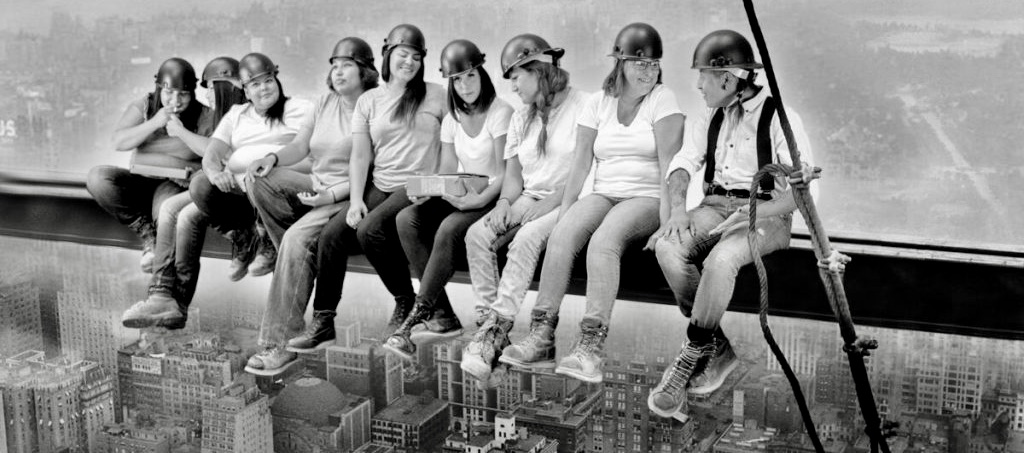
Indigenous women in Ironworkers Local 725, Canada. Photo: Lightframe
Tradeswomen Reject Union’s Capitulation
Tradeswomn Inc. is a nonprofit I helped found in 1979. Still going strong, the organization helps women find jobs in the union construction trades. Here’s the text of a speech I gave October 30, 2025 at Tradeswomen’s annual fundraising event.
Sisters, we’ve come a long way.
When we first started Tradeswomen Inc., we had one goal: to improve the lives of women — especially women heading households —by opening doors to good, high-paying union jobs.
It took us decades to be accepted by our unions. Decades of proving ourselves on the job, standing our ground, demanding a seat at the table.
And now — by and large — we’re there. We are leaders. Business agents. Organizers. Stewards. We have changed the face of the labor movement.
But sisters, we are living in a dangerous time.
Our own federal government is attacking the labor movement. And we cannot look away.
We all know that Donald Trump is gunning for unions. Project 2025 is his blueprint — a plan to dismantle workers’ rights and roll back decades of progress.
Let me tell you some of what’s in that plan.
It would roll back affirmative action, regulations we worked so hard to secure, Allow states to ban unions in the private sector, Make it easier for corporations to fire workers who organize, And even let employers toss out unions that already have contracts in place.
It would eliminate overtime protections, Ignore the minimum wage, End merit-based hiring in government so Trump can pack the system with loyalists, And — unbelievably — it would weaken child labor protections.
Sisters and brothers, this is not reform. It’s revenge on working people.
And yet, too many union members still vote against their own interests. Why? Because propaganda works. Because we are being lied to — by the media, by politicians, by billionaires who want to divide us.
That means our unions must do more than just bargain wages. We must educate. Engage. Empower. Because the fight ahead isn’t just about contracts It’s about truth.
We women have proven ourselves to be strong union members — and strong union leaders.
We’ve built solidarity. We’ve organized. We’ve made our unions more inclusive and more reflective of the real working class.
And now it’s time for our unions to stand with us.
Many of our building trades unions have stood up to Trump, and to anyone who would divide working people.
But one union — the Carpenters — has turned its back on us.
The Carpenters leadership has disbanded Sisters in the Brotherhood, the women’s caucus that so many of us fought to build.
They have withdrawn support from the Tradeswomen Build Nations Conference, the largest gathering of union tradeswomen in the world. They’ve withdrawn support for women’s, Black, Latino, and LGBTQ caucuses claiming they’re “complying” with Trump’s executive orders.
That’s not compliance. That’s capitulation.
But the rank and file aren’t standing for it.
Across the country, Carpenters locals are rising up, passing resolutions to restore Sisters in the Brotherhood and to support Tradeswomen Build Nations.
Because they know: You don’t build solidarity by silencing your own. And our movement — this movement — is built on inclusion, not fear.
While the Carpenters’ leadership retreats, others are stepping up.
The Painters sent their largest-ever delegation — nearly 400women —to Tradeswomen Build Nations this year.
The Sheet Metal Workers are fighting the deportation of apprentice Kilmar Abrego Garcia. The Electricians union is launching new caucuses, organizing immigrant defense committees, and they are saying loud and clear:
Every worker means every worker.
Over a century ago, the IWW — the Wobblies — said it best:
“An injury to one is an injury to all.”
That’s the spirit of the labor movement we believe in —and the one we will keep alive.
Our unions are some of the only institutions left with real power to stand up to the fascist agenda of Trump and his allies.
We have to use that power — boldly, collectively, fearlessly.
Because this fight is about more than paychecks. It’s about democracy. It’s about equality. It’s about whether working people — all working people — will have a voice in this country.
Sisters and brothers, we’ve built this movement with our hands, our sweat, and our solidarity.
Now — it’s time to defend it. Together. Solidarity forever!
Summer (and Winter) Solstice will be June 20, 2025
For years, these pagan holiday letters have followed the rhythm of the Northern Hemisphere. So it’s about time we turned our gaze south. What is the summer solstice for us in the north is, of course, the winter solstice down under.
In Aotearoa (the Māori name for New Zealand, often translated as “Land of the Long White Cloud”), the winter solstice is marked by Matariki, a celebration that signals the Māori New Year. In 2022, Matariki was officially recognized as New Zealand’s first indigenous national holiday — a milestone in honoring the traditions of the land’s first people.
Rooted in ancient Māori astronomy and storytelling, Matariki revolves around the reappearance of a small but powerful star cluster in the early morning sky — known in Māori as Matariki, and in Western astronomy as the Pleiades or the Seven Sisters. Its rising marks a time of renewal, remembrance, and reconnection — with ancestors, the earth, and each other.
The date of Matariki shifts slightly each year, determined by both the lunar calendar and careful observation of the stars. Māori astronomers and iwi (tribal) experts consult mātauranga Māori — traditional Māori knowledge systems — to ensure the timing reflects ancestral wisdom. In precolonial times, the clarity and brightness of each star helped forecast the year’s weather, harvest, and overall wellbeing.
Unlike the linear passage of time in the Gregorian calendar, Māori time is circular — woven from moon phases, tides, seasons, and stars. Matariki is not just a new year, but a return point. A moment to pause, reflect on what has been, and plan how to move forward in harmony with the natural world.
At the heart of Matariki is kaitiakitanga — the ethic of guardianship. It’s the understanding that humans are not owners of the earth, but caretakers. We are part of the land, sea, and sky, and we carry the responsibility to protect and sustain them.
When Matariki rises just before dawn, it opens a space for both grief and celebration: to mourn those who’ve passed, give thanks for what we have, and set intentions for the year ahead. It reminds us of the interconnectedness of whānau(family), whakapapa (genealogy), and whenua (land).
The name Matariki is often translated as “the eyes of the chief,” from mata (eyes) and ariki (chief). According to one well-known Māori legend, the stars are the eyes of Tāwhirimātea, the god of winds and weather. In grief over the separation of his parents — Ranginui (Sky Father) and Papatūānuku (Earth Mother) — Tāwhirimātea tore out his own eyes and cast them into the heavens.
In a world that often values speed over stillness, Matariki offers a different rhythm. It’s a celestial breath — a reminder that time moves in cycles. That rest and reflection are just as important as action. That the sky still holds stories if we remember to look up.
The 9 Stars of Matariki
Each star in the Matariki cluster has its own role and significance:
Matariki – Health and wellbeing
Tupuānuku – Food from the earth
Tupuārangi – Food from the sky (birds, fruits)
Waitī – Freshwater and the life within it
Waitā – The ocean and saltwater life
Waipuna-ā-Rangi – Rain and weather patterns
Ururangi – Winds and the atmosphere
Pōhutukawa – Remembrance of those who have passed
Hiwa-i-te-Rangi – Aspirations, goals, and wishes for the future
For Māori, these stars are not just celestial objects — they are guardians. They watch over the land, sea, and sky, and in doing so, remind us of our responsibility to them.
As global conversations about climate change and sustainability grow more urgent, the values of Matariki — care, reverence, reflection, and renewal — feel especially resonant. It’s a time to return to what matters, to honor the past, and to move forward in a way that honors both our roots and our shared future on this earth.
North Bay Rising
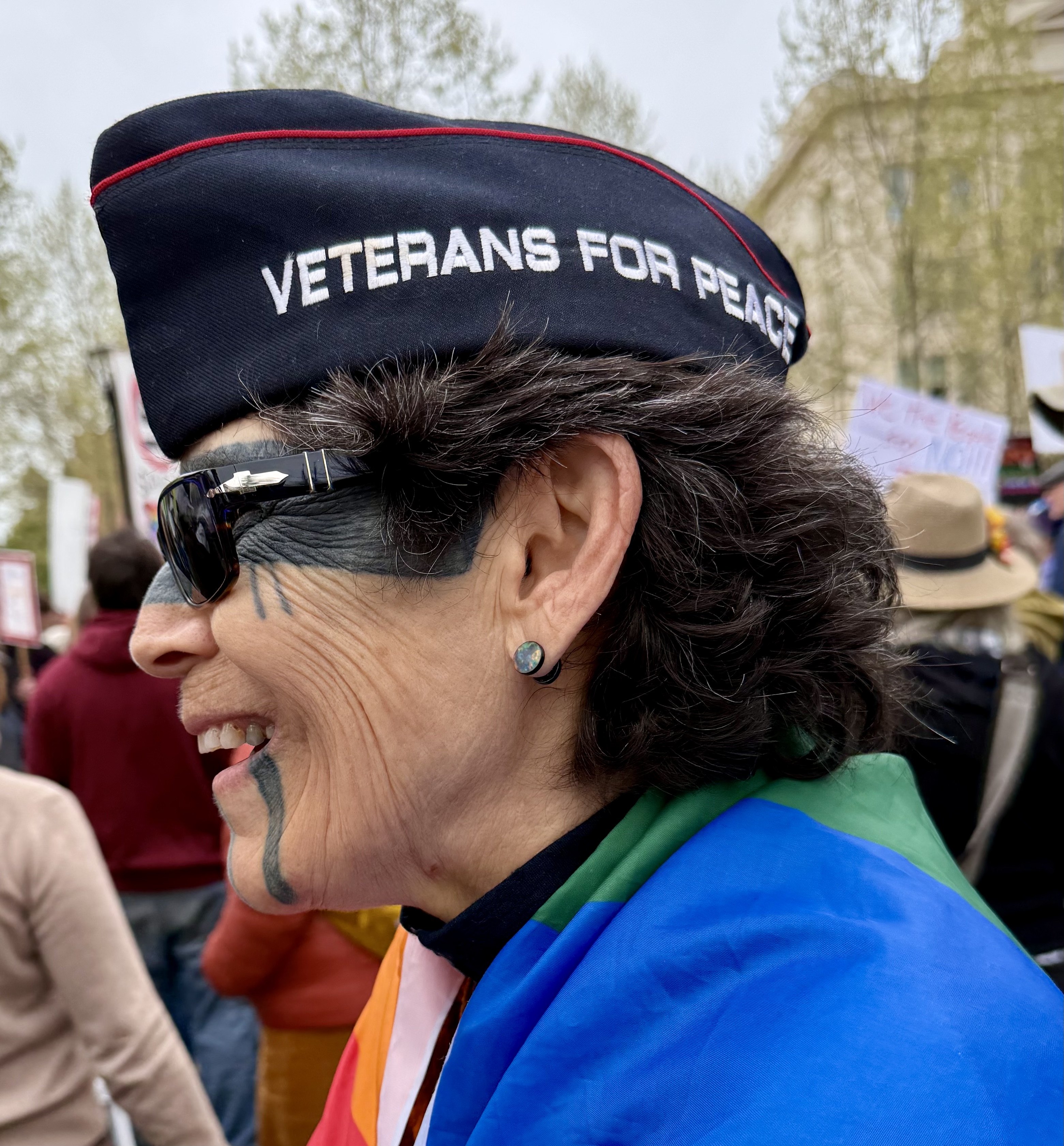
In Santa Rosa and across the North Bay, we’re mad as hell—and we’ve taken to the streets. From the Hands Off! protest in April that brought 5,000 people to downtown Santa Rosa, to thousands more mobilizing in surrounding towns, resistance to the rise of fascism in the U.S. is fierce and growing.
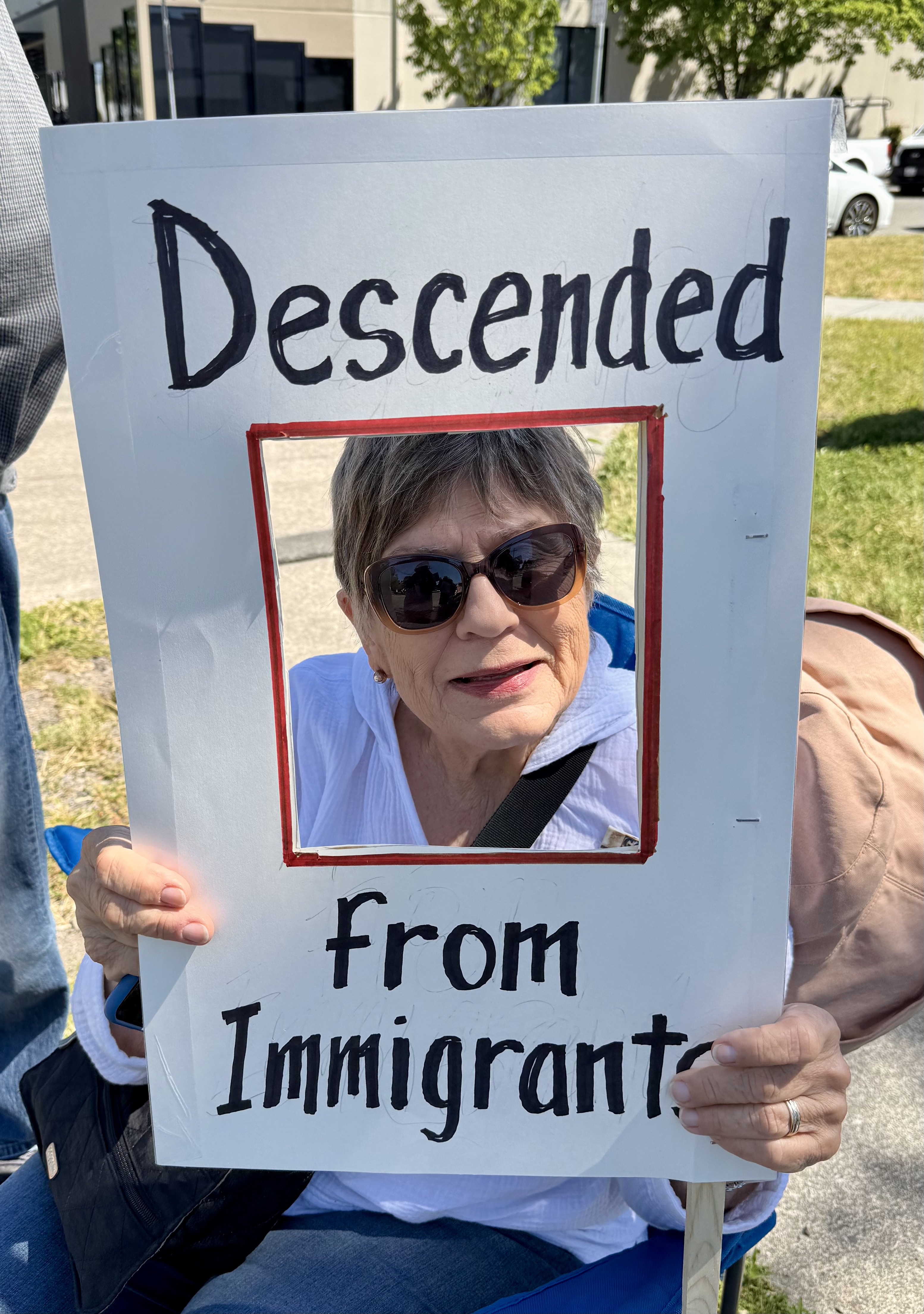
Some of the signs from our protests
Here in Sonoma County, protests are a near-daily occurrence. Demonstrators are targeting a wide range of issues: U.S. complicity in the genocide of Palestinians, Avelo Airline’s role in deportation flights, Elon Musk’s attacks on federal institutions like Social Security and Medicare/Medicaid, the gutting of the Veterans Administration, the criminalization of immigrants, assaults on free speech, and—by us tradeswomen—the dismantling of affirmative action and DEI initiatives.
The Palestinian community and its allies have been gathering every Sunday at the Santa Rosa town square since October 2023.
Weekly actions include:
Thursdays: We the People protest in Petaluma.
Fridays: Veteran-focused rallies protesting VA budget cuts.
Saturdays: Tesla Takedown at the Santa Rosa showroom, and a vigil for Palestine in Petaluma.
Sundays: Protest at the Santa Rosa Airport against Avelo Airlines, and a Stand with Palestine demonstration in town.
Tuesdays: Resist and Reform in Sebastopol.
Ongoing: In Cotati, a weekly Resist Fascism picket line.
In Sonoma Plaza, there’s a weekly vigil to resist Trump. Sebastopol hosts a Gaza solidarity vigil, along with Sitting for Survival, an environmental justice action.
Beyond the regular schedule, spontaneous and planned actions continue:
A march to raise awareness of missing and murdered Indigenous women.
In Windsor, women-led organizing for immigrant rights.
A multi-faith rally at the town square on April 16.
Protest musicians and singers are coming together to strengthen the movement with art.
Trump’s goons are jailing citizens, and fear runs deep, especially among the undocumented and documented Latinx population—who make up roughly a third of Santa Rosa. But fear hasn’t silenced them. They continue to show up and speak out.
I’ve joined the North Bay Rapid Response Network, which mobilizes to defend our immigrant neighbors from ICE raids.
Meanwhile, our school systems are in crisis. Sonoma State University is slashing classes and programs in the name of austerity. Students and faculty are fighting back with protests, including a Gaza sit-in that nearly resulted in a breakthrough agreement with the administration.
Between all this, Holly and I made it to the Santa Rosa Rose Parade. The high school bands looked and sounded great—spirited and proud. Then, our Gay Day here on May 31, while clouded by conflict about participation by cops, still celebrated us queers.
And soon, I’ll hit the road heading to Yellowstone with a friend. On June 14, we’ll join protesting park rangers in Jackson, Wyoming as part of the No Kings! national day of action—a protest coordinated by Indivisible and partners taking place in hundreds of cities across the country.
On the Solstice, June 20 in the Northern Hemisphere, we expect to be in Winnemucca, Nevada, on the way home.
In the 2000s, I began to deconstruct my Bernal Heights home. In opening up the walls, I started to uncover the house’s history, leading me to an investigation into its owners and architectural evolution from the distant past to its having been bought by my lesbian collective in 1980. The story of 386 Richland Avenue is one of Bernal Heights, San Francisco, and California more broadly, speaking to themes of land ownership and development, the legacies of slavery, and the role each person has in shaping their neighborhood.
386 Richland Avenue 1980.Photo: Molly Martin
An old house holds the ghosts and remnants of all the people who have occupied it over the years. When you live in an old house I believe you must acknowledge all the people who have lived there and the people who built and worked on the house.
When I got to San Francisco in 1976, I decided there was no place I’d rather live. I had never owned a house before and really had no hope of ever owning a building in San Francisco until my living collective of four lesbians agreed to pool our money.
I got curious about the history of our Bernal Heights building as soon as we bought it in 1980. How old was it? Real estate records said it was built in 1900, but that is the default date for all San Francisco buildings built before the earthquake and fire of 1906 destroyed city building department records. So I knew it was probably built before 1900. It was always a weird looking building: three stories with three flats over a garage. Notice the weird roofline and window placement. What architect would design such a building?
I wanted to know who had lived there before me.
The Land Underneath
Ohlone village
The first human residents of this land of gently rolling grassy hills were the Ramaytush Ohlone. Hundreds of shell mounds have been uncovered all around the San Francisco Bay and there is evidence of a great Ohlone settlement at the mouth of Islais Creek, which once flowed just down the hill south of my house where Alemany Blvd and Interstate 280 now flow with traffic. Before progress changed its course and buried it, Islais Creek formed a deep gorge on the south side of my neighborhood of Bernal Heights. The creek was long ago undergrounded and replaced by freeways but the gorge remains.
I was delighted to learn that islay is an Ohlone word naming a native bush called the islais cherry (Prunus ilicifolia) that grew along the creek and still grows in forgotten corners of San Francisco. The shiny leaves look like a cross between holly and oak. And the fruit is edible. They were eaten by the Ohlone along with plentiful bay creatures, shellfish, fish, birds, deer, and other land animals.
Spain had laid claim to San Francisco and what it called Alta California in 1542. Starting in the 1760s the Spanish established missions from San Diego up to Sonoma along the king’s highway or El Camino Real, now Mission Street and Highway 82. The Spanish and the Indians they enslaved built San Francisco’s Mission Dolores in 1776, and so the road from San Jose and the south had come sometime before that. These are well-traveled pathways that extend quite far back in time.
After Mexico won independence from Spain in 1821, it secularized the Catholic missions. In order to receive a Mexican land grant, a man had to be a Catholic. But the land was not handed out to the church as it had been by Spain.
José Cornelio Bernal was granted a league, about 4,400 acres, by the Mexican government in 1839. José was the son of Juan Francisco Bernal who, with his family, arrived in San Francisco with the Spanish Anza expedition in 1776. José and his family were cattle ranchers, some of the original Californios. Over time they lost the land to squatters, lawyers, and bankers. The family first defaulted in 1859 to William Tecumseh Sherman, a banker before he became a Civil War general, who had loaned the Bernal patriarch money. The Bernals finally relinquished their last 25 acres to foreclosure in 1917. It marked the passing of the very last bit of San Francisco real estate from the families of original Mexican land grantees—the Californios.
The area south of the Mission including Bernal Heights was not platted until after the Civil War. At that time the lack of transportation infrastructure made lots hard to sell.
Large sections of southern San Francisco fell into the hands of the real estate developer François Louis Alfred Pioche. Pioche platted and developed much of southern San Francisco. A French financier, Pioche is described as a suave and cultured European who introduced fine French wine to San Francisco’s elite, an influential player who lived openly with his male lover and business partner, L.L. Robinson. No one is sure why he committed suicide in 1872.
Bernal Hill in 1875.Photo: Carleton Watkins, courtesy of California State Library
Carleton Watkins (1829-1916) was one of the most famous outdoor photographers of the American West. He also made many pictures of the growing city of San Francisco, like this one taken in 1875. From around Silver Avenue, looking north to Bernal Heights, the bare grasslands of southwest Bernal are revealed with the Mission District and the town of San Francisco in the distance. The prominent enclosure nearby is the site of St. Mary’s College. It faced Mission Road (now Street), the principal route at the time. College Hill Reservoir is the flat area near the center of the picture. The fenced circle denotes Holly Park, donated to the city in 1862 by the silver mining baron James Graham Fair. On the extreme right is the top of Bernal Heights. My house would be just to the right of this picture near the east edge of Holly Park.
Building 386 Richland
When we bought 386 Richland, the place was a mess. The most recent owner had “remodeled” by covering the walls and even wood window trim with quarter inch sheetrock. I’m an electrician. Trying to solve an electrical problem, I discovered live bare wiring between the sheetrock and tongue and groove finish wall in the kitchen of the lowest unit. This was very disturbing but I didn’t have time to demo the walls. That would have to wait 20 years until I retired.
One day I drilled a hole in a closet wall to pull some low voltage wiring. I used a four-inch hole saw and was surprised that when the saw got through a layer of sheetrock, it hit wood. When I finished I pulled the four-inch-round block of wood out of the saw. It was inch-thick redwood. I turned it over and found newspaper pasted to the inside, a primitive type of insulation. It was a racing form dated 1893. Well, that was a clue.
The San Francisco Call applied directly to redwood for insulation.Photo: Molly Martin
Someone told me the San Francisco Water Department records had been kept in a safe and survived the 1906 fire. All you had to do was ask at the headquarters. The clerk stepped into a big safe and brought out a single piece of paper, a Xeroxed copy of the permit, which said water was provided August 1, 1893. It was signed in a clear hand by the owner, G. Shadburne.
The document contained several other clues. The Spring Valley Water Company (we didn’t yet have a publicly-owned water department) supplied water to what was then a single-family building of 825 square feet. The property owner paid $10 in gold coin. Listed were two wash trays, one wash basin, one bath, one water closet and 30 square yards of irrigation. E. J. Fisk of the water company had charged for two cows and then apparently been convinced to erase them along with some other notes. Were the cows just visiting? Had a family been living at 386 Richland without running water? It would have been possible; there were several active springs on the hill and many early homes had been built without indoor plumbing. But while Shadburne could have bought the property earlier, all evidence points to 1893 as the year a building was first erected here.
George David Shadburne during the Civil War
From the census record I learned that the house’s owner in 1900 was George David Shadburne, a lawyer originally from Texas who had moved to San Francisco in 1868. He did all right for himself in San Francisco, well enough to be published as a person of note in the city’s blue book in 1894-95. He never lived at Richland Avenue, which he developed and rented out to poorer tenants. He lived instead in a tonier neighborhood on “California Hill,” and his business address was 429 Montgomery in downtown San Francisco, a building which he owned.
Shadburne might have been the original slumlord.
Once I had his name, I went to the San Francisco History Center at the San Francisco Public Library main branch where helpful librarians point you to volumes of historical data. Even though building department records were lost in the earthquake and fire of 1906, the history room contains a wealth of other supporting historical documents. I learned about the Sanborn insurance maps (most every city has them) and found that my neighborhood had been surveyed in 1905 and 1915.
A Sanborn Fire Insurance map showing the Holly Park tract in 1905
386 Richland is part of the Holly Park Tract. Development in Holly Park had only just started in 1905. Except for a small addition that was added to the rear of our building in 1961 (there was a building permit), the footprint is the same as today. It was still a single family dwelling then.
Sanborn map in 1915
By 1915 our neighborhood had been fully developed. Along with five neighbors I published a pictorial book about Bernal Heights history: San Francisco’s Bernal Heights. We learned that Bernal saw its greatest surge of development after the earthquake and fire of 1906. Some people moved earthquake shacks here and some built homes. By this time 386 had been turned into two flats, 386 and 386 1/2. Rather than a D, the map says 2F meaning two flats and adds the ½ to the address.
Deconstructing
Barb Schultheis building a shoring wall after we discovered that there were no studs in existing walls.Photo: Molly Martin
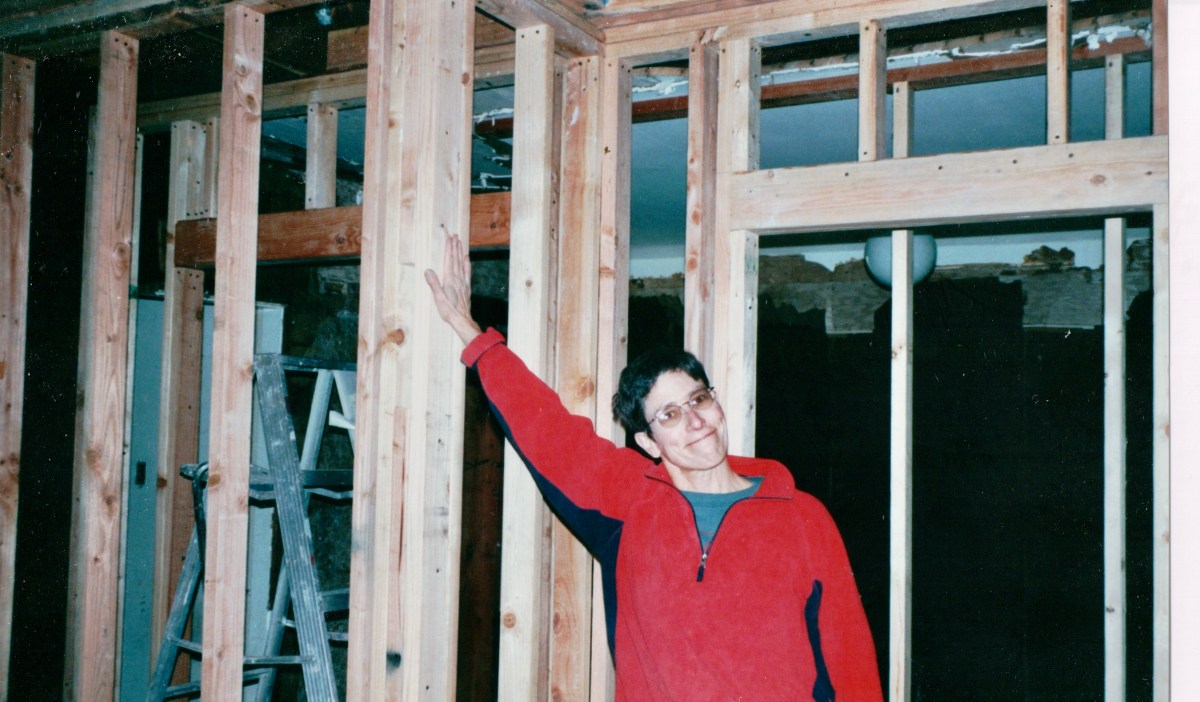
It wasn’t until the year 2000, 20 years after my original collective had bought the building, that I had the time and inclination—and also a partner who wanted to get her hands dirty—to begin to open walls and really see the structure. My then-partner Barb Schultheis and I started just a little kitchen remodel in my unit on the third floor. We opened one wall in the kitchen, pulling off many layers of finishes including sheetrock, oil cloth, and newspaper. What we found was worse than anything I’d imagined. Underneath it all was one-inch coarse sawn redwood planks, some as wide as 20 inches, and under the redwood was cross bracing and nothing else: no studs in this part of the third story apartment. And there was another story on top! The redwood was structural. We quickly built a shoring wall.
I’d never seen this building method. My carpenter girlfriend in New England called it a plank house, a more common style of building there in the 1800s.
Our demolition progressed to the front room of our unit. Here we found another construction method, more common in today’s buildings–platform construction. The walls had 2×4 studs 16 inches on center and the finish was lath and plaster.
As we deconstructed the building, we kept wondering why it is so oddly shaped, why construction methods differed from floor to floor and room to room, why floors were different heights in adjacent rooms, why floor and ceiling joists sometimes went north and south, sometimes east and west, why when wall coverings were removed we could see sky through cracks in the exterior walls.
Another clue: the staircase had been open and was closed in to create a third unit.Photo: Molly Martin
Then one day when I was standing across the street looking at the building I had an epiphany. Our home was never a plan in some architect’s mind. The different construction methods told us that these were different buildings, constructed at different times and later nailed together. It was a collection of buildings set on top of one another, cut off, pushed together, raised up, and without benefit of removal of siding, spiked together with a few big nails. Suddenly all the mysteries we’d cataloged made sense.
The old house had been turned so that its side, not the front, faced the street. Houses were often moved at the turn of the century. A builder would build a single-story house and later raise it up to add a second story. There were few systems like electrical and plumbing to disconnect as there are today. I believe this building was moved from another location where its rounded entryway faced the street. I propose that the three buildings were given to Shadburne or sold to him cheap.
Illustration of my “many buildings” theory
In this drawing I removed the double stairs to better see the different parts. I had always thought the oldest building, the yellow part, was the first house on the lot, but the square footage didn’t add up. Then I realized that the original 825 square foot house is the pink building turned so its side faces the street.
Here we can see three different buildings built with different construction methods: the yellow building had planks joined with square nails and no studs, insulated with 1893 newspapers. The pink building had modern platform construction, rolled nails (invented around the turn of the 20th century), and lath and plaster finish. The blue building below had old fashioned balloon framing with 4×4 studs 24 inches on center, also finished with redwood planks, but with rolled nails.
Our remodel progressed to the garage where we demolished a shelving unit made of old doors and metal pipes attached to a wall of sheetrock with no studs. Barb and I were standing at the base of a four-story building. We were right under three stories of kitchens with heavy appliances. We looked up to see the floor above bowing toward us. We rushed to build another shoring wall. That’s how we figured out that the bearing wall under all the kitchens had been removed! My search for building permits had uncovered a 1917 project to raise the building and add a garage. I believe the bearing wall was removed then. The building inspector didn’t notice. The building had been slowly falling down for a hundred years! So, with help from carpenter friends Carla Johnson and Pat Cull, we dug up the garage floor, poured a footing, jacked up the building, and built a new bearing wall.
Retired union carpenter Pat Cull oversaw our project and taught us much about carpentry.Photo: Molly Martin
Another shocking discovery resulted in more unplanned structural work: not one but two bearing walls had been removed to make way for the garage in 1917. Engineer Marg Hall helped us to understand the physics of load bearing (one test: have your girlfriend run up to the floor above and jump up and down) and did calculations required for the permit. I drew plans and waited in line at the Dept. of Building Inspection. This second un-wall we rebuilt as an engineered glue lam wood beam on posts.
Postcard found in the ceiling, maybe from 1903.Photos: Molly Martin
When Barb and I opened the ceiling above unit B, the third story, we found a crib full of about a ton of plaster that had been discarded when the buildings were tacked together (no wonder the ceiling was bowing). We had to remove it by hand, scooping it into buckets to take to the dump. This was the most disgusting job of the whole project. This postcard was in there. I asked Ancestry buffs brother Don Martin and cousin Richard Juhl for help researching this. They found John Hargens at this address in a 1907 city directory. He was an immigrant from Germany, born about 1868. His wife Minnie was also German which might account for the florid cursive. They lived at 386 in 1907 with their five children but moved to Santa Marina (a nearby street) in 1908. Did they move because of construction on 386? How did this postcard get into a pile of plaster left in the attic?
Some of the objects found in the walls, dating back as early as the 1800s, gave us clues to the tenants in different eras. Coffee can metal (bottom right) was used to patch holes in the fir floors.Photos: Molly Martin
Demolition was like an archeological dig and while we didn’t find anything valuable, we uncovered lots of clues about the building of the house. When I finally saw the wiring inside the walls, I couldn’t believe the building hadn’t burned down. In my time as an electrician and inspector I’ve seen the insides of a lot of walls in San Francisco but I’d never seen such hazardous wiring. Much of the building was wired with the equivalent of zip cord.
Thanksgiving 2000 was our last dinner party in my old apartment B. By Christmas I had moved up to Barb’s penthouse apartment and moved all my stuff out to the shed we’d built the year before, clearing room for the remodel. We spent the last days of December pulling apart my kitchen. Our four-story, three unit building required near complete rebuilding, a far more difficult task than simply constructing a new building from the ground up. If only I’d known what we were in for, I’d have sold the building. But there’s probably a real estate disclosure law requiring truth telling, so once we started, we had to forge ahead.
Rebuilding
In those first two years of destruction and construction of the lower two units, Barb and I did all the demolition, carpentry, and electrical work ourselves, with the help of many dear women friends. Scores of women helped us on this years-long project. We couldn’t look at the whole big project or we’d get depressed at the overwhelming amount of work ahead of us and think of suicide. Instead, we focused on each small project and celebrated whenever we finished framing a wall (virtually all the walls had to be reframed) or laying a subfloor in one room.
Carla Johnson jackhammers for new footing
In November of 2002 we celebrated having gotten the house closed up for winter and ready for sheetrock. Barb had taken off a couple of weeks in October and we’d worked our butts off replacing siding, installing new windows, patching, caulking, weatherproofing, and painting the back and west side of the building and rear stairs.
We knew the building was funky—the three-story utility “shed” which enclosed bathrooms had been added on at the turn of the 20th century with no foundation, so it had gradually separated from the main building over four inches near the top. Bad carpenters and handyman homeowners had been plugging the gap for 100 years. But we figured 21st century caulk might buy us a few more years. We decided we would tackle rebuilding the back of the house after this remodeling project was complete.
The rear side of 386 Richland before the storm; all of this work had to be torn down.Photo: Molly Martin
Then in mid-November 2002, the winter’s first storm hit. The four-story wood frame building had always moved in the wind. You’d lie in bed in a storm and feel it shimmy and buck on any floor (I’ve lived on all three and lying in bed in the bottom unit I could tell when the couple in the top unit were having sex), but especially on top. I figured it had survived a century and two big earthquakes probably because of its profound flexibility.
That night of the storm it felt like the building was on the verge of falling down. Of course! We’d removed all the many layers of wall coverings and completely gutted the two floors below. Like scotch tape and gum, the interior finishes had been holding us up. Upstairs in the top unit, lamps were swaying and everything was moving. We could see the glass in our living room windows bow in the wind and worried they might shatter. So we closed the blinds and finally went to bed, though I don’t think either of us got much sleep.
The storm caused plenty of damage in San Francisco and the area. Folks in some places were without power for weeks. I guess we were lucky. The only thing we had was water in places it didn’t belong—lots of water. One corner looked like a waterfall, and of course had been leaking for years. Only now with all the walls open could we see it. For Barb and me, this was the lowest point. It seemed as if the project would never end.
The upshot is we spent the next year tearing off the whole back of the building, including deck and stairs, and rebuilding it. All the new windows and doors we’d hung and trimmed (making casing by planing the salvaged redwood) had to be taken out, projects we’d sweated and cried over for hours and redone time after time as we learned the rudiments of carpentry.
Contractor John Burton reframing the roof.Photo: Molly Martin
To demo and rebuild the back of the building we hired a contractor, my old friend John Burton, who I’d worked with to remodel the People’s Cultural Center on Valencia Street in 1978.
We recycled the redwood stairs, reusing them as stairs when we could and building planter boxes with the rest. Barb and I bolted the foundation, put in hold-downs wherever we could to hold the various parts of the building together. Then we sheared all the open walls in the front of the building with plywood. The new rear walls have been sheared on the outside. Afterward in a windy storm I laid on the bed slightly disappointed that the house hardly moved at all.
My Local 6 electrician sisters and I showing off our tools. We were some of the first women to get into our trade.Photo courtesy of Molly Martin
With help from my women electrician sisters from International Brotherhood of Electrical Workers (IBEW) Local 6 and Local 617 I rewired the building and installed a 200 amp four-meter electric service. The job was signed off by city electrical inspector Sylvia Montiel, who had worked with me when we were electricians wiring high rises back in 1981.
The building’s plumbing–water, drains, waste, gas, and venting had to be replaced. I calculated the size of piping and drew plans. We installed on-demand water heaters in all the units, as well as heating systems. The two chimneys were demo’d and the tons of bricks recycled. We replaced all the windows, keeping only the existing old growth redwood sills.
Our remodel (perhaps it should be called a rebuild) took nearly a decade. The San Francisco Building Department granted us a building final and certificate of occupancy in 2009.
Legacies of 386 Richland
I didn’t learn much more about the house’s original owner, G. Shadburne, until the Internet made researching so much easier. He was a Confederate soldier, a captain who had been wounded, had spied for the Confederacy. During the summer of 1864 Shadburne became one of Wade Hampton’s notorious “Iron Scouts,” who hid along the Blackwater River just two miles from Grant’s lines near City Point, Va. Wearing Yankee uniforms, they skillfully eluded capture while they killed and captured Union pickets and couriers and interfered with wagon trains and telegraph lines. Shadburne also helped lead the Beefsteak Raid, stealing 2,500 head of Union cattle, Union supplies, and capturing 304 Yankee prisoners. Shadburne was captured on March 6, 1865, near Fredericksburg. He was sent to Fort Monroe, Va., then to Wallkill, a Union prison barge at City Point. Charged with being a spy, he faced hanging, but escaped on March 10th and returned to the Iron Scouts.
After the Civil War, like other Confederate slaveholders, he considered relocating to Brazil where slavery was still legal, but that didn’t work out. In 1868 Shadburne and his wife arrived in San Francisco where he opened a law practice. He gained a reputation as a bulldog litigator who never gave up until the last appeal failed and who was not above resorting to physical violence or verbal attacks on his opposing counsel.
The back of an 1858 appraisal of Shadburne’s property lists the names of his 20 slaves and their values.Image: Xavier University of Louisiana
Then I found an appraisal of Shadburne’s property from 1858 in Louisiana in the online archives of Xavier University of Louisiana. It lists the land he owned as well as his 20 slaves. What happened to them? When Shadburne moved to San Francisco slavery was illegal. I could find no evidence that he brought any of them with him. Tracing the lives of enslaved people is made difficult because only their first names and ages are recorded, sometimes with a note saying “cook” or “lame.”
Many of California’s settlers were Southerners and slave owners who sought to make California a slave state. Shadburne, who founded the Southern Society and immersed himself in civic projects, certainly contributed to the culture of San Francisco. He presented himself as a Civil War hero. He lived in San Francisco until his death in 1921.
Various owners followed Shadburne. Some actually lived there. But the property remained a rental, at least in part, in the working class neighborhood of Bernal Heights until my collective of four lesbians bought the building in 1980.
Lenders didn’t know what to do with four unmarried women buying a building together. Women had only just won the right to our own credit. We were tenants in common, not very common then, but now a common way for unrelated people to buy property together.
Lesbians Against Police Violence.Photo: Ruth Mahaney
My collective household was part of a movement. The collective living movement developed from a critique of the nuclear family and patriarchy. We sought to build alternatives. We envisioned a world without war, police violence, discrimination, imperialism, capitalism, and private property. We protested. But we also worked to build new institutions and new ways to live. For nearly 40 years of its 130-year history the building was a center of lesbian and women-centered culture and activism.
386 Richland after the remodel.Photo: Molly Martin
The lesbian collective slowly dissolved, but with numerous refinancings, 386 Richland helped the partners finance more woman-owned houses in San Francisco. I moved out of the building in 2018; today is a new chapter in Bernal history. The neighborhood, colonized by Californios, then working class immigrants from Ireland, Italy, and European countries, Communists and leftists, Mexicans and Latin Americans, and lesbians, is now being taken over by techies. The neighborhood of Bernal Heights has never been static since Europeans invaded.
As citizens and historians we don’t want to forget our own part in history. We all play an important part in shaping the culture of our neighborhood and our city.
Carpenter apprentice Outi Hicks was working on a job in Fresno, California in 2017 when she encountered continuing harassment from another worker there. She didn’t complain and no one stood up for her. Then her harasser attacked her and beat her to death.
We don’t know whether Outi (pronounced Ootee) was murdered because she was Black, lesbian or just female. But we do know that being all three put her at greater risk. Outi was 32 and a mother of three.
In response, tradeswomen organized Sisters Against Workplace Violence and worked with the Ironworkers Union (IW) to launch a program called Be That One Guy. The program’s aim is to “turn bystanders into upstanders.” Participants learn how to defuse hostile situations and gain the confidence to be able to react when they see harassment.
“Outi Hicks’ murder hit me hard,” says Vicki O’ Leary, the international IW general organizer for safety and diversity. “Companies and unions need to change the focus of their harassment policies and need to get tougher with harassers.”
Often the victim of harassment is moved to a different crew or jobsite in an effort to defuse the situation. But such a response actually punishes the victim and not the aggressor, who remains unaffected and may continue to harass other workers.
O’Leary says one of the most important parts of the program is when participants take the pledge:
“It only takes one guy to talk to the harasser or to file a complaint with the crew boss. It’s even better when the whole crew stands up together to end harassment, and we are now seeing this happen on job sites around the country,” says O’Leary. She tells of an apprentice who was being harassed by a supervisor. Seeing the harassment, everyone on the crew began to treat the supervisor the same way he was treating the apprentice. His behavior changed in a day.
The IW is rolling out the program through their district councils. They want to share it with other unions and, says O’Leary, they’re hoping general contractors will jump on.
Another anti-violence program started by tradeswomen and our allies also is specifically tailored to the construction industry.
ANEW, the pre-apprenticeship training program in Seattle, created its program, RISE Up, to counter the number of people, and especially women, who leave the construction trades because of a hostile work environment. ANEW director, Karen Dove, developed the program after meetings with contractors who would say “women just need tougher skin.”
The program focuses on empowering workers and employers to prevent and respond to workplace violence. It offers a range of services, including training sessions, risk assessments, and support for workers who have experienced violence.
Training sessions are designed to help workers and employers identify the warning signs of workplace violence and take proactive steps to prevent it. The training covers conflict resolution, de-escalation techniques, and the importance of creating a positive work environment.
The program is concerned with psychological well being and is now working with a union to develop mental health services for Black workers.
RISE Up also offers risk assessments to construction companies, which help them identify areas of their workplace that may be at higher risk of violence.
Marquia Wooten, director of RISE Up, says the program is designed to change the culture of construction. Wooten worked in the trades for ten years as a laborer and an operating engineer. “When I was an apprentice they yelled and screamed at me,” she says. She notes that men suffer from harassment too. “The suicide rate of construction workers is number two after vets and first responders,” she said. “Substance abuse is high in construction.”
ANEW partners with cities, public entities, unions, schools and employers. “They do want change in the industry,” says Wooten. Less workplace violence is good for the bottom line.
But training workers is not enough. Union staff needs training in how to respond to harassment as well. Liz Skidmore recently retired as business representative/organizer at North Atlantic States Regional Council of Carpenters. They created a training to help union staff members know what to do when a member complains.
“New federal regulations require that every person on the construction job who comes into contact with apprentices go through anti-harassment and discrimination training,” says Skidmore.
“Most of corporate America requires annual training about sexual harassment, but most trainers don’t know the blue collar world,” she says. Trainers can be classist. “To be effective, the trainer has to like these guys.”
While tradeswomen have long been virtually invisible on the front lines of the Feminist and Civil Rights Movements, we still are the ones who daily confront the most aggressive kind of sexism and racism in our traditionally male jobs. For going on five decades now we have been devising strategies to counter isolation and harassment at work and to increase the numbers of women in the union construction trades. Now we are working to educate the construction industry about how to end workplace violence. Women in construction are still isolated and often the only woman on the job. We need our brothers to act as allies.
As with women in construction, queer and transgender folks must depend on allies to stand up to bullies. We can’t do this by ourselves. The anti-violence programs developed by tradeswomen are programs that we queers can adapt to protect our communities.
The Black Freedom Movement and Tradeswomen History
I want to take us back in time and imagine a world, a culture, in which job categories were firmly divided between MEN and WOMEN. Women were restricted to pink collar jobs that paid too little to raise a family on or even to live without a man’s support. Even doing the same jobs, women were legally paid less than men. Married women were not allowed to work outside the home. Single women who found jobs as teachers or secretaries were fired as soon as they married. Black people were only allowed to work as laborers or house cleaners.
This was the world we fought to change.
Tradeswomen who have jobs today must thank Black workers who began the fight for jobs and justice.
The Black Freedom Movement has advocated for workplace equity since the end of the Civil War.
The movement gained power during and after WWII. A. Philip Randolph headed the sleeping car porters union, the leading Black trade union in the US. In 1940 he threatened to march on Washington with ten thousand demonstrators if the government did not act to end job discrimination in federal war contracts. FDR capitulated and signed executive order 8802, the first presidential order to benefit Blacks since reconstruction. It outlawed discrimination by companies and unions engaged in war work on government contracts. This executive order marked the start of affirmative action.
The fight to desegregate the workforce continued.
In the early 1960s in the San Francisco Bay Area, protesters organized successful picket campaigns against businesses that refused to hire Blacks, including the Palace hotel, car dealerships and Mel’s Drive-In. Many of the protesters were white students at UC Berkeley.
In August 1963, the march on Washington brought 200,000 people to the capitol to protest racial discrimination and show support for civil rights legislation. The civil rights act of 1964, signed into law by President Johnson, is the legal structure that women and POC have used to put nondiscrimination into practice.
But change did not come quickly or easily.
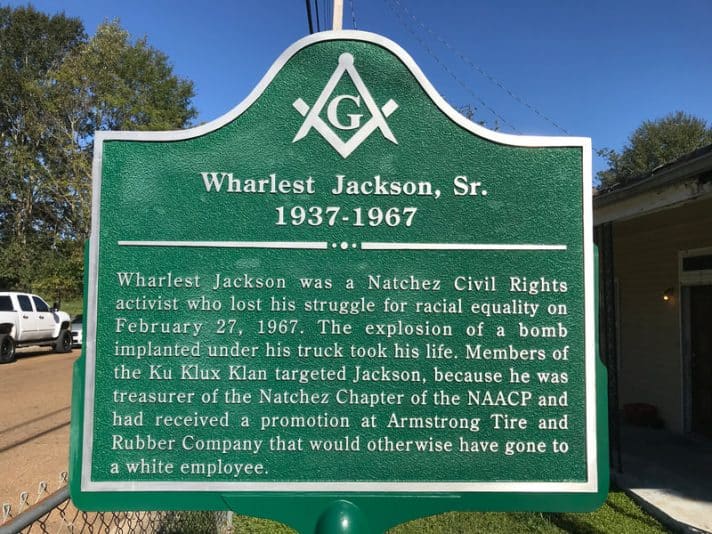
Black workers at a tire plant in Natchez Mississippi were organizing to desegregate jobs. The CIO, Congress of Industrial Organizations, supported them in this fight. In 1967, three years after the civil rights act became law, a Black man, Wharlest Jackson, who had won a promotion to a previously “white” job in the tire plant, was murdered by the KKK. They blew up his truck as he was driving home from work. No one was ever arrested or prosecuted for this crime.
Wharlest Jackson was the father of five. His wife, Exerlina, was among those arrested for peacefully insisting on equal treatment during a boycott of the town of Natchez’s white businesses. She was sent to Parchman penitentiary.
Jackson was just one of many who died for our right to be treated equally at work.
Tradeswomen are part of the feminist, civil rights and union movements. We continue to seek allies because we are few.
Discrimination has not ended, but, because of decades of organizing, our work lives have improved. We owe much to the Black workers who sought equity in employment for decades before us.
Wheelchairs were a highlight of my summer travel back home.
If you’ve never been disabled, it can be hard to appreciate disability. This is where construction workers have an advantage in sympathetic understanding. Most of us have been temporarily disabled at one time or other in our lives. We’ve had to butt crawl up the stairs, or learn to use the other hand with one arm in a sling, to navigate on knee scooters and crutches.
Buying lobbies. My first time in a store scooter. No crashes!
I’ve been temporarily disabled many times in my life, but returning from a trip to Maine was the first time I’ve ever gotten to ride in an airport wheelchair. It was awesome!
The wheelchair was a necessity after I sprained my foot getting out of bed. I know. Pretty dumb. I could tell my foot was asleep when I woke up, but I had to pee and thought I could walk on it. Not! I wonder why I’d never learned this lesson until now. Don’t try to walk if your foot is asleep! Wake it up first.
I had traveled to Maine to commune with the OTTERS (Old Tradeswomen Talking Eating and Remembering Shit). We are writing a book about the Tradeswomen Movement. For the last half century we have been agitating to help women enter the construction trades and other nontraditional jobs, and now we are recording our collective history.
OTTERS Dale McCormick, Elly Spicer, Ronnie Sandler, Lynn Shaw, Lisa Diehl, Liz Skidmore, me in front
It was great to see and hug my old friends from all over the country, many for the first time in years. Working together resulted in measurable progress on our book. We stayed in a beautiful country house. Plus we got our fill of lobbies (the Mainers’ word for lobster)!
Then the trip from Portland, Maine to Santa Rosa, California tested my enthusiasm for airplane travel.
Our “cabin” is the red house, right near Wolf’s Neck Woods State Park
My long day of travel involved three airports. By the time I left Portland, on a warm muggy day, I still could not walk. My friend and Airbnb host, Marty Pottenger, loaned me a walker and, later, a cane. She suggested I call the airline to ask for wheelchair support. She drove me to the airport where I hobbled to the airline counter. She reclaimed the cane and I plopped into a streamlined wheelchair, pushed by a handsome gray-haired man. He said he was retired but worked at the airport two days a week to help make ends meet. I said, “Two days a week! That’s all any of us should have to work. The Wobblies called for a two-hour day but I think a two day week is better.” We talked about jobs we’d worked at as we crawled forward in the security line, and I realized it would have been hell standing in that line without the chair. He left me seated near the gate and went to pick up another disabled traveler.
I was relieved to be in the first group of passengers, those who need special assistance. My foot was healed enough to limp to my airplane seat without a cane.
My Airbnb host in South Portland, Marty Pottenger and her 1850 house
At the stopover in Charlotte, North Carolina there was one other disabled traveler besides me flying on to San Francisco. The young dreadlocked assistant grabbed both our wheelchairs at once, one in each hand, and pushed us at high speed through the packed airport. Charlotte is a big city of 880,000 people and its airport is huge. We flew through the foot traffic with some close calls, but never hitting any walkers. I felt like Casey Jones drivin’ that train. I wanted to see the airport art but was barely able to take in my surroundings. The distance from one gate to the other was far but we got there in plenty of time to make our flight.
At the San Francisco airport I was greeted by a man holding a wheelchair and a sign with my name on it. What service! This was another long trek that required an elevator. I was deposited right at the taxi stand where I caught a ride to a nearby hotel where my wife was waiting.
I had first planned to take the Santa Rosa airport bus, which runs till midnight from SFO but it would have left me at a bus stop two and a half miles from my house at 2am. I had thought I could walk home from there if necessary. Sometimes Uber and Lyft can be problematic at that time. But Holly came to my rescue. After a good night’s sleep she drove me home from the hotel the next day. Home looked pretty darn good and I’m relieved to be back on solid ground.
Reuniting with my activist buddies was wonderful but I wonder if I’m too old and crabby to fly across the country again. Flying used to feel like a fun adventure. Now it’s just a trial, this time made manageable by wheelchairs and their pushers.
I first encountered Dar on a job site. The contractor had moved me there so he could meet affirmative action requirements for females on the job. This was a popular practice. Rather than just hiring more women, the company would hire one woman and move her around from job to job so monitors would count the same woman repeatedly. The job, a low-income housing project in Chinatown, received federal funding and so had to meet federal affirmative action goals for women and minorities. This was in 1980 when some regulators actually took affirmative action laws seriously and monitored job sites. Those days are long gone.*
Art by Victoria Hamlin
In those days women would often ignore each other when we were dispatched to the same job. We tried to be invisible and often, when there was only one of us, we got away with it. But as soon as two women started talking or working together, an undercurrent of anxiety rippled among the men. For a brief period on one job I got to work with a female apprentice.
“What do you two talk about?” asked one of the electricians. “Are you talking about the size of our dicks?”
This hadn’t occurred to me. Women might talk about the harassment we endured on the job or, more likely, how to work together to complete the job at hand. Dicks, drawn in profusion on the walls of the porta potties, did seem to hold a prominent place in the imaginations of some of our coworkers.
Kathryn (Kathy) Goodwin Photo Victoria Hamlin
Women knew that if we spoke to each other our male coworkers would notice. Straight women didn’t want to be painted with the dyke brush, and most lesbians were still in the closet and didn’t want the brush either. Dar didn’t worry about such implications. She was a big mouthy white woman with buck teeth and a head of bleached blond hair. On the job site you couldn’t miss her. She did not melt into the woodwork. My first day on that job, the Chinatown low-income housing project, she introduced herself as we passed each other on the deck.
“So you’re the affirmative action hire,” she said. “I guess they needed another chick.”
I wasn’t wild about being called a chick, but she had a point. Federal affirmative action regulations were the only reason I was on that job. Our short conversation made me think Dar didn’t like women any more than the men on the job did. She didn’t seem like a feminist sister.
Jake Calabro sewage treatment plant utility plumber. Photo Victoria Hamlin
For a couple of days I was pulling Romex through holes punched in metal framing. Then they pulled me off that job and put me on another where the regulations said they needed a woman. Fine with me. It all paid the same—a good wage previously reserved for men only. Dar was likely in the same boat. The plumbing contractors had a reputation for hiring even fewer women than the electrical guys. After they could check off the number of female hours worked, they could lay us off.
A couple of years later after a couple more layoffs, I scored a full-time maintenance job with the San Francisco Water Department. I worked out of a corporation yard in the southeast industrial area of the city, looking after all the motors that ran pumps that supplied water to the city. That’s when I ran into Dar again. She had been hired for a job in the plumbing division. The crews of plumbers worked installing new services all over the city, usually in big holes in the street. Or they might be required to repair a main break. The job was wet and muddy.
Molly Martin and Kathy Goodwin Photo Victoria Hamlin
I didn’t see much of Dar, as the plumbers were out of the yard working in the street all day. But I heard about her. A story in the grapevine told of Dar punching out a coworker who had harassed her while they worked in a trench. I never heard what was said. That was before the rule was imposed that fighting on the job would get you fired immediately. Dar was not the first plumber to make use of fists to manage a dispute, but she was the last to do so and avoid getting fired.
The day I saw the T-shirt was a maintenance nightmare for the water department. One of the big pump stations that housed 100 HP motors flooded. The motors sat in wells in the concrete floor and so were vulnerable to being overtaken by the quickly rising water. I could see it wouldn’t be long until the motors were under water. The team of plumbers worked fast to staunch the leak.
Carole Lee Photo Victoria Hamlin
My only job as electrician was to cut the power to the motors and that was just a matter of disconnecting circuit breakers in a huge panel on a higher level, though if the water rose high enough that panel, too, would be in peril.
That’s when I spotted Dar, down in the pit with a cluster of men. She wore a T-shirt with a message in big print:
Feeling a little sexy?
Go fuck yourself
No one said anything aloud about the message on Dar’s shirt, but it shocked me. I couldn’t imagine wearing it myself, as much as I agreed with the sentiment. I didn’t have the guts to wear that shirt.
I had to give Dar credit. Maybe she wasn’t my kind of feminist, but she was some kind of feminist.
Amy Gray Schlink Photo Victoria Hamlin
*Affirmative action in the construction industry really only lasted a short time before Reagan killed it. In California the death knell was dealt in 1996 when Ward Connerly put affirmative action on the ballot. In the meantime some of us were able to get a foot in the door and advocate for the hiring of more women. But women still make up only about three percent of the construction workforce. We were the forgotten recipients of affirmative action and we could benefit from a renewed commitment to it now as the Supreme Court threatens to end it entirely.










 tradeswomn musings