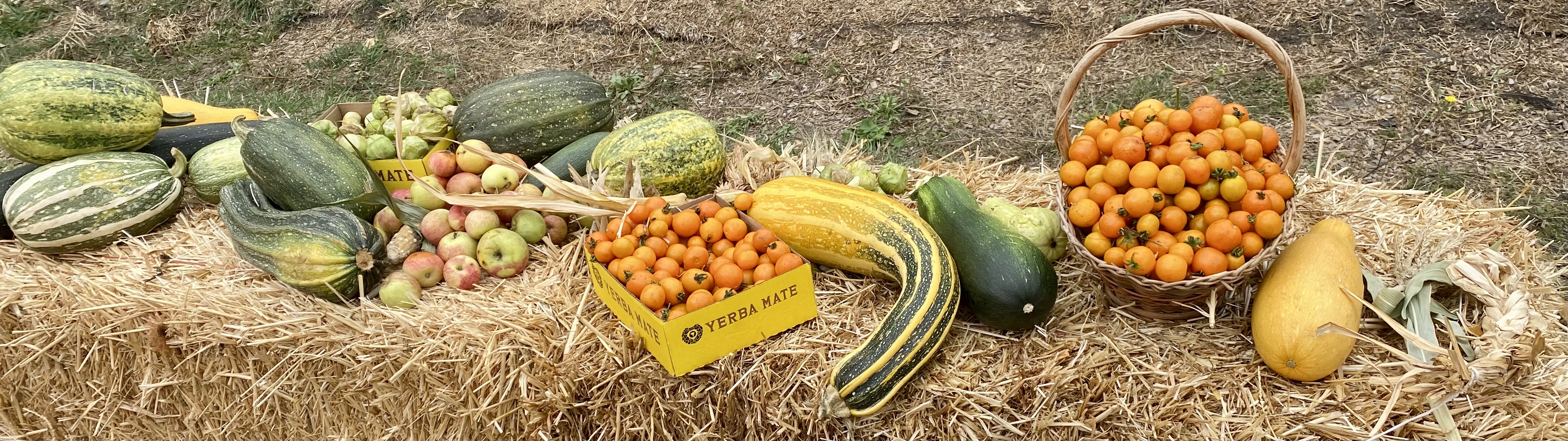
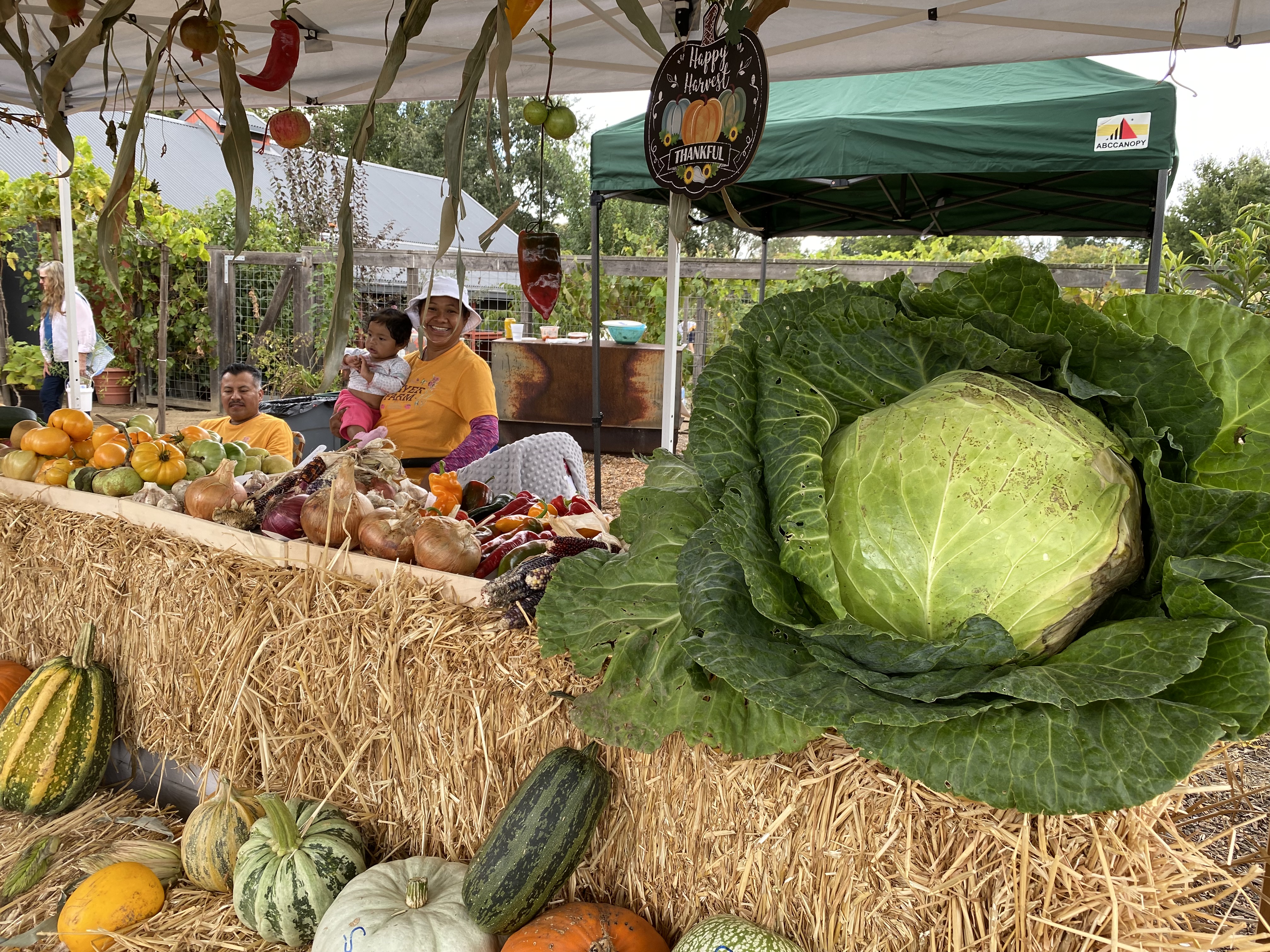
Some of the harvest of the 93 individual garden plots at Bayer Farm
My Regular Pagan Holiday Post
As the northern hemisphere tilts away from the sun this September, the autumn equinox arrives to signal a timeless transition. For centuries, cultures across the north have marked this shift with harvest festivals, and in Santa Rosa, this tradition finds a vibrant, modern home in the Festival de la Cosecha. Celebrating its 19th year, the festival is more than just a seasonal gathering; it is a living testament to the persistence of local environmentalists and land-planning activists who fought to ensure that nature and community could thrive amidst urban growth.
Mon Petit Chou
The heart of the celebration is Bayer Farm, a five-acre city park that stands as a victory of equitable urban planning. For a century, the surrounding Roseland neighborhood existed as an unincorporated pocket, an island of mostly Latinx working-class residents surrounded by the city. Historical records suggest that Santa Rosa’s ruling elite and political machine hesitated to annex the area, fearing that incorporating Roseland would introduce a wave of new voters who might shift the municipal balance of power. Consequently, the residents of Roseland were denied the basic infrastructure—sewers, fire protection, and parks—that the rest of the city enjoyed.
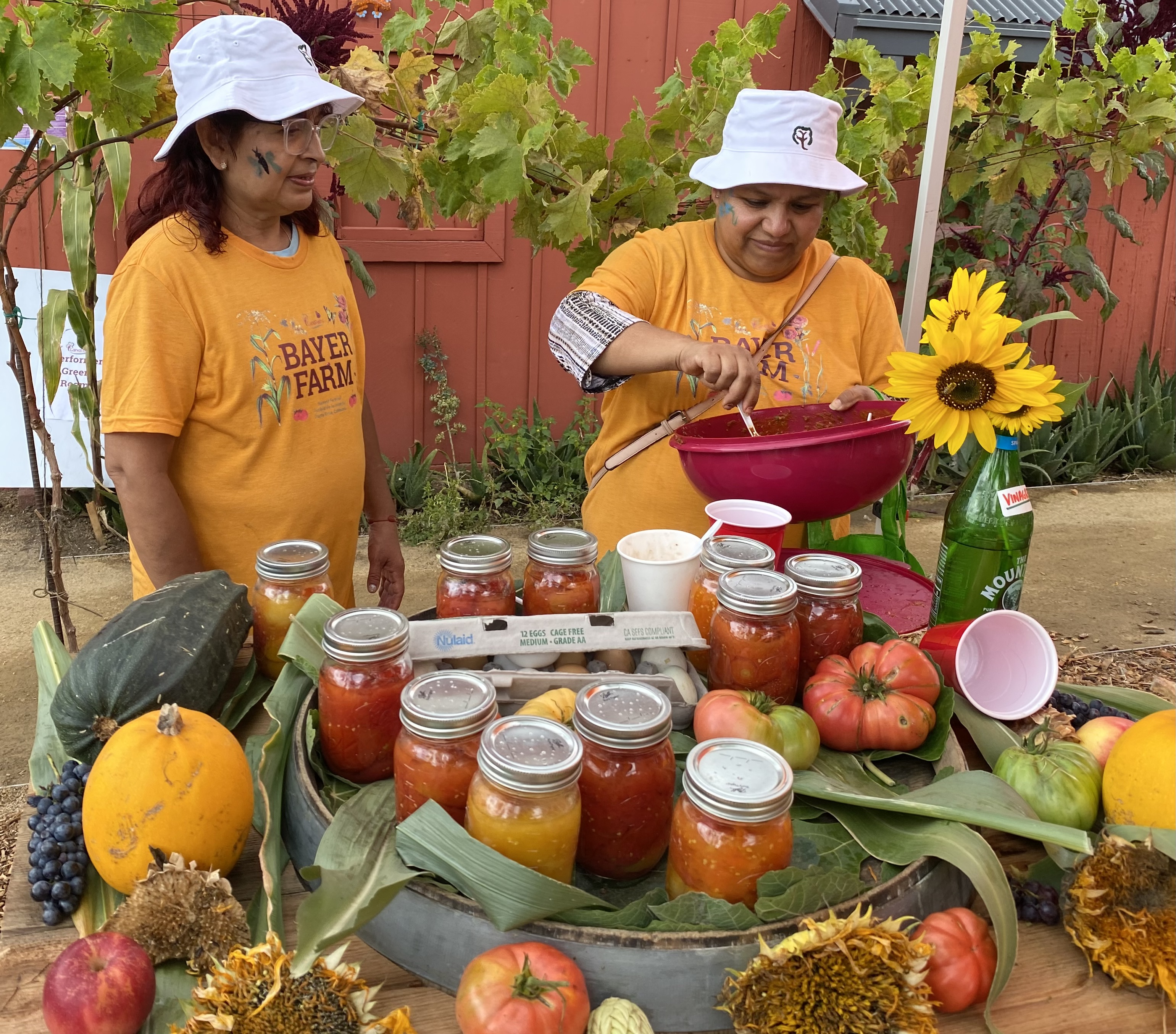
Making salsa
The creation of Bayer Farm broke this cycle of neglect. Born from a unique partnership between the City of Santa Rosa, LandPaths, and the Sonoma County Agricultural Preservation and Open Space District (Ag + Open Space), the farm embodies a vision of healing and equitable access to nature. It provides a sanctuary of greenery and cultural celebration right in the heart of a neighborhood that was long overlooked.
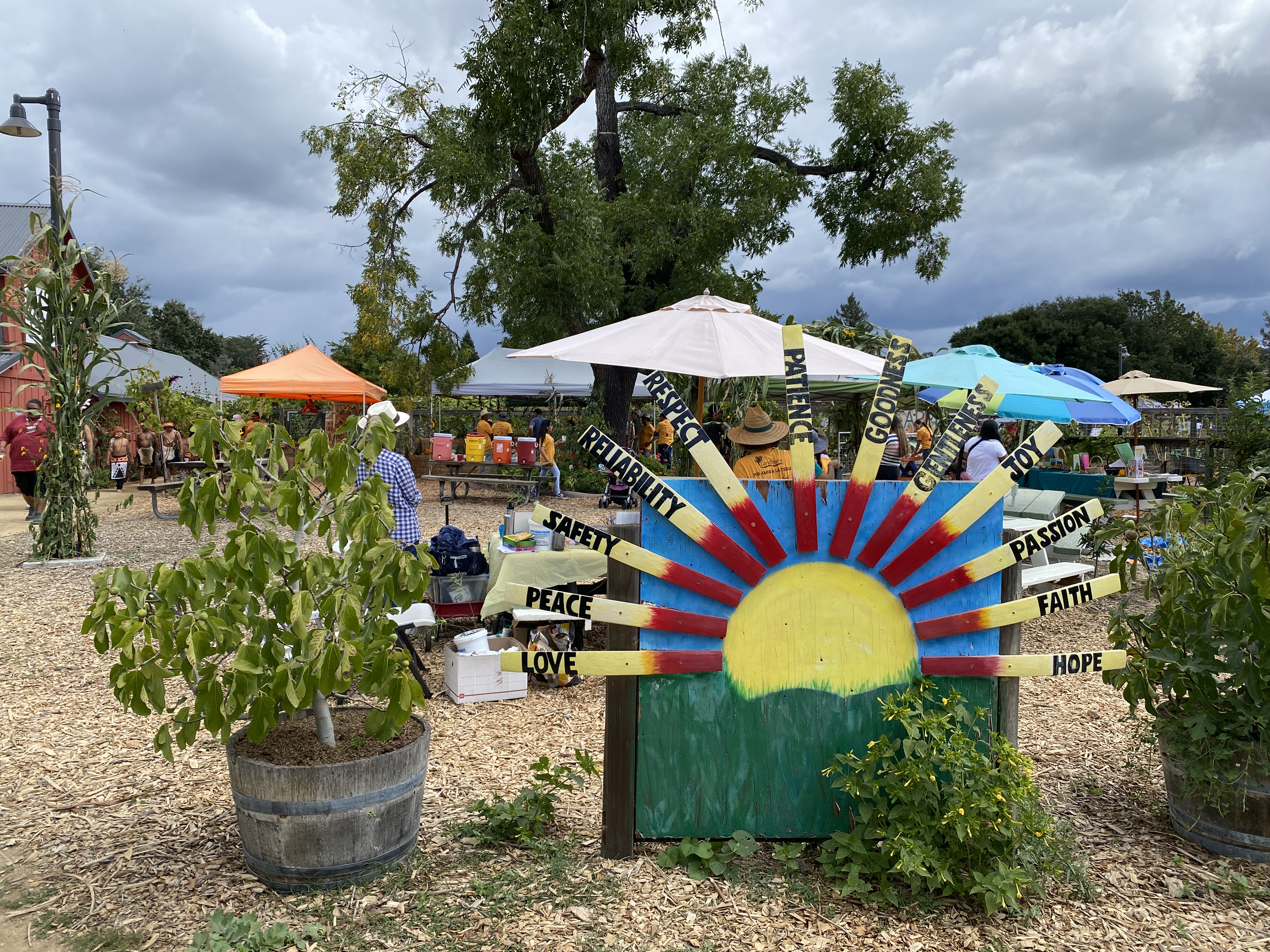
The entrance to the farm
The existence of this sanctuary is rooted in a legacy of activism. In 1990, citizens voted to establish Ag + Open Space to combat unchecked urban sprawl and protect the region’s rural identity. Through a strategic blend of grants, conservation easements, and a quarter-cent sales tax, the District works with landowners to keep the land undeveloped. This effort has permanently protected over 127,000 acres of forests, oak woodlands, working ranches, and critical waterways. By shifting the region away from a path of development and toward a model of sustainable coexistence, these activists created the very landscapes that we local residents now hike and cherish daily.
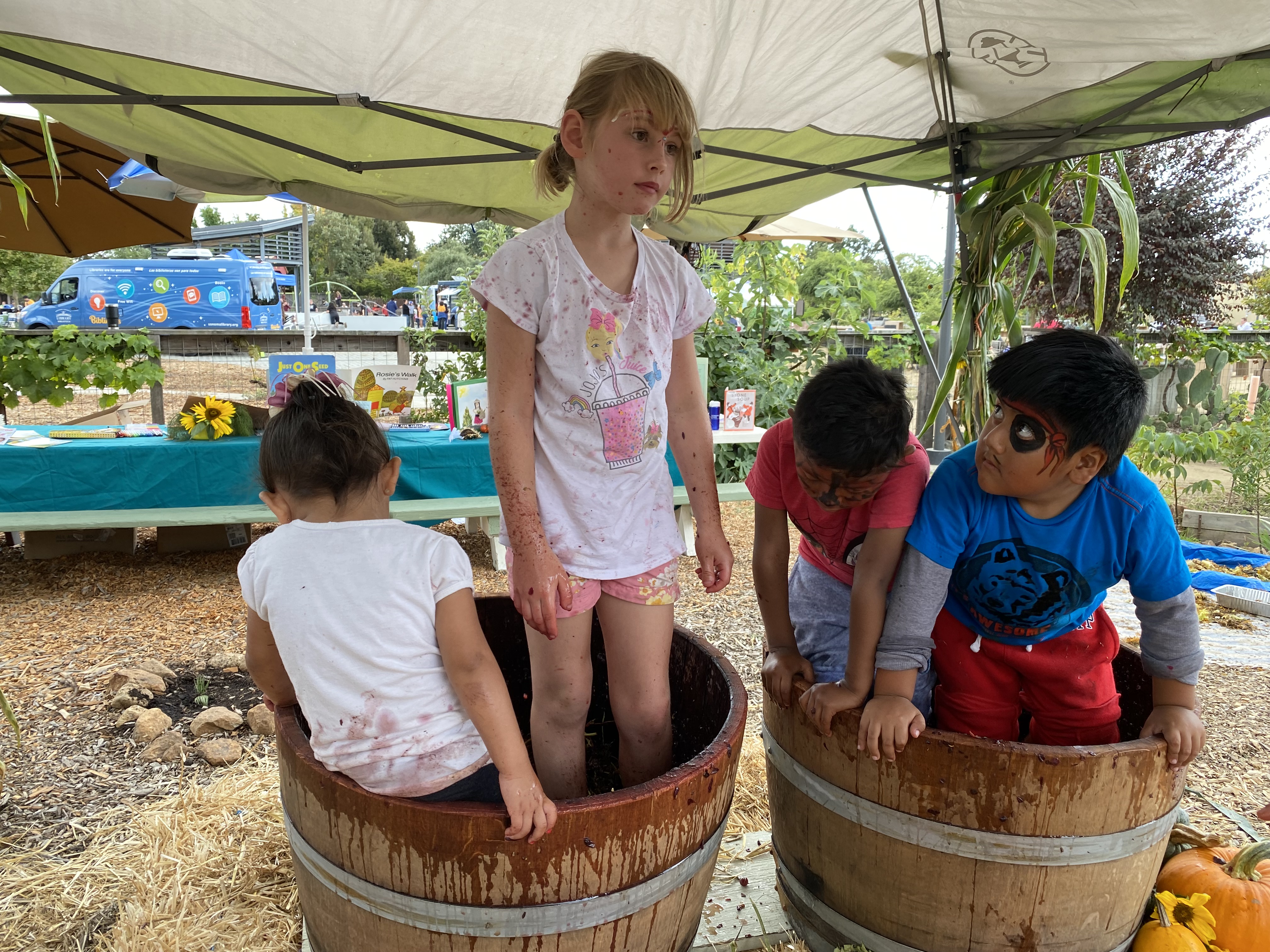
Crushing grapes the old fashioned way
Complementing this preservation is the work of LandPaths, an organization that has spent 30 years fostering a love of the land. By managing Bayer Farm and leading creative outings in both English and Spanish, LandPaths ensures that nature’s inspiration is accessible to everyone, regardless of their background. Through nature camps and community-led stewardship, they turn the act of conservation into a shared community experience.
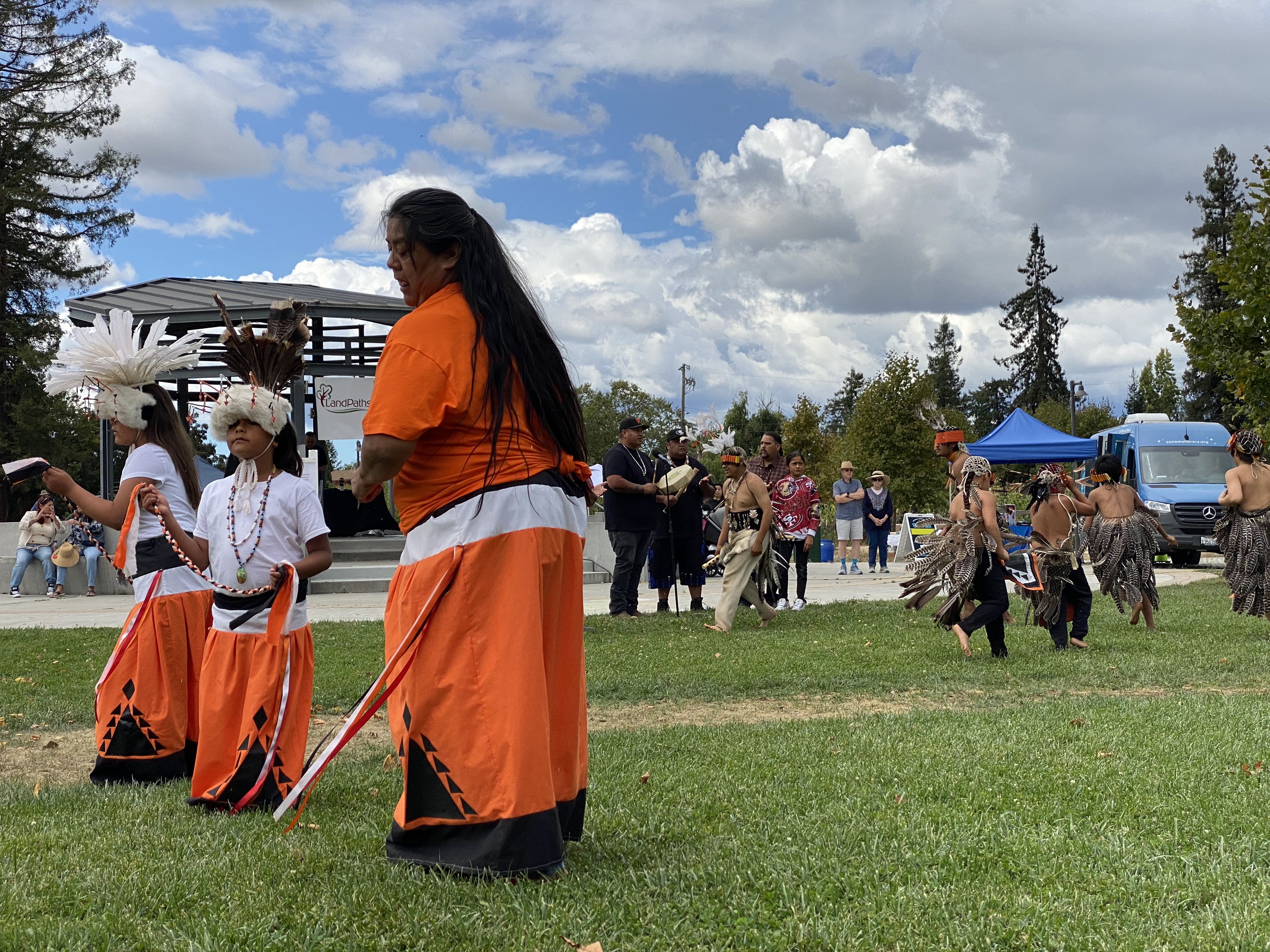
Pomo dancers performing in the meadow
On September 26, from 10 a.m. to 2 p.m., the Festival de la Cosecha brings this history to life. The air fills with the sounds of the Sonoma County Pomo Dancers and Danza Xantotl, while visitors engage in herbal medicine workshops, cooking demonstrations, and spirited salsa competitions. Between browsing community booths and picking out pumpkins and fresh vegetables, guests gather to recognize the land and the stewards—past and present—who fought to save it. In the laughter and abundance of the festival, Santa Rosa celebrates not just the harvest of the earth, but the harvest of a long-term commitment to justice, ecology, and community.
Bayer Farm is located on the ancestral homeland of the Southern Pomo people.
We imagine ourselves to be space travelers landing on a populated planet. We encounter living organisms with a well-developed culture. We wonder at their strange ways. As we work alongside them, we make an effort to adopt the culture, to fit in as best we can. In other ways we reject it, picking our battles. We are few and isolated, powerless, so we must become careful observers in order to protect ourselves.
In this culture competition is valued over cooperation. Its central tenet seems to involve establishing a pecking order, as with chickens. Woe to the one who falls to the bottom, who becomes the relentlessly picked on. Of course, our strategy is to stay under the radar and try to avoid the pecking order arrangement altogether. This is not always possible, but our differentness sometimes works to our advantage. It confuses them when they can’t immediately find a slot for us.
We speak the same language, but the words have different meanings. Topics of conversation seem designed to enable the game of one-upmanship. Slurs referring to another’s ethnic origins appear to be some sort of rite of passage. Or this may be associated with establishment of the pecking order. Weapons and war-like games assume great importance especially in the seasons when these games are played publicly. Boasting of ownership of machines, especially big ones, appears to be a way to increase position in the pecking order.
They name things after genitals and sex organs. There are nipples and studs and dicks and limberdicks, screwing and shut off cocks, male and female fittings, king studs, glory holes, screws and nuts, double hung, slab penetrations and butt joints and erection, base shaft and tip. We begin to think that nearly every word in our shared language contains a double meaning, often also referring to their own genitals or to the sex act.
Size matters in this culture. Although displaying genitals is taboo, the topic of genital size is paramount. Body size seems to contribute to pecking order status and is afforded much more importance than skill or especially intellectual capacity. In fact, intellectual prowess must be hidden in this culture to avoid low pecking order status. Presumably, the smart figure this out quickly and become proficient at pretending to be dumb.
While smartness can be covered up, small size cannot, and so the small are particularly prone to being picked on. The small have devised many strategies to avoid low pecking order status, but bonding together to form their own sub-group, an obvious possibility that we might employ, has not been one. Perhaps this indicates that the small also accept the dominant paradigm that their size makes them inferior. The typical response by the small is to develop what they call a “thick skin” and a pugnacious demeanor. Their insecurity makes them particularly difficult for us to work with, especially when we are the larger.
An important communication medium seems to be the walls of the elimination shacks. The creatures carry markers for drawing pictures and messages there. One often-depicted image is of their genitals. We try to understand what impulse might drive this primitive art. It appears to be a method of marking territory, as with dogs. We try to imagine ourselves painting our genitals on walls but find no equivalent in our own culture. We wonder at this practice, and think it may be intended to distress. To counter the practice, we follow behind with our own markers, making the genitals into faces with eyes and noses.
In our observations we look to find comparisons with other cultures. This species’ lifestyle bears more than a passing resemblance to canine culture. We notice that while they may exhibit friendly behavior when encountered alone, when they organize into packs they often become dangerously unfriendly. They see threats everywhere and might attack even when not threatened, just for the fun of it. The killing of other animals has acquired the level of a sport and is much discussed. We labor to avoid being seen as animals.
We begin to understand that we are not the only ones isolated here. Each member of this culture is, by design, alone in competition with the others. We wonder if anyone has ever taught them an alternative, that cooperation can be a marker of strength rather than weakness. We wonder if it’s too late.
Summer (and Winter) Solstice will be June 20, 2025
For years, these pagan holiday letters have followed the rhythm of the Northern Hemisphere. So it’s about time we turned our gaze south. What is the summer solstice for us in the north is, of course, the winter solstice down under.
In Aotearoa (the Māori name for New Zealand, often translated as “Land of the Long White Cloud”), the winter solstice is marked by Matariki, a celebration that signals the Māori New Year. In 2022, Matariki was officially recognized as New Zealand’s first indigenous national holiday — a milestone in honoring the traditions of the land’s first people.
Rooted in ancient Māori astronomy and storytelling, Matariki revolves around the reappearance of a small but powerful star cluster in the early morning sky — known in Māori as Matariki, and in Western astronomy as the Pleiades or the Seven Sisters. Its rising marks a time of renewal, remembrance, and reconnection — with ancestors, the earth, and each other.
The date of Matariki shifts slightly each year, determined by both the lunar calendar and careful observation of the stars. Māori astronomers and iwi (tribal) experts consult mātauranga Māori — traditional Māori knowledge systems — to ensure the timing reflects ancestral wisdom. In precolonial times, the clarity and brightness of each star helped forecast the year’s weather, harvest, and overall wellbeing.
Unlike the linear passage of time in the Gregorian calendar, Māori time is circular — woven from moon phases, tides, seasons, and stars. Matariki is not just a new year, but a return point. A moment to pause, reflect on what has been, and plan how to move forward in harmony with the natural world.
At the heart of Matariki is kaitiakitanga — the ethic of guardianship. It’s the understanding that humans are not owners of the earth, but caretakers. We are part of the land, sea, and sky, and we carry the responsibility to protect and sustain them.
When Matariki rises just before dawn, it opens a space for both grief and celebration: to mourn those who’ve passed, give thanks for what we have, and set intentions for the year ahead. It reminds us of the interconnectedness of whānau(family), whakapapa (genealogy), and whenua (land).
The name Matariki is often translated as “the eyes of the chief,” from mata (eyes) and ariki (chief). According to one well-known Māori legend, the stars are the eyes of Tāwhirimātea, the god of winds and weather. In grief over the separation of his parents — Ranginui (Sky Father) and Papatūānuku (Earth Mother) — Tāwhirimātea tore out his own eyes and cast them into the heavens.
In a world that often values speed over stillness, Matariki offers a different rhythm. It’s a celestial breath — a reminder that time moves in cycles. That rest and reflection are just as important as action. That the sky still holds stories if we remember to look up.
The 9 Stars of Matariki
Each star in the Matariki cluster has its own role and significance:
Matariki – Health and wellbeing
Tupuānuku – Food from the earth
Tupuārangi – Food from the sky (birds, fruits)
Waitī – Freshwater and the life within it
Waitā – The ocean and saltwater life
Waipuna-ā-Rangi – Rain and weather patterns
Ururangi – Winds and the atmosphere
Pōhutukawa – Remembrance of those who have passed
Hiwa-i-te-Rangi – Aspirations, goals, and wishes for the future
For Māori, these stars are not just celestial objects — they are guardians. They watch over the land, sea, and sky, and in doing so, remind us of our responsibility to them.
As global conversations about climate change and sustainability grow more urgent, the values of Matariki — care, reverence, reflection, and renewal — feel especially resonant. It’s a time to return to what matters, to honor the past, and to move forward in a way that honors both our roots and our shared future on this earth.
North Bay Rising
In Santa Rosa and across the North Bay, we’re mad as hell—and we’ve taken to the streets. From the Hands Off! protest in April that brought 5,000 people to downtown Santa Rosa, to thousands more mobilizing in surrounding towns, resistance to the rise of fascism in the U.S. is fierce and growing.
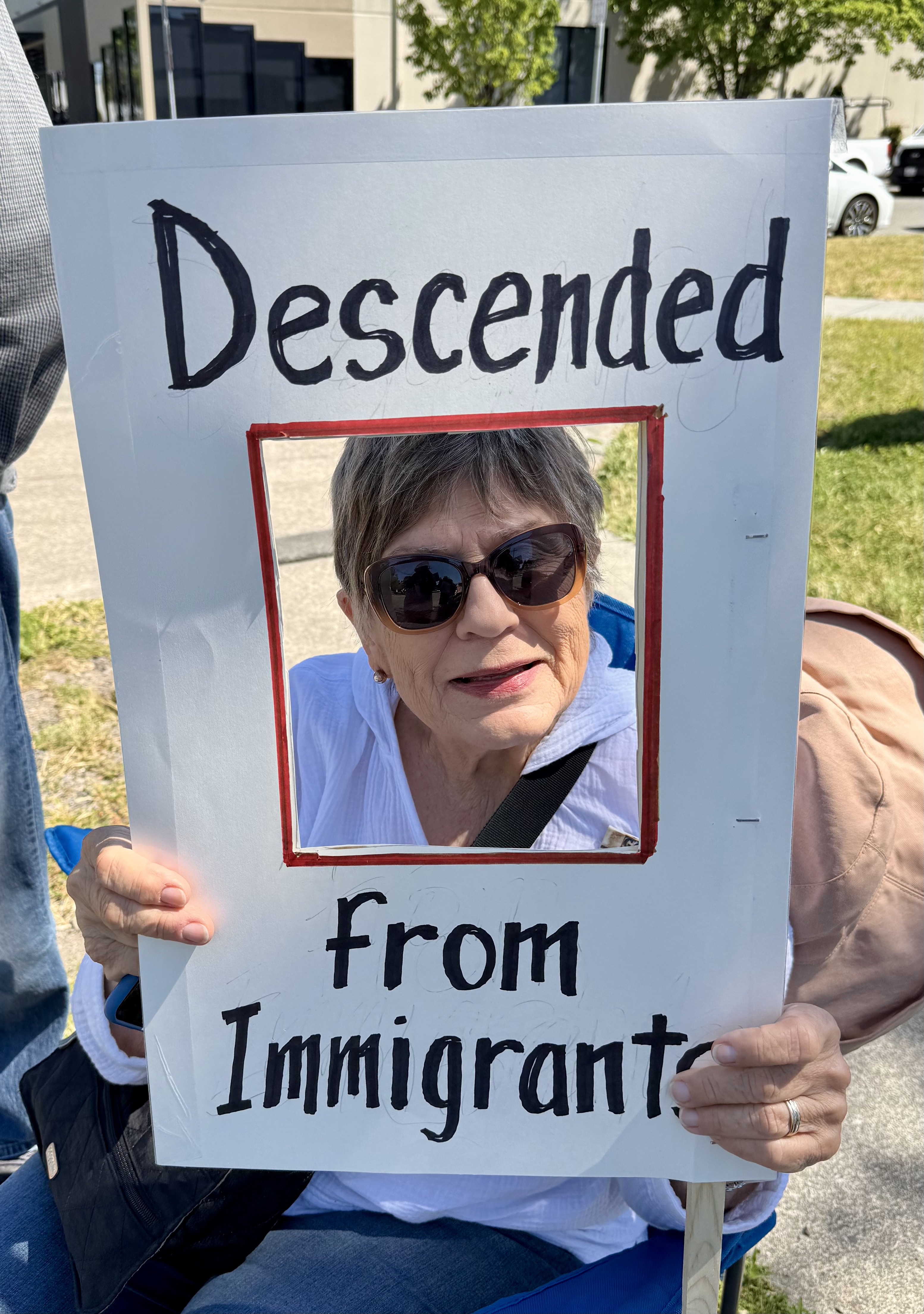
Some of the signs from our protests
Here in Sonoma County, protests are a near-daily occurrence. Demonstrators are targeting a wide range of issues: U.S. complicity in the genocide of Palestinians, Avelo Airline’s role in deportation flights, Elon Musk’s attacks on federal institutions like Social Security and Medicare/Medicaid, the gutting of the Veterans Administration, the criminalization of immigrants, assaults on free speech, and—by us tradeswomen—the dismantling of affirmative action and DEI initiatives.
The Palestinian community and its allies have been gathering every Sunday at the Santa Rosa town square since October 2023.
Weekly actions include:
Thursdays: We the People protest in Petaluma.
Fridays: Veteran-focused rallies protesting VA budget cuts.
Saturdays: Tesla Takedown at the Santa Rosa showroom, and a vigil for Palestine in Petaluma.
Sundays: Protest at the Santa Rosa Airport against Avelo Airlines, and a Stand with Palestine demonstration in town.
Tuesdays: Resist and Reform in Sebastopol.
Ongoing: In Cotati, a weekly Resist Fascism picket line.
In Sonoma Plaza, there’s a weekly vigil to resist Trump. Sebastopol hosts a Gaza solidarity vigil, along with Sitting for Survival, an environmental justice action.
Beyond the regular schedule, spontaneous and planned actions continue:
A march to raise awareness of missing and murdered Indigenous women.
In Windsor, women-led organizing for immigrant rights.
A multi-faith rally at the town square on April 16.
Protest musicians and singers are coming together to strengthen the movement with art.
Trump’s goons are jailing citizens, and fear runs deep, especially among the undocumented and documented Latinx population—who make up roughly a third of Santa Rosa. But fear hasn’t silenced them. They continue to show up and speak out.
I’ve joined the North Bay Rapid Response Network, which mobilizes to defend our immigrant neighbors from ICE raids.
Meanwhile, our school systems are in crisis. Sonoma State University is slashing classes and programs in the name of austerity. Students and faculty are fighting back with protests, including a Gaza sit-in that nearly resulted in a breakthrough agreement with the administration.
Between all this, Holly and I made it to the Santa Rosa Rose Parade. The high school bands looked and sounded great—spirited and proud. Then, our Gay Day here on May 31, while clouded by conflict about participation by cops, still celebrated us queers.
And soon, I’ll hit the road heading to Yellowstone with a friend. On June 14, we’ll join protesting park rangers in Jackson, Wyoming as part of the No Kings! national day of action—a protest coordinated by Indivisible and partners taking place in hundreds of cities across the country.
On the Solstice, June 20 in the Northern Hemisphere, we expect to be in Winnemucca, Nevada, on the way home.
“I don’t get it,” I said. “Why would you want to be a woman? We are discriminated against. The men we work with hate us. We get paid less. Why choose that?”
Jesus thought for a moment. “When I get in the shower and look down at my penis, I hate it. I feel like it shouldn’t be there.”
We were standing out in the corporation yard, away from our coworkers in the shops.
Jesus and I had worked together at the San Francisco Water Department for a couple of years and I was glad we’d become close enough for me to ask such a personal question. I was starting to get it.
But I was skeptical. “Jesus, you grew up with male privilege. How do you know what it will be like?”
“I know because I’ve already lived as a woman,” he said. “For three years.”
Jesus is a stationary engineer. His job is to maintain the pump stations for the San Francisco Water Department. I’m the electrician whose job is to maintain the electrical components of the system. We work out of a corporation yard in the industrial southeast part of the city. Each of us works alone but we often encounter each other out in the field at the pump stations. In a world of macho plumbers and engineers we gravitate to each other, more because we are different than because we are the same. We are both outcasts and we both must live within the dominant paradigm: a sexist and racist work culture with coworkers who believe we don’t belong there. It’s their territory.
It’s 1983. I’m a temporary worker with no benefits. I could be fired at any time with no recourse. I feel like I have to prove myself every day. I’m not out of the closet at work and I worry that this information might lead to a layoff.
The men think they can talk to me about Jesus. I wonder if they talk to him about me, but I think he is even more of an outsider than I am, transgender and Mexican. I’m a white lesbian and usually the only female. When you’re a double or triple minority you can never be sure why you are targeted for harassment.
“Is he gay?” They ask me. And I must try to explain transgender to these dickheads.
I know Jesus endures discrimination and harassment. The men he works with simply refuse to talk to him. They pretend he’s not there. I know from experience that this form of harassment takes a toll. It’s a way to get you to leave and it often works.
Despite all this Jesus appears to be the happiest person in the yard. He’s always singing or humming to himself and he has cemented a stereotype in my mind of Mexicans as people who smile through adversity. Yeah, I know that’s politically incorrect. I know that not all Mexicans are happy. Still, my brain forms stereotypes without my permission and I figure it’s best to acknowledge it, at least to myself. Jesus sets a good example for me. I tend to react to sexism and homophobia with anger. I can’t express it and so I walk around with the anger inside. And I take it home with me.
One day I’m assigned to work at the Lake Merced pump station in the southwest part of the city. That’s where the huge water supply pipes come in from the city’s Hetch Hetchy reservoir in the Sierra Nevada mountains. The pump motors here are 100 HP and they run on 4600 volts. (The highest voltage supplied to our homes is 220 volts.) The switchgear supplying the motors hums in a giant metal cabinet.
I’m the only electrician and it’s my job to maintain this equipment. But I’ve never been trained on high voltage. The union didn’t let women into its apprenticeship program and so I’ve learned the basics in a federal job training program and from experience. I easily passed the civil service test for electrician but I’ve never worked on more than 480 volt systems.
When the chief engineer orders me to diagnose a problem in the switchgear, I do my best to appear competent. In troubleshooting, the first step is to test. I pull out my trusty tester, a little black box with two wire leads and touch the leads to the live switchgear.
Electricians reading this will know what happens next–my tester is only rated for 1000 volts.
With an ear splitting bang the tester blows up and I’m thrown backward, landing on my butt on the concrete floor.
Jesus, the engineer on duty, rushes over, looking alarmed. “Are you ok?” He asks.
“I’m ok I’m ok,” I say. It’s the first thing we always say after a disaster, even if not true. The loud blast affected my hearing. It sounds like we’re under water.
I could have been killed. I could have been killed. Joe, the chief engineer, knows this. He has seen the explosion and he makes a quick exit, better to not be part of this.
The first emotion I register is embarrassment. I should have used the pole tester, rated for this purpose, but it’s a tool I’d never used before. I know I represent my gender to these men and my worth and work will determine their stereotypical view of women in their workplace. Their ideas of working with women will be based on me, until other females come along. My huge blunder will make all women look bad.
I’m embarrassed and I’m shaken, one minute regretting my mistake and the next thinking I could be dead. I could be dead. Stupid stupid stupid.
Jesus leads me into the chief engineer’s office where I try to recover, crouching in a corner on the floor, hugging my knees to alleviate the shaking. I could be dead. I could be dead.Jesus stays with me for moral support. And that’s when he tells me his story.
He grew up in Mexico City where he learned the trade of stationary engineer, maintaining the systems in big buildings. Then he migrated to San Francisco, became a U.S. citizen and got a job working as an engineer for another city department. That’s when he first decided to transition from male to female. He was living as a female, taking hormones and contemplating surgery when he was in a serious car accident. After time in the hospital he decided to go back to being male. That was several years earlier. In his present job he has always been male, but word got around and his coworkers know he once presented as female.
But he’s not happy as male. This is not who he really is. He’s thinking again about transitioning. He’s saving money for the operation and figures it will cost about $10,000.
“I want to tell you something I’ve never told anyone at work,” I say. “I’m gay.” And with that a sense of relief fills me. I’m no longer alone here.
Jesus nods. “I thought so,” he says, “but thanks for telling me.”
This admission makes me feel I can ask him anything without offending him.
“So are you attracted to men or women? If you transition will you be a lesbian?”
“I’m attracted to women,” he says. “Gender is different from sexual attraction.”
“I know,” I say. “I don’t want to be a man, but I sure would like some of that male privilege.”
Jesus tells me he has gone to meetings of trans groups in the city, but he never feels like he belongs anywhere. He has no community.
To me this is tragic. I depend on my lesbian and tradeswomen communities to survive as an outsider.
“What was it like for you being a woman in the trades?” I ask.
“They assume a man knows everything,” he says. “That’s challenging, because of course we don’t. But we have to act like we do. It can lead to unsafe behavior. We’re all supposed to be cowboys.
“They assume a woman knows nothing. That has its own drawbacks. They refuse to pass on knowledge. They take your tools away and don’t want to let you do anything.”
The last thing I want to be is a woman who knows nothing. Nor do I want to out macho the boys, to act like I know something when I don’t. Doing that has nearly killed me.
Jesus would never say it. He’s too polite and gentlemanly. But I understand his point–stop acting like a dick.
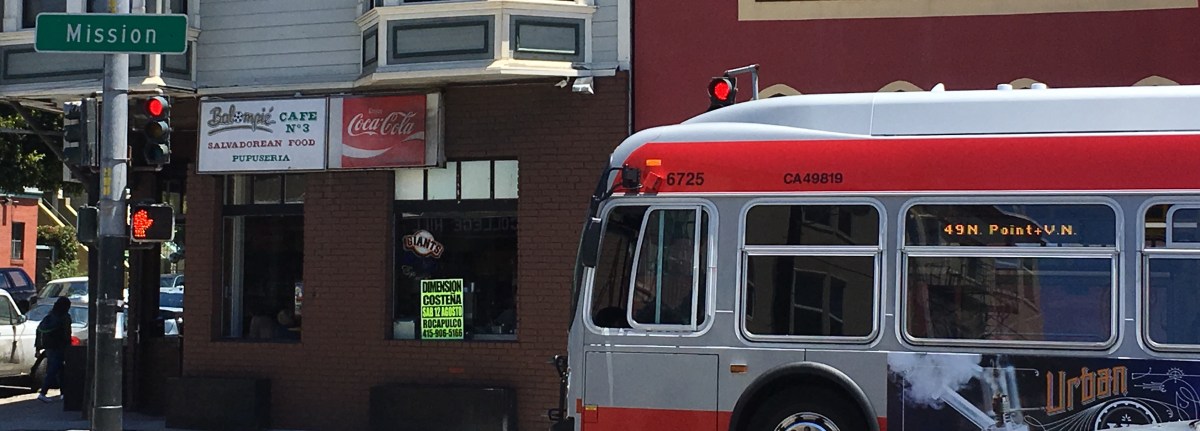
“Are your parents here in this country?” asked the garrulous drunk of the Chinese boys. The drunk, a florid, swarthy, affable man holding a big beer can, sat in the back of the 14 Mission bus. I sat to the left of the boys in seats with our backs to the side of the bus. We looked across to people sitting on the other side. It was a little like sitting around a dinner table but without the table.
“Yes,” said one boy. “We’re from here.”
I’d been swapping stories with the boys. They were clearly all-American. We had started assessing taco places as the bus sped up Mission Street on Sunday. A long line waited outside La Taqueria at 25th Street.
“It’s good, but not that good,” I said.
“Yeah,” said one of the boys. “I live in the Excelsior and there’s a great taco place out by Onondaga. The line is shorter. But my favorite is El Farolito.”
I could see this kid was a regular taco aficionado.
“No, really,” said the drunk. “When did you come from China?”
After that, the boys stopped interacting with him. But I couldn’t restrain myself, even though I could see others on the bus would prefer to ignore him. We continued to chat loudly about ethnicities.
“I’m Mexican,” he announced.
“I’m Scandinavian, but way back there,” I said, waving my arm toward ancestors in the distance.
I looked around at the others at our “table.” A young dark-skinned black man with a thin nose sat in the corner on the back bench frowning as he read Dale Carnegie’s How to Develop Self-Confidence and Influence People by Public Speaking. He looked so serious, I wanted to hug him. A young pale woman sitting across from me pretended to float in another universe, looking past me out the window with half-closed eyes. Next to her a beautiful well-dressed Latinx adjusted his ear buds and consulted his phone, multitasking. I knew he was paying nearly as much attention to us as he had to the product on his glossy, curly black mane, but he tried not to look up. He was enjoying the conversation. I kind of wanted to hug him too.
An old Mexican man sitting on my left was the only rider as obviously entertained by the drunk as I was. The drunk had been mostly talking to himself in Spanish and periodically the man on my left would translate for my benefit, then giggle. But the drunk also spoke fluent English. He wanted us to know that he was more than just Mexican. His family was Spanish.
“My grandmother in Spain had blue eyes and everything,” he announced.
“My Swedish grandmother had brown eyes,” I said. “I guess that’s where I got them. The purple hair is all mine, though. None of my people had purple hair.”
The drunk grinned, the Latinx smiled, the old guy sitting on my left giggled. The boys were still quiet, but as I got off at my stop, I thought I could see them smirking.