Why Did I Watch Heated Rivalry Over and Over?
I recently read an article explaining why children watch the same movie over and over again. According to the experts, kids learn something new every time. Apparently that’s one reason Moana made a fortune. Parents thought they were buying one movie. Their children thought they were signing up for a lifetime subscription.
Reading that article, I had an uncomfortable thought.
Maybe I was a toddler.
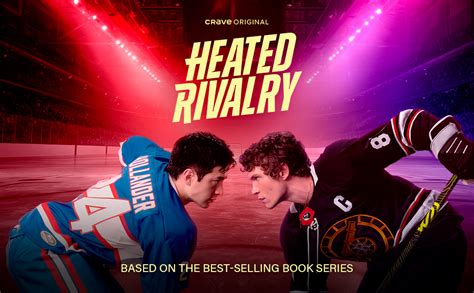
For weeks I watched Heated Rivalry, the gay hockey romance, over and over and over. When I say “over and over,” I don’t mean twice. I mean enough times that HBO probably assumed I was conducting research.
Sometimes I even hid my obsession from my partner. Not because she would object—she can happily disappear into a video game for hours without coming up for air—but because I couldn’t explain it myself. Why was I, a supposedly rational adult, watching two hockey players fall in love for the tenth time?
I’ve loved television before. Bridgerton had its hooks in me for a while. But once was enough. Heated Rivalry was different.
First I watched the entire series several times. Then I watched just the episodes where things got interesting. Then I watched only “the good parts”—the scenes where the Canadian and the Russian stopped glaring at each other and started kissing. I wasn’t interested in hockey (although I couldn’t help learning some things about the sport). It was the romance I came for.
Eventually I wore myself out. One day I realized I was finished. Just like that, I stopped. It was as if my brain announced, “We’ve extracted everything we can from these people. Time to find another obsession.”
So what was that all about?
Part of it was educational.
I’m a writer, so I notice scripts. I admired the dialogue. I studied the pacing. I paid attention to character development. I noticed continuity errors. Wait a second—it’s supposed to be July. Why are those trees just beginning to leaf out?
I also learned things I genuinely didn’t know.
Frotting.
Who knew?
The show taught me something more important than sexual mechanics, though. It showed how carefully people edit themselves when they’re afraid the world won’t accept them. Both men play professional hockey, where toughness is practically a religion. Coming out isn’t just emotionally risky; it could threaten their careers.
Watching them slowly stop pretending was surprisingly moving.
And then came the biggest surprise of all.
Nobody died.
If you’ve watched queer films over the last fifty years, you know that’s not always a safe assumption. For decades Hollywood seemed convinced that gay people could fall in love, but only briefly, and preferably just before someone was murdered or succumbed to a tragic disease. Happiness apparently violated movie rules.
Heated Rivalry broke that tradition. It let two gay men have something almost shocking.
A happy ending.
Still, that doesn’t entirely explain why I watched it enough times to qualify as an unpaid intern.
Fortunately, I wasn’t alone.
TikTok is full of people confessing exactly the same behavior. Thousands of us were asking, “Why can’t I stop watching this?” One woman offered an explanation I hadn’t considered. She loved the absence of sexism. There wasn’t the familiar tug-of-war that often shapes heterosexual romances. These were two equals figuring things out together.
That made sense to me.
Romance has spent years sitting at the kids’ table while westerns, cop shows, war movies, and superhero epics got all the respect. Romance was dismissed as something women liked, as though half the human race isn’t a respectable audience.
Maybe we’ve had that backward.
The audience for Heated Rivalry is mostly women, but there are plenty of men watching, too. Maybe they’re seeing something they don’t get very often: masculine characters who are strong without being emotionally constipated. These men compete, fight, swear, and occasionally bleed, but they also talk about their feelings, admit when they’re afraid, and love each other without apologizing for it.
That’s a version of masculinity worth watching.
Maybe children really do rewatch the same movie because they learn something every time.
Adults probably do, too.
I still don’t really understand my obsession, but it’s a relief to know that it happens to adult humans besides just me. Apparently, repeatedly watching episodes can trigger dopamine release, making it addictive and rewarding. Psychologists tell us we can form parasocial relationships with characters on TV, empathizing with characters and returning for comfort and connection. They say it’s perfectly normal to become attached to fictional characters because of how our brain recognizes human emotion. Living vicariously through characters’ experiences can offer insights into ourselves.
Besides, if I happened to learn what frotting was along the way, that’s just a bonus.